The regions of a graph are called faces and include the ‘outside’ region, which is sometimes called the infinite face.
WORKED EXAMPLE 1.22
PL E
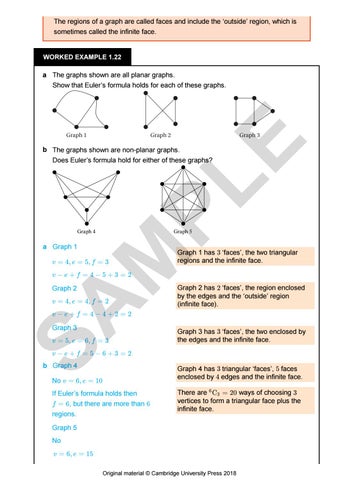
a The graphs shown are all planar graphs. Show that Euler’s formula holds for each of these graphs.
b The graphs shown are non-planar graphs. Does Euler’s formula hold for either of these graphs?
Graph 4
Graph 5
Graph 1 has 3 ‘faces’, the two triangular regions and the infinite face.
M
a Graph 1 v = 4, e = 5, f = 3
v − e + f = 4 − 5 + 3 = 2
SA
Graph 2
v = 4, e = 4, f = 2
Graph 2 has 2 ‘faces’, the region enclosed by the edges and the ‘outside’ region (infinite face).
v − e + f = 4 − 4 + 2 = 2
Graph 3
v = 5, e = 6, f = 3
Graph 3 has 3 ‘faces’, the two enclosed by the edges and the infinite face.
v − e + f = 5 − 6 + 3 = 2
b Graph 4 No v
= 6, e = 10
If Euler’s formula holds then f = 6 , but there are more than 6 regions.
Graph 4 has 3 triangular ‘faces’, 5 faces enclosed by 4 edges and the infinite face. There are C = 20 ways of choosing 3 vertices to form a triangular face plus the infinite face. 6
3
Graph 5 No v = 6, e = 15
Original material © Cambridge University Press 2018