WORKED EXAMPLE 1.21
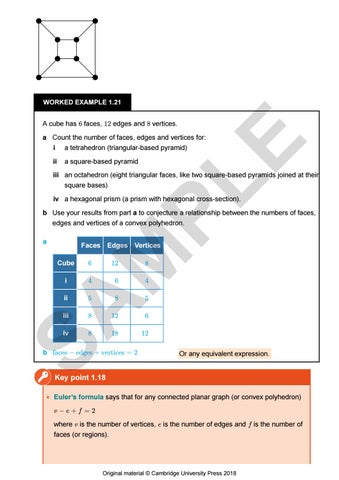
A cube has 6 faces, 12 edges and 8 vertices.
ii
PL E
a Count the number of faces, edges and vertices for: i a tetrahedron (triangular-based pyramid) a square-based pyramid
iii an octahedron (eight triangular faces, like two square-based pyramids joined at their square bases) iv a hexagonal prism (a prism with hexagonal cross-section).
b Use your results from part a to conjecture a relationship between the numbers of faces, edges and vertices of a convex polyhedron. a
M
Faces Edges Vertices 6
12
8
i
4
6
4
ii
5
8
5
iii
8
12
6
iv
8
18
12
SA
Cube
b
faces − edges + vertices = 2
Or any equivalent expression.
Key point 1.18
Euler’s formula says that for any connected planar graph (or convex polyhedron) v − e + f = 2
where v is the number of vertices, e is the number of edges and f is the number of faces (or regions).
Original material © Cambridge University Press 2018