Section 3: Planarity and isomorphism Key point 1.17 A planar graph is any graph that can be drawn with no edges crossing. A planar graph can be drawn as one layer, without needing any ‘bridges’ where one edge jumps over another.
Common error
PL E
A planar graph need not actually be drawn with no edges crossing; all that matters is that it can be manipulated (topologically) into a graph with no edges crossing.
WORKED EXAMPLE 1.19
Give two reasons why it is useful to be able to draw a graph without having any edges crossing. It avoids ambiguity about whether there is a vertex where edges cross or if there is a ‘bridge’.
M
It avoids ‘contamination’ between edges, for example short-circuits in an electrical component. WORKED EXAMPLE 1.20
SA
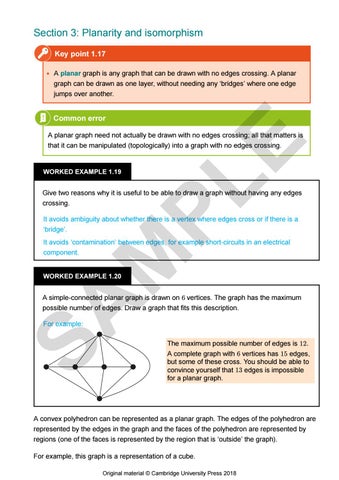
A simple-connected planar graph is drawn on 6 vertices. The graph has the maximum possible number of edges. Draw a graph that fits this description. For example:
The maximum possible number of edges is 12. A complete graph with 6 vertices has 15 edges, but some of these cross. You should be able to convince yourself that 13 edges is impossible for a planar graph.
A convex polyhedron can be represented as a planar graph. The edges of the polyhedron are represented by the edges in the graph and the faces of the polyhedron are represented by regions (one of the faces is represented by the region that is ‘outside’ the graph). For example, this graph is a representation of a cube. Original material © Cambridge University Press 2018