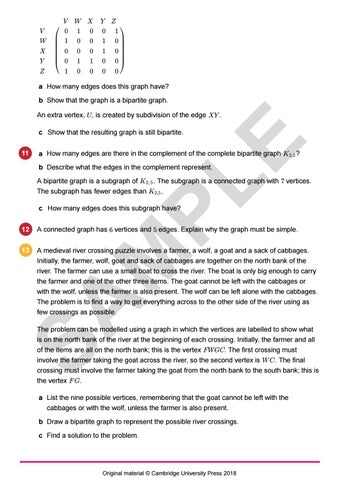
V W X Y Z
⎛ ⎜ ⎜ ⎜ ⎜ ⎜ ⎜ ⎝
V
W
X
Y
Z
0
1
0
0
1
1
0
0
1
0
0
0
1
0
1
1
0
0⎟ ⎟ ⎟ 0⎟ ⎟ 0⎟
1
0
0
0
0
⎞
⎠
a How many edges does this graph have? b Show that the graph is a bipartite graph. An extra vertex, U , is created by subdivision of the edge XY .
11
PL E
c Show that the resulting graph is still bipartite. a How many edges are there in the complement of the complete bipartite graph K
2,5
?
b Describe what the edges in the complement represent. A bipartite graph is a subgraph of K
2, 5
. The subgraph is a connected graph with 7 vertices.
The subgraph has fewer edges than K
2,5
.
c How many edges does this subgraph have?
A connected graph has 6 vertices and 5 edges. Explain why the graph must be simple.
13
A medieval river crossing puzzle involves a farmer, a wolf, a goat and a sack of cabbages. Initially, the farmer, wolf, goat and sack of cabbages are together on the north bank of the
M
12
river. The farmer can use a small boat to cross the river. The boat is only big enough to carry
SA
the farmer and one of the other three items. The goat cannot be left with the cabbages or with the wolf, unless the farmer is also present. The wolf can be left alone with the cabbages. The problem is to find a way to get everything across to the other side of the river using as few crossings as possible.
The problem can be modelled using a graph in which the vertices are labelled to show what is on the north bank of the river at the beginning of each crossing. Initially, the farmer and all of the items are all on the north bank; this is the vertex FWGC. The first crossing must involve the farmer taking the goat across the river, so the second vertex is W C . The final crossing must involve the farmer taking the goat from the north bank to the south bank; this is the vertex F G.
a List the nine possible vertices, remembering that the goat cannot be left with the cabbages or with the wolf, unless the farmer is also present. b Draw a bipartite graph to represent the possible river crossings. c Find a solution to the problem.
Original material © Cambridge University Press 2018