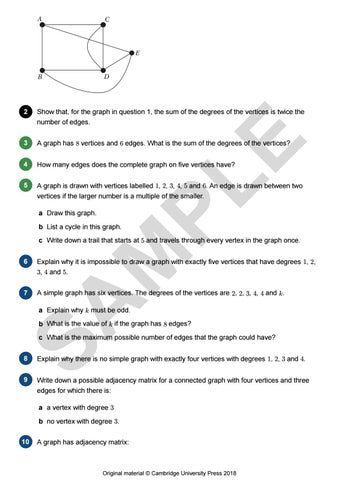
Show that, for the graph in question 1, the sum of the degrees of the vertices is twice the number of edges.
3
A graph has 8 vertices and 6 edges. What is the sum of the degrees of the vertices?
4
How many edges does the complete graph on five vertices have?
5
A graph is drawn with vertices labelled 1, 2, 3, 4, 5 and 6. An edge is drawn between two vertices if the larger number is a multiple of the smaller. a Draw this graph.
PL E
2
b List a cycle in this graph.
M
c Write down a trail that starts at 5 and travels through every vertex in the graph once.
Explain why it is impossible to draw a graph with exactly five vertices that have degrees 1, 2, 3, 4 and 5.
7
A simple graph has six vertices. The degrees of the vertices are 2, 2, 3, 4, 4 and k.
SA
6
a Explain why k must be odd.
b What is the value of k if the graph has 8 edges? c What is the maximum possible number of edges that the graph could have?
8
Explain why there is no simple graph with exactly four vertices with degrees 1, 2, 3 and 4.
9
Write down a possible adjacency matrix for a connected graph with four vertices and three edges for which there is: a a vertex with degree 3 b no vertex with degree 3.
10
A graph has adjacency matrix:
Original material Š Cambridge University Press 2018