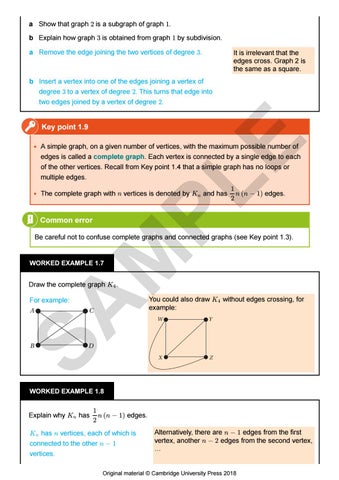
a Show that graph 2 is a subgraph of graph 1. b Explain how graph 3 is obtained from graph 1 by subdivision. a Remove the edge joining the two vertices of degree 3.
It is irrelevant that the edges cross. Graph 2 is the same as a square.
b Insert a vertex into one of the edges joining a vertex of degree 3 to a vertex of degree 2. This turns that edge into two edges joined by a vertex of degree 2.
PL E
Key point 1.9 A simple graph, on a given number of vertices, with the maximum possible number of edges is called a complete graph. Each vertex is connected by a single edge to each of the other vertices. Recall from Key point 1.4 that a simple graph has no loops or multiple edges. The complete graph with n vertices is denoted by K and has n
Common error
1
n (n − 1)
2
edges.
M
Be careful not to confuse complete graphs and connected graphs (see Key point 1.3).
WORKED EXAMPLE 1.7
Draw the complete graph K . 4
SA
For example:
You could also draw K without edges crossing, for example: 4
WORKED EXAMPLE 1.8
Explain why K has n
1 n (n − 1) 2
edges.
has n vertices, each of which is connected to the other n − 1 vertices.
Kn
Alternatively, there are n − 1 edges from the first vertex, another n − 2 edges from the second vertex, …
Original material © Cambridge University Press 2018