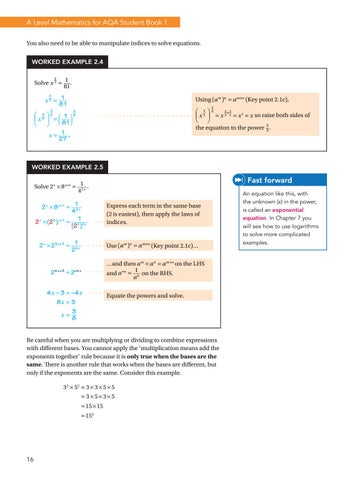
A Level Mathematics for AQA Student Book 1 You also need to be able to manipulate indices to solve equations. WORKED EXAMPLE 2.4 4 Solve x 3 = 1 . 81 4 x3 = 1 81
( )
3
43 4 1 x = 81 x= 1 . 27
Using (a m )n = a m ×n (Key point 2.1c), 3
4×3 43 4 x = x 3 4 = x 1 = x so raise both sides of the equation to the power 34 .
3 4
WORKED EXAMPLE 2.5
Fast forward
Solve 2 x × 8 x −1 = 12 x . 4 2x × 8 x −1 = 12 x 4 2x × (23 )x −1 = 21 2 x (2 )
Express each term in the same base (2 is easiest), then apply the laws of indices.
2x × 23 x − 3 = 14 x 2
Use (a m )n = a m ×n (Key point 2.1c)…
4 x −3
2
…and then a m × a n = a m +n on the LHS and a −n = 1n on the RHS. a
=2
−4 x
4 x − 3 = −4 x 8x = 3 3 x= 8
Equate the powers and solve.
Be careful when you are multiplying or dividing to combine expressions with different bases. You cannot apply the ‘multiplication means add the exponents together’ rule because it is only true when the bases are the same. There is another rule that works when the bases are different, but only if the exponents are the same. Consider this example. 32 × 52 = 3 × 3 × 5 × 5 = 3×5×3×5 = 15 × 15 = 152
16
An equation like this, with the unknown (x) in the power, is called an exponential equation. In Chapter 7 you will see how to use logarithms to solve more complicated examples.