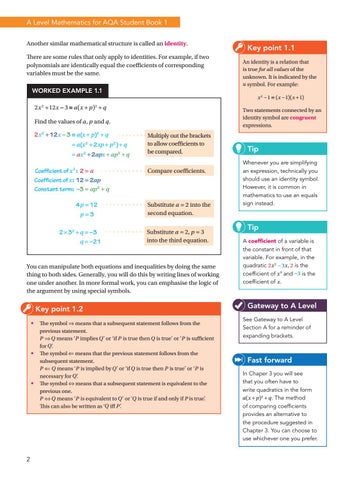
A Level Mathematics for AQA Student Book 1 Another similar mathematical structure is called an identity. There are some rules that only apply to identities. For example, if two polynomials are identically equal the coefficients of corresponding variables must be the same. WORKED EXAMPLE 1.1
Two statements connected by an identity symbol are congruent expressions.
Find the values of a , p and q. 2x 2 + 12x − 3 ≡ a(x + p )2 + q = a(x + 2xp + p ) + q 2
= ax 2 + 2apx + ap2 + q Coefficient of x 2 : 2 = a Coefficient of x : 12 = 2ap Constant term: −3 = ap2 + q 4 p = 12 p=3 2 × 32 + q = −3 q = −21
Multiply out the brackets to allow coefficients to be compared. Compare coefficients.
Substitute a = 2 into the second equation. Substitute a = 2, p = 3 into the third equation.
You can manipulate both equations and inequalities by doing the same thing to both sides. Generally, you will do this by writing lines of working one under another. In more formal work, you can emphasise the logic of the argument by using special symbols.
Key point 1.2 • The symbol ⇒ means that a subsequent statement follows from the previous statement. P ⇒ Q means ‘P implies Q’ or ‘if P is true then Q is true’ or ‘P is sufficient for Q’. • The symbol ⇐ means that the previous statement follows from the subsequent statement. P ⇐ Q means ‘P is implied by Q’ or ‘if Q is true then P is true’ or ‘P is necessary for Q’. • The symbol ⇔ means that a subsequent statement is equivalent to the previous one. P ⇔ Q means ‘P is equivalent to Q’ or ‘Q is true if and only if P is true’. This can also be written as ‘Q iff P’.
2
An identity is a relation that is true for all values of the unknown. It is indicated by the ≡ symbol. For example: x 2 − 1 ≡ ( x − 1)( x + 1)
2 x 2 + 12 x − 3 ≡ a( x + p)2 + q
2
Key point 1.1
Tip Whenever you are simplifying an expression, technically you should use an identity symbol. However, it is common in mathematics to use an equals sign instead.
Tip A coefficient of a variable is the constant in front of that variable. For example, in the quadratic 2 x 2 − 3 x , 2 is the coefficient of x 2 and −3 is the coefficient of x.
Gateway to A Level See Gateway to A Level Section A for a reminder of expanding brackets.
Fast forward In Chaper 3 you will see that you often have to write quadratics in the form a( x + p)2 + q. The method of comparing coefficients provides an alternative to the procedure suggested in Chapter 3. You can choose to use whichever one you prefer.