A Level Further Mathematics for AQA Student Book 2
Hence
Separate real and imaginary parts to find sin and cos.
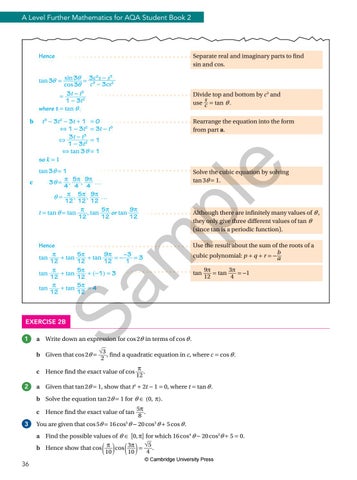
2 3 tan 3q = sin 3q = 3c3 s − s 2 cos 3q c − 3cs 3 = 3t − t 2 1 − 3t where t = tan q .
t3 − 3t2 − 3t + 1 = 0 ⇔ 1 − 3t2 = 3t − t3 3 ⇔ 3t − t 2 = 1 1 − 3t ⇔ tan 3q = 1 so k = 1
Rearrange the equation into the form from part a.
pl e
b
Divide top and bottom by c3 and use cs = tan q .
tan 3q = 1 c 3q = π , 5π , 9π … 4 4 4 q = π , 5π , 9π … 12 12 12 t = tan q = tan π , tan 5π or tan 9π 12 12 12
Solve the cubic equation by solving tan 3q = 1.
Sa m
Although there are infinitely many values of q , they only give three different values of tan q (since tan is a periodic function).
Hence tan π + tan 5π + tan 9π = − −3 = 3 12 12 12 1 tan π + tan 5π + (−1) = 3 12 12 tan π + tan 5π = 4 12 12
Use the result about the sum of the roots of a b cubic polynomial: p + q + r = − a tan 9π = tan 3π = −1 4 12
EXERCISE 2B
1
a Write down an expression for cos 2q in terms of cos q . b Given that cos 2q =
√3 , find a quadratic equation in c, where c = cos q . 2
c Hence find the exact value of cos π . 12 2
a Given that tan 2q = 1, show that t2 + 2t − 1 = 0, where t = tan q . b Solve the equation tan 2q = 1 for q ∈ (0, π).
3
c Hence find the exact value of tan 5π . 8 5 You are given that cos 5q = 16 cos q − 20 cos3 q + 5 cos q . a Find the possible values of q ∈ [0, π] for which 16 cos4 q − 20 cos2q + 5 = 0. √5 b Hence show that cos π cos 3π = . 4 10 10
( ) ( )
36
© Cambridge University Press