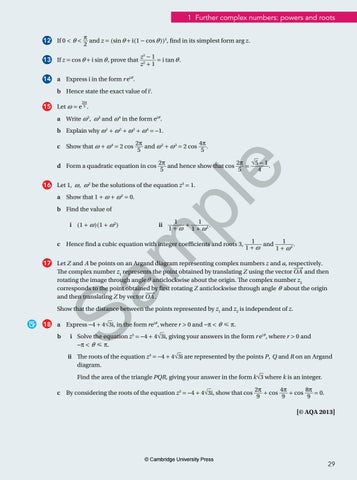
1 Further complex numbers: powers and roots 12 If 0 < q < π and z = (sin q + i(1 − cos q )) 2, find in its simplest form arg z. 2 2 13 If z = cos q + i sin q , prove that z2 − 1 = i tan q . z +1
14 a Express i in the form r eiq . b Hence state the exact value of ii. 2iπ
15 Let w = e 5 . a Write w 2, w 3 and w 4 in the form eiq . b Explain why w 1 + w 2 + w 3 + w 4 = −1. c Show that w + w 4 = 2 cos 2π and w 2 + w 3 = 2 cos 4π . 5 5
pl e
√5 − 1 . d Form a quadratic equation in cos 2π and hence show that cos 2π = 4 5 5 16 Let 1, w, w 2 be the solutions of the equation z3 = 1. a Show that 1 + w + w 2 = 0. b Find the value of
ii
1 + 1 . 1 + w 1 + w2
Sa m
i (1 + w)(1 + w 2)
c Hence find a cubic equation with integer coefficients and roots 3,
1 and 1 . 1+w 1 + w2
17 Let Z and A be points on an Argand diagram representing complex numbers z and a, respectively. › The complex number z1 represents the point obtained by translating Z using the vector OA and then rotating the image through angleq anticlockwise about the origin. The complex number z2 corresponds to the point obtained by first rotating Z anticlockwise through angle q about the origin › and then translating Z by vector OA . Show that the distance between the points represented by z1 and z2 is independent of z.
18 a Express −4 + 4√3i, in the form reiq , where r > 0 and −π < q < π. b
i Solve the equation z3 = −4 + 4√3i, giving your answers in the form r eiq , where r > 0 and −π < q < π.
ii The roots of the equation z3 = −4 + 4√3i are represented by the points P, Q and R on an Argand diagram. Find the area of the triangle PQR, giving your answer in the form k√3 where k is an integer. c By considering the roots of the equation z3 = −4 + 4√3i, show that cos 2π + cos 4π + cos 8π = 0. 9 9 9 [© AQA 2013]
© Cambridge University Press
29