Chapter 10: Hardware and communication
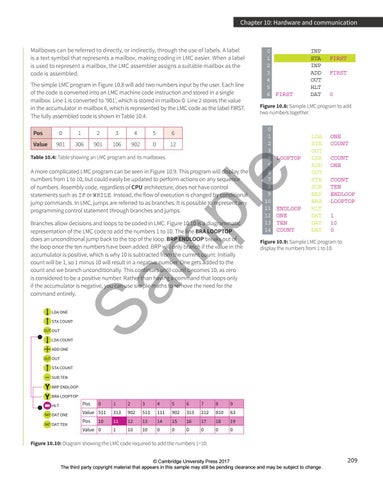
Mailboxes can be referred to directly, or indirectly, through the use of labels. A label is a text symbol that represents a mailbox, making coding in LMC easier. When a label is used to represent a mailbox, the LMC assembler assigns a suitable mailbox as the code is assembled. The simple LMC program in Figure 10.8 will add two numbers input by the user. Each line of the code is converted into an LMC machine code instruction and stored in a single mailbox. Line 1 is converted to ‘901’, which is stored in mailbox 0. Line 2 stores the value in the accumulator in mailbox 6, which is represented by the LMC code as the label FIRST. The fully assembled code is shown in Table 10.4. Pos Value
0
1
2
3
4
5
6
901
306
901
106
902
0
12
Table 10.4: Table showing an LMC program and its mailboxes.
0 1 2 3 4 5 6 7 8 9 10 11 12 13 14
LOOPTOP
pl
Sa m
Branches allow decisions and loops to be coded in LMC. Figure 10.10 is a diagrammatic representation of the LMC code to add the numbers 1 to 10. The line BRA LOOPTOP does an unconditional jump back to the top of the loop. BRP ENDLOOP breaks out of the loop once the ten numbers have been added. BRP will only branch if the value in the accumulator is positive, which is why 10 is subtracted from the current count. Initially count will be 1, so 1 minus 10 will result in a negative number. One gets added to the count and we branch unconditionally. This continues until count becomes 10, as zero is considered to be a positive number. Rather than having a command that loops only if the accumulator is negative, you can use simple maths to remove the need for the command entirely.
INP STA INP ADD OUT HLT DAT
FIRST FIRST 0
Figure 10.8: Sample LMC program to add two numbers together.
e
A more complicated LMC program can be seen in Figure 10.9. This program will display the numbers from 1 to 10, but could easily be updated to perform actions on any sequence of numbers. Assembly code, regardless of CPU architecture, does not have control statements such as IF or WHILE. Instead, the flow of execution is changed by conditional jump commands. In LMC, jumps are referred to as branches. It is possible to represent any programming control statement through branches and jumps.
0 1 2 3 4 5 6 FIRST
ENDLOOP ONE TEN COUNT
LDA STA OUT LDA ADD OUT STA SUB BRP BRA HLT DAT DAT DAT
ONE COUNT COUNT ONE COUNT TEN ENDLOOP LOOPTOP 1 10 0
Figure 10.9: Sample LMC program to display the numbers from 1 to 10.
LDA ONE
STA COUNT OUT
LDA COUNT ADD ONE OUT STA COUNT SUB TEN
BRP ENDLOOP BRA LOOPTOP
Pos
HLT DAT DAT ONE DAT DAT TEN
0
1
2
3
4
5
6
7
8
9
Value 511
313
902
513
111
902
313
212
810
63
Pos
11
12
13
14
15
16
17
18
19
1
10
10
0
0
0
0
0
0
10
Value 0
Figure 10.10: Diagram showing the LMC code required to add the numbers 1−10. © Cambridge University Press 2017 The third party copyright material that appears in this sample may still be pending clearance and may be subject to change.
209