A/AS Level Computer Science for WJEC
In parallel processing, two or more processors work together to perform a single task. The task is split into smaller sub-tasks (threads). These tasks are executed simultaneously by all available processors (any task can be processed by any processor). This hugely decreases the time taken to execute a program, but software has to be specially written to take advantage of these multi-core systems. All the processors in a parallel processing system act in the same way as standard single-core (von Neumann) CPUs, loading instructions and data from memory and acting accordingly. However, the different processors in a multi-core system need to communicate continuously with each other in order to ensure that if one processor changes a key piece of data (for example, the players’ scores in a game), the other processors are aware of the change and can incorporate it in their calculations. There is also a huge amount of additional complexity involved in implementing parallel processing, because when each separate core (processor) has completed its own task, the results from all the cores need to be combined to form the complete solution to the original problem.
pl
e
This complexity meant that in the early days of parallel computing it was still sometimes faster to use a single processor, as the additional time taken to coordinate communication between processors and combine their results into a single solution was greater than the time saved by sharing the workload. However, as programmers have become more adept at writing software for parallel systems, this has become less of an issue.
Sa m
Advantages
Disadvantages
More instructions can be processed in a shorter time because they are executed simultaneously.
It is difficult to write programs for multicore systems.
Tasks can be shared to reduce the load on individual processors and avoid bottlenecks.
Results from different processors need to be combined at the end of processing, which can be complex and adds to the time taken to execute a program. Not all tasks can be split across multiple processors. Concurrency introduces new classes of software bugs.
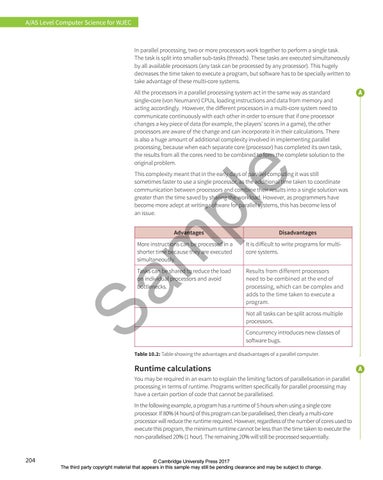
Table 10.2: Table showing the advantages and disadvantages of a parallel computer.
Runtime calculations You may be required in an exam to explain the limiting factors of parallelisation in parallel processing in terms of runtime. Programs written specifically for parallel processing may have a certain portion of code that cannot be parallelised. In the following example, a program has a runtime of 5 hours when using a single core processor. If 80% (4 hours) of this program can be parallelised, then clearly a multi-core processor will reduce the runtime required. However, regardless of the number of cores used to execute this program, the minimum runtime cannot be less than the time taken to execute the non-parallelised 20% (1 hour). The remaining 20% will still be processed sequentially.
204
Š Cambridge University Press 2017 The third party copyright material that appears in this sample may still be pending clearance and may be subject to change.