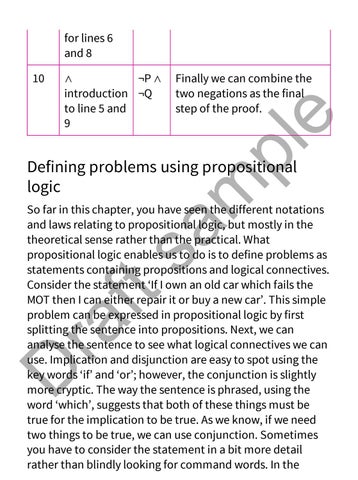
for lines 6 and 8 Finally we can combine the two negations as the final step of the proof.
e
⋀ ¬P ⋀ introduction ¬Q to line 5 and 9
pl
10
m
Defining problems using propositional logic
D
ra
ft
sa
So far in this chapter, you have seen the different notations and laws relating to propositional logic, but mostly in the theoretical sense rather than the practical. What propositional logic enables us to do is to define problems as statements containing propositions and logical connectives. Consider the statement ‘If I own an old car which fails the MOT then I can either repair it or buy a new car’. This simple problem can be expressed in propositional logic by first splitting the sentence into propositions. Next, we can analyse the sentence to see what logical connectives we can use. Implication and disjunction are easy to spot using the key words ‘if’ and ‘or’; however, the conjunction is slightly more cryptic. The way the sentence is phrased, using the word ‘which’, suggests that both of these things must be true for the implication to be true. As we know, if we need two things to be true, we can use conjunction. Sometimes you have to consider the statement in a bit more detail rather than blindly looking for command words. In the
"******ebook converter DEMO - www.ebook-