CAMBRIDGE LOWER SECONDARY MATHEMATICS 7: TEACHER’S RESOURCE
Conjecturing and convincing Talk maths
Make a statement
PL E
Conjecturing and convincing
Persuade someone
Conjecturing
Share an idea
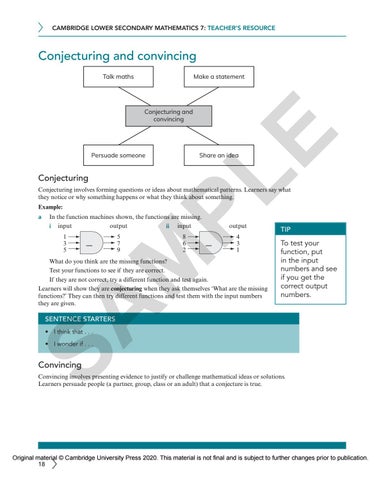
Conjecturing involves forming questions or ideas about mathematical patterns. Learners say what they notice or why something happens or what they think about something. Example:
a In the function machines shown, the functions are missing. output i input ii input __
5 7 9
8 6 2
M
1 3 5
output
__
4 3 1
To test your function, put in the input numbers and see if you get the correct output numbers.
SA
What do you think are the missing functions? Test your functions to see if they are correct. If they are not correct, try a different function and test again. Learners will show they are conjecturing when they ask themselves ‘What are the missing functions?’ They can then try different functions and test them with the input numbers they are given.
TIP
SENTENCE STARTERS • I think that . . .
• I wonder if . . .
Convincing
Convincing involves presenting evidence to justify or challenge mathematical ideas or solutions. Learners persuade people (a partner, group, class or an adult) that a conjecture is true.
Original material © Cambridge University Press 2020. This material is not final and is subject to further changes prior to publication. 18