1.3 Indices
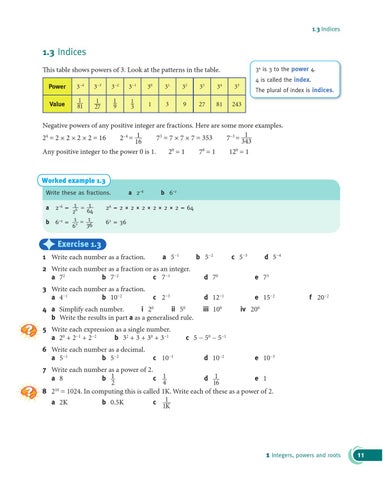
1.3 Indices This table shows powers of 3. Look at the patterns in the table.
34 is 3 to the power 4. 4 is called the index.
Power
3−4
3−3
3−2
3−1
30
31
32
33
34
35
Value
1 81
1 27
1 9
1 3
1
3
9
27
81
243
The plural of index is indices.
Negative powers of any positive integer are fractions. Here are some more examples. 1 24 = 2 × 2 × 2 × 2 = 16 2−4 = 1 73 = 7 × 7 × 7 = 353 7−3 = 343 16 Any positive integer to the power 0 is 1. 20 = 1 70 = 1 120 = 1
Worked example 1.3 Write these as fractions. 1 2−6 = 16 = 64 2 1 b 6−2 = 12 = 36 6
a
a 2−6
b 6−2
26 = 2 × 2 × 2 × 2 × 2 × 2 = 64 62 = 36
Exercise 1.3 1 Write each number as a fraction.
a 5−1
b 5−2
c 5−3
d 5−4
2 Write each number as a fraction or as an integer. b 7−2 c 7−1 a 72
d 70
e 73
3 Write each number as a fraction. b 10−2 a 4−1
d 12−1
e 15−2
c 2−3
4 a Simplify each number. i 20 ii 50 b Write the results in part a as a generalised rule. 5 Write each expression as a single number. b 32 + 3 + 30 + 3−1 a 20 + 2−1 + 2−2 6 Write each number as a decimal. b 5−2 a 5−1
c 10−1
iii 100
f 20−2
iv 200
c 5 − 50 − 5−1 d 10−2
e 10−3
7 Write each number as a power of 2. c 1 d 1 e 1 a 8 b 1 4 16 2 8 210 = 1024. In computing this is called 1K. Write each of these as a power of 2. a 2K b 0.5K c 1 1K
1
Integers, powers and roots
11