1.5
Muscles
Antagonistic muscles Muscles can contract and make themselves shorter. However, muscles cannot make themselves get longer.
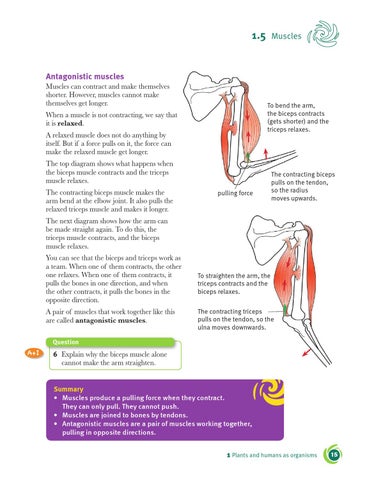
To bend the arm, the biceps contracts (gets shorter) and the triceps relaxes.
When a muscle is not contracting, we say that it is relaxed. A relaxed muscle does not do anything by itself. But if a force pulls on it, the force can make the relaxed muscle get longer. The top diagram shows what happens when the biceps muscle contracts and the triceps muscle relaxes. The contracting biceps muscle makes the arm bend at the elbow joint. It also pulls the relaxed triceps muscle and makes it longer.
pulling force
The contracting biceps pulls on the tendon, so the radius moves upwards.
The next diagram shows how the arm can be made straight again. To do this, the triceps muscle contracts, and the biceps muscle relaxes. You can see that the biceps and triceps work as a team. When one of them contracts, the other one relaxes. When one of them contracts, it pulls the bones in one direction, and when the other contracts, it pulls the bones in the opposite direction. A pair of muscles that work together like this are called antagonistic muscles.
To straighten the arm, the triceps contracts and the biceps relaxes. The contracting triceps pulls on the tendon, so the ulna moves downwards.
Question
A+I
6 Explain why the biceps muscle alone cannot make the arm straighten. Summary Ăź 0XVFOHV SURGXFH D SXOOLQJ IRUFH ZKHQ WKH\ FRQWUDFW 7KH\ FDQ RQO\ SXOO 7KH\ FDQQRW SXVK Ăź 0XVFOHV DUH MRLQHG WR ERQHV E\ WHQGRQV Ăź $QWDJRQLVWLF PXVFOHV DUH D SDLU RI PXVFOHV ZRUNLQJ WRJHWKHU SXOOLQJ LQ RSSRVLWH GLUHFWLRQV
1 Plants and humans as organisms
15