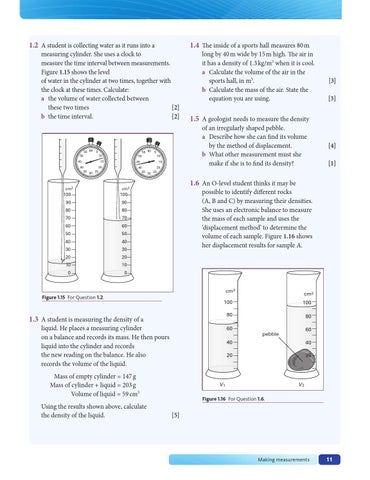
1.2 A student is collecting water as it runs into a
measuring cylinder. She uses a clock to measure the time interval between measurements. Figure 1.15 shows the level of water in the cylinder at two times, together with the clock at these times. Calculate: a the volume of water collected between these two times [2] b the time interval. [2]
55 60 50 45
55 60
5 10
50
15
45
40 20 35 30 25
cm3
5 10 15
90
90
80
80
70
70
60
60
50
50
40
40
30
30
20
20
10
10
0
0
[3]
1.5 A geologist needs to measure the density [4] [1]
possible to identify different rocks (A, B and C) by measuring their densities. She uses an electronic balance to measure the mass of each sample and uses the ‘displacement method’ to determine the volume of each sample. Figure 1.16 shows her displacement results for sample A.
cm3 Figure 1.15 For Question 1.2.
100
80
80
liquid. He places a measuring cylinder on a balance and records its mass. He then pours liquid into the cylinder and records the new reading on the balance. He also records the volume of the liquid.
60
Mass of empty cylinder = 147 g Mass of cylinder + liquid = 203 g Volume of liquid = 59 cm3
cm3
100
1.3 A student is measuring the density of a
Using the results shown above, calculate the density of the liquid.
[3]
1.6 An O-level student thinks it may be
cm3
100
long by 40 m wide by 15 m high. The air in it has a density of 1.3 kg/m3 when it is cool. a Calculate the volume of the air in the sports hall, in m3. b Calculate the mass of the air. State the equation you are using.
of an irregularly shaped pebble. a Describe how she can find its volume by the method of displacement. b What other measurement must she make if she is to find its density?
40 20 35 30 25
100
1.4 The inside of a sports hall measures 80 m
60
pebble
40
40
20
20
V2
V1 Figure 1.16 For Question 1.6.
[5]
Making measurements
11