1 Reviewing number concepts
1.5 Working with directed numbers Once a direction is chosen to be positive, the opposite direction is taken to be negative. So:
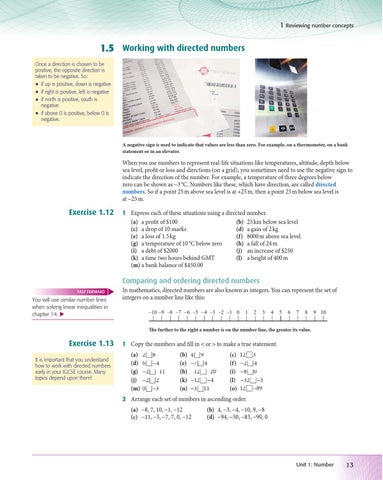
• if up is positive, down is negative • if right is positive, left is negative north is positive, south is • ifnegative above 0 is positive, below 0 is • ifnegative. A negative sign is used to indicate that values are less than zero. For example, on a thermometer, on a bank statement or in an elevator.
When you use numbers to represent real-life situations like temperatures, altitude, depth below sea level, profit or loss and directions (on a grid), you sometimes need to use the negative sign to indicate the direction of the number. For example, a temperature of three degrees below zero can be shown as −3 °C. Numbers like these, which have direction, are called directed numbers. So if a point 25 m above sea level is at +25 m, then a point 25 m below sea level is at −25 m.
Exercise 1.12
1 Express each of these situations using a directed number. (a) a profit of $100 (b) 25 km below sea level (c) a drop of 10 marks (d) a gain of 2 kg (e) a loss of 1.5 kg (f) 8000 m above sea level (g) a temperature of 10 °C below zero (h) a fall of 24 m (i) a debt of $2000 (j) an increase of $250 (k) a time two hours behind GMT (l) a height of 400 m (m) a bank balance of $450.00
Comparing and ordering directed numbers FAST FORWARD
You will use similar number lines when solving linear inequalities in chapter 14.
In mathematics, directed numbers are also known as integers. You can represent the set of integers on a number line like this: –10 –9 –8 –7 –6 –5 –4 –3 –2 –1 0
1
2
3
4
5
6
7
8
9 10
The further to the right a number is on the number line, the greater its value.
Exercise 1.13 It is important that you understand how to work with directed numbers early in your IGCSE course. Many topics depend upon them!
1 Copy the numbers and fill in < or > to make a true statement. (a) (d) (g) (j) (m)
2 8 6 4 −2 −11 −2 2 0 3
(b) (e) (h) (k) (n)
4 9 −7 4 −12 −20 −12 −4 −3 11
(c) (f) (i) (l) (o)
12 −2 −8 −32 12
3 4 0 −3 −89
2 Arrange each set of numbers in ascending order. (a) −8, 7, 10, −1, −12 (c) −11, −5, −7, 7, 0, −12
(b) 4, −3, −4, −10, 9, −8 (d) −94, −50, −83, −90, 0
Unit 1: Number
13