9780521530149cvr_9780521530149cvr 12/01/2011 10:23 Page 1
Statistics 2
Statistics 2
Steve Dobbs and Jane Miller
Dobbs and Miller
9780521530149 Dobbs & Miller: ALM Statistics 2 CVR C M Y K
A Level
This book is part of a series of textbooks created for the new University of Cambridge International Examinations (CIE) AS and A Level Mathematics syllabus. The authors have worked with CIE to ensure that the content matches the syllabus and is pitched at a suitable level. Each book corresponds to one syllabus unit, except that units P2 and P3 are contained in a single book. The chapters are arranged to provide a viable teaching course. Each chapter starts with a list of learning objectives. Mathematical concepts are explained clearly and carefully. Key results appear in boxes for easy reference. Stimulating examples take a step-by-step approach to problem solving. There are plenty of exercises, as well as revision exercises and practice exam papers – all written by experienced examiners. Statistics 2 corresponds to unit S2. It covers the Poisson distribution, linear combinations of random variables, continuous random variables, sampling and estimation, and hypothesis tests.
Advanced Level Mathematics
The books in this series support the following CIE qualifications: Pure Mathematics 1
ISBN 978-0521-53011-8
AS and A Level Mathematics
Pure Mathematics 2 & 3
ISBN 978-0521-53012-5
AS and A Level Mathematics AS Level Higher Mathematics
Mechanics 1
ISBN 978-0521-53015-6
AS and A Level Mathematics
Mechanics 2
ISBN 978-0521-53016-3
A Level Mathematics AS Level Higher Mathematics
Statistics 1
ISBN 978-0521-53013-2
AS and A Level Mathematics AICE Mathematics: Statistics (half credit)
Statistics 2
ISBN 978-0521-53014-9
A Level Mathematics AS Level Higher Mathematics
Endorsed by University of Cambridge International Examinations For use with the GCE Advanced Level Mathematics and GCE Advanced Subsidiary Level Higher Mathematics syllabuses.
Endorsed by
University of Cambridge International Examinations
Cambridge, New York, Melbourne, Madrid, Cape Town, Singapore, São Paulo, Delhi, Mexico City Cambridge University Press The Edinburgh Building, Cambridge CB2 8RU, UK www.cambridge.org Information on this title: www.cambridge.org/9780521530149 © Cambridge University Press 2003 This publication is in copyright. Subject to statutory exception and to the provisions of relevant collective licensing agreements, no reproduction of any part may take place without the written permission of Cambridge University Press. First published 2003 11th printing 2012 Printed and bound in the United Kingdom by the MPG Books Group A catalogue record for this publication is available from the British Library ISBN 978-0-521-53014-9 Paperback Cambridge University Press has no responsibility for the persistence or accuracy of URLs for external or third-party internet websites referred to in this publication, and does not guarantee that any content on such websites is, or will remain, accurate or appropriate. Information regarding prices, travel timetables and other factual information given in this work is correct at the time of first printing but Cambridge University Press does not guarantee the accuracy of such information thereafter. The publishers would like to acknowledge the contributions of the following people to this series of books: Tim Cross, Richard Davies, Maurice Godfrey, Chris Hockley, Lawrence Jarrett, David A. Lee, Jean Matthews, Norman Morris, Charles Parker, Geoff Staley, Rex Stephens, Peter Thomas and Owen Toller. Cover image: © Tony Stone Images / Mark Harwood
Contents Introduction
iv
1
The Poisson distribution
1
2
Linear combinations of random variables
20
3
Continuous random variables
35
4
Sampling
54
5
Estimation
75
6
Hypothesis testing: continuous variables
102
7
Hypothesis testing: discrete variables
121
8
Errors in hypothesis testing
135
Revision exercise
154
Practice examinations
160
Normal distribution function table
165
Answers
167
Index
177
Formulae
179
Introduction University of Cambridge International Examinations (CIE) Advanced Level Mathematics has been written especially for the new CIE mathematics syllabus. There is one book corresponding to each syllabus unit, except that units P2 and P3 are contained in a single book. This book is the second Probability and Statistics unit, S2. The syllabus content is arranged by chapters which are ordered so as to provide a viable teaching course. A few sections include important results that are difficult to prove or outside the syllabus. These sections are marked with an asterisk (* ) in the section heading, and there is usually a sentence early on explaining precisely what it is that the student needs to know. Some paragraphs within the text appear in this type style. These paragraphs are usually outside the main stream of the mathematical argument, but may help to give insight, or suggest extra work or different approaches. Graphic calculators are not permitted in the examination, but they can be useful aids in learning mathematics. In the book the authors have noted where access to graphic calculators would be especially helpful but have not assumed that they are available to all students. The authors have assumed that students have access to calculators with built-in statistical functions. Numerical work is presented in a form intended to discourage premature approximation. In ongoing calculations inexact numbers appear in decimal form like 3.456 , signifying that the number is held in a calculator to more places than are given. Numbers are not rounded at this stage; the full display could be either 3.456 123 or 3.456 789 . Final answers are then stated with some indication that they are approximate, for example ‘1.23 correct to 3 significant figures’. Most chapters contain Practical activities. These can be used either as an introduction to a topic, or, later on, to reinforce the theory. Two Practical activities, in Sections 4.5 and 5.4, require access to a computer. There are also plenty of exercises, and each chapter ends with a Miscellaneous exercise which includes some questions of examination standard. There is a Revision exercise, and two Practice examination papers. In some exercises a few of the later questions may go beyond the likely requirements of the examination, either in difficulty or in length or both. Some questions are marked with an asterisk, which indicates that they require knowledge of results outside the syllabus. Cambridge University Press would like to thank OCR (Oxford, Cambridge and RSA Examinations), part of the University of Cambridge Local Examinations Syndicate (UCLES) group, for permission to use past examination questions set in the United Kingdom. The authors thank CIE and Cambridge University Press for their help in producing this book. However, the responsibility for the text, and for any errors, remains with the authors.
Advanced Level Mathematics
Statistics 2
Steve Dobbs and Jane Miller
1 The Poisson distribution This chapter introduces a discrete probability distribution which is used for modelling random events. When you have completed it you should ● ●
● ●
●
be able to calculate probabilities for the Poisson distribution understand the relevance of the Poisson distribution to the distribution of random events and use the Poisson distribution as a model be able to use the result that the mean and variance of a Poisson distribution are equal be able to use the Poisson distribution as an approximation to the binomial distribution where appropriate be able to use the normal distribution, with a continuity correction, as an approximation to the Poisson distribution where appropriate.
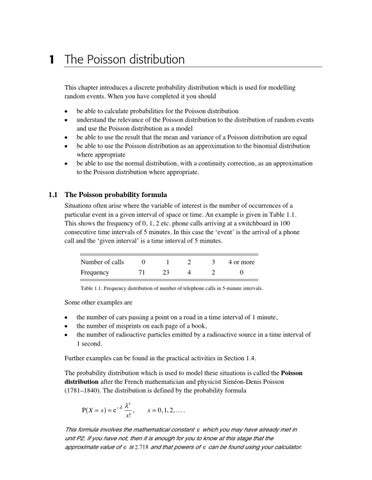
1.1 The Poisson probability formula Situations often arise where the variable of interest is the number of occurrences of a particular event in a given interval of space or time. An example is given in Table 1.1. This shows the frequency of 0, 1, 2 etc. phone calls arriving at a switchboard in 100 consecutive time intervals of 5 minutes. In this case the ‘event’ is the arrival of a phone call and the ‘given interval’ is a time interval of 5 minutes. Number of calls Frequency
0 71
1 23
2 4
3 2
4 or more 0
Table 1.1. Frequency distribution of number of telephone calls in 5-minute intervals.
Some other examples are ● ● ●
the number of cars passing a point on a road in a time interval of 1 minute, the number of misprints on each page of a book, the number of radioactive particles emitted by a radioactive source in a time interval of 1 second.
Further examples can be found in the practical activities in Section 1.4. The probability distribution which is used to model these situations is called the Poisson distribution after the French mathematician and physicist Siméon-Denis Poisson (1781–1840). The distribution is defined by the probability formula P( X = x ) = e − λ
λx , x!
x = 0, 1, 2, … .
This formula involves the mathematical constant e which you may have already met in unit P2. If you have not, then it is enough for you to know at this stage that the approximate value of e is 2.718 and that powers of e can be found using your calculator.
2
STATISTICS 2
Check that you can use your calculator to show that e −2 = 0.135 … and e − 0.1 = 0.904 … .
The method by which Poisson arrived at this formula will be outlined in Section 1.2. This formula involves only one parameter, λ . ( λ , pronounced ‘lambda’, is the Greek letter l.) You will see later that λ is the mean of the distribution. The notation for indicating that a random variable X has a Poisson distribution with mean λ is X ~ Po(λ ) . Once λ is known you can calculate P( X = 0) , P( X = 1) etc. There is no upper limit on the value of X . Example 1.1.1 The number of particles emitted per second by a radioactive source has a Poisson distribution with mean 5. Calculate the probabilities of (a) 0, (b) 1, (c) 2, (d) 3 or more emissions in a time interval of 1 second. (a) Let X be the random variable ‘the number of particles emitted in 1 second’. Then λx X ~ Po(5) . Using the Poisson probability formula P( X = x ) = e − λ with λ = 5, x! P( X = 0) = e −5
50 = 0.006 737 … = 0.006 74 , correct to 3 significant figures. 0!
Recall that 0 != 1 (see P1 Section 8.3).
(b) P( X = 1) = e −5
51 = 0.033 68 … = 0.0337 , correct to 3 significant figures. 1!
(c) P( X = 2) = e −5
52 = 0.084 22 … = 0.0842 , correct to 3 significant figures. 2!
(d) Since there is no upper limit on the value of X the probability of 3 or more emissions must be found by subtraction. P( X ! 3) = 1 − P( X = 0) − P( X = 1) − P( X = 2) = 1 − 0.006 737 … − 0.033 68 … − 0.084 22 … = 0.875, correct to 3 significant figures. Example 1.1.2 The number of demands for taxis to a taxi firm is Poisson distributed with, on average, four demands every 30 minutes. Find the probabilities of (a) no demand in 30 minutes, (b) 1 demand in 1 hour, (c) fewer than 2 demands in 15 minutes. (a) Let X be the random variable ‘the number of demands in a 30 minute interval’. Then X ~ Po( 4) . Using the Poisson formula with λ = 4 , P( X = 0 ) = e − 4
40 = 0.0183, correct to 3 significant figures. 0!
CHAPTER 1: THE POISSON DISTRIBUTION
(b) Let Y be the random variable ‘the number of demands in a 1 hour interval’. As the time interval being considered has changed from 30 minutes to 1 hour, you must change the value of λ to equal the mean for this new time interval, that is to 8, giving Y ~ Po(8) . Using the Poisson formula with λ = 8, 81 P(Y = 1) = e − 8 = 0.002 68 , correct to 3 significant figures. 1! (c) Again the time interval has been altered. Now the appropriate value for λ is 2. Let W be the number of demands in 15 minutes. Then W ~ Po(2) . P( W < 2) = P(W = 0) + P(W = 1) = e −2
20 21 + e −2 = 0.406 , 0! 1!
correct to 3 significant figures. Here is a summary of the results of this section.
The Poisson distribution is used as a model for the number, X , of events in a given interval of space or time. It has the probability formula P( X = x ) = e − λ
λx , x!
x = 0, 1, 2, … ,
where λ is equal to the mean number of events in the given interval. The notation X ~ Po(λ ) indicates that X has a Poisson distribution with mean λ . Some books use µ rather than λ to denote the parameter of a Poisson distribution.
Exercise 1A 1 The random variable T has a Poisson distribution with mean 3. Calculate (a) P(T = 2) ,
(b) P(T " 1) ,
(c) P(T ! 3) .
2 Given that U ~ Po(3.25) , calculate (a) P(U = 3) ,
(b) P(U " 2) ,
(c) P(U ! 2) .
3 The random variable W has a Poisson distribution with mean 2.4. Calculate (a) P(W " 3) ,
(b) P(W ! 2) ,
(c) P(W = 3) .
4 Accidents on a busy urban road occur at a mean rate of 2 per week. Assuming that the number of accidents per week follows a Poisson distribution, calculate the probability that (a) there will be no accidents in a particular week, (b) there will be exactly 2 accidents in a particular week, (c) there will be fewer than 3 accidents in a given two-week period.
3
4
STATISTICS 2
5 On average, 15 customers a minute arrive at the check-outs of a busy supermarket. Assuming that a Poisson distribution is appropriate, calculate (a) the probability that no customers arrive at the check-outs in a given 10-second interval, (b) the probability that more than 3 customers arrive at the check-outs in a 15-second interval, 6 During April of this year, Malik received 15 telephone calls. Assuming that the number of telephone calls he receives in April of next year follows a Poisson distribution with the same mean number of calls per day, calculate the probability that (a) on a given day in April next year he will receive no telephone calls, (b) in a given 7-day week next April he will receive more than 3 telephone calls. 7 Assume that cars pass under a bridge at a rate of 100 per hour and that a Poisson distribution is appropriate. (a) What is the probability that during a 3-minute period no cars will pass under the bridge? (b) What time interval is such that the probability is at least 0.25 that no car will pass under the bridge during that interval? 8 A radioactive source emits particles at an average rate of 1 per second. Assume that the number of emissions follows a Poisson distribution. (a) Calculate the probability that 0 or 1 particle will be emitted in 4 seconds. *(b)
The emission rate changes such that the probability of 0 or 1 emission in 4 seconds becomes 0.8. What is the new emission rate?
1.2 Modelling random events The examples which you have already met in this chapter have assumed that the variable you are dealing with has a Poisson distribution. How can you decide whether the Poisson distribution is a suitable model if you are not told? The answer to this question can be found by considering the way in which the Poisson distribution is related to the binomial distribution in the situation where the number of trials is very large and the probability of success is very small. Table 1.2 reproduces Table 1.1 giving the frequency distribution of phone calls in 100 5-minute intervals. Number of calls Frequency
0 71
1 23
2 4
3 2
4 or more 0
Table 1.2. Frequency distribution of number of telephone calls in 5-minute intervals.
If these calls were plotted on a time axis you might see something which looked like Fig. 1.3.
CHAPTER 1: THE POISSON DISTRIBUTION
0
5
10 15 20 25 30 35 40 45 50 55 60 65 70 75 80 85 90 95 100 105 110 115 120
Fig. 1.3. Times of arrival of telephone calls at a switchboard.
The time axis has been divided into 5-minute intervals (only 24 are shown) and these intervals can contain 0, 1, 2 etc. phone calls. Suppose now that you assume that the phone calls occur independently of each other and randomly in time. In order to make the terms in italics clearer consider the following. Imagine the time axis is divided up into very small intervals of width δt (where δ is used in the same way as it is in pure mathematics). These intervals are so small that they never contain more than one call. If the calls are random then the probability that one of these intervals contains a call does not depend on which interval is considered; that is, it is constant. If the calls are independent then whether or not one interval contains a call has no effect on whether any other interval contains a call. Looking at each interval of width δt in turn to see whether it contains a call or not gives a series of trials, each with two possible outcomes. This is just the kind of situation which is described by the binomial distribution (see S1 Chapter 7). These trials also satisfy the conditions for the binomial distribution that they should be independent and have a fixed probability of success. Suppose that a 5-minute interval contains n intervals of width δt . If there are, on average, λ calls every 5 minutes then the proportion of intervals which contain a call λ will be equal to . The probability, p , that one of these intervals contains a call is n λ λ therefore equal to . Since δt is small, n is large and is small. You can verify from n n Table 1.2 that the mean number of calls in a 5-minute interval is 0.37 so the distribution 0.37 of X , the number of calls in a 5-minute interval, is B n, . n Finding P(
= 0)
n Using the binomial probability formula P( X = x ) = p x q n − x , x
you can calculate, for example, the probability of zero calls in a 5-minute interval as 0
n
n 0.37 0.37 P( X = 0 ) = . 1− 0 n n In order to proceed you need a value for n . Recall that n must be large enough to ensure that the δt -intervals never contain more than one call. Suppose n = 1000 . This gives 1000 0.37 0 0.37 1000 P( X = 0 ) = 1− = 0.690 68 … . 0 1000 1000 However, even with such a large number of intervals there is still a chance that one of the δt -intervals could contain more than one call, so a larger value of n would be better. Try n = 10 000 giving P( X = 0) =
0
0.37 10 000 0.37 1− 0 10 000 10 000
10000
= 0.690 72 … .
5
6
STATISTICS 2
Explore for yourself what happens as you increase the value of n still further. You should find that your answers tend towards the value 0.690 73… . This is equal to e − 0.37 , which is the value the Poisson probability formula gives for P( X = 0) when λ = 0.37 . This is an example of the general result that 1 − to infinity.
x n tends to the value e − x as n tends n
Provided that two events cannot occur simultaneously, allowing n to tend to infinity will ensure that not more than one event can occur in a δt -interval. Finding P( = 1) In a similar way you can find the probability of one call in a 5-minute interval by starting from the binomial formula and allowing n to increase as follows. 1
n 0.37 0.37 P( X = 1) = 1− 1 n n
n −1
0.37 = 0.371 − n
n −1
.
Putting n = 1000 , 0.37 999 P( X = 1) = 0.371 − = 0.37 × 0.690 94 … = 0.255 64 … . 1000 Putting n = 10 000, 0.37 P( X = 1) = 0.371 − 10 000
9999
= 0.37 × 0.690 75… = 0.255 579 … .
Again, you should find that, as n increases, the probability tends towards the value given by the Poisson probability formula, P( X = 1) = 0.37 × e − 0.37 = 0.255 57 … . Finding P( = 2) , P( = 3) , etc. You could verify for yourself that similar results are obtained when the probabilities of X = 2, 3 , etc. are calculated by a similar method. A spreadsheet program or a programmable calculator would be helpful.
The general result for P( X = x ) can be derived as follows. Starting with X ~ B n, x
λ n λ P( X = x ) = 1 − x n n =
n− x
=
n(n − 1)(n − 2) … (n − x + 1) λx λ × x 1− x! n n
λ . n n− x
n− x λx n − 1 n − 2 n − x +1 λ × × ×…× × 1− . x! n n n n
n −1 n − 2 , etc. tend , n n n λ since x , a constant, can be approximated by 1 − n
Now consider what happens as n gets larger. The fractions
λ n− x n is negligible compared with n and, as you have seen previously, this tends towards e − λ .
towards 1. The term 1 −
CHAPTER 1: THE POISSON DISTRIBUTION
Combining these results gives
P( X = x ) =
λx − λ e . x!
The assumptions made in the derivation above give the conditions that a set of events must satisfy for the Poisson distribution to be a suitable model. They are listed below.
The Poisson distribution is a suitable model for events which ● ● ● ●
occur randomly in space or time, occur singly, that is events cannot occur simultaneously, occur independently, and occur at a constant rate, that is the mean number of events in a given time interval is proportional to the size of the interval.
Example 1.2.1 For each of the following situations state whether the Poisson distribution would provide a suitable model. Give reasons for your answers. (a) The number of cars per minute passing under a road bridge between 10 a.m. and 11 a.m. when the traffic is flowing freely. (b) The number of cars per minute entering a city-centre carpark on a busy Saturday between 9 a.m. and 10 a.m. (c) The number of particles emitted per second by a radioactive source. (d) The number of currants in buns sold at a particular baker’s shop on a particular day. (e) The number of blood cells per ml in a dilute solution of blood which has been left standing for 24 hours. (f) The number of blood cells per ml in a well-shaken dilute solution of blood. (a) The Poisson distribution should be a good model for this situation as the appropriate conditions should be met: since the traffic is flowing freely the cars should pass independently and at random; it is not possible for cars to pass simultaneously; the average rate of traffic flow is likely to be constant over the time interval given. (b) The Poisson distribution is unlikely to be a good model: if it is a busy day the cars will be queuing for the carpark and so they will not be moving independently. (c) The Poisson distribution should be a good model provided that the time period over which the measurements are made is much longer than the lifetime of the source: this will ensure that the average rate at which the particles are emitted is constant. Radioactive particles are emitted independently and at random and, for practical purposes, they can be considered to be emitted singly. (d) The Poisson distribution should be a good model provided that the following conditions are met: all the buns are prepared from the same mixture so that the
7
8
STATISTICS 2
average number of currants per bun is constant; the mixture is well stirred so that the currants are distributed at random; the currants do not stick to each other or touch each other so that they are positioned independently. (e) The Poisson distribution will not be a good model because the blood cells will have tended to sink towards the bottom of the solution. Thus the average number of blood cells per ml will be greater at the bottom than the top. (f) If the solution has been well shaken the Poisson distribution will be a suitable model. The blood cells will be distributed at random and at a constant average rate. Since the solution is dilute the blood cells will not be touching and so will be positioned independently.
1.3 The variance of a Poisson distribution In Section 1.2 the Poisson probability formula was deduced from the distribution of λ X ~ B n, by considering what happens as n tends to infinity. The variance of a n Poisson distribution can be obtained by considering what happens to the variance of the λ distribution of X ~ B n, as n gets very large. In S1 Section 8.3 you met the formula n Var ( X ) = npq for the variance of a binomial distribution. Substituting for p and q gives Var ( X ) = n ×
λ λ λ 1− = λ 1 − . n n n
λ tends to zero. This gives λ as the variance of the n Poisson distribution. Thus the Poisson distribution has the interesting property that its mean and variance are equal. As n gets very large the term
For a Poisson distribution X ~ Po(λ ) mean = µ = E( X ) = λ , variance = σ 2 = Var ( X ) = λ . The mean and variance of a Poisson distribution are equal. The equality of the mean and variance of a Poisson distribution gives a simple way of testing whether a variable might be modelled by a Poisson distribution. The mean of the data in Table 1.2 has already been used and is equal to 0.37. You can verify that the variance of these data is 0.4331. These values, which are both 0.4 to 1 decimal place, are sufficiently close to indicate that the Poisson distribution may be a suitable model for the number of phone calls in a 5-minute interval. This is confirmed by Table 1.4, which shows that the relative frequencies calculated from Table 1.2 are close to the theoretical probabilities found by assuming that X ~ Po(0.37) . (The values for the probabilities are given to 3 decimal places and the value for P( X ! 4) has been found by subtraction.)
CHAPTER 1: THE POISSON DISTRIBUTION
9
Note that if the mean and variance are not approximately equal then the Poisson distribution is not a suitable model. If they are equal then the Poisson distribution may be a suitable model, but is not necessarily so. P( X = x )
x
Frequency
0 1
71 23
0.71 0.23
e
2
4
0.04
e − 0.37
0.372 = 0.047 2!
3
2
0.02
e − 0.37
0.373 = 0.006 3!
!4
0
0
0
100
1
1
Totals
Relative frequency
e − 0.37 = 0.691 0.37 = 0.256
− 0.37
Table 1.4. Comparison of theoretical Poisson probabilities and relative frequencies for the data in Table 1.2.
Exercise 1B 1 For each of the following situations, say whether or not the Poisson distribution might provide a suitable model. (a) The number of raindrops that fall onto an area of ground of 1 cm2 in a period of 1 minute during a shower. (b) The number of occupants of vehicles that pass a given point on a busy road in 1 minute. (c) The number of flaws in a given length of material of constant width. (d) The number of claims made to an insurance company in a month. 2 Weeds grow on a large lawn at an average rate of 5 per square metre. A particular metre square is considered and sub-divided into smaller and smaller squares. Copy and complete the table below, assuming that no more than 1 weed can grow in a sub-division. Number of sub-divisions 100 10 000
P(a sub-division contains a weed) 5 100 5 10 000
= 0.05
P(no weeds in a given square metre) 0.95100 = 0.005 921
=
1 000 000 100 000 000 Compare your answers to the probability of no weeds in a given square metre, given by the Poisson probability formula.
10
STATISTICS 2
3 The number of telephone calls I received during the month of March is summarised in the table. Number of telephone phone calls received per day (x) Number of days
0 9
1 12
2 5
3 4
4 1
(a) Calculate the relative frequency for each of x = 0, 1, 2, 3, 4. (b) Calculate the mean and variance of the distribution. (Give your answers correct to 2 decimal places.) Comment on the suitability of the Poisson distribution as a model for this situation. (c) Use the Poisson distribution to calculate P( X = x ) , for x = 0, 1, 2, 3 and ! 4 using the mean calculated in part (b). (d) Compare the theoretical probabilities and the relative frequencies found in part (a). Do these figures support the comment made in part (b)? 4 The number of goals scored by a football team during a season gave the following results. Number of goals per match Number of matches
0 1 5 19
2 9
3 5
4 2
5 1
6 0
7 1
Calculate the mean and variance of the distribution. Calculate also the relative frequencies and theoretical probabilities for x = 0 , 1, 2, 3, 4, 5, 6, ! 7, assuming a Poisson distribution with the same mean. Do you think, in the light of your calculations, that the Poisson distribution provides a suitable model for the number of goals scored per match? 5 The number of cars passing a given point in 100 10-second intervals was observed as follows. Number of cars Number of intervals
0 1 2 47 33 16
3 3
4 0
5 1
Do you think that a Poisson distribution is a suitable model for these data?
1.4 Practical activities 1 Traffic flow In order to carry out this activity you will need to make your observations on a road where the traffic flows freely, preferably away from traffic lights, junctions etc. The best results will be obtained if the rate of flow is one to two cars per minute on average. (a) Count the number of cars which pass each minute over a period of one hour and assemble your results into a frequency table. (b) Calculate the mean and variance of the number of cars per minute. Comment on your results. (c) Compare the relative frequencies with the Poisson probabilities calculated by taking 位 equal to the mean of your data. Comment on the agreement between the two sets of values.
CHAPTER 1: THE POISSON DISTRIBUTION
2 Random rice For this activity you need a chessboard and a few tablespoonfuls of uncooked rice. (a) Scatter the rice ‘at random’ on to the chessboard. This can be achieved by holding your hand about 50 cm above the board and moving it around as you drop the rice. Drop sufficient rice to result in two to three grains of rice per square on average. (b) Count the number of grains of rice in each square and assemble your results into a frequency table. (c) Calculate the mean and variance of the number of grains per square. If these are reasonably close then go on to part (d). If not, see if you can improve your technique for scattering rice ‘at random’! (d) Compare the relative frequencies with the Poisson probabilities calculated taking λ equal to the mean of your data. Comment on the agreement between the two sets of values. 3 Background radiation For this activity you need a Geiger counter with a digital display. When the Geiger counter is switched on it will record the background radiation. (a) Prepare a table in which you can record the reading on the Geiger counter every 5 seconds for total time of 5 minutes. (b) Switch the counter on and record the reading every 5 seconds. (c) Plot a graph of the reading on the counter against time taking values every 30 seconds. Does this graph suggest that the background rate is constant? (d) The number of counts in each 5 second interval can be found by taking the difference between successive values in the table which you made in parts (a) and (b). Find these values and assemble them into a frequency table. (e) Calculate the mean and variance of the number of counts per 5 seconds. Comment on your results. (f) Compare the relative frequencies with the Poisson probabilities calculated by taking λ equal to the mean of your data. Comment on the agreement between the two sets of values. 4 Football goals For this activity you need details of the results of the matches in a football division for one particular week. (a) Make a frequency table of the number of goals scored by each team. (b) Calculate the mean and variance of the number of goals scored. (c) Compare the relative frequencies with the Poisson probabilities calculated by taking λ equal to the mean of your data. (d) Discuss whether the variable ‘number of goals scored by each team’ satisfies the conditions required for the Poisson distribution to be a suitable model. Comment on the results you obtained in part (b) and part (c) in the light of your answer.
1.5 The Poisson distribution as an approximation to the binomial distribution In certain circumstances it is possible to use the Poisson distribution rather than the binomial distribution in order to make the calculation of probabilities easier. Consider items coming off a production line. Suppose that some of the items are defective and that defective items occur at random with a constant probability of 0.03. The items are packed in boxes of 200 and you want to find the probability that a box contains two or fewer defective items.
11
12
STATISTICS 2
The number, X , of defective items in box has a binomial distribution since there are ● ● ● ●
a fixed number (200) of items in each box, each item is either defective or not, the probability of a defective item is constant and equal to 0.03, defective items occur independently of each other.
This means that X ~ B(200, 0.03) . The probability that a box contains two or fewer defective items can be calculated exactly using the binomial distribution as follows. P( X " 2) = P( X = 0) + P( X = 1) + P( X = 2) 200 200 0.97199 0.03 + 0.97198 0.032 = 0.97200 + 1 2 = 0.002 261 … + 0.013 987 … + 0.043 042 … = 0.0592, correct to 3 significant figures. This binomial distribution has a large value of n and a small value of p . This is exactly the situation which applied in Section 1.2 when the Poisson distribution was treated as a limiting case of the binomial distribution. In these circumstances, that is large n and small p , the probabilities can be calculated approximately using a Poisson distribution whose mean is equal to the mean of the binomial distribution. The mean of the binomial distribution is given by np = 200 × 0.03 = 6 (see S1 Section 8.3). Using X ~ Po(6) gives for the required probability P( X " 2) = P( X = 0) + P( X = 1) + P( X = 2) 62 2! = 0.002 478 … + 0.014 872 … + 0.044 617 … = 0.0620, correct to 3 significant figures. = e−6 + e−6 6 + e−6
If you follow though the calculations using a calculator you will find that the calculation using the Poisson distribution is much easier to perform. Using the Poisson distribution only gives an approximate answer. In this case the answers for the individual probabilities and the value for P( X " 2) agree to 1 significant figure. This is often good enough for practical purposes. It is important to remember that the approximate method using the Poisson distribution will only give reasonable agreement with the exact method using the binomial distribution when n is large and p is small. The larger n and the smaller p , the better the agreement between the two answers. In practice you should not use the approximate method unless n is large and p is small. A useful rule of thumb is that n > 50 and np < 5. If X ~ B(n, p) , and if n > 50 and np < 5, then X can reasonably be approximated by the Poisson distribution W ~ Po(np) . The larger n and the smaller p , the better the approximation.
CHAPTER 1: THE POISSON DISTRIBUTION
Example 1.5.1 Calculate the following probabilities, using a suitable approximation where appropriate. (a) P( X < 3) given that X ~ B(100, 0.02) . (b) P( X < 10) given that X ~ B(60, 0.3) . (c) P( X < 2) given that X ~ B(10, 0.01) . (a) Here n is large (that is greater than 50) and p is small, which suggests that a Poisson approximation may be appropriate. As a check calculate np = 100 × 0.02 = 2 . Since np < 5 the Poisson approximation, W ~ Po(2) , may be used. Using the Poisson formula P(W < 3) = P(W " 2) = P(W = 0) + P(W = 1) + P(W = 2) 22 2! = 0.677, correct to 3 significant figures. = e −2 + e −2 2 + e −2
(b) Here n is still large (that is greater than 50) but p is not small enough to make np ( = 60 × 0.3 = 18) less than 5. However np ( = 18) and nq ( = 60 × 0.7 = 42) are both greater than 5 so the normal approximation to the binomial distribution, which you met in S1 Section 9.7, may be used. The mean of the binomial distribution is 18 and the variance is npq = 60 × 0.3 × 0.7 = 12.6 , so X ~ B(60, 0.3) is approximated by V ~ N(18, 12.6) with a continuity correction. 9.5 − 18 P( X < 10) = P(V " 9.5) = P Z " = P( Z " − 2.395) 12.6 = 1 − Φ( 2.395) = 1 − 0.9917 (using the table on page 165) = 0.008, correct to 3 decimal places. (c) Here p is small but n is not large enough to use the Poisson approximation. The normal approximation should not be used either since np = 10 × 0.01 = 0.1 is not greater than 5. In fact it is not appropriate to use an approximation at all. The required probability must be calculated using the binomial probability formula as follows. P( X < 2) = P( X = 0) + P( X = 1) 10 10 = 0.9910 0.010 + 0.99 9 0.011 0 1 = 0.9043… + 0.091 35… = 0.996, correct to 3 significant figures.
13
14
STATISTICS 2
Exercise 1C 1 (a) There are 1000 pupils in a school. Find the probability that exactly 3 of them have their birthdays on 1 January, by using
(
)
. (1000 365 )
1 , (i) B 1000, 365
(ii) Po
(b) There are 5000 students in a university. Calculate the probability that exactly 15 of them have their birthdays on 1 January, by using (i) a suitable binomial distribution,
(ii) a suitable Poisson approximation.
For the rest of the exercise, use, where appropriate, the Poisson approximation to the binomial distribution. 2 If X ~ B(300, 0.004) find (a) P( X < 3) ,
(b) P( X > 4) .
3 The probability that a patient has a particular disease is 0.008. One day 80 people go to their doctor. (a) What is the probability that exactly 2 of them have the disease? (b) What is the probability that 3 or more of them have the disease? 4 The probability of success in an experiment is 0.01. Find the probability of 4 or more successes in 100 trials of the experiment. 5 When eggs are packed in boxes the probability that an egg is broken is 0.008. (a) What is the probability that in a box of 6 eggs there are no broken eggs? (b) Calculate the probability that in a consignment of 500 eggs fewer than 4 eggs are broken. 6 When a large number of flashlights leaving a factory is inspected it is found that the bulb is faulty in 1% of the flashlights and the switch is faulty in 1.5% of them. Assuming that the faults occur independently and at random, find (a) the probability that a sample of 10 flashlights contains no flashlights with a faulty bulb, (b) the probability that a sample of 80 flashlights contains at least one flashlight with both a defective bulb and a defective switch, (c) the probability that a sample of 80 flashlights contains more than two defective flashlights.
1.6 The normal distribution as an approximation to the Poisson distribution Example 1.5.1(b) gave a reminder of the method for using the normal distribution as an approximation to the binomial distribution. The normal distribution may be used in a similar way as an approximation to the Poisson distribution provided that the mean of the Poisson distribution is sufficiently large.
CHAPTER 1: THE POISSON DISTRIBUTION
15
Fig. 1.5 shows why such an approximation is valid: as the value of λ increases, the shape of the Poisson distribution becomes more like the characteristic bell shape of the normal distribution. If you have access to a computer, you can use a spreadsheet to draw these diagrams for yourself. P(X = x)
P(X = x) 0.3
0.15
λ=5
λ=2
0.2
0.1 0.1
0
0.05
0
5
10
15
20
25
30 x
0
0
5
10
15
20
25
30 x
P(X = x)
P(X = x)
0.1
0.015
λ = 10
λ = 15
0.01 0.05 0.005 0
0
5
10
15
20
35
30 x
0
0
5
10
15
20
25
30 x
Fig. 1.5. Bar charts showing the Poisson distribution for different values of λ .
Since the variance of a Poisson distribution is equal to its mean, both the mean and variance of the normal distribution which is used as an approximation are taken to be equal to λ . Just as for the normal approximation to the binomial distribution, a continuity correction is needed because a discrete distribution is being approximated by a continuous one. As a rule-of-thumb the normal approximation to the Poisson distribution should only be used if λ > 15. You can see from the last diagram in Fig. 1.5 that this looks very reasonable. If X ~ Po(λ ) and if λ > 15 then X may reasonably be approximated by the normal distribution Y ~ N(λ , λ ) . A continuity correction must be applied. The larger λ the better the approximation.
16
STATISTICS 2
Example 1.6.1 It is thought that the number of serious accidents, X , in a time interval of t weeks, on a given stretch of road, can be modelled by a Poisson distribution with mean 0.4t . Find the probability of (a) one or fewer accidents in a randomly chosen 2-week interval, (b) 12 or more accidents in a randomly chosen year. (a) For a time interval of two weeks, λ = 0.4 × 2 = 0.8 . P( X " 1) = P( X = 0) + P( X = 1) = e − 0 . 8 + e − 0. 8 0 . 8 = 0.809, correct to 3 decimal places. Note that, since λ " 15 , the normal approximation is not appropriate.
(b) For a time interval of 1 year, λ = 0.4 × 52 = 20.8 . Since λ > 15, a normal approximation is appropriate. X ~ Po(20.8) is approximated by Y ~ N(20.8, 20.8) , with a continuity correction. 11.5 − 20.8 = P( Z > −2.039) P( X ! 12) = P(Y > 11.5) = P Z > 20.8 = P( Z " 2.039) = Φ(2.039) = 0.9792 = 0.979, correct to 3 decimal places.
Exercise 1D Use the normal approximation to the Poisson distribution, where appropriate. 1 If X ~ Po(30) find (a) P( X " 31) ,
(b) P(35 " X " 40) ,
(c) P(29 < X " 32) .
2 Accidents occur in a factory at an average rate of 5 per month. Find the probabilities that (a) there will be fewer than 4 in a month,
(b) there will be exactly 62 in a year.
3 The number of accidents on a road follows a Poisson distribution with a mean of 8 per week. Find the probability that in a year (assumed to be 52 weeks) there will be fewer than 400 accidents. 4 Insect larvae are distributed at random in a pond at a mean rate of 8 per m3 of pond water. The pond has a volume of 40 m3 . Calculate the probability that there are more than 350 insect larvae in the pond. 5 Water taken from a river contains on average 16 bacteria per ml. Assuming a Poisson distribution find the probability that 5 ml of the water contains (a) from 65 to 85 bacteria, inclusive,
(b) exactly 80 bacteria.
CHAPTER 1: THE POISSON DISTRIBUTION
17
6 A company receives an average of 40 telephone calls an hour. The number of calls follows a Poisson distribution. (a) Find the probability that there are from 35 to 50 calls (inclusive) in a given hour. (b) Find the probability that there are exactly 42 calls in a given hour. 7 Given that X ~ Po(50) and P( X > x ) " 0.05 , find the minimum integer value of x . 8 Sales of cooking oil bought in a shop during a week follow a Poisson distribution with mean 100. How many units should be kept in stock to be at least 99% certain that supply will be able to meet demand?
Miscellaneous exercise 1 1 Between the hours of 0800 and 2200, cars arrive at a certain petrol station at an average rate of 0.8 per minute. Assuming that arrival times are random, calculate the probability that at least 2 cars will arrive during a particular minute between 0800 and 2200. (OCR) 2 The proportion of patients who suffer an allergic reaction to a certain drug used to treat a particular medical condition is assumed to be 0.045. Each of a random sample of 90 patients with the condition is given the drug and X is the number who suffer an allergic reaction. Assuming independence, explain why X can be modelled approximately by a Poisson distribution and calculate P( X = 4) . (OCR) 3 The number of night calls to a fire station in a small town can be modelled by a Poisson distribution with mean 4.2 per night. Find the probability that on a particular night there will be 3 or more calls to the fire station. State what needs to be assumed about the calls to the fire station in order to justify a Poisson model. (OCR) 4 On average, a cycle shop sells 1.8 cycles per week. Assuming that the sales occur at random, (a) find the probability that exactly 2 cycles are sold in a given week, (b) find the probability that exactly 4 cycles are sold in a given two-week period. 5 A householder wishes to sow part of her garden with grass seed. She scatters seed randomly so that the number of seeds falling on any particular region is a random variable having a Poisson distribution, with its mean proportional to the area of the region. The part of the garden that she intends to sow has area 50 m 2 and she estimates that she will sow 10 6 seeds. Calculate the expected number of seeds falling on a region, R, of area 1 cm 2 , and show that the probability that no seeds fall on R is 0.135, correct to 3 significant figures. The number of seeds falling on R is denoted by X . Find the probability that either X = 0 or X > 4 . The number of seeds falling on a region of area 100 cm 2 is denoted by Y . Using a normal approximation, find P(175 " Y " 225) . (OCR)
18
STATISTICS 2
6 It is given that 93% of children in the UK have been immunised against whooping cough. The number of children in a random sample of 60 children who have been immunised is X , and the number not immunised is Y . State, with justification, which of X or Y has a distribution which can be approximated by a Poisson distribution. Using a Poisson approximation, estimate the probability that at least 58 children from the sample have been immunised against whooping cough. (OCR) 7 A firm investigated the number of employees suffering injuries whilst at work. The results recorded below were obtained for a 52-week period. Number of employees injured in a week Number of weeks
0 31
1 17
2 3
3 1
4 or more 0
Give reasons why one might expect this distribution to approximate to a Poisson distribution. Evaluate the mean and variance of the data and explain why this gives further evidence in favour of a Poisson distribution. Using the calculated value of the mean, find the theoretical frequencies of a Poisson distribution for the number of weeks in which 0, 1, 2, 3, 4 or more employees were injured. (OCR) 8 Analysis of the scores in football matches in a local league suggests that the total number of goals scored in a randomly chosen match may be modelled by the Poisson distribution with parameter 2.7. The number of goals scored in different matches are independent of one another. (a) Find the probability that a match will end with no goals scored. (b) Find the probability that 4 or more goals will be scored in a match. One Saturday afternoon, 11 matches are played in the league. (c) State the expected number of matches in which no goals are scored. (d) Find the probability that there are goals scored in all 11 matches. (e) State the distribution for the total number of goals scored in the 11 matches. Using a suitable approximating distribution, or otherwise, find the probability that more than 30 goals are scored in total. (MEI) 9 The discrete random variable X has probability distribution as shown in the table below, where p is a constant.
x P( X = x )
0 p
1 1 2
p
2 1 4
p
3 1 20
p
Show that p = 95 . One hundred independent observations of X are made, and the random variable Y denotes the number of occasions on which X = 3. Explain briefly why the distribution of Y may be approximated by a suitable Poisson distribution, and state the mean of this Poisson distribution. Find P(Y = 2) and P(Y ! 4) , giving your answers to 3 significant figures.
(OCR)
CHAPTER 1: THE POISSON DISTRIBUTION
19
10 Data files on computers have sizes measured in megabytes. When files are sent from one computer to another down a communications link, the number of errors has a Poisson distribution. On average, there is one error for every 10 megabytes of data. (a) Find the probability that a 3 megabyte file is transmitted (i) without error,
(ii) with 2 or more errors.
(b) Show that a file which has a 95% chance of being transmitted without error is a little over half a megabyte in size. A commercial organisation transmits 1000 megabytes of data per day. (c) State how many errors per day they will incur on average. Using a suitable approximating distribution, show that the number of errors on any randomly chosen day is virtually certain to be between 70 and 130. (MEI) 11 A manufacturer produces an integrated electronic unit which contains 36 separate pressure sensors. Due to difficulties in manufacture, it happens very often that not all the sensors in a unit are operational. 100 units are tested and the number N of pressure sensors which function correctly are distributed according to the table. N Number of units
36 5
35 15
34 22
33 22
32 17
31 11
30 5
29 2
28 " 27 1 0
Calculate the mean number of sensors which are faulty. The manufacturer only markets those units which have at least 32 of their 36 sensors operational. Estimate, using the Poisson distribution, the percentage of units which are not marketed. (OCR) 12 An aircraft has 116 seats. The airline has found, from long experience, that on average 2.5% of people with tickets for a particular flight do not arrive for that flight. If the airline sells 120 tickets for a particular flight determine, using a suitable approximation, the probability that more than 116 people arrive for that flight. Determine also the probability that there are empty seats on the flight. (OCR)