Also available:
Also available: Teacher’s Resource CD-ROM
ISBN 978-0-521-17915-7
CompletelyCambridge Cambridge– –Cambridge Cambridge Completely resources cations resourcesfor forCambridge Cambridgequalifi qualifi cations Cambridge University Press works closely with Cambridge International Examinations as parts of the University of Cambridge. We enable thousands of students to pass their Cambridge exams by providing comprehensive, high-quality, endorsed resources.
Cambridge International AS and A Level
Chemistry Physics Coursebook
Sang, Jones, Woodside and Chadha
to develop a deeper understanding of various topics. It also contains revision questions with answers for each chapter.
CVR C M Y K
David Sang, Graham Jones, Richard Woodside and Gurinder Chadha Richard Harwood and Ian Lodge
Coursebook
r &BDI DIBQUFS CFHJOT XJUI B CSJFG PVUMJOF PG UIF DPOUFOU BOE ends with a summary. The Coursebook contains: r – 5ISPVHIPVU UIF UFYU UIFSF BSF TIPSU UFTU ZPVSTFMG RVFTUJPOT – for students to consolidate their learning as they progress, – with answers at the end of the book. – 8PSLFE FYBNQMFT JMMVTUSBUF IPX UP UBDLMF WBSJPVT UZQFT PG r question. – "U UIF FOE PG FBDI DIBQUFS UIFSF BSF NPSF TIPSU RVFTUJPOT r to revise the content, and a series of exam style questions – to give practice in answering longer, structured questions. Answers to these questions are available on the – accompanying Teacher’s Resource CD-ROM. r 5ISFF DIBQUFST PO 4FOTJOH .FEJDBM JNBHJOH BOE – Communications systems cover the Applications of Physics section of the syllabus. The accompanying CD-ROM contains: r "QQFOEJDFT XJMM IFMQ TUVEFOUT EFWFMPQ UIF QSBDUJDBM TLJMMT – – tested in examinations, as well as providing other useful – reference material and a glossary. – accompanying CD-ROM includes animations designed The
Harwood and Lodge
Sang, Woodside, Jones & Chadha: Physics (AS and A Level)
The first 17 chapters cover the material required for AS Level, while the remaining 16 chapters cover A2 Level.
Coursebook
9780521183086
the requirements the Cambridge International AS and A Cambridge IGCSEof Chemistry Level Physics syllabus (9702). It is endorsed by Cambridge International Examinations for use with their examination.
Cambridge AS and A Level Physics
Coursebook Cambridge ASand and A Ian LevelLodge Physics matches RichardInternational Harwood
Cambridge IGCSE Chemistry
Cambridge International AS and A Level Physics Coursebook Cambridge Chemistry, David Sang,IGCSE Graham Jones, Third edition Richard Woodside and Gurinder Chadha
To find out more about Cambridge International Examinations visit www.cie.org.uk Visit education.cambridge.org/cie for more information on our full range of Cambridge International A Level titles including e-book versions and mobile apps.
Endorsed by
Endorsed by
University of Cambridge International Examinations
University of Cambridge International Examinations
David Sang, Graham Jones, Richard Woodside and Gurinder Chadha
Cambridge International AS and A Level
Physics
Coursebook
Completely Cambridge -Cambridge resources for Cambridge qualifications Cambridge University Press works closely with University of Cambridge International Examinations (CIE) as parts of the University of Cambridge. We enable thousands of students to pass their CIE exams by providing comprehensive, highquality, endorsed resources. To find out more about University of Cambridge International Examinations visit www.cie.org.uk To find out more about Cambridge University Press visit www.cambridge.org/cie
c a mb r id g e u n i ve r s i t y p re s s Cambridge, New York, Melbourne, Madrid, Cape Town, Singapore, São Paulo, Delhi, Mexico City Cambridge University Press The Edinburgh Building, Cambridge CB2 8RU, UK www.cambridge.org Information on this title: www.cambridge.org/9780521183086 Š Cambridge University Press 2010 This publication is in copyright. Subject to statutory exception and to the provisions of relevant collective licensing agreements, no reproduction of any part may take place without the written permission of Cambridge University Press. First published 2010 6th printing 2012 Printed in India by Replika Press Pvt. Ltd. A catalogue record for this publication is available from the British Library ISBN 978-0-521-18308-6 Paperback with CD-ROM for Windows and Mac Cambridge University Press has no responsibility for the persistence or accuracy of URLs for external or third-party internet websites referred to in this publication, and does not guarantee that any content on such websites is, or will remain, accurate or appropriate. noti c e to t e ach e r s The photocopy masters in this publication may be photocopied or distributed electronically free of charge for classroom use within the school or institute which purchases the publication. Worksheets and copies of them remain in the copyright of Cambridge University Press and such copies may not be distributed or used in any way outside the purchasing institution.
Contents Introduction
vii
Acknowledgements
viii
1 Kinematics – describing motion Speed Distance and displacement, scalar and vector Speed and velocity Displacement–time graphs Combining displacements Combining velocities
2 Accelerated motion
1 1 4 5 7 9 10
15
The meaning of acceleration Calculating acceleration Units of acceleration Deducing acceleration Deducing displacement Measuring velocity and acceleration Determining velocity and acceleration in the laboratory The equations of motion Deriving the equations of motion Uniform and non-uniform acceleration Acceleration caused by gravity Determining g Motion in two dimensions – projectiles Understanding projectiles
19 21 24 25 26 27 30 32
3 Dynamics – explaining motion
40
Calculating the acceleration Understanding SI units The pull of gravity Mass and inertia Top speed Moving through fluids Identifying forces Newton’s third law of motion
4 Forces – vectors and moments Combining forces Components of vectors
15 15 16 17 18 19
40 42 44 46 47 49 50 53
57 57 59
Centre of gravity The turning effect of a force The torque of a couple
62 63 67
5 Work, energy and power
73
Doing work, transferring energy Gravitational potential energy Kinetic energy g.p.e.–k.e. transformations Down, up, down – energy changes Energy transfers Power
74 78 79 80 81 82 85
6 Momentum The idea of momentum Modelling collisions Understanding collisions Explosions and crash-landings Momentum and Newton’s laws Understanding motion
7 Matter Macroscopic properties of matter The kinetic model Explaining pressure Changes of state
8 Deforming solids Compressive and tensile forces Stretching materials Describing deformation Strength of a material Elastic potential energy
9 Electric fields Attraction and repulsion Investigating electric fields Electric field strength Force on a charge
92 92 93 95 98 100 100
107 107 110 112 113
119 119 121 124 125 126
132 132 134 136 138
Contents
iii
10 Electric current, potential difference and resistance Circuit symbols and diagrams Electric current The meaning of voltage Electrical resistance Electrical power
15 Superposition of waves 144 144 145 148 149 151
The principle of superposition of waves Diffraction of waves Interference The Young double-slit experiment Diffraction gratings
16 Stationary waves 11 Kirchhoff’s laws Kirchhoff ’s first law Kirchhoff ’s second law Applying Kirchhoff ’s laws Resistor combinations Ammeters and voltmeters
157 159 160 162 165
12 Resistance and resistivity
171
The I–V characteristic for a metallic conductor Ohm’s law Resistance and temperature Resistivity
172 173 174 177
13 Practical circuits
183
Internal resistance Potential dividers Potentiometer circuits
184 186 189
14 Waves Describing waves Longitudinal and transverse waves Wave energy Intensity Wave speed Electromagnetic waves Electromagnetic radiation Orders of magnitude The nature of electromagnetic waves Polarisation
iv
157
Contents
195 195 198 199 199 200 202 203 203 204 204
From moving to stationary Nodes and antinodes Formation of stationary waves Observing stationary waves Determining the wavelength and speed of sound Eliminating errors
17 Radioactivity Looking inside the atom Alpha-particle scattering and the nucleus A simple model of the atom Nucleons and electrons Discovering radioactivity Radiation from radioactive substances Properties of ionising radiation Randomness and decay
18 Circular motion Describing circular motion Angles in radians Steady speed, changing velocity Angular velocity Centripetal forces Calculating acceleration and force The origins of centripetal forces
212 212 213 216 220 223
231 231 232 232 233 237 238
242 242 242 245 246 249 249 251 254
258 258 259 260 261 262 264 266
19 Gravitational fields Representing a gravitational field Gravitational field strength g Energy in a gravitational field Gravitational potential Orbiting under gravity The orbital period Orbiting the Earth
20 Oscillations Free and forced oscillations Observing oscillations Describing oscillations Simple harmonic motion Graphical representations of s.h.m. Frequency and angular frequency Equations of s.h.m. Energy changes in s.h.m. Damped oscillations Resonance
21 Thermal physics Changes of state Energy changes Internal energy The meaning of temperature Thermometers Calculating energy changes
272 273 275 277 277 278 279 280
287 287 288 289 291 292 294 295 299 300 302
312 312 313 315 317 318 320
23 Coulomb’s law Electric fields Coulomb’s law Electric field strength for a radial field Electric potential Comparing gravitational and electric fields
24 Capacitance Capacitors in use Energy stored in a capacitor Capacitors in parallel Capacitors in series Comparing capacitors and resistors Capacitor networks
25 Magnetic fields and electromagnetism Producing and representing magnetic fields Magnetic force Magnetic flux density Measuring magnetic flux density Currents crossing fields Forces between currents Relating SI units
26 Charged particles 22 Ideal gases Molecules in a gas Measuring gases Boyle’s law Changing temperature Ideal gas equation Modelling gases – the kinetic model Temperature and molecular kinetic energy
330 330 331 332 333 334 336 338
Observing the force Orbiting charges Electric and magnetic fields Discovering the electron
27 Electromagnetic induction Observing induction Explaining electromagnetic induction Faraday’s law of electromagnetic induction
343 343 343 345 346 350
356 356 358 361 362 363 364
371 371 374 375 376 378 380 381
387 387 389 391 393
399 399 400 405
Contents
v
Lenz’s law Using induction: eddy currents, generators and transformers
28 Alternating currents Sinusoidal current Alternating voltages Measurements using a cathode-ray oscilloscope Power and a.c. Why use a.c. for electricity supply? Transformers Rectification
29 Quantum physics Modelling with particles and waves Particulate nature of light The photoelectric effect Line spectra Explaining the origin of line spectra Photon energies Isolated atoms The nature of light – waves or particles? Electron waves The nature of the electron – wave or particle?
30 Nuclear physics Mass and energy Energy released in radioactive decay Binding energy and stability The mathematics of radioactive decay Decay graphs and equations Decay constant and half-life
31 Direct sensing Sensor components The operational amplifier (op-amp) Negative feedback
vi
Contents
407 410
416 416 417
The inverting amplifier The non-inverting amplifier Output devices
32 Medical imaging
478 479 480
487
418 419 421 422 424
The nature and production of X-rays X-ray attenuation Improving X-ray images Computerised axial tomography Using ultrasound in medicine Echo sounding Ultrasound scanning Magnetic resonance imaging
487 490 491 494 498 500 502 504
431
33 Communications systems
512
431 433 437 440 441 443 444 444 444
Radio waves Analogue and digital signals Channels of communication Comparison of different channels
Appendices
512 517 520 523
534
A1 Practical skills at AS level
534
A2 Further practical skills
546
B Physical quantities and units C Data, formulae and relationships D The Periodic Table
554 555 557
448
454 454 457 458 460 462 464
469 469 473 477
Answers to Test yourself questions
558
Glossary
585
Index
595
Introduction This book covers the entire syllabus of CIE Physics for A and AS level. It is in three parts: • Chapters 1–17: the AS level content, covered in the first year of the course; • Chapters 18–33: the remaining A level content, including Applications of Physics, covered in the second year of the course; • Appendices: practical skills, and useful data and formulae. The main task of a textbook like this is to explain the various concepts of physics which you need to understand and to provide you with questions which will help you to test your understanding and prepare for the examinations. You will find that each chapter has the same structure. • At the start there are objectives, mapping out the content of the chapter. • The main text explains ideas and outlines the evidence which supports them. • Worked examples show how to tackle particular types of problems. • ‘Test yourself’ questions allow you to check your understanding as you go along. • At the end, there is a detailed summary which links back to the objectives at the start. • Finally, at the end of each chapter there are questions of two sorts: general questions which relate to the material covered in the whole chapter, and exam-style questions which will give you practice at tackling the sort of structured questions which appear in exams.
When tackling questions, it is a good idea to make a first attempt without referring to the textbook or to your notes. This will help to reveal any gaps in your understanding. By sorting out any problems at an early stage you will progress faster as the course continues. The CD-ROM which accompanies this book includes a worksheet for each chapter with more questions. The later questions on each worksheet are designed to provide more of a challenge for able students. In this book, the maths has been kept to the minimum required by the CIE Physics AS and A level syllabus. If you are also studying mathematics, you may find that more advanced techniques such as calculus will help you with many aspects of physics. Studying physics can be a stimulating and worthwhile experience. It is an international subject; no single country has a monopoly on the development of the ideas. Discovering how men and women from many countries have contributed to our knowledge and well-being can be a rewarding exercise. We hope that this book will help you to succeed in examinations but also that it will stimulate your curiosity and fire your imagination. Today’s students become the next generation of physicists and engineers, and we hope that you will learn from the past to take physics to ever greater heights.
Introduction
vii
Acknowledgements We would like to thank the following for permission to reproduce images: Cover, Omikron / SPL Figure 1.1, Edward Kinsman / Photo Researchers, Inc.; 1.2, Yves Herman / Reuters / Corbis; 1.3, © Dominic Burke / Alamy; 1.13a, Robert Harding Picture Library / Alamy; 2.1, Time & Life Pictures / Getty Images; 2.7, David Scharf; 2.12, Lockheed Martin Astronautics; 2.22, Michel Pissotte / Action Plus; 2.27, Professor Harold Egerton / SPL; 3.1, Getty Images; 3.6, Blickwinkel / Schmidbauer / Alamy; 3.7, Keith Kent / SPL; 3.9, Richard Francis / Action Plus; 3.11, Jamie Squire / Staff / Getty; 3.12, Mira / Alamy; 4.1, Phil Cole / Staff / Getty; 4.9, Andrew Lambert / SPL; 4.14, AFP / Getty; 4.16, Corbis Premium RS / Alamy; 5.1, George Steinmetz; 5.2, Popperfoto; 5.3, Mike Clarke / Getty; 5.12, Images Colour Library; 5.15, Bob Martin / Allsport; 5.16, SPL; 5.19, AustraliaLK; 6.1, TRL Ltd. / SPL; 6.2, arabianEye; 6.3, Andrew Lambert; 6.4, Andrew Lambert; 6.7, Motoring Picture Library / Alamy; 6.12, SPL; 6.14, SPL; 7.1, Andrew Dunn; 8.1, Stacy Walsh Rosenstock / Alamy; 8.17, Alex Wong / Getty; 9.1, Kent Wood / SPL; 9.4, Sheila Terry / SPL; 9.6, Andrew Lambert / SPL; 9.14, Andrew Lambert / SPL; 10.1, Adam Hart-Davis / SPL; 10.2, Adam Hart-Davis / SPL; 10.3, Adam Hart-Davis / SPL; 10.4, Adam Hart-Davis / SPL; 10.11, Andrew Lambert; 10.13, Leslie Garland Picture Library ; 10.14, Maxamillian Stock LTD / SPL; 11.1, TEK Image / SPL; 11.2, CC Studio / SPL; 11.19, Andrew Lambert; 11.23, Andrew Lambert / SPL; 12.1, Takeshi Takahara / SPL ; 12.4, imagebroker / Alamy; 12.5, Richard Megna / Fundamental Photos / SPL; 13.1a, SPL; 13.1b, Sheila Terry; 13.10, Andrew Lambert; 14.1, Jim Reed Photography / SPL; 14.2, SPL; 14.4, Hermann Eisenbeiss / SPL; 14.6, sciencephotos / Alamy; 14.10, Tom Pietrasik / Corbis; 14.11, © Popperfoto / Reuters; 14.12, Chris Pearsall / Alamy; 14.13, Dr Morley Read / SPL; 14.14, Physics Today Collection / American Institute of Physics / SPL; 14.20, Michael Brooke; 14.21, Peter Aprahamian / Sharples Stress Engineers Ltd / SPL; 15.1, Pascal Goetgheluck / SPL; 15.2, ImageState / Alamy; 15.7, ImageState / Alamy; 15.9, © superclic / Alamy; 15.14, © Bruce Coleman Inc. / Alamy; 15.21, © Phototake Inc. / Alamy; 15.24, Photography by Ward; 16.1a, Alex Bartel / SPL; 16.1b, Bettmann / CORBIS; 16.2, Tim Ridley; 16.7, Andrew Lambert; 16.13, hipp stenoglepsis / Ian Sanders /
Alamy; 17.1, Karen Kasmauski; 17.2, University Of Cambridge, Cavendish Laboratory; 17.8, Stocktrek Images, Inc. / Alamy; 17.9, Jean-Loup Charmet / SPL; 17.14, N Feather / SPL; 17.17, Leslie Garland Picture Library / Alamy; 17.18, Andrew Lambert / SPL; 18.1, Dinodia Images / Alamy; 18.12, Marvin Dembinsky Photo Associates; 18.16, Action plus sports images; 19.1, Ken Fisher; 19.10, © NASA Images / Alamy; 20.1, iStock; 20.2, Andrew Lambert; 20.3, Andrew Lambert / SPL; 20.14, Gurinder Chadha; 20.29, Robin MacDougall; 20.31, Andrew Lambert / SPL; 20.33, David Leah / SPL; 20.35, Simon Fraser; 21.1, Tony Camacho / SPL; 21.6, Martyn F. Chillmaid / SPL; 21.12, Andrew Lambert / SPL; 22.1, Patrick Dumas / Eurelios / SPL; 22.2, David Mack / SPL; 23.1, Health Protection Agency / SPL; 24.1, David Hay Jones / SPL; 24.2, Andrew Lambert / SPL; 25.1, Alex Bartel / SPL; 25.12, Martyn F. Chillmaid / SPL; 26.1, Omikron / SPL; 26.2, Andrew Lambert / SPL; 26.8, Andrew Lambert / SPL; 26.12, SPL; 27.1, Sean Gallup / Getty Images; 27.15, Bill Longchore / SPL; 28.1, Tom Bonaventure; 28.3, Adam Gault / SPL; 28.7, Andrew Lambert Photography / SPL; 28.10, Chris Knapton / SPL; 28.13, Greenshoots Communications / Alamy; 20.28, Andrew Lambert / SPL; 20.30, Andrew Lambert / SPL; 29.1, © PHOTOTAKE Inc. / Alamy; 29.2, © STphotography / Alamy; 29.3, Paul Broadbent / Alamy; 29.5, Volker Steger / SPL; 29.12, Department of Physics Imperial College / SPL; 29.13, Department of Physics Imperial College / SPL; 29.14, Department of Physics Imperial College / SPL; 29.19, SPL; 29.20, SPL; 29.21, Professor Dr Hannes Lichte, Technische Universitat, Dresden; 29.23, Dr David Wexler, coloured by Dr Jeremy Burgess / SPL; 29.24, Dr Tim Evans / SPL; 30.1, US Navy / SPL; 31.1, Ria Novosti; 31.9, Cristian Nitu; 31.10, sciencephotos / Alamy; 31.21, Simon Belcher; 32.1, Mauro Fermariello / SPL; 32.3, AJ Hop Photo / Hop Americain / SPL; 32.8, Edward Kinsman / SPL; 32.14, Zephyr / SPL; 32.15, GustoImages / SPL; 32.17, Michelle Del Guercio / SPL; 32.20, Scott Camazine / SPL; 32.21, medicimage; 32.25, GustoImages / SPL; 32.28, Professor AT Elliott, Department of Clinical Physics and Bioengineering, Glasgow University; 32.29, Geoff Tomkinson / SPL; 32.35, Alfred Pasieka / SPL; 32.36, Sovereign, ISM / SPL; 33.1, SPL; 33.2, S. Hammid; 33.13, iStock; 33.14, iStock; 33.15, iStock; 33.17, Peter Ryan / SPL; 33.19, Eyebyte / Alamy. SPL = Science Photo Library
The author and publishers are grateful for the permissions granted to reproduce materials in either the original or adapted form. While every effort has been made, it has not always been possible to identify the sources of all the materials used, or to trace all copyright holders. If any omissions are brought to our notice, we will be happy to include the appropriate acknowledgements on reprinting. viii
Acknowledgements
1
Kinematics – describing motion
Objectives After studying this chapter, you should be able to: define displacement, speed and velocity draw and interpret displacement–time graphs
describe laboratory methods for determining speed use vector addition to add two or more vectors
Describing movement
Figure 1.1 This boy is juggling three balls. A stroboscopic lamp flashes at regular intervals; the camera is moved to one side at a steady rate to show separate images of the boy.
Our eyes are good at detecting movement. We notice even quite small movements out of the corners of our eyes. It’s important for us to be able to judge movement – think about crossing the road, cycling or driving, or catching a ball. Figure 1.1 shows a way in which movement can be recorded on a photograph. This is a stroboscopic photograph of a boy juggling three balls. As he juggles, a bright lamp flashes several times a second so that the camera records the positions of the balls at equal intervals of time. If we knew the time between flashes, we could measure the photograph and calculate the speed of a ball as it moves through the air.
Speed We can calculate the average speed of something moving if we know the distance it moves and the time it takes: average speed =
distance time
In symbols, this is written as:
x v= t
where v is the average speed and x is the distance travelled in time t. The photograph (Figure 1.2) shows Ethiopia’s Kenenisa Bekele posing next to the score board after breaking the world record in a men’s 10 000 metres race. The time on the clock in the photograph enables us to work out his average speed. If the object is moving at a constant speed, this equation will give us its speed during the time taken. If its speed is changing, then the equation gives us its average speed. Average speed is calculated over a period of time.
Figure 1.2 Ethiopia’s Kenenisa Bekele set a new world record for the 10 000 metres race in 2005.
If you look at the speedometer in a car, it doesn’t tell you the car’s average speed; rather, it tells you its speed at the instant when you look at it. This is the car’s instantaneous speed.
1 Kinematics – describing motion
1
Test yourself 1 Look at Figure 1.2. The runner ran 10 000 m, and the clock shows the total time taken. Calculate his average speed during the race.
probably give the speed of a snail in different units from the speed of a racing car. Table 1.1 includes some alternative units of speed. Note that in many calculations it is necessary to work in SI units (m s−1).
Units
m s−1
metres per second
In the Système Internationale d’Unités (the SI system), distance is measured in metres (m) and time in seconds (s). Therefore, speed is in metres per second. This is written as m s−1 (or as m/s). Here, s−1 is the same as 1/s, or ‘per second’. There are many other units used for speed. The choice of unit depends on the situation. You would
cm s−1
centimetres per second
km s
kilometres per second
−1
km h or km/h
kilometres per hour
mph
miles per hour
−1
Table 1.1 Units of speed.
Drive slower, live longer Modern cars are designed to travel at high speeds – they can easily exceed national speed limits. However, road safety experts are sure that driving at lower speeds increases safety and saves the lives of drivers, passengers and pedestrians in the event of a collision. The police must identify speeding motorists. They have several ways of doing this. On some roads, white squares are painted at intervals on the road surface. By timing a car between two of these markers, the police can determine whether the driver is speeding. Speed cameras can measure the speed of a passing car. The camera shown in Figure 1.3 is of the type known as a ‘Gatso’. The camera is usually mounted in a yellow box, and the road has characteristic markings painted on it. The camera sends out a radar beam (radio waves) and detects the radio waves reflected by a car. The frequency of the waves is changed according to the instantaneous speed of the car. If the car is travelling above the speed limit, two photographs are taken of the car. These reveal how far the car has moved in the time interval between the photographs, and these can provide
2
1 Kinematics – describing motion
the necessary evidence for a prosecution. Note that the radar ‘gun’ data is not itself sufficient; the device may be confused by multiple reflections of the radio waves, or when two vehicles are passing at the same time. Note also that the radar gun provides a value of the vehicle’s instantaneous speed, but the photographs give the average speed.
Figure 1.3 A typical ‘Gatso’ speed camera (named after its inventor, Maurice Gatsonides). The box contains a radar speed gun which triggers a camera when it detects a speeding vehicle.
Test yourself 2 Here are some units of speed: m s−1 mm s−1 km s−1 km h−1 mph Which of these units would be appropriate when stating the speed of each of the following? a a tortoise b a car on a long journey c light d a sprinter e an aircraft 3 A snail crawls 12 cm in one minute. What is its average speed in mm s−1?
starts the timer. The timer stops when the front of the card breaks the second beam. The trolley’s speed is calculated from the time interval and the distance between the light gates. Using one light gate The timer in Figure 1.5 starts when the leading edge of the card breaks the light beam. It stops when the trailing edge passes through. In this case, the time shown is the time taken for the trolley to travel a distance equal to the length of the card. The computer software can calculate the speed directly by dividing the distance by the time taken.
Determining speed You can find the speed of something moving by measuring the time it takes to travel between two fixed points. For example, some motorways have emergency telephones every 2000 m. Using a stopwatch you can time a car over this distance. Note that this can only tell you the car’s average speed between the two points. You cannot tell whether it was increasing its speed, slowing down, or moving at a constant speed. Laboratory measurements of speed Here are some different ways to measure the speed of a trolley in the laboratory as it travels along a straight line. They can be adapted to measure the speed of other moving objects, such as a glider on an air track, or a falling mass.
Using two light gates
start
stop
timer
light gate Figure 1.5 Using a single light gate to find the average speed of a trolley.
Using a ticker-timer The ticker-timer (Figure 1.6) marks dots on the tape 1 s (i.e. 0.02 s). (This at regular intervals, usually 50 is because it works with alternating current, and in most countries the frequency of the alternating mains
The leading edge of the card in Figure 1.4 breaks the light beam as it passes the first light gate. This power supply
ticker-timer
timer 0 1
start light gates
stop
Figure 1.4 Using two light gates to find the average speed of a trolley.
trolley
2
3
4
5
start
Figure 1.6 Using a ticker-timer to investigate the motion of a trolley.
1 Kinematics – describing motion
3
is 50 Hz.) The pattern of dots acts as a record of the trolley’s movement. Start by inspecting the tape. This will give you a description of the trolley’s movement. Identify the start of the tape. Then look at the spacing of the dots: • even spacing – constant speed • increasing spacing – increasing speed. Now you can make some measurements. Measure the distance of every fifth dot from the start of the tape. This will give you the trolley’s distance at intervals of 0.1 s. Put the measurements in a table. Now you can draw a distance–time graph. Using a motion sensor
4 A trolley with a 5.0 cm long card passed through a single light gate. The time recorded by a digital timer was 0.40 s. What was the average speed of the trolley in m s−1? 5 Figure 1.8 shows two ticker-tapes. Describe the motion of the trolleys which produced them. start a b Figure 1.8 Ticker-tapes; for Test yourself Q 5.
The motion sensor (Figure 1.7) transmits regular pulses of ultrasound at the trolley. It detects the reflected waves and determines the time they took for the trip to the trolley and back. From this, the computer can deduce the distance to the trolley from the motion sensor. It can generate a distance–time graph. You can determine the speed of the trolley from this graph.
6 Four methods for determining the speed of a moving trolley have been described. Each could be adapted to investigate the motion of a falling mass. Choose two methods which you think would be suitable, and write a paragraph for each to say how you would adapt it for this purpose.
Distance and displacement, scalar and vector
computer
trolley motion sensor Figure 1.7 Using a motion sensor to investigate the motion of a trolley.
Choosing the best method Each of these methods for finding the speed of a trolley has its merits. In choosing a method, you might think about the following points. • Does the method give an average value of speed or can it be used to give the speed of the trolley at different points along its journey? • How precisely does the method measure time – to the nearest millisecond? • How simple and convenient is the method to set up in the laboratory? 4
Test yourself
1 Kinematics – describing motion
In physics, we are often concerned with the distance moved by an object in a particular direction. This is called its displacement. Figure 1.9 illustrates the difference between distance and displacement. It shows the route followed by walkers as they went from town A to town C. Their winding route took them through town B, so that they covered a total distance of 15 km. However, their displacement was much less than this. Their finishing position was just 10 km from where they started. To give a complete statement of their displacement, we need to give both distance and direction: displacement = 10 km 30° E of N Displacement is an example of a vector quantity. A vector quantity has both magnitude (size) and direction. Distance, on the other hand, is a scalar quantity. Scalar quantities have magnitude only.
Quantity
7 km C
B 8 km 10 km
A
Figure 1.9 If you go on a long walk, the distance you travel will be greater than your displacement. In this example, the walkers travel a distance of 15 km, but their displacement is only 10 km, because this is the distance from the start to the finish of their walk.
Speed and velocity It is often important to know both the speed of an object and the direction in which it is moving. Speed and direction are combined in another quantity, called velocity. The velocity of an object can be thought of as its speed in a particular direction. So, like displacement, velocity is a vector quantity. Speed is the corresponding scalar quantity, because it does not have a direction. So, to give the velocity of something, we have to state the direction in which it is moving. For example, an aircraft flies with a velocity of 300 m s−1 due north. Since velocity is a vector quantity, it is defined in terms of displacement: velocity =
change in displacement time taken
Alternatively, we can say that velocity is the rate of change of an object’s displacement. From now on, you need to be clear about the distinction between velocity and speed, and between displacement and distance. Table 1.2 shows the standard symbols and units for these quantities.
distance displacement time speed, velocity
Symbol for quantity d s, x t v
Symbol for unit m m s m s−1
Table 1.2 Standard symbols and units. (Take care not to confuse italic s for displacement with s for seconds. Notice also that v is used for both speed and velocity.)
Test yourself 7 Which of these gives speed, velocity, distance or displacement? (Look back at the definitions of these quantities.) a The ship sailed south-west for 200 miles. b I averaged 7 mph during the marathon. c The snail crawled at 2 mm s−1 along the straight edge of a bench. d The sales representative’s round trip was 420 km.
Speed and velocity calculations We can write the equation for velocity in symbols: s t ∆s v= ∆t
v=
The word equation for velocity is: velocity =
change in displacement time taken
Note that we are using ∆s to mean ‘change in displacement s’. The symbol ∆, Greek letter delta, means ‘change in’. It does not represent a quantity (in the way that s does); it is simply a convenient way of representing a change in a quantity. Another way to write ∆s would be s2 − s1, but this is more time-consuming and less clear. ∆s The equation for velocity, v = , can be rearranged ∆t as follows, depending on which quantity we want to determine: change in displacement ∆s = v × ∆t
1 Kinematics – describing motion
5
∆s change in time ∆t = v Note that each of these equations is balanced in terms of units. For example, consider the equation for displacement. The units on the right-hand side are m s−1 × s, which simplifies to m, the correct unit for displacement. Note also that we can, of course, use the same equations to find speed and distance, that is: speed v =
d t
d v
t=
1 A car is travelling at 15 m s−1. How far will it travel in 1 hour? Step 1 It is helpful to start by writing down what you know and what you want to know: v = 15 m s−1 t = 1 h = 3600 s d=?
In examinations, many candidates lose marks because of problems with calculators. Always use your own calculator. To calculate the time t, you press the buttons in the following sequence: [1.5] [EXP] [11] [!] [3] [EXP] [8] or
Step 2 Choose the appropriate version of the equation and substitute in the values. Remember to include the units: d=v×t = 15 × 3600 = 5.4 × 10⁴ m = 54 km The car will travel 54 km in 1 hour. 2 The Earth orbits the Sun at a distance of 150 000 000 km. How long does it take light from the Sun to reach the Earth? (Speed of light in space = 3.0 × 10⁸ m s−1.) continued
1 Kinematics – describing motion
11 x 1.5 × 10 = = 500s v 3.0 × 10⁸
Light takes 500 s (about 8.3 minutes) to travel from the Sun to the Earth.
Worked examples
6
v = 3.0 × 10⁸ m s−1 x = 150 000 000 km = 150 000 000 000 m = 1.5 × 10¹¹ m Step 2 Substitute the values in the equation for time:
distance d = v × t time t =
Step 1 Start by writing what you know. Take care with units; it is best to work in m and s. You need to be able to express numbers in scientific notation (using powers of 10) and to work with these on your calculator.
[1.5] [×10 n] [11] [!] [3] [×10 n] [8]
Making the most of units In Worked example 1 and Worked example 2, units have been omitted in intermediate steps in the calculations. However, at times it can be helpful to include units as this can be a way of checking that you have used the correct equation; for example, that you have not divided one quantity by another when you should have multiplied them. The units of an equation must be balanced, just as the numerical values on each side of the equation must be equal. If you take care with units, you should be able to carry out calculations in non-SI units, such as kilometres per hour, without having to convert to metres and seconds.
For example, how far does a spacecraft travelling at 40 000 km h−1 travel in one day? Since there are 24 hours in one day, we have: distance travelled = 40 000 km h−1 × 24 h = 960 000 km
Test yourself 8 A submarine uses sonar to measure the depth of water below it. Reflected sound waves are detected 0.40 s after they are transmitted. How deep is the water? (Speed of sound in water = 1500 m s−1.) 9 The Earth takes one year to orbit the Sun at a distance of 1.5 × 10¹¹ m. Calculate its speed. Explain why this is its average speed and not its velocity.
11 Sketch a displacement–time graph to show your motion for the following event. You are walking at a constant speed across a field after jumping off a gate. Suddenly you see a bull and stop. Your friend says there’s no danger, so you walk on at a reduced constant speed. The bull bellows, and you run back to the gate. Explain how each section of the walk relates to a section of your graph.
The straight line shows that the object’s velocity is constant.
s
0
Displacement–time graphs We can represent the changing position of a moving object by drawing a displacement–time graph. The gradient (slope) of the graph is equal to its velocity (Figure 1.10). The steeper the slope, the greater the velocity. A graph like this can also tell us if an object is moving forwards or backwards. If the gradient is negative, the object’s velocity is negative – it is moving backwards.
Test yourself 10 The displacement–time sketch graph in Figure 1.11 represents the journey of a bus. What does the graph tell you about the journey? s
The slope shows which object is moving faster. The steeper the slope, the greater the velocity.
0
t
t high v
s
low v 0 The slope of this graph is 0. The displacement s is not changing. Hence the velocity v = 0. The object is stationary.
0 The slope of this graph suddenly becomes negative. The object is moving back the way it came. Its velocity v is negative after time T.
This displacement – time graph is curved. The slope is changing. This means that the object’s velocity is changing – this is considered in Chapter 2.
0
t
0
t
s
s
0
0
0
0
T
t
s
0
0
t
Figure 1.11 For Test yourself Q 10. continued
Figure 1.10 The slope of a displacement–time (s–t) graph tells us how fast an object is moving.
1 Kinematics – describing motion
7
Deducing velocity from a displacement–time graph
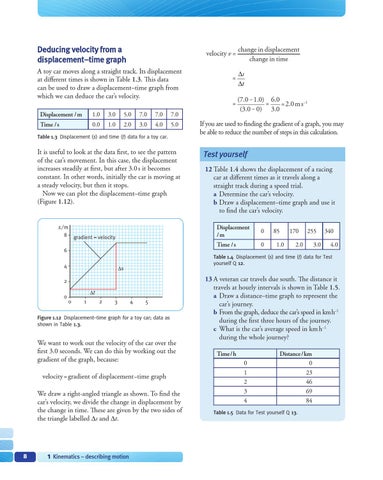
velocity v =
A toy car moves along a straight track. Its displacement at different times is shown in Table 1.3. This data can be used to draw a displacement–time graph from which we can deduce the car’s velocity. Displacement / m
1.0
3.0
5.0
7.0
7.0
7.0
Time / s
0.0
1.0
2.0
3.0
4.0
5.0
Table 1.3 Displacement (s) and time (t) data for a toy car.
It is useful to look at the data first, to see the pattern of the car’s movement. In this case, the displacement increases steadily at first, but after 3.0 s it becomes constant. In other words, initially the car is moving at a steady velocity, but then it stops. Now we can plot the displacement–time graph (Figure 1.12).
s/m 8
gradient = velocity
6 4
∆s
∆t 0
1
2
3
4
5
Figure 1.12 Displacement–time graph for a toy car; data as shown in Table 1.3.
We want to work out the velocity of the car over the first 3.0 seconds. We can do this by working out the gradient of the graph, because: velocity = gradient of displacement−time graph We draw a right-angled triangle as shown. To find the car’s velocity, we divide the change in displacement by the change in time. These are given by the two sides of the triangle labelled ∆s and ∆t.
8
1 Kinematics – describing motion
=
∆s ∆t
=
(7.0 – 1.0) 6.0 = = 2.0 m s−1 (3.0 – 0) 3.0
If you are used to finding the gradient of a graph, you may be able to reduce the number of steps in this calculation.
Test yourself 12 Table 1.4 shows the displacement of a racing car at different times as it travels along a straight track during a speed trial. a Determine the car’s velocity. b Draw a displacement–time graph and use it to find the car’s velocity. Displacement /m
0
Time / s
0
85
170
1.0
255
2.0
3.0
340 4.0
Table 1.4 Displacement (s) and time (t) data for Test yourself Q 12.
2 0
change in displacement change in time
13 A veteran car travels due south. The distance it travels at hourly intervals is shown in Table 1.5. a Draw a distance–time graph to represent the car’s journey. b From the graph, deduce the car’s speed in km h−1 during the first three hours of the journey. c What is the car’s average speed in km h−1 during the whole journey? Time / h 0 1 2 3 4
Distance / km 0 23 46 69 84
Table 1.5 Data for Test yourself Q 13.
Combining displacements The walkers shown in Figure 1.13 are crossing difficult ground. They navigate from one prominent point to the next, travelling in a series of straight lines. From the map, they can work out the distance that they travel and their displacement from their starting point.
Worked examples 3 A spider runs along two sides of a table (Figure 1.14). Calculate its final displacement. 1.2 m
A
θ
B
distance travelled = 25 km 0.8 m
(Lay thread along route on map; measure thread against map scale.)
north O east
displacement = 15 km north-east (Join starting and finishing points with straight line; measure line against scale.)
ridge
Figure 1.14 The spider runs a distance of 2.0 m, but what is its displacement?
Step 1 Because the two sections of the spider’s run (OA and AB) are at right angles, we can add the two displacements using Pythagoras’s theorem:
river bridge
valley FINISH
OB2 = OA2 + AB2 = 0.82 + 1.22 = 2.08 OB = 2.08 = 1.44 m ≈ 1.4 m
cairn
START
θ
1 2 3 4 5
km
Figure 1.13 In rough terrain, walkers head straight for a prominent landmark.
Step 2 Displacement is a vector. We have found the magnitude of this vector, but now we have to find its direction. The angle θ is given by: tan θ =
opp 0.8 = adj 1.2
= 0.667 A map is a scale drawing. You can find your displacement by measuring the map. But how can you calculate your displacement? You need to use ideas from geometry and trigonometry. Worked examples 3 and 4 show how. This process of adding two displacements together (or two or more of any type of vector) is known as vector addition. When two or more vectors are added together, their combined effect is known as the resultant of the vectors.
θ = tan−1 (0.667) = 33.7° ≈ 34° So the spider’s displacement is 1.4 m at an angle of 34° north of east. 4 An aircraft flies 30 km due east and then 50 km north-east (Figure 1.15). Calculate the final displacement of the aircraft. continued
1 Kinematics – describing motion
9
vector triangle. Measure this displacement vector, and use the scale to convert back to kilometres:
N
45°
length of vector = 14.8 cm E
Figure 1.15 What is the aircraft’s final displacement?
Here, the two displacements are not at 90° to one another, so we can’t use Pythagoras’s theorem. We can solve this problem by making a scale drawing, and measuring the final displacement. (However, you could solve the same problem using trigonometry.) Step 1 Choose a suitable scale. Your diagram should be reasonably large; in this case, a scale of 1 cm to represent 5 km is reasonable. Step 2 Draw a line to represent the first vector. North is at the top of the page. The line is 6 cm long, towards the east (right). Step 3 Draw a line to represent the second vector, starting at the end of the first vector. The line is 10 cm long, and at an angle of 45° (Figure 1.16).
al
1 cm
fin
ce pla
nt
dis
50 km 45°
30 km Figure 1.16 Scale drawing for Worked example 4. Using graph paper can help you to show the vectors in the correct directions.
Step 4 To find the final displacement, join the start to the finish. You have created a continued
10
1 Kinematics – describing motion
Step 5 Measure the angle of the final displacement vector: angle = 28° N of E Therefore the aircraft’s final displacement is 74 km at 28° north of east.
Test yourself 14 You walk 3.0 km due north, and then 4.0 km due east. a Calculate the total distance in km you have travelled. b Make a scale drawing of your walk, and use it to find your final displacement. Remember to give both the magnitude and the direction. c Check your answer to part b by calculating your displacement. 15 A student walks 8.0 km south-east and then 12 km due west. a Draw a vector diagram showing the route. Use your diagram to find the total displacement. Remember to give the scale on your diagram and to give the direction as well as the magnitude of your answer. b Calculate the resultant displacement. Show your working clearly.
me
1 cm
final displacement = 14.8 × 5 = 74 km
Combining velocities Velocity is a vector quantity and so two velocities can be combined by vector addition in the same way that we have seen for two or more displacements.
Imagine that you are attempting to swim across a river. You want to swim directly across to the opposite bank, but the current moves you sideways at the same time as you are swimming forwards. The outcome is that you will end up on the opposite bank, but downstream of your intended landing point. In effect, you have two velocities: • the velocity due to your swimming, which is directed straight across the river; • the velocity due to the current, which is directed downstream, at right angles to your swimming velocity. These combine to give a resultant (or net) velocity, which will be diagonally downstream. In order to swim directly across the river, you would have to aim upstream. Then your resultant velocity could be directly across the river.
Here, the two velocities are at 90°. A sketch diagram and Pythagoras’s theorem will suffice to solve the problem. Step 1 Draw a sketch of the situation – this is shown in Figure 1.17a. 50ms–1
b
v 200m s–1
50 m s–1
Step 4 Calculate the magnitude of the resultant vector v (the hypotenuse of the right-angled triangle). v2 = 2002 + 502 = 40 000 + 2500 = 42 500 v = 42500 = 206 m s−1 Step 5 Calculate the angle θ: tan θ = 50 200
θ = tan−1 0.25 = 14°
5 An aircraft is flying due north with a velocity of 200 m s−1. A side wind of velocity 50 m s−1 is blowing due east. What is the aircraft’s resultant velocity (give the magnitude and direction)?
200 m s–1
Step 3 Join the start and end points to complete the triangle.
= 0.25
Worked example
a
Step 2 Now sketch a vector triangle. Remember that the second vector starts where the first one ends. This is shown in Figure 1.17b.
θ
Not to scale
Figure 1.17 Finding the resultant of two velocities – for Worked example 5. continued
So the aircraft’s resultant velocity is 206 m s−1 at 14° east of north.
Test yourself 16 A swimmer can swim at 2.0 m s−1 in still water. She aims to swim directly across a river which is flowing at 0.80 m s−1. Calculate her resultant velocity. (You must give both the magnitude and the direction.) 17 A stone is thrown from a cliff and strikes the surface of the sea with a vertical velocity of 18 m s−1 and a horizontal velocity v. The resultant of these two velocities is 25 m s−1. a Draw a vector diagram showing the two velocities and the resultant. b Use your diagram to find the value of v. c Use your diagram to find the angle between the stone and the vertical as it strikes the water.
1 Kinematics – describing motion
11
Summary Displacement is the distance travelled in a particular direction. Velocity is defined by the word equation velocity =
displacement time taken
The gradient of a displacement–time graph is equal to velocity: v=
∆s ∆t
Distance and speed are scalar quantities. A scalar quantity has only magnitude. Displacement and velocity are vector quantities. A vector quantity has both magnitude and direction. Vector quantities may be combined by vector addition to find their resultant.
End-of-chapter questions 1
A car travels one complete lap around a circular track at a constant speed of 120 km h−1. a If one lap takes 2.0 minutes, show that the length of the track is 4.0 km. b Explain why values for the average speed and average velocity are different. c Determine the magnitude of the displacement of the car in a time of 1.0 minute. (The circumference of a circle = 2πR where R is the radius of the circle.)
2
A boat leaves point A and travels in a straight line to point B (Figure 1.18). The journey takes 60 s. B 600 m A 800 m Figure 1.18 For End-of-chapter Q 2.
Calculate: a the distance travelled by the boat b the total displacement of the boat c the average velocity of the boat. Remember that each vector quantity must be given a direction as well as a magnitude.
12
1 Kinematics – describing motion
3
A boat travels at 2.0 m s−1 east towards a port, 2.2 km away. When the boat reaches the port, the passengers travel in a car due north for 15 minutes at 60 km h−1. Calculate: a the total distance travelled b the total displacement c the total time taken d the average speed in m s−1 e the magnitude of the average velocity.
4
A river flows from west to east with a constant velocity of 1.0 m s−1. A boat leaves the south bank heading due north at 2.40 m s−1. Find the resultant velocity of the boat.
Exam-style questions 1
2
3
a Define displacement. b Use the definition of displacement to explain how it is possible for an athlete to run round a track yet have no displacement.
[2]
A girl is riding a bicycle at a constant velocity of 3.0 m s−1 along a straight road. At time t = 0, she passes a boy sitting on a stationary bicycle. At time t = 0, the boy sets off to catch up with the girl. His velocity increases from time t = 0 until t = 5.0 s when he has covered a distance of 10 m. He then continues at a constant velocity of 4.0 m s−1. a Draw the displacement–time graph for the girl from t = 0 to 12 s. b On the same graph axes, draw the displacement–time graph for the boy. c Using your graph, determine the value of t when the boy catches up with the girl.
[1] [2] [1]
[1]
A student drops a small black sphere alongside a vertical scale marked in centimetres. A number of flash photographs of the sphere are taken at 0.1 s intervals, as shown in the diagram. The first photograph is taken with the sphere at the top at time t = 0. cm 10 20 30 40 50 60 70 80 90 100 110 120 130
1 Kinematics – describing motion
13
a Explain how the diagram shows that the sphere reaches a constant speed. b Determine the constant speed reached by the sphere. c Determine the distance that the sphere has fallen when t = 0.8 s. 4
5
a State one difference between a scalar quantity and a vector quantity and give an example of each. b A plane has an air speed of 500 km h−1 due north. A wind blows at 100 km h−1 from east to west. Draw a vector diagram to calculate the resultant velocity of the plane. Give the direction of travel of the plane with respect to north. c The plane flies for 15 minutes. Calculate the displacement of the plane in this time.
[2] [2] [2] [3] [4] [1]
A small aircraft for one person is used on a short horizontal flight. On its journey from A to B, the resultant velocity of the aircraft is 15 m s−1 in a direction 60° east of north and the wind velocity is 7.5 m s−1 due north. N
B
60° A
E
a Show that for the aircraft to travel from A to B it should be pointed due east. b After flying 5 km from A to B, the aircraft returns along the same path from B to A with a resultant velocity of 13.5 m s−1. Assuming that the time spent at B is negligible, calculate the average speed for the complete journey from A to B and back to A.
14
1 Kinematics – describing motion
[2]
[3]