How to use this book
CASE STUDY
Case study – A variety of examples of real world scenarios are included in every chapter to illustrate relevant aspects of the syllabus, with questions to develop your higher order thinking skills. Answers are provided at the back of the book. Cambridge IGCSE and O Level Environmental Management
End-of-chapter questions – Use the questions at the end of each chapter to check your knowledge and understanding of the whole topic and to practise answering questions in a similar style to those you might encounter in your exams. Answers are provided at the back Cambridge IGCSEbook. and O Level Environmental Management of the
Acid rain in China
End-of-chapter questions
Heilongjiang Jilin
Beijing Xinjiang
Ningxia Inner Mongolia
Tibet
Shanxi
Gansu Sichuan
Shaanxi Henan Hubei
1
Tianjin
Hebei Qinghai
Chapter 3: Agriculture and the environment
Liaoning
Shandong
Shanghai
Jiangsu Anhui
Zhejiang Chongqing quality for irrigation (low in dissolved saltsHunan andJiangxi levels of Fujian pollution) but does not have to be as Guizhou clean as required for key Yunnan Taiwan Guangxi Guangdong < 4.5 potable (drinking) water 4.5–5.0 and water supplied to livestock. Macau Hong Kong 5.0–5.6 Hainan Sustainable agriculture uses alternative water supplies, > 5.6 reserving water from bore holes and other clean sources for other uses. For 7.5 example, the collection of water from Figure The distribution of acid rain in China. the roofs of buildings is ideal for irrigation. This is known China is experiencing rapid industrialisation. In 2011 as rainwaterChina’s harvesting: collecting rainwater from government published a report that claimed buildings andthat hard-standing areas it can 258 Chinese cities weremeans suffering frombe thestored effects of acid rain. Th e acid rain fallsThe in the southisand eastbe of the in tanks or reservoirs until needed. water then country, the majority of from the population, industry 164 pumped through anwhere irrigation system the storage and power stations are located (Figure 7.5). In 2014 China container to where it is needed, when it is needed.
was the world’s largest energy consumer, accounting for
23% ofa all global energy of consumption, and the dominant In systems where large amount water is being used, is coal, providing 66% of the country’s energy the irrigationfuel run-off can be collected and returned to consumption. When the coal is burnt in factories and the storage point re-useit later. This is adioxide riskierand method powerfor stations, releases sulfur nitrogen because saltsoxide, may which be leached outrain. intoExpanding the water build is form acid carand ownership to high emissions these gases.and up over time.also Silt leading can also be carried inofthe run-off The eff ectsirrigation of acid rain in China are numerous. Lakes potentially block the system.
and rivers have become more acidic, killing fish, crop yields are lower and there commercial timber is being lost as trees die. Structural damage to buildings is being by chemical weathering. The 71 mfor high and 28 m Rainwater caused harvesting: the collection of rainwater, wide Giant Buddha, hasinstood forormore example from theLeshan roofs of buildings, andwhich storage a tank than 1000 years, has been badly affected (Figure 7.6). reservoir for later use China first attempted to reduce sulfur dioxide emissions in 2007, before the 2008 Beijing Olympics. In 2011, as part of the government’s Five-Year Plan, ambitious for emission reductions were set. Several Towards a targets sustainable future? strategies were used: flue gas desulfurisation methods, As a major employer and the largest land user of any such as switching to coal with a low sulfur content and industry in the world, agriculture a major part toand play crushing and washing it,has installing scrubbers using in the maintenance of aSmall healthy and ecosystem. lime spray. coal-fi red viable power stations were closed in favour of less polluting energy sources (nuclear, wind, The pressures on agriculture to supply an increasing and solar), and in their homes people were encouraged population but in a sustainable way is one the biggest to change their fuel type and use cars less. While sulfur dioxide levels over China remain the highest in the KEY TERM
challenges the world currently faces. To rise to this challenge, environmentalists need to understand and manage a number of competing factors. • The need to understand the nature and composition of soils: how the individual components have an impact on how the soil reacts to changing circumstances. • Why soil is important for plant growth: the need for sufficient nutrients and how to manage the soil to maximise the nutrient availability (and the consequences of getting it wrong). • How to manage soils with different characteristics to maximise their performance.
■
■ ■
• Questions How agriculture can produce the yields needed in a way is sustainable for theand planet. 1 that Using Figure 7.5, describe explain the rain in China. Thesedistribution are issuesofasacid much for the future as they are for 2 a Using Figure 7.7 and your own knowledge, today, because the challenges will not diminish. Other explain how acid rain is formed. questions will come the fore, such as the about role of genetic b Should peopleto outside China be worried modification and and its potential acid rain, if so why? to feed the hungry of the world, whether global food be solved by 3 Thor e Chinese government has problems implementedcan various strategies try and are reduce acid rain in its land for dictating whattopeople allowed tolevels eat, using country. Choose one of these strategies andluxuries describeof fine a larger quantity of crops rather than the how it might help reduce acid rain levels in China. foods and flowers that are available now.
■ ■ ■
■ ■ ■
techniques used to increase agricultural yield methods of controlling pests, diseases and weeds the techniques of selective breeding and genetic modification methods for controlling the growing environment the impacts of poor agricultural management different approaches to maintaining soil fertility.
[1 mark]
How might changing the pH of the soil affect the growth of a crop?
[1 mark]
3
Give three ways the ‘Green Revolution’ has helped feed a growing world population.
[3 marks]
4
Explain how crop rotation can help increase the yield of a crop.
[2 marks]
5
Describe three ways farmers can improve the efficiency of their water use.
[3 marks]
6
Describe the impact of applying too much fertiliser to a crop.
[2 marks]
7
Intercropping is identified as a useful way of helping prevent soil erosion in certain soil conditions. In addition to the prevention of erosion, what other benefits might this technique have?
[3 marks]
8
Government advisors have developed a blueprint for farmers in a country to increase the efficiency of their milk production. The details are shown in the table
what can be done to reduce it.
Buffaloes
cows
percentage of each type of animal
75
25
number of years of milking
8-9
7-8
Food consumption per day/ kg
40-55
30-40
Milk yield per day /litres
10
14
Number of days producing milk per year
280
305
Annual milk production 83
i
Complete the table for annual milk production
ii
Many farmers have only kept buffaloes in the past. Give three reasons why the government advisors have suggested keeping cows as well. [3 marks]
[2 marks]
iii
Suggest three reasons why the government advisors have recommended keeping a mixture of buffaloes and cows rather than a complete change to cows [3 marks]
v
Chapter 3: Agriculture and the environment
EXTENDED CASE STUDY
the components of soil where the soil components originate how to evaluate the proportions of these components the availability of nutrients and the impact of deficiencies the relative merits of different soil types different types of agriculture
[4 marks]
2
world, the implementation of these strategies and a 84 of the Chinese economy to a 50% reduction • slowing Ways in which yields can beledimproved and how the in emissions of acid rain-producing gases between choice of different practices has an impact on the local 2012 and 2014. However, China’s acid rain problem ecosystem local people. has become theand world’s problem. Sulfur dioxide and oxides from China’s coal-fired power stations • nitrogen The impact different practices have on soil erosion and fall as acid rain on South Korea, Japan and Taiwan.
After completing this chapter, you should know:
■
How would a drought affect the balance of these four components?
Figure 7.6 The Leshan Giant Buddha is starting to show
Summary ■
Name the four components of soil.
b
effrole ects of rain. types of agricultural systems: how • the The ofacid different to address the different aims of different farmers.
Summary – A brief summary is included at the end of each chapter, providing a clear reminder of the key themes discussed.
■
a
Controlling pests naturally: a flawed decision
85
Extended case study – Longer case studies related to more complex real world settings provide opportunities to practise higher order thinking skills and prepare for this element of your examinations. Answers are provided at the back of the book.
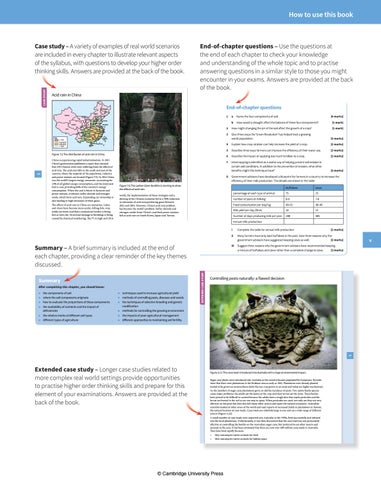
Figure 3.22 The cane toad: introduced into Australia with a huge environmental impact. Sugar cane plants were introduced into Australia as the country became populated by Europeans. Records show that there were plantations in the Brisbane area as early as 1862. Plantations were densely planted, tended to be grown as monocultures (only the one crop grown in an area) and today are highly mechanised. As the numbers of sugar cane plantations grew, so did the incidence of pests. Two native beetle species cause major problems: the adults eat the leaves of the crop and their larvae eat the roots. These beetles have proved to be difficult to control because the adults have a tough skin that repels pesticides and the larvae are buried in the soil so are not easy to spray. When pesticides are used, not only are they not very effective on the pests but they also kill many other insects and upset the natural ecosystem. Australian scientists looked at other areas of the world and read reports of increased yields in plantations in Hawaii, the natural location of cane toads. Cane toads are relatively large in size and eat a wide range of different insects (Figure 3.22). A small number of cane toads were imported into Australia in the 1930s, bred successfully and released into the local plantations. Unfortunately, it was then discovered that the cane toad was not particularly effective at controlling the beetles on the Australian sugar cane, but preferred to eat other insects and animals in the area. It has been estimated that there are now over 200 million cane toads in Australia. They have bred rapidly because: •
they outcompete native animals for food
•
they outcompete native animals for habitat space
© Cambridge University Press 9781316634851pre_pi-xiv.indd 5
16/11/16 7:55 PM