Cambridge IGCSE and O Level Environmental Management
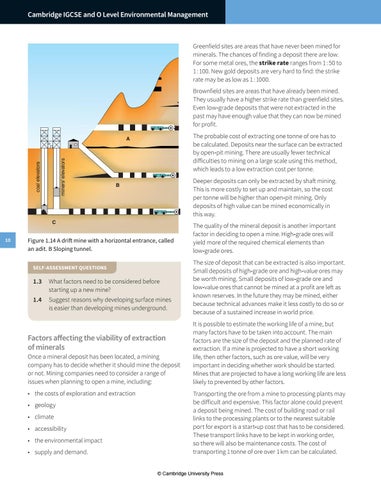
Greenfield sites are areas that have never been mined for minerals. The chances of finding a deposit there are low. For some metal ores, the strike rate ranges from 1 : 50 to 1 : 100. New gold deposits are very hard to find: the strike rate may be as low as 1 : 1000. Brownfield sites are areas that have already been mined. They usually have a higher strike rate than greenfield sites. Even low-grade deposits that were not extracted in the past may have enough value that they can now be mined for profit. The probable cost of extracting one tonne of ore has to be calculated. Deposits near the surface can be extracted by open-pit mining. There are usually fewer technical difficulties to mining on a large scale using this method, which leads to a low extraction cost per tonne.
coal elevators
miners’ elevators
A
Deeper deposits can only be extracted by shaft mining. This is more costly to set up and maintain, so the cost per tonne will be higher than open-pit mining. Only deposits of high value can be mined economically in this way.
B
C
10
Figure 1.14 A drift mine with a horizontal entrance, called an adit. B Sloping tunnel. Self-aSSeSSment queStionS
1.3
What factors need to be considered before starting up a new mine?
1.4
Suggest reasons why developing surface mines is easier than developing mines underground.
Factors affecting the viability of extraction of minerals Once a mineral deposit has been located, a mining company has to decide whether it should mine the deposit or not. Mining companies need to consider a range of issues when planning to open a mine, including: • the costs of exploration and extraction • geology • climate • accessibility • the environmental impact • supply and demand.
The quality of the mineral deposit is another important factor in deciding to open a mine. High-grade ores will yield more of the required chemical elements than low-grade ores. The size of deposit that can be extracted is also important. Small deposits of high-grade ore and high-value ores may be worth mining. Small deposits of low-grade ore and low-value ores that cannot be mined at a profit are left as known reserves. In the future they may be mined, either because technical advances make it less costly to do so or because of a sustained increase in world price. It is possible to estimate the working life of a mine, but many factors have to be taken into account. The main factors are the size of the deposit and the planned rate of extraction. If a mine is projected to have a short working life, then other factors, such as ore value, will be very important in deciding whether work should be started. Mines that are projected to have a long working life are less likely to prevented by other factors. Transporting the ore from a mine to processing plants may be difficult and expensive. This factor alone could prevent a deposit being mined. The cost of building road or rail links to the processing plants or to the nearest suitable port for export is a start-up cost that has to be considered. These transport links have to be kept in working order, so there will also be maintenance costs. The cost of transporting 1 tonne of ore over 1 km can be calculated.
© Cambridge University Press 9781316634851c01_p001-024.indd 10
16/11/16 2:35 PM