The Governor’s Workforce Council WORKFORCE STRATEGIC PLAN 2020
October 22, 2020
October 22, 2020
Dear Fellow Connecticut Residents,
Dear Fellow Connecticut Residents,
One year ago, I issued Executive Order No. 4 which established the Governor’s Workforce Council as the principal advisor to the Governor on workforce development issues.
One year ago, I issued Executive Order No. 4 which established the Governor’s Workforce Council as the principal advisor to the Governor on workforce development issues.
I invited Connecticut’s top leaders from business, labor, education, nonprofits, and philanthropy to serve as Council members. I charged this group to make strategic recommendations to improve the state’s workforce and employment system. And, I challenged the Chair of the Council to use a singular philosophy to guide this work: “Do things better than they have ever been done before.”
I invited Connecticut’s top leaders from business, labor, education, nonprofits, and philanthropy to serve as Council members. I charged this group to make strategic recommendations to improve the state’s workforce and employment system. And, I challenged the Chair of the Council to use a singular philosophy to guide this work: “Do things better than they have ever been done before.”
What does doing things better than ever before mean? That means bringing all stakeholders to the table. That means educators working with business leaders. That means having labor in the room. That means hearing from our non-profit partners and philanthropies what they think is needed to assist the communities they serve. That means changing the way we think about advancing our workforce and economy.
What does doing things better than ever before mean? That means bringing all stakeholders to the table. That means educators working with business leaders. That means having labor in the room. That means hearing from our non-profit partners and philanthropies what they think is needed to assist the communities they serve. That means changing the way we think about advancing our workforce and economy.
The modern workplace is changing faster than the edu cation and government sectors. If we fail to recognize the shift happening and take appropriate actions we will be letting down current and future generations of workers and their families and stifling the growth and innovation of the Connecticut economy. Now, more than ever, our state’s education and workforce systems must create opportunities that address issues of social and economic justice.
The modern workplace is changing faster than the edu cation and government sectors. If we fail to recognize the shift happening and take appropriate actions we will be letting down current and future generations of workers and their families and stifling the growth and innovation of the Connecticut economy. Now, more than ever, our state’s education and workforce systems must create opportunities that address issues of social and economic justice.
The Council has set a bold goal that every Connecticut resident will benefit from equitable, life-long access to pathways for career advancement that fit their interests and capabilities while providing job opportunities that meet the needs of our employers. If we succeed at this goal, we will make the kind of progress addressing equity and fairness that will be felt for generations
The Council has set a bold goal that every Connecticut resident will benefit from equitable, life-long access to pathways for career advancement that fit their interests and capabilities while providing job opportunities that meet the needs of our employers. If we succeed at this goal, we will make the kind of progress addressing equity and fairness that will be felt for generations.
This plan provides a road map to reach these goals. This plan asks all of us to play a role in our society that reaches beyond our narrow self-interest. We have learned much from the COVID-19 pandemic about what can be gained by reaching out and supporting one another to meet a challenge. Let us resolve that this will be a team accomplishment that happened under the guidance of my administration and the Council members.
This plan provides a road map to reach these goals. This plan asks all of us to play a role in our society that reaches beyond our narrow self-interest. We have learned much from the COVID-19 pandemic about what can be gained by reaching out and supporting one another to meet a challenge. Let us resolve that this will be a team accomplishment that happened under the guidance of my administration and the Council members.
This plan now requires an ongoing, relentless pursuit by our leaders, business owners and present and future workers to do things better than they have ever been done before. We all love Connecticut, and we want to see all of our residents succeed now and into the future. I have great confidence that together our state can accomplish this goal.
Sincerely,
This plan now requires an ongoing, relentless pursuit by our leaders, business owners and present and future workers to do things better than they have ever been done before. We all love Connecticut, and we want to see all of our residents succeed now and into the future. I have great confidence that together our state can accomplish this goal.
Sincerely,
Ned Lamont Governor of Connecticut
Ned Lamont Governor of Connecticut

2
LETTER FROM COUNCIL CHAIR AND OFFICE OF WORKFORCE STRATEGY EXECUTIVE DIRECTOR


3
TABLE OF CONTENTS Letters.......................................................................................................................2 Table of Contents.....................................................................................................4 The State of Play.......................................................................................................5 The Plan.....................................................................................................................8 Business Leadership......................................................................................12 Career Building – Educating Our Workforce....................................................17 Equity and Access..........................................................................................24 Accountability and Data-Driven Management...............................................28 Council Members...................................................................................................31 Appendices.............................................................................................................32 Executive Order No. 4....................................................................................32 Industry Sector Committees..........................................................................36 Manufacturing..................................................................................37 Healthcare......................................................................................40 Life Sciences.......................................................................................44 Information Technology and Business Services..................................46 4 CONNECTICUT STATE AGENCY ACRONYMS ADS Aging and Disability Services CSCU Connecticut State Colleges and Universities DECD Department of Economic and Community Development DAS Department of Administrative Services DCF Department of Children and Families DDS Department of Developmental Services DMHAS Department of Mental Health and Addiction Services DOC Department of Correction DOH Department of Housing DOL Department of Labor DSS Department of Social Services OEC Office of Early Childhood OHE Office of Higher Education OPM Office of Policy and Management OWS Office of Workforce Strategy SDE State Department of Education
Our Challenge
The Governor’s Workforce Council began its work last November when the economy was growing and employers were squeezed for talent. The challenge was to identify gaps in the labor market and to build an effective system to help workers fill them by providing education and needed supports, a task requiring unprecedented teamwork among government, educational institutions, businesses, and community groups.
Since then a great deal has changed. The economy has been knocked to its knees by the virus, creating enormous hardship and scrambling the job market. At the same time, Americans have watched essential workers carry an enormous load, at grave risk, and often for meager wages. It’s given us all a deeper sense of community, an appreciation for the dignity of work, and a conviction that we must do better; that we must build an economy that allows all workers to share in this nation’s prosperity, to build a life with dignity, and support a family with security.
The primary challenge facing the Council is to ensure that workers in Connecticut have the skills and support needed to thrive in a modern economy, one that demands a lifetime commitment to education and training. Research shows that 70 percent of Connecticut’s working-age adults should have some form of postsecondary work credential by 2025 if we are to meet the needs of our modernizing economy. This reflects a rapid pace of technological change and the resulting shuffling of job categories and skills requirements.
At the same time, we need to knock down the barriers that often stand in the way. We need to build a better childcare system, at reasonable cost. We need accessible, affordable transportation systems. We need to tap the potential of those with mental health challenges by giving them the support they need to enter the job market. And we must untangle the web of government support programs that often create disincentives to work.
Our Opportunity Agenda
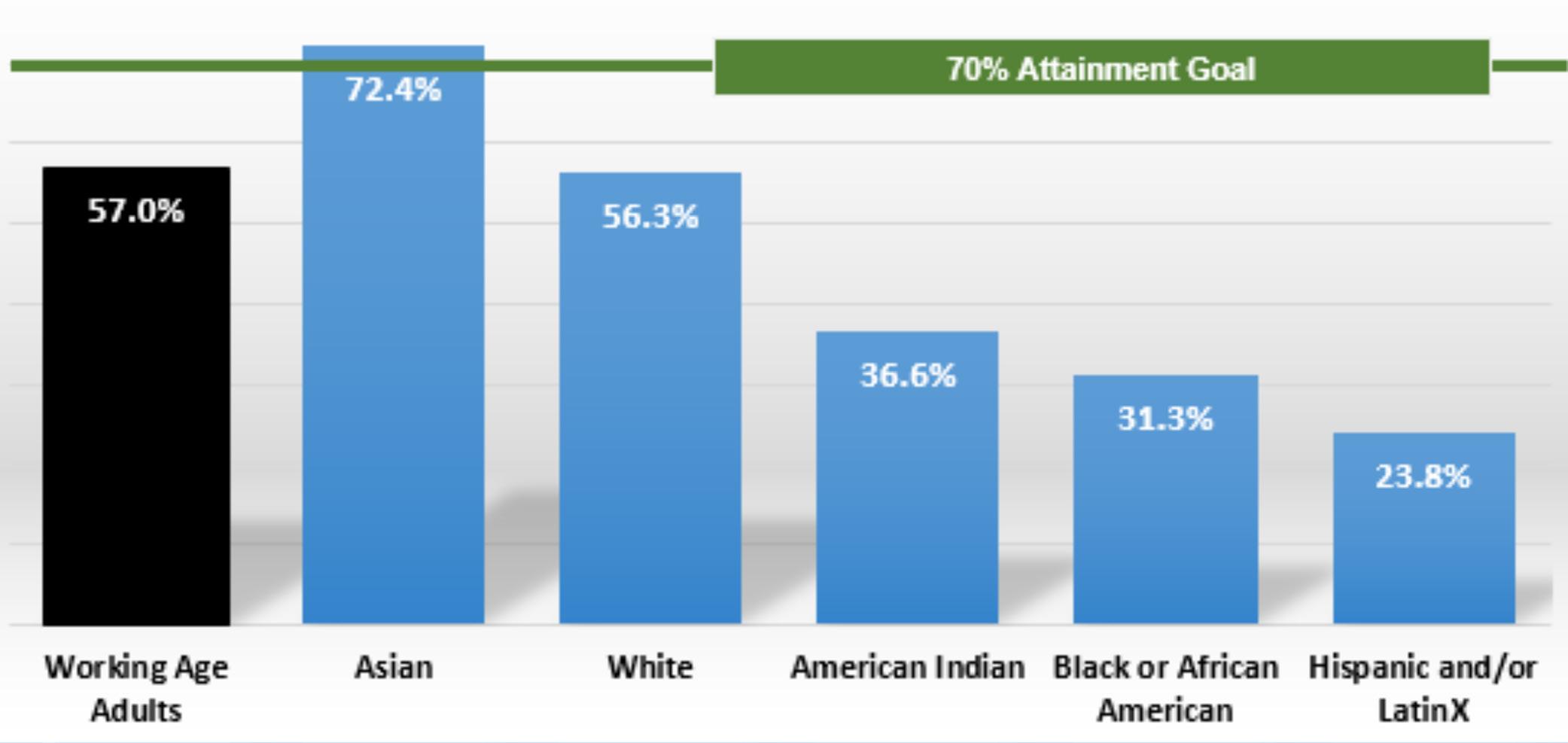
When we discuss workforce issues we usually talk about the “skills gap”, as if a motivated person plus skills training equals success. But this ignores the dynamics of multi-generational poverty, including racial, age and gender discrimination and the lack of equitable access to educational opportunities for too many jobseekers. Instead, we should be talking about closing the opportunity gap, not just a skills gap. There is too much talent out there ready to be unleashed for us to do otherwise. Cultivating and investing in diverse talent can unleash innovation, economic growth and stronger families and communities. We’d like to push the restart button and find ways to support this talent and begin to eliminate the obstacles that have excluded so many.
Connecticut’s 2018 Postsecondary Credential Attainment by Race/Ethnicity
Source: U.S. Census Bureau
5
THE STATE OF PLAY
It’s an enormous task that will require a sustained commitment, with all hands on deck – business leaders, educators, social service providers, government policymakers, and community groups. The mission is no less than to rewrite the social contract with a fresh push to expand opportunity for all.
We’ve broken this down into a series of initiatives outlined in the following pages. It’s a mission that will require coordination among players that have not always worked together as one. The Council will bring them together to discuss practical solutions to these problems. Crucially, we’ll gather objective data so that we can measure our success and adjust our tactics where needed. If we can’t measure it, we can’t manage it.
Connecticut’s Strengths
Connecticut brings distinct strengths to this mission. It has one of the most educated workforces in the country, ranking among the top five states. It is home to innovative, globally leading companies in aerospace, advanced manufacturing, insurance and financial services. It is among the top 10 states in research with commercial potential, particularly in bioscience. And it is consistently recognized as one of the best places to live in the country. At the same time, the state’s achievement gap in education is totally unacceptable, and the fiscal crisis in Hartford limits the state’s ability to make needed investments. We must capitalize on our strengths while planning carefully and seeking to elevate the best of what we have to offer.
The Council’s Response to COVID-19
SkillUp CT
Connecticut’s unemployed residents get free access to more than 5,000 online courses offered by Metrix, primarily in information technology, and to 180 Skills, an online learning platform offering over 700 courses focused on manufacturing and professional skills. To date, more than 20,000 people in the state have signed up for SkillUp CT services.
Customized Indeed Job Portal and Job Fairs
Connecticut was the first to partner with Indeed to create a custom jobs portal for Connecticut jobseekers and employers. This new portal complements the existing CTHires jobs portal by providing additional resources and opportunities to businesses and job seekers. Connecticut partnered with Indeed to hold virtual hiring events with over 40 employers. Indeed also provided a free webinar to help prepare jobseekers for virtual interviews. Employers hired approximately 300 jobseekers.
Job Training for Displaced Workers
“When the COVID crisis struck we quickly took a series of steps to make jobs, in-demand training and important supportive services available to those most seriously affected. The council’s response reflects how Connecticut can leverage its strong workforce partners, such as our regional workforce development boards, community colleges, local training providers, and others to create industry-aligned programs aimed at getting our residents back to work.”
- KELLI-MARIE VALLIERES, PhD Executive Director of the Connecticut Office of Workforce Strategy
With funding made available through the CARES Act the GWC partnered with our five regional workforce boards, employers, nonprofits, and the community college system to fund 19 workforce programs for displaced workers. We prioritized jobs with family supporting wages and strong career pathways, primarily in Healthcare, IT, and Manufacturing. Overall 1,100 participants will receive training and employment opportunities. These programs all provide access to childcare and transportation as well as a training stipend.
CT CARES Child Care Programs
The Office of Early Childhood (OEC) created a series of new, short-term childcare programs to help families and child care providers. They offer access to child care, financial help, and assistance for child care providers. These programs will reach approximately 2,500 individuals.
6
THE STATE OF PLAY
We Know What Works
None of the plans laid out here contain fundamentally new ideas. In fact, everything has already been done to some extent, either in Connecticut or somewhere else in the nation. The question now is this: Will Connecticut leaders rally into action and play an active role in driving our state forward?
Our plan calls for the creation of a series of regional sector partnerships to weave together the effort of businesses, educators, policy-makers, social service agencies, and community groups. Everyone will have input and know precisely what their role is. The partnerships will share data and ensure that any gaps standing in the way of success are filled. A key part of this effort will be to teach every student about careers and to help them explore their options, including work-based learning opportunities. They need to understand how rapidly the economy is changing, and to build skills needed to take advantage of the generational explosion in IT, healthcare, and precisionmanufacturing jobs.
Students need to understand that in today’s economy, education can’t stop after high school, or even college. Increasingly, employers are seeking out employees with specific skills who can grow with a changing workplace and are comfortable with a lifelong approach to learning. All of this puts new pressures on our educational and training institutions, both in keeping their curricula current and in finding ways to flexibly deliver learning to students when and where they need it. Educators and employers must work arm-in-arm to test new ways of delivering training programs more flexibly and at lower cost. The remote teaching and learning that has exploded during this pandemic has given us a boost on that front.
A Call to Action
The pandemic is a call to action. It’s helped to waken our nation to the grim reality that too many of our neighbors are unable to find jobs that enable them to support a family with dignity. It’s our mission at the Governor’s Workforce Council to change that. And if it’s done right, it will strengthen the state’s economy overall, bringing widely shared prosperity.
In the following pages, you will see that each sector must rally to make this work, and bring their special talents to the task. Businesses can see and convey the rapidly changing needs of the market and the workplace, and coordinate with educators to help ensure workers are ready to fill these roles. Educators must focus hard on the type of skills that will empower students in today’s economy -- experiential learning, public speaking, team projects, entrepreneurial challenges, and problem solving. The government must ensure strong data collection and spend scarce money wisely in support of this mission. Philanthropies can help enormously by helping to design solutions based on best practices around the country.
We can do this, but only if we join hands and work together. It is an enormous challenge, but if we are successful it will transform Connecticut, giving fresh opportunity to vulnerable families and greater prosperity for all.
Connecticut’s Manufacturing Pipeline Initiative (MPI)
In 2015, in response to an increased need for skilled workers in the Groton-New London area, local manufacturing employers, schools, and the workforce development board in Eastern Connecticut launched the MPI. The intensive, work-based classroom training programs last between 5 to 10 weeks and focus on building employer competencies for open jobs. Applicants who are 18 or older must pass an initial Manufacturing Skills Inventory to demonstrate an ability to successfully complete the classroom training. The skills inventory does not require any manufacturing industry experience. It covers shop math, measurements, and spatial reasoning. Once trained, graduates get placed in jobs that offer livable wages and opportunities for career advancement. The MPI represents a big win for the trainees and provides significant benefits to employers including reducing hiring and training costs, de-risking the hiring process with competency-based hiring and training, and expanding the talent pool.
Over the past three years, the MPI has become a nationally acclaimed sector-based training strategy that has been replicated statewide and expanded to include a youth pipeline, and now serves as the foundation for a multi-state Next Generation Sector Partnership in the defense industry in partnership with our friends in Massachusetts and Rhode Island. A 2019 economic impact study showed that the MPI contributed $129 million of direct and indirect economic impact. Other notable accomplishments include: a) 1,500+ job placements with a 90% job placement rate; 2) 80% of job placements were people without prior manufacturing experience; and 3) involvement of 30+ community partners and 340+ employer partners.
7
THE STATE OF PLAY
Our Vision
Every Connecticut resident has access to a meaningful career pathway and the support needed to fulfill their aspirations. Every business in Connecticut has access to a skilled workforce.
Our Mission
To build the systems, teams, and approaches that will make Connecticut a talent environment that attracts and motivates students, career builders, and companies alike.
Our Approach
The Governor’s Workforce Council was established by Governor Ned Lamont through Executive Order #4 on October 29, 2019 and charged with advising the Governor on workforce matters and developing plans and overseeing the coordination of all government agencies engaged in workforce matters. The 24-member, businessled Council is complemented by 20 non-voting ex officio members. (See Appendix.)
The Council is comprised of several committees with responsibility for leading our work and making recommendations to the full Council. The Office of Workforce Strategy (OWS) within the Department of Economic and Community Development (DECD) has responsibility for supporting the Council’s work and also for advising the Governor and coordinating workforce related activities across all government agencies.
Our plan is the result of a yearlong process that involved hundreds of volunteers from businesses, educational institutions, community organizations, workforce boards, labor unions, nonprofit service organizations, and philanthropies, as well as countless staff members of our government agencies.
We did our best to engage with as many Connecticut stakeholders and partners as was practical and safe given the circumstances. This included convening industry sector committees. The proposed initiatives create opportunities for all stakeholders to engage in the process, to support their families, and to strengthen their communities.
An Aging Workforce and Technology Acceleration Means Investing in Reskilling and Upskilling
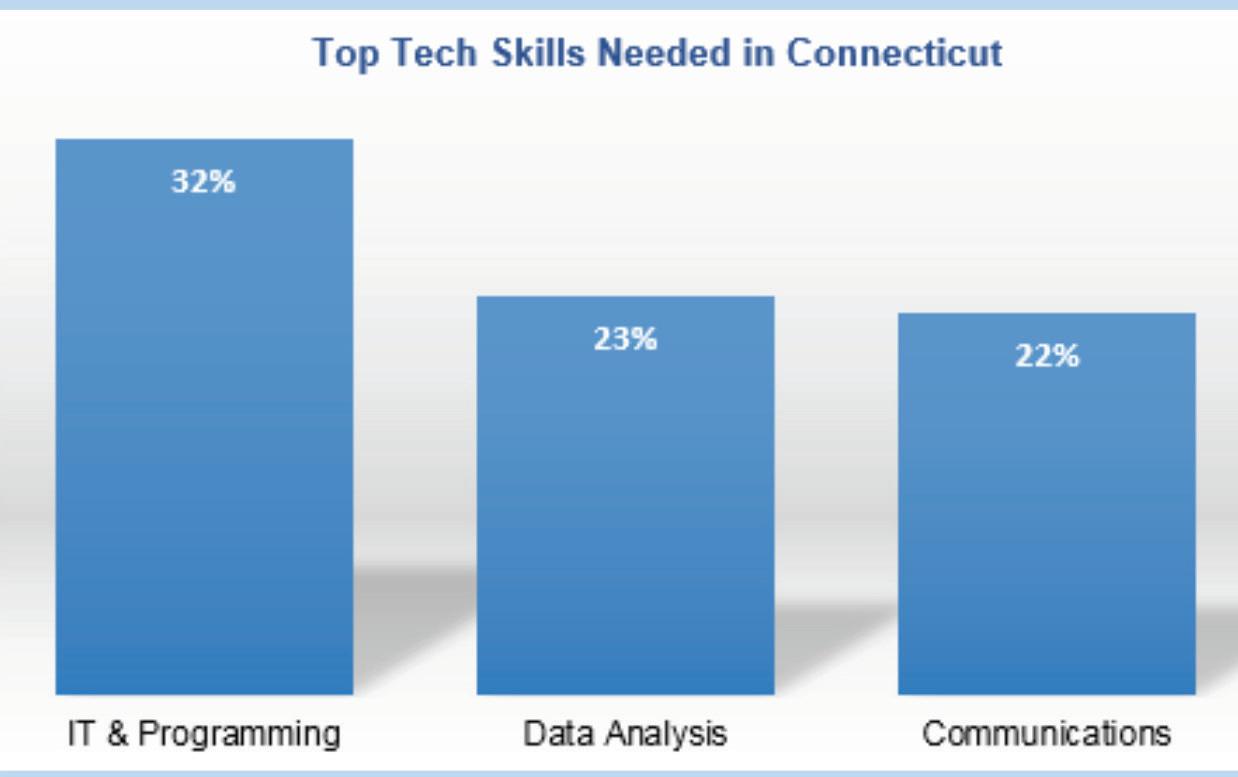
Several trends are accelerating the need for reskilling and upskilling the workforce. Technological changes resulting in increased automation are being further accelerated by the pandemic. Industries most affected by the pandemic -office support, food services, customer service -– will see long-term displacement and result in the need to reskill the workforce for new careers in information technology, healthcare, and advanced manufacturing. In addition, Connecticut has an aging workforce with a high retirement rate. This creates an urgent need to replenish the workforce while upskilling incumbent workers to replace the experienced retirees. We will need to expand proven strategies like the Manufacturing Innovation Fund that support incumbent worker training.
8
THE PLAN
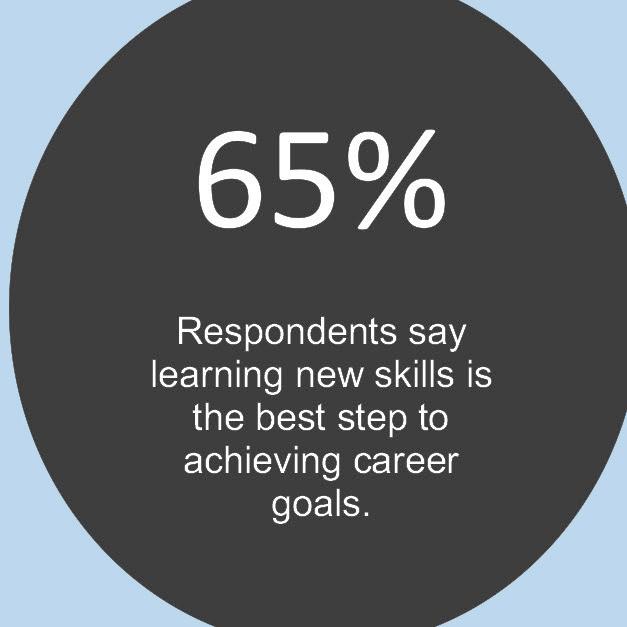
Source: January 2020 survey of 919 Connecticut residents to a survey conducted by the McKinsey Global Institute
Summary of Findings by the Council’s Industry Committees (See Appendix for more information)
MANUFACTURING
• Projected worker deficit: Demand for manufacturing employees is projected at 6,000 new workers per year due to the impact of retirements and new defense contracts. Existing training programs can produce 3,000 new employees per year, leaving a deficit of 3,000 people per year.
• Need multi-faceted training approach: Connecticut has some of the most innovative training programs in the country, but these programs need to expand and be customized to regional and sub-sector needs. Some areas for further development include:
a) Increasing manufacturing slots in technical and comprehensive high schools; b) Expanding pipeline and other short-term training programs; c) Upskilling the workforce through support of incumbent worker training and apprenticeship programs through the Manufacturing Innovation Fund; d) Growing community college programs and Goodwin College’s manufacturing programs; and e) Retaining engineering graduates by providing internships with manufacturers.
• Recruiting future workforce: Improve awareness and attractiveness of manufacturing careers among middle and high school students.
HEALTHCARE
• Largest workforce sector: Healthcare related occupations employ 16% of the state’s workforce or 270,000 jobs. The large hospitals and healthcare systems employ 80,000 employees. Industry growth will need to match population growth and the state’s aging population.
• Workforce needs: Annual workforce demand exceeds 7,000 new workers with significant shortages in nursing, certified nursing assistants, skilled technician roles, and long-term and home healthcare.
• Workforce training recommendations include: a) Improve alignment among employers, educators, nonprofits, and students as is occurring with statewide CARES funded program; b) Expand educational capacity (number of faculty, clinical slots) to address annual nursing shortage of 1,000 graduating nurses; c) Address CNA shortage of 2,500 open positions, employers need to reduce attrition rates from 30-50% per year by improving job quality and reimbursement rates for skilled nursing facilities; and d) Leverage regional sector partnerships to develop solutions for high-demand roles such as surgical technologists, imaging, pharmacy technicians, and sterile processing technicians.
LIFE SCIENCES
• Attractive sector: The life sciences sector has 23,000 employees in 1,300 companies. Sector employment growth will exceed 5,000 jobs over the next five years with an average salary of $127,000.
• Building a STEM talent pipeline: While Connecticut has a strong educational system, not enough students are acquiring STEM skills and relevant work experience required by life sciences companies. Key workforce development needs are: a) Engage high school students/teachers in STEM coursework. Increase teacher training for high school students; b) Implement BioPath Skills Institute linking content and skills to careers with industry partners. Expand BioPath’s degree and certificate programming with work-based learning components, including internships; and c) Expand upskilling programs in project management, quality assurance, and data management.
IT/BUSINESS SERVICES
• High-growth sector: Information technology is one of the highest-growth sectors in U.S. economy. Currently 6,000 open computing jobs exist in Connecticut, with future demand for 13,000 positions.
• Large, specialized sector: Business services employs 228,000 people with opportunities mainly in niche specialty areas like business operations, market research, accounting, and procurement.
• Need multi-faceted training approach: We need to attract a larger talent pool by expanding education and training pathways, providing industry-aligned training and internships, and retaining more college graduates. Some promising approaches include expanding and aligning community college pathways, adding apprenticeship programs, encouraging more students to focus on computer science, and supporting upskilling efforts to enable entry-level workers to learn more advanced skills while working.
9 THE PLAN
Our Strategies
Business Leadership strategies are those that rely most importantly on business as the driver. Regional Sector Partnerships will serve as the anchor strategy to reinvigorate Connecticut’s demand-driven approach to workforce development. Educators and trainers will partner with business to develop strategies that fill gaps in the regional talent supply chain. Students and other jobseekers will benefit from a more clearly articulated job demand picture and improved availability of training and support. Businesses can also lead the way in adopting skills-based hiring practices that will expand opportunities for all.
Area Strategy
Career Building – Educating Our Workforce strategies align training and education with occupational demand and career opportunities. The cultivation of career pathway systems and in-demand, sector-based training will serve as the anchor strategies to achieve this alignment. Career Building strategies will promote lifelong learning and modernize core skills in digital literacy, problem solving, teamwork, and communication. This plan also recognizes the need to invest in our teachers’ professional development if we are to succeed. New approaches to student advising and a redesign of our adult education system will also be critically important change initiatives.
Select Milestones 2021 - 2023
1.1 Regional Sector Partnerships Launch eight Regional Sector Partnerships by December 2021.
1.2 Credential Registry System
Agree upon a plan by June 2021 to create a Connecticut credential registry.
1.3 Skills-Based Hiring and Launch three to five skills-based hiring pilot initiatives during Training Systems 2021 and 2022, including pilot initiatives in Connecticut state government. Agree on a plan to scale skills-based hiring practices statewide by 2023.
1.4 Retain College Graduates Launch talent retention organizations in three cities by 2022; increase retention of undergraduates by 5% in participating markets within five years.
1.5 WDB Alignment Publish an operational optimization and alignment plan for the workforce development boards by December 2021.
2.1 Career Pathways
2.2 Sector-Based Training
2.3 Work-Based Learning
Develop a comprehensive, flexible Career Pathways System plan by December 2021.
Propose a series of new sector training programs for high-priority jobs in manufacturing, healthcare, and IT by December 2021. Build a process to scale the strategy statewide.
Create a state-level WBL intermediary function by June 2021. Launch a WBL portal and marketing initiative by December 2021.
2.4 Accelerating Launch a Dual Enrollment Working Group by March 2021. Report Postsecondary Access findings by March 2022. Launch an automatic admission plan for the state universities and other interested institutions of higher education.
2.5 Academic and Career Advising Develop a regionally based high school career advising system by December 2021. Achieve a student to advisor ratio of 250:1 by Spring 2024.
2.6 Improving Teacher and Adopt Next Gen Accountability System measures for high school Student Preparedness digital literacy and computer science by December 2022. Reconvene the Educator Professional Development Task Force by March 2021.
2.7 Adult Education
Launch a working group including Adult Ed leadership, CSCU’s community colleges, and WDBs to develop plans and goals to redesign AE by Q1 2021. Implement a regional pilot in Q3 2021.
10
THE PLAN Business Leadership Career Building –Educating Our Workforce
Equity and Access strategies seek to address persistent barriers that undermine access to sustainable work and training arrangements. The foremost barriers facing Connecticut’s lower-paid workforce include child care, transportation, benefits cliffs, and access to behavioral health services. Many of these barriers disproportionately affect specific underserved populations and have been exacerbated by the COVID-19 crisis.
Fundamental to these strategies is the recognition that a motivated person with a good job or training opportunity is often thwarted by barriers not of their making. These plans are intended to help our workers and jobseekers while creating a positive return for the state and its taxpayers. They recognize the talent potential that can be unleashed through thoughtful, data-driven policy initiatives. A by-product of these strategies will be to broaden our workforce and widen the pipeline of talent available to Connecticut’s employers.
Area Strategy
3.1 Expand Capacity of
Accountability and Data-Driven Management strategies use technology to increase accessibility, transparency, and accountability. They allow us to better understand program outcomes and the return on our investment in training and supportive services. Program managers and policy-makers will be able to create and revise programs based on real-time data. Analysts can study the overlapping impacts of government initiatives to improve their design.
Jobseekers will gain clarity on career options, pathways, and specific educational programs, leveraging a userfriendly online platform. Businesses will contribute to this user platform, creating a much more useful feedback loop while gaining access to a broader talent pipeline. In fact, we cannot hope to achieve an inclusive, demand-driven system without effectively using data.
Select Milestones 2021 - 2023
Develop a plan to redesign the early childhood Child Care System education system by December 2021.
3.2 Reduce Transportation
Develop a bulk transit pass purchasing program for individuals enrolled Barriers in non-credit bearing workforce training and Adult Education programs by September 2021.
3.3 Expand Access to Behavioral
By 2023, increase the number of Supportive Employment Services Health Services slots for residents with mental health challenges from 2,000 to 4,000.
3.4 Reduce the Adverse Effects
Adopt the Federal Reserve of Atlanta’s Benefits Cliffs tools for use by of Benefits Cliffs Connecticut’s state caseworkers, counselors, and analysts by December 2021.
4.1 Online Workforce Development
Propose a comprehensive online services redesign by year end 2021, Services including delivery of an initial prototype of the new system.
4.2 Data and Performance
Create standard system-wide performance dashboards and ROI Management Tools templates by December 2021.
4.3 Integrated Data System
Obtain agreement of all relevant state agencies to join the P20 WIN longitudinal data group by June 2021.
11
Equity and Access Accountability and Data-Driven
THE PLAN
Management
1.1 Regional Sector Partnerships
The Situation
Building a plan for inclusive regional workforce development requires strong partnership among businesses, educators, workforce boards, economic development agencies and community organizations. Durable, effective partnerships have clear leadership and shared processes with an agenda that motivates all of its participants over the long term. Too often the momentum provided by a successful workforce training initiative is lost when leadership changes, funding is depleted or a short-term need is met. Success in building workforce systems that endure through business and political cycles is most often achieved when all parties commit to a sustained effort to build regional pipelines of talent that serve the broadest number of stakeholders.
The Solution
Connecticut will sponsor the creation of a system of Regional Sector Partnerships. These partnerships will be the core leadership organizations for building a business led workforce agenda that provides for effective alignment of business needs, education and training programs and other supportive services in pursuit of an effective, inclusive workforce system.
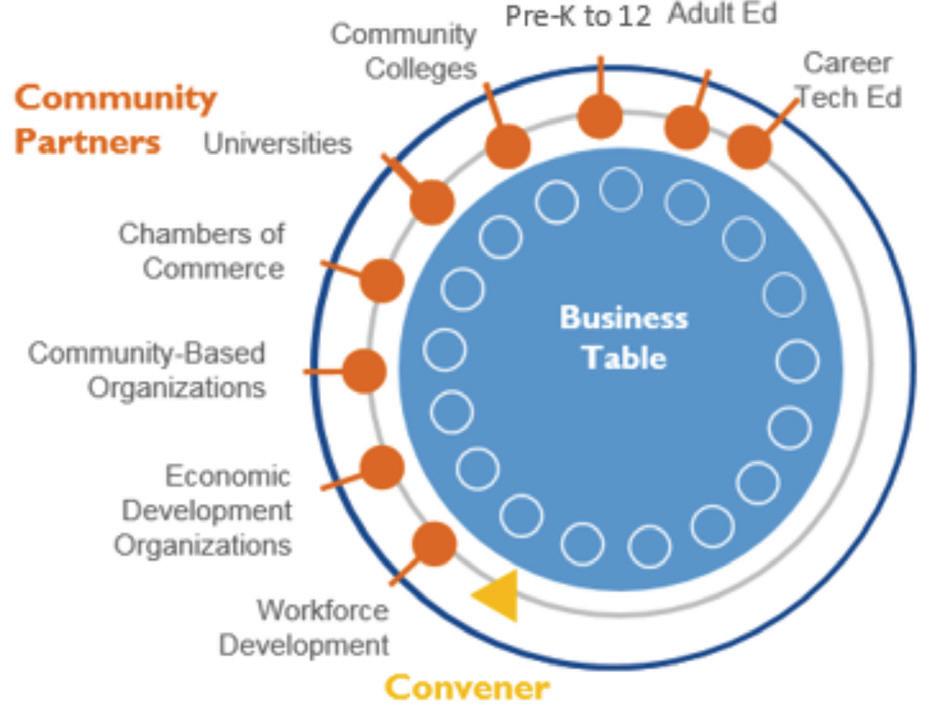
All members of these partnerships will sit at a “shared table” and commit to sustained, continuous improvement in talent development outcomes. Data driven, transparent processes will be a defining characteristic of this approach.
Next Steps
The Council has retained experts in Next Gen Sector Partnerships to assist in convening regional leadership groups that will study the partnership model and agree upon which business sectors to support in the formation of new partnerships or, where appropriate, to build upon existing strategies.
Next Generation Sector Partnerships
Business leaders form the core at the shared table of Next Generation Sector Partnerships. Diverse community partners provide implementation support for an agenda that focuses on inclusive, economic development.
Specific milestones include:
• Eight Regional Sector Partnerships will be launched by December 2021, a combination of new and expanded Next Gen Sector Partnerships that build on existing initiatives.
• Facilitate development of “Then-Now” statements from business partners and support partners in each Connecticut economic region that clearly illustrate higher levels of coordination across programs and business involvement in workforce solutions.
• Accelerate the pace and scale of best practice adoption in work-based learning (Strategy 2.3) and college graduate retention (Strategy 1.4).
• Develop a Connecticut community of practice across regions and partnerships.
Milestones & Measures
• Launch eight Regional Sector Partnerships by December 2021.
BUSINESS LEADERSHIP
12
Lead Partner OWS
STRATEGIES
1.2 Credential Registry System
The Situation
Experts anticipate that Connecticut’s economy will require 70% of workers to have some type of post-secondary credential by 2025. Hundreds of thousands of education and training opportunities exist across the nation. The list will continue to expand as new occupations emerge, and as existing jobs require new skills due to technology acceleration.
It’s difficult, if not impossible, to search and compare the different types and levels of credentials, and how these credentials translate to jobs and career pathway advancement. This decentralized environment places the burden on the end-user to search multiple sources and make important and potentially costly, life-changing decisions with incomplete information.
Understanding the cost and benefit of earning a credential is essential, particularly for a jobseeker making a career choice with significant financial consequences. An increasingly popular method for tracking the bewildering array of credentials in the marketplace is to require that all educators and trainers in a state register their credentials in a central registry using a common language that identifies associated competencies.
The Solution
Searchable and comparable data about credentials should be readily accessible, usable, understandable, and actionable for students, workers, parents, counselors, employers, educators, and policy makers.
Connecticut will launch a statewide credential registry system for secondary, postsecondary, and technical programs (credit and non-credit bearing) that improves educational access and equity, lifelong learning and career pathway advancement, and helps to sustain a globally competitive workforce for the 21st century.
Next Steps
The Council and OWS have researched models and best practices in other states to implement a single, statewide solution for uploading and searching for credentials across educational and workforce training programs.
OWS will:
• Join a regional collaborative initiative led by NEBHE to sponsor adoption of a standardized credential registry. This will provide a single, statewide solution for uploading and searching for credentials across educational and workforce training programs.
• Assemble groups of stakeholders, including Regional Sector Partnerships and representatives from high schools, community colleges, state universities, private colleges, and other workforce and training program providers, to oversee planning and implementation.
• Finalize a roadmap and timeline for adopting a set of standardized reporting requirements in partnership with registry stakeholders.
• Provide ongoing user support and introduce new online products and services to support other Career Building strategies.
Milestones & Measures
• Agree upon a plan for creating a Connecticut credential registry by June 2021.
13
Lead Partners OWS, CSCU, OHE, IHEs, NEBHE
700,000 Postsecondary and
Credential Programs by Type in the US TYPE COUNT Postsecondary Educational Institutions 370,020 MOOC Providers 7,132 Non-academic Organizations 315,067 Secondary Schools 44,209 Source: credentialengine.org BUSINESS LEADERSHIP STRATEGIES
Over
Secondary
1.3 Skills-Based Hiring and Training System
The Situation
Employers often screen potential employees on the basis of degree attainment, viewing the degree as an easy proxy for hard and soft skills. In the process they miss out on lots of talent and compound a negative dynamic for jobseekers who just want a chance to show what they have to offer. In addition, this dynamic has the negative effect of excluding lower income jobseekers who have been unable to afford higher education, locking in a vicious cycle.
Research suggests that skills-based hiring strategies expand the talent pool while de-risking the hiring process and result in significant benefits for jobseekers and employers, such as reductions in employee turnover and training time. In the process of detailing the skill requirements of a particular role, the employer provides clarity to both jobseekers and educators which translates to greater transparency and efficiency in the labor market.
Connecticut continues to expand skills-based training offerings that align with industry-valued certifications and credentials, but a gap exists in the development of skillsbased hiring strategies.
The Solution
Connecticut will promote a skills-based hiring and training environment that provides greater equity and access and sets new standards for how educators train individuals for in-demand jobs. Ultimately, the process will more effectively and quickly match qualified jobseekers with employers, and create immediate economic benefits for workers, employers, and communities.
Our state government will provide leadership by launching a skills-based hiring initiative in 2021. We will also launch a skills-based hiring working group that will develop plans for a more comprehensive skills-based approach to building our workforce in both the public and private sectors.
The Damaging Effects of Degree Inflation
A 2017 article published by the Harvard Business School titled, “Dismissed by Degrees: How degree inflation is undermining U.S. competitiveness and hurting America’s middle class” explored how degree inflation created an imbalance in the jobs market. The article references an analysis of 26 million job postings that revealed new job postings contained a requirement for a college degree when, in fact, the current employee: a) did not hold a college degree; and b) the job requirements and skill competencies to perform the work had not changed. For example, 67% of job postings for Supervisors of Production Workers required a bachelor’s degree or higher when in fact only 16% of workers employed in this occupation met those degree requirements.
Degree inflation shrinks the talent pool and overlooks qualified candidates based on competencies and experience. It can also mean employers pay higher wages to a worker with a college degree, and experience higher turnover. For jobseekers, degree inflation places individuals at a disadvantage who cannot access high quality education, particularly disadvantaging Blacks, Hispanics, opportunity youth, and ex-offenders, among others.
Next Steps
OWS will:
• Establish a working group consisting of key Connecticut companies and other relevant partners to develop skills-based hiring and training strategies that increase the opportunity to work, especially for vulnerable populations. This working group will serve as the catalyst in formulating a plan for several pilot initiatives to be rolled out in 2021 and 2022, as well as the creation of our statewide skills-based hiring strategy in 2023. The Connecticut Department of Administrative Services has agreed to develop a series of skills-based hiring initiatives beginning in early 2021.
• Encourage Regional Sector Partnerships to use skills based job descriptions, hiring and training practices as they seek to bring greater clarity and efficiency to their sector growth strategies.
Lead Partners
Milestones & Measures
OWS, DAS
• Launch three to five skills-based hiring pilot initiatives during 2021 and 2022, including pilot initiatives in Connecticut state government.
• Agree on a plan to scale skills-based hiring practices statewide by 2023.
14
BUSINESS LEADERSHIP
STRATEGIES
1.4 Retain College Graduates
The Situation
Connecticut’s higher education system is comprised of 42 colleges and universities. Of these, 19 are public institutions, 19 are nonprofit private schools, and four are for-profit private institutions. Each year, over 150,000 students attend these institutions. But we are producing graduates who too often leave the state upon graduation. In 2017, 34% of Connecticut’s four-year college graduates remained in state one year after graduation, compared to 42% in Massachusetts and 53% in New York. Graduates remaining in Connecticut benefit from staying connected to family, the high quality of life, attractive job opportunities, and career pathways.
The Solution
Connecticut can grow its talent pool and attract more businesses by providing more postsecondary students with meaningful internship experiences in their college years and highlighting the rich, diverse quality of life in Connecticut. Employers can play a leading role in retaining home-grown talent while helping to win the war for talent. Students who have substantive work-based experiences and develop meaningful work relationships during college are much more likely to remain in state after graduation. Opportunities to seed retention efforts will increase as our work-based learning and Regional Sector Partnership initiatives gain greater traction.
Next Steps
Lead partners will initially focus on two areas:
• City-Based Plans. The Council has retained Campus Philly – a Philadelphia talent retention organization – to help Connecticut develop city-based plans to help Connecticut college students feel at home in their college towns and encourage them to start their careers there after graduation. AdvanceCT has agreed to sponsor the growth and development of this network of local talent retention initiatives.
• Talent Retention Organizations. Three cities that serve as hubs for higher education - Hartford, New
Spotlight: Campus Philly
Campus Philly’s mission is to fuel economic growth by encouraging college students to study, explore, live, and work in the Greater Philadelphia region. In other words, Campus Philly helps college students fall in love with Philadelphia and launch their careers there after they graduate.
Four “generations” of college students have attended college in the region since Campus Philly’s creation in the early 2000s. The results speak loudly to the success of the model:
• 115% increase in Philadelphians 25 to 34 with college degrees (2000 and 2017)
• 118,500 more young degree holders in the Greater Philadelphia region (2000 vs. 2017)
• 54% retention of its regional college students (compared to 42% in Boston)
Haven, and Stamford - have expressed interest in launching talent retention organizations. Talent retention initiatives, typically supported by local economic development entities, will take primary responsibility for inviting local colleges, businesses, and other community organizations to join in building around two primary initiatives that can substantially improve talent retention – strengthening careerfocused internship opportunities during the college years and promoting Connecticut’s quality of life to the graduating talent pool. These organizations will encourage local businesses to think more aggressively about building internship programs that take the risk out of their long-term hiring programs while helping to build a more diverse, stable employee base. Local teams will sponsor city-wide social events for local college and graduate students that create buzz while showcasing a variety of activities – music and entertainment, industry discussions and job fairs, and speaking events. Students from diverse backgrounds will gain exposure to the breadth of the local community and meet one another in a fun, future-focused setting.
Lead Partners Advance CT, City-based teams, Regional Sector Partnerships, IHEs
Milestones & Measures
• Launch talent retention organizations in three cities by 2022.
• Increase retention of undergraduates by 5% in participating markets within five years.
15
BUSINESS LEADERSHIP STRATEGIES
1.5 Regional Workforce Development Board Alignment
The Situation
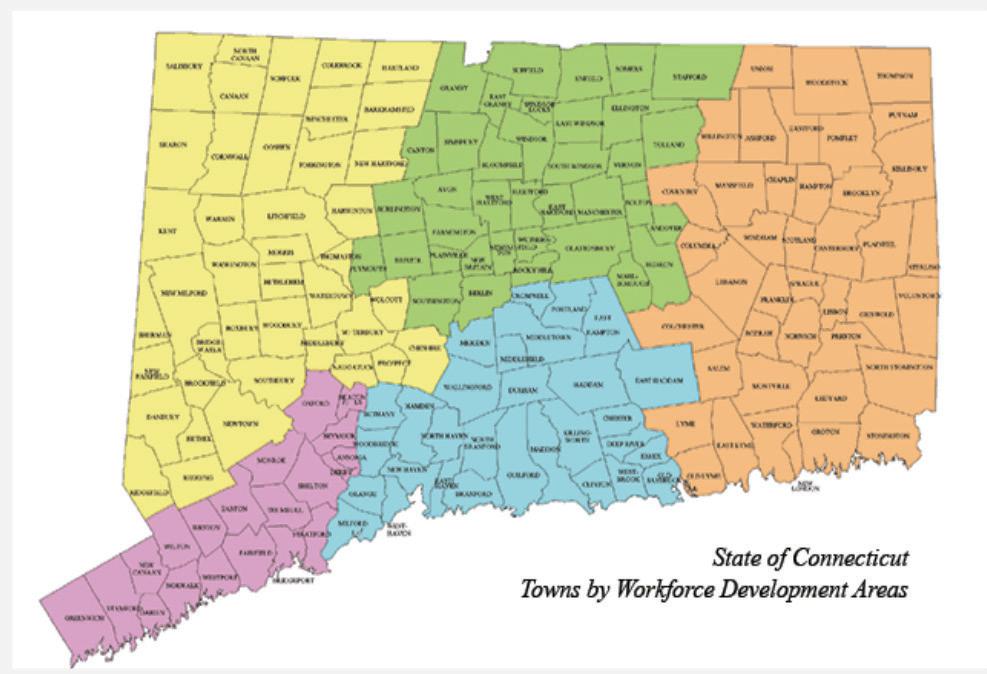
The workforce system includes a broad range of government, private, and nonprofit programs that are aimed at increasing the employment, retention and earnings of participants while increasing the attainment of recognized postsecondary credentials. These programs address various target populations, including displaced and unemployed workers, incumbent workers, youth, Veterans, returning citizens, and people with disabilities who seek to re-enter the workforce. Some of these programs are coordinated at a state level by the Council, which serves as the state workforce board, and many are managed through our five regional workforce development boards (WDBs). Other workforce programs currently in operation are managed by a range of state agencies, including DOL, DOE, ADS, DSS, DMHAS, and OEC, in addition to various education and training providers, businesses, and labor unions. Our residents can access these services at the American Job Centers (AJC), which are managed by DOL and WDBs. AJCs facilitate access to a wide array of services, including education, training, supportive services, and job placement.
The federal Workforce Innovation and Opportunity Act (WIOA) strengthened the alignment of workforce development by imposing unified strategic planning requirements, common performance accountability measures, and requirements governing the one-stop delivery system. WIOA places an emphasis on coordination and collaboration at the federal, state, and local levels to ensure a streamlined and coordinated service delivery system for jobseekers (including those with disabilities) and employers.
Connecticut’s regional WDB system has long been a source of creative workforce solutions, and it employs many of the state’s most experienced workforce professionals. Our legacy approach to grantmaking among the WDBs, however, has too often emphasized intra-state competition rather than coordinated planning and execution. With our renewed commitment to strategic statewide integrated workforce planning, the time has come to revisit the ways in which we align and integrate these activities without undermining the local insight and entrepreneurial energy that powers our regional leadership.
Connecticut’s Five Workforce Development Areas
Increasingly, our companies, educators, and strategies are multi-regional and require coordinated action. Our workforce system should be more aligned with this trend and better support multi-regional planning and service delivery.
The Solution
OWS, DOL, and our regional WDB leadership will commence a process designed to improve our alignment in serving the needs of our jobseekers, educators, and corporate partners. Better data systems and outcomes transparency will encourage a more rigorous sharing of best practices and program analysis, preserve the benefits of local knowledge and creativity, and deliver best-in-class support for Connecticut’s workers.
Next Steps
The core partners will:
• Analyze best practices in WDB coordination in other states and by surveying our partners in Connecticut to understand how to best serve their needs.
• Analyze current state and regional WIOA plans to identify additional alignment opportunities.
• Publish an operational optimization and alignment plan by December 2021.
Lead Partners
Milestones & Measures
OWS, DOL, WDBs
• Publish a WDB operational optimization and alignment plan by December 2021.
16 BUSINESS LEADERSHIP STRATEGIES
2.1 Career Pathways
The Situation
An integrated statewide career pathways system starts with learning about careers in elementary and middle school, includes career exploration and work-based learning in high school and college, and provides supports that enable any adult to capitalize on a well-articulated system of learning, training, and job opportunities. Along the way, a career pathways system will provide academic and career counseling informed by labor market conditions and available education and training options, and offer tools so that individuals can make necessary and informed financial decisions. An effective system will provide opportunities for gainful employment for students seeking to enter the workforce after high school, as well as students continuing on to complete a postsecondary program.
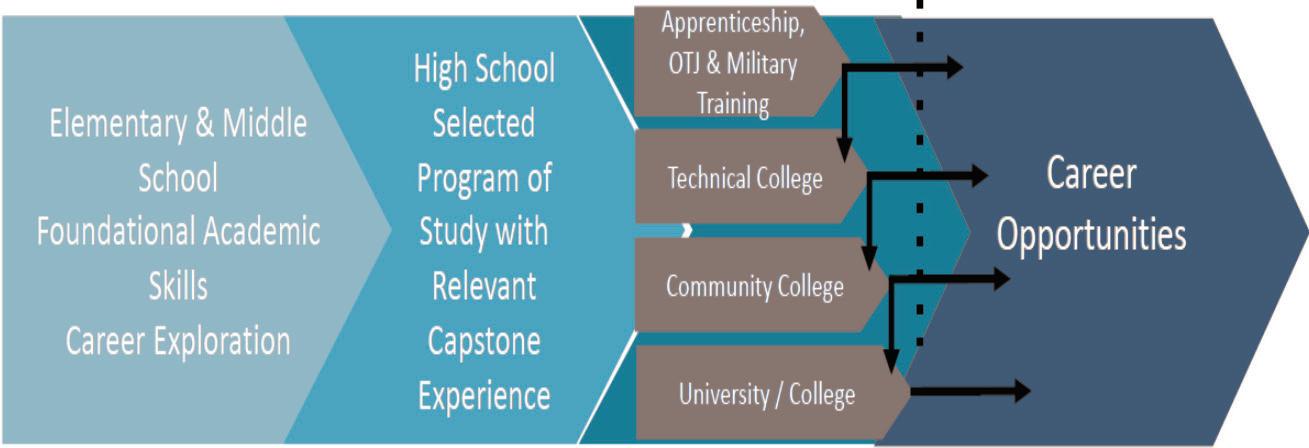
Educators and employers must work together to address today’s rapidly-evolving talent needs. Research shows that, by 2025, 70% of Connecticut jobs will require some form of postsecondary education or training, compared to a 54% postsecondary attainment level among our workers. To address this need, we will need to significantly strengthen the standards for partnership among educators, employers, and supporting players.
The building blocks for a strong career pathways system exist within many of Connecticut’s current partnerships among educators, employers, workforce boards, and others. But we have lacked coordinated leadership and alignment across partners, and often face limited resources to make this a reality. This will also require changing our educators’ accountability measures, developing rapid response capabilities in our educator/ employer partnerships, and redefining our shared goal to embrace a practical “pathways approach” that will provide greater opportunity for career growth and advancement while creating a more dynamic talent environment.
The Solution
Connecticut must develop an integrated career pathways strategy that effectively responds to today’s workforce challenges and opportunities. This should include a reimagination of our educational system that responds to our
Spotlight: Tennessee Pathways
rapidly changing, digitally-driven workplace. As it pertains to the education system, this requires a more responsive, adaptive curricular development system, modernization of the teacher preparation, professional development, and certification system, more career focused student advising resources, and an accountability system that incentivizes desired system change. Parallel changes must occur in the workforce and business sectors to assure needed progress.
Next Steps
OWS will, among other things:
• Continue to develop strategies and a legislative agenda that support a statewide integrated career pathways buildout.
• Support the CSCU’s Guided Pathways initiative and facilitate its effective integration into a statewide plan.
• Support revisions to the SDE’s Next Generation Accountability System that incentivize pathwaysoriented reforms at the district level.
• Promote Regional Sector Partnerships as engaged in pathways-oriented planning and as integral to creating effective long-term workforce partnerships.
17 CAREER BUILDING – EDUCATING OUR WORKFORCE
STRATEGIES
OWS, CSCU, SDE, IHEs
Lead Partners
Milestones & Measures • Develop a comprehensive, flexible Career Pathways System plan by December 2021.
CAREER BUILDING – EDUCATING OUR WORKFORCE STRATEGIES
2.2 Sector-Based Training
The Situation
Sector-based training strategies address specific workforce shortages or skills mismatches that limit business profitability and growth. They can provide immediate in-demand employment opportunities for jobseekers while providing a long-term talent pipeline for businesses. These training strategies require partnerships among employers, educators, training providers, and workforce boards. The most effective partnerships provide a durable feedback loop among all partners that rapidly converts market needs into ready talent in an inclusive, cost-effective manner.
High-growth, high-demand industry sectors in Connecticut include advanced manufacturing, information technology, healthcare, and life sciences. These sectors offer a combined 15,000 to 20,000 annual job openings. Job definitions are evolving rapidly and skills requirements are changing apace, demonstrating the need and the opportunity presented by a strong sector-based training capability. Computer science and information technology competencies play an especially important role across all of these sectors, particularly in the era of automation and artificial intelligence. Similarly, professional skills such as problem solving, teamwork, and communication are critical components of any training program.
Connecticut has a strong history of organizing sectorbased training partnerships, such as the nationally acclaimed Manufacturing Pipeline Initiative. Institutional partners such as our regional workforce boards and institutions of higher education continue to increase capacity to support these strategies. Yet, a significant labor shortage exists in high-demand sectors due to insufficient training capacity, an underdeveloped talent pipeline, and a lack of marketing focus to attract students to these rewarding careers. Building a responsive sectorbased training system will require redoubling these efforts and seeking to institutionalize them through the sustained effort of our Regional Sector Partnerships, our WDBs, and leadership in education and industry.
Healthcare Reskilling Pilot
In response to the COVID pandemic, a free 4-6-week certificate-level online/blended training program is being offered through the community college system for Certified Nursing Assistants and Central Sterile Processing Technicians. The program targets displaced workers from the hospitality and retail sectors with strong customer service skills. Wraparound supportive services and achievement coaches were provided. CARES Act funding was used to scale the program and expand offerings to include Pharmacy Technicians and Medical Assistants. As a result, over 200 displaced workers will enter gainful employment with living wages and career pathways in response to a pressing need of our healthcare employers.
The Solution
Connecticut must build scalable and sustainable sector-based training strategies that address near-term shortages and anticipate emerging needs. These training programs must include opportunities for returning citizens, youth, Veterans, and other individuals with barriers to employment.
Next Steps
OWS will build a dynamic sector-based training system that meets industry and jobseeker needs by:
• Refocusing training dollars to support training for indemand jobs.
• Expanding high-quality training providers and programs while ending underperforming programs based upon outcomes data and applying an ROI framework.
• Working with educators, WDBs, and other partners to better align training programs with industry needs through redesigning curricula, incorporating workbased learning, and increasing the number of shortterm certificate programs.
• Seeking federal and philanthropic support for skills training on the strength of proven outcomes, employer/educator alignment, and creative design.
Lead Partners OWS, Regional Sector Partnerships, WDBs, IHEs, SDE
Milestones & Measures
• Propose a series of new sector training programs for high-priority jobs in manufacturing, healthcare, and IT by December 2021. Build a process to scale the strategy statewide.
18
2.3 Work-Based Learning
The Situation
Work-Based Learning (WBL) includes a continuum of activities from middle school through postsecondary education that are designed to prepare students with real-world experience and applied learning that can inform and enable successful career exploration and preparation. Many Connecticut employers and educators currently partner to offer successful WBL activities including internships, career fairs, worksite tours, clinical experiences, pre-apprenticeships, apprenticeships, and on-the-job training.
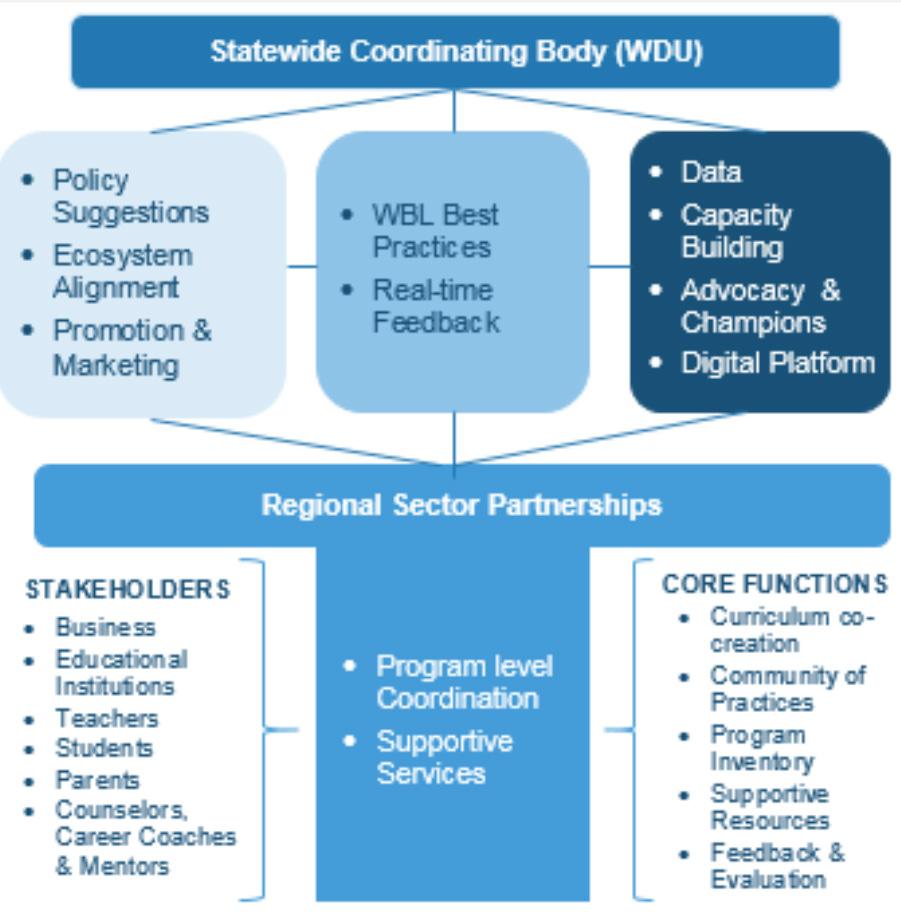
An effective WBL system promotes a shared understanding among stakeholders of the competencies and skills required, provides a process for collaboration, communication, and learning about best practices, and allows for maximum programmatic flexibility. Best practice programs in the state range from highly structured initiatives in which educators and employers co-create school curriculum that complement work experiences (such as NAF, P-TECH, and our state technical high school system) to organic initiatives such as company-sponsored internships for students with a demonstrated interest in a given field. The most effective way to enhance WBL opportunities involves developing a statewide system that will engage stakeholders as well as facilitate coordination, communication, and implementation.
The Solution
OWS will coordinate WBL activities at a statewide level. This will include the creation of a digital platform for sharing best practices, enabling communication, and facilitating a community of practice among WBL system participants. OWS will also promote and market WBL activities to multiple stakeholders such as students, parents, school counselors, educators, and employers to engage more participants in these activities. At a regional level, the Regional Sector Partnerships will help convene local stakeholders to improve program-level coordination among educators, employers, and workforce boards.
Next Steps
OWS will:
• Provide, along with the Regional Sector Partnerships, overall coordination of WBL activities across the state.
• Continue to work with the K-12 partners and across institutions of higher education to develop specific policies and practices for better integrating WBL programming with career pathways education programs.
• Promote , along with the Business Committee of the Council, the creation of more internship programs for college students to improve career outcomes, strengthen company recruiting performance, and increase college graduate retention in Connecticut.
Milestones & Measures
• Create a state-level WBL intermediary function by June 2021.
• Launch a WBL portal and marketing initiative by December 2021.
19
CAREER BUILDING – EDUCATING OUR WORKFORCE STRATEGIES
Partner OWS
Lead
Proposed WBL Ecosystem
CAREER BUILDING – EDUCATING OUR WORKFORCE STRATEGIES
2.4 Accelerating Postsecondary Access
The Situation
The increasing cost of higher education has become a barrier for students from less advantaged backgrounds to pursue postsecondary training and education opportunities that lead to high-quality careers. These students often lack access to opportunities for earning college credits in high school that can lower the cost of higher education while exposing students to attractive careers. Several steps can be taken to reverse this dynamic and provide exciting opportunities for career advancement.
Dual credit courses that are designed as part of a career pathways program can accelerate credential attainment and lead to promising career-track first jobs. Connecticut would benefit from more coordination between high schools and institutions of higher education. Immediate steps could include increasing the offerings of pathwaysoriented dual credit courses, strengthening articulation agreements between high schools and colleges, and seeking ways to reduce the cost of these programs to students.
Additional steps can be taken that would ease college entry for first-generation college students, including requiring that federal financial aid forms such as the FAFSA be completed before graduation and providing for automatic admission to the state community college and university system for all students with strong academic rankings.
The Solution
Connecticut will increase participation in dual credit programs statewide for all high school students, with a focus on educational pathways leading to living-wage careers. SDE and CSCU will lead an effort to increase the number of students completing their FAFSA applications, with a focus on school districts that score low on the Accountability Index (e.g., Alliance Districts).
P-TECH Norwalk
P-TECH Norwalk is open to all Norwalk High School students entering the 9th grade, subject to admissions via a lottery system. Students develop professional skills and STEM knowledge and can access a support system that includes counselors, teachers, IBM mentors, and classmates. Business professionals serve as mentors and allow students to interact with adults and to learn about the modern workplace. P-TECH Norwalk students can graduate from high school and earn a degree from Norwalk Community College in as little as four years. P-TECH Norwalk culminates in three possible associate’s degrees in computer science: Software Engineering, Web Development, and Mobile Programming.
The Council will also support CSCU’s plan to integrate our 12 community colleges as a way to ensure efficient and effective collaboration between industry and education. This includes supporting a common general education core curriculum that will make it easier for students to transfer credits and facilitate employers to assess career readiness and preparedness across the state.
Next Steps
CSCU and SDE will:
• Launch a Dual Credit Working Group.
• Create an automatic admission program for the state university system and other interested institutions of higher education that is triggered by a composite academic ranking.
• Require every graduating high school senior to complete a FAFSA federal financial aid form by March 31 of senior year with waiver provisions for designated subgroups. Provide additional support for students from Alliance Districts.
Lead Partners CSCU, SDE, IHEs
Milestones & Measures
• Launch a Dual Credit Working Group by March 2021. Report findings by March 2022.
• Launch an automatic admission plan for the state universities and other interested institutions of higher education in the academic year beginning fall 2023.
• Launch a FAFSA senior year completion program for the high school class graduating in 2023-24.
20
CAREER BUILDING – EDUCATING OUR WORKFORCE STRATEGIES
2.5 Academic and Career Advising
The Situation
Academic and career advising are critical for connecting students to educational and career opportunities. Advising support should begin in middle school and continue through high school and college. Ideally, advisors help to guide academic plans and career pathway exploration and preparation, identify accelerated pathway opportunities such as dual credit programs, and assist students in completing financial aid, college, and employment applications.
Presently, student advising capacity varies appreciably across K-12 school districts and is often limited to strictly academic and college admissions counseling. Career advising can provide critically-needed support for all students, including those who are considering alternatives to four-year college programs immediately following high school. Some districts have replicated nationally acclaimed models such as the P-TECH model developed by IBM, which connects students to career advisors and industry mentors. In other districts, support may be limited to encouraging students to participate in multi-district career and education fairs or accessing information online using a self-directed approach.
At the college level, initiatives are underway to provide students with dedicated advisory services and to significantly improve student to advisor ratios. Advisors provide students with clear direction about program offerings and course requirements in the context of career pathways. Their goal is to close equity gaps by focusing attention on degree completion, transfer opportunities to four-year programs, managing student debt, and placing students in high-value jobs.
The Solution
Connecticut will develop a modern advising system in which all high school and public university students have an individualized career and academic plan, with data systems to support academic and career progress and credential completion.
Integrated Approach to Student Support
“Students do not exist within a vacuum. They all bring unique educational, career, and personal goals, as well as a social context that affects the conditions they need in order to succeed. An integrated student support approach embraces this diversity of goals, needs, and contexts. It also provides a framework for institutions committed to designing a student-focused culture that delivers the combination of supports each student needs at the time they need them.”
Source: www.achievingthedream.org
Next Steps
Lead partners will:
• Secure resources to expand CSCU and UConn advising initiatives and achieve targeted advising ratios. The Council supports a requirement that all community college students be responsible for maintaining a personal Guided Pathways Plan.
• Introduce career pathway advisors into more middle/ high school systems via regional school alliances with support from Regional Sector Partnerships and local businesses.
• Make currently mandated high school Student Success Plans part of an active career pathways advising process and tracking system. Track college and career readiness for all students.
• Collaborate with WDBs and other community partners to identify WBL counselors, career coaches, and/or mentors to support awareness of career pathway frameworks.
Milestones & Measures
• Develop a regionally-based high school career advising system by December 2021.
• Achieve a CSCU student to advisor ratio of 250:1 by 2024.
21
Partners CSCU, UConn, SDE, WDBs, IHEs
Lead
2.6
Improving Preparedness for Students and Teachers
The Situation
Student and teacher preparation have to evolve in response to changing conditions. For today’s students, digital literacy ranks with reading and writing as a core competency. Teachers face the same challenge if they are to remain effective. In addition, our legacy systems for teacher preparation, certification, and professional development are outdated and hinder our progress. If we don’t address these needs now, we will be compromising our future while others are aggressively planning ahead.
Students today face a world in which almost all jobs require basic digital skills, and an increasing number rely upon advanced capabilities as artificial intelligence and big data redefine work. Students with computer science skills will expand their career pathway options, opening up higher-wage opportunities. More outreach programs that encourage K-12 students to enroll in data science and CS higher education programs are needed as well as increasing access and capacity in higher education to meet these talent needs.
Teachers require at least basic digital training to keep up with their students, and we need hundreds of CS teachers. This means that the state will have to invest in teacher professional growth, promote new hiring practices, update teacher training and certification, and provide sufficient technology infrastructure to support students and school personnel.
Teacher preparation, certification, and professional development requirements reflect the accumulation of ideas from several decades that have resulted in countless burdensome requirements that are often ignored because of their impracticality. A redesign will allow us to address today’s needs, and it is a needed reinvestment in our teachers’ futures.
The Solution
A state plan for high school computer science was passed by the State Board of Education in 2020, and a teacher professional development task force from 2017 proposed
Support for Computer Science
93% of parents want their child’s school to teach CS, but only 45% of high schools teach it.
67% of parents and 56% of teachers believe students should be required to learn CS.
50% of Americans rank CS as one of the two most important subjects of study after reading and writing. Students who learn CS in high school are 6 times more likely to major in it, and women are 10 times more likely.
Source: Code.org
a set of policy recommendations. We should expand and capitalize upon the progress of these groups and work with CSCU and UConn to expand K-12 outreach programs and increase enrollment in college-level data and CS programs.
Next Steps
Lead partners will focus initially on four areas:
• Digital Literacy and CS Competencies. SDE will develop a plan for use of ISTE (technology instruction) standards in educator preparation programs across school districts’ curricula. CSCU, SDE, UConn, and Connecticut’s private colleges will agree upon desired CS alignment, hosted by the CS for CT Committee.
• Teacher Professional Development. The Governor will convene a task force in 2021 to refine recommendations generated by the Educator Professional Development Requirements Task Force.
• Teacher Certification. SDE will assess and refine current teacher certification regulations to include digital literacy competencies.
• Higher Education. The Council will support resources for CSCU and UConn to expand K-12 outreach programs and increase enrolment in college-level data science and CS programs.
Lead Partners SDE, CSCU, UConn, IHEs
Milestones & Measures
• Convene the CS for CT Steering Committee by March 2021.
• Reconvene the Educator Professional Development Requirements Task Force by March 2021.
• Adopt Next Gen Accountability System measures for HS digital literacy and CS by December 2022.
• Develop a plan for standard utilization of ISTE standards across school districts by December 2022.
22 CAREER BUILDING – EDUCATING OUR WORKFORCE
STRATEGIES
2.7 Adult Education System
The Situation
Adult Education (AE) programs serve the most vulnerable populations by providing adult basic education, high school equivalency courses, and ESL learning. Over 320,000 of our residents (12% of all adults) have not earned a high school diploma. An additional 20% of high school diploma holders have not mastered sufficient basic skills for postsecondary and employment success. A third and growing population of 120,000 people are non-native speakers learning English as a Second Language (ESL) and building a path to citizenship. The need for adult education is significant and growing.
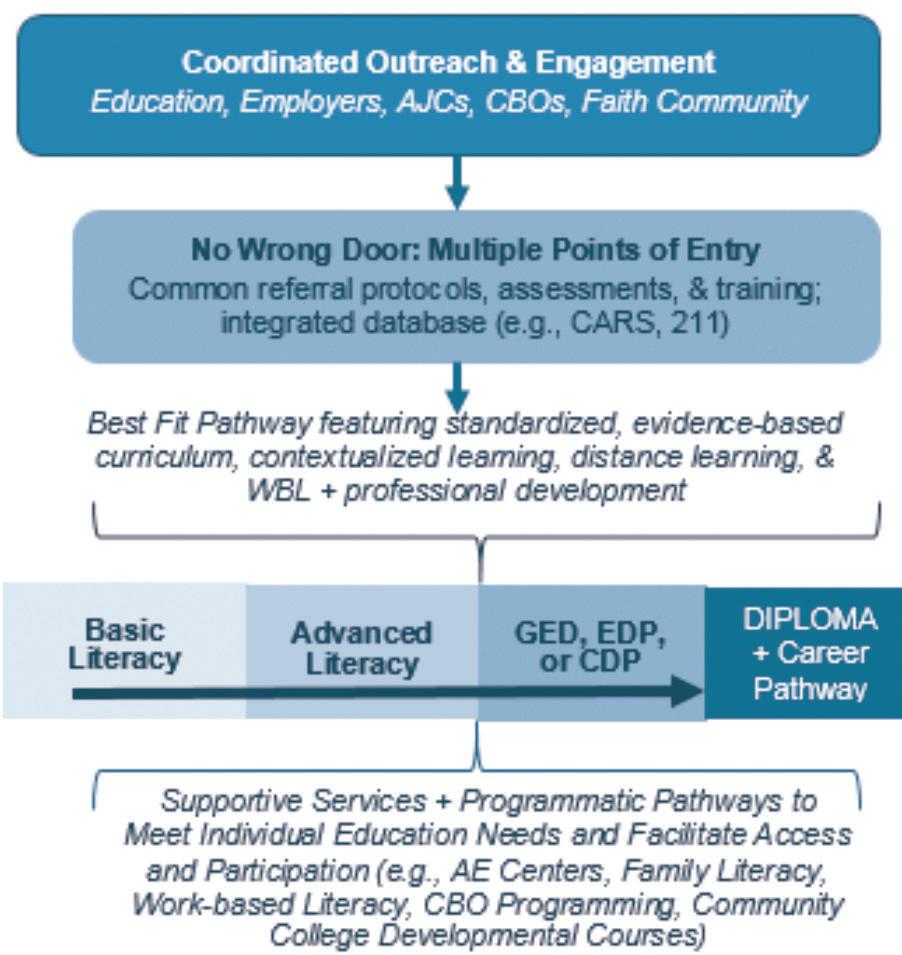
The primary objective for the vast majority of AE students is to achieve greater career success by upgrading their educational and vocational skills. As a result, a number of states are increasing the coordination across Adult Education, Community Colleges, WDBs, and employers. Aligning the curriculum and programs of these stakeholders is essential to a well-functioning workforce development system.
Connecticut’s spending for AE averages $1,500 per student, one tenth of the average annual per student cost for K-12 education. This lean approach translates into breakdowns at the system level and in the classroom. Issues include: a) limited program offerings; b) insufficient capacity of qualified full-time AE teachers; c) limited opportunities for contextualized learning; d) a lack of coordination and alignment among AE providers, WDBs, and community colleges across intake, assessment, and referral processes and protocols; and e) limited support services and distance learning options to address barriers to participation such as child care, transportation, and work schedules.
The Solution
Connecticut should create a coordinated, accountable adult literacy system that links Adult Education, community colleges, and regional WDBs to deliver education and training programs tailored to students’ goals and needs. The AE system should support a contextualized and work-based learning approach to help students achieve their desired outcomes. The new approach should include
Lead Partners SDE, CSCU, WDBs
Milestones & Measures
common curriculum standards, increased distance learning options, navigators to guide students along their pathways, and regional marketing campaigns to raise awareness of AE programs. The system should expand eligibility to include high school diploma holders who need further education to increase their access to employment and postsecondary education. Connecticut will also need to substantially rethink its funding approach for AE.
Next Steps
A statewide working group made up of key stakeholders will:
• Develop the overall goals and plans for improving the success of the AE system.
• Seek private and public funding to support regional demonstration projects to demonstrate the value of taking an integrated, contextualized approach to delivering adult education and workforce training.
• A working group including AE, CSCU, and WDBs will develop plans and goals to redesign AE by Q1 2021.
• Implement a regional pilot in Q3 2021.
23
BUILDING –
STRATEGIES
CAREER
EDUCATING OUR WORKFORCE
Capital Region Adult Education Concept
3.1 Expand Capacity of the Early Child Care Education System
The Situation
The COVID-19 pandemic has exacerbated the crisis in access and affordability in Connecticut’s early childhood education (ECE) system. According to federal standards, affordable child care should cost no more than 7% of a family’s income. The annual ECE cost in Connecticut averages $15,501 for an infant and $12,731 for a 4-year old. Using federal standards, only 11.5% of all Connecticut families can afford infant care. Our low-wage residents need to work full time for approximately 9 months to pay for care for one infant.
Options to access affordable, high-quality ECE remain limited. Nearly 44% of Connecticut residents live in a “child care desert”. This percentage increases to 58% in lower-income neighborhoods. The estimated unmet need for infant and toddler care exceeds 50,000 spaces. Consequently, nearly one in 10 parents of young children either quit a job, did not take a job offer, or changed jobs because of child care considerations. A shortage of ECE providers and staff driven by low wages, low reimbursement rates, and a lack of support for child care providers contributes to the ECE supply gap.
A strong ECE system: a) supports children through important developmental stages and increases school readiness; b) keeps parents attached to the labor force; c) increases employer access to qualified workers; and d) leads to increased tax revenues and a reduction of public benefits for the state in the future.
The Solution
The Council supports existing efforts by the Connecticut Office of Early Childhood (OEC) to enact system-wide reform and integrate these efforts with business-led strategies that increase opportunities for working parents to earn, to learn, and to support their families.
CT Cares for Family Child Care
In May 2019, OEC, alongside philanthropic partners, launched this program to provide support to licensed family child care providers during the COVID-19 public health emergency and beyond. The approach connects families with providers through a Family Child Care Network (FCCN), entities that offer support services, including professional development, business coaching, and administrative support to providers.
Next Steps
The Council supports OEC’s ongoing efforts to advance a multi-phase plan to expand access, improve affordability, and increase quality of the ECE system.
OEC will:
• Expand the Supply of Child Care Providers. This work will feature: a) securing US DOE CCAMPIS funding to support child care for low-income parents seeking a degree; b) promotion of Staffed Family Child Care Networks, a low-cost, COVID-resilient model of operation; and c) encouraging our colleges to maximize federal support for student support services such as child care and transportation throughout the CSCU system.
• Redesign the ECE System. OEC will use its current planning and community engagement process to reimagine the child care system. This system will more effectively serve parents and align government, private sector, and philanthropic funding to scale and sustain viable business models for providers.
• Align Reimbursement Rates to the True Cost of Care. OEC will develop an estimate of the true cost of care across all ages to inform legislation on new reimbursement rates – considering cost differences by geographic area.
Lead Partner OEC
Milestones & Measures
• Develop a plan to redesign the ECE system by December 2021.
• Increase the number of colleges and universities leveraging CCAMPIS funding in Connecticut from 5 to 17 by the end of 2022.
• Increase state child care subsidies to cover the true cost of care that providers realize by 2023 with no net loss of child care slots.
24 EQUITY AND ACCESS STRATEGIES
3.2 Reduce Transportation Barriers
The Situation
Inadequate transportation services and the cost of personal transit make getting to and from training and work a significant barrier for under-resourced and unemployed Connecticut residents. Similar to child care access, transportation barriers become even more severe for individuals who work non-standard hours, do not live on public transit routes, or live in rural areas.
Access to affordable public transit and individualized transportation solutions will increase the training completion and workforce participation rates of lowincome and vulnerable populations. Employers benefit from increased reliability of employees and higher employee retention. The return on investment for the state includes an increase in tax revenue and a decrease in utilization of public benefits.
The Connecticut DOT has established proven programs that provide affordable transportation solutions to individuals enrolled in state colleges and universities. These programs enable students at public colleges to access bus, rail, and other local transit through a majority of transit systems across the state at no cost, or a heavily discounted rate.
Participants in non-credit workforce training programs do not currently receive this level of access to transportation supports. A similar approach can be used to replicate the student-centered model for participants enrolled in non-credit bearing workforce training programs and adult education programs. Additionally, proven models for individualized transportation solutions exist in areas of Connecticut with less public transit. However, a unified effort does not exist to scale and sustain these models statewide.
The Solution
The Council recommends: a) increasing access to affordable public transit passes for individuals participating in non-credit bearing workforce training programs; and b)
Lead Partners DOT, OWS, WDBs
Milestones & Measures
Rides for Jobs Program
Rides for Jobs is a program operated by the Eastern Connecticut Transportation Consortium that provides transportation services to low-income residents for employment-related transportation. During FY 2019, this DOT-funded program provided transportation services to 774 low-income residents of eastern Connecticut, brokering nearly 24,000 trips. Clients of the program were referred by case managers from over 25 different social service organizations.ness coaching, and administrative support to providers.
expanding proven models that offer reimbursements for individualized transportation solutions (typically for rural participants) to and from non-credit bearing workforce training programs and employment-related activitiess.
Next Steps
Lead partners will focus initially on two areas:
• Bulk Purchasing of Transit Passes. The DOT should establish a revenue neutral bulk transit pass purchasing program in partnership with regional workforce development boards, SDE, adult education providers, and other community-based organizations that provide quality certificate training programs to ensure that individuals participating in workforce training programs have access to affordable public transit options. Additionally, the DOT should expand the UPASS program to benefit students attending independent colleges.
• Rides for Jobs Program. OWS will collaborate with the state’s workforce development boards to develop and implement a plan that expands and scales the Rides for Jobs program model now operating in Eastern Connecticut.
Both the transit pass bulk purchasing program and the expansion of the Rides for Jobs program will require additional funding.
• Develop a bulk transit pass purchasing program for individuals enrolled in non-credit bearing workforce training and Adult Education programs by September 2021.
• Expand UPASS program to benefit students at independent colleges by December 2021.
• Expand the Rides for Jobs program to provide more affordable and individualized transportation solutions to an additional 2,500 to 3,000 low-income individuals participating in job-related activities annually.
25 EQUITY AND ACCESS STRATEGIES
3.3 Expand Access to Behavioral Health Services
The Situation
Currently, only one fourth of the 100,000 people accessing state-funded mental health services are employed. The remainder are either unemployed (20%) or not in the labor force (53%). An opportunity exists to increase the workforce participation rate of this population.
Supportive Employment Services (SES) include evidence-based practices such as personalized benefits counseling, rapid job search, and permanent access to ongoing services. The benefits of SES include increased employment rates for individuals with serious mental illness, reduced spending on mental health services for those individuals, and employer access to a broader, more diverse pool of potential employees.
The federal Ticket to Work program reimburses the state based on the employment outcomes of individuals on SSI and SSDI that participate in SES services. The Connecticut Department of Mental Health and Addiction Services (DMHAS) offers SES and Individual Placement and Support (IPS) services. However, limited capacity exists to scale the program across the state’s Community Mental Health Centers (CMHC).
Behavioral health is one of many barriers that prevent individuals from entering the workforce, and SES can help to address those other barriers as well. Other agencies in the state, including the Department of Aging and Disability Services, also provide SES for their respective populations. Any efforts to expand SES for behavioral health challenges should inform and coordinate expansion of SES for other populations with barriers to employment.
The Solution
The Council supports DMHAS’s plan for a phased approach to expanding its provision of SES and IPS services. This approach will require additional state resources to build infrastructure and capacity, which in turn will leverage federal reimbursements to expand SES programming without drawing down additional state resources.
The Challenge
• 60% of individuals with serious mental illness want to work but only 20% are employed
• Only 2% of target population has access to IPS
The Impact
• 27 of 28 randomized control trials show a positive impact from IPS
• Mean employment rate of 55% for IPS participants as compared to 25% for control group
• Compared to traditional services, IPS participants have 3x the earnings and job tenure
• Employment reduces mental health services costs by $538 in a six-month period
Next Steps
DMAHS will:
• Pilot the expansion program in 2021 at selected CMHCs across Connecticut. This includes increasing administrative capacity, developing key partnerships, building data-sharing capacity, and achieving operational efficiency to scale the program.
• Assemble partners such as CMHCs, regional workforce development boards, employers, and other community partners to review findings of the pilot phase and develop a more robust expansion plan.
• Lead the expansion programming during 2022 and 2023 with CMHC partners.
The Council also recommends exploring how the expansion of SES at DMHAS can be applied to other populations in need of employment supports.
Milestones & Measures
• Increase the number of SES slots from 2,000 to 4,000 by 2023.
26 EQUITY AND ACCESS STRATEGIES
DMHAS, CMHCs
Individual Placement and Support Highlights
Lead Partners
EQUITY AND ACCESS STRATEGIES
3.4 Reduce the Adverse Effects of Benefits Cliffs
The Situation
Benefits cliffs refer to a reduction in public benefits such as child care or healthcare due to an increase in income. Often times, an increase in wages does not offset the value of a decrease in benefits. This means some workers may decide to halt their wage and career progression in exchange for protecting existing benefits.
Complex and layered social services and benefits make it difficult for families to predict whether an increase in earned income will yield more or less total income. Benefits cliffs can dis-incentivize career advancement and create income uncertainty for low-income individuals. The cliff effect shrinks the labor pool for employers.
Policy solutions that remove the adverse effects of benefits cliffs will lead to increased workforce participation rates, increased economic stability for low-income residents, and improved prospects for career pathway advancement. Self-sufficiency and career pathway advancement of residents benefits the state by increasing tax revenue and reducing benefits spending.
The Solution
The Council supports revenue-neutral changes that incentivize work and career progression while eliminating benefits cliffs. These solutions may include introducing or extending benefits phase outs, implementing earned income disregards, reducing or removing asset limits, and increasing the earned income tax credit (EITC).
Next Steps
OPM and DSS will approach the work in two phases:
• Phase 1. Benefits Cliffs Policy Analysis. OPM, DSS, and other state departments will analyze the fiscal implications and impact of benefits cliffs policy recommendations with the assistance of the Federal Reserve Bank of Atlanta’s Benefits Cliffs Dashboard.
An Example of the Impact of Benefits Cliffs
Who: A 25-year-old single mother of two school-age children.
Career Pathway: Certified Nurse Assistant (CNA) to Licensed Practical Nurse (LPN) to Registered Nurse (RN).
Impact: From ages 25-33, the household net income would be unchanged regardless of an accelerated credentialing success a CNA, LPN, or RN due to benefits cliffs.
Potential Benefits to State: The estimated lifetime net public savings from moving from a CNA to an RN range from $300,000 to $400,000.
• Phase 2. Development of High Impact Policies. Findings from Phase 1 will inform the development of longer-term policy options including:
o Extending benefits phase outs for programs such as SNAP, TANF, Medicaid, and housing subsidies.
o Increasing the state EITC for target populations.
o Implementing “earned income disregards” to smooth benefits cliffs.
o Increasing asset limits in SNAP, TANF, and other programs to incentivize savings.
Phase 2 activities will include the development and implementation of a Benefits Cliffs Personal Financial Calculator. The calculator will aid policy-makers as well as workers in understanding the short- and longterm effects of their training and career choices in very practical, easily understandable terms.
Lead Partners OPM, DSS
Milestones & Measures
• Convene a working group including OPM and DSS to analyze and propose regulatory and legislative initiatives that will mitigate the negative effects of benefits cliffs, producing a report to the Governor and the Assembly by September 2021.
• Adopt the Federal Reserve Bank of Atlanta’s Benefits Cliffs tools for use by Connecticut’s state caseworkers, counselors, and analysts by December 2021.
27
ACCOUNTABILITY AND DATA-DRIVEN MANAGEMENT STRATEGIES
4.1 Online Workforce Development Services
The Situation
Every state offers a set of online job-related tools and resources for jobseekers, employers, and workforce professionals. The online tools typically include job search assistance, a job board, resume builders, an inventory of employment and training offerings, and labor market information.
The pace of change in the work and training market and the development of new online employment-related tools have created an opportunity to improve the user experience for online tools. Jobseekers and other users face challenges in navigating the rapid expansion of sources and content, which now includes personality assessments, career interest inventories, career coaching, online recruiting, and online training courses. Jobseekers need an easy-to-use online portal to find jobs, education, training, employment, and other services, such as financial aid or housing assistance.
The Solution
Connecticut will enhance its online job-related systems and improve equity of access to these offerings. The enhanced system will include information on labor market conditions, career pathway advancement strategies, and lifelong learning opportunities while providing users with access to regional partners who can offer support. The system should also provide data about program employment outcomes, affordability, and available financing along with supportive services information that can help to sustain a work and training strategy.
Next Steps
OWS will appoint an Online services project team project team to make recommendations for improving online service offerings. The team will:
• Include subject matter experts from various state agencies and the private sector, as well as users.
My Colorado Journey Lead
My Colorado Journey connects adults, families, and students to transformational career, education, and training opportunities, as well as state resources and benefits programs. My Colorado Journey saves everyone time, money, and resources by reducing duplication of state tools and services. The platform connects jobseekers and students to careers, education planning, and support resources through a guided process that drives action and goal completion. Special campaigns such as “Colorado Applies Month” offer a five-week guided process to help participants identify a best-fit education and training option, apply for the program, and even get help accessing financial aid. At the end of the process, applicants can apply, for free, to any Colorado public college, university, and technical school, as well as selected private institutions. Several Colorado state agencies support this effort, including Higher Education, Labor and Employment, Workforce Development Council, and the Human Services Child Welfare Division.
• Develop typical user profiles to better understand the current experience of online jobseekers as well as practitioners and field staff who use CTHires products and services.
• Develop compelling use cases for new system features and make recommendations to:
o Improve the jobseeker’s career pathways exploration experience through a system that is intuitive, has real-time information, and is datadriven.
o Redesign and/or develop new resources and tools, including third-party apps and support technologies that are powering best practices in other states.
o Provide ongoing training to practitioners and field staff.
o Develop protocols for continuous quality improvement.
Milestones & Measures
• Propose a comprehensive online services redesign by year end 2021, including delivery of an initial prototype of the new system.
28
Partners OWS, DOL, WDBs, DAS
ACCOUNTABILITY AND DATA-DRIVEN MANAGEMENT STRATEGIES
4.2 Data and Performance Management Tools
The Situation
Each year, we generate lots of data regarding participation and outcomes for dozens of state-sponsored workforce programs. Too much of this data is inaccessible to decision-makers and is often provided in a way that is difficult to use. In some cases, this is the result of restrictions in enabling legislation or regulations. In other cases, program data is not collected or presented consistently. Finally, outcomes are rarely presented in a framework that enables “apples-to-apples” comparisons across programs or a “return on investment” analysis that can be used by agency managers or legislators to make sound decisions on program investments or participation.
The Solution
Connecticut must build data and performance management tools at both a system-wide and a program level that illuminate our results and help the Council to analyze program impact and return on investment. Ideally, these tools will build the capacity to analyze the effectiveness of programs alone and in combination and also better understand labor market trends. This functionality will help decision-makers understand the participants in workforce programs, the services they receive, and the outcomes.
Next Steps
OPM and OWS will advance work in three areas. Specifically:
• System-wide Dashboard. OPM will assist OWS to design and build a publicly-available workforce data dashboard. OPM and OWS will catalogue available data sets and technology platform requirements for the dashboard. OWS will coordinate a process to prioritize and socialize goals and metrics with public and private stakeholders. OWS will publish a set of dashboards in coordination with all agency “owners” by December 2021.
Washington Workforce Training Results
The Workforce Training and Education Coordinating Board is Washington’s performance accountability agent, working on behalf of the state’s citizens and employers. The Workforce Board tracks the results and return on investment for 12 of the state’s largest workforce programs. These programs account for over 98 percent of the federal and state dollars spent on the state’s workforce development system. Washington reports standard outcomes, like employment, earnings, and skills, while also including net impact estimates and taxpayer and participant return on investment results for key programs. The results are presented in an interactive dashboard and tables by program. Net impact and ROI reporting are required by legislative mandate at two- and five-year intervals, respectively.
• Program-level Data. OWS, DOL, and other state agencies will assemble an inventory of existing workforce programs with comprehensive enrollment and outcomes data. The next steps involve: a) putting the program-level data from all relevant agencies into a usable format, assuring that complete data sets are available continuously; and b) developing a standard process for presenting and analyzing data to inform decision-making.
• Net Impact and Return on Investment (ROI). An expanded P20 WIN integrated data system will provide a cross-agency data platform to support net impact and ROI analyses for workforce training programs. Specifically: a) DOL and OPM will complete research on best practice methodologies used in other states to compare programs and impact, especially when clients receive multiple services, and will develop recommendations for the Council; and b) DOL and OPM will develop a methodology and recommended approach to pilot a net impact and ROI evaluation on up to two programs in 2021, in consultation with the Council and OWS.
Milestones & Measures
• Create standard system-wide performance dashboards and ROI templates by December 2021.
29
Partners OPM, OWS
Lead
ACCOUNTABILITY AND DATA-DRIVEN MANAGEMENT STRATEGIES
4.3 Integrated Data System
The Situation
Linking data “longitudinally” – across contemporaneous programs and user groups – allows decision-makers to understand the impact of policy decisions, such as the extent to which preschool experiences correlate to education or employment outcomes. The availability at the state level of data on program usage and outcomes, like earnings or employment, can be a very powerful policy-making tool if data are integrated effectively.
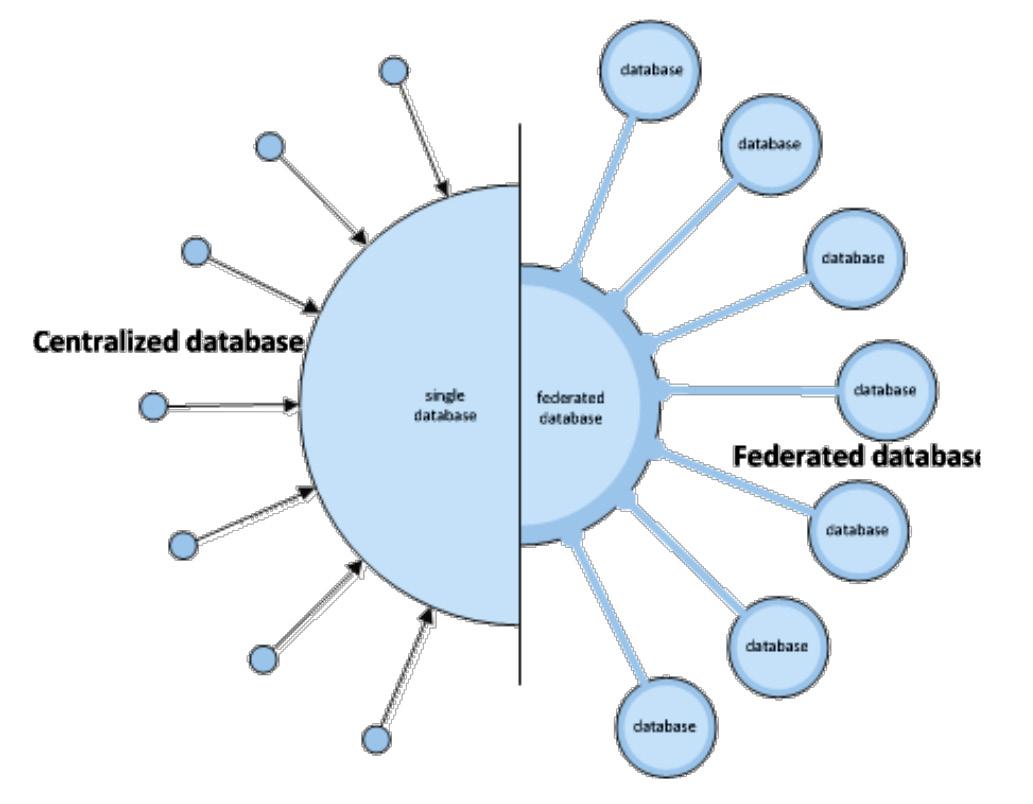
The Preschool through 20 and Workforce Information Network (P20 WIN) system in Connecticut is used to inform sound policies and program practices to ensure that individuals successfully navigate supportive services and educational pathways into the workforce.
As currently constructed, the P20 WIN system uses a federated approach that conducts individual analytic projects “a la carte” upon receiving requests from partner agencies or other research organizations. An opportunity exists to build greater analytic capacity and to improve the accessibility, speed, and scope of the current system.
The Solution
The P20 WIN participating agencies are developing a plan to expand the scope of P20 WIN to include social service, homelessness, child welfare, and financial aid agencies to provide an understanding of workforce and social program outcomes across a much broader, more textured universe of users.
In addition, OWS will develop requests for standard program reporting and analytics that, among other things, will provide essential time series data for trend analysis that can be invaluable in understanding how our tax dollars can be used for maximum impact.
Next Steps
P20 WIN partners will:
• Increase the capacity of its P20 WIN cross-agency
Transition to a Centralized Data Hub
The Council recommends a capital investment to develop centralized data hub or warehouse architecture. The centralized approach will increase speed of processing and accessibility. The current approach involves a federated data system that imports the data from other databases using approved protocols and processes.
Milestones & Measures
analytic team by onboarding analysts and technical staff in 2021 with the support of a federal grant. This analytic team will research topics and produce data that supports Council priorities and informs data and performance management tools (Strategy 4.2).
• Pursue opportunities to participate in data analytics training for state agency staff, with higher education partners. This effort will enable agency and partner staff to improve capacity for data analysis.
• Review the technical infrastructure for the P20 WIN, including the development of a data integration hub, using a data lake or warehouse structure. This review will focus on faster turnaround times for standard data requests, and will improve accessibility to data sets by practitioners at schools, training providers, and other partners.
• Obtain agreement of all relevant state agencies to join the P20 WIN longitudinal data group by June 2021.
30
OPM, P20 WIN partners
Lead Partners
CHAIRPERSON
COUNCIL MEMBERS
Garrett Moran, Year Up, Former President
VICE CHAIR
Kelli-Marie Vallieres, Office of Workforce Strategy, Executive Director
Cliff Asness
AQR, Managing Principal
Peter Bevacqua
NBC Sports, President
Cindi Bigelow
Bigelow Tea, CEO
Marna Borgstrom
Yale New Haven Hospital, CEO
Oni Chukwu
Invatron Systems Group, Director
Board of Directors & Exago, Inc.
Chair of the Board of Directors
Monette Ferguson
ABCD Inc., Executive Director
Kevin Graney, Electric Boat, CEO
Lieutenant Governor Susan Bysiewicz
Juan Hernandez, 32BJ SEIU, District Director and Vice President
Senator Tony Hwang, CT Senate District 28
Margaret Keane, Synchrony, CEO
Ravi Kumar, Infosys, President
Dr. Ruth Levy, Bozrah School District, Superintendent
Jim Loree, Stanley Black & Decker, CEO
Sal Luciano, Connecticut AFL-CIO, President
Judy Olian, Quinnipiac University, President
Dave O’Neill, Indeed, COO
Peter Salovey, Yale University, President
Erika Smith, ReNetx, CEO
Chris Swift, The Hartford, CEO
Leslie Torres-Rodriguez, Hartford Public Schools, Superintendent
Representative Toni Walker, CT House District 93
Jay Williams, Hartford Foundation for Public Giving, President
EX-OFFICIO MEMBERS
Timothy Larson, Office of Higher Education, Executive Director
Beth Bye, Office of Early Childhood, Commissioner
Miguel Cardona, State Department of Education, Commissioner
Colin Cooper, Department of Economic and Community Development, Chief Manufacturing Officer
Peter Denious, AdvanceCT, President and CEO
Scott Gaul, Office of Policy and Management, Chief Data Officer
Vanessa Dorantes, Department of Children and Families, Commissioner
Josh Geballe, Chief Operating Officer, State of Connecticut & Department of Administrative Services, Commissioner
Deidre Gifford, Department of Social Services, Commissioner
Tom Katsouleas, University of Connecticut, President
David Lehman, Department of Economic and Community Development, Commissioner, & Senior Economic Advisor to the Governor
Melissa McCaw, Office of Policy and Management, Secretary
Mark Ojakian, Connecticut State Colleges & Universities, President
Amy Porter, Department of Aging and Disability Services, Commissioner
Maria Pirro-Simmons, Department of Correction
Unified School District #1, Superintendent of Schools
Kurt Westby, Department of Labor, Commissioner
Jeffrey Wihbey, Connecticut Technical High School System, Superintendent
Jennifer Widness, Connecticut Conference of Independent Colleges, President
PARTNER COMMITTEE MEMBERS
Catherine Awwad, Northwest Regional Workforce Investment Board, Executive Director
Mark Hill, Eastern Connecticut Workforce Investment Board, President and CEO
John Beauregard, Eastern Connecticut Workforce Investment Board, President and CEO (retired)
Susan Adamsen
David Allon
Alycia Angus
Mark Argosh
Joseph Carbone, The WorkPlace, President & CEO
Alex Johnson, Capital Workforce Partners, President & CEO
Alice Pritchard, Chief of Staff to the CSCU President
William Villano, Workforce Alliance, President & CEO
SOCIAL VENTURE PARTNERS
Courtney Fero
Jennifer Gerber
Patrick Hackett
Shannon Marimón
Bernie Park
Andrew Rankowitz
Tom Robey
Sylvia Shepard
Joe Smialowski
31
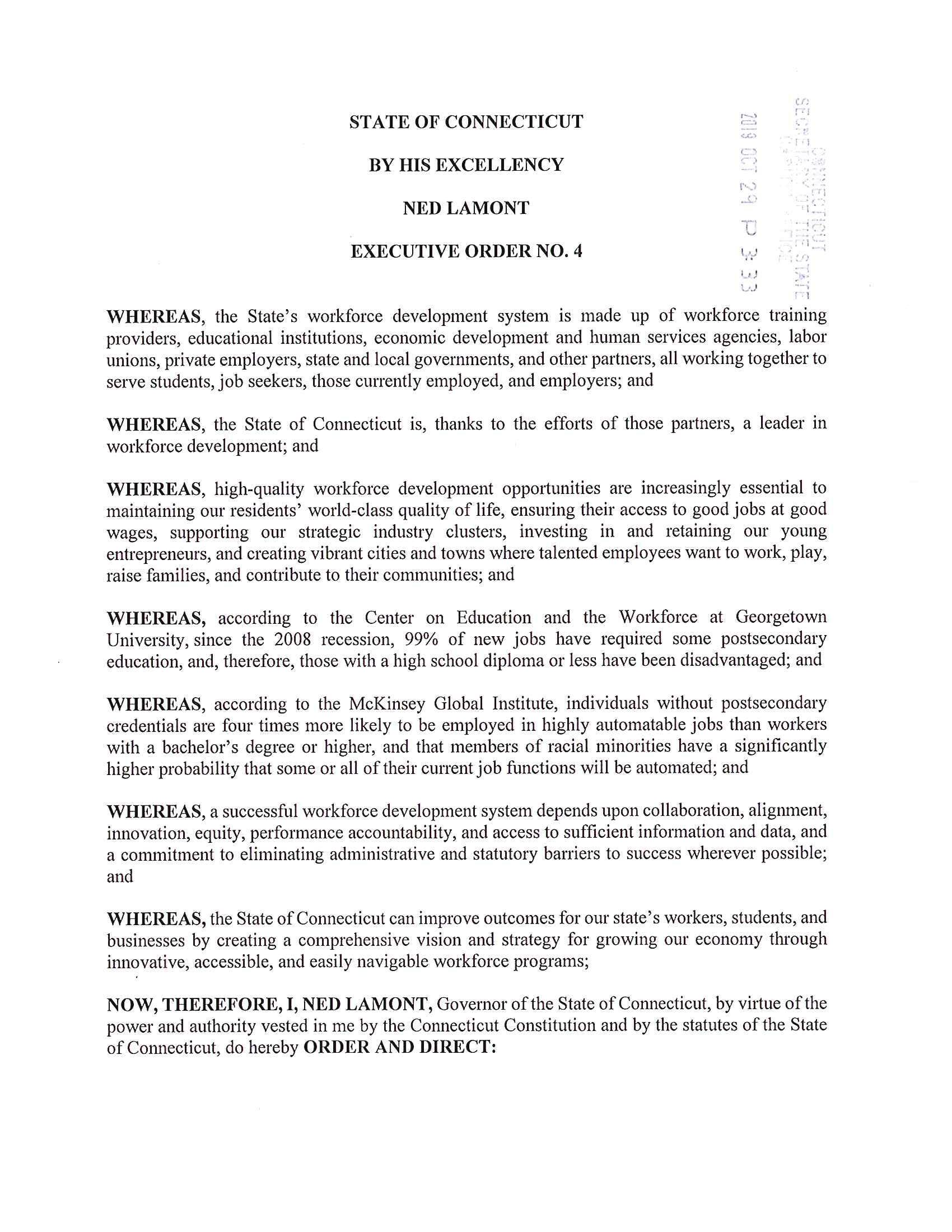
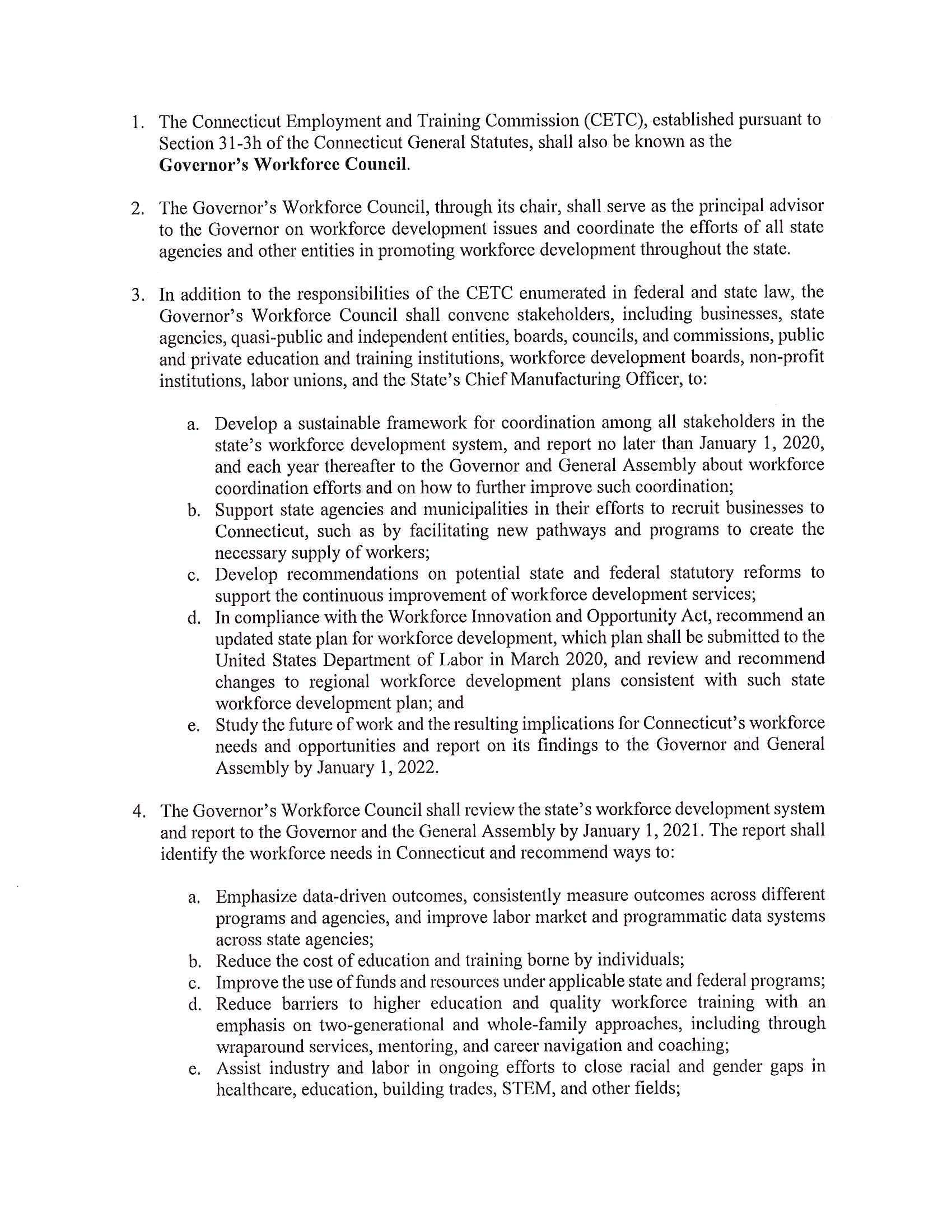
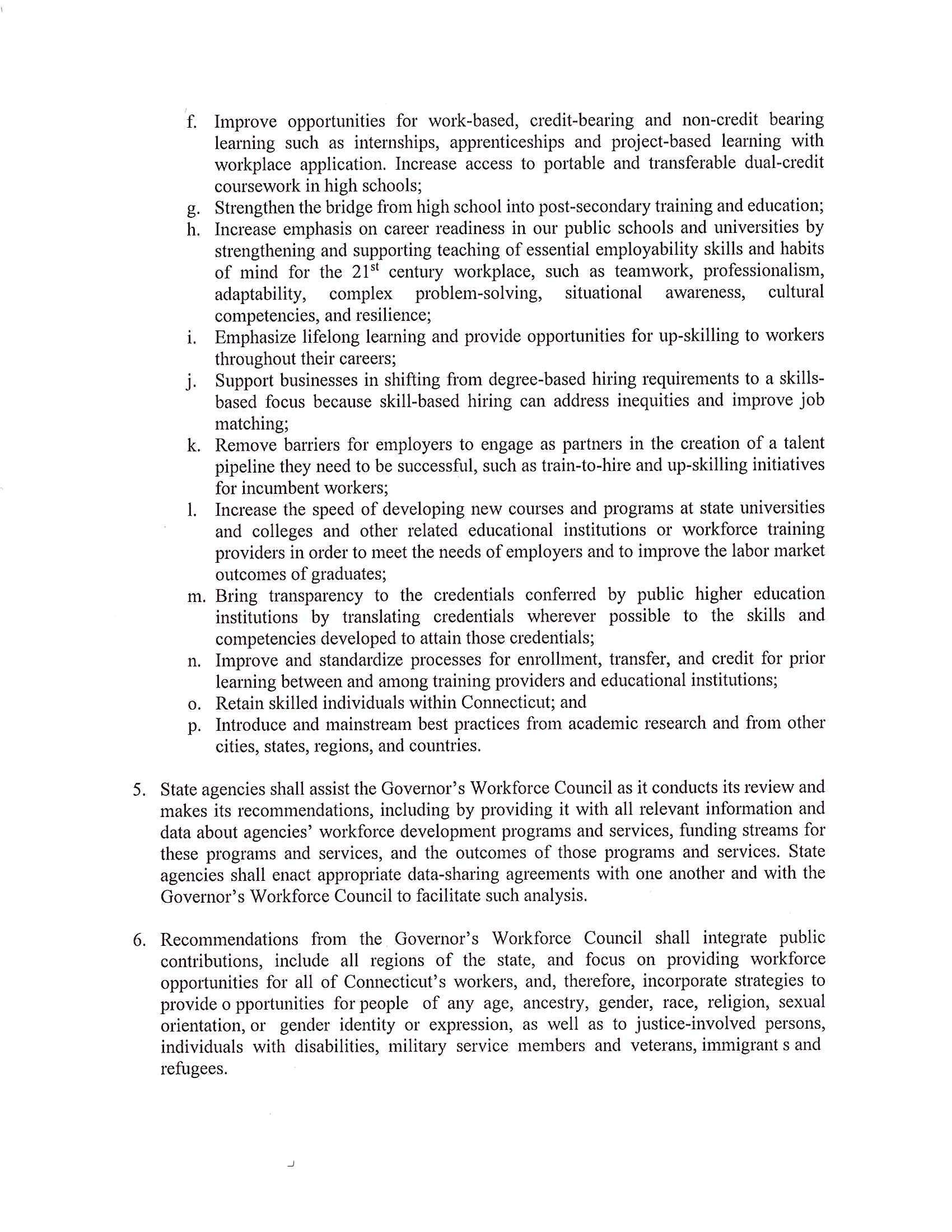

INDUSTRY SECTOR COMMITTEES
INTRODUCTION
The Council convened several industry sector committees comprised of business leaders, educators, workforce development professionals, and other diverse stakeholders. These committees analyzed workforce trends utilizing labor market information and student completion rates from education and training institutions. This information was used to assess the industry supply and demand dynamics and recommend education and training strategies to support future workforce needs in each industry sector.
The industry sector committees include:
• Manufacturing
• Healthcare
• Life Sciences
• IT and Business Services
36 APPENDICES
MANUFACTURING COMMITTEE
1. Key Findings
a. Manufacturing employment in Connecticut declined from 300,000 in 1990 to approximately 150,000 in 2012, leveled out, and then began to climb in 2016. This 25-year decline led to a reduction of training programs, shop classes in comprehensive high schools, and manufacturing in technical high schools.
b. Before the pandemic, the demand for workers exceeded the supply by at least 3,000 workers per year. Due to the pandemic, the state lost approximately 8,000 net manufacturing jobs, with a recovery rate of about 1,000 jobs per month through June. While there may be a lag in employer demand over the next six months, we expect that the supply deficit will re-emerge by the end of 2021.
c. Connecticut manufacturing is a “Tale of Two Cities:” forty percent of manufacturing employees work at 25 large companies, and 60% work at 4,000 small and mid-size firms, where the average size is 24 employees and the median is less than ten. Education and training programs need to address these diverse employer needs.
d. Aerospace and Defense and their supply chains comprise a large part of the state’s manufacturing industry. It is estimated that approximately 700 companies in the state supply products or manufacturing services to Pratt & Whitney, Sikorsky, and Electric Boat - and more if one includes those suppliers’ sub-tiers.
2. Supply and Demand Dynamics
a. Demand
i. Connecticut’s manufacturing workforce is aging. The percentage of employees age 55 and over increased from 18% in 1996 to 35% in 2018. As a result, employers must invest in incumbent worker training to replace the skills lost as the most experienced workers retire in addition to their investments in training new entrants into the workforce.
ii. Defense contracts will likely increase demand for manufacturing labor in the next three years.
iii. According to a 2019 CBIA survey, 60% of manufacturers identified workforce as their most significant immediate need, with 36% saying that they need applicants with at least a technical high school degree.
iv. Demand for manufacturing employees is projected at approximately 6,000 per year.
b. Supply
Sources of manufacturing labor in the state are not sufficient to meet the projected demand. Prominent among the sources are:
i. WDB Programs. The workforce development boards play a critical role in meeting the needs of manufacturers for workers. Most notable among these is the Manufacturing Pipeline Initiative (MPI), which is a 10-week program administered by the Eastern Connecticut Workforce Investment Board, and which has been highly successful in sourcing qualified candidates to Electric Boat, members of the Eastern Advanced Manufacturing Alliance (EAMA), and other manufacturers. According to an MPI report issued in April 2020, it had placed more than 1,571 persons in manufacturing jobs in the previous four years. The partnership between EWIB, employers, and educational institutions is a model that can be replicated (with appropriate regional adjustments) in other regions of the state.
ii. Comprehensive High Schools. 9,000 Connecticut high school students graduate every year who are neither going to college nor into the military, and this is a pool that the industry should tap into through high school manufacturing pathways programs, such as the ones occurring at Asnuntuck, Housatonic, Naugatuck Valley, and Northwestern community colleges and a new Housatonic Community College aligned program at Derby High School. In addition, in Eastern Connecticut, the Youth MPI programs are offered through Quinebaug Valley and Three Rivers community colleges. The expansion of manufacturing programs in comprehensive high schools is a challenge
INDUSTRY SECTOR COMMITTEES
37 APPENDICES
due to the decentralized nature of the K-12 school system. A key opportunity is building a manufacturing sector-based career pathway program at a statewide level.
iii. Technical High Schools. The Connecticut Technical Education and Career System (CTECS) is the largest high school system in Connecticut, serving all geographic regions and all demographics and diverse populations. In 2019, there were 362 graduates of manufacturing programs. Almost half of the graduates continued their education, generally at 2- and 4- year colleges and universities. Forty-four percent of graduates went into the workforce, the vast majority in manufacturing. The most significant opportunity here is to increase the number of CTECS students in manufacturing programs; currently only 16% of CTECS students are in manufacturing programs.
iv. Community Colleges. All 12 Connecticut community colleges provide a variety of advanced manufacturing technology programs through the College of Technology and the Advanced Manufacturing Technology Centers. This includes industry-driven manufacturing credit certificates and non-credit certificates as well as various associate’s degree programs creating a stackable credential model. Short-term programs are also offered and include pipeline, incumbent worker, and online, on-demand training to meet industry needs and requests. Across the community college system, an average of 572 students enrolled in certificate programs and 93% completed. The job placement rate is 90%. Short-term programs were provided to nearly 3,000 students in the past two years with a 96% completion rate. The ISO 9001: 2015 Certified program at Asnuntuck has an average graduation rate of 65% (nationwide community college average graduation rate is 20%). This is due in part to implementing a student cohort model. To meet industry demand, this model is being implemented across community colleges to align programs and curriculum.
v. Colleges and Universities. The State of Connecticut has excellent postsecondary institutions. However, a relatively small percentage of graduates choose to remain in the state after graduation, exacerbating the supply/demand mismatch. Among CCSU, UConn, The University of Bridgeport, and Yale, there were more than 1,600 engineering graduates last year. Through the College of Technology, a seamless pathway in Engineering and Technology degrees from the community colleges to 10 public and private universities has been in place since the early 1990s. Connecticut community colleges enrolled 2,397 and graduated 190 engineering science and technology pathway students last year. The opportunity here is to engage these engineering students through internships with in-state manufacturers to improve the retention and transfer rate upon graduation.
Goodwin College has been very effective in training manufacturing employees in the state of Connecticut. Manufacturing graduates have increased steadily since the first students enrolled in the fall of 2014, reaching 112 in 2019.
vi. The Connecticut Center for Advanced Technology (CCAT) provides significant resources for incumbent worker training, educator professional training, exposure to manufacturing programs for youth, and advanced training programs with industry.
vii. Correctional System. The Department of Correction system is a potential source of manufacturing employees. Several small-scale programs have been piloted in the state, with positive results. Through the Second Chance Pell Program, Asnuntuck and Quinebaug Valley community colleges served 108 incarcerated individuals in the 2018-19 academic year in Advanced Manufacturing Technology programs. This allowed these incarcerated students to work towards earning an Advanced Machine Technology Certificate.
viii. Online training through 180 Skills provides online learning pathways, including badges that can be stacked into higher credentials.
c. Projected Deficit
All identified training programs in Connecticut, including pipeline programs, can produce approximately 3,000 new employees per year, if filled to capacity. Demand for manufacturing employees is projected at approximately 6,000 per year, which leaves a deficit of approximately 3,000 per year. New defense contracts and the expected rise in retirements are drivers of this demand.
INDUSTRY SECTOR
COMMITTEES
38 APPENDICES
3. Proposed Manufacturing Sector Education and Training Strategy
No single education or training program can fill the expected supply deficit in Connecticut. After years of decline and stagnation, the manufacturing workforce can be replenished and rejuvenated only by a multi-faceted effort. While there has been investment in, and an expansion of, the Connecticut manufacturing training infrastructure over the past 10 years, these efforts have not been sufficient. Among the recommended efforts are the following:
• Improve awareness and attractiveness of manufacturing careers among middle- and high-school students in the state.
• Expand the capacity of technical and comprehensive high schools to provide manufacturing training.
• Reduce the skills deficit of employees entering the manufacturing workforce through expansion of pipeline programs and pre-apprenticeship programs. Online training can play a significant role.
• To improve the completion rate across all community colleges, expand the student cohort model and class offerings (both credit and non-credit) to meet industry demand utilizing online software platforms such as 180 Skills, Tooling U, and NIMS; and learning management systems.
• Engage college engineering students through internships with in-state manufacturers to improve their retention rate upon graduation.
• Expand pathways for upskilling the incumbent workforce through apprenticeship programs and stackable credentials. Re-fund the Manufacturing Innovation Fund incumbent worker training and apprentice programs.
• Expand incentives and instructor training programs for qualified, experienced employees and retirees to teach manufacturing courses.
• Support the College of Technology’s strategic plan to implement a Manufacturing Educators’ Institute that will provide professional development in advanced manufacturing technologies for current and future secondary teachers and community college instructors.
Critical to the success of these efforts will be the creation of Regional Sector Partnerships for the manufacturing industry in Connecticut. This recommendation is informed by the conclusions of this committee that:
• The diversity of manufacturing enterprises by scale, by technology, and by industry requires a regional approach to workforce development.
• The training and workforce development programs that have been most successful to date have been centered on the needs of manufacturers and have enjoyed broad support from educational institutions, workforce development boards, and other local stakeholders.
4. Risk Factors and Barriers
a. The COVID-19 pandemic has reduced manufacturing activity and employment; there can be no guarantee of how quickly the economy will recover.
b. Uncertainty around the timing of defense contracts.
c. Commercial aviation is depressed due to the precipitous decline in air travel, coupled with Boeing’s wellpublicized problems with the 737 Max.
d. The reopening of the manufacturing centers requires social distancing compliance while reducing the capacity of each class. Robust manufacturing training often requires a hands-on component. Community college advanced manufacturing programs around the state use a hybrid model of instruction with students visiting campus for the hands-on learning portion of their classes. AMTC programs need additional instructors to expand the programs.
e. Funding these strategies will be more challenging due to state budget limitations in the wake of the pandemic. Manufacturing training is more expensive than other fields due to the facilities required.
f. Lack of awareness among young people regarding the attractiveness of manufacturing careers continues to constrain the number of people participating in education and training programs. Previous marketing campaigns have proven successful such as the Connecticut Advanced Manufacturing Initiative in 2017.
INDUSTRY SECTOR COMMITTEES
39 APPENDICES
HEALTHCARE COMMITTEE
1. Key Findings
a. Healthcare related occupations represent the largest employment category in the State of Connecticut at approximately 16% of the State’s workforce or 270,000 jobs, with 220,000 in delivery of healthcare and the balance in the provision of social services.
b. Annual demand for new employees exceeds 7,000, with significant shortages in nursing, certified nursing assistants, skilled technician roles, and home healthcare.
c. Healthcare delivery in Connecticut is dominated by two large hospital-based systems, Yale New Haven Health and Hartford HealthCare, which cover most of the state and employ 25,000 to 30,000 employees each. There are three mid-sized systems, Nuvance in western Connecticut, Trinity Health of New England in Hartford, Waterbury, and Stafford Springs, and ECHN east of Hartford and in Waterbury. UConn Health, Stamford Hospital, Bristol Hospital, and Middlesex Hospital round out the balance of the delivery systems in the state.
d. Hospitals and healthcare systems are to varying degrees vertically integrated with large inpatient, outpatient, physician office locations, laboratories and imaging centers. Some also include skilled nursing and home health in their delivery systems.
e. The hospitals and systems employ approximately 80,000 people and are overwhelmingly the dominant healthcare employers in the state and at the local level.
f. Skilled nursing facilities are the second largest employer group in healthcare with approximately 30,000 employees across 213 facilities.
g. Home health agencies employ approximately 10,000 employees.
h. The balance of remaining jobs is spread out over many small employers in a very fragmented universe of physician offices, independent labs, imaging centers, outpatient surgery centers, pharmacies, and labs.
2. Supply and Demand Dynamics
a. Demand
i. Healthcare delivery is a local business with both patients and employees coming from the local community. Industry growth will tend to match state population growth and aging (which favors Connecticut since the state has the 8th oldest population in the US).
ii. Healthcare providers compete aggressively at the local level both for customers (patients) as well as employees. There is a lack of collaboration between competitive providers to solve workforce deficits. Regional Sector Partnerships can help to address this problem.
b. Supply
i. While there are a large number of administrative, financial, and marketing-related jobs in healthcare, nearly all clinical positions require a degree or certificate.
ii. Degrees and certificates are offered across a broad spectrum of public and private universities and colleges, two-year community colleges, proprietary (for-profit) schools, high schools, and other nonprofit organizations (Red Cross).
iii. The largest suppliers of degrees are the State Universities and Colleges. Private universities are meaningful contributors of graduates as well, and they are growing their programs.
iv. Certificate programs are mostly provided by the community college system, private colleges like Sacred Heart University and Goodwin College, and by proprietary institutions.
INDUSTRY SECTOR COMMITTEES
40 APPENDICES
v. Retention of graduates from BS/BA programs in the state can be improved as over half of them leave the state upon graduation. Most departing graduates have migrated to NY and Boston followed by the sunshine states (CA, FL, and TX). The state does attract a significant number of graduates from NY and Boston universities and colleges as well as RI and PA.
c. Occupation Specific Registered Nurses and Certified Nursing Assistants
• A shortage of qualified Registered Nurses (RNs) exists in Connecticut. Without factoring in nurses that decide to leave the profession for reasons other than retirement (relocation, career change, death or illness, etc.) the need for new RNs will be approximately 3,000 per year.
• Connecticut’s RN workforce totals 50,000. 52% of the employed RNs in Connecticut are over the age of 50. A number of them will likely retire in the coming 10 years.
• The number of new nursing school graduates from Connecticut colleges and universities is approximately 1,900 per year, including 700 ADN and 1,200 BSN. RN graduates are approximately equally split between Connecticut state and private colleges and universities.
• Last year, Connecticut schools rejected 7,000 qualified nursing school candidates due to a lack of educational capacity. The capacity constraints are the result of two factors - lack of faculty and lack of available clinical sites offering necessary clinical hours of onsite experience. The two factors intersect in the clinical setting, as many hospitals are requiring faculty oversight for student nurses while they are on site which, accentuates the faculty deficit.
Certified Nursing Assistants (CNAs)
• The annual churn rate for CNAs is 30-50%, and there were over 2,500 open positions in the beginning of 2020. There is a need to improve the job quality for CNAs to improve CNA retention rates. This will require buy-in from all stakeholders across the healthcare continuum.
• The CNA certificate is offered at many of the state’s community colleges, some private colleges (Goodwin and Stone Academy), the American Red Cross, a number of continuing education locations, and some technical high schools like Oliver Wolcott Technical School in Torrington.
• The course typically lasts 5-10 weeks and requires 75 classroom hours plus 25 clinical hours. The cost is usually between $1,000 and $1,600 and can be borne by the student or often the skilled nursing facility that is hiring the student.
• CNA work is viewed as physically demanding and emotionally challenging but can be personally rewarding for employees with a desire to care for others.
• Compensation for CNAs is well below the Connecticut Living Wage and often below other low-skill job opportunities, including jobs in warehousing or retail. Compensation for a starting CNA is approximately $15 to $16 per hour with shift work (nights, weekends, and holidays) paying a premium of $1 or $2 more per hour. Other states, like California, have quality job initiatives focused on healthcare.
• Most skilled nursing facilities have education and training money available for CNAs, but many do not access available career pathways due to literacy issues and the need to work multiple jobs/shifts to make ends meet. A small number do become Licensed Practical Nurses (LPN) and Registered Nurses (RNs).
• The constant replacement of CNAs impacts the quality of the care given and the experience of the residents of the facilities. These conditions have existed for some time prior to the arrival of COVID in 2019. The poor patient outcomes during the pandemic are certainly, in part, due to the understaffed, undertrained, and under-protected CNA staff.
• Skilled Nursing Facilities (SNFs) play a critical role in caring for our elderly patients who are discharged from the acute care settings. Hospital readmissions of patients discharged to SNFs are costly and negatively impact hospital quality performance metrics and reimbursement.
INDUSTRY SECTOR COMMITTEES
41 APPENDICES
Other positions
• Several positions remain in high demand, although smaller in number than RNs and CNAs. These include surgical technologists, imaging, lab and pharmacy technicians, and sterile processing technicians.
• Each of these shortages number in the 100s across Connecticut and all require either an associate’s degree or a less-than-2-year certification education. These shortages tend to be more regionally acute and are most appropriately addressed through Regional Sector Partnerships.
3. Proposed Healthcare Sector Education and Training Strategy
• A need exists to improve alignment among employers, educators, nonprofits, and students to address the significant labor shortages in nursing, assistant roles, and technicians. This will require increasing training capacity, aligning programs with the needs of employers and students, and providing supportive services to students and jobseekers.
• An additional issue is addressing job quality for entry-level, frontline healthcare jobs while supporting employer efforts at building long-term career pathways for workers.
• The Southern Connecticut COVID-19 training program sponsored by Bank of America and Social Venture Partners is an example of a successful public-private partnership that effectively responded to the immediate needs of a healthcare workforce shortage in Fairfield County. Employers were interested in retraining hospitality workers for in-demand healthcare jobs, due to their existing soft skills and customer service skills. Intent-to-hire agreements were put into place with three of the five major healthcare systems. A free 4-6-week certificate-level training program was offered through the community college system for CNA and Central Sterile Processing roles for 30 students. These educational programs were redesigned and offered in a full-time, expedited manner maximizing virtual platforms. The program also included funding for wraparound supportive services and Achievement Coaches. This allied healthcare training program has been scaled to a statewide basis through CARES Act funding and is being offered for several in-demand roles, including pharmacy technicians, CNAs, central sterile processing technicians, and medical assistants through six community colleges and will provide employment opportunities with multiple healthcare partners for over 200 displaced workers.
• Lessons learned from this program: 1) Engaging employers early in the hiring process aligns supply with demand. Educational partners can respond and design and implement programs based on employer needs; 2) Assessing and educating jobseekers about career opportunities is required to improve program completion rates as well as job retention rates. The community colleges are not adequately resourced to do recruitment, address social needs, or provide transitional/career pathway assistance to jobseekers/ students; 3) Nonprofit workforce development organizations can recruit and screen candidates, arrange employer interviews, and work with Achievement Coaches to connect students to supportive services, which improves program completion and job placement rates; 4) Recruiting students is a critical need that should start earlier in middle and high school. Marketing materials can improve awareness of the attractiveness of healthcare careers for students.
4. Risk Factors and Barriers
• A lack of formalized communication channels exists among healthcare employers, workforce nonprofits, and educators. Any improvement in workforce development must involve engagement by each of these systems at the statewide level and also at the regional level.
• Workforce nonprofits are effective connectors and service providers, but lack direct access to employer senior leadership. Business and philanthropy can help make these connections.
• Livable Wages and Benefits Cliffs: CNAs and other entry-level allied health roles often do not pay a livable wage. In addition to addressing the pay issue, it is important to reduce benefits cliffs that cause individuals to lose social services benefits if they choose to advance their careers.
INDUSTRY SECTOR
COMMITTEES
42 APPENDICES
• The industry is greatly impacted by its payor mix and reimbursement rates. An adverse payor mix greatly reduces resources and job quality at skilled nursing facilities, which are typically heavily weighted toward low-paying Medicaid clients. Acute Care settings have a diverse payor mix (Private/ Medicare/Medicaid) and are better resourced. There is a need to narrow this disparity and more equitably share resources across the healthcare system.
• The impact of COVID-19 on elective surgery revenue as well as unemployment and lack of private insurance is a current concern for the healthcare sector, and may impact hiring practices.
• A need exists for a Chief Nursing Officer at the DPH to oversee all nursing and allied health, as nursingrelated jobs make up 60% of the healthcare workforce.
INDUSTRY SECTOR COMMITTEES
43 APPENDICES
LIFE SCIENCES COMMITTEE
1. Key Findings
a. The Connecticut life sciences sector is growing rapidly, ~ 23,000 employees at ~1,300 companies. Key employers include Alexion, Arvinas, Biohaven, Boehringer Ingelheim, Jackson Labs, Medtronic, Pfizer, and Sema4.
b. The sector’s average salary of $127,000 is significantly higher than other sectors.
c. While Connecticut has a highly-ranked secondary education system, not enough students are acquiring STEM skills and relevant work experience required by life sciences companies. The sustainability of Connecticut as a life sciences hub is dependent upon the state’s ability to attract, educate, train, and retain talent.
d. Sector growth will exceed 5,000 jobs over the next 5 years, as long as Connecticut makes the necessary investment in incubator/wet lab space and builds a broader life sciences workforce development program.
e. The most important workforce development needs are to:
•Engage high school students/teachers (especially from underserved communities) in STEM.
•Build alliances with Connecticut colleges/universities to train teachers to prepare high school students.
• Implement the BioPath Skills Institute, linking content and skills to careers with industry partners.
•Expand BioPath’s degree and certificate programming with work-based learning components.
• Engage life sciences companies statewide to communicate job and internship openings and make work-based learning widely available at all levels of education.
• Develop leadership programs to create more entrepreneurs and C-suite executives. Connecticut is currently unable to fill existing and future C-suite openings.
• Expand upskilling opportunities for employees who want to advance their careers in project management, quality assurance, data management, and other areas.
2. Supply and Demand Dynamics
a. Demand
i. 750 life sciences job openings exist statewide. These job openings are distributed across a mix of small, mid-sized, and larger firms.
ii.Yale’s incubation of 30 startups per year creates a demand for an additional 300 employee per year.
iii. Key talent categories: 1) Lab techs (w/out postsecondary credential), 2) Research Associates, 3) QA specialists, 4) Biostats, 5) Clinical trial managers, 6) Senior Scientists, 7) Business leadership
b. Supply
i. Life Sciences companies need employees with a combination of academic and applied skills that will be acquired through internships plus on-the-job training - before hire.
ii.From 2014-2019, 3,000 students from community colleges to university graduate programs obtained life sciences credentials. At the present sector growth rate, talent shortages may approach 50%.
iii. Retention of college graduates and industry talent is a challenge.
INDUSTRY
SECTOR COMMITTEES
44 APPENDICES
3. Proposed Life Sciences Sector Education and Training Strategy
The ultimate objectives of the sector-based education and training strategy includes:
• Increase the number of life sciences-prepared HS graduates by 10% in 5 years.
• Increase by 10% in 5 years the number of community college graduates with life sciences skills.
• Increase the number of industry-relevant programs (credit and non-credit) by 10% in 5 years.
• Increase the statewide college retention rate of 32% of college graduates to 45% within 5 years.
• Fill the pipeline with qualified and trained mid-level managers to C-suite executives.
The recommended approaches include:
a. Support initiatives to build a more robust K-12 STEM pipeline:
• Provide high school students and teachers opportunities to learn about the life sciences sector and provide teacher training to develop requisite skills sets.
• Offer experiential learning programs to high school students. High school graduates can qualify for laboratory jobs if they develop skills through work-based learning.
b. Enhance employment market data to provide better information for employers, jobseekers, and educators
• Obtain regularly updated information from companies seeking interns and employees, make offerings known to students and prospective employees, and host interchanges for students, employees, and companies.
• Conduct employer needs assessments to project future demand for jobs requiring advanced degrees.
• Develop a job portal to reduce friction for job placement. Educational institutions need to adopt a “train and place” mentality to align their programs with local employee demand.
c. Produce more life sciences/STEM graduates with the relevant applied skills and experiential learning needed for the life sciences workforce:
• Expand industry partnerships to create internship opportunities, building upon the successes of existing programs (e.g., CT Innovation Talent Bridge, BioPath, CSCU DOL/JAX Initiative).
• Address supply of jobs not needing BA degrees by working with community colleges.
• Expand accelerated dual degree BS-MS programs that incorporate internships/experiential learning requirements. Industry needs go beyond biology and include computer science, business, and engineering disciplines.
• Scale existing project-based learning programs (e.g., Professional MS Programs, BioPath BS in Biotech, CSCU DOL-funded Health and Life Sciences Initiative).
d. Expand training programs at the management- and C-level by scaling up executive training programs to address a shortage in qualified mid-level and C-suite employees.
e. Implement “soft skills” proficiency through formalized training.
4. Risk Factors and Barriers
• Connecticut has many startup companies now and in the pipeline. These companies need lab space to establish proof of concept. Connecticut needs startup (incubator space) and graduation space (standalone companies or leasable floors) as these companies grow from 1-5 people to 200+.
• COVID-19 physical distancing presents obstacles to on-site, work-based learning opportunities.
• Resources are needed to prepare curricula for schools/colleges to adopt.
INDUSTRY SECTOR COMMITTEES
45
APPENDICES
IT AND BUSINESS SERVICES COMMITTEE
1. Key Findings
Information Technology
a. Information technology is one of the highest-growth sectors in the US economy and can provide significant employment and business growth for Connecticut, if the state can address its talent shortfalls and build effective educational and career pathways. There are currently 5,888 open computing jobs, while only 564 bachelor’s degrees were awarded in computer science and 1,480 degrees in STEM fields.
b. Retention of student graduates is a critical issue in STEM, where the state has an annual yield of only 577 graduates in STEM fields vs. 1,480 degrees awarded.
c. The majority of Connecticut’s 48,000 IT jobs are located outside of technology companies (25,000 inside companies, 5,500 jobs in professional services and 16,250 jobs in technology product companies). These IT jobs cut across sectors including manufacturing, financial services, professional and business services, healthcare and life sciences, and government.
d. COVID-19 Impacts: Gartner estimates the global impact on IT spend to be a 5-8% reduction over the next year with the mix of spend rotating away from discretionary innovation budgets and into cloud and remote working enablement. CT DOL job posting statistics show IT postings on a slight uptick in June and July, so the mix of Connecticut jobs in IT may be less susceptible to this crisis than other states.
Business Services
a. Business services is a very large Connecticut sector, with 228,000 jobs in professional and administrative functions. The current opportunities are concentrated in specialized niches like business operations, market r.
b. The number of business services jobs is expected to decline due to the increased use of automation/AI, the increased level of outsourcing and remote work, and the focus of companies on reducing their operations and overhead costs. Given this reality, Connecticut needs to focus on more highly-skilled technical job categories in key sectors like healthcare/life sciences, manufacturing, and financial services.
c. There is a significant need for workers to enhance their digital skills and professional skills to prepare themselves for business services jobs.
2. Supply and Demand Dynamics
a. Demand
i. On a long-term basis, as many as 13,000 people will be required in IT and business services. The roles with the greatest demand include software developers, cloud engineering, network architects, information security analysts, data engineers, computer user support, database administrators, bookkeeping and accounting clerks, financial and management analysts, customer service representatives, and market researchers.
ii. Over the past ten years, Connecticut has lagged other high-growth states in STEM job growth with 13% growth vs. 30% growth in Virginia.
INDUSTRY SECTOR COMMITTEES
46 APPENDICES
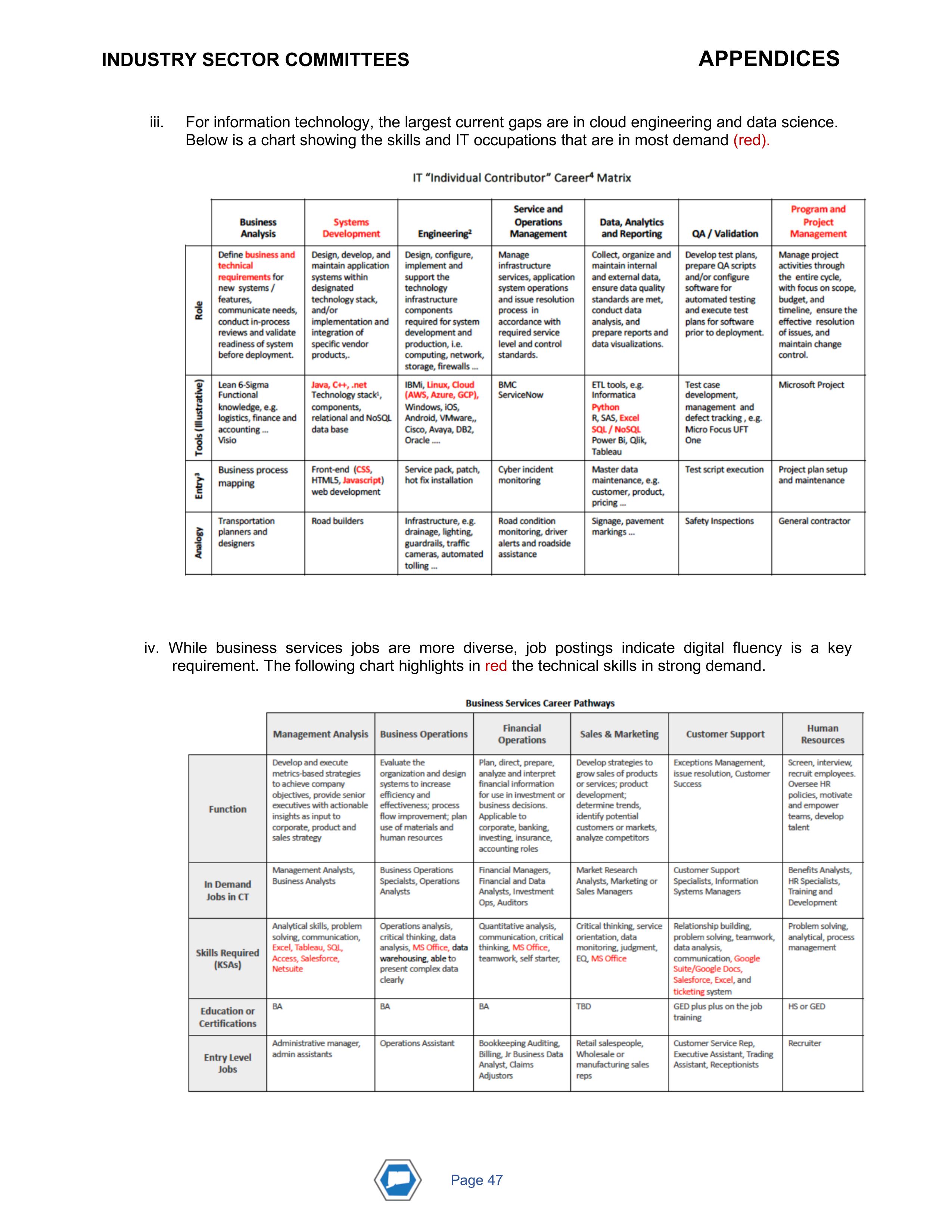
b. Supply
Not enough graduates exist to meet the demand for IT and selected business services roles. Employers are hiring the existing college graduates and recruiting talent from other states. The current sources of supply include:
i. Colleges and Universities. The four-year colleges produced 1,480 graduates in math, computer science, and MIS but only retained 577 students in the state. The schools with the largest number of graduates are: The University of Connecticut (452), CCSU (175), Yale (157), ECSU (100), and Quinnipiac (94).
ii. Community Colleges. The 12 community colleges produce 1,300 certificate and associate degree completions in computer science and information sciences, math and statistics, marketing, and related support services. Norwalk Community College partners with IBM to offer the P-TECH early college program to several hundred Norwalk students in computer science. Additional opportunities exist to align computer science programs with the needs of industry.
iii. WDB Supported Programs. The workforce boards have developed effective industry training programs such as TechHire/DCI (NWRIB, Workforce Alliance), Metrix Learning, an online platform for IT skills (EWIB) that has been expanded statewide, and Wired (The WorkPlace).
iv. The DECD Tech Talent Fund has funded several private bootcamp programs, including General Assembly, Holberton, and Tech Talent South.
v. Technical High Schools. The Connecticut Technical Education and Career System (CTECS) offers programs in information systems technology to 120 students. An opportunity exists to expand the number of slots as well as create more work-based learning and apprenticeship programs.
vi. Comprehensive High Schools. One of the biggest opportunities is to expand computer science pathways throughout the state’s high school system. An example of the potential is the IBM P-TECH program at Norwalk High School.
c. Projected Deficit
A significant capacity shortage exists in computer science-related programs that amounts to 5,000 people per year. This number may grow as Connecticut’s companies in multiple sectors increase their number of IT jobs. Shortages in business services appears to approximate around 1,500 people that will depend upon the postpandemic staffing for middle and back office jobs as well as sales- and marketing-related roles.
3. Proposed IT and Business Services Sector Education and Training Strategy
The plan needs to be multi-faceted to attract broader talent pools, expand education and career pathways, provide industry-aligned training, internships, and experience, and retain and develop the existing graduates and IT workers in the state. The greatest need is to develop stronger industry educator partnerships to ensure that both industry and academia are investing in the highest-growth employment sector for the future. Among the recommended efforts are the following:
• Increase the IT-talent production of Connecticut’s colleges and universities (math, computer science/ engineering, and MIS) to match or exceed the output of nearby states. This initiative should include certificates, associate’s degrees, bachelor’s degrees, and advanced degrees.
o Build conduits from community colleges and training programs to feed entry-level talent in companies. Apply best practices like the California Community College system, which has created one-year cloud engineering pathways aligned with business requirements. Improve the completion rates at community colleges. Increase the availability of non-credit certificate programs at the community colleges.
o Expand the liberal arts to IT career pathways that are showing promise in Hartford through a partnership between Infosys and Trinity College.
INDUSTRY SECTOR
COMMITTEES
48 APPENDICES
o Expand attractive training programs like DCI and Year Up: Target non-traditional talent pools, including unemployed and underemployed people, opportunity youth, and re-entry programs.
o Convert the Metrix Learning program into a career change/reskilling program. This initiative would target individuals in business services, leisure, hospitality, and other services sectors.
o Improve in-state retention rate for STEM graduates. This effort would focus on increasing the number of Connecticut-based employers recruiting on campus, student internship opportunities, and leveraging the Campus Philly program to position Connecticut as a “preferred place to live and work.”
• Establish occupational schools as a reliable source of computer-related graduates.
• Recruit Connecticut residents who attend out-of-state colleges and have earned a computer-related degree back to the state after graduation.
• Broaden the talent pipeline by building stronger computer science programs in public schools and educating greater numbers of women and minorities in computer science.
• Address the shortage of qualified computer science instructors by investing in teacher training and professional development programs in computer science.
4. Risk Factors and Barriers
• The IT and business services industries are highly fragmented because the jobs are located across multiple industries, making it more difficult to organize sector partnerships.
• A significant capacity shortage exists in IT training programs in Connecticut. We should consider bringing best-practice programs to Connecticut to accelerate IT training efforts, including Year Up, PluralSight, Merit USA, and Revature.
• Funding these strategies will be more challenging due to state budget limitations in the wake of the pandemic.
INDUSTRY SECTOR
COMMITTEES
49 APPENDICES