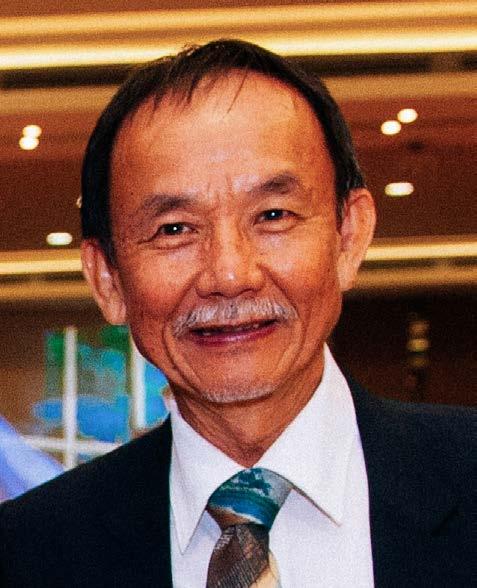
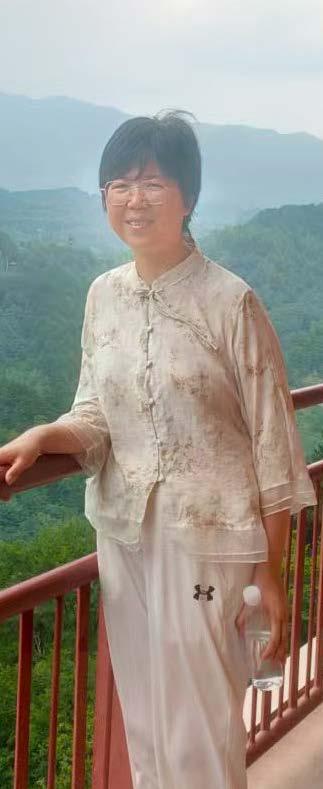
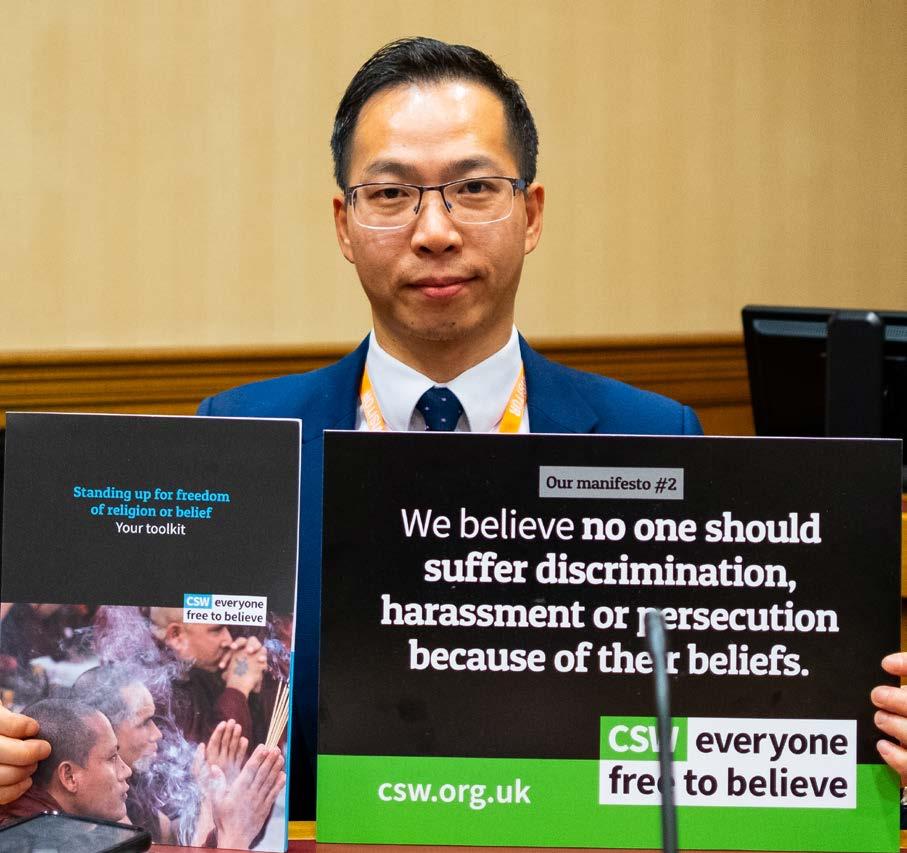
An interview with Timothy, a human rights defender, advocating for North Koreans across the world.
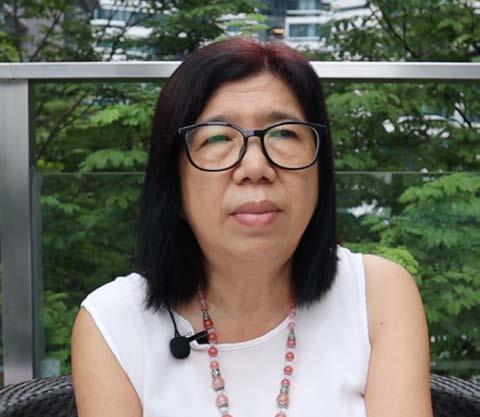
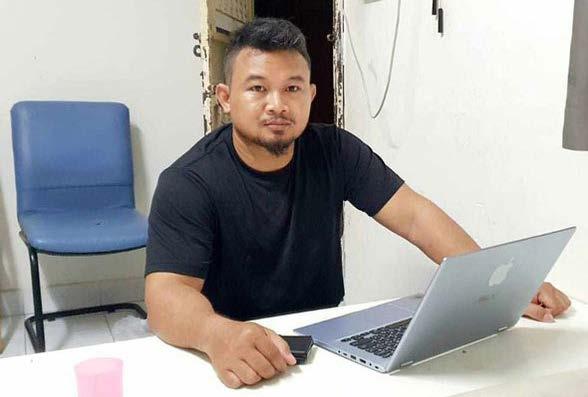
Pastor Raymond Koh Hope for closure and accountability, nine years after disappearance.
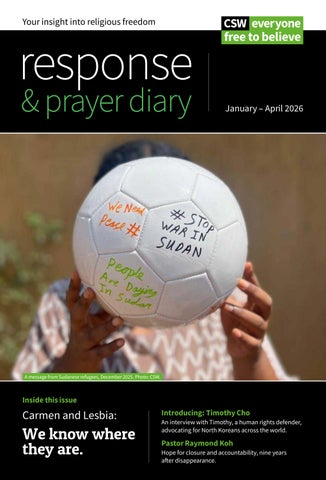
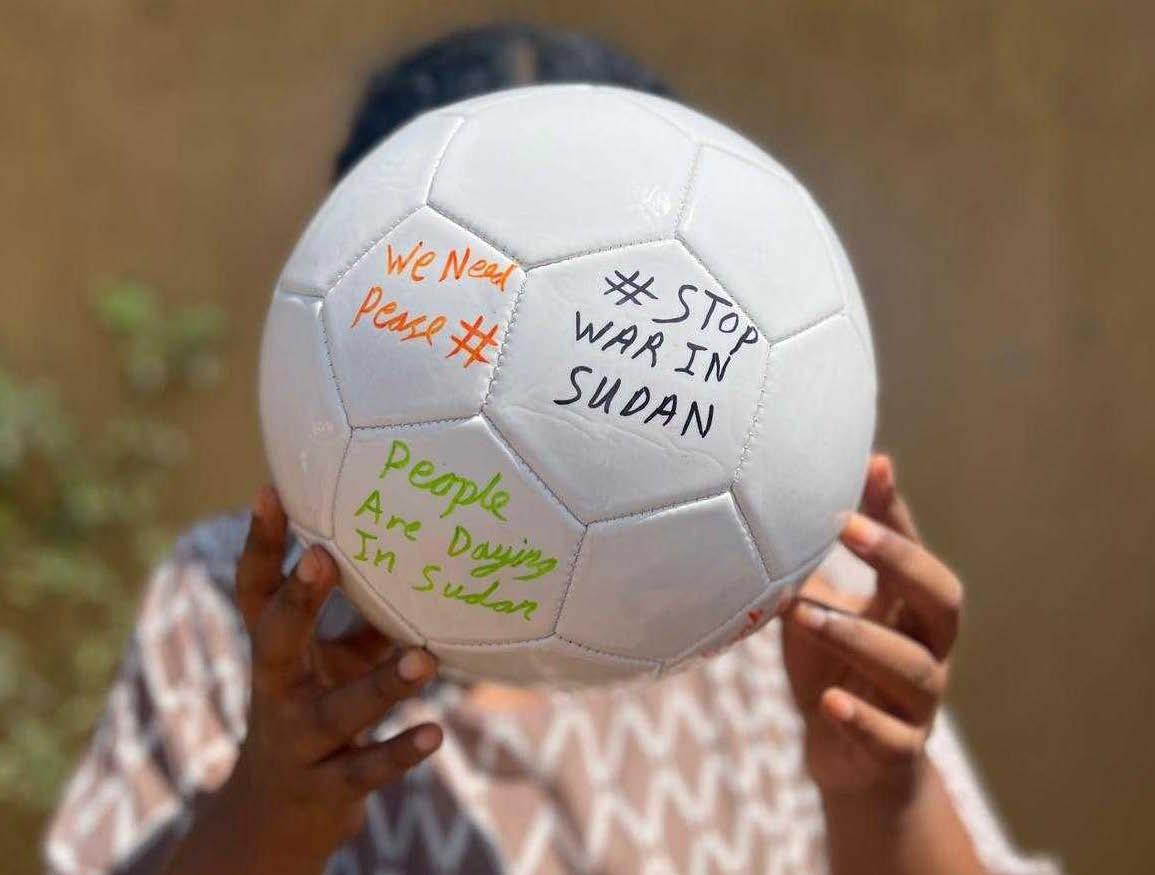
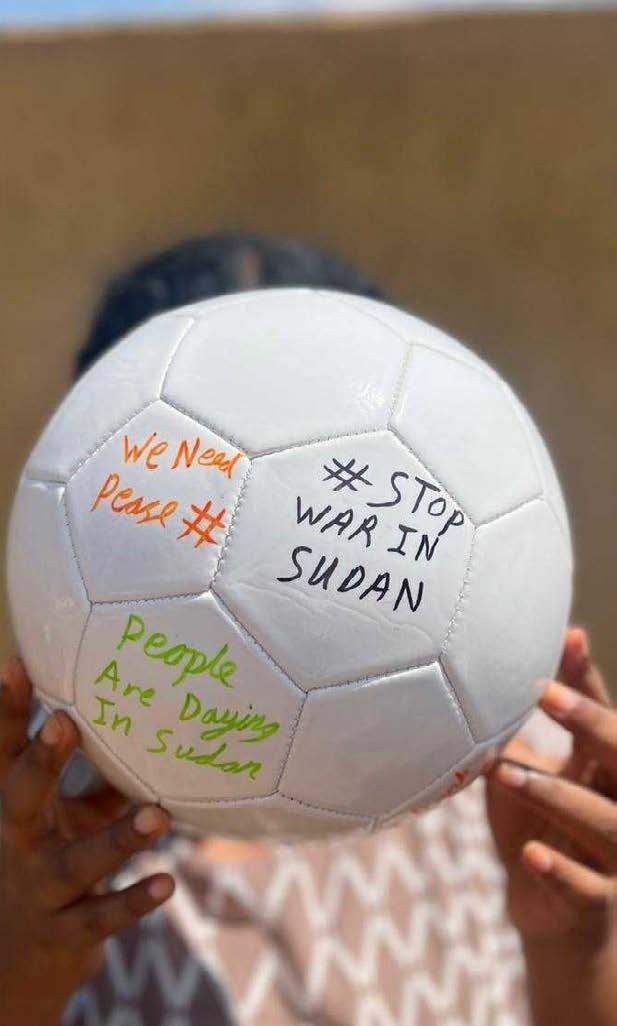
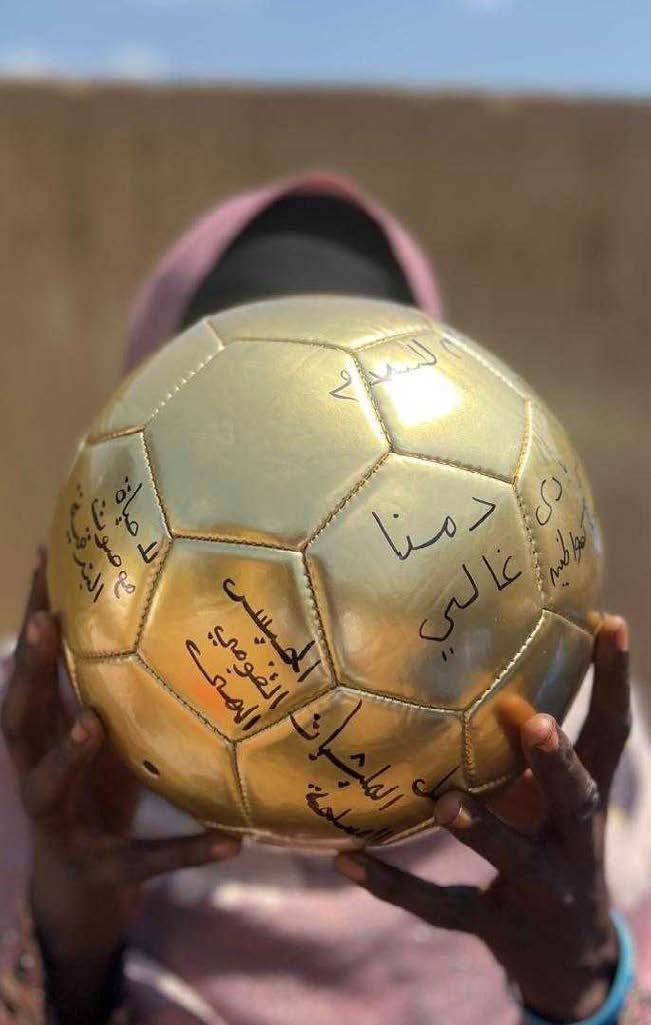
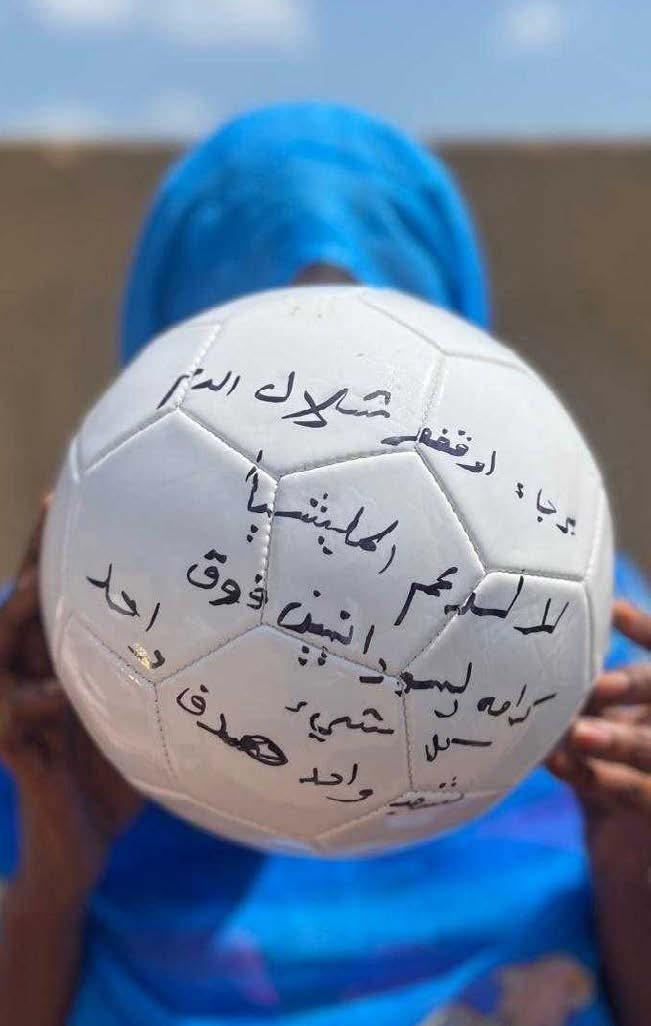
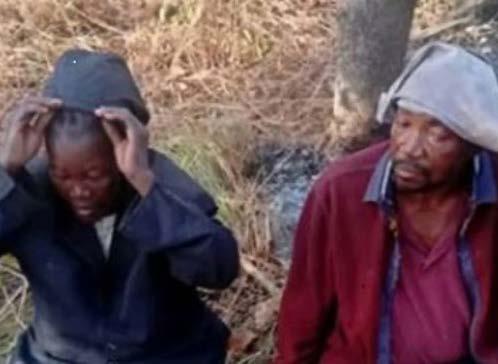
message from Sudanese refugees, December 2025. Photo: CSW.
Campaign: Eyes on Sudan
What do the war in Sudan and Manchester City Football Club have in common?
Manchester in the UK and El Fasher in Sudan are thousands of miles apart. But they are more closely connected than you might think.
You may already know that the conflict between the Rapid Support Forces (RSF) and Sudanese Armed Forces (SAF) has plunged Sudan into one of the world’s most severe humanitarian crises, where abuses by both parties against civilians may amount to war crimes and crimes against humanity.
While each warring party is backed by various international actors, there is credible evidence that the United Arab Emirates (UAE) continues to provide extensive military and financial support to the RSF.
Join the campaign
Sheikh Mansour is vice-president and deputy prime minister of the UAE, as well as the president’s brother. He is well-placed to intervene in the UAE’s role in this conflict. Furthermore, he has well-documented personal ties to the leader of the RSF, General Mohamed Hamdan ‘Hemedti’ Dagalo.
So would it surprise you to discover that Sheikh Mansour – a man described as Hemedti’s closest ally – is also the owner of Manchester City Football Club?
Call on the Premier League to raise the UAE’s role in prolonging and profiting from the conflict directly with Sheikh Mansour, and to insist that the UAE ends its support for the RSF.
Go to csw.org.uk/Eyes-On-Sudan for opportunities to respond with action.
‘We are thankful to God for an honest and fair judgement…’
After
nearly nine years, there is finally some hope for justice in the case of Pastor Raymond Koh.
Pastor Koh was abducted in a meticulous and professional operation on 13 February 2017, in broad daylight on a street in Malaysia. He hasn’t been seen or heard from since, leaving his family in unending uncertainty, anguish and grief.
His wife, Susanna, has never stopped pursuing the truth about what happened to her husband and who is responsible. Now, finally, the High Court in Kuala Lumpur has issued a verdict in a landmark case against the state.
Police and government involved
On 5 November the judge confirmed what has long been believed: that Pastor Koh was forcibly disappeared, and that the police and the government were involved.
The family is set to be awarded 37 million Malaysian Ringgit, which is approximately £6.8 million (around £1,800 for each day the pastor has been missing, until his whereabouts are known).
The landmark court ruling is the largest compensation in Malaysia involving enforced disappearance.
The judge directed the investigations to recommence, and for the funds to be kept in a trust fund until Pastor
Raymond’s whereabouts are established.
A few days after the ruling, the Home Minister of Malaysia said that his ministry was taking the court directive seriously, and that the police will reopen investigations to determine the whereabouts of Pastor Koh.
Susanna said:
‘Today marks a historic and emotional milestone for the Koh family, our legal team, civil society, and all Malaysians who have stood with us in pursuit of truth and justice.
We filed an action in the High Court and prayed to God that justice and the truth will prevail somehow, despite the overwhelming odds and circumstances. We were acutely aware of the risks to our family and our lawyers who are conducting this case, but believe in God’s protection and the prayers from all the people who believe in our cause.
We are thankful for the manner in which the Malaysian court handled this sensitive case. The judge was very patient, careful and attentive to all the evidence that was given. […] We felt some vindication as we were able to tell our side of the story, and hear the responses by some of the police officers that were named as defendants.
We are overjoyed and thankful to God that we have an honest and fair judgement after all the evidence that could possibly be brought to the attention of the judge. Though this will not bring Pastor Raymond back, it is somewhat a vindication and closure for the family. We dedicate this judgement to Pastor Raymond Koh, a man of faith, compassion and courage; and to all victims of enforced disappearance.
Last but not least, we thank all Malaysians, human rights defenders and international supporters who have stood with us. Your solidarity sustained us through the darkest of times. May God bless Malaysia. Thank you.’
Pray
Give thanks with Susanna and her family for this answer to prayer. Continue to pray that the truth will be fully known, and justice fully realised.
Campaign update
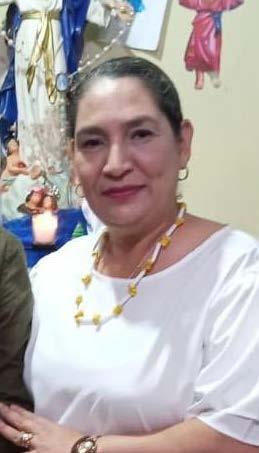
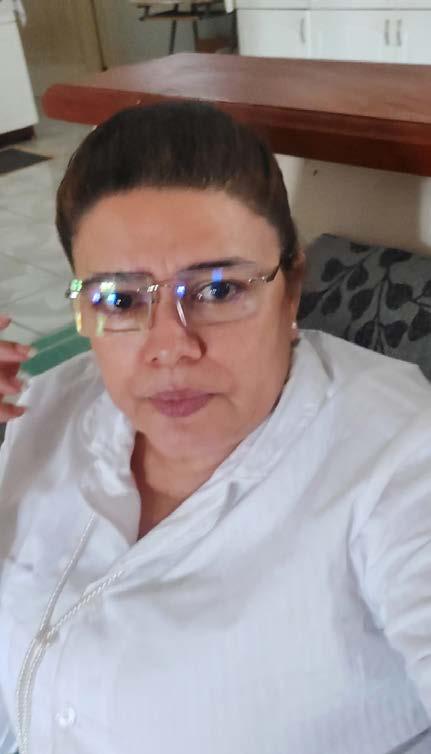
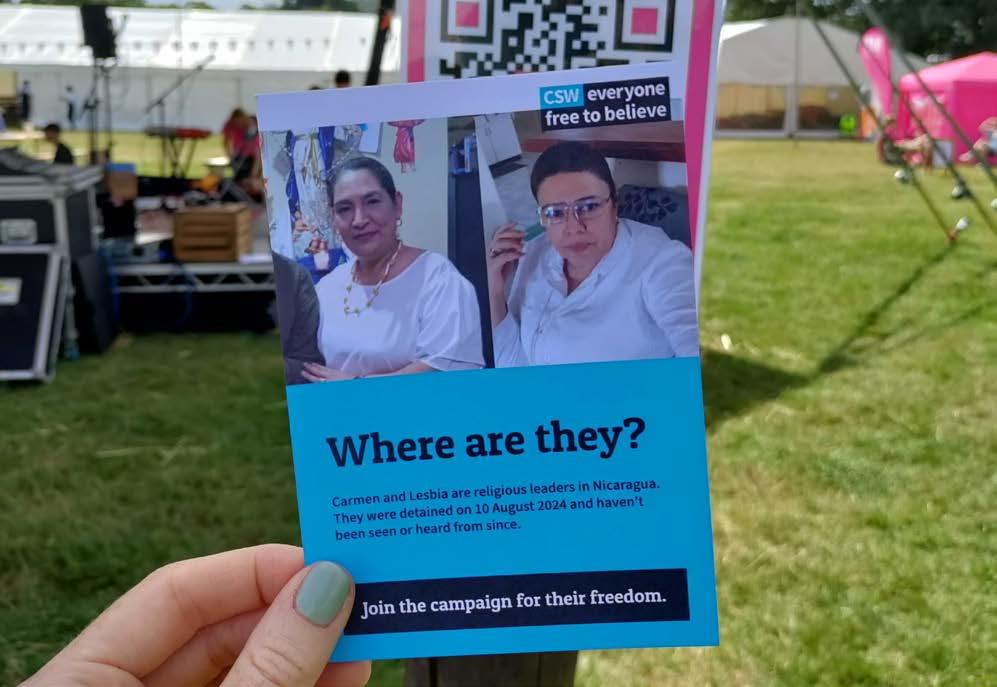
Carmen and Lesbia: We know where they are.
For over 15 months, Carmen and Lesbia’s whereabouts were unconfirmed. Their families had no proof that they were even alive. Then, just before Christmas, we heard the news that they had been released from maximum security prison to house arrest. It’s not over yet, but we give thanks that prayers are being answered.
You may remember that Carmen and Lesbia (Roman Catholic lay leaders) were targeted as part of a wider crackdown on fundamental freedoms in Nicaragua. It was part of the government’s ongoing attempts to silence criticism and all independent voices.
But our voices could not be silenced. Together we raised a collective call for answers: Where are they? And now we can say with certainty: We know where they are
Released to house arrest
Carmen and Lesbia were among a small group of political prisoners released into house arrest on Saturday 29 November. While they are still not free – despite not being charged with anything – this is without doubt an improvement on solitary confinement in a maximum-security prison.
Before this breakthrough, we did not know for sure if Carmen and Lesbia were even alive. Their families had had no contact with them for nearly 16 months. We believed they were in La Esperanza maximum-security prison, but the Nicaraguan authorities had provided no information of their whereabouts – not even a proof of life.
Responding in action
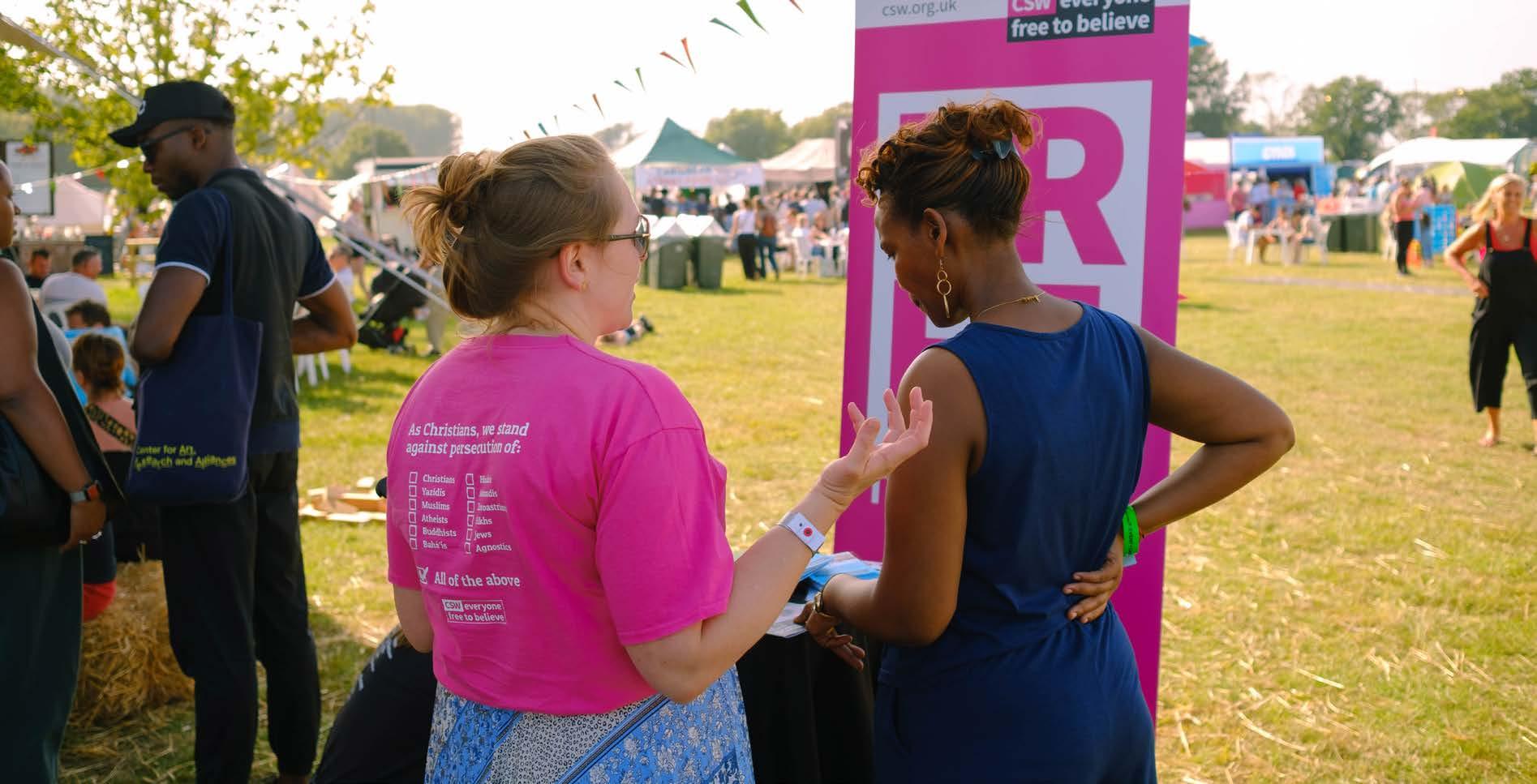
Hundreds of people like you refused to stay silent after Carmen and Lesbia were detained on 10 August 2024. You emailed 306 Members of UK Parliament about their case – some of them multiple times. We then took the ‘Where are they?’ campaign to Wildfires Festival in July, where 165 people wrote to the UK Foreign Secretary after hearing what had happened to these women. Meanwhile, CSW supporters in the United States sent messages to 11 Members of Congress. Thank you!
Alongside your actions and prayers, our advocates were busy briefing international authorities. This included the UK government, the Irish government, US government officers in Washington, DC and Costa Rica, and policymakers at the European Union. We also delivered oral statements at the UN Human Rights Council in February, March and September 2025. We have been consistently briefing the United States Commission on International
Pray
Please pray for the release of all those unjustly detained in Nicaragua. Prison conditions are inhumane, and in August two political prisoners died within the space of a week. Some families may be too fearful to speak out about the injustice their loved ones are facing.
Religious Freedom (USCIRF), who added Carmen and Lesbia to their FoRB Victims List. This is important recognition that what these women are suffering is a violation of freedom of religion or belief.
Numerous press releases, blogs and media articles helped drive awareness of their case and call for answers. Now we are relieved to know where they are, but it’s not over yet. Thank you for standing with Carmen and Lesbia, and many others like them, for as long as it takes.
15 months and counting.
Your support enabled us to speak out for Carmen and Lesbia through 15 months of silence and uncertainty. We want to continue supporting them until they are fully free. Visit csw.org.uk/donate to fuel CSW’s work in Nicaragua and around the world.
Remember their names: Syria
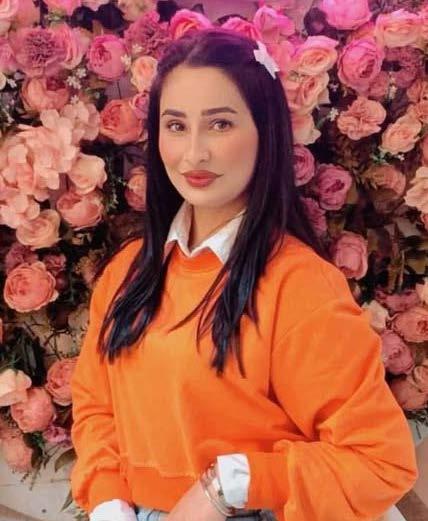
Remember their names: Reham Hammouda
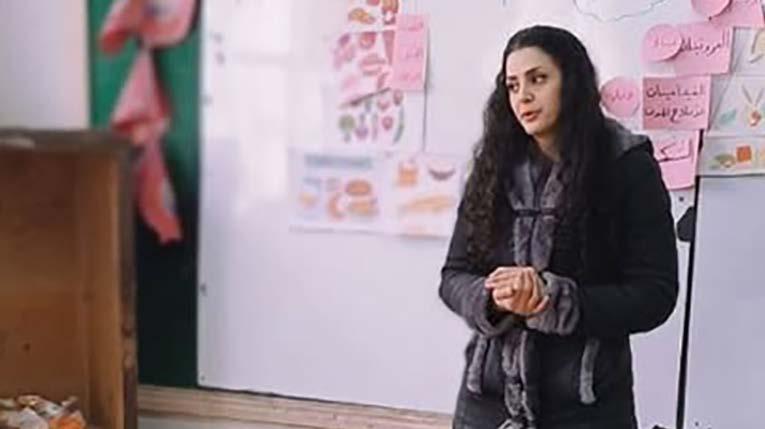
Reham Hammouda lived in the Al-Walid neighbourhood of Homs, Syria. She was a schoolteacher and a mother of two children, as well as a member of the Alawite community.
On the evening of 25 October 2025, Reham was killed by an unknown assailant on a motorbike who threw a hand grenade at her family home. Her relative, Sarah Mouhammad Hamidoush, was severely injured. Local residents complained to our sources about a lack of action from the police, who could not identify the assailant. Some accused the police and local authorities in Homs of being complicit in attacks targeting the Alawite minority.
We extend heartfelt condolences to Reham’s family and loved ones. Please join us in praying for perpetrators to be brought to justice, and an end to the tragic wave of sectarian violence across Syria.
Facts and stats
57people died in similar attacks in October 2025, with 19 of these occurring in Homs. A child was among the victims.
118Alawites have been killed since the beginning of 2025.
Source: Syrian Observatory for Human Rights (October 2025)
The scale of loss being experienced by Alawite families in Homs is staggering.
Mervyn Thomas (CSW Founder President)
Who are the Alawite community?
The Alawites are a religious minority in Syria. They make up approximately 10% of Syria’s population, while the majority of the country is Sunni Muslim. The ousted Syrian president (Bashar al Assad) was an Alawite.
CSW has interviewed many families in Homs who reported that sectarian bullying has become more common in schools and workplaces.
Powerful fireworks are frequently thrown at children’s playgrounds and at women walking along the street. Some children told us that they were forced to bark and crawl by other children because they are Alawites.
Sunday 25 January
During 2025 we saw a series of sectarian attacks, abductions and killings, as communities such as Alawites, Christians, Druze, and Murshidis were targeted by extremist elements. Please pray for the safety of Syrians who belong to religious minority communities.
Monday 26 January
Pray that the Syrian government will do more to combat sectarianism, sectarian incitement and violence. Where there is division and fear, ask God to sow seeds of peace, reconciliation, mutual respect and equality of citizenship.
Tuesday 27 January
Last July, government forces supported tribal fighters against Druze militia, causing ongoing tensions. In October, unidentified gunmen opened fire on a coach carrying Druze civilians to Damascus, injuring eleven and killing two instantly. Pray for the families of Aya Salam and Kamal Abdulbaqi and all those affected, and for reconciliation.
Wednesday 28 January
Dr Hamza Shaheen, a Druze community leader, was abducted by masked men on 27 October and died following severe mistreatment. Security forces arrested the kidnappers on 4 November. Spend a moment praying for his loved ones, and for the prevention of further incidents like this.
Thursday 29 January
In October, locals in the city of Homs complained to CSW sources of police inaction amid a wave of sectarian killings. Some even accused the police and local authorities of being complicit in attacks targeting the Alawite minority. Pray that Syrian authorities will take these allegations extremely seriously, and act to address them.
Friday 30 January
The scale of loss experienced by Alawite families in Homs is staggering. Reham Hammouda (a teacher and mother of two) was killed in October – one of 19 killings in Homs that month. Pray for all who mourn or live in fear because of their religious identity.
Saturday 31 January
Please pray for CSW’s advocate working on Syria, who cannot be named for security reasons. Part of their work includes gathering accounts of violations, equipping human rights defenders, and leading workshops for trauma survivors.
Find out more at csw.org.uk/syria
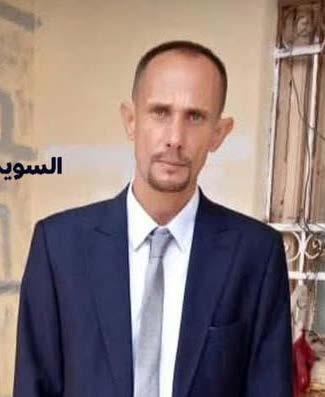
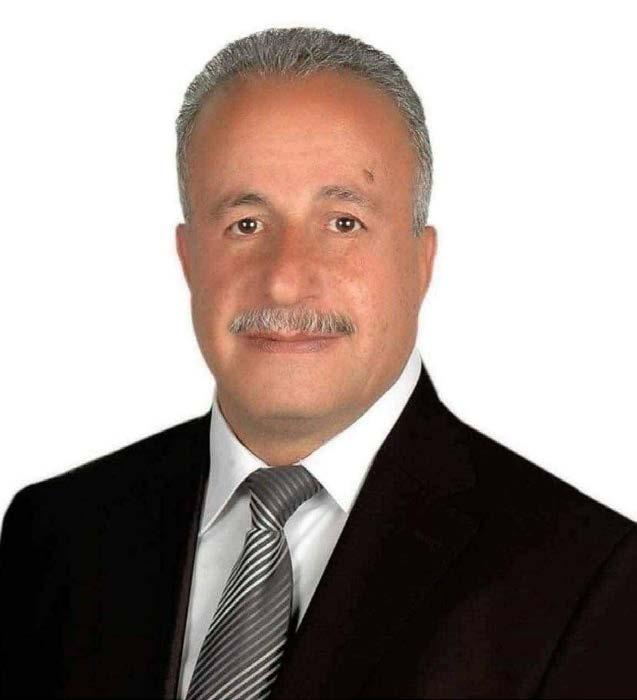
Kamal Abdulbaqi
Dr Hamza Shaheen
Aya Salam
Tanzania
A human rights crisis in Tanzania
Tanzania’s 2025 election was marred by fraud and severe repression. Those who spoke out – including religious leaders and journalists – were targeted as part of the government’s violent campaign to silence critics and intimidate opposition before election week. Some were arrested, abducted, assaulted, tortured and even killed. Religious leaders appeared to be a particular target of repression.
President Samia Suluhu Hassan’s two main opponents were not allowed to run, with one of them in prison and on trial for treason after demanding free and fair elections. She was later declared to have won, implausibly by a landslide.
Election day crackdown
On election day, Tanzania witnessed its largest protests in 64 years. The protesters were mainly young people from Gen Z, boldly standing against corruption, repression and electoral fraud. The government responded with extreme violence. There were reports of bodies being seized from mortuaries and buried in secret mass graves to obscure the death toll.
Repression continued, with 641 people charged with treason and related crimes, and thousands more disappeared. In an hour-long broadcast in December, the president justified her use of excessive force – alleging that protestors were influenced by foreigners to effect regime change.
Silence is complicity
‘Silence is complicity,’ said Mervyn (CSW Founder President) as we urged the international community to stand with the people of Tanzania. We called especially for regional organisations not to legitimise the flawed election. We were encouraged by the response from the Southern African Development Community (SADC), which concluded that Tanzanians had not been able to express their democratic will and that the elections fell short of the organisation’s principles. Later, African Union electoral observers issued a similar assessment.
President Hassan may have secured a ‘victory’, but she has lost all legitimacy.
Facts and stats 98% of the vote won by President Hassan. Over 52 abductions in October alone.
More than 1,000 people are believed to have been
killed by security agencies, including in their own homes.
Connect & Encourage update: Pastor Zhang Shaojie
Pastor Zhang Shaojie was arrested in 2013 and sentenced to 12 years in prison for ‘fraud’ and ‘gathering a crowd to disturb public order’. He was released in November 2025. Thank you for sending him your encouragements over the years, and please keep him in your prayers.
The Lord is my light and my salvation — whom shall I fear? The Lord is the stronghold of my life — of whom shall I be afraid?
Psalm 27:1
Sunday 1 February
Pray for freedom, justice and comfort for the people of Tanzania. They were denied free and fair elections in 2025, and many are mourning missing loved ones who may have been killed while protesting after the election. Funerals have even been held without bodies.
Monday 2 February
Pray for an independent international investigation into the killing of protestors in Tanzania. Pray that all who ordered or participated in their murders, as well as in the high number of abductions, will be brought to justice.
Tuesday 3 February
Abductions and enforced disappearances soared in the runup to Tanzania’s general election and afterwards. Pray for the safe return of those still missing, including Pastor Elias Samweli Domisiani. He was abducted on 4 October 2025 after being lured to a meeting by someone posing as a solar panel supplier.
Wednesday 4 February
Ask God to protect Father Charles Kitima. He was attacked on 30 April 2025 and hospitalised with serious head injuries. Nevertheless, he continued to expose government repression, including telling the world how the authorities also killed people in door-to-door raids, and dumped severely injured individuals in mortuaries.
Thursday 5 February
Give thanks and pray for the safety of all who speak out against injustice in Tanzania, including Bishop Benson Bagonza of the Evangelical Lutheran Church. In May 2025, he revealed he was receiving death threats. The bishop had spoken publicly about the rise in killings and abductions.
Friday 6 February
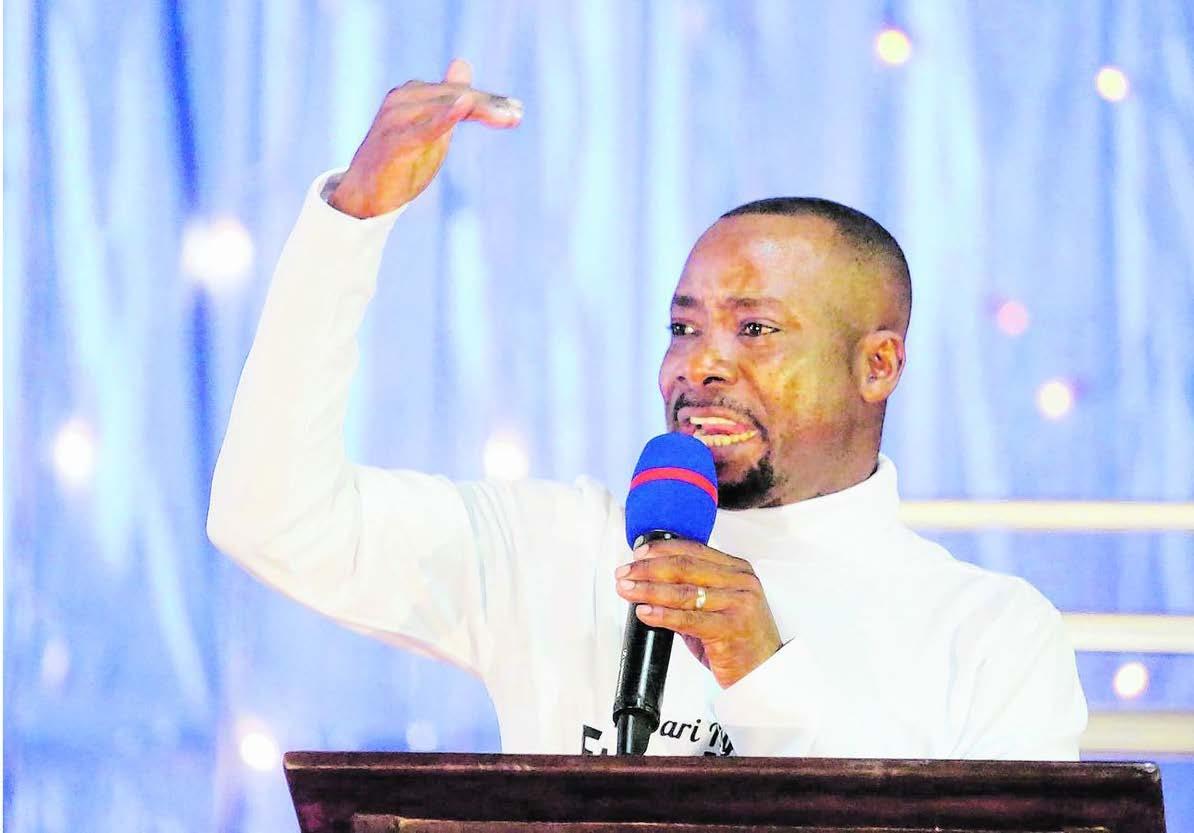
Bishop Josephat Gwajima is the founder of Glory of Christ Tanzania Church. In a sermon on 1 June 2025, he criticised escalating human rights violations ahead of the elections. Less than 24 hours later, the denomination was deregistered by the government – highlighting how registration legislation is being used to control, coerce and silence legitimate dissent. Pray this injustice would be reversed.
Saturday 7 February
Pastor Eleth Mtaita was arrested on 24 October 2025, allegedly for telling church members not to take part in Tanzania’s elections (deemed ‘incitement’). Eyewitnesses said that armed men stormed his house and took him away in a vehicle without licence plates. As far as we know, he is still detained. Uphold him in prayer today.
Find out more at csw.org.uk/tanzania
Bishop Josephat Gwajima
How
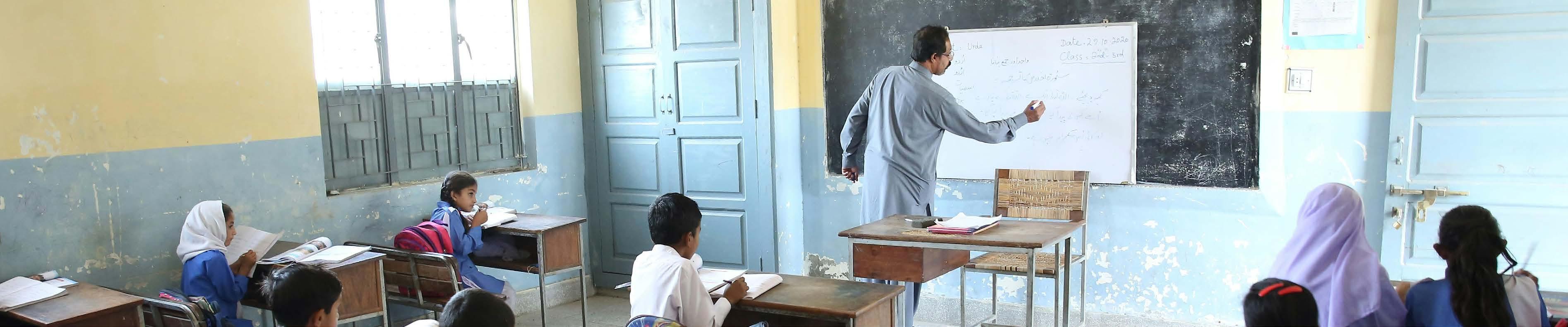
does the education system
perpetuate religious intolerance in Pakistan? And how it could be a route to change?
By CSW’s Press & Public Affairs Officer Ellis Heasley
‘No one is born hating another person because of the colour of his skin, or his background, or his religion. People must learn to hate.’ (Nelson Mandela)
While hatred can be ‘learned’ in many ways – from one’s family, or cultural background, or even from negative experiences with the object of said hatred – in Pakistan the teaching of hatred, specifically religious intolerance, is embedded in various forms into the very fibre of the country’s education system.
A hidden agenda
frequently depicted as enemies of Islam in the history of the subcontinent, and some textbooks even contain derogatory language that denigrate non-Muslims as evil and heretical.
In an Islamic republic where most of the population follows Sunni Islam, one may be inclined to question where the harm in this lies. But particularly concerning is the fact that all these subjects are compulsory, at least up to the end of secondary education, and in some cases even continuing to the tertiary (i.e. university) level.
History denied The curriculum continues to deliberately omit the contributions of religious minorities to the development
Perhaps at its most subtle, it takes the form of religious content being included in subjects where it isn’t contextually relevant. Students of English and Urdu may find that their textbooks contain stories and essays with religious themes that reinforce Islamic viewpoints, for example, while chapters on citizenship, ethics and moral values in social studies textbooks are predominantly framed on Islamic teachings.
of Pakistan, including in the fields of education, science, politics and military service.
There is no mention, for example, of the three nonMuslim members of Pakistan’s first constitutional body at any level of the syllabus. Nor is there any acknowledgement of the country’s first Foreign Minister, Muhammad Zafrullah Khan (a member of the severely persecuted Ahmadiyya community, who went on to serve as president of the UN General Assembly and the International Court of Justice), nor of Cecil Chaudhry Sr (a Christian human rights activist and military hero).
Elsewhere, religious minorities are outright demonised. Christians and Hindus are
In some cases, such discrimination is reinforced further still by teachers themselves. CSW has received multiple reports of teachers both directly and indirectly attempting to convince non-Muslims that their faith is illogical, subjecting nonMuslim students to physical and psychological abuse, and encouraging or permitting other Muslim students to do the same.
Lasting consequences
This has significant and lasting consequences for the social fabric of Pakistan. It is by teaching Muslim students that their non-Muslim counterparts are somehow lesser that some grow up to mete out extremist violence against religious minorities. It is by granting Muslim students who memorise the Qur’an 20 extra marks towards admission applications for
higher education, employment and professional studies that religious minority students are placed at a disadvantage before they have even graduated. And ultimately it is by reinforcing stereotypes and promoting exclusion that the Islamist nationalist voices who have tightened their grip on a once proudly pluralistic nation will ensure that they maintain dangerous influence over generation after generation to come.
Education is the answer
Of course, there is a second part to the aforementioned Mandela quote: ‘And if they can learn to hate, they can be taught to love, for love comes more naturally to the human heart than its opposite.’
If Pakistan is to truly honour the principles of peaceful coexistence and inclusivity on which it was founded, perhaps it should begin with education, with the empowerment of every child to see themselves – and all of their classmates – as valued and equal participants in Pakistani society and the nation’s future.
Connect & Encourage
Michelle Chaudhry is the daughter of the late Cecil Chaudhry Sr. In response to the growing and neglected needs of minorities, she set up The Cecil & Iris Chaudhry Foundation in memory of her parents, who spent their lives working to improve conditions for minorities in Pakistan. You can write to encourage Michelle and her team, and please pray for their protection. Ask God to provide all they need to run their programmes and projects.
The Cecil & Iris Chaudhry Foundation 16C/1-A, Gulberg II, Lahore 54600 Pakistan
Sunday 8 February
Read Romans 5:8 and ask God to pour out his love on Pakistan’s Christians today. As Lent begins next week, ask him to keep them safe at a time of year when they may be at greater risk of being targeted.
Monday 9 February
Pray for the freedom of those who have been falsely accused of blasphemy. One of them is Dennis Albert, a 37-year-old rickshaw driver with a strong Catholic faith. If convicted, he could be facing life imprisonment.
Tuesday 10 February
Pastor Zafar Bhatti was imprisoned on false accusations of blasphemy – robbed of 13 years of his life. The Lahore High Court overturned his conviction in October 2025, but the 62-year-old tragically died of cardiac arrest just three days after his release. Pray for reparations to be made to his grieving wife Nawab, and for an urgent review of Pakistan’s notorious blasphemy laws.
Wednesday 11 February
Give thanks that the government of Pakistan has banned the extremist group Tehreek-e-Labbaik Pakistan (TLP), proscribing it as a terrorist organisation. TLP was briefly banned in 2021, but the ban was lifted after they promised to renounce their violent agenda; a promise they did not keep. Pray that this time this ban will be more effective.
Thursday 12 February
Next week is the start of Ramadan (17 February-18 March). Please pray for the protection of the Ahmadiyya community, who were significantly targeted before and during Ramadan for the last two years. In 2024, a 13-year-old child was one of 35 unjustly detained Ahmadis.
Friday 13 February
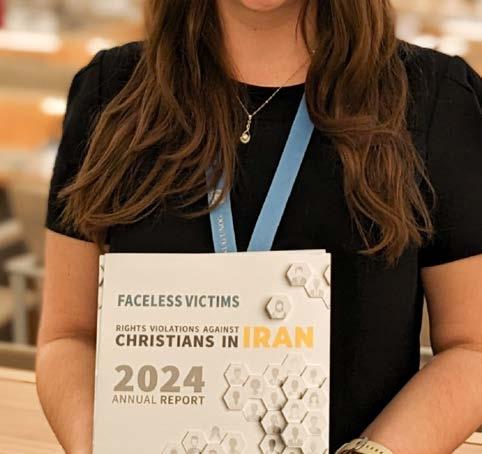
Give thanks for the work of the Cecil & Iris Chaudhry Foundation (CICF), an organisation we partner with in Pakistan. In November we were able to advocate effectively at the EU and UN on the issue of education bias, thanks to CICF’s latest research.
Saturday 14 February
The national curriculum of Pakistan does not currently teach respect for the rights of religious minority communities, nor recognise their contributions to the nation’s history. Pray that the government will review the curriculum and invest resources into educating teachers on how to teach religious and cultural topics in an unbiased, respectful way.
Find out more at csw.org.uk/Pakistan
Sunday 15 February
President Gustavo Petro was elected in August 2022 on a key promise of bringing ‘Total Peace’ to Colombia. Sadly, this remains unfulfilled. Ask God to give this nation’s leaders the wisdom and strategies they need to end Colombia’s decadeslong internal conflict.
Find out more at csw.org.uk/colombia
Monday 16 February
In October 2025, authorities in the Betania community in Caldono Municipality told Protestant Pastor Aristides Chocue that he and his family must leave their village or face punishment. Please pray for him as he continues to bravely carry out his work as a religious leader.
Tuesday 17 February
Fear has spread among Christians in rural areas where illegal armed and criminal groups operate. 2025 saw an increase in killings and forced disappearances of religious leaders and church members. Ask God to comfort and protect them today.
Wednesday 18 February
Psalm 103:6 says, ‘The Lord works righteousness and justice for all the oppressed.’ Pray that Christians in Colombia facing intimidation and violence would know the truth of this verse today, and see it come to fruition in their lives in the immediate future.
Thursday 19 February
The Colombian government continues to exclude religious leaders from their list of categories of vulnerable individuals, despite the threats that many still face, and the kidnapping, forced disappearance or assassinations of multiple religious leaders over the past 14 months. Ask God to inspire those with the power to change this to afford greater protection to religious leaders once again.
Friday 20 February
Ask God to bless CSW’s Colombia Advocacy Officer, who we cannot name for security reasons. She is based in the country and regularly meets with victims of violations. She also provides training to human rights defenders, indigenous groups and church leaders.
Lent prayer
Saturday 21 February
Jesus wept (John 11:1-44)
Lord Jesus, as you wept with your friends while Lazarus was in the tomb, so we ask you to be with those whose loved ones have been killed in Colombia. Encourage them in their faith, knowing that you are the resurrection and the life. You have power even over death. Now move in power over this nation – even as criminal groups seek to instil fear and seize control. Bring peace, life and freedom to Colombia throughout this season of Lent. Amen.
Over the next few weeks, you'll see that Saturday's prayers look a little different. We have written a special prayer each week in Lent, reflecting on Jesus's journey to the cross. Visit csw.org.uk/LentPrayer to download them as a prayer guide to use with your church or small group.
Pastor Zafar Bhatti and his wife Nawab Bibi
Pastor Aristides Chocue
Our manifesto #4
We believe our research and analysis enable policy-makers to stand up for freedom of religion or belief.
How can someone stand up for something that they do not know is happening? Why would someone respond with action if they do not understand the significance and gravity of a situation? Claire Denman, who leads our work at the United Nations, reflects on one of CSW’s core principles and shares some key advocacy moments from 2025.
At CSW we take our research and analysis seriously, and seek out opportunities to get accurate and verified information into the hands of those with the power to make a difference; the right hands at the right strategic moment to bring change. In a world where misinformation spreads like wildfire, this is more important than ever.
This year, we refreshed our general briefings on 25 countries, which explain the general situation in a country and provide specific recommendations for action. We also released a number of specialist briefings, for example about repression in China’s Ningxia Hui Autonomous Region, and attacks on places of worship in Sudan. Among our six major reports was ‘A matter of control: Challenges to freedom of religion or belief and freedom of expression.’
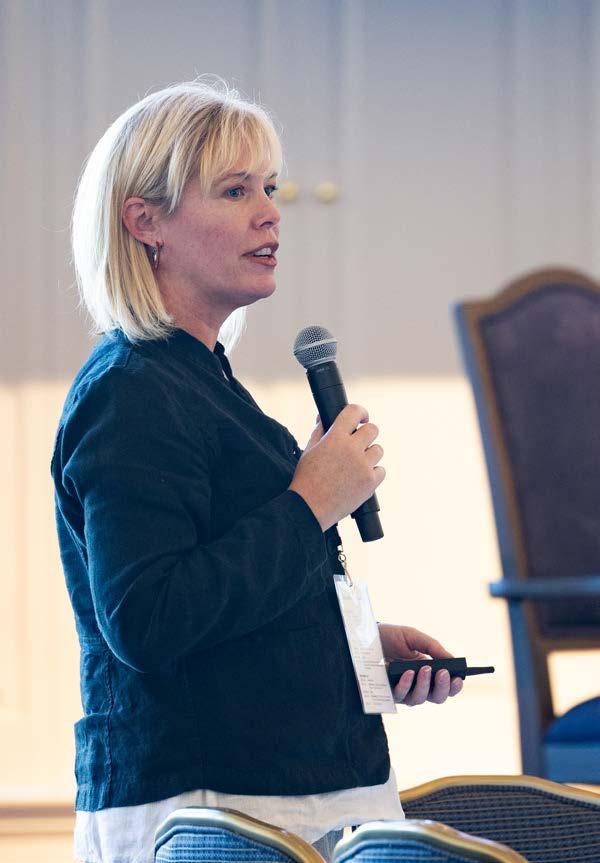
As well as sharing these reports, our team frequently meets with decision-makers in the UK Parliament, United Nations, European Union and US Congress to brief them on the situation of freedom of religion or belief around the world.
It’s been a tough year for advocacy because violations have escalated in a number of the countries we work on. There have been positive moments in our work too. Reflecting on these give us hope for the road ahead.
Here are a handful of international advocacy highlights from 2025:
• After years of consistent advocacy, research and documentation, it
finally feels as though the international community is waking up to the reality of the situation in Nigeria. It was especially powerful when Rev Yunusa Nmadu (CSW Nigeria’s CEO) travelled to Geneva for the first time to speak directly to UN experts and country representatives on the situation in Nigeria. We are so grateful for the provision of funds that enabled this to happen.
There was great appetite for our information and analysis on freedom of religion or belief, and we’re now pushing for a UN investigative mechanism to be established on Nigeria in addition to increased reporting by existing mandates.
Elsewhere, the US redesignated Nigeria as a ‘Country of Particular Concern’ in November. (Earlier, the CEOs of CSW USA, UK and Nigeria wrote to Secretary of State Marco Rubio stating in detail why redesignation was merited.)
• We conducted targeted in-person advocacy on Nicaragua in Brussels and the UK. This involved meeting with MEPs, EU Member State officials working on the region, and the UK Foreign, Commonwealth & Development Office (FCDO) Latin America desk officer. The advocacy in Brussels led to an MEP writing an article about one of the cases we had highlighted.
• As a team, we successfully advocated for the renewal of the UN Fact-Finding Mission on Sudan. This group of experts is mandated to collect evidence and report on violations, as part of the efforts to ensure accountability and justice.
CSW responded to the African Commission on Human and People’s Rights (ACHRP)’s call for input regarding human rights violations in Sudan last year. Praise God that this was well received! The publication of their report in October 2025 included a specific section on freedom of religion or belief – heavily referencing CSW’s research.
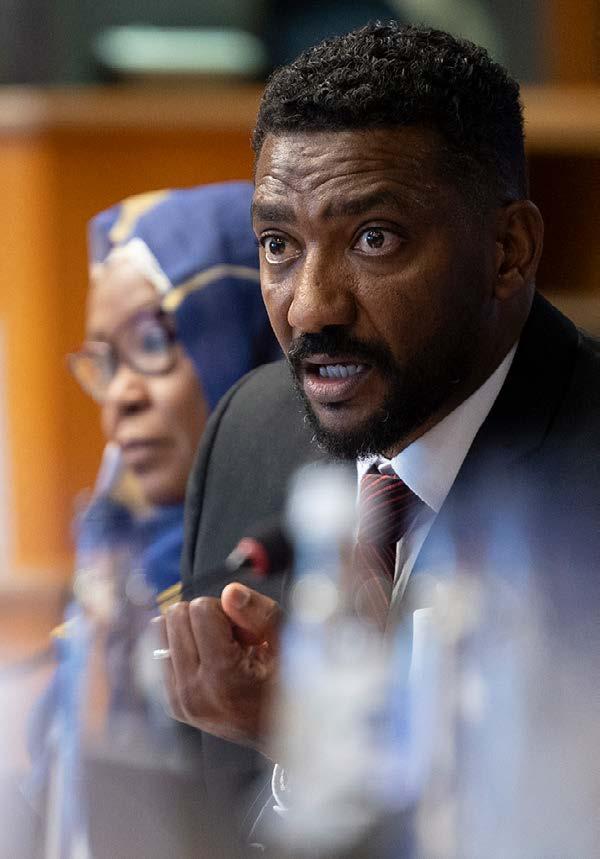
My colleague Mohaned was invited by the European Parliament Subcommittee on Human Rights to speak at a hearing on human rights in Sudan. Two days later, he delivered a statement via video at a Special Session of the UN Human Rights Council (HRC) on the situation in El Fasher. All of this contributes to international monitoring, reporting and accountability efforts.
• We briefed policymakers and human rights experts ahead of official country visits. For example, we briefed the UN Special Rapporteur on Minority Issues ahead of an official country visit to Nepal,
answering his preliminary questions and advocating for the inclusion of minority rights and freedom of religion or belief during his visit.
• The UK government launched the ‘Freedom of Religion or Belief (FoRB) Strategy’, spearheaded by Special Envoy for FoRB, David Smith MP. It aims to mainstream this human right into the UK’s foreign policy – including diplomacy, development and trade. We look forward to continuing to work with the UK government, especially the Special Envoy and his staff, to champion the right to FoRB within UK foreign policy.
Pray
For wisdom for our advocacy team as we identify which policymakers to approach, when and where best to channel our resources. Pray also for continued traction in our advocacy on countries like Nigeria.
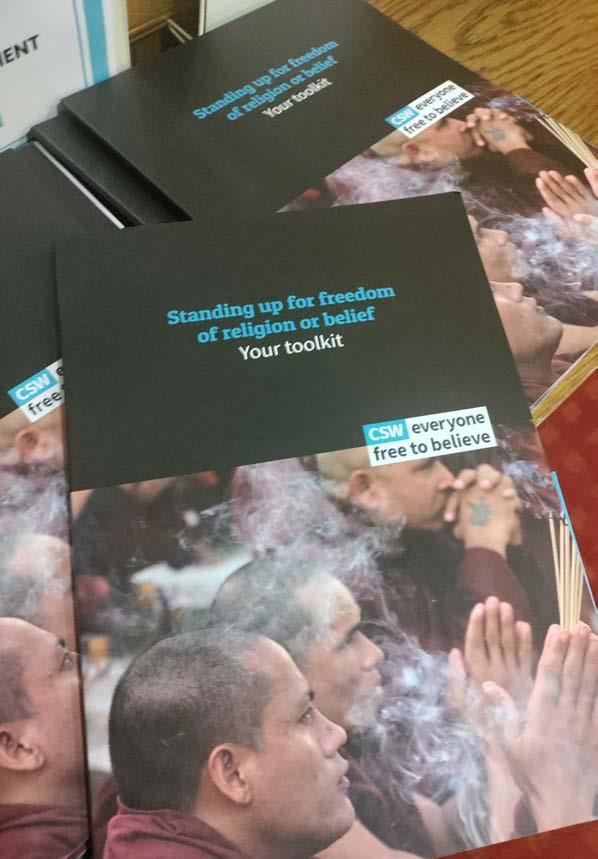
Equipping UK MPs with our toolkit
Mohaned Elnour (CSW’s Sudan Specialist). Photo: European Union 2025. Source: EP.
Director of Advocacy, Anna Lee Stangl
Sunday 22 February
The 61st session of the UN Human Rights Council (HRC) starts this week, running from 23 February-2 April. Give thanks that there will be a dedicated discussion on freedom of religion or belief, and ask God to bless our UN team with energy and perseverance. They work tremendously hard and we’re so grateful for all that they do!
Monday 23 February
Father God, thank you that the whole world is in your hands. As the UN meets this week to discuss a range of human rights issues, we pray that the voices and needs of those who are most vulnerable will be at the heart of every discussion and decision made. Amen.
Tuesday 24 February
During the HRC, we will be speaking out about ongoing violations of freedom of religion or belief in Myanmar/Burma. Pray for CSW’s advocates as they raise concerns, including the military’s continued targeting of ethnic and religious minorities.
Wednesday 25 February
Building good relationships with UN staff, Special Procedures (UN independent experts), and country representatives is essential for our work with the UN. Pray that these connections will continue to grow and be strengthened.
Thursday 26 February
At this session of the HRC, the Special Rapporteur will present her latest report on freedom of religion or belief, death and honouring the deceased. In many countries, minority religious or belief communities are denied burial rights or have funeral services disrupted. Pray that this new report will be a catalyst for legislative and social change.
Friday 27 February
The UN held an emergency ‘Special Session’ of the HRC in October, following credible reports of atrocity crimes being committed in El Fasher, Sudan. The UN’s Fact-Finding Mission on Sudan was mandated to investigate, and is due to report back to the HRC this session. Pray that this report will not collect dust on a shelf, but will be used to bring perpetrators to justice.
Lent prayer
Saturday 28 February
Pilate’s failure to release an innocent man (Mark 15:13-15)
As we remember this part of Jesus’ journey to the cross, we reflect on the imperfect and unjust leaders of this world. Lord, we pray that you will raise up leaders with integrity – at local, national and international levels – who will listen to evidence and use their power for good. We pray for unjust verdicts to be overturned, in Jesus’ name. Amen.
Sunday 1 March
On 19 September, Christian human rights defender Zhang Zhan was sentenced to four years in prison on unfounded charges of ‘picking quarrels and provoking trouble’. This is the second time she has received this exact sentence. Please pray for her immediate and unconditional release.
Monday 2 March
Zhang Zhan has gone on hunger strike and been force fed at the detention centre multiple times across both periods of her detention and imprisonment. Ask the Lord to sustain her physically, mentally and spiritually.
Tuesday 3 March
In October, at least 30 people were detained across seven cities as part of a crackdown on Zion Church, one of the largest unregistered churches in China. Eighteen of them went on to be formally arrested in November, including the church’s senior pastor, Ezra Jin Mingri. Pray for their release today.
Wednesday 4 March
‘The Lord makes firm the steps of the one who delights in him; though he may stumble, he will not fall, for the Lord upholds him with his hand.’ (Psalm 37:23-24) Ask God to grant Christians in China confidence in their walk with him today.
Thursday 5 March
It has been over three and a half years since a UN report concluded that China had committed ‘serious human rights violations’ and possible crimes against humanity against Uyghurs and other predominantly Muslim communities in Xinjiang – but accountability is still lacking. Pray for justice today.
Friday 6 March
China is responsible for acts of transnational repression. This includes its harassment of Chinese nationals living abroad, and its policy of forcibly returning North Korean defectors back to North Korea, where they are almost certain to face imprisonment and torture. Pray that governments would grow bolder in standing against these actions.
Lent prayer
Saturday 7 March
Jesus’ unjust arrest (Matthew 26:50)
Lord Jesus, today we remember how you were seized by soldiers in the garden of Gethsemane and taken away to trial, though you had done nothing wrong. With humble hearts, we thank you for taking the punishment we deserved. We remember now those who have been unjustly arrested, detained or held captive because of their beliefs. Draw near to comfort and sustain them, and make a way to set them free. Amen.
from Zion Church. This amounts to the largest crackdown of this nature on a single church since the Cultural Revolution (1976). Find out more at csw.org.uk/china
Salya T/Unsplash
Zhang Zhan, days before her detention in August 2024. Credit: Li Dawei
Around the world
Case in focus
Vietnam
Y Quynh Bdap is a Christian and a human rights defender from Vietnam.
Despite being a UN-recognised refugee, Mr Bdap was arrested in Thailand in June 2024. Thailand does not give legal protection to refugees, and when Mr Bdap was unable to show a valid visa, he was detained on immigration grounds.
After his arrest, the government of Vietnam requested his extradition on spurious terrorism charges. Yet there were fears he would face torture if returned.
In September 2024, a Thai judge ruled that Mr Bdap could be sent back to Vietnam as soon as the Thai Prime Minister had signed the extradition order. He remained in jail for more than a year, knowing he was perilously close to being deported back to danger.
Sadly, Mr Bdap’s appeal was rejected. He was handed over to Vietnamese authorities and flown back to Vietnam on 28 November 2025. At the time of writing, his exact whereabouts are unknown.
Mr Bdap is the founder of Montagnards Stand for Justice (MSFJ). This is a non-violent organisation which defends the rights of the Montagnard minority ethnic group. The Vietnamese government declared MSFJ to be a terrorist organisation in March 2024.
Facts and stats
Nicaragua
220 separate freedom of religion or belief cases recorded by CSW in 2024. Most cases involved multiple violations, and some affected thousands of people.
Mr Bdap and MSFJ are clearly being targeted for defending human rights. MSFJ methodically records and reports on the Vietnamese government’s targeted harassment of the Montagnards, who are a predominantly Christian indigenous group from Vietnam’s Central Highlands.
Facts and stats
Sri Lanka
43 incidents of religious violence and intolerance
were reported against Christians in Sri Lanka in 2024.
Source: CSW general briefing (May 2025)
• Research by the National Christian Evangelical Alliance Sri Lanka indicates that state actors, particularly the police, are the main perpetrators of violations against religious minorities.
• Sri Lanka ranked low on the 2025 World Press Freedom Index, which measures the level of media freedom in 180 countries and territories. Sri Lanka was 139 on the list.
Source: Reporters Without Borders
Facts and stats
Indonesia
Only six religions are officially recognised by Indonesia: Buddhism, Catholicism, Confucianism, Hinduism, Islam and Protestantism. All other faiths face systemic exclusion and legal uncertainty.
The
Ahmadiyya community has existed in Indonesia since 1925 and has a population of approximately 500,000 across 330 branches throughout the country. Despite identifying as Muslim, they are perceived as heretics by the majority Sunni Muslim population. Since 2005, the Ahmadiyya community has experienced serious violations of freedom of religion or belief, including incidents of violence.
CSW general briefing, May 2025
Sunday 8 March
On International Women’s Day, pray for indigenous religious minority women who are marginalised in multiple ways, including by their ethnic and linguistic identity, their socio-economic status, their gender and their religious beliefs. Ask God to show them how much he loves and values them.
Monday 9 March
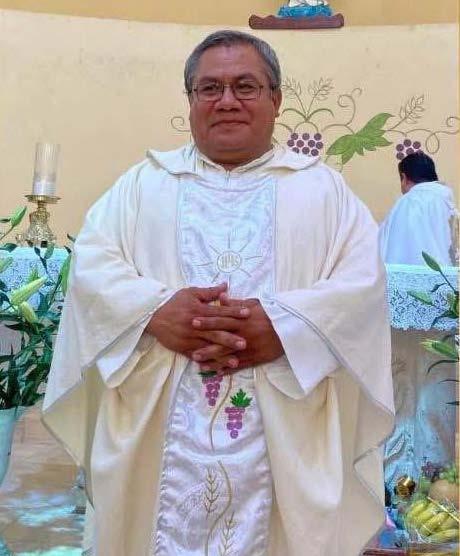
On 6 October the body of Roman Catholic priest Bertoldo Pantaléon Estrada was discovered with multiple gunshot wounds inside his vehicle, over 65km from his home parish. Please pray for his community, and for a full investigation to ensure that justice is served.
Tuesday 10 March
Our friends at the Catholic Multimedia Center told us that killings like that of Father Pantaléon Estrada are often quick to fall out of coverage in the Mexican press. Pray for greater, sustained attention on the vulnerability of religious leaders working in Mexico today.
Wednesday 11 March
‘The Lord delights in those who fear him, who put their hope in his unfailing love.’ Pray Psalm 147:11 over church leaders working in difficult contexts in Mexico. May they know the Lord’s delight in their efforts today.
Thursday 12 March
It is almost two years since over 170 Protestant Christians were forcibly displaced from the villages of Coamila and Rancho Nuevo in Hidalgo State. Most are now living in a village in the neighbouring state of Veracruz. Ask God to provide for them and protect others from experiencing similar violations.
Find out more at csw.org.uk/mexico
Friday 13 March
Pray that God would move the hearts of those in positions of authority to improve understanding of freedom of religion or belief – particularly among indigenous communities. May they not shy away from challenging the culture of impunity in which violations often take place.
International Women’s Day
Revisit our 2022 report: csw.org.uk/LetHerBeHeard
prayer
Saturday 14 March
Peter under pressure to deny Jesus (John 18:17)
Lord Jesus, we consider how your friend Peter denied you three times whilst fearing for his own life and freedom. We also give thanks that you forgave and reinstated him. Today we are moved to remember that Christians in Mexico are facing similar pressures to renounce their faith, including within indigenous communities. We thank you that you are close to the marginalised and the oppressed. Please protect and provide for the displaced, the vulnerable and the overlooked in Mexico today. Amen.
Sunday 15 March
Anti-conversion laws are currently in force in ten Indian states. At the time of writing, two more are awaiting presidential assent to come into effect. Pray that the Christian and Muslim communities against whom these laws are disproportionately enforced would be protected in these states. Find out more at csw.org.uk/india
Monday 16 March
Last year, Uttarakhand State introduced significant amendments to its anti-conversion law, imposing harsher punishments on several offences and granting police powers to make arrests without warrants. Pray that this law would not be misused to target religious minorities. Pray ultimately for its repeal.
Tuesday 17 March
In September, a mob of 60-70 villagers in Mukaram, Chhattisgarh State, attacked the home of the only Christian family in the community, forcing them to flee 15km to a neighbouring village. Ask God to provide for Sodi and Gangi Deva and their two children today.
Wednesday 18 March
‘My own hand laid the foundations of the earth, and my right hand spread out the heavens…’ (Isaiah 48:13a) Pray that Christians worried by the Hindu nationalist path India has taken in recent years would be reassured of God’s dominion over all the earth.
Thursday 19 March
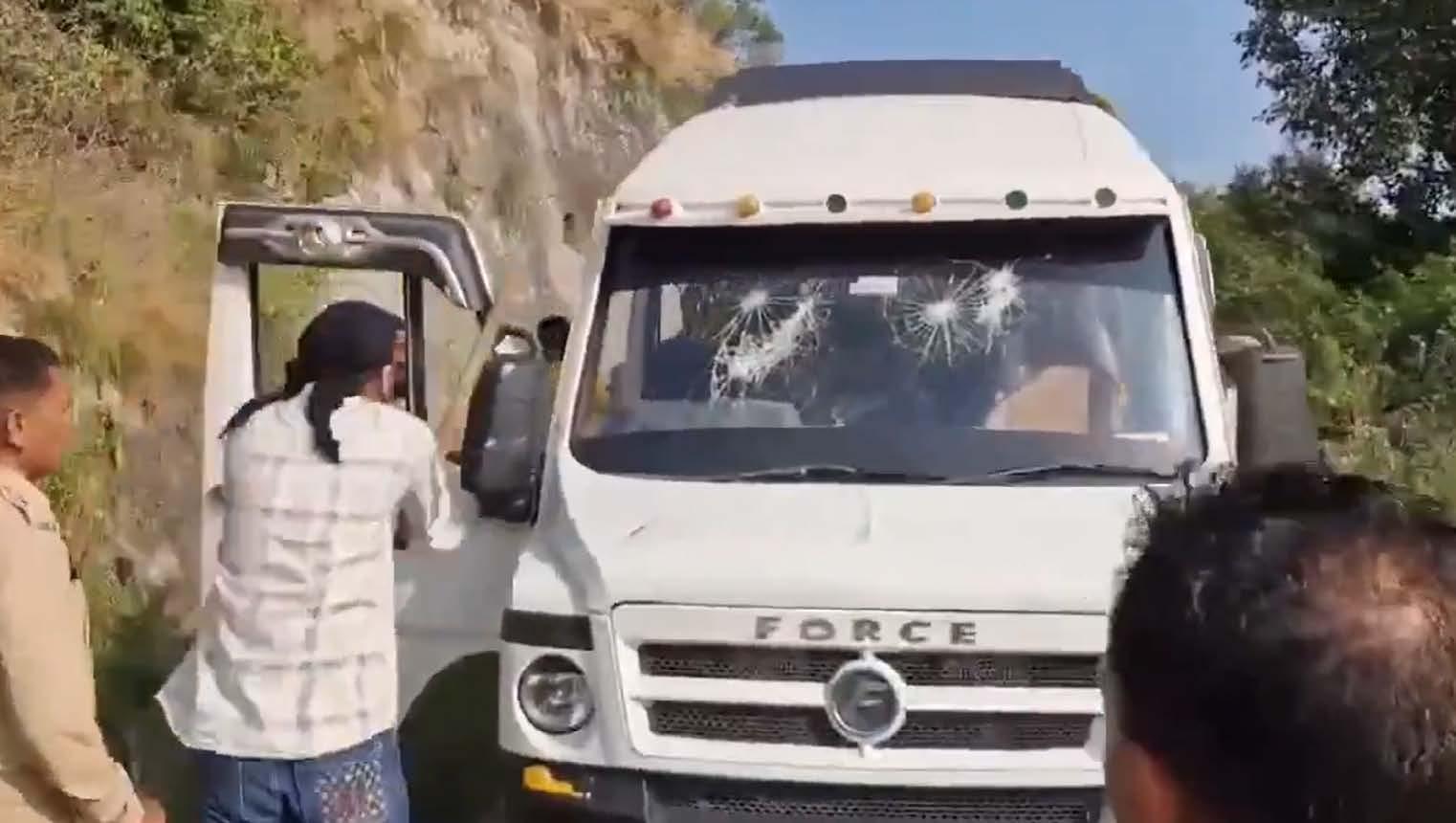
In October, assailants attacked a bus carrying a group of Christian missionaries in Jammu and Kashmir. No-one was harmed, but several police officers were pictured failing to intervene. Pray for an end to the authorities’ indifference and occasional complicity in attacks on religious minorities.
Friday 20 March
Members of the Dalit community who convert to Christianity or Islam face a form of double marginalisation because of their caste status and religious identity. Pray that they would feel known, seen and sustained by the Lord today.
Lent prayer
Saturday 21 March
Jesus is mocked and mistreated by soldiers (Luke 22:63)
Father God, we know that when you walked this earth you experienced the same kind of mockery, mistreatment and even physical assault that has been suffered by far too many Christians across India. We pray that these Christians would know your strength and solidarity in whatever they are facing, resting in the certainty that you are far more powerful than the Hindu nationalist agenda that has taken hold in the country today. Amen.
Father Bertoldo Pantaléon Estrada. Credit: Catholic Multimedia Center
Lent
Assailants attack a bus carrying Christian missionaries in Juthana village, Jammu and Kashmir in October 2025.
Introducing… Timothy Cho
Timothy Cho was given his first Bible by a South Korean gangster in a prison in Shanghai. He was there because he had dared to escape his home country of North Korea.
Timothy twice fled the country and has been imprisoned four times as well as tortured for his escape. He now works as a human rights defender, advocating for North Koreans across the world. Our team was honoured to interview him for our recent podcast series and hear his incredible story.
Timothy, you have shared widely about your dramatic escapes from North Korea. Can you tell us more about what day to day life was like in North Korea, particularly as a child?
I thought as more time goes by, I might forget my past memories because it’s been, I think, approaching nearly two decades since I escaped the country. But I think more and more of my memory goes back to North Korea.
I would spend time with my parents (who are high school teachers) and go to nursery and spend time with other kids, but learning how to speak and act and think as the Kims wanted; the typical brainwashing education. When I was in primary school, I waited to come home and watch cartoons. You realise today that all these cartoons were also about propaganda.
After my parents escaped during the famine, I survived a few years on the street before I went back to my grandma. I was 13 or 14 years old and started helping with growing food. We didn’t have any equipment, so my uncle and I became the cow to plough the farm.
By the time I was finishing high school age in North Korea, my height was 148 centimetres [approximately 4’10; the average height of a 12-year-old].
When did you first start to question the regime’s power and ability to provide and care for North Korea’s citizens?
I go back to the first year of primary school; our teacher asked us to visit one of our friends who didn’t come to school. We went to our friend’s house and knocked on the door, but no one was opening it. We could see inside the house, and we were shocked because the family were lying on the floor. They were all very seriously swollen, you couldn’t even recognise them. They had eaten grass from the field – but it was poisonous.
When we reported to our teacher, they asked all of us if we could donate something to give this family so we can bring our friend back to school. It was quite scary. And more people started dying of starvation and people started to escape. This was the reality check. Many children died of starvation during the famine throughout the 1990s.
What do you hope to see in North Korea’s future?
I can’t wait to see that moment when the two Koreas become one. When no one can stop people driving from Seoul to Pyongyang and Pyongyang to Seoul. When families can be reunited, sit down together and have dinner. And that hope still remains, not just in my heart but in all North Korean escapees all across the world.
Listen
You can hear the rest of Timothy’s interview, including his miraculous escape from North Korea, on our Free to Believe podcast. Available at csw.org.uk/podcast and on all podcast platforms.
Sunday 22 March
Recent data suggests that Kim Jong-Un (the North Korean leader) is winning the hearts and minds of young people in North Korea, by cracking down on foreign media and spinning false narratives. Pray that the truth will prevail and that citizens would see the government’s lies for what they truly are: tools to maintain control. Find out more at csw.org.uk/northkorea
Monday 23 March
Since 2020 it has become increasingly challenging to get information into North Korea. But the flow of information into the country is essential if we are to see change. Pray for creative means for news of the outside world to find its way into the hands of North Korean citizens, and for governments and other benefactors to continue to fund this work.
Tuesday 24 March
International Day for the Right to Truth concerning gross human rights violations and for the dignity of victims.
Though the number of people escaping North Korea has slowed to a trickle since 2020, there are still individuals attempting to flee. Pray for their safety and protection along the arduous and dangerous journey.
Wednesday 25 March
Along their journey, North Korean escapees must pass through China, where they are at risk of being detained and forcibly repatriated. Pray for a shift in China’s policy – that they would stop violating their international obligations, and would no longer send refugees back to North Korea, where they and their families will face terrible punishment.
Thursday 26 March
The North Korean regime continues to spend vast resources on nuclear arms and security, while citizens face severe hunger and lack of food. Pray for a change that means the people of North Korea would no longer pay the price for the regime’s security policies.
Friday 27 March
Ask the Lord to be an ever-present help to those who advocate for the people of North Korea, including Timothy Cho. He is a Christian and activist who often retells his personal experiences of imprisonment and escape, including at CSW’s event in UK Parliament in November. We are grateful for his dedication and partnership.
Lent prayer
Saturday 28 March
‘Why have you forsaken me?’
(Matthew 27:46)
Lord Jesus, you know what it is to suffer. You are the suffering servant, who understands the pain of those living under oppression in North Korea. Bring your strength, comfort, power and hope to those who feel forsaken. We think especially of those in prison camps, those who have fled the country, and Christians who may be following you in secret. Show them that they are not forsaken. Amen.
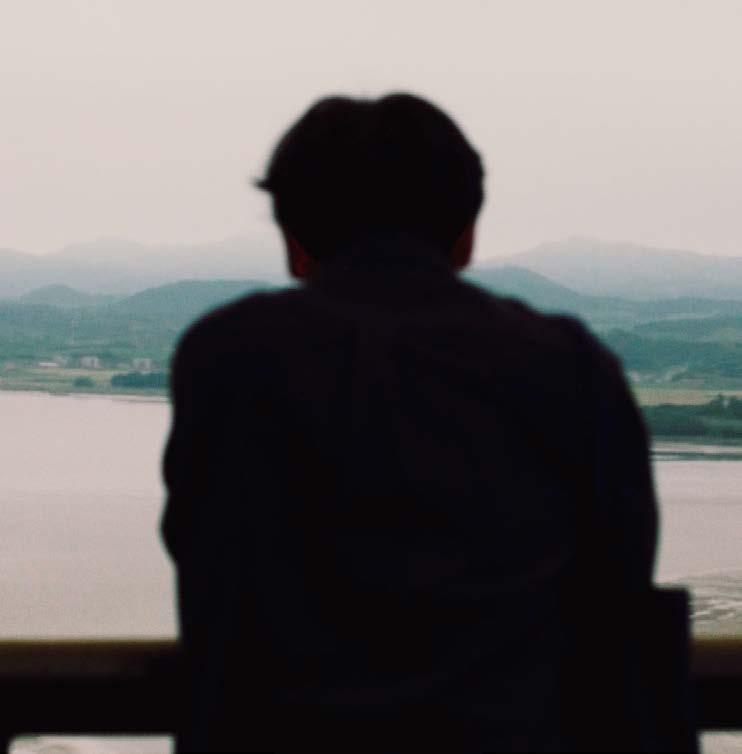
Korean Demilitarized Zone. Photo: CSW.
Who will you pray for this Holy Week? Perhaps there is a story in Response that stands out to you, or a particular country or person that has been on your heart for a while. Here are seven verses to guide your prayers – especially for Christians who may be more vulnerable as Easter approaches.
Rachel from CSW’s External Affairs Team says:
‘I’m particularly thinking about Christians in Colombia.
I remember a when pastor told us last year: “I wanted to call the churches to a season of prayer and fasting for peace in our country… but it is too risky.” It stirs me to pray, knowing that we can stand in the gap for them.
‘I’m praying through these verses, that they would be refreshed in the hope of the Gospel. As Christians we believe there is something more than this world can offer. A brighter hope; a surer future. Perfect justice; perfect peace. A saviour who is familiar with suffering. It’s difficult to hear what’s happening in the world –often in painful detail – but it helps to recentre my mind on God’s word. He is eternally triumphant, and one day every knee will bow.’
Sunday 29 March
‘For all have sinned and fall short of the glory of God, and all are justified freely by his grace through the redemption that came by Christ Jesus.’ (Romans 3:23–24)
Monday 30 March
‘But because of his great love for us, God, who is rich in mercy, made us alive with Christ even when we were dead in transgressions—it is by grace you have been saved.’
(Ephesians 2:4–5)
Tuesday 31 March
‘But he was pierced for our transgressions, he was crushed for our iniquities; the punishment that brought us peace was on him, and by his wounds we are healed.’ (Isaiah 53:5)
Wednesday 1 April
‘For the grace of God has appeared that offers salvation to all people.’ (Titus 2:11)
Thursday 2 April
“This is my blood of the covenant, which is poured out for many for the forgiveness of sins.” (Matthew 26:28)
Friday 3 April
‘He forgave us all our sins, having cancelled the charge of our legal indebtedness, which stood against us and condemned us; he has taken it away, nailing it to the cross. And having disarmed the powers and authorities, he made a public spectacle of them, triumphing over them by the cross.’
(Colossians 2:13b-15)
Saturday 4 April
‘Therefore God exalted him to the highest place and gave him the name that is above every name, that at the name of Jesus every knee should bow…’ (Philippians 2:9-10a)
Are you looking for a new devotional?
We’ve partnered with the YouVersion Bible app to create a reading plan for Forbidden Faith – our powerful devotional exploring what Scripture says about harassment and persecution.
The five-day plan includes readings from Jeremiah and Luke’s Gospel. It challenges us to reflect on how we can stand with those targeted for their beliefs.
Search ‘Forbidden Faith’ on the app and start the plan today!
Sunday 5 April
Happy Easter! Praise God for his glorious victory and endless grace – a joy we share with Christians in Nigeria and all over the world. Ask him to guard everyone gathering to worship the risen Lord Jesus today.
Monday 6 April
As we celebrate the freedom Christ won for us at Easter, we remember those in Nigeria whose freedom has been taken away, for example because they are unjustly imprisoned or abducted for ransom, forced marriage, or slavery. Ask God to set the captives free.
Tuesday 7 April
At the end of November, President Bola Tinubu declared a nationwide security emergency in Nigeria. This came after a surge in mass abductions, including of 303 children and 12 teachers from a Catholic school in Niger State. Give thanks that the crisis was finally acknowledged at the highest level. Pray that words will be turned into consistent, effective action that protects the most vulnerable.
Wednesday 8 April
Also in November, President Tinubu called for increased recruitment into the armed services. Earlier, however, names of known Boko Haram members and other criminals were found in a shortlist cleared for employment in security services. Pray for the exposure and arrest of all terrorist sympathisers and funders in government, the security services or any other significant positions.
Thursday 9 April
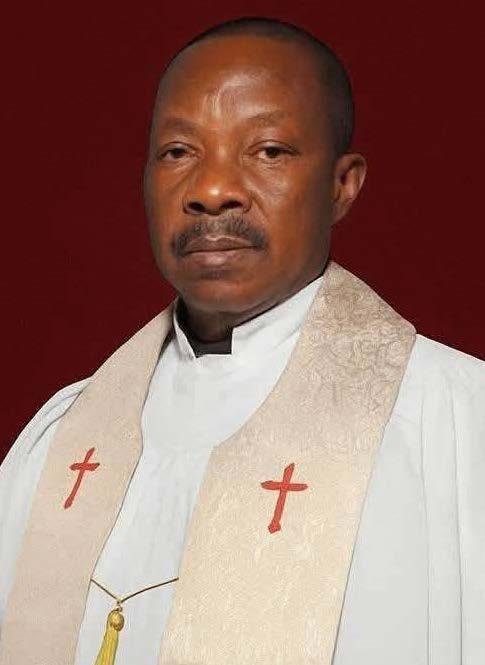
Christian leaders, their families and congregations are frequently abducted for ransom. In Kwara State, Rev James Audu was killed even after his captors received the agreed ransom. In Kaduna State, The Venerable Edwin Achi was killed when a ransom was not raised quickly enough. May God comfort all who mourn or wait in uncertainty.
Friday 10 April
Ask God to strengthen and protect congregations in Nigeria, such as Christ Apostolic Church in Kwara State. Video footage captured the terrifying moment when Fulani militia interrupted a service on 18 November. Five people were killed and 38 abducted, who were later released.
Saturday 11 April
Pray today for an independent international investigation into the violence in central and northwestern Nigeria. Pray also that the international media will report accurately and consistently, taking care to neither minimise nor sensationalise the religious element of the violence. Find out more at csw.org.uk/nigeria
The Venerable Edwin (R) and Mrs Achi (L) in a proof of life picture sent by their captors
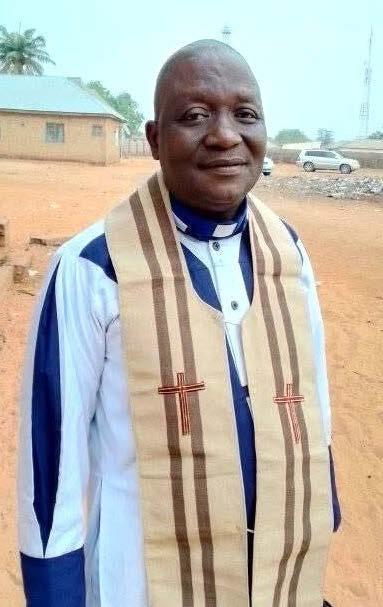
Rev James Audu. Credit: ECWA International family community
Venerable Edwin Achi
Five brutal years
On 1 February 2021, Myanmar’s military (known as the Tatmadaw) seized control of the government in a coup. This abruptly ended Myanmar’s fragile political reform, reversing a decade-long transition towards civilian governance.
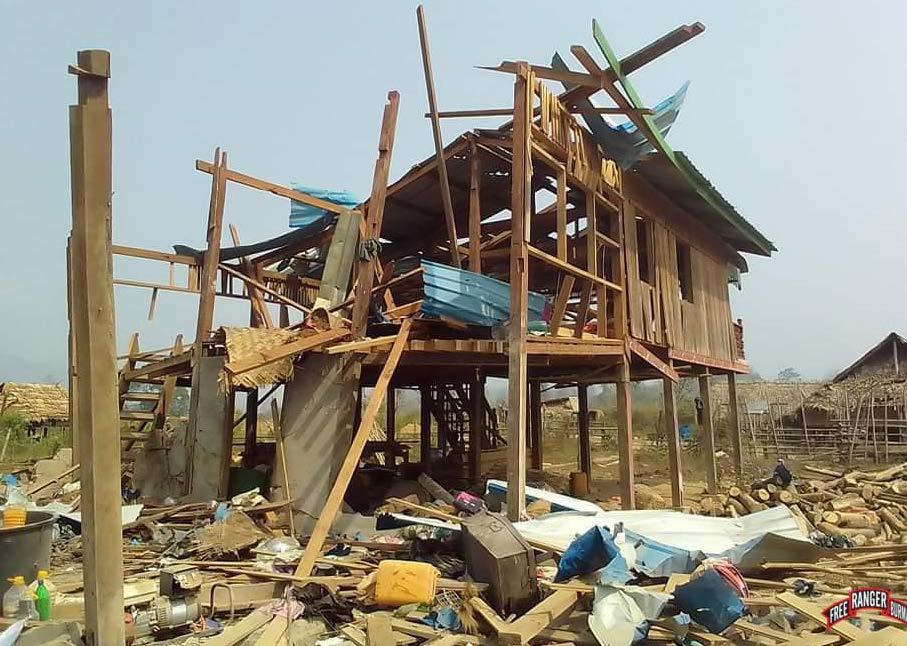
Since then, the situation for ethnic and religious minorities has worsened significantly, with the military conducting brutal campaigns of airstrikes and ground offensives targeting ethnic minority regions, particularly Chin, Kachin, Karen, Karenni and Rakhine states.
Christian minorities are facing increasing persecution as the military regime weaponizes sham elections, and mandatory conscription law. The junta ordered churches to hold early Christmas celebrations in Kachin State to avoid conflict with the December election. Also before Christmas, a 23-year-old Chin Christian pastor, Pau Mua Lian, was unlawfully arrested and conscripted, despite religious clergy being
legally exempt. These are just two examples of emblematic violations against ethnic and religious minorities across the country. When it is not destroying places of worship and other civilian infrastructure, the military is often violating the right to freedom of religion or belief by forcibly closing churches, mosques, pagodas, religious cemeteries and temples – in some cases repurposing said sites as bases in further violation of international humanitarian law.
Facts and stats
Over 7,500 people estimated to have been killed since the coup.
Source: Assistance Association for Political Prisoners (Burma), December 2025.
Your stories: Rev Carl Chambers
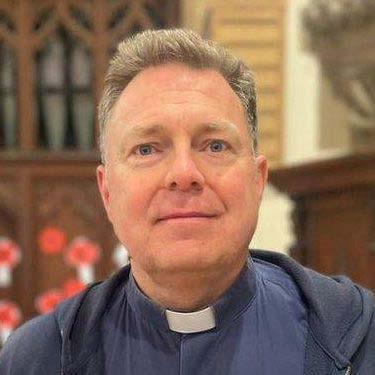
Rev Carl Chambers is the vicar at St Michael and all Angels Church in Wilmington, Kent, in the south-east of England. He shared how his church partners with CSW through praying, campaigning and giving.
How did you come to hear about CSW?
I was contacted by a member of CSW’s advocacy team a few years ago. I hadn’t heard of CSW before, but immediately felt it was a good thing to connect with them.
Are there any individuals or countries that particularly resonate with you or your church?
Yes, certainly. Personally, I’ve felt a connection with Cuba before I was a Christian, and then with Christian pastors since 1994. As a church, we support a church in Chemba, Kondoa, which is a heavily Muslim part of Tanzania. It is a diocese in the Anglican Church. Why is it important for your church to pray and help people who are suffering for their beliefs?
We believe that every human being has dignity before God, because we are made in his image. Whilst God calls us to turn from idols to serve the true and living God, it is also important that people have freedom to explore their beliefs without compulsion or pressure.
Paul urges prayer for all in authority that we may live
peaceful and quiet lives in all godliness and holiness (1 Timothy 2:1-2). There is something about peace, rather than hostility or oppression, which therefore enables people to come to know God.
‘I urge, then, first of all, that petitions, prayers, intercession and thanksgiving be made for all people— for kings and all those in authority, that we may live peaceful and quiet lives in all godliness and holiness.’
(1 Timothy 2:1-2)
How would you encourage other churches to engage with pursuing religious freedom for all?
Follow the advice CSW give! We try to have someone from CSW visit us once a year in a service, and always given them ten minutes to speak to the whole church (including children).
Then they have much longer after the service – it could be 40-60 minutes. Last time someone came, it was great to see a number of people sign the petition.
From time to time, we have someone from CSW join our monthly prayer meeting on Zoom, which keeps things up to date. And because our church only has six mission partners, we make sure we pray for one each
week. So we regularly pray for CSW in the main services, too. Thank you, CSW, for your ministry. We’re right behind you and alongside you!
Equip your church
Would you like us to come to your church or event in 2026? Our team of speakers is made up of lawyers, pastors, journalists and advocacy experts, coming from many different backgrounds and church traditions. Visit csw.org. uk/inviteaspeaker to learn more.
Inspire others
Have you got a story to tell? Perhaps you’ve taken on a fundraising challenge, gathered people to write letters, or joined one of our prayer and protest vigils? Get in touch to share why you care about freedom and justice for all. Email admin@csw.org.uk or call +44 (0) 20 8329 0010.
Airstrikes in Karen State, 2021. Photo: Free Burma Rangers.
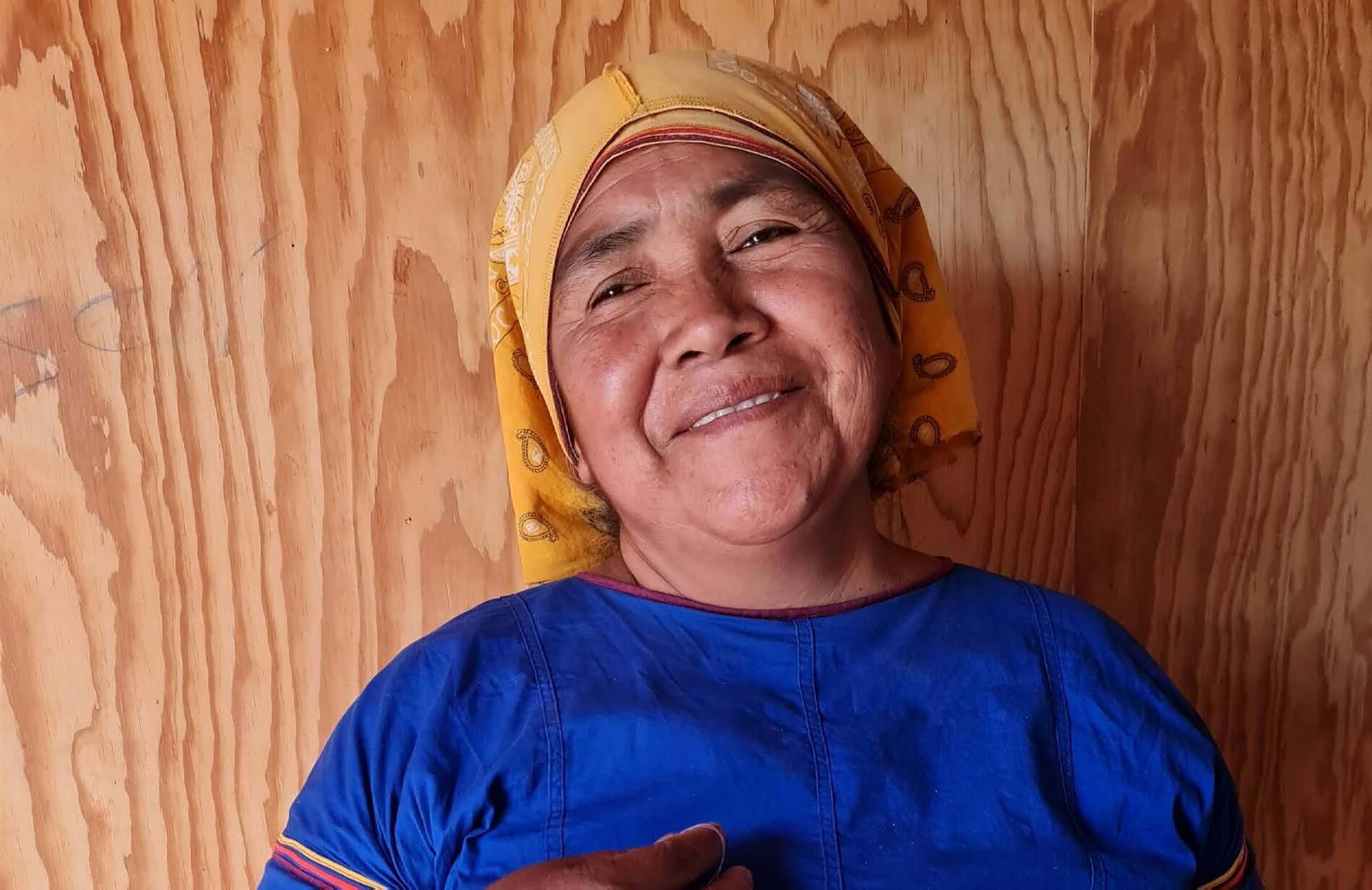
When we met Valentina in 2021, it was the first time she’d been asked to tell her story.
In some of Mexico’s indigenous communities, women like Valentina suffer not only because they are Christian, but because they are women too. Some even had their water supply cut off, making everyday tasks a dangerous burden.
Your support helps us work strategically, month after month, so that voices like Valentina’s can be heard at the highest levels. Could you make a gift to help pursue justice for Valentina and others who are targeted for their beliefs?
Donate today: csw.org.uk/donate
E admin@csw.org.uk
T +44 (0)20 8329 0010 @CSW_UK /CSWUK csw.org.uk
£5 per month* will enable us to gather firsthand information from a survivor to form part of our in-depth reports used in advocacy across international platforms.
*Given over a year. All gifts will go towards CSW’s general work helping people targeted for their beliefs around the world. This is just an example of how your gift will be used.