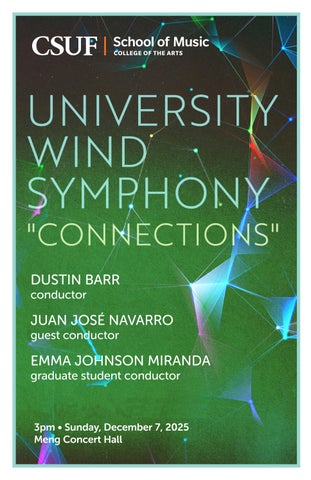
University Wind Symphony

Page 1


DUSTIN BARR conductor

JUAN JOSÉ NAVARRO guest conductor

EMMA JOHNSON MIRANDA graduate student conductor

3pm • Sunday, December 7, 2025

Meng Concert Hall
RONALD S. ROCHON

President, California State University, Fullerton

AMIR H. DABIRIAN

Provost and VP for Academic Affairs

ARNOLD HOLLAND, EDD

Dean, College of the Arts

DR. RANDALL GOLDBERG Director, School of Music

KIMO FURUMOTO

Assistant Director, School of Music

BONGSHIN KO

Assistant Director, School of Music

SCHOOL OF MUSIC FULL-TIME FACULTY AND STAFF

FACULTY

CONDUCTING

Kimo Furumoto instrumental

Dr. Robert Istad choral

Dr. Christopher Peterson choral

Dr. Dustin Barr instrumental

JAZZ AND COMMERCIAL MUSIC

Bill Cunliffe jazz piano; arranging; Fullerton Jazz Orchestra, Fullerton Big Band and combo director

Rodolfo Zuñiga* jazz studies, jazz percussion, and music techology; Fullerton Chamber Jazz Ensemble director

PIANO, ORGAN, PIANO PEDAGOGY

Bill Cunliffe jazz piano

Alison Edwards* piano, piano pedagogy, class piano

Dr. Robert Watson piano

MUSIC EDUCATION, TEACHER TRAINING, AND TEACHING CREDENTIAL

Dr. Christopher Peterson choral

Dr. Gregory X. Whitmore* instrumental

MUSIC IN GENERAL EDUCATION

Dr. John Koegel*

Dr. Katherine Reed

MUSIC HISTORY AND LITERATURE

Dr. Vivianne Asturizaga musicology

Dr. John Koegel* musicology

Dr. Katherine Reed musicology

STRINGS

Kimo Furumoto Director of Orchestra Studies and University Symphony Orchestra conductor

Bongshin Ko cello

Dr. Ernest Salem* violin

THEORY AND COMPOSITION

Dr. Hesam Abedini composition, theory

Dr. Pamela Madsen composition, theory

Dr. Ken Walicki* composition, theory

VOCAL, CHORAL, AND OPERA

Dr. Robert Istad* Director of Choral Studies and University Singers conductor

Dr. Kerry Jennings* Director of Opera

Dr. Christopher Peterson CSUF Concert Choir and Singing Titans conductor

Dr. Joni Y. Prado* voice, academic voice courses

Dr. Bri’Ann Wright general education

WOODWINDS, BRASS, AND PERCUSSION

Dr. Dustin Barr Director of Wind Band Studies, University Wind Symphony, University Band

Jean Ferrandis* flute

Sycil Mathai* trumpet

Ken McGrath* percussion

Dr. Gregory X. Whitmore

University Symphonic Winds conductor

Michael Yoshimi* clarinet

STAFF

Michael August Production Manager

Eric Dries Music Librarian

Gretchen Estes-Parker Office Coordinator

Will Lemley Audio Technician

Jeff Lewis Audio Engineer

Chris Searight Musical Instrument Services

Paul Shirts Administrative Assistant

Elizabeth Williams Business Manager

* Denotes area coordinator

Welcome to the Fall 2025 performing and visual arts season at Cal State Fullerton’s College of the Arts. Each new semester, our campus comes to life with the energy and creativity of thousands of arts students eager to share their unique visions. Whether you’re returning to our venues or here for the first time, we are so excited to present another season to you. Thank you for joining us.

On October 12, the School of Music presents the interdisciplinary performance “Shakespeare in Sound,” featuring the University Symphonic Winds along with vocal and theatre students. Later in the semester, “Here’s Johnny!: Celebrating 100 Years of Johnny Carson” swings its way onto the stage with a program of jazzy favorites on November 16. More toe tapping is in order when the Department of Theatre and Dance presents their fall musical “9 to 5,” based on the hit 1980 film and featuring the music of Dolly Parton. To close the season, “Fall Dance Theatre: Tethered” returns to the Hallberg Theatre with a fully interactive stage set for our dancers and choreographers to explore.

If you haven’t yet visited the College of the Arts Galleries, join us for the October 4 opening reception for the exhibitions Soo Kim: “(Charlie sings in the quietest voice)” and Carol Caroompas: “Mystical Unions.” Kim is known for her intricately cut and layered photographic work while trailblazing alumna Caroompas is widely recognized for her layered visual narratives. Don’t forget to stop by our student galleries while you’re there!

There are so many exhibitions, concerts, and performances to experience across the college this season, but they wouldn’t be possible without you – our extended Titan community. In every class, every rehearsal and with every hour spent in the studio, our students are pushing creative boundaries, but they need your support to thrive. The Dean’s Fund for Excellence provides arts students with necessary funds for scholarships, off-campus opportunities, and so much more. Help transform their potential into possibility by making a gift of any amount to the Dean’s Fund for Excellence today.

Thank you for joining us for this performance. Our students are ready to make the Fall 2025 season unforgettable, and we are so proud to share their artistry with you.

Sincerely,

PROGRAM

El Camino Real (1985) ................................................................... Alfred Reed (1921-2005)

Emma Johnson Miranda, graduate student conductor

Lux Perpetua (2020) ..................................................................... Frank Ticheli (b. 1958)

Traveler (2003) .........................................................................David Maslanka (1943-2017)

Intermission *****

Keepers of the House (2022)

Conni Ellisor Atmospheric (b. 1953) Andante

Symphony No. 8

Andrés Valero-Castells “València Verda” (2024) (b. 1972)

US Premiere Performance Juan José Navarro, guest conductor

PROGRAM NOTES

Alfred Reed

Born into a family of Austrian descent that cherished music, Alfred Reed began his musical studies on the trumpet at the age of ten. By high school, he was performing professionally in the Catskills at resort hotels. He served as a musician and music arranger during World War II with the 529th Army Air Force Band, for which he created more than 100 works. Following the war, he became a student of Vittorio Giannini at Juilliard. He was staff composer and arranger for both the National Broadcasting Corporation and the American Broadcasting Corporation. In 1953, Mr. Reed became conductor of the Baylor Symphony Orchestra at Baylor University in Waco, Texas, while also completing his academic work; he received his B.M. in 1955 and his M.M. in 1956. His Master’s thesis was the Rhapsody for Viola and Orchestra, which later was to win the Luria Prize. It received its first performance in 1959 and was subsequently published in 1966. During his two years at Baylor, he also became interested in educational music at all levels, especially in the development of repertoire materials for school bands, orchestras, and choruses. This led, in 1955, to his accepting the post of editor at Hansen Publishing in New York. In 1966, he left this post to join the faculty of the School of Music at the University of Miami, where he held a joint appointment in the Theory-Composition and Music Education departments and developed the unique (at the time) Music Industry degree program.

With over 250 published works for concert band, wind ensemble, orchestra, chorus, and various smaller chamber music groups, Reed has become one of the nation’s most prolific and frequently performed composers. His work as a guest conductor and clinician took him to forty-nine states, Europe, Canada, Mexico, Japan, Australia, and South America. For many years, at least eight of his works have been on the required list of music for all concert bands in Japan, where he became the most frequently performed foreign composer in the country.

Regarding El Camino Real, he writes: El Camino Real (literally “The Royal Road” or “The King’s Highway”) was commissioned by, and is dedicated to, the 581st Air Force Band (AFRES) and its commander, Lt. Col. Ray E. Toler. Composed during the latter half of 1984 and completed in early 1985, it bears the subtitle “A Latin Fantasy.”

The music is based on a series of chord progressions common to countless generations of Spanish flamenco (and other) guitarists, whose fiery style and brilliant playing have captivated millions of music lovers throughout the world. These progressions and the resulting key relationships have become practically synonymous with what we feel to be the true Spanish idiom. Together with the folk melodies they have underscored,

PROGRAM NOTES

in part derived by a procedure known to musicians as the “melodizing of harmony,” they have created a vast body of what most people would consider authentic Spanish music.

The first section of the music is based upon the dance form known as the Jota, while the second, contrasting section is derived from the Fandango, but here altered considerably in both time and tempo from its usual form. Overall, the music follows a traditional three-part pattern: fastslow-fast.

The first public performance of El Camino Real took place on April 15th, 1985, in Sarasota, Florida, with the 581st Air Force Band under the direction of Lt. Col. Ray E. Toler.

Frank Ticheli

Frank Ticheli’s music has been described as being “optimistic and thoughtful” (Los Angeles Times), “lean and muscular” (New York Times), “brilliantly effective” (Miami Herald), and “powerful, deeply felt crafted with impressive flair and an ear for striking instrumental colors” (South Florida Sun-Sentinel). Ticheli joined the faculty of the University of Southern California’s Thornton School of Music in 1991, where he was Professor of Composition until his recent retirement. From 1991 to 1998, he was Composer in Residence of the Pacific Symphony.

Ticheli’s orchestral works have received considerable recognition in the U.S. and Europe. Orchestral performances have come from the Philadelphia Orchestra, Atlanta Symphony, Detroit Symphony, Dallas Symphony, American Composers Orchestra, the radio orchestras of Stuttgart, Frankfurt, Saarbruecken, and Austria, and the orchestras of Austin, Bridgeport, Charlotte, Colorado, Haddonfield, Harrisburg, Hong Kong, Jacksonville, Lansing, Long Island, Louisville, Lubbock, Memphis, Nashville, Omaha, Phoenix, Portland, Richmond, San Antonio, San Jose, Wichita Falls, and others. His clarinet concerto was recently recorded by the Nashville Symphony on the Naxos label with soloist James Zimmermann.

Ticheli is well known for his works for concert band, many of which have become standards in the repertoire. In addition to composing, he has appeared as guest conductor of his music at Carnegie Hall, at many American universities and music festivals, and in cities throughout the world, including Schladming (Austria), Beijing and Shanghai, London and Manchester, Singapore, Rome, Sydney, and numerous cities in Japan.

Ticheli is the recipient of a 2012 “Arts and Letters Award” from the American Academy of Arts and Letters, his third award from that prestigious organization. His Symphony No. 2 was named winner of the 2006 NBA/ William D. Revelli Memorial Band Composition Contest. Other awards

PROGRAM NOTES

include the Walter Beeler Memorial Prize and First Prize awards in the Texas Sesquicentennial Orchestral Composition Competition, Britten-on-the-Bay Choral Composition Contest, and Virginia CBDNA Symposium for New Band Music.

In 2018, Ticheli received the University of Michigan Alumni Society’s highest honor, the Hall of Fame Award, in recognition for his career as a composer. He was also awarded national honorary membership to Phi Mu Alpha Sinfonia, “bestowed to individuals who have significantly contributed to the cause of music in America,” and the A. Austin Harding Award by the American School Band Directors Association, “given to individuals who have made exceptional contributions to the school band movement in America.” At USC, he has received the Virginia Ramo Award for excellence in teaching, and the Dean’s Award for Professional Achievement.

Ticheli received his doctoral and master’s degrees in composition from the University of Michigan. His works are published by Manhattan Beach, Southern, Hinshaw, and Encore Music, and are recorded on the labels of Albany, Chandos, Clarion, Equilibrium, Klavier, Koch International, Mark, Naxos, and Reference.

Ticheli offers the following remarks about his composition:

Lux Perpetua was composed for the Baylor University Wind Ensemble in memory of two young clarinetist members of that ensemble, Laura Onwudinanti and Jack Stewart, whose lives were tragically cut short in an automobile accident in 2014. The work’s title is drawn from the last line of the Latin text, Lux aeterna: “et lux perpetua luceat eis” (and let perpetual light shine upon them). The idea of light as both protector and illuminator was constantly in my mind as I composed the piece. Two kinds of light comprise the work: one soft and meditative, the other more sparkling and effervescent. Also in mind were the respective personality traits of the two dedicatees, Jack being more thoughtful and introspective, Laura being more spontaneous and gregarious.

A simple call motive begins the piece, introduced by the clarinets. Its two main notes form a descending minor 3rd, a sound that is universally associated with a call or greeting (think “yoo-hoo”) but also widely associated with playground games and nursery rhymes. This idea is laced into the entire fabric of the piece, sometimes serving as transition material, other times appearing unexpectedly for purposes of contrast, still other times flowering into main melody.

The main melody is at once longing and noble in quality, and is constructed in a way that suggests the notion of infinity. Its accompanying harmony depicts a kind of bellows or the act of breathing, in and out perpetually. It never settles on a final chord, but instead moves to a built-in modulation, compelling the melody to repeat itself in a chain of new keys.

A faster, more energetic middle section serves as a dramatic contrast, but rather than give it a new theme, I chose to continue with a variant of the

PROGRAM NOTES

main melody. The accompanying harmony is still breathing, the lyrical line still permeating the entire section, but this time building to a tremendous climax. The final coda is a brief meditation. The main melody echoes itself tenderly as the harmony begins its slow and fragile ascent to the heavens.

Lux Perpetua received its world premiere by the Baylor University Wind Ensemble, Eric Wilson, conductor, at the centennial meeting of the Texas Music Educators Association on February 13, 2020.

David Maslanka Traveler

David Maslanka was born in New Bedford, Massachusetts in 1943. He attended the Oberlin College Conservatory where he studied composition with Joseph Wood. He spent a year at the Mozarteum in Salzburg, Austria, and did masters and doctoral study in composition at Michigan State University where his principal teacher was H. Owen Reed.

Maslanka’s music for winds has become especially well known. Among his more than 150 works are over 50 pieces for wind ensemble, including eight symphonies, seventeen concertos, a Mass, and many concert pieces. His chamber music includes four wind quintets, five saxophone quartets, and many works for solo instrument and piano. In addition, he has written a variety of orchestral and choral pieces.

David Maslanka’s compositions are published by Maslanka Press, Carl Fischer, Kjos Music, Marimba Productions, and OU Percussion Press. They have been recorded on Albany, Reference Recordings, BIS (Sweden), Naxos, Cambria, CRI, Mark, Novisse, AUR, Cafua (Japan), Brain Music (Japan), Barking Dog, and Klavier labels. He served on the faculties of the State University of New York at Geneseo, Sarah Lawrence College, New York University, and Kingsborough Community College of the City University of New York, and was a freelance composer in Missoula, Montana from 1990 until his death in 2017.

About Traveler, Maslanka writes:

Traveler was commissioned in 2003 by the University of Texas at Arlington Band Alumni Association, the Delta Sigma chapter of Kapa Kappa Psi and the Gamma Nu chapter of Tau Beta Sigma, in honor of the career contributions of Ray C. Lichtenwalter (b. 1940), retiring director of bands at UT Arlington. Ray has been a close friend and champion of my music for many years, and it was a great pleasure for me to write this piece for his final concert.

The idea for Traveler came from the feeling of a big life movement as I contemplated my friend›s retirement. Traveler begins with an assertive statement of the chorale melody Nicht so traurig, nicth so sehr (Not so sad,

not so much). The chorale was not chosen for its title, although in retrospect it seems quite appropriate. The last part of a life need not be sad. It is the accumulation of all that has gone before, and a powerful projection into the future—the potential for a tremendous gift of life and joy. And so, the music begins with energy and movement, depicting an engaged life in full stride. At the halfway point, a meditative quiet settles in. Life’s battles are largely done; the soul is preparing for its next big step.

In our hearts, our minds, our souls

We travel from life to life to life

In time and eternity.

Conni Ellisor

Keepers of the House

...absolute proof that new music can be accessible, exciting and inspiring to musicians and audiences alike!

Giancarlo Guerrero, Music Director, Nashville Symphony

It is exactly this quality of being “accessible, exciting, and inspiring to musicians and audiences alike” that is the hallmark of Conni Ellisor’s work. Her critically acclaimed compositions are the beneficiaries of a brilliantly varied career. She has used her journey–formal training at Juilliard, early success in the classical world as a member of the Denver Symphony, concertmaster of the Boulder Philharmonic, first violin in the Athena Quartet (now the Colorado Quartet), and eventually as assistant concertmaster and soloist with the Nashville Chamber Orchestra, along with extensive work in the commercial world as a top-call session violinist and arranger–to inform her current musical statements.

Conni Ellisor’s contributions to the orchestral repertoire include such uniquely American works as Blackberry Winter for mountain dulcimer and strings and Whiskey Before Breakfast – Partita for Bluegrass Band and Strings. Blackberry Winter has generated widespread NPR airplay and was featured on All Things Considered. Her long and productive association with the Nashville Chamber Orchestra resulted in the premieres of eleven of her works. Three were recorded for broadcast by NPR’s Performance Today, and her Conversations In Silence became the title track on the orchestra’s 1997 debut album on Warner Bros. NPR Senior Producer Benjamin Roe’s comment that “the NCO truly is what’s new in classical music” is a testament to Ellisor’s groundbreaking contributions to the group’s repertoire. Among the pieces commissioned by the NCO was Sea Without A Shore, written for orchestra, marimba, and percussion and premiered by the NCO, Christopher Norton, and world-renowned percussion ensemble NEXUS. Other works of hers have been premiered and recorded by the St. Paul

PROGRAM NOTES

Chamber Orchestra, London Symphony, Nexus Chamber Orchestra, Denver Brass, Camelli Quartet, New York Treble Singers, Hamburg Radio Orchestra, and the London Philharmonic.

A passionate and engaging educator as well, Ellisor has written multiple works for the Arlington (NY) High School Philharmonia Orchestra and recently completed a three-year residency with Stringendo, a nonprofit community strings program in upstate New York. The partnership has resulted in seven new works for varying levels of string orchestra. Belmont University recently led a consortium of more than 20 College Band Directors National Association (CBDNA) member colleges to commission Ellisor’s first piece for wind ensemble, Keepers Of This House Commission and premiere highlights include Diaspora by the Nashville Symphony (2011), her second concerto for mountain dulcimer and orchestra, Broad Band of Light, by the Tucson Symphony (2012), Tres Danzas De Vida by the Arlington (NY) High School Philharmonia Orchestra (2013), Fort of Shadows by the Arlington High School Sinfonia Orchestra (2014), and The Bass Whisperer, a concerto for electric bass written with and for 5x Grammy-winning bassist Victor L. Wooten and commissioned by the Nashville Symphony, the Colorado Symphony, and the Chicago Sinfonietta (2015/2016). She has also written and recorded the score for the SONY/Affirm film All Saints (2017) with composer/multi-instrumentalist (and husband) John Mock, through their production company, Drowsy Maggie Productions.

Ellisor began writing Keepers of the House in 2019, but it came to completion in 2022 after the pandemic. The two-movement composition is inspired by Suzanne Simard’s book, “The Mother Tree,” which explores the interconnectedness of trees.

In her own program notes, Ellisor says:

I am intrigued by the relatively new data that all trees are interconnected; that indeed they communicate, send energy to each other, and care for each other. The evidence is overwhelming that all of our forests are alive and communicating, that the “magical trees’ we dreamed about as children are real. And I wonder what that means for us. I find it unlikely that we are the exception, but more probably, we’ve just lost the innate intuition that we are also part of the vast interwoven web of life.

Andres Valero-Castells

Symphony No. 8, “Valènica Verda”

Andrés Valero-Castells studied at the Superior Conservatories in Valencia and Murcia, earning eight degrees, four honorable mentions, and the honor prize in composition. Presently, he is pursuing a doctor’s degree at the Catholic University of Valencia.

Valero-Castells has won important awards and prizes. His works have been played in most of Europe, in the U.S.A., Canada, Argentina, Puerto Rico, and other countries. He has been commissioned to write music for various institutions, as well as for other notable musicians and groups.

Valero-Castells has been a head member of the Valencian Symphonic Composers Association, and he has been resident composer of the International Festival Spanish Brass (Alzira, 2005), and of the Young Orchestra of the Valencian Government (2005-06). He was the first living composer presented in the Palau of the Arts “Reina Sofía” of Valencia (2006). He is a member of Academy of Valencian Music.

Valero-Castells was the principal guest conductor of the Primitiva of Llíria, and founder of the Ensemble Estudi Obert. He was conductor of the Symphonic Band of the CIM of Mislata, the SAM of Picassent, and the La Lírica of Silla. In the 2015-16 season, he was principal conductor of the Municipal Band of Coruña. He is currently conductor of the Young Band of the Association “Bunyol, Cullera i Llíria”. He has been a guest conductor for the Valencia Orchestra, Galician Orchestra, ADDA Symphony Orchestra, and many other groups. Since 2004, Valero has been a professor of composition at the J. Rodrigo Superior Conservatory in Valencia.

Today, we offer the US Premiere Performance of Valero-Castell’s Symphony No. 8, “València Verda.”

Regarding the composition, Valero writes:

This work was commissioned by the Valencia City Council to celebrate Valencia’s status as European Green Capital in 2024 and to be the compulsory piece in the honor section of the 137th edition of the “City of Valencia” International Band Competition, an event to which I have affectionately dedicated this composition. The world premiere took place on July 20, 2025, at the Palau de la Música in Valencia, played by all five bands participating in the competition.

Writing this work was a truly special commission. It is not in vain that Valencian musicians, when we find ourselves anywhere in the world, often use the expression “the best land in the world” to refer to our region, and our capital in particular. Valencia is a wonderful city that perfectly combines tradition and modernity, but not only because of its history, its architecture, its culture, its festivals, its geography, or its climate. Valencia is, above all, music. And this year, a milestone has been achieved, as it became the first

PROGRAM NOTES

city in the Mediterranean basin to hold the title of European Green Capital. This award demonstrates a firm commitment to the environment. Therefore, as a Valencian, a musician, and someone concerned with sustainability, it is a privilege, a responsibility, and an honor to compose this work.

I have always thought that Valencia is an absolutely beautiful place to stroll and enjoy the surroundings. That’s why I wanted to approach this composition as a grand stroll, more contemplative than descriptive, through the most outstanding and emblematic natural sites, which have undoubtedly been the bastions for achieving European recognition. The work is therefore structured in a single movement, but clearly divided into six sections, which are explained below.

1st Section: In the first part, we find ourselves in our most unique ecosystem, the Albufera Natural Park. We depart from any of the five piers for a nighttime cruise on one of the typical artisanal boats that ply its calm waters. The tonal center of this section evolves very gradually from A-flat to C, through a seemingly static pedal sound, symbolizing the process of reaching high tide. At the same time, we hear diminished chords that appear like nocturnal chiaroscuros, saturated by the light of Valencia’s moon, along with brief, furtive interventions, inspired by the unique flora and fauna of the area.

2nd Section: At dawn, we find ourselves in the Turia Garden, the backbone of our city and surely the most impressive linear urban park in existence. In stark contrast to the first section, the music is now full of dynamism, rhythm, and vivacity. Dawn has broken, and we stroll along the old riverbed, observing the sparkling life that takes shape each morning. On our journey, we encounter long paths, first-class sports, recreational, and cultural facilities, connected by the nineteen existing bridges. Of all the sights observed in this phase of our walk, I want to highlight the Palau de la Música, where this work was born and where several generations of Valencian musicians have had our own particular “cathedral of music,” reflected in a culminating point of the sonic discourse.

3rd Section: The next place we visit is La Marina, the Paseo Marítimo, and the city’s beaches. From any of them (Cabañal, Malvarrosa, or Patacona), we stare at the intense blue of their waters, and, returning to the aquatic sound of the first section, we now perceive it in gentle movement, transmitting a seemingly chaotic sensuality, due to the freedom of the waves that, in front of our city, and as the great poet Gerardo Diego (1896-1987) would say, always sing the same verse but with different water. The watery sound image gives way to brief motifs that intertwine, like bathers enjoying themselves on our beaches, and from this texture of multiplicity emerges a nod to an emblematic folk song: A la voreta del mar (To the voreta of the sea).

4th Section: The following section pays homage to the blessed fertility of the Valencian land, embodied in its Huerta (Farm Garden), capable of providing us with the finest natural delicacies in the form of rice, citrus,

PROGRAM NOTES

fruits, and vegetables. Few songs reflect its idiosyncrasies as well as the Cant d’estil (Style Song) and the Albaes de l’horta (Albaes of the Garden). In 2006, I wrote my Rhapsody on Valencian Themes for orchestra, and I was already inspired by these folk genres. On this occasion, I wanted to borrow the brief fragment from that work in which the Albaes de l’horta are heard, with the recreation of the sound of the traditional dulzaina in the oboes, and the typical drum, as well as the beautiful, characteristic song, assigned to the English horn. If I could explain to my dear grandfather Andrés this procedure of “música sobre músicas,” invoking here another work in which I already cited said material, like the good gardener that he was, he would surely tell me that it’s as if he were “empeltant” (grafting).

5th Section: At this point in the symphony, we have surely already perceived a key melodic motif. It appears like a premonition in the Port de Silla, takes presence in its elements and as a whole as we walk through the Turia Park, and is the soul that originates the aquatic dance of the waves on the Valencian beaches. This is the initial melodic motif of the pasodoble Valencia, by the Almería-born maestro José Padilla (1889-1960); established in the vital ideology of the Valencian people as an unmistakable and universal sign of identity. But I invoke it not only for its meaning, but for the double anniversary that occurs. 2024 is the centenary of the premiere of the zarzuela La bien amada by maestro Padilla, and in 2025, it will be the centenary of the premiere of the adaptation of the fragment of his zarzuela as the pasodoble we all know today: Valencia, March from La bien amada. In addition to being omnipresent throughout the work, this ostinato section is entirely based on this motif.

6th Section: Finally, in the last section, some characteristic elements of the previous sections are briefly revisited as a restatement. Also taking center stage is the melody heard on the piano at the very beginning of the work, which has accompanied us in each and every one of the transitions between the enclaves of our walk. This is the theme of the peculiar composition Vexations by the French genius Erik Satie (1866-1925), whose death we will celebrate in 2025 on the first centenary. In addition to the anniversary, it is perfectly plausible that on this, my symphonic walk, we will listen to his music, given my appreciation for his personality. In such warlike and unpleasant times as those we are experiencing, it’s time to live. I would like to end this text with a nice aphorism from his pen that always makes me smile, and that goes like this: “I am like someone who trusts in flowers, without knowing why.” In our Green Valencia, land of flowers, light, and love, I would have it easy. In the last bars, there is a reference to the coda of the Anthem of the Valencian Community, written by the Valencian maestro José Serrano (1873-1941) in 1911, which aims to exalt the feeling of Valencianness that oozes throughout the work: Vixca València, Vixca, Vixca, Vixca!!

UNIVERSITY WIND SYMPHONY

Piccolo

Daniella Arditti

Crystal Lee

Flute

Dani Arditti

Harold Boche Castro

Roger Justo

Crystal Lee

Oboe

Brett Houston

Stephanie Marquez

Lilith Wathen

English Horn

Stephanie Marquez

Bassoon

Nayalin Guzman

Emma

Johnson Miranda

Rekha Michael

Adrian Wu

Contrabassoon

Adrian Wu

E-Flat Clarinet

Oren Dror

Clarinet

Grigorii Avetisian

Humberto Bravo

Myko Crisostomo

Oren Dror

Yilin Li

Michael Morales

Ryan Nguyen

Jonathan Recomanta

Christian Solis

Caleb Spivey

Bass Clarinet

Olivia Hirsch

Ryan Nguyen

Contrabass Clarinet

Ryan Nguyen

Saxophone

Benjamin Jones

Adam Kummer

Joshua Lopez

Kimberly Orozco

Ariel Perez

Trumpet

Dominick Bonelli

Trevor Cannon

Isaac Montaño

Alex Santiago

Susanna Sun

Rudy Xool

Horn

River Ballantyne

Diego Campos

Samuel De los Santos

Andy French

Adam Sevilla

Tenor Trombone

Giovanni Gallegos

Isaac Leyva

Nathanael Peters

Samuel Song

Bass Trombone

Nikolas Hernandez

Nicholas Perez

Euphonium

Stephen Lopez

Jessie Romo

Tuba

Zachary Arnold

Deandre Barlow

Eddie Bonilla

Percussion

Andrew Alvidrez

Ethan Greek

Brad Harris

Daniel La France

Diego Mendoza

Galadriel Pokracki

John Sunderman

Joshua Zepeda

Cello

Chani Greaves

Julian Van Aalst

Double Bass

Angelina Salcedo

Piano

Amelia Thompson

Harp

Brian Noel

Music Librarians

Daniella Arditti

Emma

Johnson Miranda

Christian Solis

Logistics Manager

Ryan Nguyen

Christian Solis

Juan Jose Navarro

Juan José Navarro holds a Superior degree in Clarinet from the Conservatory of Music of Valencia, in Orchestra Conducting from the Conservatory of Music of Murcia, and a Master’s in Conducting and Choral Pedagogy from the International University of La Rioja.

Juan José has led several courses for the conducting of wind band and orchestra with teachers such as José Miguel Rodilla, Salvador Más, Manuel Hernández Silva, Enrique Garcia Asensio, Jerzy Salwarowski, Paollo Belomia, and Cesar Álvarez. He was nominated by the Conservatorio Superior to perform the duties of assistant director for the Orquesta de Jóvenes de la Region de Murcia

Juan José has conducted concerts in Spain, Austria, Hungary, Italy, Illinois, Michigan, Egypt, France, Bulgaria, North Carolina, Pennsylvania, Poland, Luisiana, Maryland, Germany, South Korea, Missouri, Romania and Holland, with such ensembles as the Camerata Strumentale Siciliana (Italy), Orquesta del Conservatorio Superior de Música de Murcia, Karola Namyeslowsky/Zamosc Symphony Orchestra (Poland), Szolnok Symphony Orchestra (Hungary), Cloud Youth Orchestra (Australia), Fuori Comune Ensemble (Italy), Cairo Symphony Orchestra (Egypt), Málaga Camerata, California State University Fullerton Wind Symphony (California), among many others.

Jose José has conducted for many of the productions of the Compaña Lírica Andaluza, such as El Barbero de Lavapiés, Agua Azucarillos y Aguardiente, El Dúo de la Africana…in venues such as the Teatro Alameda of Málaga and the Nuevo Teatro Infanta Leonor of Jaén.

Juan José got the second prize conducting the San Indalecio Wind Orchestra in the National Competition in Murcia and the first prize conducting the Unión Musical de Godelleta in the Special Section of the Wind Bands Competition of Valencia. He has been the titular musical director of the Sinfónica Municipal de Almería for 8 years.

Juan José has run courses, lectures and given master classes for conducting in Universities as Almería (Spain), Virginia Tech University (Virginia), Syracuse University (New York), The University of Illinis (Illinois), Eastern Michigan University (Michigan), University of Northern Iowa (Iowa), University of

Maryland (Maryland), Cornell University (New York), University North Carolina Greensboro (North Caroline), Bolzano High Conservatory (Italy), among others and in places as Murcia, Galicia, Jaén, Granada and Almería organized by such institutions as the Vicerrectorado de Extensión Universitaria of the University of Almería, the Federación Andaluza de Bandas de Música, the Real Conservatorio Profesional de Música of Almería as well as for the teaching staff at the Centro de Enseñanza al Profesorado.

Juan José Navarro is frequently invited to adjudicate as a member of the board of examiners for composition, orchestra and wind orchestra, chamber music and best young musician as well as for the Erich Bergel Conducting Competition (Romania), National Competition of Wind Orchestra in Murcia, the National Competition of Composition in San Pedro del Pinatar, Kussewitzky International Conducting Competition (Italy), Concorso Internazionale “Tomasso Traetta” (Italy), the Valencia Wind Bands Competition, the UK´s National Concert Band Festival, George Gershwin International Music Competition (New York), Concorso Internazionale di Composizione Euregio Klassica di Trento (Italy), Elda Winds Competition (Spain), International Music Competition Florestano Rossamunda (Italy), Lake Como International Conducting Competition (Italy) and the National Orchestra and Wind Orchestra Competition in South Korea. He has conducted in important concert halls such as the Fanz Liszt in Budapest, the Musikverein in Vienna and the Opera House in El Cairo.

Juan José is co-founder, along with José Miguel Rodilla, of the Academia de Dirección de Orquesta y Banda, “Diesis”, which gives classes in Almería, Murcia, Sevilla, and Valencia to more than eighty pupils from every part of Spain. He has recently received the distinction of “Honorary Friend” of the University of Almería for his great contribution as director of the Orchestra, Choir, and Music Department.

Currently, Juan José teaches clarinet and conducting at the Real Conservatorio Profesional de Música of Almería, is Director of the Almería University Music Room, where he conducts the Symphony Orchestra and Choir, Professor of the Conducting Master’s Degree Program at the University of Almería, and a Conducting Teacher at Diesis Academy.

Dustin Barr

Dustin Barr is the Director of Wind Studies and Associate Professor of Music at California State University, Fullerton, where he leads the university’s comprehensive band program. He conducts the acclaimed University Wind Symphony and University Band, oversees the graduate wind conducting program, and teaches courses in conducting and music education. Prior experiences include appointments as Assistant Director of Bands at Michigan State University, Director of Bands at Mt. San Antonio College, and Assistant Director of Bands at Esperanza High School in Anaheim, California.

A leading pedagogue in the field of conducting, Barr collaborated with theatre director Jerald Schwiebert to integrate performance theory with various movement disciplines, pioneering innovative approaches to conducting instruction. Their co-authored book, Expressive Conducting: Movement and Performance Theory for Conductors (Routledge, 2018), has become an essential resource for conductors worldwide. His work in movement theory has resulted in invitations to present masterclasses and lectures throughout the USA and in Spain. Moreover, his research on Scandinavian chamber wind ensemble music resulted in published editions of Asger Lund Christiansen’s Octet, Op. 43 and Svend Schultz’s Divertimento for Wind Octet.

Barr’s accomplishments have garnered wide recognition, including winning Second Prize of the 2024 American Prize in Conducting and Second Prize of the 2024 American Prize in Collegiate Wind Band Performance. His leadership of the CSUF University Wind Symphony has resulted in prestigious performances at the College Band Directors National Association (CBDNA) conferences at both national (2019) and regional (2024) levels, as well as a headlining performance at the 2023 California All State Music Education Conference. The University Wind Symphony’s 2022 album, Effigy, is another noteworthy achievement. This album features the music of composer Brian Baumbusch and was the result of innovative musical practices and remote recording projects undertaken during the COVID-19 pandemic. Under Barr’s direction, the ensemble also received Third Prize in the 2021 American Prize Ernst Bacon Award for the Performance of American Music.

Barr has guest conducted prominent ensembles, including the United States Army Band “Pershing’s Own” and the United States Air Force Band of the Golden West, in addition to numerous collegiate bands across the country. Additionally, he has appeared as guest conductor of leading municipal bands in Valencia and Almería, Spain. He holds a Doctor of Musical Arts in conducting from the University of Michigan, and both Master and Bachelor of Music degrees from California State University, Fullerton. His principal mentors include Michael Haithcock and Mitchell Fennell.

Emma Johnson Miranda

Emma Johnson Miranda is a conductor, musician, and educator who was born and raised in Houston, Texas. Miranda is currently a graduate student at California State University-Fullerton, studying instrumental conducting with Dr. Dustin Barr. Along with completing her degree in conducting, Miranda is finishing her teaching credential all while playing bassoon in the University Wind Symphony and the University Symphony Orchestra.

As an undergraduate student, Miranda studied conducting with Dr. Shawn Smith and bassoon with Dr. Christian Smith at Brigham Young University. Additionally, Miranda played bassoon in the BYU Wind Symphony–a group that toured to Spain and Portugal in May 2023 and qualified to perform at the 2024 WASBE conference in South Korea. She graduated from BYU in April 2023 with a Music BA and a minor in Family Life.

Miranda and her husband, EJ Miranda, currently live in Los Angeles, CA, where they enjoy spending time at the beach, eating good food, and catching up on their favorite TV shows.

shape the future of the arts

The College of the Arts at Cal State Fullerton is one of the largest comprehensive arts campuses in the CSU system. We proudly serve as an academic institution of regional focus with national impact that combines rigorous arts training with cross-disciplinary exploration to encourage the artistic expression and individual achievement of thousands of students throughout the arts every day.

Our students’ success increasingly depends on the support of our community. More of our students are facing significant challenges to their ability to continue their education. Be part of the solution! We invite you to support the Dean’s Fund for Excellence. Help provide students with the education, the tools, and the opportunities to succeed both on campus and off.

Empower our students to become the successful creative professionals our economy so desperately needs! Consider making a gift of any amount to the Dean’s Fund for Excellence today.

$500,000 +

Mrs. Junko Klaus

$100,000-$499,999

Johnny Carson Foundation

$50,000-$99,999

CSU Northridge Foundation

Leo Freedman Foundation

Ms. Susan Hallman in Memory of Ernie Sweet ‘77

Mr. Matthew Scarpino & Ms. Karyn Hayter

Mr. Steve & Mrs. Robin Kalota

Dr. Sallie Mitchell*

Dr. Tedrow & Mrs. Susan Perkins

Mrs. Louise Shamblen

$25,000 - $49,999

Mr. Darryl Curran

Mrs. Lee C. Begovich

Mrs. Marilyn Carlson

Ms. Mary A. and Mr. Phil Lyons

Mr. Bob & Mrs. Terri Niccum

Mr. Ernest & Mrs. Donna Schroeder

Dr. Ed & Mrs. Sue Sullivan

$10,000-$24,999

Dr. Joseph & Dr. Voiza Arnold

Mr. John Aimé & Ms. Robin de la Llata Aimé

Dr. Marc Dickey

Mrs. Evelyn Francuz

Mr. Edward & Mrs. MaryLouise Hlavac

Ms. Kathleen Hougesen

Ms. Kathy Mangum

Mr. James & Mrs. Eleanore Monroe

Mrs. Norma Morris

Mr. John Brennan & Ms. Lucina Moses

$5,000-$9,999

Mr. Nick & Mrs. Dottie Batinich

Continuing Life LLC

Ms. Harriet Cornyn

Mr. William S. Cornyn

Dedicated 2 Learning

Mr. Richard & Mrs. Susan Dolnick

Ebell Club of Fullerton

Friends of Jazz, Inc.

Dr. Margaret Gordon

DONOR APPLAUSE

Mr. Norm & Mrs. Sandy Johnson

Ms. Teri Kennady

Mrs. Jill Kurti Norman

Morningside of Fullerton

Mrs. Bettina Murphy

Mr. David Navarro

Dwight Richard Odle Foundation

Dr. Stephen Rochford, DMA

Southern California Arts Council

Swinerton Builders

Mr. Framroze & Mrs. Julie Virjee

$1,000-$4,999

Mr. John A. Alexander & Mr. Jason Francisco

Mrs. Judy Atwell

Mrs. Lois Austin

Mr. Tod Beckett-Frank

Ms. Karen Bell

Mr. John &

Ms. Shanon M. Fitzpatrick

Dr. Keith & Mrs. Renae Boyum

Mr. Allan & Mrs. Janet Bridgford

Mrs. Marion Brockett

Mr. James & Mrs. Diane Case

Mr. Stephen Collier & Ms. Joann Driggers

Mr. William H. Cunliffe, Jr.

D Barry Schmitt Trust

Ms. Jeannie Denholm

Mr. Gordon & Mrs. Lorra Dickinson

Mr. Kenneth & Mrs. Stacey Duran

Mr. Greg & Mrs. Shawna Ellis

Ms. Judi Elterman

Dr. Anne Fingal

Fullerton Families & Friends Foundation

The Jane Deming Fund

Mrs. Marsha Gallavan

Mrs. Terie Garrabrant

Dr. Leon & Mrs. Annette Gilbert

Mrs. Janet M. Green

Mr. James Henriques

Mr. David &

Mrs. Margret Hoonsbeen

Mr. Mike Ibanez

Mr. Darren & Mrs. Tatyana Jones

Ms. Michelle H. Jordan

Ms. Gladys Kares

Ronald L. Katz Family Foundation

Mr. Raymond & Mrs. Masako Kawase

Mr. Jeffrey & Mrs. Gayle Kenan

Dr. Kristin Kleinjans & Mr. Anthony Dukes

Mrs. Shirley Laroff

Mr. Lynn & Mrs. Susan Lasswell

Mrs. Marilyn Little

Mr. Juan Lopez

Mr. Paul Coluzzi & Mr. John Martelli

Dr. George& Mrs. Karen Mast

Mrs. Thelma Mellott

Mr. Michael & Mrs. Mary Miguel

Mr. Carl Mrs. Patricia Miller

Stifel Nicolaus

Mr. Ujinobu & Mrs. Yoshino Niwa

Mr. Colin Connor & Ms. Debra Noble

Dr. Arie & Mrs. Deanna Passchier

Mr. Jarrold Petraborg

Mr. John Phelps & Mrs. Kerry Laver-Phelps

Mr. Jim Plamondon

Mr. E. B. & Mrs. Linda Powell

Mr. Robert Rennie & Mrs. Nancy Rennie

Ms. Christine Rhoades

Ms. Mary Rupp

Mr. Thaddeus & Mrs. Eleanor Sandford

Mrs. Rita Sardou

Mr. D. Schmitt

Mrs. Martha Shaver

Mrs. Ingrid R. Shutkin

Ms. Barbara Kerth & Ms. Lorena Sikorski

Ms. Janet Smith

South Coast Repertory

Ms. Ann Sparks

Mr. Robert & Mrs. Roberta Sperry

Mr. Douglas Stewart

Mr. Tom & Mrs. Carolyn Toby

Liqi Tong

Viet Tide

Ms. Verne Wagner

Dr. Sean & Dr. Tina L. Walker

Dr. Robert & Mrs. Teri Watson

Dr. Wayne & Dr. Ruth Zemke

special care has been given to the prepartion of this donor list. For questions or concerns, please contact: Ann Steichen | 657-278-3347 Gifts received from July 1, 2023 to December 31, 2024 |

ONTIVEROS SOCIETY

The Ontiveros Society includes individuals who have provided a gift for Cal State Fullerton through their estate plan. We extend our deep appreciation to the following Ontiveros Society members, whose gifts will benefit the students and mission of the College of the Arts.

ANONYMOUS

JOHN ALEXANDER

LEE & DR. NICHOLAS A.* BEGOVICH

MARC R. DICKEY

JOANN DRIGGERS

BETTY EVERETT

CAROL J. GEISBAUER & JOHN* GEISBAUER

SOPHIA & CHARLES GRAY

MARYLOUISE & ED* HLAVAC

GRETCHEN KANNE

DR. BURTON L. KARSON

ANNE L. KRUZIC*

LOREEN & JOHN LOFTUS

ALAN A. MANNASON*

WILLIAM J. MCGARVEY*

VERONICA MICHALOWSKI

DR. SALLIE MITCHELL*

ELEANORE P. & JAMES L. MONROE

LYNN & ROBERT MYERS

BOB & TERRI NICCUM

DWIGHT RICHARD ODLE*

SHERRY & DR. GORDON PAINE

DR. JUNE POLLAK & MR. GEORGE POLLAK*

DR. STEPHEN M. ROCHFORD

STAN MARK RYAN ‘75

MARY K. & WILLIAM SAMPSON

LORENA SIKORSKI

DOUGLAS G. STEWART

ANDREA J. & JEFFREY E. SWARD

RICHARD J. TAYLOR

VERNE WAGNER

RICHARD WULFF

DR. JAMES D. & DOTTIE YOUNG*

We Proudly Recognize Our VOLUNTEER

SUPPORT GROUPS

ART ALLIANCE promotes excellence and enjoyment in the visual arts, and their fundraising efforts contribute to student scholarship, gallery exhibitions, opening receptions and sculpture acquisition on campus.

Website arts.fullerton.edu/aa

MUSIC ASSOCIATES maintains a tradition of active involvement and community support and raises scholarship funds for School of Music students through annual fundraising events and membership dues.

Website arts.fullerton.edu/musicassociatesmembership

*deceased

MORE INFORMATION Dominic Mumolo, Senior Director | dmumolo@fullerton.edu

COLLEGE OF THE ARTS • SELECT EVENTS | FALL 2025

*Molly Pease, mezzo-soprano, with David Bergstedt, piano

September 19 • Meng Concert Hall

Simon Shiao, violin

October 2 • Meng Concert Hall

Soo Kim: (Charlie sings in the quietest voice) and Carole Caroompas: Mystical Unions

October 4, 2025 – May 17, 2026 College of the Arts Galleries

University Symphony Orchestra

October 4 • Meng Concert Hall

University Wind Symphony & Alumni Band: Alchemy of Sound

October 5 • Meng Concert Hall

Caroline Chin, violin

October 9 • Meng Concert Hall

Men on Boats

October 9–18 • Hallberg Theatre

9 to 5: The Musical

October 23–November 1 • Little Theatre

Shakespeare in Sound feat. the University Symphonic Winds

October 12 • Meng Concert Hall

University Singers and Concert Choir

October 19 • Meng Concert Hall

Fullerton Jazz Orchestra and Fullerton Jazz Chamber Ensemble

October 24 • Meng Concert Hall

Dr. Garik Pedersen, piano

October 25 • Meng Concert Hall

Advanced Vocal Workshop with Mark Robson, piano

October 30 • Meng Concert Hall

Ernest Salem, violin & Alison Edwards, piano

November 1 • Meng Concert Hall

Irina Kulikova, guitar

November 4 • Meng Concert Hall

The House of the Spirits

November 6–15 • Young Theatre

Mackenzie Melemed, piano

November 9 • Meng Concert Hall

Opera Scenes

November 14–16 • Recital Hall

Fullerton Pops in Here’s Johnny: A Tribute to Johnny Carson feat. University Symphony Orchestra and Fullerton Jazz Orchestra

November 16 • Meng Concert Hall

Jazz Singers

November 19 • Meng Concert Hall

Cello Choir

November 19 • Recital Hall

University Symphonic Winds

November 21 • Meng Concert Hall

Fall Dance Theatre: “Tethered”

December 4–13 • Hallberg Theatre

Fullerton Jazz Orchestra

December 5 • Meng Concert Hall

University Wind Symphony

December 7 • Meng Concert Hall

Titan Voices and Singing Titans

December 8 • Meng Concert Hall

Fullerton Jazz Chamber Ensemble and Fullerton Latin Ensemble

December 9 • Meng Concert Hall

University Band

December 10 • Meng Concert Hall

Deck the Hall at Cal State Fullerton! December 13, 14 • Meng Concert Hall

*Part of the 25th Annual New Music Series

Turn static files into dynamic content formats.

Create a flipbook
Issuu converts static files into: digital portfolios, online yearbooks, online catalogs, digital photo albums and more. Sign up and create your flipbook.