Bill Cunliffe jazz piano; arranging; Fullerton Jazz Orchestra, Fullerton Big Band and combo director
Rodolfo Zuñiga* jazz studies, jazz percussion, and music techology; Fullerton Chamber Jazz Ensemble director
PIANO, ORGAN, PIANO PEDAGOGY
Bill Cunliffe jazz piano
Alison Edwards* piano, piano pedagogy, class piano
Dr. Robert Watson piano
MUSIC EDUCATION, TEACHER TRAINING, AND TEACHING CREDENTIAL
Dr. Christopher Peterson choral
Dr. Gregory X. Whitmore* instrumental
MUSIC IN GENERAL EDUCATION
Dr. John Koegel*
Dr. Katherine Reed
MUSIC HISTORY AND LITERATURE
Dr. Vivianne Asturizaga musicology
Dr. John Koegel* musicology
Dr. Katherine Reed musicology
STRINGS
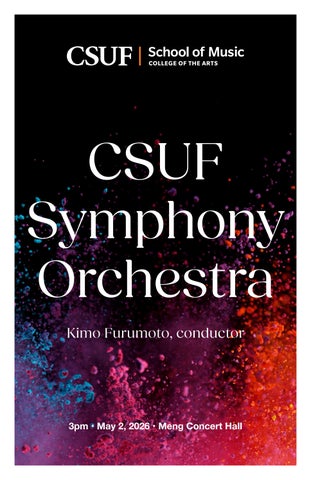
Kimo Furumoto Director of Orchestra Studies and University Symphony Orchestra conductor
Bongshin Ko cello
Dr. Ernest Salem* violin
THEORY AND COMPOSITION
Dr. Hesam Abedini composition, theory
Dr. Pamela Madsen composition, theory
Dr. Ken Walicki* composition, theory
VOCAL, CHORAL, AND OPERA
Dr. Robert Istad* Director of Choral Studies and University Singers conductor
Dr. Kerry Jennings* Director of Opera
Dr. Christopher Peterson CSUF Concert Choir and Singing Titans conductor
Dr. Joni Y. Prado* voice, academic voice courses
Dr. Bri’Ann Wright general education
WOODWINDS, BRASS, AND PERCUSSION
Dr. Dustin Barr Director of Wind Band Studies, University Wind Symphony, University Band
Jean Ferrandis* flute
Sycil Mathai* trumpet
Ken McGrath* percussion
Dr. Gregory X. Whitmore
University Symphonic Winds conductor
Michael Yoshimi* clarinet
STAFF
Michael August Production Manager
Charlotte Bouck
Audition Coordinator, Asst. Production Manager
Eric Dries Music Librarian
Gretchen Estes-Parker Office Coordinator
Jeff Lewis Audio Engineer
Chris Searight Musical Instrument Services
Paul Shirts Administrative Assistant
Elizabeth Williams Business Manager
* Denotes area coordinator
Welcome to the spring 2026 events season at Cal State Fullerton’s College of the Arts. We have been hard at work in every classroom, practice room, and studio across campus preparing to share new sounds and bold creativity with all of you. We are thrilled you are here.
Our students and their success form the core of our purpose in the College of the Arts but unlike their counterparts in other colleges, their paths are not solely formed through classroom learning; they are revealed in the moments when talent meets opportunity. Like when a dancer attends an intensive, or when a musician travels abroad on tour, or an actor or artist is mentored – this is where promise is transformed into possibility. The Dean’s Fund for Excellence gives students access to meaningful experiences like these and many more, including masterclasses, research opportunities, materials, and professional conferences. You can help ensure creativity isn’t limited by circumstance. Consider a gift of any amount to the Dean’s Fund for Excellence today.
This spring semester is brimming with performances and exhibitions for all to enjoy –some that will make you laugh and others that will make you think. In the School of Music, Sibarg Ensemble, featuring our own Hessam Abedini, explores the musical intersections of Iranian music and jazz on February 20. In April, Benjamin Britten’s comic opera “Albert Herring” follows the shy, virtuous title character as he rebels against his prudish upbringing. Join us in the Little Theatre beginning March 5 for the musical “Once Upon a Mattress” – an uproarious sendup of Hans Christian Anderson’s fairytale, “The Princess and the Pea.” If you’re craving something completely different, Eugène Ionesco’s “Rhinoceros” opens March 19 to hold a mirror to the absurdity of mob mentality and the struggle to maintain individuality in the face of mass hysteria. And in late spring, our dancers and choreographers return to demonstrate their inimitable power and grace in “Spring Dance Theatre.”
Across the walkway from where you’re seated are the College of the Arts Galleries. You can still catch exhibitions from Soo Kim and Carol Caroompas until May, or stop by the galleries on Wednesdays for our bi-weekly Student Galleries opening receptions. They are always full of energy, and you might even find student artwork to purchase and take home!
Whether you’re returning to our venues or here for the first time, we are so excited to present another season to you. Thank you for joining us.
Sincerely,
Arnold Holland, EdD Dean, College of the Arts
SCAN THIS QR DONATE TODAY TO THE DEAN’S FUND FOR EXCELLENCE
PROGRAM
Tahiti Trot, Op. 16 ................................................................. Vincent Youmans (Paraphrase of Tea for Two) arr. Dmitri Shostakovich (1898-1946)
White Rose Clarinet Concerto ...................................................... Ken Walicki* (b. 1958)
This program demonstrates how artists, such as the composers featured on this concert, respond to adverse political situations that result in crimes against humanity. The 1930’s saw the rise of totalitarian regimes in the Soviet Union under Stalin and in Nazi Germany under Hitler, both dictators who rose to power through the cult of personality. Ken Walicki’s White Rose Clarinet Concerto is an overt expression of identification with Sophie Scholl and the White Rose resistance group against the Nazi regime. Shostakovich’s Symphony No. 5 offers a “coded” response to the period known as the Great Terror in the Soviet Union. Outwardly, the work may be viewed as extolling the virtues of Stalin’s Communist Party, but at the same time, it speaks to the brutality suffered by thousands of people during this period, including members of Shostakovich’s immediate family. History has shown that such periods of strife recur, but that the human courage to resist and overcome these acts in the face of impossible odds also exists. Artists bear witness to this.
Tahiti Trot, op. 16 (Tea for Two)
VINCENT
YOUMANS
ARR. DMITRI SHOSTAKOVICH
Tahiti Trot is an orchestral arrangement paraphrasing the Song “Tea for Two” from the 1924 musical No, No, Nanette, music by Vincent Youmans, lyrics by Irving Caesar. It was composed in 1927 as a result of a bet between Shostakovich and the score’s dedicatee, Nicolai Malko, that the composer should finish the orchestration in under an hour. Shostakovich completed the orchestration in 45 minutes. The piece was premiered at the Moscow Conservatory on November 25, 1928, conducted by Malko. The work was initially very popular, but Shostakovich was quickly forced to renounce it due to the turbulent political environment in the Soviet Union during the 1928-29 period, and
Tahiti Trot was considered lost until it was reconstructed in the early 1980’s by Gennady Rozhdestvensky from the orchestral parts provided him by Malko’s widow. It is now part of the standard “lighter fare” orchestra repertoire. It provides a greater context for the precarious position artists such as Shostakovich were placed in during the Stalinist regime in Russia after Lenin.
White Rose Clarinet Concerto KEN WALICKI
When I was commissioned to write a clarinet concerto, I began with the question of subject. I have long been drawn to individuals who take moral and political stands in defense of freedom and individual rights, and I chose here to focus on Sophie Scholl and the White Rose resistance group in Germany during the Second World War.
The White Rose (Weiße Rose) was a nonviolent resistance group composed primarily of students at the University of Munich, including Hans and Sophie Scholl. Through anonymously written and distributed leaflets, as well as acts of public graffiti, they called for opposition to the Nazi regime. Their activities began in 1942 and ended with the arrest of the group’s core members by the Gestapo in February 1943. They, along with others who continued to circulate the pamphlets, were tried before the Nazi People’s Court and sentenced to imprisonment or death.
Hans and Sophie Scholl, together with Christoph Probst, were executed four days after their arrest. The proceedings against them were swift and tightly controlled.
The group initially circulated its writings in Munich; copies were later carried to other cities, eventually reaching thousands of readers. In total, the White Rose produced six leaflets denouncing the regime’s crimes and calling for resistance. Their work depended not on
PROGRAM NOTES
institutional support, but on the force of their ideas and the willingness of others to carry them forward.
They worked in a climate where there were clear limits on what could be said. That condition is not confined to history. Those limits are not always stated outright; they emerge over time. The White Rose recognized that and spoke anyway.
A similar tension runs through Shostakovich’s Fifth Symphony, written under direct political pressure and long understood as balancing public conformity with a more private, ambiguous form of dissent. White Rose takes up that refusal. It asks what it means to speak when silence is expected, what it risks, and what it costs.
– Ken Walicki
Symphony No. 5, op. 47 DMITRI SHOSTAKOVICH
On no other major recent composer has more ink been spilt attempting to understand what thought processes and motivations reveal the true inner self, than on Shostakovich. The evidence is fought over, sifted, and re-sifted to build the case that he was a musically-gifted, but incredibly naïve, tool of the worst instincts of Stalinism. Or, on the other hand, a musically-gifted, but wondrously deceptive, resident critic of the terrors of Soviet Communism. Even—something of both. The jury of experts is still out, and will more than likely remain so, for Shostakovich left a maddeningly ambiguous record of his inner thoughts. He was capable of writing the most satirical compositions that scathingly excoriated the excesses and flaws of Western Democracies—it is informing to remember that as a young man he spent much time playing the piano in silent movie houses. And, of course, he is admired for music of dark and profound passion that laments the fundamental tragedies of universal human experience. It is tempting for those who enjoy easy freedoms
of artistic expression to hold others from other times to a higher moral standard and adjure them to not “sell out” their integrity. But few major composers have endured such political and artistic oppression, as did Shostakovich.
He was a student during the early years of the Soviet regime, and like all artists in that country enjoyed the relative indifference towards the arts by early communism. Stylistic prescriptions and proscriptions lay in the future, and he studied the music of an array of traditional and modern composers. He was broadly educated, and free to pursue his artistic interest unfettered. He was generally supportive of the communist regime, and saw no reason to think otherwise.
In all, Shostakovich wrote fifteen symphonies, and his very first one, written upon the occasion of his graduation from conservatory at the age of nineteen was an immediate and acclaimed success. The next year he essayed his second symphony—subtitled “To October”—but despite its celebration of the Revolution, it was not well received. Too advanced and modern, the critics said, and that pretty much went for the third one, as well. In the meantime he had been working on a satirical opera (and Shostakovich was perhaps the greatest master of satire in the classical canon), the Nose. Well, that didn’t set too well with the Soviet ideologues, as well, either. He went from there to working on a much more significant opera, Lady Macbeth of the Mtsensk District (no relationship to Shakespeare’s work). It was at first a success, but he was treading on thin ice with this violent, lurid story of adultery and murder set to loud, dissonant music. It may have reflected Shostakovich’s youthful, trendy tastes, but it was profoundly out of step with changing times in the Soviet Union of Socialist Republics.
As the world knows, during the late twenties and early thirties, life in the
PROGRAM NOTES
Soviet Union evolved into something much more sinister and challenging. As Stalin gradually clamped down on every aspect of everyday life, the arts became progressively a tool for social and political indoctrination. Art was impressed into the service of the state as propaganda, taking in this case the form of what is known as “Socialist Realism.” Simply put, artists were to glorify the reality of the revolution and its benefit to Soviet citizens. Cantatas about the arrival of new tractors to the village, about “Stalin,” the great gardener and re-forester,” were to become the norm. Accepted musical style needed to be largely traditional, pleasant, and accessible to the masses.
1936 marked a fateful year—the Great Terror began, in which millions were executed, including many of Shostakovich’s friends and benefactors. It is said with fair accuracy that hardly any family went without tragedy. Shostakovich’s own life changed profoundly on January 26 1936, when Stalin attended a performance of Lady Macbeth. He was not pleased, to say the least. A few days later the notorious article in Pravda, “Muddle Instead of Music,” was published, and the composer was roundly condemned for an opera that was “coarse, primitive, and vulgar” and a “cacophony.” Not only that, but also an endangerment to Soviet music by one who ignored the demands of Soviet culture, and more. The diatribe—thought at the time, erroneously, perhaps to have been written personally by Stalin himself, ends with a dark hint of “of a game that may end very badly.”
Given the ease with which dozens of artists had already disappeared, never to be seen again, or openly executed, the life of Shostakovich and his music both literally became precarious. He even contemplated suicide, and camped on the landing outside his apartment to ease his arrest without disturbing his family when the secret police came for him. Taking a lower profile was the wise
course—even some of his friends who defended him were shot. But, he continued to work on this fourth symphony, his symphonic style now and thereon distinctly influenced by that of Gustav Mahler. The Symphony No. 4 was set to be given its première later in the same year of 1936, but it is said that a Party official summoned him and “strongly suggested” that he withdraw it. He did, and that was the end of the work for another twenty-five years. And all of this leads to the Symphony No. 5.
There are few major musical compositions in all the repertoire that so profoundly speak, not only to the question of independence, integrity, and honesty of the artist himself, but also to the fundamentals of life, death, freedom, and sufferings of peoples. Written in 1937, and given its première about a year after the ill-fated Symphony No. 4, it was in a new, more conservative style, and was famously, disingenuously referred to by the composer as “a Soviet artist’s creative response to just criticism.” All true—except for the “just.” It was an immediate success, and as we shall see, for a variety of reasons, depending upon the respective perspectives of individual listeners.
The first movement opens with a jagged up-and-down motive, followed by a little, hesitating stepwise descent. These elements will dominate the entire movement, and accompany a variety of other ideas, but will always be discernable, no matter what their guise. The second main idea is a lyrical, soaring tune, but just as melancholy as the first ones. Throughout, the movement’s pace is somewhat slow, even plodding, as it seems to start and stop with an innate fitfulness. Nothing seems to be resolved, even at the end. Later a repetitive “tumta-ta” accompaniment brings some motion to the dark lyricism, followed in the middle section by an absolutely malevolent, threatening march, begun by a staccato thumping low in the piano,
and a low descending line in the unison brass—sounding about as evil and foreboding as brass possibly can. It all just reeks of an overweening, suffocating totalitarian oppression. The climax of this jackboot march is huge, followed by a recapitulation that covers the material from the opening, somewhat in reverse order. The unison strings make a last impassioned outcry that is almost human in its vocal quality, rather like a desperate recitative. The low brass and timpani literally hammer out the opening motive, followed by a brief phony moment of putative happiness in the woodwinds. But truth dispels it, and the whole affair ends ominously with the trumpets playing a key, unifying interval over an incongruous little scale in the celesta. Whatever Shostakovich had in mind as “response to just criticism,” this surely is not it, and totters closely to spitting on it. If the symphony had ended here, so probably would have the composer’s life.
The second movement is no closer to what the Soviet censors surely had in mind, for it is a raucous parody for certain. Remember, the composer had lots of experience writing for the circus, ballets, and the movies, and it all comes out, here. It’s a grotesque waltz in the best tradition of Gustav Mahler, who had become an important influence on Shostakovich. Begun in the low strings, the dance moves like a kaleidoscope through the orchestral colors, featuring almost every instrument and section, not forgetting even the contrabassoon. And, as in the first movement, the meaning here is not clear at all. “Cheeky” is perhaps the best descriptor—it’s certainly not a celebration of new tractors on the collective farm.
The slow movement is epic. While there have been a legion of compositions with the appellation, “tragic,” attached, this one certainly vies for the honor of the most appropriately so. The première saw the audience literally in tears; so immediate was the music to the
tragedies that almost every family was enduring, as Stalin’s purges relentlessly murdered millions of Soviet citizens in a mindless massacre. No brasses intrude here, the movement being carried mainly by a lush, subdivided string section, with a few poignant woodwind moments from time to time. Low reflective strings open, followed by delicate flutes and harp, and the mood is set. From time to time a very special sound is heard, one that everyone in the Russian audience would recognize, and that is the imitation of the deep basso choral voices of the Russian Orthodox Church. This bit of solace appears first in the strings, and then later in the low woodwinds. The tension and grief build, as the violins ascend, and the low strings descend, accompanied by haunting voices in the piano. After this shriek of grief, there is nothing but resignation, as it all subsides. Capitulation and atmospherics creep in, ending with pianissimo, shimmering strings that accompany soft harp and celesta reflections. The sadness is palpable, and yet, still no sign from the composer of “conciliatory” thoughts about the oppressive regime.
So where does this leave us? Shostakovich has one more movement left in which to makemajor amends to the thought police, and posterity has generally conceded that he did so, but only in terms of that specific time and place. Otherwise, posterity has wrangled endless what the true meaning of the end of the symphony is, and what was in the composer’s mind at the conclusion. It all starts as a foreboding, dramatic march that is not at all cheerful. The stentorian brass accompanied by hammering timpani announce a main tune, which is thoroughly worked through, section after section relentlessly, gradually increasing in tempo. At the quickest tempo the trumpet announces a somewhat happier melody and the whole turns for briefly to the major, followed by a dramatic slowing and softening
PROGRAM NOTES
accompany a noble, lyric solo in the horn. After some tranquil ruminations with woodwind solos, a high, very soft, ostinato in the violins leads to a winding sensuous line simultaneously in the high violins and octaves below in the low strings. That sets up a return to the dynamic, opening march theme, but now it “sneaks” in, in a contrapuntal texture. It builds to a thunderous stack of increasing dissonant harmonies until the huge chord dissipates, and the ultimate triumphal moment arrives: clear, tonal, happy, D major! The brass exult, accompanied by fortissimo timpani, like a hammer driving nails. But, as the splendid trumpets ascend in their triumph, there is one very loud Parthian shot. They land on a very loud, high Bb—a note “borrowed” from the parallel minor key. Most everyone has interpreted this dramatic touch as Shostakovich’s very personal way of making totally ambiguous the “triumph” of the symphony and of the regime. A brutal fortissimo unison and even louder hammering from the timpani ends it all. So . . . what was the composer’s intent? Did he capitulate, finally, in the last movement, and this a true move to a more positive world, OR is the offending Bb just typical Shostakovichian pungency? At the time the censors were happy, the audience was happy, and so apparently was Shostakovich—only openly, though. A great work of art is like an onion, layered with meaning. Shostakovich’s symphony offers a plethora of individual interpretations; take away your own.
Hawaii-born clarinetist Michael Yoshimi is an active performer and educator based in Los Angeles. He joined the faculty at California State University, Fullerton (CSUF) in 2022 and was appointed Assistant Professor in 2024. He also teaches at Claremont Graduate University. He frequently appears as a guest player with the Los Angeles Philharmonic and has performed with ensembles including the Pacific Symphony, Los Angeles Opera, Jacksonville Symphony, Boise Philharmonic, and Hawaii Symphony Orchestra, among others.
Since 2013, Michael has been the clarinet instructor at the Colburn Community School of Performing Arts, where he has developed one of the most successful private studios in the country. His students come from across Los Angeles and have been accepted into top conservatories and universities, including the Colburn School, University of Southern California, Rice University, Eastman School of Music, The Juilliard School, Cleveland Institute of Music, Northwestern University, Columbia University, Stanford University, and Brown University. His students have earned numerous accolades, including top honors at prestigious competitions such as the International Clarinet Association’s High School Solo Competition, the National YoungArts Foundation Finals, and the Music Center’s Spotlight Awards. They have also performed on National Public Radio’s From the Top and participated as principal players in renowned summer festivals such as the Verbier Junior Festival Orchestra, Yellow Barn Young Artists Program, Carnegie Hall’s National Youth Orchestra/National Youth Orchestra 2 (NYO/NYO2), Boston University Tanglewood Institute, and Interlochen Arts Camp.
Michael holds a Doctor of Musical Arts and a Master of Music degree in clarinet performance from the University of Southern California’s Thornton School of Music, as well as a Bachelor of Music degree from Northwestern University. His principal teachers were Yehuda Gilad and J. Lawrie Bloom.
Michael’s teaching philosophy emphasizes the role of teachers in not only building a strong foundation in music but also shaping the lives of their students. He focuses on cultivating solid fundamentals to enable his students to express themselves freely through their instrument. He looks forward to connecting with and mentoring new students from around the world.
ABOUT THE CONDUCTOR
Kimo Furumoto is the Orchestra Director at California State University, Fullerton. He is also Music Director and Conductor of the Huntington Symphony Orchestra (West Virginia) as well as the Whittier Regional Symphony. His guest conducting appearances have taken him throughout the United States and Europe with many stellar orchestras. Previous positions include music director of the Concert Orchestra at the University of Cincinnati, College Conservatory of Music, conducting assistant with the Cincinnati Symphony Orchestra, and assistant conductor of the Cincinnati Chamber Orchestra. He has worked with noted conductors such as Leonard Bernstein and Robert Shaw.
Furumoto holds degrees in conducting from Chapman University and the University of Cincinnati, College Conservatory of Music. His ballet “The Mandarin Ducks” has been enthusiastically received by audiences.
$500,000 +
Mrs. Junko Klaus
$100,000-$499,999
Johnny Carson Foundation
$50,000-$99,999
CSU Northridge Foundation
Leo Freedman Foundation
Ms. Susan Hallman in Memory of Ernie Sweet ‘77
Mr. Matthew Scarpino & Ms. Karyn Hayter
Mr. Steve & Mrs. Robin Kalota
Dr. Sallie Mitchell*
Dr. Tedrow & Mrs. Susan Perkins
Mrs. Louise Shamblen
$25,000 - $49,999
Mr. Darryl Curran
Mrs. Lee C. Begovich
Mrs. Marilyn Carlson
Ms. Mary A. and Mr. Phil Lyons
Mr. Bob & Mrs. Terri Niccum
Mr. Ernest & Mrs. Donna Schroeder
Dr. Ed & Mrs. Sue Sullivan
$10,000-$24,999
Dr. Joseph & Dr. Voiza Arnold
Mr. John Aimé & Ms. Robin de la Llata Aimé
Dr. Marc Dickey
Mrs. Evelyn Francuz
Mr. Edward & Mrs. MaryLouise Hlavac
Ms. Kathleen Hougesen
Ms. Kathy Mangum
Mr. James & Mrs. Eleanore Monroe
Mrs. Norma Morris
Mr. John Brennan & Ms. Lucina Moses
$5,000-$9,999
Mr. Nick & Mrs. Dottie Batinich
Continuing Life LLC
Ms. Harriet Cornyn
Mr. William S. Cornyn
Dedicated 2 Learning
Mr. Richard & Mrs. Susan Dolnick
Ebell Club of Fullerton
Friends of Jazz, Inc.
Dr. Margaret Gordon
DONOR APPLAUSE
Mr. Norm & Mrs. Sandy Johnson
Ms. Teri Kennady
Mrs. Jill Kurti Norman
Morningside of Fullerton
Mrs. Bettina Murphy
Mr. David Navarro
Dwight Richard Odle Foundation
Dr. Stephen Rochford, DMA
Southern California Arts Council
Swinerton Builders
Mr. Framroze & Mrs. Julie Virjee
$1,000-$4,999
Mr. John A. Alexander & Mr. Jason Francisco
Mrs. Judy Atwell
Mrs. Lois Austin
Mr. Tod Beckett-Frank
Ms. Karen Bell
Mr. John &
Ms. Shanon M. Fitzpatrick
Dr. Keith & Mrs. Renae Boyum
Mr. Allan & Mrs. Janet Bridgford
Mrs. Marion Brockett
Mr. James & Mrs. Diane Case
Mr. Stephen Collier & Ms. Joann Driggers
Mr. William H. Cunliffe, Jr.
D Barry Schmitt Trust
Ms. Jeannie Denholm
Mr. Gordon & Mrs. Lorra Dickinson
Mr. Kenneth & Mrs. Stacey Duran
Mr. Greg & Mrs. Shawna Ellis
Ms. Judi Elterman
Dr. Anne Fingal
Fullerton Families & Friends Foundation
The Jane Deming Fund
Mrs. Marsha Gallavan
Mrs. Terie Garrabrant
Dr. Leon & Mrs. Annette Gilbert
Mrs. Janet M. Green
Mr. James Henriques
Mr. David &
Mrs. Margret Hoonsbeen
Mr. Mike Ibanez
Mr. Darren & Mrs. Tatyana Jones
Ms. Michelle H. Jordan
Ms. Gladys Kares
Ronald L. Katz Family Foundation
Mr. Raymond & Mrs. Masako Kawase
Mr. Jeffrey & Mrs. Gayle Kenan
Dr. Kristin Kleinjans & Mr. Anthony Dukes
Mrs. Shirley Laroff
Mr. Lynn & Mrs. Susan Lasswell
Mrs. Marilyn Little
Mr. Juan Lopez
Mr. Paul Coluzzi & Mr. John Martelli
Dr. George& Mrs. Karen Mast
Mrs. Thelma Mellott
Mr. Michael & Mrs. Mary Miguel
Mr. Carl Mrs. Patricia Miller
Stifel Nicolaus
Mr. Ujinobu & Mrs. Yoshino Niwa
Mr. Colin Connor & Ms. Debra Noble
Dr. Arie & Mrs. Deanna Passchier
Mr. Jarrold Petraborg
Mr. John Phelps & Mrs. Kerry Laver-Phelps
Mr. Jim Plamondon
Mr. E. B. & Mrs. Linda Powell
Mr. Robert Rennie & Mrs. Nancy Rennie
Ms. Christine Rhoades
Ms. Mary Rupp
Mr. Thaddeus & Mrs. Eleanor Sandford
Mrs. Rita Sardou
Mr. D. Schmitt
Mrs. Martha Shaver
Mrs. Ingrid R. Shutkin
Ms. Barbara Kerth & Ms. Lorena Sikorski
Ms. Janet Smith
South Coast Repertory
Ms. Ann Sparks
Mr. Robert & Mrs. Roberta Sperry
Mr. Douglas Stewart
Mr. Tom & Mrs. Carolyn Toby
Liqi Tong
Viet Tide
Ms. Verne Wagner
Dr. Sean & Dr. Tina L. Walker
Dr. Robert & Mrs. Teri Watson
Dr. Wayne & Dr. Ruth Zemke
special care has been given to the prepartion of this donor list. Questions or concerns, please contact: Dominic Mumolo | 657-278-7695 Gifts received from July 1, 2023 to December 31, 2024 |
ONTIVEROS SOCIETY
The Ontiveros Society includes individuals who have provided a gift for Cal State Fullerton through their estate plan. We extend our deep appreciation to the following Ontiveros Society members, whose gifts will benefit the students and mission of the College of the Arts.
ANONYMOUS
JOHN ALEXANDER
LEE & DR. NICHOLAS A.* BEGOVICH
MARC R. DICKEY
JOANN DRIGGERS
BETTY EVERETT
CAROL J. GEISBAUER & JOHN* GEISBAUER
SOPHIA & CHARLES GRAY
MARYLOUISE & ED* HLAVAC
GRETCHEN KANNE
DR. BURTON L. KARSON
ANNE L. KRUZIC*
LOREEN & JOHN LOFTUS
ALAN A. MANNASON*
WILLIAM J. MCGARVEY*
VERONICA MICHALOWSKI
DR. SALLIE MITCHELL*
ELEANORE P. & JAMES L. MONROE
LYNN & ROBERT MYERS
BOB & TERRI NICCUM
DWIGHT RICHARD ODLE*
SHERRY & DR. GORDON PAINE
DR. JUNE POLLAK & MR. GEORGE POLLAK*
DR. STEPHEN M. ROCHFORD
STAN MARK RYAN ‘75
MARY K. & WILLIAM SAMPSON
LORENA SIKORSKI
DOUGLAS G. STEWART
ANDREA J. & JEFFREY E. SWARD
RICHARD J. TAYLOR
VERNE WAGNER
RICHARD WULFF
DR. JAMES D. & DOTTIE YOUNG*
We Proudly Recognize Our VOLUNTEER
SUPPORT GROUPS
ART ALLIANCE promotes excellence and enjoyment in the visual arts, and their fundraising efforts contribute to student scholarship, gallery exhibitions, opening receptions and sculpture acquisition on campus.
Website arts.fullerton.edu/aa
MUSIC ASSOCIATES maintains a tradition of active involvement and community support and raises scholarship funds for School of Music students through annual fundraising events and membership dues.
MORE INFORMATION Dominic Mumolo, Senior Director | dmumolo@fullerton.edu
shape the future of the arts
The College of the Arts at Cal State Fullerton is one of the largest comprehensive arts campuses in the CSU system. We proudly serve as an academic institution of regional focus with national impact that combines rigorous arts training with cross-disciplinary exploration to encourage the artistic expression and individual achievement of thousands of students throughout the arts every day.
Our students’ success increasingly depends on the support of our community. More of our students are facing significant challenges to their ability to continue their education. Be part of the solution! We invite you to support the Dean’s Fund for Excellence. Help provide students with the education, the tools, and the opportunities to succeed both on campus and off.
Empower our students to become the successful creative professionals our economy so desperately needs! Consider making a gift of any amount to the Dean’s Fund for Excellence today.
CSUF COLLEGE OF THE ARTS •
Carole Caroompas: Mytstical Unions Through May 2
COTA Galleries (Atrium Gallery)
Soo Kim: Charlie sings in the quietest voice Through May 16
COTA Galleries (Begovich Gallery)
Sarah Cahill, piano*
March 18, 2026, at 8 PM
Meng Concert Hall
Rhinoceros
March 19–28, 2026
Young Theatre
University Singers & Concert Choir
March 21, 2026, at 8 PM
Meng Concert Hall
Paul Galbraith, guitar
March 22, 2026, at 8 PM
Meng Concert Hall
Fullerton Jazz Chamber Ensemble feat. Ralph Alessi Quartet
March 24, 2026, at 8 PM
Meng Concert Hall
Talich Quartet
March 27, 2026, at 8 PM
Meng Concert Hall
Fullerton Jazz Orchestra feat. Joe La Barbera, drums
March 28, 2026, at 8 PM
Meng Concert Hall
University Symphony Orchestra with Talich Quartet
March 29, 2026, at 3 PM
Meng Concert Hall
Nicholas Isherwood, bass/baritone*
April 7, 2026, at 8 PM
Meng Concert Hall
X-out
April 9–18, 2026
Hallberg Theatre
High School Honor Band & CSUF Wind Chamber Ensembles
April 11, 2026, at 8 PM
Meng Concert Hall
Albert Herring
April 10–12, 2026
Recital Hall
CSU Brass Exchange: CSUF/SDSU
April 20, 2026, at 8 PM
Meng Concert Hall
Fullerton Jazz Chamber Ensemble & Fullerton Latin Ensemble
April 21, 2026, at 8 PM
Meng Concert Hall
Cello Choir
April 22, 2026, at 6 PM
Recital Hall
Woodwind Chamber Recital
April 24, 2026, at 8 PM
Meng Concert Hall
University Symphonic Winds & University Wind Symphony
April 26, 2026, at 8 PM
Meng Concert Hall
Mariachi Titans
April 28 at 8 PM
Meng Concert Hall
University Band
April 29, 2026, at 8 PM
Meng Concert Hall
Spring Dance Theatre
April 30 – May 9, 2026
Little Theatre
Fullerton Jazz Orchestra feat. Dave Binney, saxophone