Bill Cunliffe jazz piano; arranging; Fullerton Jazz Orchestra, Fullerton Big Band and combo director
Rodolfo Zuñiga* jazz studies, jazz percussion, and music techology; Fullerton Chamber Jazz Ensemble director
PIANO, ORGAN, PIANO PEDAGOGY
Bill Cunliffe jazz piano
Alison Edwards* piano, piano pedagogy, class piano
Dr. Robert Watson piano
MUSIC EDUCATION, TEACHER TRAINING, AND TEACHING CREDENTIAL
Dr. Christopher Peterson choral
Dr. Gregory X. Whitmore* instrumental
MUSIC IN GENERAL EDUCATION
Dr. John Koegel*
Dr. Katherine Reed
MUSIC HISTORY AND LITERATURE
Dr. Vivianne Asturizaga musicology
Dr. John Koegel* musicology
Dr. Katherine Reed musicology
STRINGS
Kimo Furumoto Director of Orchestra Studies and University Symphony Orchestra conductor
Bongshin Ko cello
Dr. Ernest Salem* violin
THEORY AND COMPOSITION
Dr. Hesam Abedini composition, theory
Dr. Pamela Madsen composition, theory
Dr. Ken Walicki* composition, theory
VOCAL, CHORAL, AND OPERA
Dr. Robert Istad* Director of Choral Studies and University Singers conductor
Dr. Kerry Jennings* Director of Opera
Dr. Christopher Peterson CSUF Concert Choir and Singing Titans conductor
Dr. Joni Y. Prado* voice, academic voice courses
Dr. Bri’Ann Wright general education
WOODWINDS, BRASS, AND PERCUSSION
Dr. Dustin Barr Director of Wind Band Studies, University Wind Symphony, University Band
Jean Ferrandis* flute
Sycil Mathai* trumpet
Ken McGrath* percussion
Dr. Gregory X. Whitmore
University Symphonic Winds conductor
Michael Yoshimi* clarinet
STAFF
Michael August Production Manager
Eric Dries Music Librarian
Gretchen Estes-Parker Office Coordinator
Will Lemley Audio Technician
Jeff Lewis Audio Engineer
Chris Searight Musical Instrument Services
Paul Shirts Administrative Assistant
Elizabeth Williams Business Manager
* Denotes area coordinator
Welcome to the spring 2026 events season at Cal State Fullerton’s College of the Arts. We have been hard at work in every classroom, practice room, and studio across campus preparing to share new sounds and bold creativity with all of you. We are thrilled you are here.
Our students and their success form the core of our purpose in the College of the Arts but unlike their counterparts in other colleges, their paths are not solely formed through classroom learning; they are revealed in the moments when talent meets opportunity. Like when a dancer attends an intensive, or when a musician travels abroad on tour, or an actor or artist is mentored – this is where promise is transformed into possibility. The Dean’s Fund for Excellence gives students access to meaningful experiences like these and many more, including masterclasses, research opportunities, materials, and professional conferences. You can help ensure creativity isn’t limited by circumstance. Consider a gift of any amount to the Dean’s Fund for Excellence today.
This spring semester is brimming with performances and exhibitions for all to enjoy –some that will make you laugh and others that will make you think. In the School of Music, Sibarg Ensemble, featuring our own Hessam Abedini, explores the musical intersections of Iranian music and jazz on February 20. In April, Benjamin Britten’s comic opera “Albert Herring” follows the shy, virtuous title character as he rebels against his prudish upbringing. Join us in the Little Theatre beginning March 5 for the musical “Once Upon a Mattress” – an uproarious sendup of Hans Christian Anderson’s fairytale, “The Princess and the Pea.” If you’re craving something completely different, Eugène Ionesco’s “Rhinoceros” opens March 19 to hold a mirror to the absurdity of mob mentality and the struggle to maintain individuality in the face of mass hysteria. And in late spring, our dancers and choreographers return to demonstrate their inimitable power and grace in “Spring Dance Theatre.”
Across the walkway from where you’re seated are the College of the Arts Galleries. You can still catch exhibitions from Soo Kim and Carol Caroompas until May, or stop by the galleries on Wednesdays for our bi-weekly Student Galleries opening receptions. They are always full of energy, and you might even find student artwork to purchase and take home!
Whether you’re returning to our venues or here for the first time, we are so excited to present another season to you. Thank you for joining us.
Sincerely,
Arnold Holland, EdD Dean, College of the Arts
SCAN THIS QR DONATE TODAY TO THE DEAN’S FUND FOR EXCELLENCE
PROGRAM
Tarleton’s Resurrection ......................................... John Dowland (1563-1626)
Sir John Souch’s Galliard
Unquiet Thoughts
Sir Henry Guildford’s Almaine Commemorating the 400th anniversary of John Dowland’s death
Quatre pièces pour la guitare ............................ Lennox Berkeley (1903-1989)
Moderato ma con brio
Andante con moto
Lento (Mvt. de Sarabande)
Allegro energico
Suite in A ...............................................
Johann Sebastian Bach (1685-1750)
Allemande (from French Suite No.4, BWV 815)
Tempo di Menuetto (from Keyboard Partita No.5, BWV 829)
Sarabande (from English Suite No.1, BWV 806)
Minuets 1 & 2 (from Keyboard Partita No.1, BWV 825)
Gigue (from Keyboard Partita No.1, BWV 825)
Intermission
Sonata, Hob. XVI 33 in D (trans. E) ............ Franz Joseph Haydn (1732-1809)
Allegro
Adagio
Tempo di Menuetto
Prélude .................................................................. Maurice Ravel (1875-1937)
Menuet on the name of Haydn Waltz in the style of Borodin
Tango (from España, op. 165) ................................. Isaac Albéniz (1860-1909)
Cataluña (from Suite Española, op. 47)
Sevilla (from Suite Española, op. 47)
All works arranged for 8-string classical guitar by Paul Galbraith
Paul Galbraith appears by arrangement with Lisa Sapinkopf Artists, www.chambermuse.com
(All
PROGRAM NOTES
notes except Albéniz by Paul Galbraith)
Tarleton’s Resurrection
Sir John Souch’s Galliard
Unquiet Thoughts
Sir Henry Guildford’s Almaine
JOHN DOWLAND
While still a relative youngster, guitarist Julian Bream was described by the redoubtable musical thinker and writer, Hans Keller, as “a great artist without very much great literature at his disposal.” Keenly aware of this disadvantage, it was therefore one of the joys of Bream’s early musical life to chance upon— in the Manchester (UK) Central Library during the intermission of a concert—a selection of lute music by John Dowland, in transcription for keyboard. Here, finally, was music which immediately revealed itself to be great literature, written by “one of our own:” a fretted instrument “insider;” a virtuoso lutenist. Both the lute and Dowland’s music were still almost completely forgotten at the time, and had been for centuries, so this repertoire from the golden age of English music—the Renaissance—a time when the lute featured at the very centre of music making, was a thrilling discovery.
Bream’s subsequent championing of the lute and Dowland’s music helped galvanise the start of his career, and effectively initiated the revival of the lute in modern times. It also led to Benjamin Britten composing, some years later, that undisputed masterwork for guitar dedicated to Bream, and written on the quadricentenary of Dowland’s birth—his “Nocturnal,” a set of variations on a Dowland lute song. I imagine that Hans Keller, who brilliantly championed Britten’s music from the outset, might well have congratulated Bream at that
point for having respectively discovered and inspired such “great literature.”
The four pieces I have chosen are arranged in the form of a short suite, and between them, they comprise the four most popular instrumental dance forms of the time, respectively: the Jig, Galliard, Pavane, and Almaine.
1. Jig: “Tarleton’s Resurrection” is an extremely brief and touching homage to a famous comic actor of the time, Richard Tarleton, known for his ballades and songs. Hence perhaps the lyrical, song-like nature of this miniature, with the characteristic high energy of the dance pushed far into the background, almost beyond recognition, thus creating a “spiritualised” jig;
2. Galliard: “Sir John Souch’s Galliard” is identical—besides subtle differences in the accompanying lute part—to the third song in Dowland’s “The First Book of Songs”: “My Thoughts are Wing’d with Hopes.”
Renaissance dances such these were typically in three sections, each of which was repeated with ornate elaborations the second time around. It was normally expected that lutenists—who were almost always also composers at that time— would improvise these elaborations on the spur of the moment. However, Dowland usually preferred to notate everything himself, down to the last ornament.
It so happens that, in the case of this particular Galliard, Dowland omitted for once to provide those repeats, with the result that present-day lutenists and guitarists are obliged to get
PROGRAM NOTES
creative and improvise something of their own. For my part, I noticed that the Galliard version seemed largely to already be an elaboration on the simpler lute part of the song version, and so I tend to use the latter first, followed by the Galliard in the repeats, with a few flourishes of my own invention for good measure.
An additional detail in this piece, may be worth mentioning, relates to dynamics: indications for loud and soft. These were almost nonexistent in early music scores (basically until the end of J.S. Bach’s lifetime; the change happened with his sons and their contemporaries), and in fact a contrast of loud and soft is very much the exception rather than the rule throughout the era. So it is particularly fascinating here to have the words of the song inform our interpretation of the instrumental Galliard, as the lyrics at one point clearly create, or demand, a sudden, unexpected drop in volume: the third section, towards which the previous sections have been steadily building and which would therefore tend to be played slightly more emphatically, opens with the phrase: “And whisper this but softly in her ear . . .”;
3. Pavane: “Unquiet Thoughts” is set in the rhythm of a pavane (a slow, processional dance). Just as Britten arranged the closing song from the First Book of Songs, “Come Heavy Sleep” (also a pavane) for his “Nocturnal,” mentioned above, so have I arranged this opening song from the same book;
4. Almaine (the Renaissance equivalent of the more familiar, Baroque, “Allemande”): “Sir Henry Guildford’s Almaine” features in “A Variety of Lute Lessons,” a collection of 42 lute solos by composers from all over Europe, compiled by
John Dowland’s son, Robert (also a lutenist and composer). There has been some confusion over the authorship of this piece, as it seems that the manuscript is unsigned and in an unknown hand: initially it was assumed to be by the elder Dowland; subsequently it was officially deemed “anonymous” (and was excluded from the publication of Dowland’s complete works); and these days we are, thankfully, back to square one and those first impressions. Dowland the elder it is!
Quatre pièces pour la guitare
LENNOX BERKELEY
In 2001, an exciting event sent classical guitar blogs into overdrive: Segovia’s widow, Emilita, announced to the guitar community at large that her late husband had kept a wooden chest—a treasure chest!—as it contained a multitude of original and largely unknown guitar works dedicated to, but mainly unplayed by Segovia. Furthermore, she sanctioned the publication of all this repertoire. As each piece emerged (always, thankfully, featuring facsimiles of the original manuscripts), excitement grew, as here and there were some real gems.
Now the dust has settled, most guitarists would agree, I think, that perhaps the most enduring and substantial “new” work from the archive is Berkeley’s suite of four pieces, or “Quatre pièces pour la guitare” in Berkeley’s original title (he was part French, through his French grandmother, besides which he was studying in France at the time— late 1920s—with Nadia Boulanger, through the recommendation of his friend and mentor, Ravel).
Initial news of this work’s existence was both welcome and surprising for guitarists: welcome, because all three of Berkeley’s later pieces for guitar—the Sonatina (1957), Variations (1970), and Concerto (1974)—had long been mainstays of the repertoire—so the prospect of an additional fourth work to that list generated a high degree of anticipation, long before we could get our hands on the score; and surprising, because Berkeley himself had always stated that his first work for guitar was his Sonatina—so he obviously had no memory of having composed these pieces, around three decades earlier!
The present work needed more editing than usual to make it feel and sound “guitaristic,” perhaps because Berkeley doesn’t seem to have worked with a guitarist when writing it, in contrast to later years when he worked closely, and for extended periods, with Julian Bream. In fact, I ended up changing the keys of all four pieces. Not that they were unplayable in the original keys (though some passages needed re-voicing to be feasible, no matter what the key); but I found that the music was generally enhanced at the new pitch—”sang out” better.
The four pieces are Neoclassical in style and are set in and against some of the forms which comprise a French Baroque suite: Menuet (here, unusually, placed first); Allemande; Sarabande (the one movement to which Berkeley gave a title) and (arguably) a Rigaudon, originally a folk dance from the south eastern regions of France, including parts of the Mediterranean. My guess is that this “Rigaudon” is in the style of both Rameau and Ravel: Ravel paid homage to eighteenth-
PROGRAM NOTES
century French music in his “Le Tombeau de Couperin” for piano, and incorporated in that suite a Rigaudon, to which Berkeley’s movement bears some similarities— as it does, not surprisingly, to Rameau’s Rigaudon for harpsichord, the likely source of inspiration for Ravel in the first place.
If the intention with the last of the Four Pieces was for it to sound French (via Ravel), the same cannot be said of the other pieces. Or, to be more accurate, they partly do and partly don’t. The part that does sound French is kept more or less discretely running in the background, and serves among other things to throw into relief the part that doesn’t, which sounds unmistakably Spanish instead, in an obvious nod to the work’s dedicatee. Thus:
1. The traditionally polite, French Baroque Menuet is infused with a lively Spanish Saeta dance rhythm (of the type used, for example, by Albeniz in his piano piece, “Cadiz”), with the middle section (or “Menuet II”) in flamenco-esque “tremolo” (though true flamenco tremolo adds an extra note to its “tremolandi”), while:
2. The Allemande gradually and stealthily takes on a veiled, slow, dreamlike “Fandango” character (usually a lively dance), which moves softly but clearly through the piece like “el susurro de las brisas aromadas” (the whisper of aromatic breezes), as Albeniz memorably wrote at the head of the score of his “Córdoba”—without ever disturbing the steady walking pace of the Allemande (fandangos are traditionally in 3 or 6: never, as far as I’m aware, in 2 or 4 time), and:
3. The Sarabande, which possibly takes its cue from Rameau’s Sarabande from his “Nouvelles suites de pièces de clavecin” (ca.1728) with its lutelike arpeggiations, is adorned with impassioned, melismatic figurations and flourishes which point towards cante jondo—the “deep song” of flamenco. Here in fact the background formality of the Sarabande is promoted to the structural foreground—hence Berkeley’s title—and the reason for this is that the Sarabande was an Iberic dance to begin with: Rameau’s Sarabande also sounds, or should sound, Spanish.
4. The last piece may well have been intended as a homage to Ravel, and it is perhaps worthwhile remembering here that Ravel— whom Berkeley knew well, after all—was half Spanish through his Basque-Spanish mother, and famously wrote several modern Spanish classics (in fact it could be argued that all of Ravel’s music contains at least an undertone of Spanish character). And so, even though this movement doesn’t possess many obvious traces of Spanish music, such as those found in the other three pieces, we can perhaps still allow ourselves to imagine a subtle continuation of those Spanish “breezes” to which we’ve now become accustomed, blowing through this finale after all, and mingling with those of southern France.
Suite in A JOHANN SEBASTIAN BACH
Bach’s lute works have long been a staple of guitar programs, much in the way Bach’s harpsichord works have long been a staple of piano programs. In fact, the analogy is
PROGRAM NOTES
inevitably made between the two pairs of instruments: historically the guitar relates to the lute as the piano relates to the harpsichord, approximately so at least.
I merged these keyboard pieces by Bach, taken in this instance from two separate works, in order to create a “lute sonata” as a compliment to the existing body of Bach lute works. The fact that Bach’s keyboard sonatas, suites and partitas often vary in texture from movement to movement, led me to think of lifting the lighter-textured, more lutelike movements from one or two of them, and matching them up with others of a similar type which sounded familial, to form a new extended structure (naturally transposing where necessary).
Of course Bach’s own partitas and suites were tightly structured on a level to which my, admittedly, “mix-and-match” assemblage could never hope to aspire. Nevertheless, it’s maybe worth remembering that Bach himself largely created his great B minor Mass, for example, from disparate cantata movements written throughout his composing life, something you are never aware of when listening to this seemingly tightly integrated, towering structure.
Might Bach have approved then? Naturally it’s impossible to be entirely sure, but given Bach’s highly practical approach to arrangements of his own music and that of his contemporaries, as well as his penchant for reassembling and recycling musical material, I’d wager he would.
Sonata, Hob. XVI 33 in D (trans. E)
FRANZ JOSEPH HAYDN
Haydn liked to group his keyboard sonatas, as he did his string quartets, into sets of six; although unlike his string quartets, there is no real consensus as to opus numbers in the keyboard sonatas, due mainly to the fact that Haydn’s various publishers each came up with their own opus sequencing. This confusion has also complicated the exact dating of individual sonatas, so that we are often left to guess the dates of composition based solely on advances or otherwise in style.
Since Haydn was a born developer, with each new work—especially in his maturity—markedly different from the previous one, it is fascinating to try and judge the approximate composition date of any given Haydn keyboard sonata (or those for which no date is available at least), purely by means of the score.
The present Sonata Hob.33 is a case in point. Consensus has it that this has a composition date of around 1771-73, which puts it at the most important juncture of Haydn’s musical life, when he “hit his stride,” so to speak, never (or rarely) to look back. In fact, Haydn’s famous C minor Sonata, Hob.20, credited with being the first “great” classical keyboard sonata in the literature, has (for once) a clear date of composition of 1771, while the celebrated six op. 20 string quartets of 1772 heralded the start of Haydn’s sustained (and almost uninterrupted) sequence of 45 master quartets, to span the next 27 years.
One telltale sign that the present Sonata Hob.33 is definitely mature Haydn, is the formal feast he serves
up in the “Tempo di Menuet” final movement. Taking the Menuet tempo “in the old style” for once—that is to say, at a leisurely pace—Haydn sets out upon a musical discourse which folds sonata, rondo and variation form into one. In order to do this, he infuses variation with sonata contrasts through one of his (many) very own inventions: his revolutionary “double variation” form. The term “double variation” is really shorthand for “two themes and their respective variations” (which doesn’t trip off the tongue quite so easily . . . ), and it is the “two themes” aspect which sparks that interplay of contrast lying at the root of the sonata dynamic, and which enables Haydn to achieve the ultimate paradox: a sonata-like variation form.
Prélude Menuet on the name of Haydn Waltz in the style of Borodin MAURICE RAVEL
In 1909, the French Société internationale de musique commissioned eight French composers to each write a short piano piece in homage to Haydn, marking the centenary of his death, to be published in their magazine. The composers chosen were Paul Dukas, Reynaldo Hahn, C-M. Widor, Vincent d’Indy, Debussy, Ravel, Saint-Saëns, and Fauré. (All except the last two accepted). Five notes derived from the letters of Haydn’s name—which, in German musical notation, translate to the pitches B-natural (H), A, D (Y), D, and G (N)—were to be used as thematic material, in keeping with the timehonoured musical practice of paying homage to an important composer.
It is significant that Ravel (along with d’Indy, as it happens) chose the form of menuet for his homage to
Haydn, as Haydn, from the age of about forty onwards, tirelessly mined the menuet form, to the extent that, throughout his mature string quartets for example (which almost invariably include a menuet) no two menuets are alike. By the time you get to late Haydn, the menuet has become a fast movement—sometimes ferociously so!—and Haydn eventually supplanted the name with the title “Scherzo.”
Ravel’s Menuet, however, looks back nostalgically to earlier times when the Menuet was spaciously paced, possibly in order both to provide a broader platform for his rich harmonic “chemistry,” as Debussy would have put it, as well as to enable him to pay fuller homage to the great harmonic explorer that was Haydn.
The Homage à Borodine waltz is highly reminiscent of the Russian composer’s Sérénade from his Petite Suite pour piano, to the extent of its being almost a Ravelian re-adaptation. Both Ravel and Debussy were indepted to the Russian composers who immediately preceded them, especially Mussorgsky, whose Nursery Songs were likely the inspiration for the latter’s Children’s Corner, and despite Cocteau’s malicious comment that their style consisted of little more than “Russian music with the pedal down,” neither composer would have denied the profound effect that this generation of Russian composers had on them.
Homage à Borodine was written in 1913, as was the solitary Prélude, which distills in its single page Ravel’s irresistible blend of subtle sensuality and ravishing clarity.
PROGRAM NOTES
Tango (from España, op. 165)
Cataluña (from Suite Española, op. 47)
Sevilla (from Suite Española, op. 47)
ISAAC ALBÉNIZ
Born in Camprodon, province of Girona, Catalonia, Isaac Albéniz was a child prodigy who first performed at the age of four. At age seven, he passed the entrance examination for piano at the Conservatoire de Paris, but he was refused admission because he was believed to be too young. By the time he had reached 12, he had made many attempts to run away from home.
His concert career began at the age of nine when his father took both Isaac and his sister, Clementina, on tours throughout northern Spain. A popular myth is that at the age of twelve Albéniz stowed away in a ship bound for Buenos Aires. He then found himself in Cuba, then in the United States, giving concerts in New York and San Francisco, and then travelled to Liverpool, London and Leipzig. By age 15, he had already given concerts worldwide. This story is not entirely false; Albéniz did travel the world as a performer; however, he was accompanied by his father, who as a customs agent was required to travel frequently.
Albéniz, along with Enrique Granados and Manuel de Falla, defined and elevated Spanish music at the turn of the 20th century, each answering the call of their revered teacher Felipe Pedrell for music that united traditional and folkloric elements with classical forms to create a true national style. It is ironic that much of this music, written by and for virtuoso pianists, is better known in transcriptions for
classical guitar. Albéniz used the guitar as his instrumental model and drew inspiration from the traits of Andalusian folk music without actually using folk themes.
It was in the British Isles, of all places, where his piano recitals were causing a sensation, that Albéniz increasingly turned to subjects from his native country, composing and performing the six “Hojas de Album” (Album Leaves) of España. It might seem surprising that in this journey through the Iberian peninsula Albéniz decided to include a Tango in the form of a Cuban habanera. It would become one of his most popular works.
Albéniz began composing his Suite española in 1886. The work originally consisted of four pieces—Granada, Cataluña, Sevilla and Cuba (then a colony of Spain)—which were grouped together in 1887 in honor of the Queen of Spain, Maria Christina. Twenty years later, four other pieces (Cádiz, Asturias, Aragón and Castilla) were added by the editor Hofmeister. Deliciously atmospheric, by turns languid and festive, the suite’s movements each bear a title and a subtitle, the first referring to the geographical region portrayed, and the second to a musical form or dance from that region.
Cataluña is a corranda, or courante, a lively dance in 6/8 time performed in a circle with the women’s hands on the men’s shoulders. It is reminiscent of an early hunting song.
Sevilla, the third piece in Suite española, is a sevillanas, a Castilian dance with origins in the 15th century.
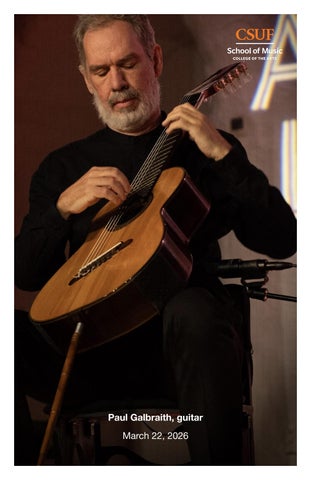
Paul Galbraith is internationally renowned as one of the foremost guitarists of our time. The searching depth of his interpretations, along with his revolutionary playing style and instrument, have made him an instantly recognizable figure in the world of classical music.
Galbraith was named as the 2024 recipient of the Guitar Foundation of America’s Hall of Fame Artistic Achievemant Award for “Monumental Contributions to the Development of the Art and Life of the Classical Guitar”—an extraordinary honor that places him alongside Segovia, Julian Bream, John Williams, etc.
Galbraith’s recording of the Complete Bach Violin Sonatas and Partitas was nominated for a GRAMMY in the category of Best Solo Instrumental Album. This 2-CD set was also chosen as one of the two best CDs of the year by Gramophone Magazine, which called it “a landmark in the history of guitar recordings.” It received a Four Star rating in Stereo Review, and reached the Top 10 on Billboard’s classical charts.
Both Galbraith’s playing position, and his guitar’s
extraordinary design, are considered groundbreaking development in the history of the instrument. The guitar is supported by a metal endpin, similar to that of a cello, which rests on a wooden resonance box. The instrument has two extra strings, one high, one low, increasing its range to an unprecedented extent.
At the age of 17, Galbraith won the Silver Medal at the Segovia International Guitar Competition. Andrés Segovia, who was present, called his playing “magnificent.” This award helped launch an international career including engagements with some of the finest orchestras in Britain and Europe (Royal Philharmonic, Chamber Orchestra of Europe, BBC Philharmonic, Scottish Symphony Orchestra, English Chamber Orchestra, BBC Scottish Orchestra, Scottish Baroque Orchestra, Ulster Orchestra, Hallé Orchestra and Scottish Chamber Orchestra among them). He toured the U.S. as soloist with the Moscow Chamber Orchestra, and performed in Prague’s Dvořák Hall with the National Chamber Orchestra of Chile. In the USA he has appeared as soloist with the Indianapolis Chamber Orchestra, Knoxville Symphony, Santa Rosa Symphony and ProMusica Chamber Orchestra, among others.
Galbraith gave a nationally-televised closing-night performance of Rodrigo’s Concierto de Aranjuez at the Scottish Proms with the BBC Scottish Orchestra, and was invited by the CBC to give a special “Tribute to Glenn Gould” concert for Canada-wide broadcast at the Glenn Gould Studios in Toronto on the occasion of the 25th anniversary of the great pianist’s death. Galbraith has been featured twice on National Public Radio’s “All Things Considered” and numerous times on “Performance Today.”
Galbraith has recently appeared in festivals in Vienna, Austria and in Spain, Italy, China and South Korea. He made his New York début at the Frick Collection, receiving a rave review in the New York Times; he appeared three times on Lincoln Center’s “Great Performances” series, and he has twice given solo recitals at the 92nd Street Y. Recent and forthcoming engagements include NYC, Boston, Washington DC, Los Angeles, San Diego, Atlanta, St. Louis, Cincinnati, Cleveland, Portland Seattle, Miami, Baltimore, Buffalo, Milwaukee, San Antonio, and San Juan (Puerto Rico). Recitals in Brazil, Mexico, the UK, Spain, Portugal, the Netherlands, Denmark, Norway, Finland, Germany, Switzerland, Italy, Hungary, Poland, Russia, Israel and Turkey are among his international activities. He has appeared at numerous Bach festivals, including those of Los Angeles, Philadelphia, Denver and Carmel.
Other highlights of Galbraith’s recent tours are appearances at the Lichfield and Greenwich Festivals in the UK; the Swedish Guitar and Lute Society; a tour of Italy including the Padova
ABOUT THE GUEST
Guitar Festival; and duo concerts in New York City, Washington DC, Atlanta and other cities with the late Antonio Meneses, the last cellist of the legendary Beaux Arts Trio. He recently made the world premiere recording of British composer Thomas Wilson’s Guitar Concerto with the Royal Scottish National Orchestra, to be released on Linn Records, and this August he gave the world premiere, in the UK, of a new solo guitar piece, Morning Star, by Michael Berkeley (the son of Lennox Berkeley, whose Four Pieces for the Guitar can be heard on this evening’s program).
Born in Scotland and now residing in Cambridge, England, Galbraith has lived in Basel, Switzerland and São Paulo, Brazil, where he founded the Brazilian Guitar Quartet. He has been a professor at the Music Academy of Basel, the Royal Scottish Conservatoire, Columbus State University in Georgia, and taught virtually for the University of Colorado School of Music.
Further information on Paul Galbraith is available at www. paul-galbraith.com
“Paul Galbraith has something near genius.”
– Classical Music
“I've never heard anyone play like this. Galbraith seemed to have transcended technique and established a personal connection with an inner source. Everything sounded like a masterpiece that evening.”
– Classical Guitar
$500,000 +
Mrs. Junko Klaus
$100,000-$499,999
Johnny Carson Foundation
$50,000-$99,999
CSU Northridge Foundation
Leo Freedman Foundation
Ms. Susan Hallman in Memory of Ernie Sweet ‘77
Mr. Matthew Scarpino & Ms. Karyn Hayter
Mr. Steve & Mrs. Robin Kalota
Dr. Sallie Mitchell*
Dr. Tedrow & Mrs. Susan Perkins
Mrs. Louise Shamblen
$25,000 - $49,999
Mr. Darryl Curran
Mrs. Lee C. Begovich
Mrs. Marilyn Carlson
Ms. Mary A. and Mr. Phil Lyons
Mr. Bob & Mrs. Terri Niccum
Mr. Ernest & Mrs. Donna Schroeder
Dr. Ed & Mrs. Sue Sullivan
$10,000-$24,999
Dr. Joseph & Dr. Voiza Arnold
Mr. John Aimé & Ms. Robin de la Llata Aimé
Dr. Marc Dickey
Mrs. Evelyn Francuz
Mr. Edward & Mrs. MaryLouise Hlavac
Ms. Kathleen Hougesen
Ms. Kathy Mangum
Mr. James & Mrs. Eleanore Monroe
Mrs. Norma Morris
Mr. John Brennan & Ms. Lucina Moses
$5,000-$9,999
Mr. Nick & Mrs. Dottie Batinich
Continuing Life LLC
Ms. Harriet Cornyn
Mr. William S. Cornyn
Dedicated 2 Learning
Mr. Richard & Mrs. Susan Dolnick
Ebell Club of Fullerton
Friends of Jazz, Inc.
Dr. Margaret Gordon
DONOR APPLAUSE
Mr. Norm & Mrs. Sandy Johnson
Ms. Teri Kennady
Mrs. Jill Kurti Norman
Morningside of Fullerton
Mrs. Bettina Murphy
Mr. David Navarro
Dwight Richard Odle Foundation
Dr. Stephen Rochford, DMA
Southern California Arts Council
Swinerton Builders
Mr. Framroze & Mrs. Julie Virjee
$1,000-$4,999
Mr. John A. Alexander & Mr. Jason Francisco
Mrs. Judy Atwell
Mrs. Lois Austin
Mr. Tod Beckett-Frank
Ms. Karen Bell
Mr. John &
Ms. Shanon M. Fitzpatrick
Dr. Keith & Mrs. Renae Boyum
Mr. Allan & Mrs. Janet Bridgford
Mrs. Marion Brockett
Mr. James & Mrs. Diane Case
Mr. Stephen Collier & Ms. Joann Driggers
Mr. William H. Cunliffe, Jr.
D Barry Schmitt Trust
Ms. Jeannie Denholm
Mr. Gordon & Mrs. Lorra Dickinson
Mr. Kenneth & Mrs. Stacey Duran
Mr. Greg & Mrs. Shawna Ellis
Ms. Judi Elterman
Dr. Anne Fingal
Fullerton Families & Friends Foundation
The Jane Deming Fund
Mrs. Marsha Gallavan
Mrs. Terie Garrabrant
Dr. Leon & Mrs. Annette Gilbert
Mrs. Janet M. Green
Mr. James Henriques
Mr. David &
Mrs. Margret Hoonsbeen
Mr. Mike Ibanez
Mr. Darren & Mrs. Tatyana Jones
Ms. Michelle H. Jordan
Ms. Gladys Kares
Ronald L. Katz Family Foundation
Mr. Raymond & Mrs. Masako Kawase
Mr. Jeffrey & Mrs. Gayle Kenan
Dr. Kristin Kleinjans & Mr. Anthony Dukes
Mrs. Shirley Laroff
Mr. Lynn & Mrs. Susan Lasswell
Mrs. Marilyn Little
Mr. Juan Lopez
Mr. Paul Coluzzi & Mr. John Martelli
Dr. George& Mrs. Karen Mast
Mrs. Thelma Mellott
Mr. Michael & Mrs. Mary Miguel
Mr. Carl Mrs. Patricia Miller
Stifel Nicolaus
Mr. Ujinobu & Mrs. Yoshino Niwa
Mr. Colin Connor & Ms. Debra Noble
Dr. Arie & Mrs. Deanna Passchier
Mr. Jarrold Petraborg
Mr. John Phelps & Mrs. Kerry Laver-Phelps
Mr. Jim Plamondon
Mr. E. B. & Mrs. Linda Powell
Mr. Robert Rennie & Mrs. Nancy Rennie
Ms. Christine Rhoades
Ms. Mary Rupp
Mr. Thaddeus & Mrs. Eleanor Sandford
Mrs. Rita Sardou
Mr. D. Schmitt
Mrs. Martha Shaver
Mrs. Ingrid R. Shutkin
Ms. Barbara Kerth & Ms. Lorena Sikorski
Ms. Janet Smith
South Coast Repertory
Ms. Ann Sparks
Mr. Robert & Mrs. Roberta Sperry
Mr. Douglas Stewart
Mr. Tom & Mrs. Carolyn Toby
Liqi Tong
Viet Tide
Ms. Verne Wagner
Dr. Sean & Dr. Tina L. Walker
Dr. Robert & Mrs. Teri Watson
Dr. Wayne & Dr. Ruth Zemke
special care has been given to the prepartion of this donor list. Questions or concerns, please contact: Dominic Mumolo | 657-278-7695 Gifts received from July 1, 2023 to December 31, 2024 |
ONTIVEROS SOCIETY
The Ontiveros Society includes individuals who have provided a gift for Cal State Fullerton through their estate plan. We extend our deep appreciation to the following Ontiveros Society members, whose gifts will benefit the students and mission of the College of the Arts.
ANONYMOUS
JOHN ALEXANDER
LEE & DR. NICHOLAS A.* BEGOVICH
MARC R. DICKEY
JOANN DRIGGERS
BETTY EVERETT
CAROL J. GEISBAUER & JOHN* GEISBAUER
SOPHIA & CHARLES GRAY
MARYLOUISE & ED* HLAVAC
GRETCHEN KANNE
DR. BURTON L. KARSON
ANNE L. KRUZIC*
LOREEN & JOHN LOFTUS
ALAN A. MANNASON*
WILLIAM J. MCGARVEY*
VERONICA MICHALOWSKI
DR. SALLIE MITCHELL*
ELEANORE P. & JAMES L. MONROE
LYNN & ROBERT MYERS
BOB & TERRI NICCUM
DWIGHT RICHARD ODLE*
SHERRY & DR. GORDON PAINE
DR. JUNE POLLAK & MR. GEORGE POLLAK*
DR. STEPHEN M. ROCHFORD
STAN MARK RYAN ‘75
MARY K. & WILLIAM SAMPSON
LORENA SIKORSKI
DOUGLAS G. STEWART
ANDREA J. & JEFFREY E. SWARD
RICHARD J. TAYLOR
VERNE WAGNER
RICHARD WULFF
DR. JAMES D. & DOTTIE YOUNG*
We Proudly Recognize Our VOLUNTEER
SUPPORT GROUPS
ART ALLIANCE promotes excellence and enjoyment in the visual arts, and their fundraising efforts contribute to student scholarship, gallery exhibitions, opening receptions and sculpture acquisition on campus.
Website arts.fullerton.edu/aa
MUSIC ASSOCIATES maintains a tradition of active involvement and community support and raises scholarship funds for School of Music students through annual fundraising events and membership dues.
MORE INFORMATION Dominic Mumolo, Senior Director | dmumolo@fullerton.edu
shape the future of the arts
The College of the Arts at Cal State Fullerton is one of the largest comprehensive arts campuses in the CSU system. We proudly serve as an academic institution of regional focus with national impact that combines rigorous arts training with cross-disciplinary exploration to encourage the artistic expression and individual achievement of thousands of students throughout the arts every day.
Our students’ success increasingly depends on the support of our community. More of our students are facing significant challenges to their ability to continue their education. Be part of the solution! We invite you to support the Dean’s Fund for Excellence. Help provide students with the education, the tools, and the opportunities to succeed both on campus and off.
Empower our students to become the successful creative professionals our economy so desperately needs! Consider making a gift of any amount to the Dean’s Fund for Excellence today.
CSUF COLLEGE OF THE ARTS
Carole Caroompas: Mytstical Unions Through May 2
COTA Galleries (Atrium Gallery)
Soo Kim: Charlie sings in the quietest voice Through May 16
COTA Galleries (Begovich Gallery)
Sarah Cahill, piano*
March 18, 2026, at 8 PM
Meng Concert Hall
Rhinoceros
March 19–28, 2026
Young Theatre
University Singers & Concert Choir
March 21, 2026, at 8 PM
Meng Concert Hall
Paul Galbraith, guitar
March 22, 2026, at 8 PM
Meng Concert Hall
Fullerton Jazz Chamber Ensemble feat. Ralph Alessi Quartet
March 24, 2026, at 8 PM
Meng Concert Hall
Talich Quartet
March 27, 2026, at 8 PM
Meng Concert Hall
Fullerton Jazz Orchestra feat. Joe La Barbera, drums
March 28, 2026, at 8 PM
Meng Concert Hall
University Symphony Orchestra with Talich Quartet
March 29, 2026, at 3 PM
Meng Concert Hall
Nicholas Isherwood, bass/baritone*
April 7, 2026, at 8 PM
Meng Concert Hall
X-out
April 9–18, 2026
Hallberg Theatre
High School Honor Band & CSUF Wind Chamber Ensembles
April 11, 2026, at 8 PM
Meng Concert Hall
Albert Herring
April 10–12, 2026
Recital Hall
CSU Brass Exchange: CSUF/SDSU
April 20, 2026, at 8 PM
Meng Concert Hall
Fullerton Jazz Chamber Ensemble & Fullerton Latin Ensemble
April 21, 2026, at 8 PM
Meng Concert Hall
Cello Choir
April 22, 2026, at 6 PM
Recital Hall
Woodwind Chamber Recital
April 24, 2026, at 8 PM
Meng Concert Hall
University Symphonic Winds & University Wind Symphony
April 26, 2026, at 8 PM
Meng Concert Hall
Mariachi Titans
April 28 at 8 PM
Meng Concert Hall
University Band
April 29, 2026, at 8 PM
Meng Concert Hall
Spring Dance Theatre
April 30 – May 9, 2026
Little Theatre
Fullerton Jazz Orchestra feat. Dave Binney, saxophone