Telco AI Enabler: Mediation's Defining Role
How the mediation system offers telco a fast track to AI data readiness
Author: John Abraham, Principal Analyst

In partnership with


Telco AI Enabler: Mediation's Defining Role - How the mediation system offers telco a fast track to AI data readiness
Published by Appledore Research LLC • 44 Summer Street Dover, NH. 03820
Tel: +1 603 969 2125 • Email: info@appledorerg.com• www.appledoreresearch.com
© Appledore Research LLC 2026. All rights reserved. No part of this publication may be reproduced, stored in a retrieval system, or transmitted in any form or by any means – electronic, mechanical, photocopying, recording or otherwise – without the prior written permission of the publisher.
Figures and projections contained in this report are based on publicly available information only and are produced by the Research Division of Appledore Research LLC independently of any clientspecific work within Appledore Research LLC. The opinions expressed are those of the stated authors only.
Appledore Research LLC recognizes that many terms appearing in this report are proprietary; all such trademarks are acknowledged, and every effort has been made to indicate them by the normal USA publishing standards. However, the presence of a term, in whatever form, does not affect its legal status as a trademark.
Appledore Research LLC maintains that all reasonable care and skill have been used in the compilation of this publication. However, Appledore Research LLC shall not be under any liability for loss or damage (including consequential loss) whatsoever or howsoever arising because of the use of this publication by the customer, his servants, agents or any third party.
Publish date: 23 February 2026
Cover image: Photo by Josh Calabrese
INTRODUCTION
The emergence of Gen-AI marked a watershed moment for industries worldwide, and telecom felt the impact immediately. CSPs have been grappling with a cluster of structural challenges: declining margins, the relentless need for massive investments in network infrastructure, NPS scores that lag well behind digital native companies, and public valuations that position them closer to utility providers than the digital enablers they aspire to be. Against this backdrop, AI was welcomed with genuine hope as CSPs expect that AI will boost revenues, transform margins, and reshape how the market values them.
Yet the reality of crossing the chasm in AI-readiness has never been more stark. The flash of fanciful applications has faded, and CSPs are beginning to acknowledge that a considerable portion of the value promised by this new wave of AI lies farther out than it initially seemed. The path forward requires more than enthusiasm—it demands architectural and process readiness that many are still working to build.
On the biggest challenges in the way of CSPs is the fragmented state of their data. This makes it exceptionally challenging to ensure AI engines receive the appropriate context and information they need to make accurate decisions without being forced to fill in the gaps, which remains a key cause for hallucinations. CSPs sit on substantial datasets, but these are typically scattered across numerous systems, often in incompatible formats. Making this fragmented data accessible to AI engines in a format that preserves essential context and relationships represents the first major challenge for CSPs.
Mediation systems are particularly well positioned to address this challenge. By virtue of their placement within the critical data flow of the network, mediation systems occupy a uniquely privileged architectural position — maintaining native access to a diverse range of data sources spanning network events, usage records, and select customer attributes.
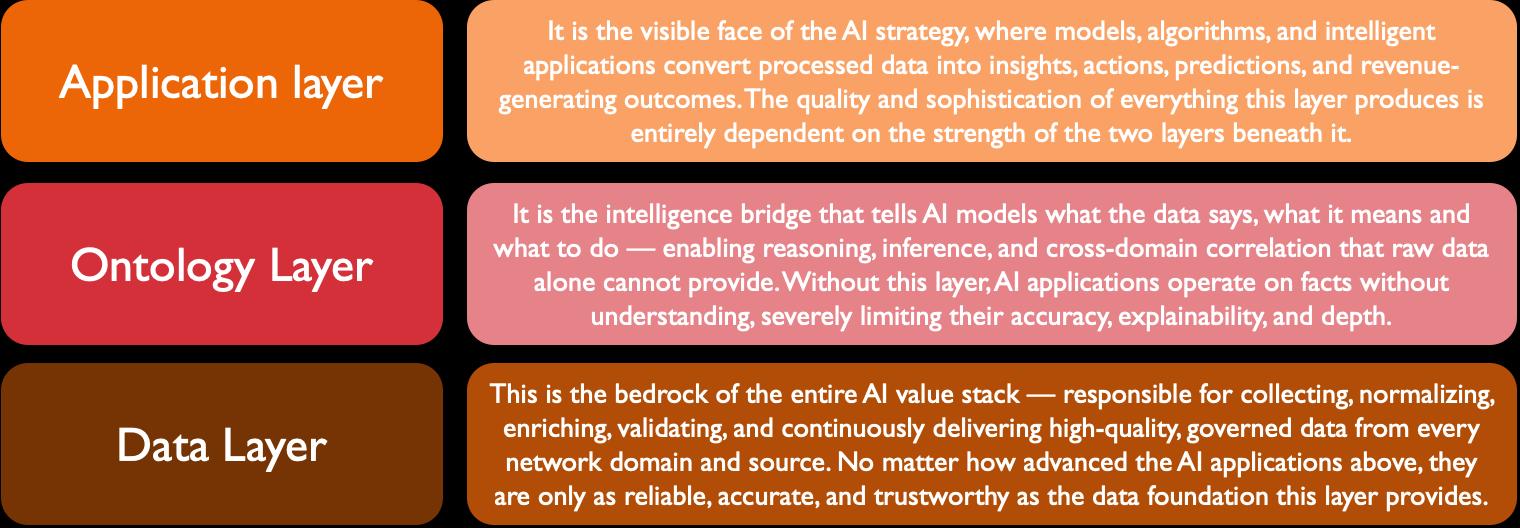
The AI technology stack can be conceptualized as a three-tier framework (Figure 1), with each layer supporting those above it. At the base sits the data layer the foundation comprising all raw inputs, historical records, and real-time feeds that fuel AI systems. The middle tier contains the ontology and semantic models that provide structure, context, and relationships to raw data, enabling AI engines to understand domain-specific concepts and business logic. Finally, the apex represents AI applications themselves—the customer-facing tools, automation engines, and decision-support systems where tangible business value is ultimately realized.
Telco AI Enabler: Mediation's Defining Role - How the mediation system offers telco a fast track to AI data readiness
Source: Appledore Research
For CSPs, the strategic implication is clear establishing a robust, governed, and high-integrity data layer is a foundational prerequisite upon which all meaningful AI capability must be built. Advancement at the application layer will remain inherently limited and inconsistent without a trusted and well-structured data foundation beneath it. While most CSPs will understandably pursue multiple parallel initiatives to advance their AI data readiness, mediation systems emerge as a particularly high-leverage enabler in this journey uniquely capable of bridging legacy infrastructure silos, enforcing data quality and consistency at network scale, and delivering the continuous, enriched, and governed data streams that production-grade AI platforms require.
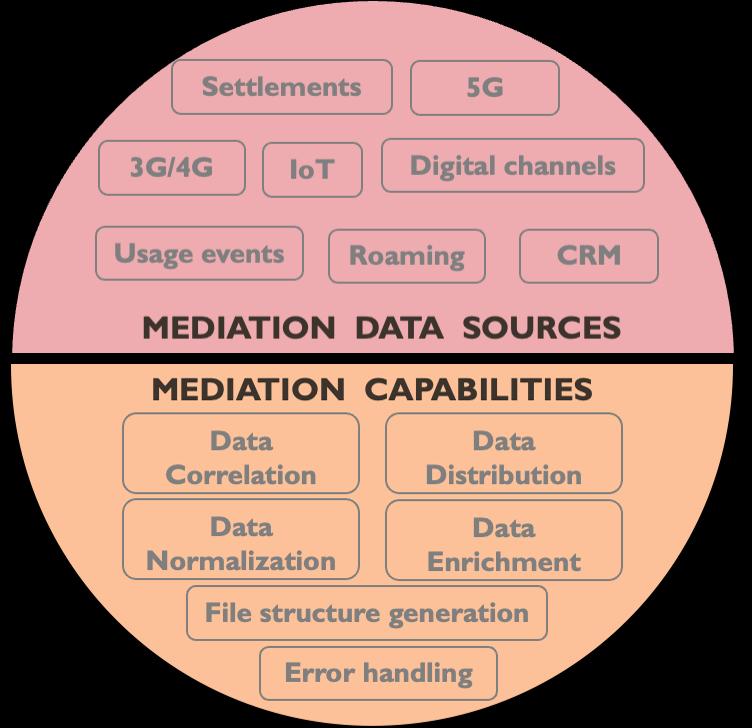
A fundamental reason why mediation systems are particularly well positioned to support this imperative lies in the breadth and depth of capabilities they have developed over decades of operational deployment (figure 2). By virtue of their placement within the critical data flow of the network, mediation systems occupy a uniquely privileged architectural position — maintaining native access to a diverse range of data sources spanning network events, usage records, and select customer attributes.
Combined with their inherent capabilities in data collection, transformation, correlation, and enrichment, this positions mediation as a function that is already structurally and functionally aligned to accelerate telcos’ AI data-readiness journey.
Source: Appledore Research
This report traces the evolution of mediation systems within telecoms and assesses their capacity to function as a critical architectural enabler of AI ambitions across the industry.
Telco AI Enabler: Mediation's Defining Role - How the mediation system offers telco a fast track to AI data readiness
THE EVOLUTION OF MEDIATION
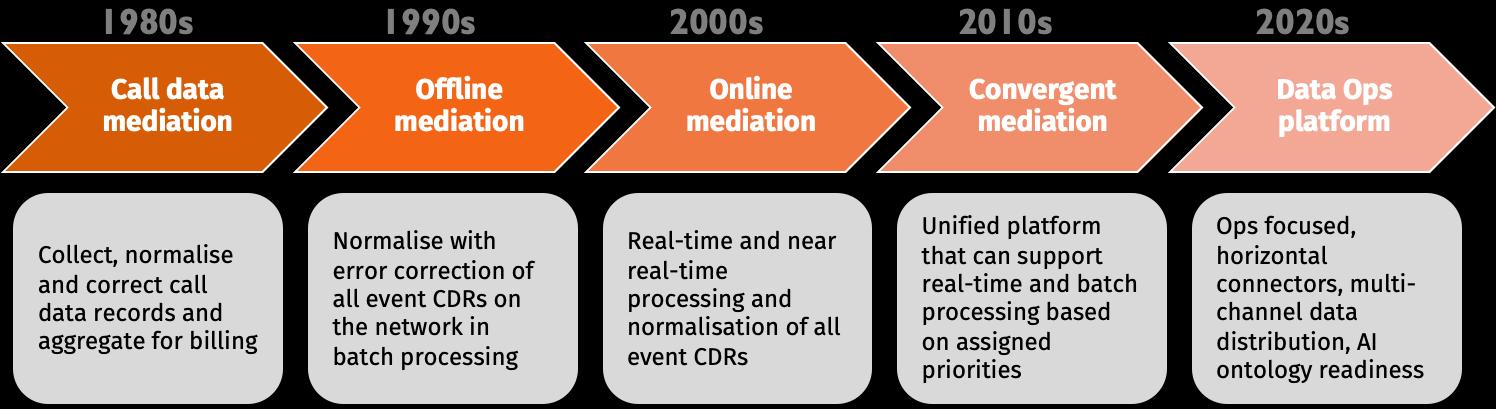
Mediation has evolved considerably from its origins as a billing record processing system. What began as a narrowly defined back-office function has matured, through operational necessity and technological advancement, into a versatile data operations platform whose relevance now extends well beyond its traditional application boundaries spanning real-time analytics, revenue assurance, partner settlement, and increasingly, the data infrastructure requirements of enterprisegrade AI.
Source: Appledore Research
A number of CSPs have yet to fully modernize their mediation infrastructure, continuing to operate legacy architectures that were not designed for the data demands of today's network environment. For such CSPs, the consequences are likely to become increasingly pronounced as AI adoption accelerates across the industry with particular impact on data quality and scalability
Key challenges of legacy mediation engines are captured in table below.
1 Batch-based processing, hardcoded rules
2 Limited scaling and poor data quality management
3 Siloed mediation per service
Files are staged, queued, and processed in bulk. Business rules are embedded directly in source code
Limited ability to distribute workloads, complexities with proprietary interfaces can result in missing or incomplete records.
Independently operated mediation systems exist for different service types with separate rules engine
Lack of near real-time processing limits visibility, settlements and new opportunities. Business agility is constrained.
Higher costs due to inflexible hardware sizing, expensive integrations to adjacent ecosystems and prolonged dispute resolutions.
Substantially higher opex costs due to multiple service silos. No unified customer usage views, no support for cross-service bundling and convergent billing.
4 Lack of Observability & Analytics
Mediation pipelines operate as black boxes with minimal logging, no real-time monitoring dashboards, and limited alerting capabilities. Troubleshooting relies on manual log inspection after issues have already caused downstream damage
5 Limited technology support Built primarily for 2G/3G voice and SMS, limited support for modern data sources
MEDIATION AS AN ENABLER FOR TELCO-AI
SLA breaches go undetected until customer complaints surface. Root cause analysis of mediation failures is slow, costly, and reactive. Business and operations teams have no real-time visibility into pipeline health, throughput KPIs, or data quality metrics making continuous improvement nearly impossible
Expensive adapters needed for supporting emerging value chains, limited support for modern hybrid revenue models
The advent of AI has unexpectedly thrust mediation systems back into the strategic spotlight, positioning them for what may prove to be their most vital role yet.
The primary obstacle CSPs now face in scaling AI adoption is the fragmentation of data across disparate silos. Multi-vendor environments have created isolated data repositories that prove far more challenging to reconcile than many operators initially anticipated. Without providing AI engines with a comprehensive, 360-degree view spanning customer behavior, network performance, and operational metrics, CSPs cannot achieve the data completeness necessary for reliable AI outputs. This gap is particularly concerning given AI's tendency toward hallucination when trained on incomplete or inconsistent datasets, which can undermine confidence in automated decisionmaking for mission-critical functions.
For mediation systems to serve as genuine enablers of data consolidation and consistency—and by extension, to strengthen the data layer readiness that AI transformation demands—they must demonstrate a specific set of core capabilities. The table below examines some of the key capabilities:
1 Raw data collection and ingestion
2 Data normalization
3 Data quality checks
Mediation acts as the universal collector, ingesting events from every network element, domain, and technology generation regardless of vendor, protocol, or format into a single, unified pipeline.
Mediation can decode and transform heterogeneous formats into a single schema
Mediation can enforce automated quality checks at the point of ingestion and can detect duplicates, correct malformed records etc.
Telco AI Enabler: Mediation's Defining Role - How the mediation system offers telco a fast track to AI data readiness
4 Data enrichment
5 Audit trails
6 Data governance
7 Metadata management
8 Real-time inferencing
Mediation can enrich raw network events with contextual metadata such as customer info, device type, location etc.
Mediation maintains a full audit trail of every record's origin, transformation, and routing path
Mediation systems can enforce regulatory compliance policies such as access controls and privacy rules
Mediation captures in-depth metadata which is relevant for AI engines
Mediation can provide continuous, low-latency event streams that can be relevant for AI inferencing engines
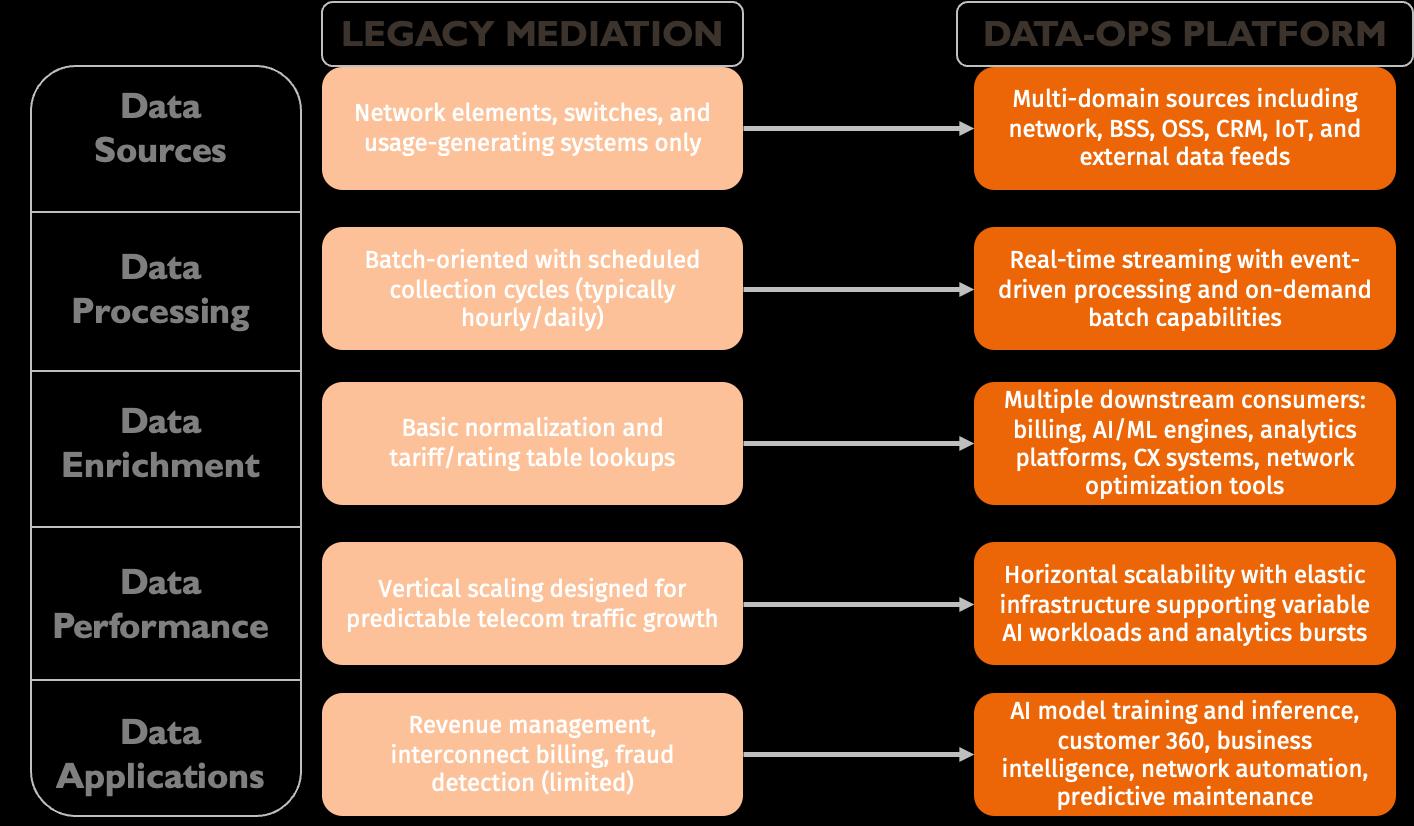
The transformation of mediation into a fully capable data ops platform represents a critical inflection point for CSPs positioning their mediation infrastructure as an AI data enabler. CSPs operating on legacy mediation engines face a structural disadvantage in this regard these platforms were not designed with the architectural agility required to support the demands of modern AI deployment. A true data ops platform preserves backward compatibility with traditional mediation functions while extending its reach to address data challenges at enterprise scale. Figure 4 illustrates the defining distinctions between legacy mediation and its modern data ops counterpart.
Figure 4: Overview of key parameters that separate data ops platform from legacy mediation systems
Source: Appledore Research
KEY CONSIDERATIONS FOR ASSESSING MEDIATION PLATFORMS
Mediation systems occupy a well-established position within the telco technology landscape mature in their core function and deeply embedded within the operational infrastructure of CSPs globally. However, this maturity should not be interpreted as uniformity of capability. The breadth of expertise, architectural sophistication, and domain depth varies materially across the vendor landscape, and the implications of that variance are significant.
Given the mission-critical nature of mediation infrastructure, vendor selection carries strategic consequences that extend well beyond the boundaries of the initial deployment.
Telecom-specific experience must be regarded as a foundational requirement. CSPs are also advised to scrutinize the depth of a vendor's telecoms heritage, the credibility and scale of their deployment portfolio, their strategic alignment with the evolving data ops and AI enablement agenda, and their capacity to engage as a long-term transformation partner rather than a point solution provider.
The table below sets out some of the key dimensions against which vendor offerings should be systematically evaluated.
Criteria
Architectural agility
Data enhancement and error handling
Ecosystem readiness
Description
Cloud-native compliance with deployment flexibility, real-time processing, ability to manage dynamic scaling, support for diverse data formats and network standards etc.
Collection, normalization, enrichment and routing of data including contextual attributes. Ability to detect, flag, quarantine, and remediate erroneous or incomplete records.
Ability to connect with the systems it must interact with such as OSS, BSS, data lakes, analytics platforms, AI and ML frameworks, cloud infrastructure etc. Pre-built connectors, established relationships and certified integrations will be advantageous.
Telco AI Enabler: Mediation's Defining Role - How the mediation system offers telco a fast track to AI data readiness
CONCLUSION
A growing consensus is emerging among CSPs that one of the most consequential barriers to realizing AI value at scale is not the availability of AI technology itself but the absence of consistent, homogeneous data foundations upon which that technology depends. Without a unified and reliable data layer, even the most sophisticated AI models are constrained in the value they can deliver.
It is precisely in this context that mediation systems warrant serious strategic reconsideration. Far from being a legacy operational function, the mediation platform is uniquely positioned to serve as the cornerstone of a CSP's AI data strategy. Its placement within the data control flow gives it privileged access to the usage and network data that AI models depend on. Its established connectivity with adjacent OSS and BSS systems provides the integration reach necessary to consolidate data across organizational boundaries. And its decades of operational maturity in data management, normalization, and transformation give it a depth of capability that purpose-built solutions would take years to replicate.
For CSPs seeking a credible and accelerated path to AI data readiness, the mediation platform represents a starting point of genuine structural advantage — one that is already embedded, already proven, and already positioned to deliver.