Culture-Driven Social Resilience
A Practical Toolkit & Casebook for Municipalities to Take Action
Developed & designed by Abbas Sbeity
Creative Insights Studio www.creativeinsights.studio
Commissioned development by Northern Dimension Partnership on Culture, project partner of BSR Cultural Pearls www.ndpculture.org
Contact info@ndpculture.org
© 2025 Northern Dimension Partnership on Culture (NDPC) & Creative Insights Studio AB.
This publication is licensed under a Creative Commons Attribution–Non-commercial 4.0 International licence (CC BY-NC 4.0): https:// creativecommons.org/licenses/by-nc/4.0/
You are free to share and adapt the material for noncommercial purposes, provided that appropriate credit is given and any changes are indicated.
Photos, logos, and other third-party materials are not covered by this licence and remain the property of their respective rights holders. Their reuse may require separate permission.
Who is this toolkit for How to use this toolkit Why do we need to build social resilience?
BSR Cultural Pearls aims to strengthen social resilience in Baltic Sea Region municipalities by harnessing the potential of local assets of culture and creativity. Annually, BSR Cultural Pearls invite local authorities from the region, especially those from less central areas – to join this transformative journey. Through a meticulous selection process, the candidates with outstanding and impactful action plans on culture driven social resilience are awarded the BSR Cultural Pearls title. By engaging and involving their citizens, increasing quality of life, sense of belonging and trust, they are able to make their communities stronger and more resilient.
Award recipients then embark on a one-year long Cultural Pearls Programme providing support, peer-learning, and expert interventions through webinars, conferences, and study visits. Showcased across the region, the BSR Cultural Pearls recipients highlight the power of community and culture. Both awardees and the other participating municipalities join the Cultural Pearls Network, gaining international exposure and continuing to enhance their community’s resilience.
The project is co-funded by the EU’s Interreg Baltic Sea Region Programme during the years of 2023 through 2025.
Building on the experience of the BSR Cultural Pearls Programme, this toolkit supports municipalities and their partners to apply the methods and mindsets of culturedriven collaboration.
The first version of the toolkit (2024) was created to support the Seed Money Initiatives of the awarded Cultural Pearls.
This second edition expands its reach offering a practical resource for all municipalities seeking to strengthen social resilience through creative collaboration. Whether you are a small town or a mid-sized city, this toolkit will help you structure, test, and scale new forms of partnership between the municipality and the local cultural and creative sector (CCS). The goal is to cultivate collaborative systems where municipalities, the creative sector, and citizens co-create responses to shared challenges.
In many municipalities, collaboration with the cultural and creative sector remains largely within the remit of the culture department. While other departments may occasionally engage creatives for communication or short-term assignments, the broader potential of the sector to address complex social, spatial, and organisational challenges often goes unnoticed. Highlighting this cross-departmental value is essential to build awareness and preparedness within the municipality.
This toolkit is designed for:
• Municipal leaders and decision-makers seeking to integrate culture into resilience strategies.
• Cultural officers and planners responsible for cultural development.
• Creative and cultural sector practitioners interested in partnering with municipalities.
This toolkit acknowledges the diversity of municipalities across the Nordic–Baltic region, from urban areas with rich cultural infrastructure, complex stakeholder networks, and multiple priorities, to smaller towns and rural communities where culture often acts as a vital infrastructure supported by close relationships and strong social bonds. It also recognises that municipalities operate at different readiness levels: some are just beginning to explore cultural collaboration, others are developing strategic approaches, and a few have well-established partnerships aiming to deepen their impact.
This toolkit provides a flexible framework that can be adapted to your municipality’s context, resources, and goals. It comes with a set of worksheets that you can mix and match. Think of it as a menu of tools. You can enter at different phases depending on where you are. It does not need to be a linear process.
Quick Start Approach
• Jump directly to Initiation if you already have a clear opportunity or partner in mind.
• Use the worksheets to formalise and structure an emerging collaboration.
• Best for: Tactical entry, experienced municipalities, timesensitive opportunities.
Strategic Build Approach
• Start with Conditions to assess readiness and build a solid internal foundation.
• Progress step by step through Initiation, Design, Piloting, and Learning & Scaling.
• Best for: Strategic entry, municipalities new to culturedriven collaboration, long-term planning.
Integration Approach
• Use selected tools and canvases to strengthen existing cultural programmes or partnerships.
• Focus on specific gaps such as partnership design, community engagement, or monitoring and documentation.
• Best for: Municipalities with ongoing cultural work that want to deepen collaboration and improve learning.
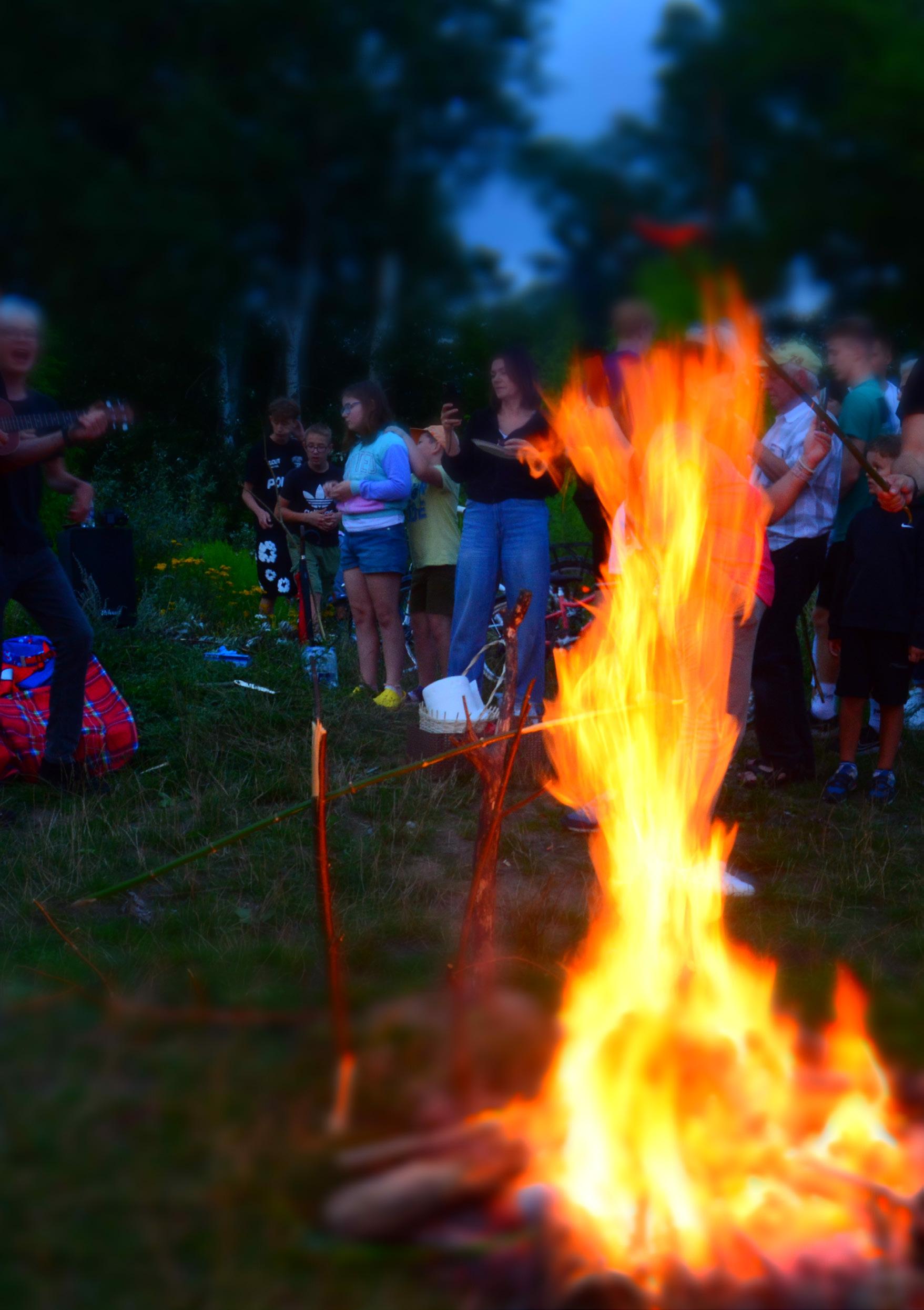
Social resilience refers to the ability of individuals, communities, and societies to withstand and recover from social, economic and environmental shocks and stresses. It involves the capacity to adapt and learn from these challenges as well as to maintain or improve social and economic well-being.
Countries in the Baltic Sea Region differ in size, historic background and cultural heritage, but they all share common challenges such as climate change, urbanisation, economic downturn, segregation, aging society or political tensions that influence our daily lives and require collective action here and now. Therefore, it is important to develop a shared understanding of the importance of social resilience and to work together to strengthen it in the region.
In order to adjust to the challenges and demands of this fast-changing world and make our neighbourhoods more liveable, decision–makers not only have to take good decisions but involve and engage their citizens. We need to be able to solve the problems of today, learn how to turn negative trends and prepare for the unexpected in the future. All together.
Social resilience can be strengthened through a variety of strategies, such as building strong social networks and relationships, investing in education and training, promoting economic diversity and fostering a sense of community ownership and participation. Cultural activities such as music, dance, theatre, and visual arts can bring people together, foster a sense of belonging, and create social connections that can help individuals and communities to weather difficult times.
Ways of thinking and working that guide culture-driven collaboration
Culture-driven collaboration requires municipalities and creative partners to move beyond traditional project management and into a shared practice of curiosity, trust, and learning. These mindsets help shape how we approach partnerships, decisions, and community engagement.
Move from Transactional to Collaborative
Shift from funding projects to forming partnerships. True collaboration is about co-owning purpose and outcomes.
Transformative partnerships invest in longterm relationships and mutual learning.
Co-create
Work with communities as active participants. Co-creation means sharing power by defining challenges together, making joint decisions, and distributing ownership. It’s about designing with empathy and for relevance, ensuring diverse voices shape the outcome from the start.
Trust is the invisible infrastructure of collaboration. Without it, projects stay superficial. Building trust means showing up consistently, communicating transparently, and valuing others’ expertise. It also means being honest about limitations and learning together through uncertainty.
There is no single formula for successful collaboration. Start small, test ideas, reflect on what works (and what doesn’t), and share those lessons. Every experiment, even a failed one, grows your collaborative capacity.
This roadmap outlines a practical 5-phase process that municipalities can use to collaborate with the cultural and creative sector, design and test pilot initiatives, and turn learning into long-term change.
1. Conditions
Establish your internal foundation by clarifying priorities, mapping your ecosystem, and assessing preparedness.
2. Initiation
Build partnerships and establish the collaboration framework with the right CCS actors.
3. Design
Move from collaboration to concrete action by co-designing the pilot, planning community engagement, and creating an action plan.
4. Pilot
Test your collaboration in practice by implementing the pilot and learning in real time.
5. Scaling & Learning
Make sense of what happened, share stories of change, and decide whether to scale, sustain, or close the work.
This toolkit comes with 11 worksheets designed to support collaboration throughout the 5-phase process. Use these worksheets in workshops and meetings to structure discussion, make decisions together, and keep your partnership aligned from first idea to future steps.
Find and download the worksheets
→ click here → or scan this QR code
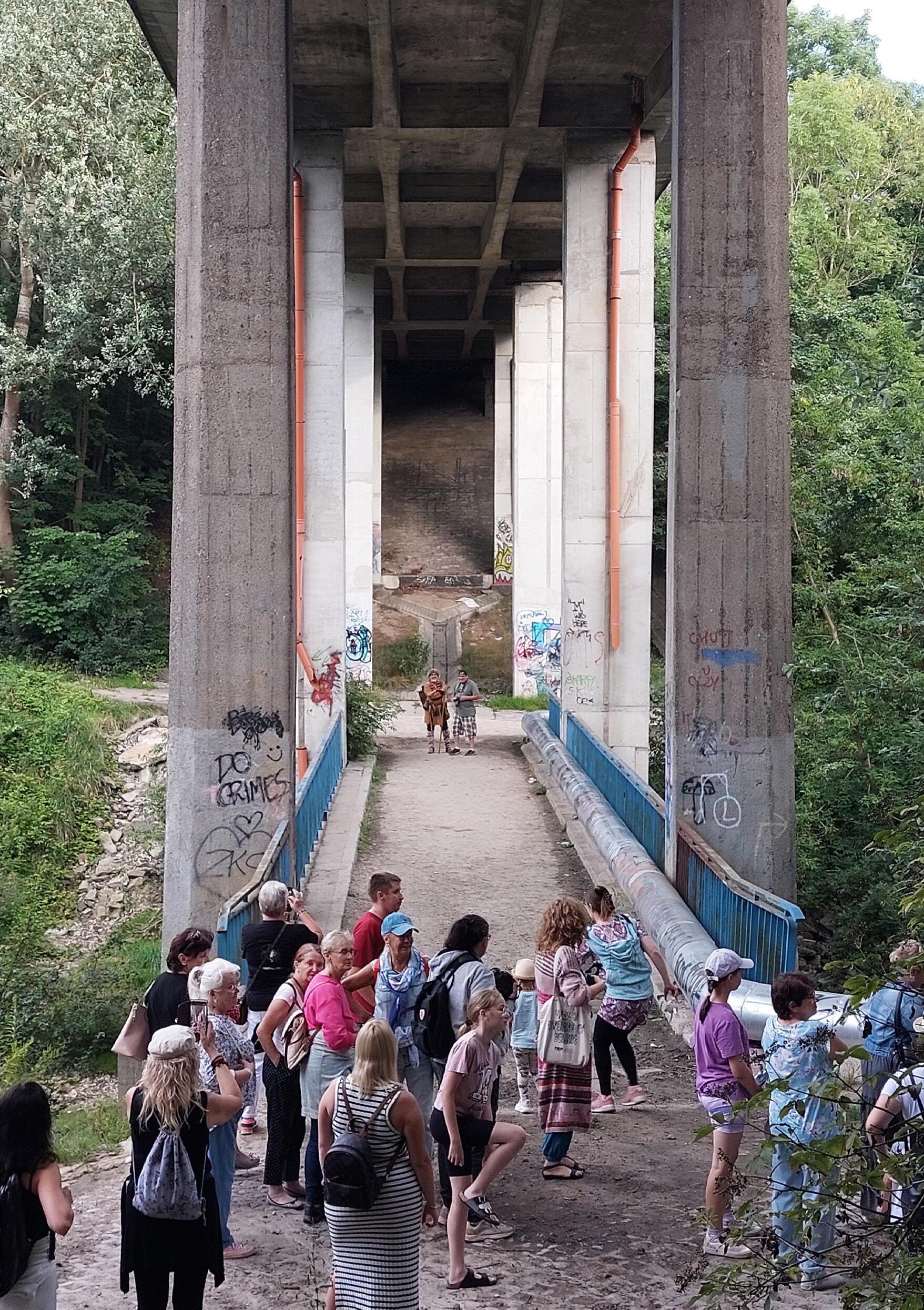
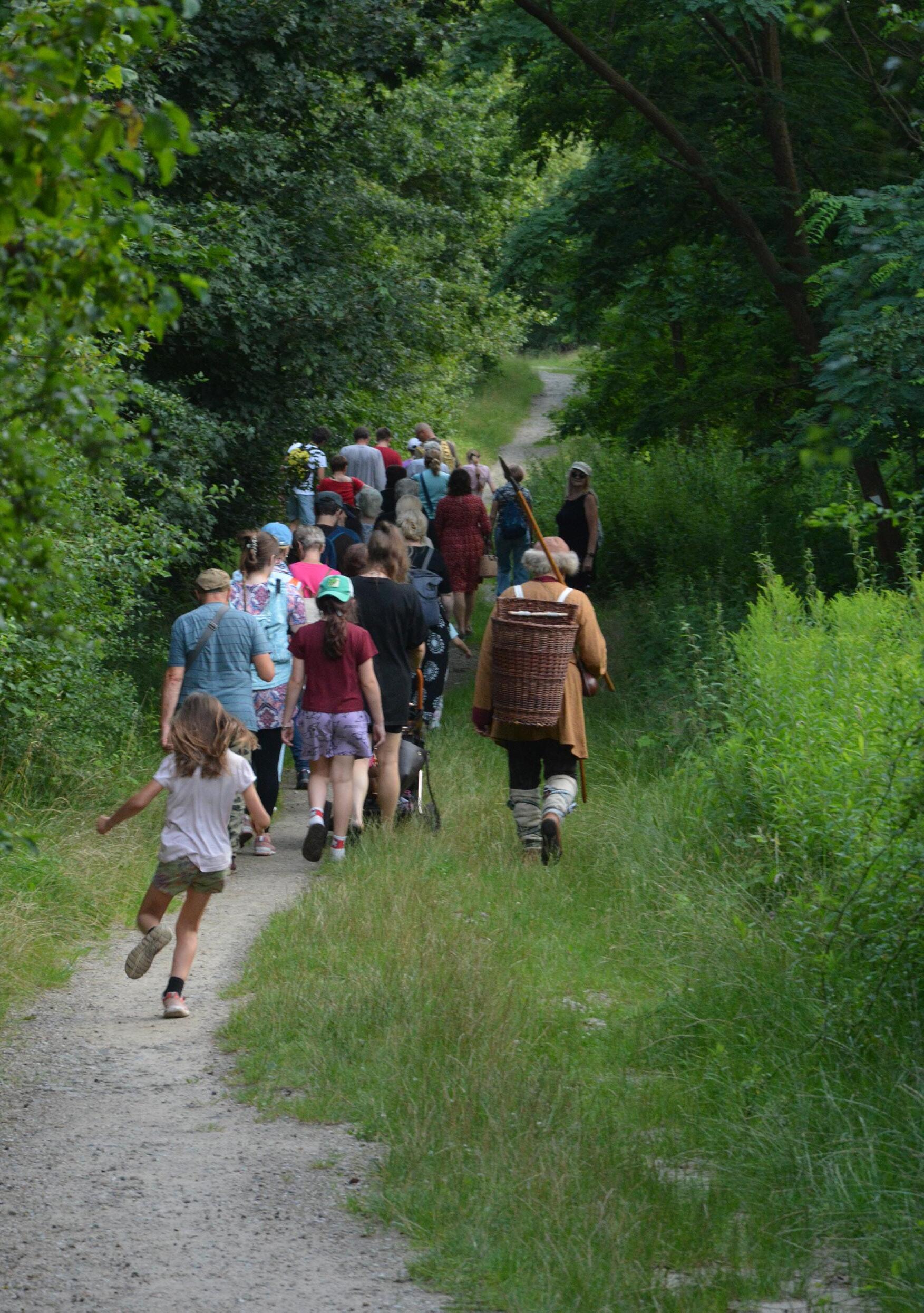
Peipsiääre, Estonia
The Conditions phase establishes the foundation for successful creative collaboration. This phase focuses on understanding your municipality’s context, building internal capacity, and ensuring the necessary conditions are in place before engaging external partners. You can complete this phase once and run different pilots after.
This phase includes:
1. Entry Point
2. Ecosystem Mapping
3. Preparedness
Peipsiääre, Estonia
The first step is to identify your starting position. Are you entering from a strategic perspective (aligned with city plans and long-term goals) or a tactical one (based on an emerging opportunity or community need)?
Municipalities can enter this process at different stages depending on their context, resources, and readiness:
Strategic Entry
• Focus on city strategic ideas and goals
• Tackle a community need or challenge
• Address a specific place or area requiring intervention
• Longer-term planning
Tactical Entry
• Respond to immediate opportunities
• Leverage existing events or initiatives
• Build on momentum from current activities
• Shorter implementation timeline
→ Find and download the
→ Connect cultural collaboration to current municipal priorities and strategic goals.
→ Use relevant evidence and examples to demonstrate potential impact.
→ Identify existing community challenges that cultural approaches can help address.
→ Assess the level of political and administrative support available for this initiative.
Map your local cultural and creative ecosystem, from institutions to informal groups, and identify the connections between them and the municipality.
Ecosystem mapping is the process of identifying and analysing the cultural assets, activities, and opportunities within your municipality. This includes:
Cultural Organisations: Museums, theatres, galleries, and cultural centres
Cultural spaces: venues and gathering places
Creative practitioners: artists, designers, musicians, writers, performers
Municipality & Public Institutions
Cultural activities & heritage: festivals, events, traditions, practices, tangible and intangible
Worksheet 1.2
Community groups: ethnic associations, hobby groups
Creative industries: design firms, media companies, craft businesses
Canvas
Use this worksheet to map your local ecosystem, visualise cultural and creative actors, explore their relationships, and identify where collaboration opportunities can grow.
→ Find and download the worksheets here
→ Include both formal and informal actors to capture the full breadth of cultural life.
→ Ensure the map reflects diverse voices, including marginalised and underrepresented communities.
→ Identify bridge organisations and intermediaries who can connect different parts of the ecosystem.
→ Identify bridge organisations and intermediaries who can connect different parts of the ecosystem.
→ Look for connections and relationships across the ecosystem to reveal networks and collaboration potential.
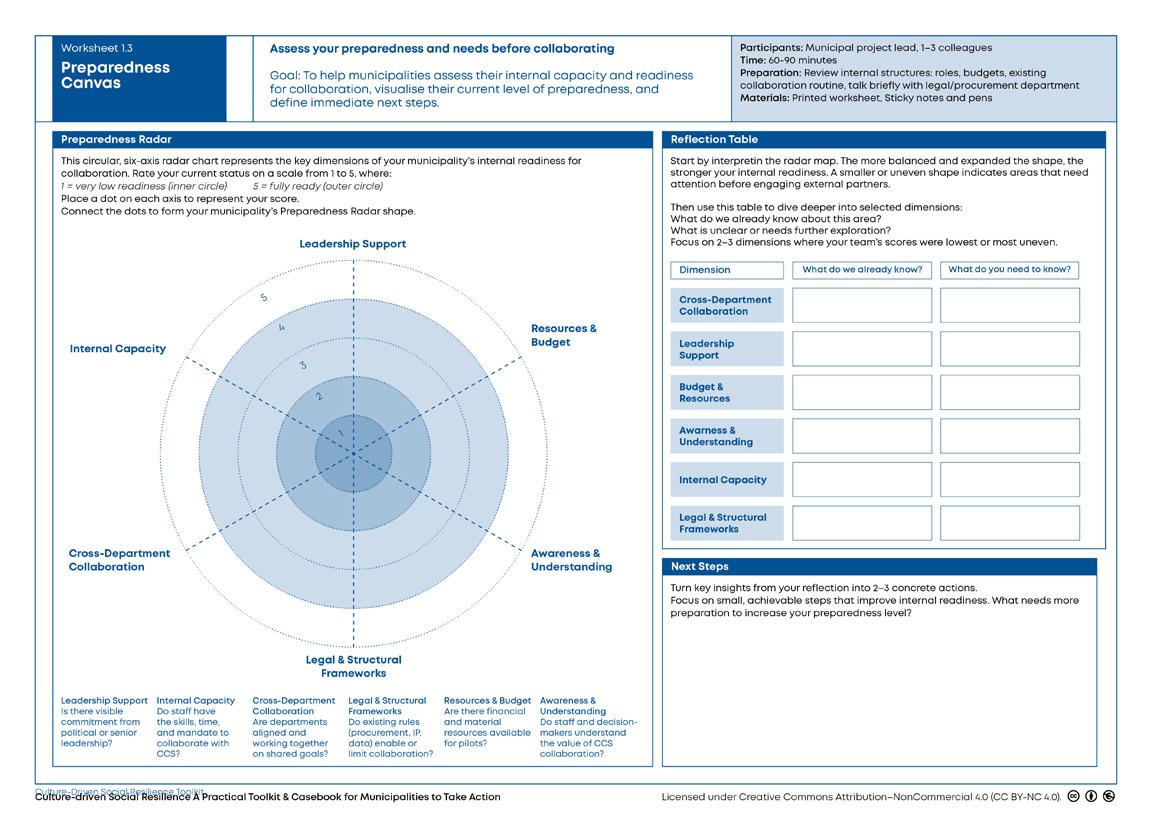
Before initiating partnerships with the cultural and creative sector, municipalities need to ensure they are institutionally ready.
Preparedness is about building internal capacity, alignment, and understanding the legal and structural frameworks that shape collaboration. This phase helps municipalities strengthen their internal foundation so that external partnerships can succeed. It involves six dimensions:
1. Leadership Support: Commitment from political and senior leaders that provides legitimacy and direction.
2. Internal Capacity: The time, skills, and mandate within the municipality to coordinate and sustain collaboration.
3. Cross-Department Collaboration: The ability of departments to work together, share knowledge, and align goals.
4. Legal & Structural Frameworks: The rules and systems that enable or limit fair and flexible collaboration.
5. Resources & Budget: The funding and materials dedicated to pilots, experimentation, and long-term work.
6. Awareness & Understanding: Shared recognition of culture’s role in resilience and community well-being.
→ Connect cultural collaboration to municipal priorities such as wellbeing, inclusion, or local development.
→ Build awareness among staff and leaders about culture’s role in resilience.
→ Review legal and procurement frameworks to understand how to contract CCS practitioners as service providers.
→ Ensure fair compensation, clear IP agreements, and compliance with GDPR and labor laws.
→ Keep administrative processes simple and accessible for smaller actors.
The Initiation phase focuses on identifying and engaging the right partners from the cultural and creative sector, and formalising the collaboration through clear agreements and roles.
This phase includes:
2.1. Establish Collaboration
2.2. Collaboration Agreement
Peipsiääre, Estonia
Before inviting collaborators, municipalities must clarify what kind of partners they need, what values and capacities matter most, and how they will reach and engage them.
This step focuses on designing the process for identifying, selecting, and initiating partnerships with CCS actors.
This includes:
1. Defining what kind of collaboration you are seeking and the partner roles you need.
2. Establishing selection criteria that align with your project goals and values.
3. Creating a first shortlist of potential partners from your ecosystem map.
4. Planning how to reach out and begin building relationships.
Establish Collaboration Canvas Worksheet 2.1
Use this worksheet to define what kind of collaboration you need, identify potential partners, and plan how to reach and engage them through a fair and transparent process.
→ Find and download the worksheets here
→ Look for partners who bring knowledge or practices that complement your project’s focus.
→ Engage partners with trusted relationships in the communities you aim to reach.
→ Include a range of voices, scales, and perspectives in your selection process.
→ Balance established institutions with grassroots practitioners to promote equity.
→ Confirm that partners have the time, resources, and readiness to engage meaningfully.
After selecting your partner based on the criteria developed in Step 2.1, the next step is to formalise the collaboration.
At this stage, both sides should already share a clear understanding of the project’s purpose and scope. The goal now is to translate that understanding into a written agreement that is accessible to everyone.
Formalisation turns mutual understanding into a clear framework that defines responsibilities, resources, and decision-making, ensuring accountability, fairness, and trust.
Depending on the nature of the collaboration, this agreement may take the form of:
1. Memorandum of Understanding (MOU)
2. Service Contract
3. Grant Agreement
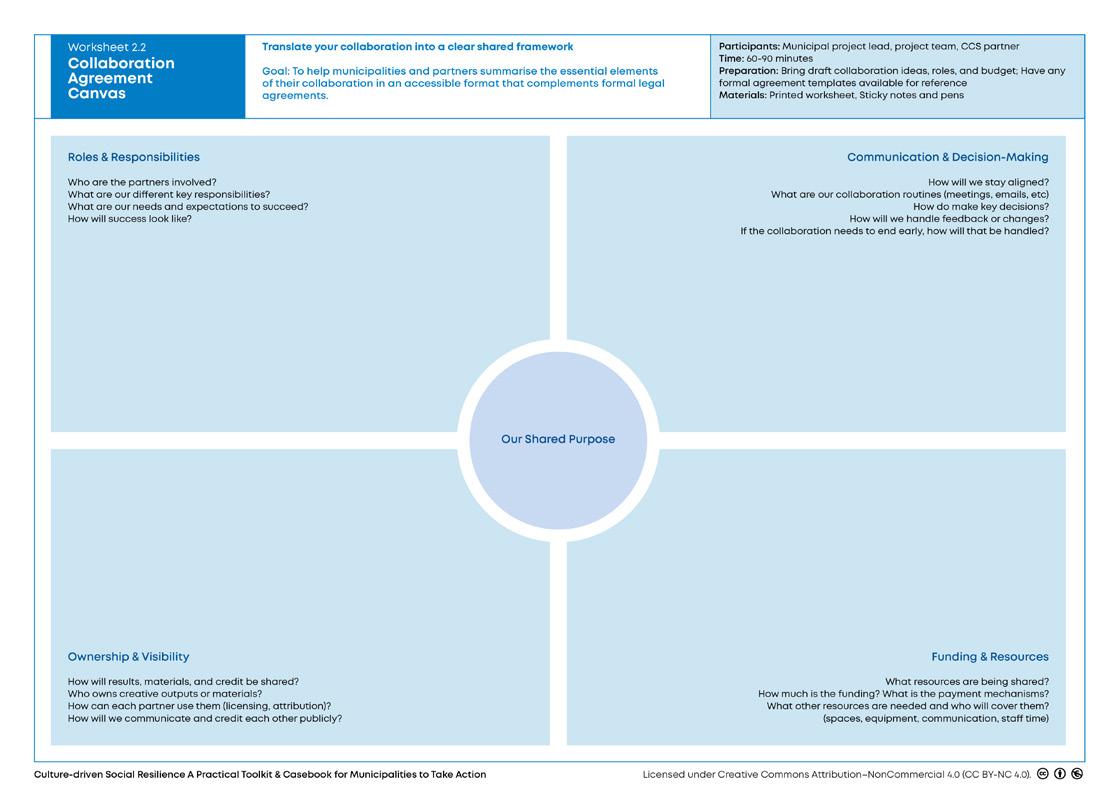
Collaboration Agreement Canvas Worksheet 2.2
Use this worksheet to co-create a plain-language summary of your collaboration, outlining shared goals, roles, and resources. It can be added as an appendix to the formal agreement to ensure clarity and transparency.
→ Find and download the worksheets here
→ Consider the context of your partner and use the simplest type of agreement suitable for the partnership.
→ Draft the agreement together to ensure shared understanding.
→ Define goals, roles, resources, timelines, and decisionmaking clearly.
→ Keep it readable and accessible by using plain, inclusive language.
→ Include a process for ending or extending the collaboration if needed.
The Design phase is where the partnership moves from ideas to structure. It focuses on developing the pilot project collaboratively, planning how and when to engage the community, and translating the concept into a clear action plan.
This phase is both creative and practical. Partners design together and build a shared roadmap that connects intention with implementation.
This phase includes:
3.1 Co-Creation
3.2 Community Engagement
3.3 Action Plan
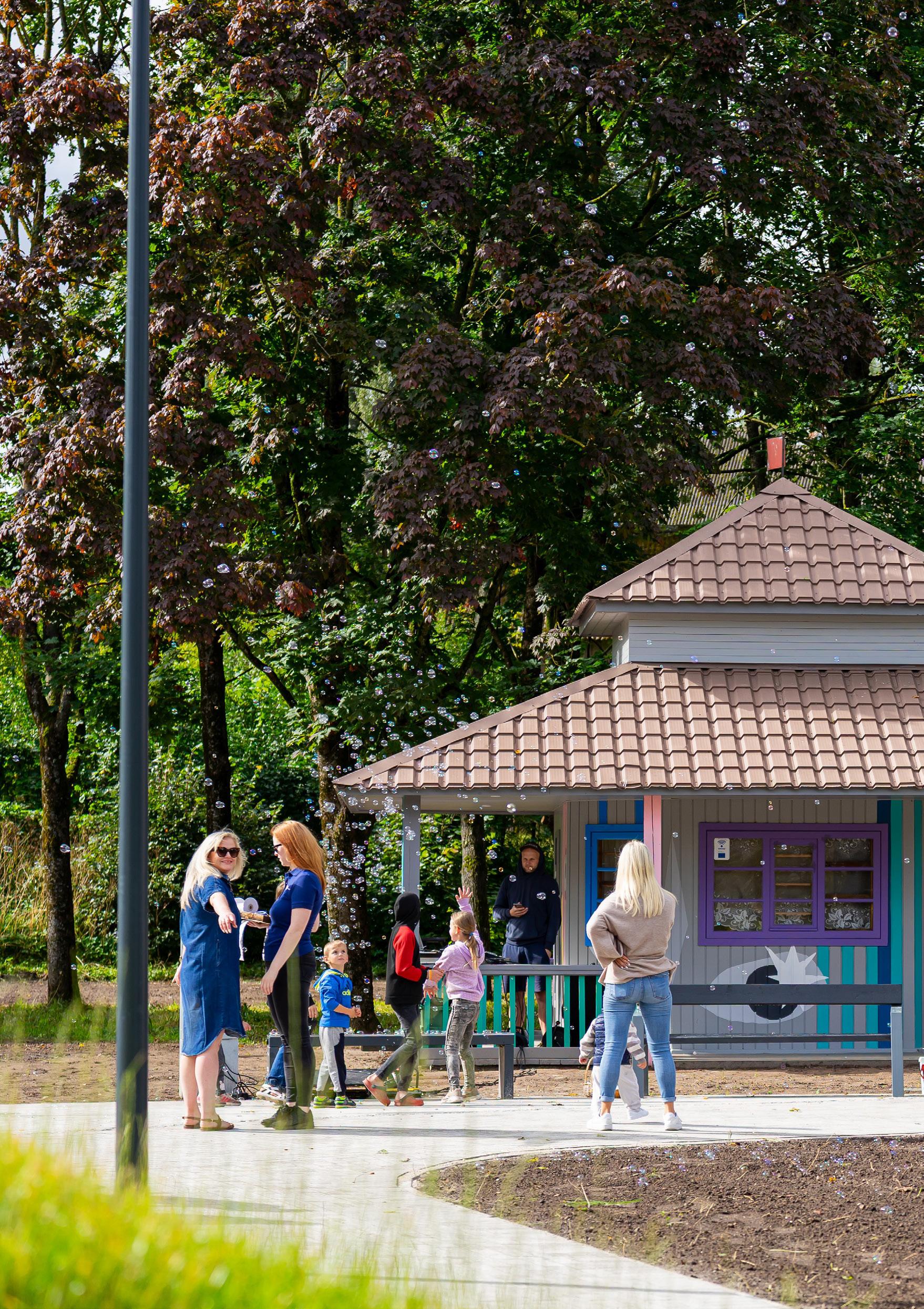
This step is a collaborative process between partners to design the pilot initiative. It focuses on moving from a shared understanding of the challenge to a clear concept and structure for implementation.
The co-creation process involves:
1. Challenge framing: agreeing on the problem or opportunity the project will address.
2. Ideation: generating and exploring creative ideas and approaches.
3. Idea selection: mapping ideas by impact and feasibility, and choosing one to develop further.
4. Concept development: shaping the chosen idea into a concrete pilot concept.
Worksheet 3.1
Use this worksheet to co-design your pilot project with your partner(s). Frame the shared challenge, brainstorm and select ideas, and develop a clear concept with defined activities before moving into action planning.
→ Find and download the worksheets here
→ Spend time defining the challenge and desired outcomes before jumping to activities.
→ Generate bold ideas but stay realistic about time, budget, and resources.
→ Define what success will look like and how it will be measured.
→ Design pilots that allow testing, reflection, and adaptation.
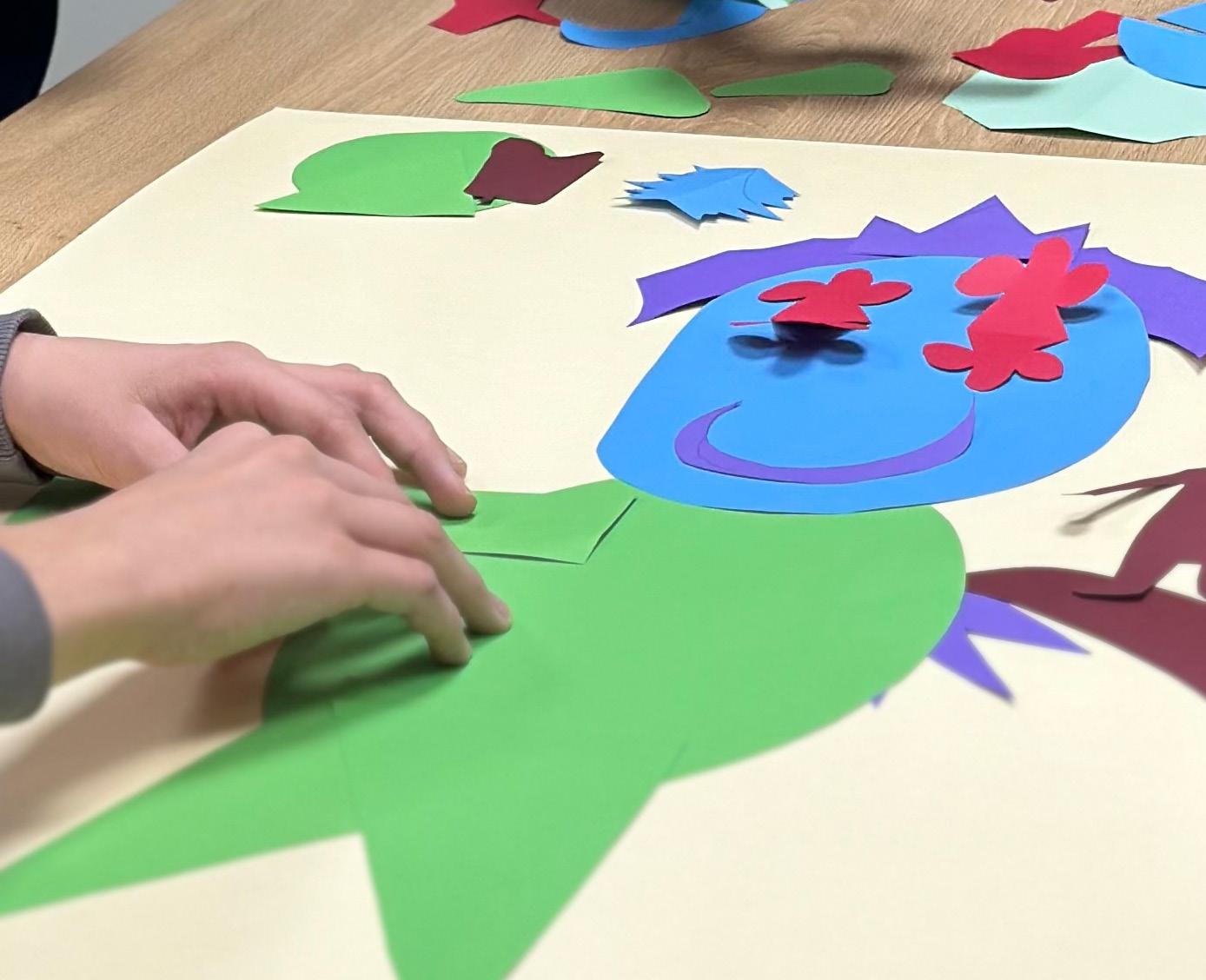
This step helps partners reflect on who the community is, what is already known about them, and how to design engagement that is inclusive and valuable for all involved.
Through this process, partners identify the community’s existing assets, what they can learn from them, how to reach them, and how the project will serve their needs. The aim is to ensure community participation creates value for them as well as for the project.
This step involves:
1. Defining the community: who they are, where they are, and what you already know about them.
2. Mapping community assets: identifying existing strengths that the project can connect to.
3. Identifying learning opportunities: what the project can help you understand or discover about the community.
4. Designing outreach: planning how to reach and engage community members meaningfully and inclusively.
5. Clarifying benefits and offerings: defining what value the project will bring back to the community.
→ Recognise existing assets and strengths in the community build on what’s already working.
→ Engagement should be a two-way exchange; ensure the community benefits from involvement.
→ Consider who might be excluded and how to make participation accessible.
→ Identify trusted individuals or organisations who can connect you to the community.
→ Invite a community representative to join this step or review the outcomes afterward to ensure accuracy and respect.
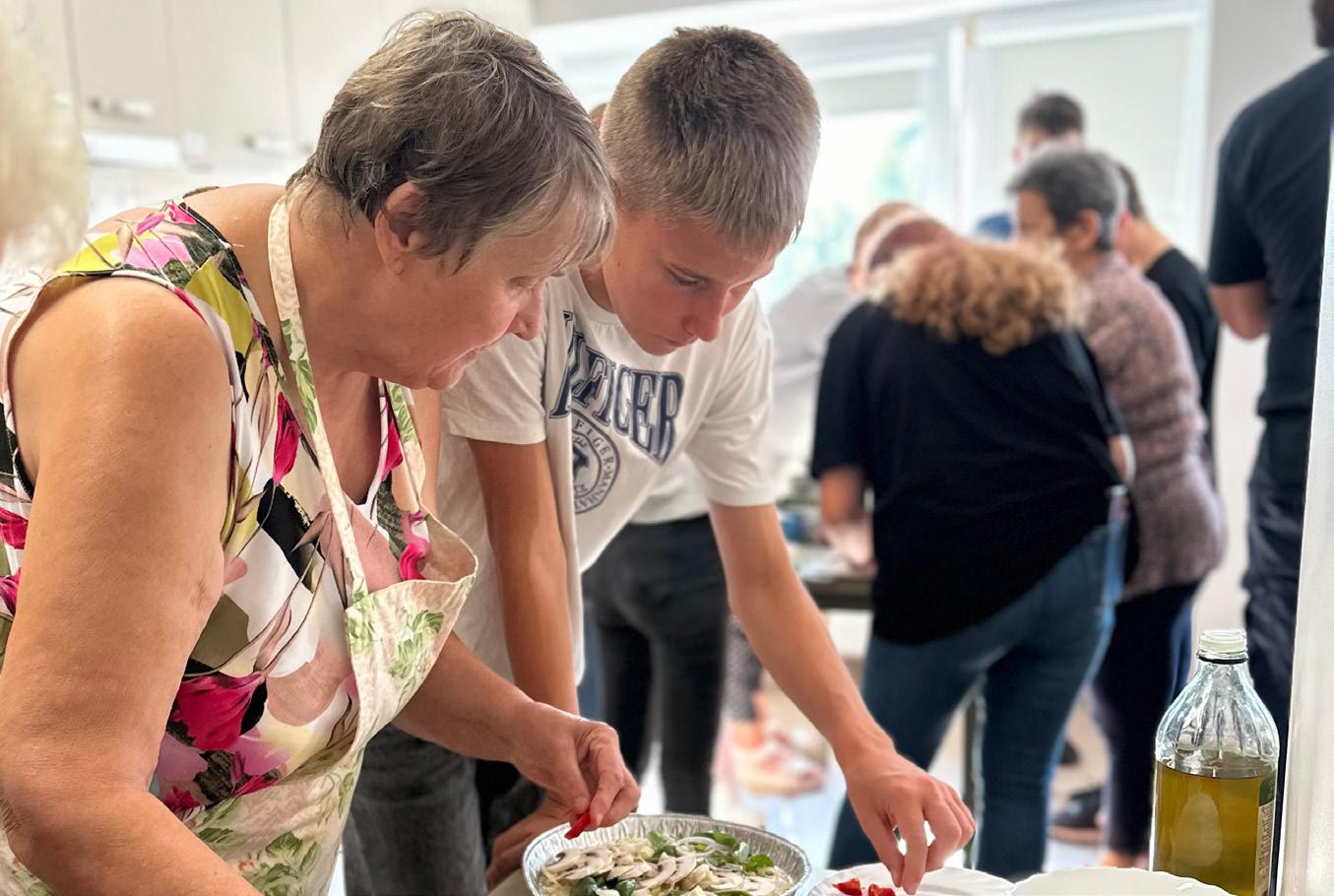
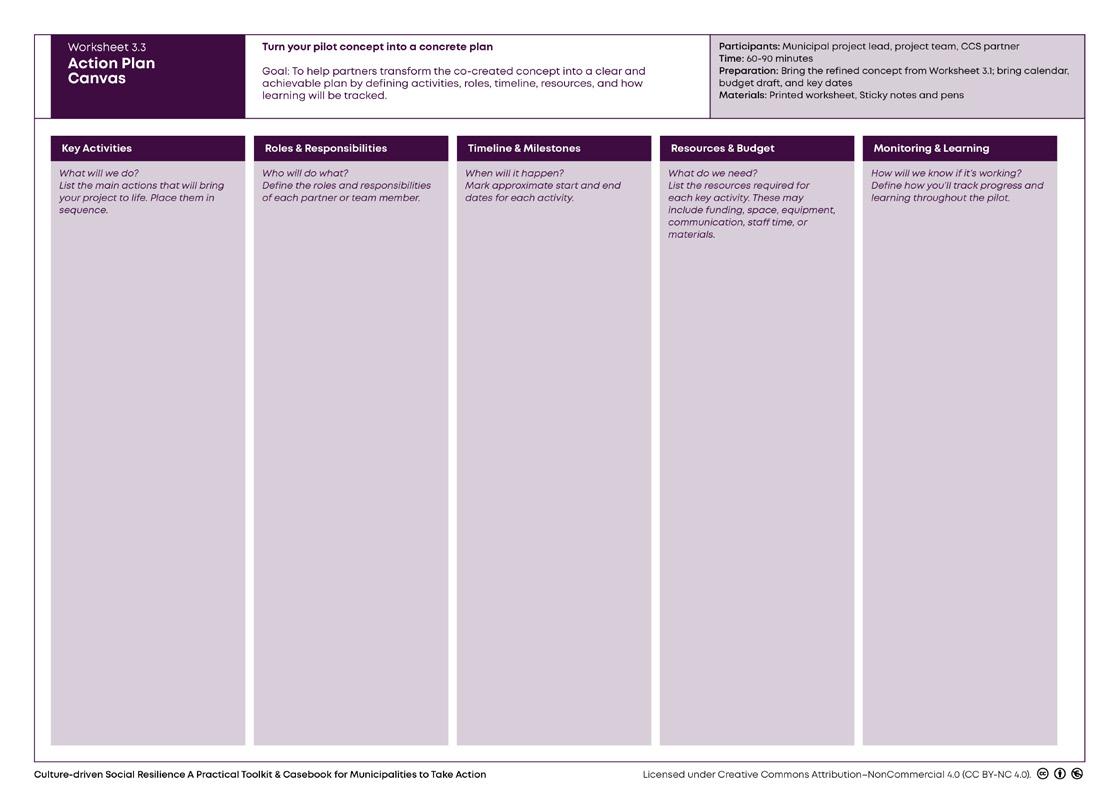
This step translates the pilot concept into an actionable plan, defining what will be done, by whom, when, and with what resources. The Action Plan provides a shared roadmap for all partners, ensuring that ideas developed during co-creation are ready for implementation.
This step involves:
1. Defining activities: outlining the key actions that will bring the concept to life.
2. Clarifying roles: deciding who is responsible for what and how coordination will work.
3. Setting milestones and timelines: planning when activities will happen and in what order.
4. Allocating resources: identifying available and needed funding, materials, and in-kind contributions.
5. Assessing risks and dependencies: anticipating challenges and planning how to manage them.
6. Tracking learning and impact: defining what success looks like and how it will be measured.
Use this worksheet to break down your project concept into clear actions, assign responsibilities, and agree on resources, timelines, and success indicators.
→ Find and download the worksheets here
→ Keep the plan achievable given available time and resources. Make sure every task has a clear owner.
→ Use a simple format to make the plan easy to follow. Make it accessible digitally for all people involved. Ensure all partners contribute to and agree on the plan.
→ Create a flow where you organise activities into preparation, delivery, and reflection.
→ Include moments to review progress and adapt along the way.
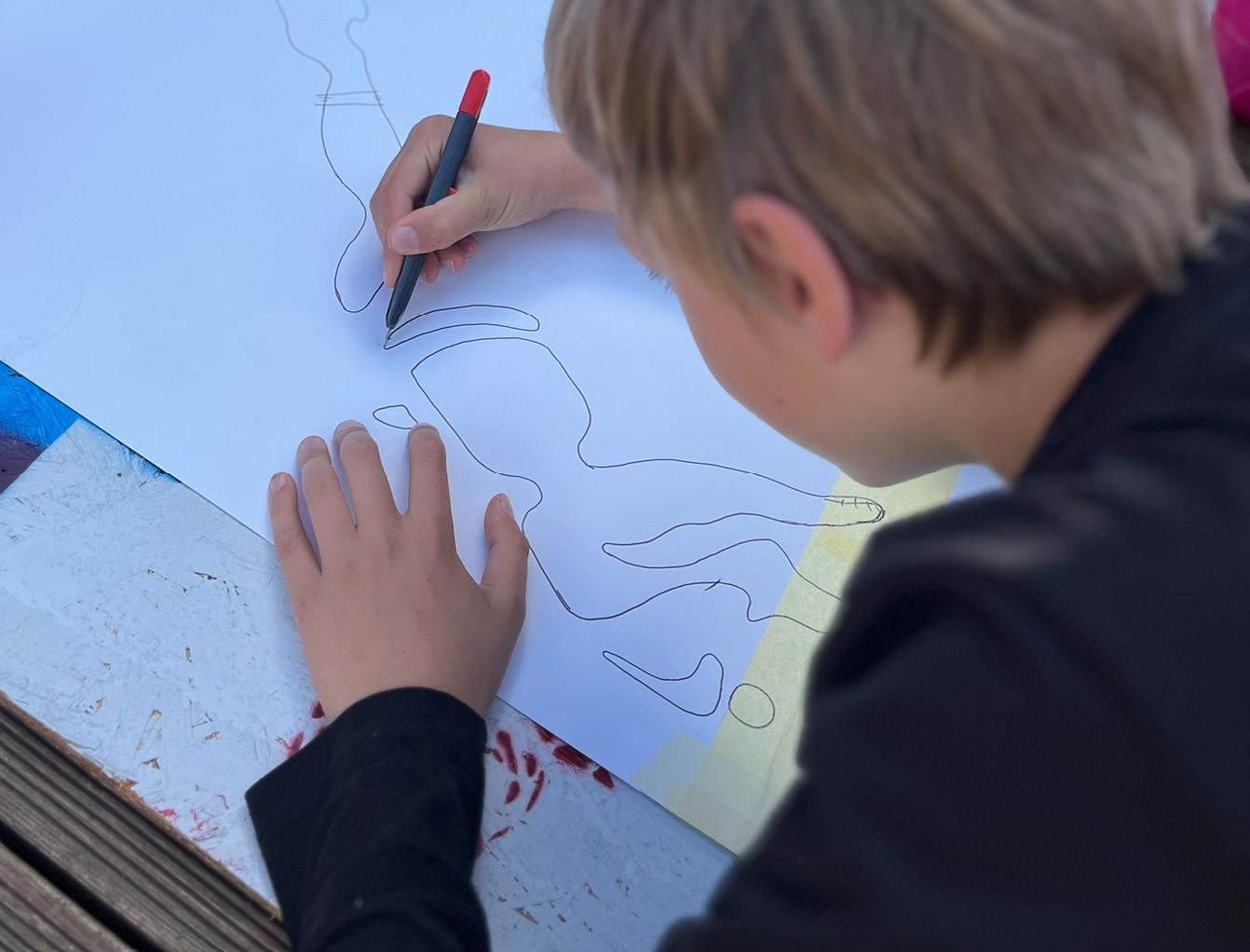
The Pilot phase is about implementing the co-created project, coordinating partners, engaging communities, and staying responsive to what emerges along the way. It focuses on doing the work, observing what happens, and making small adjustments as you go.
Use your Action Plan from Step 3.3 and the considerations in this phase to guide delivery and keep partners aligned. There are no worksheets for the Pilot phase.
This phase includes:
4.1 Implementation
4.2 Monitoring & Documentation
Peipsiääre, Estonia
Implementation is the execution of your pilot action plan. This phase focuses on delivering activities, coordinating partners, engaging communities, and responding to what emerges along the way.
This step involves:
1. Launching activities: initiating the planned pilot actions and events.
2. Coordinating partners: ensuring alignment, clarity, and collaboration throughout delivery.
3. Engaging communities: inviting participation and maintaining an accessible presence.
4. Managing resources: tracking budget, time, materials, and capacities.
5. Problem-solving: responding to obstacles, needs, or unexpected changes.
6. Maintaining momentum: sustaining energy and involvement across partners and participants.
This phase is all about doing. Use the considerations in this section together with your Action Plan from Step 3.3 to guide implementation and learning in practice.
→ Agree on a regular communication mechanism to keep everyone aligned and informed.
→ Stay flexible and adapt activities as you learn from the process.
→ Celebrate small wins to keep motivation high.
→ Support CCS partners by ensuring they have what they need to deliver well.
Monitoring is the ongoing process of tracking progress, collecting data, and assessing whether the pilot is moving towards its intended outcomes.
Documentation captures what happens along the way so that experiences, stories, and insights are not lost. Together, they support learning in real time and help you adapt the pilot while it is still running.
Monitoring and documentation can include:
1. Tracking activities: what took place, when, where, and with whom.
2. Collecting data: simple quantitative and qualitative information on participation and outcomes.
3. Gathering feedback: input from participants, partners, and stakeholders.
4. Observing and documenting: stories, quotes, photos, and field notes.
5. Analysing and reflecting: making sense of what the data is telling you.
6. Adapting: using insights to adjust and improve implementation.
This phase is all about doing. Use the considerations in this section together with your Action Plan from Step 3.3 to guide implementation and learning in practice.
→ Monitor continuously. Create feedback loops so that insights are fed back into ongoing implementation.
→ Use mixed methods by combining numbers, observations, and stories. Keep data collection simple and focused to avoid overloading partners.
→ Make monitoring participatory – involve partners and, where possible, community members in reflection.
→ Respect privacy, consent, and GDPR in all documentation and data practices.
→ Monitor both process and outcomes – track how you work together as well as what you achieve.
The Learning & Scaling phase helps you step back from the pilot and understand what it has achieved, how you worked together, and what this means for the future. It is about turning experience into learning, learning into stories, and stories into decisions.
In this phase, you evaluate the pilot, develop stories of change that can be shared with others, and decide whether to scale, sustain, or close the work.
This phase includes:
5.1 Evaluation
5.2 Storytelling
5.3 Future Steps
Peipsiääre, Estonia
Evaluation is the systematic assessment of your pilot’s process, outputs, and outcomes. It helps you understand what worked, what didn’t, and what this means for future work.
It brings together evidence, experiences, and perspectives to answer questions such as:
1. Did we achieve what we intended? (outcomes)
2. What did we actually produce? (outputs)
3. How well did we work together? (process and partnership)
4. Was it worth the investment? (use of time, resources, and money)
5. What did we learn that can inform future initiatives?
Evaluation is a structured way to support learning, decision-making, and scaling.
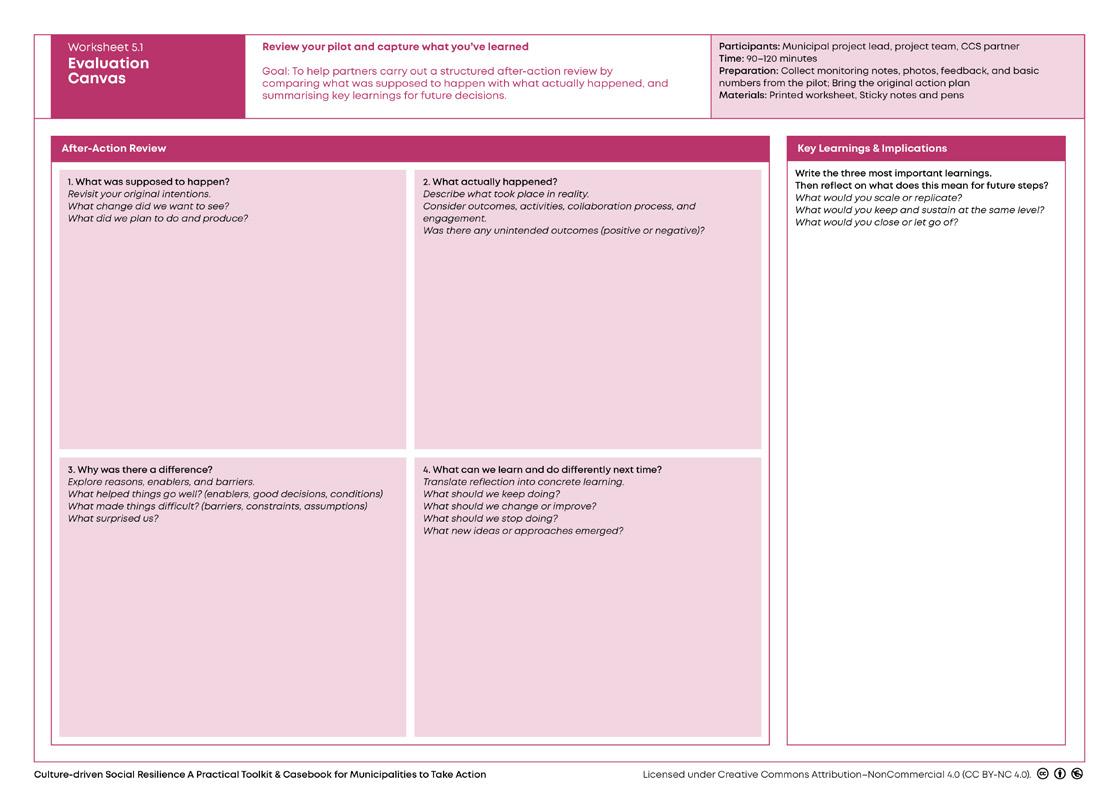
Evaluation Canvas Worksheet 5.1
Use this worksheet to look back on your pilot, compare what you intended with what actually happened, and summarise the key learnings that will inform your future decisions.
→ Find and download the worksheets here
→ Evaluate against your original goals and success indicators.
→ Include multiple perspectives by gathering input from partners, participants, and other stakeholders.
→ Be honest about challenges and failures and treat them as learning opportunities.
→ Use participatory methods such as reflection workshops or After-Action Reviews.
Storytelling is about transforming your data and lessons into a human story that can be shared with decisionmakers, partners, and other municipalities.
A good story does more than reporting. It shows why it mattered and what others can learn from it.
Storytelling can take many forms: a written case, a short presentation, a slide deck, or a short video. The important thing is to make the story accessible, concrete, and relatable.
A useful story usually covers:
• Context: Where you started, the challenge, place, and community.
• Approach: How you organised the collaboration and what you tested.
• Activities: What you actually did.
• Outcomes: What changed for people, partners, or the municipality.
• Learning: What you would repeat, change, or scale next time.
Storytelling Canvas Worksheet 5.2
Use this worksheet to shape one most significant story of change from your pilot, and turn it into a clear, shareable case that can inspire colleagues, partners, and other municipalities.
→ Find and download the worksheets here
→ Highlight the human side with community voices, photos, quotes, and concrete examples.
→ Connect the story to your original goals and show how the pilot responded to them.
→ Show both results and learning by including what did not work as planned.
→ Make the story useful for others by highlighting key insights.
→ Share the story back with community and partners and invite their perspectives.
Future Steps is about turning evaluation and storytelling into concrete decisions. After you have understood what happened and shared the story, you need to decide how – or if – to continue, expand, adapt, or close the work. Not every pilot should be scaled, but every pilot should lead to a clear next step. You can think in terms of three main pathways: scaling, sustaining, or closing.
Scaling: Growing or deepening the work
• Expand to reach more people or communities with the same model.
• Replicate by applying the model in new contexts, other programmes, or with new partners.
Sustaining: Keeping the work alive at the right level
• Continue by maintaining the pilot at its current scale with ongoing support, or by making it a stable part of your yearly plan.
Closing: Ending well and carrying learning forward
• End with learnings and close the pilot but document, share, and apply the insights.
Future Steps Canvas Worksheet 5.3
Use this worksheet to decide which parts of your pilot to scale, sustain, or close, and to agree on concrete next steps, responsibilities, and timelines for the future.
→ Find and download the worksheets here
→ Involve partners in deciding the future direction and level of ambition.
→ Base decisions on evidence and learning, not only enthusiasm.
→ Assess readiness to scale, including resources, capacity, and political support.
→ When closing, celebrate achievements and acknowledge the contributions of all partners and participants.
The Seed Money Initiative served as a method to support the awarded BSR Cultural Pearls in piloting and testing new creative solution activities with their local Cultural and Creative Sector (CCS) practitioners. It offered financial assistance to encourage the Pearls to engage with their local CCS in innovative ways and to utilise creative services effectively to foster social resilience. The CCS practitioners collaborating with the Pearls were eligible to receive up to 5,000 EUR support from the project for their local piloting activity.
The following stories showcase how municipalities across the Baltic Sea Region put the principles of culture-driven collaboration into practice. Each story illustrates a unique approach to addressing local challenges—from bridging language divides and engaging youth, to revitalising peripheral neighbourhoods and building intergenerational bonds.
Incorporating learnings to foster collaborations between the Cultural Pearl and CCS practitioners.
The municipality of Jakobstad/Pietarsaari partnered with Miriam Attias, an expert in conflict transformation and population relations from MAP Finland, to address the town’s bilingualism challenge. Despite being in Finland, Finnish speakers (32% of residents) reported significantly lower satisfaction with city life than Swedish speakers (55%), citing inadequate services in their mother tongue. The collaboration focused on transforming the Old Fire Station into a “third place” where diverse residents could meet and on creating opportunities for dialogue between language groups. Museum Director Carola Sundqvist joined the partnership to provide historical context about how rapid industrialisation around 1900 created parallel communities that operated separately for over a century. The partnership was supported by the BSR Cultural Pearls Seed Money Initiative.
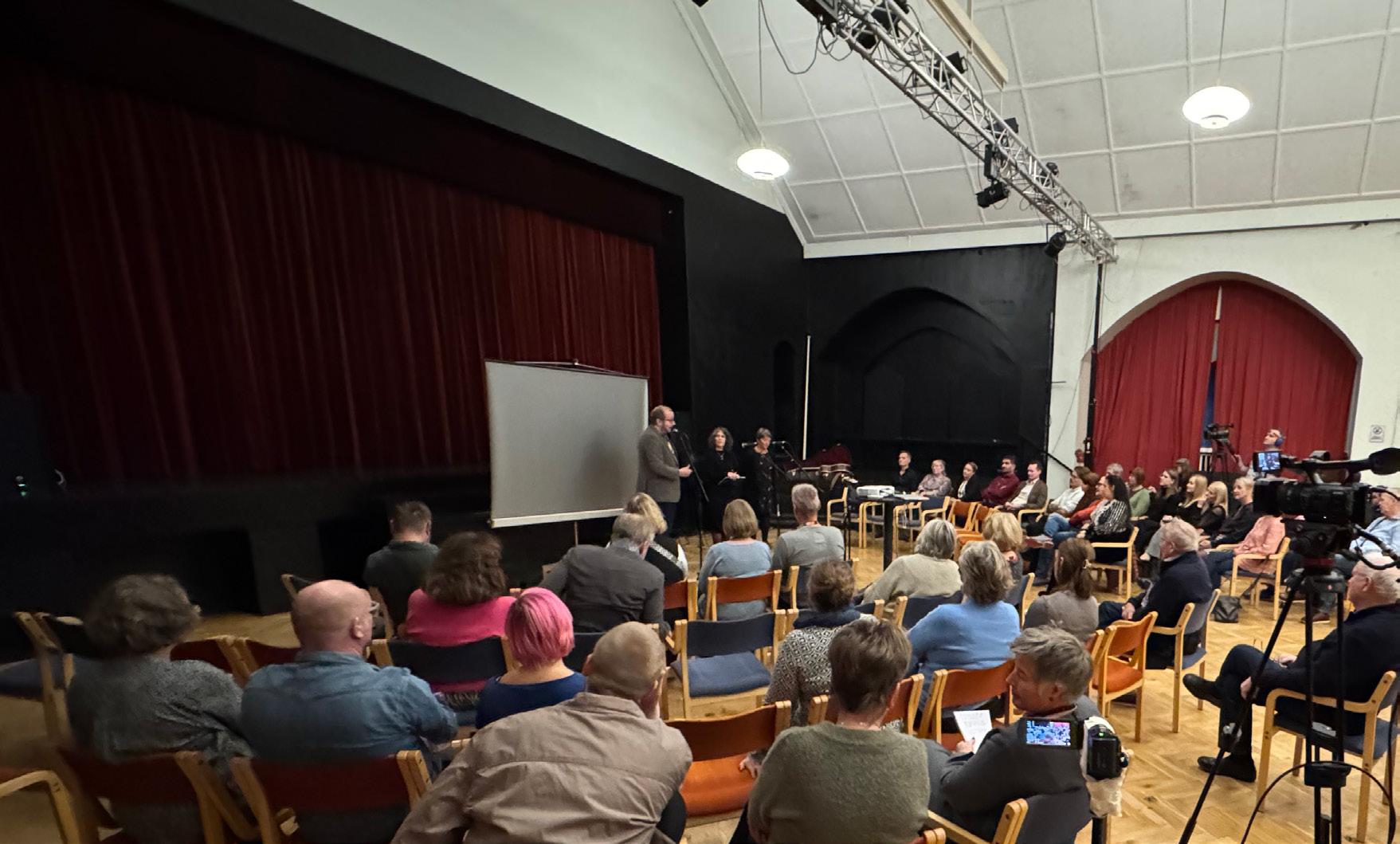
The flagship initiative was the “Histories of Jakobstad/ Pietarsaari” residents’ forum held on October 25, 2024, at the Old Fire Station. Approximately 50 residents, including Swedish speakers, Finnish speakers, bilinguals, and immigrants, participated in an evening of storytelling and dialogue. After presentations by Carola Sundqvist on the city’s bilingual history and Miriam Attias on how institutions can promote inter-group dialogue, residents shared their own and their families’ stories of living in a bilingual city. The forum was conducted bilingually and broadcast live by local television, generating community-wide conversation. The success established trust and momentum for ongoing collaboration continuing through 2025. The event contributed to the development of Jakobstad’s first-ever bilingualism programme, aimed at strengthening the bilingual language environment across all city services.
“History can be overcome when it has been heard and discussed, and when its impact on the present day becomes clear. The current situation is no one’s fault. Although we cannot change the past, we can change its meaning, learn from it and build a better future.
Carola Sundqvist, Museum Director, Jakobstad/Pietarsaari
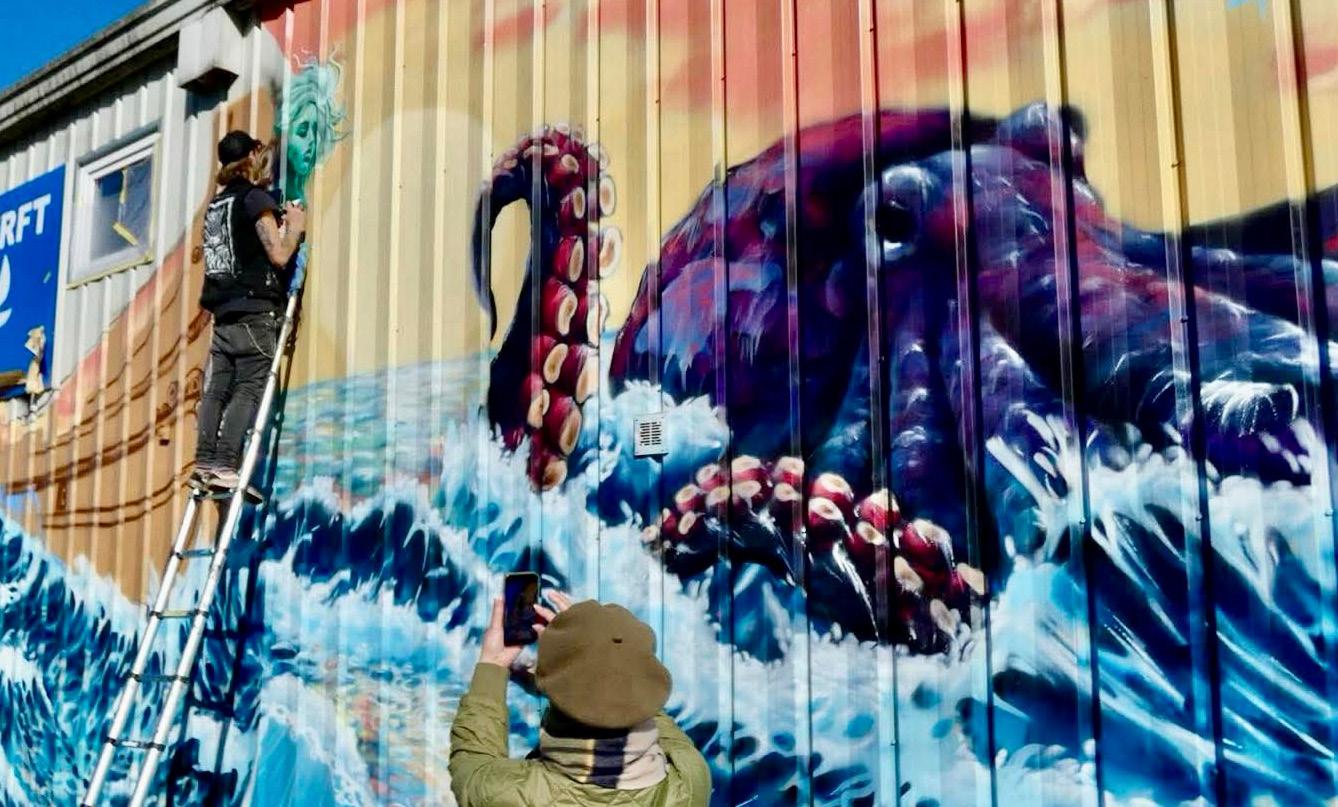
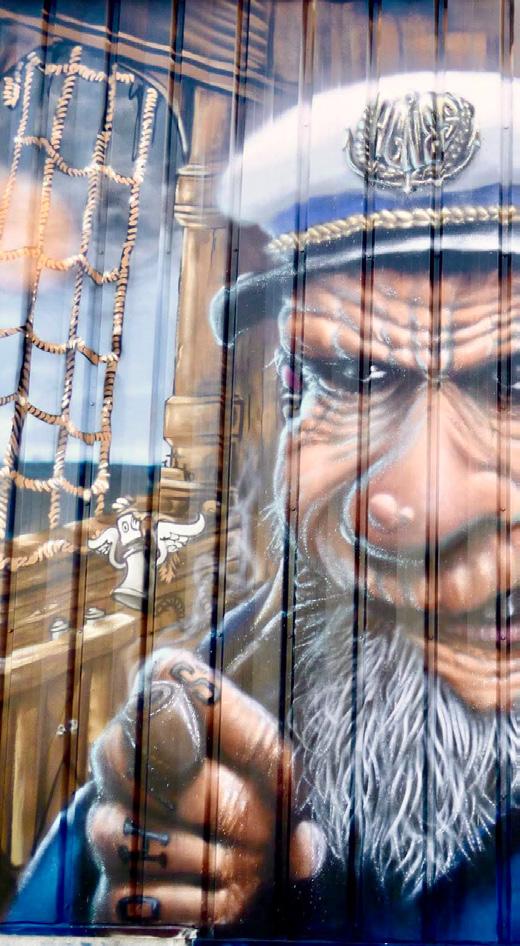
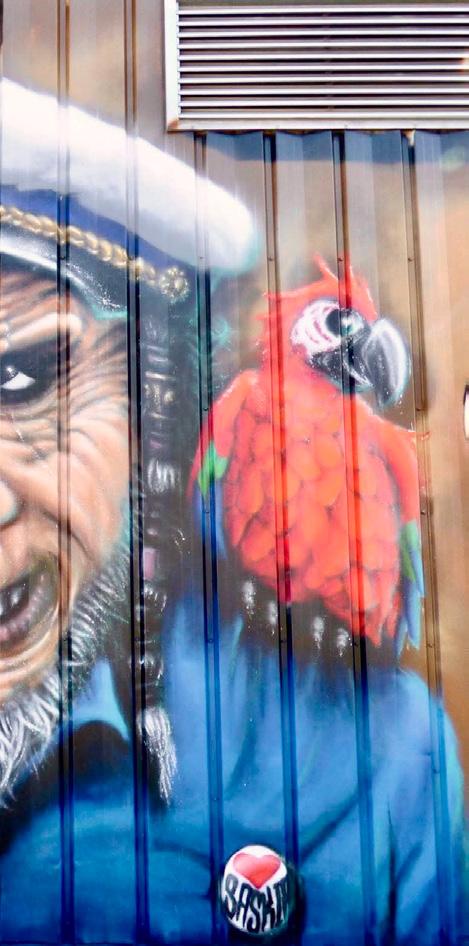
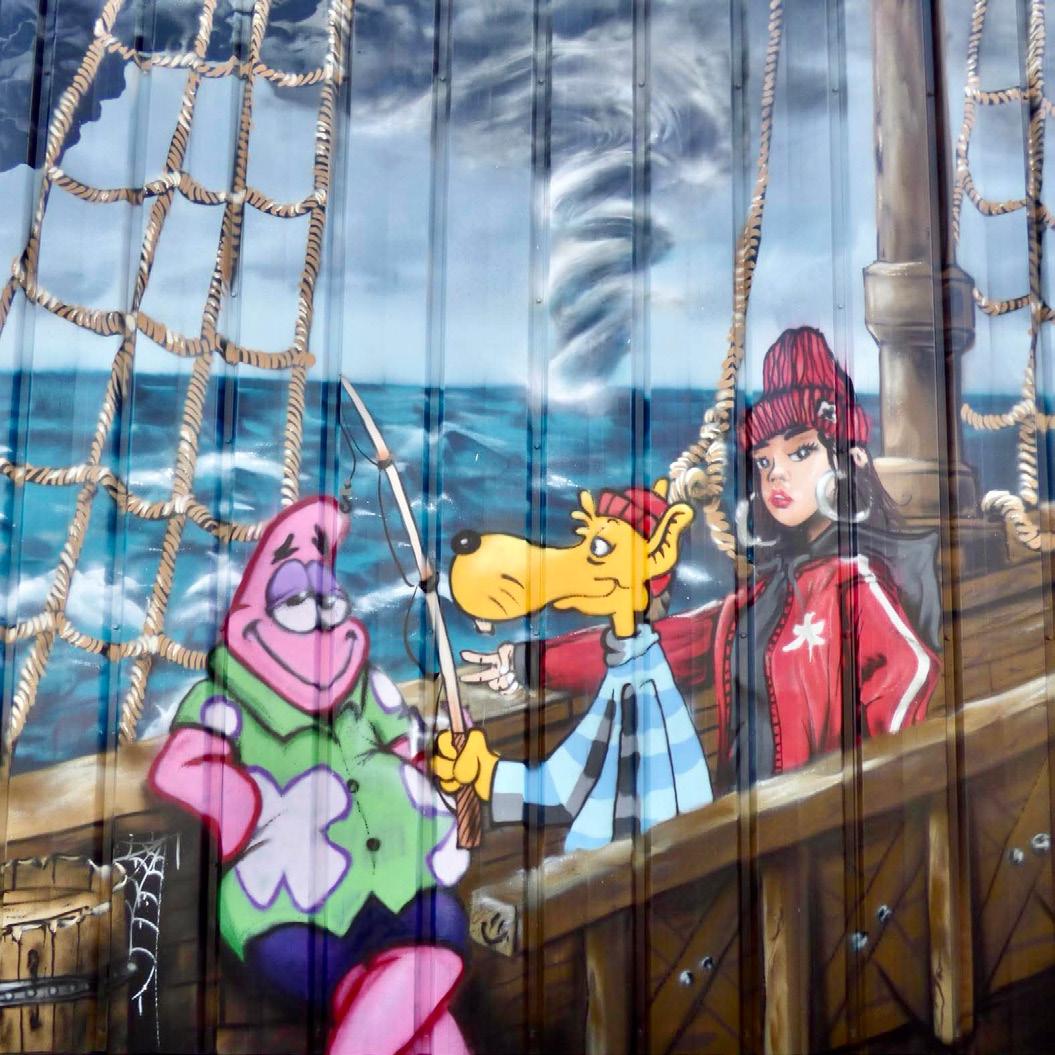
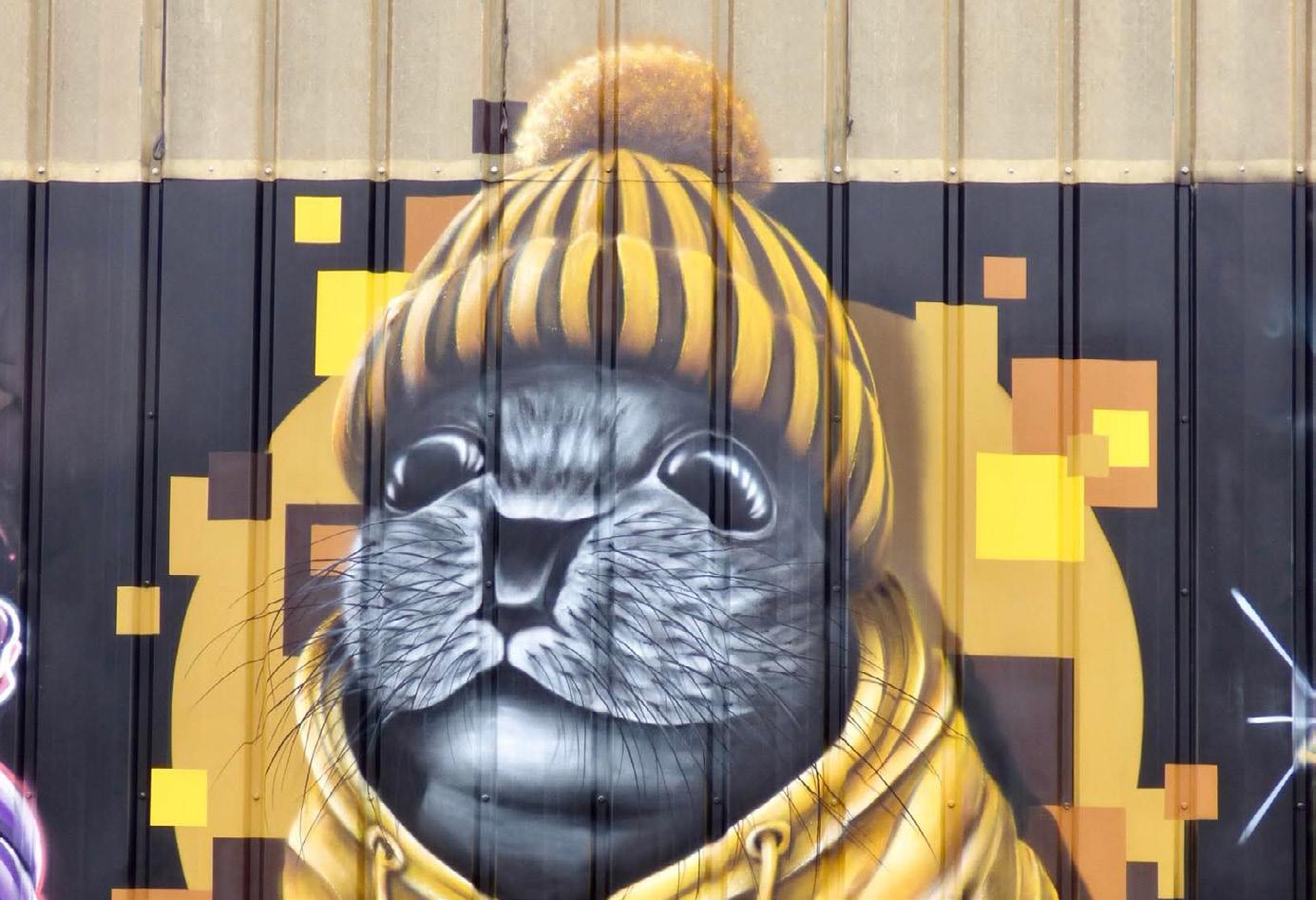
The city of Kiel partnered with Yachtwerft Dick, a mediumsized yacht shipyard where integration is lived through cooperation, and the Kiel graffiti studio Vanartizm led by Christoph Kröger. The collaboration brought together over 20 graffiti artists and shipyard employees to create a public artwork celebrating the important role that the maritime economy plays in social cohesion. At Yachtwerft Dick, skilled workers with a migration background are actively supported in learning German and dealing with authorities, achieving integration into the labour market and society through collegial contacts. The project was coordinated by Kiel project manager Annette Wiese-Krukowska and funded by the Interreg project BSR Cultural Pearls, with Yachtwerft Dick providing the hall wall free of charge.
Kiel, Germany
At the end of 2024, a workshop brought together employees of the yacht shipyard to develop image ideas. These concepts were expanded with artistic ideas from graffiti professionals and transformed into a 100-metre-long work of art over two weekends in March 2025. The huge graffiti now adorns Kiel’s Schleusenstraße at the terminus of bus route 11/Wik-Kanal. Even during creation, the artwork attracted considerable attention from local residents and passersby, who got talking to the artists and were impressed by the work. The finished piece is wonderfully maritime and imaginative, with many facets that invite close observation, creating a special work of art for Kiel with a connection to the Baltic Sea region.
“With the help of the staff at the yacht shipyard, a wonderfully maritime and imaginative work of art has been created for Kiel that has many facets and invites close observation. Kiel has gained a special work of art with a connection to the Baltic Sea region!
Annette Wiese-Krukowska, Project Manager, City of Kiel
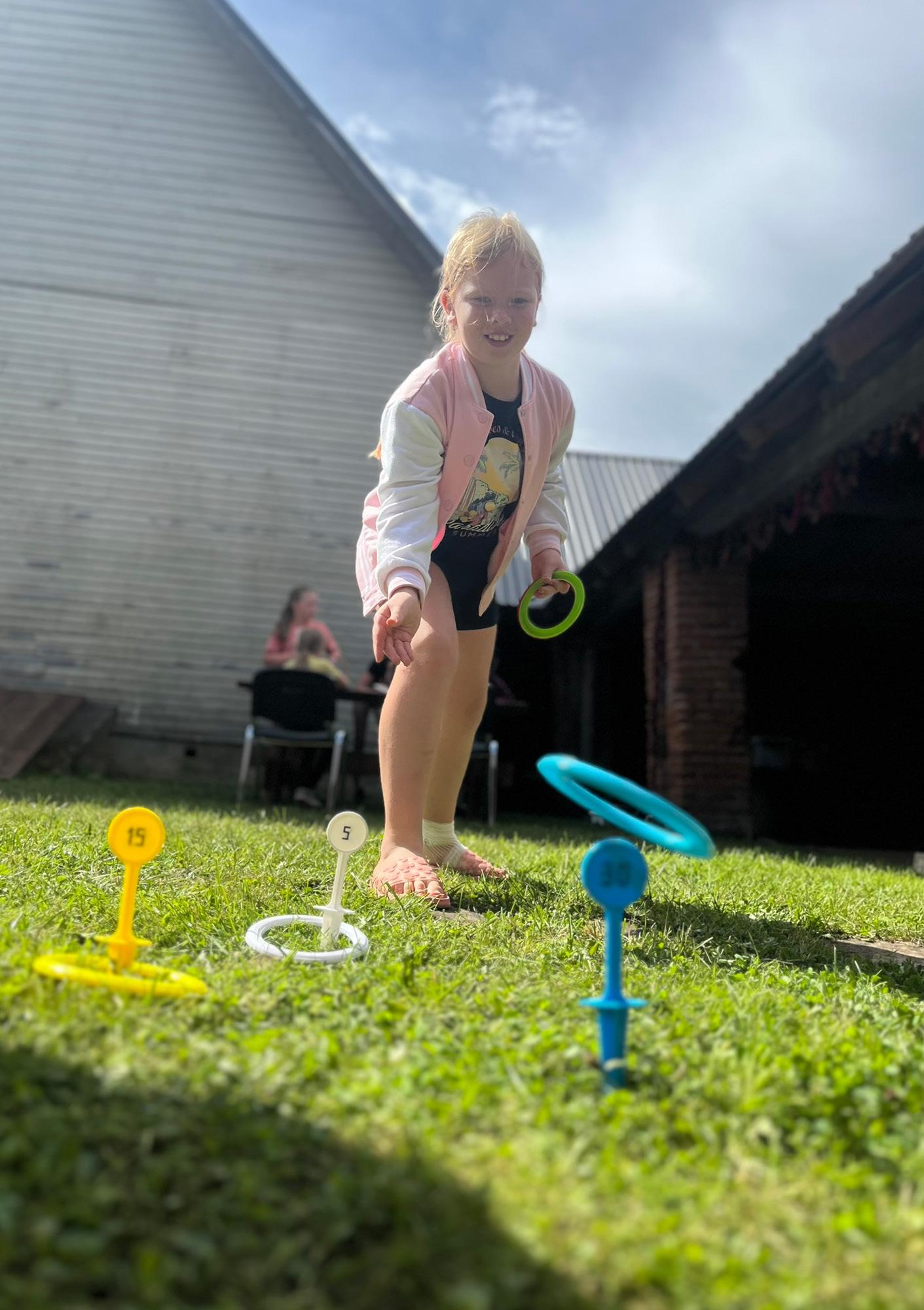
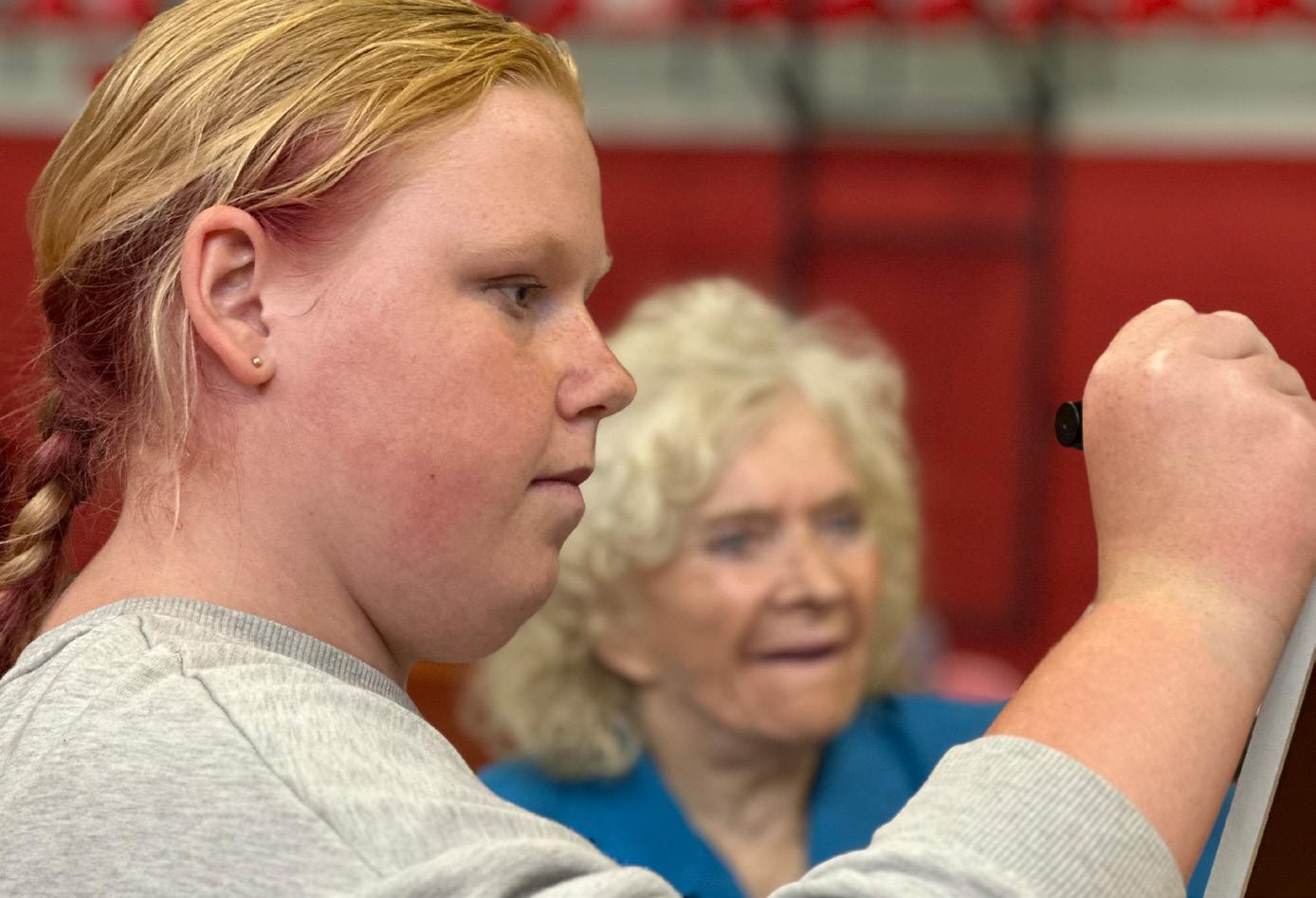
Peipsiääre municipality, formed in 2017 from the merger of five smaller municipalities in Tartu County, faces challenges common to small rural municipalities in Estonia: an ageing and declining population, with young people leaving after completing basic education. However, the distance from major urban centres has instilled in residents an appreciation for their roots and local cultural heritage. The region is exceptionally rich in culture, presenting three unique cultural traditions: the distinct Kodavere culture, the culture of the Russian Old Believers, and the Baltic-German manor heritage. For the BSR Cultural Pearls title year, the municipality partnered with the Kodavere Heritage Centre to launch initiatives aimed at introducing young people to their cultural heritage while equipping them with contemporary skills.
Peipsiääre, Estonia
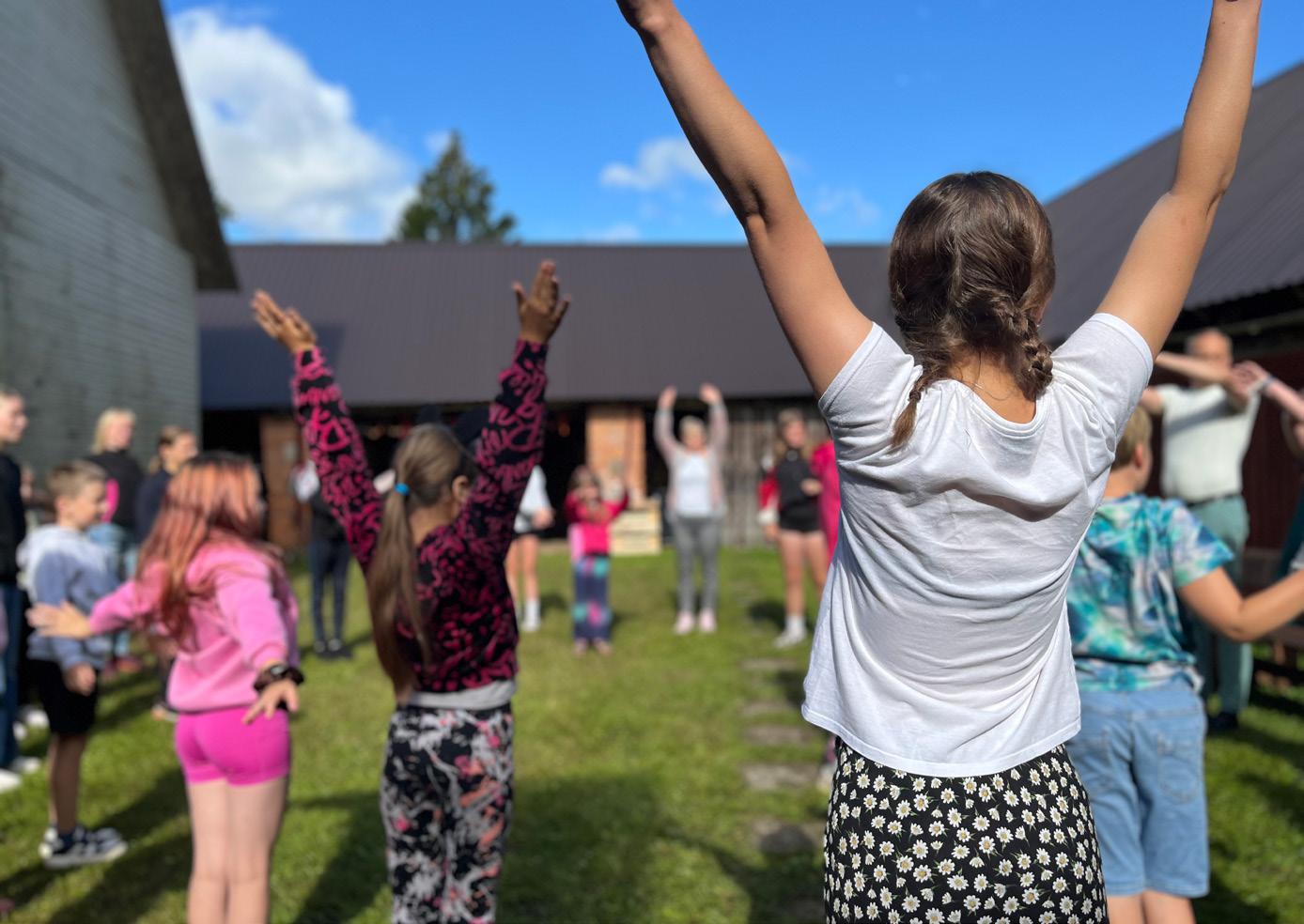
The first Kodavere Dance Festival “Enchanted by Nature” brought together 20 dance groups and nearly 280 dancers to perform before a large audience at the Pala School Stadium. The festival united different generations, from kindergarten children to senior dance groups and gymnasts. The highlights were the dances Siisik and Viru valts, originating from the historical parish of Kodavere, which framed the festival as dancers formed patterns of the traditional Kodavere belt and apron on the dance field.
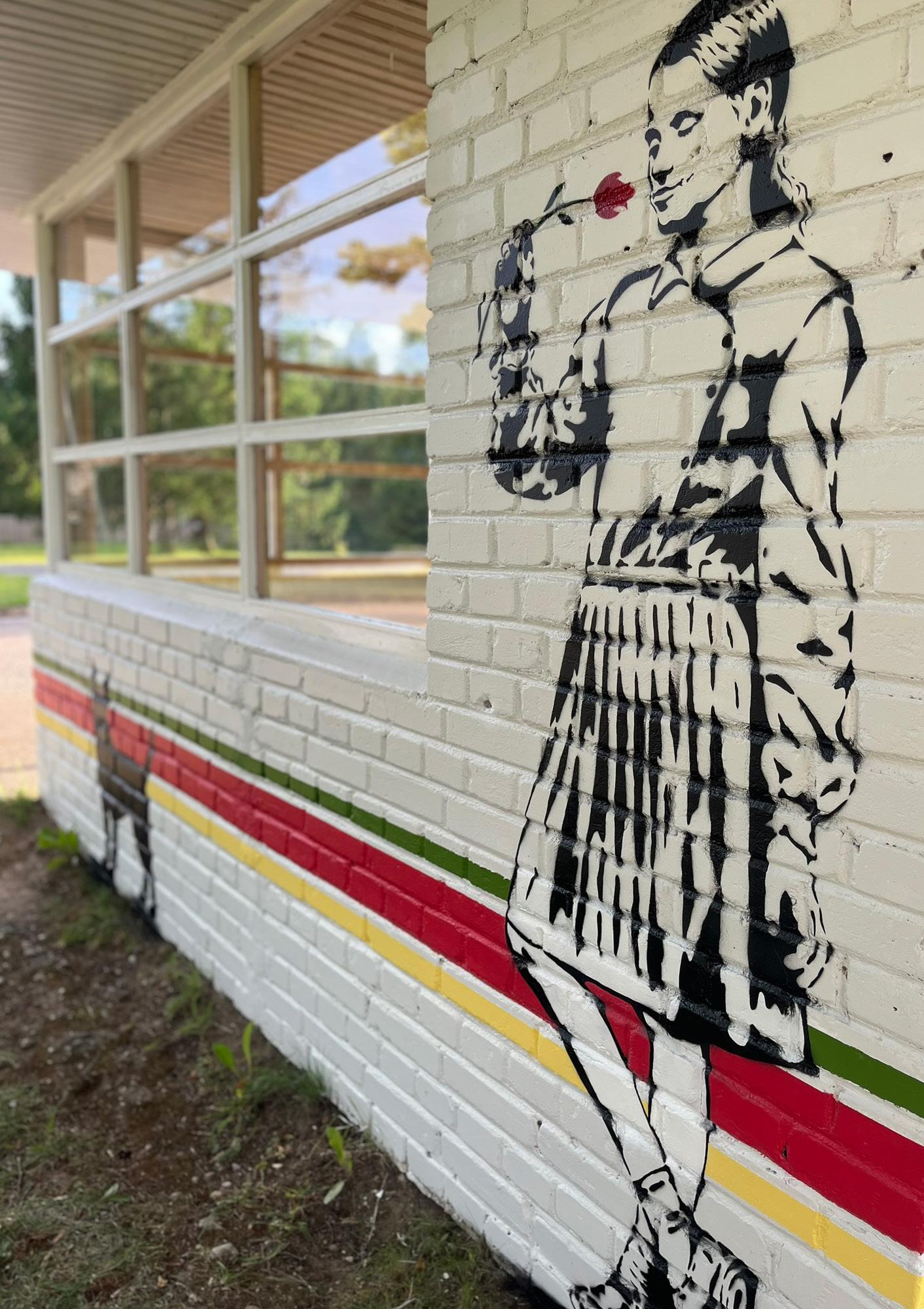
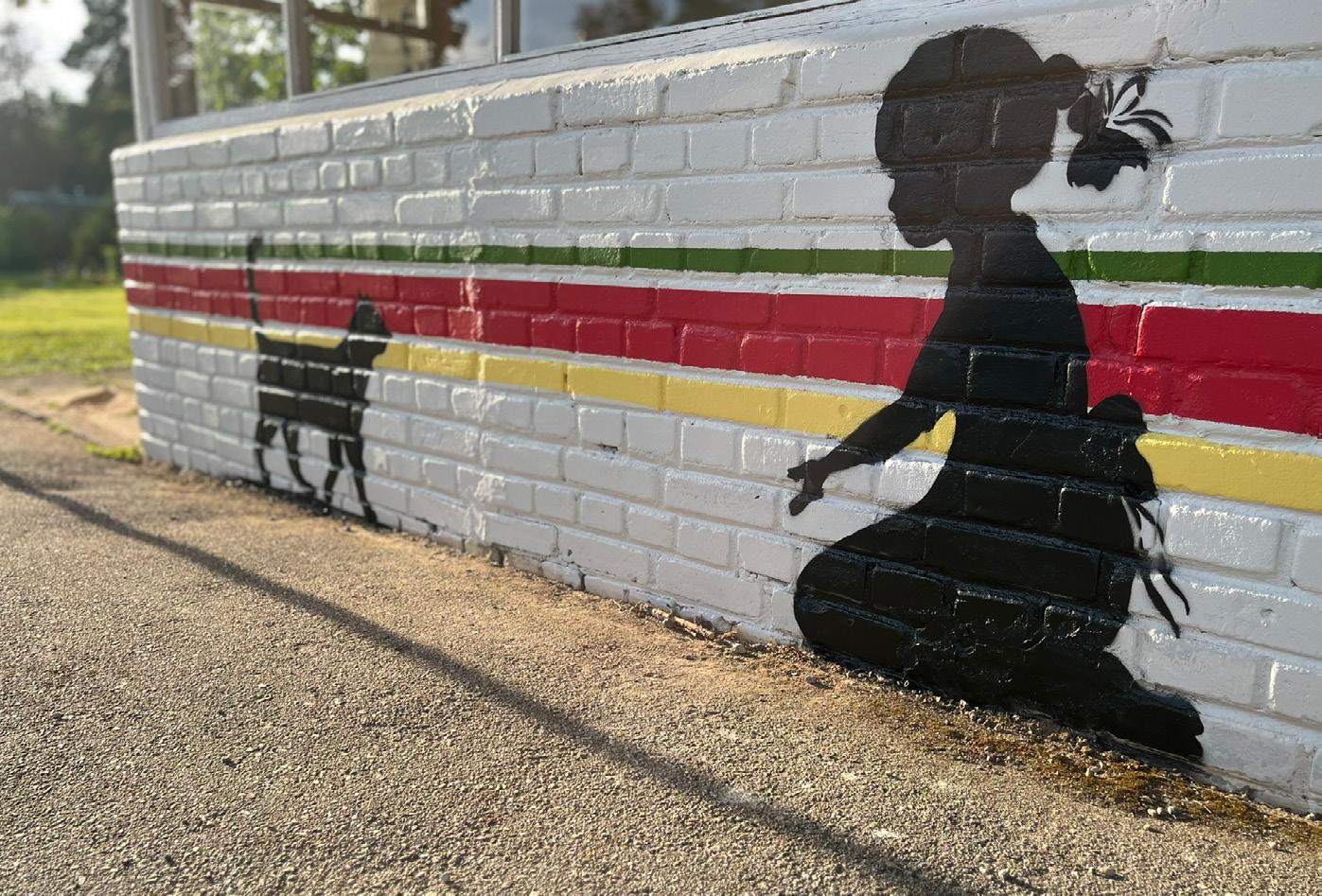
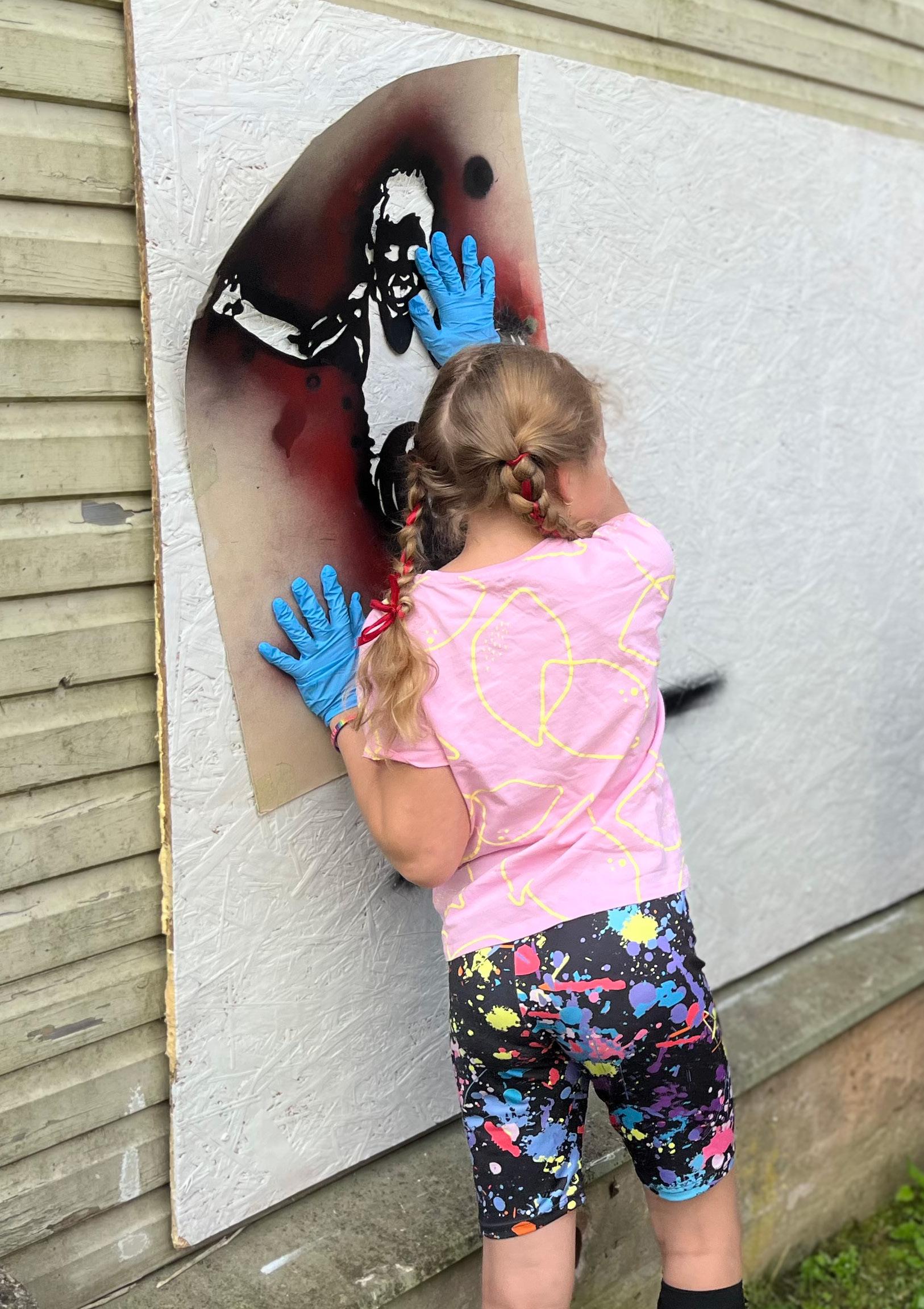
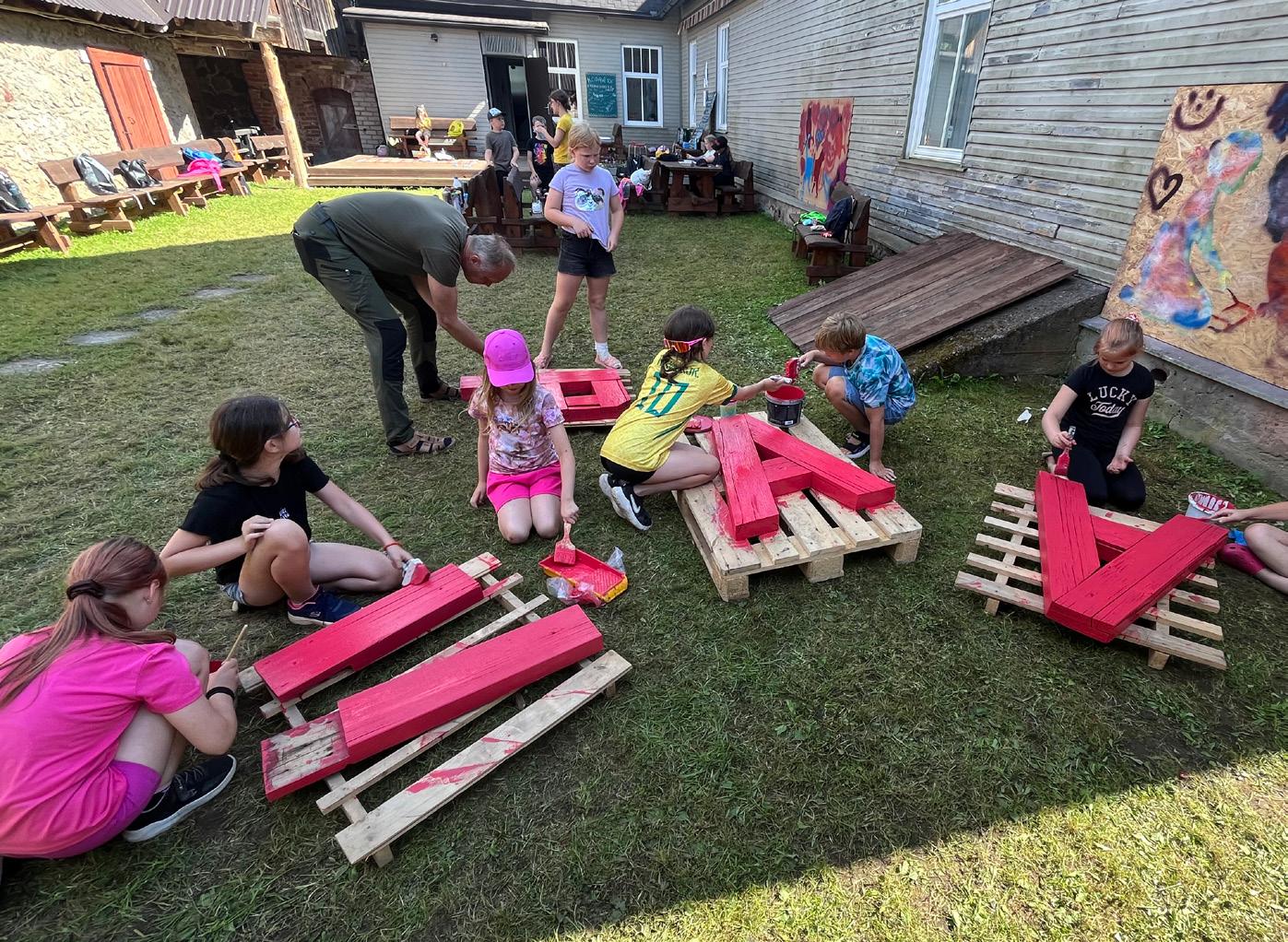
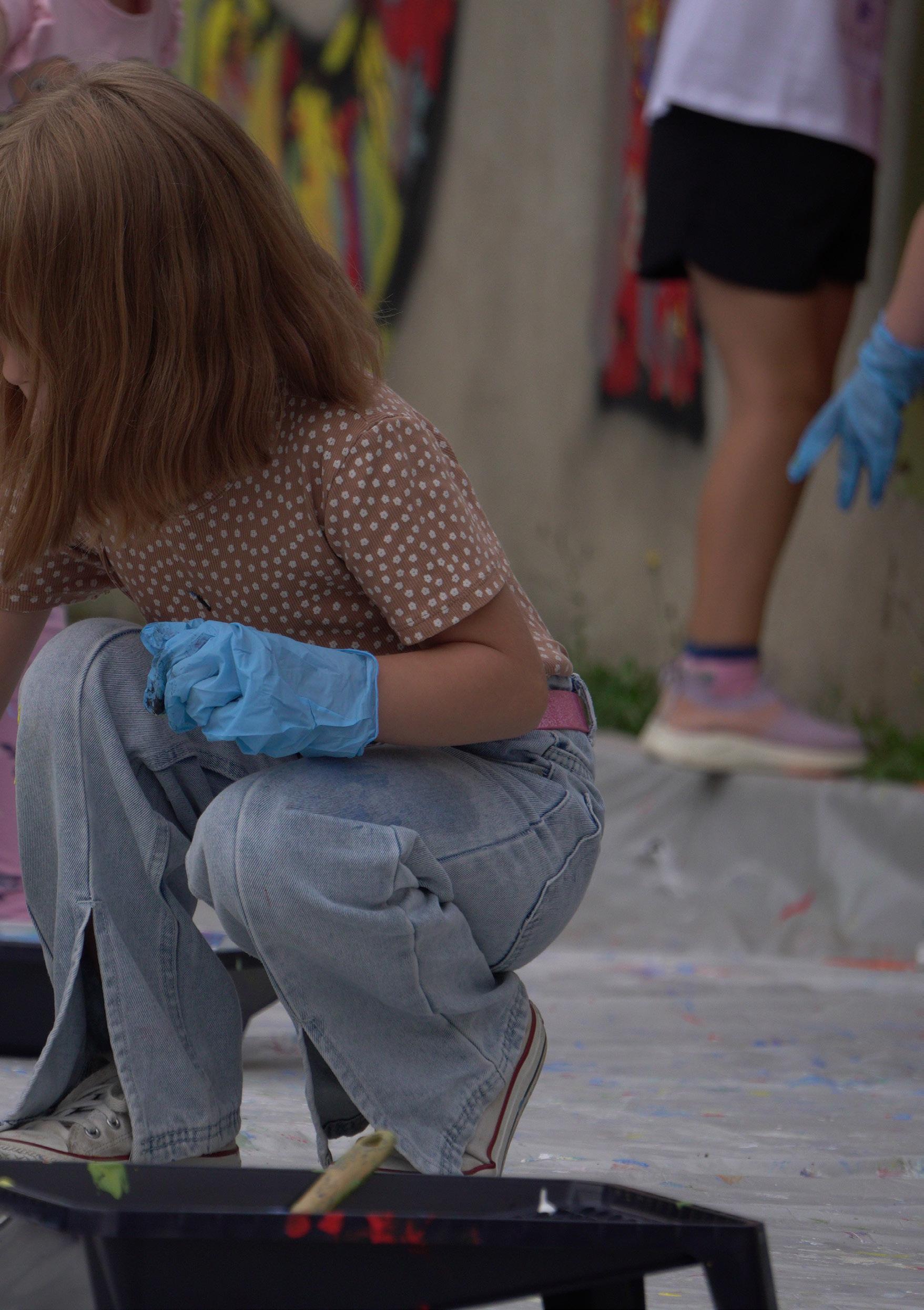
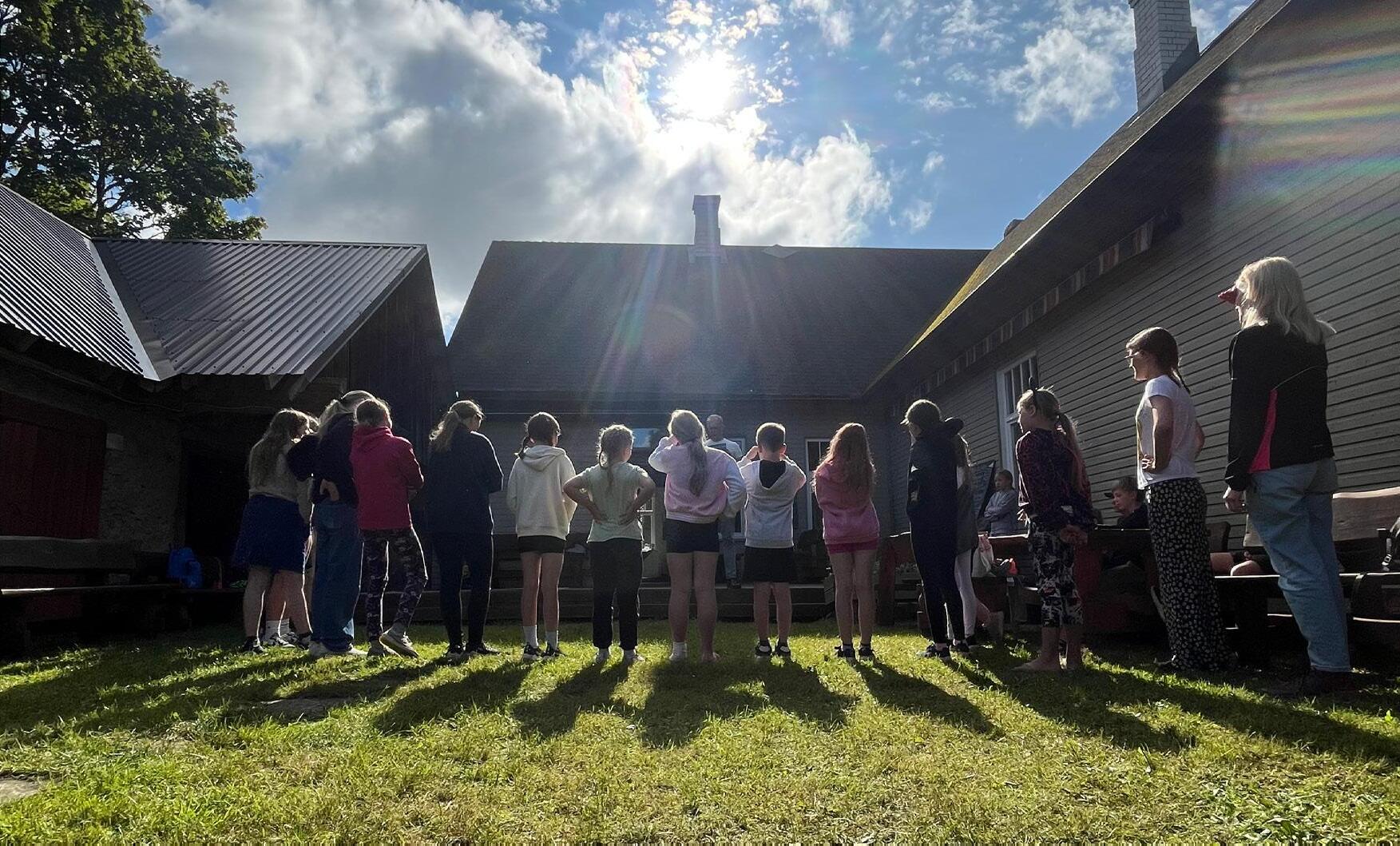
Later, the fifth Kodavere Heritage Camp for Children and Youth took place under the guidance of street artist von Bomb. Children transformed the Pala bus station with stencilstyle paintings depicting notable local figures such as Anna Haava, Mari Vallisoo, and Anna Lindvere, surrounded by figures of the participating children and other creative elements. Children also learnt the Kodavere dialect, the small kannel (traditional zither), folk dances and games, and participated in workshops on traditional dishes.
The third activity supported the launch of the Kodavere Youth Podcast “Kaugen külän” (In a Far Away Village) and recording of its first season from May to October. The idea came from Pala School student Karmen Kivistik, who together with three classmates started the youth-to-youth podcast to introduce the life, culture, and people of the Kodavere region to a wider audience. The episodes featured different guests including young people, organisers of Kodavere song and dance festivals, fluent speakers of the Kodavere dialect and folklore experts, and local youth workers. The podcast is available on YouTube and Spotify.
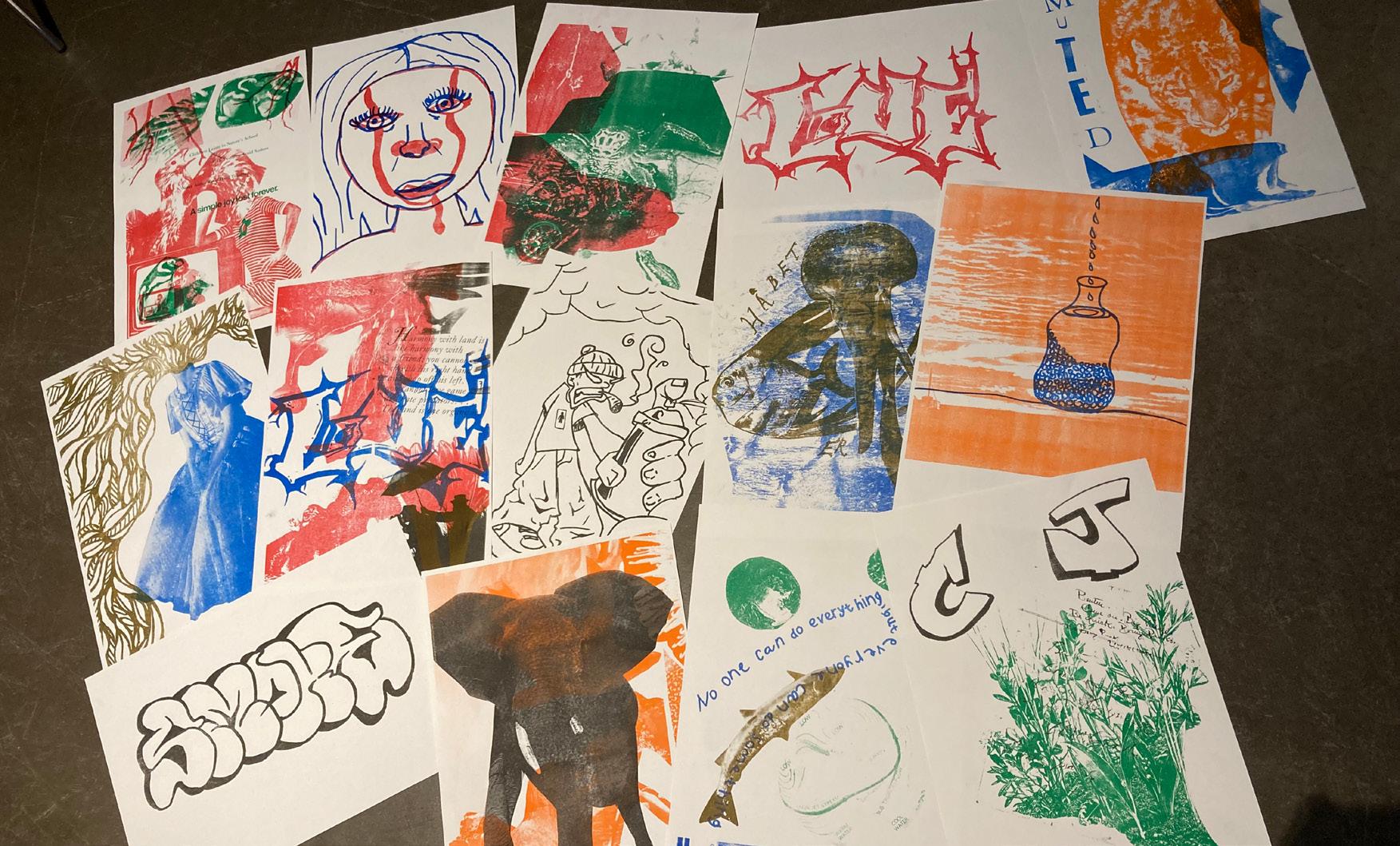
Svendborg Municipality partnered with Ungekontakten (youth guidance unit) and four local cultural actors to create Kulturrum, a municipally funded initiative ensuring young people aged 15-30 experiencing discontent have access to strengthened community through cultural activity and creative expression. The four partners—Svendborg Library, Foreningen
Laboratorie for Ung Kunst (FLUK)—worked within music, art, nature, and literature to offer young people in distress new communities through a creative shared third space. The programme runs for 12 weeks, with young people referred by school counsellors, youth guidance, or job consultants. Frivillighedshuset (the Volunteer House) serves as the anchor institution where youth communities continue after the programme ends, allowing young people to maintain the community they have cultivated together.
Svendborg, Denmark
The closing event brought together young people from Kulturrum, Ungekontakten, the four cultural actors, and Frivillighedshuset. The day began with brunch at Under Uret café, where conversation flowed easily and young people grew closer in the informal and comfortable setting where they let their guards down. The workshop that followed was held at Frivillighedshuset, led by local artist Kristian B. Johansson (KBJ Publishing), who works with riso print—a Japanese printing technique using rice and soy-based ink where one colour layer is printed at a time. The young people produced collages, text, and drawings that were printed on top of each other in different colours, creating A3-format posters. Adult actors helped and supervised throughout, and the whole group entered a fine workflow. Seven young talents also left their mark on the old shipyard halls at Frederiksø, creating a graffiti masterpiece in the iconic Rundbuehallen with guidance from a local graffiti artist. The posters will be publicly exhibited to strengthen the young people’s sense of belonging in the city, give them a feeling of having contributed something valuable and to let them be seen.
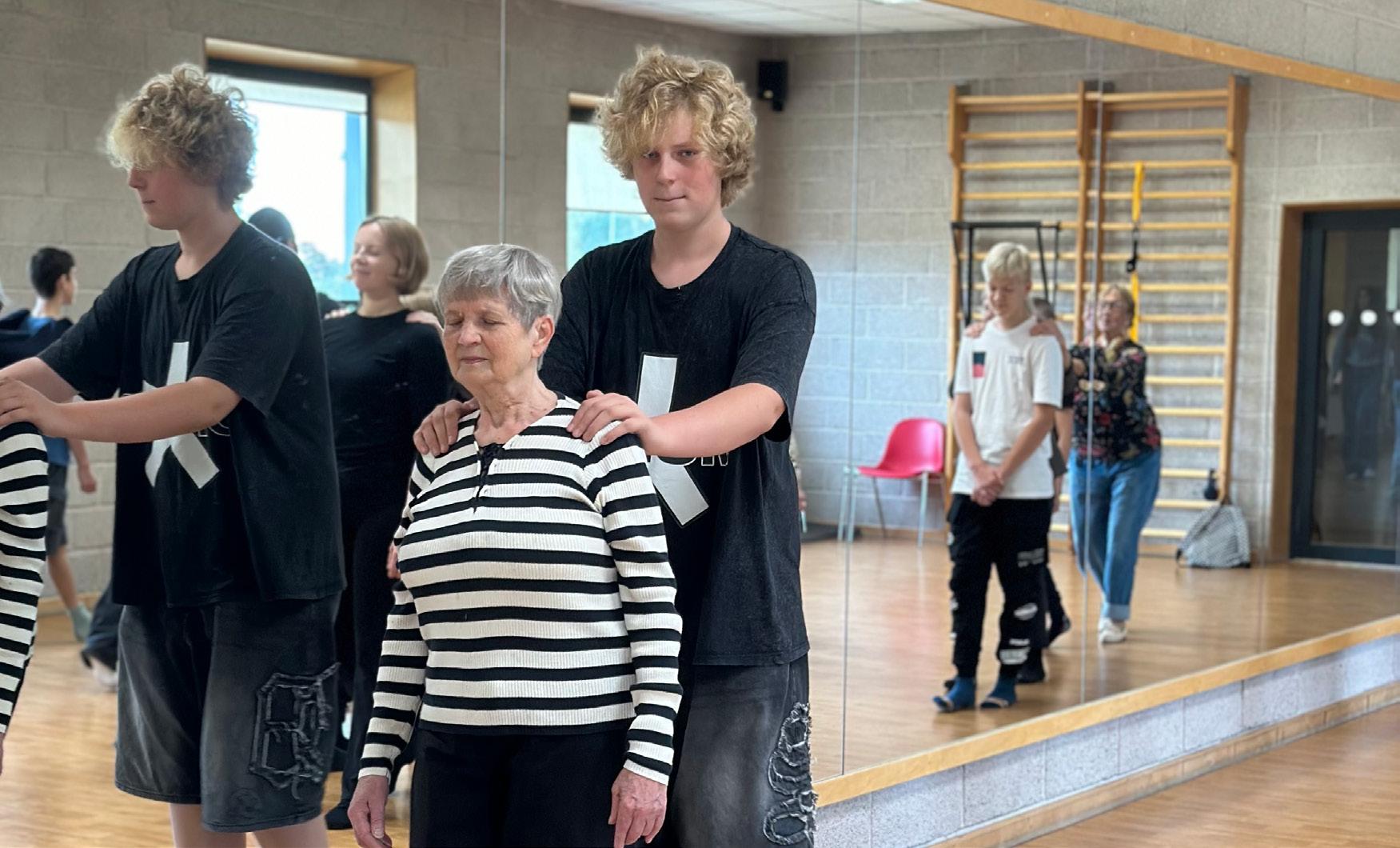
Between June 13 and October 7, 2024, the association “Ascendum” implemented a series of intergenerational activities between teen and senior aged groups in Rūjiena. The project addressed Rūjiena’s challenge as a “seniors’ town” facing population decline—a 16.9% decrease over the last 10 years—by building intergenerational dialogue and skills transfer. Initially, Ascendum planned to work with youth activists from the local youth centre, but significant difficulties arose due to summer schedules. The decision was made to cooperate with 7th grade students of Rūjiena Secondary School, as these students would likely stay in Rūjiena for another couple of years, offering greater potential to continue intergenerational activities until they leave for high school in bigger cities.
Rūjiena, Latvia
The project was implemented in two stages: a research and preparation phase involving three introductory visits and discussions to identify needs and common interests, followed by an activity implementation phase with six co-creation workshops spanning four weeks.
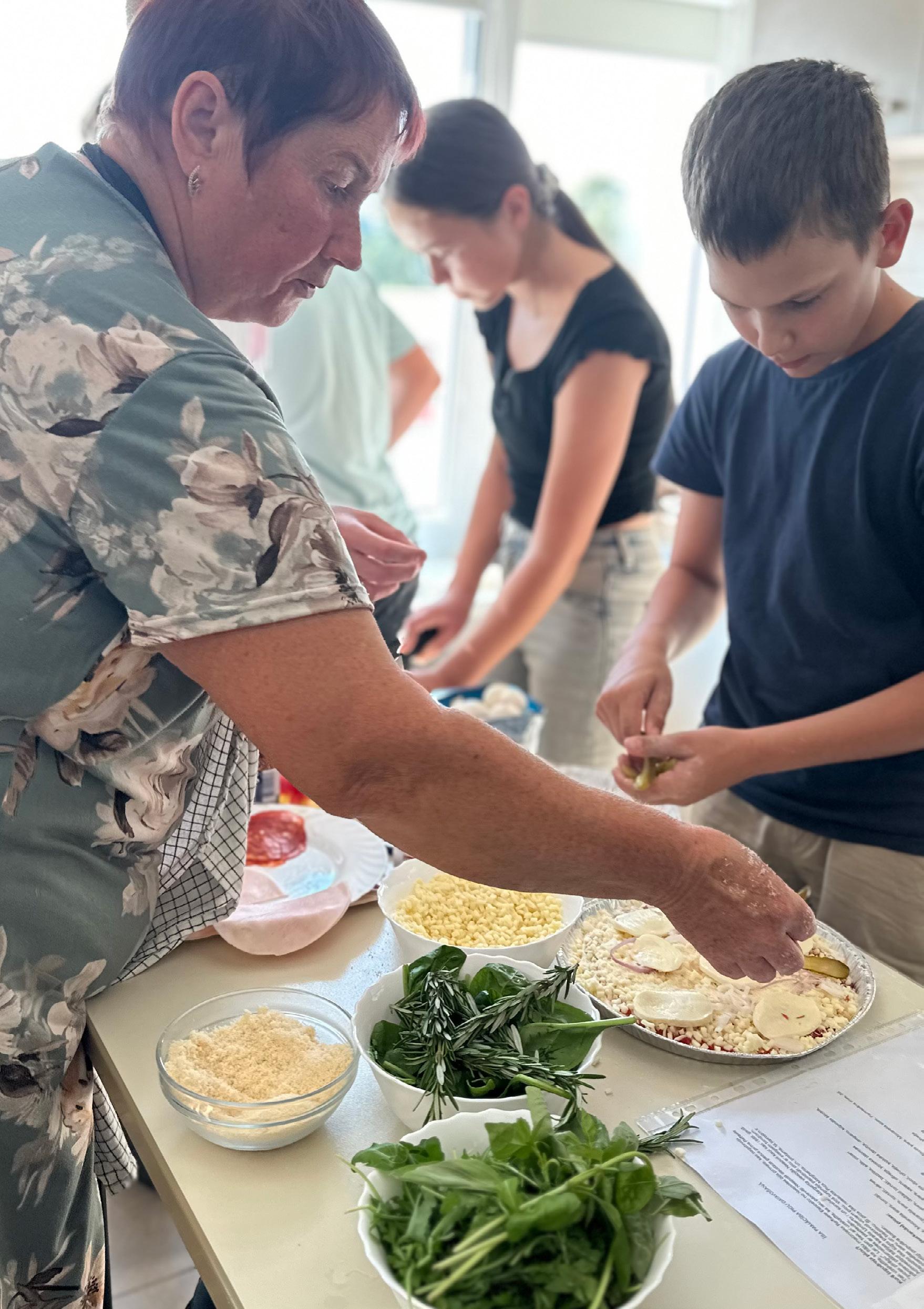
Six co-creation workshops were organised, held twice weekly initially to maintain interest and promote mutual connections between 22 students and 9 seniors. The workshops took place on school grounds in a closed environment to create a safe space for building informal, friendly, and authentic bonds. Activities included co-cooking as an introductory activity, creative writing workshop led by Latvian poet Roberts Vilsons, creative movement workshop led by choreographer Anta Grīnvalde, creative illustration workshop led by artist Rebeka Lukošus, and erudition game competitions in teams with conversation-oriented discussion clubs.
Each workshop began with ice-breaking activities where participants got to know each other a little more, with special attention to communication and reflection on progress. A survey conducted during the last workshop confirmed success: students emphasised that activities made seniors seem closer and more human, and they felt safer being in contact with their grandparents. Seniors admitted their initial fear of meeting young people was not justified, especially highlighting that when they now meet outside school in the town environment, they greet each other and feel closer.
The project contributed to reducing stereotypes and increasing comfort in intergenerational communication, establishing foundations for further cooperation.
“ Students emphasised that these activities have made seniors seem closer and more human; they also mentioned that thanks to this project they also feel safer in contact with their grandparents. The seniors admitted that their initial fear of meeting young people was not justified.
They especially highlighted the fact that they got to know the students during the project, and now when they meet outside the school in the town environment, they greet each other, they feel closer, which suggests that there is a great potential of furthering these relationships into something more outside the framework of this project.
Ascendum Association
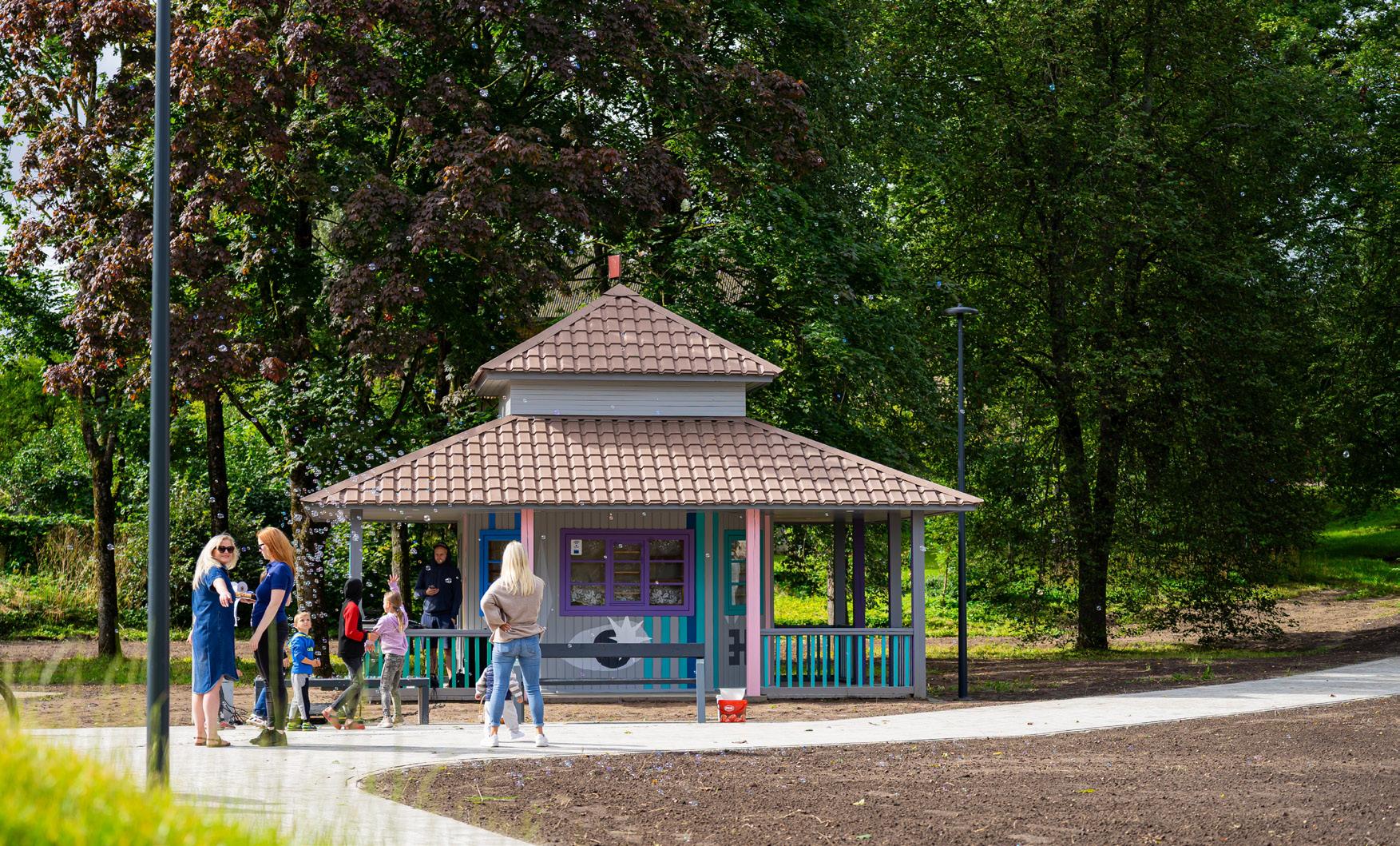
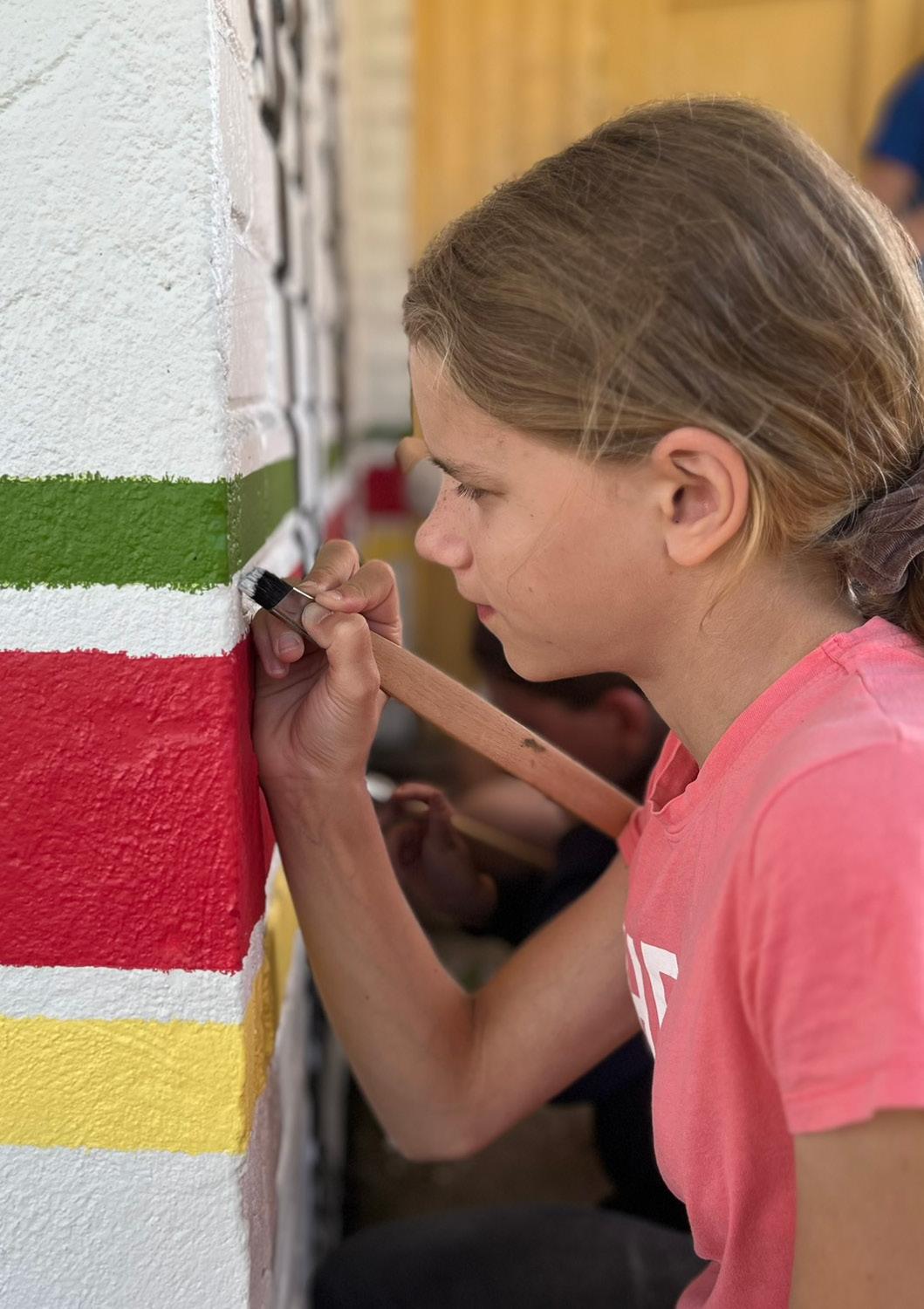
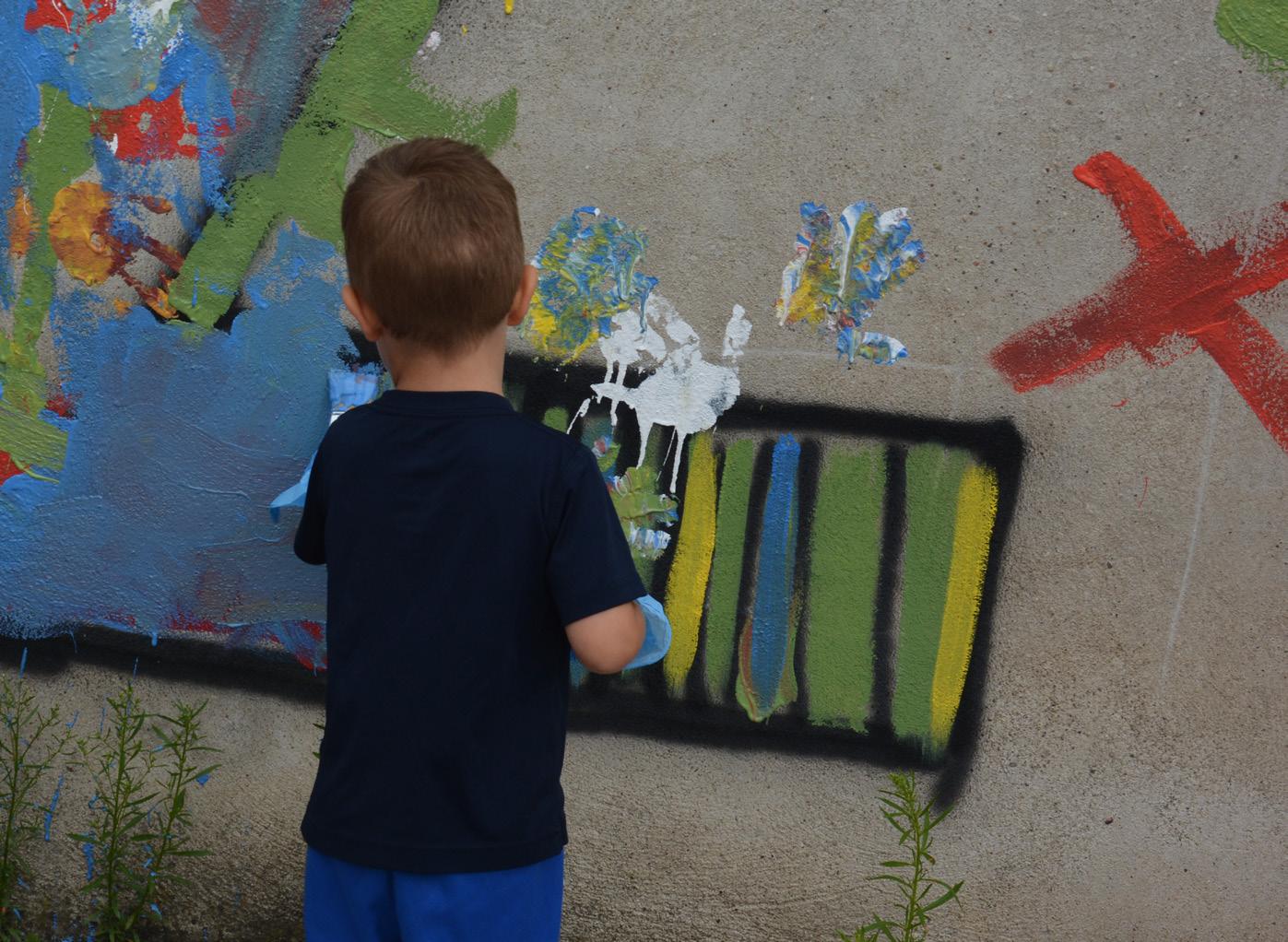
Artist Viktorija Zeme collaborated with 14 young people from Smiltene municipality aged 11 to 19 to create a colourful mural on a wooden cabin in the “Smiltiņš” active recreation park. This initiative aimed to promote youth participation, public space development, and understanding of sustainability. The project addressed Smiltene’s challenges of out-migration and declining community engagement by using culture as a platform for social change. Over five days, the collaboration combined educational lectures on environmental sustainability, water conservation, and healthy lifestyles with practical artistic work. Young people thought about the environment, the city, lifestyle habits, and how art can inspire change, creating 10 sticker sketches with calls to protect nature and care for health alongside the mural design.
Together with artist Viktorija Zeme, the young people created sketches for the cabin walls, learnt the specifics of mural art, and became familiar with material use. Based on the youth’s ideas, the artist prepared the final design, which they then implemented together by painting the cabin. Youth involvement was active and creative—they generated ideas, sketched, suggested colour solutions, and participated in the painting process. The project provided an opportunity to experience how a sketch becomes a real work of art in public space. The mural with colourful fields and abstract composition gave “Smiltiņš” a new, vibrant image. Young people joyfully shared their participation with friends and families, and at the opening there was a feeling that the cabin had become their collective work—a symbol of pride and belonging. A plaque was attached to the cabin announcing the project, and an article was published on the Smiltene municipality website and distributed on social media.
“ I never would have imagined that my sketch could turn into a real work of art. Now every time I walk past, I will feel proud that I also
contributed.
Youth participant
I liked that we could decide ourselves what the drawings and colours would be. It was serious, but at the same time fun!
Youth participant
Each of the fields symbolises movement, vibrancy, diversity, and ourselves—as we are.
Viktorija Zeme, Artist
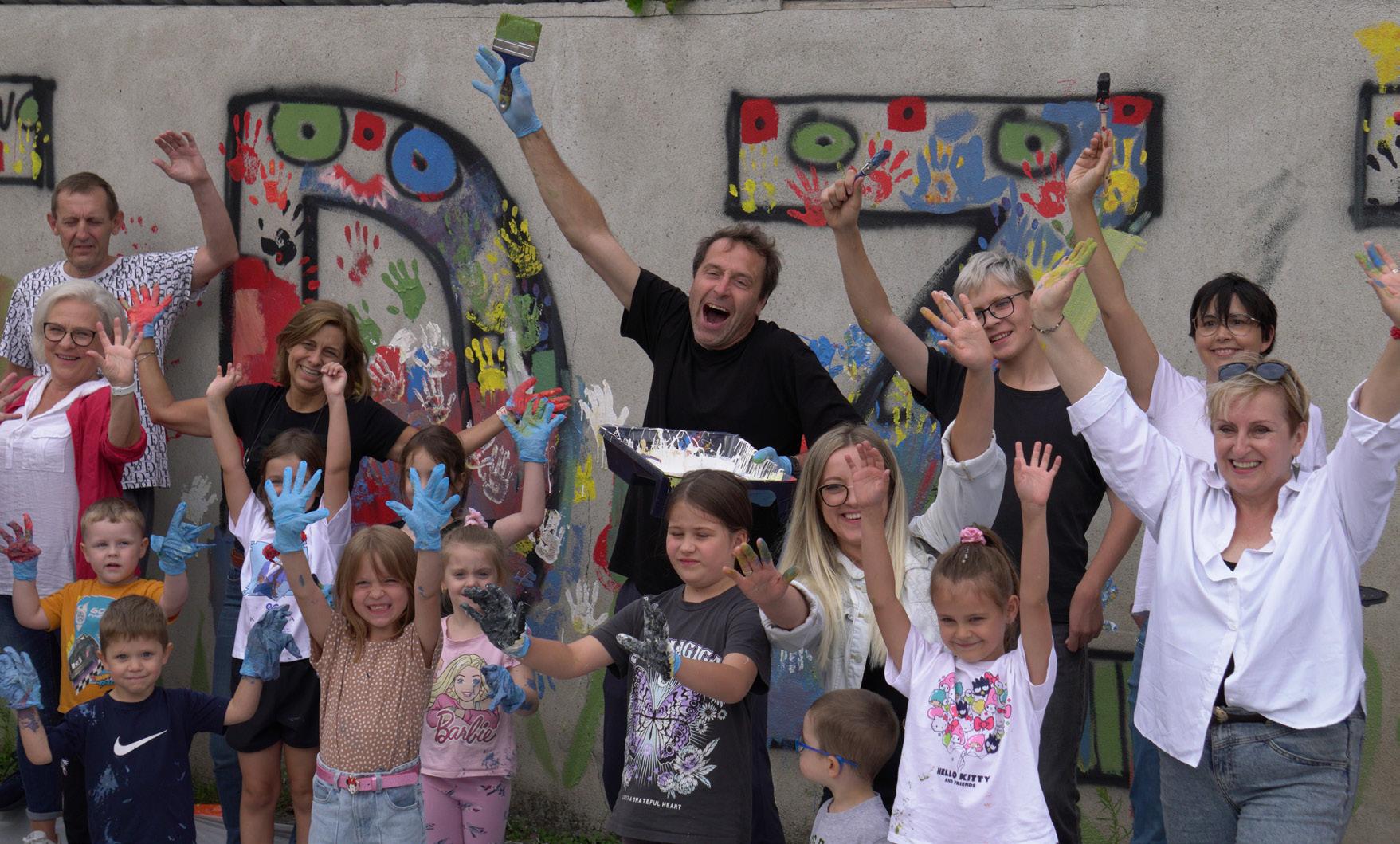
Płock is a city of over 110,000 inhabitants located 100 km from Warsaw. The city’s territorial layout naturally cuts off two peripheral settlements—Borowiczki and Winiary—from the cultural centre located on a hill. These neighbourhoods do not generate cultural offerings on their own and undertake only incidental integration activities. The City of Płock partnered with Per Se Theater Association, selected through an open tender, to implement the “culture to go” model in these settlements. Borowiczki is a residential area with a neglected green space and concert shell from the former sugar factory. Winiary has no cultural centres but features Family Allotment Gardens. The collaboration involved local artists, cultural animators, and residents, supervised by the Department of Culture and Social Initiative Support, aiming to build social resilience through cultural animation.
In Borowiczki, residents created a mural with the inscription SĄSIEDZTWO (NEIGHBOURHOOD) on the fence of Primary School No. 20, working together with animators. The evening concluded with a bonfire and grilling sausages. The final event was a performance based on Kazimierz Brodziński’s idyll “Wiesław” in the form of a wedding at the former sugar factory site. The Residents’ Council and local Fire Brigade refreshed and painted the concert shell. After the performance, participants enjoyed a dance party led by ethnographer Piotr Zgorzelski. The event attracted approximately 500 participants.
In Winiary, a Neighbours’ Historical Walk was organised with Płock actors in historical characters, ending with a bonfire. Residents created and installed a “greeter” sign reading WINIARY on green space by the main roundabout. The idea inspired Borowiczki residents to plan something similar for next year.
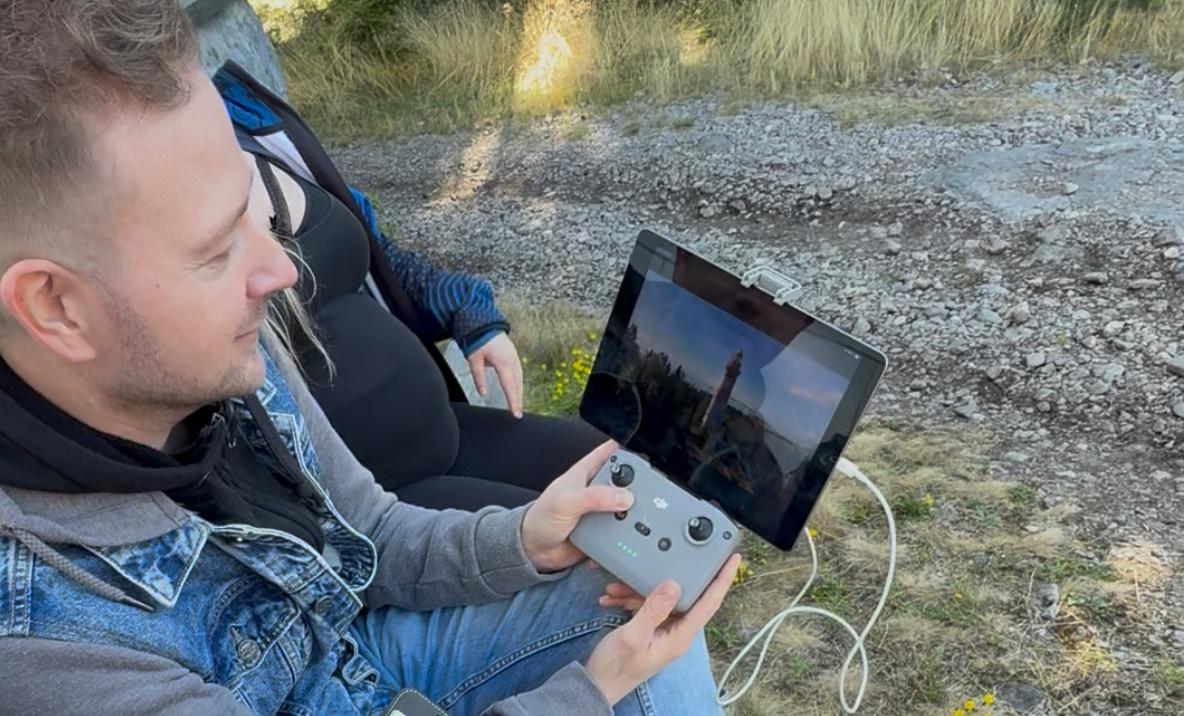
Kaskinen is Finland’s smallest town, located on an island in the western coast. The town has faced many hard years with numerous challenges, and people have forgotten the beauty of the place and how well everyone could work together. The 1980s and 1990s were the golden years of local pride in their homeland and island. The municipality partnered with Tuomas “Gary” Keskinen, a local producer and executive, to create a music video that would serve as a reminder of what a beautiful, amazing, and unique place to live Kaskinen is. The project aimed to shift the perception of locals about their home city, create positive value, popularise the city in Finland, put it on the map, increase tourism in the area, and strengthen connections to the world. The collaboration involved local artists from Kaskinen creating both music and film, with the Port of Kaskinen also expressing interest in being involved.
Through the pilot project, an entirely new song called “Meren Valo – Havets Ljus” (“The Light of the Sea”) was created. The song was born after the team was unable to obtain permission from the composer’s estate to use an existing piece. The team collaborated with professional composers and found a magnificent Disney-style arrangement for the new song. The lyrics, also written by professionals, tell a story about the sea and the light of a lighthouse. Symbolically, the lyrics reflect the people of the region—both those who still live there and those who have moved away—yet the love for Kaskinen has always remained. For the vocals, the team found Abela, an artist originally from Kaskinen who is now pursuing a music career in Sweden, and one of Finland’s top artists, Antti Railio. On the production side, the song features internationally renowned star Jukka Backlund, with string and orchestral arrangements handled by Visa Mertanen.
For the music video, local events in Kaskinen were filmed, along with beautiful aerial footage from both winter and summer. A central part of the video is the Kaskinen lighthouse. The focus of the filming was on the people of Kaskinen and their strong sense of community, portrayed in a sensitive and beautiful way. The video also highlights local identity, stunning nature, and the “light of the sea.” The video was produced by 720 Factory (Jouni and Jukka Hillberg), with aerial footage by Joni Keskinen. Some material filmed by the Kaskinen Sea Rescue Unit was also used. The single was released digitally and published on YouTube and Spotify.
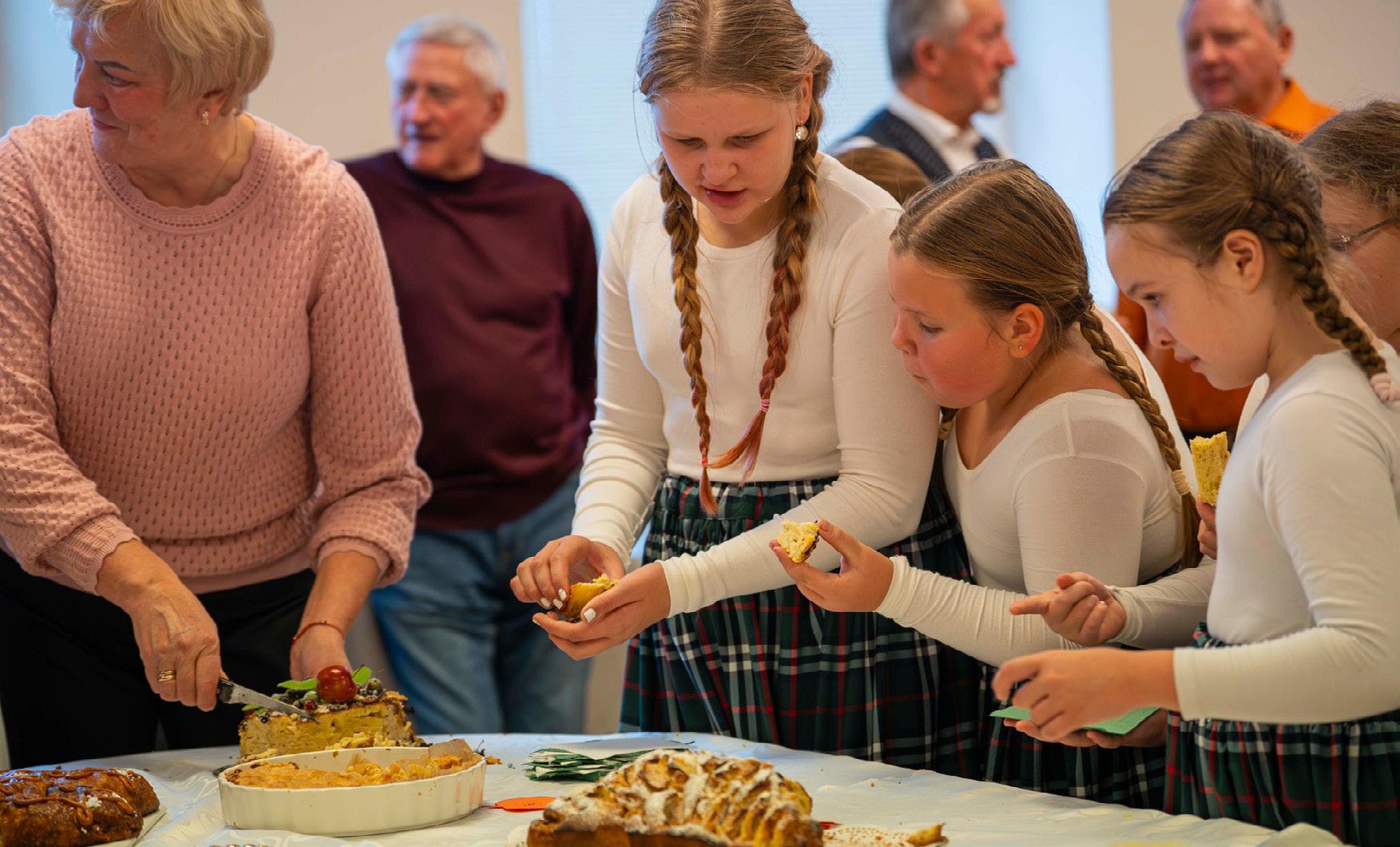
Alytus District Municipality is nestled in the picturesque Dzūkija region of southern Lithuania, home to approximately 26,000 residents across two towns—Daugai and Simnas— and 41 villages spread across 1,410 km2. The district is divided into 11 administrative units (seniūnijos-elderships) on both banks of the Nemunas River. By becoming a Cultural Pearl, the district’s primary goal was to build a stronger, more united community that reduces social exclusion and enhances resilience. With 2025 designated as the Year of Lithuanian Folk Songs and the Year of Dzūkija Songs, the municipality partnered with the small community organisation “Bent pramogos” (At Least Some Fun) and the Alytus District Cultural Center to organise a variety of cultural events and educational activities that would bring together youth and older generations, celebrating shared Dzūkija heritage and identity.
The partnership actively collaborated with local communities to implement activities uniting youth and older people. An education session on baking Dzūkija-style potato pancakes (bulviniai bandai) was organised in cooperation with the Pivašiūnai Craft Center, which was especially useful for young people who learned the baking and forming process while sharing experiences and tasting the pancakes. In collaboration with Kurnėnai Laurynas Radziukynas School, a mandala-making education session was held. Dance lessons were organised four times and were especially popular in both outdoor spaces and hall settings, where both youth and older people learnt dance steps. Other activities included weaving workshop, pie-baking sessions, rap music training, clay modelling, and acting lessons. The sessions were designed to engage participants with various practical exercises, to stimulate good impressions and rich conversations.
In addition, a checkers sports activity brought generations together in teams for quality time, with youth learning the activity that develops thinking, communication, and collaboration.
At youth request, a pumpkin festival was organised where youth, families, and older generation representatives actively and creatively participated. Pumpkin carving was a very enjoyable activity that created good atmosphere and memorable moments through collaboration.