EDUCATION Former CWRU president Barbara Snyder leaves legacy of success.
FOCUS | MANUFACTURING: Auto industry adapts to evolution, pandemic curves. PAGE 12
PAGE 9 CRAINSCLEVELAND.COM I OCTOBER 5, 2020
CONTAINED ENTHUSIASM REAL ESTATE
Childhood friends aim to break new ground with shipping-container apartments on city’s East Side BY MICHELLE JARBOE
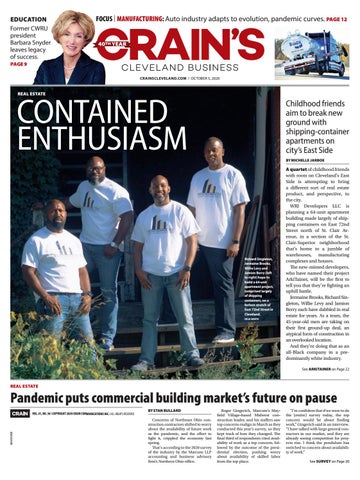
Richard Singleton, Jermaine Brooks, Willie Levy and Jamion Berry (left to right) hope to build a 64-unit apartment project, comprised largely of shipping containers, on a forlorn stretch of East 72nd Street in Cleveland. DEJA WHITE
A quartet of childhood friends with roots on Cleveland’s East Side is attempting to bring a different sort of real estate product, and perspective, to the city. WRJ Developers LLC is planning a 64-unit apartment building made largely of shipping containers on East 72nd Street north of St. Clair Avenue, in a section of the St. Clair-Superior neighborhood that’s home to a jumble of warehouses, manufacturing complexes and houses. The new-minted developers, who have named their project ArkiTainer, will be the first to tell you that they’re fighting an uphill battle. Jermaine Brooks, Richard Singleton, Willie Levy and Jamion Berry each have dabbled in real estate for years. As a team, the 45-year-old men are taking on their first ground-up deal, an atypical form of construction in an overlooked location. And they’re doing that as an all-Black company in a predominantly white industry. See ARKITAINER on Page 22
REAL ESTATE
Pandemic puts commercial building market’s future on pause NEWSPAPER
VOL. 41, NO. 36 l COPYRIGHT 2020 CRAIN COMMUNICATIONS INC. l ALL RIGHTS RESERVED
BY STAN BULLARD
Concerns of Northeast Ohio construction contractors shifted to worry about the availability of future work as the pandemic, and the effort to fight it, crippled the economy last spring. That’s according to the 2020 survey of the industry by the Marcum LLP accounting and business advisory firm’s Northern Ohio office.
Roger Gingerich, Marcum’s Mayfield Village-based Midwest construction leader, and his staffers saw top concerns realign in March as they conducted this year’s survey, so they kept track of how they changed. The final third of respondents cited availability of work as a top concern, followed by the outcome of the presidential election, pushing worry about availability of skilled labor from the top place.
“I’m confident that if we were to do the (entire) survey today, the top concern would be about finding work,” Gingerich said in an interview. “I have talked with large general contractors in our market, and they are already seeing competition for projects rise. I think the pendulum has switched to concern about availability of work.” See SURVEY on Page 20
Fifth Third Means Business™ From equipment leasing to assetbased lending, we know your business requires unique solutions to meet the specific moments you’re navigating. That’s why, at Fifth Third Bank, we have a team of local experts who understand your business. Whatever your business goals are, we’re here to help you succeed. Let’s build, together.
Fifth Third Means Business™
53.com/CommercialBank
Fifth Third Bank, National Association. Member FDIC.
HEALTH CARE
UH, MetroHealth and Summa receive ACO savings payouts All three saved money in care for seniors in 2019; Cleveland Clinic spent above its benchmark BBY LYDIA COUTRÉ
University Hospitals, MetroHealth and Summa Health all are receiving multimillion-dollar payouts from the federal government for helping to save money in their care of seniors last year. UH earned $9.2 million, MetroHealth earned $2.9 million and Summa earned $3.9 million through the Medicare Shared Savings Program (MSSP), which allows participating accountable care organizations (ACOs) to earn a cut of the Medicare dollars they each help the government save. The program is an opportunity to find and eliminate “defects in value” — anything that result in detrimental value for patients, such as not having regular wellness exams, not appropriately treating or diagnosing patients, or not providing care at the highest value site, said Dr. Peter Pronovost, UH chief clinical transformation and chief quality officer. Across the country, these tend to be invisible, and thus, accepted as the status quo, he said. “Those efforts that we put in to find defects in value make them visible,” he said, adding that eliminating these improve value for all UH patients. ACOs in Northeast Ohio have participated for several years in the MSSP, which is designed to reward providers for offering high-quality, coordinated care at a controlled cost.
It’s part of the ongoing pivot away from traditional fee-for-service reimbursement models and toward a value-based payment structure in health care. The Centers for Medicare and Medicaid Services (CMS) establishes a spending benchmark that each participating ACO must spend below — by at least a certain percentage that CMS also sets — in order to get a share of the savings. Cleveland Clinic spent above this benchmark in 2019, as it did in 2017 and 2018. Last year, the system overspent by $2.9 million, which is less than in years prior. In a statement, Dr. Nirav Vakharia, president of Cleveland Clinic ACO, attributed the loss in part to the system’s participation in other value-based models, such as Comprehensive Primary Care Plus (CPC+) and the Oncology Care Model. These models offer savings up front, which count against the shared savings program. Joshua Frederick, CEO of Sandusky-based NOMS Healthcare, also said NOMS ACO’s participation in the CPC+ program changed its savings calculation. NOMS (Northern Ohio Medical Specialists) — an independent, physician-owned and -led medical practice — has saved money in six of the seven years it has participated in the shared savings program. Last year was the first year it saved enough to trigger a cut of savings:
$576,752. However, that doesn’t come to NOMS in the form of a payout. When it started an ACO in 2013, it qualified for an advanced payment model in which CMS gave the organization $1.8 million up front. Any savings earned through the program are applied first to that amount. Historically, many ACOs nationwide have been in one-sided risk arrangements that don’t penalize them for not saving money. In recent years, MetroHealth has been the only system in Northeast Ohio to opt into a two-sided risk model through MSSP, meaning it would be held accountable for overspending but would be eligible for a larger share of savings if it did meet the set goals. Last year was the fourth consecutive year MetroHealth earned a cut of its Medicare savings, thanks to a focus on value and a “relentless and continuous emphasis” on innovation in care delivery, said Dr. Nabil Chehade, executive vice president and chief clinical transformation officer for MetroHealth. MetroHealth is committed to continued participation in value-based models, he said. “Our strong performance, plus the move away from fee-for-service, have really encouraged us to continue with that push and to push the envelope further,” Chehade said. Under the Trump administration,
CMS has been moving more and more ACOs into models that include downside financial risks. As a result of two application cycles that have taken place under new policies, the number of ACOs taking on downside financial risk has nearly doubled, according to Seema Verma, CMS administrator. Last summer, Summa Health shifted to a downside risk model. “Summa Health is all in when it comes to transforming from a hospital company to a population health company,” said Jeff Price, president of NewHealth Collaborative, Summa’s ACO. “So from our perspective, that’s where health care is going, and we’re all about being prepared, number one. And we’re all about continuing to improve upon our ability to care for our population and improve outcomes. So for us, moving into this model was the next logical step to our journey.” UH also moved to a new model last year. It remains an upside risk model but has a “glide path” to different risk levels as the system continues to participate, said Mark Schario, president of University Hospitals Coordinated Care Organization, the system’s ACO. “Risk is something that we’re becoming comfortable with as we move forward on that glide path,” he said. Before it saved enough to earn a cut of the savings in 2019, UH spent above its benchmark for three consecutive years. Leaders at UH attribute their abil-
ity to save last year to increased staff support to the ACO (including data analysts), improved technologies and a cultural shift across the organization that sees success as keeping people healthy at home. Plus, the past 10 years have included a lot of acquisitions for UH, and integrating new hospitals into the system and aligning providers, processes and technology takes time. UH’s ability to earn savings in the program in 2019 is the result of those efforts. The shared savings program also awards ACOs with quality scores, which affect how much of the savings each is able to receive. Cleveland Clinic’s ACO’s quality score was 93%, MetroHealth’s was 92.2%, UH’s was 97.4%, Summa’s was 97.7% and NOMS’ was 96.1%. All were an improvement on the year prior. As health care costs continue to rise, Pronovost said the MSSP results offer hope for reducing costs and increasing quality. “There’s plenty of estimates that say about 30% of health care spending is waste and health care costs have been going up inextricably for every payer of health care,” he said. “These results offer hope that significant reductions in the cost of care while improving quality are possible with deploying interventions.” Lydia Coutré: lcoutre@crain.com, (216) 771-5479, @LydiaCoutre
MODERN DOWNTOWN LIVING Schedule your tour today! Now Leasing Studio, 1, 2 & 3 Bedroom Apartments
(844) 345-2469 TheMayCleveland.com
October 5, 2020 | CRAIN’S CLEVELAND BUSINESS | 3
P003_CL_20201005.indd 3
10/2/2020 11:41:36 AM
SPORTS BUSINESS
LOANS RISE WITH YOUR LOCAL CREDIT UNION STILL STRONG, STILL LENDING
CALL YOUR LOCAL CREDIT UNION TODAY COMMERCIAL REAL ESTATE INTEREST RATES AT ALL TIME LOWS. Loans up to $15 Million • No Prepayment Penalties As Little as 10% Down
Your Business Lending Partner SM CONTACT Jonathan A. Mokri 440.526.8700 jmokri@cbscuso.com www.cbscuso.com
ENHANCE YOUR ASSET’S VALUE
BROKERAGE CORPORATE SERVICES AUCTIONS PROPERTY MANAGEMENT APPRAISAL AND CONSULTING RESEARCH 216.861.7200 | HANNACRE.COM
Indians hope voucher program will help address ‘unmet need’
Fans wanted greater flexibility when buying seats BY KEVIN KLEPS
In six months, the Cleveland Indians are scheduled to play their home opener against the Kansas City Royals. The hope is that the cardboard cutouts will be replaced by actual fans and the typical sights and sounds of Opening Day will be authentic — not the manufactured noises that have become a staple of professional sports in 2020. “We’re definitely planning on it being a normal season,” Tim Salcer, the Indians’ vice president of sales and service, said of 2021. The Tribe VP acknowledged that a lot can change — for better or worse — between now and April. The COVID-19 pandemic caused what Salcer described as “an unprecedented impact” on the Indians’ business. The loss of game-day income, combined with reductions in corporate partnerships, merchandise, broadcast rights and other revenue streams resulted in a jolt to the industry that was in the billions. Should some semblance of normal return in 2021, the Indians are getting creative in the ways in which they attempt to address recent declines in their season-ticket base. The Tribe on Monday, Oct. 5, is introducing a flexible voucher plan that Salcer said is the product of research done by the club’s strategy and analytics team. Feedback
Opening Day at Progressive Field looked a lot different on July 24, when the Indians defeated the Kansas City Royals with no fans in attendance. | JASON MILLER/GETTY IMAGES
showed that some Tribe fans wanted greater flexibility when purchasing their seats, which prompted the club to make an addition to its season-ticket portfolio. Vouchers — each of which is equivalent to one ticket — are available in packages of 20, 40 and 80. They can be used for seats in the bleachers, and the upper and lower levels. Prices vary by section, and the cost per seat drops for the larger packages.
The target customers, Salcer said, are fans who traditionally buy single-game tickets for at least a few contests per year, as well as former season-ticket holders. Fans can redeem the vouchers for every regular-season game except the home opener, and they have until two hours before game time to select their seats. The tickets can’t be resold. See INDIANS on Page 19
FINANCE
Citymark Capital’s investment strategy is paying off amid COVID-19 pandemic Firm buys, improves, sells multifamily housing in top apartment markets BY JEREMY NOBILE
Providing a private travel experience that exceeds expectations
HOW TO FLY WITH SKY QUEST: » On-Demand Charter » Jet Card Memberships » Aircraft Ownership Opportunities
FlySkyQuest.com 216-362-9904 Charter@FlySkyQuest.com
Daniel Walsh seems to have built a recession-resistant business in Citymark Capital. Despite the COVID-19 pandemic plunging the country into an economic downturn, the strategy for the private equity real estate investment fund is not feeling the same stress as other sectors of the economy, at least not yet. That strategy calls for buying, improving and selling multifamily housing in top apartment markets across the U.S. (so, excluding Cleveland). Investors are taking note: Citymark in August hit its $150 million target for its second fund amid a global health crisis, nearly double the $80 million collected for fund one. “One of the questions we always get from prospective investors is what happens in a downturn or economic dislocation,” said Walsh, a former Cleveland market president for Huntington Bank who left the company in 2015 to launch Citymark. “We always said people need a place to live, and rental apartments are a wonderful place to be and pretty insulated from economic downturns.” Many of the apartments in the Citymark portfolio have become remote-work offices, bolstering retention of renters.
That’s helped with strength in the apartment market nationally and supports deal flow, which remains strong, Walsh said. April was a low point for deal activity, but that has Walsh since improved. A comparable trend has been playing out with the broader M&A sector. Citymark’s debut fund, which closed in 2017, acquired six apartment complexes — in Atlanta, Orlando, Phoenix, Dallas, New York and Las Vegas — and sold four of those. The Citymark model is to buy up multifamily properties in markets ripe with deal flow, improve them, add new amenities, raise the rent and sell. One of Citymark’s secret ingredients in vetting a deal comes in examining the average ratio of rent as a percentage of renter income. Walsh has said Citymark prefers properties where tenants spend about 21% of income on rent. On average, renters tend to spend about one-third or more of income on rent. For Citymark, the thinking is that renters will be positioned to absorb rent increases when their units are renovated and buildings improved.
That might mean adding a gym or pool (features that appear to be of interest to remote workers because they provide alternatives to even more public settings), renovating floors and patios, or adding new appliances. With social distancing now the norm, properties adjacent to outdoor amenities such as forest preserves or jogging trails are getting interest. The markets and renter demographics Citymark targets are part of the firm’s secret sauce for excelling in the asset class of multifamily housing that’s been trending up for years because of things that make it harder for young professionals to buy homes. Those factors include a collective pile of student loan debt around $1.6 trillion. These are some reasons why Ed Schwartz, founder and CEO of Beachwood’s ORG Portfolio Management, is a big fan of Citymark. ORG, with about $10 billion in assets under management, represents institutional investors, including some invested in Walsh’s business. “Citymark has a strategy of suburban apartments in strong locations, growth markets,” Schwartz said. “Given the pandemic, but even before that, trends were very favorable to suburban apartments.” See CITYMARK on Page 22
4 | CRAIN’S CLEVELAND BUSINESS | OCTOBER 5, 2020
P004_CL_20201005.indd 4
10/2/2020 1:53:46 PM
M&A Deals don’t come with a
rule book, so I make it a rule to
come prepared.
Hundreds of deals done. No two the same. Each side comes to the table for different reasons, with different expectations to meet, and different personalities to consider. I guide C-suite and private equity leaders through the complexity, becoming an extension of their management team. Bringing order to chaos with a practical, personal approach. Grounded in experience with all types of businesses and the myriad of possible transaction structures. Enriched with a bias toward creative, proactive problem-solving. With Benesch’s skilled team and extensive networks comes freedom to innovate, to take advantage of opportunity, And find a path that lets both sides win. That’s what makes it rewarding. That’s why I’m here. That, and the adrenalin rush that comes with successfully closing your deal. I’m JENNIFER STAPLETON. I’m on your team.
MY BENESCH MY TEAM > Partner, Corporate & Securities Practice Group > Focuses on counseling public corporations, privately held companies, large private equity platforms, and venture capital firms through complex, high-stakes, multidimensional business transactions. > Advises clients and C-suite executives on a range of corporate matters, including governance, legal strategy, risk management and mitigation, equity incentives, and ongoing operations for subsidiaries and portfolio companies. > 216.363.4428 | jstapleton@beneschlaw.com
www.beneschlaw.com
REAL ESTATE
Wexford Science and Technology tapped as master developer for Long-term endeavor could remake a significant stretch of the district ‘Inspired by the possibilities’
A Baltimore-based developer of innovation districts scattered from With more than 20 years of expePhoenix to Philadelphia is preparing rience in institutional real estate, to tackle a similar project in Cleve- Wexford is among the nation’s foreland in a long-term endeavor that most developers of innovation discould remake a stretch of Midtown. tricts. The privately held company A group of local partners led by finances its projects through a partMidTown Cleveland Inc., the Cleve- nership with Ventas Inc., a Chicaland Foundation and JumpStart Inc. go-based real estate investment recently picked Wexford Science and trust. Technology as the master developer Cleveland-area leaders have made for the innovation district, a multi- pilgrimages to St. Louis to see the building, mixed-use vision that Cortex Innovation Community, a might take a decade to realize. 200-acre district where Wexford has The conceit is that Cleveland needs developed buildings that are home to a central space for collaboration, a labs, academic research facilities, a place that brings researchers, stu- biotech incubator, fledgling firms dents, established companies, start- and Fortune 500 companies. ups and neighborhood residents toThat district, woven into residengether to accomplish more than tial neighborhoods, is flanked by unithey’d be able to achieve on their own. versities, medical centers, cultural Such districts often are tied to anchor attractions and public spaces. Maninstitutions, such as hospitals or univer- aged by a nonprofit board and supsities. But their backers strive for an ported by Washington University in open, walkable ethos that’s a departure St. Louis, the district is home to more from traditional ivory-tower academic than 400 businesses. buildings or antiseptic research parks. “We all left inspired by the possi“There’s a whole story, generally, bilities,” said Ted Carter, chief ecobehind these,” said Julie Wagner, a nomic development and business nonresident senior fellow at the “WE INTEND TO HAVE Brookings InstiRESIDENTS AND THE tution and president of the Global COMMUNITY INVOLVED IN Institute on InnoEVERY STEP OF THE vation Districts. “Part of it has to PLANNING AND DESIGN OF do with a philosoTHIS PROJECT. THAT’S CORE phy around a collaborate-to-com- TO THE PHILOSOPHY OF HOW WE, AT pete paradigm,” she said, “a recog- MIDTOWN, ARE LOOKING AT nition that there’s DEVELOPMENT.” not one actor or one organization — Jeff Epstein, executive director of MidTown Cleveland that has all of the knowledge necessary to solve all of officer for Cuyahoga County and a our vexing problems.” participant in one of the Cortex visits. In Cleveland, economic develop- “I don’t think anyone left the trip sayment leaders arguably laid the ing this wasn’t possible here.” groundwork for a district 10 years Last year, MidTown, JumpStart ago, when they rebranded a swath of and the Cleveland Foundation Midtown as the Health-Tech Corri- launched a formal search for a masdor and began pitching new and ren- ter developer. They vetted a small ovated space to growing companies, list of candidates and put the decihealth care users and other tenants. sion to a selection committee comIn recent years, the Cleveland prised of nonprofit and institutional Foundation and nonprofits MidTown representatives and community Cleveland and JumpStart have talked members. about connecting those investments “We intend to have residents and as part of a true innovation district, the community involved in every with additional buildings, public step of the planning and design of gathering spaces, transit and trails. this project,” said Jeff Epstein, execuA linchpin for the plan fell into place tive director of MidTown Cleveland. last year, when the Cleveland Founda- “That’s core to the philosophy of how tion chose the northeast corner of Eu- we, at MidTown, are looking at develclid Avenue and East 66th Street as the opment.” site of its future headquarters. At this point, there’s no formal deWexford’s first building will sit just velopment agreement for the district. west of the foundation’s future home, The soonest construction might start on 1.7 acres of vacant property that is late next year, Epstein said. MidTown Cleveland bought from the But there’s a powerful group of city’s land bank in April. It’s too early to players working with Wexford and say how large that building will be or coalescing around the concept of what it will look like, said Tom Osha, creating a better sense of place — Wexford’s senior vice president of in- and new opportunities for education, novation and economic development. training and employment — at the “We want to take our time,” said midpoint between downtown CleveOsha, who described Wexford’s inno- land and University Circle. vation districts as long-term investCase Western Reserve University ments heavily shaped by the com- and Cleveland State University, munities that surround them. “We which bookend the district, conwant to do it right, and we want to firmed that they’re part of those dismake sure we’re doing it together.” cussions.
At th seat build
A conceptual site plan shows new buildings emerging around the Cleveland Foundation’s planned headquarters, in orange, at East 66th Street and Euclid Avenue.
CLEVELAND FOUNDATION
BY MICHELLE JARBOE
CWRU “sees research, innovation and economic progress as inextricably linked,” Lisa Camp, the university’s chief of staff in the office of the provost, wrote in an emailed statement. Harlan Sands, Cleveland State University’s president, views an innovation district as an asset that will help the university recruit and keep faculty and attract students, who increasingly want a clear sense of the types of careers and workplaces that might be within reach after graduation. CSU has talked about establishing a physical presence of some sort in the district, Sands said. “We’re in the infancy stages of looking at this,” he added. “I’m really, really optimistic about the creativity I’ve seen so far. I think Wexford is going to be a good partner.”
‘I think they want to listen well’ JumpStart, which moved its offices to Midtown almost a decade ago, could become an anchor tenant in Wexford’s first building. CEO Ray Leach described the innovation community in Cleveland as decentralized. With better cooperation in a district designed for interaction, he hopes barriers will fall for businesses, institutions and residents of majority Black, low-income neighborhoods on the city’s East Side. “I’m envisioning hundreds of millions of dollars of more capital, tens of thousands of jobs, a real ability to make an impact around racial and economic inclusion,” Leach said. “I think this is the kind of project that has to happen in order for us to find new and different ways to collaborate.”
JumpStart is one of five organizations, along with the Cleveland Foundation, the Fund for Our Economic Future, the Greater Cleveland Partnership and Team NEO, steering a broader initiative called the Cleveland Innovation Project. That alliance is attempting to reposition the regional economy, with a focus on health care, smart manufacturing and water technology. The project’s key goals include developing talent, boosting the flow of private capital to growing businesses and reducing stark gaps in Clevelanders’ digital literacy and internet access. Midtown is one logical site — though not the only potential location — to concentrate activity in those target industries, said Baiju Shah, senior fellow for innovation at the Cleveland Foundation.
6 | CRAIN’S CLEVELAND BUSINESS | OCTOBER 5, 2020
P006_007_CL_20201005.indd 6
10/2/2020 11:44:38 AM
Brigh Com
Si Tech have mill isn’t stitu A mus exis a di but “Th have from “The to a and 10 j it’s m it’s f Th
per for Midtown innovation district
izaand Ecoand ring eveallithe on ring
dew of sses evernet
— ocay in aiju n at
“We go into our bank and they know us.” At First Federal Lakewood, you’re choosing much more than a bank. You’re choosing an organization made up of people who are committed to reinvesting in our community and helping it thrive - just like you. We’re here to help you meet today’s goals and invest in tomorrow.
At the Cortex Innovation Community in St. Louis, Wexford Science and Technology developed green space and an outdoor seating area for meetings and events. The space, called Cortex Commons, sits in front of a 202,500-square-foot office and lab building. | WEXFORD SCIENCE & TECHNOLOGY/TRIGGS PHOTOGRAPHY
Visit FFL.net/thrive to learn how we can help your business thrive.
YOUR STORY. YOUR STAGE. SPONSOR AN EVENT TODAY • Learn More: astoessel@crain.com
You’re invited CLEVELAND FOUNDATION
Webinar: Making the Altering Transition to Retirement
Wednesday, October, 7 | Noon Brightly colored walls liven up the lobby of one of Wexford Science and Technology’s office and lab buildings at the Cortex Innovation Community in St. Louis. | WEXFORD SCIENCE & TECHNOLOGY/TOM ROSSITER
Since the inception of the HealthTech Corridor, developers in the area have built or renovated more than 1 million square feet of real estate that isn’t tied to hospitals or research institutions. Anything that Wexford develops must connect “seamlessly” to those existing assets, Shah said, describing a district that should feel cohesive, but not contrived. “The goal of the district is not to have a company relocate 1,000 jobs from somewhere else,” Osha said. “The goal of the district is to be able to attract 100 organizations, small and large companies, that each have 10 jobs. It’s the same 1,000 jobs, but it’s more robust. And in a lot of ways, it’s far more sustainable.” The Cleveland Foundation still
aims to break ground this year for its headquarters and to move into the building in mid-2022. That relocation, from downtown, dovetails with a broader vision of turning East 66th Street into a new gateway into the Hough neighborhood to the north. “This effort isn’t just about the initial partners coming together to get this off the ground,” Ronn Richard, the foundation’s president and CEO, wrote in an emailed response to questions from Crain’s. “This innovation district will only be a success if equity and systems-breaking work are at the core of every aspect of the initial vision and its implementation into reality.” Mansfield Frazier, a 77-year-old resident and business owner in Hough, participated in the developer selection process.
Historically, he said, neighborhood residents have been left out of development discussions — or included only as an afterthought. Midtown’s approach, by contrast, is refreshing. And so is Wexford’s, Frazier said. “It’s exciting,” he said. “I’m a futurist by nature. I like innovation. I like to think of what possibilities are, and Wexford has a great track record of working in minority communities, inner-city communities in general. … I don’t think they’re coming in with preconceived notions. I think they want to listen well. I get the sense that they want to listen and take input from the community.” Michelle Jarboe: michelle.jarboe@ crain.com, (216) 771-5437, @mjarboe
It’s important to be strategic, honest, and excited about what retirement will actually be. If you are less than 10 years away from retirement, join us for an in-depth look at the realities of retirement!
Join us to learn:
• How benefits are calculated & taxed • Techniques for maximizing your benefits • How to incorporate into your Financial Plan
Register Today: www.ncafinancial.com/retirement or 440.473.1115 Securities offered through Royal Alliance Associates, Inc. (RAA), Member FINRA/SIPC. Investment advisory services offered through NCA Financial Planners. RAA is separately owned and other entities and/or marketing names, products or services referenced here are independent of RAA. RAA does not provide tax or legal advice. John Diehl and Hartford Funds are not affiliated with RAA. NCA Financial Planners, 6095 Parkland Blvd., Suite 210, Cleveland, OH 44124, 440-473-1115, www.nca.financial.com F 440-473-0186
OCTOBER 5, 2020 | CRAIN’S CLEVELAND BUSINESS | 7
P006_007_CL_20201005.indd 7
10/2/2020 11:44:56 AM
COPING WITH COVID-19
Retirees kept apart by COVID defy an isolated and lonely future Group of friends in Cleveland Heights have had their active, social lifestyles vastly changed by the pandemic BBY BLOOMBERG
For years, the Phoenix coffeehouse on Lee Road was a haven for a group of old friends in Cleveland Heights. It started when they were working and continued after they retired. They showed up at 8 a.m. every Monday, Wednesday and Friday, told bad jokes and talked politics. They got out of the house. Then came COVID-19. After meeting three days a week, many of them for 30 years, the Phoenix Phellows — as they call themselves — are largely stuck at home and fighting the strains of isolation even as their Cleveland suburb begins to reopen. “If a list was made of who was going to still be inside in September, it was always going to be us,” said Art Brooks, a retired real estate lawyer. “Even if things are better in January, forget us. We’re still going to be locked away because we’re the ones most vulnerable.” As COVID-19’s U.S. death toll tops 200,000, the virus’ fatal toll on the elderly has been well documented. Tens of thousands have died in nursing homes and assisted living facilities. The Phoenix Phellows reveal the hidden cost, one paid by retirees still living at home who were suddenly severed from active and fulfilling lives. The pandemic disrupted routines that had animated their post-work years, separating them from friends and family, killing travel plans and putting off-limits the places that once got them out of the house: museums, restaurants, community centers, movie theaters and public libraries, as well as the odd coffeehouse. Such activities help older adults live longer and stay healthier and happier, according to the National Institute on Aging. Social isolation can have the opposite effects, making seniors more vulnerable to a host of maladies, including heart disease, depression and cognitive decline. Active seniors have largely been excluded from the discussion about reopening the economy and left to fend for themselves, structuring their own strategies to avoid risk.
for SALE
Art Brooks
Ray Elsoffer
From left, Cliff Lewis, Bob Humrick and Kermit Lind. | DUSTIN FRANZ/BLOOMBERG
At times, even President Donald Trump seems to have brushed off their susceptibility. “It affects elderly people, elderly people with heart problems and other problems,” he said at an Ohio rally on Monday, Sept. 21, before quickly moving on. “Take your hat off to the young, because they have a hell of an immune system. But it affects virtually nobody.” The virus has exposed the U.S.’ biases, according to Ashton Applewhite, 68, the author of “This Chair Rocks, A Manifesto Against Ageism.” She said Americans would have confronted the pandemic earlier if the young had been dying at the same rate as nursing home residents did. “Older people would be dying of COVID no matter what, but not in these numbers,” she said. Fear has not only scuttled plans for retirees; it has swelled their ranks. A survey by a trio of economists in April found
that participation in the labor force declined by 7 percentage points during the pandemic, more than double the cumulative decline from 2008 to 2016. People retiring early to avoid infection accounted for almost all of that spike. Retired or not, seniors are economic engines. Americans 50 and older accounted for more than half the $13.5 trillion in consumer spending in 2018, according to an AARP report. They purchased health care and homes, indulged in leisure activities and bought cars. They traveled. The pandemic brought that activity to an abrupt stop. One small loss was the regular gathering of the Phoenix Phellows. The coffee group began with two men who worked out at a nearby YMCA, then players in a pick-up basketball game down the street. It grew to about 15 regulars. “As people walked in and ordered something,
Park Goist
they would get sized up as to whether they would be invited to sit down at the table,” said Joan Moore, 68, a retired housing advocate. They were doctors, lawyers, teachers, activists, social workers, chemists, professors and engineers. Most are in their 70s, although one is 96 and two are in their 80s, including Brooks, one of the founders: “The idea was that there should be a third place to go, that isn’t home or work.” Both Brooks and Cliff Lewis — at 65 the youngest — are choral singers. Lewis is part of a ski club that travels by bus to New York ski resorts. Career coach Ann Hunter, the only member of the group still working, is an animal shelter volunteer. Former college professor Kermit Lind is active in his church. Everybody traveled. Bob Humrick, a retired chemist who has survived cancer, had a slate of trips planned for 2020 to celebrate his 50th wedding anniversary. He and his wife were going to Asheville and Charlotte in North Carolina, Maine and New York. “We were going all over the place, to see friends, to do things we had always wanted to do,” he said. Now he gets takeout coffee each day at the Phoenix, but mostly stays in. One weekend, he and his wife drove through Little Italy, a trendy restaurant district in Cleveland, to watch people at sidewalk tables doing what they couldn’t. “In a way, it was a bad idea,” he said. “It just smelled so good.” The group misses concerts, the Cleveland Museum of Art, lectures at Trinity Episcopal Cathedral, movies and going to the public library to browse the newspaper collection and
check out books. They miss inviting people to dinner and bemoan the need to vet guests if they do. “Like, do they have a secret college kid stashed somewhere?” said Brooks, laughing. Ray Elsoffer, 70, hooked up with the coffee group three decades ago when he owned a vacuum repair shop down the street. Because he and his wife have health risks, they no longer see grandchildren they used to watch two days a week, or dine at their son’s house twice a month. “The saving grace is because it’s summertime,” Elsoffer said. “I can get outdoors, do yard work. I work on a project car, a 1930 Model A Ford. “Sometimes we take walks. Sometimes we go for a ride up to Lake Erie. We look at the lake for a half hour and come home.” Most said they think the virus will keep them cooped up until at least mid-2021 and probably longer. They dread winter. The Phoenix Phellows’ youngest member brought the group to Zoom. “We were realizing that we might not be able to meet at the coffee shop anymore, and I jokingly suggested we do it online,” Lewis said. “I was not expecting much. It’s an older group, not very tech savvy.” About seven now meet on Zoom at 8 a.m. every Monday, Wednesday and Friday for a 90-minute mixture of laughter, personal updates and wistfulness. Lewis paid for the extra time, figuring it cost the same as the Phoenix’s coffee. At a Sept. 14 Zoom meeting, Park Goist, 84, said he and his wife went to an arthouse theater for a documentary on Jimmy Carter. One other person was there. Others were still not chancing it, including Moore, who shared a dream she’d had. She’d awakened oddly happy, with “a feeling like when you are going to a party and you’re excited. I woke up with that feeling about COVID, that it was about to be gone. Then I really woke up,” she said. “It was such a letdown. “Do you think we will ever go back to the Phoenix?”
industrial Flex/oFFiCe akron (sprinGField twp)
Gala Commons | 2215 e waterloo road, #307-309 n
7,782 sF versatile opportunity for variety of uses
n
n
n
n
excellent location on sr-224; easy access to i-77 and i-271
18’ ceiling height; 15’ clear 10x12 overhead doors (1 existing; 1 easily reinstalled) Zoning: C-3 (Highway Commercial)
svn summit CommerCial real estate Group, llC ContaCt
Nichole Booker, Ph.D Associate Advisor 330.475.5500 nichole.booker@svn.com
“Being in Beachwood has added a new dimension to our business.” Mayor Martin S. Horwitz •Mayor@BeachwoodOhio.com •216.292.1901
WWW.BEACHWOODOHIO.COM
3009 Smith Road, Suite 25 Akron, OH 44333 | 234.231.0200
8 | CRAIN’S CLEVELAND BUSINESS | October 5, 2020
P008_CL_20201005.indd 8 10-5-SVN Ad-Nicole-Gala Commons.indd 1
9/24/20 4:29 PM
10/2/2020 11:46:00 AM
EDUCATION
Snyder leaves behind legacy of success at CWRU Fundraising and collaboration are highlights of the former president’s tenure BY RACHEL ABBEY MCCAFFERTY
It’s tough to imagine now, but Case Western Reserve University was in trouble when Barbara R. Snyder joined the institution as president in 2007. “We had an operating deficit that was significant, and that certainly needed to be addressed,” she said. “Our applications — we weren’t getting very many. And our alumni weren’t giving very much.” Morale was low among faculty and staff, and, overall, trust in the institution had been “broken,” Snyder said. Job No. 1 was earning that back. She did that, in her view, by underpromising and overdelivering. That’s putting it lightly. During her tenure, Snyder quickly helped the university overcome a nearly $20 million deficit. She led the university’s Forward Thinking Capital Campaign, which far exceeded its original goal of $1 billion. She grew partnerships with regional institutions, like one with the Cleveland Clinic that led to the development of the Health Education Campus that just hosted the presidential debate. “Her tenure’s going to have a long-lasting effect on the university for quite some time,” said Fred
DiSanto, chair of the university’s board of trustees, and chairman and CEO of Ancora in Mayfield Heights. Snyder’s last day at Case Western Reserve was Sept. 30. For Snyder, taking on the top role at Case Western Reserve had been a little like coming home. Her academic career had started at the university in the 1980s as an assistant professor at the School of Law. That career took her to Ohio State University, where she ultimately served as executive vice president and provost before returning to Cleveland. Now, Snyder has left to take on the leadership role at the Association of American Universities in Washington, D.C. Case Western Reserve has been part of the association for decades, and Snyder found it to be a valuable resource as a president. Now, she’ll have the chance to work with her peers at other institutions in a leadership role, helping them through the challenges of the day. And much like Snyder did in 2007, Case Western Reserve’s next president will also face challenges. The most immediate challenge facing the university will be adapting to the COVID-19 pandemic, Snyder said. And looking forward, she said the next president will have to see
“WE HAD AN OPERATING DEFICIT THAT WAS SIGNIFICANT, AND THAT CERTAINLY NEEDED TO BE ADDRESSED. OUR APPLICATIONS — WE WEREN’T GETTING VERY MANY. AND OUR ALUMNI WEREN’T GIVING VERY MUCH.” — Barbara R. Snyder, former president of Case Western Reserve University
that the pandemic doesn’t halt the university’s “momentum.” While the university conducts its search, it will be led by Scott Cowen, who took on the role of interim president on Oct. 1. Cowen spent more than two decades at Case Western Reserve, including as dean of the Weatherhead School of Management, before taking on the role of president of Tulane University. He’s experienced at leading through challenging times, Snyder said, as he led Tulane during Hurricane Katrina. The next president will need to have a commitment to research, said DiSanto, who is leading the search committee for the university’s next leader. The next president also will need to be collaborative and able to continue to build relationships with the community. He or she will also need to understand the “undergraduate experience,” he said, especially in these changing times. They’ll have to be a good fundraiser. “We’re lucky as a university to be in good hands with Scott (Cowen), but I clearly believe that what Barbara has done over the last 13 years has really put the university in a great position moving forward,” DiSanto said. Snyder always had a sense of “urgency,” DiSanto said, highlighting
the work she did to grow applications and enrollment. The university has become more selective in that time, as well. He also spoke of her work to rebuild relationships with alumni and the community at large. “Her ability to connect with people is probably one of her greatest strengths,” DiSanto said. Snyder said that as president she is most proud of the work she did to build partnerships in the community, and what those collaborations allowed the university to do. In addition to the Health Education campus, collaboration with the Temple-Tifereth Israel led to the creation of the Maltz Performing Arts Center. Working with the Cleveland Museum of Art, the university created a new doctoral program and plans in the future to construct a building on jointly owned land to house such programs. Over the years, there was one constant for Snyder. She never saw her initial job at the university — earning back the community’s trust — as complete. It’s easy to lose trust, she said, and hard to earn. “That job is never done,” Snyder said. Rachel Abbey McCafferty: (216) 771-5379, rmccafferty@crain.com
BE AN INDUSTRY INSIDER. Crain’s is recruiting thought leaders across industries to participate in an exclusive online advisory panel. Through this panel, you will share thoughts on the coverage you read in print and online as well as current events, business trends, attitudes towards brands and more.
Sign up to be part of Crain’s Research Panel for a chance to win a $100 gift card. Winner will be selected among new sign ups across Crain City Book publications.
Become an industry insider today at CrainsCleveland.com/researchpanel
OCTOBER 5, 2020 | CRAIN’S CLEVELAND BUSINESS | 9
P009_CL_20201005.indd 9
10/1/2020 3:40:07 PM
PERSONAL VIEW
Is Cleveland really No. 1 for poverty? RICH WILLIAMS FOR CRAIN’S CLEVELAND BUSINESS
BBY JIM NIEBERDING
EDITORIAL
Second wind T
he Icebreaker wind energy project is no longer dead in the water. Prospects for developing the wind farm improved last month when the Ohio Power Siting Board reversed a decision from May that would have banned Icebreaker’s turbines from operating at night between March 1 to Nov. 1, to limit the risk to birds and bats. Dave Karpinski, president of Lake Erie Energy Development Corp., the nonprofit developer of Icebreaker, had considered that limitation a “poison pill” for the economic viability of the six-turbine, 20.7-megawatt demonstration project 8 miles north of Cleveland, and it led LEEDCo to push the Power Siting Board to reconsider. At that’s just what happened, in a virtual meeting that Cleveland.com characterized as involving “a level of discussion and debate unusual” for the board, whose members voted unanimously to rescind the night-operation limits. In an editorial from May 31, we objected to what we saw as the last-minute inclusion of those limits in the long road to developing Icebreaker, so this reconsideration is a welcome development. This is a case where getting IT’S APPROPRIATE THAT to a decision that gives the project a chance to move forREGULATORS TAKE A ward stems from old-fashioned political advocacy — of HARD LOOK AT a bipartisan nature, no less. ICEBREAKER. BUT THAT The advocacy came from 32 Northeast Ohio lawmakPROCESS SHOULD BE ers who, in a July letter to FAIR AND REASONABLE. Power Siting Board chairman Sam Randazzo, urged revisiting the May decision. They argued the board had offered “no compelling evidence” to override a recommendation by board staff and the Ohio Department of Natural Resources to approve the project without the limits. They were no doubt motivated by the prospect of 500 construction jobs for Icebreaker. Icebreaker is hardly a done deal. LEEDCo still needs Power Siting Board approval on issues ranging from the development of technology to measure bird collisions and how, eventually, to decommission the wind farm. The Lake Erie Marine Trades Association remains opposed to the project
and hopes to get the nighttime limits reinstated. It’s appropriate that regulators take a hard look at Icebreaker. But that process should be fair and reasonable, and the board has restored balance in its approach to the project. The state now can examine closely whether Icebreaker can operate safely, make money and demonstrate if wind turbines can work in the Great Lakes.
Pointless C
leveland got its shot in the political spotlight again, and, mostly due to President Donald Trump, it did not go well. The setting — the Health Education Campus of Case Western Reserve University and Cleveland Clinic — looked great. That’s about the only nice thing we can say about last Tuesday’s debate, which underscored this reality: As long as Trump is president, you can’t have a productive discussion about anything. We recognize some of you are Trump voters, for lower tax rates, for conservative judges, for fewer regulations. If that’s all that’s important to you, have at it. But Trump, in the debate with Joe Biden, once again revealed himself to be a relentless liar, a conspiracy theorist and an irresponsible leader who can’t clearly condemn white supremacy. Biden has his flaws and was nothing special; Trump was aggressively awful. And there are two more Trump-Biden matchups! And one, this week, between Vice President Mike Pence and Kamala Harris. You don’t have to watch, of course, but they will happen. There also was talk post-debate about ways to improve the events, with new rules to implement to keep them on track, such as cutting off mics or implementing time penalties. Good luck. We like a sentiment shared on Twitter by City Club of Cleveland CEO Dan Moulthrop, who wrote, “In order to have better debates, we need candidates who see them as opportunities and duties, not as burdens or cage matches. And those candidates need campaign staff who share that understanding, not political arsonists.” Early voting in Ohio starts Tuesday, Oct. 6. Rise above what you saw last Tuesday, vote your conscience and be part of a process that desperately needs to improve.
Executive Editor: Elizabeth McIntyre (emcintyre@crain.com) Managing Editor: Scott Suttell (ssuttell@crain.com) Contact Crain’s: 216-522-1383 Read Crain’s online: crainscleveland.com
Local news sites were quick to report that Cleveland had the highest poverty rate in 2019 based on the U.S. Census Bureau’s recently released annual poverty statistics using American Community Survey (ACS) estimates. Not only did Cleveland rank first among large U.S. cities (population of 200,000+), it ranked 11th out of the 628 cities for which poverty estimates were provided (excluding Nieberding is Puerto Rico). principal and Perhaps poverty best can be described founder of by the adage that people “know it when North Coast they see it.” Images come to mind from Economics LLC. certain spots in Africa and Southeast Asia, or from areas around major Central and South American cities that present striking pictures of poverty. But how should poverty be measured in more developed countries like the United States, one of the few countries with an official poverty metric? Importantly, since “poverty” is difficult to quantify with a single statistic, how closely does the ACS annual poverty measure reflect economic well-being of Americans? Here are a few things to consider. Because poverty is difficult to measure, the Census Bureau uses household income (relatively easy to estimate) as the IMPORTANTLY, SINCE basis for its official poverty statistics. The Census currently “POVERTY” IS classifies as “poor” any house- DIFFICULT TO hold whose income falls below a certain threshold that varies QUANTIFY WITH A by family size and age of relat- SINGLE STATISTIC, ed children under 18. In 2019, the poverty threshold was HOW CLOSELY DOES $17,120 for families of two (un- THE AMERICAN der 65) with no children, and $25,926 for families of four that COMMUNITY SURVEY include two children under 18. ANNUAL POVERTY Poverty thresholds do not vary geographically. They are the MEASURE REFLECT same throughout the U.S. ECONOMIC WELLThe current official poverty thresholds were developed in BEING OF AMERICANS? 1963 as the cost of a minimum diet in 1955 times three to allow for expenditure on other goods and services, and are adjusted annually for inflation using the Consumer Price Index for All Urban Consumers. As noted on the Census’ website, “Although the thresholds in some sense reflect a family’s needs, they are intended for use as a statistical yardstick, not as a complete description of what people and families need to live.” To determine official poverty rates, the Census estimates household gross pretax money income and compares it to the poverty thresholds. Doing so excludes a variety of noncash benefits that serve to increase household disposable income, which, in turn, affects official poverty status. These omitted items include food stamps and housing subsidies, federal monies received by low-income working families from the earned income tax credit (which was about $63 billion as of December 2019; $2.2 billion for Ohio), and various state benefits and services provided to needy families under temporary assistance programs. See NIEBERDING on Page 11
Write us: Crain’s welcomes responses from readers. Letters should be as brief as possible and may be edited. Send letters to Crain’s Cleveland Business, 700 West St. Clair Ave., Suite 310, Cleveland, OH 44113, or by emailing ClevEdit@crain.com. Please include your complete name and city from which you are writing, and a telephone number for fact-checking purposes.
Sound off: Send a Personal View for the opinion page to emcintyre@crain.com. Please include a telephone number for verification purposes.
10 | CRAIN’S CLEVELAND BUSINESS | October 5, 2020
P010_CL_20201005.indd 10
10/1/2020 3:57:46 PM
OPINION
NIEBERDING
To sell or not to sell?
For example, despite being at the top of the 2019 poverty rankings, Cleveland’s estimate (30.8%) is statistically indistinguishable from that of 24 other cities using the From Page 10 margins of error provided by the Census (which uses the To the extent the Census’ estimates understate monies 90% level of confidence). This rises to 31 cities when usDon’t make permanent and economic benefits available to lower-income house- ing the margin of error associated with a 95% confidecisions based on holds, it overstates official poverty rates. The Institute for dence level. That is, all these cities have statistically temporary circumstance. Research on Poverty (University of Wisconsin) puts it this identical poverty rates. Limited to cities with more than 200,000 people, Cleveland’s 2019 poverty rate is statistiway: Contact one of our But the official statistics measure only cash household cally indistinguishable from Detroit’s (30.6%) and Bufspecialists today! income. A picture of poverty for these decades that in- falo’s (28.8%). I interpret this to mean that Cleveland Let us work for you cluded other kinds of income would look somewhat dif- does not stand out in terms of poverty, but rather that it and your #CRE portfolio ferent. Food stamps and other nutrition programs have shares the same poverty characteristics of many Ameriso you can make an improved the diet of many poor households. Medicaid can cities. A well-executed survey requires a random sample has increased the access of many poor families to adeinformed decision. quate health care. Public housing programs have subsi- that is representative of the population under study. dized decent housing for many people who would other- However, even when a sufficiently large sample is drawn wise find themselves at risk of homelessness. These from the target population, usable responses may be obtained from only a subset of programs have all tempered the respondents. The problem of hardship of being poor, yet none AS NOTED BY THE CENSUS, “IF THE this “non-response bias” is that of their contribution is reflected DEMOGRAPHIC, SOCIAL, ECONOMIC Analysis + Market Knowledge answers of non-respondents in the official poverty statistics. www.naipvc.com may vary systematically from reOther research has shown that OR HOUSING CHARACTERISTICS OF spondents, thereby skewing regovernment poverty statistics un- NONINTERVIEWED HOUSEHOLDS derstate the economic hardship DIFFER FROM THE HOUSEHOLDS THAT sults. As noted by the Census, “If the demographic, social, ecoin certain groups, particularly nomic or housing characteristics among full-time working families ARE INTERVIEWED, THE ACS WILL of noninterviewed households with children, as job-related ex- NOT PROVIDE AN ACCURATE PICTURE differ from the households that penses tend to outweigh non- OF THE WHOLE POPULATION.” are interviewed, the ACS will not cash benefits that these families Candor Logistics provide an accurate picture of the whole population.” receive. The Census reports that while 6,850 housing units in The point is that the Census’ official poverty statistics — is a true 3rd party be it at the national, state, county or city level — should not Cleveland were initially selected for the ACS, only 2,963 logistics company be interpreted as an exact measure of U.S. households’ gave final interviews. This represents about 1.7% of the economic resources. For example, the IRS reports that in estimated number of Cleveland households in 2019 offering: 2019, a married couple with two children and household (171,632). Even if this sample were sufficiently large to ● Premium Warehouse income between $15,000 and $25,000 received $5,828 make a reliable inference about Cleveland’s poverty, it through the earned income tax credit, monies not counted still must be completely random, truly representative of Space Cleveland’s population, and contain no non-response in the Census’ official poverty measure. ● Local Cartage, The data that underlie the Census’ poverty statistics or other biases. brokerage & supply Official poverty measures are an imprecise measure are collected through a survey process. As a result, samchain fulfillment pling error must be considered when making compari- of the available economic resources to U.S. households. sons across regions because even though two estimated However, one hopes that “top-ranked” cities like Cleve● Pick & Pack, poverty rates may differ numerically, they may not be land use this information as motivation to address ecoexpedite & statistically different given the survey’s inherent margin nomic problems that underlie some of their residents’ de-vanning services relatively low incomes. of error.
216 831 3310 | Cleveland 330 535 2661 | Akron 330 239 0176 | Medina
= Creative Solutions
Looking for warehouse space? Need logistics help?
LETTER TO THE EDITOR
Sale of Merriman Valley land has consequences Municipalities and businesses face hard choices when it comes to economic development and protecting the environment. For too long, a false polemic has been established, with the latter most always on the losing side. The Summit County Environmental Sustainability Task Force is important for many reasons, including that it recognizes that our personal, community and governmental activities have consequences beyond the here and now. It was heartening to read the resolution that created the task force, most especially sections 4-7 that discuss environmental protection, environmental literacy and economic growth. It is important the document indicates that environmental protection and economic growth can both be achieved with compromises. With this in mind, it seems that the task force might discuss Akron’s proposed sale of land on the Merriman Valley’s Theiss Road. While it is being discussed as part of a population increase stimulus for economic purposes, it is an example of shortsighted development with long-term environmental consequences. In this case, the environmental impact is on the Cuyahoga River, Lake Erie and the Cuyahoga Valley National Park. As documented by the U.S. Environmental Protection Agency, the Cuyahoga River is an Area of Concern (AOC) with regard to Lake Erie. Further developing that area of land has consequences. The EPA states in its AOC designation for the Cuyahoga River: “The area is considered highly degraded because … use changes that have altered the river and its tributaries. ... Sources for these impairments include commercial and residential development.” While the city of Akron is rightly looking to increase monetary gain for Merriman Valley businesses, this is the wrong place to do so, at the gateway of one of our
Certified to handle any product regardless of size, field of industry or scope.
Now offering kitting services
Call now to discuss your
warehousing and logistics needs! most precious assets, nearby Summit County Metro Parks and the Cuyahoga Valley National Park. 216.378.7100 ● Bedford Hts, OH ● www.candorlogistics.com Economically speaking, increasing the number of Merriman Valley residents has not changed the sales figures earned by businesses. Even while housing has increased in the valley, the number of businesses has remained nearly constant. Increasing housing units will not increase business. According to the database ReferenceUSA, there was a blip in business from 2011Candor (391)Logistics to Water Softener • Industrial • Food • Ice Melt • Sea Salt Ad-4-8.indd 1 2013 (817). It is now at the usual range between 450 and 550. Sales figures for those businesses remain the same no matter the population added to the area between 1997 and 2017. Minimum Delivery: 1 Pallet And nowhere do we hear how significant the Cuyahoga Valley National Park is to economic development. Akron cares only that people want to live next to it. Loving it so much will kill it with traffic and runoff. It is not uncommon to meet people from other states who come to Ohio’s only national park, which needs our protection — not exploitation for housing or commercial development. The city of Akron needs to accept the $361,520 bid offered by the Western Reserve Land Conservancy for the property rather than developing land high above the Cuyahoga River and Cuyahoga Valley National Park. We brag the river is no longer catching fire. The bar is low if that’s our measure of successful stewardship of the river. This is a regional issue, though the city officials only are interested in hearing from Akron residents. It is regional because the quality of the Cuyahoga River directly affects the quality of Lake Erie. Both are precious resources that belong to no one entity or generation. They MEDINA, OH are, as they say, for the ages. 1-800-547-1538 Contact the mayor of Akron if you have an opinion: mayor@akronohio.gov Salt Distributors Since 1966 Jodie M. Grasgreen www.saltdistributormedinaoh.com Akron
SALT • SALT • SALT
8/28/20 11:44 AM
Call For Pricing!!
OCTOBER 5, 2020 | CRAIN’S CLEVELAND BUSINESS | 11
P011_CL_20201005.indd 11
Grimm Winter mix 2x4.33.indd 1
10/1/2020 1:40:57 PM 9/22/2020 1:14:55 PM
ng
MANUFACTURING
us-
ecin
ng. rk-
CHANGING LANES
mo m a
Elyria-based Bendix Commercial Vehicle Systems makes safety technologies and control systems for medium- and heavy-duty vehicles and welcomes the evolution in the automotive industry. Here, on a demonstration track, a vehicle has its stability system turned off. The outriggers are installed during demonstrations to keep the vehicle from rolling over. | CONTRIBUTED
Automotive, vehicle suppliers adapting in face of industry’s evolution, pandemic BY RACHEL ABBEY MCCAFFERTY
Even before the COVID-19 pandemic hit, companies in the automotive and vehicle supply chains were facing a world of change. It will be a while before vehicles drive themselves or run entirely on batteries, but suppliers have had to adapt to new products and materials their customers require. For the third quarter of 2020, the pandemic was the “biggest threat to the industry,” according to the most recent OESA Automotive Supplier Barometer Index from the Original Equipment Suppliers Association in Michigan. Respondents’ 12-month outlook improved overall, but suppliers were mixed, with about 36% of respondents becoming more pessimistic over the previous three months, and 47% becoming more optimistic. That was a drastic improvement over the second quarter of the year, however, when the outlook hit its lowest level ever.
Looking back to the first quarter of the year, before the pandemic took hold in the U.S., the index included a focus on trends in electrification. About 78% of respondents said their R&D budget went toward developing specific programs, not researching future technologies. Respondents noted that if they had more money in their budget, the areas of highest priority for additional research would be powertrain technologies — which includes hybrid and electric vehicles — and advanced materials technologies. Auto suppliers have had to stay
flexible as the industry has changed. For example, take the shift to lighter weight materials that took place in recent years, said David Klotz, president Klotz of the Precision Metalforming Association in Independence. Suppliers that stamp metal products had to pivot and find the best way to use materials such as high-strength steel or aluminum as automakers came to rely more heavily on them.
ALSO IN FOCUS | MANUFACTURING Innovation: Lubrizol’s Accelerator Program, launched in 2017 in the Life Science division, was an innovative move for an established company. PAGE 14
Growing through investment: Polymer Packaging Inc.’s three-phase investment includes millions in equipment, building and infrastructure. PAGE 16 Building up: Youngstown State University is on track with the construction of its Excellence Traning Center. PAGE 16 12 | CRAIN’S CLEVELAND BUSINESS | OCTOBER 5, 2020
P012_013_CL_20201005.indd 12
10/1/2020 1:45:24 PM
W veh opti ers t or d ture and they tries port off-h said mem has St Cuy qua ny's Whi shu the or la St auto Incl abo bus W mat wha ler ope wee ship whi The thei “A ope pus gear
e s e r s e , d t n p d s y
FOCUS | MANUFACTURING While Klotz doesn’t expect electric vehicles to replace more traditional options anytime soon, many suppliers that make parts for transmissions or drive trains are looking to the future and seeing how their products and processes might translate. And they’re looking to diversify the industries they serve, turning to new opportunities in areas such as the off-highway or aerospace markets, he said. The number of association members that only serve automotive has continued to shrink. Stripmatic Products Inc. in Cuyahoga Heights had a record first quarter to start 2020, said the company's president and CEO, Bill Adler. While the pandemic and the OEM shutdowns that followed changed the year’s trajectory, no shutdowns or layoffs have been necessary. Stripmatic still relies heavily on the automotive and vehicle industries. Including the heavy truck market, about 90% of the metal stamper’s business is in that space, Adler said. While OEMs were closed, Stripmatic was shipping about 15% of what it had planned for the year, Adler said. After those customers reopened, the company shipped seven weeks of releases in one day. Dealerships still had been selling vehicles while the OEMs were closed, he said. They just weren’t able to replenish their inventory. “And we knew, once they reopened, there’s going to be a big push to get the supply chain back in gear and try to make up whatever in-
Darrell McNair, president and CEO of MVP Plastics Inc., said some customers have shifted more responsibility to suppliers during the economic downturn. | CRAIN’S CLEVELAND BUSINESS FILE
ventory we could as fast as we could,” Adler said. In recent months, Stripmatic has been shipping about 120% to 130% of what it had planned, he said, but that still won’t entirely make up for what it lost during the shutdowns. PPP funding was “essential” to the business this year, Adler said, and he’s hoping the company can come close to breaking even by the end of the year. Most of Stripmatic’s applications are on suspensions and chassis, Ad-
ler said, so he’s confident the company’s products will be in demand whether a customer is making an electric vehicle or one with a combustion engine. But Stripmatic will have to stay flexible to make sure it can meet changing requirements. For example, electric vehicles will be heavier than combustion engine platforms, because of the battery, Adler said, which will change the needs of the suspension components Stripmatic makes.
The cost challenges posed by the pandemic have encouraged customers of Middlefield-based MVP Plastics to shift some responsibilities to suppliers, president and CEO Darrell McNair said. The company is being asked to do more on the front end, such as in terms of design. That approach, which cuts costs for customers and gives MVP a way to add more value, has been pretty standard whenever the automotive market faces an economic downturn, McNair said. About 50% of MVP’s products are in automotive, McNair said. The company has been able to add some PPE products, such as face shields and kits that package together things like masks and sanitizer, to help make up the balance left by automotive this year. At Universal Metal Products in Wickliffe, automotive makes up about a third of the company’s business. That segment completely shut down in April and May, said Kim Koeth, vice president and director of administration and support. But the metal stamping company was able to rely on the other sectors it serves — appliance and industrial — to stay up and running. Still, there were a lot of “fits and starts” across all of the company’s customers, CEO Scott Seaholm said. The company took the slower time to invest in some equipment repairs, which also had the benefit of keeping its employees busy. Kristin Jenkins, vice president and director of sales and diversity, said
Universal Metal has been involved in the electric vehicle market since 2011. The company has worked with customers to develop products, such as brackets that protect wires on the underside of a vehicle, to solve potential problems. Though it’s still a small part of the market, Universal Metal wants to be part of the next step for the industry, she said. Seaholm said it’s important for Universal Metal to evolve with the automakers, using different metals than it had in the past and forming new products. “You look for opportunities where they exist,” Seaholm said. Ultimately, it’s an exciting time to be in the industry, said Richard Beyer, vice president of engineering and research and development at Bendix Commercial Vehicle Systems. Elyria-based Bendix makes safety technologies, control systems and other products for medium- and heavy-duty vehicles. That means Bendix is already a “big player” in lower-level driver assistance systems, which can include measures such as cruise control or lane assistance, Beyer said. And it’s those safety systems that will form the foundation of fully autonomous vehicles. “We’re developing the systems that will make it plausible and feasible for the OEMs that we supply to make systems that will be both marketable and function properly,” Beyer said. Rachel Abbey McCafferty: (216) 771-5379, rmccafferty@crain.com
The community bank that’s built for business. When it comes to commercial banking across Northern Ohio, few teams offer the market experience and insight as well as the team at First Commonwealth Bank.® If you’re looking for a local financial partner who understands the unique needs of businesses like yours and has the resources and solutions to help drive your success, give our commercial banking team a call today and let’s talk business.
George Moy Matt Zuro Kevin Culp Megan Dellapina Amy Holbrook Jerry Krieg Pete Dennis Mike Brainard
Member FDIC
Regional President Senior Corporate Banker Commercial Lending Commercial Real Estate Treasury Management SBA Lending Commercial Lending Commercial Lending
216.416.0580 216.416.0577 216.416.0573 216.416.0490 330.265.2538 216.416.0494 330.280.5483 216.212.2724
fcbanking.com
October 5, 2020 | CRAIN’S CLEVELAND BUSINESS | 13
P012_013_CL_20201005.indd 13
10/1/2020 1:45:49 PM
FOCUS | MANUFACTURING
Lubrizol Accelerator Program a thing of beauty to some brands Initiative helps companies develop new products, business models BY KAREN FARKAS
When Curan Mehra wanted to develop a concentrated hand soap pod that would dissolve in water and dispense as a foam, he contacted the Lubrizol Corp., best known for creating specialty chemicals for transportation and industry. He and his father, Sanjiv, the CEO of EOS Products, a multinational skin care company, wanted to work with the 92-year-old, Wickliffe-based company’s new accelerator program, which helps startup beauty brands develop and manufacture new products. While the Mehras had access to their own chemists and had never worked with Lubrizol, they felt the accelerator provided an advantage. Not only could Lubrizol’s chemists help create a formulation for the pod, but the company also provided testing and other resources to help bring a sustainable, new product to market. “The team was very enthusiastic about the product,” Sanjiv Mehra said. Brandon Ford, chief accelerator officer for Lubrizol Life Science, said he and his team, based around the world, were excited to tackle the pod proposal. “They had some initial formulation ideas and came to us because one of the areas we have strong expertise in, which may sound strange or funny, is how to create foam,” he said. “Another expertise is how to thicken things.” Six months later, at the end of
The Lubrizol Accelerator Program helped Curan and Sanjiv Mehra develop their soap pod product, Gelo. | CONTRIBUTED
April, Gelo hand soap hit the market. The eco-friendly product with a reusable dispenser is manufactured, marketed and sold by Curan Mehra’s firm, Hayden Products. Since the dissolvable pod is attractive to consumers and the product arrived on store shelves during the COVID-19 pandemic, Gelo is on track for more than $10 million in sales this year, the Mehras said. Gelo is just one of about 100 product success stories for the Lubrizol Accelerator Program, which launched in 2017 in the company’s Life Science division, which works on beauty, health and home products. It
was an innovative move for an established company, Ford said. “Trying to do something new in a 90-year-old company can be challenging,” he said. “The fact that we are flourishing inside Lubrizol as a kind of startup is a testament to the culture being fostered here.” The accelerator was created after company officials identified an unmet need in the beauty market, he said. “Everything is happening so rapidly in the industry that independent brands have started to come into the market and were driven by lower barriers of entry — they didn’t have to manufacture tens of thousands of
units or spend tens of thousands to build a website,” Ford said. “They were bringing real creative ideas that larger brands couldn’t keep up with and the huge disruption in the beauty industry was an opportunity for us.” The initial goal of the accelerator, which was promoted at trade shows and to company customers, was to help beauty brands develop and manufacture new products. In 2019, it expanded to explore and develop new business models and identify new external partners. Lubrizol also provides technical and regulatory support and can conduct surveys and create focus groups
to validate ideas, Ford said. “One of the biggest things in the beauty space is people are not convinced about the efficacy of the product,” he said. Lubrizol’s clinical testing lab recruits volunteers to try products and provide feedback. Lubrizol’s only benefit from the program is the ongoing sale of its ingredients to the product’s manufacturer, Ford said. Sanjiv Mehra said Hayden Products is buying large quantities of chemicals every month from Lubrizol. But Lubrizol is open to opportunities. In 2018, the company invested in
your ambitions are our
blueprint.
Get training for in-demand careers
Gain skills in manufacturing/engineering technology.
• Affordable • Virtual/online offerings • Safe, on-site labs
• Apprenticeship/ internship options
tri-c.edu/mtc 216-987-2239 (Manufacturing) 216-987-4104 (Engineering)
• Degree/certifcate programs • Credits transfer
MANUFACTURING TECHNOLOGY A TRI-C® CENTER OF EXCELLENCE
YourPremierBank.com 20-0731
. 216.436.5814 .
Member FDIC
14 | CRAIN’S CLEVELAND BUSINESS | OCTOBER 5, 2020
P014_015_CL_20201005.indd 14
10/1/2020 1:48:14 PM
One skin op, F to a “W like part that nec bran gage help Th Ford facil Mon clos ists A lead deg gree at a wor cou team In foun selli
the conrod-
reand
the s infacsaid arge onth
unid in
FOCUS | MANUFACTURING
Brandon Ford, chief accelerator director for Lubrizol Life Science, is uniquely qualified to lead the accelerator program. “I call myself the chief troublemaker because I am always rustling feathers and challenging the status,” he said. “Lubrizol doesn’t mind and knows that I am here to push the envelope.” CONTRIBUTED
One Ocean Beauty, a marine-based skincare line, which it helped develop, Ford said. Lubrizol sold its equity to a venture capital fund in August. “We look at unique opportunities like that, and while it is not a core part of our strategy, it is something that we evaluate,” he said. “We don’t necessarily see ourselves as beauty brand owners. We really want to engage the beauty community and help them grow.” The five primary members of Ford’s team are located at Lubrizol facilities in Barcelona, Shanghai, Montreal and Frankfurt. They work closely with five formulation chemists in Barcelona. And Ford is uniquely qualified to lead the effort. He earned a nursing degree then later earned a law degree and an MBA. After a few years at an Akron law firm, he began working at Lubrizol in 2007 as legal counsel to its business development team in the Life Science division. In 2012, while at the company, he founded and ran Vintage TeaWorks, selling loose tea blends inspired by
wine. That company closed in 2018. He said in 2014 he wanted to learn more about Lubrizol and moved into sales in the Life Science division. “It was a great way to learn, and in four years I was thinking about what to do next and decided to take everything I had learned as an entrepreneur, lawyer, in sales and as a nurse and blend it all together,” he said. “The accelerator opportunity presented itself and was a way to flex all those different muscles and make an impact.” The success of the accelerator is leading to the addition of more team members and an expansion to the home care division, which includes laundry and surface cleaners, Ford said. “I call myself the chief troublemaker because I am always rustling feathers and challenging the status,” he said. “Lubrizol doesn’t mind and knows that I am here to push the envelope. I am having the time of my life.”
Sumitomo Demag moving to larger parts, service facility in Cleveland BY CATHERINE KAVANAUGH PLASTICS NEWS
Sumitomo Demag Plastics Machinery North America Inc. is almost done relocating from a 50-year-old plant in Strongsville to a 30,750-square-foot facility in Cleveland that will be a dedicated center for the company’s $10 million replacement parts inventory and machine rebuilding service. Suwanee, Ga.-based Sumitomo Demag debuted its all-electric injection molding machines to the U.S. market in 1994 and it is seeing growth in demand for rebuilding and updating a “sizeable population” of its older machines, according to John F. Martich III, vice president and chief operating officer of the company’s U.S. operations. “Since March, our No. 1 priority has been supporting existing and new customers with the machines, parts and service required during these challenging times,” Martich said in a news release. “Teamwork and a ‘whatever-it-takes attitude,’ plus our large
inventory of stocked machines and parts were all necessary components for helping our customers gear up quickly to meet essential requirements on exceedingly short timelines. The Schwaig, Germany-based subsidiary of Japan’s Sumitomo Heavy Industries Ltd. will offer control upgrades and barrel assemblies and rebuilding of injection units, manifolds, electrical cabinetry, linkage and ball screws at the new Cleveland center. The company also invested in new equipment to improve the efficiency of picking, packing and shipping parts orders at the facility, which is strategically located in a leased building, at 17909 Cleveland Parkway Drive, adjacent to Cleveland Hopkins International Airport. A spokeswoman said the company doesn’t share information about the monetary investment in the site. Sumitomo Demag had been leasing part of a building at 11792 Alameda Drive in Strongsville, a spokeswoman said. About 50 workers will move from Strongsville to the new site, she said,
adding that employees performing essential operations have already moved to the Cleveland center and they will be joined by those still working remotely. “We are fortunate to have our fleet modification team here with their extensive expertise spanning both our current and legacy models,” David Jersak, general manager of the Ohio operations, said in the release. Last year was a period of extensive U.S. expansion for Sumitomo Demag, including a new 74,500-square-foot facility in Suwanee, Ga.; a new 15,300-square-foot technology center outside Chicago in Buffalo Grove, Ill.; and a training and demonstration center in Anaheim, Calif. The company has been busy with pandemic-related support activities as it keeps to a plan to improve U.S. operations, according to Martich. “2020 has focused on investments in infrastructure, logistics and efficiencies,” he said. “ The parent company of Sumitomo Demag, Sumitomo Heavy Industries, is based in Chiba, Japan.
EVER WONDER WHERE THE PEOPLE WITH ALL THE ANSWERS, GET ALL THE ANSWERS?
Ask MARCUM
Contact Karen Farkas: clbfreelancer@crain.com
Webinar Series October 6, 2020
JOIN US FOR A FREE WEBINAR
October 17, 2020
Probate Court Litigation and Avoidance 12:00 p.m. & 7:00 p.m.
Parenting Your Parents 2:00 p.m.
Zoom Webinar on your computer, smartphone or tablet.
Call 216-765-0123 to RSVP or visit ssandplaw.com/events to register. Estate Planning
Probate & Trust
Elder Law CE
L E B R AT I N
G
Business Law
216-765-0123 SSandPlaw.com
marcumllp.com OCTOBER 5, 2020 | CRAIN’S CLEVELAND BUSINESS | 15
P014_015_CL_20201005.indd 15
10/1/2020 1:48:54 PM
FOCUS | MANUFACTURING
Meeting your Behavioral Needs During this Time of “Business as Unusual”
YSU on track to unveil training site in March
Center hopes to boost manufacturing workforce If you or someone you know is in need of mental health or addiction treatment services, we are open. Old Brooklyn 4269 Pearl Road Cleveland, OH 44109
Lakewood 14805 Detroit Ave. #200 Lakewood, OH 44107
Walk-in assessments available: Monday - Friday | 8:00 a.m. - 2:30 p.m. Business hours 8:00 a.m. - 5:00 p.m.
www.recres.org
P3AC3 0F M1ND Here, it’s about more than just numbers. At Ciuni & Panichi, we take a personal approach to accounting and auditing. One that’s built on understanding and trust. When you work with us, you can feel confident that you’ll get the highest level of attention. Most importantly, you’ll get expert guidance to help you achieve your definition of success.
216.831.7171 cp-advisors.com
Where Relationships Count.
BBY JUDY STRINGER
Youngtown State University’s 54,000-square-foot Excellence Training Center (ETC) is “on time, on target and on budget,” said David Sipusic, who serves as executive director of the under-construction facility. YSU broke ground on ETC in midMay, and Sipusic anticipates construction will be complete in March 2021, having not yet succumbed to any COVID-related setbacks. Along with spring release of $6 million worth of federal and state grants for the $12 million buildout, the university and its collaborators “have been very fortunate,” according to Sipusic, that materials and suppliers have been readily available to keep construction on track. “I guess you could say the stars are aligned,” he said. Once fully operational, ETC will house $10 million in advanced manufacturing equipment and other industrial machinery. The center is expected to inject trained personnel into Mahoning Valley’s anemic manufacturing workforce pipeline, especially when it comes to the regional’s growing demand for specialized skills. “We are going to have a variety of equipment and programming from the more traditional aspects of manufacturing like machining, CNC machining and stamping, all the way up to highend advanced manufacturing technologies like advanced 3D printing, robotics and automation,” Sipusic said. Such a broad range of equipment and technology, according to Sipusic, will allow the center to meet the needs of a diverse set of learners, including YSU’s collegians, non-degree students
from area vocational programs, and adults who are upskilling or changing careers. Meanwhile, YSU faculty and industry partners also will utilize the space and its equipment for research and commercial projects and create a unique opportunity for students “to see what a future in modern manufacturing looks like,” he said. Sipusic expects the university’s strong presence in additive manufacturing, in particular, to materialize into both applied research and commercialization opportunities at ETC. ETC was informed, at least in part, by other university-based technology outfits, including Ohio State University’s Center for Design and Manufacturing Excellence, the Wright State Research Institute and the Keck Center at the University of Texas at El Paso. Yet, Sipusic said the Youngtown center’s sweeping mandate makes it standout among those peers. He noted, for example, that a handful of “partners,” including Eastern Gateway Community College, based in Steubenville; four regional career centers (Mahoning, Trumbull, Columbiana and Youngstown counties); and industry groups such as the Mahoning Valley Manufacturers Coalition (MVMC) will provide programming at ETC in addition to YSU’s own education, training and research efforts. “The fact that we are trying to bring together workforce development, education and active research and commercial projects all under one roof is a unique combination,” the executive director said. “That’s not something you see often.” ETC will be located on the south end of campus at the corner of Fifth Avenue and Commerce Street. The finished
Youngstown State University’s Excellence Training Center, to debut in March, is ‘on time, on target and on budget,’ says its executive director, David Sipusic. | CONTRIBUTED
space includes the renovation of an existing 24,000-square-foot structure — a former youth detention facility — and a 26,000-square-foot addition. Sipusic said the addition will provide a high bay clearance to accommodate larger pieces of equipment. He estimates it will take two to three months to move in all of the equipment and get it properly calibrated once construction is complete. Shortterm certificate programs in the machining area will be the first to come online, possibly in late spring, Sipusic said, followed by “more robust programs” in the summer. Autumn 2021 should usher in ETC’s first “full slate of courses for education and workforce development,” he said. MVMC executive director Jessica Borza said the center will address one of the biggest roadblocks the region has faced when it comes to adequately filling its manufacturing pipeline: training students on costly advanced manufacturing equipment. “Because the university will centralize that high-end equipment, students
Con clbfr
Polymer Packaging invests millions in equipment, building and infrastructure BBY SARAH KOMINEK PLASTICS NEWS
Flexible and protective packaging maker Polymer Packaging Inc. is expanding with a three-phase investment in machine purchases and a physical plant expansion because of heightened demand for blown film from new and existing customers. The first phase included the Massillon company’s initial launch of two blown film lines, a $10 million investment in its existing 100,000-squarefoot facility on Navarre Road in Massillon, Larry Lanham, CEO and owner, said. President Chris Thomazin told Crain’s Cleveland Business in an email that Polymer Packaging received help on the first phase from city of Massillon, the Massillon Development Foundation and OhioMeansJobs. That facility, Lanham said in an email, “was already set up with high bay, rail and electric to house up to a maximum of six extrusion lines.” Those two new lines are already in production, with a third expected to be up and running by the end of Sep-
tember, part of phase two, another $10 million investment, he said. A fourth machine is scheduled to be delivered in January, officials said. The third phase is a $7.5 million investment for a 100,000-square-foot building expansion and an additional $3 million infrastructure upgrade, including additional rail siding, silos and increased chilling and electrical capacity. It will allow for up to 12 new extrusion lines, Thomazin said, bringing the firm’s total to 18. “All of the wheels are in motion for a physical plant expansion,” Eric Howard, Polymer Packaging’s film and bag division president, said. “We are currently in discussions regarding the fifth line, which may end up being a barrier line. We have room in the current facility for that equipment.” Polymer Packaging is currently in talks with builders and architects for its physical expansion, Thomazin said. “We hope to have design work completed by the end of this year and are thinking that there might be a potential groundbreaking next summer,” he said. In 2018, the company hoped to identify target areas for growth for converter
Polymer Packaging Inc. will add about 100,000 square feet to its Massillon site, seen here. | CONTRIBUTED
products such as Inno-Lok pre-applied zipper products, stand-up pouching and several proprietary specialty film and bag products, Thomazin said. “After surveying our existing printer and converter customers, as well as food packaging end users and distributors, we found a common theme indicating a need in the market for a highly flexible regional supplier of custom co-ex sealant films and bags,” he said. “Our team kicked it around a bit and decided to move forward.” The three-layer Windmöller & Hölscher lines have widths up to 110 inches, Thomazin said. “We are very fortunate that we have experienced a great deal of growth over the last several months,”
16 | CRAIN’S CLEVELAND BUSINESS | October 5, 2020
P016_P017_CL_20201005.indd 16
from from mun —w poin A ages open MVM 6,60 from pect chin whic E lege co-l she to “ chin indu mea mac robo “W case ents ern exci thes
10/1/2020 3:23:00 PM
he s of th wor we h new to fi hop P 125 Mas pan Prot Mic and prot “O have ue t core
Cra cont
ence ‘on s
n ex—a and usic high rger
hree uipated hortmaome usic pro2021 late ork-
sica one gion ateine: nced
tralents
t te,
plied hing film
rintwell diseme or a r of ags,” nd a ” & 110
we l of ths,”
DATA SCOOP
Manufacturers on list took big employment hit from COVID Other big employers saw smaller declines
Delivering Exceptional Results.
BY CHUCK SODER
from throughout Mahoning Valley — from our career centers, from our community college and from the university — will all get that exposure at the right point in their programs,” she said. A 2015 study found the region averages roughly 2,800 manufacturing openings annually, according to MVMC, and projected that more than 6,600 workers over age 55 will retire from the industry before 2025. Borza expects ETC to alleviate shortages in machining and industrial maintenance, which are two of the biggest needs. Eastern Gateway Community College’s machining program will be co-located at the new training center, she said, giving EGCC students access to “to four- and five-axis CNC machines.” Youth and adult learners on industrial maintenance pathways, meanwhile, will benefit from the CNC machinery as well as a variety of other robotics and automation technologies. “We see the ETC as being a showcase to show young people and parents and career switchers what modern manufacturing is today and how exciting and innovative and creative these jobs are,” Borza said. Contact Judy Stringer: clbfreelancer@crain.com
he said. “We certainly understand all of the difficulty facing so many in the world today. We are very grateful that we have been able to create over 20 new jobs and currently are working to fill an additional 15 to 20 positions hopefully before the end of the year.” Polymer Packaging employs about 125 workers total, with about 100 in Massillon, Thomazin said. The company also runs a facility, Polymer Protective Packaging, in Allendale, Mich., which produces foam, bubble and polyethylene packaging used to protect against impact and abrasion. “One of the biggest challenges we have faced and certainly will continue to face is staffing with the right core value employees,” Lanham said. Crain’s Cleveland Business contributed to this article.
Northeast Ohio’s largest manufacturers appear to have taken a larger economic hit from the coronavirus pandemic than many other big local employers, judging by data from our Manufacturing Companies list. Local employ Find the list ment fell by 5.2% on page 18. in the 12-month period ending on June 30, when you add up figures from the 43 companies on the full digital list that submitted employment figures for both 2019 and 2020. That compares to a 2.2% drop in the previous year, judging by data from 39 companies that provided data for three straight years. Other large employers saw local employment decline by much smaller percentages over the same time period: Companies on our 100 Largest Northeast Ohio Employers list saw a decline of just 0.66% — or nearly 1% if you look at the Excel version of list, which includes a few dozen additional, smaller companies. And many of the businesses on the Manufacturing Companies list appear on the Employers list as well — and they’re bringing percentages from that list way down. If you exclude manufacturers from the Excel version of the Employers list, the employment decrease is just 0.29%. No single company on the manufacturers list had a huge impact on the total decrease: Declines were widespread. Manufacturers nationwide are seeing decreases as well. Research firm IBIS World projects that U.S. manufacturers will see employment fall by 15.3% in 2020, compared to a 1% increase in 2019 (note that those estimates also apply to small companies that don’t appear on our list). IBIS World projects a 22.7% revenue drop for the industry. Several manufacturers on our list also saw revenue take a hit because of COVID: 13 of the 16 companies that answered the following multiple choice question said the pandemic has had a negative impact on their finances.
Without Exception.
216-696-1422. McCarthyLebit.com/crains
McCarthy, Lebit, Crystal & Liffman Co., LPA
McCARTHY LEBIT CRYSTAL LIFFMAN Expect More. Get More.
STAY IN THE KNOW with Crain’s email newsletters
Subscribe FOR FREE by visiting CrainsCleveland.com/enewsletters
“To what degree has the pandemic impacted this business’s financial performance?” Large negative impact Moderate negative impact Slight negative impact Little/no change Slight positive impact Moderate positive impact Large positive impact
4 5 4 2 0 0 1
Chuck Soder: csoder@crain.com, (216) 771-5374, @ChuckSoder OCTOBER 5, 2020 | CRAIN’S CLEVELAND BUSINESS | 17
P016_P017_CL_20201005.indd 17
10/1/2020 3:23:19 PM
CRAIN'S LIST | MANUFACTURING COMPANIES Ranked by full-time equivalent local employees as of June 30, 2020 FTE STAFF - JUNE 30, 2020 COMPANY
LOCAL
WORLDWIDE
1 2
THE SHERWIN-WILLIAMS CO., Cleveland 216-566-2000/sherwin-williams.com
4,627
SWAGELOK CO., Solon 440-248-4600/swagelok.com
4,276
3
FORD MOTOR CO., Brook Park 800-392-3673/ford.com
3,517 1
LINCOLN ELECTRIC HOLDINGS, Euclid 216-481-8100/lincolnelectric.com
RANK
4 5 6 7 8 9 10 11 12
LOCAL MANUFACTURING FACILITIES
PRODUCTS MADE LOCALLY
TOP LOCAL EXECUTIVE
53,416
Bedford Heights
Paint
John G. Morikis, chairman, CEO
5,480
Solon, Highland Heights, Strongsville, Willoughby, Willoughby Hills, Ravenna
Tube fittings, valves, hoses, regulators, fluid systems components, assemblies
Thomas F. Lozick, chairman, president, CEO
188,000 1 Avon Lake, Brook Park
Medium duty trucks, Super Duty chassis cabs, E-Series cutaways, strip chassis, EcoBoost engines
Kevin Heck, plant manager, Cleveland Engine Plant; Jason Moore, plant manager, Ohio Assembly Plant
2,872
11,000
Euclid, Mentor
Welding and cutting systems
Christopher L. Mapes, chairman, president, CEO
GOODYEAR TIRE & RUBBER CO., Akron 330-796-2121/goodyear.com
2,864
57,857
Akron
Racing tires
Richard J. Kramer, chairman, president, CEO
THE LUBRIZOL CORP., Wickliffe 440-943-4200/lubrizol.com
2,162
8,598
Avon Lake, Painesville, Wickliffe
Lubricant additives for transport fluids; engineered polymers and advanced materials for multiple industries
Eric R. Schnur, chairman, president, CEO
THE J.M. SMUCKER CO., Orrville 330-682-3000/jmsmucker.com
2,013
7,395
Orrville
Fruit spreads, ice cream toppings, syrups and foodservice items
Mark T. Smucker, president, CEO
ARCELORMITTAL, Cleveland 216-429-6000/usa.arcelormittal.com
2,002
—
Cleveland, Warren
Steel
Mike Madar, VP, general manager
SCHAEFFLER GROUP USA, Wooster 330-264-4383/schaeffler.us
2,000
—
Wooster
Transmission systems and e-mobility components
Marc L. McGrath, CEO, Americas
TIMKENSTEEL CORP., Canton 330-471-7000/timkensteel.com
1,988
2,141
Canton
Special bar quality steel and seamless mechanical tubing
Terry L. Dunlap, interim president and CEO
ROCKWELL AUTOMATION INC., Mayfield Heights 440-646-5000/rockwellautomation.com
1,880
23,000
Twinsburg
Automation products
Frank Kulaszewicz, senior VP, Control Products & Solutions
HOWMET AEROSPACE (FORMERLY ARCONIC INC.), Cleveland 216-641-3600/howmet.com
1,857
—
Barberton, Canton, Cleveland, Niles
Titanium aerospace structural components, commercial vehicle wheels, titanium ingot and mill products
Merrick Murphy, president, Howmet Structure and Wheel Systems Randall Scheps, president, Howmet Wheel Systems
LET OUR EXPERIENCE BE AN ASSET TO YOUR BUSINESS Contact Jon Ruple + jruple@maloneynovotny.com + 216.363.0100
13 14
PARKER HANNIFIN CORP., Mayfield Heights 216-896-3000/parker.com
1,800
50,520
Akron, Avon, Elyria, Fairlawn, Kent, Mentor, Ravenna
Motion and control technologies
Thomas L. Williams, chairman, CEO
GOJO INDUSTRIES INC., Akron 330-255-6000/gojo.com
1,768
2,332
Wooster, Cuyahoga Falls, Maple Heights (coming later this year)
Purell hand sanitizers, surface disinfectants, Healthy Soap, GOJO and Provon hygiene products
Carey Jaros, president, CEO Marcella Kanfer Rolnick, executive chair
15 16 17 18 19
PPG, Cleveland 412-434-3131/ppg.com
1,489
47,000
Cleveland, Strongsville, Barberton, Huron, Euclid
Automotive OEM coatings, specialty coatings and materials, automotive refinish coatings, architectural coatings
James Priddy, plant manager
AVERY DENNISON, Mentor 440-534-6000/averydennison.com
1,452
30,000
Painesville, Mentor, Concord, Painesville Township
Pressure-sensitive adhesive label, packaging and graphics materials; pressure-sensitive tapes; reflective sheeting
Jeroen Diderich, VP and GM, Label and Graphic Materials North America
EATON, Beachwood 440-523-5000/eaton.com
1,400
93,000
Brooklyn, Parma, Euclid
Aerospace, electrical and hydraulic products
Craig Arnold, chairman, CEO
THE SCOTT FETZER CO., Westlake 440-892-3000/scottfetzer.com
1,354
2,159
Avon Lake, Cleveland, Westlake, Wooster
Diversified manufacturer of products for the home, family and industry
Bob McBride, president, CEO
BRIDGESTONE AMERICAS INC., Akron 330-379-7000/bridgestoneamericas.com
1,320
—
Akron
Racing tires
Nizar Trigui, chief technology officer, Bridgestone Americas; VP, Bridgestone Corp.
20
BWX TECHNOLOGIES INC., Euclid 216-912-3000/bwxt.com
1,240
6,350
Barberton, Euclid
Pressure vessels, steam generators, electro-mechanical components
Dave Broussard, GM, BWXT Nuclear Operations Group Barberton Chris Rhodes, GM, BWXT Nuclear Operations Group Euclid
21 22 23 24 25 26 27 28
SHEARER'S FOODS LLC, Massillon 330-834-4030/shearers.com
1,185
4,470
Brewster, Massillon
Snack foods: Potato chips, tortillas, extruded products (i.e. cheese curls)
Bill Nictakis, chairman, CEO
ASSOCIATED MATERIALS INC., Cuyahoga Falls 330-929-1811/associatedmaterials.com
1,021
—
Cuyahoga Falls
Vinyl windows for replacement and new construction
Brian C. Strauss, president, CEO
THE TIMKEN CO., North Canton 234-262-3000/timken.com
1,014
17,000
Canton, Sharon Center
Tapered roller bearings, custom-engineered power transmission products
Richard G. Kyle, president, CEO
RPM INTERNATIONAL INC., Medina 330-273-5090/rpminc.com
994
14,155
Cleveland, Medina, Euclid, Twinsburg
Roofing materials, sealants, adhesives, concrete admixtures and coatings, fluorescent colorants
Frank C. Sullivan, chairman, president, CEO
GENERAL MOTORS CO., Parma 216-265-5000/gm.com
978
—
Parma
Vehicle parts
Mark L. Pervine, Parma plant director
NORDSON CORP., Westlake 440-892-1580/nordson.com
964
7,557
Amherst, Austintown
Precision dispensing equipment for coatings and sealants; polymer processing equipment
Sundaram Nagarajan, president, CEO
STEP2 DISCOVERY, Streetsboro 330-656-0440/step2.com
724
1,000
Streetsboro, Perrysville
Rotationally molded toys, home, garden and patio products
Anthony M. Ciepiel, CEO
AVIENT CORP. (FORMERLY POLYONE), Avon Lake 440-930-1000/avient.com
661
5,600
Avon Lake, Massillon, Norwalk, Berea, Barberton
Specialized and sustainable materials
Robert M. Patterson, chairman, president, CEO
Researched by Chuck Soder: csoder@crain.com | Information is supplied by the companies unless footnoted. NOTES: 1. This figure is from the employer’s website; it represents total employment, not full-time equivalent employment, and thus is higher than it otherwise would have been.
Get 47 companies, +300 executives and additional data in Excel format. Become a Data Member: CrainsCleveland.com/data 18 | CRAIN’S CLEVELAND BUSINESS | October 5, 2020
P018_CL_20201005.indd 18
10/2/2020 11:13:33 AM
INDIANS
From Page 4
Salcer said consumer research showed that “a big unmet need” was flexibility — from not having to choose games well in advance to getting discounts on tickets. The voucher program doesn’t include all of the perks given to season-ticket holders, but its customers will get early access to sales for the home opener and postseason. Fans aren’t locked into the same seats for each game, allowing them to get a feel for the locations they prefer, and they can redeem up to eight vouchers per game, depending on availability.
‘Pent-up demand’ Prior to the 2019-20 season, the Cavs introduced a subscription plan that cost $49 a month for seats in the Loudville section and $89 a month for lower-level tickets. The Cavs sold 30,000 of the passes, which were delivered via Flash Seats within 24 hours of each home game, before the pandemic brought a halt to the NBA season in March. Almost 70% of the fans who purchased monthly plans hadn’t bought a ticket in the previous two seasons, the team said. “It was really well received by that group that it applies to, especially kind of the younger demographic that was closer to downtown,” said Eric Clouse, the Cavs’ senior vice president of sales and service. Such programs, with fans able to opt out at any time, are more prevalent in Major League Baseball than the NBA. The Indians tested a $49.99 month-
The Indians’ World Series run fueled significant spikes in the club’s season-ticket business. | CLEVELAND INDIANS
ly option, one that came with standing-room-only tickets to weekend home games, in 2017. Rather than trying something similar, the Tribe went with a voucher program that will have fans buying in bulk and going to games in groups whose size can vary each day. The goal is that some of those customers will become season-ticket holders or, at the very least, increase their commitment in future seasons. In 2018, the Tribe’s season-ticket base, boosted by a franchise-record winning streak and 102 victories the year before, reached 13,800 full-sea-
son equivalents. The tally, with four 20-game packages equaling one FSE (since teams in non-pandemic seasons have 81 home games to sell), was the highest since 2007. The Indians’ FSE count dropped to 13,000 in 2019 and was at 11,000 in late February — a couple weeks before the COVID-19 pandemic brought much of the U.S. to a halt. The 2020 decrease occurred after the Indians followed a missed playoff berth in 2019 with a less-than-scintillating offseason. The 2020 Tribe advanced to the playoffs for the fourth time in five years, but the club was bounced in
two games by the New York Yankees. Salcer said more than 80% of the club’s season-ticket holders rolled over their commitments to 2021. Customers who did so received 10% bonus credits that can be used toward future purchases. The biggest reason cited for not returning were concerns about the pandemic, the Tribe executive said. “We are hopeful that this will present a future opportunity once there is more certainty,” Salcer said. With six months to go before the first pitch of 2021 is thrown at Progressive Field, the Indians are at
8,800 FSEs and 5,200 season-ticket accounts. The FSE total is 100 ahead of the Tribe’s 2016 tally, before a World Series run, three consecutive division titles and payroll surges fueled season-ticket spikes. The team’s corporate partnership business, meanwhile, was the 12thbest in MLB. Before the pandemic, the Indians were on pace to match or exceed their revenue in the category, which the club would have viewed as a significant accomplishment coming off a year that featured the MLB All-Star Game being held at Progressive Field. When the regular season was reduced from 162 to 60 games, MLB teams scrambled to make up for the lost time. The percentage of corporate partnership revenue the Indians recovered during that process was the highest in MLB, Salcer said. The Tribe has 70% of its revenue in the category already secured for 2021. The Indians, with Francisco Lindor possibly being traded and uncertainty over payroll and other roster decisions, could look a lot different in 2021. Still, the Tribe likely will be viewed as a contender. The business team is banking on that, while keeping their fingers crossed that the ballpark’s primary seat-holders aren’t of the cardboard variety. “I think there’s a pent-up demand of people miss being at the ballpark and they can’t wait to be back there,” Salcer said. “Obviously, we want it to be safe, and we hope that’s what will happen in 2021.” Kevin Kleps: kkleps@crain.com, (216) 771-5256, @KevinKleps
CRAIN’S THOUGHT LEADER FORUM IMPACT INVESTING Position yourself as a thought leader in your field. Showcase your industry expertise in this paid feature from Crain’s Content Studio – Cleveland. Use this opportunity to speak to the Northeast Ohio community about current events, trends and hot issues affecting impact investing in the region alongside similarly themed content.
WHAT WE WANT TO KNOW ABOUT:
WHO WE WANT TO HEAR FROM:
■ Characteristics
■ Nonprofits
■ Individual
impact investors
■ Measuring ■ Top
of impact investing
impact
considerations for impact investing
■ Risks
and opportunities
This is a fully integrated forum, encompassing print, digital and e-newsletter components.
■ Foundations ■ Investment
advisers
■ Attorneys ■ Wealth
managers
■ Investors ■ Private
equity firms
And More…
Contact Amy Ann Stoessel at astoessel@crain.com for more information and pricing for this custom advertising opportunity.
CLOSE DATE: Oct. 16 | Issue date: Nov. 16 October 5, 2020 | CRAIN’S CLEVELAND BUSINESS | 19
P019_CL_20201005.indd 19
10/2/2020 12:51:27 PM
AKRON MANUFACTURING
SMALL BUSINESS
With eye toward future, Gardner Pie looks to expand Baking company seeks to buy 19 additional acres in North Turkeyfoot Industrial Park BBY DAN SHINGLER
Gardner Pie says it’s preparing to expand in Akron’s North Turkeyfoot Industrial Park. The company is hoping to buy 19 acres of the park, which is in the Akron-Coventry Township Joint Economic Development District and provides both governments with tax revenues. Gardner would use that land to build onto its existing 20-year-old facilities and prepare for more expansion in the years ahead, said Jason Goff, Gardner’s vice president of corporate development and a co-owner of the family-owned business. “We have first right of refusal on 8 acres adjacent to our property now,” Goff said. That would be enough land to significantly expand existing operations by adding cold storage facilities, which in turn will free up other space at Gardner so the company can expand its production facilities, Goff said. “It frees up space that’s currently being used for cold storage to be used for production,” he said. The company hasn’t yet determined how big this next expansion will be — it last had a small expansion in 2014 — but Goff said it’s hoping to act soon. “When we do it will depend on getting everything secured and those kinds of things, but we do want to start that as soon as we can next year,” Goff said. The company’s current facility in the park is about 66,000 square feet on 6 acres of land, and all of that’s currently being used, he said. Akron’s Department of Planning and Urban Development has recommended the city sell the land to Gardner. Ellen Lander Nischt, press secretary for Akron Mayor Dan Horrigan, said the matter is expected to go before City Council for a vote sometime in October. Goff wants to buy all of the land available to his company in the park, beyond the 8 acres upon which it has refusal rights, because Gardner has been growing and company officials want it to stay in the park indefinitely, he said. “We want to make sure we’ve got enough property secured to do the things we want to do in the short term and the long term. While the 8 acres would allow us to do a lot of that, we want to control our own destiny … so we thought it was in our best interest now to take the land,” Goff said. The city, county and the Greater Akron Chamber all support Gardner’s purchase and expansion. “We’re very supportive of Gardner Pie and look forward to working with them in the future. … I’ve been to their facility several times. It’s state of the art, and they have a great product,” said Gregg Cramer, vice president for economic development for the chamber. In a January 2020 letter to Goff, Cramer said the city was willing to sell the land to Gardner for $25,000 per acre, or $475,000 for the entire 19 acres, via a capitalized lease that
would extend 20 years. Brad Beckert, manager of business retention and expansion for the city’s Office of Integrated Development, in a recent interview confirmed Goff that those are still the proposed terms for the sale. One thing indicating Gardner’s expansion might be significant is the number of jobs the company intends to add. Gardner plans to create an additional 28 jobs at the site over the next three years, with a total added payroll of just under $1 million a year, Cramer wrote in his letter and Goff confirmed. That would be significant, as the company currently employs 80 people at the industrial park, which houses all of Gardner’s operations, Goff said. If Gardner completes its deal, the North Turkeyfoot Industrial Park will be sold out. “That’s pretty much it” with regard to available land at the park, Beckert said. “We have another parcel across the street from them, but another company already wants to expand there,” he added, referencing plans by the snack food company Hickory Harvest Foods. In September, Hickory Harvest said it’s buying 5 additional acres in the park to expand its capacity there. The two companies also have something else in common, too: The COVID-19 pandemic has boosted their sales. Gardner does not disclose its revenues but has had steady single-digit growth for many years, Goff said. That’s driving its long-term expansion plans, he added. But with more people staying and eating at home, sales are up a bit more this year. “I think that just speaks to people going to the grocery store more instead of going out to eat. … And (Gardner’s products are) a comfort food,” Goff said. “We saw a little bit of a decrease when everything (with COVID) first started and people, like us, were figuring out what it meant. … But once that first month and a half or two months went by, we saw an increase.” The company, which makes about 70 varieties of pies and some cheesecakes, sells primarily through grocery chains. In fact, Goff said, most people probably eat a Gardner pie without even knowing it, because most of the company’s products are rebranded under private licensing arrangements with grocers across the country. The company is a perfect tenant for the industrial park because it has a track record of growth and provides good jobs, Beckert said. “He’s a quality tenant, and he’s going to have a huge expansion,” Beckert said of Goff. “That’s really what we want to see: Companies expand and their employment goes up. Dan Shingler: dshingler@crain.com, (216) 771-5290, @DanShingler
Akron’s hospitality sector ho As downtown construction ends, bars and restaurants now face challenges of COVID BBY DAN SHINGLER
If there was ever a time for Akron to be the Rubber City, this is it. A lot of downtown restaurants, bars and other establishments are counting on it to bounce back and are creatively working hard to be there when it does. “A large number of our restaurants might not look like they’re open, but they’re still doing deliveries and carryout,” said Suzie Graham, president of the Downtown Akron Partnership. DAP has created a web page to keep patrons informed on the status of downtown eateries. Those restaurants have been holding on for two years while the city tore up Main Street for a makeover and the COVID-19 pandemic piled on to keep people away. The city announced just last week that phase one of the Main Street revamp, from Cedar to Mill streets, was complete. “We survived, and we’re still here,” said Charlie Somtrakool, who owns and operates the popular Cilantro Thai and Sushi Restaurant on South Main Street near the shuttered Canal Park, home of the RubberDucks minor league baseball team that had no season this year. Normally a bustling place, thanks in part to foot traffic generated by the ballpark and other nearby establishments, Cilantro has had a challenging year, Somtrakool said. It was allowed to open for diners in May but held off until June because of uncertainty about COVID and because the lingering Main Street construction was going on right in front of the restaurant. “You had to park two or three blocks away and walk along a fence to get to our location,” Somtrakool said. He has had to be innovative to keep his business going this year. He began delivering dinners as well as his normal lunches and expanded his delivery area for takeout orders from 2 to 5 miles, effectively covering the entire city and more. Cilantro also cut its occupancy to comply with government orders. “Luckily, we are one of the biggest restaurants in downtown Akron. We
SURVEY
From Page 1
He said it reminds him of when the local Marcum office, then called Skoda Minotti, launched the survey in 2008 in the Great Recession. However, when the company computed all the regional results this year, the availability of skilled labor continued to be the top concern of 38% of respondents as it has the past few years, followed by availability of work, 17%, and the election, 16%. Gareth Vaughan, president and CEO of the Albert M. Higley Co. of Cleveland, said in an interview, “We are not seeing as many opportunities as we would like for 2022 and 2023. We should be winning work for late 2022 now. In addition to the
have about 4,000 square feet of space … so even though we cut (occupancy) to half, we can still seat 75 to 80 customers, no problem,” Somtrakool said. Last year, about 25% of his business was takeout, he said. This year, it’s about half. Business is down about 30% from its peak before the pandemic, but Cilantro is hanging on, and Somtrakool remains optimistic about downtown’s comeback. He’s counting on the new residents promised by the Bowery District, the Law Building and other downtown housing developments to breathe new life into what he and others hope becomes a vibrant, urban neighborhood in the city’s core. “I have always been optimistic about how things are going in Akron. I think — and this is what I repeat to myself every morning — ‘Once it’s done, it’s going to be great,’ ” Somtrakool said. Giving up on downtown isn’t even a consideration. “‘No, no, no,” he said when asked if he’d consider leaving. “We like the location. It’s like a flagship store for us — this is where it all starts. We’re looking to expand from here,” he said, adding that he’s considering opening another restaurant in Hudson or possibly Jackson Township. Cilantro has fared better than some others, but its story is fairly typical of downtown restaurants. Most, including Cilantro, have cut their staff, and some are only offering takeout or have cut their hours, but few are closed entirely. “They’re surviving. They’re just kind of morphing to meet whatever the needs are,” said Julie Pryseski, an economic development technician for the city of Akron focused on small businesses and downtown businesses in particular. Pryseski said places that already had a strong takeout business, or the ability use outside seating when the city opened up sidewalks to diners, often fared best. Others, such as Crave in the Arts District near Main and Market streets, had a tougher time without the Akron Art Museum and other attractions being open to drive traffic, she said. Crave, Jilly’s Music Room and one or two other pandemic, I do think a lot of people have a wait-and-see approach until after the election, regardless of which candidate they hope wins.” Vaughan said the construction general contractor has a strong backlog — work won but not started —and won’t feel the pinch from the changing outlook for about two years. Most of the industry shared that positive outlook. Indeed, a majority of survey respondents began 2020 looking forward to a better year in terms of backlog than last year. By the numbers, the survey reported 24% said their backlog was more than 15% ahead of what it was in 2019, while 20% said it was below 15% better than the prior year. And 30% said their backlog at the beginning of 2020 was about the same as the prior year. Respondents starting
Above, Main Street in downtown Akron was under construction for nearly two years. | CRAIN’S FILE PHOTO
Belo from
2020 with smaller backlog were clearly a minority. Just 26% of respondents started 2020 with lower backlog than the prior year. The number of companies fighting to land the same project is a key indicator of the construction market’s condition. The Marcum survey found that 55% of the respondents are seeing an average of one to four bidders, and 39% are seeing an average of five to nine bidders. In a reflection of how rosy the construction market has been — primarily due to commercial construction linked to apartments, industrial warehouses and schools — 37% of respondents reported they were bidding on larger projects the last year, while 61% found the project sizes were about the same and just 2% said the projects were smaller.
E con ryin sion “Th min he a and nific B thin man they pan 51% find both 35% Th whe of th ers f
20 | CRAIN’S CLEVELAND BUSINESS | October 5, 2020
P020_021_CL_20201005.indd 20
10/2/2020 2:58:08 PM
TROCH
or hopes for a bounce-back from shutdown
ron wo
were rewer
ghtkey marrvey ents four ver-
conmartion trial % of bidyear, izes said
C RA I N ’’ S CL EV EL AN D B US INE SS C CR RA A II N N’S S C CL LE EV VE EL LA AN ND D B BU US S II N NE ES SS S
|| |
“LUCKILY, WE ARE ONE OF THE BIGGEST RESTAURANTS IN DOWNTOWN AKRON. … SO EVEN THOUGH WE CUT (OCCUPANCY) TO HALF, WE CAN STILL SEAT 75 TO 80 S E PT EM BE R 3 - 9 ,, 2 018 || PA GE 22 S E PROBLEM.” SCUSTOMERS, EP PT TE EM MB BE ER R 3 3 -- 9 9NO , 2 2 018 018 | PA PA G GE E 2 22 2
CRAIN’S CLEVELAND BUSINESS CRAIN’S CLEVELAND BUSINESS
| |
SThai E P T Eand M B Sushi E R 3 -Restaurant 9 , 2 018 owner | PA G E 2 2 S E P T E M B E R 3 - 9 , 2 018 | PA G E 2 2
——Charlie Somtrakool, Cilantro
Owner Charlie Somtrakool said Cilantro Thai and Sushi Restaurant has faced challenges from construction and the pandemic. | JOSH TROCHE FOR CRAIN’S CLEVELAND BUSINESS
Below, the view of Main Street, north from Cedar, after work is complete. | JOSH TROCHE FOR CRAIN’S CLEVELAND BUSINESS
places have turned to crowdfunding to stay afloat, she said. The pain for workers has been intense: Akron recently was listed by MoneyGeek as one of the hardest-hit cities in terms of COVID-related job loss, with one-third of its hospitality workers sent home between February and July. But, so far at least, none of downtown’s major restaurants or hospitality businesses has closed for good. “Some of them may not be open now, but they plan to reopen,” Graham said. But if restaurants got a slowdown, places like music venues and hotels got an outright roadblock from the twin threat of COVID and construction. Developer Tony Troppe, who for years has been developing businesses around Crave into what he calls the “Blu Zone” for arts and entertainment, unveiled his new, 71-room Blu-tique Hotel at Main and Market on Dec. 31, 2019, only to have to close it on March 15 due to COVID.
“There are very few demand generators out there right now with FirstEnergy, Huntington (Bank), and Ernst and Young not back to work — and most of them probably won’t be back to work until after the first of the year. … All of our sold-out Blossom shows, the (Pro Football) Hall of Fame and other events are gone, too. There’s just no sense in opening it right now,” Troppe said. He hasn’t decided when to reopen. “People say, ‘When are you going to open?’ Well, when are you going to feel good about going to a rock concert or to the Bridgestone (golf tournament)? Oh, you can’t? Then we’re not there, yet,” Troppe said. But, like Somtrakool, he’s far from giving up on downtown. Troppe said he’s spending his downtime preparing an outdoor venue for his Musica concert venue, building out 20 new residential lofts in the nearby Everett Building, four more on Summit Street and a few more on Maiden Lane. He said he and other downtown businesses are just waiting for the pandemic to pass. “We are ready. The moment someone has a vaccine,” Troppe said. “We have a bunch of thoroughbreds at the gate ready to launch.” They’re optimistic, most said, because residential demand for downtown housing continues to be strong — even beyond the Bowery and Law Building projects, which have both reported strong demand for their apartments. Troppe said all of his downtown residences — he has about 50 now in
the Cascade Lofts and around Market and Main streets — are full. He envisions building another 100 more, including the 24 now in the works, he said, and like others thinks that building up downtown residency is critical to the success of bars, restaurants, hotels and more. “We’re creating the critical mass that it takes to bring retailers back,” Troppe said of residential developments. Restaurants, bars, and entertainment venues all are counting on the Dan Shingler: dshingler@crain.com, residential developers to Advertising succeed, (216) 771-5290, @DanShingler Section
Advertising Advertising Section Section
CLASSIFIEDS CLASSIFIEDS CLASSIFIEDS Advertising Section Advertising Section
To To place place your your listing listing in in Crain’s Crain’s Cleveland Cleveland Classifieds, Classifieds, contact Suzanne Janik 313-446-0455 Suzanne Janik at atCleveland 313-446-0455 To placecontact your listing in Crain’s Classifieds, To place youror listing in Crain’s Cleveland email sjanik@crain.com sjanik@crain.com Classifieds, orSuzanne email contact Janik at 313-446-0455 contact Suzanne Janik at 313-446-0455 or email sjanik@crain.com BUSINESS BUSINESS BUSINESS OPPORTUNITY OPPORTUNITY BUSINESS OPPORTUNITY OPPORTUNITY or email sjanik@crain.com BUSINESS OPPORTUNITY BUSINESS OPPORTUNITY Selling Your Business? BUSINESS OPPORTUNITY Selling Your Business? Selling Your Business? BUSINESS OPPORTUNITY Free Market Free Market Market Analysis Analysis Free Analysis No Upfront Fees No Upfront Fees No Upfront Fees Selling Your Business? 25 Years Years of Experience Experience 25 of Selling Your Business? 25 Years of Experience Free Market Analysis www.empirebusinesses.com www.empirebusinesses.com Free Market www.empirebusinesses.com No UpfrontAnalysis Fees 440-461-2202 440-461-2202 440-461-2202 No Upfront Fees 25 Years of Experience 25 Years of Experience www.empirebusinesses.com www.empirebusinesses.com 440-461-2202 BUSINESS OPPORTUNITY BUSINESS OPPORTUNITY BUSINESS OPPORTUNITY 440-461-2202
BUSINESS OPPORTUNITY BUSINESS OPPORTUNITY
Even before COVID-19 struck, construction contractors were worrying about the potential of a recession, Gingerich said. “The data shows that clearly the mindset changed with COVID-19,” he added. “There is more pessimism, and plans for spending dropped significantly.” Builders also are focusing on the things that they can control while managing the market’s decline, which they cannot. The top priorities of companies are strategic planning, cited by 51%; organizational planning and finding solutions for skilled labor, both 48%; reorganizing for growth, 35%; and cutting operating costs, 34%. The Marcum survey also shows where contractors are putting most of their efforts to recruit more workers for their companies and industry.
P020_021_CL_20201005.indd 21
The largest percentage, 56%, are increasing pay, followed by 47% having employee recognition and appreciation programs, and 34% partnering with employee recognition and appreciation. Marcum also took advantage of circulating its survey amid the pandemic by asking how construction contractors were coping with it. About 33% of the survey’s respondents provided an answer. The largest step was applying for the U.S. Paycheck Protection Program, 73%, followed by exploring their business interruption insurance for pandemic coverage, 45%, and seeking aid under the Economic Injury Disaster relief program, 36%. About 18% noted they cut staff. Just 9% stopped paying rent, and none said they stopped loan payments.
Marcum’s survey covers a broad range of the multifaceted construction business, but 47% of the respondents are subcontractors and 41% are general contractors. Gingerich reflected on what’s best for construction companies to do in this crisis based on his 27 years of experience providing accounting and advisory services for the industry. “The construction industry is resilient,” Gingerich said. “The key for contractors is going to be how they manage their overhead, how their jobs perform and how they hit their margins. They need to handle it so they are healthy when we come out of this and are not absorbing a lot of losses when things improve. It will happen.” Stan Bullard: sbullard@crain.com, (216) 771-5228, @CrainRltywriter
too. Traffic and business already have picked up a bit and continue to increase with the reopening of Main Street, many say. They’re just hoping new residents keep coming, things keep reopening and more businesses are attracted to join them downtown. “We’ve now got Main Street open and we’re starting to see traffic. … Hopefully all of these places are going to see a little more activity," said Howard Parr, executive director of downtown’s iconic Akron Civic Theatre. “And then, of course, there’s the Bowery. We’re all waiting for the potential impact of the bars and restaurants that eventually come in there. I’m a firm believer in the rising-tidelifts-all-boats concept. … That’s going to make it better for all of us.”
LIST LIST YOUR LIST YOUR Commercial, Executive YOUR Commercial, Executive
BUSINESS OPPORTUNITY BUSINESS OPPORTUNITY
POSITION POSITION WANTED WANTED POSITION WANTED We are hiring Commercial and ResiWe are Commercial ResiPOSITION WANTED and We are hiring hiring Commercial and Residential Painters! Experience preferdential Painters! Experience preferPOSITION WANTED dential Painters! Experience preferred but we offer training for the right red but we offer training for the right red but we offer training for the right candidates. We pay weekly. Interestcandidates. We pay weekly. InterestWe are hiring Commercial and Resicandidates. We pay weekly. Interested in applying, Contact Phoenix ed in applying, Contact Phoenix We are hiring Commercial and Residential Painters! Experience prefered in applying, Contact Phoenix Painting 216-831-5651, Marc at Painting atoffer 216-831-5651, Marc at dential Experience preferred but Painters! weat training for the right Painting at 216-831-5651, Marc at 216-906-9441, 216-831-5118 or 216-906-9441, fax 216-831-5118 or red but we offer training for the right candidates. We fax pay weekly. Interest216-906-9441, fax 216-831-5118 or sun2decro@aol.com sun2decro@aol.com candidates. We pay weekly. Interested in applying, Contact Phoenix sun2decro@aol.com ed in applying, Contact Phoenix Painting at 216-831-5651, Marc at Painting at 216-831-5651, Marc at 216-906-9441, fax 216-831-5118 or 216-906-9441, fax 216-831-5118 or sun2decro@aol.com AUCTIONS AUCTIONS AUCTIONS sun2decro@aol.com
AUCTIONS AUCTIONS
Property, Commercial, Executive Property, Commercial, Executive Industrial or Property, Industrial or Retail Retail Property, Space Industrial or Space Here! Here! Industrial or Retail Retail October 5, 2020 | CRAIN’S CLEVELAND BUSINESS | 21 Space Space Here! Here! 10/2/2020 2:58:31 PM
ARKITAINER
From Page 1
Khrys Shefton, director of real estate for the nonprofit Famicos Foundation, described the friends as driven, approachable and humble. Famicos, a neighborhood group that serves part of St. Clair-Superior, has been an adviser and cheerleader for WRJ. “They know what they don’t know,” she said. “They’re willing to bring in people that do know. They’re open. They’re honest. They’re asking for help in all the right places. And what I think it exposes is the lack of infrastructure for developers who aren’t rich and white.”
From Warrensville Heights to WRJ Levy, Singleton and Brooks, the majority partners in WRJ, graduated from Warrensville Heights High School and went on to separate colleges and careers. Berry, a minority partner in the development venture, transferred to Gilmour Academy but stayed in touch with his former schoolmates over the years. Now Brooks is a Realtor with Keller Williams Greater Metropolitan and a certification officer and outreach coordinator for Cleveland’s Department of Port Control. He began buying homes in the late 1990s and amassed a portfolio of rental properties after the housing market bubble burst in 2006. He’s since sold off all but a few of those homes. Singleton, who lives in Solon, is a vice president of global supplier operations for PNC Financial Services Group. About a decade ago, he pulled money out of his 401(k) to buy and renovate a house for his mother. That purchase kicked off a string of single-family projects, investments in homes he acquired at sheriff’s sales or through the Cuyahoga Land Bank. Levy, who lives in Maryland, has a day job at Verizon but has been buying and rehabbing houses for about 20 years. “This has been a long-term dream of mine, to be able to develop and build from the ground up,” he said of moving into commercial real estate. The trio formed WRJ — which stands for Willie, Richard and Jermaine — in July 2019. Berry, a Chicago-based management consultant with construction know-how, joined them. They saw potential in opportunity zones, federally designated Census tracts where investors can defer or cut their tax liabilities by putting money into real estate or businesses. Created in 2017 as part of a tax reform package, the opportunity zone program was intended to drive capital into economically distressed areas. But critics say it’s far from meeting that goal. The WRJ team set up an opportunity fund late last year, in hopes of attracting investors to projects in
CITYMARK
From Page 4
The trend with younger professionals taking to apartments seems to have only picked up during the pandemic, despite a booming market for mortgages and refis. “Suburban locations with good amenities and space have proven to be very successful, and we think it will continue to be successful,” Schwartz said. Citymark typically looks at Class B properties that can be improved to a B+ level, often through the renovation of common areas. Rents tend to
A conceptual rendering shows the proposed ArkiTainer project on East 72nd Street in Cleveland. The 64-unit building would be largely comprised of stacked shipping containers, welded together and clad in metal panels with faux wood accents. | THREE SQUARED INC.
Ohio’s first container apartments
long-struggling East Side neighborhoods. They’ve been promoting ArkiTainer on a website launched by Opportunity CLE, a collaboration among civic-minded nonprofit organizations and local governments. So far, they haven’t found any takers. “Not a red cent,” Brooks said. The would-be developers turned to St. Clair-Superior after hitting roadblocks on a site in Hough. On East 72nd, they found overgrown lots, abandoned buildings — and one large, red shipping container. For the friends, already charmed by cargo architecture, it was a sign. They purchased four lots and entered agreements to acquire four more from the city and the Cuyahoga Land Bank in deals that won’t close until the project financing is in place. “Our biggest issue is we go to a bank and they say, ‘What experience do you have?’ ” Singleton said. “And we say, ‘We don’t have any, but we have a great project.’ ” Charles Tucker, a Detroit-based financial consultant working with
WRJ, said he’s talking to lenders and exploring other funding sources for a project that he characterized as workforce housing, aimed at renters earning less than 80% of area median
income. In Cleveland, that’s $60,800 a year for a four-person household, according to the U.S. Department of Housing and Urban Development. “I tell my potential clients that I’ve got to see a path for success before I sign up. And, needless to say, I signed up with this team because I could see a path for success,” said Tucker, who primarily consults on affordable housing deals in Michigan. “But it’s not an easy process.”
The most recent plans for ArkiTainer show a four-story structure made of 160 stacked shipping containers, clad in metal panels and accented with faux wood. The designs, which won an early approval from the Cleveland City Planning Commission last month, are a dramatic departure from the almost fluorescent, four-building version of the project that WRJ floated in the spring. A city design review committee shot down those plans, sending the developers back to the drawing board — and, ultimately, to a new architect. Since July, the partners have been working with Three Squared Inc., a Detroit-based firm that has finished 13 container installations and has 17 more in the works. Those projects range from single-family homes to apartments and from retail incubators to creative office space. ArkiTainer, if it moves forward, will be the company’s largest residential undertaking, on a site that’s less than a mile from Lake Erie, not far from Gordon Park and the now-cleared land where FirstEnergy’s Lake Shore power plant stood for more than a century. In that post-industrial landscape, Singleton said, “our goal is to be the first apartment complex in Ohio made out of containers.” An affordable housing development in Columbus was set to claim that title a few years ago. But that development deal fell apart before anyone moved into the building. The partially finished project, Cargominium, was razed a few months ago. Three Squared provided 54 containers for Cargominium but didn’t serve as architect on the project, said Leslie Horn, the company’s founder and CEO. At ArkiTainer, the firm will
range between $1,000 and $1,200 a month. In terms of rent collection, Citymark properties, which are directly managed via partner agencies like InterCapital Group, are working with those encountering financial struggles, Walsh said. But that’s apparently a small group. Collections remain in the 95% range or better for Citymark’s portfolio properties, Walsh said. He declined to discuss fees paid by investors or actual returns. But those returns are besting returns in other sectors, Walsh said. “We are pleased so far that we’ve fared well during these initial stages of the pandemic,” he said.
According to data shared by Citymark from RealPage, the top 10 U.S. apartment markets by sales volume are New York; Dallas; Los Angeles; Atlanta; Washington, D.C.; Phoenix; Seattle; Denver; Houston; and Austin, Texas. New York and Austin logged about $7.6 billion and $3.7 billion, respectively, in apartment transaction volume in the 12-month period ending at midyear 2020, according to RealPage. Citymark really only looks at markets with at least $1 billion in annual sales, which doesn’t apply to Cleveland. In the top 50 apartment markets for annual sales volume, according to RealPage, the bottom five are Pittsburgh, Cleveland, Cincinnati, Milwaukee
and Providence, R.I. Cleveland’s annual transaction volume in the same one-year period was fewer than $300 million. This is why Ohio isn’t so much on Citymark’s radar. The firm has been investing out of its second fund since launching it in 2018. Six complexes have been acquired through that so far. They range from 120 to 408 units and are located in Las Vegas, Dallas, Houston, Atlanta and Raleigh, N.C. That fund is projected to make between 10 and 12 acquisitions, Walsh said. And the intention is to sell off the remaining assets of the debut fund in the near future.
Jamion Berry, Richard Singleton, Willie Levy and Jermaine Brooks (left to right) examine plans for the ArkiTainer project. The development site, on East 72nd Street in Cleveland, is currently a series of vacant lots and abandoned buildings. | DEJA WHITE
“OUR BIGGEST ISSUE IS WE GO TO A BANK AND THEY SAY, ‘WHAT EXPERIENCE DO YOU HAVE?’ AND WE SAY, ‘WE DON’T HAVE ANY, BUT WE HAVE A GREAT PROJECT.’ ” ——Richard Singleton, WRJ partner
play a much larger role, designing the structure, fixing up and installing containers and working with a general contractor to finish off the building. With two cranes working, one at either end of the site, it could take six days to stack the containers on a prepared foundation, Horn said. The full construction process might last four to six months, said Breck Crandall, Three Squared’s lead designer and project architect. From a developer’s standpoint, containers are appealing because — on larger projects, at least — they save time and reduce expenses like project management and fees. The 40-foot-long containers are cleaned off-site and arrive painted and modified, with openings for windows and doors. Weather delays are less of an issue than at a traditional construction site, Crandall said. But, Horn said, “you still have to supply this building with cabinets, with insulation, with all your mechanical stuff.” ArkiTainer would hold 32 studio apartments, each made of two shipping containers, and 32 two-bedroom apartments, each made of three containers. Rents might range from $1,000 to $1,300 a month, the developers said, though those numbers could shift based on financing. The details also might change if WRJ brings a partner on board — a prospect the friends are considering as they struggle to gain traction with lenders. They’re talking to Famicos, which has a deep history in affordable housing development, about taking a formal position in the project. Shefton said it’s a shame that there aren’t more avenues for aspiring developers to gain a foothold in Cleveland, particularly in minority communities. “From my perspective, I feel like you shouldn’t need Famicos to put their name on it,” she said. “But we’ll do whatever it takes in order to assist them. Now we may need to take a more active role in order ... to get the project financed.” The location is risky, yes, and the product is unorthodox. But she believes the area, where Famicos is trying to kick off a master planning process, has untapped potential. So far, the ArkiTainer team isn’t dissuaded by the challenges. They hope that East 72nd Street will be a proving ground — and the first of many development sites they’ll tackle. “We feel like the East Side is there for the taking,” Singleton said. “We’re still young at heart and young in spirit. … We’ve just got to get one in the dirt, and the rest will come.” Or as Brooks said, laughing: “This is our baby, sure. So we’re going to see him graduate.” Michelle Jarboe: michelle.jarboe@ crain.com, (216) 771-5437, @mjarboe There’s some lingering concern that a worsening economic downturn and erosion of jobs could stymie the prospects for real estate investment funds like Citymark if tenants can’t afford rent. “But we feel that the markets and the demographics they are in, the renters should be more resilient and they should be able to continue to work from home more than others who are maybe more susceptible to longer layoffs or additional negative impacts related to the current job market,” Schwartz said. Jeremy Nobile: jnobile@crain.com, (216) 771-5362, @JeremyNobile
22 | CRAIN’S CLEVELAND BUSINESS | October 5, 2020
P022_CL_20201005.indd 22
10/2/2020 3:33:21 PM
CRAIN’S CLEVELAND LOOK BACK | THE 2010S
We were the champions
crainscleveland.com
Northeast Ohioans won’t soon forget a four-day span in July 2014, when Cleveland took center stage. On Tuesday, July 8, after decades of longing to land a national political convention, Cleveland was christened the host city by the Republican National Committee for its 2016 national convention. Three days later, LeBron James revealed in a Sports Illustrated love letter to Akron and Cleveland that he was returning to the Cleveland Cavaliers. That July 11 afternoon, a party broke out downtown. Two years later, they were dancing in the streets of Cleveland. — Elizabeth McIntyre
``THE HISTORY
``IN THEIR OWN WORDS
``Before prodigal son LeBron could return, he had to leave. He does so in 2010 with “The Decision,” an hour-long televised event in which he announces he is joining the Miami Heat.
“I’m going to take my talents to South Beach and join the Miami Heat.”
``Ed FitzGerald wins election as Cuyahoga County’s first executive in 2010, only to crash and burn in 2014 when he loses the governor’s race to John Kasich. FitzGerald’s replacement as county executive, Armond Budish, is elected in 2014.
“We will provide the very best in entertainment, the best community citizenship, the best quality experience for the people who work here.”
——LeBron James, on July 8, 2010, on ESPN
——Caesars president and CEO Gary Loveman in 2012 about the opening of the Horseshoe Casino Cleveland, now the Jack Cleveland Casino
``Ground is broken on the Mall for Cleveland’s convention center/ medical merchandise mart in 2011, which opens as the Cleveland Convention Center and Global Center for Health Innovation in 2013. ``2014 is a year of victories with the RNC announcement, LeBron coming home, and Cleveland and Akron successfully hosting Gay Games 9. ``The Heinen brothers in 2015 open their much-anticipated grocery store in the rotunda of the historic building at East 9th Street and Euclid Avenue that once housed Cleveland Trust Co. ``The Cleveland Cavaliers come back from a 3-1 deficit to defeat the Golden State Warriors in the NBA Finals in 2016. A month later, Cleveland hosts the Republican National Convention. The Indians blow a 3-1 lead in the 2016 World Series, losing to the Chicago Cubs. ``Frank Jackson wins a fourth mayoral term in 2017, becoming Cleveland’s longest-serving mayor. ``As Cleveland nears its goal of 20,000 downtown residents in 2020, the COVID-19 pandemic shuts down the hospitality industry and forces companies to work remotely.
“How great are our police? And how great is Cleveland?” LeBron James celebrates during the Cleveland Cavaliers’ 2016 championship parade and rally on June 22, 2016. | JASON MILLER/GETTY IMAGES
``WHY IT MATTERS TODAY Success breeds success, and Northeast Ohio had plenty in the 2010s. A universally applauded national political convention, an NBA championship with a celebratory parade that featured more than a million people packed into downtown, a seamless Gay Games 9, and new and refurbished buildings — like the Ernest & Young Tower on the Flats East Bank, the Hilton Cleveland Downtown, The 9, a renovated Public Square, and new hotels, restaurants, condos, apartments and more. While the RNC did not quite reach the hoped for economic impact numbers, it was wildly successful in promoting Northeast Ohio. Destination Cleveland has seen a noticeable increase in planners contacting the regional convention and visitors bureau. Cleveland has since hosted the 2019 Major League Baseball All-Star
Game and, depending on the coronavirus pandemic, big events next up are the 2021 NFL draft, the NBA’s All-Star festivities in 2022, and the 2024 NCAA Women’s Final Four. Meanwhile, in 2012 a coalition of public and private leaders embraced the plan to transform Cleveland’s schools by expanding the number of high-performing district and charter schools and closing failing schools. Cleveland schools have seen some advances, but the future of the plan might be determined by the district’s request for a tax renewal and increase this November. So much uncertainty remains, though, around the coronavirus pandemic. Will workers return to offices? Will companies reduce square footage downtown? Can Cleveland continue to grow its downtown population? Will the Global Center for Health Innovation finally find its identity? Only time will tell.
——Nominee Donald Trump at the Republican National Convention here on July 21, 2016
“Successfully hosting more than 15,000 credentialed media from around the world affirmed the narrative that Cleveland truly is back in the convention business and capable of handling a largescale, citywide convention, trade show or industry meeting.” ——Dave Johnson, director of public relations and communication for the Huntington Convention Center of Cleveland
“We have not faced an enemy like we are facing today in 102 years.” ——Ohio Gov. Mike DeWine, on March 22, 2020, announcing a statewide “stay at home” order due to the coronavirus pandemic.
THE WEEK ON A ROLL: Cleveland-Cliffs Inc. agreed to buy ArcelorMittal USA and its subsidiaries for about $1.4 billion from Luxembourg-based steelmaker ArcelorMittal S.A. Cliffs, an iron ore and steel producer, employs about 11,000 in the U.S. and Canada. After the deal, Cliffs said, the company will be both the “largest flatrolled steel producer in North America” and the “largest iron ore pellet producer in North America.” The acquisition will include six steelmaking facilities, eight finishing facilities, two iron ore mining and pelletizing operations, and three coal and cokemaking operations.
Cleveland-Cliffs Inc. has agreed to buy ArcelorMittal USA. | LUKE SHARRETT/BLOOMBERG
MORE JOBS: Medical device maker Invacare Corp. could add up to 150 jobs in Lorain County in expansion projects that won support from the
Ohio Tax Credit Authority. The authority approved an eight-year, 1.476% tax credit for the creation of $7.32 million in new annual payroll.
build a 10,000-square-foot clean room for production. The company also is looking at projects that would add 100 more jobs in its Elyria/ North Ridgeville campus over three years.
Invacare will add 45 jobs in Elyria with the launch of an oxygen concentrator to address rising demand for respiratory equipment. It will
WELCOME BACK: After four months offline, the Heinen’s grocery store in downtown Cleveland is scheduled to reopen Wednesday, Oct. 7. The store’s appearance — and the shopping experience — will be a bit different. Heinen’s will limit capacity to 40 shoppers and will open only one entrance, on Euclid Avenue. The dramatic, open Rotunda space at Euclid and East Ninth Street will stay closed. Shoppers will be restricted to the neighboring 1010 Euclid Ave. building, which is set up like a more traditional grocery store.
Publisher Mike Schoenbrun (216) 771-5174 or mike.schoenbrun@crain.com Executive editor Elizabeth McIntyre (216) 771-5358 or emcintyre@crain.com Group publisher Mary Kramer (313) 446-0399 or mkramer@crain.com Managing editor Scott Suttell (216) 771-5227 or ssuttell@crain.com Assistant managing editor Sue Walton (330) 802-4615 or swalton@crain.com Creative director David Kordalski (216) 771-5169 or dkordalski@crain.com Web editor Damon Sims (216) 771-5279 or dasims@crain.com Assistant editor Kevin Kleps (216) 771-5256 or kkleps@crain.com Senior data editor Chuck Soder (216) 771-5374 or csoder@crain.com Editorial researcher William Lucey (216) 771-5243 or wlucey@crain.com Cartoonist Rich Williams REPORTERS
Stan Bullard, senior reporter, Real estate/ construction. (216) 771-5228 or sbullard@crain.com Lydia Coutré, Health care/nonprofits. (216) 771-5479 or lcoutre@crain.com Michelle Jarboe, Enterprise reporter. (216) 771-5437 or michelle.jarboe@crain.com Rachel Abbey McCafferty, Manufacturing/energy/ education. (216) 771-5379 or rmccafferty@crain.com Jay Miller, Government. (216) 771-5362 or jmiller@crain.com Jeremy Nobile, Finance/legal/beer/cannabis. (216) 771-5255 or jnobile@crain.com Kim Palmer, Government. (216) 771-5384 or kpalmer@crain.com Dan Shingler, Energy/steel/auto/Akron. (216) 771-5290 or dshingler@crain.com ADVERTISING
Local sales manager Megan Norman, (216) 771-5182 or mnorman@crain.com Events manager Erin Bechler, (216) 771-5388 or ebechler@crain.com Integrated marketing manager Michelle Sustar, (216) 771-5371 or msustar@crain.com Managing editor custom/special projects Amy Ann Stoessel (216) 771-5155 or astoessel@crain.com Associate publisher Lisa Rudy Senior account executive John Petty Account executives Laura Kulber Mintz, Loren Breen People on the Move manager Debora Stein, (917) 226-5470, dstein@crain.com Pre-press and digital production Craig L. Mackey Office coordinator Karen Friedman Media services manager Nicole Spell Billing YahNica Crawford Credit Thomas Hanovich CUSTOMER SERVICE
Customer service and subscriptions: (877) 824-9373 or customerservice@crainscleveland.com Reprints: Laura Picariello (732) 723-0569 or lpicariello@crain.com
Crain’s Cleveland Business is published by Crain Communications Inc. Chairman Keith E. Crain Vice chairman Mary Kay Crain President KC Crain Senior executive VP Chris Crain Secretary Lexie Crain Armstrong Chief Financial Officer Robert Recchia G.D. Crain Jr., Founder (1885-1973) Mrs. G.D. Crain Jr., Chairman (1911-1996) Editorial & Business Offices 700 W. St. Clair Ave., Suite 310, Cleveland, OH 44113-1230 (216) 522-1383 Volume 41, Number 36 Crain’s Cleveland Business (ISSN 0197-2375) is published weekly, except for the first issue in January, July and September, the last issue in May and the fourth issue in November, at 700 West St. Clair Ave., Suite 310, Cleveland, OH 44113-1230. Copyright © 2020 by Crain Communications Inc. Periodicals postage paid at Cleveland, OH, and at additional mailing offices. Price per copy: $2.00. Postmaster: Send address changes to Crain’s Cleveland Business, Circulation Department, 1155 Gratiot Avenue, Detroit, MI 48207-2912. 1 (877) 824-9373. Subscriptions: In Ohio: 1 year - $64, 2 year - $110. Outside Ohio: 1 year - $110, 2 year - $195. Single copy, $2.00. Allow 4 weeks for change of address. For subscription information and delivery concerns send correspondence to Audience Development Department, Crain’s Cleveland Business, 1155 Gratiot Avenue, Detroit, MI, 48207-9911, or email to customerservice@crainscleveland.com, or call (877) 824-9373 (in the U.S. and Canada) or (313) 446-0450 (all other locations), or fax (313) 446-6777.
October 5, 2020 | CRAIN’S CLEVELAND BUSINESS | 23
P023_CL_20201005.indd 23
10/2/2020 3:25:19 PM
H
Join us!
LAST CHANCE TO REGISTER
REAL ESTATE FORUM TUESDAY, OCTOBER 6
Join Crain’s journalists and local real estate experts as we take a look back on the history of downtown Cleveland development.
HEALTH CARE AFTER COVID-19 WEDNESDAY, OCTOBER 28
In many ways, the pandemic has the potential to upend the future of how health care is delivered and paid for.
RESIDENTIAL REAL ESTATE OUTLOOK
TUESDAY, NOVEMBER 10
We will explore how residential real estate professionals have reacted to the crisis, what future opportunities may be ahead, and how COVID-19 may change how we think about and develop residential real estate.
REGISTRATION IS LIVE
20 IN THEIR 20S & 40 UNDER 40 MONDAY, NOVEMBER 23
A celebration of Crain’s 40 under 40 and 20 in their 20s is one of the largest gatherings of Cleveland’s rising leaders.
CrainsCleveland.com/webcasts | CrainsCleveland.com/crains-events Interested in sponsoring a webcast? Email clbwebcasts@crain.com today.
TOP INTERNET PROVIDER Fastest, Most Reliable Download Speeds – 2018 FCC Broadband Report°
BEST SERVICES. BEST PRICE.
PERIOD. EXCLUSIVE OFFER FOR NEW CUSTOMERS
1 MONTH OF^ SERVICE FREE NO Contracts · NO Commitments Offer expires 11/30/20
• NO Contracts • NO Added Phone Taxes • NO Hidden Fees
Claim your special offer today. Promo code A26N.
855-231-6934
Spectrum Business Internet
Spectrum Business Voice
OVER 35+
200Mbps INTERNET
1 MONTH FREE SERVICE^ · 1 MONTH FREE SERVICE^ · 1 MONTH FREE SERVICE^ · 1 MONTH FREE SERVICE^
FEATURES
1 MONTH FREE SERVICE^ · 1 MONTH FREE SERVICE^ · 1 MONTH FREE SERVICE^ · 1 MONTH FREE SERVICE^
Spectrum Business Voice
Spectrum Business Internet For Only
49
$
99
For Only
/mo. when bundled for one year*
Reliable Voice with over 35+ FREE Advanced Calling Features.
Over 99.9% Network Reliability
§
3-Way Calling
NO Data Caps
Offer expires 11/30/20; subject to change. Qualified new business customers only. Must not have subscribed to applicable services w/ in the last 30 days & have no outstanding obligation to Charter. ^Free month offer will be applied as a credit by the 2nd month statement. Taxes, fees, equipment, and broadcast surcharge included. Excludes installation fees, usage charges & Spectrum Mobile. *$49.99 Internet offer is for 12 mos. when bundled w/ TV or Voice & incl. Spectrum Business Internet starting speeds. Internet speed may not be avail. in all areas. Actual speeds may vary. Advertised speed based on download speed on wired connection. Wireless Internet speeds may vary. Spectrum Internet modem is req'd & included in price; Internet taxes are included in price except where req'd by law (Texas). **$19.99 Voice offer is for 12 mos. when bundled with Internet & incl. one business phone line w/ unlimited local & long distance w/ in the U.S., Puerto Rico, & Canada plus 2,000 long-distance minutes to Mexico. Limited-time offer. Offer not available in all areas. Offer not available to bars and restaurants. Includes phone taxes, charges and fees. Other telephone services may have corresponding taxes and rates. ‡Spectrum Business TV Essentials is $19.99/mo. and requires subscription to Spectrum Business Internet. Additional taxes may apply. Spectrum TV App required to access Spectrum Business TV Essentials. Spectrum TV App is available through either a web browser (via watch.spectrum.net), Roku or Apple TV. Service only accessible through Spectrum Business Internet connection at business location. Account credentials may be required to stream some TV content online. Not available to bar and restaurant customers. Number of channels may vary. All channels not available in all areas. Additional services are extra. ‡‡While supplies last. Requires purchase of qualifying Spectrum Business Internet, Phone and TV bundle. Apple TV may require static IP address or Business WiFi. Apple TV offer not available to bars and restaurants. Apple TV offer not available in Hawaii. Restrictions apply. °Based on Eighth Measuring Broadband America Fixed Broadband report completed by the FCC, https://www.fcc.gov/reports-research/reports/measuring-broadband-america/measuring-fixed-broadband-eighth-report. =Value based on retail price for comparable services. §99.9% network reliability based on average HFC Availability, Jan 2019 - Mar 2020. Visit business.spectrum.com/network-reliability for details. ±View Business.Spectrum.com/guarantee for details about the 30-Day Customer Satisfaction Guarantee. ◊Contract Buyout offer is valid up to $500. Visit Business.Spectrum.com/contractbuyout for details. Services subject to all applicable service terms & conditions, which are subject to change. Services & promo. offers not avail. in all areas. Standard pricing applies after promo. period. Installation & other equipment, taxes & fees may apply. Restrictions apply. Call for details. © 2020 Charter Communications, Inc.
Get the best business services for the best price.
Caller ID
Voicemail to Email
Call Hunting
many more
UNBEATABLE ENTERTAINMENT for every business.
Get more with Spectrum Business Internet: NO Speed Throttling
/mo. per line when bundled with Internet for one year**
Offer expires 11/30/20
Offer expires 11/30/20
FREE Security Suite, Email Addresses, Modem and more (over $50/mo.= value)
19
99
$
SPECTRUM BUSINESS TV ESSENTIALS
19
$
99
/mo. when bundled with Internet‡
855-231-6934
With 60+ popular live streaming channels, keep your customers engaged and your employees one step ahead. Perfect for waiting rooms and break rooms No box needed No contracts
Business.Spectrum.com
Spectrum Business Internet
Spectrum Business Voice
OVER 35+
200Mbps INTERNET
1 MONTH FREE SERVICE^ · 1 MONTH FREE SERVICE^ · 1 MONTH FREE SERVICE^ · 1 MONTH FREE SERVICE^
FEATURES
1 MONTH FREE SERVICE^ · 1 MONTH FREE SERVICE^ · 1 MONTH FREE SERVICE^ · 1 MONTH FREE SERVICE^
Spectrum Business Voice
Spectrum Business Internet For Only
49
$
99
For Only
/mo. when bundled for one year*
Reliable Voice with over 35+ FREE Advanced Calling Features.
Over 99.9% Network Reliability
§
3-Way Calling
NO Data Caps
Offer expires 11/30/20; subject to change. Qualified new business customers only. Must not have subscribed to applicable services w/ in the last 30 days & have no outstanding obligation to Charter. ^Free month offer will be applied as a credit by the 2nd month statement. Taxes, fees, equipment, and broadcast surcharge included. Excludes installation fees, usage charges & Spectrum Mobile. *$49.99 Internet offer is for 12 mos. when bundled w/ TV or Voice & incl. Spectrum Business Internet starting speeds. Internet speed may not be avail. in all areas. Actual speeds may vary. Advertised speed based on download speed on wired connection. Wireless Internet speeds may vary. Spectrum Internet modem is req'd & included in price; Internet taxes are included in price except where req'd by law (Texas). **$19.99 Voice offer is for 12 mos. when bundled with Internet & incl. one business phone line w/ unlimited local & long distance w/ in the U.S., Puerto Rico, & Canada plus 2,000 long-distance minutes to Mexico. Limited-time offer. Offer not available in all areas. Offer not available to bars and restaurants. Includes phone taxes, charges and fees. Other telephone services may have corresponding taxes and rates. ‡Spectrum Business TV Essentials is $19.99/mo. and requires subscription to Spectrum Business Internet. Additional taxes may apply. Spectrum TV App required to access Spectrum Business TV Essentials. Spectrum TV App is available through either a web browser (via watch.spectrum.net), Roku or Apple TV. Service only accessible through Spectrum Business Internet connection at business location. Account credentials may be required to stream some TV content online. Not available to bar and restaurant customers. Number of channels may vary. All channels not available in all areas. Additional services are extra. ‡‡While supplies last. Requires purchase of qualifying Spectrum Business Internet, Phone and TV bundle. Apple TV may require static IP address or Business WiFi. Apple TV offer not available to bars and restaurants. Apple TV offer not available in Hawaii. Restrictions apply. °Based on Eighth Measuring Broadband America Fixed Broadband report completed by the FCC, https://www.fcc.gov/reports-research/reports/measuring-broadband-america/measuring-fixed-broadband-eighth-report. =Value based on retail price for comparable services. §99.9% network reliability based on average HFC Availability, Jan 2019 - Mar 2020. Visit business.spectrum.com/network-reliability for details. ±View Business.Spectrum.com/guarantee for details about the 30-Day Customer Satisfaction Guarantee. ◊Contract Buyout offer is valid up to $500. Visit Business.Spectrum.com/contractbuyout for details. Services subject to all applicable service terms & conditions, which are subject to change. Services & promo. offers not avail. in all areas. Standard pricing applies after promo. period. Installation & other equipment, taxes & fees may apply. Restrictions apply. Call for details. © 2020 Charter Communications, Inc.
Get the best business services for the best price.
Caller ID
Voicemail to Email
Call Hunting
many more
UNBEATABLE ENTERTAINMENT for every business.
Get more with Spectrum Business Internet: NO Speed Throttling
/mo. per line when bundled with Internet for one year**
Offer expires 11/30/20
Offer expires 11/30/20
FREE Security Suite, Email Addresses, Modem and more (over $50/mo.= value)
19
99
$
SPECTRUM BUSINESS TV ESSENTIALS
19
$
99
/mo. when bundled with Internet‡
855-231-6934
With 60+ popular live streaming channels, keep your customers engaged and your employees one step ahead. Perfect for waiting rooms and break rooms No box needed No contracts
Business.Spectrum.com
SWITCH NOW AND GET 1 MONTH OF SERVICE FREE^ SPECTRUM BUSINESS GIVES YOU MORE Fast Internet starting speed—up to 200Mbps
No data caps or speed throttling
30-Day Customer Satisfaction Guarantee±
Unlimited Long Distance
Spectrum Business Internet 200Mbps
49
$
FOR ONLY
99 /mo. when bundled for one year*
Spectrum Business Voice
19
$
FOR ONLY
99
/mo. per line when bundled with Internet for one year**
Offer expires 11/30/20
NO Contracts • NO Added Phone Taxes • NO Hidden Fees We’ll buy out your current contract—up to $500!◊
Claim your special offer today. Promo code A26N.
Get the best business services for the best price.
855-231-6934
SBIZ-GEN200-1005