EACH WEEK DON’T MISS OUT ON CRAIN’S SPECIAL REPORT!
BROUGHT TO YOU BY:
WEEKLY FOCUS: CYBERSECURITY, Page 10 VOL. 40, NO. 29
JULY 22 - 28, 2019
Source Lunch
Akron Study shows Summit County’s gender-equity gap. Page 17
Margy Judd, Executive Arrangements Page 19 HIGHER EDUCATION
Sands is outlining ambitious CSU plan
CLEVELAND BUSINESS
The List Employee-owned companies Page 16
GOVERNMENT
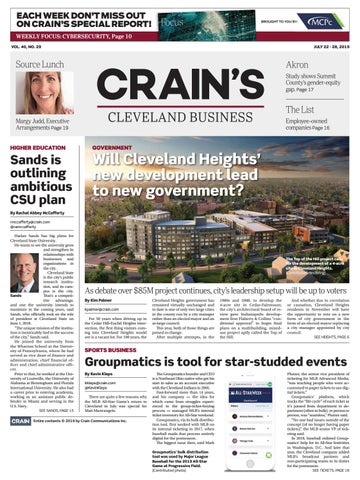
Will Cleveland Heights’ new development lead to new government?
By Rachel Abbey McCafferty rmccafferty@crain.com @ramccafferty
Harlan Sands has big plans for Cleveland State University. He wants to see the university grow and strengthen its relationships with businesses and organizations in the city. Cleveland State is the city’s public research institution, and its campus is the city. That’s a competiSands tive advantage, and one the university intends to maximize in the coming years, said Sands, who officially took on the role of president at Cleveland State on June 1, 2018. “The unique mission of the institution is inextricably tied to the success of the city,” Sands said. He joined the university from the Wharton School at the University of Pennsylvania, where he had served as vice dean of finance and administration, chief financial officer and chief administrative officer. Prior to that, he worked at the University of Louisville, the University of Alabama at Birmingham and Florida International University. He also had a career prior to entering academia, working as an assistant public defender in Miami and serving in the U.S. Navy. SEE SANDS, PAGE 15
The Top of the Hill project calls for the development of a 4-acre site in Cleveland Heights. (Contributed rendering)
As debate over $85M project continues, city’s leadership setup will be up to voters By Kim Palmer kpalmer@crain.com
For 50 years when driving up to the Cedar Hill-Euclid Heights intersection, the first thing visitors coming into Cleveland Heights would see is a vacant lot. For 100 years, the
Cleveland Heights government has remained virtually unchanged and to date is one of only two large cities in the county run by a city manager rather than an elected mayor and an at-large council. This year, both of those things are poised to change. After multiple attempts, in the
And whether due to correlation or causation, Cleveland Heights residents in November will have the opportunity to vote on a new form of city government in the form of an elected mayor replacing a city manager appointed by city council. SEE HEIGHTS, PAGE 6
SPORTS BUSINESS
Groupmatics is tool for star-studded events By Kevin Kleps kkleps@crain.com @KevinKleps
There are quite a few reasons why the MLB All-Star Game’s return to Cleveland in July was special for Matt Mastrangelo.
Entire contents © 2019 by Crain Communications Inc.
The Groupmatics founder and CEO is a Northeast Ohio native who got his start in sales as an account executive with the Cleveland Indians in 2005. Fast-forward more than 14 years, and his company — the idea for which came from struggles experienced in the group-ticket-buying process — managed MLB’s internal ticket inventory for All-Star weekend. Groupmatics, via its bulk distribution tool, first worked with MLB on its internal ticketing in 2017, when baseball made that process entirely digital for the postseason. The biggest issue then, said Mark Groupmatics’ bulk distribution tool was used by Major League Baseball for the 2019 All-Star Game at Progressive Field. (Contributed photo)
P001_CL_20190722.indd 1
1980s and 2008, to develop the 4-acre site in Cedar-Fairmount, the city’s architectural board of review gave Indianapolis development firm Flaherty & Collins “conditional approval” to begin final plans on a multibuilding, mixeduse project aptly called the Top of the Hill.
Plutzer, the senior vice president of ticketing for MLB Advanced Media, “was teaching people who were accustomed to paper tickets to use digital tickets.” Groupmatics’ platform, which tracks the “life cycle” of each ticket as it’s passed from department to department (often in bulk), or person to person, was “seamless,” Plutzer said. “No one had issues outside of the concept (of no longer having paper tickets),” the MLB senior VP of ticketing said. In 2018, baseball enlisted Groupmatics’ help for its All-Star festivities in Washington, D.C. And later that year, the Cleveland company added MLB’s broadcast partners and non-participating teams to its duties for the postseason. SEE TICKETS, PAGE 18
7/19/19 3:01 PM
PA G E 2
|
J U LY 2 2 - 2 8 , 2 019 |
CRAIN’S CLEVELAND BUSINESS
Firm pools risk to cut health insurance costs By Lydia Coutré lcoutre@crain.com @LydiaCoutre
With most businesses struggling with rising health insurance costs, Roundstone believes it has a model that can solve that problem. And the Lakewood insurance company’s significant growth in recent years shows it has found its niche in offering a self-funded insurance product in a group captive model. Between 2015 and 2018, the number of employer groups it manages has grown by more than 150% to nearly 500 across the country. In that same period, it nearly doubled its revenue to almost $17 million in 2018. Roundstone offers employers an alternative to the often double-digit cost increases that companies face under a fully insured model. A self-funded insurance model in which an employer provides health benefits with its own funds has largely only been accessible to large employers that can bear the risk that comes with paying employees’ claims. But the company offers a captive insurance solution where small and middle-market employers can come together, pool that risk and self-fund their insurance. “We go out to our customers, our employers, and say, ‘Hey, you really should self-fund and share some risk with other employers and apply these strategies to control your costs, and that’s the way you’re going to
P002_CL_20190722.indd 2
“We go out to our customers, our employers, and say, ‘Hey, you really should self-fund and share some risk with other employers and apply these strategies to control your costs, and that’s the way you’re going to beat this.’ ” — Mike Schroeder, president of Roundstone
beat this,’ ” said Mike Schroeder, president of Roundstone. The 65-employee company (up from 39 in 2015) has been adding roughly 10 employees a year. In 2016, Roundstone moved its headquarters for the second time since it began in 2003 to accommodate its rapid growth, renovating a historic church in Lakewood to house the company. Schroeder anticipates the company growing its clients, revenue and employee base at a similar rate for at least the next three to four years. At first, the growth spurt was prompted by the Affordable Care Act and employers looking to self-funded insurance as a way to avoid some of the rules and taxes associated with the landmark health care law. Tom Campanella, director of the health care MBA program at Baldwin Wallace University, calls this trend an “unintended consequence” of the ACA. Avoiding these regulations by shifting to a self-funded model can be financially attractive, he said. And for smaller- and medium-sized companies, the idea of pooling employ-
ees with other employers to in effect spread out the risk, makes the option even more attractive. While the ACA was the initial push, Schroeder said that now most of the growth is driven by the cost savings Roundstone is able to achieve for its employers. Enrollment season, once an anxiety-ridden time for employees, has essentially become a non-event at University School, where health insurance costs have remained mostly flat for the past several years since it joined Roundstone’s captive model. Before Roundstone, University School, with campuses in Hunting Valley and Shaker Heights, was facing 5% to 12% annual increases to health care costs under a fully insured model. David Wright, finance director at University School, said that, at the time, he couldn’t imagine a world in which their health costs remained flat for several years. For the past 15 years or so, the school has been in a health care consortium of roughly 55 private schools in an effort to spread risk. The con-
sortium began looking to self-funding several years ago because of ACA regulations. They’ve stuck with Roundstone for its captive self-funded insurance model and for the company’s examination of claims, said Wright, who is also head of the steering committee of the consortium. Campanella said another big advantage of going with a self-funded model is the fact that employers can better understand their claim cost trends. “Under self-insured, you’re actually paying the claims and you’re the one taking on risk, so you have that information,” he said. “So then with that information — information is power — you’re in a position to be able to get creative and design initiatives and programs to maybe direct care toward more value-based providers. … You definitely have a lot more flexibility in that regard to control your health care costs then.” Roundstone has a team of employees it calls the cost saving investigators that focus on how to save employers money. Schroeder said when a new employer joins Roundstone, the lowest-hanging fruit when it comes to immediately saving them money is in pharmacy and pharmacy benefit managers. The other major area it looks at is big-claim ticket items, such as cancer to transplants. With those, Roundstone looks to Centers of Excellence and incentivizes employees to go with higher-quality, lower-cost options. “We really think it’s important that these employers in the middle market wake up and get out of the grip of
the fully insured carriers and start buying the care direct themselves and self-funding,” Schroeder said. According to the Kaiser Family Foundation, in 2018 the percentage of covered workers enrolled in a self-funded plan in firms with 5,000 employees or more was 91%. For firms between 50 and 199 workers, that was 20%. And for firms with 200 to 999 workers, it was 50%. Small to midsize companies may not realize they have this option, he said, or they may be intimidated by the idea of proactively managing and controlling their plan design. Roundstone helps to mitigate that intimidation factor as a kind of outsourced risk management option. What Roundstone sometimes struggles with is employers who are stuck in a year-by-year approach to their health care costs. Roundstone, Schroeder said, is a long-term strategy. He tells folks that they’ll achieve enough savings in four years with the company to essentially pay for the fifth year with their model. But it’s a philosophical change for employers to go from feeling trapped without choices in a fully insured model every year to committing to a long-term investment with a self-funded model, he said. “Once a year, they sit down, they get a spreadsheet of cost increases and they hope to God it goes away,” Schroeder said. “We tell them, ‘No, no, no, let’s not do this. Let’s get in this, let’s find out your claims, let’s manage your claims and then over the long-term, let’s take proactive action to manage those costs.”
7/19/19 3:02 PM
CRAIN’S CLEVELAND BUSINESS
|
J U LY 2 2 - 2 8 , 2 019
PA G E 3
|
Global blockchain VC fund is housed here NEO-founded Grasshopper Capital, now owned by Australian firm, aims to raise $50M to $75M for fund By Jeremy Nobile jnobile@crain.com @JeremyNobile
It’s not something you can say every day: Cleveland is now a local base for a global, blockchain-focused investment fund. And while Grasshopper Capital will look for investments across the globe, the presence of some of its key advisers here could be all the more significant for relevant startups, particularly those looking for their place in an innovative tech scene the ongoing Blockland initiative aims to develop here. Although its LLC is based in Delaware, Grasshopper is a legacy Cleveland hedge fund originally designed to invest directly in the myriad cryptocurrencies flooding the sector of digital money. It was acquired earlier this year by TCM Global Asset Management, an Australian firm focused on digital ledger technology (i.e. blockchain), which has revamped Grasshopper as its venture funding arm. The group is currently working on raising between $50 million to $75 million for what is Grasshopper’s second fund overall, but the first with a venture strategy. The plan is to invest in companies seeking funding at the seed to series B stages. It’s a new identity for Grasshopper, which was launched in summer 2017 by Ari Lewis and Sagar Rhambia, two young Case Western University grads who had been trading cryptocurrencies on their own for a few years.
The two say they seeded their first fund with an $18,000 investment in cryptos like Bitcoin and Ethereum that turned into $1.4 million. Grasshopper was formed to capitalize on that success and turn crypto investing into a proper business. The fund drew additional capital Amato from a couple dozen investors — such as Cleveland family office Weinberg Capital Group, which created WCG Crypto LLC specifically to put some money with Grasshopper — who wanted a taste of exposure to the alternative asset class as Bitcoin prices exploded in 2017. Bitcoin started that year worth fewer than $1,000 a coin, then skyrocketed to $19,511. Financial press dubbed the phenomena “cryptomania.” By the end of 2018, it had fallen again to about $3,400. Grasshopper got out and returned money to investors a little before then. Lewis said that from August 2017 through October 2018, Grasshopper’s inaugural fund outperformed the performance of Bitcoin itself by 10%, enhancing their reputation in the crypto world and leaving investors generally satisfied. The exit from crypto was influenced by TCM, which learned of Grasshopper through Frank Amato, co-founder of Block5, a blockchain capital investment and advisory firm. Amato — who moved back to Cleveland a few years ago and is working on drawing tech companies to Northeast Ohio, a
Deane
Lewis
goal of the Blockland initiative — first learned of Grasshopper from a February 2018 Crain’s feature. He previously ran the London office for Block5 and started advising the Grasshopper team once connected with them. TCM CEO Jon Deane was considering investing in Grasshopper’s crypto fund in later 2018, but he said he didn’t go forward with that because of “market timing.” Yet, the firm believed “strongly” in the background of Lewis and Rhambia, he added, which was the “most attractive thing for us.” “We wanted a presence in the U.S., and Grasshopper looked like a good opportunity with strong roots in Cleveland coupled with some very exciting talent in Ari and Sagar,” Deane said. As far as Grasshopper’s crypto exodus, that was motivated in part by steep swings in crypto values as well as institutional custodians for the crypto asset class coming online — something that wasn’t as common when Grasshopper first got into the game. Companies like Fidelity Investments, for example, were just
forming their own crypto-trading platforms last fall as TCM and Grasshopper were talking out a deal. “It just didn’t make sense to move forward with a token fund model in place with all these institutional custodians coming online,” said Amato, now a general partner with Grasshopper. So TCM sought to restructure Grasshopper as a VC fund. The sense is there would be greater opportunity to help commercialize projects building the applications on both public and private blockchains in the short term. “We also felt investors were still struggling with investing in ‘pure’ crypto. However, they wanted exposure to blockchain via the companies capitalizing on it,” Deane said. “So we remodeled Grasshopper to focus exclusively on investing in seed to series B rounds for companies building blockchain solutions across financial services and commodities.” Those include trade finance solutions, clearing and settlement, Deane said. He named some companies as comparative examples like OTCXN Inc. and Xpansiv (both in San Francisco) and InfiniGold (Australia). TCM also added well-known venture capitalist Nisa Amoils — who folks in the crypto, blockchain, fintech and venture circles may know by her regular contributions on those topics for Forbes, among other interviews in financial press — to further build out the Grasshopper team as well.
Lewis and Rhambia still are involved with Grasshopper as advisers. While fundraising continues, Deane emphasized that the Grasshopper fund is looking for deals worldwide. Yet, Amato, Lewis and Rhambia still are stationed in Cleveland. And while there are no immediate deals in the pipeline, the team will certainly be vetting potential local investments. “First and foremost, we see Cleveland as a great opportunity for the fund. We are globally based, however. Too many funds only look for deals in certain jurisdictions,” Deane said. “Having Frank and Ari’s exposure in Ohio, Nisa’s presence in New York, and the majority of the TCM in (Asia-Pacific), we get great exposure for deal access. We also have the opportunity to help commercialize projects globally as they gain traction. The majority of the team has also been, at some stage in their career, global. So we see it as an opportunity.” But as far as Grasshopper’s founders are concerned, the opportunity to channel additional VC money to this region’s tech scene probably can’t be understated. “We have a long way to go in terms of bi-venture money here (in Northeast Ohio) and getting funds to invest in the Midwest,” Lewis said. “We want to hopefully be part of that movement and help put Cleveland on the map as a technological hub. There’s no reason we can’t be the next Silicon Valley.”
SIX HOSPITAL CEOS – ONE ROOM
Join Crain’s Cleveland Business as we take a high-level deep-dive into the top issues facing the health care sector while celebrating the nurses, doctors and other heroes dedicated to patient care and innovation.
Panel Discussion: Hospital CEOs MODERATOR: Elizabeth McIntyre, publisher and editor, Crain's Cleveland Business
Featuring the Hospital CEO Forum and Health Care Hero Awards
PANELISTS: Dr. Akram Boutros, president and CEO, MetroHealth System Dr. Cliff Deveny, president and CEO, Summa Health Dr. Tom Mihaljevic, president and CEO, Cleveland Clinic Thomas J. Strauss, president and CEO, Sisters of Charity Health System Grace Wakulchik, president and CEO, Akron Children's Hospital Thomas F. Zenty III, CEO, University Hospitals
AUG. 29 • 8:30 AM
Questions? Contact our events team today at clevents@crain.com.
Case Western University, Tinkham Veale University Center
REGISTER TODAY: CrainsCleveland.com/Crains-Events
P003_CL_20190722.indd 3
SUPPORTING SPONSOR
For sponsorship opportunities, contact Megan Lemke at mlemke@crain.com
7/19/19 12:53 PM
PA G E 4
|
J U LY 2 2 - 2 8 , 2 019 |
CRAIN’S CLEVELAND BUSINESS
LIST ANALYSIS
LOANS AREN’T FREE BUT
THEY’RE SIMPLE WITH YOUR LOCAL CREDIT UNION CALL YOUR LOCAL CREDIT UNION TODAY! • • • •
Rates are back to 2017 levels! Lock in a low rate today! Commercial Real Estate Loans up to $10 Million No Prepayment Penalties As Little as 10% Down
Your Business Lending Partner SM Contact Jonathan A. Mokri 440.526.8700 • jmokri@cbscuso.com www.cbscuso.com
17,500 SF Multi-Tenant Industrial Building 11683 Royalton Rd., N. Royalton, OH 44133
Davey Tree easily tops new Employee-Owned list By Chuck Soder csoder@crain.com @ChuckSoder
If you happened to be one of the 500 or so Davey Tree Expert Co. employees who owned shares in the company back in 1979, hopefully you held onto some of them. Davey Tree is atop a new Crain’s list published on Page 16: Employee-Owned Companies with Employee Stock Ownership Plans. The list is built from federal data compiled by the National Center for Employee Ownership. The Ohio Employee Ownership Center in Kent gathered data to determine which Northeast Ohio companies with ESOPs were majority owned by employees.
sbullard@crain.com @CrainRltyWriter
•Radiant Tube Heat
•Brick Building
•Excellent visibility off Royalton Rd.
•1 Dock/3 Drive-In Doors
•Power 240V/3Phase
•14’ Ceiling Height
•Each Unit has Separate Utilities
www.hannacre.com
Kevin J. Kuczynski 216.861.5684 KevinKuczynski@HannaCRE.com
Providing a private travel experience that exceeds expectations
When you rank those companies by active participants — current employees who own a stake in the business through the ESOP — Davey Tree lands in the top spot, with 4,528 active participants as of Dec. 31, 2017. But the data on the list undersells the number of Davey Tree shareholders and the value of their shares. Only 22% of the Kent-based tree and landscape services company is owned through its ESOP plan; the rest is owned directly by employees, from top executives to people “pulling brush,” said treasurer Chris Bast. In total, the company had about 6,000 shareholders at the end of 2018, and their shares were worth about
$500 million. The value of each share has grown many times over since 1979, when employees bought the company from the Davey family. The company had $60 million in annual revenue back then; that figure passed $1 billion in 2018. Martha Kordinak, treasury supervisor at Davey Tree, started at the company as a secretary in 1982. She understood the value of Davey’s employee ownership programs long before she was put in charge of overseeing them. “To just see what the stock price did over the course of the first five years that I worked here, it was just a no-brainer,” she said. The full digital list includes 45 employee-owned companies with ESOPs and is available to Crain’s Data Members.
Independence site looks appealing for optics firm By Stan Bullard
PROPERTY OVERVIEW •17,500 SF Building on 1.12 Acres
The employee-owned company list is on Page 16.
Champion One, a producer of optical networking devices and technology consulting services, plans to move to Independence from Beachwood to almost double the size of its headquarters and operations space. The firm has subleased 17,000 square feet at 7575 E. Pleasant Valley Road for a move it expects to complete by September. It will exit about 9,000 square feet at its longtime home at 23645 Mercantile Road. “We need room to expand because we’re growing at such a rate we can’t accommodate additional talent at this location and will be adding people as we add new products,” said Christina O’Neill, Champion One’s marketing manager, in a Thursday, July 18, phone interview. The company landed in Independence, she said, because it feels it is a more central location to attract new staff due to its access to downtown Cleveland and Cleveland Hopkins International Airport. The new facility will replace the company’s existing operation with a new open office, a larger area for as-
sembling products and a larger, dedicated clean room for testing products before sending them to customers, O’Neill said. “We see it as a chance to upgrade pretty much everything,” O’Neill said, although she declined to disclose a projected budget for the new operation. The privately held company employs about 50 staffers, from managers and engineers to accountants, at its Beachwood operation that will move to Independence, she said. It employs another 10 who operate remotely at locations in California, Texas, North Carolina and Canada. Champion One does not disclose revenues, O’Neill said. The city of Independence provided Champion One with a city income tax incentive that will give the company back more than $50,000 of its municipal income tax receipts over a three-year period, as well as $15,000 to aid the firm with relocation expenses. Before the suburb’s council approved the tax incentives at its July 9 meeting, Nate Romer, Champion One’s vice president of finance, said the company expects to add staff as it projects that it will increase sales 45% over the next three years. Independence Mayor Anthony To-
gliatti said in a phone interview that he’s excited about the company’s plans. “It’s a great opportunity for the city to gain a company with cutting-edge technology,” Togliatti said. O’Neill said Champion One focused on optical networking products soon after it was launched as a provider of computer memory services 25 years ago. It needs the added space and staff because it is adding new optical networking products, which use fiber networks, and moving into related networking consulting services. John Jutila, Champion One’s CEO, told Independence City Council that the company supplies customers around the world from Northeast Ohio. Clients, he said, include telephone companies, TV companies, universities and governments and so on. “It’s a very high-growth market, and we hope to be able to grow significantly faster than the market,” Jutila said. The location that Champion will occupy in Pleasant Valley Business Park has been empty for three years. The building is owned by a limited liability corporation based at the offices of Chelm Properties in Solon.
Site sold near GM plant in Parma By Stan Bullard sbullard@crain.com @CrainRltyWriter
HOW TO FLY WITH SKY QUEST: » On-Demand Charter » Jet Card Memberships » Aircraft Ownership Opportunities
P004_CL_20190722.indd 4
FlySkyQuest.com 216-362-9904 Charter@FlySkyQuest.com
The largest vacant industrial site in the city of Parma — 15 acres that was formerly part of the parking lot across Chevrolet Boulevard from the General Motors plant — has changed hands. The property was purchased June 11 by JFMC Property LLC from General Motors for $1.9 million, according to Cuyahoga County land records. Tax bills for the new owner are being sent to a Westlake address that houses Budget Dumpster, a webbased company that brokers dump-
sters to consumers and companies in 150 cities across the nation. A spokeswoman for the company said in response to a query on the LinkedIn social networking site that the firm is not prepared to comment on its plans. Neither John Fenn nor Mark Campbell, Budget Dumpster’s co-founders, returned a request for a call by the end of the day Thursday, July 18. An online record at the Ohio Secretary of State’s office lists Fenn and Campbell as incorporators of JFMC Property. Shelley Cullins, Parma economic development officer, said in a July 18 phone interview that the property’s
new owners have not filed a request for incentives or building approvals with the city. She said the site is part of the automaker’s parking lot for employees. In the past, GM has said it would raze an above-ground pedestrian bridge that connects the plant and parking lot as part of its disposition of the site. She said the site is the largest empty industrial-zoned site available in Parma. Michelle Boczek, the city of Westlake’s economic development manager, said the suburb has received no indication that Budget Dumpster might be looking to move its corporate office.
7/19/19 3:03 PM
MY BENESCH SC “You have to be able to adapt and adjust as a startup to survive the ‘valleys of death’ in getting to commercialization. Benesch knows how to step into unconventional situations and come up with creative ways to keep things moving forward.” JAY SCHABEL President RES Polyflow and Brightmark Energy’s Plastics Division
MY TEAM Featured team (left to right) IRA KAPLAN BARRY MILLER JESSICA ANGNEY MICHAEL MOZES RISTO PRIBISICH DANA WEISS MICHAEL PRIMROSE COREY SPARKS KEVIN MARGOLIS
RES Polyflow developed a novel technology that converts end-of-life plastics into valuable hydrocarbon products. Commercializing this type of innovative technology can be a multiyear process—before you even reach the starting line for ongoing production and sales. Jay and RES Polyflow have been on that journey for 11 years, with Benesch right alongside. From identifying the opportunity to securing funding to negotiating deals and handling the myriad of issues involved in IP protection, shareholder matters, plant construction and more, Benesch brings the entrepreneurial spirit, business acumen and breadth of legal counsel that helps new ventures start up and take off. To learn more about our relationship with RES Polyflow, visit beneschlaw.com/myteam.
www.beneschlaw.com
© 2019 Benesch Friedlander Coplan & Aronoff LLP
CL_072219_FP Template.indd 2
7/19/19 10:50 AM
PA G E 6
|
J U LY 2 2 - 2 8 , 2 019 |
CRAIN’S CLEVELAND BUSINESS
The most recent plan for the Top of the Hill project in Cleveland Heights is one of at least five redesigns in the last three-plus years. (Contributed rendering)
HEIGHTS
d
Edgehill Rd
ok rlo ve Top O
Minimum Delivery:1Pallet
1-800-547-1538 Salt Distributors Since 1966
P006_CL_20190722.indd 6
rlto
en P t D r u r Harco
500ft
Cedar Rd
d
Call For Pricing!!
rG
l
vd
lv irmou nt B Fa
• Water Softener • Industrial • Food • Ice Melt • Sea Salt
Ce d a
y kw
Bl
id E u cl er b y s hire
Grandview Ave
SALT • SALT • SALT
n Rd
. Hts
D
Subscribe FOR FREE : CrainsCleveland.com/enewsletters 03-07John S Grimm.qxp 2/23/2016 10:43 AM Page 1
Ca
Delaware Dr
with Crain’s email newsletters
of the Hill project
Bellfield Ave
STAY IN THE KNOW
The two issues — development and politics — go hand in hand, according to Michael Bennett, treasurer of Citizens for an Elected Mayor (CEM). “You look at the other communities around Cuyahoga County that are more successful, better at addressing development, better at addressing housing stock values, better at addressing poverty and the other issues that inner-ring suburbs have to deal with, and the one differential is that they have elected mayors,” Bennett said. CEM members collected more than 4,000 signatures to qualify the issue for the city’s November election after a city charter designed to review the government for the first time in 37 years. “What is missing is how do we ensure a community that remains viable for the future in the face of some pressing challenges,” Bennett said, adding that a strong mayor, rather than one beholden to a council, would have a better vision of the future. “A lot of those challenges have to do with the economic vitality of the city, both current and future development, and relationships with business owners,” he said. Brandon Ring, owner of the popular Nighttown restaurant and jazz club since 1992, also is eager to see Cleveland Heights compete more strongly with other suburbs for development. “Lakewood used to be the poor second cousin to Cleveland Heights, but look at the development there now,” Ring said. He has been an outspoken supporter of the Top of the Hill development, even in the face of some vocal neighborhood opposition. The estimated $85 million project consists of more than 250 one- and two-bedroom apartments, 15,000 square feet of first-floor retail space, and a 500-space parking garage. The most recent plan, which is one of at least five redesigns over a period of more than three years, also includes 25,000 square feet of public green space. The development is not a 1920s Tudor-style building or three-story red brick building, like the rest of the Cedar-Fairmount neighborhood. The tallest point is 10 floors and consists of a large expanse of glass, metal and brick, with a modern design that is not welcomed by all Cleveland Heights residents. Lute Quintrell, co-founder of Citi-
R
CONTINUED FROM PAGE 1
maps4news.com/©HERE
zens for Great Design, is not against developing the “weed-infested” lot, but said he wanted more input from the community. “We need to do something,” Quintrell sayd. “It should be developed, and it should be developed into something that is a signature development that is welcoming (and) says Cleveland Heights.” Quintrell and other residents oppose the Top of the Hill plan in its former and current iteration. They fill community meetings — there have been 39 of them — and use the public comment period to argue it, commenting that the development “just does not say Cleveland Heights” to them. Quintrell believes the city’s lack of transparency and inclusion is a driving force behind the CEM movement. “It is driving Citizens for Elected Mayor,” Quintrell said. “People have told me that based on the city’s handling of the Top of the Hill it is a direct result of that.” The counterpoint from city administrators is that the two issues are not related. “There are no politics involved with this,” said Mary Trupo, director of communications for Cleveland Heights. “This is city leaders looking at what they truly believe is in the best interest of the city and residents.” Cleveland Heights could see a surge of development. In addition to the Top of the Hill, there are plans to develop the city’s busiest retail area at the intersection of Cedar-Meadowbrook and a request for proposals out for the 57-acre Severance Mall property. “There is a great interest in development in Cleveland Heights,” said Tim Boland, the city’s director of economic development. He said he credits “having the right economic tools” for the wave of potential new development. The city recently has passed or adopted a host of incentive programs, including a citywide Community Reinvestment Act, a modified storefront
loan program, and a job creation grant program. Flaherty & Collins has negotiated a tax increment financing plan allowing the development firm to pay only 25% of taxes owed to the city’s school district using payments in lieu of taxes to secure a loan using the TIF proceeds as collateral. The back and forth with residents on the Top of the Hill is just part of the normal process for a major development, Boland said, adding that Flaherty & Collins representatives have been responsive to suggestions. “We are always going to have strong community engagement. I think each project is going to go through that, and we do not see that as a hurdle or a challenge; we see it as a benefit,” he said. Architecture board member Melissa Fliegel said in a statement to Crain’s, “Every project is different, and for this project, due to the extensive public commentary and (board) questions, further studies were needed,” It remains to be seen how Cleveland Heights, a place that residents at community meetings repeatedly call “special” and “unique,” will deal with the possible changes on the horizon. The Top of the Hill development is slated to break ground before the end of the year. In response to the formation of CEM, another group of residents organized Cleveland Heights Citizens for Good Government, or CHCGG, to advocate for maintaining an appointed city manager. Mike Ungar, chair of the city’s planning and development committee, said he supports CHCGG. “It serves our city” because it keeps the politics out of city hall, Ungar said. “The voters are the shareholders, and we as council answer to the shareholders,” he said. “Similarly, the city manager is the de facto CEO, and that city manager is accountable to council” because he or she can be fired. “I believe the city management form of government works well when people are doing their jobs,” Ungar said. Quintrell, of Citzens for Great Design, conceded that Cleveland Heights has “stagnated” a bit in recent years and is concerned that it has a “difficult reputation” after the number of fits and starts associated with the Top of the Hill development. Ring said he has had sleepless nights over the fate of the Top of the Hill plan. “If this does not work, I can guarantee no developer in their right mind will come to Cleveland Heights again,” Ring said.
7/19/19 3:04 PM
CRAIN’S CLEVELAND BUSINESS
|
J U LY 2 2 - 2 8 , 2 019
|
PA G E 7
LAND FOR SALE: Beacon West, Westlake
Ideal Industrial Multi-Tenant Building » Industrial Zoning with Many Allowable Conditional Uses » Prestigious High Visible Gateway Location » Can Accommodate up to 100,000 SF Building » $430,000 » $65,250/Acre Property Features Priced to Sell Last Two Available Parcels ● Quick access to I-90 and Crocker Park ● Enterprise Zone ● Major Business and Retail Area ● Stormwater Pond Installed ● Build to Suit Available ● ●
VIKING PARKWAY
Lot 14-C1 6.596 Acre Parcel
CONTACT US Charles Marshall or Terry Noonan 330-659-2040 3457 Granger Road, Akron, OH 44333
VISIT OUR NEW PROPERTY WEBSITE www.beaconmarshallproperties.com
Green High School’s FieldTurf construction and track installation were done by Vasco. (Vasco photograph)
Vasco expands Massillon space, eyes future growth
FOR PRESTIGE AND ELEGANCE,
Beacon Marshall Ad 3-4-Lot 2R.indd 1
By Rachel Abbey McCafferty rmccafferty@crain.com @ramccafferty
The Vasco group of parking lot and sports surfacing companies has seen a lot of growth in recent years. And now, it has a newly renovated and expanded headquarters in Massillon to reflect that. Vasco is made up of Vasco Asphalt Co. and Vasco Sports Contractors in Massillon and Nidy Sports Construction in Longwood, Fla. Officially, the holding company over all three is Visionary Holding Co. Vasco recently expanded its headquarters at 4270 Sterilite St. SE in Massillon, adding about 1,600 square feet onto the existing 4,200-squarefoot building. The company also has about 6,000 square feet of garage or warehouse space on its 7 acres. Renovations began in November 2018 and were completed in June. Vasco invested about $700,000 in the expansion and renovations, said the company’s president, Matt Savage. The company needed the space for its growth, but it also wanted to modernize its offices. Savage said prior to the renovations, the Massillon location had a “stodgy construction company feel” and lacked common areas for collaboration. The renovations are designed for flexibility and teamwork, with large tables for field advisers to come in and work when they need and new conference rooms for meetings. The company also added a break room for employees and 14 new work stations. “We just wanted something that people were excited to come to,” said vice president Glen Maurer. Savage joined the sales side of the company in 2004 and began buying into Vasco about four years later. By 2015, he bought the entire company. Maurer, who joined Vasco in 2008 as a project manager, started buying into the company in 2017. The two, who are brothers-in-law, are the sole owners of Vasco today. Today, Vasco has about 110 employees in Ohio and about 40 in Florida, Savage said. And that’s grown significantly in recent years. Five
P007_CL_20190722.indd 7
7/17/19 10:12 AM
THINK FIRESTONE COUNTRY CLUB.
Firestone Country Club is an exclusive, prestigious private club that welcomes Members and guests alike to host events in our famed clubhouse.
Owners Glen Maurer and Matt Savage were joined by employees at the ribbon-cutting event for Vasco’s recently expanded and remodeled office. (Tori Zwick, WRL Advertising)
years ago, those figures were closer to 60 employees in Ohio and 20 in Florida, Savage said. And Savage and Maurer said the company is still looking for more employees. With unemployment at a low level, and a tight labor market in construction, hiring has been a challenge, despite the company’s growth, Maurer said. Vasco serves commercial customers as well as schools of all levels, from elementary schools to colleges and universities. In Massillon, Vasco has four divisions: commercial maintenance, commercial paving and milling, sports construction and sports surfacing. The commercial paving and milling operation handles commercial parking lots and private roadways, and commercial maintenance handles seal-coating, striping and pothole patching. “If we maintain them, when it comes time for the replacement, they know Vasco and they trust us,” Maurer said. “It’s a long-term partnership, not a one and done.” On the sports side, the sports construction division oversees construction of turf fields, tracks and tennis courts, while sports surfacing is for the installation of those fields and track
and court materials. Vasco added turf installation to its services about three years ago, which has been a significant growth area, Savage said. It’s allowed the company to have full control over its projects’ quality. “We’ve always prided ourselves on being vertically integrated and being able to take responsibility for an entire project and minimize the amount of subcontractors you have to pull in,” he said. The company also has Nidy Sports, which it acquired a little more than a decade ago, in its portfolio. Savage said having Nidy Sports as a company has been great for business, as much of Vasco’s work in and around Ohio is seasonal. “The winter months are tough for us, so the vision was to have a southern presence, something that could create revenue and profitability yearround. And they’ve done a great job for us down there,” Savage said. Vasco doesn’t share annual revenue, but Savage said the company is seeing growth across all of its divisions. Savage said he’d like to expand the company geographically through another acquisition like Nidy Sports. He doesn’t have a set timeline, but would like to take that on in the coming years.
BOOK YOUR SPECIAL EVENT TODAY. 330.644.8441 | firestonecountryclub.com © ClubCorp USA, Inc. All rights reserved. 44574 0419 BB
Innovative Legal Counsel for Today’s Business Client PRACTICE AREAS Real Estate Hotel & Hospitality Business & Corporate Banking & Finance General Counsel
J.D. | M.B.A.
www.helonlaw.com
www.helonlaw.com
216.978.7463
7/18/19 3:31 PM
PA G E 8
|
J U LY 2 2 - 2 8 , 2 019 |
CRAIN’S CLEVELAND BUSINESS
Opinion From the Editor
Cyber threat is real; FBI is here to help
Editorial
Taking the helm When she arrives as general manager and CEO of the Greater Cleveland Regional Transit Authority, India Birdsong will lead an organization that’s in serious need of a new direction. Birdsong, currently the chief operating officer of Nashville’s transit agency, was tapped in early July to take over at RTA, which faces significant financial challenges and continues to see ridership fall. A final contract remains to be negotiated, but Birdsong is expected to start by the fall. She can’t get started fast enough. RTA last week proposed a 2020 budget that projects a 2% decrease in total ridership on top of a big decline already recorded this year. The transit authority had projected it would serve 17.5 million passengers through June. Actual ridership: 16.1 million. Last year, ridership slipped to a record low of fewer than 35 million. In announcing its plan to bring Birdsong aboard, RTA said the Nashville system in recent years “has launched several improvements and initiatives, including updated bus routes with tracking services on a mobile app” and many tech upgrades. She’ll need to bring that type of energy to Cleveland to figure out ways to improve RTA’s infrastructure and make its service more appealing. This isn’t easy, but Birdsong sounds like she’s ready for the challenge to better meet residents’ needs. For instance, she told Cleveland.com, “You want to be able to talk to people and understand what they need before you make decisions. That might be something needed in Cleveland to help boost ridership.” As for making the case to people that public transit is worth an additional investment, she told ideastream, “I think looking at what the makeup of the city is, how well people are traversing through the city currently, and how well they could traverse through the city if they invest in public transit, is probably one of the main takeaways to investing in public transit. ... Being transparent in your spending plan is really the main part ... (and) really getting down to the nuts and bolts of it all.” An emphasis on the basics would be a good start at RTA. Service quality on some bus and rail lines has deteriorated, and
that must be addressed so potential riders are confident they can get from one place to another in a timely fashion. We’d like to see experiments on pricing, too, to see if lower fares could boost ridership sufficiently to offset costs. Cleveland needs a stronger RTA to better connect its citizens to their city and to job opportunities. We’re excited to see the path Birdsong charts to get RTA there.
Enough
Any CEO who used the racist language routinely deployed by the president of the United States would, deservedly, lose his or her job. The rhetoric coming from Donald Trump isn’t leadership. It’s weak nativism that’s contemptuous of American values. “Send her back,” the ugly chant at last week’s Trump rally in North Carolina, is poised to become the 2020 version of “lock her up.” Bullies always need an enemy. Jonathan Greenblatt, CEO of the Anti-Defamation League, tweeted in response to Trump’s behavior, “This is the sound of illberalism, intolerance. Listen closely: it’s a danger not just to immigrants and minorities but to all Americans. Put politics aside. Time for leaders from all parts of society, people from all walks of life, to step up and say: enough.” Republicans in Congress, with a few exceptions, are unwilling to stand up to Trump. The president himself is indifferent to charges of immigrant-bashing and racism. Leaders in the business community, though, have to ask themselves: Is all this hate really the price of a tax cut, or regulatory rollbacks? True leaders of Northeast Ohio businesses, as well as nonprofits and community groups, must make it clear that the civic poison Trump is spreading is not welcome within their organizations or anywhere in society. Say it within your organizations. Say it publicly. If you don’t stand up now, things are only going to get worse.
Publisher and Editor: Elizabeth McIntyre (emcintyre@crain.com)
CLEVELAND BUSINESS
CLEVELAND BUSINESS P008_CL_20190722.indd 8
Managing Editor:
Scott Suttell (ssuttell@crain.com)
Contact Crain’s:
216-522-1383
Read Crain’s online: crainscleveland.com
Andy Jones feels a bit bit like Paul Revere these days, riding around town warning “the bad actors are coming, the bad actors are coming.” By bad actors, the CEO of the Midtown-based tech firm MCPc means the nation-states, criminals and other cyberattackers trying to steal valuable information from businesses, governments and individuals here and around the globe. And, he warns, these bad actors are getting more sophisticated. “Year-over-year ransomware was up on the order of 400%,” Jones said. “It was a $500 billion problem in the U.S. last year, which is only those who are reporting it. … We need to take the appropriate steps to protect ourselves and become highly educated in this space.” That’s a rallying cry that every business Elizabeth leader in Northeast Ohio needs to heed. McIntyre Bad actors can go after anyone with an internet connection, which means everyone. Read more on Jones has a key ally in spreading the word cybersecurity in about the increasing risk of cyber threats: Focus, 10-14. the Federal Bureau of Investigation. Bryan Smith, assistant special-agent-in-charge of the FBI’s Cleveland field office, was eager to join the cause. “Anyone can be targeted,” said Smith, who leads the Cleveland white collar and cyber investigations branch. “It doesn’t matter how big or small you are.” Proving his point, earlier this year, Cleveland Hopkins International Airport and St. Ambrose Catholic Church in Brunswick were victims of cyberattacks. A large international public airport and a small local church. As Smith said, anyone can be targeted. This isn’t something that should fall only on the chief information officer. The chief executive has to understand the threat and set the tone. “This is a business problem and not an IT problem, so we shouldn’t be reliant on the IT folks to fix it because they won’t be able to unless we all get engaged,” Smith said. Jones convened a group of executives this spring to hear Smith talk about the unique challenges cyberattacks present and how to combat them. More importantly, Jones wanted the senior leaders to learn the value of working with the FBI if cyber breaches happen, instead of keeping the news internal. That’s sometimes the strategy a business will use. They consider a cyberattack to be dirty laundry that no one needs to know about. But keeping it quiet is a bad move. It really just allows the laundry to pile, and makes it easier for other business to be victimized. “The only way this gets resolved is if we all share and learn from our experiences because the FBI, among others, has the ability to pool this kind of information and provide industry feedback and guidance,” Jones said. The more businesses share information with each other and the FBI, the easier it becomes to fix the problem at the root, Smith said, instead of just putting a BandAid on it. “This is a shared responsibility,” he said. “One day you may be the victim and the next day, you’re going to be taking advantage that someone else saw this activity.” Most ransomware can be prevented, Jones said, with basic cyber hygiene. That means updating operating systems, patching applications, backing up data and training end users. And, if the worst-case scenario happens and you’ve been hacked, reach out to the FBI. “I don’t need to see another organization breached,” he said. “They have to pay a significant fine, and that means a significant loss in profitability, which means layoffs, and that means jobs and an economic downturn. These things have broad implications and ripple effects.”
Write us: Crain’s welcomes responses from readers. Letters should be as brief as possible and may be edited. Send letters to Crain’s Cleveland Business, 700 West St. Clair Ave., Suite 310, Cleveland, OH 44113, or by emailing ClevEdit@crain.com. Please include your complete name and city from which you are writing, and a telephone number for fact-checking purposes. Sound off: Send a Personal View for the opinion page to emcintyre@crain.com. Please include a telephone number for verification purposes.
7/18/19 4:21 PM
CRAIN’S CLEVELAND BUSINESS
|
J U LY 2 2 - 2 8 , 2 019
|
PA G E 9
The former Club at Key Center is now
Personal View
There’s still time to say no to Ohio’s costly nuclear bailout By Jeff Barge
There may have been a case once for Ohio to subsidize FirstEnergy Solutions’ two nuclear plants in Ohio. But the company’s deceit and dishonesty in providing false and misleading information to the state legislature and the public now make that virtually impossible. That may be why the bailout failed to pass as scheduled on July Barge 17 by one vote and may not be brought up again until Aug. 1. FirstEnergy Solutions has been claiming for more than a year that it needs $150 million a year from the state because its Davis-Besse and Perry nuclear power plants, now in federal bankruptcy court in Akron, are running at a loss. But is this really true? “It wouldn’t be in bankruptcy court if it wasn’t in the red, correct?” responded Ohio GOP Senate spokesman John Fortney when asked that question. But that may be the misconception that is keeping the whole boat afloat. That so-called “fact” may not be true after all. FirstEnergy Solutions actually has five businesses involved in its ongoing bankruptcy case, and the two nuclear subsidiaries, known through the acronyms “FENG” and “FENOC,” are profitable. That has been firmly established by copies of a monthly operating report filed with the bankruptcy court by FirstEnergy Solutions in May of this year. According to Senate testimony by the Ohio Consumers’ Counsel that presented these documents as evidence, the two nuclear plants have had a profitable operating margin of almost $50 million since the company filed for bankruptcy in May 2018. According to these documents, FENG had an operating profit of $18.4 million in May 2019 alone. As if it were needed, a second study also proved the two plants are profitable. This one is by Paul Sotkiewicz, former chief economist for PJM Interconnection LLC, the largest U.S. power grid operator in the country. That study, which was commissioned by oil and gas group API-Ohio, said the Davis-Besse and Perry nuclear plants generated annual profits of $28 million and $44 million, respectively, and are “among the most profitable of their kind in the nation.” Arie Peskoe, director of the Electricity Law Initiative at Harvard Law School, said Sotkiewicz is a “credible” expert. And let’s face it — is it even reasonable anymore to believe that FirstEnergy Solutions is acting in good faith? Not if you look at its most recent history. In April, for example, federal authorities accused FirstEnergy Solutions and its former parent company, FirstEnergy, with concocting a “scheme” that was “an abuse of the bankruptcy system,” and filed legal papers in bankruptcy court in Akron to that effect. That’s because FirstEnergy Solutions’ initial bankruptcy filing, which was rejected by U.S. Bankruptcy Judge Alan Koschik, sought to absolve FirstEnergy of any future responsibility for costly power plant closings and cleanup estimated in the billions. The public would have been on the hook for this cleanup. Nice try, FirstEnergy. On another front, the Ohio Supreme Court in June struck down a sweetheart deal in which the Public Utilities Commission of Ohio had given FirstEnergy $600 million in a “distribution modernization rider” that allowed it to tack a fee on to customers’ bills for modernization of its energy grid. Problem is, FirstEnergy didn’t modernize its energy grid. According to testimony by the Ohio Consumers’ Counsel, the company used the money to increase dividends to its investor/owners from $152 million to $375 million a year. This again shows a lack of good faith. It diverted the fixup funds to Wall Street.
P009_CL_20190722.indd 9
The Downtown Cleveland Fitness Community No Commitments, No Fees 24 Hour Access, Free Parking Group Classes, Personal Training Discounted Services at Trilogy Spa Salon
Live | Look | Feel Better. trilogycle.com
FirstEnergy’s beleaguered Perry Nuclear Power Plant, above, and its Davis-Besse plant are at the center of a proposed bailout. (Bloomberg)
And that’s where the Ohio bailout money would go — straight from Columbus to Wall Street. As a July 8 headline in The Bond Buyer crowed: “FirstEnergy nuclear bailout would be a win for bondholders” — some of whom may have bought the bonds for pennies on the dollar after FirstEnergy’s bankruptcy. Several state senators who spoke to me before the scheduled vote noted other valid reasons not to give FirstEnergy Solutions a bailout. In an email, state Sen. Andrew Brenner, a Republican member of the Senate energy committee that heard testimony on the bill, said that FirstEnergy Solutions’ controller was evasive on the stand and “avoided answering my questions” in Senate hearings. Democrat state Sen. Nickie Antonio said her problem was FirstEnergy Solutions refused to provide her with any “math” to show they really needed the subsidy. That is, she said, they wanted the money but refused to prove they needed it. Tom Becker of FirstEnergy Solutions explained it to the Plain Dealer this way: “The company is operating under several non-disclosure agreements as part of the bankruptcy and is precluded from disclosing non-public information.” But bankruptcy attorneys contacted for this article said that was patently false. FirstEnergy Solutions even seems to be lying about the cost of its nuclear fuel. It said in June it needed $52 million immediately to order new fuel or it would have to begin the process of shutting down its plants. But the price of uranium has dropped precipitously from $48 a pound to $22 a pound, making that statement, too, dubious. Sotkiewicz, chief economist for PJM Interconnection LLC, calls that deadline phony. It’s hard to imagine a company making a worse case for a subsidy than FirstEnergy Solutions has. A “dark money” statewide TV ad campaign costing as much as $7 million and paid for by a shadow group called “Generation Now” insults the public further by featuring kids playing T-ball and eating ice cream cones in support of the sought-after $1.5 billion subsidy. The people who named FirstEnergy “Solutions” when it went into bankruptcy — almost immediately after being spun off from its parent — must have had a good laugh at the time. Spinning off all your debt into another corporation that immediately declares bankruptcy and reneging on your debts and business contracts must have indeed have seemed the ideal “solution.” Nancy Pelosi would have clapped. But Ohioans have paid $10 billion in subsidies to First Energy in the past, and it’s far past time to pull the plug. The House should vote no on the Ohio nuclear bailout when it reconvenes on Aug. 1.
JOIN US Award-winning Accounting and Business Advisory Firm in Northeast Ohio In our firm, employees come first. We believe empowering our workforce results in the best client service in the game. We also offer paid parental leave, flexible hours, personal career coaching, and student loan consolidation programs. Oh, and free coffee! That is why we’re one of the Top Work Places in CLE.
@applegrowthpartners
AppleGrowthPartners
@apple_growth
SERVING NORTHEAST OHIO’S PRIVATELY-HELD BUSINESSES
APPLEGROWTH.COM
Barge is a Cleveland-based communications consultant and a former legal and business journalist, who has written for Crain’s New York Business and the American Bar Association Journal.
7/18/19 3:58 PM
PA G E 10
|
J U LY 2 2 - 2 8 , 2 019 |
CRAIN’S CLEVELAND BUSINESS
Focus
CYBERSECURITY
HOW KEYFACTOR IS REVAMPING ITSELF INTO A GLOBAL CYBERSECURITY PLAYER Firm is seizing opportunity in the realm of the Internet of Things Illustration by blackdovfx via iStock
By Jeremy Nobile jnobile@crain.com @JeremyNobile
F
or software in development at Keyfactor, lives literally are on the line. That may sound a bit intense for a cybersecurity business. But considering that Keyfactor developers are designing security protocols for use in items from pacemakers to trains, it’s the reality. It also points to some reasons why the Independence-based company is likely poised for growth as it capitalizes on trends in the world of technology, particularly with the Internet of Things (IoT). “We are doing some incredible work with companies we think are at the cutting-edge of building next-generation technology to improve experiences for human beings,” said Keyfactor co-founder and current chief strategy officer Kevin von Keyserling. “We have a real ability to exploit opportunity in IoT.” Consider modern pacemakers running on firmware that can collect, process and send biometric information about a person. That information itself needs to be encrypted and protected. Then there’s the device’s corresponding software that inevitably will need to be updated, which can be done remotely while a person sleeps. It’s a technological marvel, albeit one ripe for tampering. And if a botched update can make a
P010_CL_20190722.indd 10
computer crash, the same issue for a human’s hardware could be fatal. “You can imagine the bad things that could happen with nefarious actors in that environment,” Keyserling said. Beyond encrypting information going in and out of a device as it’s moved between systems, Keyfactor’s software also manages and validates a firmware update by verifying things like where it’s coming from and that the Keyserling entity calling for the update, a hospital in this case, deems it necessary. The same software could be applied to a variety of other biotech devices — from insulin pumps to brain implants — as critical information is packaged, shipped around and unpacked. And that’s just in the health care sector. There is a seemingly limitless array of use cases for securing information in the developing IoT ecosystem. There just happen to be some particularly compelling ones as it relates to health care and internet-connected vehicles, two key areas of focus for Keyfactor as it looks to grab more share of the cybersecurity market. “As it relates to the wellbeing of humans, and products that now have requirements to be connected through the cloud — which are
more abundant than ever — for us, the addressable market has exploded,” said Keyfactor CEO Jordan Rackie.
The next Hyland? Development of the IoT is one of several reasons Cybersecurity Ventures projects global spend on cybersecurity products and services will balloon past $1 trillion from 2017 to 2021. The group predicts cyberseRackie curity will be a global business of $170.4 billion by 2022, compared to an estimated $124 billion in 2019. That’s projected growth of more than 37% in three years. Projections like that embolden investments by groups like Insight Partners, a New Yorkbased private equity and venture capital firm with a portfolio active with tech and cyber companies that’s buying into the Keyfactor thesis. The firm, working out of a $6 billion fund, led a $77 million fundraise for the Cleveland company earlier this year — the largest venture deal in Ohio through the first half of 2019. The investment supports an active M&A strategy as well as other general growth-supporting initiatives, like product development and staff expansion. Just this month, Keyfactor acquired Redtrust in Barcelona, establishing its first international market presence.
Insight vice president Thomas Krane said his firm gave a cursory review of Utah cybersecurity company Venafi, which raised $100 million last fall, but ended up vetting and choosing Keyfactor for an investment instead. (According to Crunchbase, Venafi has between 251 and 500 employees, and it an estimated $71 million in annual revenue.) “Keyfactor is ahead of the game. They’re market leaders in terms of tech, but in terms of IoT as well,” Krane said. “Our hope is to hopefully surpass (Venafi) in terms of size and scale.” Keyserling has similarly grand goals in mind. “I’d like to be the next Hyland Software of Cleveland,” Keyserling said. Hyland is the 19th-largest privately held company in Northeast Ohio, according to the most recent Crain’s research, with 2017 revenue of $515 million and nearly 1,900 employees as of this January.
Business revamp Keyfactor is a relatively new brand stemming from an 18-year-old company. The business dates to the inception of Certified Security Solutions (CSS) in 2001, which was effectively a consulting business focused on identity and access management that was based in Seattle. Keyserling joined the company in 2003. SEE KEYFACTOR, PAGE 11
7/18/19 10:07 AM
CRAIN’S CLEVELAND BUSINESS
|
J U LY 2 2 - 2 8 , 2 019
|
PA G E 11
CYBERSECURITY
KEYFACTOR CONTINUED FROM PAGE 10
CSS focused on deploying and leveraging security frameworks. That carried CSS through the mid-aughts until the recession was beginning to take hold and many of CSS’ clients, who were largely in financial services, started canceling contracts. That’s when the company pivoted toward cryptography, the backbone for securing the internet and a necessity in modern e-commerce. While deploying public-key cryptographies, Keyserling and company noticed the need for software to manage all those. CSS built a prototype and sold that about a dozen times to some large companies. “That gave us some confidence to say, hey, we have something here,” Keyserling said. After a couple down years, the company moved to Cleveland, where it could run a more cost-effective business. The books stabilized by the end of 2009. Some financing in 2014 helped CSS pivot from consulting to a SaaSbased cybersecurity business. By then, the company had about 50 employees and was growing under a more-lucrative business model focused on a product instead of a service. The company was developing software providing enterprise IT management, both in data centers or in the cloud, and assisted with migrating systems to the cloud. That work, based on a Zero Trust Network, remains Insight’s bread-andbutter today. It serves a variety of Global 2000 companies in addition
to smaller and midsize ones. In early 2018, the company rebranded to Keyfactor to reflect its new identity. By the end of the year, it was finalizing the terms of the capital raise led by Insight. “What we’ve seen is a renaissance in certificate management, and the need for good certificate hygiene and management driven by the explosion of devices, both end-user devices as well as remote servers and third-party servers,” Krane said.
“I’d like to be the next Hyland Software of Cleveland.” Kevin von Keyserling, Keyfactor co-founder and current chief strategy officer
“I think Keyfactor is one of a few companies with traction and success and an IoT security use case, whether in medical devices or connected cars (etc.).” Krane highlights the applications in health care and transportation because “those are things actually in production and mission-critical use cases,” he said. That new capital can be used for future M&A deals, Krane said, similar to the Redtrust deal that gives Keyfactor a European beachhead to grow from. “This isn’t about pure M&A,” Krane emphasized. “We see huge organic growth opportunity in front of us.” Executives declined to say what kind of revenue growth is projected in 2019.
‘Hyper growth’ The recent fundraise marks the start of a new chapter for Keyfactor. Since then, the company installed Rackie as CEO and added a few Insight partners to its board, including Krane. On July 2, the Redtrust deal was announced, adding a European beachhead to grow from. “This is the start of an exciting journey in Europe,” Rackie said. “We do have high growth expectations for Europe. And this is just the beginning.” Redtrust also adds about 50 new employees. Keyfactor had about 100 employees in January at the time of its fundraise — almost certainly positioning it as the largest cybersecurity business based in Northeast Ohio — and has been planning to hire an additional 40 to 60 people through the rest of this year and the first half of next. Rackie, who is based in Atlanta, said other international deals could pan out in the U.K., or maybe parts of Germany or other regions in mainland Europe. There also are some employees along the U.S. West Coast, so a buy there might also make sense. But Cleveland will remain the “center of gravity for us,” Rackie said, hinting that some plans could be in store for expanding the operation in Northeast Ohio. Keyfactor’s position in the market coupled with the trends in IoT mean the business is likely poised to claim a large swath of market share. “We are experiencing hyper growth in the business, and we expect that trend to continue for the foreseeable future,” Keyserling said. “The market opportunity is speaking loudly.”
NEO tech hiring outlook is strong, particularly in cybersecurity Of NEO technology leaders surveyed …
By Scott Suttell ssuttell@crain.com @ssuttell
Cleveland-area information technology managers have big hiring needs for the second half of 2019, according to a new survey from staffing firm Robert Half Technology, and cybersecurity is the job category with the highest demand. Of about 100 IT hiring decisionmakers surveyed in Cleveland, 74% said they plan to expand the size of their teams by adding full-time employees; nationally, that figure is 67%. Virtually all respondents — 97% — said they were “confident” in their company’s prospects for growth through the end of the year. An identical percentage said they plan to make project-based hires as needed. Here, in order, are the skills that are in the most immediate demand, according to survey respondents: JJCybersecurity JJBusiness intelligence; cloud security JJDatabase management JJCloud computing; ERP implementation JJBlockchain About 85% of respondents to the Robert Half Technology survey said it’s hard to find skilled IT professionals here.
74% plan to expand their teams. 25% plan to fill only vacant positions.
85% say it’s challenging to find IT talent in their area.
97% are confident in their
company’s prospects for growth.
Shannon Russell, regional vice president for Robert Half Technology in Cleveland, said in a statement that the region “is experiencing a fiercely competitive IT hiring market, leading many employers to accelerate their hiring processes, especially as some of the most in-demand candidates are off the market within 48 hours.” She said professionals with the right combination of skills and experience “are juggling multiple offers — sometimes three or four simultaneously — so it’s critical for employers to take steps such as relaxing hiring criteria.” Hiring to a large extent is being driven by system migrations across areas including web development, software applications, business intelligence and virtualization, Russell said.
MB NORTHEAST OHIO COMMERCIAL BANKING TEAM’S INDUSTRY KNOWLEDGE SPANS MORE THAN 225 YEARS! We understand that providing your business with the right financial solutions at the right moment matters. Learn More Today by calling 888.801.1666 or visit www.middlefieldbank.bank/mybusiness. Serving Northeast Ohio since 1901
middlefieldbank.bank 888.801.1666
MB Ad_Crains Cleveland-10.25 x 7-roughs.indd 1 P011_CL_20190722.indd 11
7/15/19 2:11 PM 7/18/19 10:08 AM
PA G E 12
|
J U LY 2 2 - 2 8 , 2 019 |
CRAIN’S CLEVELAND BUSINESS
CYBERSECURITY
Consultant TrustedSec fights against hackers By Judy Stringer clbfreelancer@crain.com
There are two things you need to know about David Kennedy. First, the former U.S. Marine Corps intelligence analyst is arguably one of the world’s most highly regarded cybersecurity experts. Prior to founding the Strongsville-based consultancy TrustedSec LLC in 2012 and co-founding Stow-based service provider Binary Defense Systems in 2014, Kennedy was CIO at Diebold, deploying a global security infrastructure for the ATM manufacturer. He keynotes some of the technology industry’s biggest conferences, like Bluehat, DEF CON and Blackhat, regularly comments about security issues on national media outlets, authors textbooks used in college cybersecurity courses and has testified on cyberthreats before Congress on multiple occasions. Second, he likes — make that loves — basketball. So much so that when TrustedSec was in the market for a larger headquarters earlier this year, Kennedy set his sights on finding a place where he could construct an indoor court, along with other cool features meant to attract and retain skilled cybersecurity consultants. When such a site couldn’t be found, he decided to build one. Early in July, Kennedy said the company will break ground within the year on a 30,000-square-foot fa-
cility in an as-yet-undisclosed Summit County location. The new headquarters will feature flexible, open office and meetings spaces, what he called a “chill area” for quieter work sessions, a rooftop firepit and, of course, a basketball court. “It comes down to culture,” Kennedy explained. The consulting business is tough, he added, with demanding schedules loaded with lots of travel and blocks of time away from family and friends. Once cybersecurity professionals get a few years of consulting experience, they can easily transition into cushier, six-figure corporate jobs. Statistics show an annual talent loss rate of 15%-30% for a typical consulting firm, according to Kennedy. Last year, TrustedSec did not lose a single consultant, which he attributed to the “fun and relaxed work culture” the management team strives to cultivate. “We did not feel there was a building out there that really would help us reach the level of culture we want for our people,” he said, adding that the time and expense of “building from scratch will be a great investment in the long run.”
It takes a village Kennedy launched TrustedSec from the basement of his former Berea home seven years ago. At the time, the CIO had made strides in creating a more security-conscious atmosphere at Diebold while patch-
“It comes down to culture.” — David Kennedy, cybersecurity consultant, on retaining talent
ing holes in its legacy security infrastructure, but he wanted to extend his expertise to other organizations. Today, the security consultancy employs 65 people. About 35 work out of its Pearl Road office in Strongsville, with remote workers scattered across the country and a few employees overseas, including in Norway and London, for its European clientele. The private firm does not share revenue figures, but Chris Boesch, sales and marketing vice president, said business has spiked 35% in each of the last two years. Last month alone, TrustedSec added 11 new
hires, he said, and expects to have up to 60 Cleveland-area employees when it moves to Summit County in late 2020. TrustedSec specializes in assessing security threats and advising organizations on how to address flaws and/or enhance their protective features. It performs simulations to hack into a client’s website, executive emails and databases with sensitive information such as customer credit cards or employee Social Security numbers. Consultants also hop fences and attempt to physically intrude in their clients’ offices to gain access to internal servers and computer terminals. In addition, the firm provides incident response for organizations that have experienced a cyberattack. “We boot the hackers out, get all the hooks out of the system and figure out how the initial breach occurred,” Kennedy said. TrustedSec’s sister company, Binary Defense Systems, provides subscription-based endpoint monitoring of a company’s phones, laptops, computer terminals and servers, as well as remote threat response. Kennedy said TrustedSec’s client roster does slightly mirror Northeast Ohio’s strong presence in finance, health care and manufacturing, but growth has been driven more broadly by an increasing awareness about the cyberthreat landscape among enterprises of all types and sizes. “What is great about cybersecurity
as a business model is that it reaches across all industry verticals,” he said. “So we work with small to medium businesses that make little widgets to the biggest companies in the world. We do work with the Fortune 500, the Fortune 1000, even entire countries securing their infrastructure.” Many small and midsize businesses struggle to properly address cybersecurity alone because their modest IT staffs are focused on the day-today operations of keeping systems up and running, Kennedy said. Meanwhile, larger organizations with dedicated IT teams can find it challenging to hire and keep security professionals due to the limited talent pool. Jess Walpole, vice president of global IT security and operations at Cleveland-based Lincoln Electric Co., said in some cases, companies can’t justify acquiring such specific skill sets full-time. According to Walpole, Lincoln Electric has contracted with TrustedSec to assist with enterprise security. It’s not practical to retain an internal team of incident-response individuals with the breadth and depth of skills of what Kennedy can provide, Walpole said. “Our team supports initial assessments, and we partner with his firm to extend out capabilities. ... As threats continue to become more sophisticated, there is a growing need to find trusted partners like TrustedSec to augment our own bench strength.”
Usually, 1+1=2 . In this case, it equals 817. That’s the combined years of legal experience in real estate, business law, and estate planning of Frantz Ward now that Kadish, Hinkel & Weibel has joined us. FrantzWard.com
P012_CL_20190722.indd 12
7/18/19 10:10 AM
CRAIN’S CLEVELAND BUSINESS
|
J U LY 2 2 - 2 8 , 2 019
|
PA G E 13
CYBERSECURITY
Adviser: Dale A. Dresch
Vendors’ data security too often overlooked The idea that cybersecurity is important is hardly a new concept. We continually see the news media meticulously outline the mistakes and breaches that play out again and again across the connected world. Those high-profile attacks demonstrate that companies of all shapes and sizes need to take additional steps to protect themselves. Additionally, legislation such as the Ohio Data Protection Act incentivizes companies to implement sound cybersecurity practices by providing legal protections in the event of a breach. These are compelling reasons to ensure our cybersecurity programs are in order and that we have all the proper practices in place. However, shouldn’t we apply that same thinking to our third-party vendors and cloud providers? It’s important to bear in mind that if your company is involved in a breach that resulted from one of your third-party vendors, nobody will care that it’s the vendor’s fault. You own the data and are responsible for protecting it, from creation to destruction. You can outsource your business functions, but you cannot outsource your responsibility for protecting the data. Ultimately, it comes back to your organization. A critical component of data security involving your third-party vendors is understanding exactly where your data resides and what type of data you have. Being able to differentiate between highly sensitive data and moderately sensitive data before you give a third-party vendor access is crucial. You want to minimize risk exposure by only giving your vendors access to the information they need to perform the service they provide. Knowing which types of data a vendor will have access to will also help you set expectations as to how the vendor secures your data. Those expectations should be stated up front and, if possible, included in the vendor contract. Organizations should perform their due diligence on all of the third -party vendors upon which they depend. This should include asking for and reviewing in detail Service and Organizational Control (SOC) reports or other audits that vendors may go through that show exactly what they are doing to protect your data. A lot of these audits are performed on an annual basis, which you should review annually as well. This should be a non-negotiable item when it comes to a vendor that your organization may use. If the vendor doesn’t perform any type of cybersecurity audits or reporting, it should be added as a requirement of the contract. This is a great way to differentiate good vendors from mediocre ones. After all, if they don’t have some type of audit or due diligence program in place, are they serious about securing your data? Most serious vendors will already have an audit program that will help you evaluate how they fit into your organization’s workflow. One new trend that is becoming more popular in third-party vendor risk-management practice is including a “right to audit” clause in vendor contracts if they aren’t already performing audits. This gives you the op-
Dresch is IT audit manager for Maloney + Novotny LLC.
portunity to audit the vendor yourself or to hire a third party to perform an audit to ensure the security expectations outlined in your contract are actually in place. If you don’t have the expertise to audit your vendors
Untitled-34 1 P013_CL_20190722.indd 13
and ensure they are protecting your data as they should, there are numerous consulting and accounting firms that do. A final note when it comes to third-party vendors is to ensure that the all of the proper incident-response protocols are in place. Most people only consider this an internal function outlining the process and procedures an organization would follow in the event of a breach. Instead, this plan should be extended to consider what procedures your vendors should follow once an incident occurs. Who is the
responsible party within your organization that gets notified if a vendor has a breach that affects your data? Ensuring vendors have all the right procedures in place, with accurate contact information and a timeline for when communications should occur, is a best practice that’s often overlooked. The advantages and benefits that third-party vendors bring to the table are almost infinite. In many cases, the right vendor relationship can reduce the complexity of a system enough that it allows a business to grow in a way that would have taken
years of work to accomplish on its own. But that ability to drastically change how an organization performs its work only reinforces why managing these third-party vendor relationships is a crucial part of any cybersecurity program. In today’s fast-paced environment, properly vetting, securing, managing and communicating with your third-party vendors can be leveraged as a competitive advantage to allow your organization to quickly take advantage of new technologies and opportunities, and continue to grow.
7/17/19 11:02 AM 7/18/19 10:11 AM
PA G E 14
|
J U LY 2 2 - 2 8 , 2 019 |
CRAIN’S CLEVELAND BUSINESS
CYBERSECURITY
Survey: Cybersecurity risks threaten deals
ORGANIZATIONAL DEVELOPMENT TRAINING SOLUTIONS • Business Communication • Change Management • Customer/Patient Experience
• Management/Leadership • Professional Services and Consulting
• Sales • Supervisor Development • Teambuilding
corporatecollege.com 216-987-0234 17-0035
MEET YOUR TARGET AUDIENCE WITHOUT EVER LEAVING THE OFFICE. MORE INFORMATION: Megan Lemke • mlemke@crain.com
And the survey says ...
Cybersecurity issues are increasingly becoming a concern in mergers and acquisitions, a new survey shows, and lapses can jeopardize deals or haunt purchasers long after the deal is done. Of more than 2,700 information technology and business decision makers surveyed by Forescout Technologies Inc. in seven countries, 53% reported that their organization had encountered a critical cybersecurity issue or incident that put an M&A deal in jeopardy. And 65% of respondents said they had experienced buyers’ remorse because of cybersecurity concerns after closing a deal. The findings, released in June, show that taking the time to conduct cybersecurity evaluations is important before and during an acquisition, even if it means finalizing the deal gets delayed, said Julie Cullivan, chief technology and people officer at Forescout. The company sells a security platform that allows companies to monitor and control access to their networks. “Cybersecurity is a challenge for every organization, and risk factors are changing all the time,” Cullivan said. “It’s about making sure you put as much energy into it up front.” Recent acquisitions highlight the threat that cyber risks can pose to a company’s reputation and bottom line. Verizon Communications Inc. acquired Yahoo’s Internet properties in 2017 at a $350 million discount after security breaches surfaced at the web company. And Marriott International Inc. inherited a massive security risk when it bought Starwood, including a breach that was disclosed just days after the deal was announced. Yahoo and Starwood aren’t isolat-
More than 2,700 information technology and business decision makers were surveyed by Forescout Technologies Inc. Key findings include:
++ + +
What you might expect from your business advisory firm
++
Corporate College® provides professional training and development customized for your organization.
Bloomberg
+
Corporate Training and Performance Solutions
+
53%
said their organization had encountered a critical cybersecurity issue that jeopardized an M&A deal.
65%
had experienced buyer’s remorse because of cybersecurity concerns after closing a deal.
ed incidents. Earlier this month, Asco Industries, which Spirit AeroSystems Holdings Inc. agreed to buy in May 2018, was hit by a large-scale ransomware attack. The attacked cause a “serious” disruption of Asco’s activities and its sites in Belgium, Canada, Germany and the U.S. were stopped. Spirit AeroSystems won EU approval for the deal in March, but the acquisition has yet to be completed. Thorough cybersecurity assessments that include utilizing third-party audits can often help avoid these types of issues, said Joe Cardamone, senior information security analyst and North America privacy officer for Haworth Inc., a designer and manufacturer of office furnishing products in Holland, Michigan. “It’s not an intangible risk. It’s a very tangible thing and true money that can be lost,” said Cardamone, who has been involved in Haworth’s acquisition of at least six companies. “Treat it like you are buying a used car. I’d still want to look underneath the hood.” Haworth, which is a Forescout customer, revamped its acquisition policy about five years ago to include information security.
+ + + ++ + +
What you can expect from Skoda Minotti
CYBERSECURITY IS SERIOUS BUSINESS. If you think hackers are not after your data, think again. If your data is breached, will your customers trust you again? Maloney + Novotny can help you achieve a cybersecurity program that current and future customers can depend on to protect their important data. Please call Dale Dresch at 216.344.5296
When all of your business advisors collaborate, t your business thrives in ways you never imagined. CPA & Business Advisory | Financial Services | HR & Professional Staffing | Risk Advisory Services Strategic Marketing | Technology Solutions | Valuation & Litigation Services
skodaminotti.com 440-449-6800 Akron | Cleveland | Tampa
Business Advisors and Certified Public Accountants
maloneynovotny.com
P014_CL_20190722.indd 14
7/18/19 10:24 AM
CRAIN’S CLEVELAND BUSINESS
SANDS
CONTINUED FROM PAGE 1
Like many new presidents, much of Sands’ first year at Cleveland State was spent getting to know the campus. To encourage engagement, the university started what Sands called the “one thing campaign.” Members of the campus community were invited to suggest one thing that they wanted to see done to improve the university. University leadership received more than 400 suggestions, from the simple, like a request to fix a crack in a window, to the complex. While the suggestions led to some simple fixes, like of that cracked window, the campaign also laid the groundwork for the university’s broader strategic planning process. Through a joint effort of faculty, staff and students, the university assessed where it is currently and created some strategic priorities to focus on in the coming years. Sands said this was a condensed approach to strategic planning, but that the shorter timeline allows the university to now move forward with implementation. One of the most important priorities the university identified is the one around growth, Sands said. Of course, growth helps universities with their bottom line. But Sands sees growth as part of a bigger picture. “First and foremost, it’s our obligation and moral imperative that we grow because no one can affect the challenge of social mobility like we can,” Sands said. “It’s part of our mission, part of our DNA. We’ll always be about access and affordability.” The university has a large percentage of first-generation students and Pell-eligible students. And the university has a “fast-growing” number of students in Cleveland’s inner-ring suburbs who see the university as a first choice, Sands said. That’s a pipeline the university wants to nurture,
Growth by Design
President Harlan Sands meets with students in his office. Like many new university presidents, Sands spent much of his first year getting to know the campus and the needs of the students. (Cleveland State University)
in addition to seeking growth in online, international, adult and graduate populations. He also thinks Cleveland State’s comparatively affordable tuition and access to handson experiences will be differentiators that could help the university grow. And some efforts launched this year could grow the pipeline of students headed for Cleveland State. The university strengthened its partnerships with Cuyahoga Community College and Lorain County Community College, making it easier for students to transition from the colleges to Cleveland State. And it reallocated some of an existing gift from Parker Hannifin to create a community at the university for Cleveland Metropolitan School District graduates, providing them with free housing and support services. Sands said he
Northeast Ohio’s economic development engine at work
SAVE THE DATE
“The unique mission of the institution is inextricably tied to the success of the city.” — Harlan Sands, Cleveland State University president
expects partnerships and the university’s donor base to continue to grow. After getting students on campus, it’s critical to ensure they stay to graduation and that they’re prepared for the workforce. Shortly after Sands arrived, the university hired “success coaches,” which could assist in this goal. This is a different role than aca-
demic coaches, and the success coaches serve more as mentors, helping students navigate the higher education system. Another priority that Sands views as a major one is the focus on promoting what he called the university’s “competitive edge:” its proximity and relationships to the region’s large employers. One of his goals is to ensure that any Cleveland State student who wants a co-op or internship is able to get one. “We have done this well in some of our colleges and schools. We want to build it so it’s a commitment to any student that comes here,” Sands said. “And we can do that.” The university also used its new strategic priorities to build its budget. In a change for Cleveland State, the board of trustees approved a two-
|
J U LY 2 2 - 2 8 , 2 019
|
PA G E 15
year budget in June, Sands said. Instead of having an annual budget, Cleveland State now has one that reflects the state’s biennial budget. Sands said this gives its schools and departments more time to look at potential changes in a holistic way, and it gives the university more time to plan and invest. The university restricted spending in some areas and reallocated $1 million annually in its new budget to a “strategic investment fund,” which will help fund the priorities the university has identified, Sands said. There isn’t a set agenda for investment; instead, the university will be creating a framework to gather community input. Sands has “certainly confirmed” why the board of trustees hired him, said board chair David H. Gunning II. Gunning also is a partner at McDonald Hopkins. Transitions between presidents can take time as the new leader gets to know the campus and its people, but it’s been a strong first year. Sands is “intelligent,” “energetic” and full of plans, Gunning said. Cleveland State needs to work with all employers, not just the large companies, Gunning said. He sees opportunities for the university to grow in specific areas, like health care, particularly nursing. The key question in Cleveland State’s projected growth is who participates in it, said Cleveland Mayor Frank Jackson. As an urban university, Cleveland State has an “urban perspective” and a strong urban studies department, Jackson said. And the university primarily serves students from the urban center, many of whom have gone on to become public, private and philanthropic leaders. If that all were to grow with the university, he’d view it as a positive. And the transfer partnerships with area community colleges and the university’s plans to support Say Yes to Education graduates align with that, Jackson said.
YOUR STORY. YOUR STAGE. Bring your story to life through Crain’s Content Studio custom events. Our team will work with you to execute a seamless experience that will highlight your brand expertise to your ideal audience.
2019 Additive Manufacturing Cluster of Ohio Annual Conference 8 a.m. to 5 p.m. Aug. 20 The program will provide manufacturers of various sizes and business models with perspectives on the available opportunities for implementing AM in their organizations over the next five years. Attendees will leave with actionable strategies and information about regional resources to help them remain competitive in the evolving manufacturing landscape.
VIEW OUR PORTFOLIO BY VISITING crainscleveland.com/studio
Interested in a complimentary consultation? Email Amy Ann Stoessel at astoessel@crain.com
Visit neohioamcluster.org and click on 2019 conference for additional details and to register.
P015_CL_20190722.indd 15
7/19/19 3:07 PM
PA G E 16
|
J U LY 2 2 - 2 8 , 2 019 |
CRAIN’S CLEVELAND BUSINESS
THE LIST
Employee-Owned Companies with ESOP plans Ranked by active participants
PARTICIPANTS 2017 THIS YEAR COMPANY
ACTIVE
TOTAL
EMPLOYER SECURITIES IN PLAN TOTAL PLAN 2017 ASSETS 2017
TOTAL CONTRIBUTIONS 2017
TOTAL DISTRIBUTIONS 2017
(1)
PLAN EFFECTIVE DATE
1
The Davey Tree Expert Co. 1500 N. Mantua St., Kent, 44240 (330) 673-9511/davey.com
4,528
5,771
$119,676,903
$240,679,656
$13,911,626
$24,167,869
1/1/2002 (2)
2
Buehler's Fresh Foods P.O. Box 196, Wooster, 44691 (888) 283-4537/buehlers.com
1,507
1,507
$6,511,000
$6,511,000
$4,516,000
$0
10/1/2017
3
Automated Packaging Systems Inc. 10175 Philipp Parkway, Streetsboro, 44241 (330) 342-2000/autobag.com
903
958
$127,733,525
$128,679,695
$1,864,238
$2,073,078
7/1/1980
4
ACRT Inc. 4500 Courthouse Blvd., Suite 150, Stow, 44224 (800) 622-2562/acrt.com
893
1,247
$21,999,013
$22,035,437
$230,571
$1,306,077
12/31/1998
5
The Garland Co. 3800 E. 91st St., Cleveland, 44105 (800) 641-7500/garlandco.com
645
759
$629,756,254
$629,785,901
$15,831,174
$29,507,867
1/1/1985
6
Buckeye Corrugated Inc. 822 Kumho Drive, Suite 400, Fairlawn, 44333 (330) 576-0590/bcipkg.com
458
527
$192,569,899
$200,499,367
$3,500,000
$17,218,450
1/1/1994
7
Robin Industries Inc. 6500 Rockside Road, Suite 230, Independence, 44131 (216) 631-7000/robin-industries.com
370
510
$34,934,450
$35,927,467
$293,901
$175,379
1/1/2012
8
Cleveland Steel Container Corp. 30310 Emerald Valley Parkway, Suite 400, Glenwillow, 44139 (440) 349-8000/cscpails.com
350
417
$193,376,209
$193,376,209
$1,394,226
$882,502
1/1/2014
9
Prentke Romich 1022 Heyl Road, Wooster, 44691 (330) 262-1984/prentrom.com
236
245
$51,404,100
$51,417,255
$2,200,783
$2,407,804
10/1/2003
10
GBS Corp. 7233 Freedom Ave., N.W., North Canton, 44720 (330) 494-5330/gbscorp.com
225
233
$69,378,024
$71,276,570
$971,235
$9,194,327
1/1/1987
11
Will-Burt Co. 401 Collins Blvd., Orrville, 44667 (330) 682-7015/willburt.com
213
363
$25,316,889
$25,824,268
$823,583
$1,792,963
1/1/1985
12
Fastener Industries Inc. One Berea Commons, Suite 209, Berea, 44017 (440) 243-0034/fastenerind.com
200
259
$51,482,146
$72,661,609
$1,919,997
$5,458,111
1/1/1964 (3)
13
Grand River Rubber & Plastics Co. 2029 Aetna Road, Ashtabula, 44004 (440) 998-2900/grandriverrubber.com
189
208
$13,041,000
$13,041,000
$189,863
$189,863
12/15/2010
14
JHI Group Inc. 309 Monroe St., Monroeville, 44847 (419) 465-4611/jhigroupinc.com
179
233
$12,700,563
$18,509,451
$500,000
$850,307
1/1/2000
15
Fin Feather Fur Outfitters Inc. 652 U.S. 250 E., Ashland, 44805 (419) 281-2557/finfeatherfur.com
171
180
$11,490,000
$12,489,774
$295,303
$3,052
1/1/2016
16
Remington Products Co. 961 Seville Road, Wadsworth, 44281 (800) 491-1571/remprod.com
145
170
$96,501,068
$105,568,669
$2,072,000
$1,044,710
1/1/2008
17
Kirkwood Holding Inc. 1239 Rockside Road, Parma, 44134 (216) 267-6200/kirkwoodholding.com
144
148
$25,563,838
$25,564,383
$525,000
$769,728
7/31/1974
18
Great Lakes Construction Co. 2608 Great Lakes Way, Hinckley, 44233 (330) 220-3900/tglcc.com
131
146
$50,100,594
$52,202,717
$1,968,463
$5,779,625
9/15/1980
19
Mantaline Corp. 4754 E. High St., Mantua, 44255 (330) 274-2264/mantaline.com
129
182
$11,916,720
$11,929,141
$441,920
$503,295
10/2/1989
20
Stow-Glen Inc. 4285 Kent Road, Stow, 44224 (330) 686-7100/stowglen.com
124
181
$208,961
$222,865
$109,600
$11,989
1/1/2000
21
O.E. Meyer Co. 3303 Tiffin Ave., Sandusky, 44870 (419) 625-3054/oemeyer.com
92
147
$15,973,915
$17,175,804
$2,023,603
$1,516,910
1/1/1989
22
Atlas Steel Products 7990 Bavaria Road, Twinsburg, 44087 (330) 425-1600/atlassteel.com
88
99
$39,117,190
$47,628,405
$1,404,214
$2,026,152
1/31/1973
23
Duramax Global Corp. 17990 Great Lakes Parkway, Hiram, 44234 (440) 834-5400/duramaxmarine.com
88
97
$14,250,000
$14,250,000
$272,167
$145,767
12/11/2012
24
E2G|The Equity Engineering Group Inc. 20600 Chagrin Blvd., Suite 1200, Shaker Heights, 44122 (216) 283-9519/E2G.com
86
131
$20,200,000
$21,227,725
$1,362,598
$11,584
10/1/2012
25
The Ruhlin Co. 6931 Ridge Road, Sharon Center, 44274 (330) 239-2800/ruhlin.com
67
67
$5,416,140
$5,433,674
$675,000
$708,937
1/1/1977
RESEARCHED BY: CHUCK SODER (CSODER@CRAIN.COM)
Get all 45 companies. Become a Data Member: CrainsCleveland.com/data
This list includes majority employee-owned companies that also have Employee Stock Ownership Plans. Numerical data is for ESOP plans only and excludes assets held through other forms of ownership. The data was compiled by the National Center for Employee Ownership from forms the companies filed with the U.S. Department of Labor. The listed companies were all majority owned as of the most recent data gathered by The Ohio Employee Ownership Center. Crain's excluded companies if a Form 5500 for the plan year beginning in 2017 wasn't yet available through dol.gov. Participant numbers and assets figures are as of the end of the company's 2017 plan year. (1) The plan effective date may not reflect when a company's ESOP plan was originally created. In some cases the date, pulled directly from Form 5500, may have been updated if significant changes were made to the plan. (2) Davey Tree's ESOP plan was originally created on March 15, 1979. (3) Fastener Industries became employee-owned in 1980, shortly after converting its profit sharing plan into an ESOP.
P016_CL_20190722.indd 16
7/19/19 2:07 PM
CRAIN’S CLEVELAND BUSINESS
|
S E P T E M B E R 3 - 9 , 2 018
|
CRAIN’S CLEVELAND BUSINESS
PA G E 17
|
J U LY 2 2 - 2 8 , 2 019
|
PA G E 17
AKRON
Advertising Section
To place your listing in Crain’s Cleveland Classifieds, contact Suzanne Janik at 313-446-0455 or email sjanik@crain.com
Moving Summit County’s gender equity needle By Judy Stringer clbfreelancer@crain.com
Sad but not surprising. That is how local female leaders characterize the findings of the first-ever study taking a closer look at gender equity in Summit County workplaces. On July 11, the Women’s Network, a nonprofit focused on professional and leadership development in Greater Akron women, released results of a study that revealed a troubling lack of female representation across a broad range of leadership levels and categories. In the private sector, for example, Summit County women hold only 18% of local senior leadership positions, compared to 30% nationally. They occupy 41% of nonprofit board seats, versus 48% nationally. And although 7% of CEOs at Northeast Ohio public companies are women — slightly ahead of the S&P 500, where women hold about 5% of CEO positions — data collectors found “there are more CEOs named David in Summit County than there are women CEOs,” according to Dr. Jennifer Savitski, an obstetrician-gynecologist in Akron and president of the Women’s Network board of directors. Savitski said high-profile leaders such as Grace Wakulchik, president and CEO of Akron Children’s Hospital, Signet Jewelers CEO Gina Drosos and Summit County Executive Ilene Shapiro contribute to a general impression that women are being represented locally. “If you look at landscape as a whole, that is not true,” she said. “These women in these top leadership positions are incredible mentors and coaches and examples for us, but we still have a lot of work to do.” The Gender Equity and Women’s Leadership Study, commissioned by the Akron-based Women’s Network, is the first glimpse at data specific to Summit County. Savitski said although the organization surveyed female board leadership in 2014, none of the other data had previously been collected. “Equity in general, and certainly equity as it relates to the workplace and leadership in our county, is very important to us, so we felt that in order for us to really address any opportunities that were available, we really had to understand what the data look like,” she said. The study builds on demographic data collected in 2018 on more than 5,000 senior leaders across 348 public and private sector employers and 167 nonprofit boards, according to the Women’s Network. Additionally, 447 Summit County professionals completed a survey designed to capture their experiences and perspectives related to diversity and equity in the workplace. There was one notable bright spot. Summit County women hold 70% of judicial seats, well exceeding 33% nationally. Part of that, Savitski said, comes down to intentional mentorship and coaching that has gone on for decades and helped to normalize the presence of women in those high-ranking positions. She does not discount, however, the role of voters. “All 10 seats of the county (common) pleas court are now held by women,” Savitski said. “These are elected positions, so it is our community who ultimately is electing these
P017_CL_20190722.indd 17
For its recent survey about gender equity in Summit County, which includes downtown Akron, seen here, the Women’s Network said it collected data on more than 5,000 senior leaders across 348 employers and 167 nonprofit boards. (Shane Wynn for AkronStock)
Savitski
Talton
judges. If that is not a reflection of values of our community, then I don’t know what is.”
Pay, pay, pay The judicial success excepted, the data was grim in not only female representation but also pay. Women are fewer than 10% of all top earners at public companies in Northeast Ohio, the study finds, and there are no women of color among top earners. The median salary for female top earners was $325,000, compared to $435,000 for male top earners — about 75 cents on the dollar and 5 cents below what women make compared to men nationally. In Summit County, women executive directors at nonprofits make 82 cents on the dollar compared to men in the same role. These results are far from surprising, said Jan Conrad, executive director of Women’s Network, when you take into account national research that shows men start higher than women in terms of job levels and pay, and men generally get promoted faster. Women also negotiate less.
“Over the course of a lifetime of a career, those incremental gaps add up to a lot of money,” she said. “I don’t think any leader in any organization gets up every day and Wakulchik says, ‘Well, I am not going to promote women to leadership.’ What I believe happens is that it is just this bias, and it starts down at the very bottom of an organization.” Wakulchik said that while she, too, was “not terribly surprised” by the data, she believes the workplace landscape is slowly evolving, especially among organizations like hers that tend to have a large portion of female employees in general. At Akron Children’s, about half of its senior vice president staff is female, a percentage that is growing largely because women make up about 85% of its front-line managers and are matriculating into greater leadership levels, Wakulchik said.
designed to help companies measure and meet workplace equity goals. More near term, Conrad and her team plan to use the women’s leadership study to launch an awareness campaign as early as this fall. Savitski said today’s workplace equity war is as much about perception as it is outright bias. Winning over the long term begins with toppling common misconceptions, such as women have less ambition or are more likely to leave the workforce to focus on family. According to the survey, Summit County men and women have nearequal ambition for senior leadership positions and a very small percentage of women plan to leave the workforce to focus on family. The survey also uncovered significant differences between men’s and women’s perspectives regarding company opportunity, with women less likely to feel there are equal opportunities for growth and advancement. “Things like having face time with superiors or the ability to speak without fearing interruption are very important. If there is a disconnect between the perception and reality of women having those opportunities on an equal basis, that is a real problem,” Savitski said. Rachel Talton, CEO of Synergy Market Research in Fairlawn, said often it is difficult for men to perceive there is a problem because they’ve never experienced it. In her executive coaching role, Talton encourages male senior leaders to “sponsor,” in addition to mentoring, rising female employees. Most men, she said, can recall a superior or colleague who recommended them for a big project or promotion to others in the company — something Talton said men innately do for one another.
Myth busting According to Conrad, the Women’s Network will roll out its first initiative, in late 2019 or early 2020, aimed at supporting employers interested in gathering data on their own workforce. The network will introduce a survey that employers can use to benchmark equity and identify areas where gaps, including in pay, may exist. Further down the road, she said, the survey will be part of a larger toolkit
“It helps them turn a page and recognize the power of those sorts of actions,” she said. “We really have to engage our male allies in the workplace if we want to see change.” There’s also a need to address the issue of female recruitment. Savitski said company leaders sometimes recoil at the thought of specific directives to hire or promote women, fearing it will bias men seeking the same jobs. What they aren’t accounting for, she said, is well-documented evidence that women tend to apply only for positions they believe they are well qualified for, while men apply for positions they believe they can grow into. Therefore organizations not actively recruiting women are failing to provide equal opportunity, even if it’s unconscious. Wakulchik suggested part of the onus is on women themselves, “who need to instill confidence in the women we work with and the women in our lives.” “I think one of the things that has held women back is that some of them have a lack of confidence about their qualifications when they are qualified, sometimes more qualified, for the leaderships roles that are out there,” she said. These messages, Savitski said, can be a hard pill to swallow, especially for organizations and executives who are trying to do the right thing. But if the Women’s Network has learned anything in the five years since it first surveyed board seats, it’s that data alone is just that. Forty-one percent of board seats were occupied by women in 2014 — a number that has remained stagnant. “We know that just putting the data out there is not enough to move the needle, that we have to take action,” she said.
Switch to
With 2.0% APY,* you don’t have to be a genius to see it’s better.
Advertising Section
CLASSIFIEDS
You can also earn more while you save!
To place your listing in Crain’s Cleveland Classifieds, contact Suzanne Janik at 313-446-0455
Money Market Account As high as
OPEN YOUR ACCOUNT TODAY. MISCELLANEOUS
Commercial Glass Company for Sale
LOOKING TO SLOW DOWN AND TRANSITION OUT OF YOUR BUSINESS?
Very Profitable Sales $ 583,536 mike@empirebusinesses.com www.empirebusinesses.com 440-461-2202
**
The higher your balance, the higher your interest rate.
or email sjanik@crain.com BUSINESS FOR SALE
2.02% APY
(800) 472-6250 www.geaugasavings.com 24755 Chagrin Blvd., Ste. 100 • Beachwood 10800 Kinsman Rd. • Newbury
NE Ohio native looking to own and grow businesses from $5mm to $25mm in sales!
Contact: fleurdelismgt@gmail.com
7/16/19 12:40 PM
*$50.00 minimum deposit is required for opening the Smart Money Checking Account. Annual Percentage Yield (APY) accurate as of 5/22/19. APY may change at any time. A minimum balance of at least $1,000 must be maintained and a minimum direct deposit of $250.00 each month to receive APY. Other fees such as NSF, overdraft fees, etc. may apply. Fees may reduce earnings. Consumer accounts only. Contact banker for details.**$1,000 to $2,499.99 1.00% APY, $2,500 to $24,999.99 1.00% APY, $25,000 to $99,999.99 1.50% APY, $100,000 and greater 2.02% APY. Rates are tiered based on account balance. The minimum balance to open the account is $50.00. Maintain a minimum daily balance of $2,500 to avoid a $8 fee. Rates are subject to change. Fees may reduce earnings.
7/19/19 11:51 AM
PA G E 18
|
J U LY 2 2 - 2 8 , 2 019 |
TICKETS
CONTINUED FROM PAGE 1
“It speaks volumes to the growth of our business, our technology and our partnership with MLB that we were the ones they called to assist with such an important project,” said Mastrangelo, who launched Groupmatics in 2012.
How it works Every MLB team receives tickets for major events such as the playoffs and All-Star Game. That process is even more complicated for the postseason, since each
CRAIN’S CLEVELAND BUSINESS
club gets tickets from every playoff club’s inventory. For example, the Indians, who made their third consecutive playoff appearance in 2018, received tickets for postseason contests scheduled at the respective venues of the other clubs that had a home playoff game last fall. The same goes for non-playoff teams, which also got inventory for the American League Division Series at Progressive Field, as well as every other postseason ballpark. Managing that inventory can be complicated, and the process is made more difficult by venues using different ticket providers. Progressive Field, for instance, is a Tickets.com venue. Yankee Stadium, on the other
Notable Groupmatics partners Leagues: Major League Baseball, NBA G League, United Soccer League MLB teams (25): All but the Blue Jays, Cardinals, Mariners, White Sox and Yankees NBA teams (16): Cavs, Clippers, Grizzlies, Hawks, Hornets, Jazz, Magic, Mavericks, Pelicans, Spurs, Suns, Thunder, Timberwolves, Trail Blazers, Warriors and Wizards NHL teams (6): Blue Jackets, Capitals, Flyers, Lightning, Panthers and Penguins MLS teams (10): Chicago Fire, Columbus Crew, FC Dallas, Houston Dynamo, Minnesota United, New England Revolution, Philadelphia Union, Portland Timbers, Real Salt Lake and Seattle Sounders FC
hand, has Ticketmaster as its provider. Groupmatics’ distribution tool manages the ticket inventory from one platform, allowing seats to be transferred to individual departments, which can then pass the tickets on to partners, who can then for-
ward the seats to an individual. All the while, Groupmatics’ software tracks the history of each ticket. “It went from just the internal MLB client inventory to now two other segments last year — broadcast partners and non-participating (playoff ) teams,” Mastrangelo said. “So a re-
Advertising Section
PEOPLE ON THE MOVE To place your listing, visit www.crainscleveland.com/people-on-the-move or for more information, please call Debora Stein at (917) 226-5470 or email dstein@crain.com. FINANCIAL SERVICES
LAW
LAW
Advance Partners
Brennan Manna & Diamond
Jeremy Bilsky has been promoted to the role of Senior Director and General Manager at Advance Partners, a subsidiary of Paychex, Inc. After 15 years serving the company in different executive capacities, Jeremy is taking the helm of a successful financial services firm with solid growth plans in place. He looks forward to taking Advance Partners to new heights while continuing to be the #1 provider of working capital and strategic services for the temporary staffing industry. Advance Partners employs 170+ people in the NE Ohio area and is growing rapidly with many open positions available.
Heather D. Holt joins BMD as an associate in the firm’s Akron Office, where she focuses on commercial and business litigation, trade secret and non-competition litigation, commercial collections litigation management, franchise litigation, and labor and employment litigation. Heather received her undergraduate degree from Cleveland State University and her law degree from Cleveland-Marshall College of Law.
McCarthy, Lebit, Crystal & Liffman Co., LPA
REAL ESTATE
REAL ESTATE
Freeland Ventures
Freeland Ventures
Natalie Meyer joined Freeland as Director of Marketing to drive the overall success of company marketing, branding, events, and publicity efforts. Meyer has over 14 years of experience in marketing, advertising, and project management, and previously held the position of Senior Manager, Client Service at BrandMuscle. She holds a bachelor’s degree in Business Management from John Carroll University, and also runs her own interior design business.
Tyler Brummett joins Freeland as Vice President of Business Development. Brummett brings 9 years of sales experience, including 7 years with Quicken Loans where he most recently held the position of Director of Mortgage Banking, plus 3+ years running his own real estate investment company. Brummett was honored as one of the Crain’s 2019 Twenty in their 20s as a rising top professional.
NONPROFITS
McCarthy, Lebit, Crystal & Liffman welcomes Jennifer Svec to the firm as a principal attorney. Svec is engaged in the practice of family law and domestic relations. Svec worked as an attorney practicing family law for eight years prior to leaving private practice in 2007 to serve as a Trial Magistrate for Medina County Domestic Relations Court. In this position, she heard and decided cases and conducted hearings in divorce, parentage, child support, child custody and domestic violence cases.
The American Cancer Society is pleased to announce Christopher M. Gorman, Vice Chair and President of Banking at KeyBank, Gorman as Honorary Chair and Dr. Theodoros Teknos, President and Scientific Director for the University Hospitals Seidman Cancer Center, as Honoree for their 15th annual Greater Cleveland Golf Classic on Monday, August 12, at Canterbury Golf Club in Cleveland, presented by Metro Lexus. We are honored to have them Teknos help the American Cancer Society in the fight against cancer by serving as the Honorees. Their leadership will help people facing a cancer diagnosis today, educate people about how to reduce their risk for cancer and fund cancer research that will help protect future generations.
NEW HIRE? PROMOTION? BOARD APPOINTMENT?
ANNOUNCE YOUR
BIG NEWS IN CRAIN’S!
Crain’s People on the Move showcases industry achievers and their companies to the business community. For more information, contact Debora Stein at dstein@crain.com • or submit directly to CrainsCleveland.com/people-on-the-move Ask about our new 6x and 13x bulk commitments. Advertising Section
PEOPLE ON THE MOVE P018_CL_20190722.indd 18
American Cancer Society
porter from Fox Sports has tickets to the Yankees and the Indians. It gives them that one hub to be able to manage that inventory.” Since the 2017 postseason, “hunMastrangelo dreds of thousands” of tickets for big-time MLB events have been managed on the company’s platform, the Groupmatics CEO said.
Major providers, partners In addition to Ticketmaster and Tickets.com, Groupmatics has integration partnerships with such major providers as AXS, SeatGeek, Paciolan and TicketReturn. That, Mastrangelo said, makes the company “agnostic” to the provider, and it’s helped Groupmatics increase its client list to a total of 250 sports teams and entertainment venues. The company has partnerships with 25 of the 30 teams in MLB, including the Indians. The Cavs are among Groupmatics’ 16 NBA partners, and the Cleveland company’s half-dozen NHL deals includes the Columbus Blue Jackets. Groupmatics also works with 10 clubs in Major League Soccer (including the Haslam-backed Columbus Crew), Playhouse Square, the NBA G League and the United Soccer League. “Our strength is our speed and our industry knowledge, having come from the team side,” said Mastrangelo, who also worked in the Browns’ ticketing department prior to going the entrepreneurial route. “That has really been our advantage.” Groupmatics has also collaborated with Soccer United Marketing and CONCACAF for the Gold Cup. The biennial soccer tournament is an example of why Mastrangelo believes Groupmatics’ technology can be scaled up to even larger events. Gold Cup matches are held at soccer-specific venues and football stadiums such as FirstEnergy Stadium in Cleveland and AT&T Stadium in Arlington, Texas. FES is a Ticketmaster venue, while AT&T Stadium, home of the Dallas Cowboys, is affiliated with SeatGeek. “We integrate with the venue, and then they can manage the inventory for these big-world events from one location,” Mastrangelo said.
‘An exciting ride’ The company’s growth accelerated in October 2016, when Groupmatics acquired Prototype1 — a custom software development firm that helped Mastrangelo’s company build its group ticket sales platform. That allowed Groupmatics to bring its technology in-house, the CEO said. At the time, Groupmatics had 65 clients. The number of partners has nearly quadrupled since, and the company’s employee count is up to 20. Last year, the company moved from Highland Heights into a 2,700-square-foot space in Tyler Village. The company doesn’t release revenue numbers, but Mastrangelo — who told Crain’s at the time of the Prototype1 acquisition that the company’s sales jumped 540% in 2015 — said the revenue bumps in the years that have followed are on par with the increase in Groupmatics’ client base. “Business is going great, and it’s been an exciting ride so far,” Mastrangelo said.
7/19/19 3:05 PM
CRAIN’S CLEVELAND BUSINESS
|
J U LY 2 2 - 2 8 , 2 019
|
PA G E 19
SOURCE LUNCH
Margy Judd
CLEVELAND BUSINESS
President, Executive Arrangements Margy Judd went to work at Executive Arrangements in 1991 and bought the firm in 2004. EA helps top executive candidates wooed by local firms, and their families, get acquainted with, and ultimately agree to relocate to, Northeast Ohio. Pairs of employees, called guides, show recruits and their families schools, neighborhoods and cultural and recreational activities around the region. The firm employs four people full-time and 24 part-time. The firm believes that top talent recruits more often turn down relocation for personal and family issues, not the job itself. The firm was co-founded in the late 1970s by two women, Cindy Denny and Florence Pollack, at a time when the city had defaulted on its debt and downtown was emptying out. Though her work immerses her in relocation, Judd, a former Crain’s “Forty Under 40” honoree, herself has no firsthand experience. She grew up in Shaker Heights and went to college at John Carroll University. — Jay Miller
The Judd file Favorite Cleveland landmark: The Guardians of Transportation statues on Hope Memorial Bridge
Vacation plans: Glacier National Park in Montana
First job: Picking up litter and shoveling the sidewalk around a bank in Shaker Heights at age 10
What she listens to on her ride home: The NPR podcast “How I Built This,” with Guy Raz
Lunch spot Fat Cats 2061 West 10th St., Cleveland
The meal One had orecchiette, with grilled asparagus, lemon, mint and parmesan; the other had the house burger.
The vibe The menu is eclectic and the food always good in a restored century house with a remarkable view of the Cleveland skyline. And there’s a painting of a stout, yellow cat over the bar.
The bill $35.45, with tip
How did you end up working at and eventually owning Executive Arrangements? My first job outside of college — I went to John Carroll — I was hired to be the director of sales and marketing for a nonprofit that doesn’t even exist anymore. But one of the women who was on the board of that nonprofit was one of the founders of Executive Arrangements. Fast forward a couple of years, I’d left that job, I had a couple of other unsatisfied jobs and I heard through someone that Executive Arrangements was looking for somebody to help with business development and I thought, all right, I’ll come do that for a couple of years. Twelve years later, Flo Pollack said that it was time for her to move on. I hadn’t ever really thought about being a business owner. And so I just stepped into that role. It was a three-year payout, and she allowed me to bypass the bank funding and pay out of the proceeds from the company, which was wonderful. But it was the equivalent of buying an additional house, and that was painful. It was a lot of stress. We refinanced the house. Luckily, that’s all in the rearview mirror and I’m able to be completely independent again. What kind of recruiting situation is the toughest to deal with? The person who wants to exactly replicate what they have from where they’re moving from, which is almost impossible. Instead of asking, “What’s your city known for? What do you do best in Northeast Ohio?,” they have to have the exact same house they are coming from. They may be coming from a gated community in
Texas that has thousands of homes in it and there’s pools and tennis courts. It doesn’t exist here. Also, people that are moving with a bunch of kids — you’ve got high schoolers and one of the parents just got an offer they can’t refuse and now they’re headed to Cleveland and you’ve got a household that’s in full revolt. When you yank a couple of kids out of high school, they feel the whole world is crashing down around them. But, really, they are so resilient and they’re going to be incredibly grateful for the experiences. Is the issue of a job for the trailing spouse something you handle? I would say we steer them in the direction of resources that can be helpful to them. When I first started in 1991, maybe 5% of the spouses were looking for jobs. And they were all women at the time, by the way, I don’t remember a single male trailing until I’d been with the company five or six years. Now I would say 30% to 35% of them have a spouse that works outside of the home. That sounds a little low, but because we get people who tend to be in the upper echelons of their career, sometimes they’ve moved four or five times. So the other spouse never had a chance to establish a career. They were busy following a person who had the core job. How many families do you work with in a year? Last year we worked with 159 candidates, and that’s a pretty typical year for us. We’re more traditionally known as working with people that are sort of at the top of their game. They’re going to join the
leadership team. They’ve relocated four or five times and they’re sought after by a couple of other people — 60% have not committed to the job here — which is why we have to make Northeast Ohio look like the best choice. What’s your batting average with the ones who are not yet committed to the local job? We go back every year and look at the last three years worth of that. As of 2018, it was 81%. So, if you give us your candidate for just a day or two, an employer increases its chances (of landing the candidate) exponentially versus them driving around on the road with a Realtor. They need the big picture. So we’re really proud of that. What’s the toughest need you’ve had to fill? There was a guy from San Francisco who was being recruited to be chief technology officer for a company, and every day at 5 o’clock he’d grab his surf board and head for the beach. I finally said to him, “If that’s your happy place, we can’t do that for you here. Can you put your surfboard in Lake Erie? Yes, but let’s be realistic.” I didn’t want the company to pay for the expense of him moving here and then a year from now start all over again. In another case, we were working with a candidate for one of the hospitals, but the spouse, his wife, was an attorney who ran an office of 100 attorneys for a county office outside of Chicago. You can’t just slip into those kinds of jobs in another place. It takes years of networking and probably a political appointment.
700 W. St. Clair Ave., Suite 310 Cleveland, OH 44113-1230 Phone: (216) 522-1383 www.crainscleveland.com Twitter: @CrainsCleveland Publisher/editor Elizabeth McIntyre Group publisher Mary Kramer Managing editor Scott Suttell Sections editor Michael von Glahn Creative director David Kordalski Web editor Damon Sims Associate editor/Akron Sue Walton Assistant editor Kevin Kleps Senior reporter Stan Bullard, Real estate/construction Reporters Jay Miller, Government Rachel McCafferty, Manufacturing/ energy/education Jeremy Nobile, Finance Kim Palmer, Government Dan Shingler, Energy/steel/auto/Akron Lydia Coutré, Health care/nonprofits Senior data editor Chuck Soder Cartoonist Rich Williams Local sales manager Megan Lemke Events manager Erin Bechler Integrated marketing manager Michelle Sustar Managing editor custom/special projects Amy Ann Stoessel Associate publisher/Director of advertising sales Lisa Rudy Senior account executives Dawn Donegan, John Petty Account executives Laura Kulber Mintz, Loren Breen People on the Move manager Debora Stein Office coordinator Denise Donaldson Pre-press and digital production Craig L. Mackey Media services manager Nicole Spell Billing YahNica Crawford Credit Thomas Hanovich Crain’s Cleveland Business is published by Crain Communications Inc.
Chairman Keith E. Crain Vice chairman Mary Kay Crain President KC Crain Senior executive VP Chris Crain Secretary Lexie Crain Armstrong CFO Robert Recchia G.D. Crain Jr., Founder (1885-1973) Mrs. G.D. Crain Jr., Chairman (1911-1996) Reprints: Laura Picariello, 732-723-0569 or lpicariello@crain.com Customer service and subscriptions: 877-824-9373 Volume 40, Number 29 Crain’s Cleveland Business (ISSN 0197-2375) is published weekly, except for the last week of December, at 700 West St. Clair Ave., Suite 310, Cleveland, OH 44113-1230. Copyright © 2019 by Crain Communications Inc. Periodicals postage paid at Cleveland, OH, and at additional mailing offices. Price per copy: $2.00. Postmaster: Send address changes to Crain’s Cleveland Business, Circulation Department, 1155 Gratiot Avenue, Detroit, MI 48207-2912. 1-877-824-9373. Subscriptions: In Ohio: 1 year - $64, 2 year - $110. Outside Ohio: 1 year - $110, 2 year - $195. Single copy, $2.00. Allow 4 weeks for change of address. For subscription information and delivery concerns send correspondence to Audience Development Department, Crain’s Cleveland Business, 1155 Gratiot Avenue, Detroit, MI, 48207-9911, or email to customerservice@crainscleveland.com, or call 877824-9373 (in the U.S. and Canada) or (313) 446-0450 (all other locations), or fax 313-446-6777.
THE WEEK On the money Cleveland-based KeyCorp disclosed in a regulatory filing that it discovered “fraudulent activity associated with transactions” conducted in the third quarter of 2019 by a business customer of KeyBank National Association. The company said it “continues to investigate this matter to determine the potential exposure to the company,” which it estimates “could be up to $90 million.”
not support the plan as submitted at a July 18 meeting. Bialosky asked for an informal show of hands of the committee’s dozen members, which showed the plan would not be approved, and Cleveland-based NRP pulled the proposal. “It’s egregious,” Bialosky said of the multistory apartment building-townhouse plan. “This plan needs to go back to be redesigned.” Aaron Pechota, NRP director of development, said he was surprised by the reception. “It’s a process,” he said.
Conagra Brands and NL Industries agreed to pay the sum over six years. Most of the money will go toward a remediation program to eliminate lead paint hazards in homes in 10 California jurisdictions. In a statement, Sherwin-Williams said it “continues to believe that this litigation was unfair, unwarranted and unwise,” but the settlement “will enable all parties to move forward.”
Try again
That’s settled
After weathering heavy criticism by the Downtown/Flats Design Review Committee for its 299-suite plan for a site on Scranton Peninsula, NRP Group withdrew its first cut at the project’s design. Architect Jack Bialosky, who chairs the committee, said he could
Sherwin-Williams Co. of Cleveland and two other former makers of lead paint reached a $305 million settlement in lead litigation filed nearly 20 years ago in California. The paint companies did not admit any wrongdoing. Sherwin-Williams,
Young Ohio companies receiving ongoing assistance from JumpStart Inc. and its partners have created 7,199 jobs, representing $458 million in labor income, according to a report commissioned by the nonprofit business accelerator and investor. The 912 companies paid $50 million in state and local taxes in 2018.
P019_CL_20190722.indd 19
This four-story building and a five-story building like it would be the major parts of a nearly 300-suite complex that NRP Group of Cleveland has proposed for a site on Scranton Peninsula facing downtown. (Cleveland City Planning Commission)
It adds up
7/19/19 11:37 AM
WHO WILL
WIN?
Join us as we recognize Northeast Ohio’s human resources professionals and honor the individuals and teams who are making an impact. This year’s event also will feature roundtable discussions designed to spark conversation about best HRpractices and the employee experience. Don’t miss this chance to network, celebrate and learn with NEO’s leading HR execs!
2019
WINNERS "Accidental" HR Leader: Trey Arney, Locus Fermentation Solutions LLC Compensation and Benefits: Keith A. Feicks, Covia Diversity & Inclusion, Individual: Donald Rice, City of Akron Diversity & Inclusion, Team/Organization: FirstEnergy Corp. Employee Advocacy: Liz Gillmore, Benesch, Friedlander, Coplan & Aronoff LLP Employee Experience, Nonprofit: Gina Cronin, Cleveland Clinic Employee Experience, Private Company: Earnest Machine HR Department Employee Experience, Public Company: KeyBank Benefits team
FINALISTS OVERALL EXCELLENCE, INDIVIDUAL: David Feinerman, Cuyahoga County
TUESDAY
Kelli Michaud, Wingspan Care Group Veronica Oubayan, ExactCare Pharmacy
AUG. 6
OVERALL EXCELLENCE, TEAM/ORGANIZATION: Great Lakes Cheese HR Team
HILTON CLEVELAND, DOWNTOWN
Pepperl+Fuchs Inc. HR Team The Centers for Families & Children and Circle Health Services HR Team RISING STAR
REGISTER TODAY: CrainsCleveland.com/Crains-Events FOR SPONSORSHIP INFORMATION, contact Megan Lemke at mlemke@crain.com
Amanda Sipes, Providence House Inc. Amy McMullen, Lincoln Electric Chris Nagel, Cleveland Clinic TALENT Hiring Optics KeyBank Campus Recruiting Team Northeast Ohio Regional Sewer District, Human Resources * Winners of these categories will be announced at event.
TITLE SPONSOR:
CL_072219_FP Template.indd 1
CO-PRESENTING SPONSOR
SUPPORTING SPONSORS
TECHNOLOGY SPONSOR
7/17/19 2:50 PM