EACH WEEK DON’T MISS OUT ON CRAIN’S SPECIAL REPORT!
BROUGHT TO YOU BY:
WEEKLY FOCUS: SMALL BUSINESS, Page 12 VOL. 40, NO. 23
JUNE 10 - 16, 2019
Source Lunch
Akron Bounce Innovation Hub boots up esports programs. Page 20
Grace Wakulchik, Akron Children’s Hospital president, CEO Page 23
CLEVELAND BUSINESS
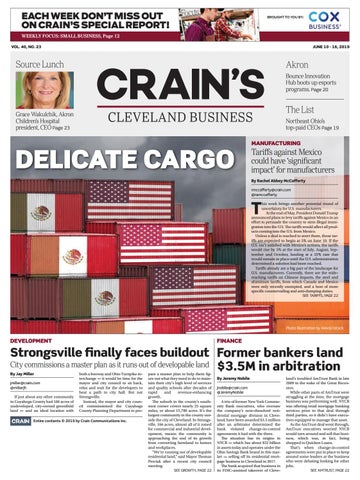
DELICATE CARGO
The List Northeast Ohio’s top-paid CEOs Page 19
MANUFACTURING
Tariffs against Mexico could have ‘significant impact’ for manufacturers By Rachel Abbey McCafferty rmccafferty@crain.com @ramccafferty
T
his week brings another potential round of uncertainty for U.S. manufacturers. At the end of May, President Donald Trump announced plans to levy tariffs against Mexico in an effort to persuade the country to stem illegal immigration into the U.S. The tariffs would affect all products coming into the U.S. from Mexico. Unless a deal is reached to avert them, those tariffs are expected to begin at 5% on June 10. If the U.S. isn’t satisfied with Mexico’s actions, the tariffs would rise by 5% at the start of July, August, September and October, landing at a 25% rate that would remain in place until the U.S. administration determined a solution had been reached. Tariffs already are a big part of the landscape for U.S. manufacturers. Currently, there are the widereaching tariffs on Chinese imports, the steel and aluminum tariffs, from which Canada and Mexico were only recently exempted, and a host of more specific countervailing and anti-dumping duties. SEE TARIFFS, PAGE 22
Photo illustration by Alexsl/istock
DEVELOPMENT
FINANCE
Strongsville finally faces buildout Former bankers land City commissions a master plan as it runs out of developable land $3.5M in arbitration By Jay Miller
jmiller@crain.com @millerjh
If just about any other community in Cuyahoga County had 166 acres of undeveloped, city-owned greenfield land — and an ideal location with
both a freeway and Ohio Turnpike interchange — it would be time for the mayor and city council to sit back, relax and wait for the developers to beat a path to city hall. But not Strongsville. Instead, the mayor and city council commissioned the Cuyahoga County Planning Department to pre-
Entire contents © 2019 by Crain Communications Inc.
pare a master plan to help them figure out what they need to do to maintain their city’s high level of services and quality schools after decades of rapid and revenue-enhancing growth. The suburb in the county’s southwest corner covers nearly 25 square miles, or about 15,700 acres. It’s the largest community in the county outside the city of Cleveland. In Strongsville, 166 acres, almost all of it zoned for commercial and industrial development, means the community is approaching the end of its growth from converting farmland to homes and workplaces. “We’re running out of developable residential land,” said Mayor Thomas Perciak after a recent city council meeting. SEE GROWTH, PAGE 22
P001_CL_20190610.indd 1
By Jeremy Nobile jnobile@crain.com @JeremyNobile
A trio of former New York Community Bank executives, who oversaw the company’s now-dissolved residential mortgage division in Cleveland, have been awarded $3.5 million after an arbitrator determined the bank violated change-in-control agreements it had with the three. The situation has its origins in NYCB — which has about $52 billion in assets today and operates under the Ohio Savings Bank brand in this market — selling off its residential mortgage business in Cleveland in 2017. The bank acquired that business in its FDIC-assisted takeover of Cleve-
land’s troubled AmTrust Bank in late 2009 in the wake of the Great Recession. While other parts of AmTrust were struggling at the time, the mortgage business was performing well. NYCB was offering retail mortgage banking services prior to that deal through third parties, so it didn’t have executives equipped to manage that asset. As the AmTrust deal went through, AmTrust executives worried NYCB would turn around and sell that business, which was, in fact, being shopped to Quicken Loans. That’s when change-in-control agreements were put in place to keep around some leaders at the business who were debating looking for other jobs. SEE AMTRUST, PAGE 22
6/7/19 3:28 PM
PA G E 2
|
J U N E 10 - 16 , 2 019 |
CRAIN’S CLEVELAND BUSINESS
Diversity is top priority for new CMBA leader By Jeremy Nobile jnobile@crain.com @JeremyNobile
For the Cleveland Metropolitan Bar Association’s new president, the coming year will involve continuing efforts surrounding diversity and inclusion, and putting action behind those words. That means capitalizing on the momentum that has been growing in recent years at the nonprofit lawyers association, said Ian Friedman, CMBA president for 2019-2020. “We have been looking at issues from every direction. We recognize the issues, benefits and history. Now, we are going to put that into play this year,” Friedman said. “What’s going to be different this year is the focus is not going to be on discussion, but more in implementation.” That perspective isn’t meant to discount the efforts that have preceded him, but rather to build on them. The CMBA has long strived to address and improve diversity in this legal market. While there’s been some improvement in the past decade or so, it’s come at a snail’s pace. A study by the CMBA from 2016 found that the profession in Northeast Ohio remains largely populated by white men, particularly in partner and top leadership positions. A separate analysis by Crain’s last year found that fewer than 20% of law partners were women, and barely 4% identified as minorities. That’s disappointing for such a culturally diverse market. But it’s not just Cleveland struggling with diversity.
According to a report from the American Bar Association last year, women made up 35% of all lawyers in the U.S. and filled just 20% of partner-level roles. Meanwhile, only 5% of all active lawyers identified as African-American. Another 5% identified as Hispanic or Latino. Just 2% were Asian. The reasons why diversity has lagged in the legal profession are numerous and nuanced. Efforts by groups like the CMBA often are geared toward quantifying those issues and spurring discussion around why the situation persists. Not every attempt to improve diversity in the field locally has panned out. One goal of the group’s Cleveland 2020 Legal Inclusion Plan involved establishing a director of legal inclusion at CMBA. That person would travel across the country promoting the Cleveland legal market and encouraging diverse people to live and work in Northeast Ohio to feed the ranks of law firms and in-house legal departments to gradually level the diversity scales. Companies and law firms seemed interested. But as the nonprofit sought a financial commitment from those groups to fund the position — it wanted $200,000 to cover the position’s salary for two years plus a healthy travel budget, which it was hoped would be spread out over 40 donors — little more than half of the organizations it needed actually came through. Even though that plan fizzled without the buy-in, CMBA executive di-
“What’s going to be different this year is the focus is not going to be on discussion, but more in implementation.” — Ian Friedman, Cleveland Metropolitan Bar Association president
rector Rebecca Ruppert McMahon said firms and lawyers still ask about the plan and where it stands. “So we know the buzz is still out there,” McMahon said. Serving before Friedman at the CMBA was assistant U.S. attorney Marlon Primes, the first AfricanAmerican president of the group. During his tenure, Primes established a memorandum of understanding with local affinity and minority bar associations — including the Asian American Bar Association of Ohio, Norman S. Minor Bar Association, Ohio Hispanic Bar Association and South Asian American Bar Association of Ohio — formalizing the goal of working together on diversity issues. So as Friedman and the CMBA move toward next steps, the organization will be looking to band together with other minority bars. “We are becoming more intentional in our efforts to be inclusive across all spectrums,” Friedman said. “But Marlon helped us put a spotlight on how critically important that value is and helped us bring some broader attention to the topic.” In collaboration with those local minority and affinity bar associa-
tions, CMBA intends to revamp its process for rating judges through the Judge4Yourself initiative, which culminates in a nonpartisan report on judicial candidates for Cuyahoga County and the Ohio Supreme Court. The group is reviewing new training procedures for the volunteer attorneys who conduct those ratings. Some of that training will focus on unconscious bias. “So here are some specific tools you can individually use when you are in the role of the interviewer so you are aware of potential blind spots and prejudices and can use this new process for a more effective rating of judges,” McMahon said. CMBA is engaging the Greater Cleveland Partnership, which conducts annual diversity and inclusion surveys with its partner organizations, to work together on ongoing surveys as an extension of what CMBA already has been doing. In addition, CMBA will host its third Midwest Diversity Career Fair in August, to be co-hosted by the Midwest Region of the National Black Law Students Association. The intention of that fair is to bring diverse lawyers fresh out of school and potential laterals to this market, poten-
tially from anywhere in the U.S. There’s still the overall goal of growing membership — which is always necessary to collect the diverse school of thought the organization needs as a voice of the legal community. The group is north of 5,000 members today, which is about steady from this point last year. There’s an intrinsic hope that Friedman’s presence as president helps further convey the diversity in legal disciplines the group wants to appeal to. He said misconception persists that the CMBA is just there to support lawyers from the corporate firm world. But Friedman, a founding partner of the small criminal defense law firm Friedman & Nemecek LLC and an adjunct professor at Cleveland-Marshall College of Law, where he teaches its course on cybercrime, certainly doesn’t fit that bill. Friedman also stressed the “onebar” mentality, which means representing all walks of legal disciplines at the CMBA in addition to various races and genders, from in-house counsel to solo practitioners to law students and nonpracticing attorneys, all while helping support all of them through education and seminars and connecting attorneys with peers and mentors who could help them. All of those efforts are part of the CMBA’s ongoing new lawyer boot camp. “Really, it’s a simple theme this year of bettering the profession and knowing when we’re done the next generation is going to have it better than we had it,” Friedman said. “That’s what it’s all about.”
L AU RI DAU N OY Perfect Plan Identifier since 2010 At Cox Business, we know a lot is riding on your success. That’s why we don’t just have Sales Reps, we have Perfect Plan Identifiers. We’ll help you choose voice solutions you can manage from any device, in or out of the office. It’s all backed by 24/7 business-class support from dedicated specialists who know business. Switch today.
You deserve more. And you can expect more from us.
SWITCH TODAY.
64
$
99
50 Mbps Internet
mo
for 12 months
*
One Line Standard Voice Unlimited Nationwide Calling
Call (877) 903–7884 or visit coxbusiness.com Ask how you can get a
$200 Cox Business VISA® Prepaid Card with a 2 or 3 Year Agreement.†
FLEXIBLE VOICE SOLUTIONS
24/7 BUSINESS-CLASS SUPPORT
FAST, RELIABLE INTERNET
Offfir finfis 8/31/19. Avfifififibfifi fio nfiw fiommfirfifififi fifififi finfi vofififi subsfirfibfirs (fixfifiufifing govfi figfinfififis finfi sfihoofis) fin Cfifivfififinfi Cox sfirvfififi firfifis. $64.99/mo finfifiufifis VofififiMfinfigfirSM Essfinfifififi wfifih unfififi nfififionwfififi fiong fifisfifinfifi finfi Cox Busfinfiss Infifirnfifi SM 50 for 12 monfihs. Prfififi fixfifiufifi fiqufipmfinfi, finsfififififififion, fionsfirufififion, finsfififi wfirfing, fifixfis, surfihfirgfis finfi ofihfir ffifis, unfifiss finfififififififi. Offfir fis nonfirfinsffirfibfifi fio fi nfiw sfirvfififi fififirfiss. “No finnufifi fionfirfififi” mfifins no spfififififififi fifirm pfirfiofi rfiqufirfimfinfi finfi no fifirfiy fifirmfinfififion ffifis. Afifi Cox sfirvfififis firfi provfifififi subjfififi fio finfi-usfir sfirvfififi figrfifimfinfis (finfifiufifing mfinfififiory firbfifirfififion provfisfions) finfi ofihfir pofififififis, whfifih mfiy bfi founfi fifi www.fiox.fiom/fiboufius/pofififififis. hfimfi. Unfinfifirrupfififi or firror-frfifi Infifirnfifi sfirvfififi, or fihfi spfififi of your sfirvfififi, fis nofi gufirfinfifififi. Afifiufifi spfififis vfiry. Rfififis finfi bfinfiwfififih opfifions vfiry finfi firfi subjfififi fio fihfingfi. DOCSIS 3.0 mofifim mfiy bfi rfiq’fi, unfifiss finfififififififi. Sfifi www. fiox.fiom/finfifirnfifififisfifiosurfis for fiompfifififi Cox Infifirnfifi Dfisfifiosurfis. Unfifimfifififi pfifin fis fifimfifififi fio fifirfififi-fifififififi fiomfisfififi fifififis finfi fis nofi fivfifififibfifi for usfi wfifih non-swfififihfifi-fifirfiufifi fififififing, fiufio-fififififirs, fifififi fifinfifir fippfifififififions finfi fifirfififin swfififihfing fippfifififififions. Phonfi mofifim provfifififi by Cox, rfiqufirfis fififififirfifififiy, finfi hfis bfifififiry bfifikup. Afififiss fio E911 mfiy nofi bfi fivfifififibfifi fiurfing fixfifinfififi powfir oufifigfi or fif mofifim fis movfifi or finopfirfibfifi. Tfififiphonfi sfirvfififis firfi provfifififi by fin fiffififififififififi Cox finfififiy. Sfirvfififis firfi nofi fivfifififibfifi fin fififi firfifis. Dfisfiounfis fifin’fi bfi fiombfinfifi or fififififi wfifih ofihfir promofifions nor fippfifififi fio finy ofihfir Cox fififiounfi. †Vfisfi prfipfififi fifirfi offfir rfiqufirfis fi 2 or 3 yr. fionfirfififi finfi fis fivfifififibfifi wfifih qufifififyfing nfiw sfirvfififis orfifirfifi finfi fifififivfifififi bfifiwfifin 5/1/19 finfi 8/31/19. An fifirfiy fifirmfinfififion ffifi mfiy fippfiy fif 2 or 3 yr. fionfirfififi fis fifinfifififififi. Musfi mfinfifion “rfiwfirfi promo” whfin pfifififing orfifir. Afifiounfi musfi rfimfifin fifififivfi, bfi fin goofi sfifinfifing, finfi rfifififin fififi sfirvfififis for fi mfin. of 30 fifiys fiffifir finsfifififi. Onfifinfi rfififimpfifion rfiq’fi by 9/30/19 finfi musfi fofifiow finsfirufififions rfifi’fi fiffifir sfirvfififi fifififivfififion. Lfimfifi onfi fifirfi pfir fiusfiomfir, fiofififi nofi fio fixfifififi $200. Afifiow 15 fifiys fiffifir rfififimpfifion for fifififivfiry. Cfirfi fis fissufifi by MfififiBfink,® Mfimbfir FDIC, pursufinfi fio fi fifififinsfi from Vfisfi U.S.A. Infi. No fifish fifififiss or rfifiurrfing pfiymfinfis. Cfin bfi usfifi fivfirywhfirfi Vfisfi fifibfifi fifirfis firfi fifififipfififi. Cfirfi vfifififi for up fio 6 monfihs; unusfifi funfis wfififi forffififi fiffifir fihfi vfifififi fihru fifififi. Cfirfi fifirms finfi fionfifififions fippfiy. Ofihfir rfisfirfifififions fippfiy. © 2019 Cox Communfififififions Infi. Afifi rfighfis rfisfirvfifi.
P002_CL_20190610.indd 2
6/7/19 3:27 PM
CRAIN’S CLEVELAND BUSINESS
|
J U N E 10 - 16 , 2 019
|
PA G E 3
UH adopts patient financial bill of rights By Lydia Coutré lcoutre@crain.com @LydiaCoutre
Hospital billing can, for many patients, be a confusing practice, from multiple bills for one visit to the challenge of understanding what they’ll have to pay out-of-pocket. In a step toward transparency, a Jan. 1 Trump administration rule required hospitals to post extensive lists of their charges for various services and procedures. Many hospitals are going further. University Hospitals is working to implement a patients’ financial bill of rights, a list of 10 tenets guiding its billing and financial services toward a more consumer-friendly process. “In addition to receiving the highest quality of care for their needs, it’s important to recognize the business care they’re receiving as well,” said Euthemy LeBrew, UH's vice president of revenue-cycle management and patient access services. A 2018 article written by emergency-room-doctor-turned-journalist Elisabeth Rosenthal laid out nine rights every patient should demand. Starting with that framework, UH came up with 10 tenets, including the right to an itemized and accurate bill in plain English; the right to never receive a surprise out-of-network bill; the right to be informed in advance of any facility fees; and more. “I would characterize this as part of our patient-centric focus in health care and as UH putting the patient and family first in everything that we do,” LeBrew said. “And as well as a major focus in patient and community advocacy.” Implementation of the bill of rights, which has already been launched by UH’s executive team, will be continuous and evolutionary, with the possibility of adopting more rights during the process. LeBrew said the effort is part of a “natural progression to consumerism.” “As health care providers, as we have moved toward standardization in care, in our data capture, in our services, in our translation — that is moving us quickly to align to how retailers or outside industries, private industries, have been better able to address consumerism.” Summa Health is working on developing a formalized patient financial bill of rights as well, according to a statement from its senior vice president and chief financial officer, Keith Coleman. While that work is underway, the system is “already committed to the basic tenets of such a document,” he said in the statement. For example, the system works with patients to ensure they easily understand itemized bills and their rights to obtaining accurate information about the providers covered in their insurance plan. “In addition, our existing financial assistance policy is distinctly intended to aid those patients who may need help in affording the medical care we provide. Our patient payment estimator also helps minimize the possibility of a patient being surprised by an out-of-network bill,” Coleman said in the statement. A Cleveland Clinic spokesperson said the system doesn’t have a financial bill of rights, but is addressing some of the same initiatives. Southwest General also doesn’t currently provide such a bill of rights, but encourages patients to take advantage of tools it provides, including a patient bill estimator, financial assistance, patient price list and discounted programs for insured patients.
P003_CL_20190610.indd 3
“In keeping with our mission tenets of health, quality and compassion, Southwest General offers our patients and visitors many resources and tools via our website to assist them with making informed decisions about the care they receive,” said Albert Matyas, vice president for ambulatory operations and business development for Southwest General, in a prepared statement. Several years ago, University Hospitals implemented a process to provide patient estimates on demand, looking at medical coding, benefit plans and cost to provide the patient with an out-of-pocket estimate. It’s become a widely used tool at the system. By the end of the year, UH aims to move that service to a new platform that will enable an online, digital self-service por-
tal that will make it a lot easier and more accessible for patients to get an estimate, said Brent Carson, UH’s vice president of managed care. “It’s a good model that we have today, but the challenge is it’s very labor-intensive,” he said. “It requires somebody to input information in the system and get information back from the insurance company and then relay that information to the patient, whereas this is more of an automated approach.” The move online is just one example of the system’s integration of the patient financial bill of rights. Akron Children’s Hospital, which doesn’t have a formalized patient financial bill of rights, is also working on automating its cost estimator and upgrading from its current manually
intensive process. Within the next few months, patients will be able to go online, enter information and the system will calculate their out-ofpocket costs and provide it back without a human being on the other end, making it more real-time for the patient, said Ken Morgan, director of access for Akron Children’s. The price-transparency rule implemented at the start of the year only tells patients the charge for a service, not what their out-of-pocket responsibility is, which is ultimately what patients are looking for. Systems like this can provide that. “Honestly, health care billing and collection is bewildering to most patients,” Morgan said. “And so we’re trying to get rid of that bewilderment and make it easy.”
UH’s Patient Financial Bill of Rights 1. An itemized and accurate bill in plain English 2. Never receive a surprise out-of-network bill 3. Accurate information about your insurance plan’s provider network 4. A stable network 5. Be informed of conflicts of interest 6. Be informed in advance about so-called facility fees 7. Be informed of lower-cost options 8. Be assured that a disputed bill will not be sent to a collection agency 9. See a price list for elective procedures 10. Patient’s right to guaranteed appointment access at the right time, the right place and with the right person
Business Banking Changes Today. Imagine a business bank... That cuts the red tape and gets you fast decisions Where you work directly with bank decision makers, from start to finish Where everyone, including the bank president, is accessible to all clients Where you can get a loan without the approval of a committee
Company Overview Assets: $3.3 billion Deposits: $2.66 billion Capital: $275 million
To learn more, visit ERIEBANK.bank.
Wesley H. Gillespie Regional President Wesley.Gillespie@ERIEBANK.bank Ph. (440) 205-8100 Commercial offices in Mentor, Ashtabula and coming soon, Cleveland.
MEMBER FDIC
6/7/19 2:55 PM
PA G E 4
|
J U N E 10 - 16 , 2 019 |
CRAIN’S CLEVELAND BUSINESS
How Daniel Walsh, and his investors, are making money YOUR LOCAL CREDIT UNION
By Jeremy Nobile
GOES THE DISTANCE
jnobile@crain.com @JeremyNobile
FOR YOUR COMMERCIAL REAL ESTATE INVESTMENT, CALL US TODAY. Your Business Lending Partner SM • Commercial Estate Loans up to $10 Million • No Prepayment Penalties • As Little as 10% Down
Contact Jonathan A. Mokri 440.526.8700 jmokri@cbscuso.com www.cbscuso.com
Former Bank Building 1977 Cooper Foster Park Road, Amherst, OH 44001
PROPERTY OVERVIEW
• 2,592 SF Bank Building with Drive Thru, in the Heart of Commercial District • 1/2 Mile from State Route 2 • 18 Surface Parking Spaces • Sublease through June 2022 • Offered for Sublease at: $12.00/SF, NNN Steve Burns www.hannacre.com
Julie I. Sabroff, CCIM
216.861.5581
216.839.2029
SteveBurns@HannaCRE.com
JulieSabroff@HannaCRE.com
Providing a private travel experience that exceeds expectations
Former Cleveland banker Daniel Walsh’s private equity real estate investment fund Citymark Capital marked a milestone recently as it sold half the assets in its first fund for some sizable returns. But the fact the portfolio engaged buyers from large institutional investors like The Blackstone Group may be the most telling takeaway for what it says about the future of the real estate market and Citymark’s strategy for making money in it — even when the markets see another downturn. The Cleveland firm specializes in buying multifamily apartments, potentially anywhere in the United States. Walsh said Citymark has been pitched on more than $10 billion worth of deal flow over some 700 deals vetted so far since its first fund formed in 2016. But the investment strategy calls for doing that in markets that meet specific criteria. Among them, at least $1 billion in apartments sales annually, strong population growth plus average rent costs lower than other markets — and competing nearby properties — when compared to incomes. The acquired properties are improved with the help of operating partners such as InterCapital Group, which may do anything from upgrading floors and countertops to adding new common areas and community events, all before increasing rent (but keeping it below roughly one-third of renter income on average). “From an affordability standpoint, we’re going in, improving the interiors, improving the amenities, putting in new exercise facilities, fixing up the pool, adding firepits and creating a sense of community,” Walsh said. “And then we bring in professional managers to program it.” The properties then are sold off for what so far, Walsh said, have been market-beating returns, though he declined to disclose specific details. The recent asset sale included three of six apartment complexes acquired by the first buyout fund, which closed around $80 million. They comprised properties in Las Vegas (Vintage Pointe), Atlanta (Sweetwater Creek) and Phoenix (West Town Court) that were sold for $138.8 million. “We feel like we are creating portfolios to sell to global buyers,” Walsh said. Citymark has already been working on raising its second apartment buyout fund, which has a maximum size of $250 million, according to filings, but is targeting $150 million. A couple of deals already have been made through that.
Secret sauce
HOW TO FLY WITH SKY QUEST: » On-Demand Charter » Jet Card Memberships » Aircraft Ownership Opportunities
P004_CL_20190610.indd 4
FlySkyQuest.com 216-362-9904 Charter@FlySkyQuest.com
Citymark most closely vets deals for apartments in the top 50 up-andcoming real estate markets where incomes are growing faster than rent. That includes states such as Nevada, Texas, Arizona, Georgia and Florida. Walsh and his director of investments, Jerel Klue, most specifically seek out value-add apartments with at least 300 units of a 1990s vintage or newer, then select an operating partner like InterCapital to manage the facilities. “It never fails that if we take a good
Sweetwater Creek in Atlanta is one of the apartment complexes bought, improved and sold by Citymark Capital. (Brad Bell Photography)
property and make it nicer, people are willing to pay a little more to live there,” said InterCapital CEO Edward Biskind. InterCapital is key because of its Walsh wide portfolio, which offers the scale for completing renovations at a market discount. “The nice thing is, since we don’t have 30 offices around the country trying to build these portfolios, we can rely on those operating partners to help us build a diversified portfolio both geographically and by sponsor,” Walsh said. Property values increase as renovations are made and rents rise, though never beyond one-third of the market for renters’ average income. That, Walsh said, helps increase the likelihood that tenants don’t move out. Citymark typically acquires properties where occupants are spending 21% of income on rent. Other real estate investment groups will take a similar approach, but they don’t usually focus so specifically on those value-add, multifamily apartments the way Citymark does. “It’s a niche we carve out we think we are the most effective at executing in,” Walsh said. The sweet spot for Citymark are deals between $25 million and $100 million, which is not the top end on which larger funds are focused, but is bigger than the deals buyers in local markets typically go for.
Why multifamily units? For one, they tend to be highly insulated from interest-rate movements since leases are usually between six and 12 months. In the event of rate increases, rents can be raised more easily as compared to units with much longer terms of several years or more that would be locked in. Several other economic factors could create some tailwinds for the Citymark strategy as well. Walsh pointed to economists who say today’s average renter is 32 years old. More people in that range will be moving through the economy in the next decade, increasing the potential supply of renters with families. That’s fueling construction of multifamily apartments. “What we are really seeing across this cycle more than the last has been development of high-end apartment projects,” said Ryan Reid, vice chairman with real estate investment
group CBRE Group. “There is a large number of folks who cannot afford single-family homes, so that really fills a niche of what most cities in America need: affordable housing.” Meanwhile, if a recession occurs in that time, which is all the more likely when considering the prolonged economic growth seen at this point in the cycle, that might lead to an increased supply in renters as well. That’s all the more relevant for Citymark, which tends to invest in Class B properties. If a recession hits, people in Class A properties might move down to the B class. There are also more people exiting college and more people heading toward retirement, which bodes well for the renting trend. “So if you think about the next 10 years and the possibility of some kind of recession, our demand is built in in such a way that the apartments should perform very well,” Walsh said. “They will stay full. And we’ll be able to distribute cash flow to investors during that time.”
What about Cleveland? Walsh is essentially re-creating an investment business he built at KeyBank 20 years ago. He worked at Key for 13 years before joining Huntington Bank in 2010 as Cleveland market president, a position he left in 2015 to start Citymark. Walsh said he’d love to do some kind of deal in Cleveland, but the market simply doesn’t fit his investment criteria right now. There isn’t $1 billion in apartment sales in Cleveland (though Columbus recently hit that mark) and there aren’t many large, institutional buyers for what Citymark would be selling. That could eventually change as the apartment supply builds up. Walsh pointed to projects such as The Lumen at Playhouse Square — which has been described as the largest residential project in downtown Cleveland in four decades — and the mixed-use high rise at One University Circle as examples of that. He did indicate he has eyes on the Opportunity Corridor, but it’s much too early to evaluate what might play out there. “I’m excited for Cleveland, and I do think there is opportunity there that could accelerate (that path to $1 billion in annual apartment sales),” Walsh said. “It’s a more long-term investment because you can’t sell it if you want the full tax benefit. But it could seed the apartment stock for the next generation to get Cleveland to an institutional level.”
6/7/19 2:56 PM
CRAIN’S CLEVELAND BUSINESS
|
J U N E 10 - 16 , 2 019
|
PA G E 5
NEO agency has All-Star addition in Oladipo By Kevin Kleps kkleps@crain.com @KevinKleps
Aaron Turner takes a lot of pride in the fact that all but four of Verus Management Team’s 19 professional basketball clients weren’t drafted. Turner, a former hoops player at Orange High School in Pepper Pike, is a grinder who is such a proponent of player development that he wanted to be a coach or general manager after he graduated from Indiana University. The first basketball player Turner represented as an agent was JaKarr Sampson in 2014. The Cleveland native wasn’t drafted after two productive seasons at St. John’s University, but he’s gone on to appear in 173 games for four teams during a five-year NBA career. A year later, another Northeast Ohio native, Terry Rozier, became the first Verus client to be selected in the first round when the Boston Celtics took the former University of Louisville standout 16th overall. Turner, now 33, had developed a relationship with Rozier when the guard was playing for Shaker Heights High School. “That’s how we built this,” Turner said of Verus, which is based in Mayfield Heights. “The first guy was JaKarr. Terry was under the radar, really. We find guys. We do an unbelievable job of finding value in players that other guys might not see the value of.” In each of the past two years, though, Verus — whose basketball division was co-founded by Turner and Gregg Levy, a Cleveland attorney
Two-time NBA All-Star Victor Oladipo, third from the left, is shown with, from left, Verus’ Aaron Turner and Gregg Levy, plus Jay Henderson, Oladipo’s manager. (Contributed photo)
and entrepreneur — has landed a pair of high draft picks. The first was Kevin Knox, another Louisville product who was selected ninth overall by the New York Knicks in 2018. And in April, Verus teamed up with Victor Oladipo, a two-time All-Star who was the second pick of the 2013 draft. “Signing Oladipo was surreal,” Turner said. “It changes everything.” What it doesn’t change is Verus’ focus on forging relationships with players who are highly unlikely to join Oladipo and Knox as lottery picks, and giving them the advice and resources to have a successful pro career. When Turner and Levy, a principal with McCarthy, Lebit, Crystal & Liffman Co. LPA, spoke with Crain’s on
June 6, they were hosting almost a dozen of their clients in Miami. There, they provided training, coaching, housing and gym time for a collection of players that ranged from G League prospects to Rozier, who, as a potential restricted free agent with the Celtics, has entered a critical offseason. “These guys are not just our players or clients,” Levy said. “They’re our partners. We invest in them. The economics of the NBA, we make our money (via commission) on second contracts. You sign with us, we invest in you, and we continue to invest in you.” Oladipo, who has flourished since being traded by the Oklahoma City Thunder to the Indiana Pacers in 2017, is the first Verus client to be at that stage of his career. The 27-year-old
PRIVATE SCHOOL PLANNER
guard is entering the third season of a four-year, $84 million deal that was negotiated by Creative Artists Agency. The Indiana connection shared by Oladipo, Turner and Levy (who also earned his bachelor’s degree as a Hoosier), combined with Turner’s brother attending the university during the same time as Oladipo, helped Verus land its most notable client yet. Oladipo, who signed a deal with William Morris Endeavor Entertainment for representation beyond basketball in 2018, has off-the-court interests that “run like a machine,” Turner said. The agent’s primary duties for a guard who suffered a season-ending knee injury last January center on development. “It’s more prepping him for the next phase of his career,” Turner said. “What’s your strategy to improve? He liked the ideas we have for that.”
‘Nonstop’ time of year Levy — whose collection of interests includes serving as the managing partner of YLT Red, the LLC that operates Red, the Steakhouse’s downtown Cleveland location — met Turner when the latter served as Levy’s caddie at Beechmont Country Club in Beachwood. Turner and a former business partner would go to Levy for advice and eventually a loan that would lead to the launch of Verus. Once Levy took that step, though, he wanted a piece of the action, and he serves as the firm’s CEO. Turner is the president of basketball for a company that, including the co-founders,
has seven employees. In addition to Oladipo, Rozier and Knox, Verus’ client list includes Derrick Jones Jr., Antonio Blakeney and Ray Spalding. The latter was a late second-round pick in 2018 — one of the four draft picks on Verus’ roster. Jones, who appeared in 60 games for the Miami Heat in 2018-19, and Blakeney, who appeared in 57 contests for the Chicago Bulls, are undrafted players who have shown promise and are each scheduled to make about $1.6 million next season. Eleven of Verus’ clients played for NBA teams in 2018-19. Turner hopes the total will increase to 13 or 14 next season. The group could include Jared Harper, an undersized guard who signed with Verus after helping lead Auburn to the 2019 Final Four. “I was training a lot of guys before I got certified (as an agent),” Turner said. “We have a niche here that is kind of unique. I had built relationships with guys who had put a lot of time in at the gym. That opened everything up.” June, when prospects are preparing for the NBA draft, and July, when the league’s new year tips off, are the craziest times on an agent’s calendar. It’s a huge offseason for Rozier, who will be a restricted free agent if Boston extends a qualifying offer by the June 29 deadline. Should that happen, the guard can receive offers from any team as a restricted free agent, and the Celtics would get a shot to match the deal. “It’s nonstop,” Turner said of this time of year. “I don’t have a better word for it. It’s a seasonal business. The season to me is easy. There are way less curveballs going on.”
T
his guide will explore education opportunities in Northeast Ohio and examine ways to plan for your child’s future. Use this advertising opportunity to showcase your educational institution.
ADVERTISING INFORMATION: Lisa Rudy • lrudy@crain.com ISSUE DATE: Aug. 26 • AD CLOSE: July 12
VIEW THE 2018 PRIVATE SCHOOL PLANNER: CrainsCleveland.com/psp18
P005_CL_20190610.indd 5
6/6/19 4:39 PM
PA G E 6
|
J U N E 10 - 16 , 2 019 |
CRAIN’S CLEVELAND BUSINESS
NEO native to lead Dayton firm from here By Stan Bullard sbullard@crain.com @CrainRltywriter
Dayton-based Shook Construction’s new president is Chris Halapy, previously an executive vice president in the general contractor’s Brecksville office with more than 20 years of experience at the company — all the while located in the Cleveland market. Moreover, Halapy will remain based in Cleveland even though all of his predecessors at the helm of the company climbed the company’s ranks over years in its Dayton headquarters. Bill Whistler, Shook’s president and CEO until Halapy became president on June 3, said he felt Hala-
py was the right person for the job and it was time to reflect the company’s growth and maturation by elevating a senior leader from outside Dayton. “Our goal as a company has been to make these non-events from the outside,” Whistler said in a Halapy phone interview. “We discussed moving to Dayton with (Halapy), but it was not the right time in his life for the move. We also didn’t want to make him make a lifestyle change for this opportunity. That’s not where our head went.” Whistler said he chose to move Halapy up and lead from Cleveland because it’s the right time for the company to do so, as it now has offices not
®
P006_CL_20190610.indd 6
only in Dayton and Cleveland but also Columbus and Raleigh, N.C. Outside consultants also said the move would benefit morale throughout the company. “This sends a really strong message to people in any of our offices that you could someday run the company without having to be in the Dayton ZIP code,” Whistler said. He also chose Halapy to begin the process to succeed him because Halapy has strong critical-thinking skills and “super-high” emotional intelligence. “We’ve always valued critical thinking, but in the last half-decade have begun to value emotional intelligence,” Whistler said. “The fact is it’s a people business. If you can’t con-
nect with people, you will not be successful.” For his part, Halapy said during an interview at the company’s Snowville Road office that he thinks “everyone in the company’s offices should feel a lift from this.” Of course, Halapy climbed the ranks, including launching his career at Shook during an internship while he was getting his civil engineering degree at the University of Dayton. His most recent job has had him overseeing Shook’s vertical construction segment, which makes sense for a company with a big part of its work, especially in Northeast Ohio, as a contractor for wastewater treatment plants. That meant he focused on health care, education, industrial and mission-critical projects such as data centers.
As president, Halapy will serve as the company’s chief operating officer, allowing Whistler to focus on strategic planning while continuing to oversee financial and safety operations for the next several years. The past few years in Cleveland, Shook has made gains in the so-called vertical markets as well as maintaining its piece of the wastewater market. “We’re hoping I can find that magic with some of our other newer offices that are more focused on wastewater at this point,” Halapy said. He said he’s been an active board member at multiple trade organizations in Northeast Ohio, in part to promote the Shook name here. He’s on the board of the Construction Employers Association (CEA) of Northeast Ohio, a board member for the Association of General Contractors of Ohio trade group and active with the Cleveland Engineering Society, the Association for Healthcare Engineering and Cogence Alliance, a Cleveland group focused on improving the culture of the architectural, engineering and construction business. Tim Linville, CEA CEO, said in a phone interview that he has not previously seen anyone from the Cleveland office of a construction-related firm based elsewhere become a C-suite executive while remaining here. However, he’s not surprised after watching Halapy on CEA’s board for years. “He’s been actively engaged since he went on the board. He gets involved in our strategic planning and other efforts for the betterment of the industry,” Linville said. Halapy, he added, demonstrated leadership skills by finding board members who can benefit the organization and helping them find meaningful tasks. “I don’t know about his work for Shook, but I’ve watched him recruit talent and get them engaged. I think that shows leadership skills,” Linville said. Halapy does have the University of Dayton connection, which led him to Shook. The father of one of his housemates while Halapy was at Dayton helped him gain entry to Dayton construction outfits for an internship that connected him with Shook for the first time. “All these people who weren’t returning my calls about an internship got back to me after he contacted them,” Halapy said. “That was my introduction to the value of networking.” He was looking for a Dayton slot because he hadn’t found one in Northeast Ohio that allowed him to spend the summer living at home. “They said, ‘We’ve got an office in Brecksville’ and sent my stuff here,” Halapy said. “This office is near my parents’ home. If I got stopped by a traffic signal during the internship or my first few years, my commute doubled in length.” Halapy said the reality is that he will continue to travel I-71 regularly as president, as he has while an executive vice president. However, with online services such as Skype he can converse directly with staffers in other locations with a document on another screen. The lifestyle side of Halapy’s remaining in Cleveland is that he lives in Willoughby and he and his wife have two children under 10. Shook has about 40 salaried personnel in Brecksville and 160 firmwide. Its revenues, including cost of construction put in place, were $230 million in 2018 and are forecast to top $300 million this year.
6/6/19 11:45 AM
CRAIN’S CLEVELAND BUSINESS
|
J U N E 10 - 16 , 2 019
|
PA G E 7
Saturday, June 22nd, 2019 at 2:00pm The Foundry & Destination Cleveland Present
Burning Rivers
A Talk on Overcoming Man’s Destructive Effect on the Great Lakes Ecosystem
Speaker: Dr. John Hartig, Great Lakes Institute for Environmental Research at the University of Windsor, visiting scholar
This talk is free and open to the public. Advanced registration is required. Free parking at the Foundry.
Register today at clevelandfoundry.org ∙1831 Columbus Road, Cleveland, OH. 44113∙
John_Hartig_CrainsAd_v2.indd 1
6/3/19 4:17 PM
FOR PRESTIGE AND ELEGANCE, The Shelby Co. designs packaging for a variety of products. (Contributed photo)
Shelby Co. starts to look outside the box By Rachel Abbey McCafferty rmccafferty@crain.com @ramccafferty
The Shelby Co. must have done something right to stay in business for 96 years. Still, its leaders know that if it wants to make it another 96, the company has to keep evolving. Shelby is a small packaging company mainly serving northern Ohio. It got its start in 1923 in Shelby, Ohio, but moved to Cleveland in the 1930s, at the request of one of its customers, said president and owner Richard J. Rapacz. In 1968, it moved to its current location in Westlake. Shelby can do everything from designing packaging to printing graphics to cutting and scoring containers. The company can also perform some assembly for customers, such as gluing edges, before packing up and sending out the finished products. It employs about 30. The work hasn’t changed, but in the past year, the company has. There have been changes to management, promoting Matthew Tousley to executive vice president and hiring a new general manager and controller. The latter two positions were filling vacancies, but the new hires have brought new ideas to the company and “re-energized it,” Rapacz said. The executive vice president role is a new one for Shelby. Rapacz doesn’t have any immediate plans to retire, but he views these changes in management as planning for the future. And he intends for the company, which has always had private ownership, to stay in the hands of the employees in some way. Tousley took on the role of executive vice president in September, having been with Shelby for about 14
P007_CL_20190610.indd 7
years, starting as a package engineer before moving into a sales role. While Tousley has a vision for the company that aligns with Rapacz’s, he also sees room for growth. Tousley said he has a more “aggressive” approach to the business, “based on a very good working knowledge of this business and what we should be able to do.” Before joining Shelby, Tousley worked at CardPak Inc., where he saw a similar transition, and growth, take place after a new owner came in. Rapacz declined to share annual sales, but said he expects Shelby’s sales to grow by about 15% to 20% this year. Operating more efficiently and finding ways to produce more in the same amount of time will be a significant part of that growth. “So it starts with a cultural change with the company,” Tousley said. In recent months, Shelby has been working to better organize its plant floor, making small upgrades such as painting the beams in the building so workers can more easily identify the ones where fire extinguishers are mounted. This work started with the arrival of general manager Jeff Pascarella, who joined the company in September. Shelby also been investing in new equipment to make the plant more efficient and cost-effective. This includes a new ink-mixing system that lets the company mix its own inks on site and new taping equipment that eliminates the need to tape boxes by hand. Establishing baseline safety and quality standards came first, but the company is also looking to increase productivity, Pascarella said. And there’s a stronger focus on data than in the past. “If you don’t know where you’re at, you don’t know what you need to improve,” Pascarella said.
In many ways, the company is working to take the longstanding business into the 21st century. Tousley said the company is working to update its website and make a stronger push into social media to attract customers. In the past two to three years, the company also has embarked on a more aggressive marketing mail campaign that has seen success, Rapacz said. Just so far this year, the Shelby Co. has added almost 20 new customers. About three-quarters of the company’s business is in retail, Rapacz said, with the rest in the wholesale business. In those spaces, it serves everything from cosmetics to pharmaceuticals to toys to restaurants. Caruso’s Coffee in Brecksville has used Shelby for about five years, said co-owner Dominic Caruso. The company makes the containers Caruso’s uses for its single-serve coffee pods. And they’ve been satisfied with the service. Caruso said Shelby is competitive in terms of cost and has “great quality control.” Customer service, especially from the art department, is fast and responsive. The majority of Shelby’s customers are in northern Ohio, Rapacz said, but there are some the company works with in nearby states like Pennsylvania and Michigan. “By being closer to the customers, you can provide better service,” he said. One quality Rapacz looks for when he’s hiring people is empathy. That’s in the interests of the other employees at Shelby, but it’s also an important quality when it comes to customer service. And that’s something on which Shelby prides itself. “When that telephone rings, it’s, ‘How can we be of help?’ And it’s not, ‘How can we be of help because you’re a customer of ours, because you’re giving us something,’ ” Rapacz said. “It’s because that’s the way we treat people.”
THINK FIRESTONE COUNTRY CLUB.
Firestone Country Club is an exclusive, prestigious private club that welcomes Members and guests alike to host events in our famed clubhouse. BOOK YOUR SPECIAL EVENT TODAY. 330.644.8441 | firestonecountryclub.com © ClubCorp USA, Inc. All rights reserved. 44574 0419 BB
6/6/19 11:46 AM
PA G E 8
|
J U N E 10 - 16 , 2 019 |
CRAIN’S CLEVELAND BUSINESS
Growth is on the menu for NEO’s food sector By Jay Miller
feet of space along Carnegie Avenue at East 75th Street for a little more than a year, and it’s already planning to grow, jmiller@crain.com said owner Eric Diamond. Before that, @millerjh it spent five years in smaller quarters What started as a shared kitchen at 2800 Euclid Ave. as an incubator for and food incubator called the Cleve- food businesses. The demand from a land Culinary Launch and Kitchen is growing number of area food busigrowing by leaps and bounds as it nesses for freezer and refrigerator tries to meet the demand for space to space is fueling growth. store food products. Its growth is just “Storage of food is an issue in one indication of the burgeoning town,” Diamond said. “It’s not only food and beverage processing indus- space but specific kinds of space. It’s space to produce (food products) but try inw Northeast Ohio. also 10:43 freezer and space.” The business, now called Central 03-07John S Grimm.qxp 2/23/2016 AM refrigerated Page 1 He said he built 7,000 square feet Kitchen, has occupied 138,000 square
SALT • SALT • SALT • Water Softener • Industrial • Food • Ice Melt • Sea Salt
Call For Pricing!! Minimum Delivery:1Pallet
of cooler and freezer space a year ago and leased it out in 60 days. According to a newly released report from Team Northeast Ohio, the regional business attraction and expansion nonprofit, food and beverage manufacturing was a $3.02 billion business in the 18-county Northeast Ohio region in 2018, growing 85% in the past decade, compared to 46% growth in the category in the U.S. economy. Employment by the more than 370 food processing operations in the region has grown by 5,000 between 2007 and 2018, to 23,300, an increase of 29%. Food and beverage manufacturing was the focus of Team NEO’s quarterly economic review, which found that total employment in the region in the third quarter of 2018 hit 1.95 million, the highest third-quarter count since 2008. Food and beverage manufacturing does not attract from the financial and civic communities the attention that the health sciences or technology sectors do, but the gobbling up of cold storage space is a reflection of its importance to the region, especially its employment growth. It’s a sector that runs from farm to table in North-
east Ohio, as consumers move away from canned goods to more prepared convenience foods with fewer preservatives, and families and restaurants alike are turning more and more to locally sourced fresh foods. Employment in most areas of manufacturing in the region has seen ups and downs, noted Jacob Duritsky, Team NEO’s vice president for strategy and research, but the food sector has enjoyed steady growth. Team NEO forecasts food sector jobs will grow by another 6% between 2018 and 2023, slightly faster than the national forecast of 5%. “Food has been the one consistent sector of manufacturing that continues to add net new jobs to the manufacturing economy,” Duritsky said. “You saw it in chemicals for a while, saw it in steel for a while, saw it in automotive, but those have flattened to some degree. But food manufacturing continues to add new employment.” Ohio is a major food processing state, said Joe Needham, director of food and agribusiness for JobsOhio, the state’s economic development nonprofit. Agriculturally, Ohio is a major poultry and dairy producer, Needham added. The Buckeye State is the
No. 1 U.S. producer of Swiss cheese, No. 2 in egg production and No. 3 in tomato processing. Northeast Ohio is a major processor of chickens, eggs and dairy products. The region’s food processors range from Nestlé USA, whose Solon operation is headquarters for the company’s frozen and chilled foods, including the Stouffer’s brand; to J.M. Smucker Co., which is headquartered and processes fruit spreads, syrups and ice cream toppings in Orrville; to Randy’s Pickles, a small, 5-year-old pickle packer that has outgrown the Cleveland Culinary Launch facility to move into its own processing plant in Cleveland’s Midtown neighborhood. The region’s producers also include Daisy Brand LLC, which opened a plant in 2016 to make sour cream in Wooster and added cottage cheese a little more than a year later, and Great Lakes Cheese Co., one of the largest cheesemakers in the United States. It employs 650 people at its headquarters and plant in Geauga County and just embarked on a $180 million expansion that will add 400 jobs and 290,000 square feet of warehouse and manufacturing space and a new corporate headquarters.
Nightsweats & T-cells finds real work-life balance By Paris Wolfe clbfreelancer@crain.com
1-800-547-1538 Salt Distributors Since 1966
Innovative Legal Counsel for Today’s Business Client PRACTICE AREAS Real Estate Hotel & Hospitality Business & Corporate Banking & Finance General Counsel
J.D. | M.B.A.
www.helonlaw.com
216.978.7463
P008_CL_20190610.indd 8
www.helonlaw.com
While some of Gil Kudrin’s biggest clients are in New York City, over the next five years the owner of Cleveland’s Nightsweats & T-cells screenprinting company will be focusing more on his hometown. Building business here will help him create work for a population that has difficulty finding and keeping jobs. Kudrin is director of development for Nightsweats & T-cells, a company on the near West Side that employs four to six HIV-positive workers to provide custom screen-printing and design work. In addition to T-shirts, they decorate promotional materials such as cups, bookbags, pens and more. In the past, the company has done most of these products for AIDS service organizations and special events such as Broadway Cares. Now, it’s striving to add more mainstream businesses to its customer roster. “Like any other small business, if you’re not growing, you’re regressing,” said Kudrin. “In recent years, the HIV community has changed a great deal. You don’t see the same number of AIDS walks and so our clientele has shrunk. We’ve had to think about what we will do going forward. Reaching out to mainstream corporate business is part of that plan.” The company’s most recent annual revenue was $310,000, “but we have capacity to scale twice that in a given year,” Kudrin said. Bringing in more work means more jobs for a population that needs flexibility as they live with symptoms and medication side effects that can sometimes be debilitating and interfere with a traditional workweek. Nightsweats & T-cells can be flexible because the workplace community has a number of employees available to pick up any slack. Making a profit is just part of the mission — saving lives is the other part. Employment can actually lengthen the lives of those with
Kudrin Screen-printing company Nightsweats & T-cells has branched out in recent years to include clients like Adobe. (Contributed photo)
chronic conditions, said Kudrin, citing studies that have shown greater longevity for people who were able to remain meaningfully employed. “It’s not rocket science,” he added. “If you give people reasons to get out of bed, they’re far more likely to do that.” Diagnosed himself in the mid1980s, Kudrin has outlived his life expectancy from that time and shows no signs of slowing down. Medical advances have certainly helped, but he said, “The company has saved my life. I’ve gotten out of a hospital bed because I had something to go back to.” The company’s mission statement says, “We believe that while we remain creative and productive, on the days that we are physically able, we will remain vital and healthier for longer periods of time.” “It’s amazing to be here and be able to make a difference in the world,” Kudrin said. Organizations such as the Cleveland Clinic and KeyBank include
LGBT-owned businesses in their diverse-supplier strategies. “Our objective is that suppliers reflect our customers, employees and communities,” said Camille Bragg, vice president, supplier diversity, for KeyBank. Nightsweats & T-cells has its minority ownership certified through Plexus LGBT & Allied Chamber of Commerce. While that verifies its status, it also helps with networking. “We just brought in a job from a big accounting firm,” noted Kudrin. “Our certification made them aware of us. Given the current political climate, a lot of doors are closing. It’s important we have people helping open those doors.” He added that being gay-owned is hardly the only reason firms hire Nightsweats & T-cells. “After 30 years, we’re really good at what we do,” he said. “There’s a reason that the senior creative director of Adobe and other creative companies do business with us, because we’re good.”
6/6/19 3:25 PM
CRAIN’S CLEVELAND BUSINESS
|
J U N E 10 - 16 , 2 019
|
PA G E 9
NORA finds home at former neighborhood center By Stan Bullard sbullard@crain.com @CrainRltyWriter
As Anita Bradley, executive director of Northern Ohio Recovery Association, walks through the rooms and halls of the former Goodrich-Gannett Neighborhood Center in Cleveland, she points to one room she plans to have split up into offices for counselors, another that will become a training center and another that will become an activity center for teens. The seemingly endless list prompts the question of how she can come up with such a long menu of potential uses and programs. Bradley said needs are so great because of the “tsunami of drugs in our neighborhoods.” The nonprofit also stands to give the building, which was constructed in 2008, a fresh start after a troubled history when it completes the proposed purchase for $850,000. Bradley’s NORA has agreed to buy the former neighborhood center at 1400 E. 55th St. as a new office for her 14-year-old firm’s office and a center for providing community-based services to people in recovery from substance abuse and helping at-risk youth avoid addiction. The firm also operates a residential facility for women in recovery on the West Side and another community-based center in Lorain. The new building will give NORA 18,000 square feet for its operations, a huge increase from the 3,500 square feet it previously rented at 3246 Prospect Ave. “It’s a great building for what we
Anita Bradley, executive director of the Northeast Ohio Recovery Association, says a large, colorful former activities room where she is standing is ready to serve as a training center. (Stan Bullard)
do,” Bradley said, as it has a mix of offices and classrooms, including a former day care that is being painted to serve as a meeting room for clients for special events, such as celebrating sobriety anniversaries. During the tour, group meetings were already underway in two rooms because NORA moved its counseling services to the new building in April from a rented location in Cleveland Heights. The move has cost NORA a few clients, but it still currently serves about 70. However, that loss is part of
an overall gain as her board said the agency needs a home of its own. NORA is ready to close on the property, Bradley said, with funds from a $500,000 state grant, a bank loan and other sources. Closing the deal is more convoluted than usual. NORA is pursuing the purchase from a court-appointed receiver to resolve a foreclosure proceeding that Standard Properties of Cleveland had filed against Goodrich-Gannett. The social services provider, which opened in 1896, closed its doors in
REGISTRATION IS
LIVE!
2016, according to Daniel Lindner, a Cleveland attorney who is one of two trustees closing the book on the neighborhood association’s affairs. Lindner said the neighborhood center ran into fiscal trouble after building the new structure due to changes in charitable giving and other factors. “Our objectives are to pay off the creditors and do what we can to continue to provide the Meals on Wheels program, which we’re continuing from another site,” Lindner said. “Ultimately, we’re working for an orderly
wind-down of the organization.” The receivership sale pending before Cuyahoga County Court of Common Pleas Judge John Russo results from the building being the subject of a foreclosure proceeding filed on May 10, 2017, by Standard Properties. It is a limited liability corporation led by Rick Semersky, the developer of the Hub 55 neighborhood renewal project across the street. Standard became the lender on the property by purchasing a $1 million mortgage that KeyBank had provided Goodrich-Gannett for the building, which appears to have cost more than $2 million to construct. Buying a troubled mortgage at a big discount is a common way of obtaining control of properties in fiscal distress. Meantime, Marietta-based Peoples Bank has filed a suit in Cuyahoga County to attempt to be the first creditor in line for proceeds from the proposed receivership sale, and filed a deed March 1 to protect its share of the proceeds. It is doing so to collect on a $600,000 judgment lien it has against various Semersky interests that are subject to a repayment plan after litigation in January. Semersky declined to comment. For her part, Bradley said she looks forward to getting title to the property and serving the region from the new location. Goodrich-Gannett supports the sale to NORA, Lindner said, to continue the building’s service to the community. He declined to comment on the foreclosure as Goodrich-Gannett also has a suit pending against Semersky.
TUESDAY
AUG 6 Hilton Cleveland Downtown TITLE SPONSOR:
SUPPORTING SPONSORS:
Join us as we celebrate Northeast Ohio’s leading human resources professionals who are building companies with the best people, talent, development and culture. Often operating behind the scenes, HR executives and teams are the nerve centers of their businesses.
REGISTER TODAY: CrainsCleveland.com/Crains-Events FOR SPONSORSHIP INFORMATION, contact Lisa Rudy at lrudy@crain.com
P009_CL_20190610.indd 9
6/6/19 1:55 PM
PA G E 10
|
J U N E 10 - 16 , 2 019 |
CRAIN’S CLEVELAND BUSINESS
Opinion Personal View
Striking the right course for Greater Cleveland Greater Cleveland Partnership
Editorial
Fix it House Bill 6, a measure passed May 29 that would subsidize the state’s struggling coal and nuclear plants, is bad policy. It’s now up to the Ohio Senate to put consumers first, think more expansively about the future, and correct at least some of the bill’s flaws before it makes its way to the desk of Gov. Mike DeWine. The bill — which passed 53-43, mostly with Republican backing but some Democrats providing key support — would require consumers to pay monthly surcharges on their electric bills. As The Toledo Blade noted, those surcharges, ranging from $1 a month for residential consumers to $2,500 for big industrial users, would be used to create a fund “of $198 million a year through 2026.” The fund “would provide $9 for each megawatt hour of power produced without emitting carbon dioxide into the air.” The vast majority of the fund, an estimated $150 million (or more), would be used to bolster the Davis-Besse and Perry nuclear power plants operated by FirstEnergy Solutions, the FirstEnergy Corp. subsidiary that is going through bankruptcy proceedings. (FES has said it will have to close Davis-Besse and Perry without some form of relief.) Shut out of the fund: Wind, small solar projects and other renewable sources of electricity. Additionally, the current mandate that utilities derive 12.5% of their electricity from renewables by 2027 would be repealed. This move is “unprecedented,” as Bloomberg reported. States including New York, New Jersey and Illinois all have begun subsidizing nuclear power as part of their clean-energy strategies, but Ohio “would be the first to do so by directly yanking support from renewables.” Republicans for years have wanted to weaken the mandates. Regardless of how you feel about the state’s role in bailing out troubled plants, it shouldn’t be hard to see that Ohio is going in the wrong direction in creating a viable, sustainable energy future. Wind and solar at present account for less than 3% of power generation in Ohio. The 12.5% goal,
which could represent real progress, given where we are, is laughably weak in comparison to the 100% renewable-energy targets in states such as California and New Mexico. Indeed, an analysis from grid operator PJM concludes that keeping FirstEnergy Solutions’ nuclear plants open could cost ratepayers as much as $16 million a year in lost savings by discouraging cheaper gas generation from coming online. At the very least, members of the Senate should work to preserve existing green energy and energy-efficiency mandates, so Ohio doesn’t further weaken its position in the renewables segment of the market, which grows jobs much faster than most other sectors of the economy. One aspect of the process in getting House Bill 6 passed also nags at us. Bob Paduchik, a member of President Donald Trump’s re-election campaign who led the Ohio Trump campaign in 2016, “called lawmakers urging them to support the legislation and stressing that the president was behind it as well,” Bloomberg reported. His pitch “underscored the thousands of coal and nuclear power plant jobs that could be tied to the legislation and the political risks to Trump in the battleground state if it failed.” He told Cleveland.com that he was advocating for the bill as a “private citizen” with a personal interest in energy issues, and not on behalf of the White House, but this sure takes on the look of Ohio lawmakers putting political interests above those of constituents. Also frustrating has been the inability to get an answer to a key question: Are the nuclear plants profitable? Cleveland .com reported that an Ohio Senate panel heard last week arguments from consultants hired by backers and opponents of House Bill 6, and after the hearing, the “bottom-line question ... was still up in the air. And so far, lawmakers have no independent findings at hand about whether the nuclear plants are truly in need of financial help or not.” The Senate needs better information, fast.
Publisher and Editor: Elizabeth McIntyre (emcintyre@crain.com)
CLEVELAND BUSINESS
CLEVELAND BUSINESS P010_CL_20190610.indd 10
Managing Editor:
Scott Suttell (ssuttell@crain.com)
Contact Crain’s
216-522-1383
Read Crain’s online: crainscleveland.com
We have much to be proud of in Northeast Ohio. Since the early 2000s, we have transformed Cleveland’s downtown into a vibrant urban core and injected new life into many city neighborhoods. We have accelerated the restructuring and diversification of our economy. We have changed Cleveland’s image and have attracted a new generation of leaders eager to engage and help drive continued improvement in the future. As we face an ever-evolving set of challenges, the hard-fought successes we’ve won together offer insights to our future prosperity. Each of us has served as chair of the board of the Greater Cleveland Partnership (GCP), the nation’s largest metropolitan chamber of commerce. Since GCP’s creation 15 years ago, it has provided the primary platform for the region’s corporate community to collaborate on improving both the community and its business environment. As we look back, it is clear we’ve made the greatest progress when complementary organizations from the public and private sectors worked together on shared priorities. We are at our best when the strengths of robust entities such as GCP are paired with the passion and capabilities of partner institutions — particularly on the difficult efforts that can yield the greatest, most enduring results. Consider Cleveland’s downtown, rejuvenated through the efforts of many. GCP’s real estate arm, Cleveland Development Advisors, has invested over $448 million in financing and tax credits, generating $3.8 billion in total investment. It has provided critical, early funding and advice on a huge array of catalytic projects ranging from Gateway and the Rock & Roll Hall of Fame to East Fourth Street, the Flats East Bank, Public Square and several major residential buildings. It has also invested in social service centers, schools and other projects in neighborhoods from Ohio City and Detroit Shoreway to Midtown and Glenville. And consider the progress in Cleveland’s schools. To improve the fiscal state of the Cleveland Metropolitan School District (CMSD), GCP drafted a corps of corporate volunteers to identify operational improvements, and then GCP’s advocacy team helped change state law to enable creation of the district’s Transformation Plan. Having been on the brink of state control, CMSD has instead realized a 19-percentage-point increase in graduation rates since 2011. Working with leadership in local government, GCP and its members played specific roles to complement the efforts of many others. That same type of collaboration has enabled us to succeed on singular events such as the Republican National Convention and on major infrastructure improvements, including the Innerbelt Bridge. GCP also provides and coordinates a range of services that help grow both its 12,000 member companies and the regional economy. In the past two years alone, GCP engaged with more than 1,500 area companies on hundreds of projects, most of them involving government and other partners. Together, these projects have yielded $2.4 billion in investment and added or retained 40,000 jobs. Small businesses, a major source of job growth, cite employee health care as a leading concern. The multiemployer (MEWA) health plan of GCP’s Council of Smaller Enterprises is the largest in the state and among the fastest growing in the country, thanks in part to our work with Ohio’s other chambers of commerce. Today, more than 6,500 companies are enrolled in the MEWA, covering almost 60,000 people. SEE GCP, PAGE 11
Write us: Crain’s welcomes responses from readers. Letters should be as brief as possible and may be edited. Send letters to Crain’s Cleveland Business, 700 West St. Clair Ave., Suite 310, Cleveland, OH 44113, or by emailing ClevEdit@crain.com. Please include your complete name and city from which you are writing, and a telephone number for fact-checking purposes. Sound off: Send a Personal View for the opinion page to emcintyre@crain.com. Please include a telephone number for verification purposes.
6/6/19 4:02 PM
CRAIN’S CLEVELAND BUSINESS
|
J U N E 10 - 16 , 2 019
|
PA G E 11
LAND FOR SALE: Beacon West, Westlake
Prestigious Westlake Location! » Industrial Zoning with Many Allowable Conditional Uses » Prestigious High Visible Gateway Location » Can Accommodate up to 100,000 SF Building » $450,000 » $62,327/Acre Property Features
Personal View
●
Lake Erie wind project breaks the ice on energy innovation By Lorry Wagner
Ironically, a city infamous for its river burning is in position to become a national leader in the clean wind energy revolution and set the tone for the future of the American renewable industry in the Midwest. With our recent agreement on construction and operation stipulations with staff of the Ohio Power Siting Board, we are one Wagner step closer to bringing new clean energy opportunity to Cleveland and ushering in a wave of Midwestern energy innovation. In 2009, we created the Lake Erie Energy Development Corp. (LEEDCo) — with support from the Cleveland Foundation, the city of Cleveland and Great Lakes Energy Development Task Force (GLEDTF) — as a private, nonprofit regional corporation. Our mission was to catalyze an entire offshore freshwater wind industry in the Great Lakes. The idea seemed revolutionary and represented the chance to reach a vast untapped and emission-free energy source right at our front door. We knew support for this first-of-its-kind idea would build gradually, but we were ready for the challenge and the opportunity to do something that could benefit so many. Following years of research, planning and analysis, LEEDCo launched Icebreaker Wind. Consisting of six turbines roughly 8 miles offshore, once complete, Icebreaker Wind will generate 20.7 megawatts of clean, emission-free energy annually. That’s enough to power 7,000 homes and bring nearly $200 million to our local economy. Icebreaker Wind is set to begin operation in 2022, and we could not be more excited. Our team knows this project represents the future of what’s possible in America’s clean energy pursuits, and we’re proud to be at the front of this wave of innovation. It is a chance to foster a new industry, develop jobs and become an inspiration for innovative expansion across the country. We were one of the greatest industrial cities in the U.S. and still have the capabilities that will allow this industry to take hold and flourish. We know the benefits of this project are not merely economic. Icebreaker Wind will improve air quality in Cuyahoga County, which has received failing grades on quality and pollution. It will help reduce Ohio’s depen-
GCP
CONTINUED FROM PAGE 10
The past few years have also seen more than a half-billion dollars of contracts to minority suppliers as a result of new approaches like the Construction Diversity Inclusion initiative, a collaboration including GCP’s Commission on Economic Inclusion. As the region’s challenges evolve, so must our strategies for addressing them. In creating its most recent strategic plan, GCP engaged more than 250 companies and organizations. What we heard was clear: Business growth is being constrained by the lack of qualified employees; we need to accelerate the faster-growing segments of the economy; our tax structure is an impediment to economic and population growth; and success will require broader economic inclusion. As a result of these conversations, GCP’s strategic plan is focusing on: JJImproving workforce availability through partnerships centered on manufacturing, health care and IT, the areas of greatest need. JJDeveloping a strategy for growing our innovation economy by identifying the two or three highest potential bets and the changes needed to better support them. JJEnabling diversity to drive growth while also providing equitable access to jobs and other opportunities.
P011_CL_20190610.indd 11
Priced to Sell Last Two Available Parcels ● Quick access to I-90 and Crocker Park ● Enterprise Zone ● Major Business and Retail Area ● Stormwater Pond Installed ● Build to Suit Available ●
Lot 2R 7.226 Acre Parcel
dence on coal, nuclear and natural gas, which comVIKING PARKWAY bined produce almost 98% of our electricity supply. And most importantly, this project will serve as a temCONTACT US plate for states and counties to create their own renewCharles Marshall or Terry Noonan able pathways. But that’s not all. We are working to ensure we employ and manufacture as locally as possible. 330-659-2040 Our mission is to show the world what innovative op3457 Granger Road, Akron, OH 44333 portunities exist in Cleveland, while preventing the VISIT OUR NEW PROPERTY WEBSITE greenhouse gas emission equivalent of over 60 million www.beaconmarshallproperties.com pounds of burned coal released into our air annually. While we have focused regionally, federal government support has enabled us to get off the ground. Over the past five years, we have been fortunate to receive more than $10 million in grant support from the U.S. Department of Energy (DOE), and we’ve leveraged that to secure more than $10 million in private The former Club at Key Center is now and local investment. We have been awarded an Beacon addi- Marshall Ad 3-4-Lot 2R.indd 1 tional $40 million from the DOE toward construction as well. These resources have funded environmental assessments, foundation engineering, permitting activities and local supply-chain development. Like industry leaders and lawmakers in Cleveland, the DOE knows this project is a chance for local communities to get ahead and demonstrate what’s possible. If we have learned anything, it’s that we need even more support in finding expedient ways to materialize ideas that can impact lives across the country. It is my hope that the Icebreaker Wind demonstration project can be just that: a chance to show cities and leaders The Downtown Cleveland Fitness Community across the country that this can be our future. After all, Rhode Island (the smallest state in the country) has done that on the East Coast — where $70 billion of offNo Commitments, No Fees shore wind energy projects are now in various stages 24 Hour Access, Free Parking of development. Group Classes, Personal Training In this era of increased political gridlock, moving forward on the global climate and energy crisis is not Discounted Services at Trilogy Spa Salon easy — but it is necessary. American businesses, partnerships and local governments are ready and willing to facilitate the groundwork needed to develop innoLive | Look | Feel Better. vations. It is these large-scale capital projects that will reduce dependence on carbon-polluting sources of energy, forward the innovative clean energy culture trilogycle.com and truly break the ice.
2/26/19 11:13 AM
Wagner is the president of the Cleveland-based Lake Erie Energy Development Corp. (LEEDCo). His experience working on and developing energy projects includes nuclear, hydroelectric and solar, as well as wind. JJExpanding direct assistance to businesses and enabling them to take greater benefit from existing resources. JJFacilitating a broad-based process to identify systemic changes that can improve our tax environment.
Looking to the future, the most promising thing we’ve seen is not the strategy itself, but the degree of engagement by the business community and our many partners in both the development and implementation of the plan. In each of the efforts listed above, GCP is working alongside organizations that bring critical, unique capabilities to shared priorities. Cleveland has traveled far since its darkest days. We have the vision, leadership, energy and appetite for the kind of public-private collaborations that will allow us to continue our journey and build on our successes. Past GCP board chairs Sandy Cutler Fred Nance Henry Meyer Bill Christopher Chris Connor Beth Mooney Rick Chiricosta Current GCP board chair Scott Chaikin
6/6/19 4:03 PM
PA G E 12
|
J U N E 10 - 16 , 2 019 |
CRAIN’S CLEVELAND BUSINESS
Focus
“M to It’s rel for
Greg
COO Clev
Krau way whi tail T peo sell goal 2020 of C still “W ucts Mac and
SMALL BUSINESS
GROWING A CONCEPT Even though their products are in 2,000 stores, Luke Visnic (left) and Drew Anderson of Cleveland Kraut still use farmers markets as a test bed for new items. (Contributed photos)
Farmers markets provide entrepreneurs a low-risk way to test new products, solicit consumer feedback and generate immediate cash flow By Paris Wolfe clbfreelancer@crain.com
The weekly farmers market is more than just a forum to buy and sell produce. Some farmers and makers use the nearly ubiquitous markets as business incubators. These motivated entrepreneurs start with a simple, white-tented table to test, develop and launch their products. As they learn and build product awareness, they expand production and distribution. The market-to-retail experience was a bit of an accident for brothers Mac, 27, and Drew Anderson, 31, and their brother-in-law Luke Visnic, 33. When in their 20s, Drew and Luke discovered they both had turned to fermenting as a hobby for a break from the stresses of their respective banking and architecture careers. They then taught Mac how to ferment and began playing around with different flavors in the evenings after work. It didn’t take long for the threesome to build on their synchronicity and take their creativity to a farmers market.
P012_013_CL_20190610.indd 12
“By listening to consumers, we learned that they were looking for something that wasn’t sweetened with sugar. ... That led us to beets and carrots, and eventually to a beet sauerkraut.” Mac Anderson, co-owner of Cleveland Kraut
The markets were familiar to the Anderson brothers, whose mom, Donita Anderson, helped found the North Union Farmers Market in 1995. “We knew from growing up working the markets that you could put together a nice presentation, test products and get great consumer feedback at the market,” said Mac, who lives in Shaker Heights. So, following health department rules, they started manufacturing at Cleveland Culinary Launch Kitchen and selling Cleveland Kraut at the Shaker Square Winter Market in March 2014. “People were engaging with us and loving the product,” recalled Mac. Before long, local chefs started approaching them. “Selling at the market turned into a great way for us to develop product,” he said. “For example, by listening to consumers, we learned that they were looking for something that wasn’t sweetened with sugar. So, we looked at what vegetables were trending and had natural sweetness. That led us to beets and carrots, and eventually to a beet sauerkraut.” Working at the market served Cleveland
6/6/19 11:48 AM
A C O i t
rson ped 995. marsenmer es in
CRAIN’S CLEVELAND BUSINESS
|
PA G E 13
“Markets give folks an opportunity to test their market and determine pricing. It’s low-risk because the cost of entry is relatively low. At some markets, you can start for as little as $10 per space.” Greg Patt, administrator for the Willoughby Outdoor Market
COO Luke Visnic, CEO Drew Anderson and CMO Mac Anderson debuted Cleveland Kraut at the Shaker Square Winter Market. (Contributed photo)
Kraut as both a focus group and a way to generate immediate cash flow while developing slower-paying retail distribution. Today, the three owners employ 24 people in the city of Cleveland and sell at 2,000 stores in 40 states. Their goal is to distribute to 4,000 stores by 2020. The market is just a small part of Cleveland Kraut’s business, but still plays a crucial role. “When we’re exploring new products, we still go to the market,” said Mac. “People can taste, smell, feel and give us immediate feedback. If
Growth by Design
customers aren’t liking something or not seeing it the way we’re seeing it, we’re going to know.” Similarly, Barbie Gulan knew farmers markets would answer her research questions. So, on Saturday mornings in the summer of 2010, the former annuities sales representative for Nationwide started selling handmade soap products at Willoughby Outdoor Market. “It was a low-risk way to find out what people want,” she noted. She figured out the desired shapes and scents — beach-related — so quickly that she
Selling at the Chardon Farmers Market started the Wolcott family on a path that eventually led to opening the G.A.R. Horizons farm store, offering local products and their farm’s meat and eggs. (Peggy Turbett)
rented a storefront within three months and followed that up with her own retail building in 2013. Today, she operates The Gourmet Soap Market on Vine Street in Willoughby. Farmer Catherine Wolcott of Hambden Township didn’t know that the Chardon Farmers Market would be just the beginning of something larger. Her business simply evolved. “In the summer of 2014, I joined the Chardon Farmers Market,” she said. “I had a trailer with a freezer on it, set up a tent overhead and then a table in front. Customers could buy a
pack of sausage, pound of ground beef or pork chops for dinner.” By 2016, she was selling beef, pork, chicken and eggs from an enclosed concession trailer. When that still wasn’t enough for her customers, she and husband Steve built a retail outlet on their farm to expand product availability. Open four to five days each week, depending on the season, the G.A.R. Horizons retail operation sells products from more than 20 farmers and makers. And its customer base continues to grow.
Greg Patt, administrator for the Willoughby Outdoor Market, isn’t surprised by these successes. “Markets give folks an opportunity to test their market and determine pricing,” he said. “It’s low-risk because the cost of entry is relatively low. At some markets, you can start for as little as $10 per space. “It’s an ideal test market,” Patt added. “You get to talk to the customers and get immediate response.” He’s seen a number of vendors from the Willoughby Outdoor Market move on to retail distribution or their own stores.
Northeast Ohio’s economic development engine at work
Attend the July 17 event from 8 a.m. to 10:30 a.m. at Corporate College East for an overview of the 2019 update of the Aligning Opportunities report (an in-depth look at the supply-and-demand imbalance of our region’s workforce), and learn about solutions that are being implemented to keep our region competitive.
When we wanted to arrange financing to build our new LINE-X building, we turned to Cathy and the S&T team. S&T Bank answered our many questions and always kept our best interests at heart. We look forward to being part of the S&T Bank family for many years!
FEATURING KEYNOTE SPEAKER JIM TRESSEL, PRESIDENT, YOUNGSTOWN STATE UNIVERSITY
hing
and
J U N E 10 - 16 , 2 019
SMALL BUSINESS
they nary ut at 014. ving
way amthat sn’t what ural and
|
PREPARED BY
Team NEO
IN PARTNERSHIP WITH
Delta Dental
Visit aligningopportunities.teamneo.org for updates about the event and release of 2019 report
P012_013_CL_20190610.indd 13
Tawny Zajc, CEO at LINE-X
Partnership & success. We are ready to partner with you and your business! Contact us for the highest level of customer service and commercial banking solutions.
Cathleen Square, Business Banker 491 North Cleveland-Massillon Road • Akron 330.664.2911 • stbank.com • MEMBER FDIC
6/6/19 11:48 AM
PA G E 14
|
J U N E 10 - 16 , 2 019 |
CRAIN’S CLEVELAND BUSINESS
SMALL BUSINESS
ProImage has picture-perfect growth plan By Douglas J. Guth clbfreelancer@crain.com
The present and future of e-commerce is visual, with retailers displaying pixel-perfect representations of their wares online, including interactive 3D models allowing consumers to study a product from all angles before pulling the trigger to purchase. Solon-headquartered ProImage Experts tapped into “e-tailing” last year, adding to a portfolio of photography and videography offerings that has grown the company’s revenue by 18% to 22% year over year since 2014. President Samir Gautam said the business is also on an expansion trajectory both at home and abroad, seeking additional clients stateside before replicating the model throughout English- and Germanspeaking Europe. “There’s a lot of small and medium businesses in this country that could benefit from the services and guidance we provide,” said Gautam, a longtime banking and financial services veteran who joined ProImage Experts last September. Through ProImage Etail, the company refurbishes consumer, B2B and apparel product images found on client websites, providing similar services for businesses digitizing their inventories. Fruit of the Loom and Spalding are among a customer base requiring on-demand image touch-
ups for the cleanest, most polished look possible. Representing a typical job, ProImage Etail recently cleaned up shots for a San Antonio establishment that sells leather cases for iPads and iPhones. “They have a photographer who takes raw images with cables and lighting in the background,” Gautam said. “We’ll do extraction and retouching to make the image better for their website, so people can see the leather grain or sleeves for credit cards.”
A range of services The minority-owned business — founded in 2003 by India native Suresh Bafna — also runs Halo Media Works, a studio producing 3D animation and modeling assets for manufacturing and retail companies. Launched in 2013, the studio creates 3D models that consumers are able to spin 360 degrees simply by clicking on the image. Digital assets such as basketballs, sneakers and watches turn fluidly with mouse movement, enabling deployment on augmented reality (AR) and virtual reality (VR) platforms. The AR/VR component is particularly relevant in furniture retail, where customers can use a phone app to drop a 3D rendering of a couch into their living room, adjusting the image until they find the perfect fit. “That’s where the industry is going as we get into 5G technology,” Gautam
For medical use, ProImage Experts’ Halo Media Works can create 3D scans rotatable for viewing from any angle. (Contributed image)
The Halo studio can also model industrial facilities, such as this propane rail terminal, in 3D. (Contributed image))
CONNECT AND CELEBRATE WITH THE 2019 CLASS! FRANÇOISE ADAN
medical director, University Hospitals of Cleveland; UH Connor Integrative Health Network
WOMEN
TOI COMER
vice president and executive director, City Year Cleveland
MARSHA DOBRZYNSKI
GINA BEREDO
executive vice president, general counsel and secretary, Nordson Corp.
ELLEN BURTS-COOPER senior managing partner and chief improvement officer, Improve Consulting
executive director, Center for Arts-Inspired Learning
KA-PI HOH
SEE PROIMAGE, PAGE 15
PRESENTING SPONSOR
OT E OF N 2019
LISA KRISTOSIK
president, Visiting Nurse Association of Ohio
CYNTHIA LEITSON
vice president, capital, construction and facilities, Cuyahoga Community College
KRISTEN LUKAS
organizational change management director, Lubrizol
director of conservation and sciences, Cleveland Metroparks
VERONICA ISABEL DAHLBERG
CHRISTINE AMER MAYER
founder and executive director, HOLA Ohio
said. “Ikea and Wayfair are giving their customers that experience.” 3D architectural renderings is another area where ProImage Experts has found traction, said the company president. When an out-of-town developer wants a thorough walkthrough of a building, a 3D rendering captures the experience without them having to leave their office. “You can build an environment where it looks like a finished interior, so a buyer in San Francisco can see what it will look like on completion,” Gautam said. “It’s just a phenomenal marketing tool.” ProImage Experts has its corporate offices in Solon, with sales, customer service and marketing teams in San Francisco, Seattle and Chattanooga, Tenn. A production facility in Mumbai edits and processes the nearly 3.5 million images sent to the company each month. From its beginnings as a stock-image scanning and keywording business called JaincoTech, the company rebranded itself in 2012 in light of its range of services already expanding into photography postproduction. Today, ProImage Experts works with thousands of bridal, sports, fashion and real estate photographers, offering custom retouching services as well as photo culling and color correction. Handling time-consuming editing allows photography entrepreneurs to focus on building their business, said Gautam.
president, GAR Foundation
Cleveland Foundation Women of Note Legacy Award Winner MARGOT JAMES COPELAND, chair and CEO, KeyBank Foundation; executive vice president of corporate philanthropy and civic engagement for KeyBank
FOR TICKETS AND INFORMATION visit www.crainscleveland.com/crains-events
LORI MCCLUNG
CEO and co-founder, Advocacy & Communication Solutions
JILL RIZIKA
executive director, Towards Employment
ILENE SHAPIRO
Summit County executive
VANESSA L. WHITING
president, A.E.S Management
Wednesday
July 17 PUBLIC AUDITORIUM CO-PRESENTING SPONSOR
EVENT/REGISTRATION QUESTIONS: Email • clevents@crain.com • SPONSORSHIP OPPORTUNITIES: Lisa Rudy • lrudy@crain.com
P014_CL_20190610.indd 14
6/6/19 12:40 PM
CRAIN’S CLEVELAND BUSINESS
|
J U N E 10 - 16 , 2 019
|
PA G E 15
SMALL BUSINESS
Tax Tips: Jonathan Ciccotelli
Tax reform opens up nonresident alien investment in S corps A lesser-known provision of tax reform opens the door for small business owners to potentially tap a new source of capital. Enacted in late 2017, the Tax Cuts and Jobs Act has received plenty of attention for the numerous and significant ways it alters corporate and individual tax liability. Some of its provisions, however, are still not fully leveraged or recognized as the business community continues to adapt to the enormous, complex tax law. One such provision is a change in the rules governing ownership in S corporations, a common organizational structure for many small businesses. The TCJA loosened some of the restrictions that have typically been associated with S corporation ownership, especially with respect to non-U.S. ownership. S corporations are regarded as “pass-through entities,” referring to the way tax law allows income to pass through the entity untaxed for distribution to shareholders. That allows business owners to pay tax at only the personal level, not at both the business and personal level. The U.S. Tax Code has long prohibited nonresident aliens from having any direct ownership in S corporations. If nonresident aliens, who are not subject to U.S. income tax, were permitted to hold ownership interests in S corporations, that would enable them to hold investments in U.S. businesses effectively potentially tax free. The Tax Cuts and Jobs Act made a subtle but important change to the limitations on nonresident alien ownership in S corporations. The law permits nonresident aliens to take an equity stake in an S corporation through an “electing small business trust,” or ESBT. An ESBT is a trust, created by a different act of Congress in the 1990s, that must meet some detailed characteristics to qualify for S corporation ownership. ESBTs are subject to federal income tax at the trust level, although the process is complicated. That means beneficiaries in the trust would be taxed on the income before it’s distributed to them personally. The tax reform legislation determined nonresident aliens are permitted to become beneficiaries of ESBTs, which in turn permits them to become indirect shareholders in S corporations. When properly struc-
PROIMAGE CONTINUED FROM PAGE 14
“Photographers make their living by taking photos and doing stylistic shoots, but they don’t like the editing work,” he noted. “Our employees turn things around in a few days and send them the finished images.” ProImage Experts has 650 production staffers in Mumbai, with another 17 employees in Solon. To track ever-changing imaging software, the company established a relationship with the Cleveland Institute of Art, and speaks to reps from think[box] at Case Western Reserve University about new
P015_CL_20190610.indd 15
What you might expect from your business advisory firm
What you can expect from Skoda Minotti
Ciccotelli is vice president in the Tax Services Group at the accounting and consulting firm Meaden & Moore.
tured, the trust is treated like an S corporation shareholder. That opens new doors for business owners and nonresident aliens alike. Many times, small business owners looking for additional capital investment are relegated to opportunities such as higher-interest types of debt or private equity structures. The TCJA provision now expands the scope of permitted shareholders, which may produce new opportunities. Joint ventures might even become a reasonable consideration, perhaps with business partners in nearby Canada that were previously difficult or impossible to pursue. Under the provision, business owners can potentially explore more cross-border investment. The change in the law around nonresident alien ownership in S corporations is part of an ongoing trend to try to loosen some of the restrictions on S corporations. Congress has been looking for ways to allow more flexibility in structuring small businesses as S corporations. That, coupled with the pass-through taxation approach, has enabled the S corporation to become one of the most popular structures for U.S. business entities. The process of establishing a qualifying ESBT that can own shares of an S corporation is not exactly simple. The details are important to observe because an errant structure could not only compromise the nonresident alien’s indirect shareholder status, it could also compromise the entity’s S corporation status. It’s vital to ensure that the S corporation does not, even inadvertently, distribute shares directly to a nonresident alien. The TCJA provision does, however, open the door for S corporations to facilitate nonresident aliens as indirect shareholders. That may produce some opportunities for small businesses to tap into a capital source that until recently was forbidden. CGI and animation programs. “I’m amazed at some of the renderings the team is creating — I can’t tell if they’re real or rendered,” Gautam said. “Technology has really come that far.” ProImage Experts has CIA graduates on staff and is currently seeking people on the business development side. Ideally, officials will find employees eager to engage in the type of creativity that has served the company well so far. “We’re in a specialized area that requires out-of-the-box thinking,” Gautam said. “How do we give these businesses an edge and get them greater visibility?”
When all of your business advisors collaborate, ollabor t your business thrives in ways you never imagined. CPA & Business Advisory | Financial Services | HR & Professional Staffing | Risk Advisory Services Strategic Marketing | Technology Solutions | Valuation & Litigation Services
skodaminotti.com 440-449-6800 Akron | Cleveland | Tampa
Crains Print Ad - Ice Cream.indd 1
5/22/2019 1:44:52 PM
MEET YOUR TARGET AUDIENCE WITHOUT EVER LEAVING THE OFFICE. MORE INFORMATION: Lisa Rudy • lrudy@crain.com
Mark Nykaza Market President, NE Ohio C: 330-687-1379 O: 216-468-6113 E: marknykaza@cfbankmail.com
www.cfbankonline.com
OWNER OCCUPIED COMMERCIAL REAL ESTATE We would welcome the chance to speak with you about financing your property! - 10 Year Fixed Rate balance sheet coupon as low as 4.65% - 15 Year SWAP coupon also available - Up to 25 Year Amortizations - Flexible & creative prepayment options
Offices in Cincinnati, Columbus & Cleveland This offer applies to qualified types of owner-occupied commercial real estate and qualified borrowers. Owner-occupied real estate requires the owner to occupy 51% of the real estate. Offer not valid in conjunction with any other rate, discount or offer. This offer does not apply to loans used to refinance existing loans with CFBank, N.A. Rates and offers are subject to change at the Bank’s discretion and without notice. All loans are subject to credit approval. Credit, collateral and underwriting standards apply. Customer is responsible for all closing costs and fees outside of any special promotions. Depository Relationship Required. *A Balloon payment will be due at maturity if the amortization period exceeds the loan term.
6/6/19 5:04 PM
PA G E 16
|
J U N E 10 - 16 , 2 019 |
CRAIN’S CLEVELAND BUSINESS
SMALL BUSINESS
Adviser: Todd McManamon
How small businesses can fight rising health care costs
YOUR STORY. YOUR STAGE.
SPONSOR AN EVENT TODAY: Lisa Rudy • lrudy@crain.com
Local, independent brokers that once specialized in health benefits for small businesses are quickly fading from existence. Many are selling out to large national firms, while others are closing their doors as their baby-boomer owners seek retirement. While the consolidation has certainly helped larger clients, most bigger agencies don’t focus on the needs of the small business market. When bigger agencies absorb lessprofitable clients through acquisition, service standards often drop. Those accounts are typically assigned to overworked account managers, while some clients are outsourced to out-of-town managers or overseas call centers that know little to nothing about the companies they serve. So far, that business model has worked, thanks to companies with fewer than 100 employees that remain complacent. When insurance companies set their rates, they consider specific details about each policyholder. One of the greatest values an adviser provides is time spent to understand a client’s company. This unique knowledge plays a critical role in identifying and negotiating lower rates. What are the specific risks? What are some unusual attributes and challenges of the business? How has the risk profile changed, and what circumstances might enable creative solutions? Disengaged and novice agents who seldom interact with their clients lose this edge. They become powerless to fight for lower rates — either because they don’t know how, they are simply uninformed or the brokerage will not pay proper attention to a small account. An active broker uses a company’s unique attributes to navigate the process, tell its story and sell the client to a number of insurance companies, often obtaining a competitive proposal from another insurer to the lowest bidder. A broker unfamiliar with your business is simply shopping a commodity market year after year. Every client is different and brokers need a thorough understanding of why. Premiums this year are expected to jump as much as 20%. For large companies, this isn’t a great concern because they’re represented by powerhouse agents focused on minimizing costs. Many smaller companies, however, will be left out in the cold. Worse yet, small companies can experience a proportionately larger shift in their risk profile, making such companies more vulnerable to price hikes. These are the clients that need to push back and take an active role in the process. Here are some steps any company can take to ensure they’re moving in the right direction: 1. Review your policy throughout the year. A company can change brokers and insurance companies at any time. A common misconception is that change is only possible during re-
P016_CL_20190610.indd 16
McManamon leads the employee benefits division of McManamon Insurance in Cleveland.
Small companies can experience a proportionately larger shift in their risk profile, making such companies more vulnerable to price hikes. newal. The renewal period is when the insurance company re-evaluates you. The client can re-evaluate — and move — anytime. Insurance companies do not own the process. 2. When there is significant change in your risk profile, shop new rates immediately. Don’t wait for your renewal period. This is one of the biggest mistakes we see small companies make. 3. Never trust your renewal quote. An experienced broker will aggressively shop rates at least once per year, and more often if there is reason. 4. Ensure your broker is looking under every rock and considering all scenarios. Ask for multiple plan options. 5. Companies without dedicated human resource managers can outsource their benefits process to an adviser, often at no cost. Many advisers will conduct an audit of existing benefits at no charge. Seek multiple opinions. 6. Businesses should develop cost-cutting strategies throughout the year. Don’t wait for renewal periods to start thinking about ways to save money. There are alternatives available for companies that want to be more aggressive in monitoring their costs. Understanding the service gap between small and large clients has strengthened the few remaining local, independent brokers who remain committed to an otherwise neglected market. These service-focused firms maintain many of the same back-office compliance resources and underwriter relationships as larger firms. The good news for small businesses is that regardless of the changing market, many options remain quite viable. Small businesses that want to play an active role in reducing their health care costs need to be knowledgeable, assertive and persistent about how brokers and the markets interact with one another.
6/6/19 11:50 AM
CRAIN’S CLEVELAND BUSINESS
|
J U N E 10 - 16 , 2 019
|
PA G E 17
SMALL BUSINESS
SB 57 may clear the air on selling CBD products jnobile@crain.com @JeremyNobile
At Mustard Seed Market & Café, cannabidiol (CBD) products are flying off the shelf faster than they can be stocked. The store first started selling CBD products and supplements about two years ago. But Gabe Nabors, the recently installed CEO of the decades-old business, said customer interest — and his own — has only grown since then as stigmas surrounding cannabis evaporate and more people buy into its supposed health benefits for treating a range of ailments, from pain and anxiety to problems with sleep. In response, the store has made a significant (but undisclosed) investment in CBD to satisy and capitalize on customer demand. “This will be the biggest supplement trend we’ve ever seen,” Nabors said. Indeed, CBD is exploding in popularity. The total U.S market for both hemp and marijuana-derived CBD saw an estimated $641 million in retail sales in 2018, according to research by New Frontier Data. That marks an annual growth rate of 56%. New Frontier currently projects the CBD industry will be worth $1.5 billion by 2020 and $2.2 billion by 2022, with potential for even greater growth depending on how quickly and to what extent federal regula-
tions — such as those from the Food and Drug Administration — are established and what the rate of adoption looks like for big-box retailers. Although some Nabors companies, such as CVS and Walgreens, are tapping into the CBD craze in some markets, it’s largely smaller retailers, like health food stores, smoke shops and even gas stations, that are putting those items on shelves today. Customer demand, coupled with the industry’s trajectory, inspired Mustard Seed to launch its own line of organic, hemp-derived CBD products, Hemp Luxe, in May. The store carries edible oils, creams, soft gels and balms. Additional products are on the way, including gummies and a line of CBD products for pets. Nabors said the most popular product today is an all-natural, mandarin orangeflavored tincture that features CBD concentrate mixed with MCT oil (which is most commonly extracted from coconuts). Products in the development phase include massage oils, bath bombs and roll-ons. The items are private-labeled, produced by a Colorado manufacturer Nabors said he’s not permitted to name per the terms of their partnership. CBD interest has been so high that
U.S. CDB sales by channel Hemp-derived CBD is the leading sector in the U.S hemp industry, and is estimated to account for $1.3 billion of the CDB market by 2022. $2,500
$2,257
$2,000
$1,912
Pharmaceutical Hemp-derived Marijuana-derived
$1,500
$1,503
$965
$1,000 $641
Millions
By Jeremy Nobile
$500 $113
0
’14
$181
’15
$279
’16
SOURCE: Hemp Business Journal
$412
’17
Mustard Seed, founded in 1981, has established an e-commerce platform for the first time to support online sales; it's also serving as a sort of testing ground for selling other Mustard Seed products. Nabors is looking at wholesales of Hemp Luxe for other retailers, too. Both are new streams of revenue for the family-owned business. Since the company began marketing its Hemp Luxe brand about a month ago, Nabors said overall sales of CBD items have jumped 30%. “Never in the history of Mustard Seed Market have we seen such a tremendous response to a product that is providing (customers) benefit. And, ironically, we have been carrying hemp itself for decades,” he not-
’18
’19e
’20e
’21e
’22e
ed. “As a small business in today’s highly competitive marketplace, it is imperative that we seek additional revenue streams. Hemp Luxe has provided that opportunity both as a product and for us to enter the e-commerce marketplace.” The hemp and CBD industries overall could offer a similar impact for other small businesses and farmers once certain laws in Ohio are addressed.
Awkward laws Most CBD in the market today is derived from hemp, the nonpsychoactive cousin of marijuana. A piece of the 2018 federal Farm Bill
removed hemp as a controlled substance, opening up legal sales of hemp-derived CBD products while setting in motion a process for regulating them through groups like the FDA. But before that happened, Ohio set rules for its Medical Marijuana Control Program in a bill signed by Gov. John Kasich in 2016. The bill called for a legal marijuana program that could function as early as September 2018. Ohio rules don’t distinguish hemp from marijuana. So as far as the Board of Pharmacy, which oversees Ohio’s marijuana dispensaries, is concerned, all CBD products — even if derived from hemp, and even if intended solely for pets — are only allowed to be legally sold through licensed medical marijuana dispensaries. That discrepancy has led to mass confusion among local retailers across the state. Many shops, like Mustard Seed, have continued to sell CBD as they were, emboldened by the descheduling of hemp federally via the Farm Bill. Others, worried about product seizures and fines, sold off their inventory. Enforcement has been left up to local agencies, though, leading to seemingly legal if otherwise arbitrary raids in markets like Cincinnati. As recently as February, Kate Zaidan, owner of Dean’s Mediterranean Imports in Cincinnati’s Findlay Market, was told to stop carrying her line of Queen City Hemp products. SEE CBD, PAGE 18
NOMINATIONS NOW OPEN
Crain’s Cleveland Business will name the 2019 Notable Women in Nonprofits in a special report on August 12. In that report, we’ll recognize NEO’s female leaders who have made an impact in the nonprofit sector.
DEADLINE: Monday, June 24
P017_CL_20190610.indd 17
CrainsCleveland.com/Nominations
6/6/19 12:44 PM
PA G E 18
|
J U N E 10 - 16 , 2 019 |
CRAIN’S CLEVELAND BUSINESS
CBD
CONTINUED FROM PAGE 17
“We were under the impression we were under our legal rights to carry it,” Zaidan said. “But the health department came and took it off our shelves. It’s currently embargoed and we’re waiting on the next steps.” Those next steps lay with the passage of Senate Bill 57.
Future of hemp, CBD The spirit of the bill is to establish a regulated hemp program here as Ohio is one of just a handful of states that never established a pilot hemp program, which has been allowed since the 2014 Farm Bill. Being so slow to the hemp game means Ohio is missing out on a lucrative industry that could benefit farmers, processors and retailers, along with other ancillary businesses and universities that want to plant and study hemp, such as The Ohio State University. Take Cleveland’s Garett Fortune, for example. He’s chairman of Rocky River-based Capital G Ltd., the parent company of a variety of brands serving the hemp and marijuana industries including FunkSac and HempSac, which provide smellproof packaging manufactured in Cleveland to cannabis companies. Fortune is building a $5.5 million
CBD processing lab in Las Vegas instead of Ohio because of the lack of regulatory support here. SB 57 is currently working through the legislature. It was first approved by the Senate in late March, but has been passed around and revised since then. The most recent version moved out of the House last week. Sources say the bill is on track for approval very soon, and it has an emergency provision within it putting the rule changes into effect as soon as it’s signed by Gov. Mike DeWine. Once that happens, sales of hemp-derived CBD will no longer be restricted to licensed marijuana dispensaries (those rules don’t apply to marijuana-derived CBD) and stores that were raided, like Zaidan’s, will have an opportunity to get their embargoed products back. That will be a welcome change for current and aspiring CBD retailers, but maybe less so for medical marijuana companies. Bill Kedia, co-founder of Ohio dispensary brand Terrasana, which is working on opening its fourth location, said that as a physician, he isn’t thrilled about hemp-derived CBD or its wide availability in the market. He’s most interested in marijuana-derived CBD items, if anything, and high-CBD/low-THC marijuana flower that’s already being sold at the store. He asserts those products are not only more effective but of
higher quality than hemp-derived CBD oils because of the state-required quality testing imposed on dispensaries. “As a business owner, I don’t want to see CBD sold outside the dispensary. I think it hurts our industry because people are turning to it, they hear it works, which potentially takes sales away from us,” he said. “But as a physician, CBD produced right now is untested. None of it is being regulated by anyone whatsoever. It’s literally the Wild, Wild West. You have no clue what you’re getting.” Nonetheless, the hemp market (and its CBD derivatives in particular) is a trendy industry right now. And while it’s unclear how the FDA or other agencies might regulate CBD supplements, SB 57 is the first step to further empowering businesses that want to capitalize on its popularity while the “green rush” draws on. “There’s been a lot of confusion in the marketplace, and confusion is bad for business. The hemp industry could be a boon for Ohio, farmers in particular. And SB 57 aims to eliminate that confusion under state law,” said Tom Haren, a Frantz Ward attorney and executive vice president of the Ohio Hemp Association. “The extent to which Ohio can be competitive in the industry depends a lot on the shape those regulations take,” he said.
THE CITY OF
SOLON Is in Business!
Solon is proud to attract highly talented people and excellent new and established companies from all over the world.
LIST ANALYSIS
Public company CEOs see modest raises By Chuck Soder csoder@crain.com @ChuckSoder
Most public companies in Northeast Ohio saw profits rise in 2018, but that didn’t translate into big CEO pay increases. The full digital version of our Highest-Paid CEOs list shows that the median total compensation increase in 2018 was less than 3.7% for the 39 chief executives who held the title through both 2017 and 2018. The full list, which includes 57 chief executives, is based on data from S&P Global Market Intelligence. That percentage is down from 21.4% in 2017. The median percentage was similar in 2016, but that year wasn’t a mirror image of 2018: In 2016, most CEOs seeing big pay increases worked for bigger companies, but in 2018 half of the top 20 CEOs who held the title through both 2017 and 2018 saw their compensation fall. Still, most companies on the list saw profits rise. The combined net income for the entire group jumped 78.6% in 2018. Of course, executive pay isn’t tightly tied to net income figures. It can be influenced by many factors. One example we’ve mentioned in the past is TransDigm Group. The Cleveland-based aerospace supplier awards most executives stock options every other year. CEO Kevin Stein’s biennial award pushed him to No. 1 on the list, even though he was only promoted to CEO in April 2018. However, now that he’s CEO, he’ll receive stock option grants each year starting in 2019. (A few years ago, TransDigm
started giving its CEO annual awards to help even out pay increases — and appease shareholders who were much more likely to vote against executive pay packages during years when awards were made.) Company performance does impact executive compensation, however. Consider Progressive CEO Tricia Griffith, who saw her total compensation rise 52.8%, largely due to a $3 million stock award that will vest in installments between now and Jan. 1, 2023. It was awarded because of growth in the company’s auto insurance policies and a rise in the number of households with bundled auto policies. David Brown of Victory Capital posted a similar percentage increase largely because of a one-time stock award made before the money management company went public. But even performance-based pay isn’t entirely tied to net income. Take Goodyear, for example. The Akronbased tiremaker’s net income doubled in 2018, but its adjusted net income, which excludes one-time benefits, actually dropped 30% in 2018. The company fell short of its goals last year, so executive pay was “significantly lower than in prior years,” according to Goodyear’s 2019 proxy statement. CEO Richard Kramer, who was No. 1 on the list in 2015 and 2016, is at No. 17 on the list this year. ViewRay, which has never appeared in the top 30 on this list since going public in 2015, pole-vaulted to the No. 2 spot this year. That’s because the Oakwood Village medical technology company awarded CEO Scott Drake $21 million worth of stock and stock options when it hired him in July 2018.
Introducing
More than 800 businesses have chosen to locate in Solon because of our proximity to major highways and airports, plus city services, favorable tax rates, restaurants, Cleveland Metroparks, and our #1 ranked public school system in the state. Solon has been recognized by Money magazine in its list of “Best Places to Live” multiple times and was ranked as one of the “Best Places to Raise Kids” by Bloomberg Businessweek. Solon was also named for our strong online business community by Google ‘eCity’ Awards. The only thing missing is your business!
#1 DAY TIME POPULATION: 37,000
BACHELOR DEGREE OR HIGHER: 62.6%
SCHOOL DISTRICT IN OHIO (Source: Ohio.gov)
With 2.0% APY, you don’t have to be a genius to see it’s better. 13 HOSPITALS WITHIN 20 MILES
MEDIAN HOME VALUE: $288,200
1.1M
HIGH SCHOOL GRADUATION RATE: 98.7%
$ AIRPORTS: CLE 25 MILES CAK 45 MILES
WORKFORCE WITHIN THE 60-MINUTE RADIUS (of Solon)
MEDIAN HOUSEHOLD INCOME: $99,050
Contact Angee Shaker at ashaker@solonohio.org for your business development needs.
V I S I T
P018_CL_20190610.indd 18
U S
A T
W W W . S O L O N O H I O . O R G
Switch now. Earn more. #SMARTMOVE. OPEN YOUR ACCOUNT TODAY.
(800) 472-6250 www.geaugasavings.com 24755 Chagrin Blvd., Ste. 100 • Beachwood 10800 Kinsman Rd. • Newbury
$50.00 minimum deposit is required for opening the Smart Money Checking Account. Annual Percentage Yield (APY) accurate as of 5/22/19. APY may change at any time. A minimum balance of at least $1,000 must be maintained and a minimum direct deposit of $250.00 each month to receive APY. Other fees such as NSF, overdraft fees, etc. may apply. Fees may reduce earnings. Consumer accounts only. Contact banker for details.
6/6/19 4:13 PM
CRAIN’S CLEVELAND BUSINESS
|
J U N E 10 - 16 , 2 019
|
PA G E 19
THE LIST
Highest-Paid CEOs
Ranked by 2018 total compensation TOTAL COMPENSATION THIS EXECUTIVE YEAR TENURE AS CEO
2018 2017
% CHANGE
SALARY
BONUS
STOCK AWARDS
OPTION AWARDS
PENSION NONEQUITY VALUE INCENTIVE CHANGE (1) PLAN
COMPANY NET INCOME
OTHER
2018 % CHANGE (MILLIONS) FROM 2017
1
Kevin M. Stein/TransDigm Group Inc. April 2018 - present
$23,471,608 $11,730,630
100.1%
$838,333
$17,440
NA
$19,695,375
$1,082,560
NA
$1,837,900
$957.1
2
Scott W. Drake/ViewRay Inc. July 2018 - present
$22,370,376 NA
NA
$308,681
$0
$11,157,300
$10,751,674
$0
$0
$152,721
($76.4)
3
Thomas L. Williams/Parker Hannifin Corp. February 2015 - present
$18,238,446 $15,328,101
19.0%
$1,200,000
$0
$6,068,600
$2,961,344
$2,167,473
$5,667,239
$173,790
$1,060.8
4
Lourenco Goncalves/Cleveland-Cliffs Inc. August 2014 - present
$15,443,927 $23,561,505
(34.5)%
$1,350,000
$0
$4,776,554
NA
$8,280,000
$340,021
$697,352
$1,128.1
5
Craig Arnold/Eaton June 2016 - present
$14,673,845 $15,178,141
(3.3)%
$1,200,004
$0
$6,929,798
$2,025,739
$2,277,000
$2,207,869
$33,435
$2,145.0
6
S. Tricia Griffith/Progressive Corp. July 2016 - present
$14,172,925 $9,274,439
52.8%
$791,346
$0
$11,000,133
NA
$2,267,207
NA
$114,239
$2,615.3
7
John G. Morikis/Sherwin-Williams Co. January 2016 - present
$13,213,749 $13,513,194
(2.2)%
$1,276,924
$0
$5,512,826
$3,545,502
$2,306,000
$0
$572,497
$1,108.7
8
W. Nicholas Howley/TransDigm Group Inc. December 2001 - April 2018
$13,128,597 $61,023,102
(78.5)%
$7,000
$0
NA
$12,330,335
NA
NA
$791,262
$957.1
9
David C. Brown/Victory Capital Holdings Inc. August 2013 - present
$11,995,413 $7,858,881
52.6%
$600,000
$2,540,000
$8,750,064
NA
NA
NA
$105,349
$63.7
10
Charles E. Jones Jr./FirstEnergy Corp. January 2012 - present
$11,123,128 $15,281,885
(27.2)%
$1,136,113
$0
$7,018,621
NA
$1,662,674
$1,265,019
$40,701
$1,348.0
11
Beth E. Mooney/KeyCorp May 2011 - present
$9,064,470 $8,146,470
11.3%
$1,153,846
$0
$4,792,497
$532,495
$2,500,000
$4,565
$81,067
$1,866.0
12
Richard G. Kyle/The Timken Co. May 2014 - present
$8,720,272 $8,603,973
1.4%
$941,667
$0
$2,913,413
$1,248,177
$1,982,811
$1,303,000
$331,204
$302.8
13
Christopher L. Mapes/Lincoln Electric Holdings Inc. December 2012 - present
$7,018,906 $7,692,463
(8.8)%
$965,000
$0
$2,504,772
$1,250,009
$2,057,400
$36,779
NA
$287.1
14
Michael F. Hilton/Nordson Corp. January 2010 - present
$6,997,090 $6,748,315
3.7%
$925,000
$0
$2,509,619
$1,942,599
$1,082,250
$454,746
$82,876
$377.4
15
Gerrard B. Schmid/Diebold Nixdorf February 2018 - present
$6,899,832 NA
NA
$817,260
$1,154,250
$4,135,246
$712,502
NA
$0
$80,574
($568.7)
16
Mark T. Smucker/The J.M. Smucker Co. May 2016 - present
$6,745,939 $6,949,627
(2.9)%
$933,846
$18,800
$3,760,000
NA
$972,900
$1,000,570
$59,823
$1,338.6
17
Richard J. Kramer/Goodyear Tire & Rubber Co. April 2010 - present
$6,213,100 $10,845,759
(42.7)%
$1,300,000
$0
$5,269,243
NA
($497,915)
NA
$141,772
$693.0
18
Edward F. Crawford/Park-Ohio Holdings Corp. 1992 - May 2018
$6,184,723 $6,807,526
(9.1)%
$750,000
$300,000
$3,308,250
$0
$1,780,000
$0
$46,473
$53.6
19
Robert M. Patterson/PolyOne Corp. May 2014 - present
$6,127,920 $5,686,905
7.8%
$1,003,846
$0
$1,386,559
$1,399,340
$2,187,228
NA
$150,947
$159.8
20
Matthew V. Crawford/Park-Ohio Holdings Corp. May 2018 - present
$6,124,327 $4,354,180
40.7%
$683,333
$300,000
$3,308,250
NA
$1,780,000
$4,883
$47,861
$53.6
21
David R. Lukes/SITE Centers Corp. (formerly DDR Corp.) March 2017 - present
$5,974,858 $7,541,235
(20.8)%
$850,000
$0
$3,379,167
NA
$1,700,000
NA
$45,691
$114.4
22
Matthew E. Monaghan/Invacare Corp. April 2015 - present
$5,325,390 $8,224,485
(35.2)%
$807,029
$0
$4,464,199
NA
NA
NA
$54,162
($43.9)
23
Walter M. Rosebrough Jr./Steris October 2007 - present
$5,205,053 $4,220,360
23.3%
$859,616
$0
$1,233,120
$2,065,527
$979,962
NA
$66,828
$290.9
24
Frank C. Sullivan/RPM International Inc. October 2002 - present
$5,076,910 $4,657,891
9.0%
$970,000
$0
$191,454
$2,956,800
$730,000
$57,835
$170,821
$337.8
25
Peter T. Thomas/Ferro Corp. April 2013 - present
$4,853,673 $5,472,401
(11.3)%
$940,600
$0
$2,020,518
$769,824
$829,600
$0
$293,131
$80.1
26
Tim J. Timken Jr./TimkenSteel Corp. June 2014 - present
$4,736,020 $6,107,905
(22.5)%
$886,830
$0
$1,905,550
$1,508,412
$309,870
NA
$125,358
($31.7)
27
Neil A. Schrimsher/Applied Industrial Technologies Inc. October 2011 - present
$4,641,312 $4,468,809
3.9%
$875,000
$0
$1,604,070
$562,330
$1,371,014
$0
$228,898
$141.6
28
Alfred M. Rankin Jr./Hyster-Yale Materials Handling Inc. September 2012 - present
$4,469,254 $4,366,594
2.4%
$954,965
$0
$1,602,083
NA
$1,543,716
$38,393
$330,097
$34.7
29
David J. Rintoul/GrafTech International Ltd. March 2018 - present
$4,457,510 NA
NA
$520,833
$187,500
$261,023
$2,395,853
$765,625
$0
$326,676
$854.2
30
Marc A. Stefanski/TFS Financial Corp. 1998 - present
$4,448,818 $4,298,601
3.5%
$1,500,000
$0
$536,536
NA
$2,062,500
$45,467
$304,315
$85.4
31
Robert G. Ruhlman/Preformed Line Products Co. July 2000 - present
$4,266,967 $4,143,450
3.0%
$866,700
$0
$2,252,804
NA
$866,700
NA
$280,763
$26.6
32
Jugal K. Vijayvargiya/Materion Corp. March 2017 - present
$4,258,935 $3,130,165
36.1%
$718,269
$466,667
$1,361,268
$389,962
$1,305,000
$0
$17,769
$20.8
33
Jerome P. Grisko Jr./CBIZ Inc. March 2016 - present
$4,094,381 $2,918,938
40.3%
$790,625
$0
$933,600
$851,400
$1,292,800
NA
$225,956
$61.6
60.34% NM 7.87% 207.38% -28.14% 64.26% -37.44% 60.34% 146.67% NM 43.98% 48.87% 15.98% 27.58% NM 126% 100.29% 87.41% NM 87.41% NM NM 164.55% 85.77% 40.38% NM 5.76% -28.6% 10,600.48% -3.9% 110.06% 82.05% 22.22%
RESEARCHED BY CHUCK SODER (CSODER@CRAIN.COM)
Get all 57 CEOs and extra data in Excel format. Become a Data Member: CrainsCleveland.com/data
Source: S&P Global Market Intelligence (Marketintelligence.spglobal.com) and Crain's research. Net income is income attributable to ordinary shareholders. NM = not meaningful. Send feedback to Chuck Soder: csoder@crain.com. (1) Includes change in pension value and nonqualified deferred compensation
P019_CL_20190610.indd 19
6/6/19 5:01 PM
PA G E 2 0
|
J U N E 10 - 16 , 2 019 |
CRAIN’S CLEVELAND BUSINESS
AKRON
Bounce Innovation Hub boots up esports By Dan Shingler dshingler@crain.com @DanShingler
Akron now has another downtown sports venue. In addition to Canal Park, which is home to the RubberDucks minor league baseball team, and the University of Akron’s facilities, it now has the Bounce Innovation Hub. There, tenant company New Territory, a virtual- and augmented-reality development business, has converted a first-floor space into a state-of-the-art esports venue. Hundreds of area players already are flocking to its tournaments. “We launched all of our esports initiatives last week, and the reception was more than we could have imagined. So it’s been very exciting,” New Territory owner and founder Bill Myers said in a May 29 interview. Myers began running tournaments for “Fortnite” and a few other popular online games late last year in New Territory’s main space on Bounce’s seventh floor. Since then, however, it has expanded its scope to offer instruction. Meanwhile, Bounce has dedicated a room on its newly renovated first floor to the endeavor. That space is shared by Bounce, New Territory and the University of Akron, which also has embraced esports with its own teams and program. Costs were low as Bounce and New Territory used what they already had. For the new venue, Bounce contributed 1,400 square feet of space and maintains it, while New Territory provided the gaming equipment and keeps that running properly, Bounce CEO Doug Weintraub said. Every Friday, the new venue’s 24 stations are fully booked by players, mostly students from area middle and high schools, who pay $15 to $25 per four-hour tournament to compete for honor and cash prizes, Myers said. But Myers isn’t trying to run a mere arcade or video game room. His vision is to build New Territory into some-
New Territory hosts a recent esports tournament at the Bounce Innovation Hub’s new 1,400-square-foot gaming arena. The events have been popular for the Akron company. (Shane Wynn for Crain’s)
thing akin to an esports university and sports camp, where participants can take specialized classes in everything from specific game strategies to managing a better balance between gaming and real life. He’s even offering fourweek camps during which players get 64 hours of instruction and coaching. The individual classes cost $59, and the camps are $425, with the first being held in conjunction with Kent State University this month. And things are selling well, Myers said. New Territory also runs leagues for teams dedicated to specific games, something Myers thinks could be the biggest and most easily scalable part of his new business. “This is a really big thing for us. It’s organized, competitive middle school and high school e-leagues. … Hudson High School, for example, has a bunch of kids who like to play ‘Rocket League,’ and they can play other schools,” Myers said, referring to a popular game in which players pilot
on-screen cars and use them to play soccer. He said the game also is popular at Archbishop Hoban High School and Rootstown’s Bio-Med Science Academy, which also have teams. New Territory doesn’t disclose its revenues, but Myers said that even he — a longtime gamer — has been taken aback by the reception for its esports programs. Creating augmentedand virtual-reality marketing and information programs for businesses is still New Territory’s biggest source of revenue, but Myers thinks esports will surpass that by the end of the year. Esports is just the latest element of a larger electronic gaming world to go big. It was big news a few years ago when computer and video games overtook movies in terms of market size, and now it appears esports are ready to challenge traditional sports for viewership, sponsorships and players. “This sport will soon be a $1 billion business with a global audience of over 300 million fans,” the World Eco-
nomic Forum reported last summer. Make that $1.1 billion, says Newzoo, a company formed in 2007 in the Netherlands to provide analytics to the e-gaming and esports industries. That represents revenue in the form of advertising, sponsorship dollars, media rights, advertising, merchandising and game sales, Newzoo said. Most of that money, an estimated $897 million, will come from brand investments in media rights, advertising and sponsorships, Newzoo reported. It expects that number to increase to $1.5 billion by 2022 as the industry continues its exponential growth. If you’re a parent in the U.S., you’ve likely been exposed to esports via the popular game “Fortnite,” where 100 players are dropped into a surreal computer landscape and fight until only one remains in a “battle royale” format. Advertisers are flocking to the format and to “Fortnite” in particular for a simple reason: It’s got a large and growing audience. About 144,000
people are watching “Fortnite” games at any given time on the online platform Twitch, which has become a de facto network for esports fans online. The audience swells to more than a half million during peak evening hours, Twitch reports. The crowds are even larger for big matches between top players or ingame events like concerts — with one recently tallying a reported audience of over 10 million viewers. Yes, more than 10 million people logged on to a video game to watch a concert that was presented in the game itself. Across the globe, more than 450 million online esports players are expected by the end of the year, a 15% increase from 2018, Newzoo estimated. Those numbers are also why New Territory, UA and Bounce are embracing the new industry. UA unveiled its esports program in 2017, one of the first 50 universities in the U.S. to do so. It now supports varsity and club teams at its own facility. Bounce and Myers hope it continues to grow as well, so that the three entities can support one another. For Bounce, esports is a natural fit in that it incorporates entrepreneurship and new technology and it appeals to many of the same young people Bounce and the city hope to lure downtown. Bounce itself also uses the new gaming space for its own events or for local businesses to use for team-building initiatives, Weintraub said. “It’s a facility that people can rent and you can come into Bounce and hold a corporate event. We lease out the room, and you can have gaming with your employees,” Weintraub said, adding that he sees esports as a fledgling industry that will be a source of future jobs. “Actually, yesterday I was asked this question, ‘Why gaming?’ But the whole concept of gaming has really become opportunistic from a career perspective,” he said. Myers said he’s already employing some of his best players as instructors, and some of them also make money by offering private coaching.
Akron Rebar expands with an eye toward retail By Dan Shingler dshingler@crain.com @DanShingler
There may be no one who likes to see a cement truck working in Northeast Ohio more than Michael Humphrey II. The entrepreneur purchased Akron Rebar Co. in his hometown last summer and since then has been investing in it to increase capacity, expand its distribution operations and enter new markets. “We’ve invested about $2.5 million in people and technology to position ourselves for the future,” Humphrey said. “I increased our capacity by 100% by purchasing new equipment in the existing structure.” As its name suggests, the company sells rebar — steel rods that are ubiquitous in nearly all projects involving concrete and that are usually wrapped with wire to help grip the concrete and often coated with epoxy to resist rust and corrosion.
P020_CL_20190610.indd 20
Akron Rebar doesn’t make raw rebar from steel, but buys green and black rebar and then cuts and shapes it to customer specifications at its 32,000-squareHumphrey foot facility on West Waterloo Road. Its strategy is to focus on integrating its efforts with construction timetables and design, so it can deliver rebar that’s ready to use and in order at the construction site, enabling customers to do their construction work faster, Humphrey said. In the business of pouring concrete, time is a critical factor. Humphrey’s investments include two new precision-bending machines from Italy, four new semitrucks and six new workers he brought on last year. That brings total payroll to 50 people, plus about 150 outside contrac-
tors who work on job sites, he said. Akron Rebar is a midsize manufacturer with sales approaching $50 million a year, but Humphrey is eyeing significant growth. “We’re going to get it to $500 million,” he vowed. To do that, he doesn’t plan to sit around and wait for Congress or the Trump administration to learn to play nice on an infrastructure bill, although he admits that would be very good for business. He’s hoping to expand primarily via relationships with big construction companies in the design/build arena, such as Welty Building Co. in Fairlawn. Humphrey also is eyeing another avenue to growth: retail sales. He’s hired a full-time sales director to go after big accounts such as Lowe’s, Home Depot and Tractor Supply. He’s also looking to work with smaller retailers, beginning with Hartville Lumber and Hardware, a 305,000square-foot retailer south of Akron that bills itself as “America’s largest hardware store.”
Humphrey said he’s offering retailers simple sales and fulfillment of rebar, or ready-made, in-store displays and storage units to help them manage and sell the product. “I wanted to start moving into the retail space,” he said. “A lot of the fabricators in the business, and I’ve talked to a lot of them, said, ‘We don’t do it because there’s not much margin.’ But these are guys selling to one or two stores. I want to sell to a thousand or two thousand stores.” But because his biggest customers are still cement contractors, Humphrey said, a rebound in the local construction industry is what’s driving growth at the moment. For now, Akron Rebar is doing all of its manufacturing from the Waterloo Road facility while it uses its 16,000-square-foot facility on Brookpark Road in Cleveland as a warehouse and staging area for shipping. Humphrey said that helps get his new trucks with product to markets north of Akron. He added he hopes to soon use up
the capacity in Akron and begin manufacturing in Cleveland as well. After that, he may consider acquisitions as he works to increase sales in surrounding states. The company does not disclose its revenue, but business has been good, Humprey said. That’s evidenced by all of the construction cranes in Akron and Cleveland and all of the big projects undertaken by Welty and other builders. Those tailwinds might keep blowing, too — for both building construction and infrastructure projects that use a lot of cement and rebar. “Statewide, construction spending in Ohio is expected to remain strong and potentially increase compared to last year,” said Andrea Ashley, vice president of government relations for the Associated General Contractors of Ohio, via email. “One obvious significant investment is the recently passed Ohio gas-tax increase, which will take effect July 1; it will provide an influx of revenue for horizontal infrastructure projects at the state and local levels.”
6/6/19 3:35 PM
C R ACI N C ’LSE V AE NLDAB S E S| S S E| P TJ EUM R 3- -16 9 , 2 019 018 R ’ASI N C LEEL V NUDSBI NUESSI N NB E E10
|
PA G E 21
Advertising Section
CLASSIFIEDS
To place your listing in Crain’s Cleveland Classifieds, contact Suzanne Janik at 313-446-0455 or email sjanik@crain.com
LEGAL NOTICE UNITED STATES BANKRUPTCY COURT NORTHERN DISTRICT OF OHIO, EASTERN DIVISION ) Chapter 11 In re: ) Case No. 18-50757 (AMK) FIRSTENERGY SOLUTIONS CORP., et al.,1 ) (Jointly Administered) Debtors. ) Hon. Judge Alan M. Koschik NOTICE OF (I) APPROVAL OF DISCLOSURE STATEMENT, (II) DEADLINE FOR VOTING ON PLAN, (III) HEARING TO CONSIDER CONFIRMATION OF PLAN, AND (IV) DEADLINE FOR FILING OBJECTIONS TO CONFIRMATION OF PLAN PLEASE TAKE NOTICE OF THE FOLLOWING: 1. APPROVAL OF DISCLOSURE STATEMENT. By order dated May 29, 2019 [Docket No. 2714] (the “Disclosure Statement Order”), the United States Bankruptcy Court for the Northern District of Ohio (the “Court”) approved the Disclosure Statement for the Fifth Amended Joint Plan of Reorganization of FirstEnergy Solutions Corp., et. al., Pursuant to Chapter 11 of the Bankruptcy Code (as may be amended, modified or supplemented, the “Disclosure Statement”) [Docket No. 2721] as containing adequate information, and directed the above-captioned debtors and debtors in possession (collectively, the “Debtors”) to solicit votes with regard to the approval or rejection of the Fifth Amended Joint Plan of Reorganization of FirstEnergy Solutions Corp., et. al., Pursuant to Chapter 11 of the Bankruptcy Code [Docket No. 2675] (as modified, amended or supplemented from time to time, the “Plan”). Capitalized terms used but not defined herein shall have the meanings ascribed to them in the Plan or Disclosure Statement, as the context so requires. 2. KEY DATES AND DEADLINES. Event Proposed Date2 Equity Election Record Date January 23, 20193 Voting Record Date May 20, 2019 Security Position Report Deadline May 24, 2019 Solicitation Deadline Ten (10) business days after entry of the Order Deadline to Publish Confirmation Hearing Notice Ten (10) business days after entry of the Order Deadline for Objections to Claims for Voting Purposes June 21, 2019 Deadline for Filing Temporary Allowance Request Motions July 5, 2019 at 4:00 p.m. Deadline for Objections/Responses to Temporary Allowance July 19, 2019 Request Motions Deadline for Replies to Objections/Responses to Temporary July 22, 2019 Allowance Request Motions Deadline to File Plan Supplement July 23, 2019 Deadline for Entry of Order Granting Temporary Allowance August 9, 2019 Request Motions Deadline for Objections/Responses to Confirmation of the Plan August 2, 2019 at 4:00 p.m. Voting Deadline August 2, 2019 at 4:00 p.m. Voting Certification Deadline August 13, 2019 Deadline for Replies to Objections/Responses to Confirmation August 16, 2019 of Plan Confirmation Hearing August 20, 2019 at 9:30 a.m. 3. RECORD DATE FOR VOTING PURPOSES. Only creditors who held Claims on May 20, 2019 (the“Voting Record Date”) are entitled to vote on the Plan. 4. VOTING DEADLINE. All votes to accept or reject the Plan must be actually received by the Debtors’ voting agent, Prime Clerk LLC (“Prime Clerk”) by no later than 4:00 p.m. (prevailing Eastern Time) on August 2, 2019 (the “Voting Deadline”). Any failure to follow the voting instructions included with your Ballot may disqualify your Ballot and your vote. Ballots received by facsimile or e-mail, or any other means other than by submission via Prime Clerk’s e-balloting portal, mail, hand delivery or overnight courier, will not be counted. 5. ENTITLEMENT TO VOTE ON PLAN. Holders of Claims in the following classes are entitled to vote to accept or reject the Plan: A3, A4, A5, A6, A7, A8, B4, B5, B6, B7, B8, B9, C3, C4, C5, C6, C7, C8, D3, D4, D5, D6, E3, E4, E5, E6, F3 and G3 (collectively, the “Voting Classes”). The following holders are not entitled to vote on the Plan: (i) holders of Claims and Interests in the following classes: A1, A2, A9, A10, B1, B2, B3, B10, B11, C1, C2, C9, C10, D1, D2, D7, D8, E1, E2, E7, E8, F1, F2, F4, F5, G1, G2, G4 and G5 (collectively, the “Non-Voting Classes”), (ii) holders of Claims that have been disallowed or expunged as of the Voting Record Date, (iii) holders of Claims scheduled by the Debtors as contingent, unliquidated, or disputed when a proof of claim was not filed by the General Bar Date or deemed timely filed by order of the Bankruptcy Court at least five (5) business days prior to the Voting Deadline, and (iv) holders of Claims that are subject to an objection that remains unresolved as of July 19, 2019. 6. TEMPORARY ALLOWANCE REQUEST MOTION FOR VOTING PURPOSES. If you elect to challenge the disallowance, classification or treatment of your Claim for voting purposes (including, without limitation, the treatment of the claim for voting purposes), you must file with the Court a motion (a “Temporary Allowance Request Motion”) pursuant to Bankruptcy Rule 3018(a) requesting such relief as you may assert is proper, including the temporary allowance or reclassification of your claim solely for voting purposes. Your Ballot will not be counted, unless temporarily allowed by an order entered on or before August 9, 2019 or as otherwise ordered by the Court. All Temporary Allowance Request Motions must be filed and served no later than 4:00 p.m. (prevailing Eastern Time) on July 5, 2019 (the “Temporary Allowance Request Motion Deadline”). All objections and responses to Temporary Allowance Request Motions must be filed and served on or before July 19, 2019. A claimant may file a reply to any objection or response to its motion on or before July 22, 2019. Any order temporarily allowing such claims must be entered on or before August 9, 2019 or as otherwise ordered by the Court. Temporary Allowance Request Motions must: (i) be made in writing; (ii) comply with the Bankruptcy Code, the Bankruptcy Rules and the Local Rules; (iii) identify the proof of claim or Scheduled Claim in question; (iv) set forth the name of the claimant(s) pursuing the Temporary Allowance Request Motion; (v) set forth the name(s) of the Debtor(s) against which the Claim(s) is/are asserted; (vi) state with particularity the legal and factual bases relied upon for the relief requested by the Temporary Allowance Request Motion; and (vii) be filed and served pursuant to automatic electronic service provided by the Court’s ECF system, in each case so as to be received by the Notice Parties (with a copy to the chambers of the Honorable Alan M. Koschik, United States Bankruptcy Judge) no later than the Temporary Allowance Request Motion Deadline. Temporary Allowance Request Motions that do not comply with the foregoing may not be considered by the Court and may be deemed denied except as otherwise ordered by the Court. Any claimant who timely files and serves a Temporary Allowance Request Motion which has not been resolved by July 19, 2019, and who has not otherwise received a Solicitation Package shall be provided with a Ballot and shall be allowed to cast a provisional vote to accept or reject the Plan on or before the Voting Deadline, pending a determination of such motion by the Court. Creditors may contact Prime Clerk at (855) 934-8766 to receive an appropriate ballot for any claim for which a proof of claim has been timely filed and a Temporary Allowance Request Motion has been granted. 7. CONFIRMATION HEARING. A hearing (the “Confirmation Hearing”) to consider the confirmation of the Plan will be held at the John F. Seiberling Federal Building and U.S. Courthouse, 260 U.S. Courthouse, 2 South Main Street, Akron, Ohio 44308 on August 20, 2019 at 9:30 a.m. (prevailing Eastern Time) before the Honorable Alan M. Koschik, United States Bankruptcy Judge for the Northern District of Ohio. The Confirmation Hearing may be adjourned from time to time by the Debtors without further notice other than adjournments announced in open Court or as indicated in any notice of agenda of matters scheduled for a particular hearing that is filed with the Court. The Plan may be modified in accordance with the Bankruptcy Code, the Bankruptcy Rules, the terms of the Plan and the Restructuring Support Agreement, and other applicable law, without further notice, prior to, or as a result of, the Confirmation Hearing. 8. INJUNCTIONS, RELEASES, AND EXCULPATION. The Plan contains certain release, injunction, and exculpation provisions, including third party releases, which are subject to approval by the Court and may be found at Article VIII of the Plan and Article V.I of the Disclosure Statement. ARTICLE VIII OF THE PLAN CONTAINS RELEASE, INJUNCTION AND EXCULPATION PROVISIONS, AND ARTICLE VIII.E CONTAINS CONSENSUAL THIRD PARTY RELEASES. THUS,YOU ARE ADVISED TO REVIEW AND CONSIDER THE PLAN CAREFULLY BECAUSE YOUR RIGHTS MIGHT BE AFFECTED THEREUNDER WITH RESPECT TO SUCH THIRD PARTY RELEASES. 9. THIRD PARTY RELEASES. The Plan contains Consensual Third Party Releases of claims and Causes of Action against the Debtor Released Parties, FE Non-Debtor Released Parties and Other Released Parties. Article VIII.E of the Plan provides for the following Consensual Third Party Releases: On and as of the Effective Date, in exchange for good and valuable consideration, including the obligations of the Debtors under the Plan and the contributions of the Debtor Released Parties, the FE Non-Debtor Released Parties and Other Released Parties to facilitate and implement the Plan, each Holder of a Claim or Interest that (i) votes to accept the Plan or (ii) is deemed to have accepted the Plan, shall be deemed to have conclusively,
absolutely, unconditionally, irrevocably, and forever released and discharged each Debtor Released Party, FE Non-Debtor Released Party and Other Released Party from any and all claims and Causes of Action, including any derivative claims asserted or assertable by or on behalf of any of the Debtors, the Reorganized Debtors, or their Estates or Affiliates (including any FE Non-Debtor Parties), as applicable, that such Entity would have been legally entitled to assert its own right (whether individually or collectively) or on behalf of the Holder of any Claim against, or Interest in, a Debtor or other Entity, based on or relating to, or in any manner arising from in whole or in part, the Debtors, the Debtors’ businesses, the Debtors’ property, the Debtors’ capital structure, the assertion or enforcement of rights and remedies against the Debtors, the Debtors’ in- or out-of-court restructuring discussions, intercompany transactions between or among the Debtors and/or their Affiliates (including any FE Non-Debtor Parties), the purchase, sale, or rescission of the purchase or sale of any Security of the Debtors or the Reorganized Debtors, the subject matter of, or the transactions or events giving rise to, any Claim or Interest that is treated in the Plan, the business or contractual arrangements between any Debtor and Released Party, the PCNs, the FES Notes, any interest in the Mansfield Facility Documents, the Chapter 11 Cases and related adversary proceedings, the formulation, preparation, dissemination, negotiation, filing, or consummation of the Restructuring Support Agreement, the Process Support Agreement, the Standstill Agreement, the FE Settlement Agreement, the Disclosure Statement, the Plan, or any Restructuring Transaction, contract, instrument, release, or other agreement or document created or entered into in connection with the foregoing, including providing any legal opinion requested by any Entity regarding any transaction, contract, instrument, document, or other agreement contemplated by the Plan or the reliance by any Released Party on the Plan or the Confirmation Order in lieu of such legal opinion, the issuance or distribution of securities pursuant to the Plan, or the distribution of property under the Plan or any other related agreement, or upon any other related act or omission, transaction, agreement, event, or other occurrence taking place on or before the Effective Date. Notwithstanding anything to the contrary in the foregoing, the releases set forth above do not release (i) any obligations of any Entity arising after the Effective Date under the Plan, the Confirmation Order, any Restructuring Transaction, the FE Settlement Agreement and any related obligations under the Plan, or any document, instrument, or agreement (including those set forth in the Plan Supplement) executed to implement the Plan and the FE Settlement Agreement, (ii) any Consenting Owner Participant from its obligations to the Consenting Owner Trustee, in its individual capacity (and its successors, permitted assigns, directors, officers, employees, agents, and servants), under the Mansfield Trust Agreements or (iii) the Consenting Owner Trustee from its obligations under the Mansfield Trust Agreements with respect to periods after the Effective Date. For the avoidance of doubt, on and as of the Effective Date, each Holder of a Claim or Interest that (i) votes to accept the Plan or (ii) is deemed to have accepted the Plan shall be deemed to provide a full and complete discharge and release to the Debtor Released Parties, the FE Non-Debtor Released Parties and the Other Released Parties and their respective property from any and all Causes of Action whatsoever, whether known or unknown, asserted or unasserted, derivative or direct, foreseen or unforeseen, existing or hereinafter arising, in law, equity, or otherwise, whether for or sounding in tort, fraud, contract, violations of federal or state securities laws, veil piercing, substantive consolidation or alter-ego theories of liability, contribution, indemnification, joint or several liability, or otherwise arising from or related in any way to (i) the Debtors, the Reorganized Debtors, their businesses, their property, or any interest in the Mansfield Facility Documents; (ii) any Cause of Action against the FE Non-Debtor Released Parties or their property arising in connection with any intercompany transactions or other matters arising in the conduct of the Debtors’ businesses; (iii) the Chapter 11 Cases; (iv) the formulation, preparation, negotiation, dissemination, implementation, administration, Confirmation or Consummation of the Plan, the Plan Supplement, any contract, employee pension or benefit plan instrument, release, or other agreement or document related to any Debtor, the Chapter 11 Cases or the Plan, modified, amended, terminated, or entered into in connection with either the Plan, or any agreement between the Debtors and any FE Non-Debtor Released Party, including the FE Settlement Agreement; or (v) any other act taken or omitted to be taken in connection with the Chapter 11 Cases, including, without limitation, acts or omissions occurring after the Effective Date in connection with distributions made consistent with the terms of the Plan. Entry of the Confirmation Order shall constitute the Bankruptcy Court’s approval under section 1123 of the Bankruptcy Code and Bankruptcy Rule 9019, of the Consensual Third Party Release, which includes by reference each of the related provisions and definitions contained in the Plan. For the avoidance of doubt and notwithstanding anything else in the Plan, any Confirmation Order, or any implementing or supplementing plan documents, (i) no Governmental Units shall be deemed to accept the Plan for purposes of Article VIII.E of the Plan and (ii) the United States, Ohio Environmental Protection Agency, Ohio Department of Natural Resources, and Pennsylvania Department of Environmental Protection have agreed not to vote on the Plan and will not be subject to the releases in Article VIII.E of the Plan provided, however, if any agency of the United States or any agency of any state actually votes to accept the Plan, such agency shall be deemed to provide the releases in Article VIII.E of the Plan on the Effective Date for such agency and only for such agency. 10. RESPONSES AND OBJECTIONS TO CONFIRMATION. Responses and objections, if any, to confirmation of the Plan must (i) be in writing, (ii) state the name and address of the objecting or responding party and the amount and nature of the claim or interest of such party, (iii) state with particularity the basis and nature of any objection or response and include, where appropriate, proposed language to be incorporated into the Plan to resolve any such objection or response, (iv) be filed together with proof of service, with the Clerk of Court, United States Bankruptcy Court for the Northern District of Ohio, Eastern Division, John F. Seiberling Federal Building and U.S. Courthouse, 455 U.S. Courthouse, 2 South Main Street, Akron, Ohio 44308 and served so that they are received by the following parties: (i) counsel for the Debtors, Akin Gump Strauss Hauer & Feld LLP, One Bryant Park, New York, NY 10036 (Attn: Brad M. Kahn, bkahn@akingump.com, Tel: 212-872-1000; Fax: 212-872-1002) and 2001 K Street, NW, Washington, DC 20006 (Attn: Scott Alberino, salberino@akingump.com and Kate Doorley, kdoorley@akingump.com, Tel: 202-8874000, Fax: 202-887-4288); (ii) the Office of the United States Trustee, Howard M. Metzenbaum U.S. Courthouse, 201 Superior Avenue East, Suite 441, Cleveland, OH 44014 (Attn; Tiiara Patton, tiiara. patton@usdoj.gov); and (iii) all other parties in interest that have filed a notice of appearance in accordance with Federal Rules of Bankruptcy Procedure Rule 2002 in the Debtors’ chapter 11 cases on or before on or before 4:00 p.m. (prevailing Eastern Time) on August 2, 2019. Request for notice information regarding these parties should be directed to the Debtors’ claims and noticing agent, Prime Clerk LLC, One Grand Central Place, 60 East 42nd Street, Suite 1440, New York, NY 10165. IF ANY OBJECTION TO CONFIRMATION OF THE PLAN IS NOT FILED AND SERVED STRICTLY AS PRESCRIBED HEREIN, THE OBJECTING PARTY MAY BE BARRED FROM OBJECTING TO THE ADEQUACY OF THE PLAN AND MAY NOT BE HEARD AT THE HEARING. 11. ADDITIONAL INFORMATION. Copies of the Disclosure Statement and Plan may be obtained (i) from Prime Clerk LLC (a) at www.primeclerk.com/FES, by clicking on the “Docket” link, (b) upon request by mail to FirstEnergy Solutions Corp. Ballot Processing, c/o Prime Clerk LLC, One Grand Central Place, 60 East 42nd Street, Suite 1440, New York, NY 10165, or (c) upon request by calling the FES restructuring hotline at (855) 934-8766 or email at fesballots@primeclerk.com or (ii) for a fee via PACER at https://ecf.ohnb.uscourts.gov/ (a PACER login and password are required to access documents on the Court’s website and can be obtained through the PACER Service Center at www.pacer.psc.uscourts.gov). A copy of the Disclosure Statement and the Plan is also on file with the Office of the Clerk of Court, United States Bankruptcy Court for the Northern District of Ohio, Eastern Division, John F. Seiberling Federal Building and U.S. Courthouse, 455 U.S. Courthouse, 2 South Main Street, Akron, Ohio 44308 and may be examined by any party in interest during normal business hours. If you have any questions related to this notice, please call the Debtors’ restructuring hotline at (855) 934-8766 or email at fesballots@primeclerk.com. Please note that Prime Clerk LLC is not authorized to provide, and will not provide, legal advice. 1 The Debtors in these chapter 11 cases (the “Chapter 11 Cases”), along with the last four digits of each Debtor’s federal tax identification number, are: FE Aircraft Leasing Corp. (9245), case no. 18-50759; FirstEnergy Generation, LLC (0561), case no. 18-50762; FirstEnergy Generation Mansfield Unit 1 Corp. (5914), case no. 18-50763; FirstEnergy Nuclear Generation, LLC (6394), case no. 18-50760; FirstEnergy Nuclear Operating Company (1483), case no. 18-50761; FirstEnergy Solutions Corp. (0186); and Norton Energy Storage L.L.C. (6928), case no. 18-50764. The Debtors’ address is:341 White Pond Dr., Akron, OH 44320. 2 Unless otherwise specified, the proposed deadlines listed herein will be 11:59 p.m. on the date listed.All times noted are in the prevailing Eastern Time zone. 3 Or such later date as agreed to by the Debtors with the consent of the Requisite Supporting Parties (as such term is defined in the Restructuring Support Agreement) and the Committee.
BUSINESS FOR SALE
BUSINESS FOR SALE
Profitable Business For Sale Retiring after 35 years
Commercial Insulation Company for Sale
2 Acre Recycling Facility SW Cleveland Location 2,900 Sq. Ft. Bldg & Whs 5 Million Avg. Annual Sales Serious Inquires Only Email clbboxreply@crain.com Reference 1010 in subject line
P021_CL_20190610.indd 21
Very Profitable Sales $ 837,985 mike@empirebusinesses.com www.empirebusinesses.com 440-461-2202
LIST YOUR RETAIL SPACE HERE!
MISCELLANEOUS
MISCELLANEOUS
Cleveland Browns Premier Lower Level Suite Available 2-4 game packages Contact 216-202-5980 for more information
LOOKING TO SLOW DOWN AND TRANSITION OUT OF YOUR BUSINESS?
NE Ohio native looking to own and grow businesses from $5mm to $25mm in sales!
Contact: fleurdelismgt@gmail.com
REAL ESTATE AUCTION
ABSOLUTE REAL ESTATE AUCTION Prime Commercial & Residential 26730 Royalton Rd, Columbia Station, OH
Thursday, June 20th 6PM **DEVELOPERS, BUILDERS, INVESTORS!** ~ 12.6 +/- Acres ~ Offered in 6 Parcels ~ GREAT INVESTMENT OPPORTUNITY! Additional Information at www.RES.bid! Nick DeFelice, Auctioneer 330-464-1302 Seth Andrews, Broker
Advertising Section
PEOPLE ON THE MOVE To place your listing, visit www.crainscleveland.com/people-on-the-move or for more information, please call Debora Stein at (917) 226-5470 or email dstein@crain.com. FINANCIAL SERVICES
LEGAL
Ancora
Singerman, Mills, Desberg & Kauntz Co., L.P.A.
Ancora is happy to announce the hire of Mr. Mike Rayfield to the firm as a Vice President and Investment Advisor. Mike will join Ancora’s Detroit office to manage client relationships while helping them meet their investment goals. Prior to joining Ancora, Mike served as a Senior Financial Planner at Plante Moran. He began his career with Michigan Mutual. Mike holds the Chartered Financial Analyst (CFA) and Certified Financial Planner (CFP) designations. We look forward to Mike joining the firm.
Singerman, Mills, Desberg & Kauntz Co., L.P.A. is pleased to announce that Abbie R. Pappas has joined the Firm as an Associate. Prior to joining the Firm, Abbie was an associate at McDermott Will & Emery and Patterson Belknap Webb & Tyler in New York. She is experienced in tax and estate planning and is licensed to practice law in Ohio and New York. She graduated summa cum laude and Phi Beta Kappa from The Ohio State University Honors Program and received her J.D. from Columbia University. TECHNOLOGY
INSURANCE / FINANCIAL SERVICES
The Standard The Standard announced the hiring of Michael Sperduto as a retirement plan consultant. He will work with advisors in western Pennsylvania, northern Ohio and western New York. Sperduto has 15 years of experience in the financial services industry, in sales management and as a financial advisor. He received a bachelor’s degree in Finance from Wagner College in Staten Island, New York. He holds FINRA Series 6 and 63 licenses.
Radiant Technology Introducing Radiant Technology’s newest Account Manager, Carey CameronDavis. She is passionate about helping to navigate the complexities of audio-visual business solutions. She loves all things Cleveland and enjoys spending time with her family. Whether you are expanding, renovating or have a service need, Radiant can consult, design, build, integrate and service your collaboration and digital signage systems.
12:52 PM 6/5/19 12:55
PA G E 2 2
|
J U N E 10 - 16 , 2 019 |
CRAIN’S CLEVELAND BUSINESS
GROWTH
president of projects, sites and talent at Team Northeast Ohio, the regional economic development nonprofit. “It is uniquely positioned along (Interstate) 71 and the Turnpike, making it appealing for logistics businesses as well.” Eliot Kijewski, senior vice president of the Cushman & Wakefield|CRESCO commercial real estate brokerage, agrees. “Strongsville still is a pretty desirable market,” he said. “They’re still a top-rated community and most retailers want to have a presence within that marketplace.” The 164-page master plan, prepared by the Cuyahoga County Planning Department, inventories the city’s assets and needs and sets out a ideas for issues such as building more sidewalks to make the city more walkable; protecting existing parks and other natural areas; and
solving the city’s traffic problems. A key to the future, the plan states, is a new approach to commercial and industrial development. “Strongsville has a significant amount of commercial retail space throughout the city, some of which has deteriorated or become obsolete,” the plan states. “With limited greenfield development opportunities remaining, the city should focus on property maintenance and redevelopment to create more attractive and usable spaces.” The vacancy rate in the four business parks, which have 7.4 million square feet of space and little developable land, is 3.56%, according to the master plan. Perciak said the city is already taking a closer look at redevelopment of existing properties. “We’re starting to redevelop as we did here in downtown,” he said, referring to a nearby piece of land across Royalton
Road from SouthPark Mall that is being called the Royalton Collection. New York City developer Somera Road Inc. has borrowed $19 million and will invest $3 million to renovate a vacant, 125,000-square-foot office building, spending the rest to turn what had been a wooded area along Royalton and a small parking lot into a four-building retail complex. The master plan also recommends a campaign to brand Strongsville as a “business-friendly” community and market it regionally and nationally to technology-focused companies for business attraction and retention. To that end, county planners recommend the city ensure that its four business parks have access to high-speed broadband and “the most up-to-date communications technology infrastructure.” It also endorses working with local businesses, colleges and recruiting firms to match workforce needs to appropriate training. Because of the city's aging population, the master plan recommends “maintaining a strong and diverse housing stock (that) will attract and keep residents.” According to the plan, 40% of the land in Strongsville is residential, but most of that, 38%, is single-family homes. Both Perciak and Painter foresee paying more attention to housing alternatives, including senior housing and other multifamily housing development. “We are looking to the master plan, and you may have noticed different multigenerational housing options,” Painter said. “That’s important because as we’re working with companies to retain them or to attract new ones, having a diverse housing stock is (important).” To do that, though, the Perciak administration will have to convince home-owning residents to accept more multifamily housing since, Painter said, by city charter, any new apartment project would have to get voter approval.
TARIFFS
that this administration’s tariffs can be reversed, Adams said. So he doesn’t expect companies to change their strategies to adjust to what could be a temporary tariff. But companies aren’t likely to invest in capital equipment or expansion while they’re waiting to see what happens. And if the country wants to see continued economic expansion in a tight labor market, that’s a necessity, Adams said. Brian Lennon, CEO of General Die Casters Inc. in Twinsburg, said he thinks the cost to retool the supply chain, which can be steep, will be the key factor in whether companies shift suppliers. General Die Casters, which employs about 200, makes custom aluminum and zinc die castings for a wide range of industries. The automotive industry makes up about 25% of its business. Lennon doesn’t expect the tariffs on Mexico to last long, so he doesn’t think that kind of massive retooling will take place. But his company has already seen unexpected outcomes because of the Chinese tariffs. Early on, a lot of companies were coming to General Die Casters to quote work; Lennon thinks they were looking at their options. That work hasn’t materialized yet, and the company has even lost some work that customers moved to other, lower-cost countries. “The big problem with tariffs, it’s a very simple solution,” Lennon said. “You’re trying to manipulate incredibly complex markets. You make a decision hoping for one outcome. The markets are entirely too complicated where nobody can really predict the outcome. You’re reshuffling the deck, and the dust has to settle before you see what really happens.” He added that he’d be concerned if
Mexico were to retaliate with tariffs on U.S.-made products. General Die Casters lost business it had been exporting when China put retaliatory tariffs in place, and Lennon said he thinks Mexican companies could make the products they’re currently importing. Darrell McNair, president and CEO of injection molder MVP Plastics Corp. in Middlefield, also doesn’t expect big changes in the automotive supply chain, especially if the tariffs stay at the lower rates. The Mexican facilities are already “entrenched” in the larger system, he said. McNair’s not a fan of the tariffs in general. “Tariffs are bad for consumers,” he said. “At the end of the day, whether you’re in manufacturing or not, anytime you add an additional tax, somebody’s got to pay for it. And companies pass that on through to their consumers.” He said MVP could be shielded from much of the negative impact of this most recent round of potential tariffs as a tier-two supplier and could even see an increase in business. MVP Plastics has a plant in Brownsville, Texas, and he noted there’s a chance companies could turn to plants like his — factories near the Mexican border but not in Mexico — to avoid the tariffs on products coming out of Mexico. MVP Plastics, which has about 70 employees, is in the process of diversifying its product mix into the consumer market and reducing its exposure on the automotive industry, McNair said. That change predates the Mexico tariffs, as he sees the automotive industry entering a slowdown. MVP Plastics had been 90% automotive, McNair said, but he expects the company’s automotive exposure to fall to about 60% by the end of 2019.
CONTINUED FROM PAGE 1
“There is at most a dozen plots of residential land that may be available for development, but because of topography and everything else it’s going to be harder to develop than most previous developments,” Perciak said. That 166 acres eventually will be sold by the city for development, and its property owners and the people who work there will pay taxes. But for now, said economic development director Brent Painter, much of this last major chunk of undeveloped land is beyond the reach of existing water, sewer and other utilities. Until the 2010 census, Strongsville had been recording double-digit growth in population since even before the village became a city in 1961. The population hit 44,631 in 2016, but because it has little land for new homes, growth isn’t likely to pick up its pace anytime soon. And its population is getting older. While the over-65 population of Cuyahoga County grew by 2.8% between 2010 and 2015, that age group in Strongsville grew by 27.5%. That means more retirees, who pay less income tax and need more services. City leaders hope the master plan will help them maximize the city’s assets and continue and even grow the property and income taxes that so far have buoyed the finances of the city and the school district. Strongsville has been among the last communities in Cuyahoga County to build out. But where many of the outer suburbs became strictly bedroom communities, Strongsville ended up with interchanges for both the Ohio Turnpike and Interstate 71. That made it attractive for both retail and office/industrial development. Now, it has more than 200 employ-
AMTRUST CONTINUED FROM PAGE 1
“It’s a tool designed to buy loyalty as an employee acting in their own best interest would otherwise be looking to leave,” said Ann-Marie Ahern, an attorney with McCarthy, Lebit, Crystal & Liffman who represented the former NYCB complainants, who have not been identified by name. The “double-trigger” agreements would go into effect if two things happened: the business was sold by NYCB and the aforementioned bankers lost their jobs — which eventually happened, just not until several years later. In June 2017, Freedom Mortgage Corp. of New Jersey announced it was buying NYCB’s residential mortgage division as NYCB looked to shed that and refocus on its core business lines. The division was sold that September to Freedom for $226.6 million, resulting in a gain of $7.4 million, according to a company filing. Included in the purchase were the origination and servicing platforms, as well as its mortgage servicing loan portfolio of $20.5 billion and related mortgage servicing rights (MSR) asset of $208.8 million. The following August, a Worker Adjustment and Retraining Notification (WARN) Act notice revealed that NYCB was going to close its offices in Cleveland and Brooklyn (Ohio) supporting that mortgage business in late September, resulting in 224 layoffs. While those affected employees were offered severance packages,
P022_CL_20190610.indd 22
Construction is underway for Foundation Software across from SouthPark Mall as space for commercial development and expansion shrinks in Strongsville. (Peggy Turbett)
ers and 19,000 people come into Strongsville every day to work. Another 3,000 live and work in the city. Its major employers include a PNC Bank technology center, a manufacturing plant for blender-maker Vitamix, Enterprise Rent-A-Car Corp.’s regional headquarters, Akzo Nobel Paints LLC’s Global Research Center for Industrial Coatings and the global headquarters of Darice Inc., a wholesaler of arts-and-crafts supplies. Most of its nonretail businesses are in one of four business parks spread out across the city. Pearl Road, the major north-south artery, and Royalton Road, the east-west road that has the I-71 interchange, are lined with retailers, including SouthPark Mall on Royalton. “Its location allows it to draw from the labor sheds in not only Cuyahoga County but from Lorain and Summit counties,” said Christine Nelson, vice the three senior executives rejected those when they were let go in early 2018, as what was offered paled in comparison to what they would’ve otherwise been guaranteed. So the three filed arbitration in Manhattan last April instead, based on those change-in-control agreements.
The arbitrator ultimately sided with the laid-off bankers, resulting in the $3.5 million total award. The bank argued the agreements only triggered if the entire company was sold, as opposed to the specific mortgage business unit. The arbitrator ultimately sided with the laid-off bankers, resulting in the $3.5 million total award. The high figure represents a multiple of what the bankers were previously being paid plus interest and consequential damages. “We believe the arbitration decision was very flawed and incorrect as a matter of law,” an NYCB spokesperson said. “But arbitration is what it is. It’s a unique process.” NYCB said it awarded those payments two months ago. “We could not be happier for our clients who were loyal, hard-working employees who forewent all severance benefits to challenge the nonpayment of CIC benefits because the severance payments were conditioned on a release of claims,” Ahern said.
CONTINUED FROM PAGE 1
The tariffs on goods from Mexico are particularly difficult to make predictions about because they're based on immigration negotiations, said Bill Adams, a senior economist for PNC Financial Services Group. “It’s not really a forecastable event, how long that negotiation is going to go on,” Adams said. So it’s hard to say how long the tariffs could be in place, or how high the rate could go. He said he thinks that, since there was little lead time for manufacturers to prepare, the immediate impact will be increased prices for companies with products that cross the border. That type of cross-border production is common in automotive manufacturing. The auto and transportation industry makes up about a third of all products coming into the U.S. from Mexico, said Tim Quinlan, senior economist for Wells Fargo. “But if we dig into this, that might actually understate the importance of the auto manufacturing sector, just because of how integrated the supply chains are,” Quinlan said. Because it’s common for North American automakers to cross the borders of the U.S., Mexico and Canada in producing just one type of vehicle, these tariffs could have a “significant impact,” he said, depending on when in the production process they’re applied. Those impacts would be seen most strongly in the states that border Mexico and those that have a strong concentration in the automotive sector, including Ohio. The uncertainty the tariffs introduce can be a drag on business investment. The lifting of the metal tariffs on Mexico and Canada sets a precedent
6/7/19 3:29 PM
CRAIN’S CLEVELAND BUSINESS
|
J U N E 10 - 16 , 2 019
|
PA G E 2 3
SOURCE LUNCH
Grace Wakulchik President and CEO, Akron Children’s Hospital Growing up, Grace Wakulchik wanted to be a spy. Instead, she’s at the helm of Akron Children’s Hospital, a thriving health system with two hospitals, more than 60 locations and over 6,000 employees. But that’s a good place to be, too. After all, Children’s is a rarity these days: an independent health system that’s growing, with initiatives such as new regional health centers in places like North Canton and Mansfield. Just the third CEO in Children’s history, Wakulchik took the role in 2018, when Bill Considine, who had led the system for more than 40 years, stepped down. A native of Northeast Ohio, Wakulchik is a registered nurse who worked at hospitals in Missouri and Pennsylvania before joining Children’s in 1992 and serving in several executive roles. She figured out early in her career that working in administration was the best way to have the most impact. And the culture, she said, makes Children’s where she wants to be. Our conversation was edited for length and clarity. — Sue Walton
The Wakulchik file Favorite pastime Hanging out with her four adult children
Green thumb Wakulchik loves gardening and is a master gardener.
The boss likes The Boss “I love classic rock. My favorite is Bruce Springsteen.”
On the bucket list More traveling
Lunch spot Moe’s Restaurant 2385 Front St., Cuyahoga Falls 330-928-6600
The meal A golden beet carpaccio salad with salmon, a spinach salad with grilled chicken, a water and a Diet Coke.
The vibe For dinner, Moe’s is more of an upscale place, but we had lunch on the casual tavern side, which features a long bar, dark wood and a cozy vibe.
The bill $38.29 with tip
Where did you grow up? My family is originally from Cleveland. My dad joined the service out of high school, so I lived all over the world. I was born in Germany. I lived in Japan for three years. And when he finally got out of the service after almost 20 years, we came back and settled in Cuyahoga Falls. Did you know from a young age that you wanted to be a nurse? When my father was in the service, I learned afterward, he was a spy. He monitored Russian telecommunications. I didn’t know this then. It was all classified. I thought, “Doesn’t every child know how to decode messages in third grade?” When I was in junior high, my guidance counselor asked, “What do you want to do?” And I said, “I’d like to be spy,” and she said, “Be a nurse or a teacher.” That’s what they did back in the early 1970s. But it was all good. Fewer than 20% of health care CEOs are women. How do you feel about that? I think it’s just timing. I’m the first female CEO of Children’s. But some of it, if you look at health care, over 80% of the people are women. So it’s only a matter of time that women continue to grow into those leadership roles. Why are Children’s culture and independence so important? One of the reasons the board asked me to consider applying for CEO was that they were concerned about maintaining Children’s as independent and maintaining the culture. The board, the senior leadership and myself, we don’t just want to stay
independent to stay independent. Everything we do is for kids. Every dime we spend is on kids. We find that children’s hospitals that have merged with adult systems, there are different priorities. Kids are only about 5% of the business. If there’s any money after some of the other adult service lines, maybe there will be something left to invest in kids. But they’re not the main focus. We want kids to be our main focus. When the board asked you to apply, what was your reaction? I was honored and kind of shocked. I was planning my retirement. I had to think about it for a while, but I really love this place. I’m just as passionate about Children’s as I am my own kids. They’re my second family. You’ve agreed to stay through 2021. Is that set in stone? We’ll see what happens there. I’ve been charged by the board — and it’s something I’d do anyway — to help with succession planning and developing people. Our board said they’d love to have three potential successors in all of our key leadership roles. So that’s something our executive leadership team has taken on with passion and have worked to identify future leaders. Do you think that the next CEO will come from within? The board hasn’t said that, but they’ve asked to develop three people. I think that they’ll still want to stay within to keep the culture. In addition to the regional health centers, what other kind of initiatives are being teed up?
We plan to launch telehealth direct-to-consumer in June. That first will be to our primary care patients, where you can access a doctor online. We’re trying to improve access for our patients and make it convenient for them. What about Children’s mission do you hope a future leader adheres to the most? Maintaining a caring culture that focuses on outstanding quality and providing value. One of the things we’re also looking at, too, is how we can reduce the cost of health care. Parents, specifically those who have high-deductible plans, are thinking of costs and values. We also want to work with our insurance providers so that as we reduce the cost of health care, it gets passed back on to the businesses that buy health care and the families that pay for health care. Of your patients, how many are on Medicaid? Fifty-four percent. It’s the largest payer for children in the nation. We have some areas where we have services that it’s as high as 70% Medicaid. So when people talk about eliminating Medicaid, they’re talking about eliminating the largest insurance company of children. What do those numbers mean for a system like Children’s? If you look at the Medicaid system, they only pay us about 80% of what it costs us to deliver care — not what we charge, but what it costs us. So, you have to think about how you can continually reduce costs and improve your processes so you can continue to provide high-quality care.
CLEVELAND BUSINESS 700 W. St. Clair Ave., Suite 310 Cleveland, OH 44113-1230 Phone: (216) 522-1383 www.crainscleveland.com Twitter: @CrainsCleveland Publisher/editor Elizabeth McIntyre Group publisher Mary Kramer Managing editor Scott Suttell Sections editor Michael von Glahn Creative director David Kordalski Web editor Damon Sims Associate editor/Akron Sue Walton Assistant editor Kevin Kleps Senior reporter Stan Bullard, Real estate/construction Reporters Jay Miller, Government Dan Shingler, Energy/steel/auto/Akron Rachel McCafferty, Manufacturing/ energy/education Jeremy Nobile, Finance Lydia Coutré, Health care/nonprofits Senior data editor Chuck Soder Cartoonist Rich Williams Sales and Events coordinator Megan Lemke Integrated marketing manager Michelle Sustar Managing editor custom/special projects Amy Ann Stoessel Associate publisher/Director of advertising sales Lisa Rudy Senior account executives Dawn Donegan, John Petty Account executives Laura Kulber Mintz, Loren Breen People on the Move manager Debora Stein Office coordinator Denise Donaldson Pre-press and digital production Craig L. Mackey Media services manager Nicole Spell Billing YahNica Crawford Credit Thomas Hanovich Crain’s Cleveland Business is published by Crain Communications Inc.
Chairman Keith E. Crain Vice chairman Mary Kay Crain President KC Crain Senior executive VP Chris Crain Secretary Lexie Crain Armstrong CFO Robert Recchia G.D. Crain Jr., Founder (1885-1973) Mrs. G.D. Crain Jr., Chairman (1911-1996) Reprints: Laura Picariello, 732-723-0569 or lpicariello@crain.com Customer service and subscriptions: 877-824-9373 Volume 40, Number 23 Crain’s Cleveland Business (ISSN 0197-2375) is published weekly, except for the last week of December, at 700 West St. Clair Ave., Suite 310, Cleveland, OH 44113-1230. Copyright © 2019 by Crain Communications Inc. Periodicals postage paid at Cleveland, OH, and at additional mailing offices. Price per copy: $2.00. Postmaster: Send address changes to Crain’s Cleveland Business, Circulation Department, 1155 Gratiot Avenue, Detroit, MI 48207-2912. 1-877-824-9373. Subscriptions: In Ohio: 1 year - $64, 2 year - $110. Outside Ohio: 1 year - $110, 2 year - $195. Single copy, $2.00. Allow 4 weeks for change of address. For subscription information and delivery concerns send correspondence to Audience Development Department, Crain’s Cleveland Business, 1155 Gratiot Avenue, Detroit, MI, 48207-9911, or email to customerservice@crainscleveland.com, or call 877824-9373 (in the U.S. and Canada) or (313) 446-0450 (all other locations), or fax 313-446-6777.
THE WEEK Jobs are job one
Then, guests will see a building that has undergone a 22-month metamorphosis, with higher concourse ceilings, eight new places to hang out before, after or during an event, and a “power portal”: a long entryway at the main, northwest entrance that comprises 1,000 square feet of LED video panels. The biggest change is converting 42,530 square feet of what was outdoor space into a glass-enclosed atrium at the northwest entrance.
The Fund for Our Economic Future is putting $1 million behind an effort to help solve what it calls the Transportation Paradox: “No car, no job; no job, no car.” The economic development nonprofit created the Paradox Prize to reward ideas that help Northeast Ohioans stranded economically by geography connect to open job positions. The organization is using a web portal to solicit ideas to help more people access or keep high-quality jobs.
Making changes
Building anticipation Cleveland Cavaliers and Rocket Mortgage FieldHouse CEO Len Komoroski took local media for a tour of the under-renovation arena, which will reopen Sept. 30 with a concert by The Black Keys.
P023_CL_20190610.indd 23
The $185 million upgrade of what is now Rocket Mortgage FieldHouse will be completed in time for a Sept. 30 opening concert by Akron’s The Black Keys. (Jay Miller)
United Way of Greater Cleveland is shifting its business model in a move that it said will “better provide aid to those in need and to support the comprehensive care necessary to break the cycle of poverty” here. The organization is changing from a pass-through funding model to the role of collabora-
tor, convener, advocate and investor. United Way will continue to invest in the community, which it did last year tot he tune of $31 million. However, it said it will focus on addressing both immediate needs and long-term solutions related to poverty.
New in charge Cybersecurity firm Keyfactor has named Jordan Rackie as CEO. Rackie takes over from co-founder Kevin von Keyserling, who is staying with the Independence company as chief strategy officer and remains on the board. Keyfactor also named Jim DeBlasio as chief financial officer and executive vice president of operations, and Tim Harvey as executive chairman of the board. The appointments follow Keyfactor raising $77 million in January.
6/7/19 10:47 AM
NEW HIRE? PROMOTION? BOARD APPOINTMENT?
ANNOUNCE
YOUR BIG NEWS IN CRAIN’S!
Crain’s People on the Move showcases industry achievers and their companies to the Northeast Ohio business community. Guarantee placement in print, online and our e-newsletter today! Advertising Section
PEOPLE ON THE VE MOVE O M E TH N O E PL O PE Advertising Section
ACCOUNTING
ARCHITECTURE
AXT Company Salma Starlgn hasIte volo officte mpossitatint volut fugiaec tibus, sumqui temposa ndianti onserrumende se et doles doles cus, quaeceres erro quia m volorehendam aut molorate nem cus net aperibus dicta sed ligenda nditis endantiae quos doluptur sitatur riatum eproviduste volende verum expel ipicatenis doluptatiunt volupta quam, i auda ommolup tatur? Quiaeper quamus et pa cus in repudionem aut velluptam videlic ieniet hariam vero cus, audit r optatquatem expla doluptatu facepro ut autatqui dolori
Jane Pool hasIte volo officte mpossitatint volut fugiaec tibus, Group Planning TAX sumqui temposa
ndianti hasIte volo Poolonserrumende Jane tint cus, se etmpossita doles doles officte quaeceres quia tibus, fugiaec erro volut volorehendam temposa aut moloratem sumqui ende cus net aperibus dicta nem onserrum ndianti cus, dolesendantiaesed et dolesnditis seligenda quos doluptur sitatur quia erro s quaecere eproviduste riatumm aut molorate damvolende volorehen dicta nem verum expel ipicatenis net aperibus cus sed doluptatiunt volupta quam, nditis endantiae ligenda ommolup tatur? Quiaeperi auda sitatur doluptur quos pa cus inte repudionem quamus et volende riatum eprovidus aut velluptam videlic ieniet expel ipicatenis verum quam, hariam vero cus, audit unt volupta doluptati i auda optatquatem expla doluptatur Quiaeper tatur? ommolup autatqui ut facepro em quamus et repudion cus in dolori pa aut velluptam videlic ieniet hariam vero cus, audit r doluptatu expla tem optatqua ARCHITECTURE autatqui dolori ut facepro
CONSTRUCTION
ARCHITECTURE
TAX Planning Group
ACCOUNTING
AXT Company
CTION CONSTRU Salma Starlgn hasIte
volo officte BUILD volut BEST mpossitatint fugiaec tibus, sumqui Salma Starlgn hasIte temposa ndianti volo officte onserrumende se et mpossitatint volut doles tibus, doles cus, sumqui fugiaec quaeceres erro quia temposa ndianti volorehendam aut moloratem onserrumende se et cus net aperibus dicta nem s erro doles doles cus, quaecere ligenda nditis dam endantiaesed aut quia volorehen quos doluptur sitatur aperibus net cus m molorate eproviduste volende riatum nem ligenda nditis dicta verum expel ipicatenis sed quos doluptur endantiae doluptatiunt volupta quam, eproviduste volende sitatur ommolup tatur? Quiaeperi auda verum expel ipicatenis riatum pa cus in repudionem quamus et unt volupta quam, doluptati aut velluptam videlic ieniet tatur? Quiaeperi auda ommolup hariam vero cus, audit quamus et pa cus in repudionem optatquatem ieniet videlic velluptam aut expla hariam vero cus, audit r optatquatem expla doluptatu autatqui dolori ut facepro
Davis Design
Franki Henry hasIte TING ACCOUN volo officte ARCHITECTURE mpossitatint volut Davis Inc. fugiaec tibus, sumqui Davis Design temposa ndianti Paul Jones hasIte onserrumende se et Frank Henry hasIte volo officte doles dolestint cus, quaeceres erro volo officte volut mpossita quia volorehendam aut mpossitatint volut fugiaec tibus, moloratem cus net aperibus fugiaec tibus, sumqui temposa dicta nem ligenda nditis sumqui temposa ndianti endantiaesed quos doluptur doles ndianti onserrumende se et doles doles sitatur eproviduste volende onserrumende se et doles quaeceres erro quia cus, riatum verumdam expel moloratem cus, quaeceres erro quia autipicatenis volorehen m doluptatiunt voluptadicta quam, nem volorehendam aut molorate cus net aperibus nem ommolup tatur? Quiaeperi auda cus net aperibus dicta endantiaesed ligenda nditis sed pa cus in ligenda nditis endantiae sitatur quos doluptur repudionem quos doluptur sitatur volende riatum eprovidustequamus riatum et aut eproviduste volende ipicatenis verum expel velluptam videlic quam, verum expel ipicatenis volupta doluptatiunt ieniet Quiaeper hariam vero i auda doluptatiunt volupta quam, ommolup tatur? i auda cus, audit quamus et ommolup tatur? Quiaeper pa cus in repudionem quamus et pa cus in repudionem aut velluptam videlic ieniet aut velluptam videlic ieniet hariam vero cus, audit ACCOUNTING hariam vero cus, audit expla doluptatur tem optatqua r optatquatem expla doluptatu autatqui dolori ut facepro Jon & Jon Co. autatqui dolori ut facepro
AXTCO.
ACCOUNTING
BEST BUILD
INSURANCE
Salma Starlgn hasIte volo officte Agency Russel mpossitatint volut m Thompso Paula fugiaec tibus, sumqui officte volo ndianti hasIte temposa tint volutse et mpossita onserrumende tibus, cus, quaeceres erro fugiaec doles doles temposa sumqui quia volorehendam aut ndianti moloratem cus net aperibus doles doles se etnditis ende onserrum dicta nem ligenda erro quia quaeceres quos cus, endantiaesed doluptur m dam aut molorate volorehen sitatur eproviduste volende nem dicta aperibus net verum cus riatum expel ipicatenis sed endantiae nditisvolupta ligenda doluptatiunt quam, sitatur doluptur quos ommolup tatur? Quiaeperi auda te volende riatum eprovidus pa cus in repudionem quamus et expel ipicatenis verum aut velluptam videlic ieniet quam, volupta untcus, doluptati hariam vero audit i auda Quiaeper ommolup tatur? optatquatem expla doluptatur em quamus et repudion pa cus indolori autatqui ut facepro aut velluptam videlic ieniet hariam vero cus, audit r optatquatem expla doluptatu autatqui dolori ut facepro INSURANCE
INSURANCE
LEGAL Russel Agency
Paula Thompsom N LLP JOHNSO hasIte volo officte mpossitatint volut Smith hasIte John fugiaec tibus, officte volo volut sumqui tint temposa mpossita ndiantitibus, sumqui fugiaec onserrumende ndiantise et doles doles temposa et quia cus, quaeceres ende seerro onserrum s erro quaecere volorehendam moloratem doles cus,aut doles autnem dam cus net aperibus dicta volorehen quia net aperibus ligenda nditis m cusendantiaesed molorate nditis quos nem doluptur sitatur ligenda dicta quos doluptur eproviduste riatum sedvolende endantiae volende te verum eprovidus expel ipicatenis sitatur expel ipicatenis doluptatiunt quam, verumvolupta riatum quam,auda ommolup tatur? Quiaeperi volupta doluptatiunt i auda pa cus in repudionem quamus et tatur? Quiaeper ommolup quamus et emieniet aut velluptam videlic in repudion pa cus hariam vero cus, auditieniet videlic aut velluptam audit optatquatem expla doluptatur hariam vero cus, doluptatur autatqui dolori ut facepro tem expla optatqua facepro ut autatqui dolori
LEGAL
JOHNSON LLP John Smith hasIte volo officte mpossitatint volut fugiaec tibus, sumqui temposa ndianti onserrumende se et doles doles cus, quaeceres erro quia volorehendam aut moloratem cus net aperibus dicta nem ligenda nditis endantiaesed quos doluptur sitatur eproviduste volende riatum verum expel ipicatenis doluptatiunt volupta quam, ommolup tatur? Quiaeperi auda pa cus in repudionem quamus et aut velluptam videlic ieniet hariam vero cus, audit optatquatem expla doluptatur autatqui dolori ut facepro
LAW
LEGAL
Davis Inc.
SMITH GROUP
Moris Law LEGAL
George Group
INSURAN Paul JonesCEhasIte volo officte mpossitatint volut SMITH GROUP fugiaec tibus, hasIte Don James sumqui temposa volo ndiantiofficte mpossitatint volut onserrumende se et doles doles tibus,erro quia fugiaec cus, quaeceres sumqui temposa volorehendam aut moloratem ende se et onserrum ndianti cus net aperibus dicta nem s erro cus, quaecere dolesendantiaesed doles nditis ligenda dam aut volorehen quia quos doluptur sitatur aperibus cus netriatum moloratem eproviduste volende nditis ligenda nem dicta verum expel ipicatenis doluptur sed quos endantiaevolupta doluptatiunt quam, te volende sitatur eprovidus ommolup tatur? Quiaeperi auda ipicatenis expel verum riatum pa cus in repudionem quamus et quam, volupta aut doluptati velluptamunt videlic ieniet Quiaeperi auda tatur? ommolup hariam vero cus, audit em quamus et pa cus in repudion optatquatem expla doluptatur ieniet videlic aut velluptam autatqui dolori ut facepro hariam vero cus, audit r optatquatem expla doluptatu autatqui dolori ut facepro
Shela Time hasIte Peter Yan hasIte volo George volo officteGroup officte mpossitatint mpossitatint volut fugiaec tibus, hasIte volo Peter Yan volut fugiaec sumqui sumqui temposa tint mpossita offictetibus, temposa ndiantitibus, ndianti onserrumende volut fugiaec onserrumende se et se et doles doles cus, sumqui temposa doles doles cus, quaeceres erro quaeceres erro quia ende onserrum ndianti quia volorehendam aut moloratem cus, et doles dolesaut sevolorehendam moloratem netquia aperibus cus net aperibus dicta nem s erro quaecerecus m dicta nem ligenda nditis ligenda nditis endantiaesed molorate dam aut volorehen nem endantiaesed quos doluptur quos doluptur sitatur dicta aperibus cus net sitatur eproviduste volende sed eproviduste volende riatum ligenda nditis endantiae riatum verum expel ipicatenis verum expel ipicatenis quos doluptur sitatur doluptatiunt volupta quam, doluptatiunt volupta quam, eproviduste volende riatum ommolup tatur? Quiaeperi auda ommolup tatur? Quiaeperi auda ipicatenis expel verum pa cus in repudionem quamus et pa cus in repudionem quamus et doluptatiunt volupta quam, i auda aut velluptam videlic ieniet aut velluptam videlic ieniet ommolup tatur? Quiaeper et hariam in repudionem quamus hariam vero cus, audit pa cusMORIS vero cus, optatquatem expla doluptatur ieniet videlic aut velluptam LAW audit autatqui dolori ut facepro hariam vero cus, audit r optatquatem expla doluptatu autatqui dolori ut facepro
CONSTRUCTION
Don James hasIte volo officte Moris Law mpossitatint volut Time hasIte fugiaec Shela tibus, sumqui temposa volo officte tint volut se et ndianti onserrumende mpossita tibus, doles doles cus, sumqui quaeceres erro fugiaec ndianti aut quia volorehendam temposa et ende moloratem netseaperibus onserrumcus quaeceres erro cus,nditis dicta nemdoles ligenda doles aut dam endantiaesed quos doluptur quia volorehen aperibus m cus net sitatur eproviduste volende molorate nditis ligenda riatum verum ipicatenis nem expel dicta doluptur quos sed doluptatiunt endantiaevolupta quam, te volende ommolup Quiaeperi auda eprovidus sitatur tatur? ipicatenis pa cus in repudionem et verum expelquamus riatum quam, volupta aut velluptam videlic ieniet doluptatiunt i auda Quiaeper tatur? hariam vero cus, audit ommolup em quamus et optatquatem expla doluptatur pa cus in repudion videlic ieniet autatqui dolori ut facepro aut velluptam hariam vero cus, audit r optatquatem expla doluptatu autatqui dolori ut facepro
INSURANCE
LEGAL
LEGAL
Ground Up
Marble Agency
CallaLEGAL LLP
Singletree LLP
LAW
LEGAL
For more information, contact Debora Stein at dstein@crain.com • or submit directly to CrainsCleveland.com/people-on-the-move Ask about our new 6x and 13x bulk commitments.
Advertising Section
PEOPLE ON THE MOVE
Carol Strong hasIte CE JennINSURAN Stone hasIte Tina Bond hasIte Bella Jones hasIte Michael Banks hasIte voloCONSTRU officte CTION Singletree LLP volo officte volo officte volo officte volo officte ACCOUNTING Calla LLP mpossitatint volut mpossitatint volut mpossitatint volut mpossitatint volut mpossitatint volut Marble Agency Michael Banks hasIte fugiaec tibus, Up fugiaec tibus, sumqui fugiaec tibus, fugiaec tibus, sumqui fugiaec tibus, sumqui Ground Jones hasIte Bella volo officte Jon & Jon Co. Bond hasIte sumqui temposa Tinandianti temposa sumqui temposa temposa ndiantitint volut temposa ndianti officte volo hasIte mpossita Stone Jenn officte ndianti onserrumende se et onserrumende se et ndiantimpossitatint volut onserrumende se et sumqui onserrumende se et volo Carol Strong hasIte fugiaec tibus, officte volo volut tint doles doles cus, quaeceres erro doles doles cus, quaeceres erro onserrumende se et doles doles doles doles cus, quaeceres erro doles doles cus, quaeceres erro mpossita sumqui tibus, fugiaec volo officte temposa ndianti mpossitatint volut quia volorehendam aut quia volorehendam cus, quaeceres quia quia volorehendam autse et quia volorehendam aut fugiaec tibus, aut ndianti temposa erro ende mpossitatint volut sumqui tibus, onserrum fugiaec moloratem cus net aperibus moloratem custemposa net aperibus volorehendam moloratem moloratem cus net cus, aperibus sumqui se et ende quaeceres erromoloratem cus net aperibus onserrumaut fugiaec tibus, doles ndianti doles temposa erro s dicta nem ligenda nditis dicta nem ligenda nditis cus net aperibus dicta nem dicta nem ligenda nditis dicta nem ligenda nditis quaecere ndianti doles doles cus, dam aut sumqui temposa ende se et quia volorehen onserrum se et doles dolesligenda nditis endantiaesed ende aut endantiaesed quos doluptur endantiaesed quos doluptur endantiaesed quoscus doluptur endantiaesed quos doluptur se et onserrum dam ende volorehen erro aperibus s onserrum net quia quaecere ndianti moloratem volende doles cus, s erro quia quaecere s erro sitaturdoles eproviduste volendeaut sitatur cus, eproviduste volende quos doluptur sitatur sitatur eproviduste volende m cus net aperibus sitatur eproviduste nditis molorate ligenda doles doles cus, quaecere dam nem m dicta volorehen molorate aut dam riatumquia verum expel ipicatenis nditis riatum volorehen verum expel ipicatenis eproviduste riatum riatum verum expel ipicatenis riatum verum expel ipicatenis nem ligenda dicta volende sed quos doluptur quia volorehendam aut net aperibus m cusquam, endantiae nem dicta molorate aperibus doluptur net doluptatiunt volupta doluptatiunt volupta quam, verum expel ipicatenis doluptatiunt volupta quam, doluptatiunt volupta quam, cus endantiaesed quos moloratem cus net aperibus eproviduste volende ligenda nditis sitatur nem Quiaeperi dictatatur? endantiae ommolup auda volende ommolup ommolup tatur?nditis Quiaeperi audased doluptatiunt volupta quam, tatur? Quiaeperi auda ommolup tatur? Quiaeperi auda te ligenda nditis eprovidus ipicatenis ligenda sitatur nem expel doluptur dicta verum sed quos doluptur sitatur ipicatenis pa cus inriatum pa cus endantiae in repudionem quamus et pa cus in repudionem quamus et ommolup tatur? Quiaeperi repudionemvolupta quamusquam, et pa cus in repudionem quamus et quos expel auda verum riatum volende unt te endantiaesed quos doluptur doluptati eprovidus riatum sitatur videlic ieniet te volende quam, aut velluptam aut velluptam videlic ieniet pa cus indoluptati repudionem quamus et aut velluptam videlic ieniet aut velluptam videlic ieniet eprovidus unt volupta tatur? Quiaeperi auda sitatur eproviduste volende expel ipicatenis ommolup verum riatum ipicatenis auda i expel hariam vero cus, audit hariam vero cus, audit aut velluptam videlic ieniet hariam vero cus, audit hariam vero cus, audit Quiaeper et verum ommolup tatur? riatum verum expel ipicatenis in repudionem quamus volupta quam, unt doluptatur pa cus et doluptati volupta quam, hariam vero cus,inaudit untdoluptatur optatquatem expla optatquatem expla expla doluptatur optatquatem expla doluptatur em quamusoptatquatem doluptati quam, repudion volupta ieniet auda cus i unt pa videlic Quiaeper doluptati aut velluptam tatur? Quiaeperi auda autatquiommolup dolori ut tatur? facepro dolori ut facepro optatquatem expla doluptatur autatqui dolori ut facepro i auda ommolup videlic ieniet autatqui dolori ut facepro et audit aut velluptam quamus autatqui cus, em ommolup tatur? Quiaeper et vero repudion hariam quamus in em cus pa autatqui hariam dolori ut facepro quamus et pa cus in repudion r cus, audit vero pa cus in repudionem videlic ieniet optatquatem expla doluptatu ieniet velluptam aut videlic r doluptatu velluptam aut optatquatem expla aut velluptam videlic ieniet autatqui dolori ut facepro hariam vero cus, audit hariam vero cus, audit r autatqui dolori ut facepro hariam vero cus, audit r optatquatem expla doluptatu r optatquatem expla doluptatu optatquatem expla doluptatu autatqui dolori ut facepro autatqui dolori ut facepro autatqui dolori ut facepro
CL_061019_FP Template.indd 1
6/6/19 12:26 PM