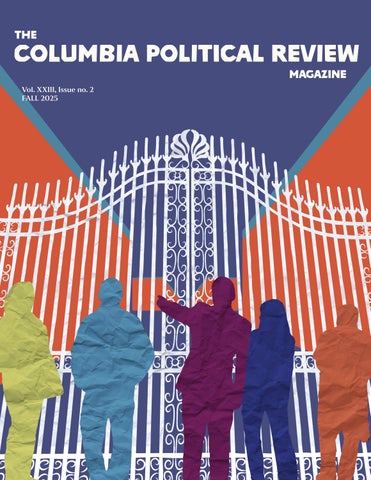
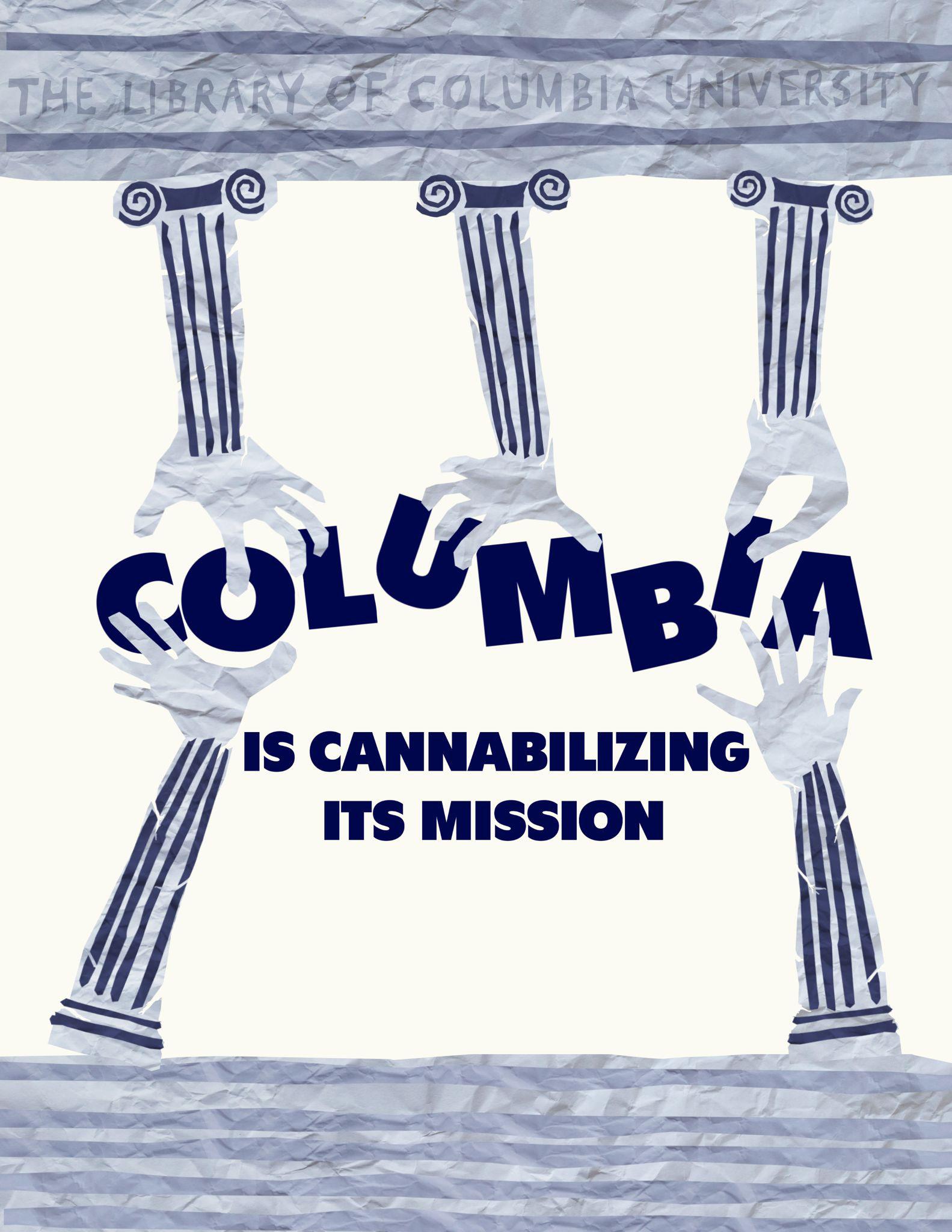
What an interesting year. Since our spring issue, the situation on campus has at once cooled down and intensified. So many things—funding, faculty, and entire swathes of the student body—have been cut from the fabric of Columbia’s community. Many are feeling politically dejected by this year’s developments, and others are stirred to action. Campus feels both defeated and uneasy, as if something much better or far worse is looming at the gates. In every case, the costs of political speech have been made clear to us. But even under pressure to hush up, we at the Columbia Political Review are confident that, however hard they try, the powers that be cannot amputate a student’s spirit. And it is that spirit that brings you this collection of our writer’s work.
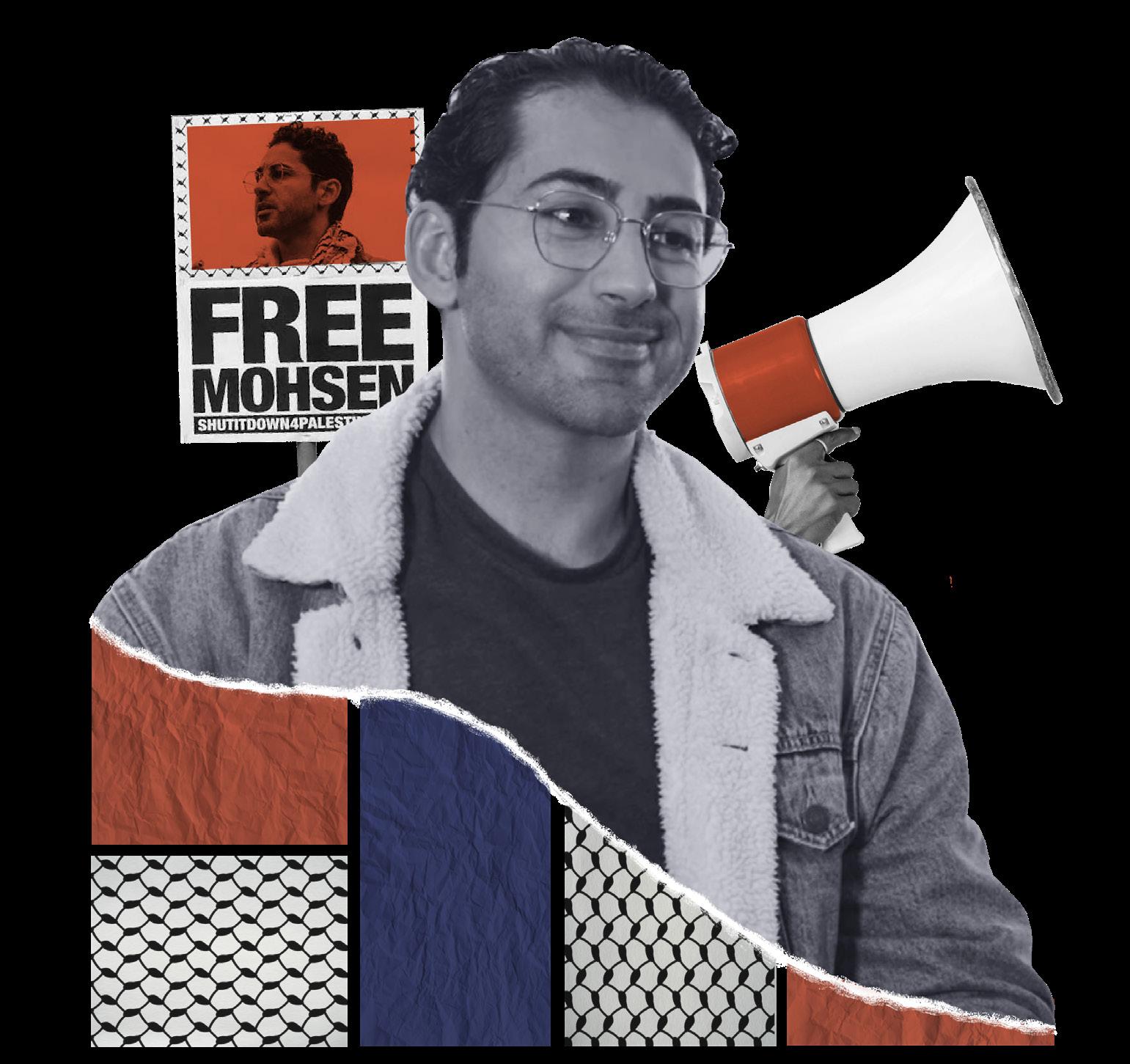
Curating this issue meant confronting the different ways in which access is defined in 2025: who counts as part of the “we,” who gets entry into campus (or the country), and who is locked out, willingly or otherwise. Our staff, as usual, approached every angle of this year’s contradictions with grace and a critic’s eye. Gabi Fabozzi (CC ‘28 ) clarifies the true stakes of keeping ICE officers’ identities a secret, while Sandrine Sader (Sciences Po ‘26) discusses the reason for the all-but-secret identification of some Lebanese as Phoenician. An anonymous writer interrogates Columbia’s claim to institutional neutrality in light of its response to student activists. Yunseo Kim (CC ‘27) interviews Columbia’s own Mohsen Mahdawi, whose ongoing legal battle brings to bear fundamental questions about our commitment to preserving the right to free speech for all people in this country. And much, much more.
This will be my final print issue as CPR’s Editor-in-Chief, and to be frank, I am not satisfied. I am unfathomably proud of the foundation that our team has built, but if this year has taught us anything, it is that we cede everything when we bend to pressure. I have seen many of our peers “lock in” to their schoolwork, in turn locking out the crises that always make their way to the doorstep of our beloved (gated) community. Shutting out the horrors of today is understandable, but it won’t make them stop. We can’t settle for “discourse” for its own sake. I ask you instead to write endlessly about these problems with the knowledge that history will see every line as an affirmation of your principles and every principle as a word in the definition of your identity. If we do that, I am confident that all of us will meet the moment.
Signing off,
Adam Kinder, Editor-in-Chief
MASKED ICE OFFICERS ARE MORE THAN A CONSTITUTIONAL QUESTION
BY GABI FABOZZI ILLUSTRATED BY BEATRIX HOLSTINE
People are out there taking photos of their names and faces and posting them online with death threats to their families and themselves. So I’m sorry if people are offended by them wearing masks, but I’m not going to let my officers and agents go out there and put their lives on the line and their family on the line because people don’t like what immigration enforcement is.”
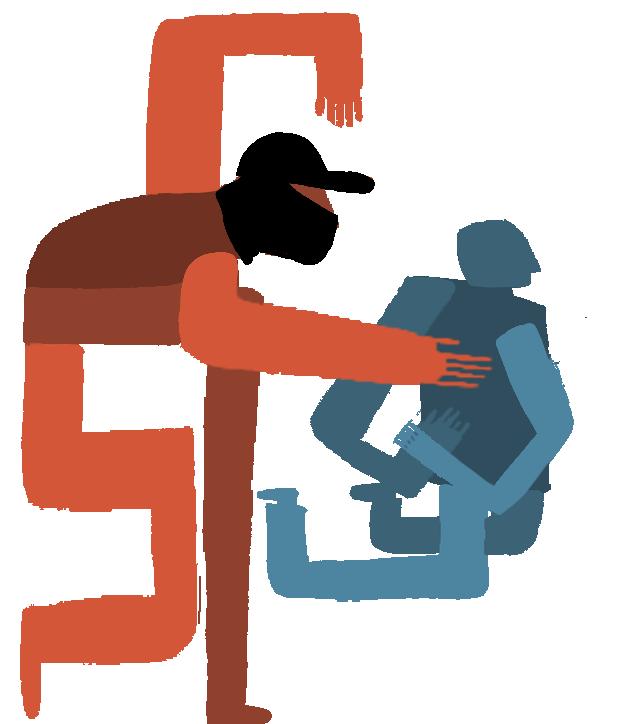
Immigration and Customs Enforcement (ICE) Acting Director Todd Lyons offered this as a response to growing outrage over ICE officials performing immigration arrests while being masked and concealing identifying information, like
badge numbers and names. Recent internal data from the Department of Homeland Security (DHS) shows a 500 percent increase in assaults while conducting immigration enforcement operations, equivalent to about one assault per day. The agen-
cy frames this statistic as the reason for ICE officers’ anonymity, touting the masks as a necessary shield from public outrage and violence. Already, this justification for masking triggers concerns about abuses of power, such as uses of ex-
cessive force or racial profiling, that can more easily take place when law enforcement cannot be identified. While no federal law explicitly forbids masking, the lack of accountability and due process implications that arise from obstructing officers’ identities is deeply troubling. In response, Democrats in California and New York City have even introduced legislation to ban the practice. While these pieces of legislation are likely to pass in solid blue states, the risk of these ICE practices remains real for the rest of the nation. A lack of transparency from ICE, which will likely continue without the interference of the courts or Congress, invites mistrust in all public officials as the public struggles to distinguish between federal ICE officers and local officials.
Any future lawsuit regarding the constitutionality of ICE officials’ refusal to identify will take years to play out in federal court. However, the immediate public safety con-
cerns of this practice are being left to the wayside. ICE officials’ failure to identify has created logistical challenges for local law enforcement, as well as confusion and resistance from private individuals, which generates greater, multi-layered public safety issues.
In a June incident in Los Angeles, ICE officials driving unmarked vehicles crashed into another car while making an arrest. LAPD responded
to the incident as a typical hit and run because the ICE officials lacked any clear identification and federal law enforcement, and did not inform local law enforcement of their activities beforehand. Similar incidents repeatedly occur, both in Los Angeles and across the country, like ICE’s fail-
ure to coordinate with local authorities in Kingston, New York.
While ICE, as a federal agency, does not have an obligation to inform local authorities of its activities, the agency’s choice to operate alone allows for further confusion and distraction to develop within police departments. A lack of clarity regarding who is and is not an agent of the fed-
eral government causes local police to inadvertently disregard their actual duties to respond to reports of potential kidnapping calls and other crimes. Only when police are onsite and confronted with the chaotic work of ICE officials, who often act recklessly and violently, can they actually understand what the agency is doing locally. This conflict between
local and federal law enforcement leads to greater confusion, ultimately undermining what should be law enforcement’s primary goal: ensuring public safety.
Complicating this issue further, an absence of formal identification, alongside ICE’s enforcement strategies, fosters growing mistrust of all law enforcement agencies among the public. Often, ICE officials will only identify themselves as ‘police’ to individuals, failing to clarify that they are a part of Immigration and Customs Enforcement or even the federal government. Unlike a choice in uniform, this ‘ruse’ is more deliberate and has been a commonly used tactic for years. However, recent increases in ICE arrests will doubtlessly cause more fear for not just ICE but also general law enforcement, especially in the communities most vulnerable to immigration enforcement. When communities feel unable to assess who is a member of the local police versus an ICE agent, it is simply logical that many civilians will stop approaching local law enforcement to report crimes or seek help out of fear. Without honest self-identification, the recent increases in ICE arrests will inevitably create a general fear of law enforcement. Since trust is such an essential component of effective law enforcement, ICE’s practices continue to undermine it and jeopardize public safety.
Beyond confusion and logistical challenges with local police, ICE’s failure to properly identify itself has allowed for even more malicious criminal activity to take place. Within an atmosphere of fear, incidents of private citizens impersonating ICE have been on the rise. In South Carolina and Pennsylvania, several men have been charged with criminal offenses after pretending to be ICE offi-
Scan the QR code on the right for the full article (with citations)
A LONESOMESTATE
BY ELLA HUMMEL ILLUSTRATED BY BEATRIX HOLSTINE
On June 29, 2025, in Kootenai County, Idaho, local firefighters were called to fight a brush fire on Canfield Mountain. However, upon arriving on the scene, they were ambushed by twenty-year-old Wess Roley, who opened fire on the firefighters, killing two and injuring a third. Later that night, he died from a self-inflicted gunshot wound.
The day before his ambush, Roley had left his father a note confessing to the attack: “Tomorrow I shall go into battle, if I survive, it would be the utmost dishonor.” By his signed name, he drew two symbols linked to Nazi ideology. Growing up, Roley’s classmates knew him as someone who was obsessed with Nazism, the military, and guns. Midway through his sophomore year of high school, Roley moved to northern Idaho with his father. The move placed him in an environment that allowed his discriminatory views to fester. The area is one of the most conservative regions in America; in Northern Idaho, there are five Republicans for
every Democrat. Within the state legislature, there are 9 Democrats out of 70 total members in Idaho’s House and only 6 Democratic senators out of 35 in the Senate. Of these Democratic representatives, they all come from districts in the south of the state. Northern Idaho has also notoriously been home to many exclusionary hate groups, including its most infamous: the Aryan Nations. The region’s historical and continual isolation and exclusionary behavior will be detrimental. It is limiting itself to a cyclical trap of repeating history, a trap that can only be escaped by the diversity of ideas, people, and beliefs.
Idaho has historically drawn individuals looking to separate themselves from the modern world. This sense of remoteness and the privacy that Idaho’s natural geography provides have helped hate groups flourish in the state. The region’s lack of racial and ethnic diversity has also been attractive to the groups. In the 2020 census, eighty-nine percent of Kootenai County’s population identi-
fied themselves as white, compared to the national average of around sixty-one percent. Within this homogenous and private environment, white Christian nationalist groups have been able to build and expand their followings with minimal pushback.
The Aryan Nations was created in the 1970s by Richard Butler, who had dreamed of creating an exclusively white community. Its infamous yearly conferences brought together members of various hate groups, including the Ku Klux Klan, to take classes in guerrilla warfare and urban terrorism. Throughout the country, members coordinated bombings, armed robberies, and other racially motivated attacks. All of these efforts helped to establish the hate group as a dominant force both in northern Idaho and throughout the nation. However, in 2000, the Aryan Nations were sued by the Southern Poverty Law Center, a nonprofit organization focused on the research and dismantling of hate groups. In the fallout of this case, the group
was forced to sell its property in a federal bankruptcy sale. On the former com -
pound, local firefighters used the land and buildings to create controlled burns as a training exercise. The burns destroyed the remains of the headquarters, demolishing buildings including a commissary with a large swastika painted on its roof, Butler’s church, and guard towers.
Roley’s attacks fell on the 24th anniversary of the day Idaho firefighters burned down the compound. While not directly related, both Roley and the Aryan Nations attempted to reject modernity. While Butler created the Aryan Nations compound to be his idealistic and isolating whites-only community, Roley was attempting to disrupt the social order supporting our country. Both men wished to live in a reality separate from the rest of the nation. Roley proved this in his goodbye to his father, writing, “I beg that you do not fall into the traps of modern existence, with media and other false pleasantries that plague the minds of individu -
als today. Propaganda of sorts.” Ultimately, Roley and the Aryan Nation’s violent attacks were drastic defiances against the progress of American civil rights.
Northern Idaho’s isolation from opposing ideas has allowed for the legacy of the region’s historical hate groups to live on. At a pride event in Coeur d’Alene in 2022, thirty-one members of the white-nationalist group Patriot Front were arrested for planning a riot and possession of at least one smoke grenade. In February 2025, Kootenai County made national news when a woman was forcibly dragged out of a Republican town hall for protesting against legislators. There are at least six different hate groups active in northern Idaho today. The groups’ biases range from anti-LGBT, anti-government, anti-semitism, and white nationalism. These demonstrations of hatred are part of a larger trend of rejecting acceptance of others in favor of preserving a skewed idealism of the past. However, not only are they violent and dangerous, but they also limit the region’s growth. The hostility discourages others from moving into the community, which in turn limits the new ideas that are brought to the area, stifling its development and ability to adapt to the present. While Idaho has not directly helped support its hate groups, the state’s inaction in preventing their spread has allowed them to flourish. Since the early 20th century, when white Idaho residents blamed an economic downturn on the recent in-
flux of immigrants, white supremacy has grown within the state. A 1923 Ku Klux Klan parade through the state capital, Boise, also helped to promote the normalization of racial discrimination and segregation in Idaho. While largely pared back, this exclusionary behavior has continued into the modern day. In early 2025, an Idaho teacher was prohibited from hanging a poster in her classroom that displayed a series of hands of different skin colors underneath the phrase “Everyone is Welcome Here.” The school district and other Idaho leaders claimed this poster violated House Bill 41, which prohibits flags or banners that may display political opinions in K-12 schools. When asked about the legitimacy of the “Everyone is Welcome Here” poster within the limitations of House Bill 41, the Idaho attorney general’s office issued a statement saying, “These signs are part of an ideological/social movement.” The bill also banned government buildings from flying any non-official flags, a stipulation targeted towards
pride flags. In a mark of defiance, the city of Boise adopted the pride flag as an official city flag so it could continue displaying it. In June 2025, a bar owner based in Eagle, Idaho, hosted “Hetero Awesome Fest,” a fair located on the lawns in front of the state Capitol as a protest against LGBTQ+ Pride Month. Within Idaho’s Human Rights Act, there are still no written protections against discrimination based on sexual orientation or gender identity, leaving the opportunity for these actions to continue.
All of these policies and actions were designed to oppose outsiders and different beliefs. While much is created in fear of change, Idaho’s reluctance to become more inclusive is dangerous. Not only does it create an unwelcoming and even dangerous environment for those who differ from the state’s social norms, but it also endangers those who follow and support the policies. A lack of diversity limits new ideas and beliefs from spreading, restricting creativity and the growth that a region could have.
Instead of bringing in new ideas and beliefs to the state, Idaho mainly attracts those of similar thinking. Within the past few years, the state
has seen an influx of new residents coming from California, and according to a 2023 report from the Idaho Secretary of State’s Office, 75 percent of these new residents are registered Republicans. From all other states, except for Vermont, of those who moved to Idaho, the number of Republicans outweighed the number of Democrats. The state’s pull of similar-minded individuals creates an environment less likely to attract those from different backgrounds, trapping it within a continuous cycle of homogenous thinking.
As a state, Idaho is a demonstration of the dangers of isolation from different beliefs. Its history of hatred exemplifies the dangers of exclusionary behavior. Not only does the state’s legislation deter others from moving to the state, but it also directly harms the community that is currently in the state. Roley’s attack and the Aryan Nation’s troubled past are examples of the violence that results from exclusionary thinking. By continuing to tolerate and promote discriminatory behavior, Idaho is jeopardizing itself and its citizens.
On a national level, America could learn from the mistakes that Idaho
has made. Without recognizing the dangers of its exclusionary thinking and properly correcting for it, Idaho enhances its risks. Throughout the country, as book bans and anti-DEI policies grow more popular, more communities may look like Northern Idaho–unwelcoming and unfriendly to outsiders and different beliefs. With such deep-rooted hatreds, both Idaho and this nation at large have a responsibility to prevent this thinking from carrying into the future. Already in the state, there are demonstrations of how this historical hatred can be dismantled. Walking down the streets of Boise, you will see yard signs of the miniature version of the “Everyone is Welcome Here” poster. In mid-July, the Boise School District announced that it would support its teachers who hung the posters in their classrooms. In its statement, the school district clari-
fied that the posters “affirm a foundational principle of public education–that every student, regardless of their background, is legally entitled to dignity, respect, and a sense of belonging in their school community.”
Yet, more than just individual steps to combat exclusionary thinking, the state has to make some changes. It could include provisions for discrimination based on sexual orientation and gender identity within the Idaho Human Rights Act. The inclusion is necessary to ensure equal protection for all of Idaho’s residents. Within Northern Idaho specifically, the region could recognize its historical contributions to the state’s exclusionary practices. While small steps, Northern Idaho could teach students about the past or fund museums and monuments to educate the
public. The region could follow a path similar to Germany’s Culture of Remembrance, which encourages its citizens to be educated on history so as to prevent it from repeating. Some of these changes are already starting to happen. On the land that used to host the Aryan Nation’s compound, philanthropist Greg Carr and the North Idaho College Foundation had initially planned to establish a “peace park.” However, they have now decided to sell the land, promising to donate the proceeds towards an endowment for human rights education. In a region that tends to cling so tightly to the past, this sale is representative of a movement towards the future. While acknowledging the dark history of the area, the sale is allowing residents to build something new.
Ella Hummel (CC ‘28) is a staff writer at CPR studying political science and comparative literature.
HOW CHARLIE KIRK WON TRUMP THE
BY CADENCE GONZALES ILLUSTRATED BY BEATRIX HOLSTINE
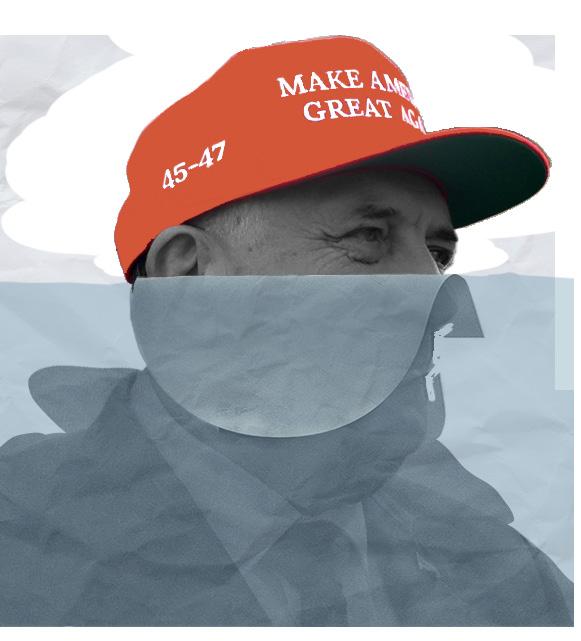
There is no question that one of, if not the main, goals of the Trump administration and MAGA movement is to win the culture war. We have seen it through pointed attacks on our universities, workplaces, and even the federal government itself. This swift rebrand to a time before “wokeness” and DEI is all part of a calculated gambit to dominate the political moment. One of the key architects of the MAGA culture war was right-wing political commentator Charlie Kirk, and in the wake of his assassination, we now see the outcome of his decades-long project to reshape political culture.
WARS CULTURE
right’s rising political star would not be without consequence. Five days after Charlie Kirk’s assassination, Vice President JD Vance claimed on Kirk’s show that his death was an organized plot by violent far-left organizations and retribution would be swiftly dealt through righteous anger.
The current conduit of the right’s anger is consequence culture. The target of this movement is individuals who have expressed political opinions that the sensibilities of the right view as insensitive, hateful and intended to incite violence.
spaces in which the First Amendment has little to no reach. This has manifested in the form of mass firings, death threats, and people’s names being doxed on online watchlists for their speech about Charlie Kirk.
Kirk’s assassination is just one in a series of politically violent acts that have taken place in the United States just this last year. But in the weeks that followed, it became clear that the martyrdom of the
Jimmy Kimmel’s show was temporarily canceled when he implied the right was aiming to gain political points from Kirk’s death, while others have had visas revoked for criticizing Kirk’s legacy. While these comments are protected by the First Amendment as relevant political discourse no matter who they might offend, the consequences of these statements have been largely dealt in private
Consequence culture is, in its essence, counter to the spirit of the First Amendment, as it weaponizes angry mobs to silence the expression of certain ideas. It was not too long ago that the right championed themselves as free speech warriors, even chastising the “woke” left’s cancel culture. But this is not a left or right issue: policing the rhetoric of others and ostracizing those who disagree with us is a feature of contemporary American political culture. Many have been reported for statements made about Charlie Kirk’s death on private Instagram stories, or in
the confidence of an employee breakroom. In other words, these individuals were reported by people they know and were often uploaded to large watchlists to be the target of the right’s righteous indignation.
However,
this is not a left or right issue, it is a feature of the political culture of the United States in which we police the rhetoric of others and ostracize those who disagree with us.
The Trump administration benefits from consequence culture, and they encourage it as it allows them to shape the bounds of political expression in their image. In a presidential memorandum after Kirk’s assassination, Trump created
a task force to identify and go after far-left domestic terrorism groups like ANTIFA for their role in Kirk’s death through their incendiary rhetoric. However, average Americans, not organized domestic terrorists, are facing the brunt of the right’s anger, and little state action has been actually taken against private citizens’ speech about Kirk. In other words, this narrative allows the government to indirectly dictate what expressions are permissible, legitimizing consequence culture as a means of combating the “violent” left while doing little to materially preempt violence where it might actually occur.
While the Trump administration is surely inflaming political tensions with its rhetoric in regards to the violent left, it is the public who are really taking charge of consequence culture and creating a culture of censorship. Speech, once a
weapon wielded by the people against the government, is one that we aim at each other.
In the wake of Kirk’s death, both sides of the aisle praised him as the embodiment of the First Amendment, and his murder an act to silence his political speech. Yet Kirk himself was one of the pioneers of the consequence culture movement currently creating watchlists that seek to “unmask” or rather dox “radical” teachers and professors who act as conduits for “feminism,” “LGBTQ,” “DEI,” “climate alarmism,” or “terror support.” Now, some of Kirk’s more fringe ideas have become mainstream, and the mere act of criticizing them has violated employee codes of conduct across the nation. Through his death, Charlie Kirk delivered Trump a major victory in the culture wars, and now we the people continue his legacy of policing speech.
Cadence Gonzales (BC’26) is a Staff Writer for CPR from Santa Fe, New Mexico, studying political science. She can be reached at cag2272@barnard.edu
Scan the QR code on the right for the full article (with citations)
SOLITARY CONFINEMENT AND THE STATE’S CONTROL OF THE MIND
BY MILA NOSHIRVANI ILLUSTRATED BY BEATRIX HOLSTINE
THE SELF HOURS DAYS 122,000
The United Nations’ Nelson Mandela Rules define solitary confinement as the isolation of prisoners for at least 22 hours per day without meaningful human contact, and classify it as torture when punishment exceeds 15 consecutive days. On any given day, over 122,000 Americans are subjected to such imprisonment.
Used as a tool for discipline and control, solitary confinement is a punishment that deeply erodes the mind in a variety of ways. Individuals subjected to solitary confinement are removed from
22 15 DAYS
122,000
all forms of social stimulation—conversation, touch, shared experience—which are foundational to human connection. The brain is a social organ; it requires interaction and stimulation to maintain its structure and function. When deprived of that input, the brain begins to atrophy (shrink and weaken from lack of activation). Specifically, the isolation of solitary confinement is harmful to the brain’s structure, neural activity, and cognitive functions,impairing memory, attention and emotional regulation. These changes induce trauma that can last long after
release and damage the machinery that allows people to think, feel, and relate. Despite these deleterious consequences to mental health, solitary confinement remains a routine practice in prisons across the world.
This damage lays the groundwork for a deeper ethical conversation. Solitary confinement constitutes a violation of human rights because it undermines both human dignity and neurobiological identity, eroding the brain’s ability to think, feel, and connect.
Solitary confinement constitutes a violation of human rights because it undermines both human dignity and neurobiological identity, eroding the brain’s ability to think, feel, and connect.
By stripping individuals of the cognitive and emotional capacities that allow them to participate in society, solitary confinement reduces these individuals to a state of biological survival. This is not just an ethical transgression. It is a political act. It expands the boundaries of carceral power beyond the physical body and allows the state to regulate cognition, thought, and identity itself. When the state reserves the authority to erase personhood, it redefines who qualifies as a full subject of its rights and who does not.
Clinical observations paint a grim picture. Psychiatrist Stuart Grassian identified a distinct psychiatric syndrome caused by solitary confinement that was even found in individuals with no prior psychiatric conditions. The symptoms of this syndrome mirrored the effects of delirium. Such a drastic cognitive response shows the extent to which solitary con-
finement assumes total agency over the individual, creating a serious ethical violation.
This alteration in the brain significantly compromises an individual’s sense of self and identity. Human subjectivity transcends merely being alive; it is also about interpreting the world, reflecting on one’s experiences, and engaging meaningfully with others. These abilities are precisely what solitary confinement destroys. In a 2025 essay, a formerly incarcerated person recalled: “The anxiety that I would feel–and still feel sometimes–and just trying to be around people, especially in public spaces, was incredibly difficult to deal with. I was isolated a lot.” Even three years later, he continues to withdraw: “Every time I feel something, I isolate.”
The learned association between emotional arousal (heightened states like anxiety, fear, or hypervigilance) and emotional withdrawal (numbing, detachment, or emotional shutdown) mirrors the neurological imprinting caused by long-term isolation. Solitary confinement can rewire emotional responses by conditioning individuals to associate social interaction with anxiety or danger, while perceiving isolation as a source of relief or control. The aforementioned testimonies
demonstrate how solitary confinement strips individuals of their capacity for social identity, not just their emotional well-being. They live without the mental and psychological frameworks that give life coherence and meaning.
Giorgio Agamben, a contemporary Italian philosopher known for his work on biopolitics and the relationship between law and life, describes a state of existence, bare life, as life devoid of political or moral value. Because solitary confinement is state-sanctioned and deliberate, it is a form of control. When the state has the power to isolate a person so completely that their mind begins to disintegrate, it is no longer simply administering punishment. It is exerting authority over the very construction of the self.
Solitary confinement is the concrete enforcement of bare life, dismantling a person’s ability to exist meaningfully within society. The state permits survival, but extinguishes participation. Individuals are not only cut off from others, but from the rights, relationships, and roles that once gave their lives structure. They lose the ability to advocate for themselves, to exist in community, to express grievances, or to be seen as full citizens. What’s lost is not just comfort or stimu-
lation, but the scaffolding of personhood itself: memory shaped by interaction, identity confirmed through recognition, and agency grounded in social belonging. Without these, the emotional regulation, trust, and sense of coherence necessary to vote, work, organize, or engage meaningfully in civic life begin to deteriorate.
When the state has the power to isolate a person so completely that their mind begins to disintegrate, it is no longer simply administering punishment. It is exerting authority over the very construction of the self.
Solitary confinement does not prepare people to rejoin society. It manufactures citizens in name only, who are politically
silenced and socially severed. When the state engineers this erasure, it asserts the power to determine whose humanity is preserved and whose is suspended.
Supporters of solitary confinement argue that it is a necessary tool for maintaining safety and order within institutions. They view it as a form of “punishment by removal,” where privileges are taken away to motivate compliance and gradually reintroduce individuals to the general population. However, this rationale collapses under the weight of the overwhelming scientific evidence showing that prolonged isolation inflicts damage so severe that it fundamentally undermines any claim that the practice is rehabilitative, controlled, or humane. The overwhelming evidence against the carceral practice reveals deep contradictions between its stated principles and the
realities of solitary confinement. While human rights laws are intended to protect identity, solitary confinement dismantles it under the guise of control and rehabilitation.
Solitary confinement does not just violate individual rights. It breaches the fundamental principle, enshrined in international human rights law: the state must never exercise complete control over a person’s mind or inner being. When the government possesses the authority to isolate, deconstruct, and ultimately erase the selfhood of incarcerated people, it breaches the ethical boundaries human rights law was designed to uphold. It treats the individual as an object of state control, stripped of agency and managed as a mere biological entity. This is neither discipline nor justice. It is the state-sanctioned erasure of personhood.
Scan the QR code on the right for the full article (with citations)
Mila Noshirvani (BC ’27) is a staff writer majoring in political science and cognitive science. She is interested in exploring the intersections between law, policy, and the human mind.
An interview with
MOHSEN MAHDAWI
ON FREE SPEECH, COLUMBIA ADMINISTRATION, AND THE STUDENT MOVEMENT FOR PALESTINE
BY YUNSEO KIM ILLUSTRATED BY SOPHIE KAMDAR
The transcript below is an excerpt from a full 30-minute interview, which can be accessed on the Columbia Political Review YouTube channel. In this interview, Managing Editor Yunseo Kim speaks with Mohsen Mahdawi, a prominent Palestinian activist and Columbia University student, on Columbia’s response to the second Trump administration, the implications of his ongoing legal case for the future of political speech, and the persistence of the student movement for Palestine at large.
Yunseo Kim: I want to begin by revisiting a speech you gave on campus in January 2024, in which you said, quote, “This Friday I received a death threat. If I get murdered or any one of us gets murdered, the whole responsibility falls on Columbia University administration and the deans who support Israel.” In addition to your detention by the federal government, your activity on campus at Columbia has placed you in great personal danger. Can you tell us more about what drives your advocacy for the Palestinian cause in the face of these risks? In other words, what keeps you going ?
Mohsen Mahdawi: What keeps me going is the drive for justice. That drive to see peace, to not see children going through pain and suffering through trauma such as the trauma that I experience. And they lived it through in the refugee camp. That sense that keeps me going. That specific– specific speech, if you remember the circumstances, there was an attack on campus against students, a chemical attack where a number of students were hospitalized. And we have seen the level of injustice that took place here, where the Columbia University administration has discriminated against Palestinians and pro-Palestine students. And the discrimination was so shocking to me, to the point
that I thought that there would be further and further and further risks. At that time, I did not imagine that the risk would lead to my detention during my citizenship interview and me spending time in the prison, along with other students as well. But the reality is that we were exposed and put at risk starting from this university. And if I go back to that specific event, what did the university do with the people who actually insulted other students? They ended up doing settlements with them and rewarding them with an around $400,000 settlement, while the students who were hurt and hospitalized were left basically abandoned. And, there was not any level of justice that was brought to them. And
some of them were punished later by being suspended. So what drives me is the sense of injustice that I feel, and the drive for injustice. What I felt here is not much different than what I feel about Palestine and what I felt in Palestine.
And they can see the connection between the injustices similar to what MLK has shared, that injustice anywhere is a threat to justice everywhere. And that’s what keeps me going.
Columbia agreed to pay the federal government more than $220 million to restore $400 million in funding that had been frozen after accusations that the university had failed to prevent antisemitism on campus. As part of that settlement, Columbia codified several federal oversight measures, policies that some critics characterize as forfeiture of academic freedom in an effort to silence pro-Palestinian speech on campus. What do you think of the university’s actions and what posture should it adopt with the Trump administration moving forward?
MM: I think not only myself, um, the larger Columbia community are feeling a sense of betrayal, abandonment and and serious disappointment because what the university has done is a capitulation, especially after the Trump administration has came after, and arrested, detained a number of students. And the university has not only abandoned its community, its community in terms of professors and the students, and put them at risk, including we have to keep in
mind that we have a significant number of international students, which I think it’s close to one third of this, the body of students, over 34,000 students. So now they allowed the Trump administration and the government to actually, create this condition, which is chills of speech, and intimidation, where people are fearful to share their beliefs, what they believe in, and the university by doing so, not only, again, not only abandoned their own community and their own students, but also they have let down other universities that don’t have the ability to fight.
We saw what happened with Harvard. Harvard took the case to the courts, and they won the case. Just recently, about a month ago, Columbia could have done the same thing. Instead, what they have done, they have put the whole community at jeopardy! Because now we have an external mon -
itor, who is controlling the curriculum, and watching the curriculum, which is against academic freedom, which is the core principle of this university. If you can’t speak freely and debate and be critical of many things, you are actually not doing what a liberal institution should be doing. And when we think of this, the impact of what the university has done is actually on a larger level, leading to the deterioration and destruction of democracy itself.
So, how I feel about it, I see that injustice, if one might say, and the oppression, and the internal systematic discrimination that the university is doing. But I’m not going to focus my energy there because I know the fight is much larger, because now the fight is for democracy in this country, which is a form of justice and for justice for Palestinians and for humanity as a whole.
I’m also interested in how the narratives surrounding this conflict have been communicated to the nation in covering your situation and also the movement for Palestine at Columbia. Is there anything that you think the mainstream media has gotten wrong about the reality on campus, or in Palestine?
MM: Many things, but I would boil it down to three major points. The first one, the mainstream media has failed to show that the movement for Palestine is a mass movement, and that the vast majority of that university here and many other universities, want to see an action done by their universities that’s aligned with the principles of human rights and international law and equality and equity.
And that is more than just a dialog. It is a proactive measure, which is divestment from war and investment in peace. And the mainstream media has failed to show that.
The other point, which is very significant, is the importance of the partnership that we have with the Jewish community, that the movement actually had a significant number of the Jewish community part of it.And what the mainstream media has not shown, actually, is that Jews, students and faculty, were a very important and vital part of the movement that was created. The top organizers who were with us, our Jewish organizers.
And the last part, that the media has failed to cover, which is, the painting of the movement as being anti-Semitic. They have failed miserably because the movement had nothing to do with anti-Semitism.
“The larger Columbia community are feeling a sense of betrayal, abandonment and and serious disappointment because what the university has done is a capitulation, especially after the Trump administration has came after, and arrested, detained a number of students.
And this is something I call gaslighting. Gaslighting the American people and the Jewish communities around them that this is an anti-Semitic movement, while the movement itself is asking for dignity and the freedom and equality of the Palestinian people, and not only the only and not only the Palestinian people: this will apply to all people. So, showing that the movement actually at its core, is advocating for the safety and the equality of all people, Jews and Palestinians, Israelis and Palestinians, and that the fight for the freedom of Palestine, which is the message in the movement, is intertwined with the fight against antisemitism.
And on a more personal note. After graduating from Columbia School of General Studies last semester, you’ve since started a graduate program here at the School for International and Public Affairs. After everything that’s happened, why stay here?
MM: This is a question that has been recurring, and many people are asking me, even the closest to me. And I tell my friends and my community: ‘Don’t you get it?’ We are part of a much larger project. There is a reason why the government is targeting Columbia University. Because not only they want to crush any dissent, but also because they realize that a pillar of democracy is the free speech and the ability to express your opinions. So they are going after anybody who disagrees with them. And we know also that universities are the moral compass of a nation. This is where crit -
ical thinking takes place. This is where the intelligent, the best minds of the country go to liberal universities. So I come back here realizing the importance of education and to be in solidarity with my community.
Columbia University is not the senior administration or the board of trustees. It is the students and the professors and the community that is here. And I come back in solidarity with them. And the one that is most personal to me is related to a message that I received from my uncle who was actually murdered when I was 11 years old. And his message was that we Palestinians, after the Nakba, which is the catastrophe 1948, we lost everything. Except our minds and hearts. And his message was that education is hope, and I should invest in my mind and return that love to the people and to the land. So I come back here to study, a master’s in international affairs, focusing on conflict resolution and peacemaking, because I believe that education is hope. Education is light and the path to move forward, which is aligned with my purpose in this life, which is elevating the suffering of the Palestinian people and making peace between Palestinians and Israelis.
And this is bringing me closer. Yes. It’s bringing me to the middle of this fight again. In the midst of the fire. But I consider myself a firefighter.
And meanwhile, back on campus and across the country, students have ex -
pressed feelings of hopelessness in the face of the continued suffering in Gaza. That protests have proven ineffective, or that the costs of political speech in this climate are simply too heavy to bear. What is your response to those who feel the urge to disengage from the movement, or from politics altogether?
MM: I think we might be looking at the feeling of students from different angles, because what I see, actually, I see determination and resilience and strength in resisting this authoritarianism and what is becoming fascism in this country. So, I don’t see that the students have given up, or they are in despair because I see the initiatives and the momentum.
They have learned a lot. The state violence that was impacted and imposed on the students has created a level of trauma. We saw with how the police traumatized the students here after the permission of different universities, including Columbia University. But the students have processed that, and they are organizing, and they know that this is a matter about humanity.
Now, this is the government’s whole purpose. They wanted to shut down any attempt of dissent or resistance. And I don’t think that the student, is—are there yet in terms of, giving up on what’s going on. Now also, we see what the government tried to do with myself, with Mahmoud Khalil, with Rümey -
sa Öztürk, with Khan Suri, and they tried to make an example of us by detaining us in–in an inhumane way and making that an example to deter and to scare and to intimidate other students. But we get free. And many of us became more outspoken, than before our detention. And if this communicates something, it communicates that we will not surrender to fear and intimidation.
This is how I see it. Even though my case now is at a very critical point of its path. Because, if you may be aware of that development of the case, the government is trying to put me back in prison by appealing what is called the habeas corpus. And if they succeed to do that, the impact of this will be so significant that it will impact every non-citizen that they may not be able to practice, their rights in this country, their, First Amendment rights, their constitutional rights. They can be detained unjustly, kept in prison for a long time until, the case makes it to what we call an appellate court through the immigration system.
So we can see that the direction that this country is going in, and which government this government is driving or going towards, and it’s very serious and dangerous because I see it as the first step towards taking the rights of the citizens of this country, which we see is happening with journalists in this country, with immigrants and with other people who saw a level of resistance and dissent.
Yunseo Kim (CC ‘27) is a Staff Writer at CPR studying political science and human rights. She is passionate about international relations and immigration law. Yunseo can be reached at yk3058@columbia.edu.
WHAT IS THE PEOPLE?
BY YUNUS AKDAL ILLUSTRATED BY SOPHIE KAMDAR
The way we do politics today is not how it has always been. Far from it.
I think we know of this on an intuitive level; the strongest argument that compels one to go to the ballot today is that one party is “the lesser of two evils.” We know that the window of policy difference between the Democrats and Republicans in the United States is claustrophobically narrow, and that there is no room for
revolutionary politics in Congress, nor amongst the people. And yet, we are continuously confronted in our history classes with the Age of Revolutions, which envisioned something far greater than our political imagination and capacity today. We know that there was once a time when parliaments grappled openly with the very nature of our freedom, the foundational rights of individuals, and the meaning of social existence.
We know, then, that at the dawn of the 19th century, politics was alive, and that by the beginning of the 21st century, it was dead. Something must have intervened that replaced all the philosophers with bureaucrats, idealists with public servants. There are many ways of reading into this problem. In the limited space of this column, I want to give you a brief glimpse of what a living political body looks like through the eyes
at the royal session of the National Assembly on 23 June, 1789, to the
bly: “Tell those who send you that ple and will leave only by the force of bayonets!” Another fan favourite was when Desmoulins, responding
osophical dimension of politics in the French Revolution more powerfully than Abbé Sieyès’ response to Jacques Necker, the finance minister under Louis XVI. Necker had sought guidance from political writers on how to organize the king’s advisory body, the Estates General, and instead of addressing Necker’s question, which limited the question of the Estates General to purely administrative matters, Sieyès reframed the issue, asking instead: “What is the Third Estate?” In this existential question alone, we find the first political expression of a society demanding a self-identity. Sieyès’ reply—“Everything”—was not rhetoric, but the opening move in a radical reconceptualization of the meaning of politics.
It is in the first part of his pamphlet that Sieyès translated the abstract idea of social freedom (first articulated by Rousseau as the “general will”) into concrete political forms. For
professionals, and intellectuals, was responsible for all the essential functions of society. It produced agricultural and industrial goods, sustained its trade networks, staffed and provisioned its military, and carried out the specialized work of doctors, lawyers, educators, and philosophers. So really, “everything.”
The conclusion follows logically: if the Third Estate does everything necessary for society’s survival and flourishing, in other words, the social rights over that society, then it must also be entitled to the political rights over that society: power to constitute itself, become itself, and control itself. Philosophy, to Sieyès, was inseparable from language and the spirit of politics.
This understanding was not unique to him, as it set the tone for what followed. The history of the French Revolution is marked by a succession of these dynamic moments. I should
nance minister by Louis XVI, climbed onto a table at the café Foy, drew a pistol, and lit the fuse: “To arms, to arms!” Saint-Just’s intense 1792 speech on the fate of the King similarly encapsulates the revolutionary fever, when in one of the many thunderous crescendos, he declared, “No man can reign innocently!” Moments like these reveal a kind of political conviction that feels almost unimaginable today. Perhaps nowhere is this contrast more profoundly expressed than in Robespierre’s 1794 speech, “On the Principles of Political Morality.”
“What is the end of our revolution? The tranquil enjoyment of liberty and equality; the reign of that eternal justice, the laws of which are graven, not on marble or stone, but in the hearts of men, even in the heart of the slave who has forgotten them, and in that of the tyrant who disowns them.” Robespierre, perhaps the most
more insidious form of servitude, the political oppression of oneself from within oneself, echoing what Rousseau described in The Social Contract as the condition of “vile slaves” who “grin in mockery at the name of liberty.” Robespierre speaks about the citizenry, having once glimpsed the horizon of emancipation, has retreated into cynicism and complacency. Thus, he speaks to us, people who have abandoned the transformative ideals that once animated politics. We, who in our vague political imagination can no longer conceive of human nature as contingent and society as an entity with limitless potential. Robespierre’s political morality hinged on precisely this point: that the human subject is not fixed, but formed through collective life and civic virtue. His vision was anthropological transformation. Laws, he claimed, must awaken “generous passions” in the hearts of the people and not simply pose as fragments of lan-
guage.
This was the ethical foundation of the Republic: a society grounded in shared public virtue. You get the point. These pivotal moments, moments that highlight the eclectic personalities who led the republic, moments of energy and zeal, and of philosophic inquiry, were all fundamental, not only to the politics of France during the 1789 Revolution, but also to the rights and freedoms we cherish today. It was only because they were politicians as philosophers and not as statesmen that they discovered the social demand for freedom and pursued it without conviction.
Our understanding of political rights is much less ambitious today. That ambition, the belief that politics could reforge the human condition, seems unintelligible. The most radi-
sion we have seen in the past 10 years of American politics could possibly be Trump’s international tariffs. That, regrettably, is the horizon of our political moment. It is no wonder, then, that in a place like Columbia, a policy school, above all, the deeper questions of sovereignty and freedom barely register. We let the NYU kids wander about that. This is why, when CPR published an op-ed titled “The ‘Radical Left’ Needs to Start Playing Dirty,” encouraging the Democrats to use anti-democratic weapons such as filibustering and gerrymandering more assertively, and simultaneously rendering them effectively indifferent from the Republicans, I was not surprised at all. Although CPR advertised this article as a “provocative argument,” I really thought the opposite. Telling politicians to abandon their principles in order to win in office is truly a timeless strategy, but it leans more
ing public goods, is the political compass reading of politics. It is not provocative one bit. It appears to me that the most provocative and radical stance one can take today is to unapologetically advocate for what one believes to be true. This is the difference between the politics of 1789 and 2025.
Perhaps this is what best explains populist movements and the politicians who emerge from them, such as the likes of Trump. The social demand for politics is inevitable. The people will always want to
ways want to be led. We cannot pretend otherwise and declare that “politics should be boring,” that it is just a matter of policy.
The unfortunate reality is that the further we run away from 1789, the more our politics will reflect an uglier side of that epoch, precisely that which materialises in Trump.
current state, represent our political and social desire for freedom. When asked the question “what is the most cost-effective model for healthcare?” we should respond with a question of our own, as did Sieyès: “what is the People?”
Scan the QR code on the right for the full article (with citations)
Yunus Akdal (GS ’26) is a political science major and critical theory enthusiast. Contact Yunus if you disagree at ya2545@columbia.edu.
BY ANONYMOUS ILLUSTRATED BY SOPHIE KAMDAR
Since the beginning of the 2024 fall semester, members of the Columbia administration have sent thirteen university-wide emails expressing Columbia’s dedication to protecting “open inquiry.” The authors of the correspondences themselves vary—from former interim president Katrina Armstrong to trustee David Greenwald in his announcement of Armstrong’s departure—yet the unifying message remains clear. Caught between the pro-Palestinian and Zionist debates on campus, Columbia attempts to position itself as champion of a third, alternative side: that of free speech and open discussion. Through initiatives and administrative proceedings, the university has attempted to materialize this rhetorical commitment to discourse; on-campus ‘Listening Tables’ aim to “generate connection and understanding” in the fight against the “censoring of uncomfortable but important speech.” Last March, Columbia announced the establishment of their Provostial Advisory Committee on Academic Freedom and Freedom of Expression (the committee’s name, albeit a tongue-twister, effectively outlines its purpose).
tion. In the midst of the publicity storm spurred by post-October 7th campus events, Columbia’s leaders have felt immense pressure to address what many politicians, largely Republican, have deemed rampant anti-semitism and hate speech on campus. Facing retaliation from the House of Representatives and now the Trump administration, the university has doubled down on its efforts to combat perceived campus discrimination. Perhaps most notably, the university established the Office of Institutional Equity (OEI), responsible for “oversee[ing] the review and arbitration of all reports of discrimination and discriminatory harassment at Columbia.” Interestingly, Columbia itself recognizes a tension within this doubled obligation to both free speech and anti-discrimination. In an update to the institution’s protest-related procedures, the university announced that “values of free speech, open inquiry, and rigorous debate … cannot come at the expense of the rights of others to live, work, and learn here, free from discrimination and harassment,” posing the two as at odds.
However, over the past two years, Columbia has made it apparent that on-campus freedom of speech is limited by problematically unclear boundaries. Undeniably, the Columbia administration views its preservation of “vigorous and open debate” as a tenet of the university’s identity, “central to achieving [its] academic mission.”
Yet, in the eyes of the administration, the protection of free speech is not the university’s sole obliga -
page in all-caps: that protestors want to “crush Zionism.” Crucially, though, the invocation of the Star of David allows for a much more sinister, alarming subtext to seep through. Whether students intended to depict the Star as removed from the Israeli flag is ambiguous; in any case, the reception of its isolation is the same. What is being “crushed” is not just Zionism but an inarguable symbol of the Jewish people—this sort of configuration demands condemnation.
In theory, Columbia’s assertion here is principled. Investigating genuine cases of anti-Semitism is essential—anti-Zionist speech that crosses into anti-Jewish rhetoric does not constitute legitimate conversation on a university campus or anywhere. Student protestors dangerously blurred the two when they entered a “History of Modern Israel” course and distributed flyers with a boot positioned over the Star of David. The tamest interpretation of this flyer would be the one literally written on the bottom of the
However, Columbia has started confusing instances of anti-semitic rhetoric and genuine argument, the foundation of the discourse it claims to want to protect. In March, the Associated Press broke news of the Office of Institutional Equity’s targeting of Maryam Alwan, a then-Columbia senior. The OIE accused Alwan of “discriminatory harassment” for her alleged association with an op-ed penned in the Columbia Spectator’s Opinion section on behalf of the Columbia Palestine Solidarity Coalition (CPSC). The op-ed serves both as an explanation of the coalition’s exigency and as an argument for both fis -
cal and academic divestment from Israel.
pressure against the University.” Pivotally, though, what the CPSC recognizes here is that mobilization—“reignit[ing] pressure”—is an essential extension of argument itself. Conversation is pointless without a movement towards action at stake; ultimately, CPSC dedicates itself to “shifting the discourse” because it wants to effect actual change. While Columbia gestures towards preserving “open inquiry,” their protection is performative if it ends before discussion of real-world activism. The university cannot claim to champion free conversation if it neuters any possibility of tangible action arising from intellectual debate.
What is central to the oped’s critique of university policy and the Israeli government, though, is its reliance on evidence in building a sound line of reasoning: when the piece proposes that the university halt the Tel Aviv Global Center’s opening, it points towards the inaccessibility of the program for Columbia’s Palestinian affiliates, alongside the majority vote against the center in the 2024 university referendum by participating Columbia College, Barnard, and SEAS students. Even in making its most controversial point, implicitly supporting armed resistance in an affirmation of the Palestinian right to resist, the article immediately calls upon legal precedent. The CPSC invokes the “Additional Protocol 1 to the Geneva Conventions and the U.N. General Assembly’s resolution 37/43” before describing national and institutional recognition of grievances on which resistance may be justified. Alwan’s coalition is arguably more moderate than the organization it disaffiliated from, Columbia University Apartheid Divest, which the article critiques for its focus on “revolutionary ideals.” The OIE’s invocation of this specific op-ed in accusing Alwan of discrimination implies that mere discussion of contentious subjects (i.e., violent resistance) can be targeted as prejudicial, limiting the bounds of campus conversation to the university’s status quo. By its end, the CPSC’s op-ed is not solely limited to on-the-page conversation. Calling attention to CPSC’s role as “student organizers,” the piece describes how “by recentering Palestine, we reignite
Doubly alarming, Columbia targeted an op-ed published by an independent student publication—beyond its attack on overall discourse, the Office of Institutional Equity’s actions grossly infringe upon Columbia’s free student press. The Spectator, in which CPSC’s piece was published, operates financially independent of Columbia, allowing the paper to report on the university’s disciplinary measures and faculty relationships without the school’s influence. Its separation from institutional authority is key to the Spectator’s ability to keep Columbia accountable. Furthermore, Columbia targeted the publication’s section dedicated explicitly to free discourse: Opinion. The section publishes both pro-Israel and pro-Palestinian op-eds that often explicitly cite and disagree with each other, perpetuating a heated yet self-regulatory conversation. The editorial board affirmed the importance of their own roles in a staff editorial: “a newspaper’s opinion section acts as
a vital aspect of the free press … it is through the exchange of diverse perspectives that we arrive at a more nuanced understanding of the issues that shape our community and are, in turn, more readily able to hold power accountable.” The Opinion section has always operated as a forum for open, even contrarian student discourse separate from the university’s authority. By threatening a Spectator contributor with disciplinary action, Columbia establishes an implicit, yet dangerous, precedent for administrative interference in what the student press can publish without fear of retaliation against its authors or staff, risking the autonomy of one of the most prominent vehicles of institutional accountability.
In a more recent development, Columbia and Barnard placed four undergraduate Spectator and WKCR reporters under interim suspension for their presence at May 7’s Butler Library protest, all of whom had stated their roles as press to Public Safety. While all suspensions were eventually removed, the Spectator’s editor-in-chief and managing editor published a joint editorial the following week, accusing Columbia of “hav[ing] betrayed the trust
of their student journalists and hav[ing] broken an essential campus norm” by failing to guarantee its student press’ protection.
Columbia’s suppression of Alwan’s beliefs is not a self-contained issue. Rather, it is indicative of a larger silencing of pro-Palestinian perspectives in open academic discourse, a perversion manifested in the proto-receivership of the Middle Eastern, South Asian, and African Studies Department, a department known, as noted by the New York Times, for its willingness to hire anti-Zionist faculty. This stifling of anti-Zionist speech on-campus was only furthered in July, when Columbia’s administration, under pressure from the White House, chose to adopt the International Holocaust Remembrance Alliance’s (IHRA’s) definition of anti-semitism, a dire act for on-campus free speech. In explaining their working definition, the IHRA explicitly states that “denying the Jewish people their right to self-determination, e.g., by claiming that the existence of a State of Israel is a racist endeavor” is anti-Semitic. As anti-Zionism typically predicates the notion that Israel’s manifestation of Jewish self-determination was unjust, almost all anti-Zionist speech university-wide becomes effective grounds for disciplinary
action. Indeed, the punitive bias against anti-Zionist advocates has already become apparent: nearly 80 students involved with the Butler protest in May were met with a 1 to 3 year suspension or expulsion, a level of punishment deemed unprecedented by Columbia’s student worker union. As the union references, when an occupation of then-president Lee Bollinger’s office took place in 2019 for fossil fuel divestment, the protestors were not suspended but merely told to
and in many ways, it is easier for the university to capitulate than to pursue legal action in the face of governmental repercussions. However, as the university itself recognizes, free discussion is at the bedrock of Columbia’s existence— the loss of one entails the decay of the other. Beyond an -
write
“an essay and apology letter” to the custodial overtime workers.
While the university has attempted a performance of agnosticism within the Palestine-Israel debate, Columbia’s crackdown on free speech, specifically that critical of Israel, reveals a bias incompatible with institutional neutrality. Clearly, the political pressure Columbia faces to limit such discourse is enormous,
nouncements and lengthy emails, Columbia must rededicate itself to accepting open inquiry from all perspectives, not only in rhetoric but in action. Otherwise, the university will lose the basis of its institutional identity altogether.
Scan the QR code on the right for the full article (with citations)
LEFT BEHIND
BY HELENA FERNÁNDEZ GARRIDO ILLUSTRATED BY SOPHIE KAMDAR
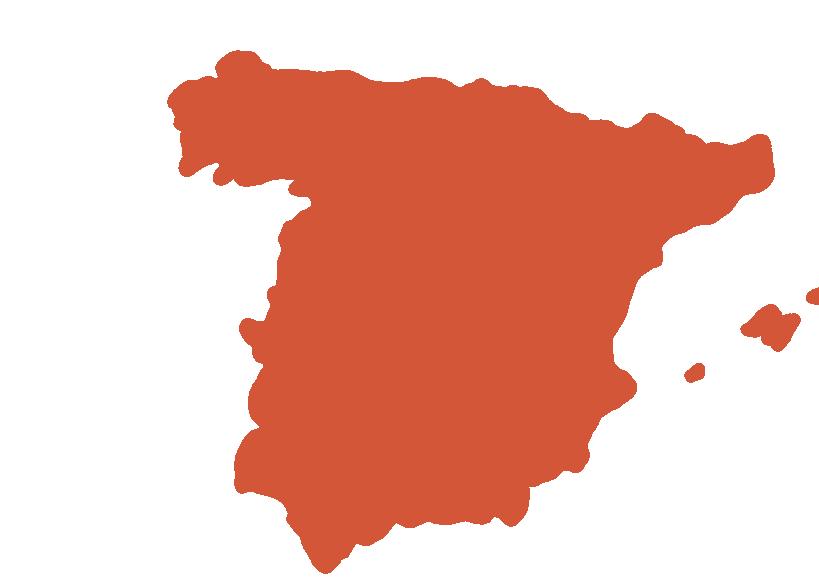
The tables have turned. From toppling the right-leaning government over illegal campaign financing to denouncing cases of funds mismanagement, the Spanish Socialist Workers’ Party (PSOE) has positioned itself as the moral compass against its corrupt political rivals for decades. But the party once hailed as a guardian of social progress is now being accused of embezzling millions through the inner circle of Prime Minister Pedro Sánchez. The party’s response? Silence. The case is one of many
recent scandals of the PSOE that demonstrate how the party has created an internal culture of loyalty that preserves its ruling coalition while sidelining transparency and accountability. By eroding the very legitimacy it claims to defend, the PSOE risks ultimately alienating voters and weakening its own political viability
The scandal centers on the alleged embezzlement of over €50 million in COVID-era contracts funneled through companies tied to former transport adviser Koldo García,implicating senior PSOE figures, including ex-minister José Luis Ábalos and organization secretary Santos Cerdán. The Supreme Court has since expanded the investigation to public works contracts allegedly approved in exchange for kickbacks, estimating personal gains
of more than €5 million. Alarmingly, tes timony even suggests that Prime Minister Sánchez was aware of the scheme.
More appalling than the scandal itself is the response from the left: a wave of loyalty that has extended beyond those directly involved, shaping the behavior of the leadership, both within PSOE as well as its coalition partners.
The reason for this widespread culture of loyalty is political power. Fragmen tation threatens to unravel the fragile thread holding together Spain’s left-lean ing ruling coalition. At the coalition’s center is the PSOE, led by Pedro Sánchez, governing alongside Sumar—an electoral alliance led by Yolanda Díaz that includes factions like Compromís and Izquierda Unida (IU). With only about 155 out of 350 seats in Congress, the two parties rely on support from smaller regional, na tionalist parties such as the Catalan Republican Left (ERC), Junts per Catalunya, the Basque Nationalist Party (PNV), EH Bildu, and Coalición Canaria to govern effectively (some of which are right-leaning!). The lack of ideological unity among the left makes the coalition inherently unstable in comparison to the Spanish right, which pushes PSOE and its allies to prioritise loyalty over consistent ideals to maintain power. As such, none of the coalition parties have supported calls for a vote of no confidence by the right-leaning People’s Party (PP) or Vox, or demanded Sánchez’s resignation in response to the Koldo case. Instead, they have merely reaffirmed commitment to government stability amid emerging scandals, refusing to dissolve the coalition or force early elections.
ing PP for bribery, fraud, prevarication, corruption, falsification of documents, and prohibited negotiations. The coordinator of Sumar has even stated that “the [PSOE] government is worth defending to prevent a figure like Trump from storming Congress.”
do secured immunity through what the Superior Court of Justice has called a blatant “fraud of law,” expelling five candidates ahead of him from a regional parliamentary list in one day upon learning he might be prosecuted.
When criticism has arisen, it is more advisory than confrontational. Allied parties Unidas Podemos and Sumar have called for more transparency. The coordinator of Izquierda Unida, Antonio Maíllo, recognised that, despite the need for stronger anti-corruption policies, breaking with PSOE would risk a government collapse. As a result, the socialist party continues to be defended as the lesser evil compared to an allegedly entrenched right-leaning corruption. This framing has only strengthened following the recent indictment of the former Minister of
What’s even more worrying is the opportunistic complicity that regional nationalist parties such as ERC and Junts have embraced, seeking satisfaction of certain conditions for continued support. Aware of their crucial role in sustaining the current government, they hold the upper hand and demand that the Prime Minister travel to their regions to negotiate concessions, revealing the asymmetric power dynamics that now define national governance. From successfully transferring control over immigrant work permits to the nationalist PNV in the Basque Country to renegotiating funding arrangements with Junts in Catalonia, strategic silence has become a potent weapon in Parliament. The broader left has prioritised political survival over ethical consistency.
To hold together the coalition, the PSOE maintains this culture of impunity most visibly by exploiting legal privileges to shield its allies from prosecution. Even under criminal investigation, Santos Cerdán retained “aforamiento”—immunity from being tried in ordinary
But protecting its members is not the only way the party consolidates power. Institutional shielding is paired with a culture of enforced silence, where dissent is punished to preserve unity. Odón Elorza, the former Secretary for Transparency, recalled being sidelined, silenced, and even physically discouraged from speaking in meetings until he resigned in 2023, describing his contributions as “no longer useful.” Regional president Emiliano García-Page recently described the PSOE as “intolerant of dissent,” gripped by a cult of leadership that suffocates internal democracy. Victor de Aldama, a businessman connected to the Koldo case who was released from prison after agreeing to provide information to authorities, even survived a politically-motivated assasination attempt. Those who deviate from the party line risk political isolation or worse.
Just as troubling is the collective refusal to condemn wrongdoing. From Secretary of State for Infrastructure Isabel Pardo de Vera’s years of silence after being charged, to the efforts of socialist Leire Díez to obstruct criminal investigations and regional leaders like Francina Ar-
mengol and Ángel Víctor Torres denying responsibility for millions in shady contracts—there is a clear pattern of evasion to shield PSOE from public and judicial accountability. In regards to the current scandals, no internal commission has been launched to clarify the facts. Disciplinary actions have been minimal and symbolic. Even the party’s spokesperson in Parliament continues to frame the scandal as a partisan smear, claiming that the right is simply weaponizing corruption. The party’s eagerness for political power blinds it to the very accountability it once demanded from others, and its message is clear: unity comes first, truth comes second.
But unlike their politicians, leftist voters are not choosing silence. PSOE’s strategy of enabling corruption may keep its coalition afloat in the short term, but is politically corrosive in the long run. While many voters continue to embrace a partisan “lesser evil”—60 percent still favor Sánchez’s continuation in office despite 80 percent expressing political disillusionment—this loyalty masks a deepening contradiction among PSOE supporters. Both major parties have institutionalized corruption without enacting any meaningful reform, making voters feel as though corruption has become an inescapable result of any ruling coalition. For some voters, especially those over 50 and residents in traditionally socialist regions like Andalusia or Extremadura, the scandals are viewed as a regrettable exception, not a betrayal of the party’s core values. Indeed, the July 2025 electoral barometers from National Centre of Sociological Studies (CIS) and the independent Sigma Dos show PSOE support dropping over 7 percent to 27 percent. Yet the party
is still narrowly ahead of or tied with the PP, suggesting that many disillusioned voters are staying in the fold, if uneasily. Nonetheless, this does not mean that PSOE’s strategy of discretion is working out. The scandal has exposed a mismatch between the leftist party’s ideals—transparency, social justice, and democratic renewal—and the realization of such ideals in party behavior. Younger voters and women, especially those under 40, have shifted away from PSOE. Though some of these lost votes stem from the release of voice messages in which Koldo and Ábalos detailed encounters with prostitutes in a demeaning manner, it is clear that voters have not become desensitized to corruption. Rather, the gap between what the PSOE claims to stand for and how it actually behaves when in power has created a partisan identity crisis: Some voters stay because they feel trapped, while others leave because the moral weight of staying feels too heavy. In a post-scandal focus group conducted by Cadena SER in July, many respondents in their twenties and thirties expressed a sense of “political homelessness”— they feel unable to support the PSOE in good conscience, but remain unconvinced that smaller parties like Sumar or Podemos could deliver change.
This crisis could harm PSOE’s electoral viability in the long-run. While a portion of disenchanted voters appears to be
shifting modestly toward smaller leftist parties like Podemos or Sumar, a more alarming trend is the 5.7 point surge in support for Vox, a party whose populist message feeds on precisely this kind of disaffection. The addition of roughly 1.4 million voters to the far-right’s base combined with moderate centre-left voters drifting toward the PP could ensure a practical parliamentary majority for centre-right and far-right forces, leaving PSOE weakened despite its current hold on power.
PSOE’s strategy of prioritising loyalty over accountability is counterproductive for its political survival in the long run. Even though voters are not abandoning the party en masse today, the growing partisan identity crisis threatens PSOE’s future electoral base and leaves space for the right and far-right to gain ground. Unless the party regains credibility and aligns its actions with its ideals, Spain risks a Parliament dominated by centre-right and far-right forces. To survive, the PSOE must reclaim both the voters and the values it has left behind.
Helena Fernández Garrido (‘28) is a sophomore student enrolled in the Dual BA between Columbia University and Sciences Po Paris. She is studying Politics and Law with a minor in International Relations.
Scan the QR code on the right for the full article (with citations)
BETWEEN HISTORY, CULTURE, AND POLITICS:
WHY SOME LEBANESE CLAIM TO BE PHOENICIANS
BY SANDRINE SADER ‘26 ILLUSTRATED BY SANDRINE SADER ‘26
The Preamble of the Lebanese Constitution states that “Lebanon has an Arab identity and belonging.” Despite such formal enshrinement, some Lebanese citizens reject Arab identity, instead claiming to be Phoenicians, descendants of the ancient civilization of skilled sailors and merchants who lived between 1550 and 300 B.C.E. along the Mediterranean coast. Why do some Lebanese choose to self-identify in this way, and what does it tell us about Lebanese society?
In contemporary Lebanon, this narrative has been leveraged for political ends and is largely a reflection of the social and political divisions in the multiconfessional Lebanese society. This divide was exacerbated by the political dynamics produced by the Civil War (1975-1990) and solidified by Lebanon’s political structure. Today, religious and political groups continue to adopt historical narratives in an attempt to distinguish themselves from political opponents. The Phoenician claim in particular deepens sectarianism by further politicizing religious identity and contributing to the “us versus them” discourse that pervades much of Lebanese political society, which is in turn rooted in misunderstandings of its history and culture. Overcoming Lebanon’s current socio-political crisis requires greater efforts for social cohesion and a reckoning with the country’s history of conflict and colonialism. As we will see, the Phoenician identity claim is not a historically grounded fact but rather a modern political narrative that has been shaped by colonial influence over the past century and reinforced divisions in Lebanon today.
Lebanon officially recognizes eighteen religious sects, the majority of which are Christian and Muslim. Its confessional government, established by the Constitution in 1926 and cemented in 1943 through the “National Pact” between President Bechara El Khoury and Prime Minister Riad El Solh, distributed political and institutional power proportionally among religious groups. Contrary to its feebly
representative intention, this structure entrenched political divisions between religious communities that were famously and brutally exacerbated by the Civil War (1975-1990). The Taif Agreement of 1989, which ended the war, restructured the government and resulted in an equal power-sharing structure between Christians and Muslims. Within this unique political framework, Phoenician narrative has been mobilized by Maronite Christian groups to distinguish them from Lebanon’s Muslim population and in turn perpetuate these same sectarian fissures.
Tracing the historical emergence of the Phoenician claim shows how it was constructed politically to distinguish the Maronite Christian population, and allows us to understand its resurgence and broader implications today. In his book, Reviving Phoenicia: The Search for Identity in Lebanon (2004), Asher Kaufman argues that the Phoenician idea emerged as a myth of origin that shaped Lebanon’s social, intellectual, and political landscape. Echoing this, Mouannes Hojairi, assistant professor of history at the American University in Cairo states that the Phoenician narrative was later adopted by Christian communities in the early twentieth century, in an effort to construct a “narrative of return” to an ancient golden age in opposition to Arabism. Hojairi asserts that by 1919, the Phoenician claim had become clearly associated with a non-Arab, non-Syrian, and pro-Western political discourse. In other words, the elevation of the Phoenician as an ancestor to Lebanese national identity illustrates how ancient civilizations are leveraged by communities as political tools to claim the creation of a nation itself, even when the connection may be factually dubious.
Kaufman also notes that the use of Phoenician heritage was mobilized in the political sphere as a foundation in
the early state-building efforts. For instance, Maronite Patriarch Elias Peter Hoayek sent a delegation to the 19191920 Paris Peace Conference, which sought to define postwar borders according to the principle of self-determination. The delegation invoked Lebanon’s purported Phoenician identity to try and distinguish it from an Arab one and to lobby for an independent state.
Seeing as the Maronite population of Mount Lebanon had historically been close with the West––and particularly to France––their
feeling of cultural affinity for Western and French culture and separation from Muslims and Arab identity in the years since becomes much more clear. France exerted influence over Lebanon stemming from its close ties with the community and obvious colonial interests, which led it to present itself as the Maronites’ protector. France formalized a mandate over Lebanon in 1920,
applying the secret Sykes-Picot Agreement (1916) which divided the territories of the declining Ottoman Empire between the French and the British, leading to the separation of Lebanon from what was then Greater Syria, in large part because of the perception that it held a distinct identity.
The distinction of Maronites from Arabs is also favored due to the complexity embedded in the term “Arab identity,” which allows for its rejection in favor of characteristically stronger communal ties. The Arab world encompasses a broad array of diverse populations, traditions, and culture across different Arab countries. Despite the assertion that Arab countries share some unifying factors—such as geographical proximity, common historical experiences, membership in the Arab League, the predominance of Islam, and the usage of the formal Arab language, these commonalities are limited. Regional dialects vary widely; Arab identity is not limited to Islam, and the religion does not represent all Arabs. Moreover, the Arab League is not diplomatically nor politically united. In the absence of a clear objective definition, “Arab identity” can ultimately be attributed to shared historical experiences and modern political considerations that are then translated to a personal subjective identification.
Proponents of the Phoenician claim also argue Lebanese are genetically Phoenician. But there is no cultural
continuity to substantiate this claim. Lebanese biologist Pierre Zalloua concluded that roughly 30 percent of Lebanese males carry a genetic strain present in Phoenician Y-chromosomes. However, he found no correlation between religion and genetic variation, describing religion as a way to “paint over” preexisting genetic differences. His finding, among others, disproves the validity of Maronite Christians’ efforts to distinguish themselves from other Arabs and Muslims and further some distinct non-Arab origin story.
So, despite claims of genetic origins or physical links to ancient history, there is no conclusive evidence linking modern Lebanese identity to the ancient Phoenician civilization. Thus, the Phoenician claim is merely a constructed narrative rather than a historical fact. Historian Charles El Hayek similarly criticizes the genetic argument made by some Maronite Christians, noting there is no cultural continuity between the ancient civilization and the current Lebanese society.
Understanding why some Lebanese identify as Phoenicians rather than Arabs is essential to grasp the deep social and political layers of Lebanese society. The Phoenician claim originates partly from European colonial interests in Middle Eastern history, which later provided a foundation for nationalist interests and discourse. Its resurgence today reflects religious divisions in Lebanon and is strengthened by the country’s confessional political structure. Moving forward, the pressing issue for Lebanese society should not be the revival of a centuries-old civilization, but the cultivation of social cohesion and the pursuit of political reform through a fuller, more critical engagement with Lebanon’s history.
Sandrine Sader (Sciences Po ‘26) is an exchange student at Columbia College, studying political science with a focus on Mediterranean and Middle East politics. She aims to pursue a career in international affairs and diplomacy. She can be reached at ss7597@columbia.edu. Scan the QR code on the right for the full article (with citations)
MAKE REPUBLIKA SRPSKA GREAT AGAIN?
BY ELI LESTER LEVY ILLUSTRATED BY BEATRIX HOLSTINE
While most Americans remain focused on flashpoints in Ukraine, Gaza, and Taiwan, a quieter but potentially explosive crisis is brewing in the Balkans. Republika Srpska is a majority ethnic-Serb political entity within Bosnia that holds half of the country’s landmass and produces a third of the country’s gross domestic product. Milorad Dodik, the region’s pro-Russian, separatist president, is exploiting the uncertainty created by a U.S. foreign policy doctrine that has moved away from post-WWII commitments to global institutions and internationalist ideals. The separatist movement in Bosnia provides a precarious staging ground for a renewed Trump-Putin relationship, destabilizing the fragile peace established in the Balkans 30 years ago by the Dayton Accords.
Under past administrations, it has primarily been the foreign policy of the United States to support the “American values” of economic opportunity, international stability, and liberal democracy. These principles have shaped a majority of the largest U.S. foreign policy decisions, particularly since the fall of the Soviet Union, leading to interventions in the Balkans and Persian Gulf in the ‘90s and Afghanistan a decade later.
However, under the second Trump administration, these values seem to be irrelevant in dictating the United States’ relationship to the rest of the world. With Ukraine, for
example, instead of continuing the Biden administration’s defense of a primary opponent to Russia and long-term U.S. ally, Trump demanded that Ukraine provide a
ed States, separatist movements have to convince President Trump that they have something to offer the United States under the Trump administration’s “America
Foreign Affairs, “Trump does not care about impoverished separatists if they cannot provide him with immediate rewards.” Now, instead of aligning with “American values” of sovereignty and democracy, to gain the support of the Unit-
even issued a now-nullified arrest warrant by Bosnia’s Constitutional Court for refusing to show up to questioning after passing laws in Republika Srpska revoking the authority of the national police. However, despite close Trump affiliates
showing deference to Serbian national interests and Donald Trump Jr. meeting with Serbian President Aleksandar Vučić in Belgrade this March to discuss both business and political deals, President Trump himself has publicly shown no at-
Milorad Dodik has also explicitly offered Republika Srpska’s mineral resources to the United States in return for support in his region’s secession movement. Additionally, he stated that Republika Srpska may be open to striking a deal regarding third-country deportations from the U.S. if the Trump administration were to suggest such a stipulation. However, these grasping-atstraws attempts to work with the U.S. government have also thus far fallen on deaf ears. This hasn’t stopped Dodik from trying to grab the U.S. government’s attention. Unable to court President Trump directly, Dodik has found allies among Trump’s (albeit
In February, former New York City Mayor Rudy Giuliani—who, along with being a long-time friend of President Trump, served on his personal legal team until he was disbarred in New York and Washington, D.C., last year—spoke at a rally in support of Dodik where Giuliani was presented with a hat embroidered with the words “Make Srpska Great Again.” Earlier that day, the two also recorded a podcast together
with heavy Islamophobic and anti-Bosniak undertones, echoing old sentiments linking Islam with terrorism.
This July, former Governor of Illinois Rod Blagojevich—whom President Trump pardoned earlier this year after convictions of corruption—wrote an oped for the Washington Times in which he posited that “Iran is in Europe.” In an alarmist tirade, he argued that Bosnia’s large Muslim population has become a hub for future terrorism now that Hezbollah and Hamas have taken major beatings in the Levant.
These two examples of prominent Republicans advocating in favor of Republika Srpska’s secessionist movement are alarming. They represent the slow establishment of a foothold for ethnic-Serb interests in American far-right circles. Though Giuliani and Blagojevich
instincts: reactive, manichean, and aimed more at Fox News viewers than North Atlantic Treaty Organization (NATO) allies. In a direct response to Blagojevich, Bosnian Ambassador to the United States Sven Alkalaj explained that “the unmistakable objective is to derail Bosnia-Herzegovina’s Euro-Atlantic trajectory by deliberately reframing the country from a reliable regional partner into a security threat to the United States.” The tropes employed by Giuliani and Blagojevich provide cover for Dodik’s secessionist ideas. By framing support for Srpska’s secession as a crusade against terrorism, Dodik is recasting his efforts to dismantle the Bosnian state in a way that is palatable to Americans. To proceed with separatism, Dodik doesn’t need a signed treaty, but rather permissive silence and tacit support from NATO’s largest historical
tion, Bosnia offers a narrative playground where they can signal toughness on supposed Islamic extremism and continue their campaign against the foreign policy establishment—all without committing to a coherent strategy or values. If Dodik can convince President Trump that Republika Srpska has something of value to offer the U.S., be it a mineral deal or a new location for third-country deportations, Dodik may receive the strategically ambiguous carte blanche from the U.S. that he is looking for. Even though Republika Srpska’s separation from Bosnia would serve as a heavy blow to NATO’s regional hegemony in the Balkans and thus a crack in its promise of international security, President Trump has already shown that NATO priorities do not come first in his evaluations of foreign affairs, opting instead for what he views as benefiting the United States over all else.
At the same time, Dodik is not only looking towards the U.S. government for support, but the Kremlin as well. Moscow’s long-standing interest in a fractured Bosnia aligns neatly with Dodik’s own goals. For Russia, Republika Srpska’s destabilization of Bosnia is a lowcost, high-reward opportunity to shake NATO’s southeastern flank, especially as Western attention is drawn elsewhere, namely Ukraine and the Middle East. As Dodik stated in an April meeting with Putin in Moscow, “Russia will advocate for the ending and cessation of the work of international institutions, especially the fake high representative, or, as he says, the illegitimate representative.” Both Dodik and Putin are hoping for the eventual defeat of NATO.
As the interests of the U.S. and Russia increasingly align, Bosnia becomes more than just a frozen conflict. It becomes a litmus test and herald for what foreign policy might look like under an increasingly post-institutional international doctrine, one that rejects the traditional notion of rigid institutions and the binary between formal and informal institu-
tions.
This large convergence of interests between Dodik’s ethnonationalism, the Trump administration’s “America First” agenda, and the Kremlin’s strategic aims lays the groundwork for reimagined relations between President Trump and Vladimir Putin.
Under the first Trump administration, cooperation between the U.S. and Russia was channeled through formal offices or shared international events. Now, in a second term, collaborations could flow through aligned proxies and anti-institutional ecosystems. The informality of these channels would be plausibly deniable, reducing accountability for both countries.
Unlike the overt diplomatic channels of the first Trump administration, this probable iteration of Trump-Putin relations would be more underground, informal, and perhaps even more dangerous. Amid recent rocky posturing between Trump and Putin, the two can continue to openly scorn the other’s country while cooperating in private. Rather than unproductive tête-à-têtes in Alaska or odd flattery, this new mode of engagement would operate through loosely affiliated actors who
new international norms and a warning that in the next era of geopolitics, chaos may no longer need commanders,
Eli Lester Levy (CC ‘29) is a staff writer at CPR as part of the New Student Summer Publishing Program. He is interested in studying political science and history. Eli can be reached at ell2166@columbia.edu.
Scan the QR code on the right for the full article (with citations)
IT IS TIME TO LET STRANGERS SHAPE OUR FUTURE
BY ETHAN MACHADO ILLUSTRATED BY SOPHIE KAMDAR
Throughout the amber-laden autumn of 2012, Finbarr O’Brien, 62, found himself disgruntled and closed off from the political scene in Ireland. Having always harbored a distrust for politicians, this wasn’t necessarily a new sentiment. O’Brien maintained a strict lifestyle that didn’t involve much change. He worked as a mailman, did not attend university, and had just a few years of schooling.
At this time, Ireland was facing a financial and confidence crisis. Many citizens, like O’Brien, felt a sense of injustice with regard to the political system. As elites gained increasingly greater influence in government
ginning to feel sidelined. With referendums proving ineffective and often misguided, the Irish government was forced to revolutionize their approach to larger issues. Rather than
sembly to directly restore political efficacy.
At its core, a citizens’ assembly is a randomly selected group of individuals that represents the demograph-
ics and social features of the whole society. The selection process often happens through selection, where a true lottery chooses people from the electorate, ultimately giving every person an equal shot at participating. In practice, organizers may send out thousands of invitations and then select respondents using a ‘stratified random process,’ meaning the final group mirrors the population’s age, geography, gender, income, and other important demographics. Technically, anyone, from a mailman to a university president, could be chosen, as long as the assembly looks like and represents the varied values and interests of the community it represents.
Once selected, members spend multiple weekends working through briefing materials, attending lectures, questioning experts, and engaging in facilitated discussions and deliberations. The structure of this process is meant to truly transform the participants into a knowledgeable, cohesive body capable of wrestling with thorny policy questions. By design, it sidesteps partisan pressures and amplifies voices that rarely reach the halls of power, ultimately producing recommendations grounded in both evidence and lived experiences.
Ireland’s assembly was made up of 100 citizens randomly chosen from the electorate. The assembly was asked to deliberate on aspects of the Irish Constitution, including whether to change a constitutional provision forbidding same-sex marriage. Despite having little to no political perspicacity, Finbarr O’Brien was selected to be a member of this citizens’ assembly—a fact that made him the perfect candidate for this revolutionary practice.
Where Ireland’s stalemate prompted innovation, the United States’ deepening political turmoil has hardened divisions, constituting a desperate cry for help. The limitations of our democracy are readily apparent as the weight of partisan divides erodes public trust. Accord-
ing to a Pew Research Center survey conducted in 2022, 62% of Republicans and 54% of Democrats say they have very unfavorable views of the other party. These levels of antipathy are significantly higher than they were a few decades ago, with reports from 1994 suggesting fewer than a quarter in both parties rated the other unfavorably.
These sentiments don’t just stop at “us-versus-them.” They have created a catalyst, paralyzing the pursuit of identifying the legislative middle ground. In 2022, the Pew Research Center published another study with data indicating that 72% of Republicans and 48% of Democrats preferred their leaders to stand up to the other side rather than work together on policy solutions. These aren’t just statistics; rather, they are a direct reflection of the despair of millions of Americans who no longer have faith in their own government.
With a sizable majority favoring conflict over compromise, a fullblown legitimacy crisis has erupted. As of February 2025, just 29% of Americans say they approve of Congress’s job, while 65% say they disapprove. These ratings are not just limited to D.C. Across the country, many states are facing difficulty getting through discourse and disagreement. In Iowa’s 2023 legislative session, only one out of 143 Democrat-sponsored amendments passed. In total, out of 164 amendments that made it into legislation in both the Iowa Senate and House, only 19 passed, according to an analysis published by the advocacy group Progress Iowa. When compromise, the cornerstone of our democracy, vanishes, our system grinds to a halt.
When elected officials refuse to bridge divides, critical policies stall, and citizens rightfully lose faith in a process that is marred by partisan warfare. This loss of faith and control has also been exacerbated in recent months as a lack of democratic form has led to an increase in actions like executive orders that bypass stan-
dard precedent and involvement. The longer the US fails to combat division or return political voice to those who benefit from it the most, the more our democratic foundation will crack under the weight of deepening mistrust and fragmentation. From climate threats to healthcare access issues and poor educational outcomes, our country is in desperate need of bold solutions that can be achieved without gridlock and political theatrics.
Citizens’ assemblies, which have already been successfully implemented in other democracies around the world, present a viable and unique opportunity to enable our divided communities to find common ground and identify solutions to a plethora of problems. More specifically, they can be a powerful tool to improve engagement in civic participation, enhance evidence-driven debate, encourage political efficacy, and, most importantly, build the vital trust between a democracy and its citizens.
IMPROVING ENGAGEMENT IN CIVIC PARTICIPATION
One of the most important aspects of an assembly—that citizens are randomly selected to participate through the process of sortition— recognizes that everyone has something to contribute. Random selection also focuses on reaching those who may not be heavily invested in the outcome, ultimately engaging a truly representative cross-section of a community. It is this environment— where all walks of life come together—that builds bridges, lessens polarization, and offers citizens the opportunity to emphasize the issues that may be important for politicians to examine.
ENHANCING EVIDENCE-DRIVEN DEBATE
While critics may point out that “everyday citizens” could struggle to handle complex policy debates, it is important to highlight that assemblies aren’t just a free-for-all, but rather a highly facilitated process. Briefing materials are vetted by multi-partisan panels to ensure balanced evidence. Dozens of expert witnesses present pros and cons while participants have ample time to ask questions. Additionally, professional moderators work to guard against the dominance of louder voices or outside media influence.
With social media generating intense misinformation, and the divisive tones of cable television adding to its appeal, facts and evidence often get lost in the heat of political discourse. However, by the end of an assembly, delegates will have fully learned how to formulate informed recommendations. They are given the time and space needed to interact with the topic to their greatest ability and may even spend more time than seasoned legislators gaining clarity and nuance on a single issue.
ENCOURAGING POLITICAL EFFICACY AND EFFICIENCY
Research from the Organization for Economic Co-operation and Development (OECD) shows that this process emboldens citizens in their
abilities and encourages further contribution. It is a common experience of representatives to awaken a sense of political efficacy following the completion of the assembly.
The efficiency of these bodies has already been well researched and documented. Studies by the OECD count 600 examples of citizens’ assemblies in Mongolia, Japan, Germany, Chile, Brazil, Belgium, and Austria. The spate of these assemblies throughout the world indicates an exciting potential for producing real change in the U.S. as well.
BUILDING TRUST BETWEEN GOVERNMENTS AND THEIR CITIZENS
It is important to acknowledge that citizens’ assemblies are not free and may require substantial investment. However, they can also be established for a variety of different actions. A small, one-off assembly of 20-30 people can range from $30,000 to $100,000, while a larger, more technical process, dealing with a contentious issue, can involve 200+ delegates and cost upwards of $250,000. To address ongoing needs, a standing or governance as-
sembly, which meets periodically or year-round, typically lands around $150,000.
While the costs may stick out, the social and political benefits are far greater than any monetary strain. At the heart of U.S. political turmoil is the fact that trust is a two-way street. Not only is there a crisis of public trust in government, but there is also a distrust of citizens by those in power. Through the current political framework, no mechanism exists to bridge this divide. Both sides of the aisle will continue to yell with the hopes of being louder than the other, ultimately drowning out the solutions that are right in front of them. With citizens’ assemblies, people are given the chance to fill the shoes of politicians. The electorate increases their understanding of the difficulty of political decision-making while governments gain confidence in the ability of those they represent.
However, the question still remains whether or not leaders will listen to the recommendations produced by the assembly. Another major critique is that the assembly’s proposals are not legally binding. Pre-commitments, such as when Ireland’s government pledges in advance to respond substantively to every recommendation, are what
transform an assembly’s recommendations from advisory into a political mandate that emboldens both sides. The process highlights civil-society partnerships, and elected officials can leverage their citizen-driven credibility to build public support for controversial policies.
We can see all these positives culminate when examining Finbarr O’Brien and Ireland’s citizens’ assembly. When O’Brien attended his first assembly meeting, he was a conservative Catholic opposed to samesex marriage. One of the first people he met was Chris Lyons, a 26-yearold gay man from Dublin. It was a meeting of complete opposites. Both men also harbored deep wounds that would otherwise ostracize them from each other. When Finbarr was 9, he was molested by another man, fueling a hatred for gay men. When Chris came out to his parents, they told him to never return to their house, inciting strong resentment.
Despite these adversarial backgrounds, their encounter would not have flourished if it hadn’t been encouraged by the assembly’s neutral environment, where respectful dialogue triumphed over preconceived notions. Bit by bit, polite small talk gave way to honest and truthful dialogue. All while listening to a tech-
nical presentation on same-sex marriage legislation from both sides, not only did their physical differences dissolve, but also their ideological differences.
Ultimately, 79 percent of the citizens’ assembly voted in favor of legalizing same sex marriage in Ireland. Parliament accepted their recommendation, and a few years later, a referendum to amend the constitution was presented to the whole country—it passed with 62 percent in favor.
Finbarr O’Brien and Chris Lyon’s unlikely friendship is indicative of the true essence of citizens’ assemblies. Their evolution of thought and the understanding they reached through neutral and progressive dialogue is how politics should function. Both men began the assembly with a distrust in politics, but their appreciation and involvement ended up growing because the Irish government trusted them.
The United States has the chance to do the same. While it will require additional resources and a new mindset as to how we approach problems, citizens’ assemblies can be the key to unlocking the political cohesion we are all looking for.
Ethan Machado (CC ’27) is a staff writer from Sacramento, California, studying economics and political science. He can be reached at eam2312@ columbia.edu.
Scan the QR code on the right for the full article (with citations)
Battleship:
Few stretches of water spark as much geopolitical tension as the South China Sea (SCS). Even the name for the region remains contested, reflecting the political tensions that surround it. Enclosed by various governments, the waters form the maritime crossroads of the Indo-Pacific. Nearly one-third of global shipping, comprising trillions of dollars in annual trade, flows through these waters, which binds the region’s economics to the SCS’s geopolitical stability. For states that depend heavily on these routes, such as Japan, China, the Philippines, Australia, the United States, and much of Southeast Asia, the stability of the SCS is essential to their economic and security interests.
Beyond its economic importance, the SCS is shaped by conflicting territorial claims that sharpen regional tensions. China, which relies on the SCS for 80 percent of its oil imports, claims nearly 90 percent of the SCS as its territory. This territorial “nine-dash line” declaration encompasses numerous surrounding islands and overlaps with the territories of every other nation bordering the SCS. Vietnam maintains claims to many of the island chains in the area, expanding its military and infrastructural presence in those areas despite overlapping with several other nations. Other Southeast Asian countries also declare competing entitlements, making this maritime space one of the most contested in the world.
As the political environment shifts, so too do the strategies of the actors operating in and around the SCS. China has expanded its presence in the region.
The US has deepened its focus on maritime freedom. Japan and Australia have revised their defense postures. The Philippines has moved towards a more assertive approach. Together, these changes have transformed the SCS into a defining area for Indo-Pacific strategy.
This roundtable examines how five key actors—Japan, China, the Philippines, Australia, and the U.S.—currently approach the SCS and recommendations as to how they should continue. Their perspectives reveal both divergent national strategies and the pressures shaping regional security. Together, these analyses reveal the shifting realities of an Indo-Pacific region increasingly defined by competition and strategic uncertainty, shaped not by a single actor or strategy but by the unique security pressures, political constraints, and economic concerns facing each country.
power
Islands of PossibilitiesThe Philippine Gamble
by Soenke Pietsch
In 1999, the Philippines intentionally sank one of its vessels at the Second Thomas Shoal, an island off the coast of the Spratly Islands. Less than 200 miles off the Philippines’ coast, the Second Thomas Shoal is well within its Exclusive Economic Zone (EEZ), and should therefore, under Article 57 of the United Nations Convention on the Law of the Sea (UNCLOS), be the sovereign territory of the Philippines. And yet, an increasingly aggressive neighbor to the North, the People’s Republic of China, has challenged this convention, both by brute force and by rejecting rulings by the International Tribunal in The Hague.
At heart, the Philippines face a significant challenge in asserting its sovereignty over disputed waters in the South China Sea, locally called the West Philippine Sea. The core problem is overlapping maritime claims under China’s expansive “NineDash Line,” which encroaches almost entirely on areas claimed by Manila and 90 percent of the South China Sea. The dispute entails sovereignty, access to fishing grounds, and control over untapped energy resources.
Under the previous president, Rodrigo Duterte, the Philippines took a conciliatory stance towards China’s aggression in the South China Sea, stemming from Duterte’s pro-China vision for the nation. Duterte’s successor, President Ferdinand Marcos Jr., has pursued a more radical agenda, “abandoning the established consensus, breaking conventional arrangements, and acting[...] impulsive, bold” as one recent report by the World Navy Research Center at the National Institute for South China Sea Studies puts it. Under the new leadership, the Philippines Coast Guard has tripled patrol areas and bolstered naval presence in contested zones, while simultaneously pursuing multilateral diplomatic channels within the Association of Southeast Asian Nations (ASEAN) and leveraging U.S. military alliances to deter further incursions.
In so doing, President Marcos Jr. has exploited the intensifying rivalry between the United States and China, placing not just the South China Sea at stake, but also risking potential involvement during a possible Taiwan conflict. The Philippines recognized that the South China Sea dispute was no longer solely a bilateral problem but increasingly linked with wider
Indo-Pacific security dynamics. This realization has been accompanied by intensified efforts to deepen military cooperation with the United States, leveraging alliances such as the Enhanced Defense Cooperation Agreement (EDCA) to enhance deterrence against Chinese incursions.
The Philippines’ current approach, which involves augmenting its military presence while engaging diplomatically through ASEAN and international legal mechanisms, continues to be a path favored by its neighbors. It joins countries, such as Japan, in calling for an “effective, substantive, and legally consistent” Code of Conduct between ASEAN and China. Yet, the increasingly aggressive tilt from President Marcos Jr.bears the risk of spiralling a regional conflict into an international one, though it also buffers the Philippines from an increasingly hostile China.
As a point of contrast, countries like Indonesia have sought a more neutral stance, balancing relations with China and the West, while Vietnam has pursued robust military modernization to assert its claims. Thus, the Philippines’ strategy reflects both a pragmatic recognition of its limited unilateral capacity and the strategic imperatives of partnering with the U.S. amid shifting great-power contests.
Perhaps more than any of its neighbors, the Philippines confronts the most challenging sovereignty disputes of this century, both due to its proximity to China and the naval power it faces at high seas (and close shores). It must be cautious in pursuing an assertive defense posture under President Marcos Jr., though combined with sustained diplomatic efforts, the strategy represents a calibrated strategy to safeguard national interests amid rising regional naval powers and geopolitical rivalry. Like the rusting hull deliberately left on the Second Thomas Shoal, the Philippines’ presence in these waters stands as both a symbol of defiance and a declaration of enduring sovereignty against the tides of great-power ambition.
For China, modernization means survival. China’s naval expansion in the South China Sea represents a necessary effort to protect maritime territorial claims while simultaneously defending national security interests. China’s maritime security has become an existential concern, with roughly 80 percent of China’s energy imports passing through the South China Sea, a vital intersection linking the Pacific and Indian Oceans. In addition, over $3.4 trillion in annual trade passes through these waters. Thus, it is imperative for China to secure regional safety and freedom of navigation, especially in light of its expanding global economic role.
China’s strategic mindset regarding the South Pacific today is marred by a history of naval weakness. Throughout what is referred to as the ‘Century of Humiliation’ (1839–1949), China’s coasts were repeatedly penetrated by foreign forces, mostly Britain and France. Following the establishment of the People’s Republic of China (PRC) in 1949, sovereignty and territorial integrity, especially on the coast, became a non-negotiable for China’s sense of strength. The history of unease was compounded by the 1996 Taiwan Strait Crisis, in which U.S. aircraft carriers breached the region to signal support for Taiwan. In addition to further antagonizing China, the breach simultaneously promoted U.S.-Taiwan intelligence sharing and cooperation. Again, this situation crystallized China’s sense of helplessness in preventing foreign intervention on the water. Since then, maritime modernization has become central to China’s strategic independence.
China seeks to cultivate a navy capable of sustained operations in the Western Pacific. This shift is demonstrated by investments to develop new aircraft carriers, advanced submarines, and artificial island infrastructure in the South China Sea.Thus far, the decades of systemic
China’s naval game
by Miya Segal
investment have paid off: the Chinese Navy now operates 234 warships compared to the US Navy’s 219, . Such capabilities intend to secure access and deterrence throughout the Pacific maritime sphere.
While China and its allies boast these successes, other regional and international stakeholders are intimidated by such developments.. The U.S., for instance, maintains forward-deployed forces and alliance networks in the region to maintain maritime dominance. China perceives such acts as provocative and reciprocal behavior it would not tolerate. Countries such as Japan, Australia, the Philippines, and Malaysia find themselves amid the global superpower scuffle between the U.S. and China. Of specific concern is the recent AUKUS partnership between Australia, the U.K., and the U.S. for the joint development of nuclear submarines and naval technologies. China perceives this initiative as oppositional to its hegemonic strength and fears expansions of such partnerships across the Indo-Pacific.
Still, some states find that cooperation with China is more beneficial than harmful. China signed trade and security agreements with the Solomon and Cook Islands in recent years, demonstrating that economic cooperation, mutual development, and infrastructure investments can be borne out of China’s expanding presence. Further, China scaled up aid efforts, totaling billions of dollars in foreign aid to the Pacific Islands, namely Fiji, the Cook Islands, and Papua New Guinea, over the past decade. Such endeavors are to the displeasure of states like New Zealand, which maintains authority over the Cook Islands, and was irked the territory had acted autonomously to effectively siding with China in this East-West divide.
Ultimately, China’s current policy is pragmatic, asserting influence without seeking to destabilize the region. For now, China’s signals highlight cooperative management over unilateralism. Agreements with the Pacific Island nations demonstrate this approach of combining security freedom with economic opportunities for smaller states. However, some states still perceive China’s expanding naval presence as a direct threat and signal future military escalations. Although the global naval status remains subject to change, for now, China’s naval trajectory in the Pacific only continues to rise.
A Delicate Balance: Protecting Japanese Interests in the South China Sea
by Siyang Ding
The waves of the South China Sea (SCS) may lie far from Japan’s shores, but they float the lifeblood of its economy and security. Indeed, three-quarters of its energy and a significant portion of its trade pass through these waters, making any escalation in the area threatening to Japanese interests. Japan’s approach to the SCS is a delicate one: it must ride a fine line, defending a rules-based order while avoiding any kind of escalation that could destabilize the region.
Japan has clearly framed China’s dispute over SCS territory as a clear violation of the United Nations Convention on the Law of the Sea. In its June 2024 press release, the Ministry of Foreign Affairs of Japan reiterated serious concern over actions that increase regional tensions and declared it opposes any unilateral attempts to change the status quo by force.
The SCS has long been a contested region: following World War II, it became a hotspot for territorial disputes. More recently, conflicting territorial claims by China (in particular, the “nine-dash line”), the Philippines, Vietnam, Malaysia, Brunei, and Taiwan have become increasingly confrontational, resulting in frequent encounters between civilian and military vessels.
From Japan’s perspective, this is not only an issue between regional nations and China; it’s a test of the international community’s ability to uphold peace and international law for smaller island states in the Asia-Pacific region. Japan, a “non-littoral state” without a coastline in the region, still considers the SCS as vital because it relies on its shipping lanes. This aligns with Japan’s broader concern: if freedom of navigation fails there, similar coercion could threaten its own waters in the East China Sea and the Taiwan Strait.
Japan’s policy, outlined by the Diplomatic Bluebook 2025, calls for an “effective, substantive, and legally consistent” Code of Conduct between the Association of Southeast Asian Nations and China. In the status quo, Japan’s SCS policy rests on three mutually reinforcing pillars: law, alliance, and expanding capacity.
First, Japan utilizes legal diplomacy, consistently supporting ASEAN efforts to finalize a Code of Conduct, and backs the 2016 ruling that invalidated China’s nine-dash-line claim. Anchored in international law and conduct, this lets Japan defend principle and interest without appearing partisan, particularly against its regional superpower.
Second, Japan bolsters its deterrence through critical alliances. The U.S.-Japan alliance dominates Japan’s military
influence. In recent years, however, Japan has also expanded cooperation within the Quad (a diplomatic agreement between the U.S., Japan, India, and Australia). Frequent maritime exercises, joint surveillance missions, and information sharing build a stance of security assurance, particularly to smaller states in the region under China’s shadow.
Third, Japan’s strategy is heavily invested in capacity-building for its neighbors. Through its Official Security Assistance program, Japan provides patrol vessels, drones, and other military technology to Southeast Asian coast guards. Recently, Japan supplied ten 44-meter patrol boats to the Philippine Coast Guard and six refurbished patrol vessels to Vietnam, later financing six more. These transfers deviate from the previous two pillars, shifting Japan’s stance from a donor to an enabler.
Despite these three pillars forming an integrated approach, where law grants legitimacy, alliances provide credibility, and capacity multiplies Japan’s reach, there are constraints that persist. As a non-claimant to the region, Japan has limited leverage in flashpoints and tight tensions with China in the East China Sea risks further escalation. Domestic policies further limit how aggressively Japan can act abroad under its pacifist constitution, although even these principles are subject to change under the new right-wing government. But in contrast to China’s aggressive assertion of rights and Australia’s reliance on AUKUS hard power, Japan situates itself in a measured middle ground, supporting alliances while maintaining credibility. Still, Japan must consider its ability to balance assertiveness with restraint to determine whether it remains a stabilizing force or risks being sidelined in a shifting regional order.
Australia and AUKUS: A Commitment to Failure?
by Jay Jacobson
For the first time in 80 years, the Australian Defence Force (ADF) updated its “Indo-Pacific” security posture, stating in the 2023 Defense Strategic Review (DSR) that China is Australia’s primary strategic adversary. In doing so, Prime Minister Anthony Albanese intended to align more closely with the security priorities of the United States. As a result, the DSR presented an interesting contradiction: it declared U.S. hegemony as meaningless while committing Australia to deeper integration with U.S. security policy. The current DSR wants Australia to be aligned with the U.S., ready for a regional conflict. But what does that concretely mean for Australian security?
This realignment breaks with prior policy, which viewed defense against direct threats from “small or middle power[s] in [the] immediate region” to be Australia’s primary concern. This was especially relevant in the 1999 East Timorese Crisis, when violent pro-Indonesian groups caused an international crisis. In response, Australia spent USD 653 million and deployed troops, stabilizing the area. The investment paid off, and proved Australia’s prior strategies as effective and efficient.
Then, Prime Minister Scott Morrison departed from this proven strategy, and pivoted to a trilateral partnership with the U.S. and United Kingdom dubbed “AUKUS,” cancelling a deal with the French company Naval Group in the process (a deal which was already controversial for being a break with an even prior deal with a Japanese firm). This departure shocked the French government and the Australian public. It forced Australia to compensate Naval Group $647 million for breaking the contract in 2022, and the twelve conventionally powered “Shortfin Barracuda” submarines, already produced, were sold to India. This debacle worsened when more details were revealed: Australia would immediately pay the US over $240B in exchange for nuclear-powered Virginia-class submarines. Unlike previous deals with Japan or France, there is no timeline for the U.S. to supply them. Per AUKUS, nothing will be provided at all if the U.S. Navy determines it can’t spare the ships. Certain U.S. officials also suggested that nothing would be provided unless they were “deployed in U.S. interests.”AUKUS has become an albatross around Alba-
nese’s neck. According to the Trump administration, U.S. shipbuilding capacity is woefully underperforming. Currently, there is no indication that the U.S. will surpass its own shipbuilding estimates or provide the submarines Australia has already paid for. Even more uncertainty arose as President Donald Trump’s administration expressed skepticism towards AUKUS, even after Trump invited Albanese to the White House. The deal may not even survive long enough to fail.
Australians have already paid $241B without any guarantee of a return. In the process, consecutive Australian governments have alienated France, Japan, and China. In an interview with Reuters, a Chinese official noted that AUKUS forced China to reorient its strategy towards Australia. This is raising the temperature in the waters around China, especially as U.S. officials appear intent on preparing for an “inevitable” conflict in 2027. In a search to upgrade its naval power, Australia has sacrificed much in the realms of diplomacy, its citizens’ money, and paradoxically, its military readiness.
So, what is Australian defense policy? Albanese’s government seems unsure, committing to antagonizing security positions with what has been Australia’s largest trade partner for years, while declaring the end of Pax Americana. These policies are not born out of necessity; with past defence strategies yielding better results. Australia’s previous focus on maintaining peace in Papua New Guinea and its peace-keeping operations in East Timor have proven to be effective.
The underpinnings of the DSR, AUKUS, and Sino-Australian relations acknowledge the confusing shift in mood. But while these shifts may have made sense when they were announced, the Trump administration adds another level of uncertainty to an already difficult situation. If the Sino-Australian relationship cannot be repaired and AUKUS made more equitable, then Australia risks committing to failure.
Restoring U.S. Naval Dominance in the Pacific
by Alexander Vincenti
This year, on October 13, the United States Navy celebrated its 250th anniversary, and its importance in establishing American hegemony cannot be overstated. Recently, however, U.S. naval superiority has been challenged in the Pacific by upgrades in Chinese naval capabilities and the stagnating quality of American ship production.
The Navy is a longstanding and effective mechanism of enforcement at the U.S.’s disposal. The Navy possesses a tremendous amount of military power, featuring a well-balanced arsenal of nuclear-powered stealth submarines, fast destroyers, and aircraft carriers capable of launching air strikes across the globe.
The Navy’s function goes well beyond combat, and threats to exercise its power is power in itself. Displays of naval force in the Pacific are routinely deployed to help the U.S. enforce its national interests. In 2018, a U.S. carrier docked in Vietnam as a show of strength of the U.S.-Vietnam alliance in the face of Chinese aggression. Similarly, in 2024, a destroyer sailed through the Taiwan Straight after Taiwanese elections to show its support for the island’s sovereignty. The Navy has also launched multiple freedom of navigation operations, pushing back against aggressive maritime claims from China and other countries. In 2016, a U.S. destroyer sailed through waters around Fiery Cross Reef, challenging excessive territorial claims made by China, the Philippines, and Vietnam.
The Navy is likewise critical to maintaining soft power in the Pacific. In 2004, an earthquake in Indonesia killed hundreds of thousands, and the U.S. Navy responded within days with humanitarian aid and relief. In the following weeks, American naval vessels transported 24 million tons of supplies, with Indonesian public opinion of the U.S. rising from 15% to 38% and international opinion doubling from 25% to 53%.
For three decades, China has been modernizing its maritime forces and threatening the U.S.’s firm lock on the Pacific. The Chinese navy now has more ships than the U.S., and is capable of advanced operations throughout the region. Investing heavily in anti-ship cruise and ballistic missiles along with ship production has allowed China to solidify its regional control and redouble its deterrence capabilities against U.S. naval operations. This development comes as China challenges U.S. hegemony and splits with the U.S. over key geopolitical disputes such as Taiwanese sovereignty and the Philippines’ territorial claims.
The U.S. has struggled to respond, with its ship production being expensive, of poor quality, and delayed. Unlike China, the American industrial base for shipbuilding is weak, with shortages in labor and building capacity. This not only threatens the current U.S. Navy construction, but also reduces the potential for wartime shipbuilding. Furthermore, the U.S.’ desire to simply produce ship numbers to catch up has interfered with building advanced ships that can carry out more specific missions.
Production delays, in particular, have impeded the Navy as it fights to maintain its dominance in the Pacific. In 2019, two Virginia-class submarines were ordered per year until 2028, and as of last year, production was only at 60% of their target. Additionally, 12 Columbia submarines were ordered for 2030, and the first submarine has already been delayed by one year, with more delays expected. In both cases, a lack of shipbuilders, supply chain issues, and production capacity challenges were cited as the culprit.
A dominant US Navy is crucial to protecting U.S. interests, and it is a vital tool in the Pacific to counter Chinese and Russian aggression. If the Navy is to preserve this dominance, Uncle Sam must invest in it. By creating and subsidizing new shipbuilding infrastructure and jobs, implementing naval and congressional oversight over the ship production process, and supporting its allied navies in the region, the U.S. can begin to meet the demands of the Pacific.
Conclusion
The perspectives in this roundtable highlight how the SCS sits at the intersection of state ambition and regional order. Each country approaches the SCS from varying motives and positions. At the same time, they all face the common reality that the region’s security environment is tightening, and decisions today will shape the area for decades to come.
States must balance a variety of factors when considering steps forward, and these national strategies reflect distinct priorities. For China, a path to controlling the SCS could be as simple as gaining the favor of other claimants, whether through trade pressure or military might to overcome Western influence in the region. For Japan, this would be a disaster; therefore, the country wishes to challenge China in any way it can, from enforcing international agreements to bolstering its military alliances. For the Philippines, to apply command over its sovereign territory, leaders have been mostly conciliatory towards China, but this has already begun to threaten its economic interests. As for Australia and the U.S., tensions between them over broken promises and flimsy deals continue to mount, and the U.S. is struggling to compete with China in the region.
The fate of the region remains thoroughly contested. The SCS could become a zone of contained competition, multilateral compromise, or confrontation, depending on the decisions being made now by the regional and global actors that connect the decisions. This roundtable makes one point clear: while the SCS’s future remains uncertain, the answer to the question of who controls it will profoundly shape the future of the Indo-Pacific and the wider world.
This POLICY 360 was edited by: Eli Levy, Maytal Chelst, and Claire Thornhil
WE WELCOME
ANONYMOUS SUBMISSIONS!
In these times of institutional pressure and social isolation, we feel that it is our moral imperative not to shut up. As a venue for free speech on campus, the Columbia Political Review welcomes perspectives from every corner of the ideological spectrum through our online submission process. This includes the voices of those who have been targeted by the authorities or have been socially isolated for their views. Naturally, the current political environment has made many legitimately fearful to express themselves, but we believe that makes it all the more important to stay loud.
To that end, we have infrastructure that allows us to accept submissions, anonymous or otherwise. Please find our “submit a pitch” tab at cpreview. org and share your thoughts!