Spotlight
M
y brother Rahul is the inspiration for the Autism Siblings and Friends Network. He is one year younger than me, so we grew up doing everything together. At a young age he was diagnosed as being on the autism spectrum. I noticed that all the things that I was able to do – go to school, play at the park, visit the mall – he was excluded from because, in Trinidad and Tobago, we lack so many opportunities for autistic people. Schools are not designed to meet their needs; we don’t have enough trained teachers, and the environments are too loud and crowded. Even when Rahul did go to school or for therapy, it was really expensive, because we had to pay privately. When he approached his teenage years, the therapists and teachers said they could not work with him any more because they are not equipped to look after autistic teenagers, so there was nowhere for him to go. When I was 12, I started the Autism Siblings and Friends Network to create opportunities for those with autism and their loved ones to be included. We held the first autism-friendly fun days in Trinidad and Tobago; we organised parties for people to get together and fashion shows so autistic young people could showcase their talents. We also started the first Trinidad and Tobago autism awards, to recognise those with autism, their siblings, their teachers and their parents. Rahul’s Clubhouse The network has been running for 12 years now. Our long-term goal was always to have a centre where young autistic people can access therapy and try new things. Three years ago, we got a grant from the Queen Elizabeth II Commonwealth Trust, so we were able to rent a building. I named it Rahul’s Clubhouse, after my brother. We provide a wide range of services at a nominal cost – or free for families who cannot afford it – from speech, occupational, behavioural and development therapies to crochet, dance, art and yoga classes. We help autistic people to find the thing that brings them joy and develop it. One young person loved our art classes and drew amazing designs. We helped her and her mum to learn how to transfer the designs to T-shirts, which she now sells. She feels empowered, her mum feels proud, and we feel privileged to see how she has grown over the years.
On winning the award It’s an honour. I’m really thankful for the recognition, because it shows that our work is getting out there and more people are getting to learn about it. Ultimately, my hope is always that the government sees things like this and it comes on board.
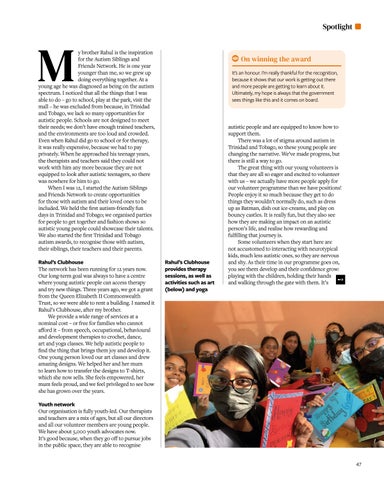
Rahul’s Clubhouse provides therapy sessions, as well as activities such as art (below) and yoga
autistic people and are equipped to know how to support them. There was a lot of stigma around autism in Trinidad and Tobago, so these young people are changing the narrative. We’ve made progress, but there is still a way to go. The great thing with our young volunteers is that they are all so eager and excited to volunteer with us – we actually have more people apply for our volunteer programme than we have positions! People enjoy it so much because they get to do things they wouldn’t normally do, such as dress up as Batman, dish out ice-creams, and play on bouncy castles. It is really fun, but they also see how they are making an impact on an autistic person’s life, and realise how rewarding and fulfilling that journey is. Some volunteers when they start here are not accustomed to interacting with neurotypical kids, much less autistic ones, so they are nervous and shy. As their time in our programme goes on, you see them develop and their confidence grow: playing with the children, holding their hands and walking through the gate with them. It’s
Youth network Our organisation is fully youth-led. Our therapists and teachers are a mix of ages, but all our directors and all our volunteer members are young people. We have about 5,000 youth advocates now. It’s good because, when they go off to pursue jobs in the public space, they are able to recognise 47