Cowboy Journal v1n2

Page 1


J COWBOY OURNAL

Mandi Branstetter

Editor

Shelly Holland Assistant Editor

Cindy Raith Graphics Editor

Amy Hagebusch Photo/Web Editor

Janna Quaring Circulation Coordinator

Shayla Givens Sponsorship Coordinator

Misty Ambrose

Andrea Barnhart

Laura Burch

Christy Couch

Lori Eutsler

Kristi Manning

Faren Revard Staff

Shelly Peper Sitton Managing Editor

Limousin World

Oklahoma Farm Bureau

Quebecor Printing

Founding Sponsors

Special thanks to ...

Ursula Blanchard

Fred Causley

Margi Cooper

Gayle Hiner

Dwayne Hunter

Todd Johnson

TomJorsch

Heather Lloyd

Jeff Miller

Don Stotts

Elizabeth Whitfield

Tbe Cowboy Journal taff (from top left): bay/a Givens, Christy Couch, Faren Revard, Laura Burch, Knsti Manning, Andrea Barnha11, Cindy Raith, Shelly Holland, Lori Eutsler, Amy Hagebusch Janna Quaring, Mandi Branstetter. ot pictured: Misty Ambrose.

COWBOY JOURNAL

Vol. I A 0. 2 A Fall 19 9

Once Upon a Time ...

CASNRstudents create a fairytale event.

6 The Man Behind the Students

Associate Dean Ed Miller: who he is, where he stands and what he believes.

1O Looking to the Future ...

A distinguished few CASNRstudents get a jump on their future.

12 It's a Bug's Life at OSU

Forget a dog. How about a pet roach?

J 4 Test-tube Calves Become Reality at OSU

New research advances livestock production into the new millennium.

Rapin' the Right Career

Combine your skills for a winning career.

Pullin' for the Future

CASNRstudents get their motors running.

Roughin' it in the Woods

Summer camp lets the forest be a teacher.

18 Cracking the Fat Content?

OSU professors get the skinny on pecan fat removal.

20 Red, White and Green?

Oklahoma wheat researchers study different varieties of wheat for the American economy.

22 Humble on His Pedestal

Truman and Marshall scholarships winner reflects on his accomplishments and prepares for the future.

2 6 Rinse, Repeat, Recycle

Oklahoma farmers participate in recycling program.

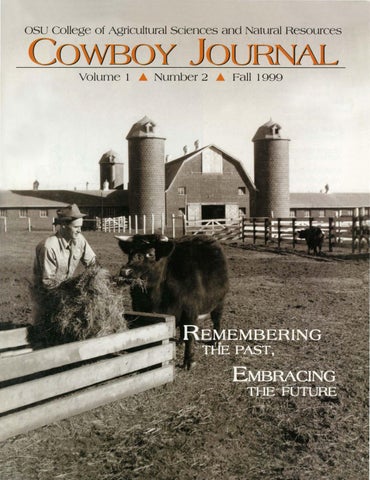
On the Cover... In 1946, Oklahoma &Iv[ College bred, fed and

howed the grand champion ho1thorn sreer at the Chicago Live tock Exposition. Weighing in at 1 380 pound this hort-legged, round-bodied hunk of beef i an example of how much the indu uy has changed. Although this animal husbandry barn no longer exist , it wa located west of Agricultural Hall on the site known a the college farm, where Iba Hall and the O tudent Health Center stand today.

A the indu try continues to change, the Cowboy Journal taff i proud to REMEMBER THE PAST A D EMBRACE THE FUTURE.

I'<eedi11g a champion
Orville Deewa/1, beef cal/le herdsman, and Royal J11p/1er, 1946
Chicago liveslock £'(jX) grand champion.

Kings and queens.

Jesters andjugglers.

Singing.

Da11cin1J. Dinin/J.

The OSU Madrigal Dinner Concert, held each December, is a combination of singing, dancing a11ddining set in medieval times. While they enjoy their meals, more than 2,000 guests each year are entertained by jesters and other medieval characters.

Agricultural Sciences and Natural Resources, they do.

Celebrating its 25th anniversary, the Madrigal Dinner Concert is a joint effort among the department of horticultme and landscape archl tecture, the department of music and the OSU

Student Uruon.

A once-

"This is an excellent experience because it's very much Likedoing a large gala event such as a wedding reception," Needham said. "It's very practical from the standpoint that student:$ have to come up with the ideas, develop the prod-

'The greatest benefit is the real-life uct, implement it and install it in a short time frame." a-year event, the Madrigal experience. This practi-

Although these images may not seem to go hand--inhand with the Oklahoma State University College of Dinner provides experience and scholarship money for some CASNR students.

The event is unique in several ways. Unlike similar productions at other universities, this event is conducted solely by students. Other universities may utilize professional designers and decorators. But that's where the OSU department of horticulture and landscape architecture comes -into play.

Students enrolled in the -; advanced floral design class ] (HORT 3553) are responsible ~- for transforming the Student -~ Union Ballroom into a medi.,, w eval fantasy land. Doug Needham, associate professor in the department, said the event provides a unique opportunity for students.

cal experience was appreciated by Shaun Dalrymple, horticulture and genernl business senior from Stillwater, who took part in the 1997 event.

"We were doing designs on a large scale, and working on a scale that large makes a big difference," said Dalrymple, who plans to begin a floral shop specializing in weddings.

The planning and designing for the Madrigal Dinner Concert is no small undertaking for horticulture students.

"Beginning the first class period in August," Needham said, "students discover the year's theme, which ranges from love to forest animals."

Once Allen Reding, director of the event, and the

OSU music department have selected music, the horticulture students enter a new phase of planning.

"We interpret tl1e musk selection in floral material," Needham said. "We try to suppoit the theme in floral decorations."

Students are given a month to develop individual floral designs for the event. They then present their designs to a "madrigal jury," comprised of Needham, a representative of American Floral Services and representatives from the Madrigal Dinner Concert committee.

"The students have about a four- or five-week period to develop an idea or concept of how the student is going to interpret tlle madrigal theme, create a mock table arrangement and a mock wreath, and present that to a jury,'' Needham said.

Although tbejury presentation may be stressful for students, tlle experience prepares them for the "real world."

"Why do we do t11is? Why is it important? Well, it's very much like selling a concept to a potential clieu t," Needham said. "Once a design is selected, students de-

termine the amount ofmateria ls needed and begin prep arations for implementing those designs."

Two weeks prior to the di:imer,actual assembly of the designs occurs. In addition to class time, students work about 2-0hours in their spare time to assure the designs are just right for the event.

Dalrymple said the extra work and late nights taught students many life lessons.

"It was kind of hard work because we had a Jot of different creative minds together," she said. "It was difficult at times. But we got really close as a class. We seemed to be a really cohesive group compared to the other classes f've taken."

The extra effort and difficu1t moments pay off in the end for students.

"The greatest benefit is the real-Ii fe experience," Needham said. "There are very few situations in the classroom that can be taken directly to real life. This is one of them."

But experience is not the only thing gained from the event. Ticket sales provide scholarship money for the department of horticulture and

landscape architecture and the department of music.

The department of horticulture and landscape architecture uses the scholarship money as work-in-progressthe previous year's earnings provide funding for the current year's materials.

This funding ensures the music will play on for years to come.And a medieval fairytale will continue to flourish because of the talent and hard work of students in the department of horticulture and landscape architecture.

The Man Behind the Students

Who he is, where he stands and what he believes.

After looking coast to coast for a new associate dean for the Collegeof Agricultural Sciences and Natural Resources, an Oklahoma State University search committee found the right man right beneath their collective nosesin the basement of Agricultural Hall.

Edwin Miller, former head of OSU's department of forestry, was selected from numerous candidates who applied for the position.

Students, student leadership groups, administrators, student council, faculty, department heads, other administrators, deans and the president of the university were all part of the selection process.

"Dr. Miller has an excellent performance record administering programs in teaching, research and extepsion," said Sam E. Curl, CASNR dean. "He bas proven himself a leader during bis time as bead of the OSU department of forestry, and I know he will do an outstanding job as associate dean.

"There were a number of highly qualified applicants, but in the end, Dr. Miller was selected because of his excellent administrative performance record and marvelous potential for success in the associate dean position," he said.

Miller acknowledges the high level of responsibility that comes along with the job.

"They were looking for someone who really understands agriculture, had administrative experience, a special interest in teaching, and most importantly, someone with an interest in students," Miller said.

1989 he became head of the forestry department.

He joined the department of forestry after 11 years as hydrology program leader for the Weyerhaeuser Co.'s southern forestry research department in Hot Springs, Ark. He began his career in 1973, teaching in the School of Forestry at Stephen F. Austin State University in Texas.

Although Miller has been active in the college, many students didn't have an opportunity to meet him unless they were majoring in forestry. Forestry students, however, have a great respect for their former department head.

"He is a very down-to-earth guy," said Casey Keller, forestry senior from Batesville, Ark. "Dr. Miller is easy to get along with, easy to talk to, and he tries to get to know the students. He makes you feel as if you are an important part

of something."

Wic Warden, forestry senior from Bernice, La., agreed.

"I admire Dr. Miller's efforts to maintain his contact with students, since I'm sure it is much harder for him to do from the position he is in now," Warden said.

The associate dean's obligation is one of great responsibility, having to oversee the activities and affairs of all staff and faculty within the college.

"Everything done in this office is ultimately for the benefit of the student," Miller said. "Anyone in this position needs to understand students, because that's what this office is all about, helping students."

There are certain advantages to having someone from within the organization who understands and believes in it, Miller said.

A native of Des Moines, Iowa, he received three degrees from Iowa State University: A bachelor of science in forestry management in 1968, a master of science in agronomy in 1970 and a doctor of philosophy in water resources in 1973. Miller came to OSU in 1986. In Ed Miller enjoys taking time to advise CASNR students about challenges they face.

"We have to give credit to the great job Paul Hummer did as a former associate dean," Miller said. "He was an excellent administrator and he did an excellent job of managing the college."

"Sometimes

when you come into a new position you have to fix what has been broken, but fortunately, Dr. Hummer left us in good shape."

great quality of academic programs.

"I think Dr. Ed Miller is an excellent choice to be the new associate dean," said former associate dean Paul Hummer. "He has integrity, high standards for the aca-

·we need to make sure we recruit the very best students, be as supportive as we can and nurture them while they are here."

With a new associate dean comes a new set of goals and aspirations for the college. Miller has a great challenge ahead of him, which he plans to face head-on.

Miller said he believes there is a strong and positive spirit within CASNR. The spirit of this college he said, is healthy and also inspiring, and these are assets he wants to maintain. He also feels CASNR must keep up its

demic experience of students, a sensitivity to the needs of others, an abundance of energy, and the experience and wi dom to go with a high level of intelli-

gence."

Miller said he believes students should be taken good care of from the first time they step into Agricultural Hall.

"We need to make sure we recruit the very best students, be as supportive as we can and nurture them while they are here," Miller said. "We feel that we have a responsibility to enable students

to find placement and to provide a strong linkage with employers. We want to facilitate that process."

"Overall, the main goal is that we want to continue striving to provide a better quality of education."

•Fertilizers

•Fencing

•Electric Fence Repair

•Cattle Panels

•Portable Dog Pens

•Ag Chemicals & Sprays

•Hydraulic Oils

•Garden & Field Seed

•Bailer Wire & Twine

•Cutting & Tillage Parts

"ALWAYS FRESH" A&M FEEDS

•Tractor Oils

•Chain, Pulleys, Rope

•Work Clothing

•Wrangler, Cinch

•Carhartt & Woolrich

FOR CATTLE, HORSE, SWINE, POULTRY, SHEEP, GOATS, DOGS & CATS

Ed Miller FEEDS

to Rope e Right ER

ills, the ability experiencesand

entsare often what

Personality,intra-person to communicate.intern extracurricularachiev. fand the job. Lear ow to combine your into a winning career. skilfsand turn the

Unles you intend to be an engineer, accountant or scientist, your major is minor to most employers. Corporate recruiters may admire your proficiency in analyzing the genetic map of a species, but they are more interested in your transferable skills, work experience and attitude according to agricultural career ervices.

Kenny Weynand, division aftermarket manager for the Dallas sales branch of John Deere, aid students shouldn't feel insecure about their credentials.

"You've developed marketable skills that apply in bu iness, and your

experiences do count. If a student has been a waitre s, I think, 'She's worked in high-pres ure ituation and knows good customer ervice. She knows how to make people happy and defu e tenions; the same skills needed for a marketing repre entative,' Weynand aid.

So give yourself credit-and don't let your degree alone determine your destiny. A major in economics didn't keep Sandra Day O'Connor off the U.S. Supreme Court, and a degree in advertising didn't hurt country-mu ic star Garth Brooks. If you develop a strategy, and are persistent and creative, you can turn your education into an exciting job.

First remember you come to college to learn how to think not how to master a vocation; working with a team, conducting research, analyzing problems and communicating effectively are skills necessary for success in any profession.

"The companies that interview at OSU hire good people, people who have worked hard to develop skills, not majors. They are problem solvers and people who have proven they know how to learn. The recruiters look for the skills you've learned in and out of the classroom,' said Louann Waldner, director of career services in the OSU College of Agricultural Sciences and atural Reources.

Recniiters ask about the field you've chosen as a way of getting to know you, not reject you.

"Sometimes students' ideals and what they want to do change over time. We aren't going to hold you back just because of your area of study. We are more concerned that the job is a good fit for you. It costs so much to hire and h·ain that it's counterproductive to hire

someone who isn't going to enjoy the job," said Katie Schulte, agricultural recruiter for Koch Industries.

WHERETO START

For the most successful students~ca~ reer planning sta.i:tsthe day, you walk on campus, Waldner said. You start by joining organizations, building a network, gaining experience and creating your career calendar. lt is important to job-shadow, read about the industry~ attend career fairs ahd take every opportunity to practice your speaking skills.

The career fair provides a grea,t chance to see a variety of jobs and companies you might be interested in working for down the road. lt is also a great place to practice meeting people. Use the career fait to research companies, gain confidence and practice your people skills.

"Exposure is one of the keys t'o future employment," Waldner said. "lt is never too 1ate to start, but make a decision today to not wait ap.other day.'

She said it takes the average job hunter six to ~1inemonths to find a po- · sition. The later you start the more frustrated you'll be.

Ask the director of the career center to put you in touch with alumni who majored in your area-recent grads as well as people who have been working at least 10 years-to get a diverse perspective. Don't forget to register with career services, sign up at http:// www. dasnr. oks ta te.edu/ casnr/ career.html

YOUR RESUME

"Yourresume is the first impression given to a company, so it amazes me what little time some students put i,nto them. Interview pre-se1ection is based on resames," Schulte said.

Waldner said it's never too early fo start a resume. Itis an ever-evolvingcreative process that wiU also need tobe changed to fit the profile of the job for which you are intetviewing.

"If you have a resume on file atoareer services it's re::J.dyincase someone requests it, and once you discover yow objective it's easy to see if your experience matches or if you have gaps yq,u need to fill,'' Waldner said.

11Preparation is always an advan-

tage,'' Sc)l.1,1.ltesaid l<'.eegyow;activities J;i$ctcurrent inrfo~,, ~ates, and yotp: senior year bf a cl:i,am:e to fine:.fun:ewhtt yoi'lhave r;ompiled.

SO Wf:::U\TREALLYCOU

E~e:rie:ncefEmp'leyers,d: you to acquire sfieeffi,ctechpichl knO}Yl"' edge about their company in the class~ r:_oom.Internships, part-tiln'ejobs and relevant activities ar~l:hernfore m~at tory.

"1 did a.nilitetn.sh1ppart-tittle inthet iei summer. I didn;t .get p~d bP,tit vv:asa ,fa representq.tive @f the ~elate', great experience because: it was 'With a s • • • re cypically top-notch co111pany. lt gets you:rr · e ~the noticed uwell," saia E:odyB1ootl, wi:vioml cultur~ economics senior from Binger, intern tiinf}tiof.l Okla. that , •el>e •nstut i

Students sho11ldnol justJoJn. clubs • and organizations, but get i:nvol'9'ed. , "It gives you a lot more to.~about or c;,nlyoµe in thei.I"J.terview if yotLheld aJeadership late fo conn . .' position and made a difference within ot"e~lore lJ.! , summ that organization,'t;Bl'oot;lsaid. po~itionsand eiampqsactivities to gain Schulte said Koch lndust,ries looks moreeiperience 1ttld.Vsisitthe.agricul- " for students who take iuitiatiV'«tThe tut r services office;~. new emi:iloyeeswon't.always be told ev- .Glass~stodaytna:yseem drlib,.;J:w:t erytltlng; they are expected to ,deliver wh enter tlier:e~;wm"ld.y01lll andneea to :knowwbetiandhow to take app .· your college edueatip action. exa9tlyw.hati teall ~·- Mu ''Welook forwe)l-rounded cancli- fo~llfe"

whatever is thrown at them/' she said. •

INTERVIEWS

Ch

The question remains when faced ecklist with tough competiti,on, what is th~ 4 Self-~valuate _ Be abl most effectivewayto distinguish-your• articult e to self in an intervlew? 1f yo1i don't 4 Wr·t ate Your objective know the answer to th'is qaestion;; l e a superb resume consider yourself normal. iut'be,te• 6 Ha~e_your resume are a few clues toput:you a step ahead en tiqued by thr of your competition. 4 Regist . ee people 't'he newest type of intetri;~W'- er With CASNR iug is ca·Ueabehavioral interview,. Career Services ing. rt is one of the hottest tl:e'l1asin • Check out the c S areer evaluating antl recruiting new em• erv:ices Web site ployees. ' • lnvestig , Many rf}cruite;rswillcsteer the 6 Sharp ate po~enti_a]jobs interview into thi§ area by aik:i11,g en your mtervie yq:uto aes<:ribea 01p,ewhen yoti skills w used leadership;;sJ.ti,UScort1r'de- Attend CASNR_C scribe how your communia:ation Fair O areer $Jci;llbeneijted yo~I! em:pfo..i,er. N on ctober 20 v etwork 't 11 But, you'll really impress tnem i£: ab - e everyone youvolu:nteel'detaileder:a:mples out Your job objective

Looking to the Future...

A distinguished few CASNRstudents get a jump on their future.

The freshman year - a time for students to get adjusted to a new way of life. Being away from parents for the first time. Adjusting to a life of no curfews and few rules. But getting hands-on experience with cutting-edge research?

That is exactly the case for some students in the Oklahoma State University College of Agricultural Sciences and atural Resources. Through the freshman research scholar program in the department of biochemistry and molecular biology, students get a jump start on their future.

classroom weekly to discuss issues in the biochemistry and medical fields and become acquainted with instructors and other students.

Although the freshman scholars do not have specific projects, they do have the

"It gave me an idea if that was really what I wanted to do

opportunity to work with upperclassmen on their research projects.

Brad Liston, biochemistry senior from Moore, Okla., said the expe1;ence was beneficial in many ways. while I was at Oklahoma State."

"It helped us because it not only

what we really wanted to do, ' Liston said.

Nelson said the program offers many benefits to participating students.

"The freshman research scholar program pairs students with a mentor and kept us up on daily events about what was happening in our fields, but also helped us to make up our minds fairly quickly about our college career and to know if that's gets them into a laboratory their first year at OSU, usually their first semester," said Eldon C. Nelson, professor ofbiochemistry and molecular biology.

In addition, students have the opportunity to meet in a "It does two things - it gives them an atmosphere that is We at BancfirstRecognizethe

Importance

As one of our country's leading industries, this means jobs, dollars, and prosperity for all. We at BancFirst know the language.

We know the business. But it all comes down to one point:

We never forget we're in business to help.

different from a teaching lab and they get right into doing a real problem in biochemistry and molecular biology," he said.

"The other benefit i every once in a while a student will find out this is not what they want."

"They get into a lab their first semes~ as a freshman rather than waiting until they are seniors, ';Melson said. 1486 this is an undergraduate re earch project ~atila~fteshmeI\ can get into.'

Liston said the scholar program als classes he would face at OSU.

"It helped me out in the way that in tructors were wanting and what to look said. "It gave me an idea of what I wanted

$400 award and is determined by a student's high school grade point average and activities.

"My biochemistry adviser Dr. Nelson, talked with me about the program when I made a visit as a senior in high scl;10ol,"Liston said. "He looked at my high school resume, and he and the rest of the committee made the decision to give me the scholarship."

'If the committee thought you would fit in the program and work hard at it, then they would grant you the award," headded.

• ti$ton said biochemistry was the major of choice for him be2_i!.~e;Jtcombined two of his top priorities.

"I liked biochemistry because it was in the college of ag," Oklahoma State, anfl.,it ~ve me a better feel for the major of biochemistry rig}it the~e in 4;hebeginning. '

Fifty stude ts receive he OSU Freshman Research I Scholarship eac year thriu h the office of the OSt:r vice president of rese&rcb. Th<:;.s<lliolarship is a non-continuing

Liston said. "I enjoy, of course, the ag field, and biochemistry is really the only major in the college of ag that fulfills all the requirements to get into medical school."

For more information concerning the freshman research scholar program, contact Eldon C. Nel on at 405/744-6201. . ,

Mo t ofus try to killcockroaches. However many Oklahoma State University students do just the opposite. 111eyw01·kbard to keep a pet cockroach alive as part of the curriculum of a unique "bug" clas

Entomology 2003 also known as 'In ect and Society,'1 is a das that introduces tudents to the fascinating world of bug

ments and conditions.

"At first, I was scared to touch my cockroach, but now I'm comfo1tabletouching and feeding it," said Jo Lynn Enlow, agricultural communication sophomore.

"However

"I want the myroommate is still not sold on the idea of a pet cockroach." students to wonder, What will he do today?"'

It may not sound interesting to ome people,but the class attracts a wide variety of students from different majors and backgrounds.

It is one of the most popular science classes the university offers, probably because of the shock factor, said Ken Pinkston, OSU entomology professorand instructor of the class.

Throughout the semester students are involved in many hands-on assignments, including a 'pet" project.

Each student is given a Madagascar hissing cockroach to adopt for three weeks. The students are responsible for keeping the cockroach alive and monitoring its reactions to different environ-

The student also par-

ticipate in a 'Build-a-Bug" project in which they work with a group to design a new species of insect using supplies like Styrofoam balls and foil paper. This e,xerciseencourages student to work in groups to better understand the different body parts of an insect.

'Build-a-Bugproject was really great because we got to meet new people from different colleges," said Jamie Liston, agricultural education sophomore. "This clas is so diverse. Its a really neat change from ordinary classwork."

The class is also a big hit with students because of th professor. Pinkston uses unusual teaching schemes like the pet cockroach and the

'Build-a-Bug" project to encourage students to attend cla . "You must entertain students to hook them,' said Pinkston. 'I lik trying offthe-wall stuff. I ant the students o wonder, What will he do today?"'

Another highlight of the class is the "Bug Bowl." Students form teams and compete in a quiz bowl of entomology topics to win bonu points for class. Thi activity prepares tudents for exams and enables them to learn and memorize information in a fun way.

The cla provides three hours of natural science credit without requiring a lab. Most university science clas e require students to participate in th learning proce s during time spent in a lab. The absence of a lab may attract some students to the course, Pinkston said.

The tudents receive. knowledgeabl expe1ience in dealing with bugs from caring for the cockroach to oral presentations in cla s.

Regardle of the student s major, each student enrolled in E TO 2003 leave the cla s with a better understanding of the wacky world of bug

THOMAS FORD

FULL SERVICE TIRE CENTER

•Brakes-Struts-Shocks • A/C Repair and Service

•Alignments • Lube & Oil • State Inspections

•ASE Certified Technicians

"YOUR ONE STOP AUTO SHOP"

Goodyear-Michelin-Dunlop-BF Goodrich-Continental

Free Road Hazard Warranty

Free Re-Balance & Rotation & Flats

24-Hr. Road Service

Cars-Trucks-RVs-Farm Equipment

Custom Wheels-Complete Auto Detailing

UNOE.R NEW MANAGEMENT

DARRELL McKINNEY

261 7 NORTH PERKINS ROAD

Test-tube CalvesBecome Reality at OSU

New research advances livestock production into the new millennium.

How would you like to be able to guarantee your livestock will have the best production traits possible? This can happen with the help of a team of researchers consisting of veterinarians, professors and post-graduate trainees from Oklahoma State University.

OSU is currently conducting research on in-vitro fertilization. This technique involves taking an ovicyte from a cow and fertilizing it with sperm in a laboratory. After fertilization, the embryo is either frozen or transplanted into another living cow.

This research is relatively new to OSU. Although research began more than a year ago, most research has been completed in the last six months. In October 1998, the first embryos were produced. The first transfer into the recipient cow took place the next month.

Currently, OSU has its first cow carrying a calf as a result of in-vitro fertilization. This research will benefit livestock production in many ways. Embryo screening will assist producers in determining a calf's gender, and research in animal genetics will help determine whether the embryo carries the genes in which the producer may be interested.

Gregor Morgan, doctor of veterinary medicine, said this type of research is important in Oklahoma.

"Given the importance of cattle in this state, it is important we keep up on new technologies in animal production," Morgan said. "We can't let the rest of the world get ahead of us."

Jerry Malayer, professor at the OSU School of Veterinary Medicine, said students and alumni should be interested in this topic, especially if they are involved in the cattle business.

"Many of our students are coming from a cattle business, and their parents are paying for them to be here to aid in the research effort," Malayer said. "This also increases our research potential and keeps the faculty up to date in the different areas. If students are interested in participating directly in research it will enhance their experience at OSU."

In-vitro fertilization research will affect producers, as they will be able to select desired traits at the embryo stage. Morgan said from a genetic selection standpoint, this research will make a huge impact.

"Improvement in animal production comes through genetic selection,

and right now traditional means of identifying animal traits takes a long time," Morgan said. "In tl1e future we will be able to identify what genes control many of the production traits in our domestic livestock.

"The whole future of cattle is going to the molecular level."

Cattle am not the only species that can benefit from in-vitro fertilization. Steps are being taken to include sheep, swine and even dogs into this research.

"The other specie we've had a lot of people ask about, believe it or not, is the dog," Morgan said. "We also have some people on staff who are world-renowned swine researchers. 1 don't think it would take that much for us to move into swine, but we're going to concentrate on cattle first."

The first in-vitro fertilization calf to be born at OSU is due in June at the OSU dairy barn. Researchers said they are not sure what the coloring of the calf will be.

"The egg came from a slaughter cow in Wichita, Kan., and the semen from Reproductive Enterprises in Stillwater," Morgan said. "Nonetheless, it's going to be a big day."

FDR 'IHE

OSU CASNRstudents get their motors running for a national competition.

The roar of engines drowns out the cheers and applause of the crowd. Exhaust fumes billow and a cloud of dust fills the air as the garden tractor with a mighty pull, lunges its way to victory.

Well, it isn't a typical form of student competition, but when the dust and exhaust fumes settle, a crew of Oklahoma State University biosystems and agricultural engineering majors intensely await the result of their latest competition.

Revving up for its second year of competition, the OSU American Society of Agricultural Engineers chapter is preparing for the national quarter-scale tractor pull competition, May 22-23 in Moline, ill.

ASAE initiated the National Student Design Competition last year. Through designing a quarter-scale tractor, students are chal-

lenged to harness the power and torque of a specified stock engine in order to maximize performance in the tractor pull.

"Each team i given a 16-horsepower Briggs and Stratton motor and a set of tires and is required to build a frame and tractor," said Jake Hol1oway, biomechanical

option junior.

"Our one limitation is that we are supposed to leave the engine completely stock, we al'en't allowed to

stage tractor pull using a progressive sled.

The ASAE Web site indicates that although the size and shape of the quarterscale tractor is similar to that of a typical lawn and garden tractor, very few parts will

'When you make a lot of noise, they stand up and greet ya." be used directly from a commercial machine.

The OSU crew obtains all equipment and part~ through do- mess with it."

According to the ASAE Web site, the tmee main categories in the competition are a written design report, a team presentation and a performance competition. The performance competition is comprised of a multi-

nations, and monetary donations are always accepted.

"We're getting a brochure together to take to companies for possible sponsorship . We want to look profes ional and show that we have a purpose," said senior team member Dustin Simmons.

According to ASAE, one of the primary concerns of profes ionals in the industry today is the lack of practical knowledge or design experience with many engineering

tudent (of all majors) entering the workforce. The organization believes design competitions and projects are important keys to prepare

Suiting up for a practice

for a win.

students to be effective professional engineers.

The crew agrees they gain practical experience and develop skills in communication, leadership, teamwork and fund raising.

"The best way to learn a lot of this stuff is just to experience it," Simmons said. "There's no substitute for the experience. When you can see how something works or doesn't work you can apply that to future projects," Simmons said.

Experience also pays off in the competition itself. Last year, the team competed for the first time, simply testing the water.

"Last year we didn't know a thing about it, and we learned a lot," Holloway said.

The team came home last year ranked seventh overall but concede they competed without oral or

Goingfor a full pull, the quarter-scale tractor is tested at a local tractor pull to practice for the national competition in Moline,fll.
run, Dustin Simmons prepares to drive th.eASAE tractor

Below: It may look like a garden tractor on steroids, but you won't see it cutting any grass at the national competition. The tractor was built from the ground up to compete with other ASAE chapters from across the country.

Above: Complete dedication is required of team members to ensure victory at ASAE competitions. Dustin Simmons, Jake Holloway and Chad Fisher make any last minute changes beforetaking the tractor to competition.

written presentations.

"That's where the rest of the club comes in - it's a total club effort," Holloway houses for high school sesaid. niors.

Other biosystems majors are involved with the competition by assisting with the non-mechanical pa.rt of the competition, fund raising and of course 1 moral support. And this year the crew is ready to compete in all aspects of the competition with both a junior and senior team.

"The senior team will consist of the crew that competed last year with a new tractor, and the juniors will have last year's tractor at their disposal," Simmons said. "The old tractor is constantly evolving."

The tractor itself serves as a great public relations device for the department, as it has been showcased at the annual Ag Roundup, Homecoming parade and open

"The tractor attracts a lot of attention. When you make lots of noise, they stand up and greet ya;" said Chad Fisher, a freshman involved for the first time this year on the junior team.

To help prepare for the big competition in the spring, the crew attends many local tractor pulls in the fall. These are usually only attended by individuals in the Oklahoma Garden Tractor Pullers Association.

"Since we're the only college team that makes it out, they are real excited to see us and they take care of us/' Simmons said.

"OKGTPA changed its rules to accommodate us as a family membership so we all wouldn't have to pay individual dues," Holloway

added. And the crew is just that - a family.

Time and time again, the crew is reminded of what they are gaining by becoming hivolved in the competition.

"We apply all the skills we learn in class and gain insight to what we are going to be faced with in the future," Simmons said.

The future is indeed bright for the team whose hopes include becoming design or test engineers for John Deere or Caterpillar. And those companies have nothing to fear when they hire someone with this much experience.

"Not only will students gain practical design experience by participating in this project, they will also obtain invaluable experience as they

manufacture, build and assemble their own designs," boasts the ASAE Web site.

"Many a manufacturing department cringes when design engineers simply throw their designs 'over the wall' and assume they can be easily manufactured. Through hands-on experience with numerous manufacturing processes, Shi.dents will gain awareness of the capabilities and potential pitfalls in the design for manufacturability and design for assembly."

As for how to get involved, Holloway offers this advice.

''Just ask - we accept all free labor."

Crackingthe Fat Content?

OSU professors get the skinny on pecan fat removal.

Do the words 'healthy" and "pecan" go together? You bet they do.

A team consisting of Oklahoma State University professors in the departments ofhorticulture and landscape architecture, nutritional sciences, and biosystems and agricultural engineering have found a way to reduce the fat in pecans and create healthy by-products as well.

IN THE BEGINNING

Sue Knight, retired OSU nutritional sciences associate profe sor, said she and Marilyn Waters, a graduate re earch assistant, started the project as a study to produce lower fat content and extend shelf-life in pecans. They began by 1owering the fat content using FDA-approved food-oil solvents.

"We were able to get ome of the fat out, up to 30 percent, if the kernel were

chopped, but only about S percent with whole pecan halves," Knight said.

Knight said pecan are between 60 and 70 percent fat, with a large percentage monounsaturated.

"Granted, it is a very healthy type of fat, and we need more monounsaturated fat in our diet. But manufacturers are wonied about the fat level when stating it on the product nutritional label," Knight said. "We wanted to help market pecans for a calorie-concerned public."

"Although our product was wellrated, there were lots of things about the equipment and procedures we were unhappy with. We were way beyond our capabilities,engineering wise. We needed help."

Knight said the pecan product was well rated, but the researchers were unhappy with the available equipment and procedures.

TEAMWORK

That is when a group of interdepartmental professors came together as a team. iels Maness, professor of horticulture and landscape architecture, along with Gerald Brusewitz, professor ofbio ystems and agricultural engineering, stepped in to get the ball rolling. They began studying the use of a gas-underpres ure type of extraction to obtain the lower-fat pecan.

Brusewitz aid this new way of oil extraction is a method developed by OSU to be used on food products. It is a highpressure proce s using supercritical carbon dioxide at levels of 4,200 pounds per square inch.

How much oil can be removed from pecans?

"About 30 to 40 percent of the pecan oil can be extracted by flowing the supercritical carbon dioxide through the pecans for a three-hour duration,' Maness aid.

The team project began as a study to find a way to extend the shelf-life of intact pecan halves. Pecans were chosen for the project because they go rancid quickly, only having a shelf-life of three to four month at room temperature.

"We are still using good sample from our 1996 extraction, so we are not quite sure of the shelf life of the lowerfat pecan," Manes said. So far, the shelf-life ha proven to be over two years in duration."

OIL BY-PRODUCTS

The lower-fat pecan is not the only product resulting from the oil-extraction B process.

~r--,;:,Jl "Pecan oil is a high-grade oil that can be used in a salad dressing," said -gKnight. "It also can be a good substitute :g'for olive oil when cooking."

Gerald Brusewitz, Niels Maness and Sue Knight display lower-fat pecans and oil extraction equipment.

This type of food oil-extraction process has given manufacturers an incentive to come to Oklahoma.

Knight said research is currently being done to develop a cake mix that has pecan oil already included. Once the low-fat cake is developed she will then try to produce it as a dry mix for easier manufacturing.

Pecan oil is not only used as a food product. It has been proven to work a a nonfood product as well.

"You wouldn't think pecan oil would make a very good profit, but you can make much more money using it as a wood stain than as a food source," Brusewitz said.

OKLAHOMA BENEFITS

ow that the oil-extraction process has been proven using liquefied gas and supercritical carbon dioxide, manufacturers are beginning to look at production.

"There is a company looking at putting a manufacturing plant in Oklahoma that will be able to extract oil not only from pecans, but from other food products as well," Brusewitz said.

"The type of food oil-extraction process used in this project has given manufacturers an incentive to come to Oklahoma, ' aness said.

Oklahomans will not only see a new company coming into the state, but they may also see the result of a similar process discovered long ago.

"The actual process of using liquefied gas to extract oil was patented in Oklahoma by a local crude oil company," Maness said.

Maness said although the process was patented long ago, no one considered using a process done on crude oil as a process to extract oil from foods for human consumption.

PROMOTING OIL-EXTRACTION

The team is working on ways to help promote on-going oil-extraction research, by meeting with legislators, preparing pamphlets and producing a short documentary about the process and results.

Maness said promotion is an on-go-

ing team process. He said a team approach i what has made the oil extraction project a succe s. One example of teamwork is the staff in the Department of Ag1iculture's marketing office, who helped market the lower-fat pecan to the public.

Maness said the team hopes the continuation of research support will help increase the capability of marketing and producing the lower-fat pecan for 1·etailsale by companies, such as the one coming to Oklahoma.

THE LOW-FAT CHOICE

Oklahomans will oon have the choice of products containing lower-fat ingredient due to the oil-extraction process. This proves team effort can get the job done.

So, when the holidays roll around and you find yourself in the store looking for those pecan pie ingredients, remember to look for the lower-fat pecan - any other pecan may not prove all it's cracked up to be.

3.22 House GPA

Homecoming sweepstakes Award

Truman Scholar

Marshall Scholar

Five of Top ~oFreshmen

Ag Student Councjl Officers

President

Vice President

Ag Senators

Red, White and Green?

Oklahoma wheat researchers study different varieties of wheat for the American economy.

Like the colors of the American flag, Oklahoma researchers hope to see red and white waving across the bread basket of the United States. Red and white varieties of wheat, that is.

For years, Oklahoma has produced only hard red varieties of winter wheat, and a major reason for that is its tolerance to environmental conditions that prevent it from sprouting in the fields.

Brett Carver, Oklahoma State University professor of plant and soil sciences, said a breeding program focused on genetic improvements in varieties of hard white winter wheat for Oklahoma started about five years ago.

"A breeding effort is now being focused on white winter wheat. We are trying to produce it because of pressure from markets," Carver said. "Oklahoma

needs to think about how agriculture can be diversified within the state."

Domestic buyers want lighter-colored whole wheat products that are sweeter in taste than the red wheats for consumers who demand these qualities, particularly for making certain pasta products such as noodles.

Patricia Rayas, OSU Food and Agricultural Products Research and Technology Center cereal chemist, said polyphenolic compounds within wheat provide its color and taste.

"People can detect taste differences between the two wheats, and the white wheats are sweeter," she said.

Carver agreed, saying the dark wheat tastes somewhat bitter because of the same polyphenolic compounds.

"An advantage of white wheat is the compound is inherently removed so fewer sweeteners are added to wheat products," he added.

Another advantage of producing white winter wheat is the potential for the United States to market it to other countries.

"It can be used in producing different types of oriental noodles for countries such as China and] apan," Carver said. "Other countries won't use red wheat because they really prefer the white. The use of white wheat results in a more appealing end product."

Rayas said the use of red wheat in noodle products changes the elasticity, texture and color of the 0 ] noodles. The result often is a batch of grayish-colored noodles that

0 E could spoil the hungriest of appe-

:§, tites.

'C

A major weakness of white wheat, however, is its susceptibility to sprouting while in the fields. Once sprouting occurs, the germ and gluten i I' .;J

in the wheat are"°'destroyed,resulting in a non-milling quality wheat and losses to growers.

Jiming Wu, OSU graduate student from Nanjing, China, said the problem with white wheat sprouting early exists in his home country. He said the wheat can actually poison foods if the germination rate is high enough.

After studying at Nanjing Agriculture University, Wu worked with Carver to develop a procedure to evaluate white wheat genotypes for the sprouting characteristic.

"We compared gennination procedures and chose the one which best predicted sprouting tolerance in the field," Wu said.

Carver said their main objective is to give farmers the option to produce the white variety in the event demand makes it possible to do so on a regular basis.

Kim Anderson, OSU Cooperative Extension agricultural economist, said no one knows what the demand for white wheat will be.

"I don't perceive a strong market until researchers introduce varieties that are not susceptible to sprouting," Anderson said. "If they can develop a variety that won't sprout, and we can produce a consistent supply of quality hard white wheat, then there may be a switch from the red variety."

The wheat researchers and developers said they have seen progress in the development of sprout-tolerant white wheat over the past few years. However, their hope is to see mass marketing of the fruits of their labor begin within the next two or three years. When that happens then perhaps the waving of both red and white wheat will plant a little green in the pockets of the American farmer.

Experience the Benefits of Tae Kwon Do:

Self-Defense - Confidence - Discipline

Stretching - Flexibility - Calisthenics

Weight Loss - Toning - Cardiovascular Health

Improved Coordination - Improved Balance

Classes Taught by 4th Dan Black Belts

Blu Gut~Anderson

Phone: (405) 743-3775 E-Mail: TiKDo@aol.com A Fun Approach To Tumbling Cheer & Day Care

Tumbling - Cheerleading

All-Star Competitive Cheer Squad

Aerobics - Country Western Dance - Tanning

Licensed Day Care Center

Birthday Parties

Ages 3 and Up Are Welcome!

Open 7 a.m. to 8 p.m. Monday through Friday

Humble on His Pedestal

Truman and Marshall scholarships winner reflects on his accomplishment and prepares for the future.

Chris Stephens has reached a point in his life he never expected to reach.

Stephens, an Oklahoma State University agricultural economics graduate from Chickasha has received two of the nation's most prestigious scholarships - the 1998 Harry S. Truman and the 1999 British Marshall scholarships.

The Truman scholarship, developed in the 1970s, pays each recipient $30,000 in graduate school tuition. About 600 students apply each year and only 75 to 80 receive scholarships.

The Marshall scholarship gives the recipient the opportunity to study in England for two years. Established in the 1950s, 40 students receive the scholarship out of 800 applicants annually.

These two scholarships have placed Stephens on a pedestal above his expectations. However, he merely calls it luck. His "luck" is providing him with

the opportunities of a lifetime.

Stephens said he started thinking about the Truman scholarship when he was still a senior at Chickasha High School. At that time, Wesley Holley, College of Agricultural Sciences and Natural Resources assistant dean, knew Stephens from his participation in public speaking contests and various activities through the National FFA Organization.

Holley asked Stephens to contact him when he got to OSU to begin preparations for the scholarship process.

Upon his arrival, Stephens took part in many campus activities and became a member of Alpha Gamma Rho fraternity. He said no one pushes him to succeed more than he pushes himself.

Stephens is pleased Holley and Bob Graalman, director of the office of scholar and development recognition, are involved in the process of student

scholar preparation. Stephens said the applications and interviews became a consuming process that developed into a craving. Because of his accomplishments, Stephens has been asked to help students prepare for their scholarship interviews.

In October, Stephens will fly to London with other Marshall scholarship recipients to begin reaping the rewards of his accomplishments. He hopes to study land economy, which is a combination of agricultural economics, environmental law, and water and land use policies. It takes one year to achieve a master's degree, but because of regulations, students can only receive one master's degree per school. Stephens will try to transfer to another school and get a second master's degree.

"I am trying to prepare myself by looking on the Internet, and I have been talking on the phone to students from the U.S. who are already in England," Stephens said.

While Stephens will spend the next two years in school, the different environment and society will provide him with somewhat of a two-year break. When he returns to the United States, he plans to use the money from the Truman scholarship to pay for law school.

Stephens said he believes his peers and the people around him now look at him differently.

"The standards people expect from me are a little intimidating, but the opportunity never loses its excitement."

Stephens was caught a little off guard when asked what his parents would say about him.

"I would hope they would say they were proud of my accomplishments, but that they were most proud of me for being the same old Chris I have always been, and that nothing has gone to my head, that I am still humble."

211dYr. 3rtf Yr. 4th Yr. _~I: i\':mo0:1IJuni0r11llll

15.CXXJ 10,00l $15,00J 2().(00 25.0Cl.1

~.O:Xl $ 8,00J $12.00J $16.IKXl 20.00J

!2,CXXl S~.OOJ $ 6,00l I 8,00'.l I 10,IXXl

$1.iOO 3,000 ·1,500 6,00l ',.500

11,000 $1.500 2,00) $2,500 3.000 ~1JI Nauun.ill~~ ~11 t!~ Shol.___

2.!XXJ $2,500 3.fXXl 3.500 $.i.lXXl

1,500 $2,00l 2,500 $3.(XXl ,3,500

SllXXl '1,500 2,00J RSOO ,3.(XXI I 500 $1,OC() 1.500 2,00l 2,500 [!:YEI.IIJ:..wIeFair+HandFFAJun_lorSh<)ll,~ s1.500 RlXXl 2.soo 3,roi .Boo

$ 'All $1.IXXl $I,'iOO ROOJ $2,'iOO N· SW1~_.1!!!1!QrFM!ld_Day~ Qxm!J:luni<y_Jlo;, I 'iOO HOO 500 I 500 $ 500

$ 250 $ 250 25(! 250 $ 2'i0

,00

Rinse, Repeat, Recycle

Oklahoma farmers participate in nationwide recycling program.

Rinse and repeat.

o, these aren't the directions on a shampoo label. These are the instructions given to farmers who plan to recycle their pesticide containers. The Oklahoma State University Cooperative Extension Service and Oklahoma Department of Agriculture sponsor a recycling program to help reduce the number of pesticide containers put in landfills and to help protect the environment.

"Oklahoma is part of a nationwide recycling effort supported by the Agricu.lturnl Container Research Council," said Melinda Crockett, Oklahoma Cooperative Extension agent.

In 1992, the ACRCbegan collecting and recycling many of the 35 million plastic containers used by farmers each year. The ACRC has worked with the Environmenta.1Protection Agency, state environmental regu.latory agencies, and

departments of agriculture and natural resources to develop proper rinsing and storage techniques and to provide this information to the public.

The Oklahoma pesticide container recycling program began in 1996 with 12 one-day collections and 4,650 pounds of plastic containers collected. Each year the number of recycled containers has grown.

"In two years we have more than doubled the pounds of containers collected," Crockett said.

In 1998, the number of collection sites increased to include 26 sites across the state. Because of the additional sites, the pesticide container recycling program was able to increase the collection volume to 11,840 pounds of recycled containers. Semi-permanent collection sites are planned across the state to increase these numbers even more.

Kennedy,Laubach & Associates

Building Tomorrows SuccessToday

Stewart & Casey Kennedy a SuccessSpeakers,Trainers an

• Have spoke in 2 tates• •To more than l 00,000 peopl • •In more than 200 Oklahomc1to ns•

"I am confident in recommending Kennedy, Laubach & Associates. They understand student organizations They know the importance of establishing a professional image and serving as role models. If you are in need of an excellent presentation in personal achievement, motivation, positive attitude, team work, self-esteem, and other areas, this is your group."

Proper rinsing is the key to the recycling program, she said. Correctly rinsed containers are classified as clean, solid waste. Containers that have any residue left in them are considered hazardous waste and cannot be recycled.

"Proper rinsing also benefits the farmer," saidJim Criswell, associate professor of entomology at OSU and extension pesticide coordinator. "By rinsing the container so that it drains into the spray tank, more of the product is used and less money is wasted."

The ACRC contracts collectors to pick up, grind and transport the containers to recyclers. USAg Recycling from Houston, Texas, is the contractor for all Oklahoma collection sites.

Education about pesticide container recycling will help everyone see that the ·nstructions "rinse and repeat" make "cents."

Qua/19'Horsesfor

Tr(!J. Sherry and Caleb Eutsler

Brad & Lori Eutsler Criner

Kevin & Laci Eutsler Klinger

Rt I Box 81-4, TahleQuah.OK 74464 (918) 456-0076 eutsler@intellex.com

oughin' it in the Woods

"Summer camp allows students to diversify and learn that not everybody thinks like Oklahomans."

Imagine it's five in the morning and an Oklahoma State University student has just finished packing the car. Armed with a road map and everything ranging from camping gear to the kitchen sink, the tudent start across the country to meet a bunch of friends. Together, they will live in the wilderness for nine week.

They are forestry majors participating in the O U' Roving Summer Camp program. The program is required for forestry tudents before they begin taking upper-division clas es.

Oklahoma State has held SO summer camps in 20 different states and one foreign country since 1948, taking advantage of the di tinctive forest re ource setting , activitie , operations and issues in each camp region.

"OSU takes advantage of the wide range of forest region across the country," said Thomas Kuzmic, associate profe sor and summer camp director.

He takes the students outside the midsou th region, in which Oklahoma is located, to further educate the students in the diversity of forestry resources and practices.

The camp program is compri ed of four required forestry upper-division classes: FOR 3001Multiple Use and Values of Fore t Reources, FOR 3003Forest Men uration II, FOR 3011 - Logging and Milling Op-

eration and FOR 3013 - Silvics and Field Silviculture.

"There are too many restraints in the c1assroom, o we go to the forest," Kuzmic

land survey, wildland recreation management, professional ethics and forest resource administration.

"Students gain experience in managing time said. "We let the forest be our teacher."

The camp format is made up of lectures, bands-on experiences, on-site visits, laboratory exerci es and special programs in a diversity of

'We let the and resources, teamwork and leadership," Kuzmic said.

forest be

teacher"

Some forestry topics can not be taught as well in the classroom as other areas of forestry. our

forestry topics. These topics include: timber inventory, measurement of tree dimensions, forest ecology, silvicultural practices, forest protection, forest soils, watershed management, wildlife habitat management, timber harvesting, wood products manufacture, mapping and

Therefore, the students benefit by experiencing a professional work environment in the woods, where they work from eight in the morning to five in the evening.

"Students change positively during camp," Kuzmic said. "They develop an eagerness for learning."

Students conduct a timber inventoru exercise during the 1995 camp in Pingree Park, near Ru tic, Colo.

Exposed to more than trees as a part of the summer camp, students measure waterflow during the 1997 camp at Cloquet For·estry Center in Minnesota.

Jennifer Bovee, a junior from Hamden, Conn., went to camp in 1998 at Pingree Park, Colo. Bovee said she learned how to cruise timber, which is sampling a given tract of land to determine total wood volume.

"I was on a crew of three that cruised 75 acres a day," she said.

Summer camp is an exercise in living in a professional environment consisting of fieldwork, study and recreational activities.

"Summer camp allows students to diversify and learn that not everybody thinks like Oklahomans," Kuzmic said.

Dillion Curran, a senior from Enid, Okla., went to camp at Cloquet, Minn., in 1997.

"Growing up in Oklahoma, you don't often get to see how an economy relies on timber," be said.

Students usually have weekends off to use as recreational time, therefore Kuzmic encourages them to go camping, hiking, fishing and exploring.

Bovee said her greatest camp experience occurred when the professors took them hiking over two 12,000-foot mountains.

Kuzmic said Oklahoma State runs one of the most cost-efficient summer camps in the nation, because the university does not own a camp facility that must be staffed and maintained. Every year the forestry department takes stu-

dents to a different camp location, giving the camp its name, roving summer camp.

"Traveling to different summer camp locations helps to enrich the faculty," he said. "It allows professors to cite unique case studies from the field."

Most of the forestry faculty have been to camp at least once; however, budget demands have reduced faculty involvement. Kuzmic said in previous years, four professors taught the courses

at camp, but this year, a fifth will be added. Student costs receive great consideration when planning and scheduJing camp locations.

Students must pay a "camp fee" that covers lodging, meals, operational costs, transportation and certain supplies. Last year's camp fee was $1,293. Students also must enroll in eight hours of upper-division classes, buy the required textbooks, and provide their own way to and from camp.

Curran said living in the forestry environment for nine weeks was for him the best experience of the campsomething no summer job cottld offer.

"Cost was not a big deal," said Nathan Johnrow, a junior from Enid, Okla., who also camped at Cloquet in 1997. "When you start out in the program, you know you have to go through camp and prepare for it."

Ten years later, a couple of OSU alums have finished packing the car for a family vacation. With a road map in the glove box and the kids buckled in, they take off once again for Pingree Park. As they back out of the driveway, mom and dad begin telling the stories of OSU's Roving Forestry Summer Camp at Pingree Park, and mom was running a chainsaw - dropping trees right along with the guys.

Harvesting is as much a part of forestrg as maintaining trees. Students observe industrial logging during the 1991 camp at the Cloquet Forestry Center in Minnesota.

STAPlES

616 N. Perkins• Stillwater, OK 74075 Tel. (405) 624-8256 • Fax (405) 624-8404

Dr. RobertKropp Director

10701 Deer Ridge Perry, OK 73077 Home: (580) 336-0220 Work (405) 744-8868

EMBROIDERY

JENISE BURCH

RT. 1 BOX 222 WALKER, MO. 64790 (417) 465-2234

Brad Copeland Dr. Mike Alexander Dr. Debbie Alexander

Ash Street. Nevada.MO 64772 (417) 667-3255or (417) 667-6081

-3651 E-mail: cotton@ionet.net

Agent McConnell-WhiteInsuranceAgency Auto• Home• life • Commercial 326S. Main,Lindsay,OK73052 • P.O.Box218,Lindsay,OK73052 Business:(405)756-2554 • Residence:(580)432-5337 Fax:(405)756-3562

The Cowboy Journal

Oklahoma State University

Department of Agricultural Education, Communications, and 4-H Youth Development

448 Agricultural Hall Stillwater, OK 74078-6031

For More Information, Contact: Louann Waldner Director, Student Career Services 136 Agricultural Hall Oklahoma State University Stillwater, OK 74078 (405) 744-5395 http://www.dasnr.okstate.edu/ casnr / career.html

Turn static files into dynamic content formats.
Create a flipbook
Issuu converts static files into: digital portfolios, online yearbooks, online catalogs, digital photo albums and more. Sign up and create your flipbook.