Cowboy Journal v19n2

Page 1


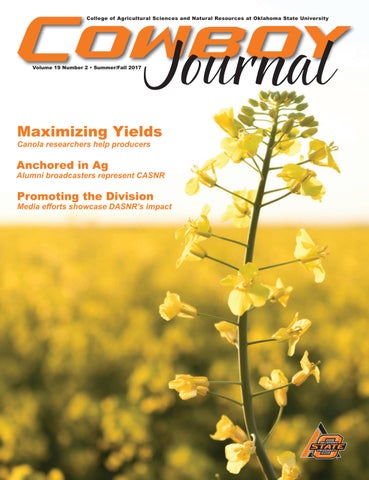
Maximizing Yields

Cano/a researchers help producers

Anchored in Ag Alumni broadcasters represent CASNR

Promoting the Division

Media efforts showcase DASNR's impact

Whatever is happening in your life, there’s a good chance your college experience helped you get to where you are today. When you reflect on that time, you may be overwhelmed by fond memories — meeting your spouse, celebrating a big football win, pulling an all-nighter to study or laughing with people who became your lifelong friends. Today’s Oklahoma State University students are having the same experiences as they pursue bright orange futures. Visit OSUgiving.com to learn how you can be a part of their journey.

FROM THE EDITORS

As we send this issue of Cowboy Journal to print, we reflect on our time at OSU and would like to thank each person who has supported us through this process as well as the loyal readers.

To the Cowboy Journal staff — we did it! Our magazine would not have been possible without each and every person’s hard work and dedication.

We thank Holly Blakey, Ruth Inman, Melissa Mourer, JD Rosman, Lindsay King, Kristin Knight, Kelsey Conley, Todd Johnson and especially Ashton Lierle for contributing their efforts and expertise to this magazine. Your impact has helped mold us into better agricultural communicators and people.

Most importantly, we thank our second family — our faculty members — Shelly Peper Sitton, Dwayne Cartmell, Angel Riggs and Samantha Blackwell. Without your guidance and support throughout our time at OSU, we would not be prepared for the real world. Thank you for the memories of the past four years and for helping to provide us with the best education we could have ever imagined.

— Paige, Laurie and Whitney

EDITORS

Paige Crawford | Laurie Fitch | Whitney Turek

MANAGING EDITOR

Shelly Peper Sitton, Ph.D

ASSISTANT MANAGING EDITORS

Dwayne Cartmell, Ph.D. | Ashton Lierle

Angel Riggs, Ph.D. | Samantha Blackwell

GRAPHIC COORDINATORS

Morgan Cook | Erin Larson

PHOTO COORDINATOR

Keely Brown

SPONSORSHIP COORDINATORS

Chelsea Coulson | Bethany Harder

SOCIAL MEDIA COORDINATOR

Macy Mertens

CIRCULATION COORDINATOR

Mariah Fredman

STAFF

Zuhrah Alwahabi | Whitney Andras

Katie Bullard | Kate Garvie | Annie Jo Gilbert

Samantha Gillespie | Andersen Hubbard

Kalli Kliewer | Hollee Koester | Brennan Kolega

Kaylyn Lefan | Katie Lindsay | Qi Liu

Haley Saul | Shelby Saul | Tim Taylor

Katlyn Tunstill | Breanna Viles | Sage Watson

Cheyenne Webb | Alyssa Worrell

FOUNDING SPONSORS

Limousin World | Oklahoma Farm Bureau

QuadGraphics

08 Ag On Air

OSU agricultural communications alumni join their interests in storytelling with their agricultural roots

26 Unlocking Canola’s Potential

New research helps canola farmers maximize yields

42 Capturing Oklahoma

Changing the lives of Oklahomans through teaching, research and extension

ON THE COVER

As the second largest producer of canola in the U.S., Oklahoma harvests approximately 75,000 canola acres every year. See story on page 26. Photo by Alyssa Worrell.

Capitalizing on whit and charm, Courtenay DeHoff has embraced a career by staying true to her cowgirl roots and rural lifestyle when going live on the air.

Whether she is on camera or riding horses, the Kansas native and 2011 agricultural communications alumna is known for her rural upbringing.

DeHoff grew up with horses and competed on the Kansas High School rodeo team. She graduated from Tonganoxie High School in Tonganoxie, Kan., and fell in love with OSU after touring the campus, she said.

DeHoff joined the OSU Rodeo Team as she earned her agricultural communica-

tions degree. She got her video production start as an intern with “Oklahoma Horizon” after a class tour.

“I was so intrigued by the behind the scenes and behind the camera of video production,” DeHoff said. “I immediately emailed them.”

Rob McClendon, host and executive producer of “Oklahoma Horizon,” said DeHoff immediately impressed him with her work ethic as they worked together on and off the set.

“The thing about Courtenay is she is super driven,” McClendon said. “She asked ‘What does it take to work here?’”

DeHoff started working for “Oklahoma Horizon” as a freshman and learned

how to edit and shoot video from her mentor McClendon.

“In today’s world, you are not just talking to someone,” McClendon said. “You are listening to them, too. That is what she understands.”

DeHoff said McClendon taught her everything from behind and in front of the camera. The pair worked together for four years at “Oklahoma Horizon,” which was the building block of her career as an anchor, she said.

“There are always those people who will be with you the rest of your career,” DeHoff said. “Rob is one of them.”

She said she got a call from a network

Continued on page 10

Courtenay DeHoff serves as the host and producer for EyeOpener
TV Photo by Samantha Levi.

CLINTON GRIFFITHS

At a young age, Clinton Griffiths set a long-term goal to be involved in broadcasting.

Now, Griffiths tells the stories of American farmers and ranchers in his current role as the editorial director of Farm Journal Broadcasting and host of AgDay TV.

“I knew I wanted to do something in communications, television and broadcasting,” Griffiths said. “My goal was never to be on television but to tell the story of American agriculture.

“Agriculture always played an important role in my life growing up,” Griffiths said. “It is in the culture of my family, as my grandparents and great-grandparents were farmers in New Mexico.”

Griffiths said he combined his interest in communications with his background in agriculture, leading him to study agricultural communications.

“When I toured Oklahoma State University, I also toured the ‘SUNUP’ studio,” he said. “I was told that I could work as an intern at the studio during my four years of undergrad.”

Griffiths said he was sold on the promise to work at “SUNUP.”

“The fact I could study agricultural communications and learn what I wanted to learn at the studio is the reason I attended OSU,” Griffiths said.

The great group of mentors, leaders and teachers at “SUNUP” and at OSU

helped Griffiths advance in his undergraduate experience, he said.

“They went above and beyond to help me learn the business of news, broadcasting and video production,” he said.

Rob McClendon served as a mentor to Griffiths. McClendon, host and executive producer at “Oklahoma Horizon” and previous executive producer at “SUNUP,” said Griffiths’ ambition set him apart from the other students.

McClendon said Griffiths understood the concept of broadcasting.

“Whether you are making a living on the land or making a living in a building,” McClendon said, “Griffiths understood

Continued on page 11

OSU agricultural communications alumni join their interests in storytelling with their agricultural roots

Clinton Griffiths is the editorial director of Farm Journal Broadcast and host of AgDay TV Photo by Eric Crowley.

in Nashville, Tenn., after the staff saw her work from “Oklahoma Horizon.”

“They said we want you,” DeHoff said. “I thought ‘This is it. This is the start.’”

At 21 years old, DeHoff landed her first anchor position at Rural TV. However, she struggled with the realities of TV and journalism, she said. DeHoff decided to take a break and backpack throughout Europe, traveling to 15 countries.

“Everyone should travel,” DeHoff said. “It made me a better journalist and overall person. It changed my life.

10 finalists. The video focused on rural lifestyle and background. DeHoff visited with producers in New York as many of them were fascinated by her way of life, she said.

“It truly opened my eyes to how hungry and eager rural America is for a spokesperson in the national spotlight,” she said.

Many people showed immediate support as the video took the internet by storm and was shown to organizations such as the American Quarter Horse Association and American Angus Association, Dehoff said.

It truly opened my eyes to how hungry and eager rural America is for a spokesperson in the national spotlight.

“I came out a veteran,” DeHoff said. “I then started a job in Kansas City, Mo., for a top 30 network.”

DeHoff worked for the Emmy-nominated show “Better Kansas City” for two years, which advanced her career as she interviewed celebrities and co-hosted the show, she said. A video of DeHoff went viral and reached millions of views, creating a name for her as the nation laughed and connected with her humor, she added.

“In TV, we write how we talk,” DeHoff said. “It is so different. Deadlines are extremely harsh.”

After “Better Kansas City,” DeHoff competed for the guest co-host position for “Live with Kelly.” Her mom, Cindy DeHoff, encouraged her to submit a video. DeHoff reached the competition’s top

— Courtenay DeHoff

EyeOpenerTV

“On live TV you cannot take anything back, but then again that is the beauty of it,” she said.

DeHoff said she builds her brand around her rural background because of prople’s interest in her rural life. DeHoff said she wants more people to be in the national spotlight who can portray agriculture in a positive light.

“I do not wear my overalls to work, and I do not say ‘y’all,’” DeHoff said. “We have to break down the stereotype of rural.”

DeHoff said her brand is the same when you see her at a five-star restaurant or run into her on the street.

“Every day I really try to be better at social media,” she said. “Everything is built around branding and how you brand yourself.”

She now works as an anchor, producer and editor for “EyeOpener TV” in Dallas for a national network. DeHoff said her schedule changes daily in the studio or out reporting.

She starts her day by waking up between 4 a.m. and 7 a.m. and turning in her daily segment.

“In this industry, we always work a day ahead,” DeHoff said.

DeHoff has been named as one of the top science journalists in North America for producing and shooting stories on international relations.

“I never want to change who I am for my career,” she said. “I have tailored my brand into the Courtenay DeHoff who grew up ridin’ horses and ropin’ calves.

“I always tried to stay true to my rural lifestyle,” she said.

DeHoff’s biggest support system is her family, she said.

“The great thing about Courtenay is she can shoot, edit and write,” said Cindy DeHoff. “She has grown into a voice for the agricultural industry.”

DeHoff said she uses what the OSU agricultural communications program taught her and it has been an influential part of her success.

“OSU will always be family,” DeHoff said. “You do not find that everywhere.”

DeHoff said she is a perfect example of an agricultural communications major, showing you can do more than just write, design or take pictures.

“Agricultural communications is such a great building block for anything you want to do in the journalism industry,” DeHoff said. “I chose to go to OSU because I wanted that agricultural influence in everything I did.”

DeHoff said she never wants to abandon her rural upbringing. She said she hopes to grow her career and become an anchor for a national show while staying true to her cowgirl roots.

“Once a cowboy, always a cowboy,” DeHoff said. “The sky is the limit.”

Wellston, Okla.
Courtenay DeHoff prepares daily segments for EyeOpener TV In Dallas. Photo by Andy Nguyen.

the influence of technology in agricultural communications, combining the two different types of living.”

After working on the set of “SUNUP” for four years, Griffiths created a newsreel, or video portfolio, of his work.

“For my first job, I worked in Hays, Kan., at a news bureau, working with a CBS station based out of Wichita,” Griffiths said.

When Giffiths first arrived, he said he was the only broadcasting staff member. He shot his own video, wrote his own stories, and edited his own work. He anchored two-and-a-half minutes of news each evening.

“The experience I took from OSU allowed me to excel and be competent when I started,” he said. “Without that, I do not know if I would have received the job.”

Three-and-a-half years later, Griffiths decided to go back to school for a master’s degree, but he found it difficult to work in local news and find time to go to school at night, he said.

“My wife, MaryBeth, and I were living in Wichita when I took a job at Spirit Aerosystems, an aviation company, working in corporate communications,” Griffiths said. “While I was there, I went back to school and got a master’s degree in business administration.”

Griffiths said he planned to be in business administration for the rest of his career, but one day OSU called him.

“They said, ‘Hey, we are starting “SUNUP” again’ and asked me if I was interested in joining the staff,” he said. “It was an opportunity I could not say no to.”

Farm Report’ to help spread the word about farmers, ranchers and researchers.”

He said he wanted to reach their audience with content they were already producing in hopes it would bring recognition to the industry.

Griffiths said the vice president of Farm Journal’s broadcast division saw his work one day and asked, “Who is that guy? Call him, and see if he wants to work for us.”

After three years of producing “SUNUP,” Griffiths and his family moved to South Bend, Ind., after he accepted a job with “AgDay.” Since then, Griffiths has expanded his career to his current position with AgDay TV and the Farm Journal.

For Griffiths, every day starts with a blank slate, he said.

“During the first couple of hours, I look at newswires, press releases and stories to build an idea of what is going on in the industry today,” he said. “Every morning, I start with nothing and build up from there. We call it ‘stacking the show,’ layering news stories in order of importance into the rundown of each day.”

Griffiths works hand-in-hand with his reporter and social media editor to coordinate which stories will be pushed to social media outlets and decide how they leverage the stories, he said.

“After the morning, we start executing,” Griffiths said. “Usually around 12:30 p.m., we buckle down and start writing.”

The morning episodes of “AgDay” are recorded the prior afternoon. Having a strategy and a plan is important to the staff of the show, Griffiths said.

My goal was never to be on television but to tell the story of American agriculture.

— ClintonGriffiths Host of AgDayTV

AgDay TV sends it to New York where it gets delivered to its network affiliates. An estimated 120 stations around the country air the morning episode of “AgDay,” Griffiths said.

Griffiths said he finds excitement through storytelling.

He helped re-launch “SUNUP,” which ran every Saturday for 30 minutes.

Austin Moore, media development specialist at “Oklahoma Horizon,” worked with Griffiths at “SUNUP.”

“Working with Clinton was like being on a dream team,” Moore said.

Griffiths diversified his knowledge in agriculture with every story, Moore said.

“The opportunity to work with ‘SUNUP’ opened the door to my current job at ‘AgDay,’” Griffiths said. “I was producing videos and writing stories at ‘SUNUP’ and sent versions to ‘AgDay’ and the ‘U.S.

“We need to be cognizant of how stories are written and delivered,” Griffiths said. “We cannot be wrong the next morning.”

Griffiths and his team write scripts and pull sound bites while working with the editor. Around 3 p.m., the staff goes to the studio to record, he said.

“I will sit down and record the entire 30 minutes of the show in 15 minutes,” Griffiths said.

After the sound bites, recordings, graphics and video clips come together, Griffiths said the editor assembles the pieces together like a puzzle. Around 4:30 p.m., Griffiths watches the show from start to finish. Once the show is ready,

“I get to tell the story of agriculture and show the majority of Americans things they will never see,” he said. “I get to share how food is produced, who is producing it, and why they enjoy what they do. Those are the stories I love to share.”

Griffiths said he frequently steps back to think about the people who influence the show.

“It is the farmers and ranchers who are the best part of my job,” Griffiths said. “With this role, I travel all over the country, driving down back roads most people will never travel in a lifetime.

“The best parts of America are down a country road,” he said.

ERIN LARSON
New Richland, Minn.
Clinton Griffiths travels the country roads of the United States to tell the story of farmers and ranchers. Photo by Eric Crowley.

If you have driven through Oklahoma during mid-summer and had your windshield “sprinkled” with tiny insects, you may have experience with sugarcane aphids.

These tiny insects continue to be a growing problem for Oklahoma sorghum as well as an issue in other parts of the U.S., said Scott Armstrong, U.S. Department of Agriculture entomologist researcher and Oklahoma State University adjunct associate professor.

“Sugarcane aphids are distinctive by their pale-yellow body, no body hair, six dark feet, a long black antenna, which goes past the abdomen, and black cornicles that look like two exhaust pipes,” said Jess Lindenmayer, OSU entomology and plant pathology doctoral student.

Sugarcane aphids were first discovered in Florida on sugarcane in 1977 and found in Louisiana in 1999, said Ali Zarrabi, OSU entomology and plant pathology assistant research professional.

“In 2013, we saw the sugarcane aphid switch from sugarcane to sorghum,” Zarrabi said. “The first reported infestation in sorghum was detected mid-June 2013 near Beaumont, Texas.”

Also in 2013, the first Oklahoma sorghum infested with sugarcane aphids was found in Bryan County, Okla.

By 2016, the sugarcane aphid was causing problems in 37 Oklahoma sorghum-producing counties, Zarrabi said.

“There is a weather pathway that comes from Mexico and brings in wheat rust,”

Lindenmayer said. “In a similar manner, sugarcane aphids are brought in on southto-north-moving winds.”

One sorghum plant can have in excess of 1,000 aphids.

When the aphid population becomes too crowded on a plant or the plant begins to die, a hormone change causes the adult females to produce winged forms that move to a new plant, Lindenmayer said.

The insects’ surface-area-to-volume ratio is large, and since aphids are so small and have large wings, they to turn into gliders, she said.

“Aphids are phloem feeders that use their sucking mouth parts to extract sugars from the sorghum plant,” she said. “Their gut is specially designed to filter out what they need from the plant, and at the same speed, they filter out and excrete honeydew.”

The aphid’s honeydew covers the underside of the leaf in black sooty mold and harms the sorghum, Lindenmayer said. At harvest, the sticky honeydew clogs the combines, making the grain roll out the back of them.

lady beetle larvae and adults, and hover fly larvae and adults.

“The problem is sugarcane aphid reproduction is higher and faster than most aphids,” she said. “Even though we see increased predation on these insects, it is not enough to keep up with how much their population is growing.”

Armstrong said the sugarcane aphids clone themselves and within a week immature aphids become mature and produce asexually. In optimum temperatures of 80 degrees, the adult female can live up to 30 or 40 days and can reproduce 60 nymphs in her lifetime.

The sorghum plant has five general growth stages: seedling, pre-boot, milk stage, soft and hard dough, and harvest. The sugarcane aphid can infest sorghum at any growth stage.

The problem is sugarcane aphid reproduction is higher and faster than most aphids.

“In Oklahoma, farmers plant sorghum in midApril,” Zarrabi said. “The sugarcane aphids typically show up mid-July and early August. If the sugarcane aphids show up before flowering, they can stunt the growth of the sorghum crop. If they attack at the harddough stage, it can still reduce the yield but will not kill the plant.”

Lindenmayer said farmers have observed natural enemies that feed on sugarcane aphids.

The most common natural enemies of the sugarcane aphid are green lacewings,

The sugarcane aphid has impacted Oklahoma farmers and the economy, said Tom Royer, OSU entomology professor and integrated pest management coordinator. Before 2013, farmers never had to treat for sugarcane aphids.

Sugarcane aphids infest Oklahoma sorghum crop

In 2015, Oklahoma producers harvested 410,000 acres of sorghum, according to the USDA, and the product was worth $69 million. In contrast, only 370,000 acres were harvested in 2016, and the crop was worth $61 million. The decrease was caused primarily by sugarcane aphids, Royer said.

If producers do not manage the sugarcane aphids, they could have a potential yield loss of 14 to 15 percent in Oklahoma sorghum, according to the USDA.

“In 2015, if every infested acre in Oklahoma was treated an average of 1.5 times with an insecticide, it would have cost a minimum of $3.5 million,” Royer said. “If left untreated, it could have resulted in a $9.9 million loss.”

In 2015, the sugarcane aphids infested 60 percent of the crop, more than 246,000 acres. In 2016, they infested 80 percent of the crop, Royer said.

Oklahoma sorghum producers contacted the OSU Division of Agricultural Sciences and Natural Resources to seek a solution, Zarrabi said.

Collaborating scientists from DASNR and USDA created a sorghum checkoff for farmers in Oklahoma. The checkoff is to support trials for insecticide evaluations, field screening of tolerant hybrids to sugarcane aphids and development of an integrated pest management system for control of sugarcane aphids, Zarrabi said.

Integrated pest management is a program utilizing strategies, which include planting time, plant tolerance, seed

Female sugarcane aphids feed on a sorghum plant.
Photo by Keely Brown.

treatments and foliar insecticide treatment, Zarrabi said.

Two insecticides — Transform® and Sivanto® — are registered in Oklahoma by the Oklahoma Department of Agriculture Food and Forestry. They could prevent the aphids from reducing yield or killing the plant, Zarrabi said.

Although Oklahoma farmers have access to insecticides to manage the sugarcane aphids, they should be cautious when applying them, Zarrabi said.

“You cannot always rely on insecticides,” Zarrabi said. “You have to find a sorghum variety that is genetically tolerant to the sugarcane aphid.”

Scientists and researchers are concerned the sugarcane aphids could become resistant to chemical treatment, Lindenmayer said. OSU researchers emphasize good coverage on the plant with insecticide to ensure effective control.

KEELY BROWN

Locust Grove, Okla.

Here'ssomethingworthshoutingabout.Asanelectricco-opmember,youhave a sayin howtheco-opis runandthedecisionsthataremade.Isn'tthatniceto hear?Learnmoreaboutthepowerof yourco-opmembershipatwww.oaec.coop.

Adult sugarcane aphids feed on a sorghum plant in a USDA lab. Photo by Keely Brown.

Professional bullfighter Broc McGuire works to save lives

Acowboy nods his head, ready for the gate to swing open. Kicking out of the chute, the bull throws the him to the ground. The cowboy looks up to see the 1,600-pound bull coming down on him. In the last second, he sees the bullfighter jump in front of the bull to take a direct hit, saving the cowboy from being crushed.

“Think of bullfighters as a lifeline,”said Broc McGuire, 2016 Oklahoma State University agribusiness alumnus. “We are there to protect the bull riders, whether it be life or limb. It could be anybody’s life the next time we step in the arena, and we know that.”

McGuire, a 23-year-old from Kellyville, Okla., received his professional card for rodeo bullfighting in 2013.

The feeling you get when a guy walks over to you and says, ‘Thanks, man’ is an indescribable moment.”

McGuire said he has been fortunate to know great bullfighters who helped him get started. His initial training in 2009 was in Locust Grove, Okla., and was hosted by Matt Baldwin and Ray Cleary.

His first rodeo was a bull riding sanctioned by Championship Bull Riding at Kansas State University in conjunction with the KSU National Intercollegiate Rodeo Association rodeo. He said it was the most nerve-racking rodeo he has worked.

It could be anybody’s life the next time we step in the arena, and we know that.
— Broc McGuire 2016 CASNR Alumnus

“I started riding bulls at 13 years old and rode for about two years until I decided to go to bullfighting school in 2009,” McGuire said. “That is when I started getting serious about bullfighting.”

Professional bull rider Guthrie Murray said he met McGuire a few years ago in Texas. It seemed like every time he got on a bull McGuire was there, he added.

“I got bucked off, and the bull was right on top of me,” Murray said. “Broc jumped in between us, and the bull shot him up about seven feet in the air. He has saved me so many times.”

Murray said bullfighters are his life support in the arena. Without them, he can end up in a bad spot with no one to protect him, he added.

McGuire’s mother, Sheila McGuire, said she always knew her son was the type of person to help others. They discussed a career in paramedics or even medicine, but he always felt like he needed to save someone and he constantly puts others before himself, she said.

“I have always been the one person to run to a wreck, not away from it,” McGuire said. “It is just something in me.

“I have worked at amazing places like Vinita, Okla.,” McGuire said. “This year is the 81st annual Will Rogers Memorial Rodeo. It is one of the oldest rodeos in Oklahoma, and this will be my fourth year to return.

“Working rodeos with the guys who compete is an accomplishment,” he said.

McGuire worked the National Junior Bull Rider’s Association Finals three years in a row, and in 2015, he was selected as the alternate bullfighter for the Ram Prairie Circuit Finals.

He works at about 50 rodeos a year and has worked around 200 since he earned his professional card, he said.

“My favorite memories are interacting with the kids and fans and getting them engaged in the rodeo,” McGuire said. “Teaching people about why we do what we do is so important. Many people think it is crazy.”

McGuire said he could fight bulls until he does not want to fight them anymore. He does not know how long he will continue because circumstances could change through injuries, life plans or God’s intentions, he said.

“One of the biggest blessings in my life was to attend OSU,” McGuire said. “There is no place like Stillwater. You meet so many lifelong friends and professors

and make so many memories. How can you not feel honored to go there?”

He plans to work in the agricultural industry in the future, he said.

“I have always taught him if you are going to do something you give 110 percent no matter what,” said Greg McGuire, the bullfighter’s father.

The elder McGuire said no matter what you do, you should have a passion. In rodeo, another human being depends on the bullfighter, so he has to be willing to take a hit for someone, he said.

“I always tell Broc he should have done this or he could have done this better,” Greg McGuire said. “It’s not that I am getting on to him. I know I can push him to do better, and he has.”

Sheila McGuire said her son needs an adrenaline feeling as well as the feeling he is saving someone. She said she is proud of the fact he can fight bulls because not everyone can.

“Bullfighters are there to protect and prevent any harm from happening to bull riders,” McGuire said. “Our job is to do whatever we can to keep the bull’s attention and to keep those boys away from harm.”

McGuire said for now his plan is “to stay alive.” He said he will know when the time comes to slow down and find a career, but for right now, he said, he just wants to fight bulls.

MARIAH FREDMAN Wellston, Okla.
Broc McGuire’s face-paint designs pay tribute to fellow bullfighters who have impacted him. Photo by Mariah Fredman.

Powerhouse of Nutrients

Every 60 seconds, 260 people die from not having access to sufficient protein sources.

Protein, however, can be gained from eating a wide variety of things, such as meat, eggs, plants and even insects.

With these facts in mind, Oklahoma State University researchers have

worked on an alternative protein source many people would overlook — algae.

Researchers at the OSU Robert M. Kerr Food and Agricultural Products Center work with spirulina, a blue-green algae packed with protein, amino acids and antioxidants, to potentially provide those suffering from malnutrition with an inexpensive, alternative source of protein.

“We started looking at a range of different microbial sources of protein,” said Danielle

Bellmer, biosystems and agricultural engineering professor who conducts research in FAPC. “Lots of yeast, bacteria and algae have high levels of protein. We found spirulina has one of the highest. It is cheap to make, and it has other health benefits.

Used in sensory tests, three spirulina-filled cookies are compared with a control cookie filled with soy These often become the first experience most consumers have with spirulina.

“Spirulina is cheaper than soy protein,” she said. “Soy costs about 40 percent more than spirulina.”

Deepak Kumar, OSU food science master’s student, said the algae’s protein levels are comparable to eggs or beef.

“We call it the ‘powerhouse of nutrients,’” Kumar said. “It is comparable to egg protein. However, egg has 13 percent protein, which you would need to extract, filter, and refine to get 100 percent protein content. Spirulina is already at 70 percent protein content, so the extraction costs are less.

“When compared to beef, spirulina has about three times more protein, requires 50 times less water and needs 200 times less land to produce the same amount of protein,” he said.

Bellmer said one of the main reasons consumers do not see spirulina-added products lining grocery store shelves is its taste.

“It does not taste very good — actually it tastes really bitter,” Bellmer said. “It is green in color, like a green powder, which, depending on the product you are making, could be OK.

Photo by Tim Taylor.

Nutrients

“But in many cases, people do not want to eat green food,” she added.

To make spirulina more palatable, Kumar and Bellmer have worked on coating beads of the algae in an edible gel, which dissolves when swallowed.

“If we can coat it, and the coating stays on it while consumers swallow it, they never taste the spirulina,” she said. “Part of the challenge, though, is getting the spirulina content in those beads high enough to get a high protein content. It is a very viscous product — so it is really thick.”

Bellmer said the technique used to make the beads is easier than it sounds. The spirulina is mixed with sodium alginate, pulled into a syringe, dropped into a calcium chloride solution, and gel forms.

“We are a bit limited by the amount of pressure we can apply to a syringe,” Bellmer said. “In a commercial setting, we would use an extruder where we can get a lot higher pressure. We are limited on the protein concentration of spirulina because it is so thick and will not go through the syringe with our hand.”

Bellmer said the research team conducted sensory tests with the spirulina beads baked into cookies. In the test, three spirulina-filled cookies were compared to a control cookie filled with soy, which is one of the most common sources of alternatively sourced protein.

“We will actually be comparing three things filled with spirulina,” Bellmer said. “One with a bitter flavor blocker, one with our encapsulated beads and the last is the spirulina raw directly into the cookies.”

Ranjith Ramanathan, OSU animal science associate professor, said one advantage spirulina has over other sources of protein is its ability to grow in reused or recycled water.

“In animal-sourced protein, you need more water to produce each pound of protein,” Ramanathan said. “Spirulina uses less water, and the quality of that water is insignificant.”

Kumar said FAPC purchases its spirulina in powdered form for its research, but explained spirulina could be grown easily at OSU as well as in small quantities in developing countries using water that normally would be wasted.

Water used in food-processing systems contains nutrients that could be used to grow spirulina. Kumar said by recycling the water, the cost of spirulina remains manageable, especially in parts of the world where water costs are on the rise.

FAPC researchers work with algae to alleviate global malnutrition

higher-quality food to some existing food source — is a worthwhile idea because young children have a higher protein need than adults,” Stoecker said.

“However, you have to think about the market, the supply chain and how the product is going to be purchased and produced,” she said.

Stoecker said the encapsulation technology FAPC researchers are doing has the potential to give spirulina some added value by making it taste better.

These microbial proteins can be grown in large quantities — like in an open pond — making it more cost effective.

— Deepak Kumar

OSU Food Science Master’s Student

“If the problem is bitterness and it is possible to coat it with something useful and does not raise the cost very much, it has some potential,” Stoecker said.

“These microbial proteins can be grown in large quantities — like in an open pond — making it more cost effective,” he said.

Providing access to inexpensive, high-quality and sustainable protein to those suffering from malnutrition, especially those living in developing countries, was a large motivator for the FAPC research team, Kumar said.

Barbara Stoecker, OSU nutritional sciences Regents’ professor, said while the overall cost of the products being covered needs to be considered, benefits from mixing high-quality protein sources, like spirulina, with available food sources can improve lives, especially for children, in developing countries. Stoecker said many of the farmers she has worked with in developing countries were mainly subsistence farmers with little additional resources to invest in expensive protein sources.

“The idea of fortifying — adding a

Kumar said as the world population continues to grow, food scientists and all agriculturalists need to consider an “all of the above” approach to produce enough alternative sources of protein for everyone.

“Right now, what we primarily have for alternative proteins is plant-based proteins like soy or rice,” Kumar said, “but what we need to tap into is single-celled proteins, like spirulina.

“Can you imagine these tiny microbes could replace your steak?” Kumar said. “Brace yourself — that day is coming.”

TIM TAYLOR Vinita, Okla.

From the forests of Sierra Leone to the red dirt of Oklahoma, Liberty Galvin has come to love both lands and the opportunities they have given her.

Liberty Galvin’s experiences studying abroad — combined with her love for Oklahoma State University — sparked her desire for international partnerships and helping fellow Cowboys have the same opportunities to study abroad, she said.

A third-generation OSU graduate who received her undergraduate degree in 2013, majoring in environmental science with minors in soil science and agronomy, Liberty Galvin has always been passionate about traveling, which sparked her interest in international agriculture, she said.

At one point, she said she wanted to go into the Peace Corps. Jeff Hattey, former

plant and soil sciences professor, encouraged her to look into an OSU program in Sierra Leone, Africa, knowing her desire to study abroad, Liberty Galvin said.

She said she had no idea of the future she was building for herself with this journey and ended up traveling back and forth to Sierra Leone four times.

Liberty Galvin’s mother, Jennifer Galvin, said her daughter has a passion for the people of Sierra Leone, which came as a surprise and was apparent as soon as she returned home from her first trip.

After landing in Chicago, Liberty Galvin called home in tears, touched by the orphans’ positive outlook and people’s graciousness, Jennifer Galvin said.

“She kept saying, ‘They have nothing, but they will share their rice with you,’”

Jennifer Galvin said. “She has always loved to travel, but she did not realize how much this trip would teach her.”

After graduation, Liberty Galvin worked several jobs to earn enough money to travel back to Sierra Leone. Her goal was to build the Bonganema village a rain-water harvesting system at the local elementary school. This project would give children in the village the ability to attend school and take home fresh water instead of hauling dirty water long distances.

“The people of the Bonganema village gave her an African name that resonates across the small village,” Jennifer Galvin said. “It is Lumbeh, which means ‘live for me’ — and she does.”

Liberty Galvin said she was fortunate to have help to make these trips possible. She

CASNR alumna
Liberty Galvin (right) joins Fallah Kassoh, the dressmaker for Gondwana International, who lives at Njala. Photo courtesy of Liberty Galvin.
Liberty Galvin signs papers and checks to make the Gondwana International Scholarship official. Photo courtesy of Liberty Galvin.
Mike Dicks (front) led Liberty Galvin (left), Richard Moore (back) and Jessica Lay on a study-abroad trip. Photo courtesy of Jessica Lay.

received the Wes & Lou Watkins Matthew 25:40 scholarship and was an OSU teaching assistant for a study-abroad trip led by Mike Dicks, retired OSU agricultural economics professor.

“These experiences were life-changing,” Liberty Galvin said. “I would not be the person I am today if it were not for the OSU study-abroad programs.”

These experiences shaped her as an individual and changed the way she sees the world today, she said. They led her to attend the University of California-Davis, where she is pursuing a master’s degree in international agricultural development with an emphasis in extension and outreach, she said.

While furthering her education, Liberty Galvin also serves as the executive director of Gondwana International LLC., a company aiding international community development projects through global partnerships. Gondwana was started in 2011 by Katie Arroyo.

Arroyo started the company after traveling to Sierra Leone in 2010 on an OSU study-abroad trip with the help of a Matthew 25:40 scholarship. On this trip, Arroyo bought several art sculptures, paintings, wood carvings and locally made jewelry unique to Sierra Leone, which she sold in Stillwater. When Liberty Galvin prepared to travel to Sierra Leone the next year, Arroyo suggested they bring back more handicrafts so they could be sold at the OSU Creativity Festival.

“The group brought back many cool

things, and several of us set up shop at the festival,” Arroyo said. “We had great success and over time set up booths at the Stillwater Farmers Market, OSU Homecoming, Earth Day and other events. We gave more than $2,000 to other OSU students traveling to Sierra Leone to help cover their visas, passport fees and immunization costs.”

Liberty Galvin said the group’s goal was to offer students reimbursements for different things needed to study abroad as long as they would help sell items.

“I was the teaching assistant for a class in which a lot of students would do these events with us and talk to people about their study-abroad goals,” Liberty Galvin said. “They would sell items and talk about how they had to pay for vaccines and visas.”

Liberty Galvin lived in Sierra Leone for seven months — September 2013 through April 2014.

After moving back to the U.S., Arroyo formally sold Gondwana to Liberty

Galvin, who restarted and grew it to the company it is today.

Liberty Galvin said she is extremely grateful for the help her mother has given her and her company. The two would go to the local farmers markets and sell different items they made of cloth purchased in Sierra Leone. Liberty Galvin said the original purpose was to offer financial assistance to OSU students who wanted to study abroad and the purpose remains the same today.

“Throughout the whole time I was involved with Gondwana, Liberty was my business partner working so hard to bring our vision to life,” Arroyo said. “She is an inspiration to me, and I am so proud of the work she does.”

Arroyo said when Liberty Galvin bought the business, she took the Gondwana model even further by establishing the Gondwana scholarship.

“In the fall of 2015, right before I moved to California for graduate school, my mom and I met with Dr. Cynda

Liberty Galvin (right) and Katie Arroyo sell Gondwana art at an OSU Homecoming. Photo by Nadege Rose Petrie.
alumna creates study-abroad scholarship

Clary,” Liberty Galvin said. “We told her we wanted to start a scholarship, even though we cannot offer much money.”

Clary, OSU College of Agricultural Sciences and Natural Resources associate dean for academic programs, said she has been impressed with Liberty Galvin’s desire to help students who are not much younger than she is while she is still a student herself. She is passionate about helping people in other countries and here at home, Clary said.

“When Liberty decided to go to graduate school at another location, she was concerned about how she could continue to help OSU students get the opportunity to study abroad,” Jennifer Galvin said. “She knew the business did not generate a lot of money, but she also knew even a small contribution could make the difference between a student affording the trip or not.”

and get a bigger world experience, I think it is important to try to facilitate that opportunity,” Liberty Galvin said. “The time to study abroad is when you are young because it is the time to gain a better understanding of yourself and to explore cultures different than your own.”

“Liberty is doing this so her peers can experience making a difference, and to me, that is what I find so impressive,” Clary said. “She did not wait until she had made it in her career. She decided even though she could not do everything, she could do something and it would matter.”

During the trip with her daughter to Stillwater to discuss establishing the scholarship, Jennifer Galvin said they met with representatives from CASNR, the OSU Foundation and study-abroad programs.

As Liberty Galvin told her story, Jennifer Galvin said emotion filled the room and the listeners’ hearts were touched.

“This young lady who did not have a full-time job wanted to set up a scholarship,” Jennifer Galvin said. “That day, they made it happen.”

She said the main points of her daughter’s speech included helping Arroyo start the company, the profit generated from the African art sales and the how students were encouraged to help with the potential reward of a study-abroad stipend.

“For people who want to study abroad

Liberty Galvin said she is pleased with how the scholarship program has gone. The annual Gondwana Study Abroad Scholarship is for OSU Master of International Agriculture Program students. Even though she may not be acquainted with the scholarship recipients, she said they are all part of the Cowboy family and she is proud to help fellow OSU students.

“When you want to study and travel abroad to do good things internationally, this is a certain type of compassionate mentality I think is worthy of putting on a pedestal,” Liberty Galvin said.

Traceable from to Farm

FORK

OSU researchers develop a whole-chain traceability system

An outbreak of bovine spongiform encephalopathy Dec. 23, 2003, halted U.S. beef exports, causing prices to drop.

The impact of the outbreak could have been reduced had a system been in place where a product could be traced quickly throughout the food supply chain back to its source, said Brian Adam, agricultural economics professor.

The National Whole Chain Trace-

ability Institute is a system funded by the U.S. Department of Agriculture and the National Integrated Food Safety Initiative and was developed by three OSU researchers: Adam; Michael Buser, biosystems and agricultural engineering associate professor; and Blayne Mayfield, computer science associate professor.

“Agricultural economists estimated millions of dollars could have been saved if we had a traceability system,” Adam said.

After the 2003 BSE incident, this team of OSU researchers developed a way producers could use a mobile app to enter data, such as birthdates, vaccination records, farm location and genetics, into a server. The data would follow the animal or commodity through its life cycle from producer to consumer, Adam said.

“The goal is to be able to trace a package of steaks in a grocery store back to the ranch the calves were born on,” he said.

the future, consumers can

In
use a traceability app to find information about the source of their beef. Photo by Keely Brown.

When the system is implemented, consumers will be able to scan a food product’s quick reference code. The app would bring up a web page, possibly including photos, information about the farm and how the product was produced, he said.

“We have visited with a number of beef producers who are interested in raising natural beef, cattle without hormone implants and given limited antibiotics,” Buser said.

paperwork exists to verify specific animals have been vaccinated,” he said. “By using a whole-chain traceability system, feedyard personnel could determine which animals had been vaccinated to avoid the re-vaccination of animals, which would save the feedyard money.”

The goal is to be able to trace a package of steaks … back to the ranch the calves were born on.

He said farmers can enter a wide range of information into the traceability system, such as vaccination information for a specific animal to the fertilizer and pesticide used on the forage where the cattle grazed.

“Cattle producers generally keep excellent records,” Buser said. “The issue is these records do not generally follow animals from owner to owner.

“Many of the animals coming into a feedyard have already been vaccinated, but they are vaccinated again because no

Providing product-specific information to the different groups along the supply chain has the potential to add value to the product and reduce production costs, Buser said.

An earlier attempt at a national identification system failed in part because producers feared competitors might use their information, he said. OSU developed a proprietary centralized data system that allows producers to control who has access to which bits of information and resolves the issue, Buser said.

“For example, if a processor is willing to pay to see the genetics, then the producer can let the processor see that information,” Adam said. “If someone else along the supply chain is not willing to pay to see the genetics, then they don’t get to see it.

“Producers get value by adding value

to the product, and the processors benefit from having a higher quality of product,” he said. “If producers share even basic information, the effects of an outbreak could be minimized.

“Producers thought the costs were going to outweigh the benefits,” Adam said. For cattle, the system is based on radio-frequency identification, also known as RFID, ear tags and an electronic wand to read the tags, he said. With the tags costing an average of $4 per tag and $300 for the wand, small producers may fear it will not be worth the investment, he said.

The National Whole Chain Traceability Institute server and app are prototypes, so the app, which is optimized for iPad use, is not yet available. The app will become available on the Apple App Store once it gains a higher level of interest and attracts more potential clients, Mayfield said.

ZUHRAH ALWAHABI
Tehachapi, Calif.

UNLOCKING

New research available to canola farmers could unlock canola’s yield potential throughout Oklahoma, which is the second highest producer of canola in the United States, according to the National Agricultural Statistics Service.

“We frequently see canola planted without any form of tillage after wheat has not done as well,” said Josh Lofton, Oklahoma State University cropping systems extension specialist.

“For the first couple of years after we brought canola into the state, we thought the poor growth was just a wheat-related problem,” he said. “But then we saw bigger winter kills in no-till as compared to conventional till.”

Allelopathy — the chemical inhibition of one plant to another — from the wheat residue has affected canola yields negatively by decreasing plant growth, Lofton said. Previously, researchers thought the problem of growing canola after a wheat crop was a mechanical issue with planting equipment used, Lofton added.

The process of researchers landing on the idea of their wheat residue being allelopathic did not come right away, he said.

Several factors influence why canola is more difficult to establish with a no-till system than a conventional till system, said David Marburger, OSU small grains extension specialist.

“One factor could be wheat allelopathy,” Marburger said. “Another part is likely the residue itself when we are trying to plant. We are probably not getting good soil-to-seed contact to give it an ideal place to begin germination.”

After running various tillage trials, yield declines were still evident. Continuous yield reduction piqued researchers’ interest, which led them to the idea of wheat residue being allelopathic, Lofton said.

you can grow one that is non-allelopathic, then grow one of those if you are going into canola the next year.”

The good news is allelopathy is not the same across all wheat varieties, Lofton said.

“We have some outstanding wheat varieties that do very well in the state and have no impact on canola,” Lofton said.

However, farmers may have a favorite potentially allelopathic wheat variety and not want to switch to a different variety.

It is all about knowing what wheat varieties are doing to the canola and managing around it.

The results from greenhouse testing proved a chemical inhibition from the wheat residue was a contributing factor in the decline of canola yields for growers, Lofton said.

“The newest thing for growers to do in the field is to look at the list of wheat varieties that are non-allelopathic and potentially allelopathic,” Lofton said. “If

Lofton said these farmers should grow their favorite variety two years before canola. The year before canola, they should choose one of the non-allelopathic varieties to plant.

The year after canola is planted, farmers can switch back to their favorite varieties, he said.

In addition, tillage and burning wheat residue helps minimize the allelopathy, as will removing the residue from the area where the canola was planted, Lofton said.

Lofton said any form of strip tillage or implement on the planter to remove the residue from the area where farmers are

In Oklahoma, winter canola’s optimum planting dates are between September and October
Photo by Alyssa Worrell.

going to plant the canola seed is effective. This would allow the farmers to grow any wheat variety they want ahead of canola without any issues, he said.

“It is actually the chemical leaching right into where you are planting that allelopathy becomes an issue,” Lofton said. “The problem is you cannot till at planting. You have to move the wheat residue off before you allow the chemical to soak out of the residue and into the ground.”

Lofton said researchers try to give farmers enough options to select what is best for them and their production systems.

“It is all about knowing what wheat varieties are doing to the canola and managing around it,” Lofton said.

Jeff Scott, a wheat and canola farmer from Pond Creek, Okla., is president of the Great Plains Canola Association and served two years as the U.S. Canola Association president. He said he has enhanced his canola yields with trial and error in the last 14 years.

“Although I started noticing this effect on canola a few years ago, I did not know exactly what was going on with the crop,” Scott said. “We have had issues with winter kill going into no-till canola for years.”

POTENTIAL

To break up the wheat straw, Scott said he used to apply anhydrous ammonia in the fall with a knife applicator and would run a heavy harrow through the field because no-till would not work.

“That helped quite a bit with my winter survivability, but the crop still was not to the point of where it should be,” Scott said. “So, we went on a several-year cycle of burning. Being a no-tiller, I do not like burning residue, but it took burning to get good stands of canola.”

Scott said the process of burning residue, fertilizing and harrowing the field to plant was extremely time consuming. Then, Scott started experimenting with vertical tillage disks, he said.

“We disk the fields 30 days ahead of planting canola now, and we are still trying to leave our residue for a fairly long time to retain our moisture,” Scott said. “We run about an inch-and-a-half deep at 8 to 10 mph with the vertical tillage disks. That gives us enough bare dirt on top, and it chops and sizes the residue.”

Scott said they are not seeing the winter-kill issues they have in the past because of this method.

“We try to pick wheat varieties to use

that fit our production models as well as take into consideration the allelopathic effect we may see from the straw,” Scott said.

Canola farmers must plan strategically to have a successful canola crop, he said.

“We plan ahead with our wheat varieties,” Scott said. “It is not that any of the wheat varieties are bad, but as canola farmers, we have to pay attention to varieties showing allelopathic effect and causing problems in the next canola crop.”

Scott said by using vertical tillage and selecting varieties with low or no allelopathic effect, farmers have increased their canola’s survival level on a normal year to more than 90 percent.

“The common theme we see is too much or not enough residue with a crop loss,” Scott said. “We have managed it through burning, vertical tillage or other ways to destroy the residue. Then, we do not see the crop dying over the winter.”

New research helps canola farmers maximize yields
ALYSSA WORRELL Altus, Okla.
Bart Fischer serves as the chief economist and deputy staff director of the House Agriculture Committee. Photo courtesy of the House Agriculture Committee.

ORANGE BEGINNINGS

Afifth-generation farmer who grew up outside of Frederick, Okla., Bart Fischer said farming is in his blood. Now, this College of Agricultural Sciences and Natural Resources alumnus serves in the U.S. Capitol as deputy staff director and chief economist of the House Committee on Agriculture for Chairman K. Michael Conaway of Texas.

“My mom and dad farmed full time in southwest Oklahoma,” he said. “Wheat, cotton and cattle are our primary enterprises.”

Fischer said production agriculture is something he is passionate about and is one of his three main motivators in life.

“My faith, my family and farming are all incredibly important to me,” he said.

Fischer served as president of Aggie-X club for two years. Woods said Fischer helped the club become the national chapter of the year while president.

Fischer was in 4-H and FFA and competed in FFA public speaking events, finding his favorite subject to speak about was, and still is, agricultural policy, he said. That interest led him to Oklahoma State University and, eventually, the Capitol.

“My faith drives me, and I think it is one of the reasons I have always had a passion for public service,” he said. “It was always natural for agriculture to be part of that passion.”

He said his love for the industry came from his father, Roger Fischer, and his persistence from his mother, Karen Fischer, who started her battle with cancer when he was in junior high and has now been cancer-free for 20 years.

“He was a very enthusiastic, great leader and had a bit of a competitive spirit about him,” Woods said.

Fischer was one of three alumni who created a endowed scholarship to give back to the club. Fischer said he has nothing but fond memories of OSU and has a great deal of respect for everyone on campus.

Fischer said he interned for the committee during college and his dream job was to be chief economist, but he never thought the opportunity would come quite so early in his career.

He said one of his biggest challenges now is wanting to spend more time with his wife, Karalynn Fischer, and their two sons, Luke, 4, and Liam, 1.

My faith, my family and farming are all incredibly important to me.

– Bart Fischer House Agriculture Committee

“I met some of my best friends at OSU,” Fischer said. “Ultimately, it was several OSU donors who financially supported me to go on to graduate school.”

Fischer completed his master’s degree at Cambridge University where he studied environmental policy. Cambridge was completely different from what he was used to, but it was an incredible experience, he said.

Fischer said he loved his time at OSU and found his fit in agricultural economics. He triple-majored in agricultural economics, accounting and finance, earning two bachelor’s degrees in the process.

“I really wanted to understand the business of agriculture, particularly from a farmer’s point of view,” he said.

Mike Woods, OSU agricultural economics department head, said Fischer was always working on something and always kept a smile on his face. Woods said he frequently would see Fischer running to a meeting or activity as a student at OSU.

“There was nothing quite like walking across a campus that was eight times older than my home state,” Fischer said.

Compared to growing up driving a tractor in southwest Oklahoma, the contrast was a culture shock in England, he said.

“At each stage, it was a learning experience,” Fischer said. “Life has been a series of culture shocks, but I guess that keeps things interesting.”

After Cambridge, he moved to Washington, where he worked four years as an analyst in the natural resources and environment division of the U.S. Government Accountability Office. In 2008, he moved and began work on his doctorate at Texas A&M University, while also working for the university’s Agricultural and Food Policy Center.

Three years later, Fischer accepted the chief economist position for the House Agriculture Committee from then-Chairman Frank D. Lucas from Oklahoma.

“I got married two weeks before I started as chief economist,” he said. “My wife and I have been blessed with two little boys along the way.”

Fischer said he served throughout the development and passage of the 2014 Farm Bill and, although his training is incredibly important, the relationships he has established with other people have always been vital.

“The way you treat people along the way is as important as anything,” he said.

Jody Campiche, vice president of economics and policy analysis at the National Cotton Council, works with Fischer on a regular basis regarding cotton policy.

“He is a great economist, and he works well with everyone,” Campiche said.

Campiche also worked with Fischer to develop the 2014 Farm Bill.

“He is a strong advocate for agriculture,” she said. “He understands what impacts the agricultural industry.”

Fischer recently was promoted to deputy staff director while maintaining his role as chief economist. Through it all, he said he has had too many role models to count.

“I have been extraordinarily blessed with great friends, mentors and teachers along the way,” Fischer said.

CASNR alumnus leads at the U.S. Capitol
LAURIE FITCH
Stillwater, Okla.

OSU partners with China Agricultural University to help students earn joint bachelor ’s degrees

Dongrui He, an agribusiness senior from China, plans to attend graduate school at OSU in Fall 2017. Photo by Kalli Kliewer

Amid the northeast China mountains, a young Dongrui He saw agriculture’s impact firsthand.

He is from Shenyang, China — an industrial city and the cultural and economic center of northeast China — where his parents own an international decorating company. However, he lived on his grandparents’ farm for three years.

“My grandfather likes horses and is crazy about riding horses, so he always wears a cowboy hat,” He said. “Now, when I see a cowboy, it reminds me of him.”

More than 6,000 miles away, Oklahoma State University began negotiating with China Agricultural University in 2010 to form a joint degree program and pave the way for future Cowboys.

“When the agreement was signed, CAU recruited students to do their first two years at CAU in the international college in Beijing and then transfer to finish their last two years at OSU,” said Joe Schatzer, OSU agricultural economics professor.

In Fall 2015, OSU accepted its first CAU joint degree students. OSU received 21 students the first year and 32 students

the second year. Schatzer said he expects the largest class to date in fall 2017.

Before the first CAU students began attending OSU, the agricultural economics department hired Arakssi Arshakian as the international academic program coordinator for the department.

“I started my job here in late January 2015, before the arrival of our students,” Arshakian said. “There were not any blueprints, so along with my supervisors, we led the efforts to create the program from conception to implementation.”

Arshakian said she, along with agricultural economics colleagues, chose a three-level approach for the students: before the students arrive, while students are here, and while they prepare to graduate.

“I value quality, not just quantity,” Arshakian said. “My primary goal for the students is for them to have rich cultural, academic and personal experiences.”

Before the students arrive at OSU, an agricultural economics professor travels to the CAU campus to teach the OSU-based freshman orientation course.

“We also send weekly journals to our

students while they are still at CAU, telling them about life in Stillwater, life at OSU, and things in general to give them a glimpse about what life is like here,” Arshakian said.

Schatzer helps the students enroll in courses at OSU, and Arshakian secures housing arrangements for them.

After the CAU students arrive in Stillwater, they participate in a twoday departmental orientation as part of OSU Welcome Week. They learn about classroom courtesies, academic integrity, cross-cultural topics and campus resources.

“My goal for my students during Welcome Week is for them to be a step further ahead than any international students who may come here and struggle with information,” Arshakian said.

After Welcome Week, the international students are partnered with peer mentors to help guide them and answer any questions while attending OSU, Schatzer said.

“We divide the CAU students into groups of six to eight, and a mentor meets with each group weekly,” Schatzer said. “This year we had five mentors. Two are

Students engage in peer mentor sessions once a week on the OSU campus: Yicheng Liang (front left), Xiaoyang Xue, Xin Sun, Yu Gao, Zhengyi Wang, Shuyu Zhang, Daoyu Tan, Jingxin Hu (back left), Fayu Chong and Yi Jiang. Photo by Qi Liu.

domestic students, and three are from the first class of CAU students.”

Arshakian said the student mentors are required to meet with their mentees four hours weekly, write weekly reports about their meetings, and meet with Arshakian once a week. The student mentors receive a $1,000 scholarship each semester for their time spent helping the international students.

“It is a really good opportunity for them to come see an entirely different side of the world,” Kraft said.

Jack Kraft, an agribusiness junior, received an email about the exchange program from Schatzer last spring and applied to be a peer mentor. After an interview process, Kraft was selected.

“We find fun things to do on campus together,” Kraft said. “We’ve been to a basketball game and a baseball game. We keep in touch with our mentees and make sure everything is going smoothly for them with not too much homesickness.”

Kraft took his mentees to the ConocoPhillips OSU Alumni Center Legacy Hall to teach them the history of OSU. He also took his mentees to OSU Homecoming Walkaround.

“Beijing is more than twice the size of New York City, and they went to school in high-rise buildings,” Kraft said. “Now, they walk a mile to class. In Beijing, you can walk a mile and get anywhere.”

One student who has embraced the culture of Oklahoma and small-town life in Stillwater is Dongrui He.

He appreciated the warm welcome he received from faculty and students when coming to OSU.

He decided to go to CAU in 2013 and spent two years at CAU taking general education courses before moving to Stillwater in August 2015.

“When I first got here, it was difficult for me to adapt because of the language and the food,” He said. “People speak too fast. All of my professors and American friends tried their best to help me blend in with this new environment.”

His peer mentor, Weijue Wang, helped

him adjust to the culture and encouraged him to travel to new places, He said.

“I’m trying to know the history and stories of Oklahoma,” He said. “I took my friends to church, to the Philbrook Museum of Art, to the National Cowboy and Western Heritage Museum and to an Oklahoma City Thunder game. I think this place is peaceful and enjoyable.”

He said he embraces Oklahoma culture and embodies the OSU spirit. Of everywhere he has traveled in Oklahoma, his favorite place to visit is Boone Pickens Stadium, He said.

Because of the joint degree program between CAU and OSU, He said students like him can receive two degrees and are able to study at OSU. These students embrace OSU traditions and love the OSU atmosphere, He said.

“I learned how to be the spirit of OSU,” He said. “Loyal and true.”

KALLI KLIEWER Thomas, Okla.

TNREM student studies how Northern bobwhite quail nests he bird dogs stop and point to a tall grass thicket. Behind the dogs, riders on horseback survey the area. A covey of Northern bobwhite quail flushes up out of the grass, and the hunt is on.

These sights and sounds are familiar to Win and Kay Ingersoll, who own an 11,000-acre ranch near Inola, Okla.

The McFarlin-Ingersoll Ranch has been known as a venue for national bird dog field trials. However, in recent years, Win Ingersoll said he noticed a decline in the quail population.

“We have always had plenty of quail here — up until about 10 years ago — to run these trials and hunts,” Win Ingersoll said. “All of a sudden, they disappeared.”

As Oklahoma State University alumni, the Ingersolls contacted the OSU Department of Natural Resource Ecology and Management about a research study on quail at their ranch. The Ingersolls offered to provide the funding for the project. Former NREM department head and current associate vice president of the Oklahoma Agricultural Experiment

Above: Dillon Fogarty has developed a passion for the agricultural industry, which shows through his dedication to quail research. Photo by Dave Londe. Right: Northern bobwhite quail wear collars so field technicians can track them back to their nest locations. Photo by Chad Fitzmorris. Below: Quail can lay 10 to 20 eggs at one time. Photo by Chad Fitzmorris.

Station, Keith Owens, along with NREM faculty members Dwayne Elmore and Scott Loss, surveyed the ranch and created a research proposal to learn whether bobwhite quail consider olfactory, or scent, concealment when building nests.

“The factor most often considered important in wildlife habitat management is visual concealment,” Loss said. “However, most predators, including mammals and snakes that eat quail and their eggs, hunt primarily using the sense of smell.

birds’ necks. Fogarty and his field technicians used the collars to track the animals until they selected nest sites.

Once nests were found, airflow measurements were taken to determine what kind of airflow movement surrounded the nest locations. The airflow characteristics the team was looking for and measuring was updraft and turbulence, Fogarty said.

We believe our study has advanced the way people think about nesting ecology.

“Because of this, a quail nest location selected to increase scent concealment should have a greater chance of being successful,” he added.

After the research proposal was approved, NREM hired a graduate student to lead the study.

Dillon Fogarty, a biology alumnus from Bemidji State University in Minnesota, was accepted into the NREM master’s program at OSU and chosen to conduct the quail research study.

The project officially began in fall 2014. The beginning stages of the project included the study’s design and protocol development by Fogarty, Loss and Elmore.

To begin the research, quail were caught using funnel traps. Radio transmitter collars were then placed around the

Dillon Fogarty 2016 NREM alumnus

“Air flow largely affects the way odor travels,” Fogarty said. “Areas with more turbulence, updraft, or both, carry away or disseminate odor from the nest, making it harder for predators to track a quail’s odor directly to a nest.”

The team monitored natural nests but also set up artificial nests in which they placed pen-raised quail eggs.

These artificial nests were placed in grassland habitats with varying levels of turbulence and updraft and monitored to determine how the airflow patterns influenced nest survival, Fogarty said.

“We found artificial nests in areas with high levels of turbulence were more successful than nests in areas with less turbulence,” Fogarty said. “Although we know olfaction plays a role in nesting ecology, we did not find quail purposefully build nests in areas with olfactory concealment.

“We believe our study has advanced the

way people think about nesting ecology,” Fogarty said. “As one of the first studies to investigate olfactory concealment of nests, we hope others will continue this work.”

Fogarty graduated from OSU in December 2016. He is working on his doctorate in agronomy horticulture at the University of Nebraska-Lincoln. He said he would like to continue this line of research in the future.

While this project did not show quail strategically place their nests in areas with olfactory concealment, Fogarty and the research team discovered what an environment conducive to olfactory concealment would look like.

“Tall grasses, variable grass heights, visual concealment, and patches of habitat with more shrubs are all areas with high turbulence,” Fogarty said. “Knowledge gained from this study allows people to envision an olfactory environment for the first time.

“It increases an understanding of how animals use habitat to avoid predators,” Fogarty said.

KATIE BULLARD Wister, Okla.

Food from

Discover, develop and deliver. The beginning of the mission statement drives the work of the Robert M. Kerr Food and Agricultural Products Center at Oklahoma State University, and 2017 marks its 20th year of serving Oklahoma.

Groundbreaking for FAPC occurred in mid-November 1994, the facility was dedicated in 1996, and it opened for business Jan. 1, 1997. Since then, FAPC employees have the shared goal of supporting and sustaining agricultural production in Oklahoma, said Roy Escoubas, FAPC administrative director and board member.

“Through heavily applied research and extension, FAPC helps Oklahoma businesses contribute to rural communities,” Escoubas said.

FAPC’s clients are Oklahomans. Escoubas said they represent every aspect of food — from the food manufacturing industry and producers to co-ops and food transportation companies. The most used service offered through FAPC is for entrepreneurial food processors.

“Some of the most well-known products developed through FAPC were P.B. Slices, the Vegas Strip Steak and turtle food,” said Mandy Gross, FAPC communications services manager.

During the past 20 years, FAPC has helped more than an estimated 1,000 clients through 3,000 technical and business projects, Gross said.

“FAPC’s job in the client-service relationship is to assist in getting the business going,” Escoubas said. “Since the center provides broad services, the staff members have to be broadly trained to meet all of the clients’ needs.”

The majority of FAPC’s clients come to the center with an idea of a value-added product to produce and distribute in Oklahoma. FAPC staff’s job is to help the client realize what producing a new product includes as well as help in the development process to get the product delivered to store shelves, Escoubas said.

Some relationships with FAPC began prior to starting a business. Shane Lansdown, founder of Payne County Rust LLC, worked for FAPC as a student in the late 1990s.

“I spent countless hours in the building grading meats, learning packing techniques, manufacturing food products, processing meats, and speaking with U.S. Department of Agriculture employees,” Lansdown said. “One of the key features the facility offered was the slaughter and processing facility.”

FAPC celebrates 20th anniversary

“As students, we were able to process whole carcasses of sheep, beef cattle and swine all the way through grading and packaging for sale,” he added.

Later, Lansdown attended a workshop at FAPC he said helped clear up his questions regarding manufacturing, liabilities, pitfalls, contract-packing and other general questions regarding the food industry.

“FAPC has offered half-day workshops to entrepreneurs since 1999 and a full-day Business Basic Training Boot Camp since 2004,” said Jim Brooks, FAPC business and marketing services manager. “One of the biggest initial thrusts for FAPC was helping its entrepreneurial clients.”

Basic Training Boot Camp allows the new clients a look at what to expect when starting up their businesses, Brooks said.

“All new clients must go through Business Basic Training Boot Camp,” Escoubas said. “FAPC has helped more than 1,500 people through the basic training course. Of those, approximately 100 to 115 have launched businesses, and 80 are sustainable today.”

FAPC is always open and available for its clients, Escoubas said. Once a client starts with FAPC, the company’s file stays active. Whenever the company needs additional assistance or resources, they can

FAPC assists clients in marketing their products. Photo courtesy of FAPC.

contact the business and marketing team, which works to put each client back on a successful path. This path is individualized because clients’ needs are not the same nor do they come to FAPC for the same reasons, he said.

“The Client Success Path checklist was implemented eight years ago,” Brooks said. “The checklist allows entrepreneurs a guide of steps to follow to start a business. The entrepreneur must follow the steps one at a time, as each step has to be complete before you can move to production.”

1907 Meat Co.’s new storefront was crucial in the company’s development to sell and distribute fresh, locally grown foods, Gribben said.

It was a smart move on our part to place our business by the “Agricultural Powerhouse.”

— Adam Gribben

1907 Meat Co. Founder

1907 Meat Co. in Stillwater, Okla., opened in 2016 and is a great example of how a relationship inside FAPC works, Escoubas said. Adam Gribben, 1907 Meat Co. founder and CEO, contacted FAPC needing a harvesting facility to process and fabricate meat grown locally.

“FAPC is a good resource, which is why we are in Stillwater,” Gribben said. “It was a smart move on our part to place our business by the ‘Agricultural Powerhouse.’”

Having a harvest facility so close to

“Now, we are in FAPC about every two weeks for three to five days for processing and to pick up stored, chilled meat to be transported to our facility,” Gribben added.

The 1907 Meat Co.’s purpose is to provide a valuable market with a large-scale impact for small-scale ranches, he said.

The company works with more than 20 local farmers, but it would not be able to do so without an ongoing, intertwined and “just peaches” relationship with FAPC, he added.

FAPC also works with co-packers who have gone through FAPC programs to further help clients.

“About 10 years ago, FAPC began partnering with co-packing plants in Oklahoma such as Backwoods Foods and S&S Foods, instead of using their pilot plants, to not compete with the private industry in Oklahoma and also help contribute business to other clients,” Brooks said.

Brooks said FAPC has grown steadily since inception. It serves as a resource to the Oklahoma Department of Commerce, the Oklahoma Department of Agriculture, Food and Forestry, the Greater Oklahoma City Chamber, and the Oklahoma Cooperative Extension Service.

“We have established a reputation for what we have done throughout the years with the contacts we made, the programs we developed, workshops offered, and the outreach we have done,” Brooks said. “FAPC is also one of the main destinations for tours on campus.”

Clients in the food and agricultural industries have grown, Brooks said.

“I remember when FAPC was an empty building,” Brooks said. “It took six months to fully staff the facility. Since the beginning, our No. 1 concern has always been food safety.”

Needthe Connection?

FAPC has launched a new app, FAPC Connect. The app features information about FAPC's disciplines plus services the center provides to the food and agricultural industries, food safety information, workshops and events, faculty and staff information as well as publications, news and videos.

After a person downloads the app and creates a profile with the information that interests them, FAPC can send push messages to the person when new information is added to the app.

A person also can register for work-shops and events on the app, plus ask IL.-a questions via the "Ask the Expert" but- llPc ton. The app is available for download for Apple and Android devices.

Samantha Gillespie Belleville, Ark.
ROBERT M. KERR

CASNR beginnings bring horticulture alumnae together

More than a decade spent landscaping, gardening and planting flowers developed the passion of two Oklahoma State University Department of Horticulture and Landscape Architecture alumnae.

Rachael Pepin, owner of Pepin Plants in Claremore, Okla., said she has always enjoyed gardening and growing things.

While growing up, tending to her garden at home and her love for being outside led her to horticulture, she said.

Pepin attended Coffeyville Community College in Coffeyville, Kan., for two years before finishing her undergraduate degree at OSU in 2006.

“OSU has always been my favorite college,” Pepin said. “My first semester at junior college, I had a horticulture class, and my professor had just graduated from Oklahoma State.”

With intentions of continuing her education at OSU, Pepin said her experiences with horticulture in junior college, along

with her horticulture professor, helped direct her to Stillwater.

Pepin worked part-time landscaping jobs throughout college and continued after graduation, she said. Then, a phone call from Janet Cole, OSU horticulture and landscape architecture department head, brought her back to Stillwater to help Cole develop an online course.

“Cole asked me to come back to OSU to help her with a project,” Pepin said. “I love Dr. Cole, so I did.”

Cole was Pepin’s adviser for her master’s degree, and they both worked together developing an online nursery production course for students nationwide.

“She never planned on coming back for graduate school, but I needed a student to do a project and help me teach, so I asked her,” Cole said.

Cole said Pepin was always a “go-getter” and worked hard in all her classes, earning her graduate degree in 2012.

Pepin also was passionate about the

Horticulture Club’s plant sale each April, Cole said.

“Rachael was always hands-on with the plant sale,” Cole said. “She was active in the program since the day she started.”

Cole said as an undergraduate, Pepin had high expectations for herself and was always working outside of the classroom to learn new things.

Pepin said she commuted between Claremore and Stillwater while in graduate school, and she stayed at a friend’s apartment during the week. She also was doing freelance floral design and landscape work, she said.

Upon completion of her master’s degree, Pepin said she went back to Claremore to be with her husband, John, and their children, Gracie and George, while continuing her passion for landscaping and horticulture.

“I managed the landscaping side of things for a small company after graduate school,” Pepin said. “Due to them wanting

Hell’s Flamin’ Rose, a customer favorite for its bright color, grows in a greenhouse at Pepin Plants. Photo by Brennan Kolega.

to downsize, I ended up buying their landscape truck and all their equipment.”

In August 2016, Pepin also bought the company’s garden center and store.

“It all just kind of fell into my lap,” Pepin said. “Now, here we are.”

Pepin Plants is a garden center with multiple greenhouses, fishponds, landscapes, and a full-service flower shop.

Pepin manages the store, while one of her best friends and employee, Ellen Weatherholt, takes care of the landscaping jobs in the field.

“I do a little bit of everything,” Weatherholt said. “Landscaping, tending to the greenhouses, bidding jobs, floral design and everything in between.

“Rachael and I were both transfer students, so we instantly had things in common when we met at OSU,” Weatherholt said. “We met in the Horticulture Club and have been friends ever since.”

Weatherholt said being OSU horticulture majors together prepared them both for what they do now, and the department gave them real-world experiences.

After receiving her undergraduate degree from OSU, Weatherholt earned her master’s at Cornell University. She stayed in the horticulture field, working jobs as far from home as Pennsylvania.

“Rachael called me when I had a

U-Haul truck behind me, moving back to Tulsa,” Weatherholt said. “She told me she needed me to come work for her, and I happened to be looking for a job, so I took it.”

“I had worked off and on with Rachael for more than a decade prior,” she said.

The pair of OSU graduates work well together and have done so for a long time, Pepin said.

“Rachael is one of the most hard-working people I have ever met,” Weatherholt said. “We know the science behind landscaping, and we know what needs done to make our clients’ yards look good.”

Weatherholt said they have the ability to know what certain customers’ needs are because of the science and professional skills they obtained at OSU.

Cole said Pepin Plants is something Pepin has worked toward for a long time.

“I knew working for herself and starting her own business was the direction she was going to go,” Cole said. “She has always been an entrepreneur.”

BRENNAN KOLEGA
Ijamsville, Md.
Rachael (left) and Gracie Pepin enjoy working together in the Pepin greenhouses. Photo by Brennan Kolega.
Pepin Plants is a full-service garden center and flower shop as well as a landscaping business located in Claremore, Okla. Photo by Brennan Kolega.
The OSU Charles and Linda Cline Equine Teaching Center had nine foals in spring 2017 and expects to breed 12 mares in spring 201 8. Photo by Whitney Turek.

Students gain experience with new foaling and breeding class

spring. Cold weather begins to fade, the smell of rain and fresh grass fill the air, and new beginnings bloom in gardens, fields and pastures.

At the Oklahoma State University Charles and Linda Cline Equine Teaching Center, animal science students arrive early during the spring semester to ensure they never miss a moment of the opportunities available in the new Equine Foaling and Breeding class.

What started as a volunteer-only opportunity in the Horse Science class taught by animal science associate professor Steven Cooper has become a hands-on experience where students get involved in the foaling and breeding process while earning academic credit, said Natalie Baker, OSU equine herd manager.

Ianalyze semen, and artificially inseminate the mares for the following spring.

Baker said this class allows the department to utilize the new facility and provide students with an experience vital to pursuing a career in the equine industry upon graduation.

Courtney Karr, an animal science senior with a minor in microbiology and a student manager for the Spring 2017 course, said the class is an asset to students focused on the equine industry.

I have gained an extensive amount of knowledge and hands-on experience with the pregnant mares, foals and studs.

“I had been involved in the equine industry my whole life but was first introduced to OSU’s foaling opportunities in Dr. Cooper’s Horse Science class as a volunteer,” Karr said. “I became so interested I asked Natalie if I could come back and help teach the course.”

I“Making this class available has been a goal of mine since my interview,” Baker said. “I knew we had the mares, the stallions and the facility, but nobody had come forward and said, ‘Let’s give them credit for this.’”

Baker started at OSU on Feb. 1, 2016, and has worked to make this course a reality, she said.

“Only using this experience as a volunteer opportunity left out too much benefit for the students,” Baker said. “The handson experience is vital.”

Spring 2017 was the first semester this class was available to students.

Baker said throughout the semester, the 25 students enrolled in the course began by preparing the mares for foaling and learning the signs to watch for.

Baker said the students learned how to perform ultrasounds, palpate the mares, recognize warning signs of foaling complications, prepare the mare for breeding,

Karr and the other student manager, Zoe Potthier, an animal science senior, found their passion for the foaling process while watching the same mare last spring during their volunteer experience with Cooper, Karr said.

“I had a great experience as a volunteer last year and I wanted to make sure more students got the same experience I did,” Potthier said. “I am extremely passionate about the equine industry and love the subject of reproduction, so being able to help students develop the same passion I have for the process is exciting.”

Karr and Potthier both agreed having a class where students can earn credit while learning a mare’s foaling process has had a tremendous impact on the students.

“It is amazing to see the students get out of their comfort zone and get rid of the scared or intimidated mentality,” Karr said. “Working with mares as docile as these can eventually help them know how

to deal with more temperamental mares in the future.”

Many of the students said this class provided them with a better understanding of the foaling and breeding process, Karr said.

“Even though I grew up having two horses as a kid and one in high school, all geldings, I really did not know much about them,” said Amanda Slife, animal science senior with a pre-veterinary option and microbiology minor. “I have gained an extensive amount of knowledge and hands-on experience with the pregnant mares, foals and studs.”

Slife said her favorite aspect of the class was combining everything she learned in previous classes and applying it in a class where she gets to see results firsthand.

While the foaling class does not have prerequisites, Baker said she hopes the Animal Reproduction class will become a prerequisite in the near future to ensure students have a better understanding of terminology as well as the foaling and breeding process.

Even though this course is only available in the spring semesters, students can foal out mares in this course and then take the Equine Training Methods class in the fall to learn how to train and desensitize the foals.

Later in the Equine Sales and Marketing class, students can learn how to saddle and market the foals as 2-year-olds.

“Students can quite literally breed and foal a mare, come back and work with that same foal, train it and sell it,” Baker said. “This opportunity is the first of many.”

WHITNEY TUREK South Haven, Kan.

In 2014, after the centennial celebration of the National Cooperative Extension System, leaders of the Oklahoma State University Division of Agricultural Sciences and Natural Resources realized a need to raise awareness of DASNR’s efforts to enhance the lives of rural and urban Oklahomans.

“Some people do not know who we are or what we do,” said James Trapp, Oklahoma Cooperative Extension Service associate director. “The centennial celebration showed us if we can capture the imagination of the public and find a way to keep their attention, we can keep them. That is how the We Are Oklahoma campaign evolved.”

In 2016, DASNR launched the We Are Oklahoma campaign with help from OSU Agricultural Communications Services.

“The main purpose of this campaign is to highlight the Oklahoma Cooperative Extension Service and the Oklahoma Agricultural Experiment Station,” said Lyndall Stout, director of OSU ACS. “The reason behind it is to raise awareness about the work being done statewide.”

Without the campaign, Trapp said, many people do not know about the programs and activities OCES and OAES has to offer.

“It is kind of a different take on the old adage,” Trapp said. “If you build it, they will come, but they will not come if people do not know you built it.”

He said OCES and OAES relate to the old saying because both agencies assumed if they built a good extension program people would come use it. However, people will not come if they do not know about the program, Trapp said.

Iments that happen through DASNR: community, crops, food safety, health and wellness, livestock, and water.

“This year, we have 11 impact stories to support what our faculty and staff have been doing,” she said.

Using testimonial videos highlighting community members who have benefited from OCES and OAES, DASNR created an online presence that allows DASNR to spread its messages, Inman said.

They need to know the message, but also they need to feel engaged enough for it to come from the heart.

— Tom Coon

OSUVice President of Agricultural Programs

“With DASNR and extension being so large and spreading so far, we want to help people better conceptualize what we do,” said Ruth Inman, OSU ACS communications specialist.

Inman said to help the public understand what research and extension is about, DASNR identified six priority areas to showcase the activities and accomplish-

I“We have a message, and we want to get the message out,” said Tom Coon, OSU vice president of agricultural programs. “But we want other people to deliver it through testimonials about what DASNR has done for them.”

Coon said he recently led a series of listening sessions with individuals who have been active in leadership opportunities through extension.

He said he invited them to speak, provide their opinions and suggestions on the

Changing
Crops

lives of Oklahomans through teaching, research and extension

programs, and receive the latest information about extension.

“If you want other people to carry your message for you,” he said, “they need to know the message, but also they need to feel engaged enough for it to come from the heart.”

Coon said several people who share messages for DASNR are community members who have benefitted from the services provided by extension. Having these supporters engage with the We Are Oklahoma campaign makes it more valuable to others and brings awareness to those who may not know about the programs offered, he said.

Coon said when someone values what DASNR does enough to say they support it, the message becomes more powerful.

Though numerous programs are available through extension, Coon said the goal is to be relevant to everyone in Oklahoma.

“We are often painted as a rural program,” Coon said. “We are proud of that, but we also have programs built for our urban audiences.”

The Master Gardener program is one

example, Coon said. After a 12-week training program and 40 hours of community service, 32 volunteers graduated and received their Master Gardener certificates in Tulsa County in February.

The Master Gardener program originated in Washington in 1972. Since then, the program has grown across the country and is now active in every state with a total of 83,389 active Master Gardeners. Of these individuals, 7,477 of them have graduated from a Master Gardener program in Oklahoma.

“The Master Gardener program is more than learning how to grow plants,” Coon said. “It is teaching you how gardening can influence a community, make a playground safer, or create a new atmosphere in the downtown area.”

With the help of the Master Gardener program, people can amplify their skills with the education offered through extension, Coon said. By offering these opportunities, OCES can create experiences and stories for people to share with others to help make people aware of why the OCES and OAES are needed, he said.

“One of the best parts for me is I get to hear so many stories from people about how the work we do has influenced their lives,” he said.

The We Are Oklahoma campaign is not just about liking the program, Coon said.

The campaign is about how OCES and OAES has impacted people’s lives, whether helping a child become more successful, a farm be more profitable, a family learn to work together, or a community attract more business, he added.

“That is what I love about being a part of DASNR,” Coon said. “The faculty and staff are committed to making a difference by helping people improve their lives.”

To learn more about OSU DASNR and the We Are Oklahoma campaign, visit weareoklahoma.okstate.edu.

Reed City, Mich.

MORGAN COOK
Livestock water health & wellness

CASNR associate professor takes five-month sabbatical to the Orient with family

TAKE

As Tyson Ochsner sat on a subway in Beijing, China, with his wife, Stephanie, and their five children, the family agreed on a plan they did not have to use: If one of the seven happened to become separated from the rest, they would meet in a specified area in Beijing. For the next five months, this would become their normal routine.

Tyson Ochsner, a plant and soil sciences associate professor at Oklahoma State University, took a sabbatical from August 2016 through January 2017 to travel to China with his wife and children.

While in China, Tyson Ochsner engaged in a research program with colleague Tusheng Ren at China Agricultural University, began writing a textbook, and

worked on his own professional development, he said.

“I was able to get a portion of my electronic textbook written, and I am incorporating it into a class I am teaching now: Soil, Water and Weather,” he said.

He said the book is the main resource he will use in the class.

He and his wife chose to take the whole

family on the sabbatical because they wanted to give their children the opportunity to experience adventures together and to help them obtain a broader view of the world, Tyson Ochsner said.

He said this experience added to the children’s education because the Ochsners home school their children. He said their schooling was not interrupted because they continued lesson plans while abroad.

“It was so difficult to move around,” Tyson Ochsner said. “Beijing is one of the world’s largest cities, and it is crowded.”

The trip was good because we had more family time while we were over there.

The family used public transportation to travel outside of walking distance. The nearest bus stop was nearly three-quarters of a mile away from their house.

“The trip was good because we had more family time while we were over there,” Tyson Ochsner said.

Edwards also said sabbaticals are a chance for faculty members to learn about new techniques, tools or practices to enhance or improve their research programs upon their return.

Edwards said farmers and ranchers can use this information to make better, more profitable decisions for their operations.

A CASNR faculty member can apply for sabbatical leave after seven years of service at the university.

Stephanie Ochsner said she had the chance to incorporate international aspects in the everyday lives of her children: Audrey, 15; Isaac, 12; Annie, 9; Eli, 7; and Abel, 2.

“We did not have to pull the children out of the school system, so it was an easy decision for us to up and take their schooling with us,” she said.

However, challenges exist to living in Beijing, Tyson Ochsner said.

Ochsner.

The family lived close to the CAU campus, and Tyson Ochsner said he could walk to work each day. He would eat lunch with at least one of his children or his wife each day.

“It was a nice change for me because we do not typically get to do things like that back home,” he said.

“Whatever the sabbatical topic, they come back with new energy, advanced skill sets and stronger collaborative relationships that will enhance their performance in the future,” Edwards said.

“Dr. Ochsner uses the same techniques in the classroom to get students excited about technical concepts,” Edwards said.

Tyson Ochsner said adjusting to life back in Oklahoma was a struggle at first, but they are doing fine now.

Stephanie Ochsner said the hardest thing for her to adapt to was finding new ways to feed her family and care for everyday things.

She said their particular apartment was not equipped with modern conveniences Americans use every day like a microwave, dishwasher, dryer and a four-burner stove.

To help the Ochsners adjust to their new environment, their friend and recent OSU graduate Scarlett Cox accompanied them for the first three months.

Jeff Edwards, plant and soil sciences department head, said Tyson Ochsner is an outstanding researcher and teacher. His research enhances the understanding of soil and water availability.

“One of the things I have always admired about Dr. Ochsner is his ability to take very technical concepts and explain how they can be used by everyday Oklahomans to better their lives,” he said.

Tyson Ochsner’s work in understanding soil moisture availability is a perfect example, he added.

“His research is at the forefront of discovery using complex models and measurement of neutrons produced by cosmic rays,” Edwards said. “He uses this information to develop better estimates of soil and water availability.

“Sabbaticals are an opportunity for faculty to build collaboration and strengthen relationships with colleagues at partner institutions,” he said. “It enhances the exchange of information, which further drives discovery and innovation.”

He said they are trying to take lessons they learned in China and incorporate them into their everyday lives.

For example, the Ochsners take extra steps to preserve family time, which they enjoyed in China, he said.

They also enjoy having CAU students spend time with their family here i, Ochsner said.

“We are in the process of finding more opportunities to invite CAU and international students to our house in Stillwater,” he said.

Tyson Ochsner said he appreciates the Edwards’ support as well as the support of Tom Coon, OSU vice president of agricultural programs for faculty sabbaticals and hopes to take a second sabbatical in another seven years.

Stephanie Ochsner said their next trip will feel like a different family.

“More than likely, we will travel with three of our children instead of five, and our youngest child will be 9 instead of 2,” she said.

The Ochsners said they are excited to see where their next adventure takes them and are already dreaming about where they will go next.

PAIGE CRAWFORD Yukon, Okla.
The Ochsner family visits the Great Wall of China. Photo courtesy of Stephanie
Photo 1: Mike Schoonover administers PRP treatment in the injured joint. Photo 2: Sarge the horse waits patiently Photo 3: Amanda Plunkett (left) and Maranda Skaggs discuss the procedure.
Photo 4: Maranda Skaggs sterilizes the injection site near the joint Photo 5: Mike Schoonover adds the blood platelets to the PRP treatment. Photo 6: The PRP treatment and saline solution used for the procedure. Photos by Sage Watson.

MAKI

Tendon lesions, muscle tears and injured joints can cause major problems in the horse industry, but a new form of equine therapy could become the medicine of the future for animal athletes.

Equine regenerative medicine has been around for a few decades but has grown in popularity during the past few years, said Dr. Mike Schoonover, a veterinarian and assistant professor of equine surgery at Oklahoma State University.

Schoonover said veterinarians use three injection options to help horses recover from serious injuries: stem cells; platelet-rich plasma, known as PRP; and interleukin–1 receptor antagonist proteins, called IRAP. All treatments can be used in joint treatments in the horse, while PRP and stem cells primarily are used in tissues to enhance repair of the injured area, Schoonover said.

OSU veterinarians most often treat horses with PRP and IRAP, Schoonover said. They now offer a Pro-Stride Injection® as well as a PRP and IRAP combination therapy, he said.

“When tissues heal, they will scar, and the scar is weaker than the normal tissue,” Schoonover said. “We are trying to make the healing process better for the animal so they do not have as much scar tissue.”

The goal of regenerative therapy in horses is to increase healing by using the body’s natural processes to heal so the horse does not reinjure, Schoonover said. Reinjury rates in soft tissues are around 60 percent or more for horse athletes because of the weakened scar tissue from current or previous injuries, he added.

“You are trying to repair damaged tissue,” said Kris Hiney, assistant professor

OSU veterinarians treat horses with innovative medicines

and equine extension specialist at OSU. “You are looking at the body’s own mechanism to repair itself with external aid.”

Veterinarians use regenerative therapy several ways in horses, with the best known being stem cells, Schoonover said. Stem cells are present in all tissue types in the body, but the cells most often used for regenerative therapy come from bone marrow, fat and umbilical cord blood, he said.

“Stem cells can become any type of cell,” Schoonover said. “They also recruit cells. Once they get to an area of injury, they send out signals to bring in other cells important to the healing process.”

therapy is subjective and inconsistent, Schoonover said. Injuries are different, horses heal in different ways, and rehabilitation lasts for varying amounts of time, he said.

Studying success rates of this form of medicine is difficult to track, but success does occur with this type of medicine in treating injuries, he said.

“Regenerative therapy will not hurt the horse,” Schoonover said. “Is it going to make a significant difference in its healing? We do not know. Every horse is a little different.”

We are trying to make the healing process better for the animal so we do not get as much scar tissue.

The cells can come from another horse, but most of the time, cells are extracted from the horse receiving the therapy, Schoonover said.

— Mike Schoonover

OSU EquineVeterinarian

Both PRP and IRAP can be harvested from blood taken from the injured horse.

“You inject the product into the injured joint or the tendon,” Schoonover said. “It has to be done in a sterile environment.”

Regenerative therapies should not be thought of as getting the horse recovered from injury and back to work faster, Schoonover said. In general, tendon injuries will have the horse in rehabilitation for a year. The horse still needs rest, he said, but regenerative therapy could help the animal heal better.

“A lot of people think regenerative therapies are going to replace rehabilitation and they are not,” Schoonover said. “Rehabilitation is very important in any injury. We can use regenerative therapies alongside rehabilitation.”

The effectiveness of regenerative

While treating horses with regenerative therapy, veterinarians rely on anecdotal information and other veterinarians’ experiences to determine the best method to use in treatment.

“I have been using stem cells derived from horses’ teeth,” said Dr. Sammie Crosby, an equine veterinarian in Oklahoma City. “I have had some decent results with those.”

Most horses treated with regenerative medicine are athletes: racehorses, jumpers and rodeo horses. Schoonover treated a racehorse with a sesamoid fracture with surgery and regenerative therapy and the horse won a race a year later.

“Whether he got better because of the stem cells or the surgery we performed, we do not know,” Schoonover said. “But he was a successful racehorse before injury.”

Although success in regenerative medicine is not easy to measure, Schoonover said, advances in treatment procedures and their impact on recovery time have been noted in controlled research studies.

“These therapies do seem to work, but

we do not have any concrete evidence,” Schoonover said. “Clients need to be educated about these products so they can make an informed decision on whether they want to use the products or not.”

Crosby said although the benefits to a treated horse given the proper amount of rest and rehabilitation can be substantial, the treatments can be expensive.

“The expense is the bad part of it,” Crosby said.

but on the other horse, I did see some improvement,” Akin said.

Akin’s horses reacted better to different types of treatments.

Why skip reconditioning? If you are going to put in the investment into the animal, take your time.

“For platelet-rich plasma, we will end up charging around $600.”

For other types of regenerative therapy, such as using antagonist proteins like IRAP, which are made from white blood cells from the horse, the whole treatment can cost around $1,000, depending on the practice, Crosby said.

For stem cell regenerative therapy, the cost can be $2,000.

Curt Akin, a farmer and rancher in southwest Oklahoma, has had two horses receive regenerative therapy.

“I did not see a whole lot of improvement on the horse with the joint injection,

Depending on the therapy, the waiting time to perform the procedure can vary. Stem cells take the longest of the three treatments. Veterinarians can receive the stem cells from the animal needing treatment about four weeks after sending them in for processing, which can hinder the healing process, Schoonover said.

“If the injury occurred and we harvest the cells that day, before we can treat the horse, we are already three or four weeks down the road,” Schoonover said. “The healing process is well on its way. The earlier you can get the cells the better.”

Veterinarians can harvest cells before injury, but with storage fees, stem cell therapy can get expensive, Schoonover said. With PRP injections, the whole procedure takes about an hour. IRAP takes about 24 hours.

Stem cells can be used interchangeably in different horses, Schoonover said, and

this has cut down on the waiting time between harvest and treatment. In certain circumstances, veterinarians can order the stem cells from laboratories to use in regenerative treatments.

“You might reduce your healing time by a few months, but you still need to go through rest and rehabilitation,” Schoonover said.

Some horses get better results from regenerative therapy when given extensive rehabilitation after being treated, but keeping a horse inactive is hard for some owners, Hiney said.

“These treatments would have better results if people would stick to the program,” Hiney said. “These techniques are not cheap. So why would you skip rehab? Why skip reconditioning? If you are going to put the investment into the animal, take your time.”

Frederick, Okla.

FOUNDATION

FOR THE FUTURE

In the U.S., typically more than 55 million acres of wheat are produced annually, most being harvested in the heartland. As demand for better wheat varieties increases, so does the need for programs like the Oklahoma Foundation Seed Stocks within the Oklahoma State University Division of Agricultural Sciences and Natural Resources.

OFSS provides farmers across the Midwest region with new and improved seed varieties to create more efficient, higher-yielding wheat crops. OFSS provides the vital link between OSU’s award-winning plant breeders and their producers, said Randy Raper, assistant director of the Oklahoma Agricultural Experiment Station. OFSS products and services help keep Oklahoma’s agricultural economy strong, he said.

OFSS doubled its annual production of foundation-class seed during the last five years to meet the increased demand for the latest high-performance wheat, peanut and grass varieties.

A new $4 million warehouse facility will accommodate the growing demand and allow higher distribution of innovative products created at OSU, Raper said.

Now under construction, the facility is located on Range Road at Highway 51. Supporters from across Oklahoma raised the funds to build a new facility to accommodate the growing demand for high-yielding seed varieties, said Jeff Wright, OFSS coordinator.

“Foundation Seed is a self-funded program, so our salaries, equipment and basically everything operates off of seed sales,” Wright said.

In the past, OFSS received several monetary donations, but equipment is what gets donated most often, Wright added.

“OFSS has been trying to do something about expanding the facility since 2009,” Wright said. “We got a seed cleaner donated to us, and it was so large it could not fit in our building. So, we started with just trying to build a seed cleaning plant.”

Construction on the new facility began in November 2016, and the warehouse should be finished by Fall 2017. OFSS is planning to store the 2018 harvest in the new facility, Wright said.

The current facility allows OFSS to clean 125 to 150 bushels per hour. The new one will have the capacity to clean up to 500 bushels per hour.

“When Brett Carver releases a new variety, he gives us a few bushels,” Wright said.

Oklahoma Foundation Seed Stocks builds new warehouse
OFSS breaks ground on its new $4 million warehouse facility: Tom Coon (left), Jeff Edwards, Burns Hargis, Ann Hargis, Brett Carver, Bob Hunger, David Marburger and Kristopher Giles. Photo by Todd Johnson.

“It is up to us to get it increased while maintaining genetic purity and get it out to the farmers so the seed gets all the way down the chain and back to the end use.”

Carver, a Regents professor and wheat genetics chair in agriculture, provides the new wheat varieties to OFSS after OSU’s wheat improvement team develops them.

“I do not come to work thinking, ‘Well, this is what am I going to have ready in 11 years,’” Carver said. “I am always thinking ‘What am I going to have ready this year’ because the work has already started. It is like an assembly line, and you never stop the assembly process.”

is called “foundation seed.” This becomes the variety’s foundation for all the seed produced from that point further.

“It is kind of like a relay station,” Carver said. “You are relaying from small scale to a commercial scale, and really, this facility is the connection between research and the commercial world.”

Growth is what pushed the facility to be built, Carver said. The volume of seed that comes from OSU’s wheat development program has to be handled, requiring more capacity to store and transmit new seed, Carver said.

There has to be a seed-production period. That is where OFSS comes in.

Carver said farmers do not get the seeds immediately after they are developed. The Oklahoma Agricultural Experiment Station officially releases the variety. Once that happens, the farmers will not grow it widely for two years, Carver said.

“There has to be a seed-production period,” Carver said. “That is where OFSS comes in.”

Carver produces the breeder seed, which then goes to OFSS to produce what

“We are producing a new variety every year, but 20 years ago it was a new variety every three years,” Carver said. “The facility serviced that rate of production very well, but not the one variety per year we are producing now.”

MACY MERTENS
Talala, Okla.
Bentley, a hard red winter wheat, features excellent grain yields. Photo by Macy Mertens.

1

2

3

The State FFA Interscholastics event is conducted with the help of DASNR, the Oklahoma FFA Association and Oklahoma Department of Career and Technical Education.

In 2016, the National FFA Organization recorded 649,355 student members. Oklahoma is home to 27,205 of those members. Oklahoma ranks fourth in the U.S. for largest FFA membership numbers.

Oklahoma FFA members donated more than 1 million protein sticks to Oklahoma’s two food banks during the 2016-17 school year.

Competing for the

or more than a hundred years, thousands of Oklahoma FFA members have traveled to Oklahoma State University’s campus to compete in the State FFA Interscholastics.

In 2017, 2,400 members displayed their skills in 33 different leadership and career development events, earning recognition for themselves, their advisers and their chapters.

Kristi Bishop, OSU CDE locations superintendent and College of Agricultural Sciences and Natural Resources prospective student coordinator, said hosting the event on OSU’s campus has a large impact on student recruitment to CASNR.

“Showing FFA members we think what they are doing is meaningful as

a floral arrangement during the Floriculture CDE. Photo 5: Dalton Weer of the Vian FFA chapter uses differential leveling to determine elevation differences during the Soil and Water Management CDE. Photo 6: Carley Schroeder of the Sequoyah FFA chapter evaluates a carcass during the Meats Judging CDE. Photos by Keely Brown, Kylie Sellers and Morgan Vance.

CASNR brings Oklahoma FFA’s best to campus

they spend their time investing in these programs, in these contests, really putting some leadership abilities and skill sets to work. It really shows we support what they do, we support FFA, and they are the type of student we want to connect with.”

Rob Terry, general OSU CDE superintendent and head of the Department of Agricultural Education, Communications and Leadership, said the contests give the Division of Agricultural Sciences and Natural Resources faculty an opportunity to fulfill the outreach component of the land-grant mission and serve alumni.

“It fits directly in with the extension, outreach, service component of the land-grant mission,” Terry said. “We are connecting with stakeholders of our land-

grant institution and bringing them on our campus to interact with our faculty, as well as to see and use our facilities.

“Most of the agricultural education teachers are alumni of this department,” Terry said. “For us, it is a chance to serve them and interact with them again while keeping our faculty plugged into an important event for teachers and students.”

Bishop said her favorite part about working with the contests is interacting with the FFA members.

“Seeing those students on Friday night or Saturday registering for a contest, making sure everything runs smoothly, and then seeing the winners at State FFA Convention is really cool.”

— Tim Taylor

Photo 1: Courtney Gilpen (left) and Alyssa Snow, both of the Lawton FFA chapter, attend the state FFA speech contest. Photo 2: Kasen Cooper of Morrison FFA competes in the Milk Quality CDE. Photo 3: Clifton Williams of the Watts FFA chapter evaluates eggs during the Poultry Evaluation CDE. Photo 4: Jill Newer of the Kingfisher FFA chapter prepares

A RURAL difference

Growing up in a small community on the northern edge of Virginia, Dave Shideler had no idea how his rural experience would have a powerful impact on his life and change the future for others.

Shideler said he saw firsthand the rural aspects of his community diminish as a young child, and when he attended Clemson University as an undergraduate, his experiences led him to focus on community and rural development.

Fast-forward to present day, Shideler now impacts the lives of rural Oklahoma communities. Through the Oklahoma Cooperative Extension Service, Shideler serves as an agricultural economics associate professor whose focus is on strengthening rural economies.

“On a national level, there is a policy discussion going on right now about where federal and state governments should be investing,” Shideler said. “Because of population density, it is easy to invest in

urban places. My colleagues across the country and I have to advocate for rural areas because they play an important role in society.”

Shideler said he strengthens rural communities by helping with local development efforts. He said he provides these rural areas with community-based reports to give them an idea of what their retail activity is like and demographics of their towns and counties.

“Many people do not realize how rural areas provide food, water, clean air and energy sources,” Shideler said.

zations and points of view to help people move forward and make good choices.”

Many people do not realize how rural areas provide food, water, clean air and energy sources.

He also assists communities with their economic development plans.

“Shideler has a talent for working with diverse audiences and groups,” said Mike Woods, OSU agricultural economics department head. “He has displayed the ability to work with groups and organi-

Lexington, Okla.

In the town of Lexington, Okla., Shideler provided data reports for the community to achieve the Certified Healthy Status of Oklahoma. Shideler also helped Lexington gather data for reports when the bridge from Lexington to Purcell was closed for six months. Lexington is so small it does not have a store to purchase groceries or local produce; therefore, many people travel to Purcell to get food.

“Dave Shideler helped us with population reports with those in city limits

as well as the difficulty of people having access to food,” said Susan Moffat, retired community development educator for OCES in Cleveland County. “I needed demographics, and Shideler helped me with the process and the initial stages of food scarcity.”

Shideler’s reports generated discussion of a community garden and the Farm-toSchool program, where local farmers provide food to local sources. The 4-H and FFA programs in Lexington schools have

Since 2008, Shideler has helped 107 communities while generating 115 reports. He also has delivered more than 109 presentations to citizens about development strategies for their communities. Among those he has assisted are Lexington, Okla., Medford, Okla., and four counties in eastern Oklahoma. With help from reports and the OCES, Shideler said he wants people to understand they can advocate, be proactive, take control, and change their communities. Community vision empowers people to take control of their future, he said.

“It is an empowerment program,” Shideler said. “People who live in rural places are people. They have an inherent dignity and should have the opportunity to pursue good things.”

developed Ag Day, where students can learn about the connections of agriculture to help them become more aware of where their food comes from.

4-H and FFA members invite elementary students to tour the school barn and learn about different species of livestock. They also have more than 10 commodity booths sponsored by organizations in Oklahoma, including the Oklahoma Wheat Commission and the Cleveland County OCES.

difference

OCES helps strengthen rural communities

Medford, Okla.

In the community of Medford, Okla., a new economic development program, the Medford 2020 Vision Process, has launched and is making changes.

“Dr. Shideler’s most important contribution was facilitating and guiding us through the vision process,” said Frankie Robbins, one of 15 steering committee members for the Medford 2020 Vision Process. “His expertise and experience were most valuable.

“In addition, Dr. Shideler provided economic and demographic data that helped us develop a vision statement, set

goals, and develop action plans to meet those goals,” Robbins said. “Implementing the action plans will make Medford’s 2020 Vision a reality.”

Robbins said the key to success also is getting the whole community involved. He added people must brainstorm and develop ideas for their community so they can have a vision and goal they are working toward.

Robbins said farming is the base economy in Medford. The town is home to a large number of farmers who come from generational families. One of the

Cherokee Cultural Communities

In addition to these rural towns, four Oklahoma counties have used Shideler’s resources to strengthen their region.

“Cherokee, Adair, Sequoyah and Delaware counties make up the core of the Cherokee cultural communities,” said Anna Knight, executive director of commerce for the Cherokee Nation. “We are trying to figure out our commonalities, strengths and issues we share and how to address those issues.

“Shideler has provided data regarding the region to help us identify the strengths and how to capitalize on those strengths,” she said.

With Shideler’s assistance, these counties have identified four goals: grow healthcare impacts in the region, leverage Cherokee tourism to increase spending and travel in the region, conduct a feasibil-

ity study of water and wastewater systems, and diversify agricultural production.

“It is helpful to develop a plan on paper that specifies timelines and responsibilities for achieving the four goals we have settled on,” Knight said. “Once it is done, change is going to happen in our region. Why not plan for that change and make the change occur the way we want it to, instead of just leaving it to chance?”

The Cherokee Nation’s focus on agriculture is developing a locally grown market strategy. They work in the school systems, OCES, FFA and 4-H clubs to engage youth through agriculture.

“We want them to understand agriculture is a viable career or supplemental career option for them,” Knight said.

The Cherokee Nation offers youth agricultural loans for students to engage

goals of the Medford 2020 Vision Process is to focus on local food. They have the potential to develop community gardens and are looking to resolve the issue of food waste by using locally grown foods around the community. They also are looking to get people interested in marketing their grass-fed beef.

“It is something about those generational families — they have the greatest investment in the future,” Robbins said. “If you get enough people, you can get the energy to make great things happen. I am very positive about going forward.”

and finance agriculture while they are still in school. Knight said agriculture is a supplemental piece.

Knight said if someone does not come from a farming family, sometimes a gap occurs in knowledge and understanding of the agricultural industry.

“As our youth get older and finish school, they are moving out of our region,” she said. “This is a way to try to engage them and try to help them to make a good living so they can stay within our region and our rural communities.”

KATE GARVIE Burlington, Okla.

I If one drives into northwest Oklahoma from the east, the scenery changes. Hills become flat plains and winding, curving roads become straight. Trees disappear, allowing one to see for miles. Beneath this scene lies the Ogallala Aquifer, one of the largest freshwater aquifers in the world.

“The aquifer is the largest pool of freshwater groundwater in the U.S.,” said Jason Warren, a soil and water conservation and management associate professor in the Oklahoma State University Department of Plant and Soil Sciences “The aquifer has driven an agricultural region that could not otherwise be supported, and it is a tremendous benefit to Oklahoma agriculture.”

The aquifer sits under portions of eight different states, including Oklahoma. In the Sooner State, it rests under the Oklahoma Panhandle — Beaver, Texas and Cimarron counties, which are referred to as No Man’s Land. Warren said having the aquifer allows Panhandle farmers to irrigate and produce record-breaking harvests in spite of low annual rainfall.

For example, Texas County, which is one of the state’s driest counties, ranked No. 1 in Oklahoma for cattle and calves, hogs and pigs, corn for grain, and sorghum for grain, according to the 2012

U.S. Department of Agriculture Census of Agriculture. In 2014, it produced approximately 16.5 million bushels of corn, more than three times what any other Oklahoma county produced.

“Most people do not understand the value the Panhandle holds,” said Landon Hyer, a 2013 OSU agribusiness alumnus who farms in Texas County. “Irrigation drives everything we do. We need to irrigate. We have to irrigate. Farming is our livelihood.”

lot of water, but we are very efficient with how we do it.”

Hyer said the amount of extensive agricultural production in the Panhandle is unparalleled and the aquifer is the reason.

We need to irrigate. We have to irrigate. Farming is our livelihood.

— Landon Hyer OSU Agribusiness Alumnus

Warren said the ways farmers irrigate their crops have changed during the last 50 years. They began with flood and furrow irrigation. Most Panhandle farmers now use center pivot irrigation.

“If you look at the numbers, agriculture in the Panhandle uses a tremendous amount of water,” Hyer said, “but we are growing more per drop of water than we did 10 years ago.

“Without the crop industry, without the beef industry, without the hog industry, there would be a lot less food,” Hyer said. “We would not have the feedlots or the hog processing plants. We do use a

“The Panhandle is the prime irrigated agricultural area in Oklahoma,” said Saleh Taghvaeian, water resources specialist for the Oklahoma Cooperative Extension Service. “The main source of water in the Panhandle is the aquifer, and we have to figure out how to improve its sustainability and still get more crop per drop.

“Producing crops requires water, and our growers are already very efficient,” Taghvaeian said. “However, we need to

Farmers in the Oklahoma Panhandle irrigate crops with pivot irrigation using up to 800 gallons per minute. Photo by Katie Lindsay

continue searching for more tools and methods to further improve producers’ irrigation management.”

He said the producers have been open and excited about the OSU research taking place with the aquifer. The research has included everything from different crop types and varieties to methods of deficit irrigation, the use of advanced sensor technologies, and improving energy and water use efficiencies, he said.

“We have looked at growing milo instead of corn and how those economics work,” Warren said. “Milo is more economically viable than corn when you have limited water, but it is also harder to grow and market.

“Being able to take the information to the farmers is very important,” Warren

said. “Saying ‘How can we help you?’ ‘What can we do for you?’ and keeping a good relationship with the farmers and being a resource for them is vital.”

Hyer said farmers in the Panhandle are eager and excited about the new technologies and methods being offered to them to make irrigation more sustainable for the aquifer.

“The aquifer is what makes our area unique,” Hyer said. “Our short-term and long-term concern is the amount of water we have. We are combating it with better technology, but we still have less and less water every year.”

Warren said even though agricultural yields are high in the Panhandle, the depletion of the aquifer is a concern to producers and researchers alike.

“The declining availability of water is my biggest concern,” Warren said. “Water is becoming harder and harder to obtain. Five years ago, the water availability was not declining, but now there is a general understanding it is.”

Hyer said irrigation farming in the Panhandle will continue. Farmers, both young and old, will adopt new practices to sustain the water level of the aquifer.

KATIE LINDSAY

Guymon, Okla.

DASNR researchers join Oklahoma Panhandle farmers to battle declining water levels

Wha wan,

If your passion for agriculture has you designing new equipment or solving complex problems, the Oklahoma State University biosystems and agricultural engineering department may have the degree for you.

The BAE degree includes multiple options: biomechanical engineering, bioprocessing and food processing as well as environmental and natural resources.

“We are known as OSU’s best-kept secret,” said Garrett Dollins, BAE senior. “We are so small that it is like a family in our department.”

Dollins said the department’s diversity allows BAE students to pursue a variety of career avenues.

Sherry Hunt, who earned a BAE bachelor’s degree in 1999 and a BAE master’s degree in 2000, serves as research leader and research civil hydraulics engineer at the U.S. Department of Agriculture’s Agricultural Research Service. She said the BAE program includes every sector of the engineering industry.

“The BAE degrees have some overlapping aspects, such as chemical, civil and mechanical engineering, but it also takes a step into the agricultural industry,” Hunt said. “I could work in any field of engineering. We are so diverse.”

BAE runs in Hunt’s family, she said. Her brothers, Berry and Terry Britton, received the same OSU degree she did.

“I have the responsibility to lead the research at ARS, from planning and conducting all the way to publishing the results,” Hunt said. “On top of that, I work on budgeting for the year, supervising staff, and traveling to present research.”

Hunt and her staff work with the USDA Natural Resource Conservation

J
odi Vinyard credits her success at Ditch Witch to the internship she had with them throughout college PhotobyCheyenne Webb.Sherry Hunt works on a research project for the USDA-ARS.
Photo by Kem Kadavy.

Service to develop alternative plans for embankment overtopping protection as well as predict when an embankment dam breach may occur.

“An overtopping protection system like a stepped spillway can be placed over an existing embankment dam,” Hunt said. “This type of spillway can provide a more economic solution for controlling the release of flow from a dam downstream while also dissipating the flow of energy.”

ICASNR biosystems and agricultural engineering major offers diverse degree options

basis but does work with all the facility and equipment systems that support the production process.

“Most people would not pair engineering with food processing,” Evicks said, “but there are a lot of technical details that go into making the food that we all eat.”

We are known as OSU’s best-kept secret. We are so small, it is like a family in our department.

IHunt specifically works on stepped spillway design, she said. Her team’s research is long term and high-risk. Generally, they work in five-year project increments, she added.

While Hunt’s work involves large-scale hydraulic structures, J.K. Evicks, 2016 BAE master’s alumnus, uses his degree to help make food.

Evicks serves as an environmental manager at The Bama Cos. Inc. in Tulsa, Okla. This food-processing company makes pies, biscuits, pancakes and other baked goods.

“In most food processing plants, you take the raw ingredients and merge them into the final product,” Evicks said. “As an engineer, I ensure all those systems work together from start to finish.”

Though he works in food processing, Evicks completed the biomechanical option within the BAE program.

“With how diverse the degree program is, I had many classes that involved food processing,” Evicks said. “I also took some extra classes geared toward food.”

Evicks said he does not work directly with Bama’s food products on a daily

One of Evicks’ most recent projects involved expansion of the Bama Food facility. The expansion allowed the facility to have the capacity to make pancakes to provide their customers with an additional product option.

“The facility used to only make biscuit products, and now it is making biscuit products and pancakes,” Evicks said. “It was a big project for our group. We had to work with other engineers and contractors to build the new building, put the equipment in it, and tie all systems together to make it work.”

Everything about the BAE program is centered around design. Most careers allow students to develop these skills for a wide variety of equipment.

Jodi Vinyard, a 2016 BAE alumna, started her degree in biosystems and agricultural engineering, aspiring to use this route as a different approach to becoming a veterinarian.

“I always wanted to be a veterinarian, but both of my parents are engineers so I felt being an engineer was the better professional fit for me,” Vinyard said. “I wanted to stay with my agricultural background, so instead of choosing a mechanical engineering degree, I chose to do agricultural engineering.”

Vinyard completed the biomechanical

option, which means she is a mechanical engineer with an agricultural emphasis, she said.

“I could have the same job as a mechanical engineer,” she said. “My degree is the same just with agricultural ties.”

Vinyard first found herself working as an intern for Charles Machines Works, makers of Ditch Witch, in Perry, Okla. She worked part-time with them until she graduated from OSU in December 2016, when they hired her full time as a design engineer.

“As a design engineer, I get to design new ideas, exactly what you would think someone who designs does,” Vineyard said. “We use a computer-aided design and drafting system to design and model what is needed for the project.”

Michael Buser, BAE associate professor, said the BAE degree does not have a “typical” job.

“As an associate professor, I mainly do research that is anywhere from biomechanical engineering to air quality to product traceability,” Buser said.

He said because the BAE degree program is small, students have more opportunities to work hands-on with research and their professors.

“We have students who go into the oil and gas industry, manufacturing, or food engineering,” Buser said. “There is not just one job for students who come out of this degree program.”

CHEYENNE WEBB
Stillwater, Okla.
Top left: Devin DeLozier (left) follows in the footsteps of his father, Dennis DeLozier, as an agricultural educator. Photo by Shelby Saul. Top right: Bailey Kliewer serves as an agricultural educator because of her dad, Justin Kliewer. Photo by Amber Allen. Bottom: Jordan Miller (left) and Tanner Miller (right) continue the family tradition of teaching agricultural education like their dad, Allen Miller, started. Photo by Shelby Saul.

Carrying on ark - 9 r - WIii

while some children dream of becoming a doctor, actor or astronaut when they grow up, others dream of following in their parents’ footsteps and carrying on tradition.

For Devin DeLozier, Bailey Kliewer, and Tanner and Jordan Miller, teaching agriculture follows a family tradition.

For these four individuals, carrying on the tradition included attending Oklahoma State University to earn their degrees in agricultural education.

“It is in our blood,” said Dennis DeLozier, retired agricultural educator and 1966 OSU alumnus.

Growing up as children of agricultural educators, these younger alumni learned about agriculture at an early age and knew what it took to become agricultural educators like their fathers.

“I had my first registered cow before I was even born,” said Bailey Kliewer, agricultural educator at Burns Flat-Dill City Public Schools and a 2015 OSU alumna.

She said she showed livestock from the time she was 9 years old through her senior year of high school.

Seeing her dad as an agricultural educator, Bailey Kliewer said she knew what it took and the hours she would have to work to become one.

“It prepared me to become a teacher because I did not have a learning curve,” Bailey Kliewer said.

Tanner Miller, agricultural educator at Perry Public Schools and a 2016 OSU alumnus, said ever since he was little, he knew he wanted to be involved in agriculture when he got older.

“I started riding around in the ag truck at age 4,” said Tanner Miller.

Agriculture was something he grew up

around and always helped his father with, he said.

The children said seeing their fathers attend OSU and become agricultural educators impacted why they decided to follow in their footsteps.

“It fit me personally,” said Devin DeLozier, Adair Public Schools agricultural educator and a 1996 OSU alumnus. “I wanted to be around kids and livestock and carry on my dad’s legacy.”

IJordan Miller, agricultural educator at Olive Public Schools and a 2013 OSU alumna, said she always looked up to her dad. Her ultimate goal is to make her parents proud, she added, and to do what her father did or modify it to succeed in her position is a cool experience.

As agricultural educators, we can have a unique and deep impact on students if they will allow us.

Bailey Kliewer said with her father being an agricultural educator, she grew up immersed in the industry.

“I remember going to hundreds of sheep sales with my dad as a little kid,” Bailey Kliewer said.

She credits her father for having the biggest impact on why she decided to pursue an agricultural education career.

Tanner Miller said following in his father’s footsteps brings high expectations.

“My dad’s role as my agricultural educator had a big impact on why I chose this career path and the success we shared did not hurt,” Tanner Miller said.

“It is known that I am his son and he is my dad,” he said. “With that comes expectations others might not have during their first year.”

Tanner Miller said even though there may be expectations, at the same time it is meaningful to know someone in his family has already experienced the challenges he has faced thus far as a first-year teacher.

“Where normally one would have to rely on someone outside his or her family to get advice, it is nice knowing I have that at home,” Tanner Miller said.

— Bailey Kliewer Agricultural Educator

“I cannot put into words how it feels to be a part of my family’s tradition in this profession,” said Jordan Miller, Tanner Miller’s sister. With their fathers having an impact on why they chose their career path, these agricultural educators all said they wanted to do the same thing for their students.

_J

Devin DeLozier said being an agricultural educator is the best position in the community and he loves building relationships with his students and their families.

He said one of his fondest memories was when his students won the 2013 National Horse Judging contest.

“You cannot replace the feeling of being on the National FFA stage and seeing your chapter’s name on that plaque,” he said.

Bailey Kliewer said when she was a freshman in high school, she won the State FFA Creed Speaking Career Development Event and knew then she wanted to share similar moments with other students by becoming an agricultural educator.

Her favorite thing about teaching agricultural education is her students, she said.

“I love my kiddos,” Bailey Kliewer said. “I would not give my students up for anything in the world.

“I can think of two girls, who if my door is open they will be in there, no matter what I am doing,” Bailey Kliewer

Children continue the agricultural education legacy

said. “I can give them the dirtiest, hardest job, and they will come back the next day ready to go again.”

She said for the kids who let you in, you can change the paths of their lives if they need it.

“It may not be because of me, but I feel like it is,” Jordan Miller said. “As agricultural educators, we can have a unique and deep impact on students if they will allow.

I started riding around in the ag truck at age 4

“An agricultural educator can become your best friend,” Bailey Kliewer said.

Tanner Miller said his favorite thing about being an agricultural educator is being able to take nontraditional agricultural students and instill a love for agriculture. What sets agricultural educators apart from most other classroom teachers is the time they get to spend with their students, he said.

“I get to spend time teaching students how to be responsible and respectful young adults in the context of agriculture and through events within the FFA,” Tanner Miller said. “We teach more personal and life skills you will not get in a lot of other classrooms.”

Jordan Miller said her favorite thing about teaching agriculture is the small victories and breakthroughs teachers get with each student.

“A regular teacher only gets to see their students for one, maybe two, hours a day,” he said. “But if they are an agricultural student and an active FFA member, we get to see them for multiple hours a day. That is a unique situation.”

For the fathers, seeing their children follow in their footsteps means a lot.

Dennis Delozier said his son helps him stay connected to the program but he allows him to have complete responsibility.

“It is his deal, but I am a supporter,” Dennis Delozier said.

Justin Kliewer, agricultural educator at Thomas-Fay-Custer Public Schools and a 1986 OSU alumnus, said he has strong confidence in his daughter as an agricultural educator.

“I trust her,” Justin Kliewer said. He enjoys getting to see his daughter at activities and share ideas with her, he said.

Justin Kliewer also said he likes seeing his daughter’s FFA members succeed.

“It makes me think all the lessons I have taught her are not going to waste,” Justin Kliewer said.

Allen Miller, a former agricultural educator and current agricultural education program specialist at the Oklahoma Department of Career and Technology Education and 1984 OSU alumnus, said seeing his two children follow in his footsteps really impresses him.

“They were great students in high school, not just in the agricultural education building,” Allen Miller said. “They have been able to take that into their own programs and impress upon their students education is important.”

Agricultural education holds a special place in all of their hearts.

“I took my dad’s job at Adair and it was the best decision I have ever made,” Devin DeLozier said. “It has been really important for me to carry on the tradition.”

SHELBY SAUL Claremore, Okla.

Defending the Prairie

hile wandering around her grandfather’s ranch as a child, Luci Wilson developed a deep passion for nature.

Now a natural resource ecology and management master’s student, the Tulsa, Okla., native won the Oklahoma State University College of Agricultural Sciences and Natural Resources Three Minute Thesis competition by describing her tallgrass prairie research.

In the Three Minute Thesis competition, using one PowerPoint slide, contestants have three minutes to present a summary of their research.

“The competition causes the students to think about and verbalize the importance of their research,” said Karen Hickman, CASNR co-interim assistant dean. “Many times students do not have the need to do that until they are in an elevator or they are sitting at a holiday dinner with their family.”

When Luci Wilson first attended OSU, she was an entomology and plant pathology major. When her horticulture class took a field trip to Cimarron Valley Research Station in Perkins, Okla., a staff member mentioned needing someone to work and hired her for the summer, she said.

“I had a lot of fun working at the research station,” Luci Wilson said. “I immediately knew I wanted to be outside.”

However, life led her to Northwestern Oklahoma State University to earn her bachelor’s degree in health and fitness management, she said.

“I had an interest in health services and wanted to follow in my granddad’s footsteps,” she said. “He was an athletic trainer for Coach Henry Iba.”

Her grandfather, Bob R. Williams, otherwise known as “PeeWee,” was the 1945 National Champion football team and basketball team athletic trainer.

When she completed her NWOSU degree, Luci Wilson realized a career in athletic training was not for her, she said. She took a job during the summer as a tour guide at Alabaster Cavern State Park in Freedom, Okla. She said she enjoyed working with the public.

“I knew then I wanted to do something with conservation,” Luci Wilson said.

Gail Wilson, natural resource ecology and management professor, responded to an email from Luci Wilson and met her in July 2015.

In her first semester, Luci Wilson took two graduate classes and worked in a lab to ensure NREM was what she wanted to do. She then accepted a research position with Gail Wilson.

“Turns out I was really lucky and I really enjoyed it,” Luci Wilson said.

Luci Wilson travels to the Konza Prairie

Biological Station in Manhattan, Kan., to conduct her field work.

During the last 18 months, Luci Wilson collected soil samples to determine if a soil legacy is left by the invasive grass, Caucasian Bluestem. Once this non-native species invaded the native grassland, it outcompeted the native grass, she said.

“It is a pretty neat project because we do not know what effects are left behind,” Luci Wilson said. “Knowing how this species effects the soil will pave the way for a more successful restoration projects in the future, which means potentially protecting the remaining tallgrass prairie.

“If we are able to restore the tallgrass prairie, it would mean that we could preserve a bit of our history for prosperity,” she said.

As her adviser, Gail Wilson has worked with her to develop and organize her research project. Most of Gail’s research has been with the tallgrass prairie ecosystems.

“At KPBS, there is a severely invaded area where a non-native grass has developed a monoculture,” Gail Wilson said.

Luci Wilson’s research is divided into three different steps. First, she assessed the soil associated with the monoculture invasive grass and collected soil associated with the plants in the adjacent native prairie, Gail Wilson said. Luci Wilson compared the microbial communities, soil

Oklahoma native attempts to preserve

Prairie

preserve the tallgrass prairie through research nutrients and biomass of the plants in the two systems to determine the effects of the native grass, Gail Wilson said.

The second step was to eradicate the non-native plant species to create an area where native plant species can be established. Previously, restoration projects had minimal success in restoring these grasslands once an invasion occurred, she said.

“We have the first two stages already completed in three semesters,” Gail Wilson said. “She has made great progress for a master’s student.”

Hickman said it has been thrilling to see Luci Wilson’s oral presentation skills significantly improve since the beginning of her graduate studies.

Luci Wilson said she gained confidence through her research and by preparing for the 3MT competition, but she also faced a different challenge: her 92-year-old grandfather died days before the competition.

“I gave the eulogy the day before the 3MT competition,” Luci Wilson said. “ I kept telling myself, if I could get through this, I could get through my 3MT.”

WHITNEY ANDRAS Checotah, Okla.
NREM’s Luci Wilson shared her tallgrass prairie research through OSU’s Three Minute Thesis competition. Photo by Whitney Andras.
Scott Carter, animal science associate professor, teaches animal science courses at OSU and works with the Oklahoma pork industry.
Photo by Haley Saul

Oklahoma Pork Council honors faculty member

Although Scott Carter is known for his reserved and quiet personality, his passion for service speaks loudly. Carter, a 1989 Oklahoma State University alumnus and OSU animal science associate professor, has worked with swine his whole life.

In February 2017, the Oklahoma Pork Council recognized Carter as the distinguished service award recipient at the Oklahoma Pork Congress.

Carter’s background gets him excited and ready to teach youth, he said.

“There is just something about the pig that fascinates me,” Carter said.

Growing up in Maysville, Okla., Carter’s love for the pork industry started at a young age as his father raised pigs.

“I basically grew up in a farrowing house,” he said. “It is what fueled my love for the pork industry.”

Carter started showing pigs in Maysville 4-H and has been hooked since.

Carter attended Ninnekah High School, where he participated in FFA activities. He showed pigs and steers, was a member of the officer team, and participated in public speaking.

“My dad was an agricultural educator,” Carter said. “I enjoyed growing up in an FFA environment.”

After high school, Carter said he went to OSU to study animal science in hopes of becoming a veterinarian.

His decision to attend OSU came from long-term relationships with Bill Luce and Charlie Maxwell, both faculty members in the animal science department at the time, he said.

“Since I was 4 or 5 years old, I knew OSU was where I was going,” Carter said.

While at OSU as an undergraduate, Carter started doing research under Maxwell, his academic adviser, working with Japanese quail, he said.

Carter did this for a semester and decided he needed to get back to working with pigs.

“I worked at the OSU swine farm for four years under the direction of Kim

Brock,” he said. “Seeing the research Brock and Maxwell conducted developed my passion for research.”

Carter said when he was a junior at OSU, Maxwell told him he was not going to veterinary school, but needed to attend graduate school instead.

After receiving his bachelor’s degree in animal science, Carter attended graduate school at the University of Kentucky, going straight into earning his doctorate in swine nutrition.

share his swine knowledge and his personality changes.

“You will not see it when you are just having a conversation with Scott about the weather or what is happening on campus,” Lindsey said, “but when you get him talking about pigs or what is happening in his research area, the passion just jumps off the page at you.”

His devotion and dedication to the pork industry has set him apart from others.

— Joe Popplewell

Oklahoma Pork Council Board of Directors President-elect

After graduate school, Carter worked at North Dakota State University as a swine extension specialist. In his second year at NDSU, Carter received a phone call from Maxwell saying he was going to retire and recommended Carter apply for his job working as an assistant professor, he said.

“I applied for the job and was lucky enough to get it,” he said “I have been here ever since.”

Once on the OSU faculty, Carter began working with the Oklahoma Pork Council as a member of the board of directors.

Roy Lee Lindsey, the Oklahoma Pork Council executive director, said the council gives this award annually to someone who contributes to the industry by volunteer work, research, or in other ways.

The award has been given to a wide range of folks whose contributions have been extremely important to the pork industry and the Oklahoma Pork Council itself,” Lindsey said.

The Oklahoma Pork Council Board of Directors chooses who will receive the award by selecting and voting on who they think is most deserving, he said.

Lindsey said Carter received this award for his knowledge and passion for teaching college students and Oklahoma youth.

“He’s a huge asset to us,” Lindsey said. “He has a major impact on what we do in the pork industry.”

Lindsey said when Carter is put in a setting with young people, he wants to

Carson Cooper, OSU animal science master’s student, said Carter is in his element when he is around his students.

“His goal is to get students involved in the pork industry,” Cooper said.

Carter has devoted his life to the pork industry since he was a young boy, said Joe Popplewell, president-elect of the Oklahoma Pork Council board.

“His devotion and dedication to our pork industry here in Oklahoma has set him apart from others, making him so deserving of the award,” Popplewell said.

He said Carter has such a passion for teaching young people and has made such an impact on the way people view the Oklahoma pork industry nationwide.

Popplewell said although Oklahoma is not known for pork, Carter uses his knowledge to make strong pork production states respect Oklahoma more.

“Scott’s knowledge, passion and teaching ability have helped bring more respect to the Oklahoma swine industry and OSU’s swine program,” he said.

Carter said receiving the award was such a surprise to him and to know the Oklahoma Pork Council would think of him in such a way is humbling.

“I cannot even express what the award means to me,” Carter said.

HALEY SAUL Claremore, Okla.

BUil

At Oklahoma State University, chances are you will talk to students who say a professor impacted their lives and influenced their careers. Such is true for former students and colleagues of John Ritter.

Respected, reserved and involved are words used by Janet Cole, OSU Department of Horticulture and Landscape Architecture department head, to describe Ritter.

Although the former landscape architecture professor died in January 2017, his legacy lives on at OSU through his colleagues, former students and the recipients of the scholarships Ritter created, said Michael Holmes, associate professor of landscape architecture.

Ritter grew up in Payne County and graduated from Yale High School in 1955 with honors, Holmes said.

“He grew up in a family of five children,” Holmes said. “He lived on a family farm in Yale, Okla., where they produced milk and transported it in cream cans in their own vehicles to sell in Stillwater.”

After graduation, Ritter enrolled at Oklahoma A&M, later renamed Oklahoma State University, where he obtained his Bachelor of Science degree in horticulture and landscape architecture.

After graduating in 1961, Ritter was drafted into the U.S. Army and served his country for two years while stationed in Germany.

After receiving an honorable discharge from the Army, he earned a master’s degree at Kansas State University in 1970, the highest degree one can earn in landscape architecture, Cole said.

Holmes said finances were difficult for

John Ritter celebrates during his retirement reception in 2011. Photo by Todd Johnson.

DING a

Ritter during his time at OSU, causing him to consider taking a semester off until he could find the funds needed to finish his degree.

“John went to a professor and said he was going to have to take time off,” Holmes said. “The professor heard John’s needs, and a donor from a gardening club stepped up to help. He always remembered that.”

Ritter spent time overseas after college working in landscape architecture. In 1990, Ritter was working for Betchel Corp. in Kuwait during Operation Desert Storm, said Lynn Brandenberger, horticulture food crops specialist.

Holmes said Ritter was in Kuwait during a time when being an American was not a good thing.

“He would barricade himself in his apartment and hide during the day in the closet and in a dropped ceiling space,” Holmes said.

When Ritter moved out of his apartment, he was found and taken hostage. The U.S. government arranged for Ritter and the other hostages to be released, Holmes said.

“He never really talked much about his time being a captive, but he was there for three to five months,” Holmes said.

After this life-altering event, Ritter returned to Oklahoma to teach in the OSU horticulture and landscape architecture department. He then taught for 20 years, Holmes said.

“He taught landscape architecture, design studios and a construction class,” Cole said. “He also went on study-abroad trips and competitions with his students.”

Holmes said Ritter taught a

Construction I class, which requires a lot of math.

Although the class was difficult, Holmes said, Ritter had the ability to get the students to love it.

Ritter’s former students appreciated him being involved with them, said Jason Wilke, 2006 landscape architecture alumnus and owner/operator of Studio W LLC, a firm in Edmond, Okla.

“He went out of his way and put a lot of effort into establishing a relationship with students that was more of a friendship that would last a lifetime,” Wilke said. “His mentorship — both professional and personal — is highly regarded among the landscape architecture community and will forever be his legacy.”

After Ritter retired in 2011, he continued to help students at OSU, said Ryan Grider, a 2016 landscape architecture graduate and employee at Studio W.

“Professor Ritter was always willing to make himself available to his students even after he retired,” Grider said. “There were many times I would be working in the studio on projects and Professor Ritter would just show up to see what we were all working on. He would give us feedback, critiques and advice on not only our designs but also our future careers.”

Grider said he credits Ritter for his valued advice, which has helped him today in his career.

“Some of the things Professor Ritter told me about projects and design are things I use every day,” Grider said. “At the time, I did not realize how helpful they would be, but now that I am in the field, it is extremely valuable.”

Ritter was a devoted man who cared

about his students, Brandenberger said. He also wanted to give back to help students struggling financially, so he created a scholarship, Brandenberger added.

In 2011, at the time of his retirement, Ritter created a scholarship in honor of his parents: the Elmer and Mona Lewis Ritter Scholarship. This $1,750 scholarship is open to fourth-year landscape architecture students and is awarded annually.

As part of the application for the scholarship, students must submit their best design projects.

The scholarship has a small pool of applicants and is juried by faculty. Ritter helped jury the applications until this year, Holmes said.

“We wanted to create a scholarship in honor of him,” Holmes said. “He said he wanted to create one in honor of his parents first.”

The Professor John Ritter Scholarship was created to honor Ritter, and a campaign was launched in 2017 to endow a scholarship that honors Ritter’s legacy. The fund must reach $25,000 to endow the scholarship, Holmes said.

“He was a mentor to me and a father figure,” Holmes said. “He cared deeply about the students. We will continue to carry the legacy of John Ritter.”

To donate to the Professor John Ritter Memorial Scholarship, visit osugiving.com.

Former CASNR faculty member ’s legacy continues through scholarships
BREANNA VILES Jay, Okla.

• 4 (6-7 ounce) New York (top loin) pork chops cut 1 ¼-inch thick

• 4 slices bacon, thick-cut

• ¼ cup butter, (½ stick), softened

• 2 tablespoons Dijon-style mustard

• 1 clove garlic, minced

In a small bowl, stir together ingredients until well mixed. Wrap in waxed paper to shape like a stick of butter. Chill while pork is cooking. When ready to serve, cut into fourths and top each pork chop before serving.

Dry the chops with paper towels and season generously with salt and pepper. Wrap a strip of bacon around each one, securing with a toothpick. Cook as directed below to medium doneness. *Remove toothpick before serving chops.

Grill: Prepare medium-hot grill; grill chops over direct heat for 6-7 minutes; turn and grill 5-6 minutes until internal temperature on a meat thermometer reads 145 degrees Fahrenheit, followed by a 3-minute rest time.

For the~ of It

From boots to high heels, work jeans to dress pants, casual wear to wedding gowns — a few Oklahoma State University College of Agricultural Sciences and Natural Resources alumni have seen it all.

These alumni and their families are beginning to use their land and barns to follow the barn-wedding trend. Aside from their day jobs, they use the wedding and event venues as a second source of income.

Amanda Lanning Kaufman, The Collingwood Barn event coordinator, graduated in 2011 with an agricultural communications degree. After graduation, she began working for the Farm Service Agency in Reno County, Kan. Shortly

after, she began her second job at The Collingwood Barn.

“I knew I wanted to do something in agriculture,” Kaufman said, “but I was not sure exactly what until I planned my own wedding. Before that, I had only planned smaller events, like a baby shower. This job is a lot of answered prayers.”

Kaufman said she never planned to be an event coordinator, but The Collingwood Barn was put in her lap, she enjoys this professional role. She said if event planning is what someone truly loves to do, then he or she should take the chance.

“My favorite part of running the venue is sharing such an amazing landmark for people’s big day,” Kaufman said. “The

barn is over 100 years old and has been fully restored for events.”

Although Kaufman does not own the barn in Pretty Prairie, Kan., she said she hopes to buy it from the current owner some day. Kaufman said she thinks agriculturalists opening their barns and land to the public provides a great opportunity.

“It is such a different part of agriculture that we should appreciate,” Kaufman said.

Kaufman said the business side of The Collingwood Barn is much harder than she had expected. However, the professors in CASNR taught her valuable knowledge to help her prepare for her life in the real world, she said.

“I did not know it then, but Dr. Kim

CASNR alumni operate rural event venues
The Collingwood Barn is located in Pretty Prairie, Kan. Photo by Jesse Cable.

Anderson’s sales class is so crucial because now I am selling this venue,” Kaufman said with a laugh.

Across the state line is The Lodge at Rock Creek Ranch in Adair, Okla. Martha Armitage began the venue three years ago. She graduated from OSU in 1984 with a degree in home economics education and community services as well as a minor in journalism.

IIt is such a different part of agriculture that we should appreciate.

businesses: a livestock marketing company, an American Quarter Horse Association performance-breeding program, a traditional cow-calf production herd and the entertainment venue at The Lodge.

with agriculture, the venue allows us to introduce many people to our ranching lifestyle, which is something I really enjoy,” Armitage said.

_J

— Amanda Kaufman The Collingwood Barn Event Coordinator

When Mike Armitage is not too busy with the other ranch duties, he likes to help her at the venue, she said.

In Tecumseh, Okla., the Gilbert family owns the Crossing Hearts Ranch venue. Randy Gilbert graduated from OSU in 1983 with a bachelor’s in agricultural education, and his wife, Suzanne Gilbert, graduated with a bachelor’s in education in 1984 and a master’s in special education in 1986 from East Central University.

Although Armitage did not graduate through CASNR, she is surrounded by family who did. Her husband, Mike, the co-owner of The Lodge at Rock Creek Ranch, graduated with an agricultural economics degree.

Her younger of two sons, Turner Armitage, graduated in 2016 with an animal science degree. His fiancée, Sarah Coffey, graduated with an agricultural economics degree in 2015.

Armitage said she grew up on a ranch and always wanted to have ranching in her life. After graduation, she got married and moved to the ranch they own near Claremore, Okla., she said.

“Thankfully, God put me where he did, and now my two sons, Turner and Merrit, have been raised doing what we love to do,” Armitage said.

The Armitage family operates four

“Mike is a good person to have on my team,” Armitage said. “He has some innovative ideas for our business.”

The Armitages use The Lodge at Rock Creek Ranch as a site for events other than weddings. She said agritourism is important to the Armitages because it allows people who normally would not see their ranch and venue an inside look at the numerous aspects to their business.

“In June, we are hosting Ag in the Classroom,” Armitage said. “Around 50 to 60 teachers will tour our ranch, and my husband will show them the three divisions. They will end up at the lodge, and we will serve a chuck wagon meal.”

Armitage said they try to be as versatile as possible. If one day the barn-wedding trend comes to an end, the Armitages want to be prepared by hosting a variety of events and being involved in agritourism.

“With so many becoming disconnected

Their daughters, Dustie Butner Baker and Annie Jo Gilbert, were both OSU agricultural communication majors.

“I am not a graduate of Oklahoma State, but I sure did spend all my money there,” Suzanne Gilbert said with a laugh.

Although Suzanne Gilbert runs the calendar and communicates with the majority of the clients, Randy Gilbert is the “yard-mower, table-mover, and set-up, tear-down, and trash guy,” he said.

Crossing Hearts Ranch is located on 400 acres and a natural creek separates the 15 acres where the venue was built. The Gilberts run cattle on the remaining acreage, Suzanne Gilbert said.

“My favorite part of this industry I can tell you without even blinking,” she said. “It is seeing these young people start their new lives together.

“I love knowing that I have one little part in that,” she added.

The Lodge at Rock Creek Ranch is located in Adair, Okla. Photo by Hannah Bode, Prickly Pair Photography.

The first nuptial event at Crossing Hearts Ranch was Baker’s wedding in September 2012.

“Crossing Hearts Ranch was created completely by accident,” Randy Gilbert said. “When we were looking for venues for Dustie’s wedding, not many venues in the area met all of her needs. So, we talked about cleaning up an area down under some trees so she would be able to get married outside.

“I thought I needed a barn down there to work on my tractor anyway,” Randy added. “We could have the reception there, and then I would have a barn to keep and work on my equipment. From there, we got to talking, and next thing we knew, we were in the wedding business.”

In the wedding and event industry, weather is a critical aspect, Suzanne Gilbert said. From summer heat to winter snow, rain to shine, weather in Oklahoma can be unpredictable.

Fortunately, Baker’s wedding has been the only one in which the Gilberts had to deal with rain, Suzanne Gilbert said.

“They are holding umbrellas in the pictures,” Suzanne Gilbert said. “Dustie told

me ‘Mom, you always told me to “cowgirl up,” and I want an outside wedding so we are staying outside.’ So, that is exactly what we did.”

Crossing Hearts Ranch can be used as a banquet hall, meeting area and party location, she said. The goal is to bring people to the ranch as often as possible to contribute to agritourism, she added.

She said as a business owner trying to bring people in, especially in the wedding industry, one should have a desire to deal with people daily because many different personalities are involved.

“I tell anyone who wants to get into event planning or owning a venue that you truly do have to have a love for people,” Suzanne Gilbert said. “In this industry, you have to be open to anything.”

AG IS OUR MIDDLE NAME

Frisco, Texas
The Gilbert family displays heart iron-work in front of Crossing Hearts Ranch. Photo by Andersen Hubbard .

0n Jan. 20, 2017, 4-H youth from across the country gathered at the U.S. Capitol in Washington to witness the transfer of power between President Barack Obama and Presidentelect Donald J. Trump.

Six Oklahoma 4-H members participated in this preeminent 4-H citizenship and leadership experience called Citizenship Washington Focus.

“The Citizenship Washington Focus Presidential Inauguration conference was a four-day event,” said Jim Rhodes, northwest district 4-H youth development program specialist and event chaperone. “This was the first presidential inaugural trip to be hosted by the National 4-H Center.”

Rhodes said 503 participants from 26 states attended the 4-H Citizenship Washington Focus conference. Six 4-H’ers from Oklahoma were chosen from 18 applicants. Asher Corter and David Wall from Payne County, Rachel Dockrey and Hadley Griffith from Pottawatomie County, Lauren Slagell from Custer County, and Emily McNeill from McClain County represented Oklahoma.

“To be able to witness the peaceful transition of power between presidents was a once-in-a-lifetime experience,” said Dockrey, a senior at Dale High School. “Being in Washington, D.C., at the time was rather shocking for someone like me, who is from a small town in Oklahoma. There were so many people.”

Dockrey said she was surprised to see the number of youth who were involved in citizenship and government today. She said it reassures her to know her generation cares about the democratic process.

“Every 4-H member in attendance wanted to be at the Citizenship Washington Focus,” Dockrey said. “Every time we attended a workshop or session, everyone was intrigued and wanted to learn more about the executive branch of government and the democratic process.”

Rachel Dockrey was one of more than 500 4-H’ers who witnessed the transfer of power to the 45th president during the inauguration in January Photo courtesy of Rachel Dockrey.

The 4-H’ers attended workshops, participated in sessions, and listened to guest speakers. Two of the guest speakers were former Secretary of Agriculture Daniel Glickman and Anita B. McBride, chief of staff to former First Lady Laura Bush.

Rhodes said each speaker had the same underlying point: the importance of stepping up to the plate and accepting a leadership role whether you are appointed or elected.

4-H’ers participate in citizenship and leadership program at 2017 Presidential Inauguration

•Lincoln, Korean War, Thomas Jefferson and Franklin D. Roosevelt memorials.

community in a way that makes it better for you and others.

Experience is what you make it, so make it a good one.

The Newseum highlighted the use of media throughout the history of politics and offered interactive displays on how the media has influenced politics today, Rhodes said. They also visited the University of Maryland and picked up trash along the creek bed for a service project.

The students learned about the government’s role in setting policy, what the executive branch does and the powers of the president, Rhodes said. The 4-H’ers participated in the election and inauguration for the 4-H president of Citizenship Washington Focus.

“They broke into three parties called the hands, health and heart,” Rhodes said. “Each party elected a candidate, and then each candidate vied for the presidency.

“Every student had the opportunity to cast his or her vote,” he added.

Aside from attending sessions, the 4-H’ers visited the Smithsonian Museum, Newseum, and the Vietnam Veterans,

The take-home message from the trip was to be open to serving in an elected position and being actively involved whether it be on a local or national level, he said.

“If you were asked to serve in an appointed position, you recognize it is an honor to be asked and it is your civic duty to say yes,” Rhodes said.

This experience left the 4-H’ers with new civic leadership skills to be more involved in their communities and to get them out of their comfort zones, he said.

“As citizens, it is our job to make our communities as great as we want them to be,” said Griffith, a Dale High School sophomore. “You can give back to your

“Being educated on the democratic process is important,” she said. “How are you supposed to contribute to society if you are unaware of issues today?”

Griffith said taking part in the democratic process or giving back to your community brings service further than just voting or picking up trash. Find a job or career aligned with your interests and use your abilities to do good in whatever capacity you can, she said.

Any 4-H’ers who are interested in participating in future Citizenship Washington Focus events should take every opportunity to be as involved as possible, Griffith said.

“Do not be afraid to try new things or be silly,” Griffith said. “Experience is what you make it, so make it a good one.”

HOLLEE KOESTER
Wellston, Okla.
Oklahoma 4-H’ers tour Washington, at the Citizenship Washington Focus conference: Jim Rhodes, northwest district 4-H youth development educator (left); Asher Corter; Emily McNeill; Lauren Slagell; Rachel Dockrey; Hadley Griffith; David Wall; and Joy Rhodes. Photo courtesy of Rachel Dockrey

FOOTSTEPS to Success

Following his father’s and grandfather’s footsteps to Oklahoma State University, Dillon Johnson has spent four years studying plant and soil sciences and agribusiness at OSU to define his legacy and contributions to OSU and the College of Agricultural Sciences and Natural Resources.

“This passion has led me down several different paths,” Johnson said. “This college has provided me with the tools and resources necessary to succeed in whatever I have tried to do.”

Honored as the 2017 CASNR Outstanding Senior, Johnson said his accomplishments in academics and research include serving as the 2016-17 president of the OSU Student Government Association and the 2015-16 president of CASNR Student Council.

Serving as SGA president allowed him to connect with students from across campus and have a better appreciation for OSU, he said.

“The biggest challenge I dealt with during my college career happened this year,” Johnson said. “One of my good friends and student government colleagues, Andrew Steadley, passed away unexpectedly near the beginning of the spring semester.”

As president, he represented SGA during the difficult time and coordinated with Steadley’s family to plan events in his memory, he said.

“All the while I was grieving myself, but I learned a lot about love and loss from this time,” Johnson said. “It has helped define my time at Oklahoma State.”

As CASNR Student Council president, he worked with CASNR students from every discipline as well as students who had a wide range of backgrounds and interests, he said.

“The leadership opportunities I was given through CASNR Student Council gave me the chance to advocate on behalf of agricultural students and gave me the

confidence to pursue my dream of being SGA president,” Johnson said.

Johnson is diligent, encouraging and a good leader, said Shannon Ferrell, agricultural economics associate professor and one of Johnson’s academic advisers.

“I was so impressed by how respectful

and professional he was the first time I met him,” Ferrell said.

In addition to his CASNR Outstanding Senior honor, Johnson earned other top honors: OSU Outstanding Senior, OSU Senior of Significance, a Top 20 Freshmen Man, a Wentz Leadership Award and a

Johnson receives top CASNR senior award
Outstanding Senior Dillon Johnson is a third-generation CASNR Cowboy. His father, Scott Johnson, was CASNR Outstanding Senior in 1989. Photo by Todd Johnson.

College of Agricultural Sciences & Natural Resources

CASNR Undergraduate Research Fellowship Award. He said none of this would have been possible without the people of CASNR supporting him.

“To say CASNR has had an impact on my personal and professional development would be a huge understatement,” Johnson said.

He said he had little idea in what direction his life was headed when he started his undergraduate journey.

“At that point, I was a plant and soil sciences pre-med major with loose plans to attend medical school, become a surgeon and take a job wherever I could make the most money,” Johnson said.

He said his mindset shifted because of Samantha Shoaf Miller, former OSU plant and soil sciences assistant professor.

“Her emphasis on the importance of the agricultural industry to global health, international peace, and the well-being of the human race awakened a passion inside me that continues to push me today,” Johnson said.

Johnson is a smart, personable and good student leader, said Sergio M. Abit Jr., soil science assistant professor and Johnson’s other adviser.

“I can see a good future for him,” Abit

said. “Johnson raised the quality of his intern teams as an intern for Congressman Frank Lucas last summer.”

Johnson also has conducted research focusing on rural economics while working with associate professor David Shideler.

“The chance to do research under David Shideler has shown me the promise of rural communities in Oklahoma,” Johnson said. “He has made me excited about the possibility of returning to rural Oklahoma and making a difference in these communities I have grown to love.”

Johnson said he hopes to share his story and inspire others to “go above and beyond” during their time at OSU.

“No matter how daunting a task or goal,” Johnson said, “you will never achieve it unless you jump into it with two feet. Do not have any regrets.”

Johnson said he will return to Washington to work in Rep. Lucas’s office as a full-time staffer after graduation.

AWARDS

Outstanding CASNR Freshman Clay Daily • ANSI

Early Career Award for Excellence in Teaching Angel Riggs • AGCM

Excellence in Undergraduate Student Advising and Mentoring Don Ruhl • BMB

Excellence in Graduate Student Advising and Mentoring

Chanjin Chung • AGEC

Award for Excellence in Teaching Dan Stein • ANSI

Alpha Zeta Outstanding Teacher

Steven Cooper • ANSI

Student Success Leader Outstanding Adviser

John Michael Riley • AGEC

Student Success Leader Outstanding Professional Staff

Mary Ellen Givens • CASNR

QI LIU Beijing, China
Five seniors received the Dean’s Award of Excellence at the 2017 CASNR Scholarships and Awards banquet: Lauren Clark (left), Ricki Schroeder, Dillon Johnson, JD Rosman and Christian Ley Photo by Todd Johnson.

Lauren Clark

Lauren Clark, an agribusiness senior, was raised in Eagle, Idaho, where she was involved in 4-H for 10 years and FFA throughout high school, serving as the 2012-13 Idaho FFA Association secretary before attending OSU.

Clark said her favorite memory from OSU was serving as a CASNR Ambassador and chairwoman for the Future Collegiate Leaders Conference. She also served as the 2016-17 president of the CASNR Student Council.

“It was so rewarding to meet high school students from across the country and share my CASNR story with them,” Clark said.

She plans to begin her master’s degree in the fall with the help of an OSU agricultural economics research assistantship after graduation, Clark said.

Christian Ley

Christian Ley, a biosystems engineering senior, is from Broken Arrow, Okla.

Ley said her most rewarding memory was being one of four students from OSU to present research at Research Day at the Oklahoma Capitol in 2016.

“I was given the opportunity to meet with members of the state legislature and show them how my research has the potential to impact the environment in Oklahoma,” Ley said.

Ley said she has discovered a passion for designing solutions to bring renewable energy and water treatment systems to people living in developing countries. Christian recently received a National Science Foundation graduate research fellowship and plans to attend graduate school and continue her research in the area of water quality and environmental engineering, she said.

JD Rosman

JD Rosman, from Creston, Wash., grew up working on his family’s wheat and cattle operation as well as raising and showing Angus cattle. He pursued his degree in agricultural communications with minors in animal science and agricultural economics.

Rosman said his most rewarding experience was being the member of the 13th class of the Oklahoma Agricultural Leadership Encounter.

“OALE opened my eyes to the diversity of Oklahoma agriculture, agricultural policy and international agriculture,” Rosman said. “It was truly a once-in-a-lifetime opportunity that provided keen insight into the agricultural industry.”

Rosman has accepted a job as a communications specialist for Angus Media.

“In the field of communications, experience in this ever-changing industry is invaluable,” Rosman said. “My passion is to work with both producers and consumers to help me better tell agriculture’s diverse story.”

Ricki Schroeder

Ricki Schroeder is an agribusiness and agricultural leadership senior from Kremlin, Okla.

Schroeder’s most valued experiences at OSU included being involved in a wide array of leadership activities. Schroeder served as the 2015-16 Homecoming VIP executive. He was also involved in OSU Student Alumni Board, Alpha Zeta, CASNR Student Council and Collegiate 4-H.

“After completing an internship at the National Association of State Departments of Agriculture in Washington, D.C., I decided I wanted to enter the policy sector so I could use my knowledge of agriculture to improve the lives and work of agriculturalists all around the United States,” Schroeder said.

After graduation, he will move to Washington to pursue a career in agricultural policy.

Early Career

on Marc Holt, senior operations manager inbound for Target Corp., graduated from Oklahoma State University in 2003 with a bachelor’s degree in agribusiness with a management emphasis.

“It is an honor to be recognized by CASNR,” Holt said. “Since being notified about being selected for this prestigious award, I have reflected a lot on my experiences at OSU and specifically in CASNR.”

Holt’s foundation in the agricultural industry has allowed him to thrive in the corporate world for 13 years while maintaining a 20-sow show pig operation, he said.

Although Holt’s career is not typical for

hannon Angle, finance director for Koch Ag and Energy Solutions’ global fertilizer business, graduated from Oklahoma State University in 2002 with a bachelor’s degree in agricultural economics and accounting.

“I am humbled and honored to receive the CASNR Alumni Early Career Achievement Award and to be recognized by the CASNR Alumni Board,” Angle said. “Having the opportunity to participate and to create value in the agricultural industry each day is a blessing.”

Prior to her current position, Angle previously held multiple roles at Koch. She led Koch’s OSU campus recruiting for six years.

Two alumni receive the CASNR Alumni Association’s Early Career Achievement Award from CASNR Alumni Board President Jeremy Bennett (right in both photos): Jon

by Todd Johnson.

lflWl"/fO

a CASNR alumnus, he credits agricultural courses for helping him use data and make appropriate decisions to drive profits for his career at Target and with Holt Livestock.

In 2015, Target recognized Holt with its Senior Distribution Leadership Award.

“Most recently, I have worked to develop a mechanical and automation system enhancement in partnership with lead engineers, which is projected to save the company more than $60 million in transportation costs in 2017,” Holt said.

Within his agricultural business, Holt donated seven show pigs for the young men of White Fields Boys Home, a long-term

Angle and her team provide financial and accounting support for doing business in the U.S., Canada, Brazil, Uruguay, France, the United Kingdom, China, Singapore and Australia to support more than 15 million metric tons of fertilizer per year, she said.

“I have been fortunate to experience and participate in business at the global level and even more specifically in the commodity and agriculture space,” Angle said.

Last October, Angle arranged a Koch facility tour of the Wichita, Kan., location for nearly 40 Chinese and domestic students from the OSU agricultural economics department who are part of the OSU and Chinese Agricultural University joint program.

care facility located in Northwest Oklahoma City that focuses on troubled boys within the Oklahoma Department of Human Services system, he said.

“The moment when I watched those boys see the pigs come off the trailer was more enjoyable than any pig show I could ever win,” Holt said. “In that moment, they reminded me what is important in life. So when people say, ‘That was so generous of you and others,’ I simply tell them I was more than paid in full.”

Holt was raised in Hobart, Okla., and attended Hobart High School. He lives in Alvarado, Texas.

“Hosting the AGEC Chinese student group this fall is one example of where I have continued to try to give back to CASNR and the agricultural economics department as a way to show my appreciation for preparing me for the workforce,” Angle said.

Angle is from Amorita, Okla., and attended Burlington High School. She lives in Wichita, Kan.

BETHANY HARDER Battiest, Okla.

Marc Holt (left in left photo) and Shannon Angle (left in right photo).
Photos

CASNR Alumni News

Alma Mater

he CASNR Alumni, a nonprofit organization, promotes academic excellence in the OSU College of Agricultural Sciences and Natural Resources by providing support for the college, building scholarship programs and promoting activities.

A 12-member board of directors, elected from active members of the organization, directs the group’s activities. The board includes two representatives from each of the four districts throughout Oklahoma as well as four members elected at large.

Throughout the year, the CASNR Alumni Board of Directors coordinates and is involved with several events, including CASNR Roundup, CASNR Alumni Annual Meeting and Reception at Homecoming, and the DASNR Access Tour. The organization also supports the recognition of the CASNR Early Career Achievement Award and the CASNR Seniors of Distinction as well as several student scholarships.

For more information, visit casnr.okstate.edu/alumni.

Thank you, sponsors !

American Farmers & Ranchers

Bank of the Panhandle

Enid Regional Development Alliance

Express Ranches

Farm Credit of Western Oklahoma

Guymon Convention and Tourism Board

Kisling Farms

Oklahoma Association of Electric Cooperatives

Oklahoma Farm Bureau

Oklahoma Pork Council

Sidwell Strategies

SST Software

CASNR Alumni Board of Directors

Jeremy Bennett President Stillwater, Okla. At-large Member 2016-2017

Brandon Chandler Vice President Stratford, Okla. Southeast District 2015-2017

Lewis Cunningham Secretary Edmond, Okla. At-large Member 2015-2017

Karen Hickman Executive Secretary Stillwater, Okla.

Raylon Earls Guymon, Okla. Northwest District 2016-2018

Mechelle Hampton Tulsa, Okla. Northeast District 2017-2019

Amber McNeill Elgin, Okla. Southwest District 2017-2019

Haley Nabors Enid, Okla. At-large Member 2016-2018

Charles Rohla Ardmore, Okla. Southeast District 2016-2019

Travis Schnaithman Garber, Okla. Northwest District 2017-2019

Kirby Smith Oklahoma City Southwest District 2016-2018

Brian Vowell Stillwater, Okla. Northeast District 2010-2017

Paige Wallace Stillwater, Okla. At-large Member 2016-2018

Oklahoma's farmers and ranchers draw on generations of experience to grow and raise food, fuel and fiber for our world. But it's hope for the future that drives them to protect the land, preserve the environment and use our resources as efficiently as possible. Oklahoma Farm Bureau stands up for our state's agriculturalists because we know making a living from the land is not a get-rich-quick scheme -it's the humble pursuit of a brighter tomorrow.

I am where I am todaybecause of facultyand alumnimentoring and believingin me while I was a studentat OklahomaState. I am gratefulfor these individuals, and the least I can do in returnis to offer currentCASNR students guidanceas well as share the many opportunitiesavailableto them in the food industry. I love this university,and I am passionateabout helping CASNR studentssucceed.

- Jamie Lofland Food SafetyManager,EQFS SchreiberFoods

Turn static files into dynamic content formats.

Create a flipbook