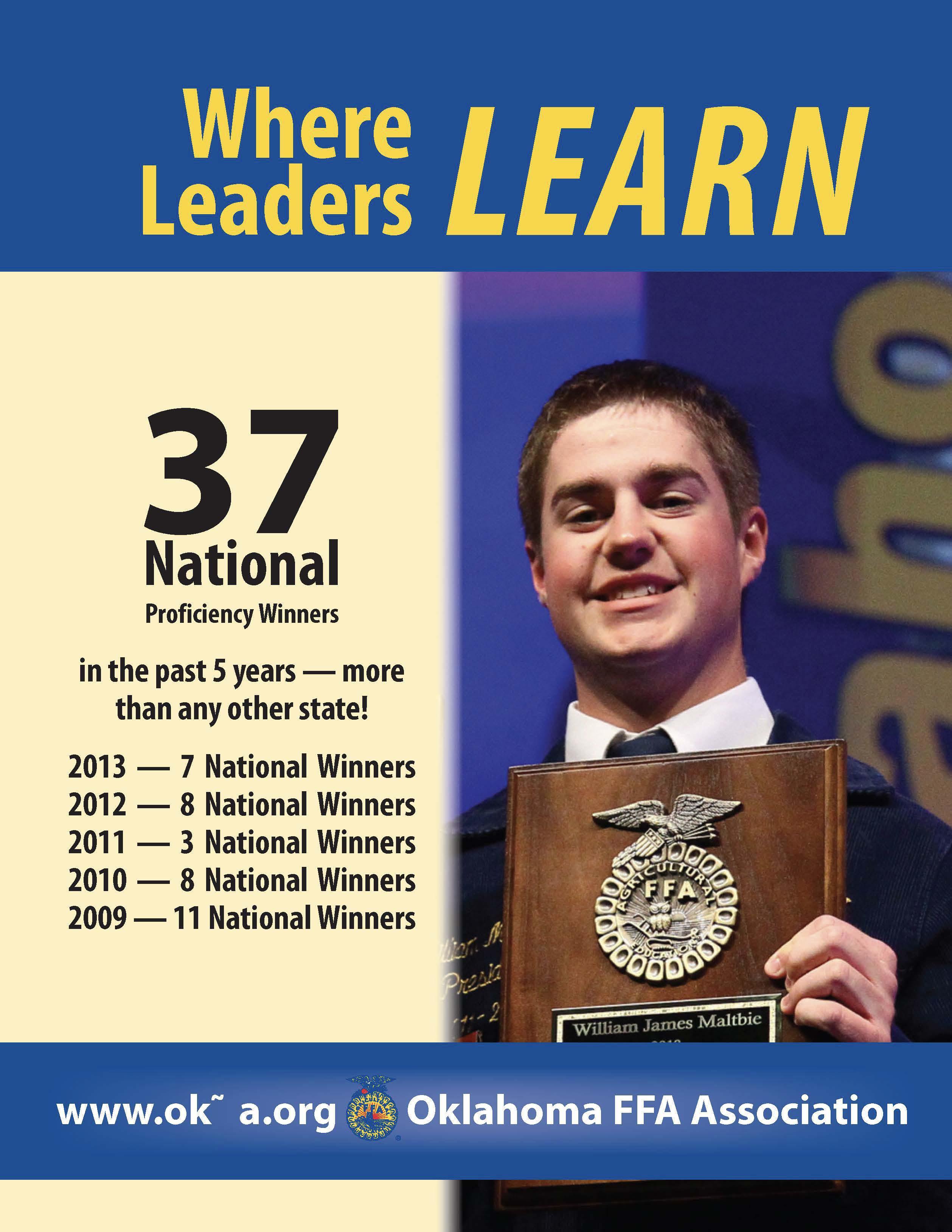
National ProficiencyWinners in the pastSyears- more than anyotherstate!
2013- 7 NationalWinners
2012- 8 NationalWinners
2011- 3 NationalWinners
2010- 8 NationalWinners
2009- 11 NationalWinners
Vol. 17 No. 1
EDITORS
Morgan Hannabass
Hannah Nemecek
Mary Belle Zook
MANAGING EDITOR
Shelly Peper Sitton, Ph.D.
ASSISTANT
MANAGING EDITORS
Dwayne Cartmell, Ph.D.
Traci Naile, Ph.D.
Angel Riggs, Ph.D.
GRAPHIC & PHOTO COORDINATORS
Kezia Hines
Cassie Laxson
SPONSORSHIP COORDINATORS
Kaleigh Lynch
Samantha Walker
CIRCULATION COORDINATOR
Nicole Withey
STAFF
Callie Colclasure
Holly Denton
Shelbi Kautz
Hannah McCollom
Dakota Miller
Brooke Powell
Jacob Redway
Paige Warren
Kylie Watson
Kristal Williams
FOUNDING SPONSORS
Quad Graphics
A Letter from the Editors
In preparing this CowboyJournal, we gained a new appreciation for the College of Agricultural Sciences and Natural Resources at Oklahoma State University. With each story, we learned more about the outstanding faculty, students and alumni who contribute to CASNR's excellence.
This publication would not be possible without the hard work and dedication of our staff. Each individual worked tirelessly to ensure the success of this issue. We, as editors, express our gratitude for the opportunity to serve each of you. May this experience be only a stepping-stone in the success of your professional careers.
A heartfelt thank you to alumnae Holly Blakey, Kelsey Conley and Kristin Knight for their willingness to contribute their time and talent in proofreading this issue.
To our assistant managing editors - Dwayne Cartmell, Traci Naile and Angel Riggs - thank you for your support. Through your advice and wisdom, we have grown professionally as agricultural communicators.
Most importantly, to our managing editor, Shelly Peper Sitton, thank you for teaching us the two ways of accomplishing anything: Do it right, or do it again. You have instilled skills in us that will benefit us professionally, ethically and personally. Because of you, we are better writers, designers, team players and optimists.
We came to OSU to gain an education, but we leave with memories and experiences to treasure for a lifetime. We are proud to be part of the Cowboy tradition, and we will forever be indebted to the university that allowed us so many opportunities.
- Morgan, Hannah & Mary Belle
Photo by Hannah Nemecek.
Photo by ShelbiKautz.
8 Invading the State
NREM department wages war on Oklahoma's invasive plant species. 1 2 It's Not Rocket Science
4 2 Keeper of Presidential Gardens
OSU CASNR alumna maintains the historic gardens of Monticello, home of Thomas Jefferson.
4 5 An Army Bug's Life
A veteran combines two passions to pursue his career.
2 6 Home Grown
Small-town Girl. Big Mission. 2014 Truman Scholar does public service work in South Africa.
Putting on a New Hat
OSU's DASNR welcomes a new vice president, dean and director.
Rooted in Tradition
Family-owned store with CASNR roots serves community.
Celebrating with Wheat
At OSU, research success just might be in the genes. 14 18 20 24
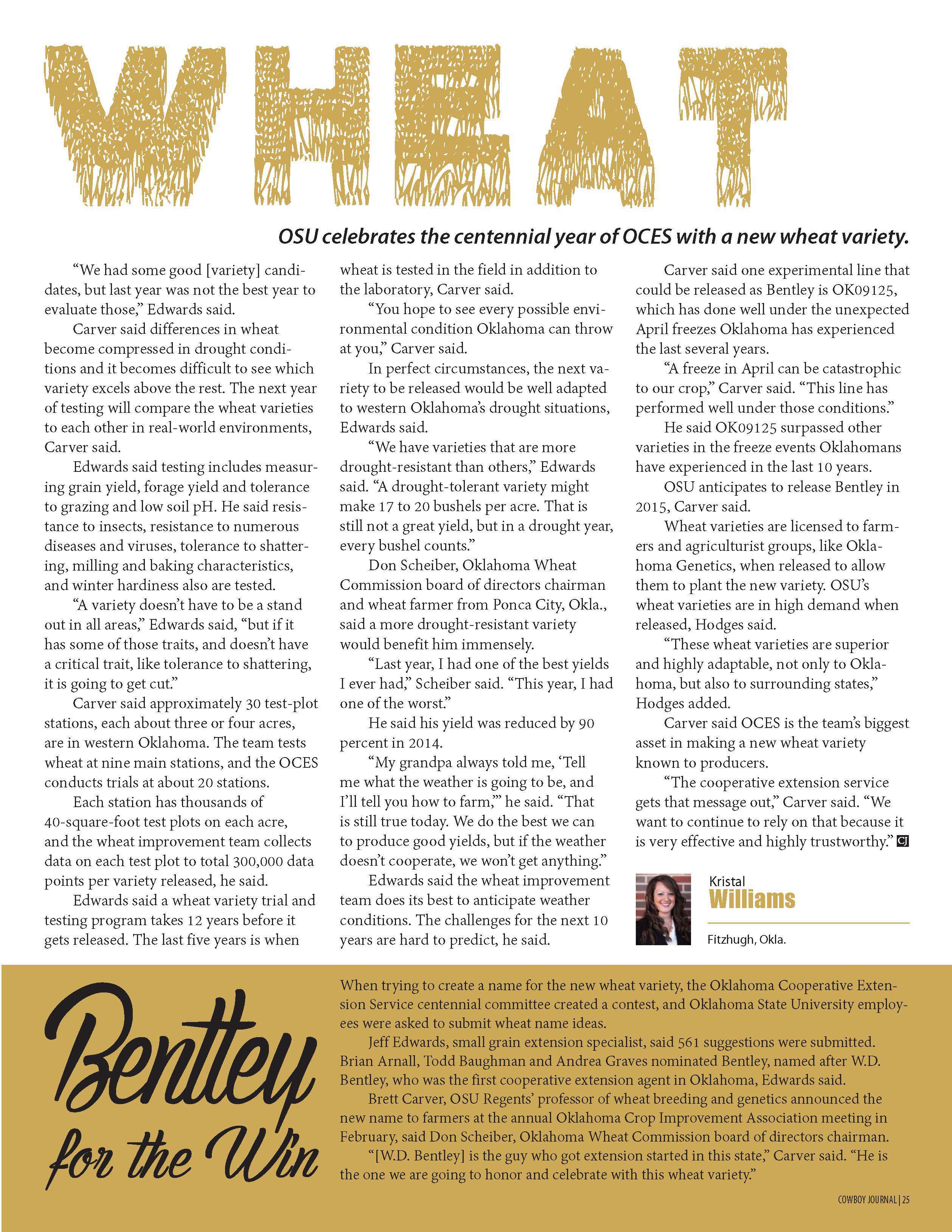
OSU celebrates the centennial year of OCES with a new wheat variety.
OSU's dining services promotes Made in Oklahoma products. 2 8 Next Generation Farmer
PaSS faculty member develops mobile apps for agriculture. 31 34 A Picture Perfect World Worth Exploring Students, faculty capture beauty in studying abroad.
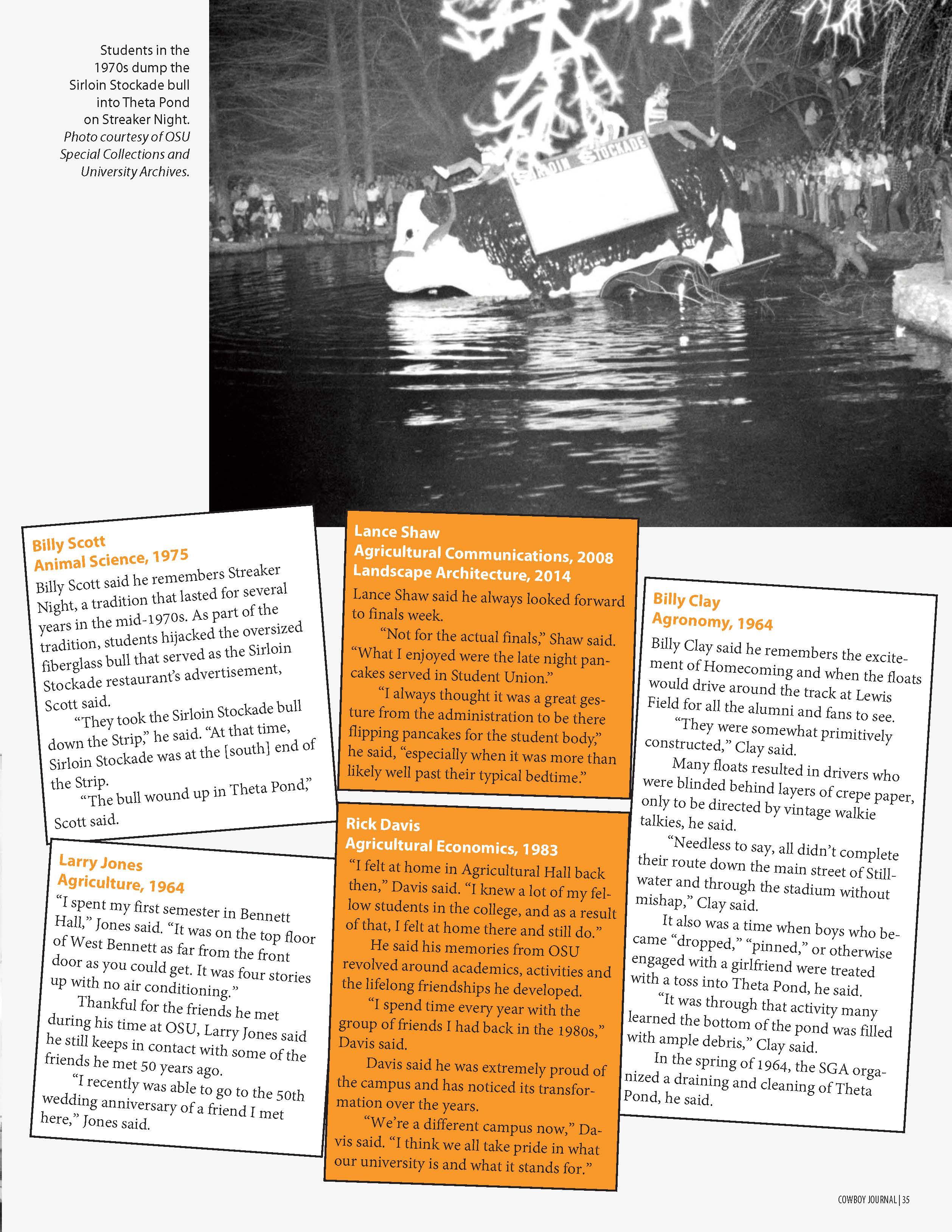
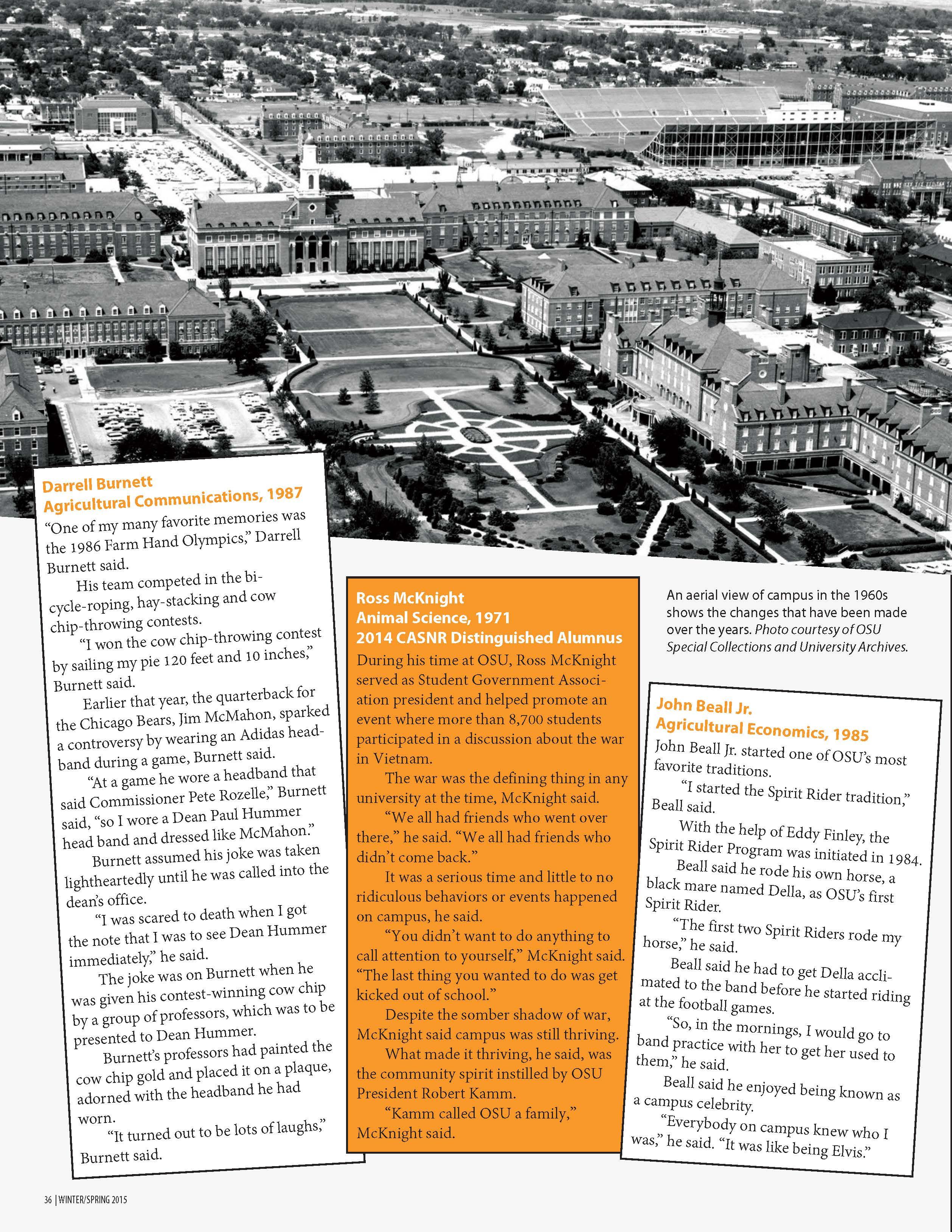
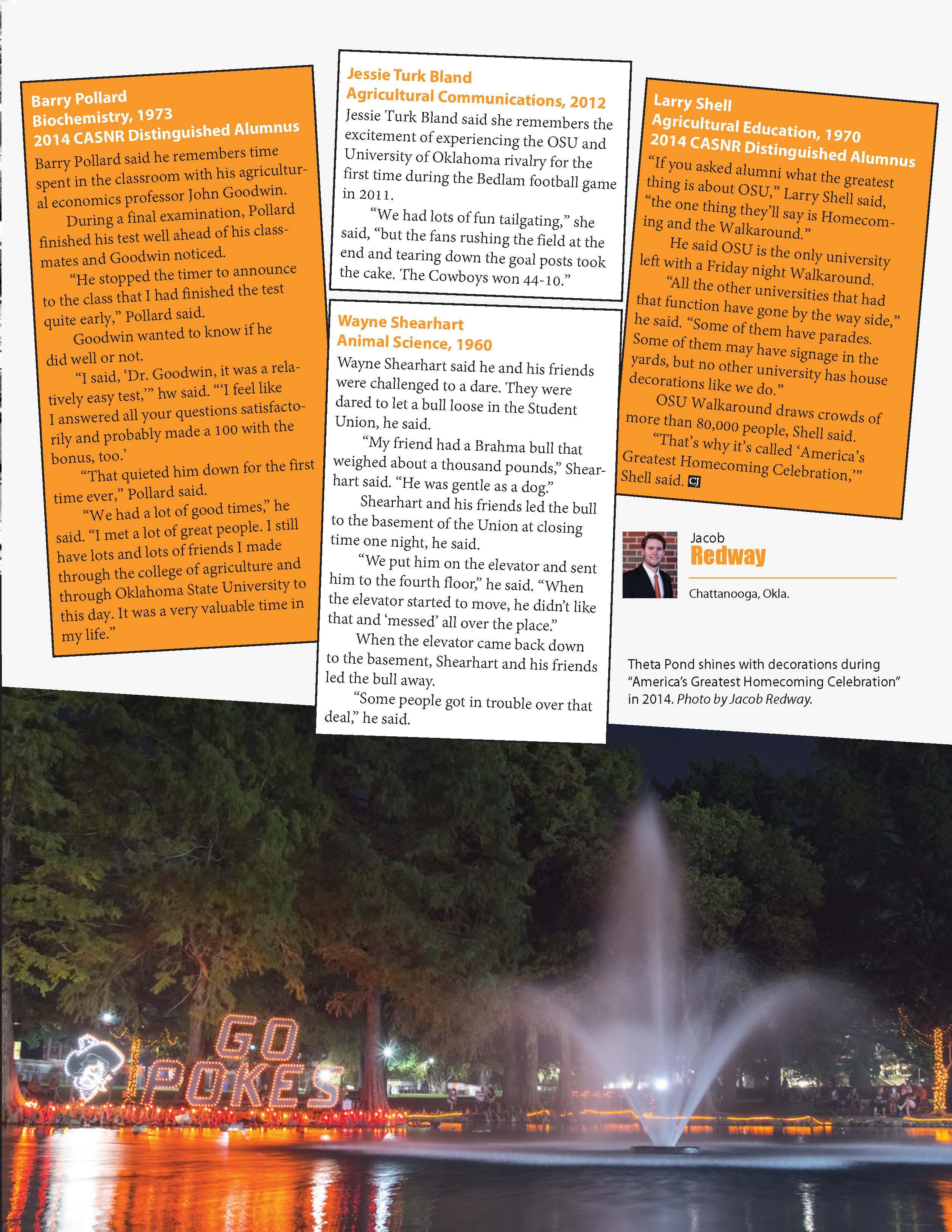
To Our Alma Mater CASNR alumni reminisce about their experiences from OSU. 3 9 Quilt of Many Colors
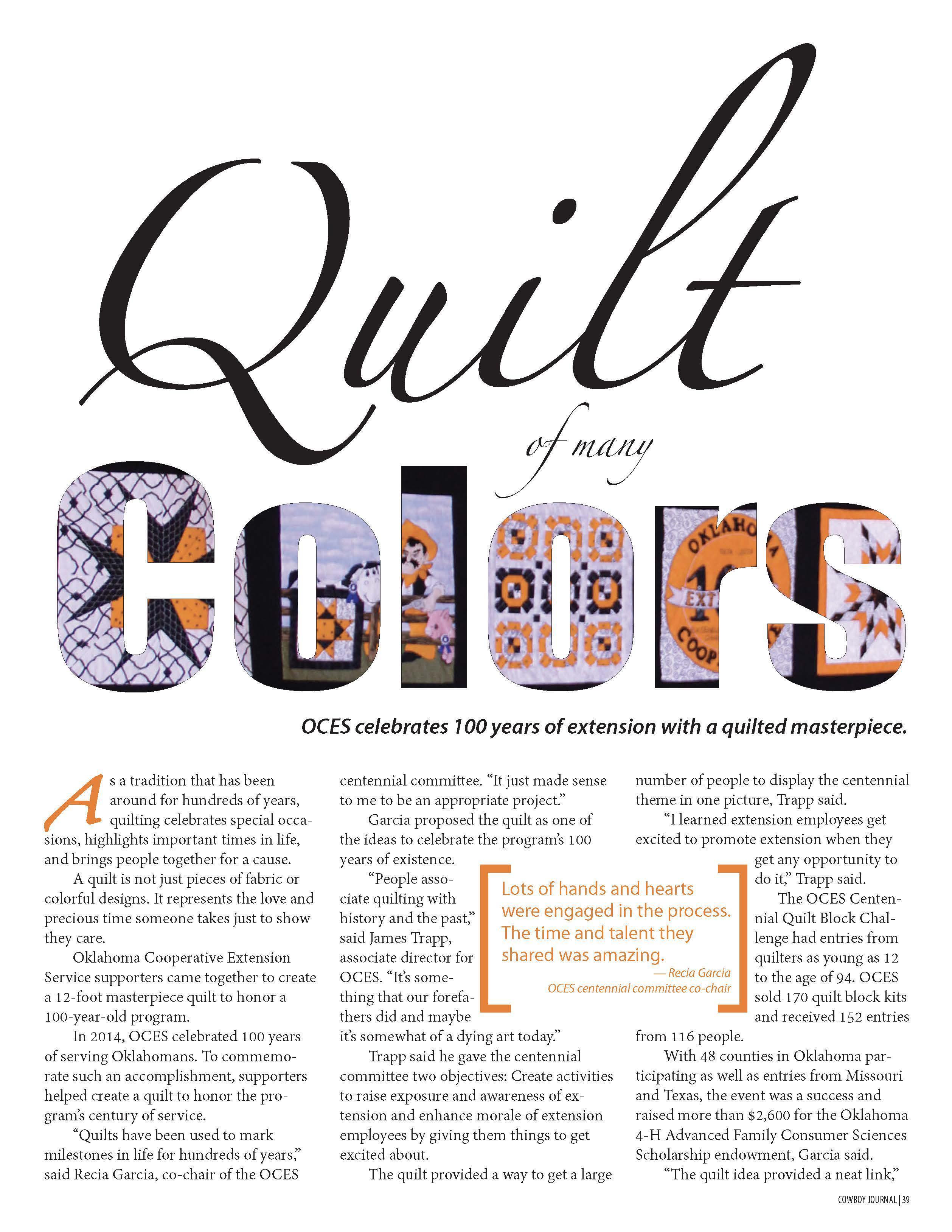
OCES honors 100 years with a quilted masterpiece
48 52 Pre- Vets Prepare
Students get ready for vet school through undergraduate research.
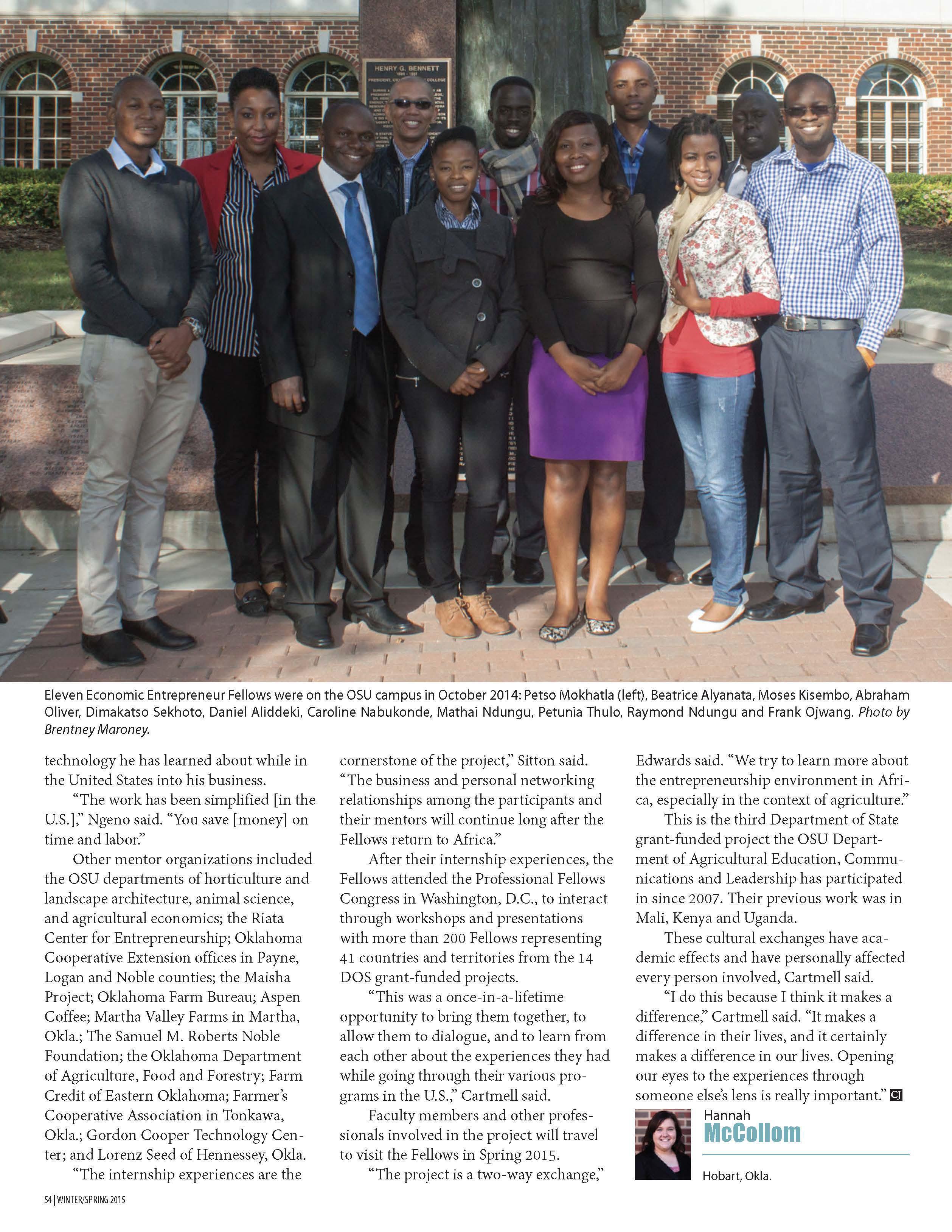
A Cultural Exchange
Eleven Africans visit OSU as Entrepreneur Fellows.
A new mix of students become agricultural education instructors.
64 One Dress at a Time
OSU senior impacts lives through the simple act of sewing.
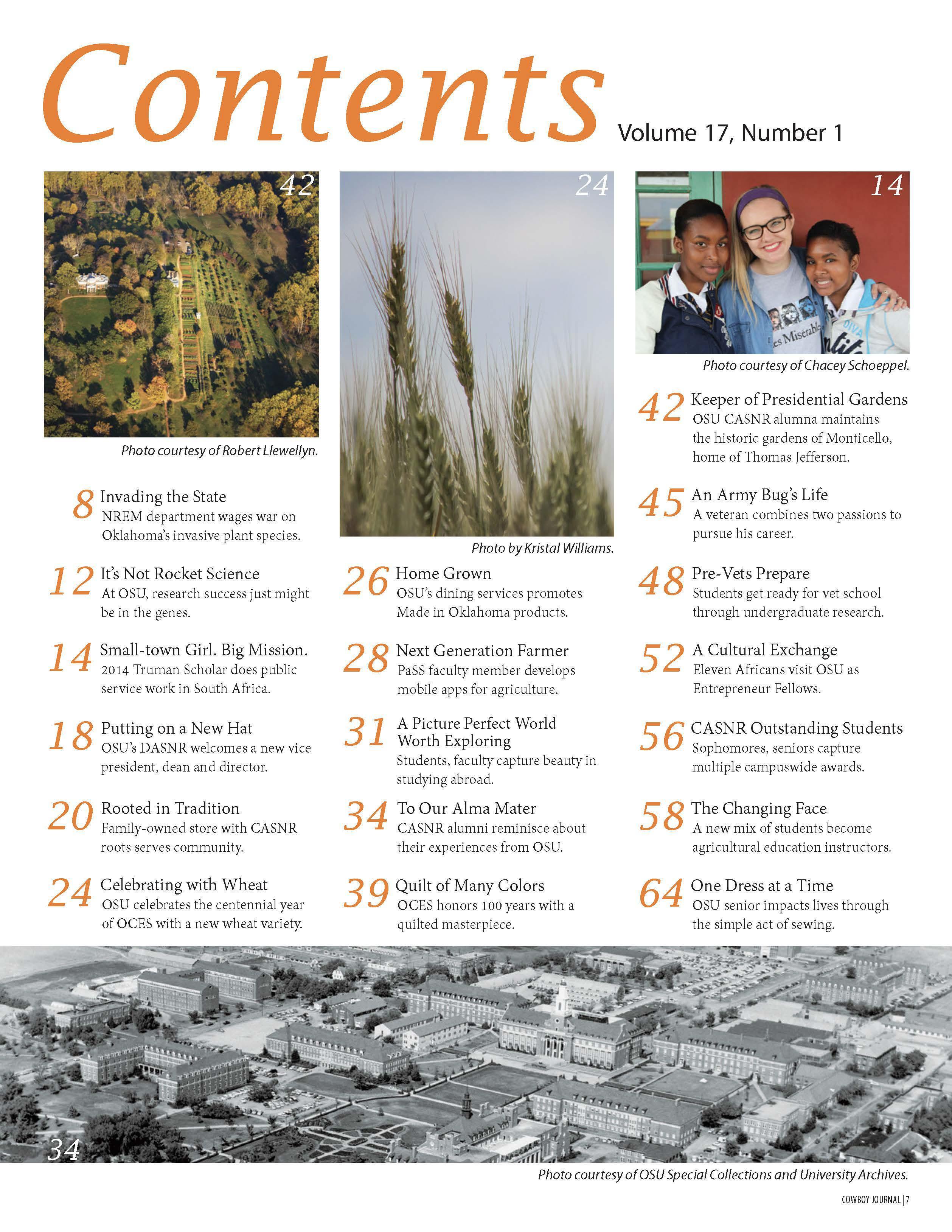
Photo courtesy of Robert Llewellyn.
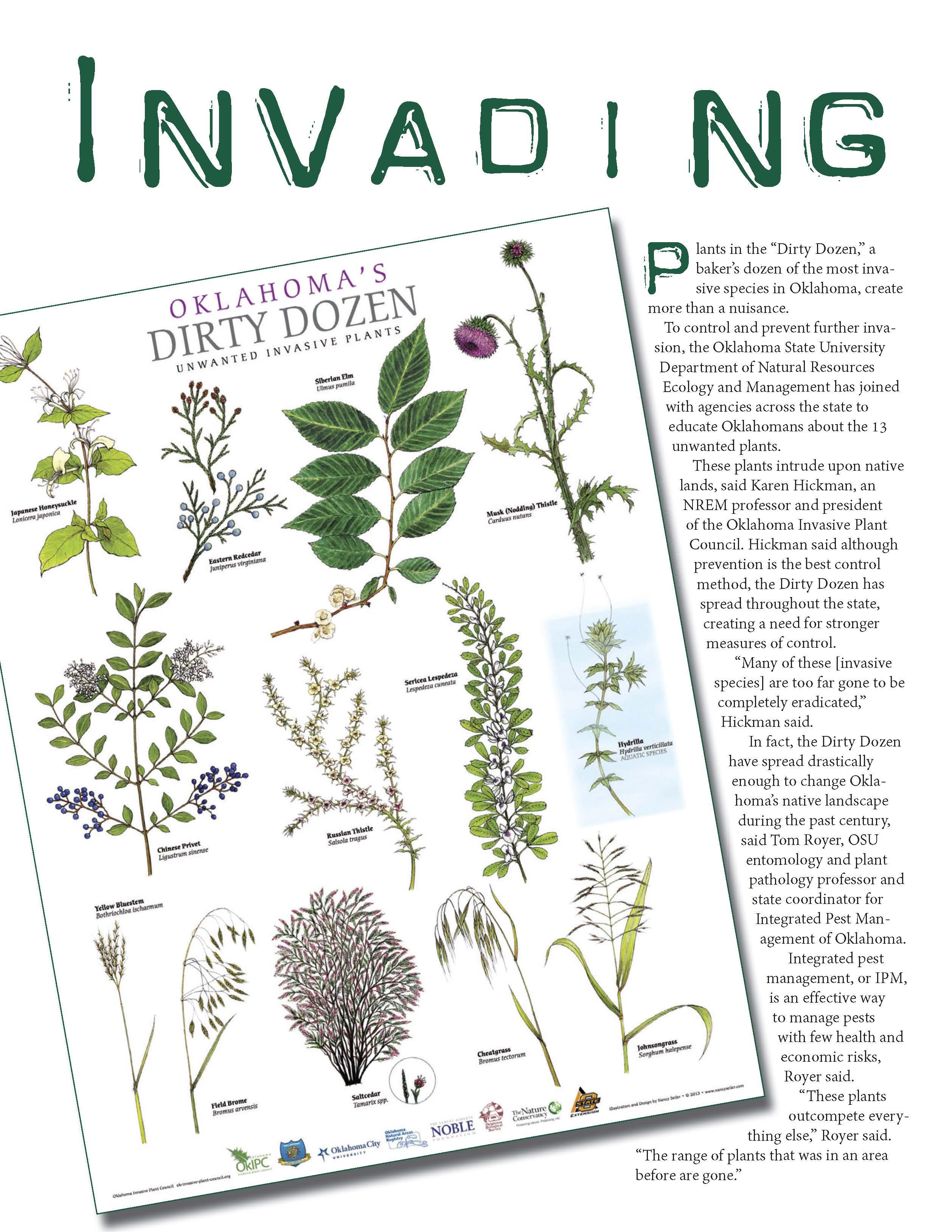
Photo by Kristal Williams.
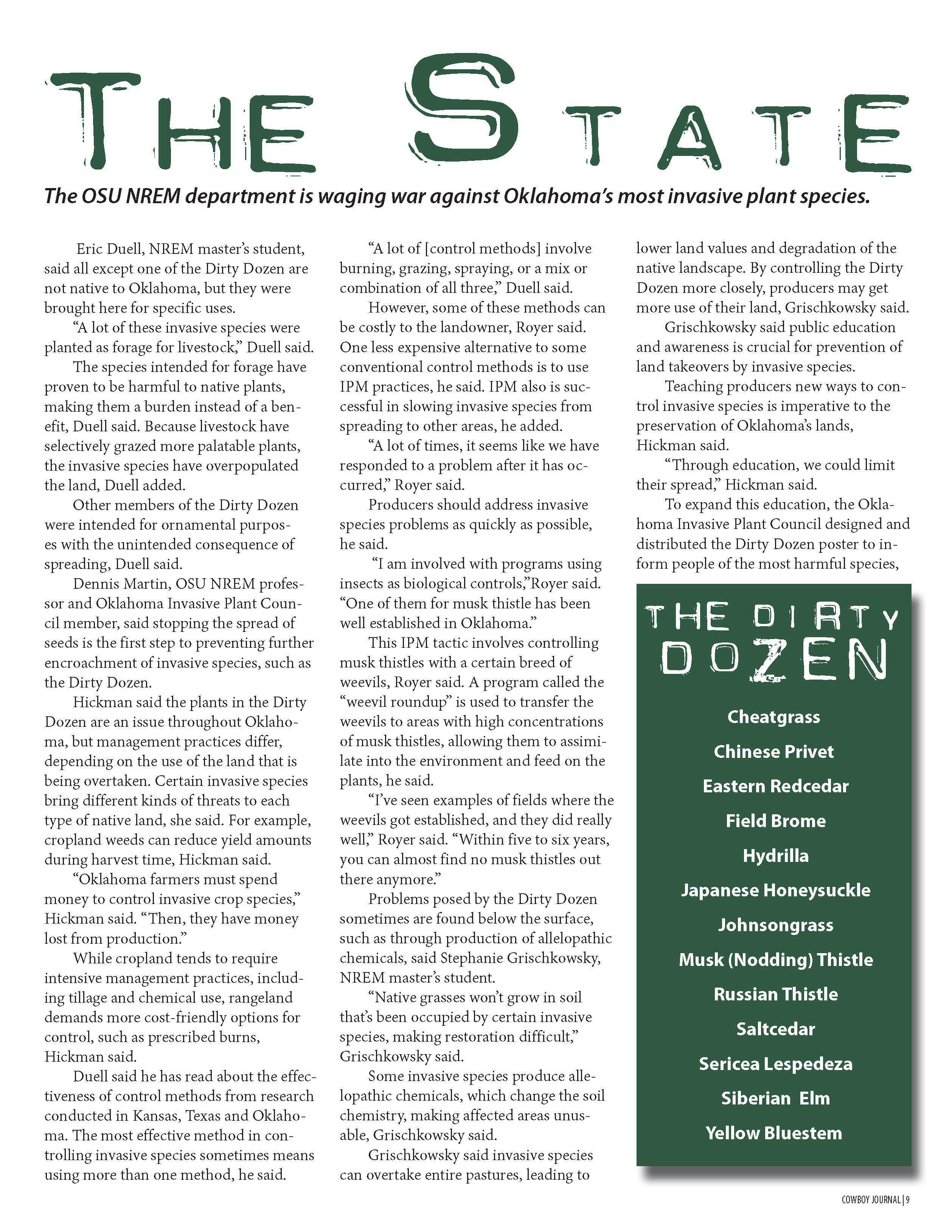
Photo courtesy of ChaceySchoeppel.
'T!-H';E
I I !_ I
The OSUNREMdepartment is waging war against Oklahoma'smost invasiveplant species.
Eric Duell, NREM master's student, said all except one of the Dirty Dozen are not native to Oklahoma, but they were brought here for specific uses.
"A lot of these invasive species were planted as forage for livestock;' Duell said.
The species intended for forage have proven to be harmful to native plants, making them a burden instead of a benefit, Duell said. Because livestock have selectively grazed more palatable plants, the invasive species have overpopulated the land, Duell added.
Other members of the Dirty Dozen were intended for ornamental purposes with the unintended consequence of spreading, Duell said.
Dennis Martin, OSU NREM professor and Oklahoma Invasive Plant Council member, said stopping the spread of seeds is the first step to preventing further encroachment of invasive species, such as the Dirty Dozen.
Hickman said the plants in the Dirty Dozen are an issue throughout Oklahoma, but management practices differ, depending on the use of the land that is being overtaken. Certain invasive species bring different kinds of threats to each type of native land, she said. For example, cropland weeds can reduce yield amounts during harvest time, Hickman said.
"Oklahoma farmers must spend money to control invasive crop species;' Hickman said. "Then, they have money lost from production:'
While cropland tends to require intensive management practices, including tillage and chemical use, rangeland demands more cost-friendly options for control, such as prescribed burns, Hickman said.
Duell said he has read about the effectiveness of control methods from research conducted in Kansas, Texas and Oklahoma. The most effective method in controlling invasive species sometimes means using more than one method, he said.
"A lot of [control methods] involve burning, grazing, spraying, or a mix or combination of all three;' Duell said.
However, some of these methods can be costly to the landowner, Royer said. One less expensive alternative to some conventional control methods is to use IPM practices, he said. IPM also is successful in slowing invasive species from spreading to other areas, he added.
"A lot of times, it seems like we have responded to a problem after it has occurred;' Royer said.
Producers should address invasive species problems as quickly as possible, he said.
"I am involved with programs using insects as biological controls;'Royer said. "One of them for musk thistle has been well established in Oklahoma:'
This IPM tactic involves controlling musk thistles with a certain breed of weevils, Royer said. A program called the "weevil roundup'' is used to transfer the weevils to areas with high concentrations of musk thistles, allowing them to assimilate into the environment and feed on the plants, he said.
''I've seen examples of fields where the weevils got established, and they did really well;' Royer said. "Within five to six years, you can almost find no musk thistles out there anymore:'
Problems posed by the Dirty Dozen sometimes are found below the surface, such as through production of allelopathic chemicals, said Stephanie Grischkowsky, NREM master's student.
"Native grasses won't grow in soil that's been occupied by certain invasive species, making restoration difficult;' Grischkowsky said.
Some invasive species produce allelopathic chemicals, which change the soil chemistry, making affected areas unusable, Grischkowsky said.
Grischkowsky said invasive species can overtake entire pastures, leading to
lower land values and degradation of the native landscape. By controlling the Dirty Dozen more closely, producers may get more use of their land, Grischkowsky said.
Grischkowsky said public education and awareness is crucial for prevention of land takeovers by invasive species.
Teaching producers new ways to control invasive species is imperative to the preservation of Oklahoma's lands, Hickman said.
"Through education, we could limit their spread;' Hickman said.
To expand this education, the Oklahoma Invasive Plant Council designed and distributed the Dirty Dozen poster to inform people of the most harmful species,
Hickman said. Another way to educate people is to direct them to agencies, such as the Natural Resources Conservation Service, Hickman said.
"[Producers] are encouraged to go to their local OSU Extension or NRCS office;' Hickman said. "These personnel are going to have information about how to control [invasive species J:'
Duell said OSU's field days also have helped to inform producers about invasive species control strategies. However, getting the public's attention on the statewide issue is more difficult because many people do not see how the issue affects them, he said.
Although most of the Dirty Dozen do not cause health issues, they impact other important factors, such as the economy and natural resources, which indirectly affect everyone, Hickman said.
Another aspect of the problem is land owners renting their land to others instead of residing on it, Royer said.
This can hinder motivation to control invasive species because the landowner receives money for the use of the land without facing the consequences of the invasives, Royer said.
Humans are not the only ones affected by the Dirty Dozen, Duell said.
The invasive plants also drive out wildlife, interfere with cropland and rangeland, and take away resources that otherwise would be used by native plants.
"The Great Plains feeds our nation and a lot of the world;' Duell said. "The invasive species aren't just affecting the native biodiversity.
"Researchers are coming up with new information almost daily on effective control methods;' Duell said. "We don't
know everything there is to know, but the research continues:'
Despite the varying methods now used to control the Dirty Dozen, only one option fully inhibits them, Hickman said.
"Prevention is key;' Hickman said. "If they are not there yet, let's find a way for them not to get there:' ti]
Holly Denton Fay,Okla.
Rangeland ecology and management majors Seth Coffey (left), Clark Roberts and Brandon Miller sample sericea lespedeza in patch-burn grazing treatments. Photo by Karen Hickman
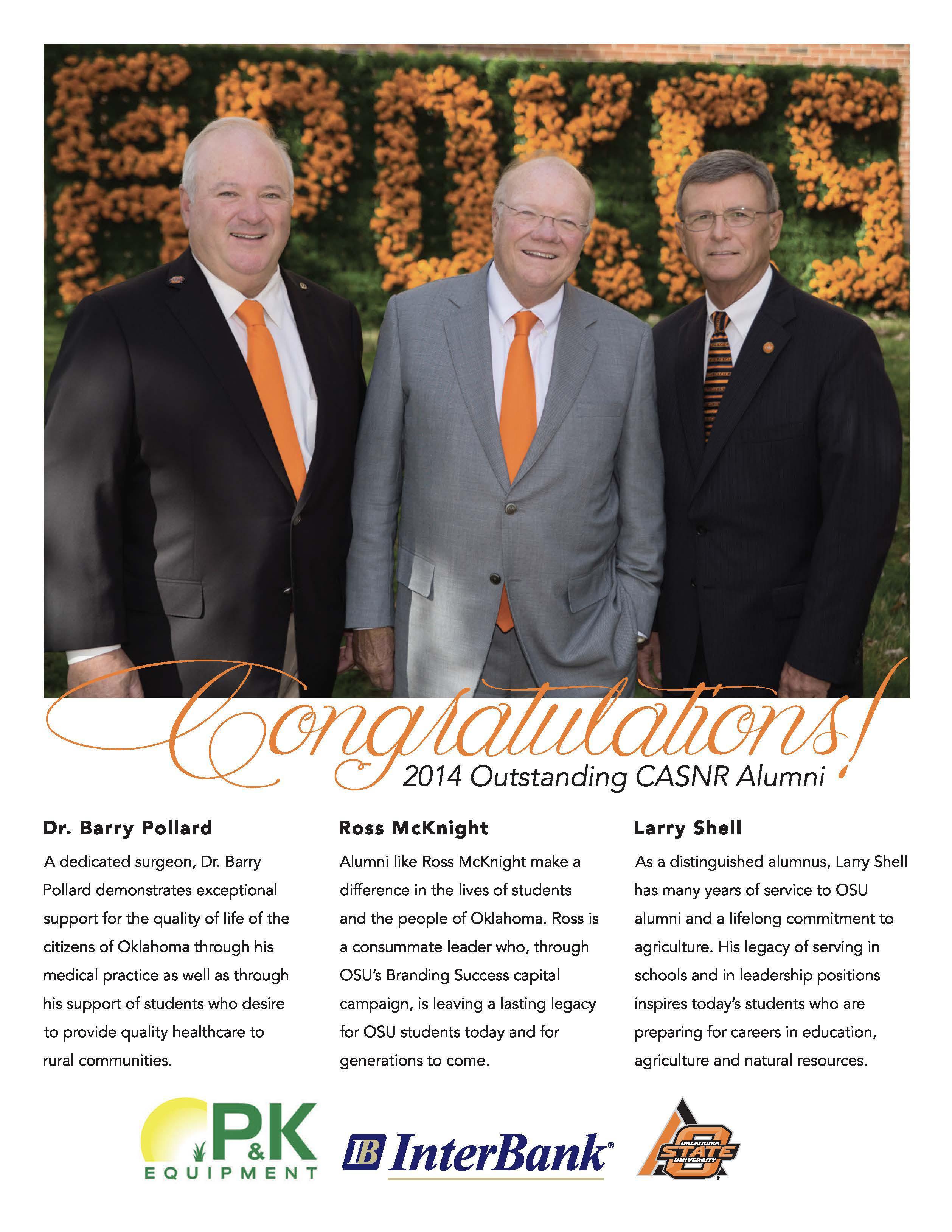
Dr. Barry Pollard
A dedicated surgeon, Dr. Barry Pollard demonstrates exceptional support for the quality of life of the citizens of Oklahoma through his medical practice as well as through his support of students who desire to provide quality healthcare to rural communities.
2014 Outstanding CASNR Alumni
Ross McKnight Larry Shell
Alumni like Ross McKnight make a As a distinguished alumnus, Larry Shell difference in the lives of students has many years of service to OSU and the people of Oklahoma. Ross is alumni and a lifelong commitment to a consummate leader who, through agriculture. His legacy of serving in OSU's Branding Success capital schools and in leadership positions campaign, is leaving a lasting legacy inspires today's students who are for OSU students today and for preparing for careers in education, generations to come. agriculture and natural resources.
IT'S NOT
From a tiny room in Old Central to modern labs and classrooms today, the Department of Agricultural Chemistry at Oklahoma State University has evolved into the Department of Biochemistry and Molecular Biology. Quietly and with little fanfare, this department prepares students for a variety of futures, said John Gustafson, professor and department head.
A large percentage of current undergraduate biochemistry and molecular biology students study either pre-medical or pre-veterinary options, said Casey Landis, Biochemistry Club president.
According to the Department of Biochemistry and Molecular Biology, 80 percent of medical school applicants from the department receive acceptance.
"Every course in biochemistry and molecular biology prepares the students for the MCAT;' Gustafson said.
The department helps students succeed through its implementation of the three-plus-one program, Landis said.
"The program allows students to gain matriculation into a medical school early;' Gustafson said.
Students participating in the program replace their senior year at OSU with their first year at any professional school.
"It allows students to get into what they really want to do faster;' Landis said.
Encouraged by her adviser, Landis enrolled in the program. She has received early admission to veterinary school and will finish her biochemistry coursework in May 2015.
"It cuts down on costs;' Landis said. "It's one year of tuition that the student doesn't have to pay while completing their undergraduate degree:'
Another way the department encourages success is through the numerous research opportunities offered.
"All of our freshmen are invited to join a research program;' Landis said.
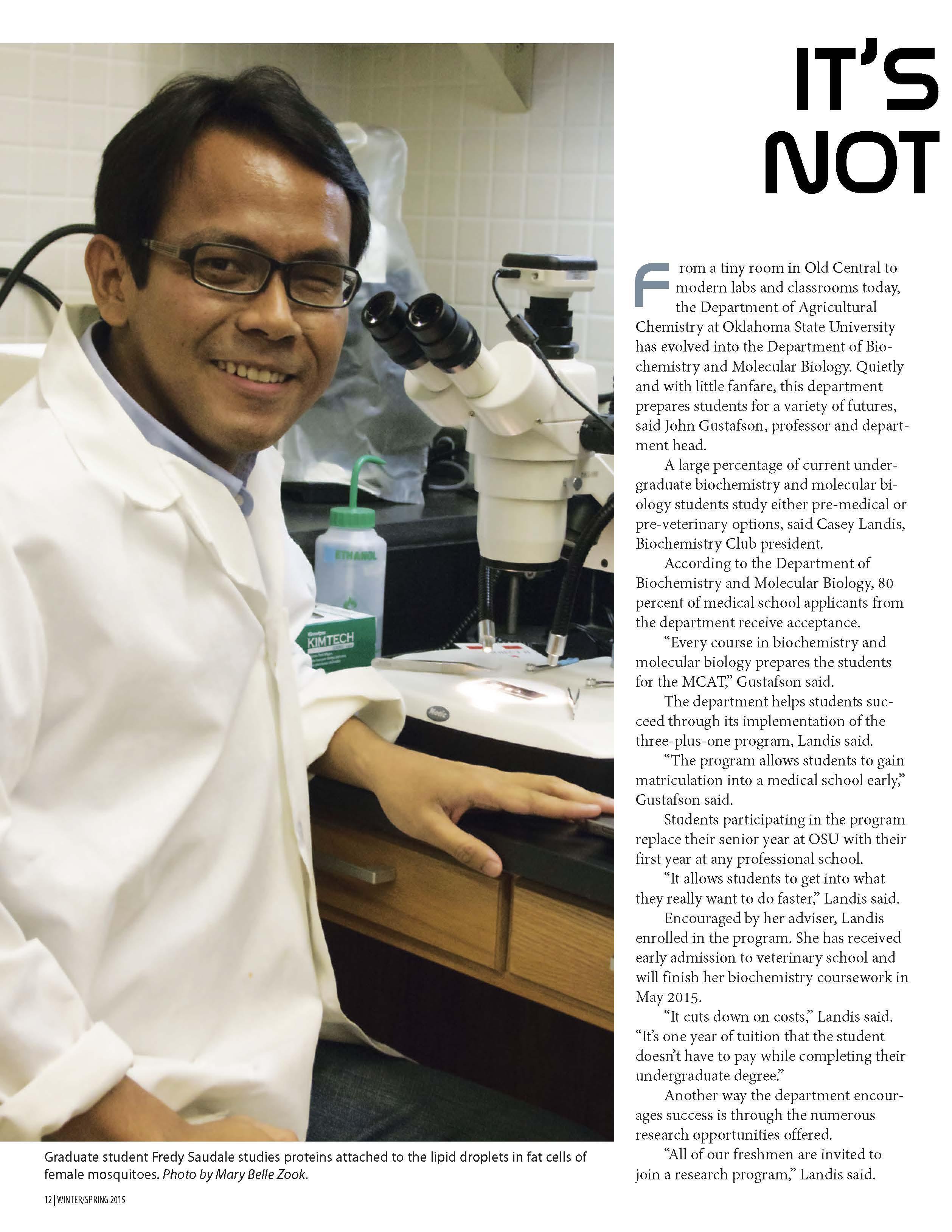
Graduate student Fredy Saudale studies proteins attached to the lipid droplets in fat cells of female mosquitoes. Photo by Mary BelleZook.
At OSU,successjust might be in the genes.
The program, headed by Patricia Canaan, associate professor of biochemistry and molecular biology, allows students to work in groups by collecting samples and doing lab research. At the end of the semester, students participate in a research day where they present their research to faculty and fellow students, Landis said.
Students also participate in undergraduate research award programs such as Life Science Freshman Research Scholars, the Wentz Research Project Award and Niblack Research Scholars Program, Gustafson said.
"We have numerous faculty members who greatly appreciate the opportunity to work with undergraduates on research projects;' Gustafson said.
The department does a tremendous amount of research, especially related to health, Landis said.
"The faculty is really good about getting the students who want to do research into the lab to get experience;' Landis said.
In fact, many biochemistry and mo-
lecular biology students go on to attend graduate school to conduct research and obtain advanced degrees, Gustafson said.
"The department of biochemistry at OSU prepares students to be researchers in a university, state institute or private company;' said Fredy Saudale, biochemistry and molecular biology doctoral student. "The idea is to expose the undergrads as soon as possible to research:'
Students receive a variety of choices on research topics, Saudale said.
Saudale currently studies specific proteins attached to fat cells in mosquitoes.
"One of the biggest problems right now in tropical countries is the struggle with infectious disease ... like malaria, dengue and yellow fever;' Saudale said. "The issue is the factor of how mosquitoes transmit these diseases. In the future, the implication of this research could be very good because then we will know whether this protein that I am studying can give us insight to how to block the transmission:'
In addition to the courses and re-
search available, the faculty has a tremendous impact on the success of the department, Landis said.
"Our faculty members love our students;' Gustafson said.
The department's smaller staff-tostudent ratio makes for a more positive experience for students, Landis said.
"The biochemistry department here is a really close-knit group;' Landis said. "The students, faculty and grad students are close and have a good relationship:'
Saudale, who is native to Indonesia, said he appreciates how open to students the faculty and staff are compared to other institutions he has attended.
"The faculty is good about helping students do whatever they want to do;' Landis said. "Whatever dreams [students] want to chase, the faculty will help along thewaY:'til
Mary Belle Zook Waynoka, Okla.
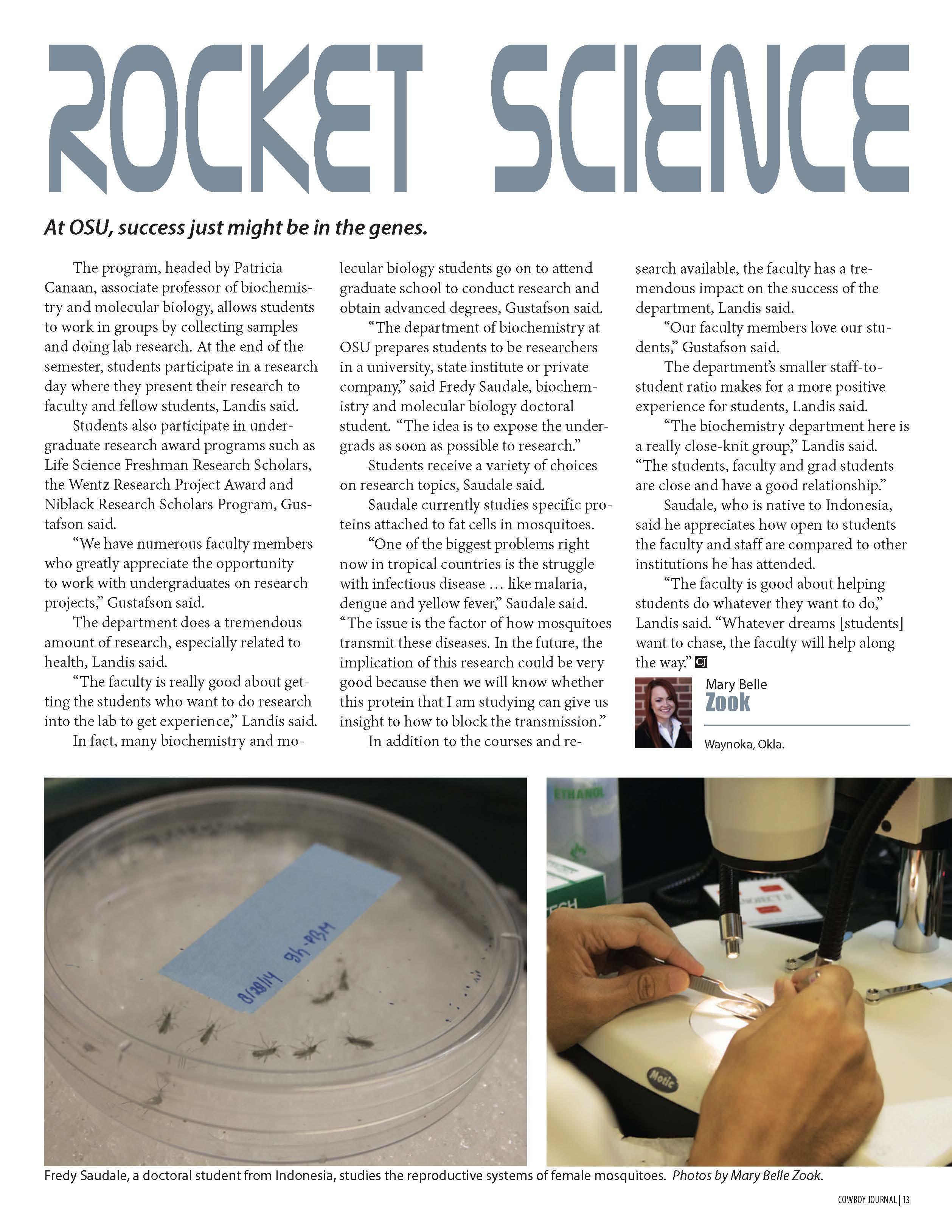
Fredy Saudale, a doctoral student from Indonesia, studies the reproductive systems of female mosquitoes. Photos by Mary BelleZook.
Imagine a world where developing nations could sustain themselves through agriculture, entrepreneurship and education. Imagine U.S. dollars going toward strengthening economies across the world. One Oklahoma State University student is helping make that change happen.
Chacey Schoeppel grew up on a cattle ranch near Fairview, Okla., and said she considers herself lucky to have grown up in "quintessential small-town America:'
ISSSSION.
OSUstudent becomesa 2014 Truman Scholar through her public servicework in South Africa.
At a young age, Schoeppel said she got involved wherever and whenever she had the chance. From American Farmers and Ranchers speech contests to FFA, Schoeppel said she enjoyed every opportunity to meet new people and to learn from those who are different from her.
Her involvement in organizations continued after high school, when FFA led her to Oklahoma State University. Schoeppel said she knew she wanted to be in a sorority for the same reasons she enjoyed being a part of student organizations in high school - the chance to meet different people - which being a Chi Omega allowed her to do.
During her freshman year, Schoeppel also was involved in Freshman Representative Council with the Student Government Association and saw leadership opportunities on campus in a way most students are not exposed to, she said.
"I think my involvement in college was more characterized by opportunities to better myself as a person;' Schoeppel said, "but also to gain a better grasp on the tools I would need to be successful later in my career, both as an individual and as a professional:'
As an executive team member for SGA her sophomore year, Schoeppel said she decided to run for SGA president.
Although she dropped from the race, she said she still made a difference by helping improve the election code where candidates can better focus on issues.
After dropping from the race, Schoeppel reconnected with Alyssa Peterson, an OSU biochemistry graduate she met during her first semester at OSU. With Peterson's help, she became involved in the Ubuntu Youth Project in South Africa.
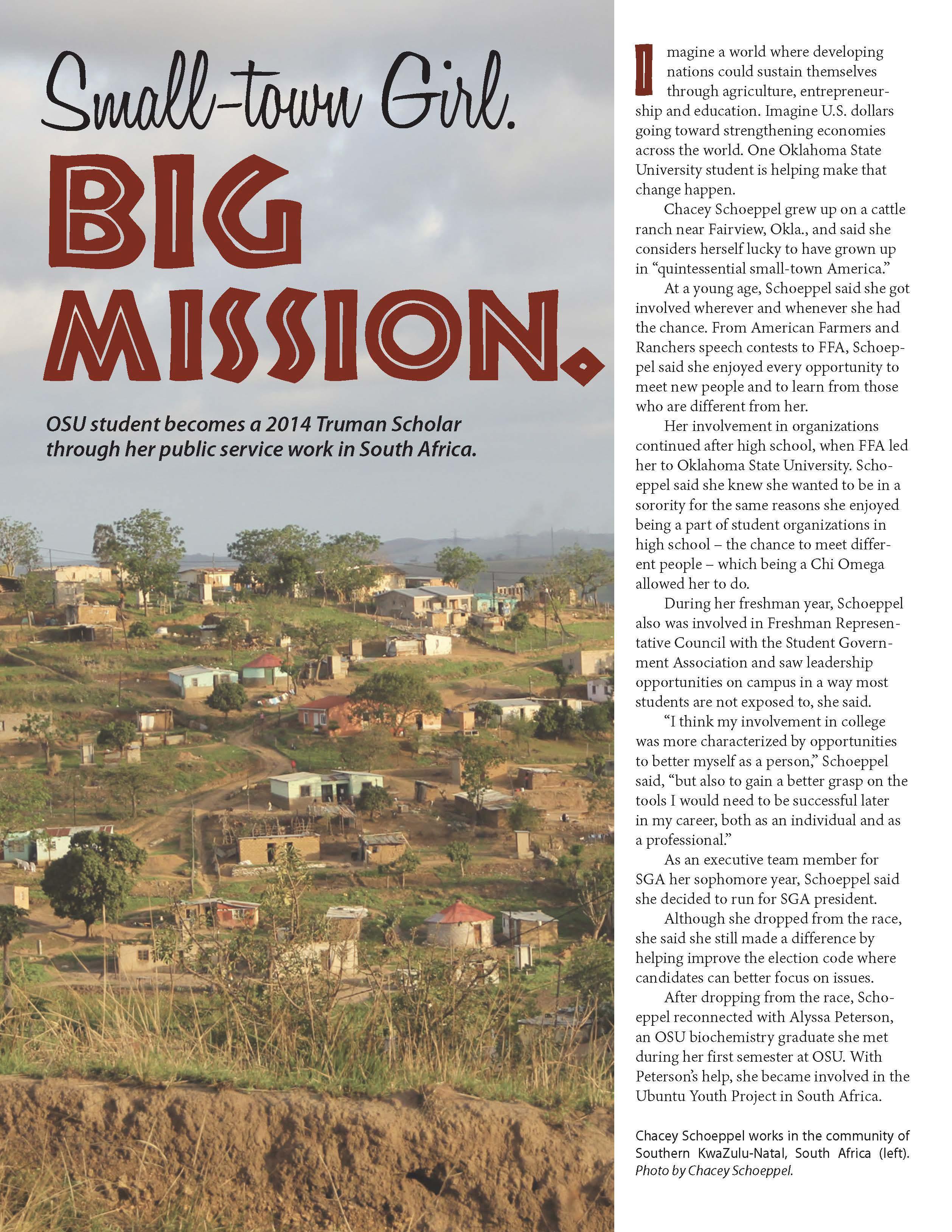
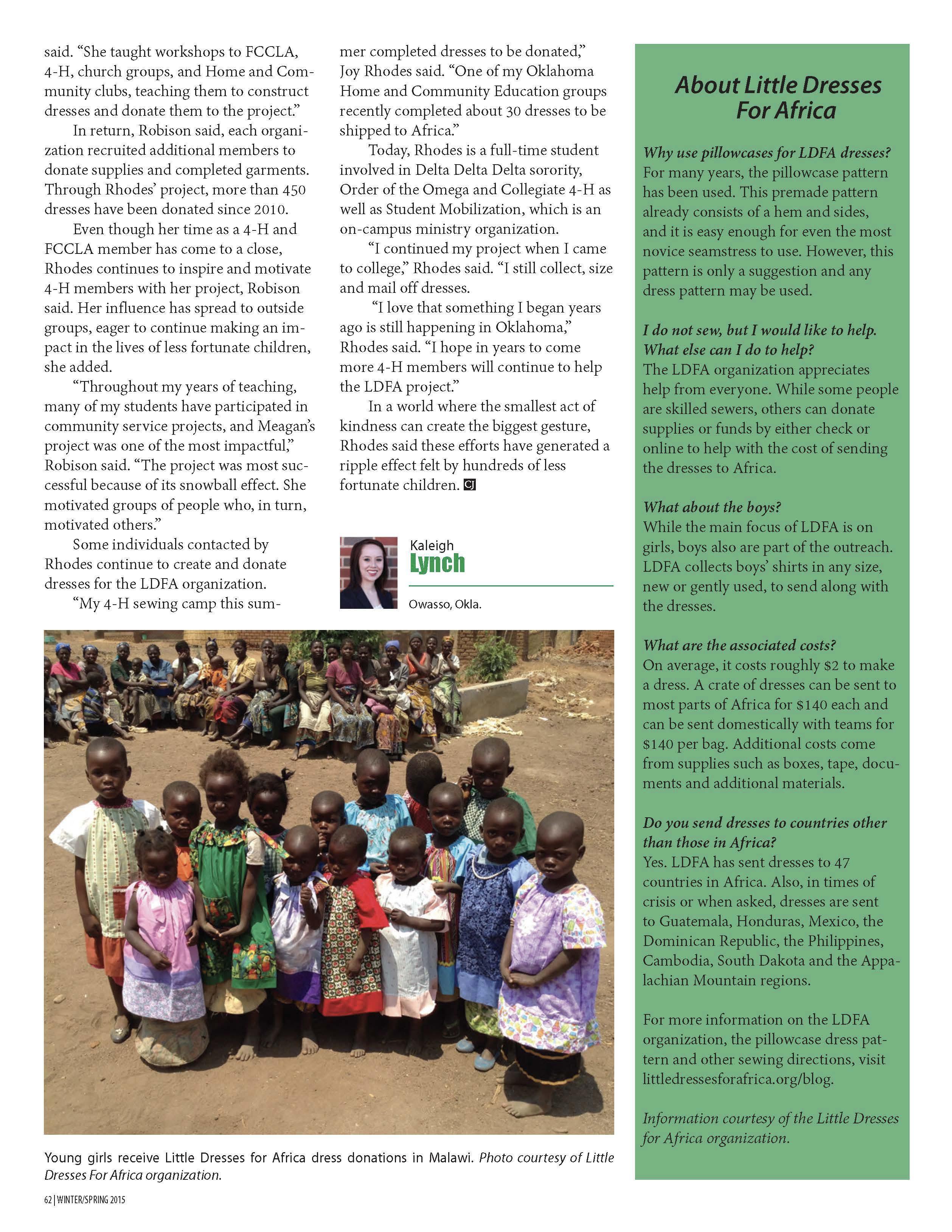
Chacey Schoeppel works in the community of Southern KwaZulu-Natal, South Africa (left).
Photo by ChaceySchoeppel.
The Ubuntu Youth Project is an education-based nonprofit located in Southern KwaZulu-Natal, South Africa, that connects local mentors in the community to local high school students through tutoring, entrepreneurship ventures and post-graduate opportunities. Ubuntu Youth's goals are to provide a college
does not take credit for her accomplishments because she knows credit can go much further if given to the very person fighting every day to pick themselves up by their bootstraps:'
Schoeppel decided to leave the college environment to work with Ubuntu Youth, but through online courses from OSU, is still able to work scholarship, a micro loan to start a business or the professional skills to be compet-
She was a fit for the scholarship. It was just natural.
market following graduation. Schoeppel said Ubuntu Youth's motto is to "provide opportunity to motivated youth where opportunity is limited:'
toward her degree at the same time.
"The purpose
-Shannon Ferrell agricultural economics associate professor of a college environment and being on campus and being involved in student organizations is to acquire and refine skills that will be used in the 'real world;" Schoeppel said. "My experience with campus leadership coupled with academic knowledge acquired in classes prepared me, as much as it could have, for what I am doing now. Without a doubt, I believe I made the right choice to spend a semester in South Africa while still an undergraduate:' itive in the job
The purpose is to help decrease the youth unemployment rate and give the students the opportunity to be successful in a dismal job market after they finish high school. Schoeppel said another goal for Ubuntu Youth is to "give students the chance to be their own heroes and develop themselves as professionals to be competitive after high school:'
Through Schoeppel's connection with Peterson, she became a director for the Ubuntu Youth Project in March 2013 and took a trip to South Africa during the summer of 2013 to better understand the organization and how it "ran on the ground;' she said.
"After coming back from South Africa, I really narrowed my focus of organizational involvement to make sure I could devote enough time to both the organizations and doing Ubuntu Youth work stateside;' Schoeppel said. "I [later] transitioned out of campus involvement and more into working with Ubuntu Youth [in spring 2014]:'
Schoeppel left for South Africa in May 2014 and said she plans to return to OSU to finish her degree in spring 2015. Peterson, executive director for Ubuntu Youth, recruited Schoeppel to be the nonprofit's third U.S. director and said doing so "changed the course of my life as well as the lives of so many others halfway across the world:'
Peterson said she chose Schoeppel because she understood Ubuntu Youth was about seeing people with potential, not seeing causes and projects to help
resume. She said Schoeppel "does an excellent job of being a selfless leader and
With help from her nonprofit work, Schoeppel was named a 2014 Truman Scholar. She is OSU's 17th student to receive the prestigious honor and earn a $30,000 scholarship toward a graduate degree to pursue a career in public service.
"Sometimes you find people who can make themselves fit a scholarship, but that was not Chacey;' said Shannon Ferrell, agricultural economics associate professor
and mentor of Schoeppel. "She was a fit for the scholarship. It was just natural:'
Ferrell said Schoeppel's focus on service through her efforts with Ubuntu Youth in South Africa made her a perfect Truman Scholar candidate.
"You see a young person with potential and you know with just a little bit more resources you can dramatically expand that potential;' Ferrell said. "I think that is a really good description of Chacey getting the Truman Scholarship.
"She was amazing to start with, and she has already done so much, but the investment of the Truman Scholarship is going to exponentially increase the things she will be able to do;' Ferrell added.
Ferrell said the Truman Foundation helps recognize people who have a talent and desire for public service, which he said he believes Schoeppel truly has.
"The whole purpose of the Truman Foundation is to provide young individuals with the resources and funding necessary to pursue a life that will make a difference in the lives of others;' Schoeppel said. '"Make a difference' is a pretty cliche phrase, but it rings true for each Truman Scholar, and it also looks different for each:'
For Schoeppel, it means to help young people beat the status quo and be the ones to break out of cyclical poverty, she said. Schoeppel's Truman focus was on how
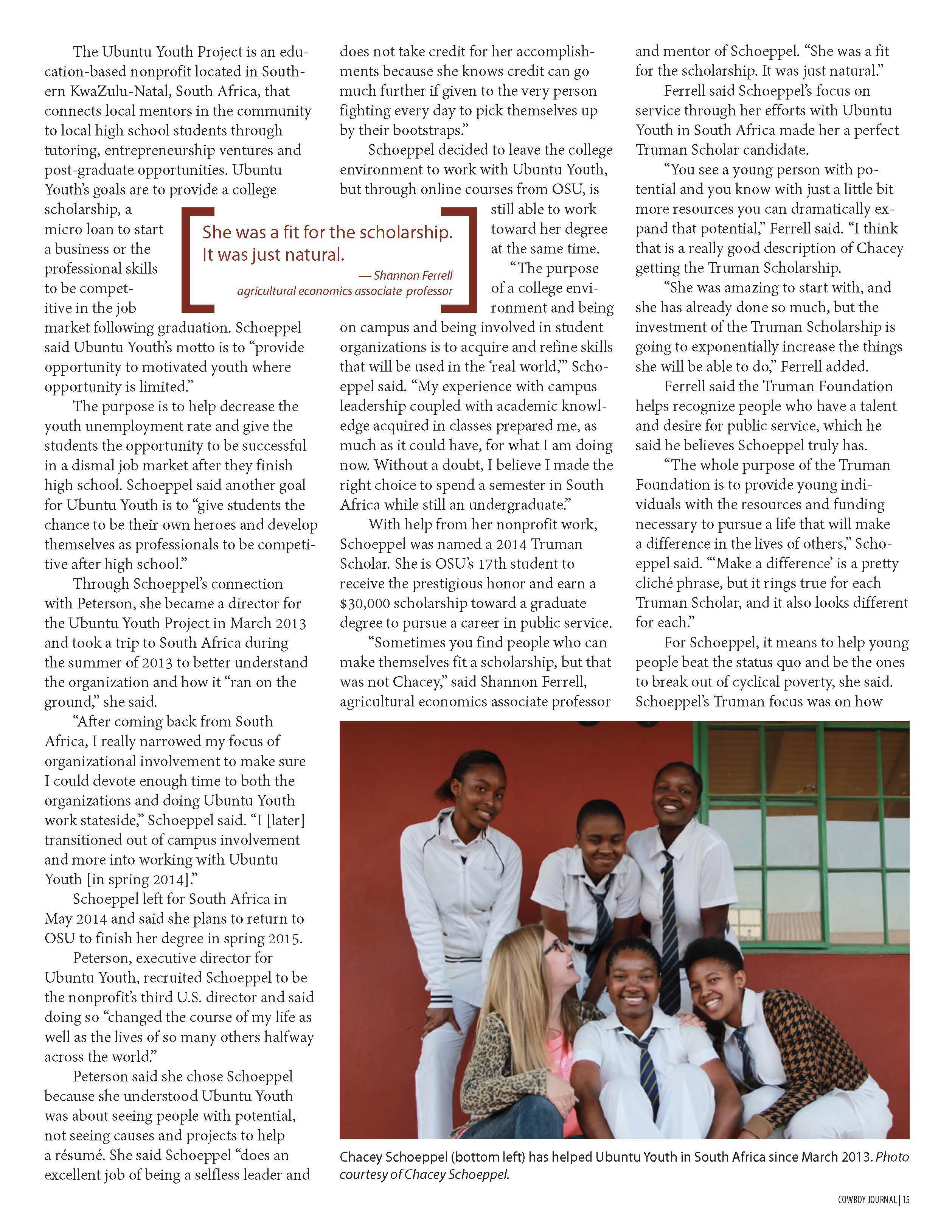
Chacey Schoeppel (bottom left) has helped Ubuntu Youth in South Africa since March 2013. Photo courtesy of ChaceySchoeppel.
TRAVEL THE WORLD.
the United States and the U.S. Agency for International Development need to change their funding structure of developing nations.
"Just giving countries money makes the rich richer and the poor poorer;' Schoeppel said. "The money never actually makes it to the people who need it:'
Schoeppel said she plans to use the scholarship to attend law school, though she said law school could be waiting three years or it could be waiting 10.
Her commitment is to the Ubuntu Youth and helping it become locally sustained by having the local staff completely running the project so the U.S. directors are no longer needed, she said.
"You never know how long [the progress] will take in Africa;' Schoeppel said. "The concept of'time' is extremely different [in South Africa]:' ti]
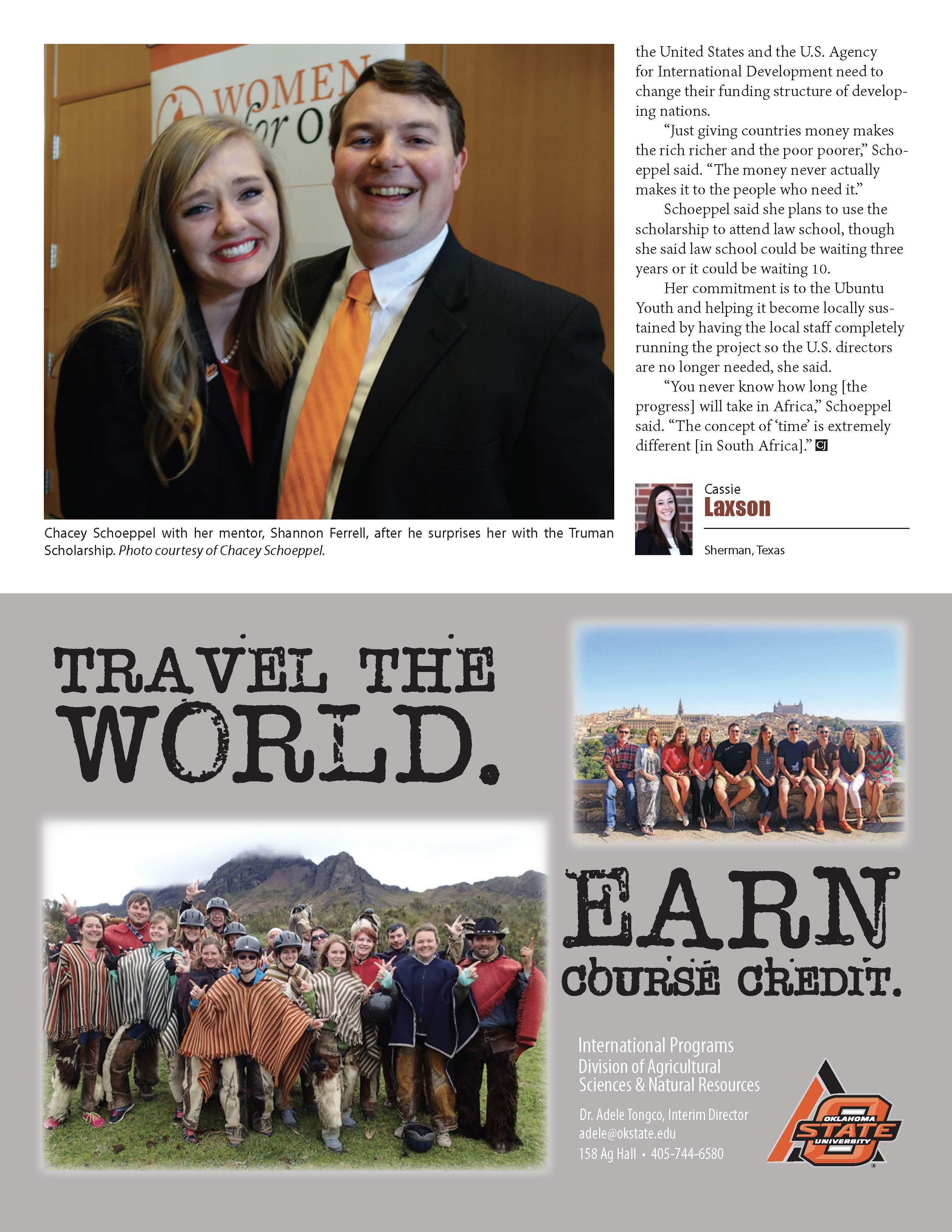
Chacey Schoeppel with her mentor, Shannon Ferrell, after he surprises her with the Truman Scholarship. Photo courtesy of ChaceySchoeppel.
Cassie Laxson
Sherman, Texas
Purpose. Solutions.
OSU'sDASNRwelcomesa new vicepresident,dean and director.
Son. Brother. Paperboy. Farmhand. Athlete. Boy Scout. Scholar. Husband. Father. Professor.
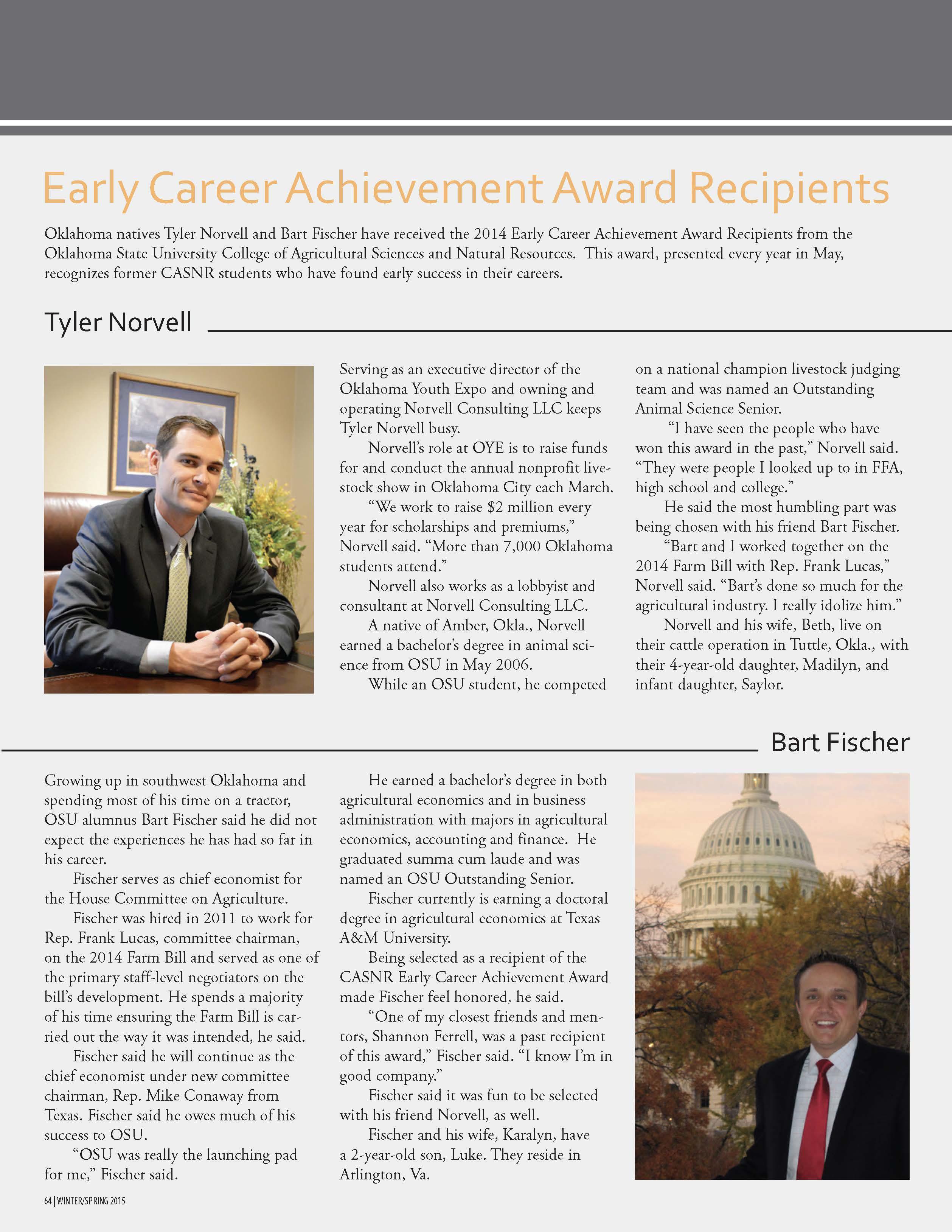
Through the years, Thomas Coon has filled many roles. Most recently, he has taken on a new role as the vice president, dean and director of Oklahoma State University's Division of Agricultural Sciences and Natural Resources.
Coon comes to OSU from a 25-year career at Michigan State University. He brings with him extensive experience and great enthusiasm, said Rob Terry, head of the OSU Department of Agricultural Education, Communications and Leadership. Terry served as a member of the search committee that brought the new hire to Stillwater.
Having grown up in southeast Iowa as the second youngest in a family of six children, Coon attributes much of his personality to his upbringing.
"The fifth child is usually a pretty boring person because you don't get noticed;' Coon said. "I say that jokingly, but it does have a lot to do with who I am.
"I feel fortunate to be from the family I am;' he said.
Coon said his parents are great individuals who taught him and his siblings the value of family time and hard work.
"We had to work, but it was never a burden;' he said.
He delivered newspapers, sold magazine subscriptions, worked as a farmhand, and worked at a butcher shop in his younger years. He also was involved in Boy Scouts and various sports.
Coon's wife, Rhonda, said her husband's childhood activities, experiences
and upbringing undoubtedly contributed to the person he is today.
"I so much admire the work ethic he has;' she said. "I have no doubt it came from his parents. He gives 150 percent in everything he does:'
Rhonda Coon said
Coon said when he was approached about the position again two years later, he felt differently about it. His younger son had just completed high school, so he decided to apply, he said.
"Tom came home and said, 'The time is her husband's passion for his career and his family is unparalleled. She said he is so
He gives 150 percent in everything he does. better now. What do you think?"' his wife said. "We talked quite a bit, and it seemed right. He was so impressed dedicated to each of his endeavors she feels she can barely keep up.
"Even when we first started dating, I couldn't keep up with him as he went from one project to the next;' she said with a laugh. "I gave up on keeping up with him a long time ago:'
The Coons have two grown sons, Charlie and Robbie. Although Coon's career is accompanied by a demanding schedule, his wife said their family has never suffered.
"He was a master at being able to juggle very tough schedules and still be a dad;' Rhonda Coon said. "I don't think our kids ever felt he wasn't there for them:'
Coon gives much of the credit to his wife. He said she took time away from her career in fundraising and alumni work to stay home with their children.
"Rhonda's decision made it easier for me to take on administrative responsibilities;' he said.
However, Coon emphasized the importance he places on family involvement. In fact, he said his younger son was the reason he did not apply initially for the position at OSU when it opened in 2012.
- Rhonda Coon wife of Thomas Coon with everything at Oklahoma State:'
Graduating summa cum laude, Coon earned a Bachelor of Arts in biology from Luther College and both a Master of Science and a doctorate in ecology from the University of California-Davis. Coon said although he originally considered attending medical school, he found his calling in environmental issues.
Before coming to OSU, he taught at Luther College, the University of Missouri and Michigan State. His last position was as director of extension as well as a professor in the MSU Department of Fisheries and Wildlife.
Terry said Coon's background in extension made him stand out.
"Because of his background with cooperative extension, it's exciting to see what his experiences in another state's extension program could bring to ours;' Terry said. "He's very eager to learn about Oklahoma agriculture:'
Coon impressed the committee during the interview process, Terry said. The dean's position is possibly the thirdmost visible academic position in the state
behind the presidents of OSU and the University of Oklahoma, and his presence is seen in every county, making people skills of utmost importance, Terry said.
"He was engaging and dynamic both with the committee and during his seminar;' Terry said. "He clearly meets and interacts with people extremely well, which is a huge part of the job:'
Terry said Coon's natural resources background will benefit the university.
"Agriculture is diversifying;' Terry said. "It's important to begin recognizing other products our state could produce:'
Coon said he hopes to continue the division's excellence in teaching and advising while placing greater emphasis on making DASNR's resources more widely available across the state.
Terry said Coon can help ensure the division serves the people of Oklahoma as it will need to in the future.
'Tm excited about him being here;' Terry said. "It's a positive and exciting time for DASNR:'
Rhonda Coon said she and her husband are excited to be in Oklahoma.
"Tom is very, very happy with his new job;' Rhonda Coon said. "The people of Oklahoma are so warm!"
Coon said DASNR has strong programs in teaching, research and extension.
'Tm thrilled to be affiliated with the division;' he said. Cil
Morgan Hannabass
Indiahoma, Okla.
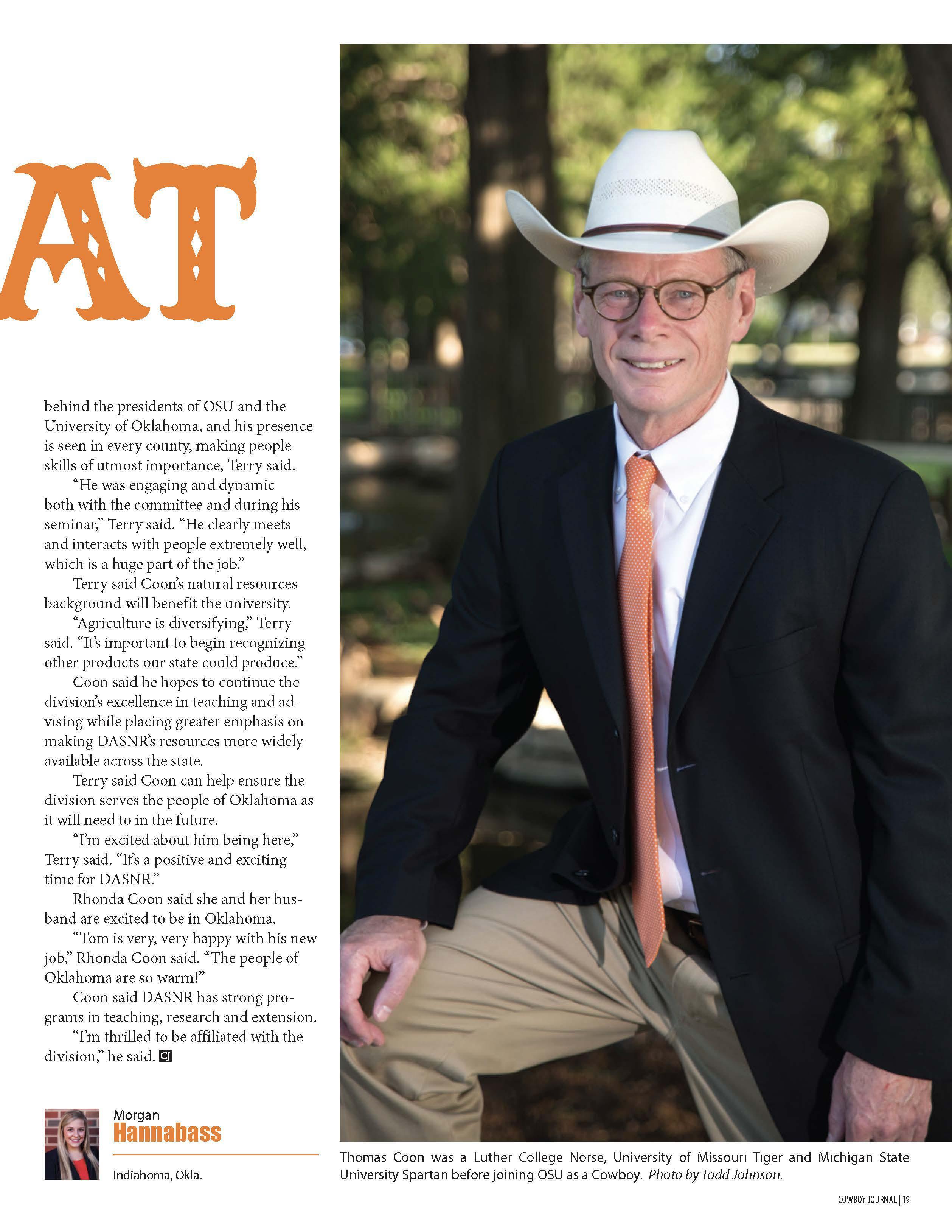
Thomas Coon was a Luther College Norse, University of Missouri Tiger and Michigan State University Spartan before joining OSU as a Cowboy. Photo by Todd Johnson.
A family-owned company usesits CASNRroots to serve its customersand its community.
Snacking on hot, buttery popcorn while shopping for feed, seed, tools or other household items may seem a little strange. However at Ross Seed Co., customers expect the tradition.
The nearly 100-year-old feed, seed and hardware store has given fresh popcorn to customers daily since the 1970s. On Wednesdays, customers enjoy the special treat of caramel popcorn.
"Popcorn is a huge part of Ross Seed;' said Richelle Yost, store employee.
At this hometown hardware store, tradition runs deep.
The Rosses have kept the company in the family since the beginning. Henry Ross established Ross Seed Co. in Chickasha, Okla., in 1918. After returning from World War II and graduating from Oklahoma State University, two of his six children, Joe Ross and Walter Ross, continued to work in the store.
His son Joe Ross stayed in Chickasha, raised his family of 10 children, and operated the store.
However, in 1949, Walter Ross moved to El Reno, Okla., purchased a feed store, and raised a family of four children.
Today, Walter Ross' children, OSU graduates Tom Ross and Julie Ross Martin, own and operate both locations.
"We bleed orange;' Martin said. "OSU gets a lot of our money every year:'
Currently, more than 18 family members have degrees from OSU.
As the tradition of attending OSU
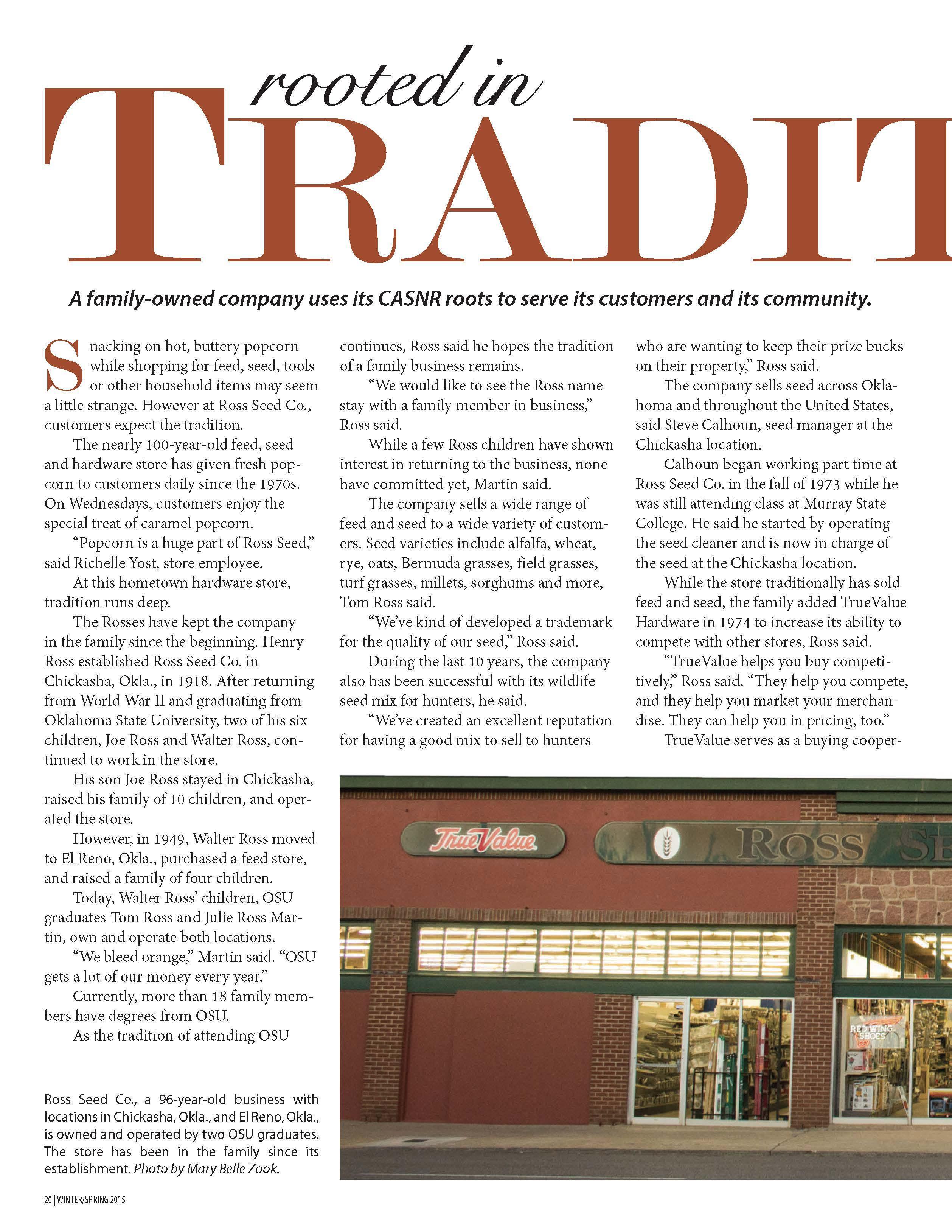
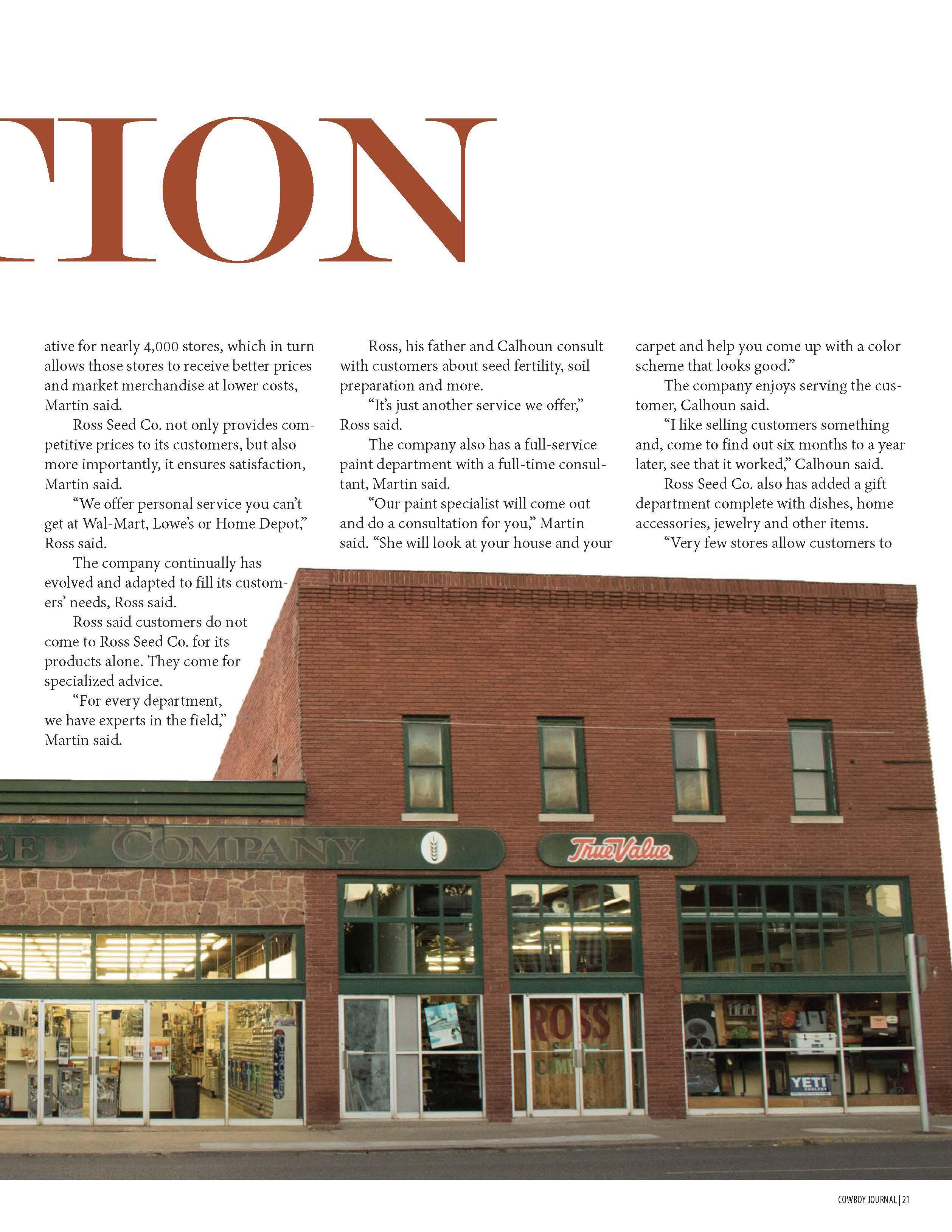
Ross Seed Co., a 96-year-old business with locations in Chickasha, Okla., and El Reno, Okla., is owned and operated by two OSU graduates. The store has been in the family since its establishment. Photo by Mary BelleZook.
continues, Ross said he hopes the tradition of a family business remains.
"We would like to see the Ross name stay with a family member in business;' Ross said.
While a few Ross children have shown interest in returning to the business, none have committed yet, Martin said.
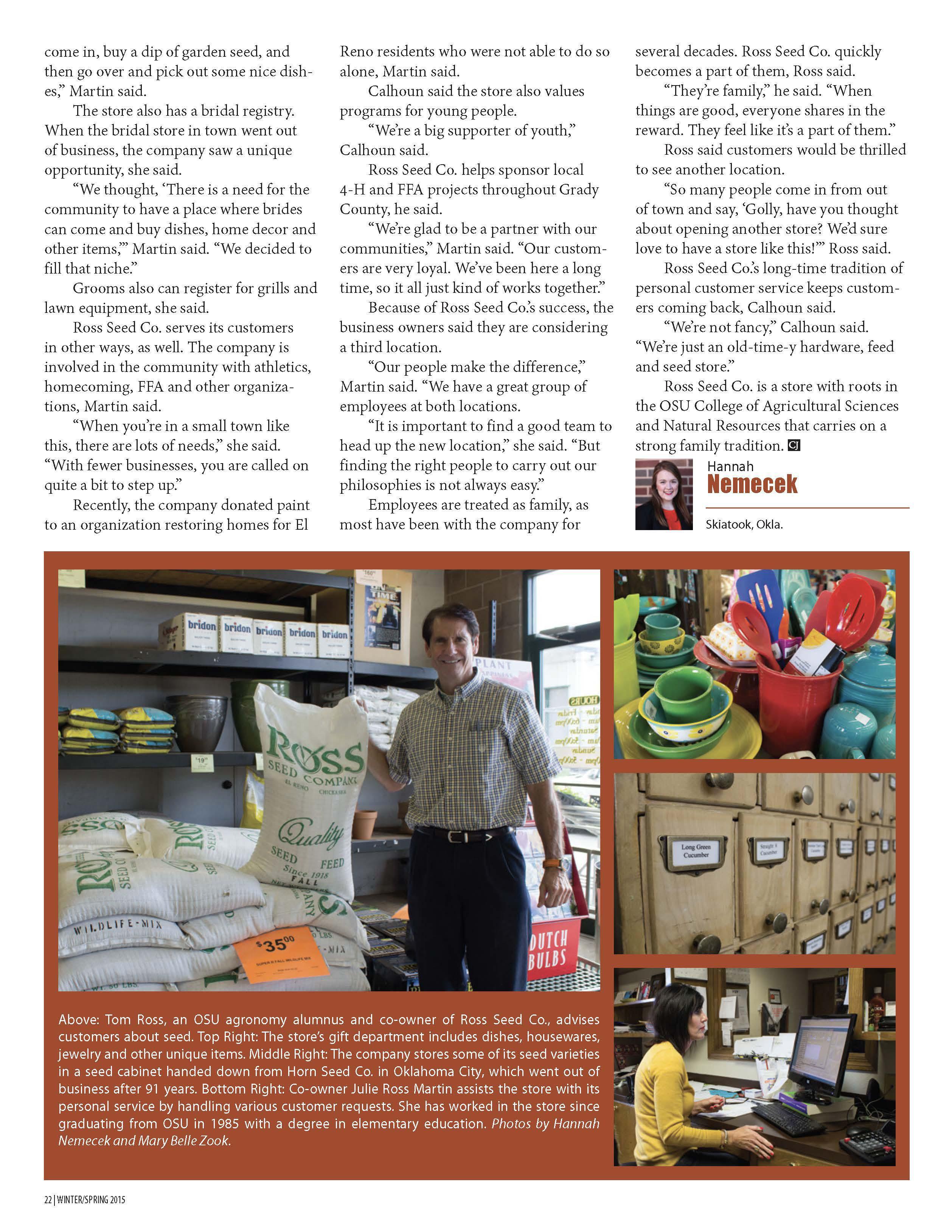
The company sells a wide range of feed and seed to a wide variety of customers. Seed varieties include alfalfa, wheat, rye, oats, Bermuda grasses, field grasses, turf grasses, millets, sorghums and more, Tom Ross said.
"We've kind of developed a trademark for the quality of our seed;' Ross said.
During the last 10 years, the company also has been successful with its wildlife seed mix for hunters, he said.
"We've created an excellent reputation for having a good mix to sell to hunters
who are wanting to keep their prize bucks on their property;' Ross said.
The company sells seed across Oklahoma and throughout the United States, said Steve Calhoun, seed manager at the Chickasha location.
Calhoun began working part time at Ross Seed Co. in the fall of 1973 while he was still attending class at Murray State College. He said he started by operating the seed cleaner and is now in charge of the seed at the Chickasha location.
While the store traditionally has sold feed and seed, the family added True Value Hardware in 1974 to increase its ability to compete with other stores, Ross said.
"True Value helps you buy competitively;' Ross said. "They help you compete, and they help you market your merchandise. They can help you in pricing, too:'
True Value serves as a buying cooper-
ative for nearly 4,000 stores, which in turn allows those stores to receive better prices and market merchandise at lower costs, Martin said.
Ross Seed Co. not only provides competitive prices to its customers, but also more importantly, it ensures satisfaction, Martin said.
"We offer personal service you can't get at Wal-Mart, Lowe's or Home Depot;' Ross said.
The company continually has evolved and adapted to fill its customers' needs, Ross said.
Ross said customers do not come to Ross Seed Co. for its products alone. They come for specialized advice.
"For every department, we have experts in the field;' Martin said.
Ross, his father and Calhoun consult with customers about seed fertility, soil preparation and more.
"It's just another service we offer;' Ross said.
The company also has a full-service paint department with a full-time consultant, Martin said.
"Our paint specialist will come out and do a consultation for you;' Martin said. "She will look at your house and your
carpet and help you come up with a color scheme that looks good:'
The company enjoys serving the customer, Calhoun said.
"I like selling customers something and, come to find out six months to a year later, see that it worked;' Calhoun said.
Ross Seed Co. also has added a gift department complete with dishes, home accessories, jewelry and other items.
"Very few stores allow customers to
come in, buy a dip of garden seed, and then go over and pick out some nice dishes;' Martin said.
The store also has a bridal registry. When the bridal store in town went out of business, the company saw a unique opportunity, she said.
"We thought, 'There is a need for the community to have a place where brides can come and buy dishes, home decor and other items;" Martin said. "We decided to fill that niche:'
Grooms also can register for grills and lawn equipment, she said.
Ross Seed Co. serves its customers in other ways, as well. The company is involved in the community with athletics, homecoming, FFA and other organizations, Martin said.
"When you're in a small town like this, there are lots of needs;' she said. "With fewer businesses, you are called on quite a bit to step up:'
Recently, the company donated paint to an organization restoring homes for El
Reno residents who were not able to do so alone, Martin said.
Calhoun said the store also values programs for young people.
"We're a big supporter of youth;' Calhoun said.
Ross Seed Co. helps sponsor local 4-H and FFA projects throughout Grady County, he said.
"We're glad to be a partner with our communities;' Martin said. "Our customers are very loyal. We've been here a long time, so it all just kind of works together:'
Because of Ross Seed Co:s success, the business owners said they are considering a third location.
"Our people make the difference;' Martin said. "We have a great group of employees at both locations.
"It is important to find a good team to head up the new location;' she said. "But finding the right people to carry out our philosophies is not always easy:'
Employees are treated as family, as most have been with the company for
several decades. Ross Seed Co. quickly becomes a part of them, Ross said.
"They're family;' he said. "When things are good, everyone shares in the reward. They feel like it's a part of them:'
Ross said customers would be thrilled to see another location.
"So many people come in from out of town and say, 'Golly, have you thought about opening another store? We'd sure love to have a store like this!"' Ross said.
Ross Seed Co:s long-time tradition of personal customer service keeps customers coming back, Calhoun said.
"We're not fancy;' Calhoun said. "We're just an old-time-y hardware, feed and seed store:'
Ross Seed Co. is a store with roots in the OSU College of Agricultural Sciences and Natural Resources that carries on a strong family tradition. Ci]
Hannah Nemecek
Skiatook, Okla.
from Boise City to Altus and everywhere in between, more than 5.5 million acres of wheat grow in western Oklahoma each year, according to the U.S. Department of Agriculture.
To serve this vital industry, Oklahoma State University's wheat improvement team strives to improve Oklahoma's wheat by breeding and testing thousands of wheat experimentals, said Jeff Edwards, small grain extension specialist. The team is led by Brett Carver, Regents' professor of wheat breeding and genetics.
OSU usually releases one new wheat variety per year, said Mark Hodges, Oklahoma Genetics executive director.
Two wheat varieties OSU developed and released, Duster and Endurance, make up almost one-third of total wheat planted in Oklahoma, Edwards said.
He said the next OSU wheat variety will celebrate the centennial year of the Oklahoma Cooperative Extension Service.
"OSU has had one of the largest and most extensive celebrations of any cooperative extension program;' Edwards said.
Along with an old-fashioned field day and train rides at Wellston, Okla., last spring and centennial half-time recognition during an OSU football game, the centennial committee decided to name a wheat variety in honor of the centennial celebration, Edwards said.
"We wanted to do something that would bring light to the anniversary and make it more widely known;' Carver said. "What better way to do that than name a wheat variety, which could possibly be planted on millions of acres in Oklahoma, to be a connection to that celebration?"
Edwards said the new variety, to be named Bentley [see sidebar on right], has not been released yet because it needs another year of testing.
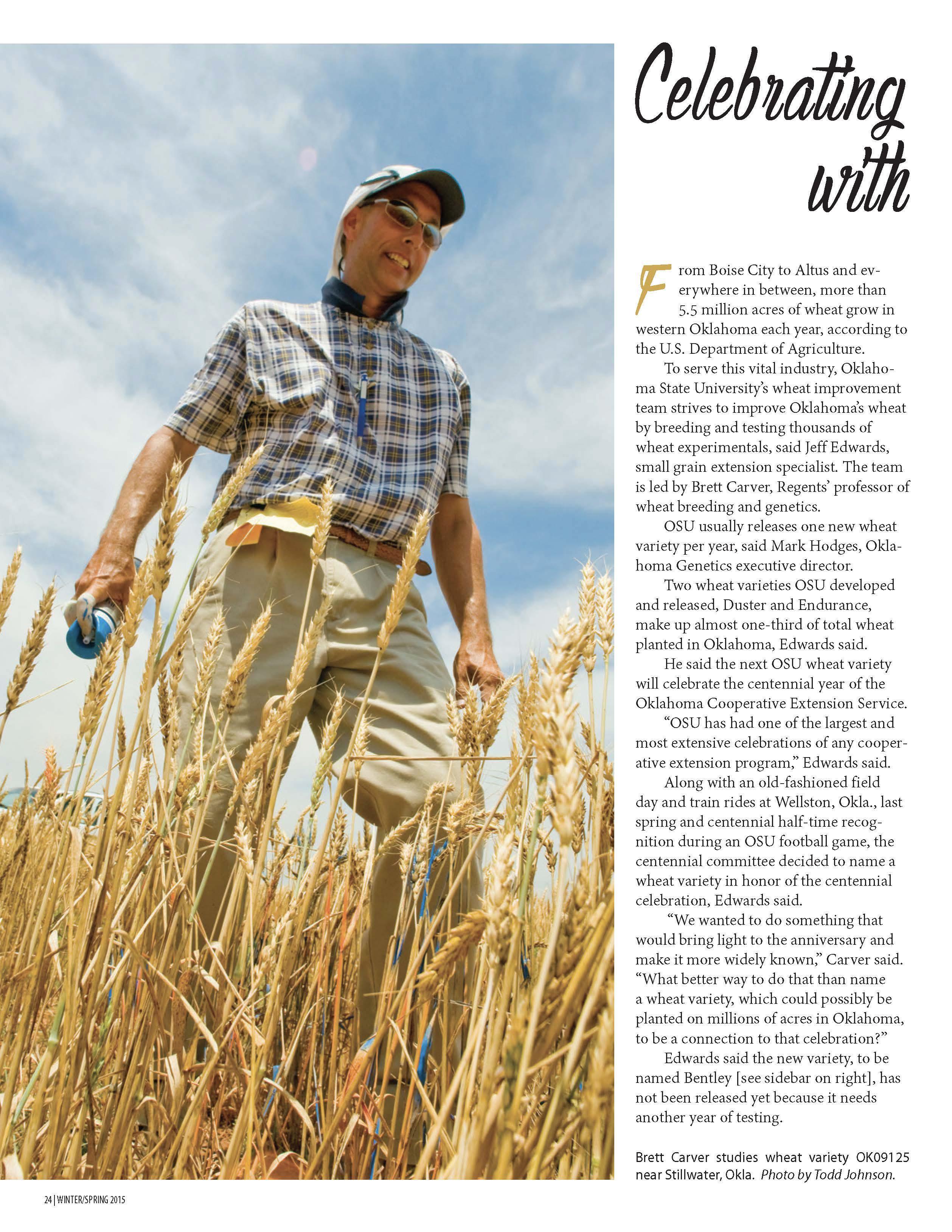
Brett Carver studies wheat variety OK09125 near Stillwater, Okla. Photo by Todd Johnson.
OSU celebrates the centennial year of OCES with a new wheat variety.
"We had some good [variety] candidates, but last year was not the best year to evaluate those;' Edwards said.
Carver said differences in wheat become compressed in drought conditions and it becomes difficult to see which variety excels above the rest. The next year of testing will compare the wheat varieties to each other in real-world environments, Carver said.
Edwards said testing includes measuring grain yield, forage yield and tolerance to grazing and low soil pH. He said resistance to insects, resistance to numerous diseases and viruses, tolerance to shattering, milling and baking characteristics, and winter hardiness also are tested.
"A variety doesn't have to be a stand out in all areas;' Edwards said, "but if it has some of those traits, and doesn't have a critical trait, like tolerance to shattering, it is going to get cut:'
Carver said approximately 30 test-plot stations, each about three or four acres, are in western Oklahoma. The team tests wheat at nine main stations, and the OCES conducts trials at about 20 stations.
Each station has thousands of 40-square-foot test plots on each acre, and the wheat improvement team collects data on each test plot to total 300,000 data points per variety released, he said.
Edwards said a wheat variety trial and testing program takes 12 years before it gets released. The last five years is when
wheat is tested in the field in addition to the laboratory, Carver said.
"You hope to see every possible environmental condition Oklahoma can throw at you;' Carver said.
In perfect circumstances, the next variety to be released would be well adapted to western Oklahoma's drought situations, Edwards said.
"We have varieties that are more drought-resistant than others;' Edwards said. "A drought-tolerant variety might make 17 to 20 bushels per acre. That is still not a great yield, but in a drought year, every bushel counts:'
Don Scheiber, Oklahoma Wheat Commission board of directors chairman and wheat farmer from Ponca City, Okla., said a more drought-resistant variety would benefit him immensely.
"Last year, I had one of the best yields I ever had;' Scheiber said. "This year, I had one of the worst:'
He said his yield was reduced by 90 percent in 2014.
"My grandpa always told me, 'Tell me what the weather is going to be, and I'll tell you how to farm;" he said. "That is still true today. We do the best we can to produce good yields, but if the weather doesn't cooperate, we won't get anything:'
Edwards said the wheat improvement team does its best to anticipate weather conditions. The challenges for the next 1O years are hard to predict, he said.
Carver said one experimental line that could be released as Bentley is OK09125, which has done well under the unexpected April freezes Oklahoma has experienced the last several years.
"A freeze in April can be catastrophic to our crop;' Carver said. "This line has performed well under those conditions:'
He said OK09125 surpassed other varieties in the freeze events Oklahomans have experienced in the last 1O years.
OSU anticipates to release Bentley in 2015, Carver said.
Wheat varieties are licensed to farmers and agriculturist groups, like Oklahoma Genetics, when released to allow them to plant the new variety. OSU's wheat varieties are in high demand when released, Hodges said.
"These wheat varieties are superior and highly adaptable, not only to Oklahoma, but also to surrounding states;' Hodges added.
Carver said OCES is the team's biggest asset in making a new wheat variety known to producers.
"The cooperative extension service gets that message out;' Carver said. "We want to continue to rely on that because it is very effective and highly trustworthy:' Cil
Kristal Williams Fitzhugh, Okla.
When trying to create a name for the new wheat variety, the Oklahoma Cooperative Extension Service centennial committee created a contest, and Oklahoma State University employees were asked to submit wheat name ideas.
Jeff Edwards, small grain extension specialist, said 561 suggestions were submitted. Brian Arnall, Todd Baughman and Andrea Graves nominated Bentley, named after W.D. Bentley, who was the first cooperative extension agent in Oklahoma, Edwards said.
Brett Carver, OSU Regents' professor of wheat breeding and genetics announced the new name to farmers at the annual Oklahoma Crop Improvement Association meeting in February, said Don Scheiber, Oklahoma Wheat Commission board of directors chairman.
"[W.D. Bentley] is the guy who got extension started in this state;' Carver said. "He is the one we are going to honor and celebrate with this wheat variety:'
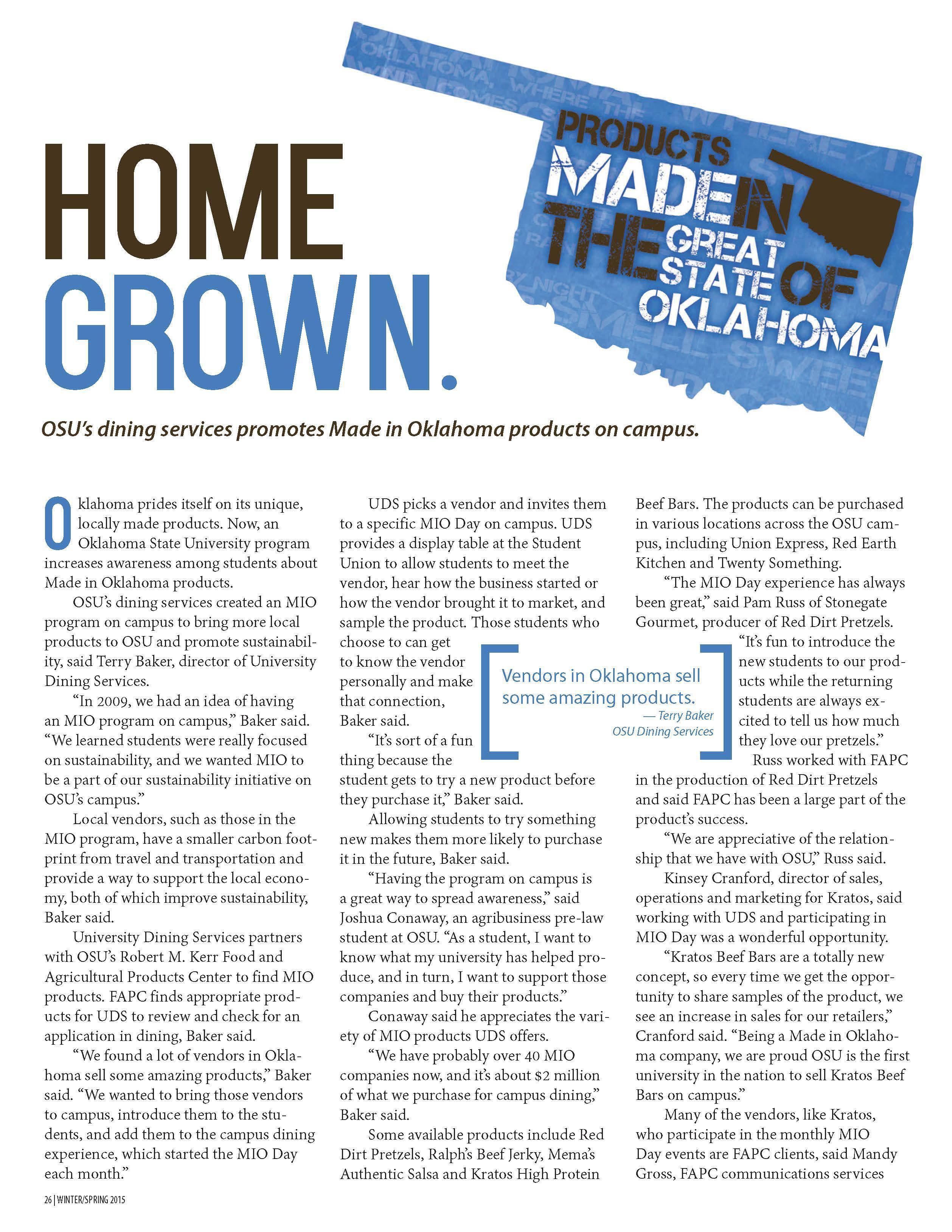
OSU'sdining servicespromotes Made in Oklahoma products on campus.
0klahoma prides itself on its unique, locally made products. Now, an Oklahoma State University program increases awareness among students about Made in Oklahoma products.
OSU's dining services created an MIO program on campus to bring more local products to OSU and promote sustainability, said Terry Baker, director of University Dining Services.
"In 2009, we had an idea of having an MIO program on campus;' Baker said. "We learned students were really focused on sustainability, and we wanted MIO to be a part of our sustainability initiative on OSU's campus:'
Local vendors, such as those in the MIO program, have a smaller carbon footprint from travel and transportation and provide a way to support the local economy, both of which improve sustainability, Baker said.
University Dining Services partners with OSU's Robert M. Kerr Food and Agricultural Products Center to find MIO products. FAPC finds appropriate products for UDS to review and check for an application in dining, Baker said.
"We found a lot of vendors in Oklahoma sell some amazing products;' Baker said. "We wanted to bring those vendors to campus, introduce them to the students, and add them to the campus dining experience, which started the MIO Day each month:'
UDS picks a vendor and invites them to a specific MIO Day on campus. UDS provides a display table at the Student Union to allow students to meet the vendor, hear how the business started or how the vendor brought it to market, and sample the product. Those students who choose to can get
Beef Bars. The products can be purchased in various locations across the OSU campus, including Union Express, Red Earth Kitchen and Twenty Something.
"The MIO Day experience has always been great;' said Pam Russ of Stonegate Gourmet, producer of Red Dirt Pretzels. "It's fun to introduce the
Vendorsin Oklahoma sell to know the vendor personally and make that connection, Baker said.
some amazing products.
"It's sort of a fun thing because the student gets to try a new product before they purchase it;' Baker said.
Allowing students to try something new makes them more likely to purchase it in the future, Baker said.
"Having the program on campus is a great way to spread awareness;' said Joshua Conaway, an agribusiness pre-law student at OSU. "As a student, I want to know what my university has helped produce, and in turn, I want to support those companies and buy their products:'
Conaway said he appreciates the variety of MIO products UDS offers.
"We have probably over 40 MIO companies now, and it's about $2 million of what we purchase for campus dining;' Baker said.
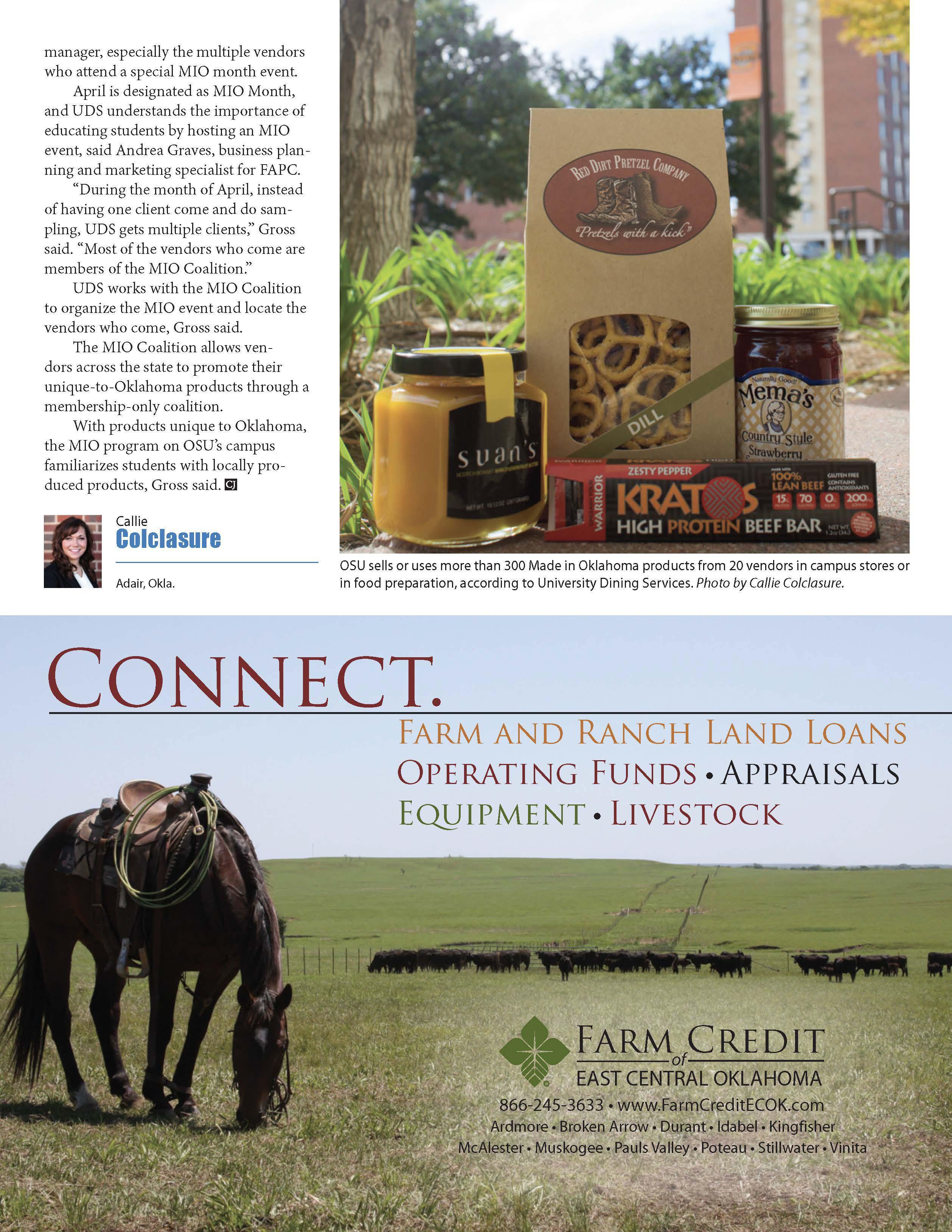
Some available products include Red Dirt Pretzels, Ralph's BeefJerky, Merna's Authentic Salsa and Kratos High Protein
- TerryBaker OSUDining Services
new students to our products while the returning students are always excited to tell us how much they love our pretzels:'
Russ worked with FAPC in the production of Red Dirt Pretzels and said FAPC has been a large part of the product's success.
"We are appreciative of the relationship that we have with osu;' Russ said.
Kinsey Cranford, director of sales, operations and marketing for Kratos, said working with UDS and participating in MIO Day was a wonderful opportunity.
"Kratos Beef Bars are a totally new concept, so every time we get the opportunity to share samples of the product, we see an increase in sales for our retailers;' Cranford said. "Being a Made in Oklahoma company, we are proud OSU is the first university in the nation to sell Kratos Beef Bars on campus:'
Many of the vendors, like Kratos, who participate in the monthly MIO Day events are FAPC clients, said Mandy Gross, FAPC communications services
manager, especially the multiple vendors who attend a special MIO month event.
April is designated as MIO Month, and UDS understands the importance of educating students by hosting an MIO event, said Andrea Graves, business planning and marketing specialist for FAPC.
"During the month of April, instead of having one client come and do sampling, UDS gets multiple clients;' Gross said. "Most of the vendors who come are members of the MIO Coalition:'
UDS works with the MIO Coalition to organize the MIO event and locate the vendors who come, Gross said.
The MIO Coalition allows vendors across the state to promote their unique-to-Oklahoma products through a membership-only coalition.
With products unique to Oklahoma, the MIO program on OSU's campus familiarizes students with locally produced products, Gross said. ril
Callie Colclasure
Adair, Okla.
OSU sells or uses more than 300 Made in Oklahoma products from 20 vendors in campus stores or in food preparation, according to University Dining Services. Photo by Callie Colclasure.
NEXTGENERATIONFARMER.
The days of the almanac have transpired into computer technology in the palm of a farmer's hand.
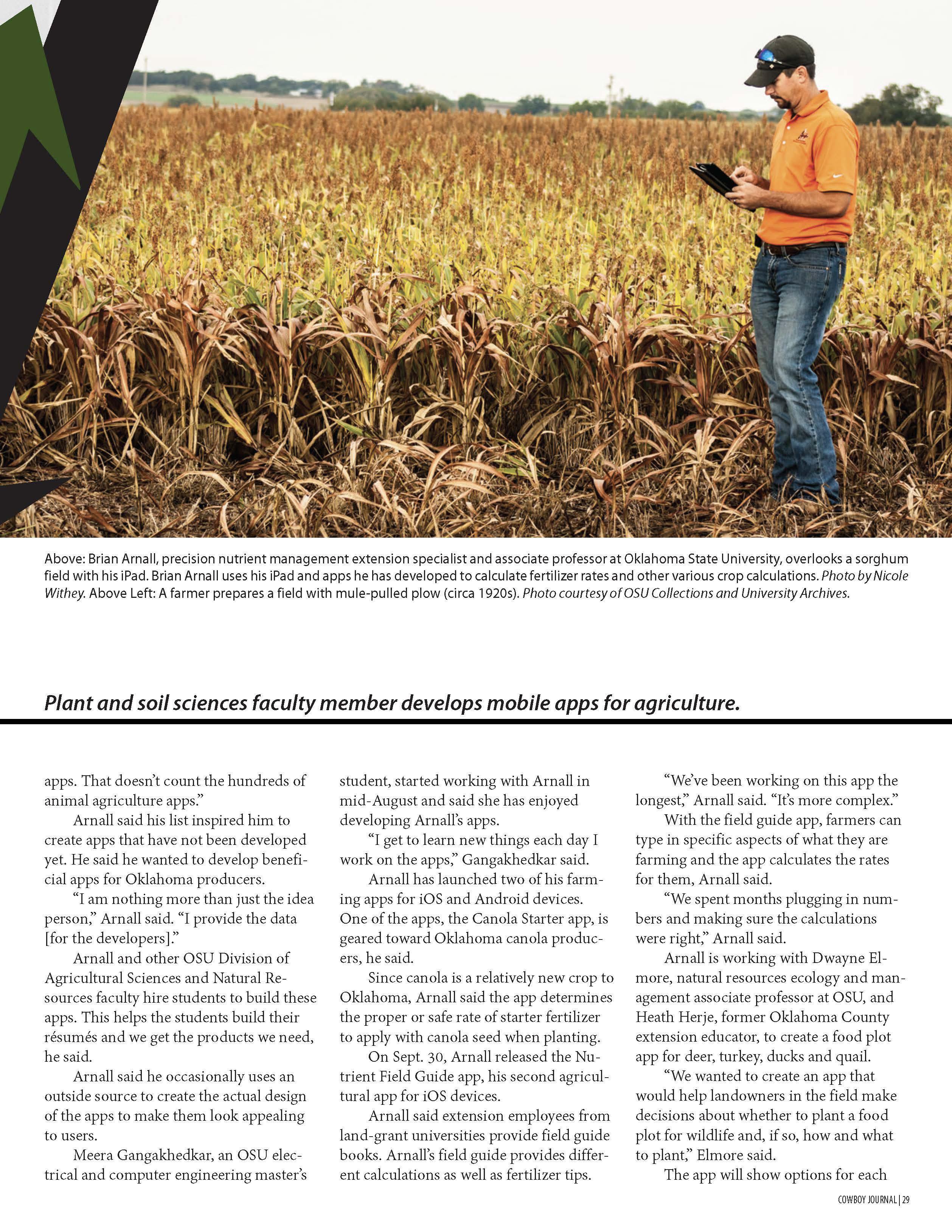
Today, smartphones and tablets are commonplace in agriculture, said Brian Arnall, precision nutrient management extension specialist and associate professor at Oklahoma State University.
He has developed specialized iOS and Android mobile apps to help make farmers more efficient.
"Mobile apps are important because tablets are the future of agriculture;' Arnall said.
For years, Arnall has used electronic technology in the field to help producers, but the expense of acquiring or replacing such equipment prevented some farmers from using the technology, he said.
The apps he has created and other farming apps are free to download on
the iTunes App Store or from the Google Store. These apps collect data more efficiently than older devices, he said.
"In general, producers can purchase an operating device as inexpensively as $200;' Arnall said. "That makes it easier to get one or to replace it when needed:'
Arnall said one of the nice aspects of apps, especially in Oklahoma, is you can use them anywhere.
"Most app calculators are internal on a tablet so they don't need connectivity to the Internet;' Arnall said. "You can go anywhere, to the lowest hollow or the highest point, and be able to access what you need on the app:'
Arnall said individuals, including farmers, of all ages use smartphone and tablet apps.
"One of my best mobile app researchers is a 65-year-old farmer who calls me
when he finds an app he likes;' Arnall said.
Arnall started researching mobile apps for agriculture in March 2013 when a friend of his asked if he would talk about agricultural apps at the Info Ag Conference in June 2013 in Springfield, Ill.
Precision agriculture researchers and agribusiness innovators gather at the Info Ag Conference annually to discuss new opportunities and technologies in precision agriculture.
"I only had two or three agricultural apps on my iPad at the time;' Arnall said.
After researching the different agricultural apps, Arnall said his presentation became an editor's pick of about 55 different agricultural apps he discovered during his research.
"I have gone from having 55 apps in my presentation to 202 apps;' Arnall said. "That list is only cereal, fiber and grain
Plant and soil sciencesfaculty member developsmobile apps for agriculture.
apps. That doesn't count the hundreds of animal agriculture apps:'
Arnall said his list inspired him to create apps that have not been developed yet. He said he wanted to develop beneficial apps for Oklahoma producers.
"I am nothing more than just the idea person;' Arnall said. "I provide the data [for the developers]:'
Arnall and other OSU Division of Agricultural Sciences and Natural Resources faculty hire students to build these apps. This helps the students build their resumes and we get the products we need, he said.
Arnall said he occasionally uses an outside source to create the actual design of the apps to make them look appealing to users.
Meera Gangakhedkar, an OSU electrical and computer engineering master's
student, started working with Arnall in mid-August and said she has enjoyed developing Arnall's apps.
"I get to learn new things each day I work on the apps;' Gangakhedkar said.
Arnall has launched two of his farming apps for iOS and Android devices. One of the apps, the Canola Starter app, is geared toward Oklahoma canola producers, he said.
Since canola is a relatively new crop to Oklahoma, Arnall said the app determines the proper or safe rate of starter fertilizer to apply with canola seed when planting.
On Sept. 30, Arnall released the Nutrient Field Guide app, his second agricultural app for iOS devices.
Arnall said extension employees from land-grant universities provide field guide books. Arnall's field guide provides different calculations as well as fertilizer tips.
"We've been working on this app the longest;' Arnall said. "It's more complex:'
With the field guide app, farmers can type in specific aspects of what they are farming and the app calculates the rates for them, Arnall said.
"We spent months plugging in numbers and making sure the calculations were right;' Arnall said.
Arnall is working with Dwayne Elmore, natural resources ecology and management associate professor at OSU, and Heath Herje, former Oklahoma County extension educator, to create a food plot app for deer, turkey, ducks and quail.
"We wanted to create an app that would help landowners in the field make decisions about whether to plant a food plot for wildlife and, if so, how and what to plant;' Elmore said.
The app will show options for each
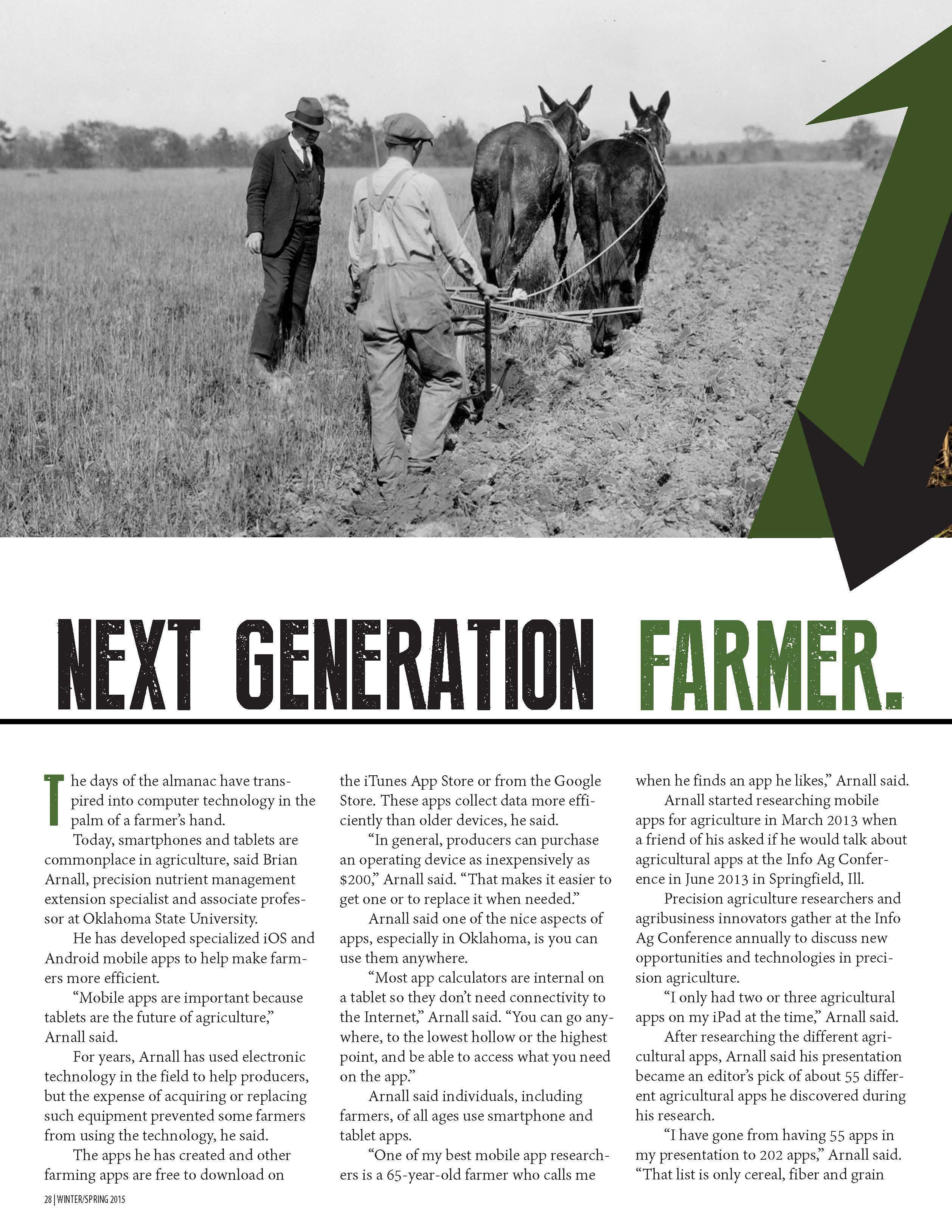
Above: Brian Arnall, precision nutrient management extension specialist and associate professor at Oklahoma State University, overlooks a sorghum field with his iPad. Brian Arnall uses his iPad and apps he has developed to calculate fertilizer rates and other various crop calculations. Photo by Nicole Withey. Above Left: A farmer prepares a field with mule-pulled plow (circa 1920s). Photo courtesyofOSU Collections and University Archives.
wildlife species as well as information about the plant, such as planting dates and rates, Elmore said.
Arnall said they used an off-campus business to create the app's layout and design but students wrote the iOS and Android code for the app.
The wildlife app will let the user pick a specific animal and season to plant the feed plots. The app will suggest what plants and soil conditions to use, given the specific criteria. Arnall said this app provides tips on how to plant the food plot and what nutrients to use. He said he would like to have the food plot app available by spring 2015.
Arnall said he plans to continue creating and researching different apps to help farmers do their job more efficiently.
Arnall said mobile apps for agriculture are convenient and user friendly, making it easy for producers to get answers at their fingertips. til
Nicole Withev
Stillwater, Okla.
Brian Arnall, OSU precision nutrient management extension specialist and associate professor, uses his iPad for various farming apps to make farming more efficient. Photo by Nicole Withey.
A Picture r Worth Exp
Students and faculty capture beauty in studying abroad.
Some students dream of the day they will step off a plane onto different soil to study another culture.
For Oklahoma State University College of Agricultural Sciences and Natural Resources students, this dream can become a reality.
"Last year, there were 11 faculty-led study-abroad trips through CASNR;' said Katy Kemp, CASNR study-abroad graduate assistant.
The 2013-14 trips included Spain, Australia and New Zealand, Ireland, Italy, Czech Republic and Central Europe, Guatemala, the United Kingdom, Brazil, Taiwan, Japan and China, and South Africa and Uganda.
Kemp said learning about another culture, especially its agricultural practices, is the best part of traveling abroad.
"The CASNR trips are more agriculturally based;' she said.
On average, 10 to 20 students attend each trip. The trips allow students to earn three credit hours.
"The average length for CASNR faculty-led study-abroad trips is two weeks;' Kemp said.
McCandren Lewis, an animal science junior who traveled to Czech Republic, said multiple benefits exist from going on a study-abroad trip.
"I chose to go to the Czech Republic because I learned that traveling abroad can
potentially help you land a better job;' she said. "I also was intrigued by the fact that I would be about 5,000 miles from home in a new environment:'
Lewis said during the two weeks the group was abroad, she learned not only about the culture but also gained a deeper understanding about herself.
"Being away from everything and everyone you are familiar with is hard;' she said. "It allowed me to open my eyes and see what the world has to offer:'
Joe Schatzer, an agricultural economics professor who led a trip to Scotland and England, said students traveling abroad experience a new culture that allows them to gain an appreciation for things that may be different or similar to what they are used to at home.
"Students figure out that they can travel internationally with the proper planning and gain a whole new outlook on the world around them;' Schatzer said.
Kemp said the price of each trip varies based on the location.
Lewis said her trip to the Czech Republic cost around $3,000, including tuition, airfare, lodging and meals.
"Some destinations require more travel and that increases the cost, but CASNR offers several study-abroad courses in different price ranges;' Kemp said.
"There are many different ways to get financial help, including scholarships
offered through the college as well as the university;' she said.
The College of Agricultural Sciences and Natural Resources Study-abroad Scholarship is offered each year to undergraduate students. The scholarship varies in amount depending on how many students apply for it, Kemp said. Students must be enrolled in a CASNR studyabroad trip to apply for the scholarship.
Kemp said obtaining a student loan to pay for the trip is common.
"A student loan for a study-abroad trip is a smaller loan and can be seen as an investment of international exposure for future job applications;' she said.
Kemp said the CASNR international programs office is planning trips for spring 2015 to Ecuador, Argentina, New Zealand and Europe.
Lewis said she is saving money to go on another study-abroad trip before she graduates next May. Cil
Brooke Powell Guthrie, Okla.
To celebrate the study-abroad program, the Cowboy Journal collected photos provided by students and faculty who traveled on CASNR study-abroad trips in 2014. For information about studying abroad, visit internationalagprograms.okstate.edu.
A
A
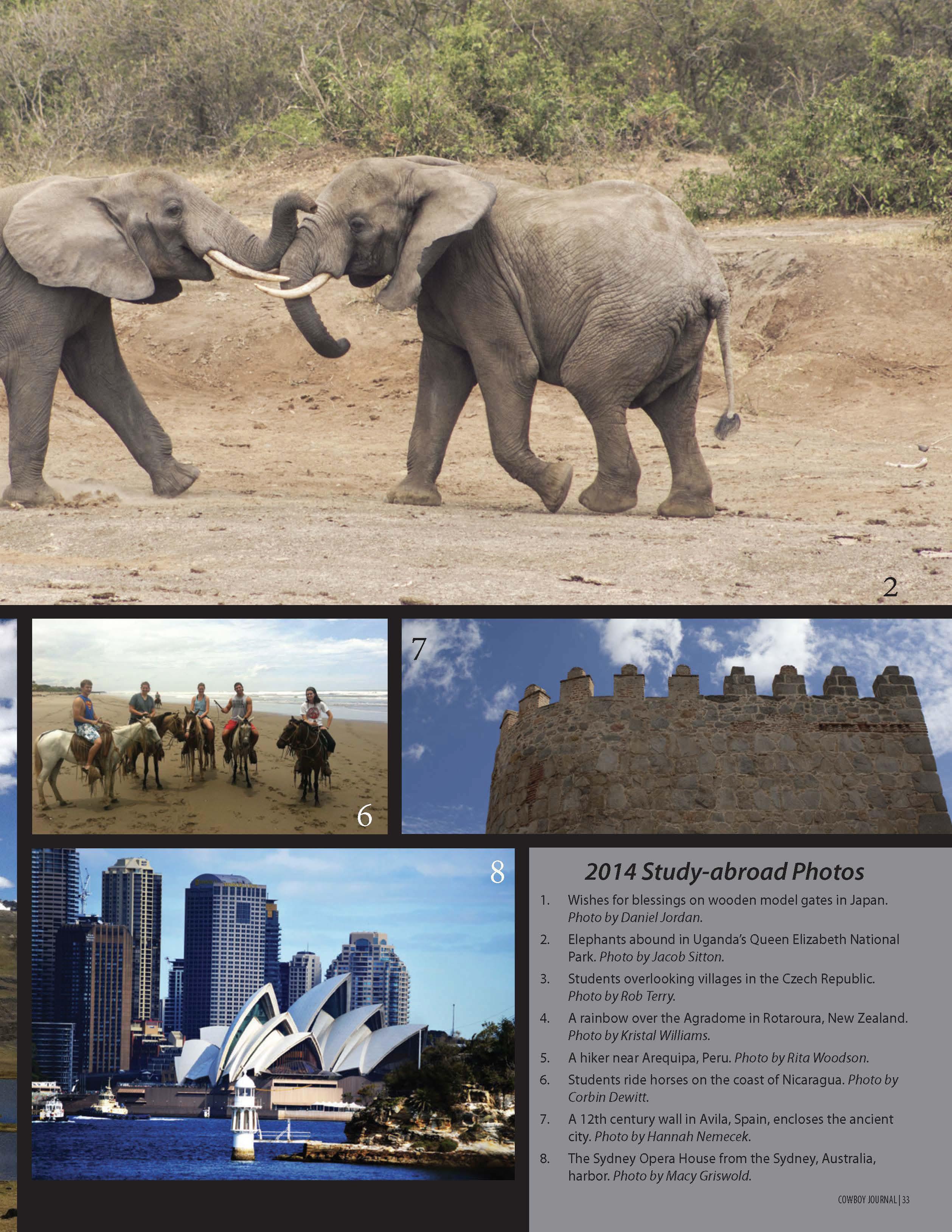
2014 Study-abroad Photos
1. Wishes for blessings on wooden model gates in Japan.
Photo by Daniel Jordan.
2. Elephants abound in Uganda's Queen Elizabeth National Park. Photo by Jacob Sitton.
3. Students overlooking villages in the Czech Republic. Photo by Rob Terry.
rainbow over the Agradome in Rotaroura, New Zealand. Photo by Kristal Williams.
hiker near Arequipa, Peru. Photo by Rita Woodson. Students ride horses on the coast of Nicaragua. Photo by Corbin Dewitt.
A 12th century wall in Avila, Spain, encloses the ancient city. Photo by Hannah Nemecek.
The Sydney Opera House from the Sydney, Australia, harbor. Photo by Macy Griswold.
AMERICA'S PIG FARMERS ARE t/!Jillllt-
Pig farmers are on a mission. They are dedicated to producing safe, high-quality pork on their farms. With a legacy of using responsible practices and a commitment to ongoing improvement, pig farmers produce a high-quality product that is distributed to consumers. When it comes to responsible farming, nobody cares more about the environment, animal care, food safety and the community than a pig farmer.
OCEScelebrates 100 years of extension with a quilted masterpiece.
s a tradition that has been around for hundreds of years, quilting celebrates special occasions, highlights important times in life, and brings people together for a cause.
A quilt is not just pieces of fabric or colorful designs. It represents the love and precious time someone takes just to show they care.
Oklahoma Cooperative Extension Service supporters came together to create a 12-foot masterpiece quilt to honor a 100-year-old program.
In 2014, OCES celebrated 100 years of serving Oklahomans. To commemorate such an accomplishment, supporters helped create a quilt to honor the program's century of service.
"Quilts have been used to mark milestones in life for hundreds of years;' said Recia Garcia, co-chair of the OCES
centennial committee. "It just made sense to me to be an appropriate project:' Garcia proposed the quilt as one of the ideas to celebrate the program's 100 years of existence.
"People associate quilting with history and the past;' said James Trapp, associate director for OCES. "It's something that our forefathers did and maybe
number of people to display the centennial theme in one picture, Trapp said.
"I learned extension employees get excited to promote extension when they get any opportunity to
Lotsof hands and hearts do it;' Trapp said.
The OCES Centennial Quilt Block Challenge had entries from quilters as young as 12 to the age of 94. OCES sold 170 quilt block kits were engaged in the process. The time and talent they shared was amazing.
- ReciaGarcia OCEScentennial committee co-chair
it's somewhat of a dying art today:' Trapp said he gave the centennial committee two objectives: Create activities to raise exposure and awareness of extension and enhance morale of extension employees by giving them things to get excited about.
The quilt provided a way to get a large
and received 152 entries from 116 people.
With 48 counties in Oklahoma participating as well as entries from Missouri and Texas, the event was a success and raised more than $2,600 for the Oklahoma 4- H Advanced Family Consumer Sciences Scholarship endowment, Garcia said.
"The quilt idea provided a neat link;'
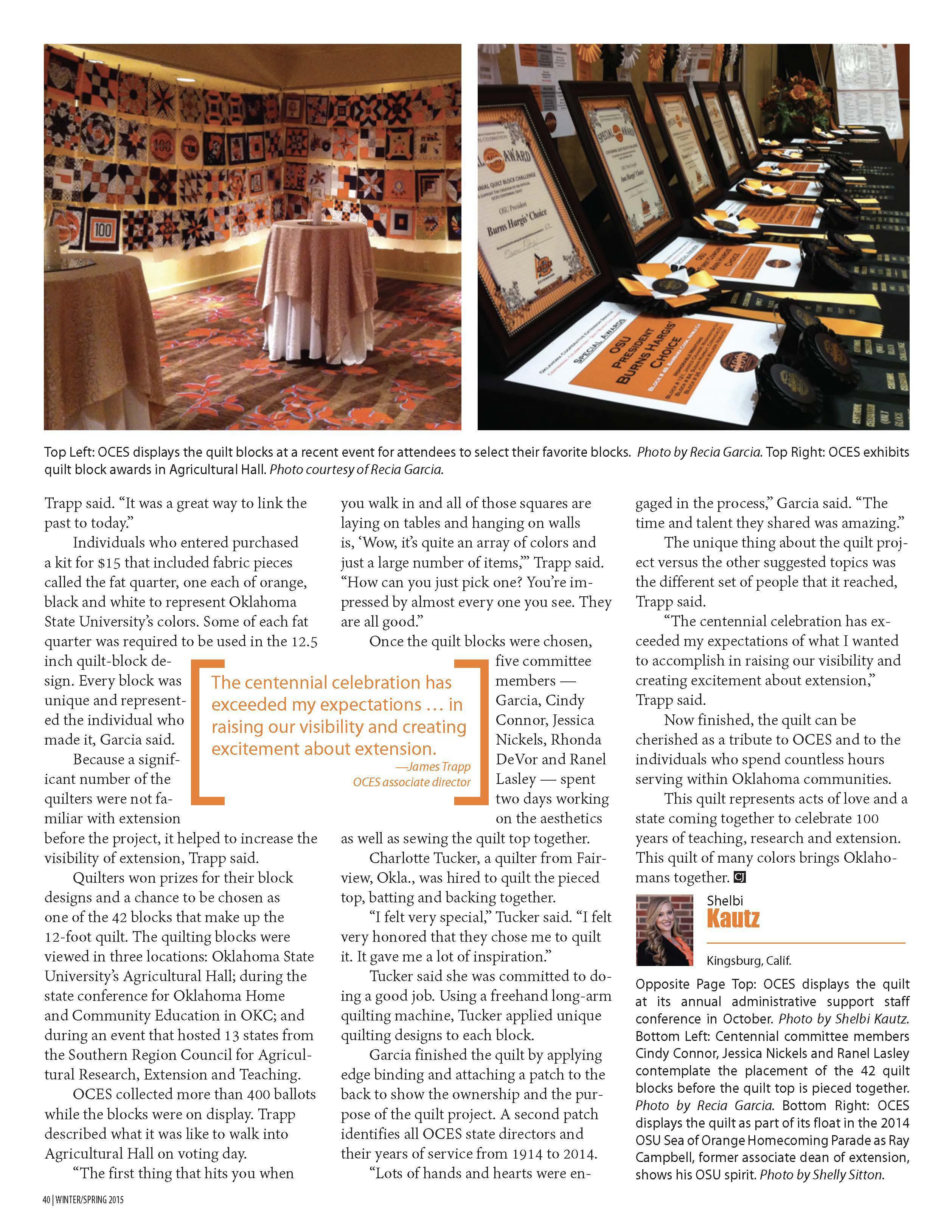
Top Left: OCESdisplays the quilt blocks at a recent event for attendees to select their favorite blocks.
quilt block awards in Agricultural Hall. Photo courtesyofRecia Garcia.
Trapp said. "It was a great way to link the past to today:'
Individuals who entered purchased a kit for $15 that included fabric pieces called the fat quarter, one each of orange, black and white to represent Oklahoma State University's colors. Some of each fat quarter was required to be used in the 12.5
you walk in and all of those squares are laying on tables and hanging on walls is, 'Wow, it's quite an array of colors and just a large number of items;" Trapp said. "How can you just pick one? You're impressed by almost every one you see. They are all good:'
Once the quilt blocks were chosen, five committee inch quilt-block design. Every block was unique and represented the individual who made it, Garcia said.
Because a significant number of the exceeded my expectations ... in raising our visibility and creating excitement about extension.
-James Trapp OCESassociate director
The centennial celebration has membersGarcia, Cindy Connor, Jessica Nickels, Rhonda DeVor and Ranel Lasley - spent two days working
quilters were not familiar with extension before the project, it helped to increase the visibility of extension, Trapp said.
Quilters won prizes for their block designs and a chance to be chosen as one of the 42 blocks that make up the 12-foot quilt. The quilting blocks were viewed in three locations: Oklahoma State University's Agricultural Hall; during the state conference for Oklahoma Home and Community Education in OKC; and during an event that hosted 13 states from the Southern Region Council for Agricultural Research, Extension and Teaching.
OCES collected more than 400 ballots while the blocks were on display. Trapp described what it was like to walk into Agricultural Hall on voting day.
"The first thing that hits you when
on the aesthetics as well as sewing the quilt top together.
Charlotte Tucker, a quilter from Fairview, Okla., was hired to quilt the pieced top, batting and backing together.
"I felt very special;' Tucker said. "I felt very honored that they chose me to quilt it. It gave me a lot of inspiration:'
Tucker said she was committed to doing a good job. Using a freehand long-arm quilting machine, Tucker applied unique quilting designs to each block.
Garcia finished the quilt by applying edge binding and attaching a patch to the back to show the ownership and the purpose of the quilt project. A second patch identifies all OCES state directors and their years of service from 1914 to 2014.
"Lots of hands and hearts were en -
gaged in the process;' Garcia said. "The time and talent they shared was amazing:'
The unique thing about the quilt project versus the other suggested topics was the different set of people that it reached, Trapp said.
"The centennial celebration has exceeded my expectations of what I wanted to accomplish in raising our visibility and creating excitement about extension;' Trapp said.
Now finished, the quilt can be cherished as a tribute to OCES and to the individuals who spend countless hours serving within Oklahoma communities.
This quilt represents acts oflove and a state coming together to celebrate 100 years of teaching, research and extension. This quilt of many colors brings Oklahomans together. Cil
Shelbi Kauu
Kingsburg, Calif.
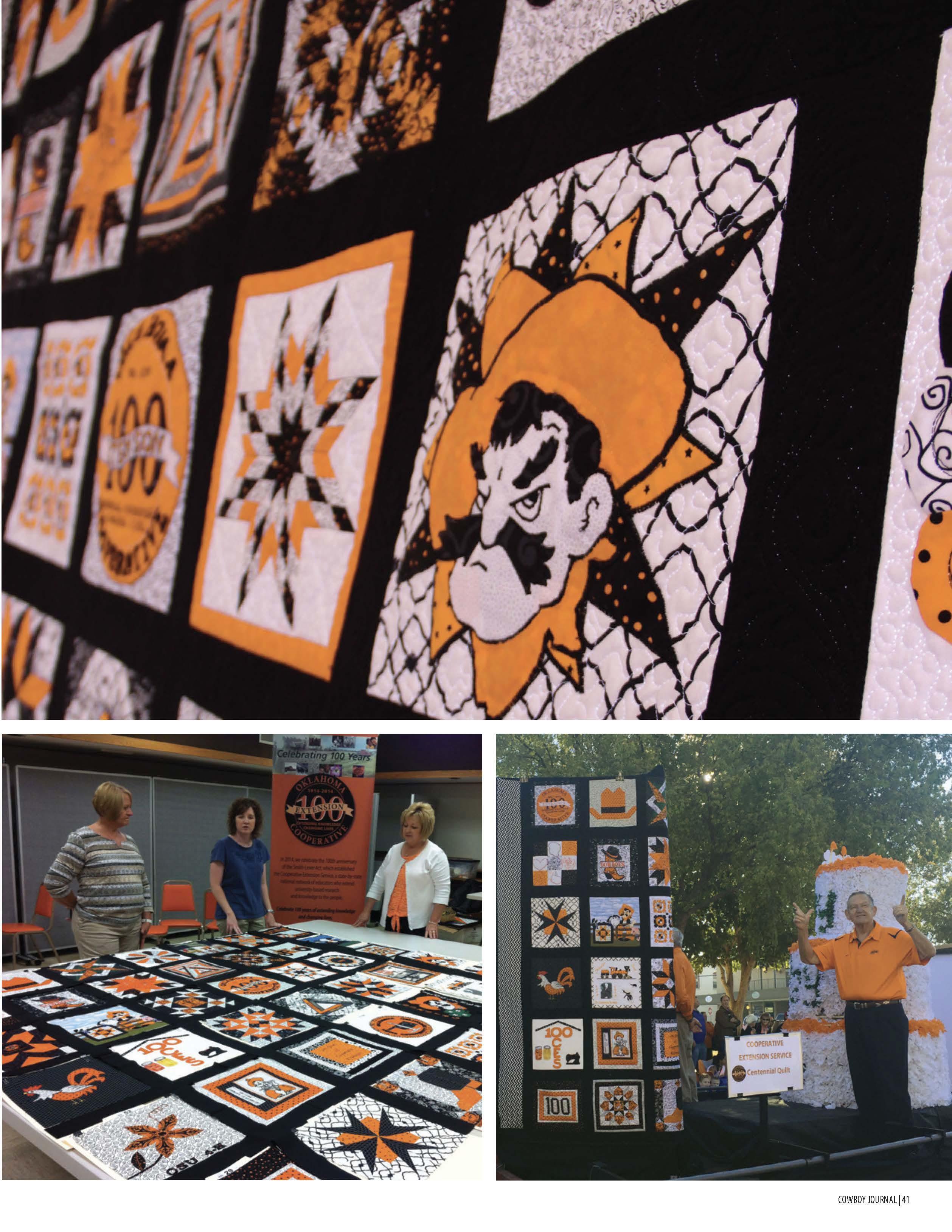
Opposite Page Top: OCES displays the quilt at its annual administrative support staff conference in October. Photo by Shelbi Kautz. Bottom Left: Centennial committee members Cindy Connor, Jessica Nickels and Ranel Lasley contemplate the placement of the 42 quilt blocks before the quilt top is pieced together. Photo by Recia Garcia. Bottom Right: OCES displays the quilt as part of its float in the 2014 OSU Sea of Orange Homecoming Parade as Ray Campbell, former associate dean of extension, shows his OSU spirit. Photo by Shelly Sitton.
Photo by Recia Garcia. Top Right: OCESexhibits
OSUCASNRalumna maintains the historic gardens of Monticello, home of ThomasJefferson.
Por Amy Jeffries, a love of horticulture started in her grandmother's garden. This love led her to Oklahoma State University, and now Jeffries lives out her dream at Monticello, the home of Thomas Jefferson, Jeffries said.
"My dad always told me to find something I love to do and then figure out a way to get paid for it;' said Amy Jeffries, OSU horticulture alumna and superintendent of gardening at Thomas Jefferson's Monticello. "Gardening with my grandmother was the base foundation behind the career path I chose:'
Jeffries said the idea of pursuing a degree in horticulture and landscape architecture was more than just a hobby in high school. It blossomed into a new and exciting passion, she said.
"My second semester of college is when I realized I liked the idea of sharing gardening and plants with other people;' Jeffries said. "So, I switched my concentration to public horticulture:'
Jeffries said Doug Needham, former OSU horticulture professor, influenced her throughout the time she spent at OSU. His class helped her decide she could pursue a career in horticulture, she said.
"Amy was a very sharp student;' said Doug Needham, now head of the education department at Longwood Gardens in Pennsylvania. "She has a great passion for horticulture and public gardens:'
Needham said Jeffries is a great role model for students interested in pursuing a career in horticulture.
While at OSU, she was an active member of the President's Leadership Council and a member of the OSU Symphony Orchestra.
She also designed and maintained gardens at private homes and estates at
the Oklahoma City Zoological Park and Botanic Garden.
Needham encouraged her to pursue an internship with Longwood Gardens to gain some real-world experience and understanding, Jeffries said.
Needham said he felt Jeffries was highly qualified for an internship at Longwood Gardens based on her experience.
"She sought experience and likely that is what set her above the other candidates;' Needham said.
Needham was a Longwood Gardens advocate during his tenure at OSU and during the time Jeffries interned with Longwood Gardens.
As an advocate, he informed students about the great opportunities Longwood Gardens had to offer.
"Horticulture is such a unique field of study and practice, as it touches both the art and science of plants;' Needham said.
Needham said he continues to encourage students to look at the diversity of occupations under horticulture and pursue the one that speaks to their passion and career goals.
"Interning at Longwood Gardens was the stepping stone for a solid foundation that in turn helped me get where I am today;' Jeffries said.
While serving as an intern at Longwood Gardens, Jeffries worked in the outdoor displays.
She was responsible for the maintenance of the display beds, including planting, watering, deadheading, weeding, and changing bed displays as well as some supervision of volunteers, Needham said.
"What I didn't realize is that when you get to the East Coast, Longwood Gardens is a name that people recognize;' Jeffries said. "When you say 'I studied horticulture at Oklahoma State' and 'I did an
internship at Longwood Gardens; it will open doors.
"I completed a really stellar internship at an entry-level position in horticulture and just continued to expand my knowledge;' she said.
Monticello hired Jeffries in 2009 and promoted her to superintendent of gardening in July 2013. She manages the gardeners in the fruit, flower, vegetable and visitor center gardens.
"Amy didn't waste any time when I met her, and that is what I liked about her;' said Gabriele Rausse, director of gardens and grounds for the Thomas Jefferson Foundation at Monticello.
Today, Jeffries manages the new Monticello Visitor Center that is home to many different plants native to Virginia landscapes. She is a part of the team resp onsible for the Revolutionary Garden Tours and the Sequential Vegetable Planting, Rausse said.
The Revolutionary Garden Tours, led by a Monticello professional staff member, take visitors on a journey through Thomas Jefferson's vegetable and fruit gardens followed by a Meet the Gardener segment. Guests participate in seasonal gardening activities, including planting, harvesting, and sampling crops ranging from asparagus to baby root vegetables.
Additionally, Monticello highlights the Sequential Vegetable Planting, a threepart series that educates people who are planting gardens at their homes. Visitors participate in a hands-on workshop, learning useful gardening tips to help their gardens reach full potential even late in the season.
"The fact that Amy was willing to get straight to the point and work hard was something a person who was applying for a job at Monticello needed;' Rausse said.
L DENS
"We needed a person who had a degree in horticulture that was willing to adventure herself into the unknown:'
When Monticello hired Jeffries, one of her primary responsibilities was to
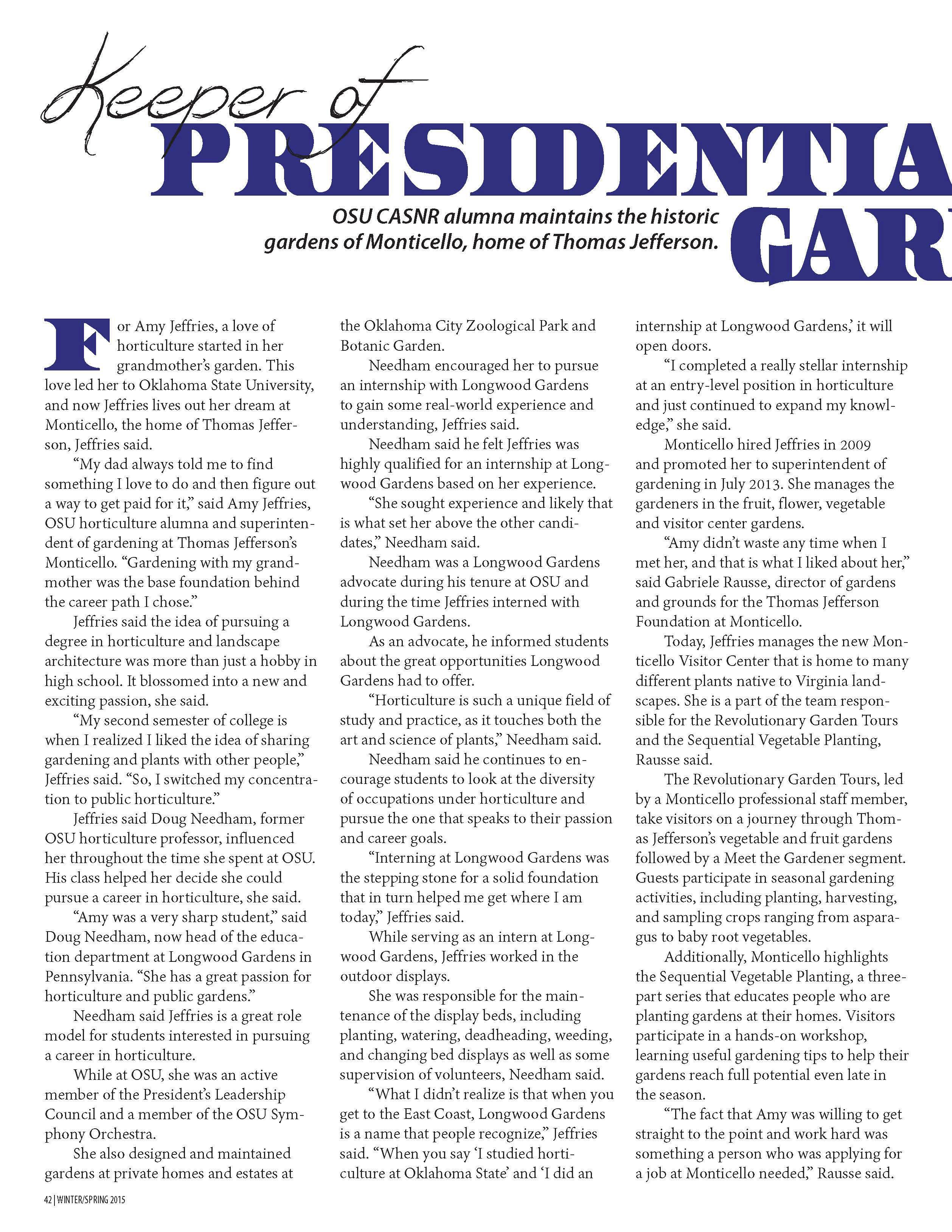
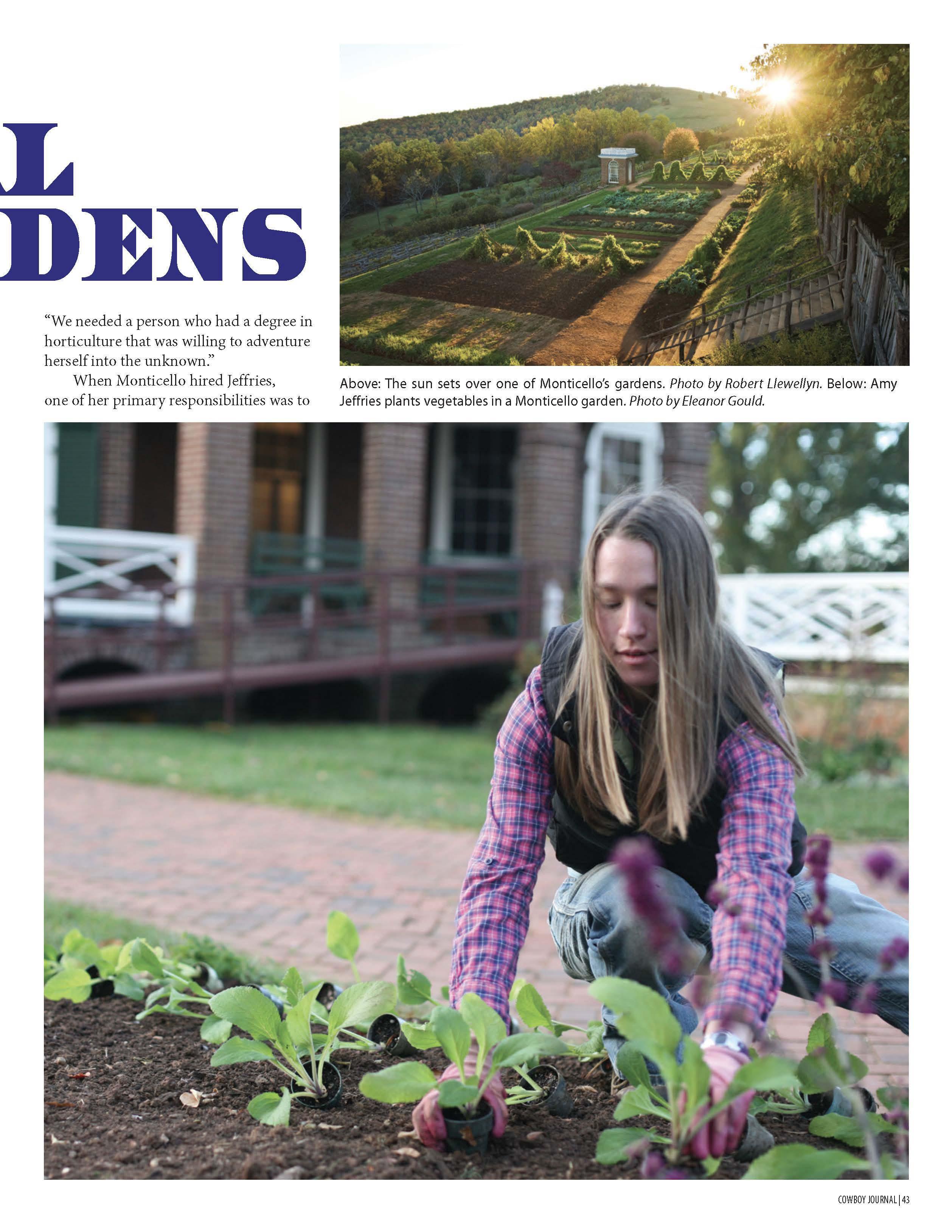
Above: The sun sets over one of Monticello's gardens. Photo by Robert Llewellyn. Below: Amy Jeffries plants vegetables in a Monticello garden. Photo by EleanorGould.
manage the new native plant garden at the Visitor Center.
Although she had no experience caring for native plants, she was the perfect candidate for this position because she was unafraid of challenges, Rausse said.
"She is the 'curator' of every problem that arises;' Rausse said. "She has been indispensable to me.
"Coming to work and knowing that she is here is the warranty that everything will be done;' he said.
Students interested in pursuing a career in horticulture need to know the field is really hard but rewarding, Jeffries said.
"If you are interested in making an impact on the changing global environment- whether through research or production of foods, ornamentals, or turfgrass; through landscape design, installation and maintenance; or through public horticulture - then you should investigate the many opportunities under horticulture;' Needham said.
He said the need for well-trained and educated students is increasing.
Horticulture can be exciting, if taught in way to appeal to the senses, Jeffries said.
"Jefferson leaves us a great legacy;' Jeffries said. "I didn't realize I would be growing plants Jefferson grew or had access to when he was alive:'
Jeffries said working at Monticello is a humbling experience and each day brings on a new exciting challenge.
Great people work at Monticello and being able to work at the home of Thomas
Jefferson is a once-in-a-lifetime opportunity, she said.
"I love my job;' Jeffries said. "I am grateful for the opportunity I have been given at Monticello:' Cil
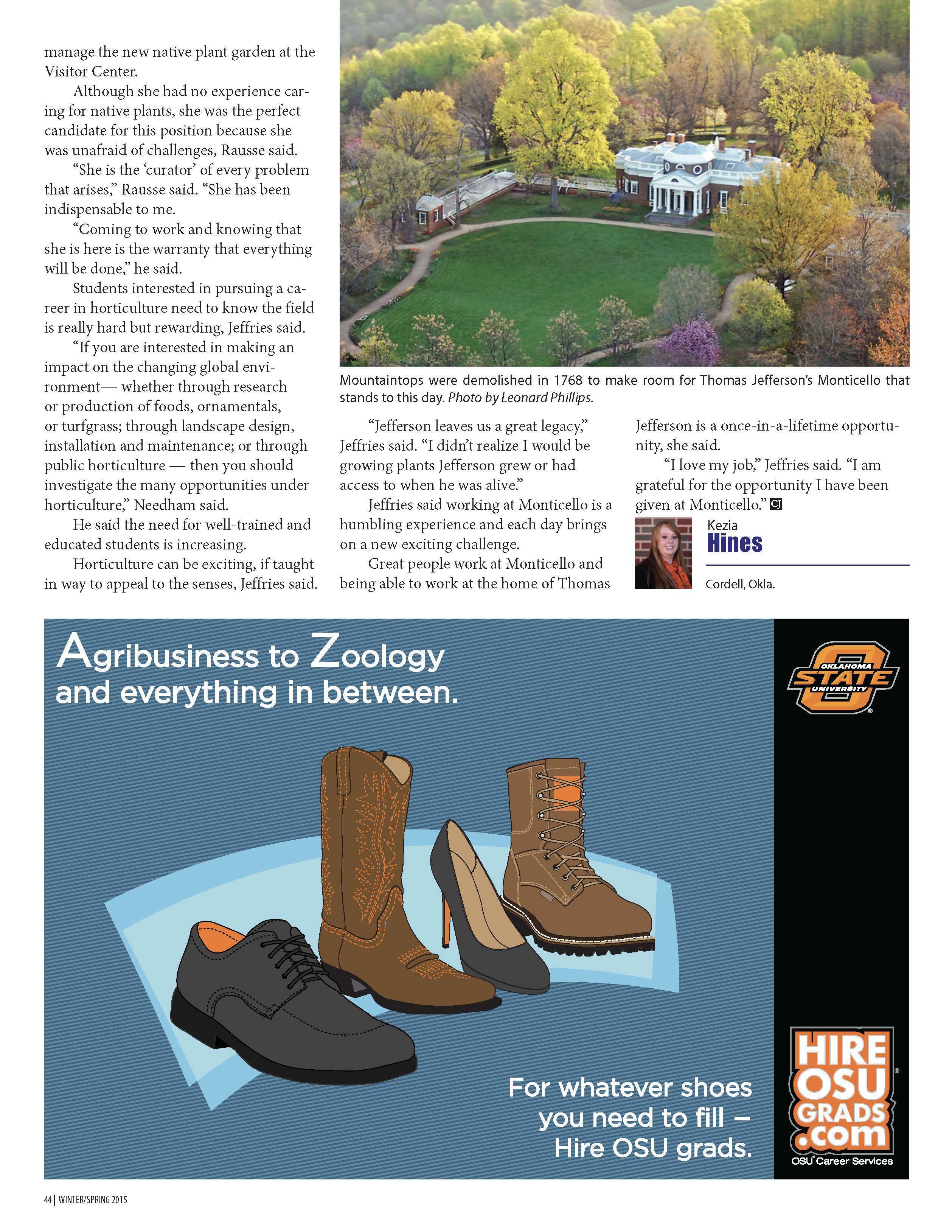
Mountaintops were demolished in 1768 to make room for Thomas Jefferson's Monticello that stands to this day. Photo by Leonard Phillips.
Kezia
Hines
Cordell, Okla.
6ug'5Life
A veteran combines two passions to pursue his career.
0n campus, Dave Bradt looks like a typical college student. But when this 22-year-old veteran graduates, he plans to apply his entomology degree in the U.S. Army.
Currently a junior at Oklahoma State University, Dave Bradt said he felt a calling to serve in the military before earning his degree. He served in the Army for three years, first at Fort Lewis, Wash., then in Afghanistan for nine months, before completing his active duty service.
His parents, David and Loretta Bradt, said they remember their son coming home during his senior year in high school and telling them he wanted to join the military following his graduation.
"His mom was initially upset out of concern and because we had made so many college plans with him;' David Bradt said. "I was concerned at first but proud of him for wanting to serve our country:' His mom said her concern eventually turned into pride because of his noble decision to serve his country.
Dave Bradt said his home is in Oxford, Conn., so he is asked frequently why he chose OSU. His answer is because the university had a great program and offered him a scholarship. OSU held the scholarship for him until after his active service.
He said he knew he wanted to pursue his degree in something involving insects.
''I've always been interested in insects;' Dave Bradt said. "Insects are the one group in the animal kingdom you deal with every daY:'
He originally majored in zoology, but because of his love for insects, he switched to entomology.
He said he learned about becoming an Army medical entomologist last year. After doing more research, he found only 60 soldiers are Army medical entomologists.
"When I decided to major in entomology and go through the ROTC;' Dave Bradt said, "I found that no one has graduated with an entomology degree through ROTC in about 20 years:'
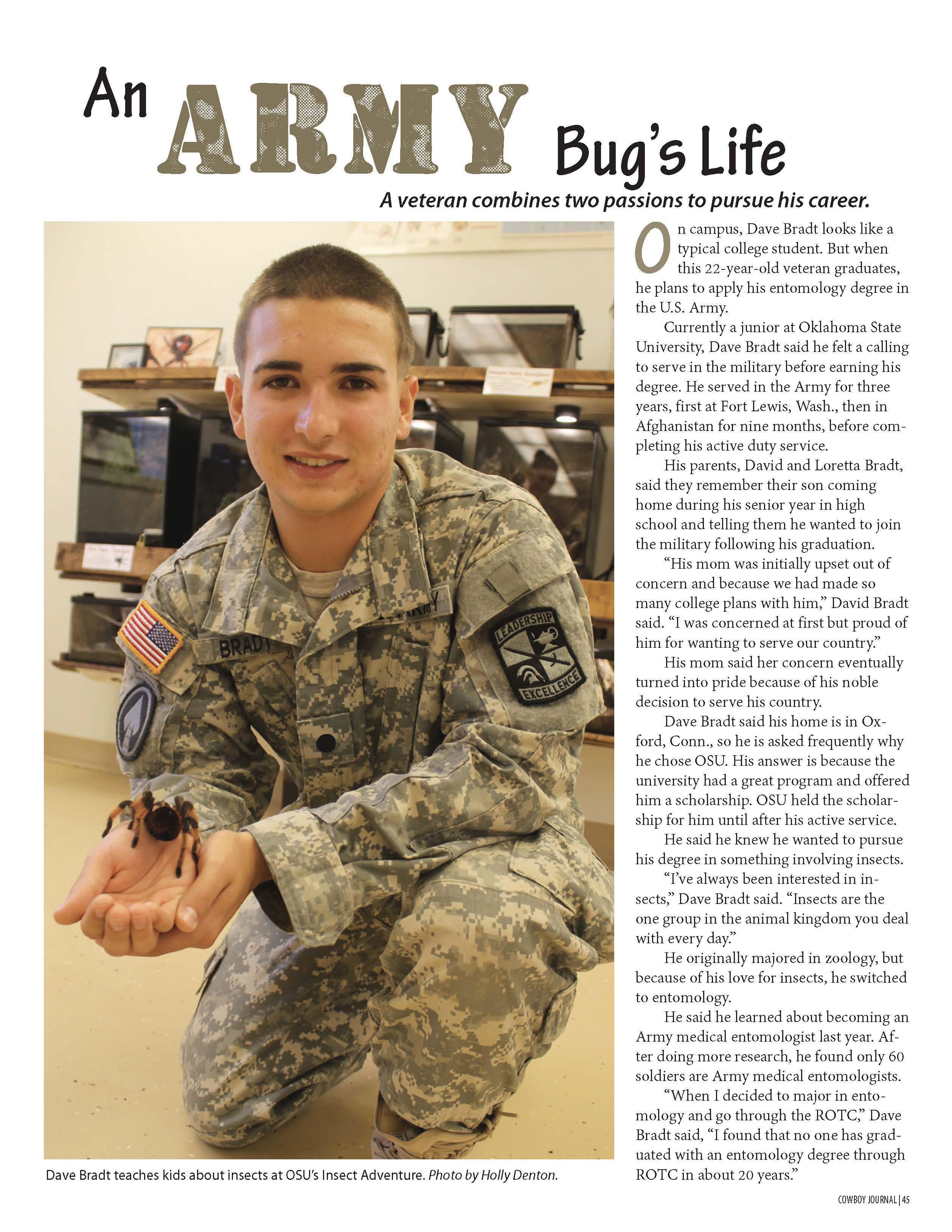
Dave Bradt teaches kids about insects at OSU'sInsect Adventure. Photo by Holly Denton.
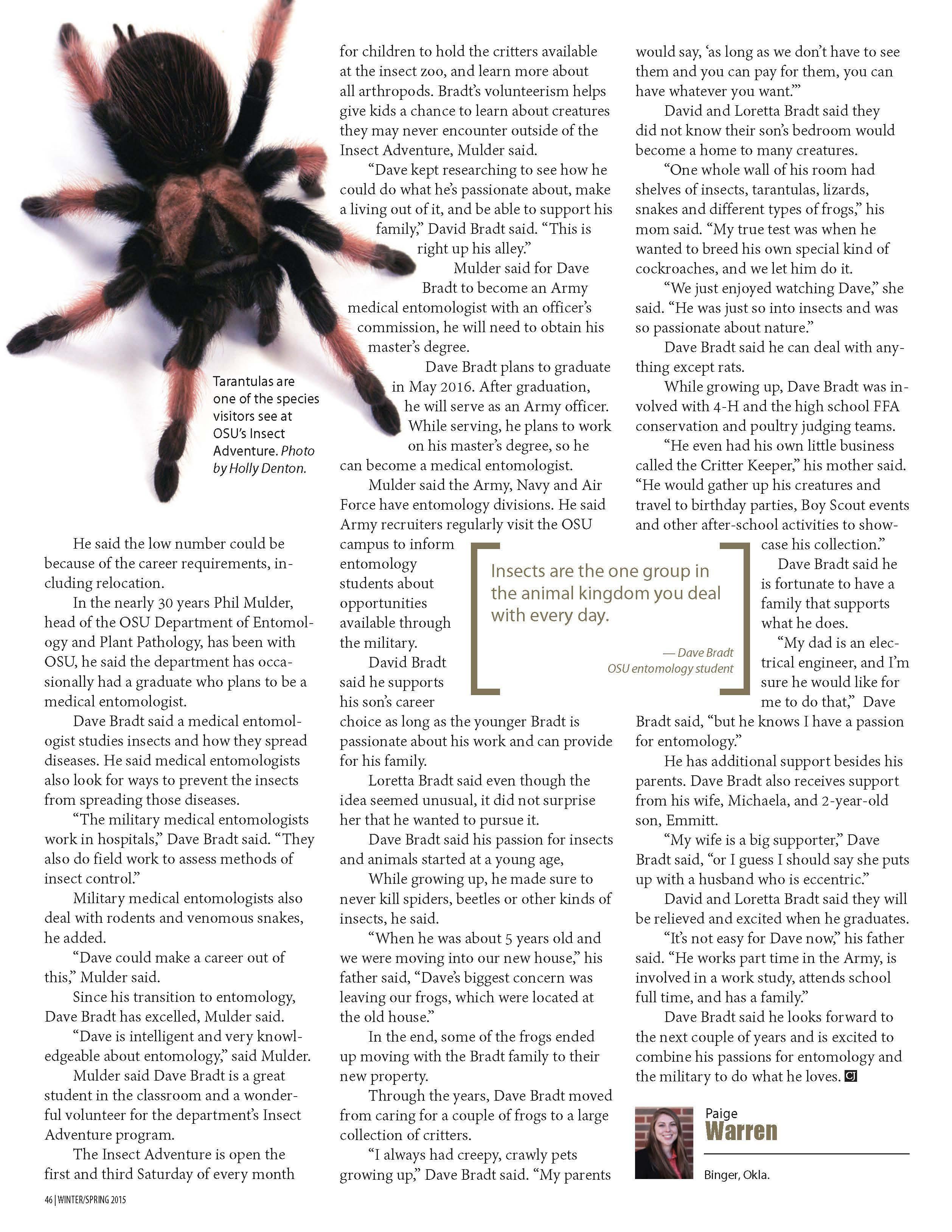
Tarantulas are one of the species visitors see at OSU's Insect Adventure. Photo by Holly Denton.
He said the low number could be because of the career requirements, ineluding relocation.
In the nearly 30 years Phil Mulder, head of the OSU Department of Entomology and Plant Pathology, has been with OSU, he said the department has occasionally had a graduate who plans to be a medical entomologist.
Dave Bradt said a medical entomologist studies insects and how they spread diseases. He said medical entomologists also look for ways to prevent the insects from spreading those diseases.
"The military medical entomologists work in hospitals;' Dave Bradt said. "They also do field work to assess methods of insect control:'
Military medical entomologists also deal with rodents and venomous snakes, he added.
"Dave could make a career out of this;' Mulder said.
Since his transition to entomology, Dave Bradt has excelled, Mulder said.
"Dave is intelligent and very knowledgeable about entomology;' said Mulder.
Mulder said Dave Bradt is a great student in the classroom and a wonderful volunteer for the department's Insect Adventure program.
The Insect Adventure is open the first and third Saturday of every month
for children to hold the critters available at the insect zoo, and learn more about all arthropods. Bradt's volunteerism helps give kids a chance to learn about creatures they may never encounter outside of the Insect Adventure, Mulder said.
"Dave kept researching to see how he could do what he's passionate about, make a living out of it, and be able to support his family;' David Bradt said. "This is right up his alley:'
Mulder said for Dave Bradt to become an Army medical entomologist with an officer's commission, he will need to obtain his master's degree.
Dave Bradt plans to graduate in May 2016. After graduation, he will serve as an Army officer. While serving, he plans to work on his master's degree, so he can become a medical entomologist.
Mulder said the Army, Navy and Air Force have entomology divisions. He said Army recruiters regularly visit the OSU campus to inform
would say, 'as long as we don't have to see them and you can pay for them, you can have whatever you want:"
David and Loretta Bradt said they did not know their son's bedroom would become a home to many creatures.
"One whole wall of his room had shelves of insects, tarantulas, lizards, snakes and different types of frogs;' his mom said. "My true test was when he wanted to breed his own special kind of cockroaches, and we let him do it.
"We just enjoyed watching Dave;' she said. "He was just so into insects and was so passionate about nature:'
Dave Bradt said he can deal with anything except rats.
While growing up, Dave Bradt was involved with 4-H and the high school FFA conservation and poultry judging teams.
"He even had his own little business called the Critter Keeper;' his mother said. "He would gather up his creatures and travel to birthday parties, Boy Scout events and other after-school activities to showcase his collection:' entomology students about opportunities available through the military.
Insectsare the one group in the animal kingdom you deal with every day.
-Dave Bradt
David Bradt said he supports his son's career OSUentomology student
choice as long as the younger Bradt is passionate about his work and can provide for his family.
Loretta Bradt said even though the idea seemed unusual, it did not surprise her that he wanted to pursue it.
Dave Bradt said his passion for insects and animals started at a young age, While growing up, he made sure to never kill spiders, beetles or other kinds of insects, he said.
"When he was about 5 years old and we were moving into our new house;' his father said, "Dave's biggest concern was leaving our frogs, which were located at the old house:'
In the end, some of the frogs ended up moving with the Bradt family to their new property.
Through the years, Dave Bradt moved from caring for a couple of frogs to a large collection of critters.
"I always had creepy, crawly pets growing up;' Dave Bradt said. "My parents
Dave Bradt said he is fortunate to have a family that supports what he does.
"My dad is an electrical engineer, and I'm sure he would like for
me to do that;' Dave Bradt said, "but he knows I have a passion for entomology:'
He has additional support besides his parents. Dave Bradt also receives support from his wife, Michaela, and 2-year-old son, Emmitt.
"My wife is a big supporter;' Dave Bradt said, "or I guess I should say she puts up with a husband who is eccentric:'
David and Loretta Bradt said they will be relieved and excited when he graduates.
"It's not easy for Dave now;' his father said. "He works part time in the Army, is involved in a work study, attends school full time, and has a family:'
Dave Bradt said he looks forward to the next couple of years and is excited to combine his passions for entomology and the military to do what he loves. Iii
Okla.
Paige Warren Binger,
-Bob
& Glenda Adcock,
If you are a freshman at Oklahoma State University in the College of Agricultural Sciences and Natural Resources, chances are you want to be a veterinarian when you grow up.
Of the 450-plus students who enroll in CASNR each summer, more than half begin with a pre-veterinary science option paired with a major in animal science, biochemistry and molecular biology, entomology, agricultural economics, or natural resource ecology and management.
Regardless of major, these students can gain relevant experiences by participating in one of OSU's undergraduate research scholars programs.
The OSU Department of Animal Science's program offers its students unique experiences both in and out of the lab, said Jennifer Hernandez Gifford, assistant professor and one of the department's undergraduate research scholars program coordinators. Although not all students in the program want to be veterinarians, all can benefit in multiple ways, she said.
Pre-veterinary students Catherine Horsley and Nick Elroy have limited animal agriculture backgrounds. To gain experience, they participate as animal science undergraduate research scholars.
"This program will be something that will be able to set me apart in the future from other vet school applicants;' Horsley said. "It also gives me this opportunity to 'test the waters' for research in case I decide to go into research later:'
A sophomore, Horsley is an Oklahoma native who spent a large part of her life growing up in Chicago. She said living in Chicago limited her experiences with animals to mostly companion animals.
Animal science undergraduate research program provides hands-on experience.
"This program allows me to get hands-on experience with large animals, which I would never have really done if I didn't have this job;' Horsley said.
During one ofHorsley's first times running cattle through a chute, a calf became stuck, Horsley said.
"I don't know what happened, but somehow the calf got turned around in the chute and his leg was sticking out;' Horsley said. "Apparently, it was a big problem and I was kind of freaking out, but with how the faculty and the other workers at the feedlot handled the situation, I thought 'OK, I probably shouldn't have been as scared as I was:"
Horsley said when she enrolled at OSU as an animal science major, she knew she would learn about and work with large and small animals. She said she never expected to be as involved as she is now as an underclassman.
Horsley said she learned about the animal science undergraduate research scholars program after one of her friends applied and was accepted. Soon after, Horsley applied, not really knowing what to expect, she said.
"When I started, I had no idea what I wanted;' Horsley said. "I liked genetics and reproduction, so when talking to Dr. Hernandez Gifford about doing research, I specifically mentioned this to her, even though I had no idea what it was about nor had any background knowledge on it:'
Hernandez Gifford said one of the purposes of the program is to expose students to real-world applications of the scientific method.
Hernandez Gifford said program participants have the opportunity to work
in any of the major animal science disciplines, including nutrition, physiology, reproductive physiology, genetics and genomics, meat science, food safety, animal well-being and sustainability. Beyond the lab opportunities, some faculty members mentor students in extension, teaching assessment and animal advocacy programs.
"Experiences in the program can range from basic benchtop- type research to more applied type of experiences where students get hands-on work with animals;' Hernandez Gifford said.
Students participating in the animal
science undergraduate research scholars program must be full-time students with a major in animal science or food science, maintain a minimum 3.0 GPA, and work in the lab for at least four hours each week.
"They don't have to be a 4.0 student or have the highest ACT score;' Hernandez Gifford said. "What leads to a successful research scholar is a true desire to get something from the experience:'
Some animal science undergraduate research scholars, like Elroy, consider conducting research beyond their undergraduate degrees.
Above: Nick Elroy processes data collected from a spectrophotometer for his meat coloration research. Left: Catherine Horsley uses a tank containing liquid nitrogen to keep research materials frozen. Photos by Samantha Walker.
"I haven't exactly decided yet, but there's a part of me that wants to do a dual DVM- Ph.D. degree in vet school;' said Elroy, an animal science pre-veterinary junior who joined the undergraduate research program his freshman year. "If I did that, it would help me greatly, just being able to write scientifically and knowing how to conduct research in general:'
Elroy said even ifhe chooses not to conduct research after receiving his undergraduate degree, he will still benefit from his experiences with the program because he is quite adept at reading and interpreting scientific articles.
"As students become more exposed to the experiences and surrounded by what science means;' Hernandez Gifford said, "it really puts them on track for being successful either in graduate school, vet school or anything they do because it demonstrates an ability to think critically:'
Elroy said he finds his undergraduate research scholar work makes some of his other classes less stressful.
"For me, the organic chemistry labs are easier than I expected;' Elroy said. "I accredit that to me doing research for so many years and gaining all that experience with how to go through protocol and work ahead with things in the experiment:'
Hernandez Gifford said one important purpose of the program is to help students find something to motivate them. Some undergraduate scholars find research is not for them. Learning they don't like research is just as important as learning they love it, she said.
"It's important for students to find out for themselves whether research is something that interests them or not because that's what college is all about;' Hernandez Gifford said. "It's about finding out what you like as well as what you don't like.
"If they decide research is not for them, then it gives us the opportunity to say they can take a semester off or consider looking at something else that interests them;' she added.
Hernandez Gifford said about 20 undergraduate scholars are in the program each semester. The number of faculty able to oversee undergraduate research limits the number of positions in the program, she said.
"We try to place as many students who meet our minimum criteria as possible;' Hernandez Gifford said. "Even if we
can't fit them in this semester, students will be graduating or rotating out. We keep applications on file and work hard to get all applicants in the program:'
Interested students can download the application from the animal science department's website. Once students complete the application, they should submit it to Hernandez Gifford in ANSI 114 or by emailing it to her.
"Scholars are paid by payroll and must turn in a time card every week;' Hernandez Gifford said. "It holds them account-
Scholars are paid by the hour and can earn up to $500, she said.
The program is not just for students hoping to stand apart in the veterinary school application process. Anyone majoring in food science or animal science can explore career opportunities through the animal science undergraduate research scholars program. til
Samantha Walker
Above: Nick Elroy retrieves myoglobin from the freezer to reconstitute into a liquid form to use for experiments dealing with meat coloration. Below: Catherine Horsley pipettes a chemical into test tubes for processing. Photos by Samantha Walker.
.
The Economic Entrepreneur Fellows completed three-week internships and spent time with OSU students: (1) Raymond Ndungu; (2) Caroline Nabukonde; (3) Abraham Oliver (left), Mathai Ndungu, Daniel Aliddeki, Petso Mokhatla and Petunia Thulo; (4) Elizabeth Powell (left) and Daniel Aliddeki; (5) Beatrice Alyanata; and (6) Mathai Ndungu. Photos by Hannah McCollom,Kaleigh Lynchand BrentneyMaroney.
tudy abroad at Oklahoma State University usually means students travel to better understand other cultures. But for 11 entrepreneurs from Kenya, Uganda and South Africa, study abroad had the opposite perspective.
Through a grant project funded by the U.S. Department of State's Bureau of Educational and Cultural Affairs, these entrepreneurs spent five weeks learning about American culture and agriculture - Oklahoma style - as well as best practices in their entrepreneurial areas.
"They wanted to learn;' said Craig Edwards, OSU agricultural education professor and co-director of the project. "They were like sponges, but they wanted Americans to know their countries, too, because they know we have a lot of stereotypes about other cultures:'
Edwards, along with agricultural communications professors Shelly Peper Sitton and Dwayne Cartmell, coordinated the grant. Shida Henneberry, director of the Master in International Agriculture program, and Craig Watters, director of the OSU Riata Center, served as project team members.
Lisa Taylor, Brentney Maroney, Stephen Mukembo and Assoumane Maiga, graduate students in the OSU Department of Agricultural Education, Communications and Leadership, worked directly with the Fellows to enhance their experiences.
During the project's first week, the
group - referred to as Economic Entrepreneur Fellows - learned about U.S. history and government, land-grant universities, and U.S. agriculture as well as the use of social media, marketing and small-business customer service in the United States.
"The week of training provided entrepreneurial background some Fellows may not have received in their home countries;' Taylor said.
The grant project focused on entrepreneurship as related to agribusiness and agriculture, Edwards said, but included cultural exchange.
The Fellows interacted specifically with OSU College of Agricultural Sciences and Natural Resources students to discuss their countries, entrepreneurship and agricultural issues, Edwards said.
"Connecting and speaking with another farmer from across the globe was so rewarding;' said Alison Slagell, an agricultural communications senior. "I learned about the many similarities and differences between our countries:'
A difference exists in reading about another culture and being completely immersed into it, Sitton said.
"This whole project is an exchange of our thoughts, ideas, impressions and feelings among groups of people;' Edwards said. "The Fellows wanted to see if what they see on television is really America:'
Mathai Ndungu, a socioeconomist for
the Kenya Agricultural Research Institute, was in the United States for the first time to participate in this project.
"I have learned a lot about America;' Ndungu said. "Back home, we are told stories. Now, I experienced the real thing:'
During the second phase of the Fellows' time in the United States, they participated in individual internship and job-shadowing experiences.
"The Fellows provided their professional goals and a description of their enterprises or what they aspire to do;' Edwards said. "We then found mentors to host the Fellows who were attracted to the cultural exchange and to sharing their knowledge and expertise with others:'
Andrea Graves, business planning and marketing specialist at OSU's Robert M. Kerr Food & Agricultural Products Center, worked with Daniel Aliddeki, an agricultural engineer for St. Jude Family Projects in Uganda.
"I was so happy to work with Daniel;' Graves said. "The information I provided will not only benefit his business but also he will be able to share it with many other professionals in Uganda:'
Raymond Ngeno, founder and chief executive officer of Chepkoilel Fabrication Services in Kenya, interned with P&K Equipment and with the welding and metal fabrication programs at Meridian Technology Center in Stillwater, Okla. He said he has plans to implement the innovative
Oliver, Dimakatso Sekhoto, Daniel Aliddeki, Caroline Nabukonde, Mathai Ndungu,
BrentneyMaroney.
technology he has learned about while in the United States into his business.
"The work has been simplified [in the U.S.]:' Ngeno said. "You save [money] on time and labor:'
Other mentor organizations included the OSU departments of horticulture and landscape architecture, animal science, and agricultural economics; the Riata Center for Entrepreneurship; Oklahoma Cooperative Extension offices in Payne, Logan and Noble counties; the Maisha Project; Oklahoma Farm Bureau; Aspen Coffee; Martha Valley Farms in Martha, Okla.; The Samuel M. Roberts Noble Foundation; the Oklahoma Department of Agriculture, Food and Forestry; Farm Credit of Eastern Oklahoma; Farmer's Cooperative Association in Tonkawa, Okla.; Gordon Cooper Technology Center; and Lorenz Seed of Hennessey, Okla.
"The internship experiences are the
cornerstone of the project;' Sitton said. "The business and personal networking relationships among the participants and their mentors will continue long after the Fellows return to Africa:'
After their internship experiences, the Fellows attended the Professional Fellows Congress in Washington, D.C., to interact through workshops and presentations with more than 200 Fellows representing 41 countries and territories from the 14 DOS grant-funded projects.
"This was a once-in-a-lifetime opportunity to bring them together, to allow them to dialogue, and to learn from each other about the experiences they had while going through their various programs in the U.S.;' Cartmell said.
Faculty members and other professionals involved in the project will travel to visit the Fellows in Spring 2015.
"The project is a two-way exchange;'
Edwards said. "We try to learn more about the entrepreneurship environment in Africa, especially in the context of agriculture:'
This is the third Department of State grant-funded project the OSU Department of Agricultural Education, Communications and Leadership has participated in since 2007. Their previous work was in Mali, Kenya and Uganda.
These cultural exchanges have academic effects and have personally affected every person involved, Cartmell said.
"I do this because I think it makes a difference;' Cartmell said. "It makes a difference in their lives, and it certainly makes a difference in our lives. Opening our eyes to the experiences through someone else's lens is really important:' ti! Hannah
Eleven Economic Entrepreneur Fellows were on the OSU campus in October 2014: Petso Mokhatla (left), Beatrice Alyanata, Moses Kisembo, Abraham
Petunia Thulo, Raymond Ndungu and Frank Ojwang. Photo by
McCollom
Hobart, Okla.
AlphaG Rho
THE COLLEGE OF AGRICULTURAL SCIENCES & NATURAL RESOURCES CONGRATULATES ITS
Eight CASNRsophomoresreceiverecognition as 2013-2014OSUTopTen FreshmenMen and Women:RickiSchroeder(back left),TylerSchnaithman, Garrett Reed,LawsonThompson,TaylorKennedy(front left), EricaSummerfield, Allison Christianand Jaci Hodges.Photocourtesyof GeneseePhotoSystems.
Just weeks after Kadie Smith and Hilary Bush were hired as the new agricultural education instructors and FFA advisers at Oologah High School, the front-page headline of the Oologah Lake Leader newspaper was "Ladies Take Lead in Oologah FFA:'
"I didn't realize it was going to be such a big deal;' Bush said. "We are just new teachers, not something extraordinary:'
Smith and Bush make up the first female two-teacher agricultural education program in Oklahoma.
The number of female agricultural education teachers is on the rise, with nearly 15 percent of agricultural education instructors in Oklahoma being female. In 2013-2014, fewer than 10 percent were females, said Rose Bonjour, central district agricultural education program specialist for Oklahoma Department of Career and Technology Education.
"Looking back 1O years ago, there was only a small handful of female teachers;' said Jon Ramsey, agricultural education assistant professor at Oklahoma State University. "Maybe only 1 or 2 percent of teachers in the state were female:'
One of these pioneering female teachers was Shirley [Stephens] Hufford. In 1971, she was the first female to graduate with an agricultural education degree from OSU.
"My dad was an agricultural education teacher;' Hufford said. "Even though girls were not allowed in FFA back then, I had been around it for most of my life:'
Hufford said she and her late husband, Mike Stephens, student-taught together at Guthrie High School in Guthrie, Okla., which had a pilot program for high school girls to enroll in agricultural education and FFA.
After graduation, Hufford did not teach agricultural education for nine years, until a third teaching position opened at Guthrie High School.
"I got the job eight months pregnant
with my second child;' Hufford said. "I only took two weeks of maternity leave because I had to be teaching:'
Hufford continued to teach for 29 years, six at Guthrie High School and then 23 at Chickasha High School.
"It was a great profession to be in;' Hufford said. "We could always take our family, and our boys were able to grow up in the program:'
Hufford said throughout 29 years of teaching, she saw growth in the number of female agricultural education teachers.
"The change was gradual at first;' Hufford said. "Be-
"I never questioned what I could do;' Bush said. "There is nothing that I can't do just because I am a girl:'
Most administrators realize they need to hire a good teacher, not just base their decisions on a person's sex, Ramsey said.
"In the past, the fence was pretty high to women;' Ramsey said. "Now, it is significantly lower for them to get a job:'
Respect was their No. 1 priority, both giving and receiving it, Smith said.
"This really set the tone being able to discipline all the students;' Smith said.
In the first couple of weeks, the students had a difficult time
- Kadie Smith cause girls were becoming tough competitors in career development events and other FFA areas, it became more pronounced over time:'
It is time for new traditions warming up to the new teachers, Smith said. in agriculturaleducation as a whole.
"I sat down with the officer team;' Smith said, "I told them, 'Guys, I know that you question
This trend of females becoming a larger part ofFFA and agricultural education has not slowed down.
"We see girls are a lot more willing to step up and take that leadership role or participate in a contest than boys;' Hufford continued. "That plays into the fact that there are so many more female agriculture teachers than in the past:'
However, skepticism about the change still exists, Bush said.
"While I was applying to jobs, I got a lot of questions about if I could work in the shop or if I could back a stock trailer;' Bush said.
Both said they were asked on numerous occasions during interviews about how they would handle disciplining high school boys who were not much younger than them.
"These questions were asked from schools that had male teachers in the past;' Bush said.
Both Smith and Bush said they do not think they are at a disadvantage in any area because they are females.
whether two girls know what we are doing, but we promise you that we are going to work our hardest to make sure that you have the best experience possible:
"I went on to tell them that we weren't just working hard for them but we were working to pave the way for younger women who wanted to be agricultural education teachers;' she continued. "We want this to work because we want girls to have this opportunity in the future:'
Bush said after that conversation, students started to believe Oologah FFA needed new traditions.
"It is a time for new traditions in agricultural education as a whole;' Smith said.
The OSU Department of Agricultural Education, Communications and Leadership is working to make diversity a larger part of its agricultural education program, Ramsey said.
"We try to be mindful of diversity in everything that we present in our classes;' Ramsey said. "Whether it be our Future AgEd Teacher Academy presenters or a panel of teachers we bring into the
Oologah agricultural education instructor
classroom, we always try to make sure we maintain balance:'
Ramsey also said the department sees students as potential agricultural education teachers regardless of sex.
An increasing number of females are not the only change happening in agricultural education. Students with diverse backgrounds pursue agricultural education as their major, as well.
Fewer students with first-hand agricultural experiences are enrolling in agricultural education, Ramsey said.
"People are four or five generations removed from the farm," Ramsey said. "We should not be surprised by the fact that students don't have contextual agricultural experience:'
Sierra Rogers, 2014 agricultural education graduate, grew up in Owasso, Okla.
"I am a city girl;' Rogers said. "Because of my involvement with FFA and the amazing agricultural education teachers that I had, I realized this was what I wanted to do:'
Most people want to go into this profession because they had an agricultural education instructor who impacted their lives, Rogers said.
"There are people who did not grow up on a farm with a strong animal agriculture background;' she said. "Because of their involvement in FFA, they realize teaching is something they want to do:'
Having an agricultural education and FFA background is not a prerequisite to be an agricultural education major, however.
Cheyenne Sparks, an agricultural education senior, was not in FFA and never took a high school agricultural education class. She will graduate with an agricultural education degree in May 2015.
"I have always admired education and those who devote their lives to it;' Sparks said. "When it comes to agriculture specifically, I am drawn to it for its diverse topics and overall contribution to the world.
"Agriculture is a driving force in every
life, state, country and continent;' she added. "I want to educate students on its importance and how it impacts their lives:'
Regardless of what they look like or where they come from, today's agricultural education instructors work to ensure their students have the experiences and opportunities they had, Rogers said.
"I work hard because I want to prove myself;' Smith said. "I want to give all I can for these kids:'
Cil
Dakota Miller Amber, Okla.
Above: Kadie Smith (third from left) instructs students how to candle and incubate chicken and duck eggs. Below: Hillary Bush (right) helps students at the Oologah school farm. Photos by TarrynBruner.
In a place where material possessions can be irrelevant, a 12-year-old girl's biggest concern often is caring for her siblings because she has become their only living relative.
For thousands of African children, in a world stricken by poverty and disease, an item as simple as a dress can make a world of difference, said Meagan Rhodes, Oklahoma State University agricultural economics senior.
"Little Dresses for Africa is a nonprofit, 501(c)(3), Christian organization that provides relief to the children in Africa;' Rhodes said.
Dresses similar to those Rhodes makes are distributed in 47 African countries as well as other troubled nations around the world.
Rhodes said the goal of the organization is to let the girls know they are worthy. According to the LDFA website, more than 2.5 million dresses have been distributed since the organization's founding in 2008.
"Basic dresses are made out of pillow cases and other fabrics;' Rhodes said. "They are then distributed through the orphanages, churches and schools in Africa:'
Rhodes became involved with the Little Dresses for Africa organization during her senior year of high school while looking to expand her family and consumer sciences 4- H project.
"My aunt actually told me about Little Dresses for Africa because her church was involved with it;' Rhodes said. "I looked into the project and knew it was something I wanted to do:'
Rhodes said the projects she had previously been involved with focused mainly around her community.
"I was excited to be involved with something that was impacting the world;' Rhodes said.
Rhodes said she was the first 4- H
·---
OSUsenior impacts lives through the act of sewing.
member in Oklahoma to become involved with the LDFA organization.
Although participating in a largescale project at age 17 can be intimidating, Rhodes said she relied heavily on her family and community for support.
Together, Rhodes and her mother, Joy, worked to develop her project's timeline.
"We brainstormed ideas of who to share [the project with] and scheduled workshops with other 4- H members, Oklahoma Home and Community Education groups, a quilting guild, our church members, other churches, their youth groups, and family, career, and community science classes;' said Joy Rhodes, Blaine County cooperative extension educator.
Rhodes said much of her project success is because of her 4- H county extension educator, Jim Rhodes, who also happens to be her father and the Oklahoma northwest district extension 4- H development program specialist.
He assisted by helping locate the information on how to construct the dresses, by promoting her project to 4- H members in Major County, and by contacting local and regional newspapers.
Using these contacts, Rhodes promoted her projects through various media. Rhodes said she has been featured on the "SUNUP" TV program, in her local newspapers and in the Oklahoma 4-H newsletter.
Through Meagan Rhodes' efforts, more than 450 dresses have been donated to the Little Dresses for Africa organization. Photo by Kaleigh Lynch.
In addition to making the colorful dresses, Rhodes also mentors 4-H members and presents workshops to continue her project's legacy.
Donna Robison, Rhodes' high school Family, Career and Community Leaders of America adviser, connected Rhodes with community groups, where Rhodes presented her LDFA project and asked for their assistance.
"Meagan explained the purpose and mission of the LDFA project;' Robison
said. "She taught workshops to FCCLA, 4-H, church groups, and Home and Community clubs, teaching them to construct dresses and donate them to the project:'
In return, Robison said, each organization recruited additional members to donate supplies and completed garments. Through Rhodes' project, more than 450 dresses have been donated since 2010.
Even though her time as a 4- H and FCCLA member has come to a close, Rhodes continues to inspire and motivate 4- H members with her project, Robison said. Her influence has spread to outside groups, eager to continue making an impact in the lives of less fortunate children, she added.
"Throughout my years of teaching, many of my students have participated in community service projects, and Meagan's project was one of the most impactful;' Robison said. "The project was most successful because of its snowball effect. She motivated groups of people who, in turn, motivated others:'
Some individuals contacted by Rhodes continue to create and donate dresses for the LDFA organization.
"My 4-H sewing camp this sum-
mer completed dresses to be donated;' Joy Rhodes said. "One of my Oklahoma Home and Community Education groups recently completed about 30 dresses to be shipped to Africa:'
Today, Rhodes is a full-time student involved in Delta Delta Delta sorority, Order of the Omega and Collegiate 4- H as well as Student Mobilization, which is an on-campus ministry organization.
"I continued my project when I came to college;' Rhodes said. "I still collect, size and mail off dresses.
"I love that something I began years ago is still happening in Oklahoma;' Rhodes said. "I hope in years to come more 4- H members will continue to help the LDFA project:'
In a world where the smallest act of kindness can create the biggest gesture, Rhodes said these efforts have generated a ripple effect felt by hundreds ofless fortunate children. Cil
AboutLittle Dresses ForAfrica
Why use pillowcasesfor LDFAdresses?
For many years, the pillowcase pattern has been used. This premade pattern already consists of a hem and sides, and it is easy enough for even the most novice seamstress to use. However, this pattern is only a suggestion and any dress pattern may be used.
I do not sew, but I would like to help. What else can I do to help?
The LDFA organization appreciates help from everyone. While some people are skilled sewers, others can donate supplies or funds by either check or online to help with the cost of sending the dresses to Africa.
What about the boys?
While the main focus ofLDFA is on girls, boys also are part of the outreach. LDFA collects boys' shirts in any size, new or gently used, to send along with the dresses.
What are the associatedcosts?
On average, it costs roughly $2 to make a dress. A crate of dresses can be sent to most parts of Africa for $140 each and can be sent domestically with teams for $140 per bag. Additional costs come from supplies such as boxes, tape, documents and additional materials.
Do you send dressesto countriesother than those in Africa?
Yes. LDFA has sent dresses to 47 countries in Africa. Also, in times of crisis or when asked, dresses are sent to Guatemala, Honduras, Mexico, the Dominican Republic, the Philippines, Cambodia, South Dakota and the Appalachian Mountain regions.
For more information on the LDFA organization, the pillowcase dress pattern and other sewing directions, visit littledressesforafrica.org/blog.
Information courtesyof the Little Dresses for Africa organization.
Kaleigh Lvnch
Owasso, Okla.
Young girls receive Little Dresses for Africa dress donations in Malawi. Photo courtesy of Little DressesFor Africa organization.
Early Career Achievement Award Recipients
Oklahoma natives Tyler Norvell and Bart Fischer have received the 2014 Early Career Achievement Award Recipients from the Oklahoma State University College of Agricultural Sciences and Natural Resources. This award, presented every year in May, recognizes former CASNR students who have found early success in their careers.
Tyler Norvell
Growing up in southwest Oklahoma and spending most of his time on a tractor, OSU alumnus Bart Fischer said he did not expect the experiences he has had so far in his career.
Fischer serves as chief economist for the House Committee on Agriculture.
Fischer was hired in 2011 to work for Rep. Frank Lucas, committee chairman, on the 2014 Farm Bill and served as one of the primary staff-level negotiators on the bill's development. He spends a majority of his time ensuring the Farm Bill is carried out the way it was intended, he said.
Fischer said he will continue as the chief economist under new committee chairman, Rep. Mike Conaway from Texas. Fischer said he owes much of his success to OS U.
"OSU was really the launching pad for me," Fischer said.
Serving as an executive director of the Oklahoma Youth Expo and owning and operating Norvell Consulting LLC keeps Tyler Norvell busy.
Norvell's role at OYE is to raise funds for and conduct the annual nonprofit livestock show in Oklahoma City each March.
"We work to raise $2 million every year for scholarships and premiums," Norvell said. "More than 7,000 Oklahoma students attend."
Norvell also works as a lobbyist and consultant at Norvell Consulting LLC.
A native of Amber, Okla., Norvell earned a bachelor's degree in animal science from OSU in May 2006.
While an OSU student, he competed
on a national champion livestock judging team and was named an Outstanding Animal Science Senior.
"I have seen the people who have won this award in the past," Norvell said. "They were people I looked up to in FFA, high school and college."
He said the most humbling part was being chosen with his friend Bart Fischer.
"Bart and I worked together on the 2014 Farm Bill with Rep. Frank Lucas," Norvell said. "Bart's done so much for the agricultural industry. I really idolize him."
Norvell and his wife, Beth, live on their cattle operation in Tuttle, Okla., with their 4-year-old daughter, Madilyn, and infant daughter, Saylor.
He earned a bachelor's degree in both agricultural economics and in business administration with majors in agricultural economics, accounting and finance. He graduated summa cum laude and was named an OSU Outstanding Senior.
Fischer currently is earning a doctoral degree in agricultural economics at Texas A&M University.
Being selected as a recipient of the CASNR Early Career Achievement Award made Fischer feel honored, he said.
"One of my closest friends and mentors, Shannon Ferrell, was a past recipient of this award," Fischer said. "I know I'm in good company."
Fischer said it was fun to be selected with his friend Norvell, as well.
Fischer and his wife, Karalyn, have a 2-year-old son, Luke. They reside in Arlington, Va.
Bart Fischer
Bank of Western Oklahoma• Chisholm Trail Farm Credit Farm Credit of East Central Oklahoma Farm Credit of Western Oklahoma• Grissoms LLC Oklahoma Farm Bureau• P&K Equipment
Persimmon Creek Investments• Shattuck National Bank The Bank of Kremlin • The Bank N .A. • The Stock Exchange Bank WB. Johnston Grain Co.
Brian Vowell President Stillwater, Okla.
Mechelle Hampton Vice President Tulsa, Okla.
Coleman Hickman Secretary Sapulpa, Okla.
Steve Damron Executive Secretary Stillwater, Okla.
Jay Bessinger Tulsa, Okla.
Brandon Chandler Stratford, Okla.
Lewis Cunningham Edmond, Okla.
James Ferrell Yukon, Okla.
Kyle Hughbanks Alva, Okla.
Don Roberts Enid, Okla.
Ken Spady Hinton, Okla.
Tresa Trammell Madill, Okla.
Glen Winters Altus, Okla.
Oklahoma State University
Department of Agricultural Education, Communications and Leadership