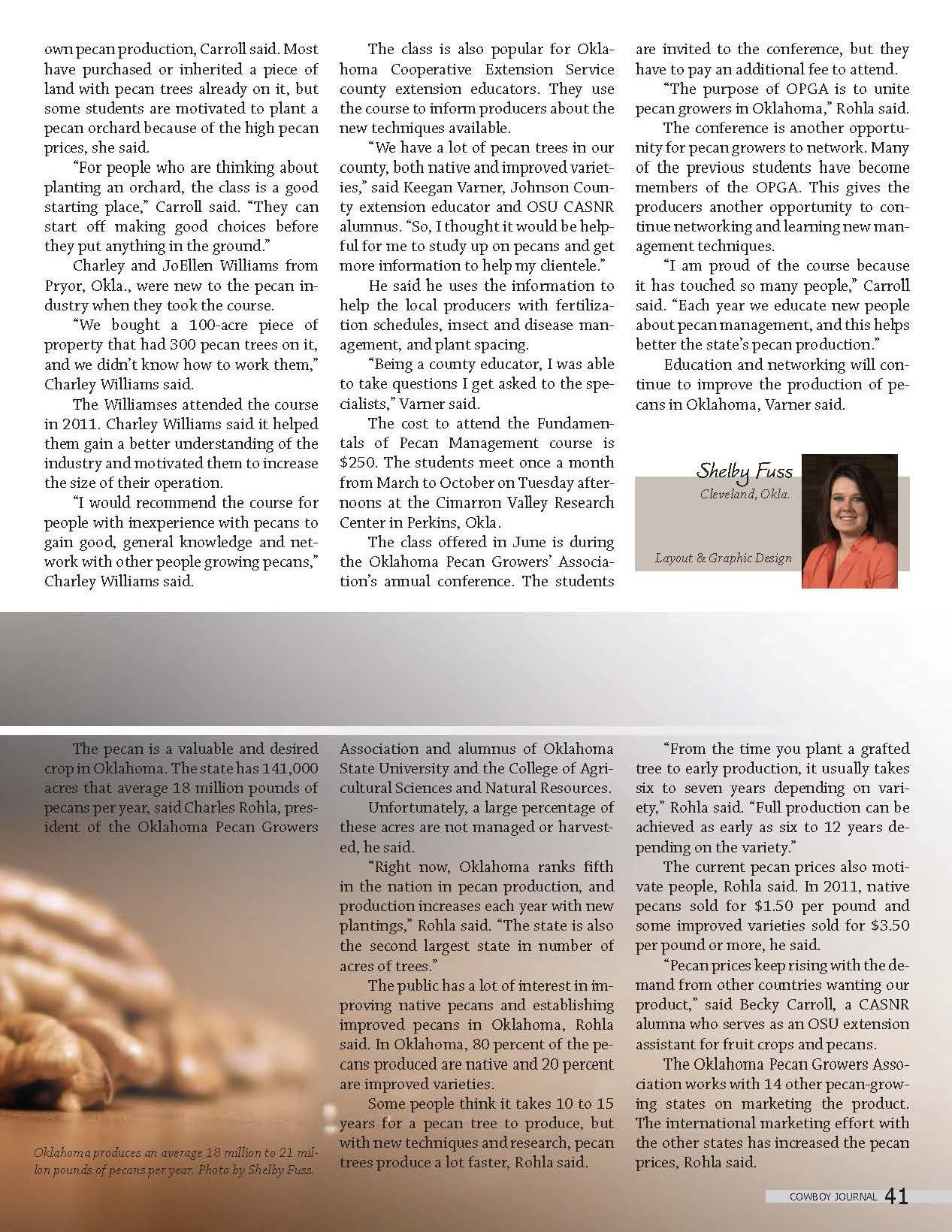
Posthumus, Marissa Tescier, Katie Vaz and Amanda Watson
Managing Editor
Shelly Peper Sitton
Assistant Managing Editors
Dwayne Cartmell, Traci Naile and Angel Riggs
Cover
Photo by Ashley Breitnauer
Sponsors
Limousin World
Oklahoma Farm Bureau
Quad Graphics
I etterI romtheeditors
This issue of Cowboy Journal is dedicated to the memory of Dr. Bill Luce. His long-time service to the Oklahoma Cooperative Extension Service and the swine industry will be missed.
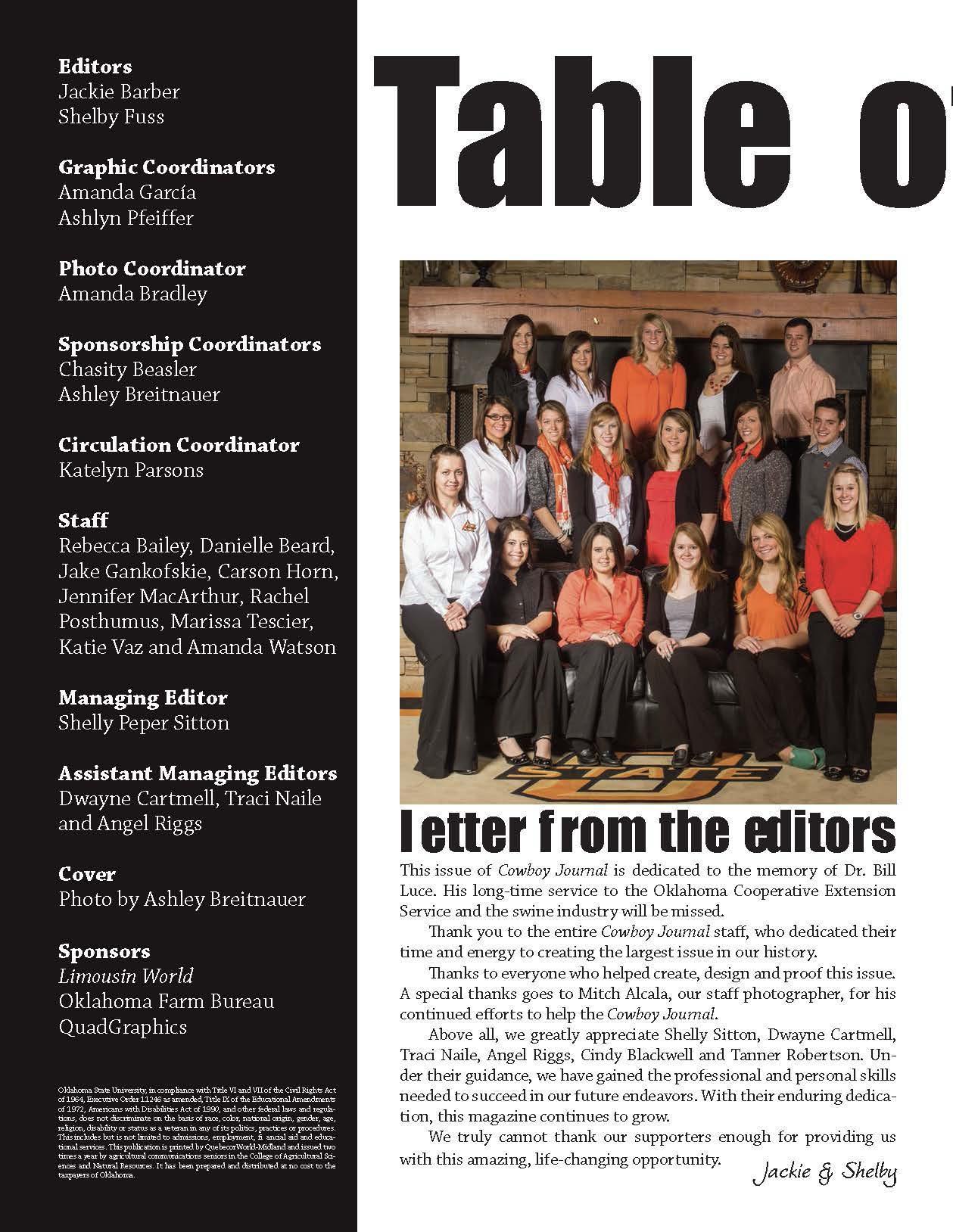
Thank you to the entire Cowboy Journal staff, who dedicated their time and energy to creating the largest issue in our history.
Thanks to everyone who helped create, design and proof this issue. A special thanks goes to Mitch Alcala, our staff photographer, for his continued efforts to help the Cowboy Journal.
Above all, we greatly appreciate Shelly Sitton, Dwayne Cartmell, Traci Naile, Angel Riggs, Cindy Blackwell and Tanner Robertson. Under their guidance, we have gained the professional and personal skills needed to succeed in our future endeavors. With their enduring dedication, this magazine continues to grow.
We truly cannot thank our supporters enough for providing us ·with this amazing, life-changing opportunity.
Jackie § Shelb,j
JB'e~liS62, the majority of college-eduza - - people were the elite, those who li,admppey and the ability to pass the ent'hng exams of the liberal arts universities. However, for the past 150 years, the Morrill Land Grant Act has provided higher education for the "common man."
The Morrill Act introduced the multi-level approach to educationteaching, research and extension - into the curriculum.
"If you bundle it together in one package, then the package you get from those three areas is greater than the individual parts," said David Porter, the interim associate dean for academic programs for the Oklahoma State University College of Agticultural Sciences and Natural Resources.
When students attend class and learn new ideas, they then have the opportunity to participate in a research project. Students can take the knowledge they have learned about the subject and apply it back to the classroom, strengthening the teaching mechanism.
The information gained in the classroom from research will then be transferred to or shared with the public
Porter said when students communicate new knowledge and its impact, they give back to the community, which is the spirit of the land-grant mission.
"A lot of students do this, but they don't realize what they are doing," Porter said. "That's the beauty of the system. It's a natural package - teaching, research and extension - built into the everyday life of the student."
Porter said a lot of small things go on in each component that all come together in the university setting to create the basis for the leaders of the next gen-
"It's really a way of life," Porter said. "You're not just here to go to class. Combine all those pieces together, and you get the whole, rounded, complete educational experience."
This way of life benefits the student and society.
"Land-grant-educated people make the world go round," said Steve Damron, interim assistant dean. "We educate people to be practical doers in the world and to make things happen."
Damron said he believes educating tomorrow's leaders is the top priority of land-grant universities. He said many people have a stereotypical view of what a leader, is but he believes a leader is simply someone who makes things happen.
"You can lead from the bottom, middle or top," Damron said.
"Just being a self-starter and a motivated person who gets out and accomplishes things is exercising personal leadership," he said. "That's the type of people we turn out."
Robert Sternberg, OSU's provost, said he sees two types of leaders: smart leaders and wise leaders. A smart leader can be any well-educated person in a well-known position, but a wise leader is someone who knows how to lead others wel~ he said.
"The essence of the land-grant mission is to not only develop smart leaders but wise leaders, as well," Sternberg said.
He said the mission is to produce the kind of leaders who will make a positive impact on the world and have accountability in areas that actually count.
Sternberg said OSU focuses on instilling values to create change, rather than simply doing what will make the college look better on a piece of paper.
"We have a special missio , not the best mission," Sternberg said.
Sternberg said the traits of future leaders include creativity, analytical ability, and wisdom as well as people with a vision, those who have the practical skills to execute their vision, a person who can persuade people to the value of a vision, and people who want to ensure any idea pursued is for the common good.
"Land-grant graduates are vital leaders because they know how to get their hands dirty, both literally and figuratively," Damron said. "They know when to push, when to pull and sometimes even when to shove. To me that's the essence of everything we do."
All three men agreed that the landgrant system is one that will endure.
"If you look back on our founding,
especially with agriculture, everybody has to eat," Porter said. "One hundred fifty years later, everyone still has to eat, so we still have to provide the latest, greatest information. The focus changes over time, but the underlying theme stays the same."
Starting as a borrowed church with 35 students in 1891 and today stretching into five campuses with more than 35,000 students at its core, OSU will continue into the future with the missions of the land-grant act close at heart.
Otinielle Betird
Fairland, Okla.
Photography,New Media & Marketing
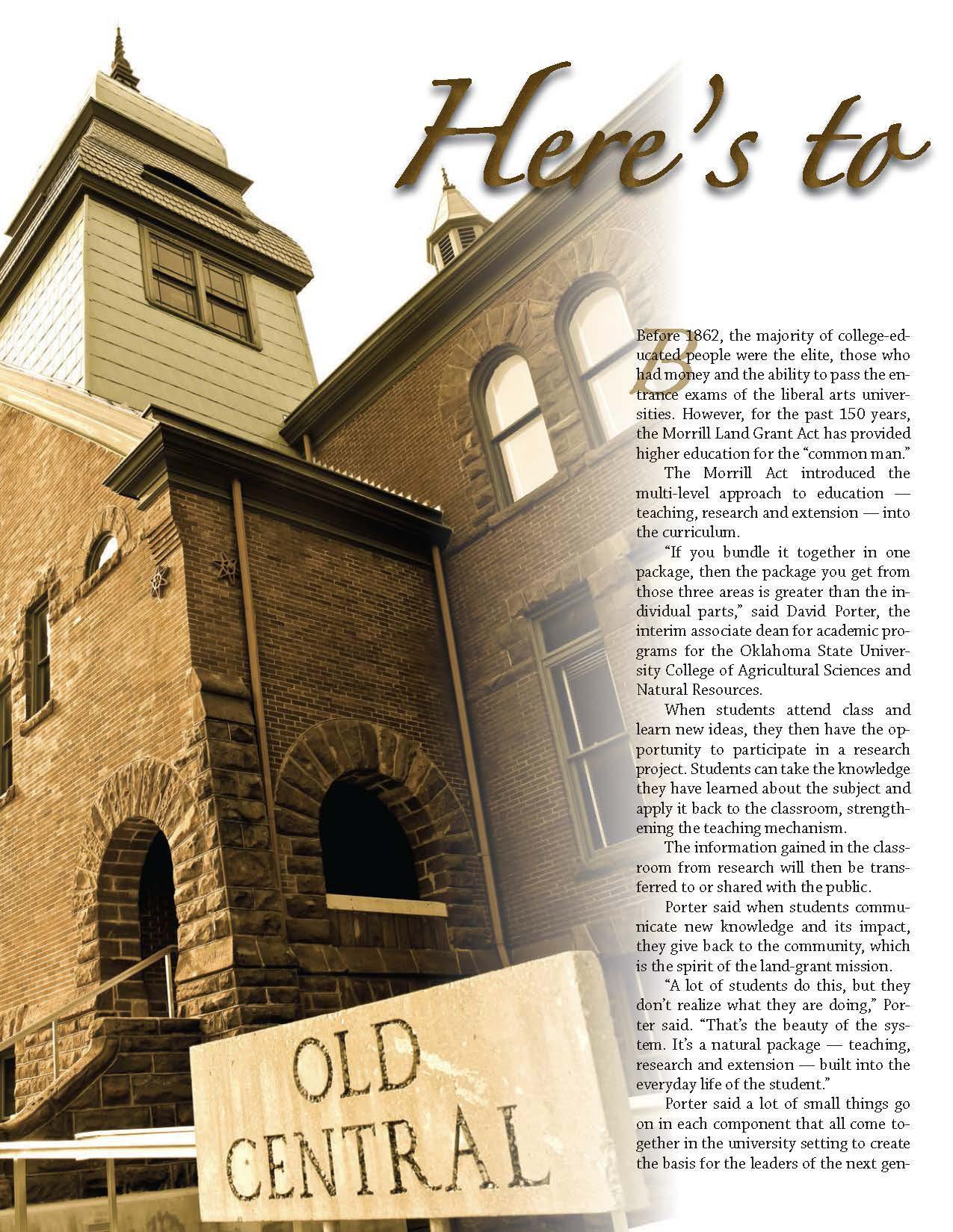
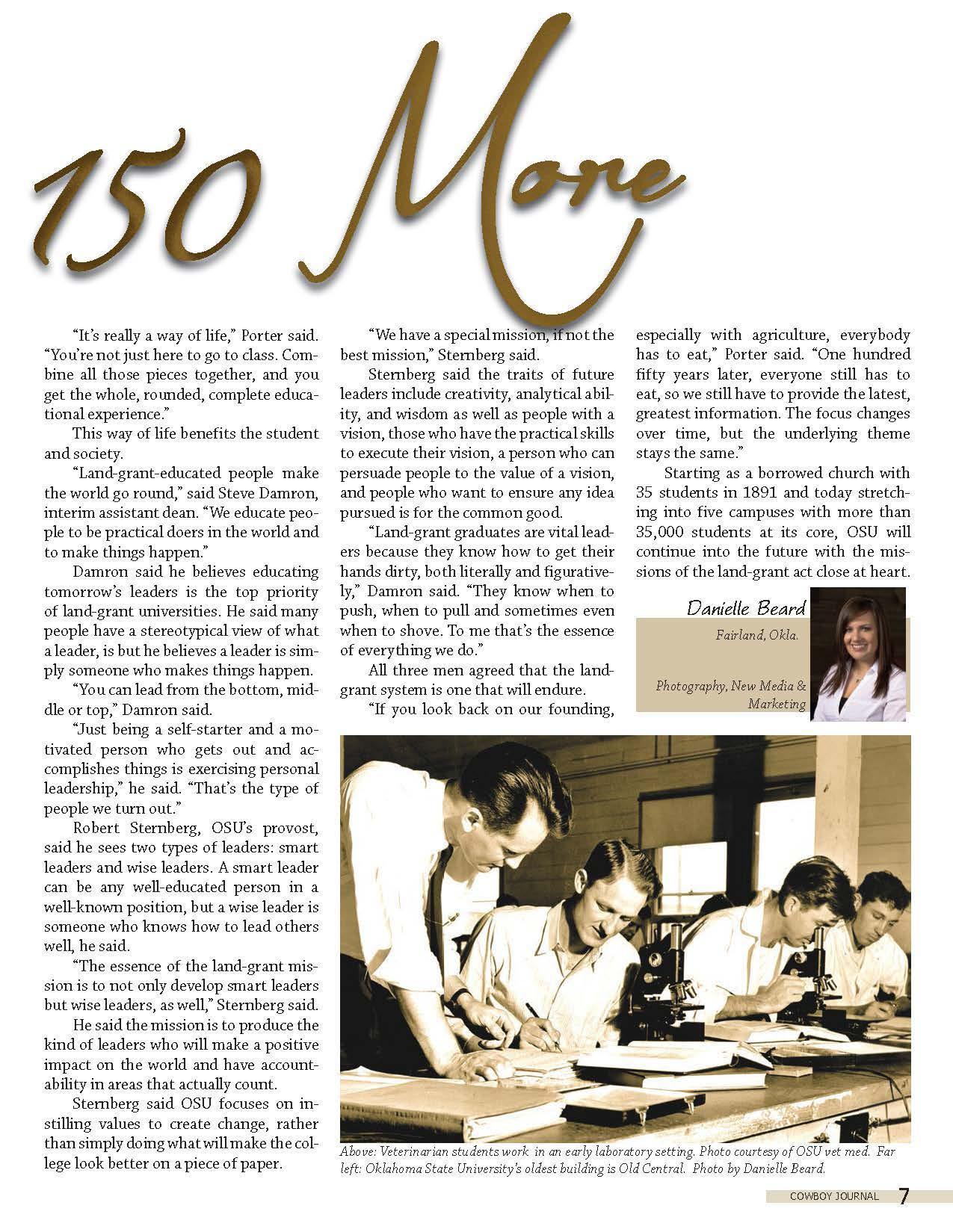
Above: Veterinarian students work in an early laboratory setting. Photo courtesy of OSU vet med. Far left: Oklahoma State University'.soldest building is Old Central. Photo by DanielleBeard.
President Abraham Lincoln signed the Morrill Act on July 2, 1862. The act, sponsored by Vermont Congressman Justin Morrill, officially was titled "An Act Donating Public Lands to the Several States and Territories which May Provide Colleges for the Benefit of Agriculture and the Mechanic Arts."
This act allotted each state 30,000 acres of federal land to create a state university that would specialize in agricultura~ mechanical arts and military tactics. This revolutionized higher education by creating 69 public colleges.
The Second Morrill Act followed in 1890 and provided federal funding for
university cooperative extension services. This follow-up act laid the basis for county fairs and 4-H clubs.
Founded on Christmas Day in 1890, Oklahoma State University originally was named Oklahoma Territorial Agriculture and Mechanical College, or Oklahoma A&M. The land-grant legislation specified the college was to be within Payne County. While all towns wanted the honor of becoming the home of the college, Stillwater was chosen.
The first classes were held in Congregational Church in December 1891.
In 1896, 16 men became the first graduates of Oklahoma A&M.
The campus was started in 1900 on 200 acres provided by families of the land run. The first building for the campus was Old Central, while the first infrastructures of the "Cow College" were barns and a watering hole. What was once the watering hole is now known as Theta Pond.
It was not until after Oklahoma gained statehood in 1907 that "Territorial" was dropped from the institution's name. The name was changed to Oklahoma State University on May 15, 1957, to reflect the broad scope of curricula the university offers. - by
DanielleBeard
~~~m!fff1ury, 4- H has shaped ~...,._...,.;,,..s through hands-on learnes. For the past 50 years, the ma 4-H Foundation has supported the mission and goals of 4-H while investing in members across Oklahoma.
This fall, the Oklahoma 4-H Foundation will celebrate its golden anniversary, and 50 years of supporting the Oklahoma 4-H program and the youth involved.
Originally established on Jan. 25, 1962, the foundation began as the result of a large gift from R.D. Farmer, who made Oklahoma 4-H the beneficiary of his estate. After the passing of his heirs, the 4-H Foundation became the sole recipient of his trust.
In the early days, 4-H Specialist Ray Parker played an immense role in the development of the foundation.
"Way back in the '60s, the foundation was kind of an extra thing, so we didn't spend a lot of time on it," Parker said. "Its main function was to supervise the available scholarships and, of course, try to go out and stimulate more giving by contacting prospective donors."
Parker said one of the biggest obstacles in the beginning was keeping everything in order.
"One of the challenges was coordinating everything to make sure support was coming in," Parker said.
However, the individuals involved believed in the foundation, put in the work, and received the support.
"We did a good job selling the 4-H program," Parker said.
The Oklahoma 4-H Foundation was created to promote excellence among 4-H members, and since its establishment, that is exactly what it has done.
"From the very beginning, our pur-
pose has been to provide support for local 4-H programs;' said Jim Rutledge, Oklahoma 4-H Foundation executive director. "Our entire purpose is to support the Oklahoma 4-H program, which means helping to provide incentives and recognition for
ed to give a donation to a local program, you can put money in an account designated for a specific county and its programs," Rutledge said.
Rutledge said the positive growth and development would not have been possible without the outstanding project work, 4-H leadership and citizenship. Bottom line,we're here to help 4- H."
The Oklahoma 4-H program has such a rich history and heritage, and we have the best alumni in the country.
great supporters who stand behind Oklahoma 4-H. - Jim Rutledge, Oklahoma 4-H Foundation executive director "The Oklahoma 4-H The foundation manages most of the gifts and grants given for the various 4-H programs throughout the state.
"The foundation is essentially the financial arm of Oklahoma 4-H," said Derek Smithee, former Oklahoma 4-H Foundation executive board of directors president. "If someone like me wants to give a few hundred or a few thousand dollars to support Oklahoma 4-H'ers, there has to be a place to do this, and that is the function the foundation serves."
Rutledge said during the past 50 years, the Oklahoma 4-H Foundation has grown exponentially.
"The first year, they listed less than $14,000 as assets,'' Rutledge said. "Now, because of the endowment funds and the balances in those program funds, we have more than $5 million."
The Oklahoma 4-H Foundation manages an account for each county in the state. As a result, the foundation takes care of all the duties local counties would have to do if they created their own foundation.
"If you come along and say you want-
program
has such a rich history and heritage, and we have the best alumni in the country,'' Rutledge said. "We have had outstanding board members over the years who have helped so much in the fund-raising activities and have given so much of their time to make the foundation a success."
Smithee said the foundation has been successful because of its tie to a flourishing program.
"A lot of youth programs are struggling financially right now, but 4-H is so basic to teaching a young person to be a successful adult," Smithee said. "It has a strong foundation and is just a wellrounded program."
The foundation has provided support for 4-H promotion, educational conferences and events, scholarships, recognitions, awards, and efforts to enhance or expand program delivery.
Rutledge said an important function of the foundation is providing young people with the opportunity to change their views of life.
"When we can take someone from a rural community, who has never flown
cialist, began her involvement with 4-H as a member and then pursued a career as an extension educator.
During her time as an extension educator, Murray said she saw the impact the foundation has on local 4-H clubs.
"The foundation raises funds for grants, which help counties have strong programs," Murray said. "When I worked in the county, we were the recipient of a number of those and they worked to enhance the programs we worked on."
Rutledge said the foundation recently has worked with 4-H Enhancement Grants to expand programming.
"This program allows for individual clubs or counties to apply for grants to support their educational programs to do something new or innovative," Rutledge said.
As a certified volunteer and 4-H leader, Murray said she believes in the future of the Oklahoma 4-H Foundation.
"As long as we can continue to show we are making a difference in kids' lives, there will be people who are going to invest in 4-H," Murray said.
Murray's two daughters followed in her footsteps and got involved in 4-H at an early age. Her younger daughter, 17-year-old Jenna, is a current State
4-H Ambassador and 2011 Hall of Fame Award winner.
Jenna Murray said she credits the 4-H Club for where she is today and is thankful for the opportunities and experiences presented by the foundation, such as participating as a delegate at the National 4-H Congress.
"Oklahoma sent 25 delegates, and the foundation played a big part in helping us travel there," Jenna Murray said.
Jenna Murray said she understands the importance of the foundation and the impact it has.
"It's awesome how this group of people is dedicated to making 4-H the best it can be," Jenna Murray said. "The fact the foundation cares so much about youth development, knows we are the future and invests in us is amazing to me."
Jenna Murray said as an adult she would like to give back to the club that shaped her development. She plans to attend Oklahoma State University in fall 2012 to pursue a degree in agricultural communications. While she is not sure what her career goal is, she knows she wants to stay involved in 4-H.
"With an agricultural communications degree, the option for working in extension is open," Jenna Murray said.
"I definitely want to give back to 4-H as a volunteer and hopefully one day as a scholarship donor."
Jenna Murray is one of thousands who have benefited from the foundation throughout the past 50 years.
"I still hear from young people I worked with 30 years ago who were involved in 4-H as ambassadors or kids who went on trips to National 4-H Congress or conferences," Rutledge said. "To know they are successful business people, educators, politicians or work for extension is such a rewarding experience."
As for the future of the foundation, Rutledge said as long as people continue to understand the importance of 4-H, it will continue to thrive. Smithee agreed.
"I am really excited about the next 50 years," Smithee said. "I fully expect the foundation to continue to grow and generate more funds to help members for many years to come."
Rebecca Bailej Turlock, Calif
Marketing & Promotions
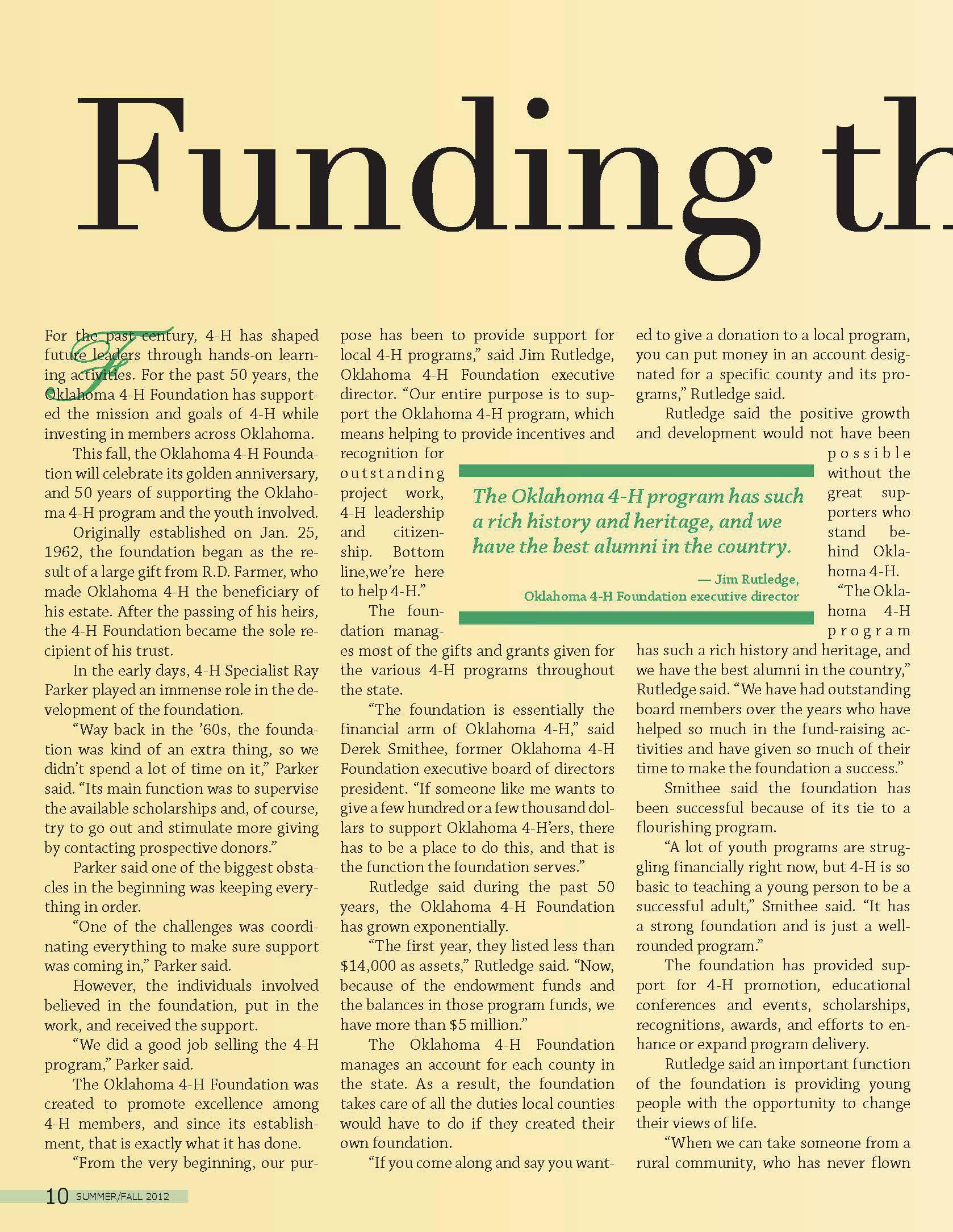
1. The Oklahoma 4-H Foundation supports the State 4-H Roundup, an Oklahoma 4-H tradition that has taken place for more than 90 years, Photo courtesy oft he Oklahoma 4-H Foundation.
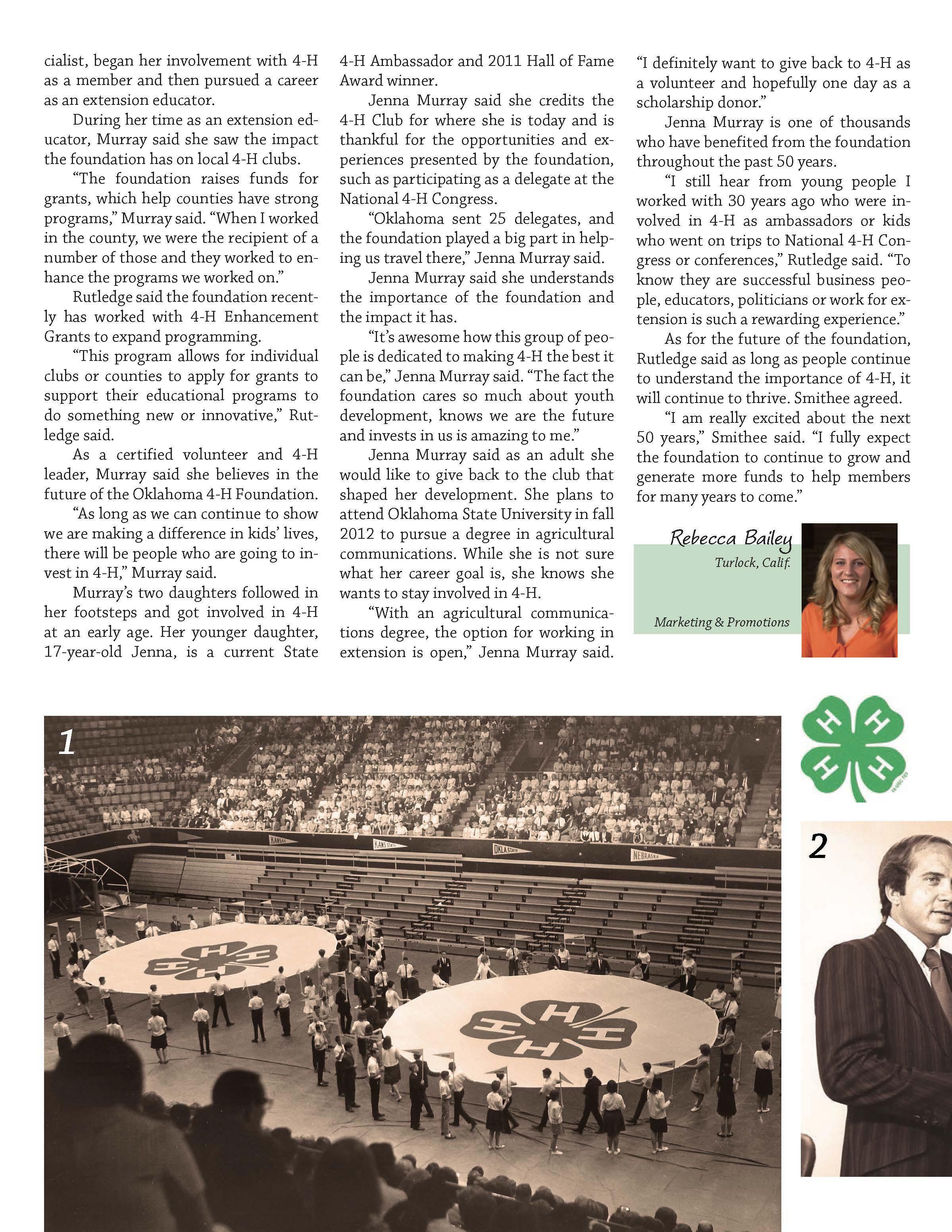
2. Derek Smithee (right) presents Johnny Bench the 4-H Alumni Award in 1977. Photo courtesy of the Oklahoma 4-H Foundation.
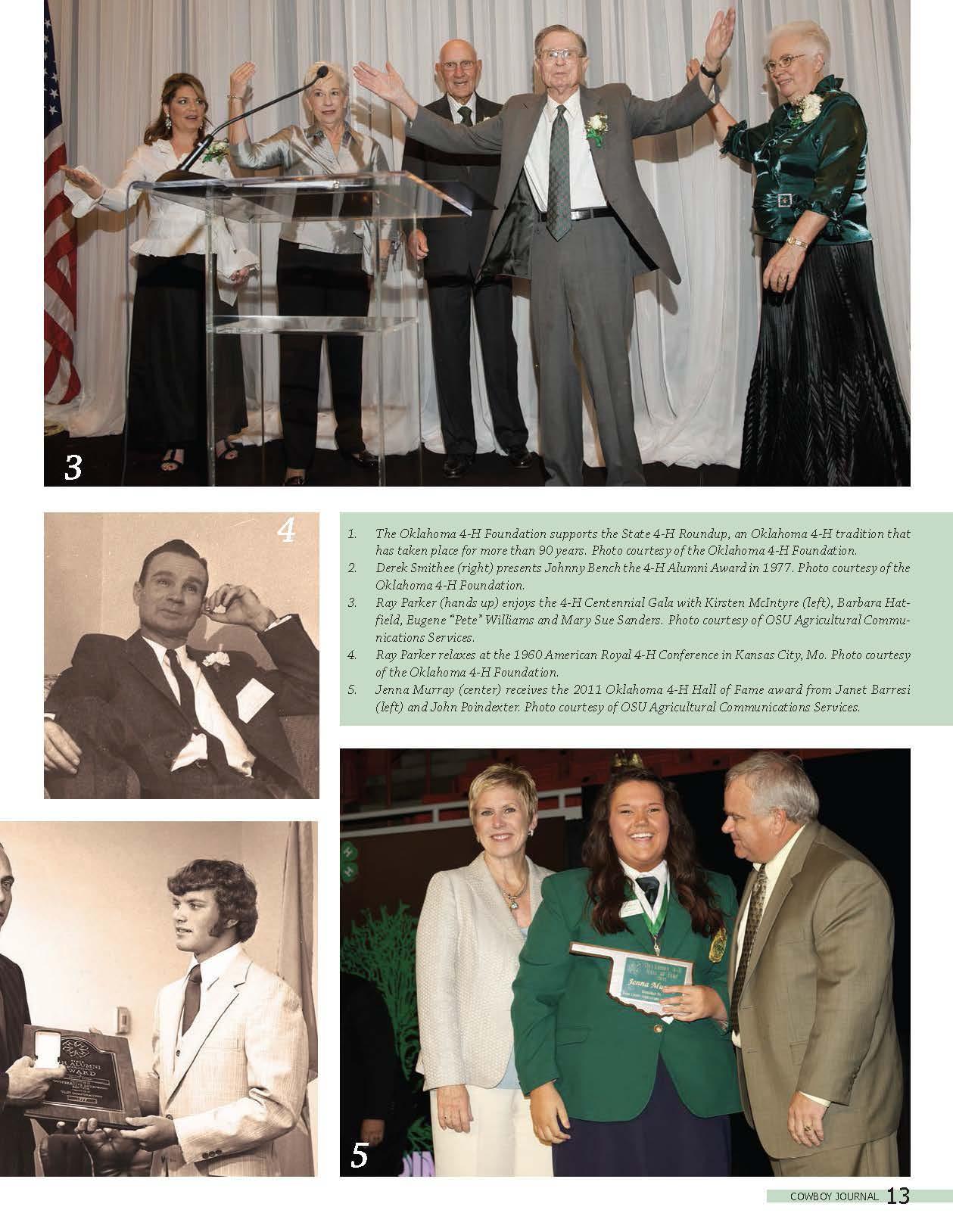
3. Ray Parker (hands up) enjoys the 4-H Centennial Gala with Kirsten McIntyre (left), Barbara Hatfield, Eugene "Pete" Williams and Mary Sue Sanders, Photo courtesy of OSU Agricultural Communications Services.
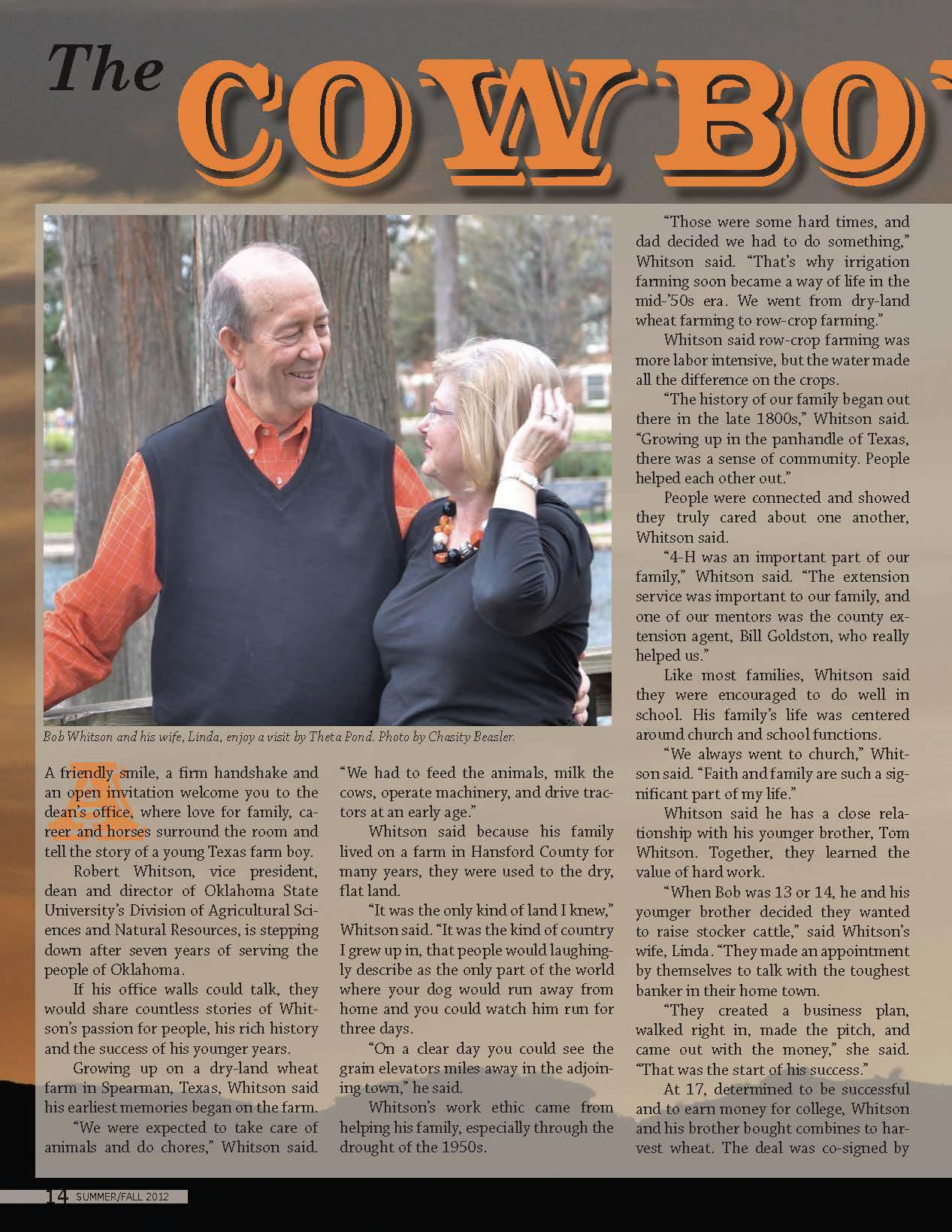
4. Ray Parker relaxes at the 1960 American Royal 4-H Conference in Kansas City, Mo. Photo courtesy of the Oklahoma 4-H Foundation.
5. Jenna Murray (center) receives the 2011 Oklahoma 4-H Hall of Fame award from Janet Barresi (left) and John Poindexta Photo courtesy of OSU Agricultural Communications Services.
A friendly smile, a firm handshake and an open invitation welcome you to the dean's office, where love for family, career and horses surround the room and tell the story of a young Texas farm boy.
Robert Whitson, vice president, dean and director of Oklahoma State University's Division of Agricultural Sciences and Natural Resources, is stepping down after seven years of serving the people of Oklahoma.
If his office walls could talk, they would share countless stories of Whitson's passion for people, his rich history and the success of his younger years.
Growing up on a dry-land wheat farm in Spearman, Texas, Whitson said his earliest memories began on the farm.
"We were expected to take care of animals and do chores: Whitson said.
"We had to feed the animals, milk the cows, operate machinery, and drive tractors at an early age."
Whitson said because his family lived on a farm in Hansford County for many years, they were used to the dry, flat land.
"It was the only kind of land I knew," Whitson said. "It was the kind of country I grew up in, that people would laughingly describe as the only part of the world where your dog would run away from home and you could watch him run for three days.
"On a dear day you could see the grain elevators miles away in the adjoining town," he said.
Whitson's work ethic came from helping his family, especially through the drought of the 1950s.
"Those were some hard times, and dad decided we had to do something," Whitson said. "That's why irrigation fanning soon became a way of life in the mid-'S0s era. We went from dry-land wheat farming to row-crop farming."
Whitson said row-crop fanning was more labor intensive, but the water made all the difference on the crops.
"The history of our family began out there in the late 1800s," Whitson said. "Gro,ving up in the panhandle of Texas, there was a sense of community. People helped each other out."
People were connected and showed they truly cared about one another, Whitson said.
"4-H was an important part of our family," Whitson said. "The extension service was important to our family, and one of our mentors was the county extension agent, Bill Goldston, who really helped us."
Like most families, Whitson said they were encouraged to do well in school His family's life was centered around church and school functions.
"We always went to church," Whitson said. "Faith and family are such a significant part of my life."
Whitson said he has a dose relationship with his younger brother, Tom Whitson. Together, they learned the value of hard work.
"When Bob was 13 or 14, he.and his younger brother decided they wanted to raise stocker cattle," said Whitson's wife, Linda. "They made an appointment by themselves to talk with the toughest banker in their home town.
"They created a business plan, walked right in, made the pitch, and came out with the money," she said. "That was the start of his success."
At 17, determined to be successful and to earn money for college, Whitson and his brother bought combines to harvest wheat. The deal was co-signed by
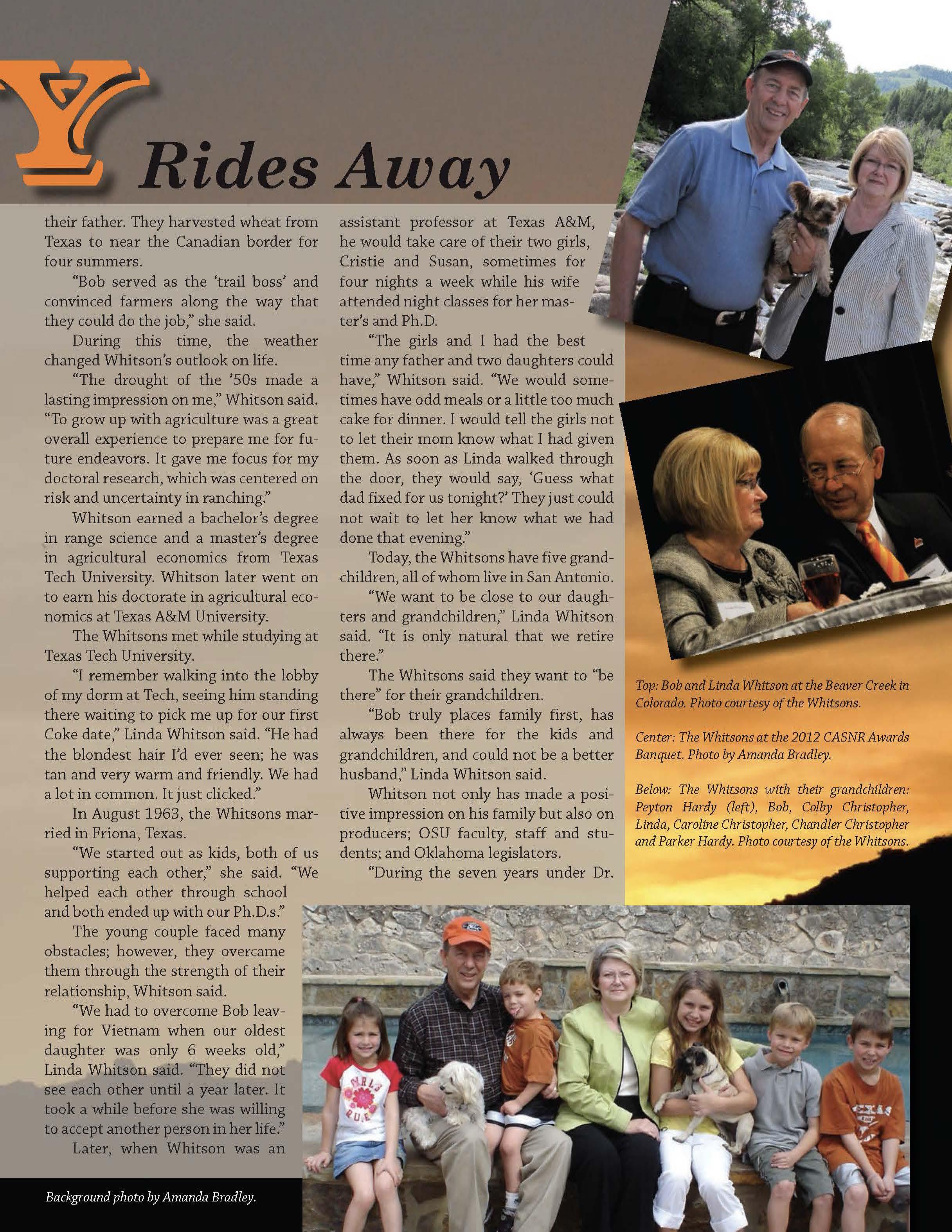
Bob Whitson and his wife, Linda, enjoy a visit by Theta Pond. Photo by Chasity Beas/er.
Rides Away
their father. They harvested wheat from Texas to near the Canadian border for four summers.
"Bob served as the 'trail boss' and convinced farmers along the way that they could do the job;' she said.
During this time, the weather changed Whitson's outlook on life.
"The drought of the '50s made a lasting impression on me;' Whitson said. "To grow up with agriculture was a great overall experience to prepare me for future endeavors. It gave me focus for my doctoral research, which was centered on risk and uncertainty in ranching!'
Whitson earned a bachelor's degree in range science and a master's degree in agricultural economics from Texas Tech University. Whitson later went on to earn his doctorate in agricultural economics at Texas A&M University.
The Whitsons met while studying at Texas Tech University.
"I remember walking into the lobby of my dorm at Tech, seeing him standing there waiting to pick me up for our first Coke date;' Linda Whitson said. "He had the blondest hair I'd ever seen; he was tan and very warm and friendly. We had a lot in common. It just clicked."
In August 1963, the Whitsons married in Friona, Texas.
"We started out as kids, both of us supporting each other;' she said. "We helped each other through school and both ended up with our Ph.D.s:'
The young couple faced many obstacles; however, they overcame them through the strength of their relationship, Whitson said.
"We had to overcome Bob leaving for Vietnam when our oldest daughter was only 6 weeks old;' Linda Whitson said. "They did not see each other until a year later. It took a while before she was willing to accept another person in her life!'
Later, when Whitson was an
assistant professor at Texas A&M, he would take care of their two girls, Cristie and Susan, sometimes for four nights a week while his wife attended night classes for her master's and Ph.D.
"The girls and I had the best time any father and two daughters could have;' Whitson said. "We would sometimes have odd meals or a little too much cake for dinner. I would tell the girls not to let their mom know what I had given them. As soon as Linda walked through the door, they would say, 'Guess what dad fixed for us tonight?' They just could not wait to let her know what we had done that evening:'
Today, the Whitsons have five grandchildren, all of whom live in San Antonio.
"We want to be close to our daughters and grandchildren;' Linda Whitson said. "It is only natural that we retire there:'
The Whitsons said they want to "be there" for their grandchildren.
"Bob truly places family first, has always been there for the kids and grandchildren, and could not be a better husband;' Linda Whitson said.
Whitson not only has made a positive impression on his family but also on producers; OSU faculty, staff and students; and Oklahoma legislators.
"During the seven years under Dr.
Backgroundphoto by Amanda Bradley.
Below: The Whitsons with their grandchildren: Peyton Hardy (le~), Bob, Colby Christopher, Linda, CarolineChristopher,ChandlerChristopher and ParkerHardy.Photo courtesyof the
Top:Bob and Linda Whitson at the BeaverCreekin Colorado.Photo courtesyof the Whitsons.
Center:The Whitsons at the 2012 CASNRAwards Banquet. Photo by Amanda Bradley.
Whitsons.
Whitson's leadership, we have been able to make significant strides in bringing agriculture to the forefront of this university and throughout the state," said Robert L. Westerman, DASNR assistant vice president for program support.
Jane Fuhlendorf, executive associate for the office of the vice president, said the university's data shows an increase in students in the OSU College of Agricultural Sciences and Natural Resources since Whitson's arrival.
One of the first changes Whitson made was a renovation to Agricultural Hall. He moved the dean's office from the north end of the first floor to the center of the first floor, where he could be in direct contact with students on a daily basis, Fuhlendorf said.
"The excellence in the division's programs has been strengthened through Dr. Whitson's relationship with our commodity groups," said Diana Ward, executive administrative assistant. "Because of him, DASNR and commodity groups established new scholarships and new chair professorships with the division."
Oklahoma Sen. Ron Justice said he appreciates the job Whitson has done.
"Dr. 'v\Thitsonhas impacted my life because of the dedication he has shown to Oklahoma," Justice said. "When you find someone who has that passion in helping other people, it is impressive.
"Dr. Whitson has given me encouragement and has been a mentor in those respects because of the true concern he shows," he said.
Westerman said he admires Whit-
son's ability to communicate with all different kinds of individuals, from clients to faculty and administrative personnel. Whitson treats everyone with respect, Fuhlendorf said. He listens to a variety of ideas and can help push people beyond what they think their limits are.
"Dr. Whitson's No.1 objective is putting Oklahoma agricultural producers first and their success first," said Scott Dewald, president of the Oklahoma Cattlemen's Association. "Understanding the success of the producers is dependent upon what happens at the university, and utilizing our land-grant mission of teaching, research and extension to put our producers at a competitive advantage world,vide is essential."
Whoever assumes Whitson's role has huge boots to filL Dewald said.
"He has come to be the best boss and most amazing person I have had the privilege of knowing," Ward said. "We understand his decision for leaving. I just hate to see him go."
Starting out, Whitson's family depended solely on agriculture; he then became a producer, soldier, extension educator, assistant professor, senior vice president of a bank, administrator, family man of faith, department head, dean and vice president.
"Dr. Whitson's heart is in the right place," said Gary Sherrer, assistant vice president for external affairs. "I admire his priorities - God first, family second and job third."
Whitson said he sees nothing but success for future generations because ag1iculture is so far ahead in caring for and training future agticulturalists.
"I'm going to miss the Cowboy family because of the impact the family atmosphere has left in our lives," v\Thitson said. "We have had so much fun being Cowboys and having the pleasure of getting to know so many people.
"Everyone in the DASNRfamily has made this a great experience."
Chasit_j Beasler
Wellston, Okla.
aboutBob Whitson
1. As a 4-H member in Amarillo, Texas, Bob Whitson was crowned 4-H Wheat King at the Tri-State Fair after having the best grain in the 4- H division.
2. When Whitson is in his vehicle, he loves playing with all the new gadgets and technology.
3. As much as Whitson talks about Jake, you might think he is a grandchild, but really Jake is a Yorkshire terrier. Whitson loves his dog Jake like family.
4. The Whitsons will celebrate their 50th wedding anniversary in August 2013. He said he often wonders how he got so lucky.
5. Whitson's idea of a lake was the stock tank he and his siblings swam in as children.
6. Lt. Whitson served his country during the Vietnam War and was assigned to Advisory Team 37, serving as the Detachment Commander of the team with American advisers to elements of the 23rd Infantry Division, Army of the Republic of Vietnam.
7. While Whitson was an administrator at Texas A&M University, he rode a horse in the grand entry parade during the Houston Livestock Show and Rodeo in 2004.
8. Whitson truly has agriculture in his heart. Literally, a valve in his heart was replaced with a bovine heart valve. He likes to tell everyone it was from a Brahman bull.
Public Relations, Marketing & Design
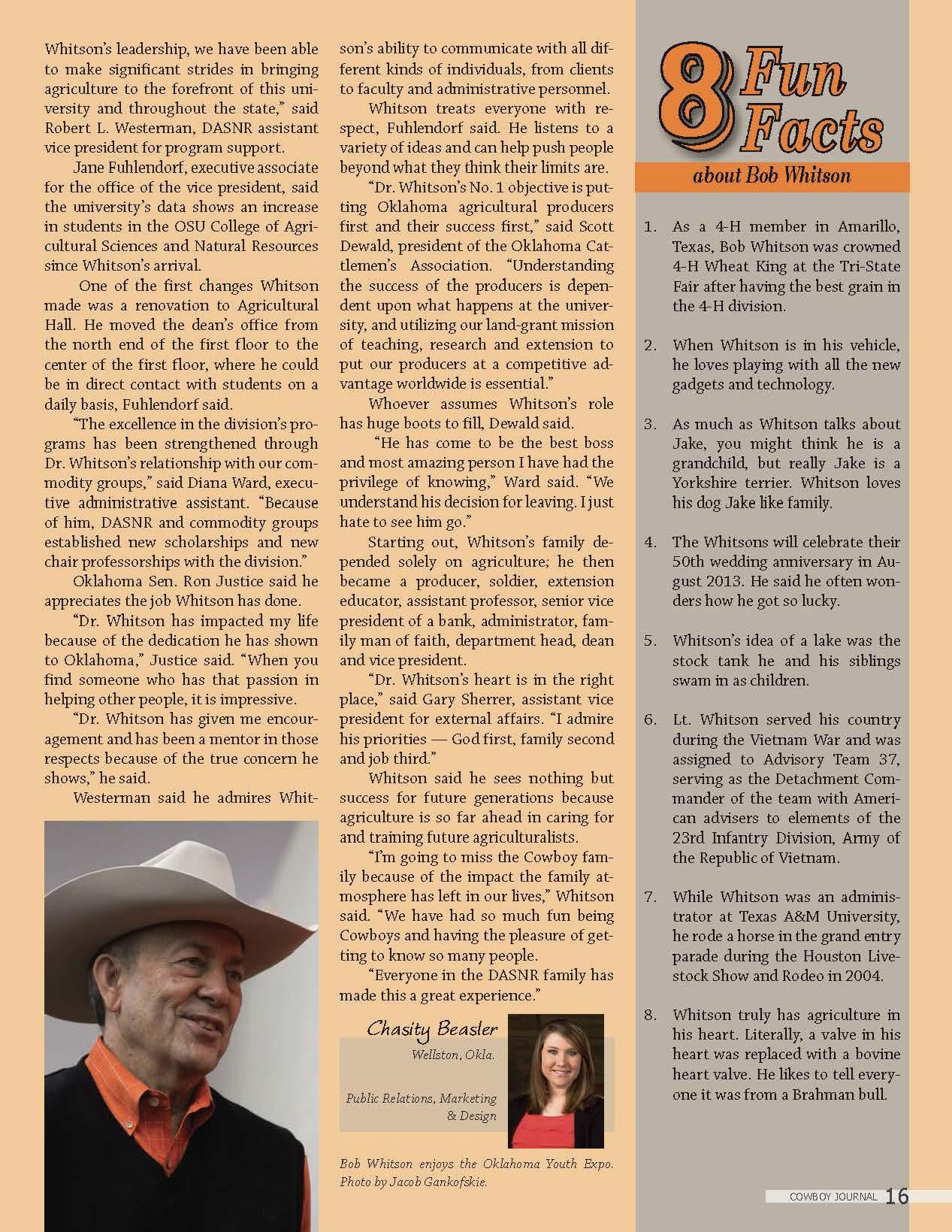
Bob Whitson enjoys the Oklahoma Youth Expo. Photo by Jacob Gankofskie.
.m.
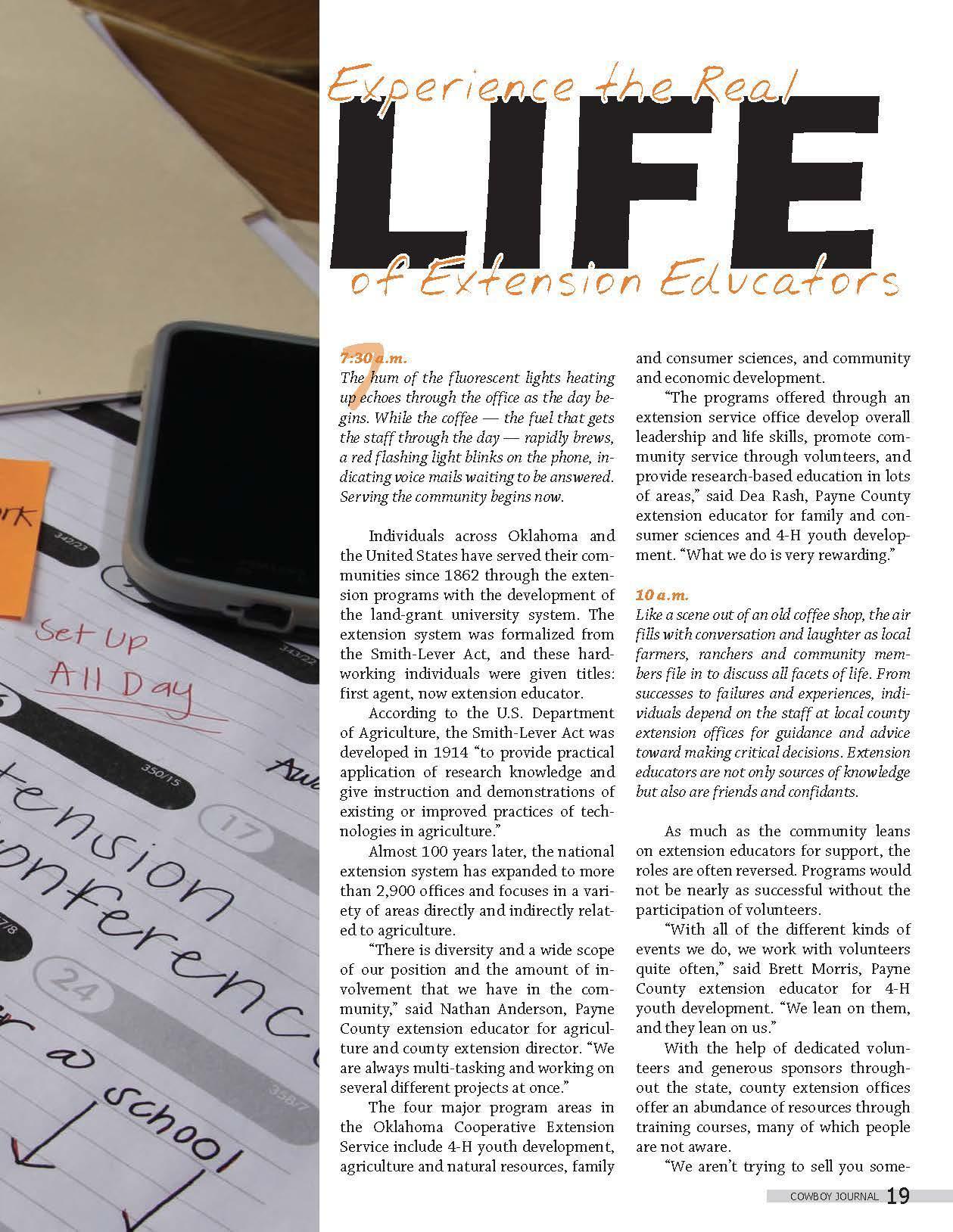
The hum of the fluorescent lights heating up echoes through the office as the day begins. While the coffee - the fuel that gets the staff through the day - rapidlybrews, a red flashing light blinks on the phone, indicatingvoicemails waiting to be answered. Serving the community beginsnow.
Individuals across Oklahoma and the United States have served their communities since 1862 through the extension programs with the development of the land-grant university system. The extension system was formalized from the Smith-Lever Act, and these hardworking individuals were given titles: first agent, now extension educator.
According to the U.S. Department of Agriculture, the Smith-Lever Act was developed in 1914 "to provide practical application of research knowledge and give instruction and demonstrations of existing or improved practices of technologies in agriculture."
Almost 100 years later, the national extension system has expanded to more than 2,900 offices and focuses in a variety of areas directly and indirectly related to agriculture.
"There is diversity and a wide scope of our position and the amount of involvement that we have in the community," said Nathan Anderson, Payne County extension educator for agriculture and county extension director. "We are always multi-tasking and working on several different projects at once."
The four major program areas in the Oklahoma Cooperative Extension Service include 4-H youth development, agriculture and natural resources, family
and consumer sciences, and community and economic development.
"The programs offered through an extension service office develop overall leadership and life skills, promote community service through volunteers, and provide research-based education in lots of areas," said Dea Rash, Payne County extension educator for family and consumer sciences and 4-H youth development. "What we do is very rewarding."
10a.m.
Like a sceneout of an old coffeeshop, the air fills with conversationand laughteras local farmers, ranchers and community members file in to discussall facets oflife. From successesto failures and experiences,individuals depend on the staff at localcounty extension offices for guidance and advice toward making criticaldecisions.Extension educatorsare not only sourcesof knowledge but also are friends and confidants.
As much as the community leans on extension educators for support, the roles are often reversed. Programs would not be nearly as successful without the participation of volunteers.
"With all of the different kinds of events we do, we work with volunteers quite often," said Brett Morris, Payne County extension educator for 4-H youth development. "We lean on them, and they lean on us."
With the help of dedicated volunteers and generous sponsors throughout the state, county extension offices offer an abundance of resources through training courses, many of which people are not aware.
"We aren't trying to sell you some-
thing," Rash said. "We are here to provide neutral, factual information based on research. Extension has so many great programs to offer, so it is important for people to utilize these resources."
In Rash's main focus area of family and consumer sciences, a wide assortment of training is available, ranging from nutrition to time management. These classes are available to community members of all ages and include cooking, canning and customer-service classes.
"What we do is not just involved in production agriculture," Anderson said.
"We aren't just providing information about plows and sows. We also work with shooting sports, safety programs, leadership, health and nutrition, community service projects and finance."
Extension offices now even provide rural and economic development programs that assist community members with financial and business practices. Three extension educators are dedicated to this program area in Oklahoma.
"This is such a unique program area," said Suzette Barta, Payne County extension educator for rural and economic
development. "There was nothing really developed for the position when I began, which was challenging but rewarding because I could base the programming around the specific needs of my county."
Like other extension program areas, rural development strives to provide affordable, informational training to better the community by stimulating the county's economy.
"One of the new programs that we have implemented is the Youth Entrepreneur Expo," Barta said. "Participants between 11 and 20 years old who already have their own businesses can come and display their business ideas in a booth and be judged by successful business owners in the community."
Noon
The clockchimesnoon,indicatinglunchtime and a breakfrom the hustle and bustleof the day. But for many extension educators,this sound just means another hour passing by. The lunch hour might bring the rareopportunity to go out to eat, but in many cases, luneh meanseating on the road,snackingat their desks whilecatchingup on other tasks, or being too busy to even eat at all.
Lunch plans are not the only unpredictable portion of an extension educator's day.
While some aspects are pre-planned
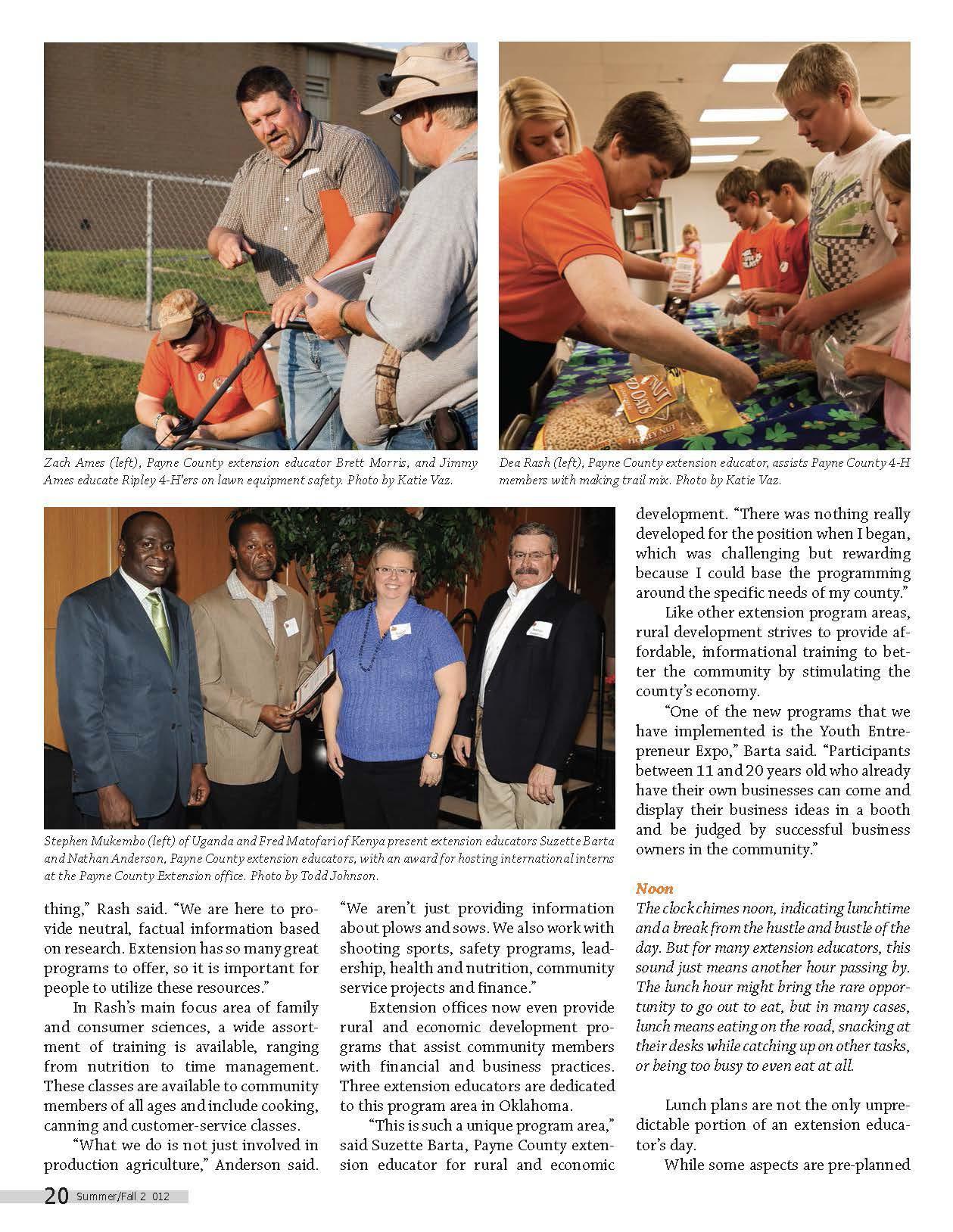
Zach Ames (left), Payne County extension educator Brett Morris, and Jimmy Ames educate Ripley 4-H'ers on lawn equipment safety. Photo by Katie Vaz.
Dea Rash (left), Payne County extension educator, assists Payne County4-H members with making trail mix. Photo by Katie Vaz.
Stephen Mukembo (left) of Uganda and Fred Matofari of Kenya present extension educators Suzette Barta and Nathan Anderson, Payne County extension educators, with an award for hosting international interns at the Payne County Extension office. Photo by Todd Johnson.
and expected, the position is ever-changing, with no two days ever the same.
"One of the beauties of the job is that it is not repetitious," Anderson said. "Each day brings different things."
Sometimes you have no idea what you are going to have to answer throughout the day, he said.
"You would be surprised at some of the questions that we receive and are more than willing to answer," Rash said.
"We are really flexible," she said. "The holidays are especially a busy time, and we get lots of questions from how to cook a turkey to canning to food in the freezer being safe after the elect1icity has gone out."
With the variety of questions extension offices receive, educators may not have all the answers immediately, but they will go to whatever measures necessary to find an answer or solution.
"We can't be everything to everyone, but we sure try," Anderson said. "If we don't have the answer right away, we make sure to contact someone who does have the answer."
6p.m.
The extension office is now silent after yet another busy day of helpingpeople. The office has assisted both peoplefrom the community and across the state of Okl.ahoma. However,though the office might be vacant and standard working hours have concluded, often the work is not done for the day.
"This is definitely not an 8-to-5 job," Rash said. "After a day spent at the office, you could have multiple meetings throughout the county, and you may not be done until 9 p.m. It's just part of the job, and you work until the work is done."
These extended hours are not always a daily occurrence for an extension educator, but the job can be extended into weekend even ts, as well.
"Alot of 4-H events are held on Saturday mornings because it is considered an extracurricular activity that shouldn't interfere with school," Morris said.
4- H also offers an abundance of leadership camps and conferences that occur over the duration of a few days, and extension educators often are asked
to serve as chaperones for these trips and activities.
"When you chaperone these events, you are working in your sleep, too," Morris said. "Even when you are sleeping, you are on watch because the delegates are your responsibility."
As much as duties of extension educators seem overwhelming, it does not seem like work when you are passionate about what you do, Anderson said.
"Yes,you might work 80 to 90 hours in one week, but it is worth it when you are doing what you love," Anderson said.
"The greatest satisfaction of it all is knowing you are helping people and somehow making a difference in their lives," he said. "That is what we strive to do every day."
Galt, Calif
YOUNG,BEGINNINGANDSMALLFARMERPROGRAM
Farm Credit of East Central Oklahoma'sYBS Program makes a concerted and cooperative effort to finance young, beginning and small farmers, ranchers and producers or harvesters of aquatic products. The Association maximizes efforts to coordinate with other associations, non-wstem lenders, g agencies, co-signers and other guarantors to develop and/or provide joint financing.
Public Relations &Marketing
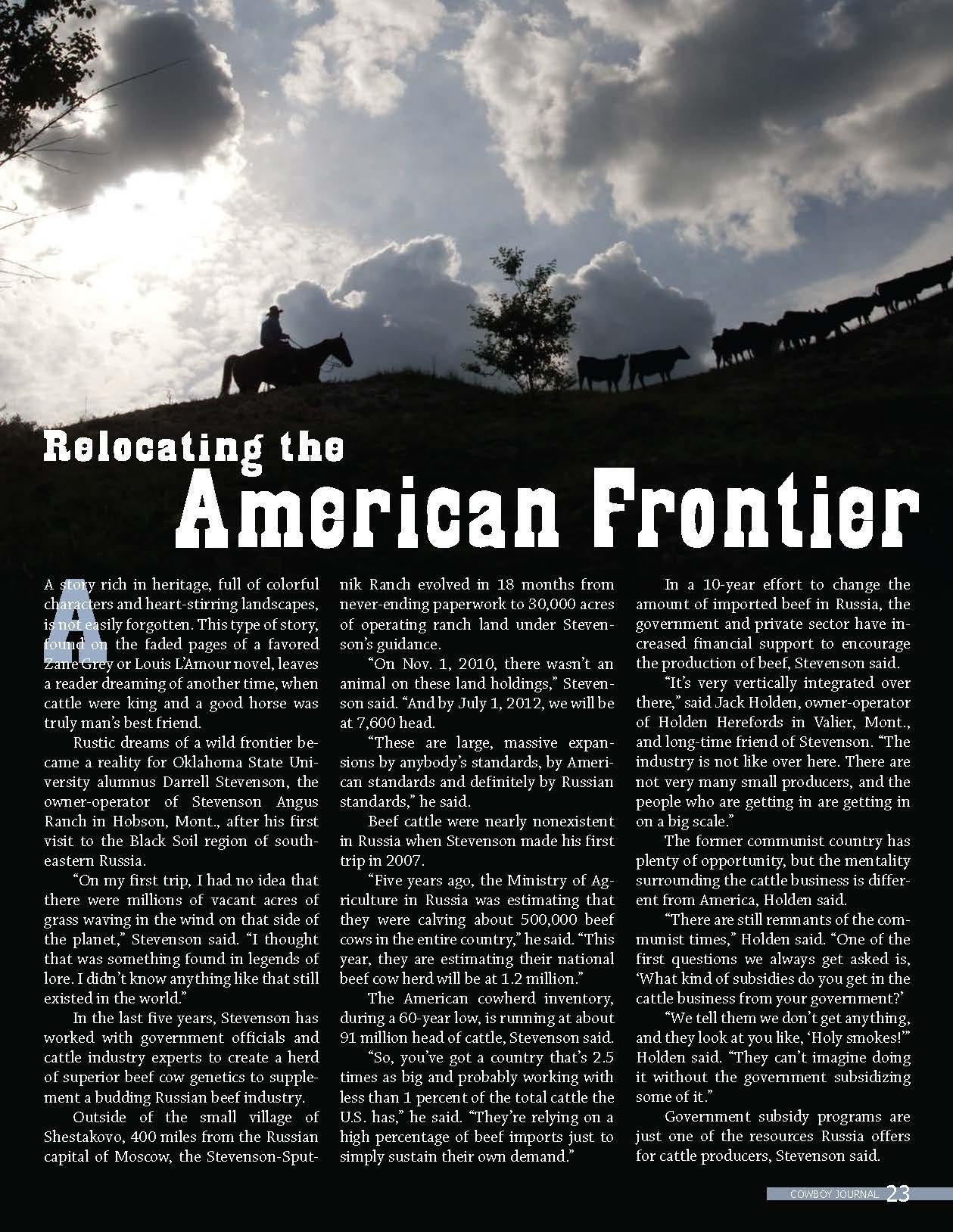
"They've got a vast amount of natural resources," Stevenson said. "They have unbelievable investor interest, both from the banking sector, which is willing to actually invest in upstart programs, and from government subsidy programs. Land is open and available to be put into agricultural production."
The "perfect recipe" for beef production was sitting in Russia, waiting for someone to come along and combine the ingredients, he said.
"They just needed some assistance in the establishment of the whole line of production, starting with the seedstock sector," Stevenson said. "I'm not saying I need to be involved in every segment of the industry, but nobody had really stepped in and shown leadership to really one segment, let alone all of them."
Stevenson Angus and Holden Herefords provides quality genetics to their customers, a key factor for the expanding Russian beef industry, Holden said.
"The reason the first unit was started was to establish a core nucleus herd of breeding cattle to supply good beef cattle genetics within the country of Russia," Stevenson said.
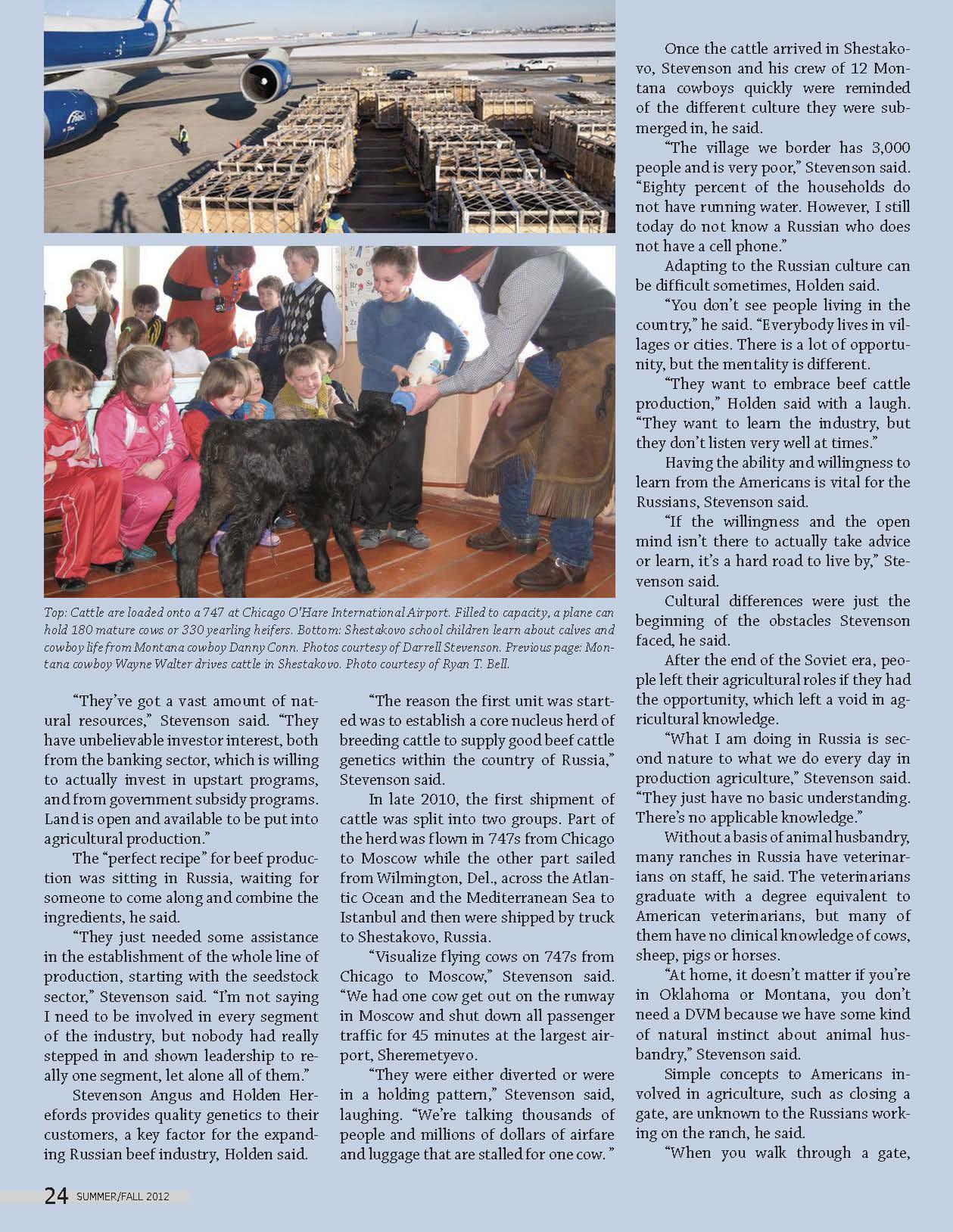
In late 2010, the first shipment of cattle was split into two groups. Part of the herd was flown in 747s from Chicago to Moscow while the other part sailed from Wilmington, Del., across the Atlantic Ocean and the Mediterranean Sea to Istanbul and then were shipped by truck to Shestakovo, Russia.
"Visualize flying cows on 747s from Chicago to Moscow," Stevenson said. "We had one cow get out on the runway in Moscow and shut down all passenger traffic for 45 minutes at the largest airport, Sheremetyevo.
"They were either diverted or were in a holding pattern," Stevenson said, laughing. "We're talking thousands of people and millions of dollars of airfare and luggage that are stalled for one cow. "
Once the cattle arrived in Shestakovo, Stevenson and his crew of 12 Montana cowboys quickly were reminded of the different culture they were submerged in, he said.
"The village we border has 3,000 people and is very poor," Stevenson said. "Eighty percent of the households do not have running water. However, I still today do not know a Russian who does not have a cell phone."
Adapting to the Russian culture can be difficult sometimes, Holden said.
"You don't see people living in the country," he said. "Everybody lives in villages or cities. There is a lot of opportunity, but the mentality is different.
"They want to embrace beef cattle production," Holden said with a laugh. "They want to learn the industry, but they don't listen very well at times."
Having the ability and willingness to learn from the Americans is vital for the Russians, Stevenson said.
"If the willingness and the open mind isn't there to actually take advice or learn, it's a hard road to live by," Stevenson said.
Cultural differences were just the beginning of the obstacles Stevenson faced, he said.
After the end of the Soviet era, people left their agricultural roles if they had the opportunity, which left a void in agricultural knowledge.
"What I am doing in Russia is second nature to what we do every day in production agriculture," Stevenson said. "They just have no basic understanding. There's no applicable knowledge."
Without a basis of animal husbandry, many ranches in Russia have veterinarians on staff, he said. The veterinarians graduate with a degree equivalent to American veterinarians, but many of them have no clinical knowledge of cows, sheep, pigs or horses.
"At home, it doesn't matter if you're in Oklahoma or Montana, you don't need a DVM because we have some kind of natural instinct about animal husbandry," Stevenson said.
Simple concepts to Americans involved in agticulture, such as closing a gate, are unknown to the Russians working on the ranch, he said.
"When you walk through a gate,
Top: Cattle are loaded onto a 747 at Chicago O'Hare International Airport. Filled to capacity, a plane can hold 180 mature cows or 330 yearling heifers. Bottom: Shestakovo school children learn about calves and cowboy life from Montana cowboy Danny Conn. Photos courtesy of Darrell Stevenson. Previous page: Montana cowboy Wayne Walter drives cattle in Shestakovo. Photo courtesy of Ryan T Bell.
what do you do with the gate?" Stevenson said. "You dose the gate, right?
"We can say that five times," Stevenson said. "We can say it until we're blue in the face, but until we walked away and they realized that every time they left that gate open, they would be the ones to chase those cows back into that pasture, they didn't dose the gate. It's those kinds of failures that you allow and set them up for, while still being there for a soft landing, in order to ensure longterm success."
Allowing the Russians to learn through trial and error is not a common policy found on other ranches in Russia.
"I am approaching this completely different than the other investors who are using American managers to run the show," Stevenson said. "I am completely opposite in that I do not believe that the Russians need or deserve to take orders from Americans.
"The Americans are going to leave one day,"he said. "It might be two weeks, two months or two years, but they are going to leave. So, I wanted to have our failures up front and go through all of these growing pains now."
Learning experiences or "growing pains" occur often on the ranch, Stevenson said. However, adjusting a learned routine is not always well received.
"One of my biggest arguments in this whole thing is they want to calve in January and February," Stevenson said. "They've never calved in May, so they don't know the difference.
"Thank God we artificially inseminated everything," Stevenson said jokingly. "For some reason that canister from the U.S.just didn't show up until it was time for April calvers."
With oversight of every part of the ranch's operation, from construction to animal health, Stevenson said he has learned a few good lessons the hard way.
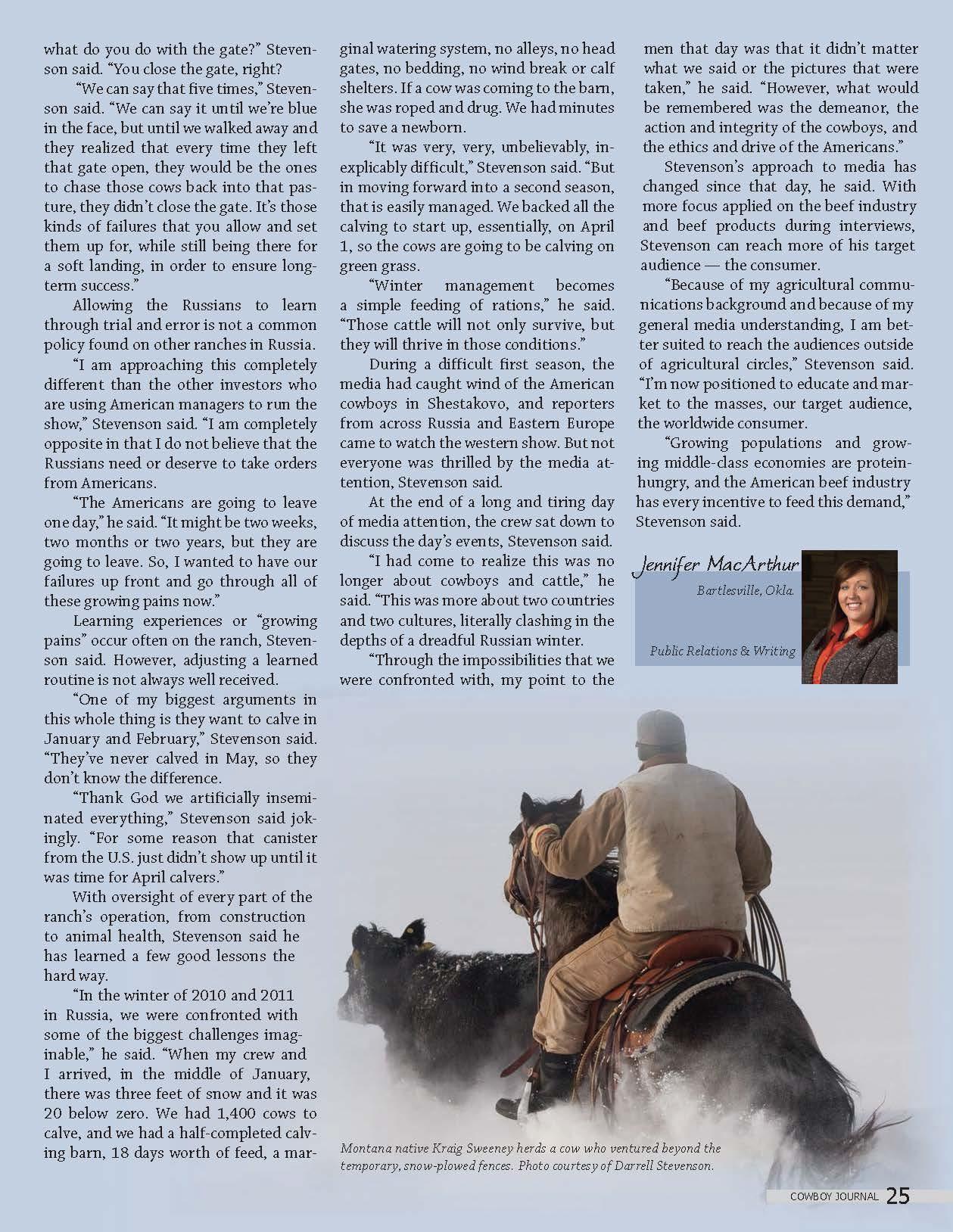
"In the winter of 2010 and 2011 in Russia, we were confronted with some of the biggest challenges imaginable," he said. "When my crew and I arrived, in the middle of January, there was three feet of snow and it was 20 below zero. We had 1,400 cows to calve, and we had a half-completed calving barn, 18 days worth of feed, a mar-
ginal watering system, no alleys, no head gates, no bedding, no wind break or calf shelters. If a cow was coming to the barn, she was roped and drug. We had minutes to save a newborn.
"It was very, very, unbelievably, inexplicably difficult," Stevenson said. "But in moving forward in to a second season, that is easily managed. We backed all the calving to start up, essentially, on April 1, so the cows are going to be calving on green grass.
"Winter management becomes a simple feeding of rations," he said. "Those cattle will not only survive, but they will thrive in those conditions."
During a difficult first season, the media had caught wind of the American cowboys in Shestakovo, and reporters from across Russia and Eastern Europe came to watch the western show. But not everyone was thrilled by the media attention, Stevenson said.
At the end of a long and tiring day of media attention, the crew sat down to discuss the day's events, Stevenson said.
"I had come to realize this was no longer about cowboys and cattle," he said. "This was more about two countries and two cultures, literally clashing in the depths of a dreadful Russian winter.
"Through the impossibilities that we were confronted with, my point to the
men that day was that it didn't matter what we said or the pictures that were taken," he said. "However, what would be remembered was the demeanor, the action and integrity of the cowboys, and the ethics and drive of the Americans." Stevenson's approach to media has changed since that day, he said. With more focus applied on the beef industry and beef products during interviews, Stevenson can reach more of his target audience - the consumer.
"Because of my agricultural communications background and because of my general media understanding, I am better suited to reach the audiences outside of agricultural circles," Stevenson said. "I'm now positioned to educate and market to the masses, our target audience, the worldwide consumer.
"Growing populations and growing middle-class economies are proteinhungry, and the American beef industry has every incentive to feed this demand," Stevenson said.
Jennifer Mt:icA.rthur
Bartlesville, Okla.
Public Relations & Writing
Montana native Kraig Sweeney herds a cow who ventured beyond the temporary, snow-plowed fences. Photo courtesy of Darrell Stevenson.
Whetner a /pastime, an intense sport, a way !t-life or just an enjoyable activity, fishing Rlays a large role in the lives of many Oklanomans.
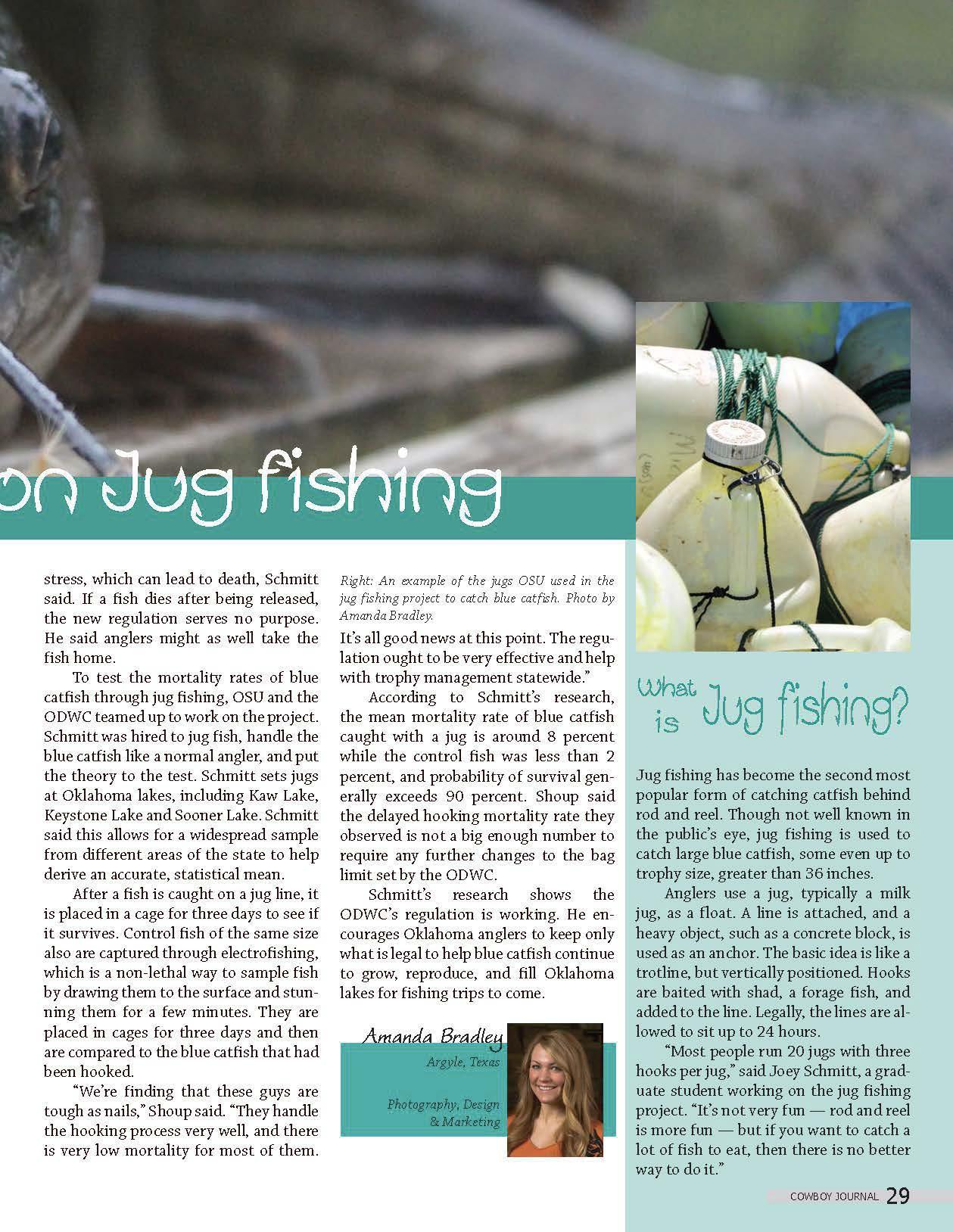
While most use rod and reel, jug fishing allows anglers a unique option. Jug fishermen use a milk jug, a vertical line with hooks attached, and a concrete block to keep the line in place.
The natural resource ecology and management department at Oklahoma State University is conducting research on the sport of jug fishing and how it may affect the mortality rates of blue catfish, a common catch on a jug line.
"There was some research done several years ago by the Oklahoma Department of Wildlife Conservation," said Dan Shoup, associate professor of fisheries at OSU, who leads the project. "They looked at the growth rates of blue catfish and found that a lot of the fish grow very slowly. Only a small percentage of the population grows fast enough to reach trophy size."
The research shows some blue catfish are not as big as they used to be and are not living ll,,.,.,"..., __ .., long enough to grow to trophy size. Since
the blue catfish are harvested too soon, the ODWC implemented new regulation in 2010, limiting anglers to keeping one fish longer than 30 inches per day, said Joey Schmitt, a master of science student working with Shoup on the project.
"Based on fish management, this ought to work well," Shoup said. "We know big fish occur, but they are rare. There was a lot of concern that we could over fish the trophy-size class because so few of them make it that big. When we harvest big fish, the genetics that code for that size are gone, as well."
For a blue catfish to have future growth potential, it has to survive the release from the jug line.
"This management strategy will only be successful if a large number of released fish survive to further contribute to the population," Schmitt said. "Oklahoma law allows fishermen to leave their jug lines and trotlines unattended for up to 24 hours, which means hooked catfish could feasibly be struggling for the en tire 24 hours."
This continual struggle increases
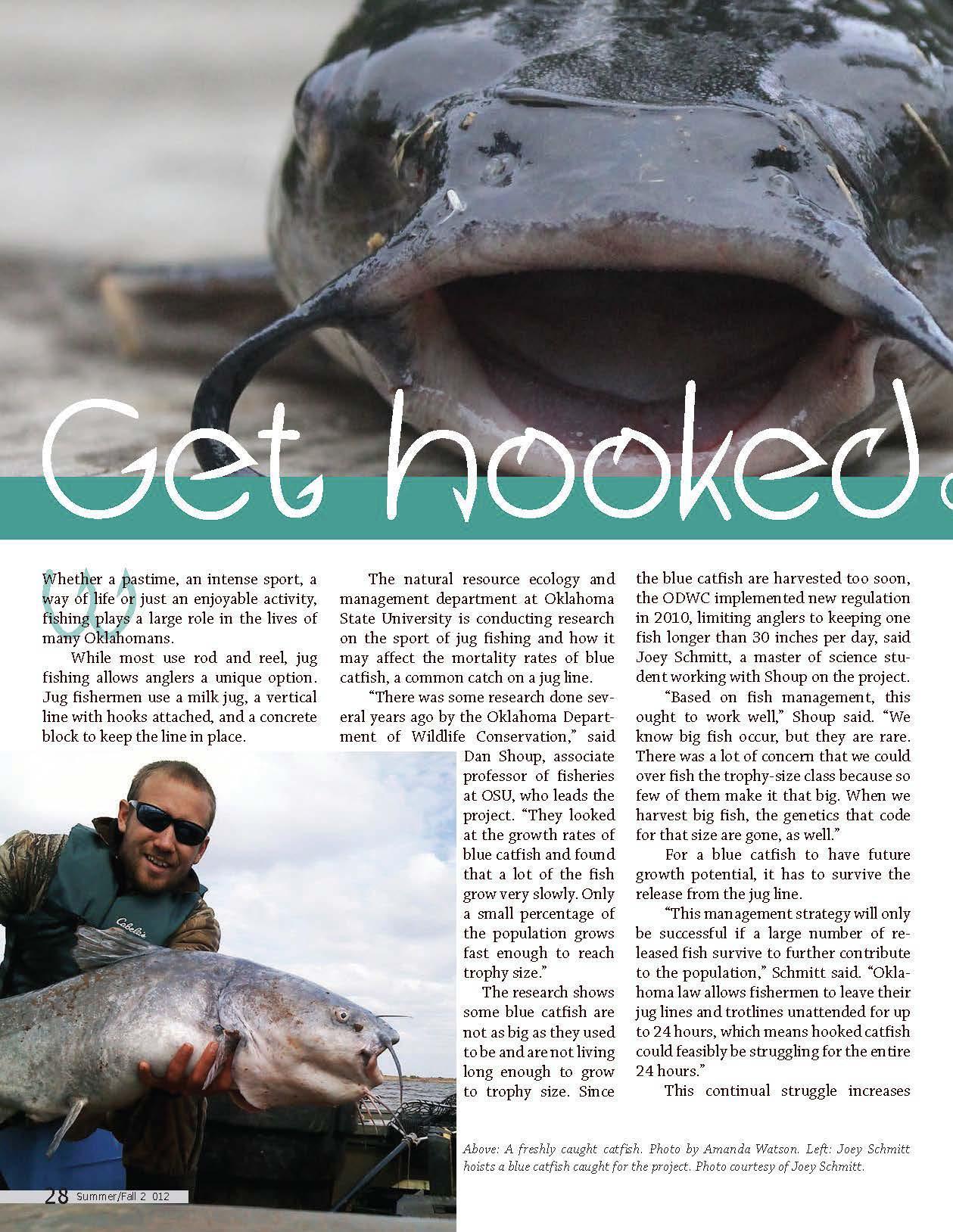
Above: A freshly caught catfish. Photo by Amanda Watson Le~: Joey Schmitt hoists a blue catfish caught for the project. Photo courtesy of Joey Schmitt.
stress, which can lead to death, Schmitt said. If a fish dies after being released, the new regulation serves no purpose. He said anglers might as well take the fish home.
To test the mortality rates of blue catfish through jug fishing, OSU and the 0 DWCteamed up to work on the project. Schmitt was hired to jug fish, handle the blue catfish like a normal angler, and put the theory to the test. Schmitt sets jugs at Oklahoma lakes, including Kaw Lake, Keystone Lake and Sooner Lake. Schmitt said this allows for a widespread sample from different areas of the state to help derive an accurate, statistical mean.
After a fish is caught on a jug line, it is placed in a cage for three days to see if it survives. Control fish of the same size also are captured through electrofishing, which is a non-lethal way to sample fish by drawing them to the surface and stunning them for a few minutes. They are placed in cages for three days and then are compared to the blue catfish that had been hooked.
"We're finding that these guys are tough as nails," Shoup said. "They handle the hooking process very well, and there is very low mortality for most of them.
It's all good news at this point. The regulation ought to be very effective and help with trophy management statewide."
According to Schmitt's research, the mean mortality rate of blue catfish caught with a jug is around 8 percent while the control fish was less than 2 percent, and probability of survival generally exceeds 90 percent. Shoup said the delayed hooking mortality rate they observed is not a big enough number to require any further changes to the bag limit set by the ODWC.
Schmitt's research shows the ODWC's regulation is working. He encourages Oklahoma anglers to keep only what is legal to help blue catfish continue to grow, reproduce, and fill Oklahoma lakes for fishing trips to come.
Photography,Design &Marketing
Jusfishins?
Jug fishing has become the second most popular form of catching catfish behind rod and reel. Though not well known in the public's eye, jug fishing is used to catch large blue catfish, some even up to trophy size, greater than 36 inches.
Anglers use a jug, typically a milk jug, as a float. A line is attached, and a heavy object, such as a concrete block, is used as an anchor. The basic idea is like a trotline, but vertically positioned. Hooks are baited with shad, a forage fish, and added to the line. Legally,the lines are allowed to sit up to 24 hours.
"Most people run 20 jugs with three hooks per jug," said Joey Schmitt, a graduate student working on the jug fishing project. "It's not very fun - rod and reel is more fun - but if you want to catch a lot of fish to eat, then there is no better way to do it."
Right: An example of the jugs OSU used in the jug fishing project to catch blue catfish Photo by Amanda Bradley.
Learning the
Som p>lks are born Cowboys, predestin to bleed orange from birth, while other re enticed by stories from those Li ain loyal and true. Others come to Cowboy Country to fulfill a lifelong dream - a dream of walking the steps of Agricultural Hall, cheering in a sea of orange, and singing the alma mater hymn at graduation - knowing they have succeeded in becoming a Cowboy forever. Whatever the reason, they have come to learn the Cowboy culture.
"There is a process of earning your spurs as a student in the College of Agricultural Sciences and Natural Resources," said Rob Terry, department head for the Department of Agricultural Education, Communications and Leadership. "Expectations are that new Cowboys embody the old west cowboy image of having a sunup to sundown work ethic, shooting straight, and living with a passion for what they value and believe in."
CASNRis equipped with faculty and staff to help students create an organized career plan to achieve their goals.
"There is an outwardness to the way the university and our college approaches things," said Steve Damron, interim assistant dean of academic programs. "It's very optimistic and it's forward thinking. It's such a positive view of the world and helping people find a place in it."
So, how do you find your place in the world of CASNR?
Follow these informed steps to guide you through your journey and make the most of the opportunities available through CASNR.
Get involved.
"The CASNR Round-Up each August is one of the best ways new students can see all of our student organizations, how our upperclassmen are involved and roles they can be involved in," said Cas-
siDe Street, CASNR prospective student services coordinator.
"We encourage students to join two organizations starting out, a social one and a professional one. That way, they're not too overwhelmed and time management skills can be developed."
With more than 35 student organizations available in CASNR, you have several options to find your perfect fit.
"Our student organizations develop students' interpersonal and employability skills and teach them how to expand their networks," said Amy Gazaway, CASNR career development coordinator.
Students are encouraged to get involved quickly.
"I ran for an officer position at the first [Agricultural Communicators of Tomorrow] meeting I went to and got elected," said Andy Barth, a transfer student from Washington majoring in agricultural communications. "The orga-
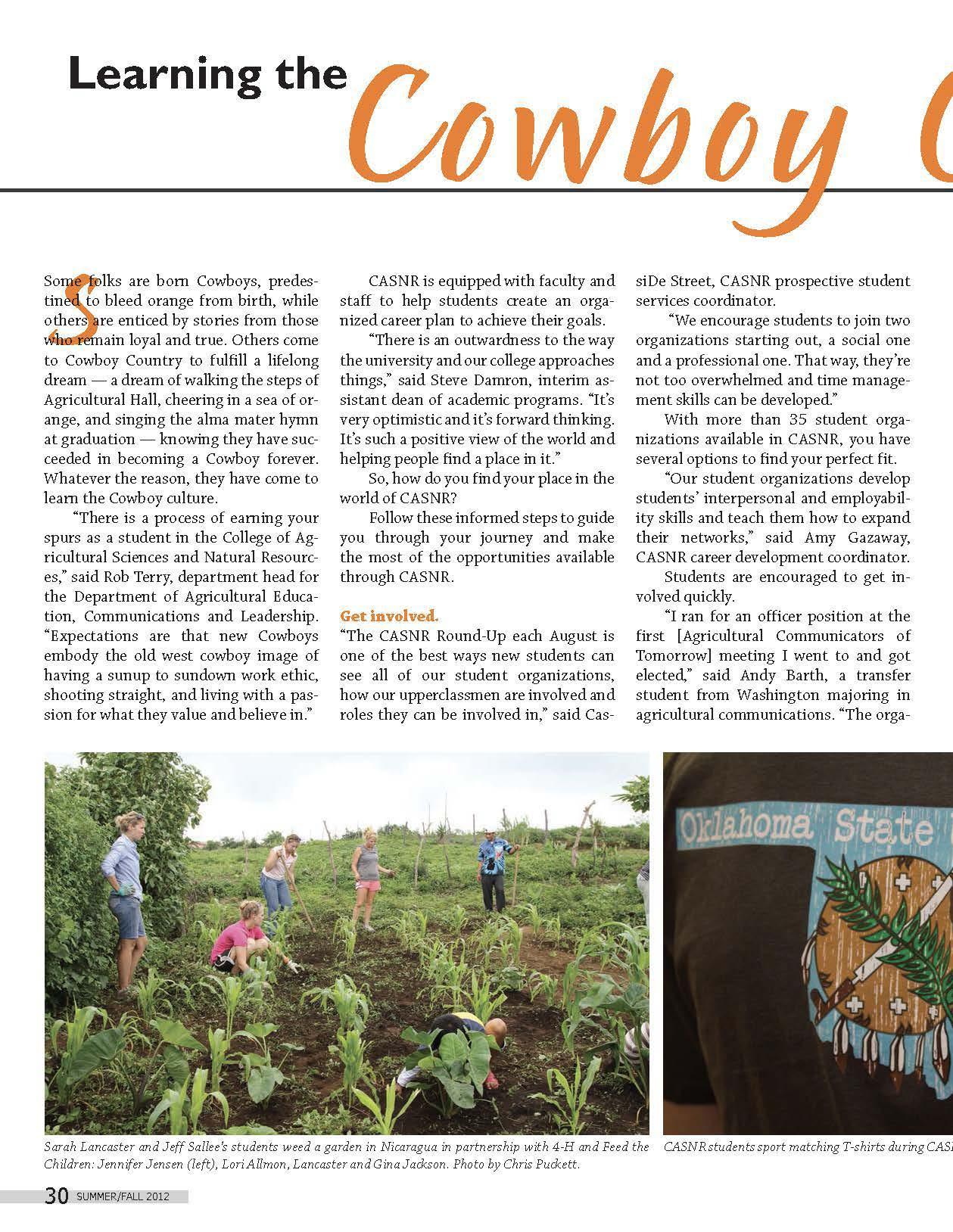
Sarah Lancaster and Jeff Sallee's students weed a garden in Nicaragua in partnership with 4-H and Feed the CASNRstudents sport matching T-shirts during CASi Children: Jennifer Jensen (left), Lori Allmon, Lancaster and Gina Jackson. Photo by Chris Puckett.
re
A Survival Guide for New Cowboys on the Block
nizations I'm involved in have helped me meet contacts not only in the college but also with future employers."
Regardless of your interests or your hometown, the CASNR student organizations can help you find your niche and build your resume.
Prioritize.
The college clock ticks quickly.
"Students should make sure they balance their extracurricular activities with their coursework," said Joe Schatzer, a professor of agricultural ecomomics.
"Scheduling time to complete homework should take priority over extracurricular activities," he said.
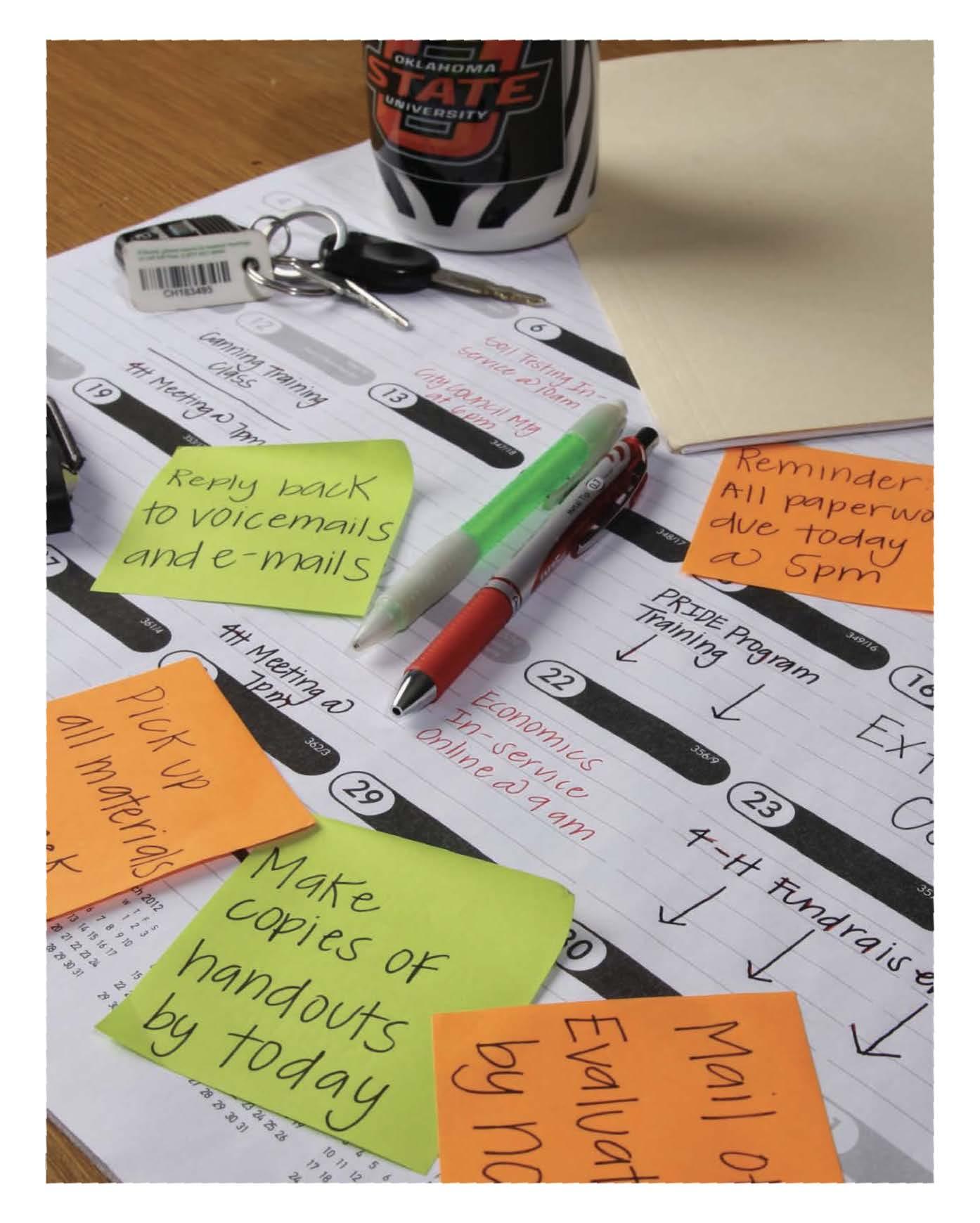
Students learn to prioritize their time using planners and calendars.
"Buy a Mortar Board calendar and prioritize every thing you need to do," said Kyle Pingleton, an entomology/zoology sophomore. "Time management is
a huge key to success in college."
Aside from planning your schedule, prioritizing your goals is an important step in determining what will make you happy after graduation.
"Getting on the track to follow your bliss is first and foremost," Damron said. "It makes everything else irrelevant, and it brings our goals into very clear and sharp focus for us."
Get to know your professors.
"Our faculty are great at getting to know our students as well as their career goals," Street said.
Professors can help students make decisions that will affect them for the rest of their lives.
"I have always focused on being in the moment when students ask for my presence," Damron said. "Being an effective faculty member is being honest about the paths students are heading
down. It's their decision to stay with it or pick another one, but it's my obligation to point out what I'm seeing."
Know the Student Success Center. When selecting a major, many students ask, "What can I do with this degree?"
The Student Success Center staff in 103 AGH explores the options to help students make informed decisions.
"It's not 'what can you do with a degree,'" Gazaway said. "It's 'what do you want to do with your degree.'"
The expanding agricultural industry creates options beyond traditional fields.
"Employers often contact CASNR to find future employees," Gazaway said.
"Create a resume and bting it in for a critique," Gazaway continued. "Then develop a career plan of action and start looking for an internship. Experience is critical to being competitive as a college graduate if you're wanting a job."
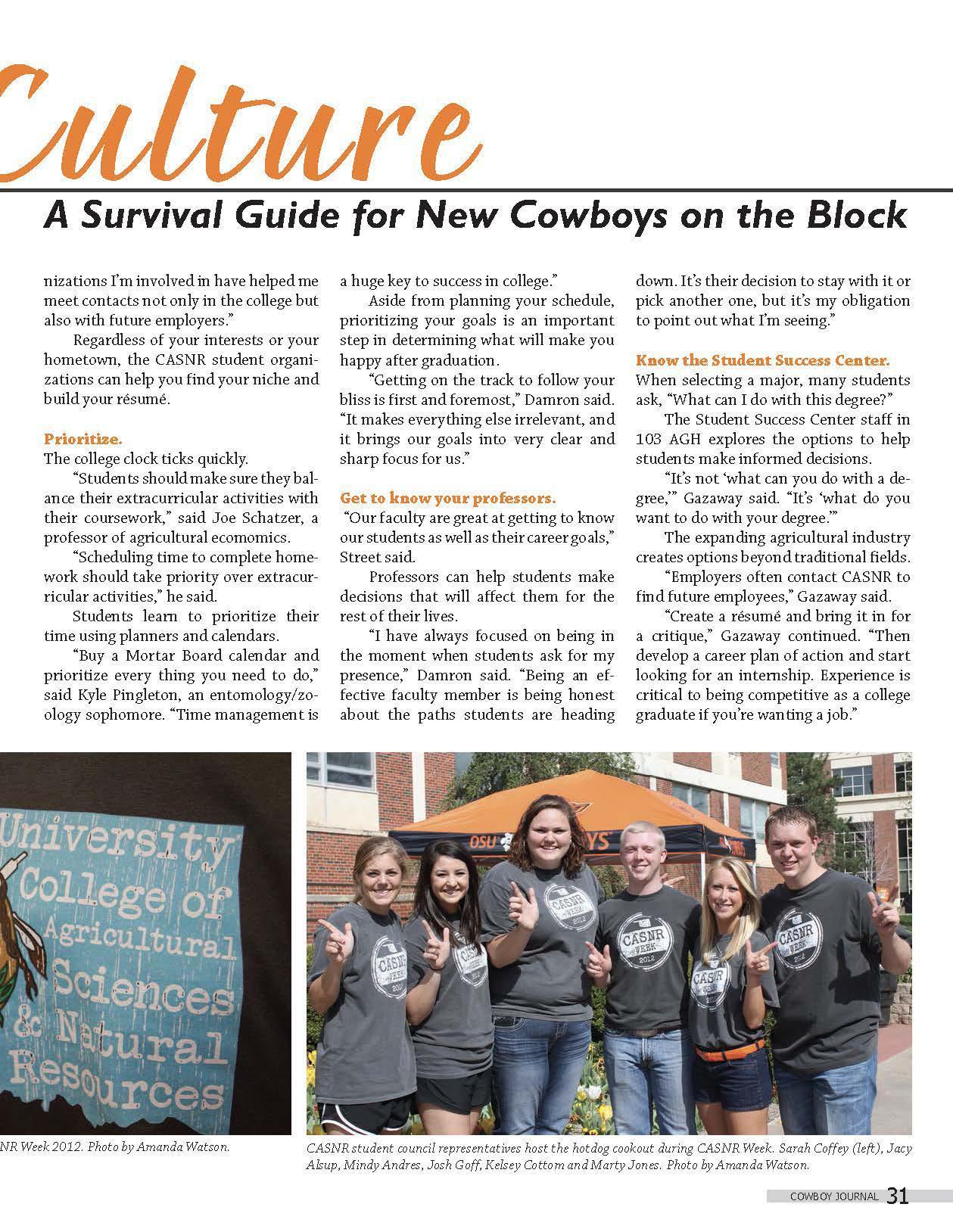
NR Week 2012. Photo by Amanda Watson. CASNRstudent council representatives host the hotdog cookout during CASNR Week. Sarah Coffey (left), Jacy Alsup, Mindy Andres, Josh Goff, Kelsey Cottom and Marty Jones. Photo by Amanda Watson.
graduate if you're wanting a job."
The CASNR fall and spring career fairs are opportunities for employers and students to connect and network on the OSU campus. Having a polished resume helps students look more professional.
"I had my resume critiqued several times," said Robby Branscum, an agricultural education and animal science junior. "It made it much more professional looking to give employers at the career fair."
Attend the sporting events.
Pistols firing, arms waving and Bullet racing across the field are just a few high-
sphere of uniting and becoming one," Pingleton said. "The camaraderie of it is just outstanding. You are having fun while supporting your team, and you're learning part of the OSU tradition."
Mingling with students from across campus is a proven way to experience the culture and traditions that bond the entire university.
"It's a Saturday when you have 50,000 to 60,000 people in orange screaming," Branscum said. "It's the craziest down in the student section. I guess those Saturdays are when I'm most proud to be a Cowboy."
lights of the Cowboy Nation sporting Go global. events that bring out the loyal and true In every major, several opportunities spirit for which OSU fans are known. exist for students to study abroad to gain
"Before the game, we walked down international experience. Hall of Fame in front of the stadium and "An international experience is an it blew my mind," Barth said. "It's like a important part of the CASNR culture,"
around the world.
"The only way to understand what is needed in another country is to go there," Lancaster said. "It doesn't matter where you go - just get out and experience life in another culture. You'll be surprised how much you learn about yourself in the process."
Students can choose what type of international credit they want to earn.
"I wanted to get my international credit by helping others," said Lori Allmon, agricultural communications junior. "I spent a week in Nicaragua, and we were able to make a big difference in the community of El Crucero by building an agricultural outreach center and teaching the people how to plant gardens, bake bread and sustain a chicken coop. My international experiences allowed me to grow as an individual."
midway in front of the Stadium. I can- said Sarah Lancaster, assistant professor Enjoy your time at OSU. not wait every year for football season to of plant and soil sciences.
"As leaders in the field of agriculture Damron said. "You get sort of a reprieve
"Four years in college is such a gift," come around."
This excitement is felt by students and natural resources, our students have on adulthood where you get to spend all throughout Boone Pickens stadium. a responsibility to use their knowledge of your time and • n working o
"Sp ti create an atmo- to improve the quality of life for people your approac our li
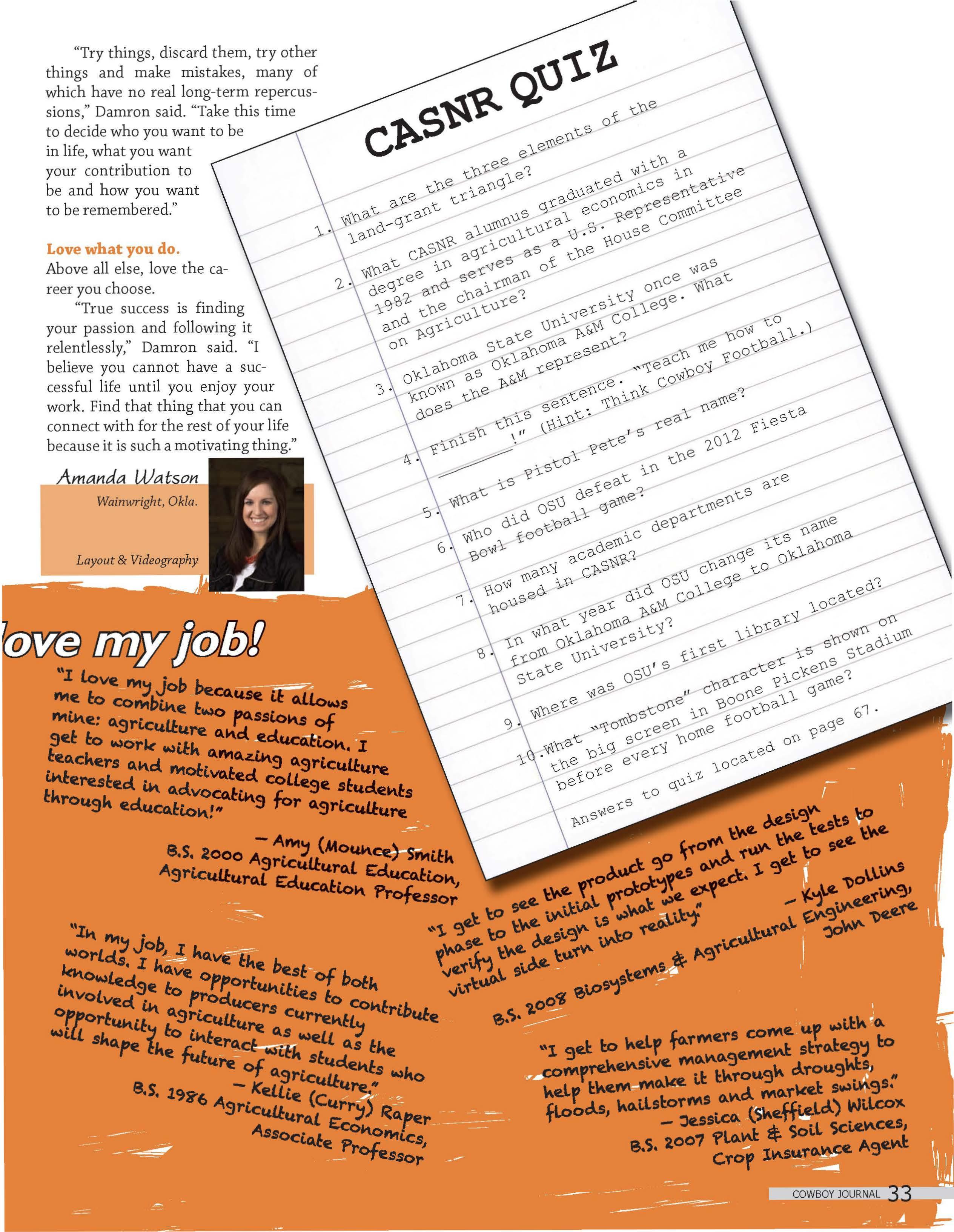
• discard t em, h try other "Try thmgs, k many of ke m1sta es, things and ma 1 1 -term repercus- h o rea ong . which ave n .d "Take this time
• " Damron sa1 s10ns, h want to be to decide w o you in life, what yo~ want our contribut10n to y d how you want be an d" to be remembere .
hat you do. Love w love the ca- Above all else,
reer you choose. s is finding "True succes ·t
• n and followmg 1 ass10 ·d "I your P ,, Damron sa1 relentlessly, have a suecannot believe you ·1 eni·oy your 1 l .f unt1 you cessfu i e h' g that you can work. Find that t hm t of your life
• h for t e res " connect wit h otivating thmg.
• • sue am because it is
Wainwright, Okla.
Amanda Watson
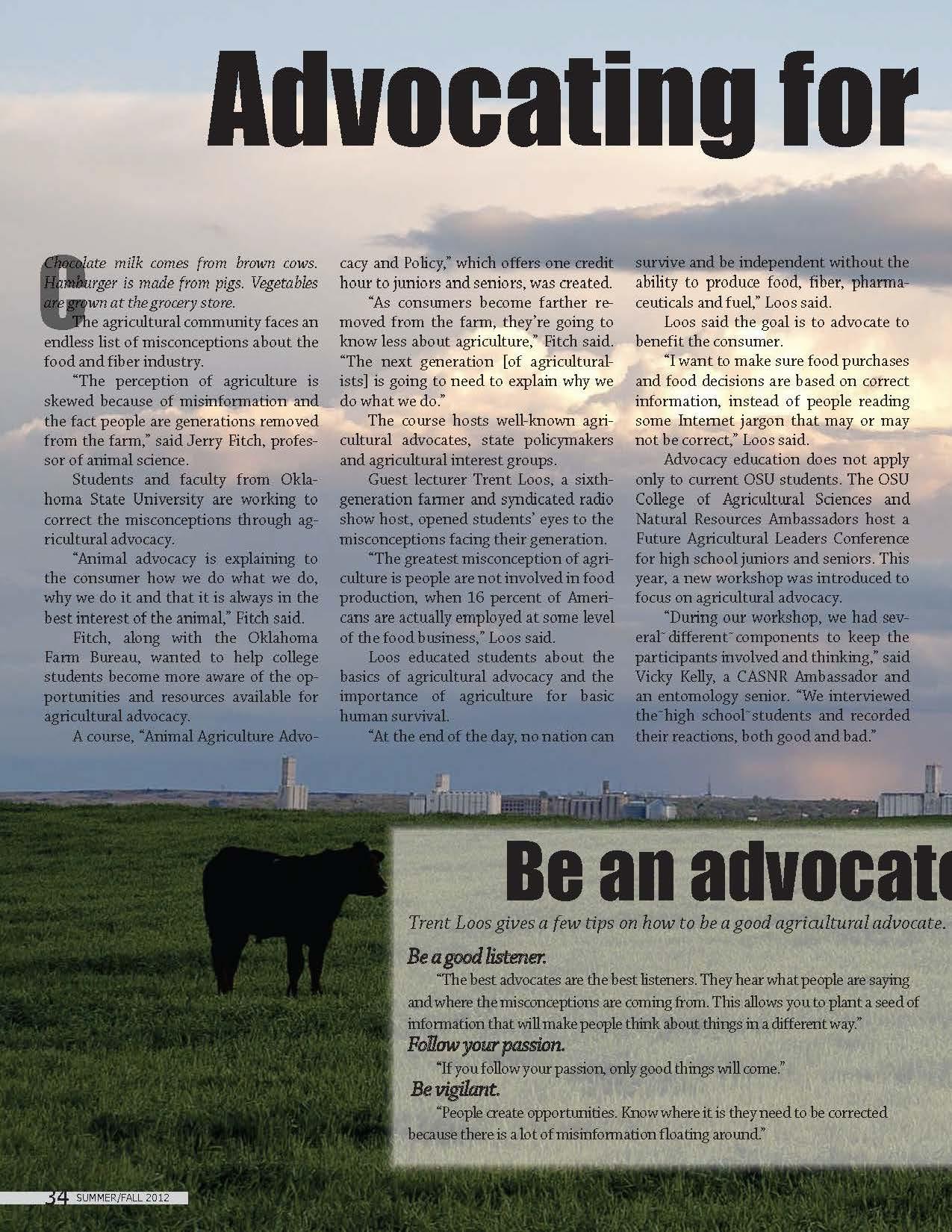
Advocatingtor
te milk comes from brown cows.
erger is made from pigs. Vegetables wn at the grocerystore.
e agricultural community faces an endless list of misconceptions about the food and fiber industry.
"The perception of agriculture is skewed because of misinformat-ion and the fact people are generations removed from the farm," said Jerry Fitch, professor of animal science.
Students and faculty from Oklahoma State University are working to correct the misconceptions th rough agricultural advocacy.
"Animal advocacy is explaining to the consumer how we do what we do, why we do it and that it is always in the best interest of the animal,"' Fitch said.
Fitch, along with the Oklahoma Farm Bureau, wanted to help college students become more aware of the opportunities and resources available for agricultural advocacy.
A course, "AnimalAgricultureAdvo-
cacy and Policy,"which offers one credit hour to juniors and seniors, was created.
"As consumers become farther removed from the farm, they're going to know less about agriculture," Fitch said.
"The next generation [of agriculturalists] is going to need to explain why we do what we do."
The course hosts well-known agricultural advocates, state policymakers and agricultural interest groups.
Guest lecturer Trent Loos, a sixthgeneration farmer and syndicated radio show host, opened students' eyes to the misconceptions facing their generation.
"The greatest misconception of agriculture is people are not involved in food production, when 16 percent of Americans are actually employed at some level of the food business," Loos said.
Loos educated students about the basics of agricultural advocacy and the importance of agriculture for basic human survival.
"At the end of the day, no nation can
survive and be independent without the ability to produce food, fiber, pharmaceuticals and fuel," Loos said.
Loos said the goal is to advocate to benefit the consumer.
"I want to make sure food purchases and food decisions are based on correct information, instead of people reading some Internet jargon that may or may not be correct," Loos said.
Advocacy education does not apply only to current OSU students. The OSU College of Agricultural Sciences and Natural Resources Ambassadors host a Future Agricultural Leaders Conference for high school juniors and seniors. This year, a new workshop was introduced to focus on agricultural advocacy.
"During our workshop, we had several~different~ components to keep the participants involved and thinking," said Vicky Kelly, a CASNR Ambassador and an entomology senior. "We interviewed the-high school-students and recorded their reactions, both good and bad."
Beanadvoca11
Trent Loos gives a few tips on how to be a good agricultural advocate. Beagoodlistener.
"The best advocates are the best listeners.They hear what people are saying and where the misconceptions are comingfrom. This allowsyou to plant a seed of information that willmake people think about things in a different way."
Followyourpasswn.
"If you followyour passion, only good things will come." Bevigilant.
"Peoplecreate opportunities. Knowwhere it is theyneed to be corrected because there is a lot of misinformation floating around."
Kelly said one of the biggest problems with agricultural advocacy is not misleading information, but emotions.
"We then showed the group their reactions and talked about the good and bad and how to better be prepared, which also~ includes~ being better informed," Kelly said.
Loos agreed the agricultural community tends to get defensive.
"While we continue to get arrows shot at us, we cannot be defensive," Loos said. "We must seek every opportunity to tell our story."
Opportunities allow agriculturalists to remind people why animal agriculture exists, Loos said.
"I see college students, FFA members and 4-H members who are fed up with people not knowing right from wrong," Loos said. "Every day, they are in some way going to be an advocate for an industry that enables mankind to excel."
Experiences at OSU have spurred alumni to advocate in their daily lives.
"We have a unique story to share in which the majority of our population does not have an opportunity to learn about and experience," said Ryan Goodman, a 2010 OSU animal science alumnus and current graduate student at the University of Tennessee.
Goodman has created a website and uses other forms of social media to advocate for agriculture. Agricultureproud. com features agricultural facts, blogs and articles relating to agriculture.
"We must take it upon ourselves to share our story," Goodman said. "If we do not do this, someone else will."
Goodman suggested using personal stori.es when sharing agriculture's goal.
"Raising awareness of how much agriculture affects our daily lives through food, fiber and fuel products can lead to a better appreciation for agriculture," Goodman said.
Chelsea Clifton, the Oklahoma Youth Expo director of communications, said constant positive publicity in agri-
1.Getinvolved.
CollegeAggiesOnline(aggiesanline.ning.r.om)
This website created by the AnimalAg Allianceturns the focus to college students. This website gives them the opportunity to participate in discussions related to agricultureand give tips on how to be a better advocate. AnimalAgAllinnce(anima1agallumce.org)
This group was formed in 1987 to educate consumers about the products they buy and the role agriculturehas in providing a safe food supply. OklahomaFanningandRanchingFoundation(ok{mm(oundation.org)
This nonprofit organization created by the Oklahoma FarmBureau aims to enhance awareness and understanding of agriculture'scontribution and importance to Oklahoma.
culture will strengthen the industry and keep it alive.
"Our job is to ensure our industry is promoted, protected and represented correctly," Clifton said. "Our main threat is uneducated people."
Goodman suggested being open and listening to consumers' questions.
"Agriculture is more than just a part of life," Goodman said. "It's a passion, a lifestyle, a resilient community working hard to feed the world."
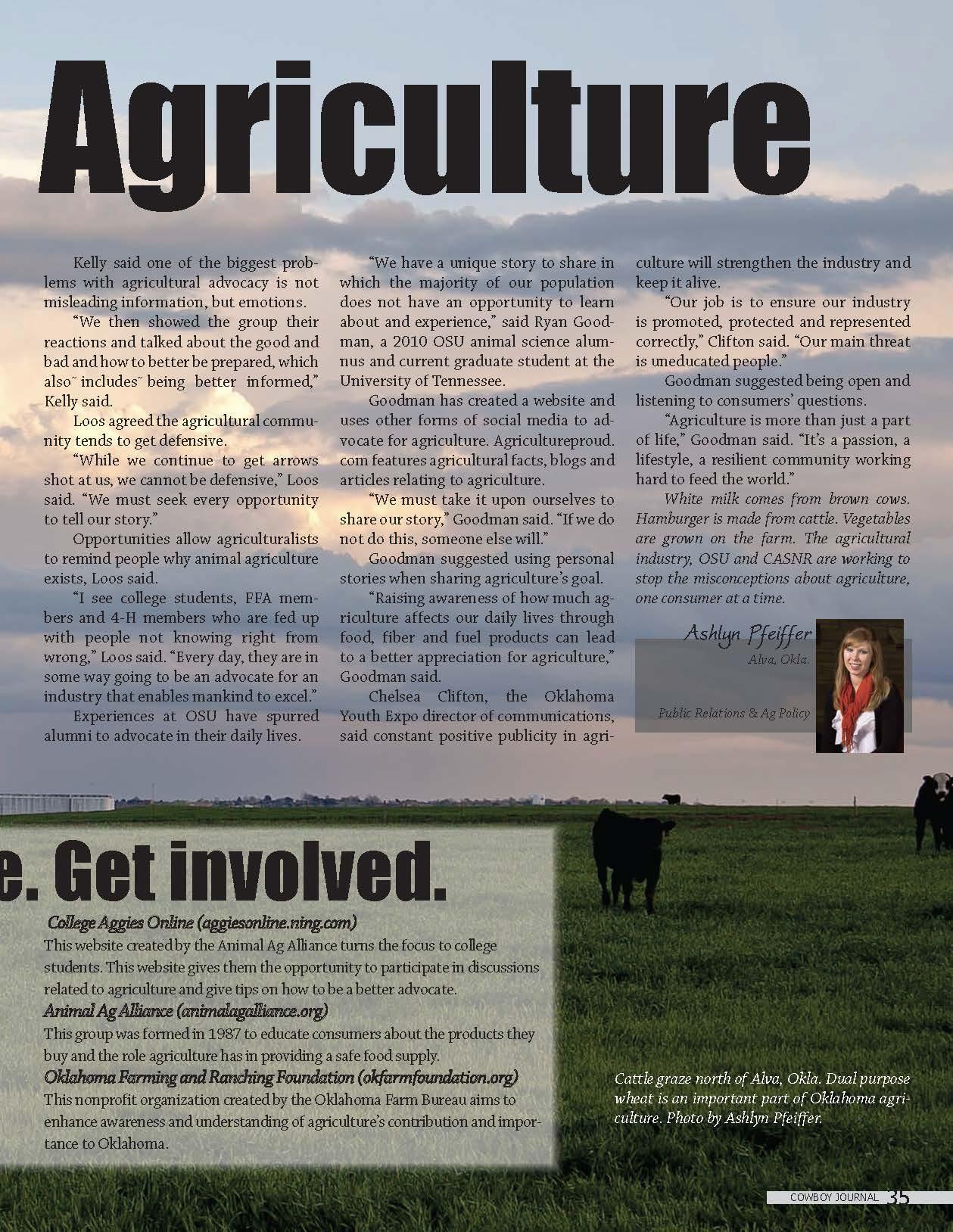
White milk comes from brown cows. Hamburger is made from cattle. Vegetables are grown on the farm. The agricultural industry, OSU and CASNR are working to stop the misconceptions about agriculture, one consumer at a time.
As~ fJ.efJ~er
Aliid. ()'ltlft_,
£rtb1Ji:.Relations&Ag Policy
Students Find a Passion for
Whether in a greenhouse, a feedlot, a test plot a laboratory or a library, undergraduate research programs allow Oklahoma State University students to escape the lecture hall and experience their passion first hand.
"We have extensive undergraduate research opportunities that are comparable to any university in the country," said Tim O'Neil, director of the Freshman Research Scholars program. "It's becoming a bigger and bigger part of OSU's recruiting policy."
--Freshman Research Scholars, Wentz Research Scholars and Niblack Research Scholars perform research in their chosen areas under a faculty mentor.
Although many students involved in undergraduate research are in hard science areas like biochemistry, animal science, or plant and soil sciences, students in social sciences like agricultural economics, agricultural education and agricultural communications can take advantage of research opportunities.
"The general public has a perception that research is what you do in a lab," said Robert Graalman, director of OSU's Office of Scholar Development and Recognition. "Most people who go through it realize [research] is a competitive difference and an exciting new way of thinking."
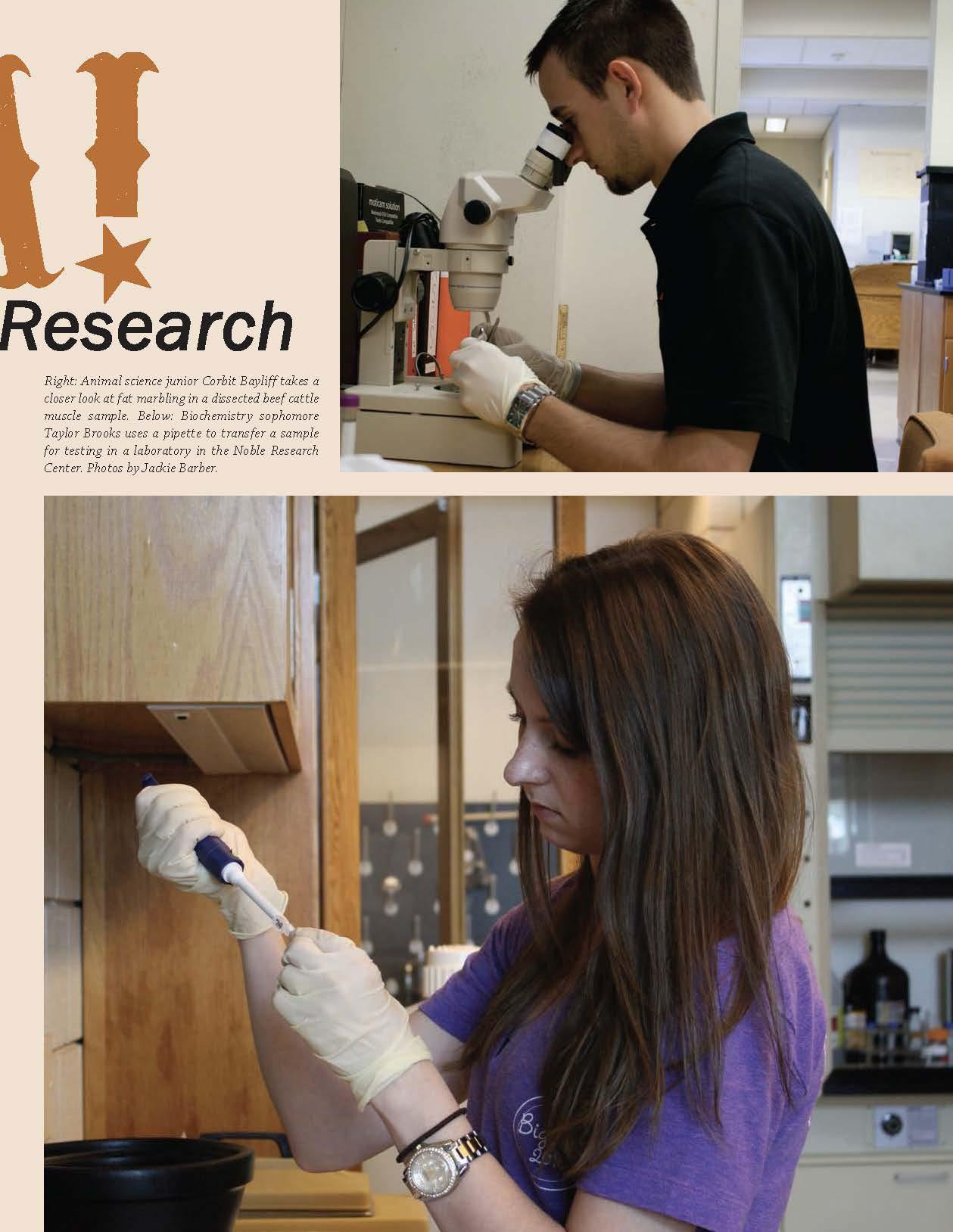
Animal science junior Corbit Bayliff said he hopes his competitive difference will set him up for professional school.
Bayliff is a Wentz Scholar researching how muscle growth and metabolism affect intramuscular fat, or "marbling," development in beef cattle. Marbling contributes to juiciness and flavor.
"It's definitely something I couldn't learn in the classroom," Bayliff said.
Bayliff said learning how to do research will help him in his potential career path of becoming an animal or human doctor.
The early days of Bayliff's research were spent meeting with his mentor and reading scientific journal articles related to his research.
Learning to read journal articles was "pretty overwhelming" at first, Bayliff said, gesturing to a five-inch-thick manila folder of journal articles he has read.
"Every other word was a word I'd never heard," he said.
All three scholar programs teach students how to conduct research, analyze data, interpret journal articles, and present their findings. Freshman Research Scholars spend the fall semester focusing on the basics of research and getting to know their mentors.
The research mentor guides the student and, in the case of laboratory-based research, provides the laboratory facility and equipment to run tests. Mentors' specialties sometimes guide the students to pick a particular research topic.
For Freshman Research Scholar Andrea Sanders, joining her mentor's research team gave her an opportunity to be involved in a real-world, ongoing research project in the plant and soil sciences department.
Sanders is researching how plant genetics affect leaf rust in wheat.
"[My mentor's] job at the university is to do this research," she said. ''I've never had a chance to work in a professional lab environment before."
Mentors also help students design research plans and offer advice for collecting and presenting data.
"Research is a discipline," said Patricia Canaan, a professor and research mentor in biochemistry and molecular biology. "Students don't just automatically know how to do research."
In addition to the three university-wide undergraduate programs, the biochemistry and molecular biology department has created its own freshman research program exclusive to the department's students.
The department implemented its research program to teach students how to think like researchers early in their college careers, Canaan said.
"The students need to be critical and not just take everything at face value," Canaan said. "I try to initiate that train of thought."
When learning how to conduct research, students must learn how to make hypotheses and create research plans that have direction.
"It's not enough to go out fishing," Canaan said.
The focus on conducting measurable, well-planned research means undergraduates in these programs perform legitimate research up to the standard of any other university research.
"They're doing real experiments, making and recording observations that matter," Canaan said.
Bayliff's research aims to provide information to help ranchers and feedlots cut the overhead costs of feeding cattle by increasing marbling without getting cattle too fat.
i( Research
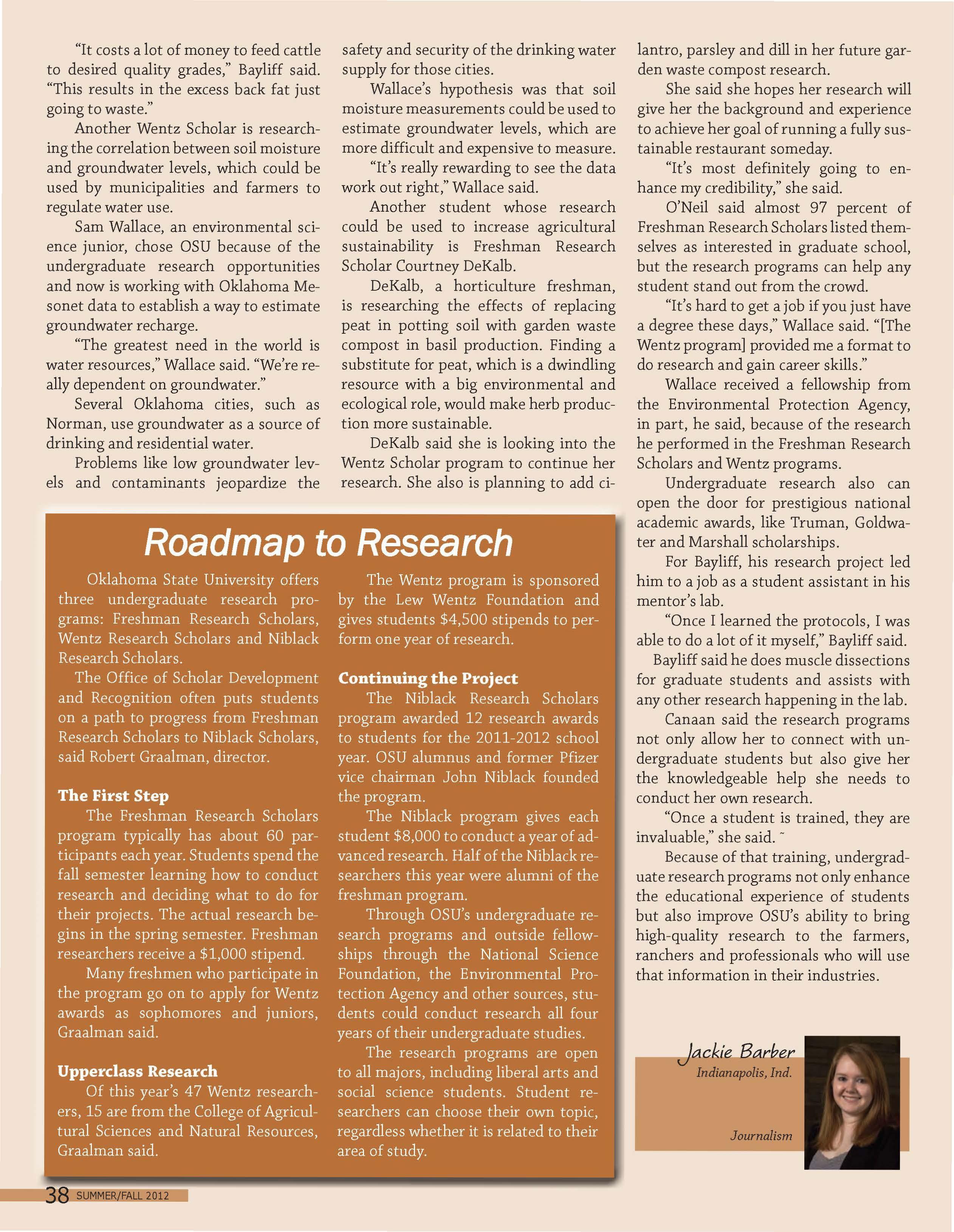
Right: Animal science junior Corbit Bayliff takes a closer look at fat marbling in a dissected beef cattle muscle sample. Below: Biochemistry sophomore Taylor Brooks uses a pipette to transfer a sample for testing in a laboratory in the Noble Research Center. Photos by Jackie Barber.
"It costs a lot of money to feed cattle to desired quality grades," Bayliff said. "This results in the excess back fat just going to waste."
Another Wentz Scholar is researching the correlation between soil moisture and groundwater levels, which could be used by municipalities and farmers to regulate water use.
Sam Wallace, an environmental science junior, chose OSU because of the undergraduate research opportunities and now is working with Oklahoma Mesonet data to establish a way to estimate groundwater recharge.
"The greatest need in the world is water resources," Wallace said. "We're really dependent on groundwater."
Several Oklahoma cities, such as Norman, use groundwater as a source of drinking and residential water.
Problems like low groundwater levels and contaminants jeopardize the
tlie program go awards as sop Graalman said. Graalman said.
safety and security of the drinking water supply for those cities.
Wallace's hypothesis was that soil moisture measurements could be used to estimate groundwater levels, which are more difficult and expensive to measure.
"It's really rewarding to see the data work out right," Wallace said.
Another student whose research could be used to increase agricultural sustainability is Freshman Research Scholar Courtney DeKalb.
DeKalb, a horticulture freshman, is researching the effects of replacing peat in potting soil with garden waste compost in basil production. Finding a substitute for peat, which is a dwindling resource with a big environmental and ecological role, would make herb production more sustainable.
DeKalb said she is looking into the Wentz Scholar program to continue her research. She also is planning to add ci-
lantro, parsley and dill in her future garden waste compost research.
She said she hopes her research will give her the background and experience to achieve her goal of running a fully sustainable restaurant someday.
"It's most definitely going to enhance my credibility," she said.
O'Neil said almost 97 percent of Freshman Research Scholars listed themselves as interested in graduate school, but the research programs can help any student stand out from the crowd.
"It's hard to get a job if you just have a degree these days," Wallace said. "[The Wentz program] provided me a format to do research and gain career skills."
Wallace received a fellowship from the Environmental Protection Agency, in part, he said, because of the research he performed in the Freshman Research Scholars and Wentz programs.
Undergraduate research also can open the door for prestigious national academic awards, like Truman, Goldwater and Marshall scholarships.
For Bayliff, his research project led him to a job as a student assistant in his mentor's lab.
"Once I learned the protocols, I was able to do a lot of it myself,'' Bayliff said.
Bayliff said he does muscle dissections for graduate students and assists with any other research happening in the lab.
Canaan said the research programs not only allow her to connect with undergraduate students but also give her the knowledgeable help she needs to conduct her own research.
"Once a student is trained, they are invaluable," she said. ~
Because of that training, undergraduate research programs not only enhance the educational experience of students but also improve OSU's ability to bring high-quality research to the farmers, ranchers and professionals who will use that information in their industries.
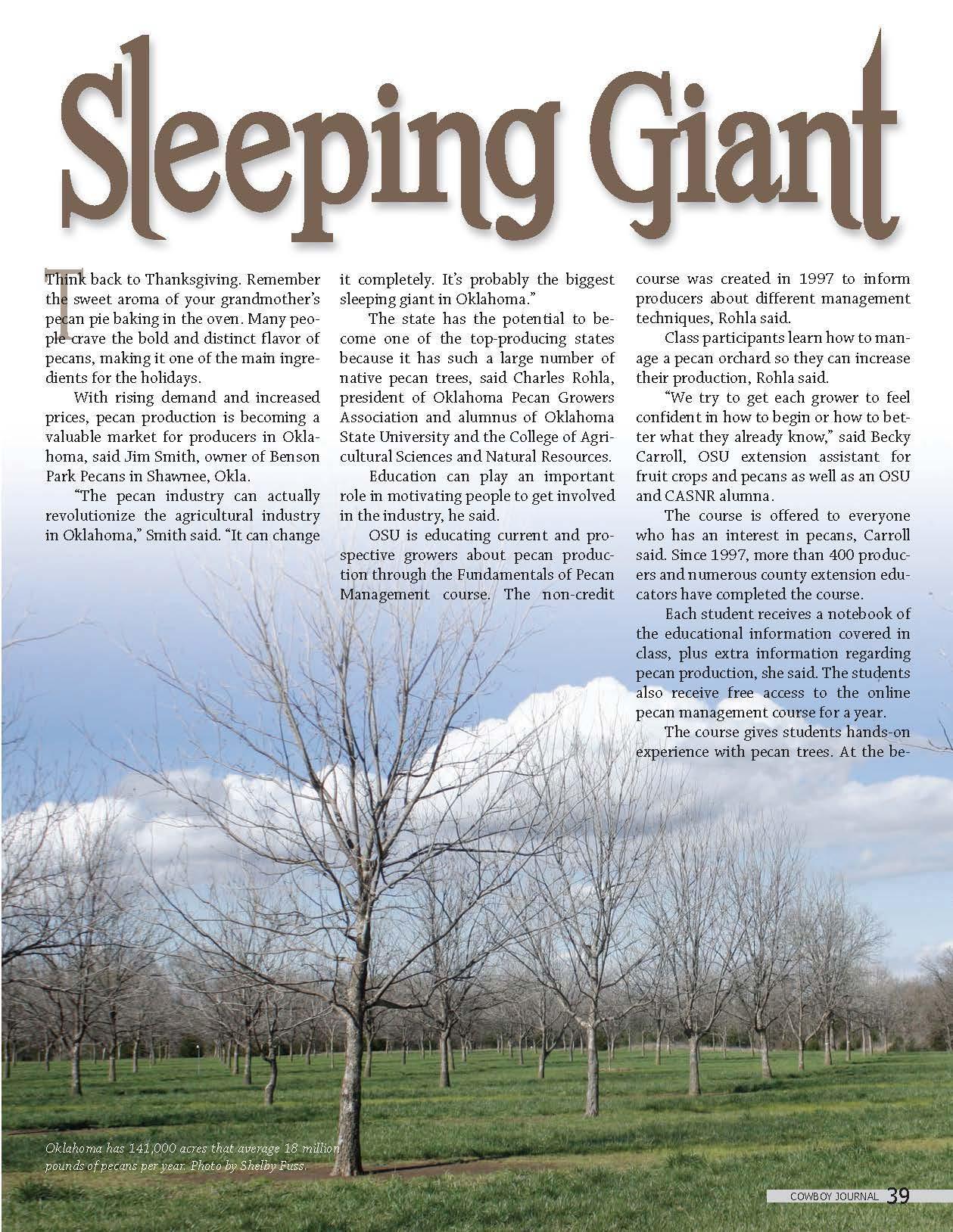
iflliiiilback to Thanksgiving. Remember th~ sweet aroma of your grandmother's p~an pie baking in the oven. Many peopl~\.crave the bold and distinct flavor of pecans, making it one of the main ingredients for the holidays.
With rising demand and increased prices, pecan production is becoming a valuable market for producers in Oklahoma, said Jim Smith, ovmer of Benson Park Pecans in Shavmee, Okla.
"The pecan industry can actually revolutionize the agricultural industry in Oklahoma," Smith said. "It can change
it completely. It's probably the biggest sleeping giant in Oklahoma."
The state has the potential to become one of the top-producing states because it has such a large number of native pecan trees, said Charles Rohla, president of Oklahoma Pecan Growers Association and alumnus of Oklahoma State University and the College of Agricultural Sciences and Natural Resources.
Education can play an important role in motivating people to get involved in the industry, he said.
OSU is educating current and prospective growers about pecan production through the Fundamentals of Pecan Management course. The non-credit
course was created in 1997 to inform producers about different management techniques, Rohla said.
Class participants learn how to manage a pecan orchard so they can increase their production, Rohla said.
"We try to get each grower to feel confident in how to begin or how to better what they already know," said Becky Carroll, OSU extension assistant for fruit crops and pecans as well as an OSU and CASNR alumna.
The course is offered to everyone who has an interest in pecans, Carroll said. Since 1997, more than 400 producers and numerous county extension educators have completed the course.
Each student receives a notebook of the educational information covered in class, plus extra information regarding pecan production, she said. The stuq.ents also receive free access to the online pecan management course for a year.
1 The course gives students hands-on , • experience with pecan trees. At the be-
ginning of the class, students are shoM'l how to grow new trees. The students plant the seeds and watch them grow throughout the season. Each student takes five of the trees home to plant.
"The OSU pecan course is really good at teaching step-by-step what to do throughout the year," Rohla said. "It teaches [participants] things they need to be doing in their orchards during certain times of the year."
All of the class meetings are different. Carroll and Rohla are the course instructors, and they teach about the various areas of pecan production for native and improved varieties. The class focuses on insect and disease management, grafting, pruning and much more.
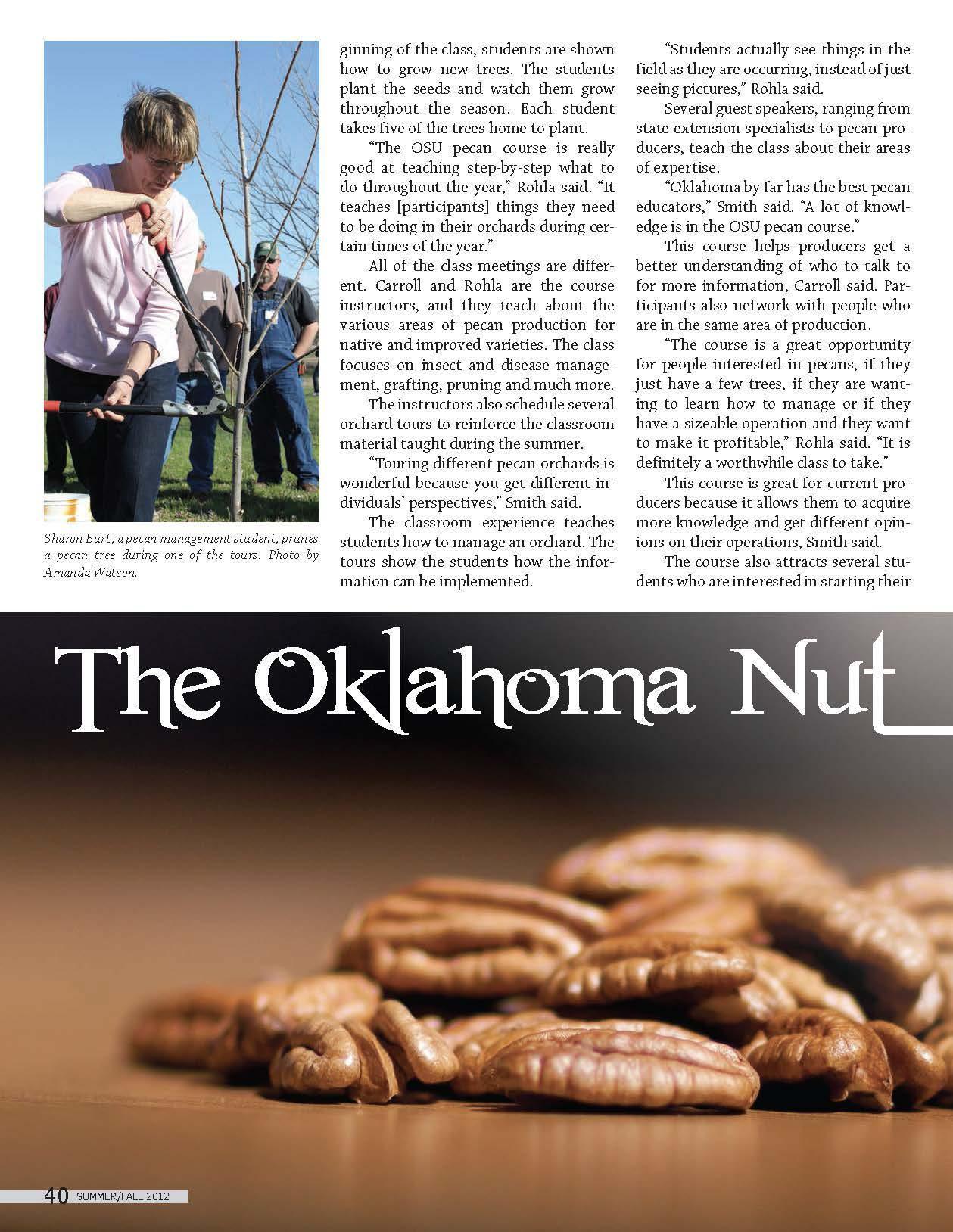
The instructors also schedule several orchard tours to reinforce the classroom material taught during the summer.
"Touring different pecan orchards is wonderful because you get different individuals' perspectives," Smith said.
The classroom experience teaches students how to manage an orchard. The tours show the students how the information can be implemented.
"Students actually see things in the field as they are occunfog, instead of just seeing pictures," Rohla said.
Several guest speakers, ranging from state extension specialists to pecan producers, teach the class about their areas of expertise.
"Oklahoma by far has the best pecan educators," Smith said. "A lot of knowledge is in the OSU pecan course."
This course helps producers get a better understanding of who to talk to for more information, Carroll said. Participants also network with people who are in the same area of production.
"The course is a great opportunity for people interested in pecans, if they just have a few trees, if they are wanting to learn how to manage or if they have a sizeable operation and they want to make it profitable," Rohla said. "It is definitely a worthwhile class to take."
This course is great for current producers because it allows them to acquire more knowledge and get different opinions on their operations, Smith said.
The course also attracts several students who are interested in starting their
Sharon Burt, a pecan management student, prunes a pecan tree during one of the tours. Photo by Amanda Watson.
own
pecan production, Carroll said. Most have purchased or inherited a piece of land with pecan trees already on it, but some students are motivated to plant a pecan orchard because of the high pecan prices, she said.
"For people who are thinking about planting an orchard, the class is a good starting place," Carroll said. "They can start off making good choices before they put anything in the ground."
Charley and JoEllen Williams from Pryor, Okla., were new to the pecan industry when they took the course.
"We bought a 100-acre piece of property that had 300 pecan trees on it, and we didn't know how to work them," Charley Williams said.
The Williamses attended the course in 2011. Charley Williams said it helped them gain a better understanding of the industry and motivated them to increase the size of their operation.
"I would recommend the course for people with inexperience with pecans to gain good, general knowledge and network with other people growing pecans," Charley Williams said.
The class is also popular for Oklahoma Cooperative Extension Service county extension educators. They use the course to inform producers about the new techniques available.
"We have a lot of pecan trees in our county, both native and improved varieties," said Keegan Varner, Johnson County extension educator and OSU CASNR alumnus. "So, I thought it would be helpful for me to study up on pecans and get more information to help my dientele."
He said he uses the information to help the local producers with fertilization schedules, insect and disease management, and plant spacing.
"Being a county educator, I was able to take questions I get asked to the specialists,» Varner said.
The cost to attend the Fundamentals of Pecan Management course is $250. The students meet once a month from March to October on Tuesday afternoons at the Cimarron Valley Research Center in Perkins, Okla.
The class offered in June is during the Oklahoma Pecan Growers' Association's annual conference. The students
hle and desired tehas141,000 • n pounds of Rohla,presn Growers
Association and alumnus of Oklahoma State University and the College of Agricultural Sciences and Natural Resources.
Unfortunately, a large percentage of these acres are not managed or harvested, he said.
"Right now, Oklahoma ranks fifth in the nation in pecan production, and production increases each year with new plantings," Rohla said. "The state is also the second largest state in number of acres of trees."
The public has a lot of interest in improving native pecans and establishing improved pecans in Oklahoma, Rohla said. In Oklahoma, 80 percent of the pecans produced are native and 20 percent are improved varieties.
Some people think it takes 10 to 15 years for a pecan tree to produce, but withnew techniques and research, pecan ucea lot faster, Rohlasaid.
are invited to the conference, but they have to pay an additional fee to attend.
"The purpose of O PGA is to unite pecan growers in Oklahoma," Rohla said. The conference is another opportunity for pecan growers to network. Many of the previous students have become members of the OPGA. This gives the producers another opportunity to continue networking and learning new management techniques.
"I am proud of the course because it has touched so many people," Carroll said. "Each year we educate new people about pecan management, and this helps better the state's pecan production."
Education and networking will continue to improve the production of pecans in Oklahoma, Varner said.
"From the time you plant a grafted tree to early production, it usually takes six to seven years depending on variety," Rohla said. "Full production can be achieved as early as six to 12 years depending on the variety."
The current pecan prices also motivate people, Rohla said. In 2011, native pecans sold for $1.50 per pound and some improved varieties sold for $3.50 per pound or more, he said.
"Pecan prices keep rising with the demand from other countries wanting our product," said Becky Carroll a CASNR alumna who serves as an OSU extension assistant for fruit crops and pecans.
The Oklahoma Pecan Growers Association works with 14 other pecan-growing states on marketing the product. The international marketing effort with the other states has increased the pecan prices, Rohla said.
Shelbd Euss Cleveland, Okla.
Layout & Graphic Design
THE
most days, Tyler Powelfs cell phone before he sat down at his desk. It o'cl ck Tuesday morning, and little w the call he was about to take would ignite a fire beneath his career.
"Answering that phone call was the best career move I could have made," Powell said.
Nearly 10 months prior to this fateful phone call Powell graduated summa cum laude from Oklahoma State University with a degree in agribusiness.
Throughout his college career, Powell served on the executive boards of the Student Government Association, College of Agricultural Sciences and Natural Resources Student Council, Collegiate Farm Bureau and the Alpha Gamma Rho Fraternity. He also earned campus-wide honors as a Top Ten Freshman Man as well as an OSU Outstanding Senior and the 2010 Homecoming King.
"I worked hard to earn the awards and positions I got," Powell said. "I knew some day these titles would look really good when I started applying for jobs."
In spring 2010, Powell served as the OSU agricultural legislative intern. Through this internship, Powell developed diverse contacts, including U.S. Rep. Tom Cole.
"I remember the first time Tom introduced me to Tyler," said Jill Daugherty, district director for Cole's office. "Tomtook to Tyler like old friends."
When Cole needed a new field rep-
Goes to
resentative, he offered Powell the job. Within a few days, the 22-year-old was winding his way throughout six counties in southwest Oklahoma, tending to Cole's constituents.
"This was exactly the position I was hoping to get right out of college," Powell said. "I never
thought I would get it, but there I was. This was my opportunity to really break into the political arena, and I was
cultural Sciences and Natural Resources when Tyler was interning at the capitol," Sherrer said. "I knew he was a really sharp, hard worker and that he was doing a good job for Cole, and I wanted somebody who didn't have a lot of experience who I could teach."
Sherrer asked Powell to apply for the job. His competition included four of his peers, some with more so excited to see all my efforts finally paying off"
I
never expected to be where I am today, especially only a year since I graduated.
- Tyler Powell, director of the Office of the Secretary of Environment
Powell spent 10 months working from Cole's Lawton, Okla., office. While there, he commuted more than 45,000 miles, spent hundreds of hours on the phone, answered thousands of emails, and shook countless hands.
"Tyler became my detailguy," Daugherty said. "He knew policy inside and out. There was never a task I could throw at him that he wouldn't have thoroughly researched and summarized quicker than I had assigned it to him."
Powelfs reputation for his hard work ethic and infectious personality started to precede him, Daugherty said. Then, Gov. Mary Fallin appointed Gary Sherrer as her secretary of environment.
"I was serving as vice president of external affairs for the Division of Agri-
experience than he had.
"I wanted this job," Powell said. "I studied up on every piece of environmental legislation I could find.
"What really enthused me about it was the involvement the department has on all ends of the spectrum," he said. "The Office of the Sea·etary of Environment reports directly to the governor's office, has three state agencies reporting to it and is the state's official delegate to the Environmental Protection Agency."
A few days after his interview, Powell's phone rang early Tuesday morning.
"Tyler, what do I have to do to get Cole to let me hire you?" Powell said, quoting Sherrer as he reflected on the call he said he remembers so vividly.
Powell said he felt this position was an opportunity he could not pass up. He
said working on environmental matters was something he would enjoy.
"Several others applied for the job, but I liked Tyler," Sherrer said. "He had a good work ethic and an eagerness to serve people."
Powell started his new job as the director of the Office of the Secretary of Environment on April 1, 2011, April Fool's Day to most, but not for Powell.
"I was sad to see him leave," Daugherty said. "He helped the office tremendously in the short time he was here. His background and knowledge of agriculture raised the bar for this office in connecting with rural constituents."
It has been a year since he took the position with the secretary's office. Powell said it still seems brand new.
"I'm dealing with something different every day," Powell said. "Our office deals with almost every industry, so we are having a direct affect in many areas, from commerce to policy and education to even innovation. But in whatever we do, we are always looking out for the state's interests."
As director, Powell said he assumes many different roles to ensure the effectiveness of the office. This requires him to become an expert on all facets of current politics and policies in legislation.
He often must offer counsel to the governor's office on matters concerning policy implementation and probable effects. He also fills in as Sherrer's spokes-
Opposite page: Tyler Powellpauses on the front steps of the Oklahoma State Capitol. Photo by CarsonHorn.
man when the secretary's busy schedule has him occupied elsewhere.
"Since Tyler came on board, he hasn't ceased to amaze me," Sherrer said.
"The efficiency and quality of work he has brought to this office have made him indispensible," Sherrer said.
The responsibilities associated with Sherrer's OSU position gamer a large portion of his time. However, Sherrer said he is able to oversee and manage all his tasks at hand, thanks to Powell's instrumental work.
"What's great about Tyler is his ability to pick things up so quickly,"he said.
"Of the three agencies I oversee, all the directors have commented on his efficiency," Sherrer said. "I've been extremely pleased so far."
Powell said his work for the secretary includes issues such as Oklahoma's endangered species, water resources and EPAair quality regulations.
"I got into this position ata really ex-
citing time," Powell said. "We have more influential issues up in the air right now than the office has ever seen before."
Powell must become an expert on every issue pertaining to the office. At a moment's notice, Sherrer could be summoned to make a statement or attend a pivotal meeting where profound decisions will be made, Powell said. In situations such as this, Powell will brief the secretary on the situation and bring him up to speed, sometimes in only a matter of minutes. This kind of teamwork has made the Office of the Secretary of Environment "tick like clockwork," he said.
"It's my job to put out the fires before they get to the secretary," Powell said. "If he needs to speak on an issue in 15 minutes, I have to be ready with the information he needs and the security that what he's about to say is already in the works."
As for the future, Powell said bigger and better things may be on the horizon,
but for now, he said he is "in a pretty good spot."
"One misconception is that we are all political scientists," Daugherty said. "We come from all walks of life. The secret to getting involved is forming a network, attending legislative receptions, interning, and meeting people at the capitol whenever you can."
Powell credits his legislative internship as the key to his current success and said to land a job in politics, you have to get involved.
"Everyone starts at the bottom in politics," Powell said. "I never expected to be where I am today, especially only a year since I graduated."
c~rson Hoer,; Yukon, Okla.
Public Relations
Tyler Powell (right) and Kyle Arthur, director of planning for the Oklahoma Water Resources Board, on their way to a meeting. Photo by Carson Horn.
have
their picture taken with Pistol and Pete, oxen owned by Dan Stein, assistant professor in animal science.
Ok,horiia's neighbors to the south are ~d for using the phrase "everyng 9igger in Texas." That may be &noccasion, but when it comes to the world's largest junior livestock show, Oklahoma owns the bragging rights.
Originally called the Oklahoma Spring Livestock Show, the Oklahoma Youth Expo has developed into one of the nation's premier junior livestock events, attracting 4-H and FFAmembers from across the state.
"Oklahoma Youth Expo provides a capstone experience for youth showing livestock in 4-H and FFA," said Rusty Gosz, Oklahoma State University's extension youth livestock specialist.
Gosz said Oklahoma has more than 60,000 youth who exhibit livestock through 4-H and FFA, many of whom travel to Oklahoma City every March to exhibit their animals at OYE.
The success and shear magnitude of OYE could not be possible without the staff, students and educators at OSU, Gosz said. Every year, OSU students help at the event and gain essential skills through expetience.
According to recent research, more than half of the College of Agricultural Sciences and Natural Resources freshmen participated in 4-H or FFA.
"OSU has a direct impact on how the show is carried out," Gosz said. "The chances to get involved are limitless."
OYE provides OSU students with the opportunity to gain real-world experience, meet and network with industry professionals, and develop leadership skills used in promoting agriculture.
Each year, OYE offers students internships, scholarships and leadership opportunities that are second to none, Gosz said.
"OYEhas presented me with opportunities most college students couldn't imagine," said Hallie Frobose, an animal science senior from Pemberville, Ohio.
Frobose is
a member of the 2011-2012 Oklahoma Agricultural Leadership Encounter, a year-long
program
witness the behind-the-scenes work and gain an appreciation for all the work that goes into such a large show.
"Being involved in OYEhas provided me with the opportunity to work with professionals in the livestock industry that I wouldn't have gotten to work with otherwise," Doyle said.
OSU has a direct impact on how the show is carried out. The chances to
Although Doyle is quick to share how OYE has influenced her get involved are limitless. personally, she
- Rusty Gosz, Oklahoma State Unii<ewity still recognizes extension youth livestock specialist the impact it
sponsored by OYE and several other agricultural entities. OSU students must apply, interview, and be selected to participate in the program. Selected students experience and witness Oklahoma agriculture firsthand, travel abroad, and partake in agricultural legislation.
"In return, it's our duty to educate consumers worldwide about production agriculture," Frobose said.
Frobose and the other members of OALE help conduct the daily shows and events at OYE.
OSU junior and Elgin, Okla., native Carolyn Doyle said she attended OYE while growing up. Now, she plays an integral role in organizing OSU@ OYE and the daily events at the 11-day expo.
"OYEgives OSU students a chance to stay connected to their passion," Doyle said. "Many OSU students grew up showing and hoped there would be a way to stay connected. This allows students to has on others.
"OSU students who help at OYE can expect to take away a sense of pride that they were part of the 'World's Largest Junior Livestock Show' and put on an event so many of Oklahoma's youth look forward to," Doyle said.
But, OYE is more than building a resume or enhancing skills. Gosz recalled a career-defining moment: assisting a youth with cerebral palsy show his pig.
"My interaction with the young man changed my perception of what I do," Gosz said. "It truly defines what we are there for, and that is supporting youth involved in agriculture."
Jacob §ankojskie
Clinton, Maine
Every year, the Oklahoma Youth Expo designates the last Friday of the event as "OSU@ OYE". Recently celebrating its seventh year, Oklahoma State University Day has become one of the most highly anticipated days at OYE. Not only does the event showcase the many College of Agricultural Sciences and Natural Resources degrees and options, but it also introduces its student clubs and organizations. In turn, the event gives prospective students and their parents a chance to interact with current students and faculty at OSU.
"We're in the heart of Oklahoma and the Great Plains," said Rusty Gosz, OSU extension youth livestock specialist. "We are surrounded by students with agricultural interests."
Gosz said OSU @ OYE sheds light on the various degrees and educational routes CASNR offers.
"The opportumt1es are limitless," Gosz said. "There are options for students wanting to go to medical school and even programs for students interested in engineering."
Furthermore, OSU @ OYE offers a chance for OSU students and teachers to witness developments in departments not directly associated with one another.
"This event gives students and professors a hands-on learning experience as well as a chance to see each other in their own element," said CassiDe Street, CASNR prospective student coordinator.
In addition to the recruiting opportunities, OSU @ OYE is a day where students, faculty, staff and alumni come together to inform others about CASNR and celebrate being an OSU Cowboypast, present or future.
Offering the best in Angus, Sim-Angus and Maine Anjou Genetics
Darrel'Dean'TroxelOutstandingFraternity37 of the last 43 years
Darrel'Dean'TroxelOutstandingCampusInvolvement
Darrel'Dean'TroxelOutstandingCampusRelations ScholarshipCup: BestGradesAmongFraternities77 of the last 84 years
ThomasKeysMostOutstandingPledgeClass26 of the last 31 years
Individual Honors
12 Seniorsof Significancefor 2009 and 2010 • 1 Top 15 HomecomingRoyalty 2 Top 10 FreshmanMen • 4 Top20 FreshmanMen
A sinking feeling invades the rancher's heart/ as he surveys the rough terrain in nopes of spotting the cattle that once grazed it. For the second time in recent months, he will report missing cattle and a loss in income.
Miles away, anger grows within the city manager, as budget cuts mean fewer funds for wastewater treatment while record rainfall causes damage to parking lots across the city. Each man wonders if anything can stop this continuing cycle.
The students enrolled in the Biosystems and Agricultural Engineering Instrumentation and Control (BAE 3023) class at Oklahoma State University learn to eliminate the many challenges like these faced by agriculturalists, environmentalists and businesses.
"Students are learning to design and develop mechatronic systems using sensors and actuators," said Ning Wang, BAE assistant professor. "The instrumentation and control class provides hands-on experience and enables the students' education to come to life."
This course, like others in the department, integrates engineering sciences, physical sciences and biological sciences to teach students to address real-world challenges.
In their BAE 3023 projects, student teams develop a data acquisition system, select electrical components, and test and demonstrate the system. The experience benefits students in their future careers, Wang said.
"BAE is about bringing engineering systems to the biological world," said Aaron Frazen, a BAE doctoral student who helps with the projects. "Students need to know how to design and implement measurement and control systems whether they pursue a career with food,
biotechnology, environmental or biomechanical engineering."
The course introduces students to new technology and encourages them to explore options and understand the role of technology to become well-rounded in their careers, Wang said.
Using their prior knowledge of basic circuits, students learn microprocessors, sensors, controllers and computer programs for the first time.
"Our student body consists of students from all four BAE majors," said Yeyin Shi, a doctoral student in BAEand a teaching assistant in BAE 3023. "Their backgrounds in electrical engineering are extremely diverse, thus Dr. Wang has to inspire students and teach them how to make use of electrical engineering knowledge so they can apply it to their future careers."
BAE3023 students refine and develop new electrical components to increase efficiency within the biomechanical, environmental, and biotechnology and food processing realms.
"The technology students work with may already exist," said Randy Taylor, BAE professor. "However, it's not their role to develop technology. They need to understand it and possibly refine how it works. It goes off the quote: 'The actual is limited, but the possible is immense."'
In fall 2010, Meredith Shiftlet, Emily Matlock and Sydney Herlock used sensing technology and their interest in natural resources and environmental sciences to develop a measuring system for pervious concrete. The concrete captures storm water as it seeps into the soil to recharge groundwater and reduce storm water runoff.
Shiftlet said pervious concrete has been used in urban areas to eliminate
runoff ponds and lets water soak into the soil profile to eliminate flooding. The team's goal was to create a sensing system to alert urban areas when pervious concrete is clogged and no longer allows water to sink into the ground. The students designed and built a metal and glass enclosure with a tensiometer to measure how fast water sinks and then rises through pervious concrete.
"We learned a lot about a low-impact system that we were not familiar with," Shiftlet said. "But most importantly, we learned about the sensors, programs and electrical components. In our future careers, we will now know what approach to take from the basic knowledge from this class."
The technical details needed for the project to succeed and the constant refining of the computer program and sensors is one of the hardest aspects of the class, Herlock said.
Though many students start from scratch and determine details on their own projects, some of the teams use previous research on the design projects created by former BAE3023 students.
Students from the spring 2012 course designed an automatic cattle counting system based off the work of previous BAEstudents. The system used a microprocessor and sensor technology to allow cattle to access feed through a trough while preventing wildlife access.
The team's goal was to use radio-frequency identification, or RFID, technology to create a system to count specified cattle and display results in a producer's vehicle. The system can store the data for use on a computer so the producer can access the data and know if he has missing cattle.
"This technology is about saving
time and money and increasing etficiency for the producer," said Ryan/Dunkerson, BAEjunior. "Using a control board, an RFID sensor and Arduino microcontroller and building the frame of the design, we get to see a project materialize in front of us that can actually improve herd management."
In 2009, students built a fully functioning model greenhouse with limited electronic circuits. Since then, student teams have added sensors and electronics to the model to control lights, fans, doors and water dispensers. The most recent team created a system to measure soil moisture content, ambient temperature and humidity.
"I like having something to work from that already works efficiently and effectively," said Kelsey Turner, a BAE junior. "It's a beneficial project because lack of food is a major problem. An automated system that allows crops to grow and monitors all the elements humans sometimes can't is a great idea."
From the agricultural and environmental realm to businesses, data systems are becoming the cornerstones to furthering these industries, Wang said. With creative and determined minds as well as real-life knowledge and application, BAE students from OSU are prepared to engineer solutions to make the impossible possible.
A.shle8 Breif;ntiuer Cedaredge, Colo.
Qualia Parman tests the system controls for a fountain war competition (see related story on page 52). Parman and her team designed and developed the electrical components controlling the solenoid valves used to raise a flag. Photo byAshleyBreitnauer.
Several student projects in Biosystems and Agricultural Engineering Instrumentation and Control (BAE 3023) form the foundation for design systems competing at the American Society of Agricultural and Biological Engineers meeting each summer.
Most Oklahoma State University BAE students become members of this professional organization, which provides a closely woven network of experts who share the visions of engineering for a sustainable tomorrow, said Ning Wang, BAE professor. At the national meeting, students showcase their knowledge and compete against students from universities across the nation.
OSU students compete in the ASABE robotic, quarter-scale tractor and fountain war competitions.
The electrical portion of the ASABE competitions is the robotics competition. In 2012, OSU will compete for the fourth time after finishing behind Kansas State University in 2011.
Three teams in BAE 3023 will design different components for the competition. Their robot design must fit in a 12-inch cube. The team's main task is to design a robot to follow a pattern in a mock feedlot and dispense an allotted feed prescription per pen. The autonomous robot uses sensors to detect black tape on an 8 feet by 8 feet white board to distribute the feed correctly and return to the starting point. Teams will be judged on speed, accuracy and design.
"The design is for a competition, but it can be used in reality," said Collin Craige, a junior and BAE 3023 student. "Feedlots are looking for automated feed systems to increase efficiency and lower cost. This is just one more step in applying our education to real life."
The quarter-scale tractor competition challenges students to use mechanical engineering knowledge to design a fully functioning small tractor weighing 800 to 900 pounds. They design and build an engine as well as determine the size of the tires, type of transmission
and safety elements. They are judged on aesthetic appeal and their ability to make it practical.
Taking the class knowledge from BAE 3023, Justin Ludwig and teammates are designing a dash with instruments and gauges in digital form that will display speed, revolutions per minute and oil temperature.
"Technology in agricultural systems is constantly advancing," Ludwig said. "This type of display allows a farmer to better handle his equipment just by glancing at a screen. Being able to design and build this from scratch is ultimately what I want to do with my career, so it's exciting to be working on these components before I graduate."
The fountain war competition challenges environmental and water engineers to apply their knowledge and passion in a two-part competition. The competition this year challenges students to use sensors to raise a flag by filling a bucket with water.
\ The stuijent feam uses111photo resistor to read light from a reflective sticker placed on the water bucket.
Once the resistor receives the light reflecting off the bucket, it turns on an electromechanical solenoid valve to allow water through the nozzle corresponding to that photo resistor.
As the bucket fills with water, the photo resistors will turn the nozzles on and off to continue filling the bucket until the flag is completely raised. The projects will be tested on their speed and design, according to ASABE.
"I really had not worked with circuits and sensors before BAE3023," said Qualla Parman, a BAEjunior and member of the fountain war team. "I'm hoping to go into water and soil quality as a career. In this field, I'll be using sensors in order to control all sorts of nozzles, valves and water systems like in our project. The competition allows us to see our project in motion."
- by Ashley Breitnauer
All the components for the robot for the AS.ABE robotic competition are designed and assembled by the students. Photo byAshleyBreitnauer.
steak, and the nutritional henof beef probably are not the first ·n s that come to mind. Americans, as le, take for granted the protein at their fingertips, unless they are U.S. soldiers serving abroad.
From experience, World War II Veteran George Huggins learned soldiers need high protein to keep their muscles going. He said few non-perishable food items are high in protein.
With that in mind, Huggins initiated a project to provide Oklahoma's soldiers a beefy treat with just enough protein to keep them healthy. Huggins contacted the Oklahoma Department of Agriculture, Food and Forestry, which directed him to the Robert M. Kerr Food and Agricultural Products Center at Oklahoma State University.
In early spring 2011, Huggins called Jim Brooks, FAPC'smanager of business and marketing services. Huggins wanted to make an Oklahoma-made beef stick for U.S. troops, specifically for the Oklahoma Army National Guard's 45th Infantry Division.
Huggins' idea stemmed from a Nebraska program where farmers and ranchers donated their deer to create jerky for deployed troops.
"That [program] was nice, but jerky isn't high in protein," Huggins said.
The beef stick needed to be shelfstable, high in protein and ready for a backpack. Brooks started using FAPC's resources to move Huggins' idea forward. He researched the history of the 45th Infantry Division and started to see a trend.
"The 45th is always one of the first for battle," Brooks said.
While coming up with a name for a non-perishable beef stick, Brooks said he wanted to implement the word battle, as it was directly related to the 45th. He added "beef" and changed the word "for" into "4," creating "Beef 4 Battle."
After the project had been named, cattle needed to be donated for the product to be made.
Huggins told a friend about Beef 4 Battle. He asked his friend to donate cattle to his project.
"[The friend] said, 'it's the least I can do,'" Huggins said. "His five sons found out, and they donated cattle, too."
Huggins also contacted Maj. Gen. Myles Deering, the adjutant general for the state of Oklahoma.
"George is the most persistent and most convincing individual I know,"
Deering said. "He came to my office, sat at my desk, told me his idea, and the rest was history."
At an initial meeting, both Deering and Brooks agreed the protein stick could be done. They recommended Huggins seek support from the Oklahoma Farm Bureau.
Huggins contacted Thad Doye at the Oklahoma Farm Bureau and asked if OFB would help sponsor his project. Doye said the OFB had just created the Fatming and Ranching Matters Foundation (now called the Oklahoma Farming and Ranching Foundation) and decided Beef 4 Battle was a great project.
With project cattle donated and production ready to begin, the team needed a processing plant for the beef.
Huggins asked Burt Buitenhuis, owner of Chickasha Meat Co., ifhe would process the cattle and Buitenhuis agreed. Brooks then asked Larry Schwab, owner of Schwab Meat Co., if he would make the beef sticks. Schwab did not have any experience in shelf-stable meat, but he agreed to do so if Brooks could find someone to help develop the product.
Jake Nelson, FAPCmeat processing specialist, worked with Schwab to create the beef stick.
After Nelson created the product, it underwent a sensory analysis at the FAPC to analyze the water activity as well as the pH and protein levels before it was allowed to be shipped overseas.
The beef sticks, packaged in fourpiece packages, were sent to soldiers of the 45th Infantry in Afghanistan. The first shipment of about 1,200 pounds of beef sticks was sent Nov. 23, 2011. A second shipment was sent Jan. 19, 2012.
Hudiburg Chevrolet in Oklahoma City paid the shipping costs. The U.S. Post Office in Blanchard, Okla., donated the boxes and arranged a reduced postage rate, about half the regular cost, Brooks said.
Huggins said the Beef 4 Battle program will continue through at least 2014, although the timing of the next shipment is uncertain. He also said he would like to partner with the U.S. Department of Agriculture to get cattle donated.
Dee1ing said most of the troops will come home before mid-summer. However, Huggins said he wants to continue to make the beef sticks for the troops while they are home so they can eat them during training.
"The troops are greatly appreciative of the effort," Deering said. "The sticks
taste great, and they can put them in their pockets and in their backpacks and head out."
Huggins said a spin-off of Beef 4 Battle is also in the works.
Beef 4 Backpacks is the group's next project. Brooks said Beef 4 Battle is teaming up with the Oklahoma Food Bank to put beef sticks in children's backpacks.
Instead of the four-stick packages made for the troops, children will receive two-stick packages. Brooks said estimates suggest the Oklahoma Food Bank will go through 22,000 packages a month through the end of the school year.
"It is just as worthwhile to feed our children as it is to feed our troops," Brooks said.
Whether using Oklahoma's beef to feed troops or youth, Beef 4 Battle takes care of Oklahoma's own.
TODIJNATE
If you would like to donate to Beef 4 Battle, please contact Thad Doye at the Oklahoma Farm Bureau. • Both cattle and monetary donations are being accepted. • Call 405-523-2307 or send an email to thad.doye@okfb.com.
1. Laghman Province, Afghanistan - U.S. Army Sgt. Jerry Eiffel of Norman, Okla., (left) and US. Army Spc. Christopher Roberts of Edmond, Okla., both assigned to Headquarters and Headquarters Company, 700th Brigade Support Battalion, Task Force Thunderbird, check out Beef 4 Battle Sticks mailed to their company.
2. Laghman Province, Afghanistan - A group of soldiers assigned to Headquarters and Headquarters Company, 700th Support Battalion, Task Force Thunderbird show off Beef 4 Battle sticks.
3. Laghman Province, Afghanistan - U.S. Army Spc. Wigberto Burgos of Norman, Okla., tears open a vacuum-sealed package of Beef 4 Battle sticks.
4. Laghman Province, Afghanistan - U.S. Army Sgt. Jerry Eiffel (left) and US. Army Spc. Wigberto Burgos square off playfully with Beef 4 Battle sticks. U.S. Army photos by Staff Sgt. Luke Graziani, Task Force Thunderbird Public Affairs.
Pursuing a
Rain boots on, you stomp through and ~cr~s.z:;,piud and moss-covered ground, searchlng for the perfect pool of water to uiscover the amazing creatures that ridke The ecosystem run. You carefully roll over an old, decaying log and find a plethora of creepy crawlies requiring immediate examination.
Maybe you prefer larger and "cuter" critters, such as bears or ducks, or maybe you enjoy being outdoors in the middle
of the wilderness. A degree in wildlife management can make that happen.
"I grew up fishing and hunting and always had to find out what was under that rock or that log or in that pool of water," said Tracy Daniel, the District 8 game warden chief for the law enforcement division of the Oklahoma Department of Wildlife Conservation.
Daniel earned his degree in wildlife management from Oklahoma State Uni-
versity. Watching people break the laws of the environment made Daniel want to become a game warden.
"I spent a summer as an intern working in fisheries where I gained a lot of experience," Daniel said.
Daniel, along with more than half of the personnel who work in the ODWC, are OSU graduates.
"Fifty percent of the people we currently hire come from O-State," Daniel said. "And, that's just in the law enforcement division."
OSU houses the Oklahoma Cooperative Fish and Wildlife Research Unit, a program that allows undergraduate and graduate students to volunteer or work as hired students in research projects.
Daniel, along with many other alumni, went through this program. Currently, 15 doctoral students and 30 master's students are in the research unit.
"It allows you to get your foot through the door," said Craig Endicott, ODWC's northeast region supervisor.
"Many of us who work here now started out working as a technician or just volunteering on research projects at the co-op unit."
OSU offers a wide va1iety of options to help students discover what they really want to do and what to expect from a career in wildlife. The goal of the research unit at OSU is to give students the necessary experience.
"Field experience is beneficial in wildlife and fisheries," said David Les-
NorthAmericanfallow deer graze at Woolarocnear Bartlesville, Okla. Photo by Jennifer MacArthur.
lie, co-op unit director. "The experience makes a good student look even better."
Much work is involved to earn a degree from the natural resources ecology and management department and certain classes have to be taken along with a designated amount of experience before graduating, Leslie said.
"We want the students to understand what has to be done, classes taken and experience required for this major," Leslie said. "We offer a required class to inform students about what a wildlife degree is like and careers it can lead to."
Students can participate in a multitude of tasks, from cleaning tanks at the school to taking part in research.
"I have two students now who are paid technicians helping me with my crayfish research project," said Randy Stewart, a doctoral student at OSU.
Stewart decided to have a career in fisheries when he saw OSU alumnus and former ODWC fisheries biologist Ken Cook fishing competitively on ESPN. Stewart worked two years in the field in Tennessee and Florida before coming to OSU to pursue his doctorate.
"I had a lot of opportunities because I had a lot of experience," Stewart said.
OSU offers multiple degree options, dedicated faculty and excellent facilities.
"OSU played a big role in where I wanted to go as they have one of the best programs in the country," said Jarrod Powers, a 2011 NREM graduate with an option in wildlife.
Powers spoke highly of the staff and the opportunities given to him through his education at OSU.
Powers has worked at the co-op unit since last June, when he started working
with a graduate student on a project researching mussels.
"The best advice I could give a prospective student is to not limit yourself to just wildlife classes," Powers said. "Be willing to take other classes that focus on the natural world."
The variety ohvildlife topics and extensive research conducted by OSU students assists the ODWC with research.
"OSU is the one we ask to conduct our research and projects," Daniel said.
Currently, Sara Lyda, senior research specialist for the co-op unit, along with ODWC personnel are conducting a bear project in northeast Oklahoma to establish the status and health of the black bear population. This allows students to gain valuable field experience.
"We engage 30 to 40 technicians a year," Leslie said. "Anything from paid
Sara Lyda, senior research specialist for the Oklahoma Cooperative Fish and Wildlife Research Unit and an OSU alumna, removes a cub from its den to be counted and weighed. Photo courtesy of Craig Endicott.
positions, work experience or those who just want to vo1unteer can do it."
NREM faculty have many alumni within the O DWCwho can help students continue with their studies.
"OSU alumni are recommended and suggested to talk to for resources and potential jobs," Leslie said. "And, the alumni love being ca11edby the students."
For people 1ike Daniel, the research unit rea11yhelped him when he started job hunting.
"I graduated in the summer from OSU and was hired that faU,"Daniel said.
Those like Daniel and Endicott are living proof their careers with wildlife are enjoyable, and OSU is a student's "one-stop shop" for a career within natural resources.
fid1M N PROGR
Craig Endicott (left), Oklahoma Department of Wildlife Conservations northeast wildlife supervisor, and Colby Farquhar, ODWC wildlife technician, weigh a young bear for the project wrrently tracking and evaluating black bears in northeast Oklahoma. Photo courtesyofODWC.
Wlirs\oyaiv. ncements in technology haF~.a11owe, veterinarians to give their pat t's e best treatments possible e way your family physician woul t t you and your family.
At Oklahoma State University's Boren Veterinary Medical Teaching Hospital, veterinarians have the most upto-date technology to treat patients and educate students.
"We have a wide array of instruments that allow us to do all kinds of complicated surgeries," said Dr. Mark Rochat, OSU small animal surgeon. "There are probably not many things that are done to people that we don't do to animals at this level:'
The field of veterinary medicine includes a variety of specialties, including radiology, cardiology, ophthalmology, neurology, oncology, surgery, zoo and exotic wildlife, equine surgery and medicine, food animal surgery and medicine, clinical pathology, dermatology, and internal medicine, said Dr. Mark Neer, the hospital's director.
Within each of these specialties, veterinarians have access to various technologies suited for their patients' individual needs.
Veterinary school students participate in three-week rotations through the different specialty departments as part of their general education. They are exposed to different technologies during their rotations, allowing them to become familiar with their functions.
"Anything we can introduce a student to, they leave with that information," said Carolyn Rodebush, OSU radiology technician. "That way, they can communicate with clients better and they know what [technologies] will help them to make a better diagnosis and treat their patients."
Dr. Margi Gilmour, the hospital's board-certified ophthalmologist, works with specialized equipment for the eye. One of the technologies, called a video indirect ophthalmoscope, allows students to see the same view of the patient's retina on a TV monitor as the doctor performing the exam.
"[It] has a camera mounted on it so when I'm looking in the dog's eye and I'm looking at the retina, for example, the picture shows up on the TV screen," Gilmour said. "Students can stand there and see everything I'm seeing."
A Boston terrier mix named Lovey
has experienced multiple ophthalmologic technologies during the course of six years. Gilmour said the dog developed cataracts as a 1-year-old, which is not rare but is not typical, either.
"We routinely do cataract surgery, which people kind of take for granted because it's such an in-and-out thing for humans, but the technology sort of gets lost," Gilmour said.
The device used during cataract surgery is the same device doctors would use in a human hospital. A small needle goes into the eye through a tiny incision and uses ultrasound frequency to break up the cataract, pulverize it, and suck the material out, all while keeping the eye inflated with fluid.
"It's this fantastic technology that maintains the eye pressure perfectly," Gilmour said. "Meanwhile, you're removing this entire cataract through a 3 millimeter incision."
A few years later, Lovey developed glaucoma, or high pressure, in one of her eyes. When she was brought in, her optic nerve already was damaged, which caused her to lose the ability to see.
Above: Dr. KelciMcKeirnan conductssurgery using a C-arm.Photo by Marissa Tescier.
"High pressure in the eye is painful, so what we did was a prosthetic surgery," Gilmour said. "She could keep her eye there, but you take out all the structures inside the eye and just put in a silicon prosthesis. It looks very cosmetic, but she doesn't have any more pain."
A year later, Lovey developed glaucoma in the other eye, but veterinarians were able to catch it at an early stage. Gilmour used the latest technology in ophthalmology, endoscopic laser surgery, to help relieve the pressure in her eye.
A tiny incision made in the eye enabled Gilmour to slide a probe equipped with a camera, laser port and light into the eye and underneath the iris.
"You can visualize on the TV screen, with lots of magnification, the structure behind the iris you need to treat with the laser," she said. "You line it up, aim your little beam and press the pedal. Then you can see the tissue blanch and turn white and then you just move your way through the eye."
Gilmour said most of her patients are dogs and horses, but she also works with cats, various exotic species and the occasional large animal.
Similar to the ophthalmology area, the radiology department provides veterinarians with various technologies, in-
eluding routine radiographs, ultrasounds and other specialized equipment.
After roughly five years of planning, the hospital acquired a magnetic resonance imaging machine, or MRI, to help look at problems associated with soft tissues and the nervous system.
"We went with a mobile MRI trailer, which is a semi-trailer similar to what a lot of human hospitals will use," Neer said. "We can do dogs, cats, pot-bellied pigs, little baby llamas and alpacas. We can't do horses because there's not enough room to do that, but most of our patients are going to be dogs and cats."
Dr. Robert Bahr, the hospital's radiologist, said the first MRI was Jan. 12 and he hopes to have a case every day as the usage expands.
"We used to have to do the MRI offsite," Neer said. "Now, this allows us to do them right here, which is much better for the patients and their care."
The hospital also is equipped with a four-slice helical computerized tomography machine, or CT scanner, the same you would find in a human hospital.
Rodebush said this diagnostic tool uses 3-D imaging rather than routine Xrays, so veterinarians look at a body from top to bottom or side to side.
In a normal X-ray, veterinarians are limited to viewing a 2-D image of a 3-D subject. Rochat said this proves to be a challenge in determining whether the thing they are looking at is closer to or farther away from them.
The CT allows veterinarians to view the image in cross sections, giving them more detail of the anatomy, Rochat said.
"In a particular organ, we can see masses, and sometimes we can actually find abnormal blood vessels," Rodebush said. "Other exams that we do here, like with brain CTs, we can find tumors or masses and potentially those can be removed or radiation therapy can be planned or chemotherapy. It's just a planning tool for other helpful diagnostics."
Rochat said he believes this to be a huge improvement in technology by allowing veterinarians to look at the problem before the patients go into surgery.
The location of a mass in the patient's chest can he identified using the CT. Photo by Marissa Tescier.
Surgeons can sit at their desks and use the computer program to be more efficient during surgery.
"You can manipulate the program where you can take away everything," Rochat said. "You can rotate it, look at it, all kinds of stuff, before you ever go to surgery. When you do go to surgery, you know right where to look, and you know how big [the abnormal structure] is."
This technology allows veterinarians to perform procedures more quickly.
"When I finally go in and do surgery with a tiny little dog [for example], time is really important," he said. "They get cold really quickly, and they don't do well under anesthesia, so I don't need to spend too much time goofing around in there trying to figure out what is going on. I know where I need to go look right now, and I can go right in."
Another method used within veterinary medicine involves the use of a C-arm, a fluoroscopic or live X-ray unit, which can be moved in multiple directions and in multiple angles: horizontal, vertical and side-to-side rotations.
''An easy way to think about the images obtained with the C-arm is like using a video camera that appears as an X-ray image," said Dr. Danielle Dugat, OSU small animal surgeon. "The video can be stopped, and the image frozen on the screen can be saved and printed."
The C-arm's common uses involve procedures such as pacemaker placement, fracture reduction and stabilization, and percutaneous laser disk ablation, which helps ease the pain from a herniated disc, Dugat said.
The C-arm allows veterinarians to conduct a minimally invasive approach, which involves conducting surgery through tiny incisions or holes rather than one large opening. While using the C-arm, surgeons can see where they are going inside the animal without making an incision.
In recent years, surgeons also have acquired a device known as a ligasure system, allowing them to cauterize tissue, seal blood vessels, and prevent blood loss during surgeries.
"We can go in for types of tissue that tend to bleed a lot, like a spleen or liver, and seal those vessels off so they don't bleed," Rochat said.
Ligasure sys terns allow veterinarians to perform surgery with almost no blood loss, eliminating the risk of bleeding to death or any other problems associated with severe blood loss, he said.
"We used [theligasure] theotherday at the zoo with a grizzly bear," he said. "We took her ovaries out. Rather than having to go in there and put a suture around that, we can just take the ligasure and seal those blood vessels, take out her ovaries, and off we go. It's quicker, it's safer, and it's easier."
About eight students will work under the small animal surgeons during the three-week rotations. During this time, they receive the opportunity to be scrubbed into surgeries as assistants.
"Most of the surgeries we do are very complex surgeries," Rochat said. "A lot of them aren't even done by general practitioners. It's something that is really over [the students'] heads, so they get to watch, and they get to assist."
Students also are assigned to individual patients during their surgical rotation period, and if their patients require rehabilitation, they will be exposed to those technologies.
The rehabilitation technician at the hospital, Laura Moorer, said she works with the students on surgery rotations the most because most of the animals she works with are surgery patients.
The rehabilitation ward is equipped with an underwater treadmill; a low-level laser therapy for wounds, arthritis, inflammation and pain; and an ultrasound unit used tor sott tissue injuries. Exercise equipment such as physio-balls and electrical stimulations benefit rehabilitation patients, too.
"The water treadmill works really well because the buoyancy of the water takes the weight off of the patient's joints," Moorer said. "It provides a lowimpact exercise."
The treadmill is useful for weightloss therapy, post-operative orthopedic surgeries and patients with neurologic disorders such as herniated discs.
"The resistance of the water makes for better muscle building because it's more work than just the ground," Moorer said. "They say 15 minutes in the pool is about an hour on the ground. It's a really good workout because they're not as
sore in their joints as they would be on a regular walk."
Moorer fills the treadmill with fresh water every Monday and drains it each Friday to let the treadmill air out over the weekend.
"In between each patient, [the water] goes through about seven filters and pumps back into the reservoir where it's chlorinated, agitated, and heated so it stays nice and clean," she said.
The technologies available at the hospital are used on a routine basis, sometimes daily.
Students are able to gain more knowledge and hands-on experience watching the technologies in use, while clients can give their pets the best treatments available.
"[Technology] is changing all the time," Gilmour said.
"Students come in now with their fourth year of training, and in about 10 to 15 years, there's going to be all new stuff," she said. "It's constantly changing, so they need to keep up on that. Everyone needs to."
Marissa ]escier Pal/brook, Calif
Writing & Photography
Obtaining Veterinary Specialties
Students in a veterinary school can pursue further education after their doctorate in veterinary medicine and obtain a specialty board certification.
"A student in veterinary school may get really energized about diseases of the eye and decide to become an ophthalmologist," said Dr. Mark Neer, director of the Boren Veterinary Medical Teaching Hospital.
"They can become a board-certified ophthalmologist by doing a one-year internship, then completing a three- to four-year ophthalmology residency and finally by passing a very difficult certification examination," he said.
Students who specialize spend four to five additional years studying.
Once the veterinarians complete their residency programs, they have to take a board-certification test for the particular specialty.
"[The exams] are extremely difficuJt, and most of them are two full days of testing, some are even three," Neer said. "When you pass the exam, you receive your board certification and you can say you're a specialist."
Veterinary schools throughout the nation offer different residency programs to graduate veterinarians. Oklahoma State University offers residency programs in small animal medicine, small animal surgery, equine medicine and equine surgery.
Butterball exercises on the water treadmill at the Boren Veterinary Medical Teaching Hospital to lose weight for knee surgery. Photo by Marissa Tescier.
Desigqiqg Boqds
e architecture fourth-year
stu io class during early 2012 que teams of students working toge to complete a common goal. In addition to Oklahoma State University students, an observer would have noticed two faculty and 11 students from a different country.
The country is Peru, and the students are architecture majors participating in an exchange program.
"The students do a joint design with OSU students during their visit," said Michael Holmes, associate professor of landscape architecture. "In May, OSU students can participate in a study abroad program to Peru."
Holmes coordinates the project now, but the real start to the program came in 1989 from Charles Leider, professor of landscape architecture at OSU.
"While I was in graduate school at Yale University, there was an agreement to train architecture students in South America in city planning for mass popu-
lations," Leider said. "Five South Americans came to my class. My wife and I developed a friendship with Reynaldo Agama and his wife."
This program gave Leider the idea for an exchange program at OSU.
"Reynaldo and I worked to compose a formal letter to present to OSU to propose an exchange program between OSU and a public university in Lima, Peru," Leider said. "In 2012, the Peruvians came up and participated in our upper-level design class with landscape architecture students. We return the visit and work with them on a project of their own."
When the OSU students visit the university in Peru, they get to experience another culture firsthand.
"Besides working on the studio project with the Peruvians, the students spend one week doing the 'Grand Tour' of Peru, which includes, among other sites, Cusco and Machu Picchu," Leider said. "It is an amazing trip."
Peru is filled with historical and
archeological sites that landscape architecture students cannot experience anywhere other than Peru.
"My friend transferred to a private university, Universidad Peruana de Ciencias Aplicadas, shortly after the exchange program began, which is now the university in Peru that OSU is partnered with," Leider said. "The program is more effective at the Universidad Peruana de Ciencias Aplicadas than the public one. The students at the private university are all bilingual, which makes it easier on OSU students since they do not know Spanish very well. Also, the public university does not have a lot of money; therefore, taking trips like this one are difficult."
Even for OSU students, taking this trip can be challenging, which is why the program has not occurred in four years.
"It is hard due to the small n umber of interested students," Leider said. "Students going on this trip to Peru from OSU receive credit but must do a report on their visit."
When it is possible for both OSU and the university in Peru to participate in the exchange, the results are fantastic, Holmes said.
"For the Peruvians, this is summer school," Leider said. "The exchange falls right in the middle of their semesters. When we go there, they are just starting a new term. Our students take at least three courses while they are there."
OSU students most often take courses including a design studio, a course in outdoor sketching and another course called Earth and Architecture.
"While in Peru, OSU students can experiment with mixing adobe, which is not common in Oklahoma," Leider said. "This is a new experience for our students. We also encourage them to work on sketching while they are in Peru. Peru has some amazing sketchers that landscape architecture students can learn sketching from."
However, it is not just what students
Faculty members Micheal Holmes (left), Cristina Dreifuss and Mario Bragagnini work with student Clark Boackhahn to edit and improve a collaborative project. Photo by Katelyn Parsons.
can learn, but what they can learn about the cultures and history of Peru.
"Peru has layers of civilization compared to other parts of the world," Leider said. "They have an excellent climate, which has allowed for preservation of their archeological sites. There is historical background from the Native Americans to the Spanish to the contemporary Peru. It is a very enriching experience."
OSU students learn a lot while the Peruvians are here as well as when they make the
journey to Peru, Holmes said. The first thing they do is collaborate on a design project with the Peruvians.
with the group of students from Peru help team-teach the design studio portion," Holmes said. "These faculty members have other responsibilities while they are at OSU, as well."
This February, two Peruvian faculty members came to the OSU campus with the group of Peruvian students.
"This is the first time I have been on the trip to OSU," said Cristina Dreifuss, a professor from Peru who came to OSU for this exchange.
This experience is more learning about yourself in a different environment than anything else.
"Each year the design project varies," Holmes said. "This year it is a hotel/resort complex in Peru. The students work in groups to do design concepts. Professors will look at the concepts for ideas and then possibly incorporate them into their designs."
This allows students to gain real experience for their future careers.
"On the joint studio design project, OSU students will do the site planning while the Peruvian students will do the designing of buildings," Leider said.
This exchange program is all about what students can gain from the experience, Leider said.
"From a teaching standpoint we provide an opportunity for a multicultural experience with this program," Holmes said. "It sounds simple, but landscape architecture students approach problems differently than architecture students. In the professional world, collaboration and working on a team is a necessity."
OSU faculty and Peru faculty go on these exchange trips and see a different point of view, just like the students.
"The faculty members who come
"Each time that Peru comes to OSU, we bring two faculty members with a group of students. We try to allow differ-
ent faculty to come to OSU each visit so that they get a chance to experience OSU."
OSU worked with these professors to make the experience worthwhile.
"It has been a great experience," Dreifuss said. "I am amazed at the kindness of OSU and the level of students who attend OSU. The landscape architecture students are very good, especially considering the different backgrounds of the students at OSU."
In addition to being at OSU, the Peruvian students travel on the weekends they are in the United States.
"On the first weekend, we visited Texas A&M for an opportunity to gain more knowledge," Dreifuss said. "The last weekend we visited Chicago."
The exchange participants work with the OSU School of International Studies, as well.
"The Peruvian students in the landscape architecture exchange program are among the most socially adept international students that OSU has had on campus," said David Henneberry, associate vice president of international studies and outreach. "They mix well with
- Cristina Dreifuss, Universidad Peruana de Ciencias Aplicadas Professor
Top and bottom: Hand-drawn sketches as well as computer sketches were used for this project. Middle: Audrey Clark works to prepare her sketches. Photos by Katelyn Parsons.
our OSU students and have the capacity to form strong friendships in a short period of time. This is a great advantage in the type of program that Dr. Leider and others have designed."
The experience comes full circle when the OSU students travel south.
"When our OSU students go to Peru, sometimes they renew their friendships and the experience becomes truly inter-
cultural," Henneberry said. "The quality of work they do is impressive. I have attended several of their project presentations and have always been surprised at the rigor and dedication they brought to bear on the assignment."
On Feb. 22, 2012, OSU and Peruvian students presented their final project in Agriculture North.
Seeing the quality of the work from the collaboration of the OSU and Peruvian students is an important step in this process, Holmes said.
"I hope [the students] will learn to communicate their ideas more effectively," Dreifuss said. "The exchange program takes students out of their everyday life and allows them to explore their careers in a new context. This experience is more learning about yourself in a different environment than anything else."
The Peruvian students had to leave their phones in Peru. Clark Boackhahn, an OSU landscape architecture student, said he did not even realize how hard it is to communicate with someone who does not have his or her phone.
"Students who have participated in
RobertM Kerr Food& AgriaJlturalProductsCenter
this trip have had a very positive experience," Driefuss said. "It is a different way of doing collaboration and teaching the importance of collaboration."
Pierina Sanchez, a Peruvian student who participated in the exchange, said she and other exchange students struggled with communicating in English. Her colleagues also use the metric system, which served as another gap in communication between the groups.
Yet, the students still worked sideby-side to complete their projects and meet their deadlines.
"The most rewarding part is what the students do," Holmes said. "The students tend to focus on products, but this project is a process that allows the students to learn about themselves."
Nathalie DiF/orio and Dan Mesenbrink presented a design of a spa and resort in Antioquia, Peru, to their professors. Photo by Katelyn Parsons.
Each y-ear~he College of Agricultural 7es and Natural Resources recogizes the outstanding individuals in tlie rnllege. This year, 13 students were honored as the 2011-2012 CASNR Outstanding Seniors and the top five seniors received the Dean LeCrone Award.
Agribusiness major Haley Baumgardner was named outstanding senior and received the Paul and Mary Hummer award at the 2012 CASNR banquet.
Originally from Carrier, Okla., Baumgardner was involved in university activities such as CASNR Ambassadors, student council and Mortar Board.
"Through CASNR, which has served as my home away from home for the past four years, I have obtained a first-rate education, real-world experiences, caring mentors and some of the best friends I could have ever asked for, and for that I will be forever grateful," she said.
Along with Baumgardner, four other students were named Dean LeCrone award winners as the top five seniors in the college.
Blake Jackson, an agribusiness major from Hartshorne, Okla., served as a Student Academic Mentor for AG 1011 and was involved in university activities such as Aggie X and CASNR Student Career Board of Directors. Jackson was also a Harry S. Truman and Morris and Stuart Udall Scholar.
"My college experience at OSU and CASNR has been a journey of personal and academic growth," Jackson said. "Having supportive peers, faculty and mentors has taught me important life lessons. It has greatly shaped the person I have become over the last four years."
Randy Gordon, an agribusiness major from Taloga, Okla., served as a Student Academic Mentor and was named the OSU Homecoming King. He also participated in Mortar Board, Student Government Association and Order of Omega National Honor Society.
"My story of how I joined the CASNR family and the opportunities given to me have allowed others to understand just how special CASNR is and the countless opportunities you have as a student," Gordon said.
Amy Truitt, an agricultural education major from Wetumka, Okla., was a state FFA president and 20112012 OSU Homecoming Queen. She also participated in Mortar Board and National Society for Collegiate Scholars.
"The past four years Sherri Baumgardner.
at OSU in CASNR has been a broad, lifechanging, learning experience that has helped mold me into the hard-working, dedicated and confident woman I am today," Truitt said.
As a pre-veterinary animal science major, Andrew Harding of State College, Pa., participated in the Animal Science Leadership Alliance and CASNR Student Council. Harding also received the Wentz Special Scholars Award.
"I have learned more at OSU than I could have ever imagined," Harding said.
"Not just in the classroom, but things about friendship, integrity, loyalty and devotion," he said. "OSU has given me the tools that virtually guarantee my success after college."
The additional 2011-2012 outstanding seniors were Carly Schnaithman, an agribusiness major from Garber, Okla.; Clairissa Craige, a pre-veterinary animal science major from Bokchito, Okla.; Kelsey Stein, an animal science major from Cherokee, Okla.; Ashley Breitnauer, an agricultural communications major from Cedaredge, Colo.; Cameron Jones,
an agricultural education major from Sayre, Pa.; Kaitlyn Lingus, an agricultural leadership major from Trinchera, Colo.; Kellie Whipple, a pre-veterinary animal science major from Alva, Okla.; and Stephanie Willis, an animal science major from Mt. Solon, Va.
An agribusiness marketing major, Jacy Alsup from Gravette, Ark., received the Charles and Magda Browning Outstanding Freshman Award.
Sarah Lancaster, assistant professor in the plant and soil sciences department, accepted the award for CASNR Ambassador Outstanding Adviser.
Shelly Sitton, professor in agricultural communications, accepted the Alpha Zeta Outstanding Teacher honors.
Lynette Rhea, administrative assistant for the animal science department, received the Outstanding Professional Staff Award.
The 2012 Outstanding Club Award was given to Freshman In Transition, a leadership club for CASNR freshman.
- by Jackie Barber and Shelby Fuss
2012 outstanding senior, Haley Baumgardner, joins her parents Troy and
Photo by Amanda Bradley.
Null Seed Farm
1391 9 N. 21 80 Road
Hobart, OK 73 651
Larry: 580-726-3220
Scott: 580-726-5882
Tom 580-482-4601
Specializing in registered and certified seed wheat
C<JwhfJJJ Oyiz: Answers
1. The triangle represents the three parts of the land-grant mission of Oklahoma State University - Instruction, Research and Extension.
2. Rep. Frank Lucas was born Jan. 6, 1960, in Cheyenne, Okla. Lucas graduated from OSU in 1982 with a degree in agricultural economics. He was first elected to the U.S. House of Representatives in a special election in 1994 and is serving his 10th term as a member of Congress.
3. Oklahoma State University was founded on Dec. 25, 1890, as Oklahoma Agiicultural and Mechanical College, just 20 months after the Land Run of 1889. When the first students assembled for class on Dec. 14, 1891, no buildings, no books and no curriculum existed.
4. Gundy- The YouTube video of head football coach Mike Gundy dancing in the locker room after defeating Texas A&M gained more than 250,000 views.
5. Frank Eaton was known as "Pistol Pete," a nickname he acquired at the age of 15 when he outshot U.S. cavalrymen in a contest at Fort Gibson, Okla. After seeing Eaton ride a horse in the 1923 Armistice Day parade in Stillwater, a group of Oklahoma A&M College students decided Eaton as "Pistol Pete" would be a more suitable mascot than their current Tiger. They felt "'Pistol Pete" represented the Old West and the spirit of Oklahoma. However, it was not until 1958 that "Pistol Pete" was adopted as the school's mascot. The familiar caricature of "Pistol Pete" was officially sanctioned in 1984 by OSU as a licensed symbol.
6. Stanford - Oklahoma State defeated Stanford 41-38 in overtime on Jan. 2 to win the 2012 Fiesta Bowl.
7. Nine academic departments are housed in CASNR:ag1icultural economics; agricultural education, communications and leadership; animal science; biochemistry and molecular biology; biosystems and agricultural engineering; entomology and plant pathology; horticulture and landscape architecture; natural resource ecology and management; plant and soil sciences.
8. On July 1, 1957, Oklahoma A&M College became Oklahoma State University.
9. In 1894, the library found its first official home in Old Central. The original library shared a single room with the English department.
10. Wyatt Earp - This legendary cowboy is featured on the big screen in Boone Pickens Stadium before the Cowboys rush the field to intimidate the other team and ignite the sea of Cowboy fans.
CASNR Recognizes Early Career Achievement
The College of Agricultural Sciences and Natural Resources prepares its graduates to succeed at the highest levels of their chosen career path.
The 2012 Early Career Achievement Award recognizes two former CASNR students who have found early success in their careers: Heather (Williams) Van Hooser and Tyson Ochsner
He.ather (Williams) Van Hooser Van Hooser got her start in agriculture, which gave her the skills to succeed in her career as senior vice president of Private Financial Services in Tulsa, Okla.
"My roots that gob ack to agriculture
are so vital," Van Hooser said. "The life lesson learned taught me how to be successful in business."
Van Hooser grew up in Stillwater, Okla., where both her parents worked for Oklahoma State University.
Van Hooser spent her young life balancing school, work and community service while actively participating in 4- H by showing horses, raising hogs with her family, and serving as an Oklahoma state 4-H officer. She said those activities helped her learn time management and dedication.
"The most important thing I have done to achieve this award is excel in my
career at a rapid pace while not losing focus of what matters - helping others," Van Hooser said.
Besides being successful in her career, Van Hooser regularly gives back to her community. She became a Big Sister in the Big Brother/Big Sister community service program in Tulsa, Okla., 13 years ago. In 2006, she was honored as the National Big Sister of the Year.
"It is important to me to help other people and give back to my community," Van Hooser said.
While at OSU, Van Hooser became involved with many activities, including serving as a CASNR Ambassador, join-
Former CASNRAlumniAssociation president John Cothren (left) presents Tyson Ochsner and Heather Van Hooser the 2012 Early Career Achievement Award. Photo
Services.
CASNRAlumni News Award Recipients
ing Alpha Zeta honorary fraternity and competing on the horse judging team. She served as an OSU athletic tutor and a teaching assistant in the Department of Agricultural Economics. Before completing her degree, Van Hooser had internships at a bank and at the Chicago Board of Trade.
"Being a double major at OSU taught me how to maintain a rigorous course load and still be involved in my community," Van Hooser said. "Any person can both learn and be involved on campus."
Van Hooser's advice to current college students is to give everything you do the best effort that you have.
"Whatever you do, give 100 percent and strive to be a well-rounded person," she said. "It is vital to give your job 100 percent as well as your community, yourself, your spirituality and your health:'
Tyson Ochsner
Although Ochsner has built his professional life around a dedication to plant and soil sciences, he gives his students, colleagues and family the credit for building his career.
"I wouldn't be where I am now without the people in my life," Ochsner said.
Ochsner is an assistant professor in the Department of Plant and Soil Sciences at OSU.
"OSU has been a major influence in my career path," Ochsner said. "It has al-
lowed me to network with many talented people and has provided me with excellent training."
Ochsner, a Chattanooga, Okla., native, earned his bachelor's degree in environmental science at OSU in 1998. He then moved to Ames, Iowa, where he attended Iowa State University and earned a Master of Science in 2000 and a Ph.D. in 2003. After spending several years as a soil scientist for the U.S. Department of Agriculture Agricultural Research Service in St. Paul, Minn., Ochsner returned to Oklahoma.
"Oklahoma and OSU will always be home to me;' Ochsner said.
Ochsner said the years he spent in Alpha Gamma Rho fraternity participating in homecoming celebrations, football games and CASNR activities developed lifelong friendships and networks.
However, Ochsner is quick to add meeting his wife, Stephanie, was the most valuable thing he did at OSU.
Currently, Ochsner conducts soil science research, teaches undergraduate and graduate classes, and advises students pursuing graduate degrees in the Department of Plant and Soil Sciences.
"I anticipate many more years of helping students learn about plant and soil sciences and working with the outstanding faculty at OSU," Ochsner said. - by Jacob Gankofskie and Katelyn Parsons
Thank you, sponsors!
Gold Level
Central National Bank of Alva
Crown Auto World Bristow
Express Ranches
Greg & Kristen Hart
J-M Mushroom
Bronze Level
Rural Enterprises of Oklahoma
Regent Bank
Hopeton State Bank
Bill & Kathryn Fanning
Silver Level
American Farmers & Ranchers Oklahoma Farm Bureau
Bank of Kremlin
Chisholm Trail Farm Credit
P & K Equipment
Persimmon Creek Investments, LLC
East Central Farm Credit Shattuck National Bank
Grissoms LLC, John Deere
Summer/Fall 2012
The College of Agricultural Sciences and Natural Resources Alumni Association Board of Directors
Kyle Hugh ban ks President Alva, Okla.
James Ferrell Vice President Yukon, Okla.
Br.ian Vowell Secretary Stillwater, Okla.
Steve Damron Execu.tive. Secretary Stillwater; Okla.
Mechelle Hampton Tulsa, Okla.
Kent Gardner Oklahoma City
Glen Winters Altus, Okla.
Coleman Hickman Sapulpa, Okla.
Don Roberts Enid, Okla.
Tresa Runyan Ardmore, Okla.
John Cothren Stratford, Okla.
Ken Spady Hinton, Okla.
Dana Bessinger Watonga! Okla.
onefarmer atatime.
Jon and Natalie Leeds care for the land. Managing water, selecting efficient seed varieties and using conservation tillage help them keep their Muskogee County farm productive while ensuring a safe U.S.food supply and a vibrant future for their kids. Which is important because when these Oklahoma Farm Bureau members retire from the land, they want to pass it on.
Oklahoma State University
Department of Agricultural Education, Communications and Leadership