Cowboy Journal v14n1

Page 1


<£>ervin8 our land-8rant m1ss1on throu8h

Volume 14 • Number 1

First and foremost, we would like to dedicate this edition of the Cowboy Journal to the memories of OSU women’s basketball coach Kurt Budke, assistant coach Miranda Serna, and OSU alumni Olin and Paula Branstetter. We will forever remember the four.

We appreciate the hard work and dedication from the entire Cowboy Journal staff. It was enjoyable working and growing with each one of you throughout the semester. We are excited to showcase your talents and efforts in this magazine.

We would like to give a special thanks to Teri Hayles for her important contributions to the “An Extraordinary Grant” feature. This story would not have been possible without your help. Also, a big thank you to Mitch Alcala, our staff photographer. Overall, we thank everyone who helped us plan, proof, and execute this magazine. Your continued support keeps the Cowboy Journal one of the best student publications in the nation.

Last, but certainly not least, we express our greatest appreciation and gratitude to our professor, managing editor and friend, Shelly Sitton. Your leadership and devotion to your students, this project, and the agricultural communications program mean the world to us. We cannot thank you enough for the countless hours poured into each semester, continually pushing us to do our best.

Reflecting on this semester, we have learned so much. The skills perfected, the friendships built, and the memories shared have made a lasting impact on our lives. Through this magazine, we are proud to represent Oklahoma State University and the College of Agricultural Sciences and Natural Resources.

We are truly thankful and blessed for the opportunity to serve as editors, and we will never forget this experience!

{Editors}

Jessica Agnew

Avery Kinzie

{Sponsorship Coordinators}

Hannah Carroll

Alice White

{Graphics Coordinators}

Kayla Burden

Jessica Lewis

{Photography Coordinator}

Ashley Travis

{Circulation Coordinator}

Hillary Yetter {Staff}

Sydney Cox

Courtenay Dehoff

Katherine Kuykendall

Sarah Reasnor

Courtney Skaggs

Tess Steckline

Mitch Steichen

Brytnee Tucker

Margaux Tucker

{Managing Editor}

Shelly Peper Sitton

{Assistant Managing Editors}

Dwayne Cartmell

Traci Naile

Angel Riggs

{Sponsors}

Limousin World

QuadGraphics

Oklahoma Farm Bureau {Cover}

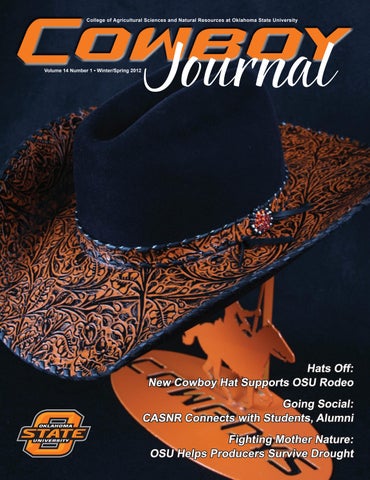
First Cowgirl Ann Hargis’ custom “Caboy” hat shows her support for the OSU Rodeo Team. Go to “The Real ‘Caboy’” on page 34 to learn more.

Photo by Avery Kinzie.

LLiving within tight budgets, college students quickly learn how to make the most of their dollars.

Oklahoma State University alumni Ben and Alma Grant remembered their own days of making something from very little, and they have donated funds to aid agricultural education majors in their final semester.

The Grants understood the challenges student teachers face and the necessity of good agricultural educators. To help alleviate expenses, they created the William E. Brown Student Teaching Assistance Program, donating $630,000 to the OSU Department of Agricultural Education, Communications and Leadership in April 2011.

“Mr. Grant recognized the need for student teaching and the expenses associated with it,” said Larry Shell, president of the OSU Alumni Association.

While on their “block” semester, seniors pursuing a bachelor’s degree in agricultural education spend four weeks in the classroom on campus and 12 weeks student teaching in various school districts in Oklahoma and occasionally other states. Student teachers cannot hold another job and must find housing in Stillwater and where they teach while covering their food and living expenses.

“With no job, it’s a big financial strain on us,” said Brent Schoeloen, an agricultural education student from Mustang, Okla. “Some people have to pay rent in two places during the three months of student teaching.”

One man’s generosity creates opportunities for agricultural education students
Ben Grant talks to the first recipients of the William E. Brown Student Teaching Assistance Program in August 2011. Photo by Mitch Alcala.

Students in their block semester automatically receive this new financial aid. With no grade requirements, application processes or selection committees, the money in the assistance program will be divided according to the number of students enrolled each block semester.

“Initially, Mr. Grant said he would give $300,000,” said Rob Terry, department head in agricultural education, communications, and leadership. “So, we did the math and showed him what each student would get. He said that wasn’t enough, and he doubled it.”

Grant said Brown, his high school agricultural education teacher, dedicated his life to students. Grant recalled a trip to the 1933 Chicago World Fair and the impression it left on him and 26 students.

” I hope one day someone will be as inspired by me as he was by his ag teacher.
– Cameron Jones Agricultural Education Senior

“Mr. Brown took us to Chicago in the back of an old farm truck,” Grant said. “Man, that was something. We went to a macaroni factory, a John Deere factory, a brewery and a natural history museum. He showed us what made the world go around.”

Brown encouraged all of his students to go to college to become better farmers.

They started a custom harvesting business in Pasco, Wash., after Grant returned from World War II. By the 1960s, the Grants had created more than enough savings for their retirement. Grant said they wanted to honor significant people in their lives and help students.

“Mr. Grant credits that first link of his success to his ag teacher,” Terry said.

Grant’s gratitude for Brown inspired him to create the assistance program for upcoming agricultural education teachers. The 12 students in their block semester in Fall 2011 were the first to receive the aid, totaling $800 per student.

The Grants have supported the College of Agricultural Sciences and Natural Resources for many years. Their successful custom harvesting business and diligent saving habits allowed them to honor significant people in their lives through creating scholarships.

“All my life, I wanted to do something for William E. Brown and the other people who helped me through life,” Grant said.

“So, at 17, I liquidated my assets and went to Oklahoma A&M,” Grant said. “I had $82 and a new bicycle.”

Throughout his college career, Grant met people who continued to advise and help him. He worked in the animal science department, joined the Air Force ROTC, became a member of Alpha Gamma Rho, and fell in love with Alma. After graduating, he and Alma continued to succeed through working hard and saving portions of each paycheck.

“Mr. Grant happened to be in town the first day of class,” Terry said. “I asked if he would like to meet the first group of students receiving his money.”

Grant said yes.

After the students introduced themselves, Grant stood and told his story. Terry said the students were captivated by Grant and the impact his agriculture teacher made on his career choices and life decisions. His testimony proved to the students they could make a difference in their future students.

“ We were excited and proud,” Schoeleon said. “Knowing that Mr. Grant’s ag

Ben Grant (center front) joins the recipients of the William E. Brown assistantships: Julie Meder, (front left) Brent Schoelen, Garrett Roland, Cameron Jones, Colton Blehm, Mika Osborn, Jeff Conner (back left), Kassey Steele, JJ Bull, Kelly Jo Pinnick, Robyn Carter and Michael Salmon. Photo by Mitch Alcala.

The Journey of a Lifetime

Following William E. Brown’s advice, Ben Grant liquidated his assets to pursue a college education and become a better farmer.

With $82 and a new bicycle, he ventured to Oklahoma A&M. While studying animal science, he worked at the horse barn.

“I lived off of Post Toasties and milk,” Ben said. “I was right across from the dairy barn, so the milk was right there.”

Thanks to his boss, Andy Kincaid, Ben worked two years at the barn, trumping the one-year-limit rule. Andy also encouraged Ben to join the Alpha Gamma Rho fraternity, and when Ben resisted due to his $18/month paycheck, Kincaid footed the bill.

“We had to eat one meal a week at the house,” Ben said. “It was like Christmas dinner once a week.”

One year after returning from a weekend sneak, Ben learned he needed a date for an upcoming event.

“I hadn’t been on a date in college,” Ben said. “You’d have to go to a show, get her a soda and popcorn. That was nickels I didn’t have.”

A friend gave him a number to call for a potential date, and the young lady accepted Ben’s over-the-phone request. When Alma came down the staircase, Ben fell instantly in love, he said.

“I was in love with that lady before I ever shook her hand,” Ben said.

They dated through college, and after Ben’s graduation, they married. About a year later, Uncle Sam called Ben into the Army Air Corps. He completed 56 missions during World War II.

While he was away, Alma worked at a Douglas Aircraft factory and saved the money she did not need.

teacher pushed him so much that he donated this money inspired all of us.”

Smiles of shock, relief, excitement and awe zipped through the room after the students learned of Grant’s gift.

“Dr. Terry kind of hinted that something had been given to the department,” said Cameron Jones from Edmond, Okla. “During our first session, Mr. Grant told us his story. When he said we all got $800 to help with our student teaching, I was shocked. I couldn’t wait to call my mom.”

Each student teacher received money from the assistance program. The money was credited to their OSU Bursar accounts, allowing them to use it for anything from school materials and tuition to food and rent.

Once he returned, they moved to Washington to make a life together.

As wheat farming in the Washington Basin developed, many farmers needed combines; however, a loan for the equipment was not top priority. Ben had a combine and started to help his neighbors. His custom harvesting business grew with Alma driving trucks and keeping records and Ben operating the combines.

By 1958, Ben began trading in his machinery annually. After replacing valves, chains and bearings, the dealers would give the machine a new warranty.

“My used combines were better than the new ones cause I got all the bugs out,” Ben said. “Not a single one ever went to the dealer’s lot. They all got picked up at my place.”

From 1964 to 1986, Massey-Ferguson sent combines and mechanical engineers to Ben’s shop for six-month periods. They would experiment with new equipment, and often Ben would solve the problems. After all the time he spent with Massey-Ferguson, they offered him a job as an engineer, which he respectfully declined.

Through saving and diligent work, the Grants gained the means to give back to their alma mater. Before the Student Teaching Assistantship, the Grants created five scholarships in the OSU Department of Animal Science. Ben also started the tradition of buying and re-donating a brick from the original Animal Science Arena. Ben said this tradition has raised $50,000 for OSU so far.

“All my life, I have wanted to do something to honor Mr. Brown and the others who helped me through life,” Ben said. “I classify myself as one of the most fortunate individuals who came to be in the right place at the right time.”

“ We all felt that it was very generous of Mr. Grant,” said Colton Blehm of Loyal, Okla. “We were happy, yet humbled at the same time.”

After listening to Grant, Jones said the successful businessman reaffirmed they as teachers have the opportunity to impact students.

“I hope one day someone will be as inspired by me as he was by his ag teacher,” Jones said.

After donating the initial $630,000, Grant challenged the department to raise $200,000. If the department can raise this amount, Grant will match it with an additional $200,000.

“ We hope to get it matched in a hurry,” Terry said. “Then we would have

a million dollars in the student teaching assistance program.”

A million-dollar gift originated from seemingly simple advice: Go to college. Nearly 75 years have passed since Brown encouraged Grant to attend college, and the results are still felt today.

Alumni and friends interested in contributing to the OSU College of Agricultural Sciences and Natural Resources can call the OSU Foundation at 405-385-5100.

Alice White

Agricultural Communications Agribusiness Belvue, Kan.

Emphasis:

Leaving Their Mark

filWil

Scott Dewald (left), Don Schieber and Terry Forst visit OSU to receive their awards. Photos by Todd Johnson.

SMarkSince 1983, the Oklahoma State University Division of Agricultural Sciences and Natural Resources has honored graduates as distinguished alumni.

DASNR honored three additional and exceptional alumni in fall 2011: Don Schieber, plant and soil sciences; Terry Forst, animal science; and Scott Dewald, agricultural communications.

This annual award program recognizes excellence and shows current students what they can achieve professionally, said Robert E. Whitson, DASNR vice president, dean and director.

Nominations for the award can come from any DASNR department or from the College of Agricultural Sciences and Natural Resources Alumni Association.

Don Schieber

As a seventh grader, Don Schieber decided he wanted to be a farmer when he grew up. He began designing his education in a way that would provide that future for him. When his high school agricultural education teacher brought his class to Oklahoma State University, Schieber decided it would be “the school.”

“I liked what I saw,” Schieber said. “And at the time, OSU was really the only school for agriculture.”

Schieber graduated with a Bachelor of Science in 1968 from the plant and soil sciences department and with a Master of Science in agronomy in 1970, both from OSU.

David Porter, head of the OSU Department of Plant and Soil Sciences, said Schieber is well branded within Oklahoma agriculture.

“He can be on a combine cutting wheat one day and then pack his bags to go to Russia, for example, to represent U.S. wheat the next week, and then come back and help our foundation here on

campus by providing all types of donations-in-kind to help out with our operations,” Porter said.

After graduating with his master’s degree, Schieber worked at the North Central Oklahoma Agricultural Experiment Station in Lahoma, Okla. While there, he became interested in the seed business and decided to move to the farm he and his wife, Cecelia Schieber, bought in 1969 near Kildare, Okla.

“I didn’t want to be a researcher all my life and had bought a farm the same year as I went to Lahoma,” Schieber said.

Once on the farm, Schieber began growing seed wheat and became involved in wheat associations. He served as chairman of the board of directors for U.S. Wheat Associates and represents District 5 of the Oklahoma Wheat Commission.

The Schiebers have four adult daughters: Sherri, Christi, Cindy and Kami. Cindy earned an OSU degree in business while Kami earned an accounting degree from OSU.

Even with all this national involvement, Schieber said he was surprised to learn DASNR selected him as a 2011 distinguished alumnus.

“I was shocked,” Schieber said. “I sure wasn’t expecting anything like that.”

Schieber is not planning any changes in his career for now.

“I’m kind of in the age group now where I need to start thinking about retirement,” Schieber said. “But I haven’t started yet.”

Terry Forst

Persevering in a man’s world never kept Terry Forst of Waurika, Okla., from wanting to run her family’s ranch. Forst said she wanted to attend Oklahoma State University from the very beginning.

“I never thought there was any other choice,” Forst said. “I wanted to go to OSU from day one.”

She graduated with a Bachelor of Science from the animal science department in 1976 and then began working on the family ranch.

After graduating, Forst became general manager of the 45,000-acre 7S Stuart Ranch, but she never forgot her friends at OSU. Kensinger, former OSU animal

DASNR’s Best Best of the

Henry Bellmon

Fred Merrifield • Herbert Swim

Melvin Jones

Whitham Finney

Leon McDonald

K.C. Emerson• Lloyd Long

William May

Frank Baker • Henry Hitch Jr.

Zerle Carpenter • J.D. Fleming

Henry Ponder

Duane Acker • William Taggart

Wes Watkins

U. Jerry Grant • Ed Long

Francis Tuttle • Robert Walton

Richard Crowder

Richard Willham

Harold Burkhart

Williams McDonald Jr.

Doyle Keirn • Jean Neustadt

Ray Kimsey • Alan Ritchey

Willard Sparks

Walter Woolley Jr.

Robert Ealy • David Williams

Bobby Moser • Russell Pierson

Terry Nipp • Orville Sweet

Emmett Thompson

Ralph Dreessen • Paul Hitch

Lew Meibergen

Burkey Healey

Ronnie Morgan• Donald Ramsey

George Hall • Quintus Herron

Billy Tucker

Don Peters • R. Larry Watkins

Pongsak Angkasith

Frank D. Lucas

Byrd Collins Curtis

Edward Smith • Dennis R. White

Joe Neal Hampton

Mike Kubicek

Clem McSpadden

Claude Evans • Mark Hodges

Ken Starks

Keith Kisling • Joe Schulte

Doug Tippens

science department head, said Forst has remained close with faculty members Steven Cooper and David Freeman, OSU’s equine specialists.

“She has been a good friend to the department,” Kensinger said. “She’s donated animals to us in the past. Because they have champion Quarter Horses, particularly their reining horses, she can give good advice about breeding decisions.”

Forst has earned many honors in the ranching world. She bred the 1995 American Quarter Horse Association World Show Superhorse, Genuine Redbud. In 1995, the 7S Stuart Ranch received the Best Remuda Award under her management. She also earned a spot on the 1996 Beef Improvement Federation Commercial Producer of the Year Honor Roll, and the Society of Range Management awarded her with the Excellence in Range Management award in 2003.

Forst received the OSU Department of Animal Science Master Breeder Award in 2007 and was president of the Oklahoma Cattlemen’s Association in 2010-11.

Forst said she sees no big changes in the future for her career.

“ When you identify people who are very busy running their own business but also show the capacity to give back, the faculty are always going to rally around a graduate like that,” Kensinger said.

Along with turning the 7S Stuart Ranch into a profitable operation, Forst has raised two adult sons, Clay and Robert. Clay graduated from OSU with a Bachelor of Science in agribusiness.

Scott Dewald

Even as a young boy, Scott Dewald of Fargo, Okla., knew he would go to Oklahoma State University. After all, his father went there.

“Dad was a successful scientist and researcher, and he constantly credited OSU for setting him on a solid career track,” Dewald said. “He valued his education and the life-long friends he made while in Stillwater. It was a no-brainer to follow his lead.”

He fulfilled his goal in 1985 by earning a Bachelor of Science in agricultural communications. Dewald has spent the

last 16 years advocating for the beef cattle industry as the executive vice president of the Oklahoma Cattlemen’s Association.

Prior to the OCA, Dewald worked with the Farm Credit System and served as executive director of the Oklahoma Agricultural Cooperative Council. Then, he was coordinator for the Oklahoma Secretary of Agriculture, followed by serving as director of the Secretary of the Environment’s office.

Dewald serves as treasurer of the Oklahoma Cattlemen’s Association, publisher of the Oklahoma Cowman Magazine and senior adviser of the Oklahoma Junior Cattlemen’s Association. He represents his industry on the DASNR Dean’s Advisory Council and serves on the Advisory Council of the Oklahoma Animal Disease Diagnostic Laboratory, located on the OSU campus.

Some of Dewald’s many awards include being named 2001 distinguished agricultural communications alumnus and the 2010 Oklahoma Society of Association Executives’ Association Professional of the Year.

“He’s one of those good folks who’s always happy to wear orange wherever he goes, and he’s a proud Cowboy,” said Rob Terry, head of the OSU Department of Agricultural Education, Communications and Leadership.

Terry said his department looks for graduates who represent the department and apply their schooling in a significant way, showing the undergraduates the possibilities available to them.

After graduating, Dewald married Brenda Brainard, who also has a Bachelor of Science in agricultural communications. They met in the Agricultural Communicators of Tomorrow student organization. Together they have four children: Alex, 21; Drew, 19; Ross, 16; and Grace, 14. Dewald said he plans for all of them to graduate from OSU.

Agricultural Communications Tecumseh, Okla.

Emphasis: Photography

Cotton

GGiant, white cotton bales blend with the white clouds that fill the vast blue skies. Charlcey Vinyard’s upbringing is stamped with this photograph in the rear view of her dad’s cotton picker as they plow through his operation in Altus, Okla.

Vinyard, an Oklahoma State University senior majoring in agricultural communications and working toward a minor in agricultural economics, owns and operates a clothing and accessories boutique in downtown Stillwater, Okla., called CP North. CP North, short for Cotton

Winter/Spring 2012

Patch North, is a branch of her mother’s boutique located in Altus, called The Cotton Patch.

“My mom opened her store in Altus 18 years ago,” Vinyard said. “She started her store because she was a teacher and realized she wanted to go into retail.”

Her father, a cotton farmer, is the inspiration for the naming of both her and her mother’s stores. The name Cotton Patch not only refers to the store but also gives a hint as to what products are carried inside, Vinyard said.

“My dad is a cotton farmer, so I strive to carry 100 percent cotton products,” Vinyard said. “That’s not always the case because what’s in style may not always be that, but we incorporate our family into the business.”

Vinyard said when her mom, Cindy, opened her store in 1993, her main objective was to carry 100 percent cotton products that were made in the United States. The objective was harder to achieve than originally planned, Vinyard said.

“It is getting harder to find goods made here at home,” Vinyard said. “The marketing that Cotton Incorporated does with Colbie Caillat has hopefully brought a renewed interest in consumers seeking out 100 percent cotton products and demanding designers to use them in their product designs.”

Her father’s occupation influences how Vinyard operates her company, but her agricultural upbringing triggered her desire to begin CP North.

“My deep roots in agriculture have taught me great responsibility as well as an invaluable work ethic,” Vinyard said. “I know that it would be impossible to run my own business if it wasn’t for my background.”

“be sold around the United States. These vendors sell anything from clothing items to gifts, jewelry and shoes.

Owners like Vinyard will place orders to be shipped to their stores. These orders are also placed online, depending on the vendor.

“ We have to attend that many times to keep up with the latest fashion trends,” Vinyard said. “The products my mom and I select are kind of different. I target a younger age market than she does.”

It would be impossible to run my own business if it wasn’t for my background.

Vinyard can recall helping her dad on their cotton farm, working 16-hour days doing anything from planting and harvesting to taking meals to their farm help.

Her dad never allowed her or her brother, Carson, to sit around. Vinyard stayed active through school, extracurricular activities and farm work.

“I’ve always had a hard work ethic instilled in me, so it was important for me to maintain that while I was going to school,” Vinyard said. “We decided to open this store my sophomore year.”

Vinyard worked with her mother to launch CP North in Stillwater. It had been her mother’s dream to expand Cotton Patch and it was the perfect time to do so, Vinyard said.

Her mother’s dream and father’s occupation helped launch the boutique. The day-to-day tasks make owning and operating a boutique a huge time commitment for Vinyard.

At CP North, Vinyard plans work schedules for employees, pays employees, organizes racks, sells products to customers, and cleans the store. In addition to managerial work, Vinyard travels to market alongside her mother five times a year to select merchandise for the boutique.

Market consists of vendors showcasing their products to shop owners to

Understanding her audience is a key component of making CP North a successful operation. Vinyard said her major has really helped her have an understanding of how to communicate effectively to her audience.

”“Communication as a whole is a huge component,” Vinyard said. “You have to be able to communicate effectively to sales representatives and let them know what you want.”

Classes such as layout and design in her major have helped gear her marketing pieces to the right people and design them appropriately, she said. Her minor in agricultural economics has played a strong role in her success, as well.

“My agricultural economics classes have helped me,” Vinyard said. “Ag marketing and sales was a huge help. It helped me learn how to interact better with people and showed me how to market my things in a way that people will want to buy them.”

The application of coursework has helped to further CP North into a boutique that Vinyard would like to keep long after she graduates.

“I do want to continue on and have a career besides the store, but I would like to keep it open,” Vinyard said. “After graduation, I will be able to keep it running with the employees I have now because they are all reliable and dependable.”

Although Vinyard said she will want to step away from the business in the future, her position as owner and operator

CP North consistently carries a large selection of denim, clothing, jewelry and home gifts. Photos by Hillary Yetter.

Charlcey Vinyard’s many duties include helping customers like Harlie Runner find the products they need. Photo by Hillary Yetter.

of CP North seems to be a great way to prepare for her future, no matter what the industry.

Vinyard said she hopes her work at

CP North will show future employers her dedication and work ethic.

“I don’t think anything has prepared me for the real world better than this,”

Vinyard said. “I have done a lot of this on my own, and it has taught me a lot about the real world and how a real job will be some day.”

From the cotton farm in southwest Oklahoma to the Cotton Patch in Stillwater, Vinyard has connected the strenuous work of keeping up with a farm to the chic, fashion-friendly world of owning a boutique. She may work with different stages of the cotton process, but Vinyard finds her farm roots have brought her this far in life.

“Being an ag kid is hard work,” Vinyard said. “But the life lessons you can take away from those experiences will be important later in life. If it was not for my dad always expecting the best out of me, I know that I would not be where I am today.”

Hillary Yetter

Agricultural Communications Edmond, Okla.

Wants You

TTwo Oklahoma State University colleges may have found a solution to get rural youth back into rural communities to practice medicine.

The OSU College of Osteopathic Medicine and OSU College of Agricultural Sciences and Natural Resources will offer CASNR students who study pre-medical biochemistry and molecular biology an early admissions program opportunity.

The Rural and Underserved Primary Care Early Admissions Program began in Fall 2011 and will set sophomores on the right path to medical school with a checklist to ensure their medical futures.

OSU-COM will admit students wanting to become primary care physicians in rural and underserved Oklahoma, said Lindsey Kirkpatrick, assistant director of admissions and recruitment for OSU-COM.

“Sixty percent of the classes each year go into primary care specialty,” said Dr. Randy Grellner, 1998 OSUCOM graduate who serves in Cushing, Okla. He also is a 1988 OSU agricultural economics alumnus.

OSU-COM chose the OSU Department of Biochemistry and Molecular Biology in CASNR because the students experience a rigorous schedule through degree requirements that have a heavy emphasis on science, Kirkpatrick said.

Students who take part in this program would finish their first three undergraduate years at OSU and then start their first year of medical school at OSU-COM, which would count as their senior year of their undergraduate degree, Kirkpatrick said. The students would then earn their Bachelor of Science degree from OSU and would have completed year

Students examine the human skeleton during lab. Photo courtesy of OSU-COM.

OSU College of Osteopathic Medicine 1111 W. 17th St. • Tulsa, OK 74107 918-561-8468

Your Prescription for Success

Students must meet certain requirements to be eligible for application. Many of these start during their freshman year.

Minimum Requirements for Applicants

• Resident of Oklahoma

• Graduated from a high school in rural or underserved Oklahoma as designated by OSU-COM

• Strong desire to practice primary care medicine in rural or underserved Oklahoma

• Must have completed 45 credit hours toward a biochemistry and molecular biology degree in the College of Agricultural Sciences and Natural Resources

• Overall grade point average of 3.6 and science GPA of 3.5

• Complete an AACOMAS application by March 1 of sophomore year

• Two letters of recommendation: one from a faculty adviser and one from an osteopathic physician

• Agree to an interview with the Early Admissions Program Selection Committee (Interviews occur during the spring semester of the sophomore year.)

• Take the Medical College Admission Test (MCAT) in the spring semester of junior year

Continued Eligibility for Admission to the College of Osteopathic Medicine

one of medical school, putting them one year ahead and saving them one year of expenses. Most medical school students graduate with about $160,000 in debt. Finishing a year early would mean saving about $8,000 and allowing them to start their careers a year earlier, Kirkpatrick said.

“Medical school students are very Type A personalities,” Kirkpatrick said. “This provides them with a checklist to meet their goals.”

Grellner said this program is great for giving students direction and for cutting some of the students’ anxiety from the process.

Along with OSU-COM being ranked first in Oklahoma at fulfilling the “social mission” of medical education and in the production of rural physicians, one of the many reasons students choose OSU-COM is because it is an osteopathic medical school. Osteopathic medicine is a philosophy of caring for patients and incorporates the use of preventive medicine, Kirkpatrick said. Doctors of osteopathic medicine use manipulative techniques to diagnose and treat patients. Treatments can incorporate the realigning of backs, looking at someone’s eating habits for causes of migraines, or treating for a simple flu or cough, Grellner said. Osteopathic medicine strives to achieve an overall wellness. However, OSUCOM is more than osteopathic medicine, Grellner said.

The environment of the school is similar to being a Cowboy in Stillwater, he said, so OSU students who decide to go to OSU-COM will feel right at home.

• Maintain an overall GPA of 3.5

• Have a science GPA of at least 3.0

• Complete 90 hours of course work toward the biochemistry and molecular biology degree

Continued Eligibility for Progression to Second-year Osteopathic Medical School

Curriculum

• Awarded a Bachelor of Science degree from OSU

Signature:

For more information on the OSU-COM program, call Lindsey Kirkpatrick at 918-561-8468 or CassiDe Street, OSU CASNR prospective students coordinator, at 405-744-9464.

Kayla Burden

Agricultural Communications Stillwater, Okla.

Emphasis: Portrait Photography

DImagine a place where food is abundant, but resources are scarce — a place where violence and hunger threaten the normality of everyday life. Imagine being the only person with the opportunity to make a difference.

This was the case for 26 Kenyans and Ugandans who were given a unique opportunity to visit Oklahoma State University, the College of Agricultural Sciences and Natural Resources, and the Department of Agricultural Education, Communications and Leadership in the spring and fall of 2011.

“The goal of the exchange program was to ensure food safety and food security through intensive training, professional development, and U.S. agricultural experiences,” said Dwayne Cartmell, project co-director and OSU professor of agricultural communications.

During the past few months, subSaharan Africa, which includes Kenya

Kenyan women collect wood for their villages on a daily basis, often traveling many miles on foot. Photo by Marshall Baker.

and Uganda, has experienced the worst famine, war and drought in 25 years, according to the U.S. Department of State.

Although Kenya is heavily centered on agriculture, more than 2 million of its own people suffer from food shortages each year, according to the U.S. Agency for International Development, and about 2 million Ugandans suffer from hunger, as well.

In response to this crisis, faculty in agricultural education and agricultural communications developed a citizen exchange program to play a small but meaningful role in the sustainability, security and future of international agriculture in the region.

In January 2011, they received a $578,000 grant from the U.S. Department of State’s Bureau of Educational

and Cultural Affairs. International participants in the grant included media professionals, policy makers and community leaders from Kenya and Uganda. These individuals were the project’s “food security fellows.”

“Part of our selection consideration was how much impact participants might have on others in their home countries after the program,” said Shelly Sitton, agricultural communications professor.

The program included four phases. During the first phase, OSU hosted 12 Africans in April 2011. Those six Ugandans and six Kenyans spent four weeks in Oklahoma and one week in Washington, D.C. Denise George, an agricultural communications master’s student who assisted with the program, was one of 15 individuals who traveled to Kenya and

Uganda in two separate groups in July 2011 as the second phase of the exchange.

“ The concept was to create a communications network providing benefit to food security in both countries,” George said.

The individuals who traveled to Kenya included Cartmell; Cindy Blackwell, former OSU associate professor of agricultural communications; Rachel Hubbard, associate director/general manager of KOSU Radio; Josh Phelps, nutrition education specialist in the OSU College of Human Sciences; Jon Ramsey, OSU assistant professor of agricultural education; Tanner Robertson, West Texas A&M assistant professor of agricultural sciences; Jeremy Cook, Northern Oklahoma College social science faculty liaison; and Marshall Baker, OSU agricultural education doctoral student.

“ The Kenya trip was my first international experience,” Ramsey said. “It truly opened my eyes to the similarities between Kenya and the United States, rather than the differences. They are just as passionate about food security, agriculture and education as we are.”

Joining George and Sitton on the Ugandan travel team were Craig Edwards, OSU professor of agricultural education; Barbara Stoecker, regents professor of nutritional sciences in the OSU College of Human Sciences; Vincent Giannotti, OSU Agricultural Communications Services graphics and video producer; Jim Hynes, Sam Houston State University assistant professor of curriculum and instruction; and JC Bunch, OSU agricultural education doctoral student.

“After interacting with the first group of fellows in Oklahoma, it was neat to see them in their working environment in Uganda,” George said. “They do so much with so little, and yet they remain motivated and focused to make a difference in their communities.”

The third phase of the exchange brought 14 new Kenyans and Ugandans to OSU in September 2011. Among them was Julius Kibet, a journalist in Kenya with Internews Network, who said the program was a great opportunity and honorable experience.

A Kenyan farmer teaches Jon Ramsey (center) and Dwayne Cartmell (left) about African agriculture. Photo by Marshall Baker.

“Every day I learned new things,” Kibet said. “I was most excited about seeing American agriculture and how it can benefit my country in the near future.”

Kibet said he reports primarily about conflict-sensitive issues. He said land and food security were the primary causes for political violence in his country.

“I am most passionate about promoting peace in my country,” Kibet said. “I want to share a positive outlook on agriculture. I want to report how communities can complement and benefit each other, rather than how they fight and tear each other down.”

During the Africans’ visit in September, Ramsey said he shared the importance of the OSU land-grant mission with the food security fellows.

“ They were exposed to our model of research, teaching and extension,” Ramsey said. “We wanted to help them

enhance and develop what they are already doing and reassure them that we are genuinely interested in their success.”

To promote this positive outlook on agriculture, the fellows not only learned from OSU professors through lectures and workshops but also received valuable real-world experiences in their respective fields through internships.

The Payne County Oklahoma Cooperative Extension Service office, the Oklahoma Department of Agriculture, Food and Forestry, Oklahoma Farm Bureau, and KOSU Radio are just a few places where the fellows interned during their time in Oklahoma.

While Kibet gained valuable experience during his time in Oklahoma, he said he also wished to educate Americans about the importance of small-scale farming and family farms.

“Everywhere I looked I saw large-

scale farms,” Kibet said. “So many young people are passionate about giving a voice to agriculture, but they are not willing to go back to the family farm or start smallscale farming on their own. More smallscale farms would help ease the reliance on superstores like Wal-Mart, and the focus would be to provide more food for everyone on the local level.”

Charles Uma, another food security fellow, serves as a senior administrative officer for the Ugandan government. He said he also believes in small-scale, subsistence farming and the importance of diversified agriculture.

“Over 90 percent of Ugandans operate their own small farm, whether that is fruit, coffee or livestock, for example,” Uma said. “That is tremendous considering America’s food industry relies on a small number of large-scale farms.”

Uma said this was his first experience

Clockwise from left: A Ugandan woman sells produce at a local market; a curious lion observes the Kenyan group during a safari; fresh eggplant, lettuce, pineapples and various fruits ready to be sold at a Ugandan market. Photos by Marshall Baker & Denise George.

in the United States. He said he was impressed with the people he worked with and he is excited to apply what he has learned to Uganda.

“ The people here were very warm, receptive and friendly,” Uma said. “I liked their passion and enthusiasm regarding agriculture and pride for their country as a whole.

“I came to the United States to gain new knowledge, skills and experiences in the agricultural industry,” Uma said.

“I am now very optimistic about food security in Uganda. It might take a few years, but my country will benefit from the training I have received here.”

The fourth and final phase of the program will be a return trip to Kenya and Uganda sometime in 2012.

Imagine a world where food safety and security is not an issue. Imagine a world where Americans and Africans work together to provide food for the hungry and, ultimately, a better future

for their countries. Consider the impact OSU, CASNR and the agricultural education, communications and leadership department have made to prove a world like this is possible.

Agricultural Communications Tulsa, Okla.

Emphasis: School Counseling

Alpha Gamma Rho “To Make Better Men”

For more than 80 years, Alpha Gamma Rho has been building better men at Oklahoma State University — men who live up to the high ideals that the Brothers before set, ideals that we strive for in our daily lives.

We strive to uphold the high morals and standards that we believe in while “Making Better Men.”

A rich tradition of success in academics, leadership, and the community

Jessica Agnew
Travelers enjoyed African wildlife; Ugandan special needs students share their enthusiasm. Photos by Marshall Baker & Jim Hynes.

aA sneaking warmth creeps through the bottom of a farmer’s boots as he surveys a parched pond, its depths filled with dry, cracked mud where water once stood. The soft thud of cattle hooves draws him out of his reverie. Looking back, he sees the water trough is almost full with newly transported relief. A cow ambles to the trough and drinks from its refreshing contents, leaving the farmer to wonder how it got so hot and dry.

For Oklahoma’s drought-stricken producers, this scene was a 2011 reality. Hauling water to pastures presented just one of the many challenges they faced during the state’s hottest year on record.

“You basically have to live it to even fathom it,” said Garfield County farmer and 2010 Oklahoma State University alumnus Travis Schnaithman. “Com-

ing off of 2010, we had record yields all across the board — wheat, corn, soybeans. 2011 has been the total inverse of that. It teaches you not to be so quick to predict things.”

George Bellmon, 1967 OSU alumnus, knows about the ups and downs of Oklahoma’s climate. Bellmon, brother of former Oklahoma Gov. Henry Bellmon, has farmed on and off for more than 50 years near Billings, Okla.

“Oklahoma’s seen lots of droughts through the years,” Bellmon said. “They’re a learning experience for most farmers. We always find our way through them, one way or another. You’d have to go pretty far back to find one as severe as this, though.”

According to data from Oklahoma Mesonet, you have to go back to 1934

to feel a hint of the same sweltering heat the state received in 2011. Between June and August, the statewide average temperature was 86.8 degrees, smashing the previous record of 85.2 degrees in 1934.

The state showed a dire need for rain, as well. According to the Oklahoma Water Science Center, rainfall totals were about 13 inches below normal between January and October. This makes it the second driest period since 1921.

OSU’s Division of Agricultural Sciences and Natural Resources has worked with producers to help them find their way through the past year. OSU associate professor and small grains extension specialist Jeff Edwards said the drought began to affect producers a year ago.

“It really started to hit home going into the winter of 2010,” Edwards said.

“We didn’t get the rainfall we needed to move nitrogen into the soil, which affected our wheat crops. We needed rain by mid-March, and it just never happened.

“If we’d gotten that rain, it could have been a record year for wheat production,” he said. “We certainly ended up doing better than expected though, as many producers made about 5 to 10 bushels per acre more than they thought they would.”

Wheat farmers were not the only ones impacted by the draining heat and dry weather. According to the Oklahoma Cooperative Extension Service, Oklahoma suffered $1.6 billion in agricultural losses in 2011.

Corn, grain sorghum and soybean crops failed last summer because of the lack of rain. The state’s cattle producers,

who depend upon grazing, found themselves baling the crops left in their fields.

“It really gives you a new perspective,” Schnaithman said. “When you have half a wheat crop and all your other crops fail, you learn to change and become willing to adapt.

“ We never thought that we’d be baling our soybeans, milo and corn for livestock forage. But hay has been a big concern for us, so it’s kind of like reinventing the wheel.”

Alfalfa and other hay fields produced little forage, leaving many ranchers to scramble for hay outside of the state. Others were forced to sell cattle for more manageable herds. Chris Richards, OSU beef cattle extension specialist, said he has received more than 10 calls a day about what producers should do to take care of their cattle.

“ The producers are concerned with how to use their resources to come out on the other side of this,” Richards said. “We’re starting to become a lot less conservative about what we suggest people feed to their cattle than we would in a lot of cases. Everyone’s looking for cheaper supplements, but the fact of the matter is, even cheap alternatives are expensive at this point.”

To help producers during this challenging period, OCES hosted conferences near the end of summer. These drought meetings provided the state’s producers with much-needed information on how to stay ahead of the weather.

“Extension hosted a series of meetings through the northwest part of the state, two meetings in the southeast and several single county or multi-county meetings,” Richards said. “We saw huge turnouts, with the smallest meeting hosting about 90 people and most seeing between 270 and 300. Producers showed a great interest in what was going on and what could be done because it’s such a unique and everchanging situation.”

According to the OCES, the meetings presented producers with reports on a number of issues: whether

ranchers should keep or sell some of their cattle herd, how to manage water and feed resources, and concerns over nitrate and prussic acid poisoning.

Each topic discussed ensured farmers and ranchers heard answers to their pressing questions.

Schnaithman, who attended OSU’s drought meeting in Enid, Okla., said although the large crowds were there because of uncertainty, he came away with greater awareness.

“ The biggest thing I took away from the drought meeting came from [OSU beef extension specialist] Dr. Dave Lalman,” Schnaithman said. “He talked about the feed additive Rumensin and how it’s very key during dry feeding conditions. It’ll definitely put a big return on your investment if you’re adding it to your feed source.”

According to the OCES, the meetings drew comparisons between the Dust Bowl era and the type of drought the state has experienced recently. However, they were quick to remind producers of the changes experienced and implemented over the decades. Bellmon said he recalls some of those differences on his farm when he and Henry returned home following World War II.

“During harvest, we’d be steering our combine around a pretty good size wheat field until we came across a washed out ditch,” Bellmon said. “By the time you get

Photos by Mitch Steichen

to where you could cross, you’d run into another ditch. Erosion was terrible in those days, so the government came out with a program to help build terraces, ponds and waterways.”

According to DASNR, the prevention of erosion dramatically changed how droughts impact producers today, but that impact is still felt.

Edwards said the loss of field crops “creates a hard-hitting ripple effect, starting with producers and moving out into the community.”

OSU’s agricultural departments continue to support producers through droughts like this one through extension support and the continual development of research.

“The one positive thing we can take from this year is that some of our newer wheat varieties that have been performing extremely well in good years were also near the top in this poor production year,” Edwards said. “To me, that shows our research and development is making

good progress and our newer varieties are going to do better in drought years.”

Brian Arnall, OSU assistant professor and soil fertility extension specialist, helped support producers through newsletter releases and by taking calls from all over the state. Arnall said planting wheat, and the subsequent nutrients needed, has farmers concerned about fertility.

“I’ve been making recommendations to producers to have soil tests done,” Arnall said. “I’m talking to guys who harvested 10-bushel-an-acre wheat after fertilizing for what they thought would be 60-bushel-an-acre wheat. This means a lot of them didn’t need to put much fertilizer down following this drought.”

Keeping communication open between producers and DASNR is essential for both groups, especially in a year like this, Arnall said. OSU’s involvement in agriculture fosters a relationship that began at the collegiate level for many of the state’s producers.

“I started at Oklahoma A&M a year

before I had to leave for World War II,” Bellmon said. “When I got home, I went back and tried to finish my degree, but I was a senior with one semester left when I got orders from the Marine Corp for the Korean War. I got my degree in agronomy in 1967 and when I look back, I can see quite a few things where the college and its extension people have been very active and successful.”

The drought has kept extension educators, specialists and producers active and, through their cooperation, successful. As for when the drought will break, Schnaithman said one old farmer gave him this piece of wisdom: “There’s only one good thing about a drought: It doesn’t last.”

Agricultural Communications Perry, Okla.

Emphasis: Marketing, Freelance Journalism and Photography

Pledging my health

to Better Living

DDebuting in 2011, Oklahoma 4-H members started cooking up a bright future through their latest competition: the 4-H Food Showdown.

Bearing resemblance to the Food Network’s “Iron Chef,” this activity allows members to embrace culinary creativity while learning valuable lessons in nutrition, kitchen safety and food costs.

The Food Showdown is one of the most real-life applications of food science and it allows members to be creative while having fun and learning, said Charles Cox, assistant director and program leader of Oklahoma 4-H.

Working in teams of three, members ages 14 to 19 are challenged to create a dish using only one clue, four predeter-

mined ingredients and common pantry items. Team members must present one single-serving dish to a panel of judges in a 40-minute time frame. Upon presentation of their dish, they also must be prepared to present a five-minute explanation about the preparation, nutritional qualities, food safety techniques used, and cost per serving of their dish as well as answer the judges’ questions about the dish they created.

“What I love most about the Food Showdown is that the advisers can only help us so much,” said Steven Baringer, a participant from Murray County. “Once the judges reveal the ingredients, it is all up to us to go do the work.”

Inspired by the Texas 4-H Food

Showdown in fall 2009, this activity was created to address the need for a new and exciting food and nutrition educational opportunity for Oklahoma 4-H members. The Food Showdown made its statelevel debut at the state 4-H Roundup in July 2011.

Healthy living, a mission of 4-H, is the primary focus of the Food Showdown. Oklahoma 4-H lists its educational objectives of the Food Showdown as providing opportunities for participants to exhibit their food and nutrition knowledge, which promotes teamwork and leadership and provides members with another opportunity to experience competitive success.

“What sets the Food Showdown

Steven Baringer (left), Brenna Hefley and Zane Hefley of Murray County learned about healthful cooking options while preparing for the 2011 4-H Food Showdown. Photo by Todd Johnson.

apart from being just another cookingfor-fun activity is the educational aspect,” said Cathy Allen, assistant extension specialist and 4-H curriculum coordinator.

Nationally, the 4-H’s catch phrase is “the revolution of responsibility,” a movement for positive change in American communities. 4-H youth can influence the revolution by doing the right thing and pushing their communities forward. Also, the revolution emphasizes the responsibility each person has to his or her own health and handing down healthy traditions to their future families.

“Kids are helping transfer these skills to their parents and encouraging them to buy groceries and cook at home, rather than purchasing less healthy fast-food options on a regular basis,” Allen said.

The Food Showdown has attracted the interest of hundreds of members both male and female across Oklahoma.

“One of the greatest indicators of our success with the Food Showdown has been the interest of male students,” Cox said. “Often, it’s not cool to be a boy in the kitchen. With the help of the media and programs like this one, we are disproving this stereotype.”

Allen said the involvement of male members has been rewarding.

“It’s really exciting to see them get all dressed up in their chef coats and hats and know that cooking is just as much for boys as it is for girls,” Allen said.

The Food Showdown competition was held in the wet processing lab of the Robert M. Kerr Food and Agricultural Products Center on the OSU campus.

The Food Showdown coordinators try to incorporate Oklahoma-grown products into the competition, Allen said. Also, members are given the opportunity to learn about and appreciate agricultural practices involved in production.

“Exposing these young students to local commodities helps them become interested in programs OSU has to offer, like food science, meat science and horticulture,” Allen said.

Aside from nutrition, learning about the expenses involved in purchasing and preparing food is another learning point achieved by the Food Showdown.

“Students are learning that it is just not always practical to spend dollars on food eaten away from home,” Cox said. He said they can spend pennies to

prepare food at home and have fun while doing it.

“ The 4-H Brand Platform says: ‘Young people in 4-H are uniquely prepared to step up to the challenges of a complex, changing world,’” Allen said. “That is what this program is doing for students, preparing them to succeed with their health and education in a complex, changing world.”

Many entities help with the Food Showdown, including Walmart with a Healthy Living Grant and the Oklahoma Soybean Board with financial support.

“It’s really great to see the whole state getting excited about this and jumping on board,” Allen said. “We started from a dream and laid the groundwork. We’ve learned some things in this first year, but all in all, we have had great success.”

For information visit http://oklahoma 4h.okstate.edu/foodshowdown/.

Agricultural Communications Elgin, Okla.

Emphasis: Professional Keynote Speaking/Leadership Training

Savoring Success

At the state 4-H Roundup contest in summer 2011, teams of students were asked to prepare a healthy, cost-conscious meal using only these ingredients and common pantry items:

• Chef’s Requested 100-calorie steaks

• Edamame

• Fresh tomato

• Yellow pepper

Jeromy Knapp of Stephens County (left), Judge Chef Remmi (center), Randi Hoskins and Laura Givens of Ellis County enjoy participating in the 2011 4-H Food Showdown (right).
Woods County students prepared seasoned steak tacos and a vegetable medley. Photos by Todd Johnson.

Students receive details about events, scholarships and other Oklahoma State University information through hundreds of emails every day. However, this information can be overlooked as they delete messages without giving them a second look.

The OSU College of Agricultural Sciences and Natural Resources has found a more appealing way to connect with students as well as alumni and future students by using social media.

“CASNR’s appearance on Facebook makes it so much easier to get updates and information instead of always having to go to my email,” said Bethany Wright, agricultural communications sophomore.

Facebook as well as Twitter, LinkedIn and Blogger are used to share information that in recent years was sent only through emails. Now, it can be accessed through social media sites to prevent busy students from overlooking important information, said Amy Gazaway, CASNR career development coordinator.

“ We started out with a newsletter sent via email, but of course, students

don’t always read their email and delete it,” Gazaway said. “That’s when we moved to integrating social media into our platform.”

The CASNR Student Success Center started its social media efforts on Facebook in 2004, when Gazaway created the college’s student activity groups and alumni groups.

“We promoted our site through classes like AG 1011, and by day eight, 100 more students had liked the page. – Amy Gazaway Career Development Coordinator

“ We wanted a way to be able to stay connected with not only current students and faculty but also alumni and prospective students,” Gazaway said.

The Facebook groups eventually dissolved because no regular postings occurred. Now, CASNR has a Facebook page where information is posted on a daily basis, and anyone who visits the page can post and ask questions to the site, as well.

”As such, the Student Success Center staff implemented these venues to promote CASNR’s annual Career Fair. Using “The 12 Days of Career Fair” as a theme, they used social media updates to provide tips and information about the upcoming event.

“ We promoted our site through classes like AG 1011, and by day eight, 100 more students had liked the page,” Gazaway said.

CASNR has added more than 500 followers on both Facebook and Twitter since summer 2011.

Megan McCool, the CASNR marketing and communications graduate assistant, handles the Facebook, Twitter and Blogger sites.

“ When I started college in 2006,

“ To be truly social media, people must interact,” Gazaway said. “That’s why we did away with the groups. Now it is all dynamic and not just an information sharing place.”

to ti.i lAJo

Facebook was still fairly new,” McCool said. “The rate at which information is shared and received is much faster just since I was a freshman.”

CASNR also uses LinkedIn to facilitate professional networking among current students and alumni. Gazaway said LinkedIn enables CASNR Career Services to connect with a more diverse group of alumni and industry professionals.

On the OSU CASNR LinkedIn site, individuals can post discussions about career opportunities, job-search strategies or other professional topics. They can build their résumé information into their profiles, research employers, and connect with professionals.

Gazaway said 85 percent of U.S. companies have indicated they plan to recruit on LinkedIn.

“LinkedIn is something new for us,” McCool said. “Although we use it to connect with alumni the most, our students use it for networking opportunities.”

Graduate students handle CASNR’s Blogger site, which was started in December 2010. Blog posts share informa-

tion about the upcoming events and any important information students, alumni or future students may need to know.

McCool said this means students can be reached in more than one way.

“With social media changing so frequently, we are just trying to take everything in and see what works best for us,” Gazaway said. “It is a process.”

So far, CASNR uses Facebook and Twitter the most because it connects with more people. Facebook and Twitter are relationship-building tools.

People can mention CASNR on Twitter, comment about it on Facebook and ask questions.

“Students are more likely to ask a question through social media than to send us an email or give us a call,” McCool said. “Technology helps us break down barriers.”

CASNR has developed a social media business card to distribute to students, alumni, future students and anyone interested in connecting with the college through social media. The cards are available in the CASNR Student Suc-

cess Center and at various events where the college is represented.

“Hopefully, the number of people visiting these sites will increase with giving people the cards,” McCool said.

The business-card-sized handout has CASNR’s Facebook and Twitter names, Blogspot URL and how to find the college on LinkedIn.

Prospective students go through the Student Success Center every day and are able to pick up a card, which will lead them to information about CASNR.

“Students and alumni get excited about getting to connect with CASNR through social media because it’s a modern and fun approach,” McCool said. “We encourage everyone to join us online to stay connected to CASNR.”

Emphasis: Sales and Marketing

by

Sydney Cox
Agricultural Communications Chelsea, Okla.
Photo
Dwayne Cartmell

BBeyond the boundaries of the traditional Oklahoma State University-Stillwater campus, a new addition to the college of agriculture has been constructed in southern Oklahoma.

The new $15 million Institute for Agricultural Biosciences in Ardmore, Okla., has created an enhancement to OSU’s agriculture and biofuels research focus. The 33,000-square-foot building will allow increased research related to plant biosciences, which will involve everything from plants for bioethanol to livestock forages.

“I am pleased that the resources of our division can be pulled together at the institute to maximize positive impacts in Oklahoma in terms of crop production systems, economic development and technology transfer with emphasis on biosciences, particularly biofuels,” said Robert E. Whitson, Division of Agricul32 CJ Fall/Winter 2011

tural Sciences and Natural Resources vice president, dean and director. “It is an exciting time for OSU and DASNR.”

The research done at the IAB will assist producers through the development of new or improved crops and crop production systems, Whitson said. Ultimately, this information will enhance livestock production and help develop new alternatives for rural economies. Research already in progress at the IAB includes studies on alfalfa, rice, cotton, sorghum and switchgrass. These studies look at basic plant molecular biology and functional genomes.

“ We want to find what causes stress to plants and identify which genes can be used to improve performance of plants,” said Randy Allen, IAB director. “The goal is to improve drought stress in plants.”

Most of the plant research at the IAB is directed toward bioenergy, particularly

biofuels, but some studies involve cotton and several other species of plants. In addition, research is being conducted on model plants that have been developed specifically for research to quickly identify the targeted genes. The discoveries from model plant research can be applied to crops in the future.

Researchers also are studying digestibility in plants. Increased digestibility can make plants both easier for cattle to consume and more ideal for the development of biofuels.

The majority of funding for the IAB was provided as an appropriation from the Oklahoma legislature, according to DASNR. The Oklahoma Agricultural Experiment Station and Oklahoma Cooperative Extension Services also provide funding to IAB.

Additional research funding comes from OCAST, the National Science

Foundation, the Noble Foundation and Cotton Inc.

This new facility was created to strengthen OSU’s ties with the Ardmorebased Samuel Roberts Noble Foundation, one of the premier plant research facilities in the world, Allen said. OSU purchased land for the IAB a half mile east of the Noble Foundation, allowing for an easy commute for faculty and producers between the two facilities.

“As a land-grant university, OSU wanted to strengthen its collaborative ties with the Noble Foundation,” Allen said. “The goals of the facilities are similar.”

Allen is joined at the IAB by Million Tadege, assistant professor from the OSU Department of Plant and Soil Sciences, in addition to several post doctorate students and a graduate student. The building has a capacity for six faculty members and their graduate students. Faculty may

NEW BIOSCIENCES BUILDING

The Institute of Agricultural Biosciences adds to OSU’s research scope

be recruited from outside OSU or some may move their offices from Stillwater to Ardmore to take better advantage of this new facility.

Todd Baughman, the IAB’s program support leader, coordinates with the Noble Foundation and state extension offices. From a teaching perspective, Allen said he expects classes to be offered at the IAB for the graduate students who work there. In addition, Stillwater students may use the facility for class projects.

The IAB has a central core with meeting offices and an auditorium, while the two wings hold labs where research is conducted. The south wing is fully functional, while the east wing is in construction and will be occupied as additional faculty join the team. Currently using 10 of 90 acres, additional plans include building a greenhouse on the land surrounding the IAB.

Plans for this venture were underway in 2008 when Allen came in as a prospective director. The groundbreaking ceremony took place in April 2009, but excess rainfall and non-ideal construction conditions delayed the building process.

Ultimately, the dedication ceremony was performed on July 28, 2011, although the building is still undergoing construction inside with lab space and equipment being installed. Both wings should be finished by February 2012, allowing the newest addition to OSU to be in full swing.

Agricultural Communications Master of Science Richland Center, Wis.

Emphasis: Livestock Communications

The Institute of Agricultural Biosciences is located in Ardmore, Okla.
Photo courtesy of OSU Agricultural Communications Services.

YYou can spot them in a crowd instantly, and once you have seen the style, you will never forget it.

Like the Gucci of fashion and the Cadillac of cars, these custom-made cowboy hats are designed with the elegance, grandeur and hardiness cowboys and cowgirls have dreamed of for years.

Shorty’s Caboy Hattery in the historic Oklahoma City Stockyards draws some of the most famous cowboys who have ever lived.

Rodeo stars, world champions, actors and actresses alike try to get one of the designer’s unique cowboy hats. But the cowboy behind the creations is not a 34 CJ Winter/Spring 2012

cowboy at all. Cowgirl Lavonna “Shorty” Koger is the spunky woman behind the hats, dominating in a man’s world.

“I grew up in the country and always wanted to be a cowboy,” Shorty said. “I never considered being a cowgirl. I would play cowboys and Indians out in the pastures by myself for entertainment.”

From riding bareback in the pastures as a kid to designing hats, Shorty credits her childhood in the small town of Fairfax, Okla., and her family as her inspiration. She recalls going to town on Saturdays as the highlight of her life because sometimes she would catch a glimpse of famous cowboys Ben John-

son and Randolph Scott walk down the streets in their cowboy garb.

At home, Shorty had a little calf her father had given her. Eventually, she told him to sell it and go buy her a horse. The rest, as they say, is history.

“ That was a sight to see when he brought home this skinny little horse,” Shorty said. “He was malnourished and pitiful, but I loved him and took care of him. He turned me on to wanting to barrel race.”

Shorty hit the road and, like so many cowgirls and cowboys, found a love for the sport of rodeo. From barrel racing to riding bulls, Shorty tried her hand at it

Shorty Koger uses steam to get the perfect shape for Ann Hargis’ custom cowboy hat. Photo by Courtenay DeHoff.

The Real ‘Caboy’

all. With her teakettle or even the steam from a hot shower, she would shape people’s hats in her down time during rodeos. Now, many years later, Shorty has found the best of both worlds.

“Now, I am totally devoted to my hat shop, which I also love very much,” Shorty said with her signature broad grin. “It has given me lots of satisfaction, and I still get to deal with horse people and make money at the same time — not a bad life.”

In business now for 20 years, Shorty is the only woman in the country to own and operate her own custom hattery. Her hats have a silky finish, are firm and are made completely of beaver fur. The quality means her 2,000-plus customers from around the world will keep coming back.

“ Working here is a different day every day,” said longtime friend and employee Bobbie Gough. “Different cowboys and cowgirls walk through our doors each day all with different hat styles. We not only have great customers, we make them friends for life.”

Friends like Reba McIntire, Charlie Daniels, Mark Harmon and many stars from Oklahoma State University enjoy Shorty and her hats. President Burns Hargis and his wife, Ann, both wear custom-made hats designed specifically for the No. 1 Cowboy and Cowgirl at OSU.

“Many years ago, I rented a house from Burns and Ann Hargis,” Shorty said. “She was always so friendly and accommodating to me. In 2008, I made Burns a hat because he was going to be president of the Cowboys, and Ann liked it so well I decided she needed one also.”

Ann sports a black felt hat with black engraved leather covering the brim and orange inlay underneath. One might think the shape and style is as elegant as Ann’s style and personality.

“I was so thrilled when I saw the hat,” said the first lady of OSU Ann Hargis. “I immediately started taking pictures, tweeting and Facebooking about it right there in the store.”

Shorty not only has the president and first lady of the university looking sharp, but her kind-heartedness also has impacted the OSU Rodeo Team. The team is considered a student club and must provide all of its own funding.

your life, and maybe somehow I can help make a difference.”

Make a difference she does. Shorty does remarkable amounts of charitable work for several organizations. In 2004, Shorty lost her sister and longtime business partner to breast cancer. During that same time, she also was diagnosed with the disease and underwent a double mastectomy. Seven years later, she still lives cancer-free.

” I was so thrilled when I saw the hat. I immediately started taking pictures.
– Ann Hargis First Lady of Oklahoma State

“Having Shorty as a supporter at this level and magnitude is another step toward changing the face of OSU Rodeo,” said OSU Rodeo Team adviser Cathryn Christensen. “With Shorty’s commitment to this team, we will be able to expand on our goals of promoting OSU and the rodeo team to more people. We will forever be grateful to Shorty for her encouragement of this team.”

Shorty invites the team to her shop for special events and helps them raise money. After spending a few minutes around her, one can tell her heart is huge and the school and the team mean so much to her.

“It is all about helping young kids, and to me, you all are kids,” Shorty said. “I admire where you are trying to go in

“After seeing my sister go through all that I decided I wanted to do something in her honor,” Shorty said. “She was one tough lady and never missed work while going through all her treatments; in fact, she would tell people, ‘I am not sick, I just have cancer.’ I started a mission the year she died and have raised $500,000 in her name.”

Humility, integrity and morality are the traits you cannot ignore when you stand next to Shorty, Christensen said, and she makes a difference in the lives of cowboys around the world and in the epicenter of cowboys at OSU.

Shorty is a feisty woman, a cancer survivor and a true role model for young cowgirls and cowboys at OSU and throughout the world.

Courtenay DeHoff

Agricultural Communications Tonganoxie, Kans.

Emphasis: Broadcast Journalism

The Official Hat of

Ann Hargis adjusts her custom-made cowboy hat, designed by Shorty Koger to fit her head perfectly. The OSU Rodeo Team hats will be similar but will not include the leather tooling. Photo by Courtenay DeHoff.

Customers can soon find the official hat of the OSU Rodeo Team at Shorty’s Caboy Hattery.

Shorty Koger plans to donate some of the proceeds from these hat sales to helping the team establish scholarships. This partnership could change the face of OSU Rodeo forever.

Shorty will give two new awards to members of the OSU Rodeo Team each year.

The Shorty Superstar Award will be given to a college rodeo athlete who competes for OSU, and the Rising Star Award will be presented to a member of the team who does not compete but makes significant contributions to the OSU Rodeo Team.

e ,ev,n theFutureof

Trophies, plaques and banners fill the classrooms, emphasizing the success accomplished through the hard work, practice and dedication of the students … and their agricultural education teachers.

Husband-and-wife team Ryan and Lori Burns never boast about the Kingfisher FFA’s accomplishments, but the awards speak for themselves.

The Burnses graduated with bachelor’s degrees from Oklahoma State University, Ryan in animal science and agricultural education and Lori in agricultural education.

“For me, it was pretty easy in deciding to become an ag teacher,” Ryan said.

cal field, she learned she did not like any of the options.

“I decided to go into the college of ag,” Lori said. “My high school ag teacher always told me I should go into the ag education field but did not have to become a teacher.”

For me, it was pretty easy in deciding to become an ag teacher.
– Ryan Burns Agricultural Education Alumnus

“My father is an ag teacher, and I grew up around FFA and agriculture from being with him. It was something I knew I wanted to do early on, and it always seemed natural for me to go into agricultural education.”

Originally, Lori did not plan to become an agricultural education teacher. She was on the cheerleading squad at OSU and started as a pre-medicine major, she said.

After taking a class to help her decide what options were available in the medi-

”After entering the college of agriculture, Lori began studying animal science. Since she had already taken many science classes, Lori thought animal science would be the best option, she said.

“I wanted to do something involving biotechnology or research,” Lori said. “Then I realized Oklahoma has few jobs, and most of the jobs were located in big cities, where I did not want to move.”

When Lori completed her junior year, she decided to go into agricultural education. She learned she also could teach science using this degree, she said.

Lori Burns distributes plant pieces to students to transplant. Photo by Hannah Carroll.

Students

She never intended to teach agriculture, but along with Ryan, they have become two of the most respected instructors among their peers and students.

Ryan graduated in May 1998 and took his first teaching job as an agricultural education teacher in Thomas, Okla. Lori graduated in December 1998, and the couple married after her graduation.

Kingfisher Schools hired Ryan as the agricultural education teacher in the fall of 1999. Lori accepted a job as the eighth-grade science teacher and as the cheerleading coach. At the time, only 40 students were enrolled in the agricultural education program, so only one instructor was needed.

The school built a greenhouse and developed a horticulture class. This additional class filled Ryan’s schedule, and he was not able to offer as many classes. This was when Lori began to teach agriculture part time.

“I taught eighth-grade science for three years, and after my second child, Braden, was born, I began to teach ag part time,” Lori said. “I taught horticulture and ag communications.”

Working only part time, Lori dedicated free time to working with students on parliamentary procedure, speeches, leadership and any type of communication pieces, she said. Four years ago, Lori was hired as a full-time agricultural education teacher.

“I gradually added hours,” Lori said. “I got to the point where I was at school all day but only considered part time.”

Once Lori was hired as a full-time agricultural teacher, she began to add other career development event teams, like agricultural sales, she said.

When it comes to their different strengths as instructors, they balance each other out, Ryan said.

“My strength is in the livestock and shop area, but I listen to speeches and she

Ryan Burns works on goat showmanship skills with a student. Photo by Hannah Carroll.

will listen to reasons,” Ryan said. “Lori is much better at all the technical things involved in the speeches and other events.”

Former Kingfisher assistant superintendent and high school principal Charles Willis has worked with the couple during the last 12 years. He said he has seen firsthand how the Burnses work together and how they have made a difference.

“Ryan has a definite livestock background that is phenomenal, especially in livestock judging,” Willis said. “Lori excels in parliamentary procedure, leadership and public speaking. She has phenomenal attributes by getting kids to want to compete and practice.”

Willis said he remembers coming to school before 7 a.m. and seeing Lori practicing with students.

This type of dedication from Ryan, Lori and the students has been a critical piece to becoming successful in competi

and practice to prepare them for the upcoming contest,” Ryan said. “We do a lot of before- and after-school practices.”

The students begin preparing early for upcoming contests. These competitions involve a lot of pressure and confidence helps prepare them for that situation, Lori said.

“I never pressure the kids into thinking they have to do well,” Lori said. “I try to prepare them as early as possible, so when they get to the point they need to do well, they are confident.”

When the Burnses started teaching at Kingfisher, the chapter was strong in livestock judging and leadership.

“They have taken the chapter to different levels of state and national championships across the board,” Willis said.

McKenzie Clifton, former student of the Burnses and OSU animal science/agricultural business junior, said she learned a lot from them throughout her years of

who served as 2009-2010 Oklahoma FFA Secretary. “They are the type of instructors who will help you achieve anything you want to.”

Public speaking was one of Clifton’s strengths in FFA. Lori worked with Clifton in order to help her become a successful speaker throughout her FFA career, Clifton said.

“Mrs. Burns has an eye for good speakers,” Clifton said. “She is very intelligent, to the fact that she knows what division you need to be speaking in and what the hot topics are.”

Clifton also said she wants to take what she learned as a member of the Kingfisher livestock judging team to become a member of the OSU livestock judging team, just like Ryan.

“What makes them good ag teachers is that they were dedicated to us as if we were their own kids,” Clifton said. “They would meet with us before school and after school to practice for upcoming contests. They always would work around your schedule, which I always thought was cool.”

During Clifton’s senior year, she decided to run for FFA state secretary with support from Ryan and Lori. “They took me across the state to meet with people and were very encouraging throughout the process,” said Clifton,

“Having to constantly jump into speeches, judging and parliamentary procedure gave me the same attitude when I came to college,” Clifton said. “In college, I have been willing to try new things that I have never done before, like joining the meats evaluation team.”

The duo constantly encouraged Clifton to try something new, she said.

The Burnses have always had an exceptional relationship with their students. Their relationship among students is integrated, Willis said.

“They know the kids inside and out,” Willis said. “They have an ability to be well-rounded and not just be involved with them in the classroom but also within the community. They are always being a support tool, which helps take the kids to the next level.”

After 12 years of teaching at Kingfisher, the Burnses are well known throughout the community and are appreciated for their hard work and dedication they give their students, said Beverly Lippoldt, member of the Kingfisher FFA Parents’ Club.

This past summer, the couple and their three boys — Peyton, 10; Braden, 8; and Colton, 3 — received an all-expense-paid trip to Disney World from the Kingfisher community.

“The main instigator for the vacation idea was the community,” Lippoldt said. “Community members thought that Ryan and Lori do so much for the town,

Braden (left), Peyton, Ryan and Colton Burns enjoy the Magic Kingdom on their Disney World vacation. Photo by Lori Burns.

so they decided they wanted to do some thing for them.”

Lippoldt’s son was an active FFA member at Kingfisher and currently her daughter is a member of the chapter. She also assisted with the surprise vacation.

“Everything they have done for the kids has rolled over into a benefit for the town,” Lippoldt said. “There have been people who have moved to Kingfisher because of the school and ag program.”

People within the community, former students and others who have known the Burnses donated all the funds for the trip, Lippoldt said.

“I had no idea about the vaca tion,” Lori said. “I was shocked how they kept it from us for so long.”

Along with the vacation, they r ceived a book of appreciation letters from former students and friends, Lori said.

“We were surprised with the vacation at our end-of-the-year FFA banquet,” Ryan said.

When Ryan and Lori received the trip, few dry eyes remained in the audience, Lippoldt said.

“It was neat to see their reactions,” Lippoldt said.

With their busy lives, the Burnses would have never had the opportunity to go on a vacation like they received.

“It takes a lot of planning to go on trips like that, and we do not have a lot of time to plan things like that,” Lori said.

Ryan and Lori both have a strong passion for teaching and enjoy being around the students and helping them become successful.

“I enjoy seeing the kids grow all to-

Lori

through public speaking and see them become more responsible and learn how to work through showing animals, and of course I enjoy seeing them accomplish the things they are working toward.”

Along with winning contests and having numerous state officers, the Burnses have accomplished so much more at Kingfisher.

“They help kids develop goals and passions in life,” Willis said. “Ryan and Lori have helped those kids reach those set goals.”

The students enjoy the work ethic of Ryan and Lori when it comes to assisting them on whatever they are working on, Lippoldt said.

“They give it as much as the kids

stay there until 10 or 11 o’clock working on a speech, so will they.”

The Burnses have touched many lives during their time at Kingfisher and continue to do so each year. Their dedication to the students is what makes the chapter a success.

“Ryan and Lori are outstanding people and very complimentary to one another,” Willis said. “They are very involved with what they do and are a great young couple.”

Hannah Carroll Emphasis: Promotions

Under Ryan and Lori Burns’ instruction, the Kingfisher FFA has earned multiple honors

• American Royal Champion Livestock Judging Team: 2004, 2009

• National Extemporaneous Public Speaking Winner: 2010

• National Creed Speaking Finalist: 2005, 2007, 2009, 2011

• National FFA Livestock Evaluation Winner: 2006, 2010; High Individuals 2006, 2010

• National Parliamentary Procedure Finalist: 2005, 2008

• National Western Livestock Judging Contest Champion Team: 2004, 2009, 2010

• National Prepared Public Speaking Winners: 2009, 2010

• State Officers: 2

Ryan and
Burns and their students receive the sweepstakes award at the 2011 State FFA Convention. Photo by Lance Shaw. Here
Okla.

Going on a

The bobwhite is one of two breeds of quail found in Oklahoma.

AAt 6:30 a.m. on a cold day in February, you sit in a northern Oklahoma field, the wind lightly blowing around you. As the sun rises above the horizon, you hear in the near distance the call of a bobwhite quail: bob … bob … white, bob … bob … white. You know your prize is near. You inch forward slowly and quietly. A group of bobwhite quail fly into the air. You shoot, and the boom of your gun flushes up additional coveys. However, you notice fewer birds than last year, and you wonder why.

The Oklahoma Department of Wildlife Conservation has teamed with the Oklahoma State University Department of Natural Resource Ecology and Management, the Department of Entomology and Plant Pathology, and the Oklahoma Cooperative Fish and Wildlife Research Unit to partake in a six-year study on bobwhite quail in western Oklahoma to try to establish why the fowl’s population has decreased.

“Restoration of white-tailed deer, wood duck and wild turkey from their

very low numbers in the early 1900s was made possible by the same program that is supporting this new research on bobwhite quail,” said David Leslie, the unit leader and adjunct professor of the Oklahoma Cooperative Fish and Wildlife Research Unit.

The study is funded by a $2.7 million grant from the ODWC to the Oklahoma Cooperative Fish and Wildlife Research Unit housed at OSU. The money comes from the Wildlife Restoration Federal Aid Program, which takes taxes from the sale of any ammunition, firearms, archery equipment and arrows in the United States and divides it among the states based on the number of hunting and fishing licenses sold in each state.

Leslie directs a team of eight OSU staff and faculty members who will execute this study. Eight graduate students and two post-doctorate students will work in research facilities built at the wildlife management areas by the ODWC. The field data collection will begin in spring 2012 with the trapping of quail to start in March.

“[OSU] has the best wildlife research experts in the state,” Leslie said.

The main focus in this study will occur in the Beaver River Wildlife Management Area and Packsaddle WMA. Beaver River is 17,700 acres of river bottom, flood plain and upland located in Beaver County in the Oklahoma Panhandle. Packsaddle WMA is located in Ellis County, also in the Panhandle. This WMA covers 19,659 acres of woods, grass prairies and sandy hills.

“Both locations are large landscapes with relatively high populations of quail,” said Dwayne Elmore, OSU extension wildlife specialist.

Photo by Todd Johnson.

Quail Hunt

The study started due to the constant decline in bobwhite quail during the last 100 years. Additionally, Oklahoma has seen a decrease in quail hunting.

“Most hunters are in their 60s, and the younger generations just do not have as much interest,” Elmore said. “This means less license revenue and less revenue for rural Oklahoma communities.”

In Oklahoma, quail hunting starts on the second Saturday in November and lasts until Feb. 15. Between sunrise and sunset, a hunter can shoot 10 quail daily, but after the first day, a hunter is allowed 20 birds in his possession.

“Quail hunting is very exciting,” Leslie said. “The birds burst into flight with great speed, making them a very difficult target.”

Hunters can only shoot birds that are in flight, not those resting on the ground.

“I quail hunt and have a personal interest in quail,” Elmore said. “However, my motivation for this project is to gather information on how to better manage the ecosystem upon which quail and other species depend.”

According to the ODWC, this quail management research project will cover four different categories: how the quail respond to their habitat; predators and their effect on quail; toxins produced by molds; and insects that might be used as food for the quail, particularly chicks. Each category has a staff or faculty member who will oversee that portion of the study. The researchers were chosen for their expertise, experience and interest in each of the categories.

During the study of how quail respond to the habitat, the researchers will catch chicks and adults and place radio transmitters on them for tracking.

These transmitters will allow the researchers to see where the birds go during the different seasons, said Craig Davis, associate professor of wildlife. In addition, the transmitters will give an inside look at how temperatures and weather patterns affect the quail’s nesting habits as well as their production and chick survival.

Entomologists will use the transmitters to monitor the insects in the areas where the quail were located, Leslie said. This will enable the researchers to see if insects affect nesting locations and if chick survival is related to insect abundance. The researchers also plan to determine what insects are part of a quail chick’s diet.

Tim O’Connell, associate professor of ecology and natural resources, will study the possible effect of predation on quail. This allows the research team to see how mammals and other birds play a role, if any, in the quail’s daily life, according to the ODWC. The final part of the study is to see if the toxins produced by molds in native and commercially obtained seeds have an effect on quail.

“ This federal aid program benefits wildlife management and research in all 50 states,” Leslie said. “Without it, many of our most common wildlife species would be less abundant.”

Agricultural Communications Cleveland, Okla.

Emphasis: Advertising and Marketing

A shorthair dog wears an e-collar to help the hunter keep track of the dog while hunting.
Photo by Dwayne Elmore.

Raising Bar the

IIt started as a normal day for Blake Jackson. While waiting on the day’s assignment, his boss at the Oklahoma State Capitol, Sen. Eddie Fields, told him to grab a jacket and follow him.

When the pair entered the lounge, seeing Senate and House members together was Jackson’s first glimpse that something unique was happening. Lining up to pose for a picture together also sparked the senior’s interest.

But when Jackson questioned Sen. Jim Halligan about this occasion, his life changed. The statesman replied with a nonchalant statement:

“It’s no big deal. You’ve just won the Truman and Udall Scholarships.”

With his mouth open in surprise and excitement, Jackson became the first student at Oklahoma State University to receive both the Harry S. Truman and the Morris and Stuart Udall scholarships in the same year.

Jackson, an agribusiness pre-law senior, grew up in Hartshorne, Okla. He participated in FFA during high school and developed a love for agriculture through working on his projects. He showed sheep, goats and pigs as well as managed a small herd of cross-bred cattle.

Jackson’s involvement in FFA influenced his decision to attend OSU and study agriculture.

From his freshman year, Jackson said he was interested in the Truman and Udall scholarships because of his friendships with previous winners Courtney Timmons, Savannah Smith and Jeremy Bennett. However, taking the course Communicating Agriculture to the Public (AGCM 3103) began his journey toward applying.

“ We had résumé critiques, and my teacher, Jill Rucker, pulled me aside after class and asked me about my inter-

ests since I was really involved,” Jackson said. “I told her the Truman and Udall scholarships were something I might be interested in applying for, and she told me to talk to Bob Graalman on campus.”

Following Rucker’s advice, Jackson met with Graalman, who manages the Henry Bellmon Office of Scholar Development and Recognition at OSU. The office staff focuses on finding scholarship opportunities and helping students apply for major scholarships.

“ When I first met Blake, he was very shy,” Graalman said. “But, he wanted to please, was a hard worker, and had strong public service aspirations.”

defend his policy, leadership abilities, and plans in front of both the OSU and Truman selection committees.

“I realized [from the application process] that I got to meet some motivating and inspiring people even if I didn’t win this scholarship,” Jackson said. “This is just worth the process of applying for it.”

” Don’t feel limited ...You are capable of more than you realize.

Graalman’s office supported Jackson throughout his application periods, helping him refine his ideas and assisting with the logistics of the large assignments.

“Dr. Graalman sees the diamond in the rough when looking at candidates,” Jackson said. “He pushes and polishes them along the way, and in the end, you find you were more qualified than you first thought.”

Shannon Ferrell, an assistant professor of law in agricultural economics at OSU, serves as Jackson’s adviser and another mentor on his path to success. He said Jackson had clear goals and a willingness to plan and take action from the start.

These characteristics helped get Jackson through months of preparation and hard work.

The Truman Scholarship required Jackson to develop a policy for an area of government he wished to see reformed or implemented as well as develop a postgraduation plan for himself. This was followed by a series of interviews to

– Blake Jackson Agribusiness Senior

The Udall Scholarship is intended for people with an interest in Native American health care and tribal public policy or any student interested in an environmental career. An essay is required about a specific piece of legislation enacted by Morris or Stuart Udall and how it applies to an applicant’s career goals.

Jackson, who is affiliated with the Choctaw Nation, applied for the Udall Scholarship in his sophomore year. Although he did not receive the scholarship, he said it was valuable experience.

Jackson said he applied at Graalman’s encouragement. The feedback from his entry helped him improve the next year.

Other classes that helped Jackson prepare for the application process included Agricultural Policy (AGEC 3703) with Larry Sanders and Agricultural Law (AGEC 3713) with Ferrell. Jackson also became involved on campus through organizations such as the Aggie-X Club, Alpha Zeta, Mortar Board and the Student Government Association Sustainability Committee.

During his sophomore year, Jackson participated in the RecycleMania project with the SGA Sustainability Committee.

The project was a contest between several OSU residence halls challenging them to collect as many recyclable materials as possible.

Blake Jackson became the first student at OSU to receive the Truman and Udall scholarships in the same year. Photo by Avery Kinzie.

“It made me realize the difference just one person can make on campus,” Jackson said.

In addition, Jackson spent the summer of 2010 in Washington, D.C. He worked as an intern in the office of tribal relations for the U.S. Forest Service.

All of his work and dedication on the applications resulted in success. Jackson said learning he won the two scholarships was something he will never forget.

“Getting the Truman is big news and getting the Udall is big news, but getting hit with both at the same time is like, whoa!” Jackson said.

Ferrell, a 1997 Truman Scholarship recipient, said being able to mentor, encourage, and be a part of the process with Jackson was beyond compare.

“It is one of the most gratifying experiences as a professor,” Ferrell said. “It is a great feeling to be able to share the experience with him. It is a tremendous feeling to be a part of the OSU community, and this reinforces the value of the investment OSU places on its students.”

Since becoming a recipient of these

You could be the next

scholarships, Jackson has traveled to conferences in Missouri and Arizona and spent the summer of 2011 in a second internship in Washington, D.C., with the U.S. Department of Agriculture Economic Research Service.

“You get exposed to so much information that it makes your head spin,” Jackson said. “Getting back [to OSU], I have had to gather myself and decide what was best for me long term.”

Jackson will earn his bachelor’s degree in May 2012. Some of his future plans include attending either graduate or law school, learning more about his interests in environmental programs and Native American law, and working in state government.

Jackson said earning both scholarships is honoring and humbling.

“After all the work and how much it takes to get there, it means so much more once you’ve gone through the process,” Jackson said.

Both Graalman and Ferrell said they are proud of what Jackson has achieved.

“It is gratifying to see how impressive

and confident Blake is now that he has done well in these competitions,” Graalman said. “His future is very bright.”

For a student interested in applying for the Truman or Udall scholarships, Ferrell offers this advice:

“Believe that you can, and don’t talk yourself out of it,” he said. “Start as early as you can, and establish a good network of people who can help you. Also, challenge yourself — take the hard classes whether or not you get the scholarship.”

Jackson said he hopes to have the opportunity to help other students achieve success on a national level.

“Don’t feel limited by your ambitions just because you are from a smaller area,” Jackson said. “Don’t short change yourself. You are capable of more than you realize.”

Emphasis: Graphic Design

CASNR scholar

Morris and Stuart Udall Scholarship • Sophomores and Juniors • Award up to $5,000

The Udall is for any student who intends to pursue a career related to the environment or a Native American or Alaska Native who intends to pursue a career in Native American health care or tribal public policy. The Udall Foundation seeks future leaders across a wide spectrum of environmental fields such as policy, engineering, science, education, urban planning and renewal, business, health, justice, and economics. Tribal policy includes fields related to tribal sovereignty, tribal governance, tribal law, Native American education, Native American justice, natural resource management, cultural preservation and revitalization, Native American economic development, and other areas affecting Native American communities. Native American health care includes health care administration, social work, medicine and research into health conditions affecting Native American communities.

Harry S. Truman Scholarship • Juniors • Award up to $30,000

The Truman provides funding to students pursuing graduate degrees in public service fields. The Truman Foundation seeks future “change agents” who aspire to leadership positions in federal, state or local governments or in the not-for-profit and education sectors where they can influence public policies and change public programs. Truman Scholars are required to work in public service for three of the seven years following completion of a Truman Foundation-funded graduate degree program as a condition of receiving Truman funds.

of Henry Bellmon Office of Scholar Development and Recognition

Avery Kinzie
Agricultural Communications Stillwater, Okla.

On a piece of nature nestled between two creeks on the west side of Stillwater, Okla., a couple sits hand in hand on a bench, a woman walks on a winding trail, and a class full of wide-eyed students follows their instructor through the beauty that is The Botanic Garden at Oklahoma State University.

Beginning as an arboretum in 1935, today The Botanic Garden provides a place for relaxing, learning and research.

“We always had an arboretum, which is essentially a display of plants for enjoyment and instructional use,” said Dale Maronek, department head of horticulture and landscape architecture and director of The Botanic Garden. “But in the early 1990s, there was a focus on developing the arboretum into a comprehensive facility.”

The idea of creating the comprehensive facility came with a hefty price tag and has required much fundraising as well as a 25-year plan, Maronek said.

The OSU Department of Horticulture and Landscape Architecture initiated the long-term master plan in 2003.

The focus of the master plan is to advance teaching, research and extension programs, Maronek said. The Botanic Garden at OSU is also designed to encourage environmental sustainability.

“The environment we are living in is in need of improvement,” Maronek said.

An Integrated Environmental Research and Education Site, or IERES, was

developed to aid in advancement toward a sustainable environment.

“IERES [pronounced ‘iris’] was created to be one of the most comprehensive collections of environmentally sensitive and energy efficient practices in Oklahoma and the Great Plains by providing programs for academic and public education as well as research,” Maronek said.

The Botanic Garden features more than 35 environmental studies including the newest additions of the Green Cottage and the Highway 51 entrance.

““The Green Cottage has generated lots of interest in water storage management,” said Kimberly Toscano, assistant extension specialist and “Oklahoma Gardening” host.

water conservation through efficient irrigation systems, rainwater collection and reuse through a sand cistern, low-wateruse landscape designs, mulching, and careful plant selections.

The newest addition to the Botanic Garden, the Highway 51 entrance, was unveiled to the public in June 2011. This entrance allows visitors to park and take one of two trails to the other completed areas of the gardens.

” We’d be really lost without The Botanic Garden.
– Lou Anella OSU Horticulture Professor

From the outside, this structure resembles a residential home.

“The Green Cottage employs a variety of alternative energy and resource conservation techniques applicable to the home landscape,” Maronek said.

The building promotes energy conservation and water conservation by using wind power, solar lighting, compact fluorescent light bulbs, solar heating, adequate insulation, energy-efficient appliances and summer ventilation for natural cooling.

The exterior of the Green Cottage features a landscaped area to promote

Created with the assistance of IERES, the western side of the entrance road features porous paving that allows rainfall to drain directly through the pavement to be temporarily stored underneath it.

The eastern side of the entrance road was constructed using impervious paving, which allows rainfall to be conveyed by a curb. Water from both sides is directed to a stormwater sampling station.

The beauty and tranquil atmosphere one would expect when visiting a botanic garden is not lost behind the science. The Botanic Garden provides a relaxing and refreshing environment for anyone to enjoy, Toscano said.

Little of the southern portion of the master plan has been created to date, but only a short walk on one of the two trails takes one to the completed gardens. From bright colors and butterflies to

amazing smells, the gardens offer much to see and lots to learn.

Along one of the walking trails are Peter Pan-inspired play areas to entice children. Children can enjoy climbing and playing, allowing the whole family to enjoy the gardens.

The finished gardens showcase different settings, each of which has a different theme. One area, the studio gardens, serves as the filming grounds for the television show “Oklahoma Gardening.”

“ The studio gardens are currently the showpiece of the gardens,” Toscano said.

The gardens showcase unique and over-the-top designs meant to be practical enough that viewers can implement them in their gardens.

Adjacent to the studio gardens is a sensory garden. A path leads visitors through different gardens meant to excite one of the five senses.

The gardens offer a beautiful and relaxing escape to anyone willing to take the time to explore, Toscano said. Developed for research and enjoyed by the public, The Botanic Garden is also used for teaching.

Lou Anella, professor in the Department of Horticulture and Landscape Architecture, uses The Botanic Garden as an interactive teaching tool.

“I think of The Botanic Garden as a living collection,” Anella said. “I teach from that living collection by literally taking my classes out there.”

Benches provide a resting place for guests who visit the Botanic Garden. Photo by Courtney Skaggs.

Although he allows his students to tour the gardens, Anella teaches with the plants rather than with some of the other more technical aspects of the gardens.

Less than one mile from the OSU campus, the location of The Botanic Garden also offers the ease of visiting the gardens during a class period.

Taking students to The Botanic Garden allows them to see live specimens, which is an indispensible opportunity for a classroom setting, Anella said.

“It is a really, really important teach-

ing tool,” Anella said. “We would be really lost without it.”

As it would with almost anyone, The Botanic Garden’s beauty never ceases to amaze Anella’s students.

Many of the students are unaware of The Botanic Garden and are impressed and surprised the first time they see it, Anella said. He has heard them say on many occasions that it is the best-kept secret in Stillwater.

The Botanic Garden of OSU combines many different features into one

spectacle of a garden. Whether it be a family outing, an outdoor classroom, or intensive research, The Botanic Garden is ready to reveal its secrets to any visitor willing to walk along its paths.

Courtney Skaggs

Agricultural Communications Enid, Okla.

Emphasis: Marketing and Promotions

Clockwise from top left: Visitors walk the trails at the grand opening ceremony. Photo courtesy of Agricultural Communications Services. • The Green Cottage promotes energy and water conservation. Photo by Courtney Skaggs. • OSU Provost Robert Sternberg; The Botanic Garden director Dale Maronek; OSU President Burns Hargis; and vice president, dean and director of the OSU Division of Agricultural Sciences and National Resources Robert Whitson open the Highway 51 entrance. Photo courtesy of Agricultural Communications Services. • A wind chime adds a musical element to the Sensory Garden. Photo by Avery Kinzie.

of good

The Kitchen HOPE

HHOPE — the combination of compassion, care and chocolate, sealed in a small, plastic container — comes in a variety of colors, flavors and shapes.

HOPE warms a small kitchen in Tulsa, Okla., where Tammie Shipman creates treats of delight, decadence and dietary healthiness.

HOPE Food Sciences fired up the oven in January 2010. Co-founders Shipman and Stephanie Christner established a mission to “create pre-selected and prepared foods for families with special dietary concerns and a busy lifestyle.”

HOPE — Healthy Options for People Everywhere — is an appropriate name, given these bakers dedicate their creation of gluten-free and casein-free, or GFCF, food recipes.

Shipman’s goal is to create healthy, palatable options.

“Gluten-free foods aren’t always the tastiest,” Shipman said.

Shipman desired to create tasty GFCF foods after discovering the benefits available for her son, Cameron, who has autism.

She knew results would vary on an

individual basis but was willing to try the diet for her son.

“I needed something healthy for [Cameron] and something that tasted good,” Shipman said.

The benefits of a gluten-free diet for autism range greatly, Shipman said. Success depends on the individuals, how strictly they adhere to the diet, how long they are on the diet, and how young they are when they start. Shipman said she saw improvement in her son’s social skills.

According to HOPE Foods, the gluten-free diet removes one of the most common food allergens from the diet. Gluten is the protein found in wheat, rye, barley and some oats. Casein-free diets eliminate those allergens commonly found in dairy products.

“Usually it isn’t just gluten that has to be omitted from the diet,” Shipman said. “There are other things, like casein found in dairy, that have to be omitted.”

HOPE can test individuals’ blood to determine if they are reacting to gluten or casein and need to restrict either in their diets.

A GFCF diet is beneficial to those

with autism because they lack a glutenor casein-specific enzyme to digest the respective protein properly, Shipman said.

However, individuals with autism are not the only ones negatively affected by gluten or casein.

“Lots of different diseases have problems with protein digestion,” Shipman said. “There are people who go glutenfree due to Celiac disease, ulcerative colitis, Crohn’s, [and others].”

The proteins from gluten and casein are different than those found in meat. Individuals with autism break these proteins down differently. Although little research has been conducted, the difference in processing can mean a difference in social behavior and cognitive thinking, Shipman said.

“ The type of results can vary depending on the child,” Shipman said. “[On this type of diet] you can see an increase in eye contact, social interaction and speech as well as a decrease in stemming behaviors.”

For Shipman, the problem arose when she could not find flavorful, premade GFCF foods.

Shipman put her baker’s thumb to work and tried her hand at diet-friendly, tasty treats for her son.

When asked how she discovered her recipes, Shipman said, with a shrug and a smile, “It was just me in my kitchen — trial and error.”

Shipman and Christner decided to partner to provide healthy options to many people, but they found they could not do it alone.

To take on such a venture, Shipman and Christner needed to create everything from a marketing plan to FDA-approved food labels to a Hazard Analysis and Critical Control Points plan. Together, they sought assistance from the Robert M. Kerr Food and Agricultural Products

HOPE Foods’ gluten-free “Double Dose Chocolate Cake Balls” were added to OSU’s campus convenience stores in November 2011. Photo by Margaux Tucker.

HOPE

Center at Oklahoma State University. The staff at FAPC were just the people to help in this mission for HOPE.

“ The Tulsa Health Department directed us to Jason Young, FAPC quality management specialist, when they learned we would be using reduced-oxygen packaging and would need to have a HACCP plan for that,” Shipman said.

As a result, Shipman started attending FAPC workshops in October 2010.

“ They are doing everything right,” said Andrea Graves, FAPC business planning and marketing specialist. “They are go-getters. They have attended some of our workshops including Basic Training and Social Media workshops.”

The next step was to become a certified gluten-free facility. On Sept. 16, 2011, they received their certification.

The certification means the HACCP plan Shipman generated, with the help of Young, is put into practice. Kitchen workers must ensure no gluten containing ingredients are in the facility so consumers do not incur the side effects of gluten from cross-contamination.

“Quality control issues are extremely important to ensure a good, consistent and safe food product,” Graves said.

As a result of hard work and diligence to a healthy product and its marketing, HOPE Foods was able to display its products at the Oklahoma Restaurant Association Convention and Expo. This opportunity was made possible through a FAPC cost-share program to help smallbusiness owners participate.

The ORA Convention is held each year at the end of August. This year’s event was at the Cox Convention Center in Oklahoma City.

“HOPE was able to share samples of their products to representatives from various restaurants, hospitals, convenience stores and culinary students

attending the show from all over Oklahoma,” Graves said. “HOPE also gained exposure in front of the main food service distributors including Ben E. Keith, Sysco and U.S. Foods.”

Shipman took this opportunity to share the details about marketing GFCF at the restaurant level.

“It was shocking,” Shipman said. “Most people did not even know what gluten-free was. I think we were the only ones there with a gluten-free product.”

Additionally, FAPC helped HOPE Foods gain recognition on the OSU campus as part of the OSU Dining Services’ Made in Oklahoma program.

“I helped introduce HOPE Foods to OSU Dining Services in an effort to add more Made in Oklahoma products to OSU’s many food facilities on campus,” Graves said.

Terry Baker, director of OSU Dining Services, along with her colleagues, became interested in placing HOPE products in OSU convenience stores to be another Made in Oklahoma product and to fulfill the needs of students with a gluten condition.

“[HOPE] has a unique market segment because it’s gluten-free,” Baker said. The chocolaty, moist cake balls and

muffins of all flavors hit campus convenience store shelves in November 2011. Prices range from $1.99 for a single muffin to $6.99 for a four-pack of cake balls.

“I love the Raggin’ Carrot muffins,” said Murphee Stepanek, animal science senior. “It is hard to get gluten-free foods to stay moist, and these are!”

Stepanek discovered she had Celiac disease about three years ago. Since then, she has had a hard time finding food options on campus.

“Most of the time the only thing I can get on campus is fruit or a salad,” Stepanek said. “But a salad isn’t always the most convenient, and it doesn’t fix my craving for sweets.”

Shipman said she is excited to see the products introduced on the OSU campus and thankful to gain a new market.

“ We would not be where we are today without [FAPC],” Shipman said. “We cannot put a price on what [FAPC] has done for us. It is invaluable.”

Tammie Shipman works in the FAPC kitchen on a new product, a gluten-free baguette. Photo by Margaux Tucker.
Animal Science
Agricultural Communications South Bend, Ind. Margaux Tucker

BBeef. Sheep. Swine. Three days. One hot arena. One unforgettable experience.

July 19-21, 2011, marked the 25th anniversary of Oklahoma State University’s “Big 3” Field Days.

The OSU Department of Animal Science hosts the “Big 3,” although it was originally just one field day.

“In the ’60s when it was a swine day, it was known as the industry day,” said Rusty Gosz, OSU extension youth and livestock specialist. “People from all over the United States would come to Stillwater to set a tone for the industry and look at industry trends and production ideas.

“Then 25 years ago, two gentlemen, Dr. Bob Totesek, department head of animal science, and Dr. Joe Hughes, youth livestock specialist, realized they needed to expand to the youth audience with the field days,” Gosz said.

When swine industry members’ attendance decreased, organizers changed to the Big 3: Swine Day, Sheep Day and Beef Day.

“It very quickly took off and became the single largest youth field day experience in the country,” Gosz said.

“Big 3” attracts about 1,500 youth and adults from across the United States on each of the three days. Up to nine states attend, but most teams include Oklahoma youth.

“We had a team from Maryland this year,” Gosz said.

By design, “Big 3” is an educational event combined with a contest.

“The first half of each day is the contest,” Gosz said. “The kids get packed

into a non-air-conditioned building, and it seems illogical, but in Oklahoma, they beat the battle drums for a judging contest and the students come.”

Chad Blocker, an agricultural education teacher at Sentinel High School and an OSU agricultural education alumnus, has attended the “Big 3” since he competed as a high school FFA member. He has not missed a “Big 3” event in 15 years and now takes members of the Sentinel FFA Chapter to the event each year.

“The kids can gain a lot from this event, and there are not a lot of events like this left,” Blocker said.

Paul and Mitch Fuss, CASNR alumni and agricultural education instructors at Cleveland, Okla., have attended the field days since their youth. They now bring their FFA’ers to the field days.

“When that week of July rolls around, everyone gears up and drops everything to go to the ‘Big 3,’” Paul Fuss said.

The event provides a lot of beginners with the means to get into judging competitions without giving oral reasons, said Mark Johnson, OSU associate professor and livestock judging coach.

“If you are in 4-H, FFA or interested in livestock in Oklahoma, you come to ‘Big 3,’” Johnson said.

In 2012, the three-day event begins July 17.

“We take kids every year,” Mitch Fuss said. “It is a good event for both beginners and experienced livestock judgers.”

The “Big 3” also includes the “Best of the Best” reasons challenge. Each team nominates a junior or senior to judge a

class of beef cattle. The top 30 competitors give oral reasons to a panel of industry leaders. Participants’ overall scores determine the top three individuals.

“The ‘Best of the Best’ is a great addition to the ‘Big 3,’ and I always encourage my kids to get involved,” Blocker said.

To highlight the quality of OSU’s livestock programs, the animals used in the contests come from OSU’s Purebred Beef Center, Swine Research and Educational Center, and Sheep Farm.

“Virtually without exception, all the animals come from all our herds and flocks,” Johnson said. “We have outstanding livestock here at OSU, and the impact ‘Big 3’ has on future students helps us expose our livestock.”

FFA and 4-H members have other opportunities during the “Big 3.”

In the afternoons, the youth can practice on classes of the species for the next day, Johnson said.

“A lot of youth livestock judging teams will come because they can judge 25 to 30 classes of livestock over three days,” Johnson said. “Not only do you have the contest, but you also have the opportunity to see classes and work through them.”

The repetition of placing classes during the three days is enjoyable and educational, Blocker said.

“It is a good place to teach kids about livestock evaluation,” Mitch Fuss said. Participants also can tour GallagherIba Arena and the OSU Center for Veterinary Health Sciences as well as other local and OSU facilities.

“ When touring Gallagher-Iba, the kids couldn’t quit talking,” Blocker said. “It was a major deal for the big Oklahoma State fans.”

“Big 3” also is a recruiting tool for OSU and the animal science department.

“ This event opens our doors to let everyone see who we are,” Gosz said.

The “Big 3” attracts people interested in animal science as well as in other academic majors in CASNR, so the various departments are invited to participate.

The coordinators try to have everyone who wants to be involved help, Gosz said, including various Oklahoma agricultural associations.

The Oklahoma Pork Council sponsors a public speaking contest on Swine Day, and the Oklahoma Beef Council assists with Beef Day.

The Oklahoma Farm Bureau sponsors trophies as well as $1,000 in scholarships for the “Best of the Best” competition. Farm Credit of Enid also sponsors two $500 scholarships.

As the “Big 3” continues to grow, people mark their calendars to ensure they attend the event.

“ The ‘Big 3’ is a highly competitive event,” Gosz said. “People will plan their vacations around the field days and make it their vacation.”

Steckline Agricultural Communications Garden Plain, Kan.

Despite the extreme heat, thousands of 4-H’ers and FFA’ers evaluate livestock classes at the 2011 OSU “Big 3.” Photos courtesy of Ag Youth Magazine.

OSU Alumni Association Recognizes Ramsey,

For professional achievement and service to others, agricultural education alumni Donald Ramsey and Kent Boggs became members of an elite group this fall.

The Oklahoma State University Alumni Association recognized the pair as Distinguished Alumni.

Ramsey, from Jones, Okla., graduated from Oklahoma A&M in 1950. While there, he won the Little International Swine Management and Showmanship Contest and was president of his agricultural education graduating class.

After a short teaching stint, Ramsey was drafted into the U.S. Army. In 1954, he returned to teaching vocational agriculture in Alfalfa, Okla. After 20 years of teaching, Ramsey left the Jones agricultural education program and founded the Blue & Gold Sausage Co.

Ramsey spent 10 years serving as a director and officer for the Dale Rogers Training Center. He was named an Oklahoma 4-H and FFA Livestock Show Honoree in 1984.

As a community leader, Ramsey has served on the Jones School Board for six years and president of organizations such as the Sirloin Club of Oklahoma, the Oklahoma Vocational Technology Foundation and the Southwest American Livestock Foundation Inc.

Ramsey was inducted into the Vocational Technology Foundation Hall of Fame in 1993 and in 2001 received the Distinguished Agriculture Alumnus Award from the OSU College of Agricultural Sciences and Natural Resources.

“Receiving the Distinguished Alumni award was overwhelming,” Ramsey

said. “I’m fortunate to be one of the ones chosen. This is the greatest honor I’ve ever had.”

Boggs, from Stillwater, Okla., graduated from OSU in 1978 and received the OSU Outstanding Student Teacher Award before joining the faculty at Marlow High School as an agricultural education instructor.

Boggs taught five years at Elgin High School then became state FFA executive secretary at the Oklahoma Department of Career and Technology Education.

Boggs ser ves on the State FFA Executive Committee, the board of directors of the Oklahoma FFA Alumni Association and the Oklahoma FFA Foundation. He is a member of the Oklahoma Agricultural Education Teachers Association, the National Association of Agricultural

Donald Ramsey and Kent Boggs celebrate receiving their Distinguished Alumni awards. Photo by Mitch Alcala.

CASNRAlumni News

Fall/Winter 2011

Boggs

Educators and the Southwest American Livestock Foundation Inc.

“I’m humbled to receive this award,” Boggs said. “I had no idea I was even nominated for it until a few months prior. I give all credit to my former FFA officers who nominated me and put everything together.”

Boggs has received honorary membership to the Alpha Gamma Rho fraternity as well as the Distinguished Service to Oklahoma Agriculture Award presented by the Oklahoma Farm Bureau and the Arch Alexander Award for outstanding contributions to CareerTech education. In 2009, OSU Ag-Ed Scholarship Inc. established the Kent Boggs Endowed Trust in his honor.

Both Ramsey and Boggs are life members of the National FFA Alumni and of the OSU Alumni Association.

“I purchased my lifetime membership to the OSU Alumni Association immediately after graduation because I just felt so connected to OSU,” Boggs said.

The Distinguished Alumni award recognizes alumni who are successful in their professions and perform outstanding service to their communites. Service to the advancement of the university or the OSU Alumni Association may be considered. Members of the OSU Alumni Association Hall of Fame are not eligible for these awards.

Jessica Lewis Agricultural Communications Stigler, Okla.

Emphasis: Sales and Marketing

Thank you, sponsors!

The CASNR Alumni Association thanks its sponsors for their support, which makes events such as the annual homecoming barbecue possible.

Gold level:

Central National Bank • Express Ranches • Bank of Kremlin • Johnston Enterprises Farm Credit of Western Oklahoma

Silver level:

Grissoms LLC John Deere

Jackson County Farm Bureau P & K Equipment Inc.

Bronze level:

Chisholm Trail Credit • Cassidy Grain

American Farmers & Ranchers • Michael Marlow Farm Credit of East Central Oklahoma Farm Credit of Central Oklahoma

Kyle Hughbanks • Kate Robertson

Oklahoma Grain & Feed Association

Oklahoma Farm Bureau • Ken Starks

Monsanto Company • Don Roberts

Bill Fanning • Chris & Tara Thompson

Woods & Waters Winery

Agriculture

The College of Agricultural Sciences and Natural Resources Alumni Association Board of Directors

John Cothren President Shawnee, Okla.

Kyle Hughbanks Vice President Alva, Okla.

Dana Bessinger Secretary Watonga, Okla.

Steve Damron Interim Executive Secretary Morrison, Okla.

Mechelle Hampton Tulsa, Okla.

Kent Gardner Oklahoma City

James Farrell Oklahoma City

Coleman Hickman Jenks, Okla.

Don Roberts Enid, Okla.

Theresa Runyan Ardmore, Okla.

Wes Elliott Elk City, Okla.

Ken Spady Hinton, Okla.

Brian Vowell Stillwater, Okla.

Feeding and clothing the world ...

one farmer at a time.

Richard Alig’s family has a proud tradition of producing food on their farm near Okarche for more than 100 years. That’s more than a century of caring for the land. While we haven’t been around quite as long, Oklahoma Farm Bureau has been representing farmers like Richard for 70 years. Together with our farm and ranch members, we are ensuring a future for everyone who relies upon the food, fuel and fiber Oklahoma farmers and ranchers produce.

Tradi~ionfam1· 1yconnections Creativity Dedication Passion Values ~eart frllldShlP

'lfli:©WOO@~@ffllWEducation Horticulture DlversnvHom_e SpiritLoyal & True

EXTENSIONTeaching Commitment Animal Science

Bullet Excellence Pre-Law Plant and Soil Sciences

Career Services Student Succe~s

Natural Resources& Ecology Management Pre-Vet Production I ! I

ScholarshipsBeef Networking he 1111111Dairy Environmental Science

SheepNutritiondWildlife Research &Entomology

LauacvImmortal~:at

BIOTECBFood Science Conservation (OMMUNITYlnnovation

Landscape Architecture & Contracti~

Business Service Leadership

ORANGE PDffEFI

8-,ecrultnwttCommunicationsGenetics Biosystems & Agr;icultural Engineering Swine Econom1csFacul1Y Advtstna . . :FOX Opportunistic Youth Development

Turn static files into dynamic content formats.

Create a flipbook