The Cowboy journal video is dedicated to past, present and future agricultural communications students and staff who have had or will have a part in chis magazine. Dedication and hard work go into chis publication so it can be a success.
From the first class meeting to final edits, countless hours are spent finding sponsorships, designing ads and layouts, interviewing, and more.
The video I created depicts the teamwork and contribution put forth by all involved.
Through chis process I cried to show how everyone plays a key role in the making of Cowboy journal. Each student interviews, writes, and designs the layout for his or her story. However, much more work is involved that cannot be seen by reading the writer's story, which is why I wanted to make a video to showcase chis project.
The video will cake you inside the classroom of Cowboy journal at the beginning of the semester, caking a glimpse into class discussions, peer editing and sponsorship design.
You will see students in the field interviewing sources for their stories while also caking pictures to gee the perfect shot.
Finally, you not only will see students who are involved in Cowboyjournal but also you will meet the people who make the stories possible.
I have been fortunate to be able to produce chis video. I appreciate my classmates' patience in allowing me to "videotape chem" on their journeys while working on their stories.
FROMED"TORS
In the words of Thomas Edison, "Opportunity is missed by most people because it is dressed in overalls and looks like work." The staff of this year's Cowboyjournal can attest to the truth of this statement as we took on the challenges sec before us and produced an exceptional magazine.
With the largest staff CJ ever has seen, this semester has pushed everyone involved to reach beyond their normal boundaries. As editors, we have seen the growth and development of each and every staff member as they poured tremendous effort into the layout, design and stories of chis magazine.
We offer our sincere thanks to Cindy Blackwell, Dwayne Cartmell and Tanner Robertson. The Cowboyjournal could not have succeeded without your help. We also would like to thank the following for their photographic contributions: Mitch Alcala, Michael Alpert, Steve Beck, Tom Campbell, Jeffory Hattey, Bech Jensen, Todd Johnson, Patti Miller, Katie Simpson, Kim Spady and Debbie Wilson. Finally, we would like to recognize Shelly Sitton for her extreme dedication and passion in ensuring chis magazine exceeds expectations each semester. She is the driving force behind not only CJ's success but also the personal success of each of our staff members.
I also would like to extend my appreciation to "Extreme Makeover: Home Edition:' Damona Doye,Janec Cole, Shane Robinson, Ed Miller, Ruch Inman and Dwayne Cartmell. Without your time and input, chis video would not have been possible.
I especially would like to thank Shelly Sitton for giving me the opportunity to make chis video. This video would have not been possible if it were not for her consideration and inspiration.
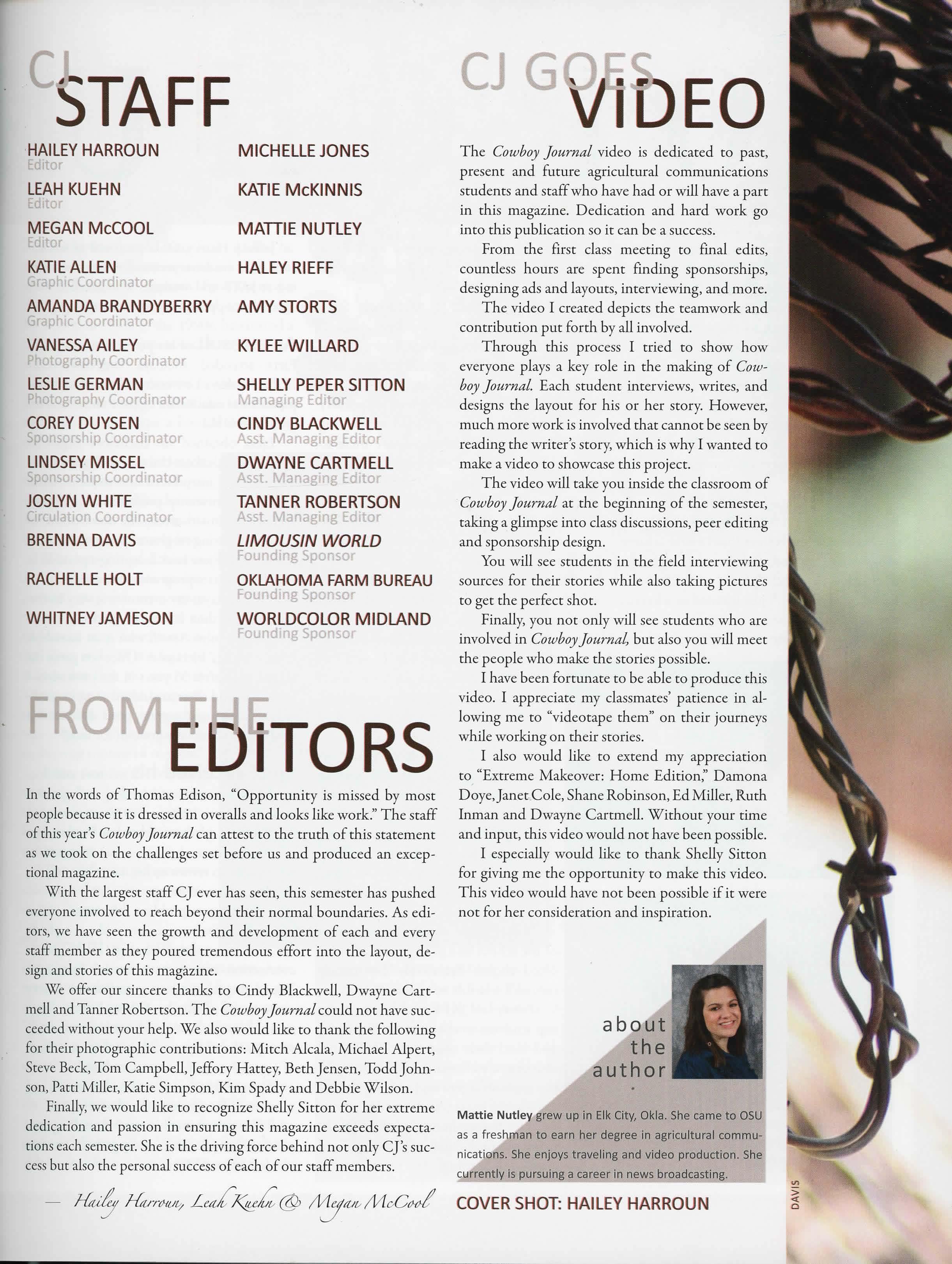
about the author
Mattie Nutley grew up in Elk City, Okla. She came to OSU as a freshman to earn her degree in agricultural communications. She enjoys traveling and
She
With no bus to catch and no bike to ride, Gebisa Ejeta was forced co walk more than 12 miles to the nearest elementary school each Sunday evening. He would not return to the comfort of his family's Ethiopian mud-floor hut until Friday.
Decades later, those dusty footsteps paid off as Ejeta won the World Food Prize, agriculture's equivalent to the Nobel Prize.
Before Ejeta developed his passion for science and research, he barded the hardships of poverty in a small farming community in central Ethiopia.
Ejeta said his mother, although she was illiterate, believed in rhe value of education.
"She made me believe that I could achieve things that I wanted, and she encouraged me to do that as a child;' Ejeca said. "And not knowing any better, I just listened to what my mother told me."
"I grew up poor in a very small village;'
Ejeta said. "And growing up poor we did not have a school, so I walked 20 kilometers to [go to] school."
David Porter, head of Oklahoma State University's plant and soil science department, said the individuals from Ethiopia with whom he has worked, including Ejeta, have been humble and unassuming.
"They'll never reveal che level of poverty and hardship they were exposed to growing up;' Porter said. "So unless you are there to experience it, you have no comprehension of what they went through."
Ejeta said after he finished grade school, the future of his education was uncertain. The nearest high school was almost 80 miles from his home.
Jeffory Haney, OSU professor of soil science, said students received vocational training at ]ATS and students who excelled were offered an opportunity to attend college.
As a result of his performance at JATS, Ejeta attended Alemaya University. Like ]ATS, Alemaya University is located in Ethiopia and was established by the Point Four Program and OSU.
"My family would either have to move, which would be very difficult, or I would have to find some way of supporting myself to get a high school education;' Ejeta said. "In ,---------------~
Ejeta obtained his bachelor's degree in 1973 from Alemaya University. Then his Alemaya adviser introduced him co John Axtell, a Purdue University professor who became Ejeta's longtime mentor. The duo worked together collecting sorghum species around the world, with Ejeta later accepting a position in Axtell's graduate program at Purdue.
chose days in Ethiopia, once you fin-
ished eighth grade you took a national exam, and the top students would get to choose schools that they wanted to go to."
Because he performed well on his national exam, Ejeta was able to choose which of Ethiopia's four boarding schools he wanted to attend. The school he was most interested in attending was Jimma Agricultural Technical School, established by OSU and by President Harry S. Truman's Point Four Program.
"I had heard about the reputation of the school and so I chose that as my No. 1 choice;' Ejeta said. "Fortunately for me, I was able to attend it."
Porter saidJATS would seek out the top students in the country, like Ejeta, and fund their education. The school also provided housing and clothing for the students. Ejera said moving to Jim- • ma was the most transformative part of his life. Before he attended ]ATS, he faced the probability of starvation and scarcity of housing.
"At Alemaya, my mentor was very instrumental, and then I came to grad school and worked for John Axtell, who is an incredible human being;' Ejeta said. "Once you get to the stage I'm at after 35 years in the profession, I look back and there are indeed some key individuals who made a great, great difference in my life, and I am very grateful for that."
Ejeta received his master's and doctoral degrees ih plant breeding and genetics from Purdue in 1976 and 1978, respectively.
While in graduate school at Purdue, Ejera's African home became a war zone and he was unable to return to his native country for nearly a quarter century.
"The biggest problem, of course, is you have a love for your country like everybody else, but we are human beings, so the greater connection is with your family;' Ejera said. "Not being able to see your parents is very emotionally difficult. When I went back nearly 24 years later, I did not know anybody younger than 30 years old, and chat's too much of a punishment for anyone to have."
Ejeta said he had to make adjustments and move on. He refused to dwell on the past.
"The culture evolves, and in making true connections you never really go back to what you left behind;' Ejeta said.
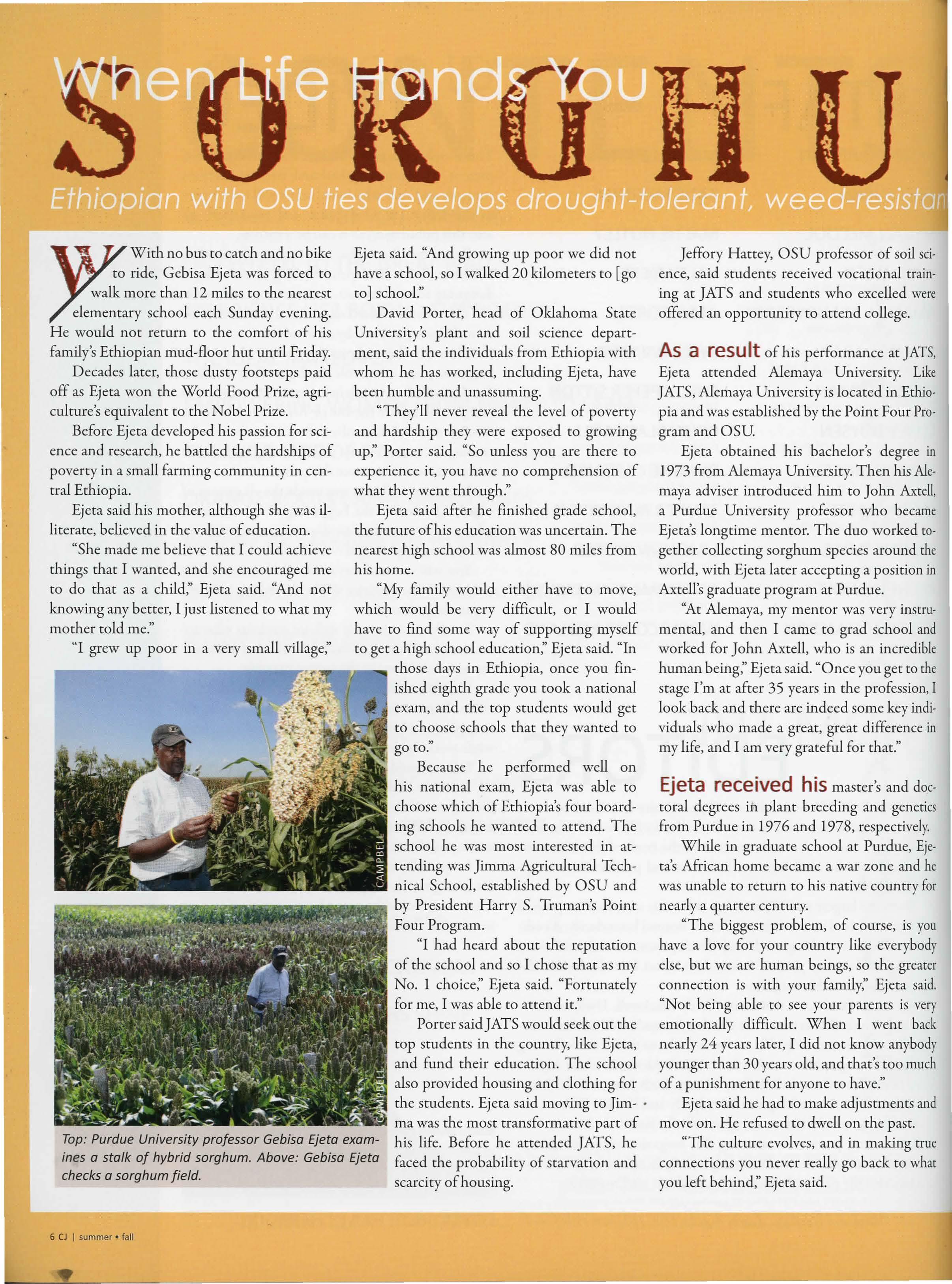
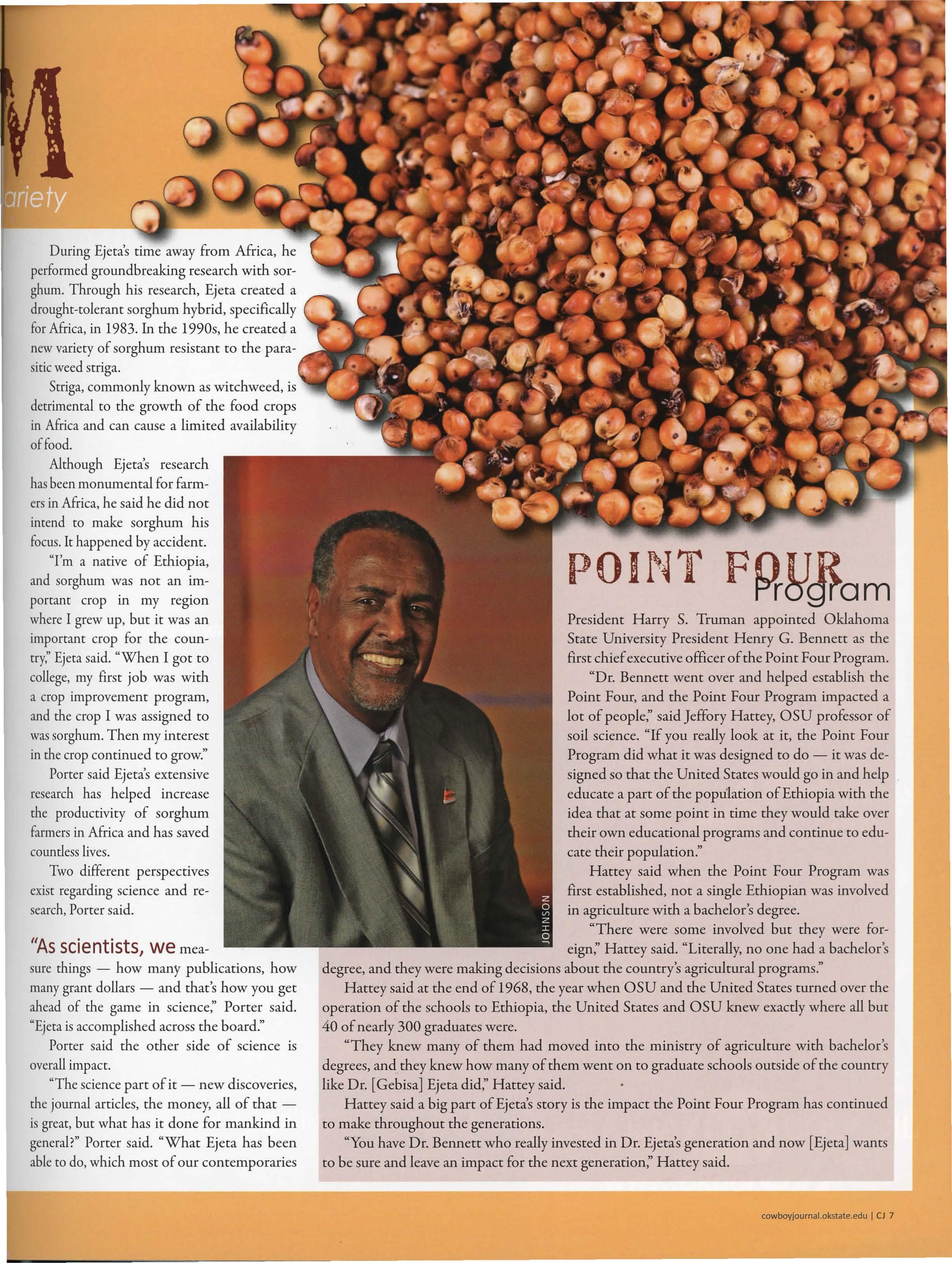
Top: Purdue University professor Gebisa Ejeta examines a stalk of hybrid sorghum. Above: Gebisa Ejeta checks a sorghum field.
During Ejeta's time away from Africa, he performed groundbreaking research with sorghum. Through his research, Ejeta created a drought-tolerant sorghum hybrid, specifically for Africa, in 1983. In the 1990s, he created a new variety of sorghum resistant to the parasiticweed striga.
Striga, commonly known as witchweed, is detrimental to the growth of the food crops in Africa and can cause a limited availability of food.
Although Ejeta's research has been monumental for farmers in Africa, he said he did not intend to make sorghum his focus.It happened by accident.
"I'm a native of Ethiopia, and sorghum was not an important crop in my region where I grew up, but it was an important crop for the country,"Ejeta said. "When I got to college, my first job was with a crop improvement program, and the crop I was assigned to wassorghum. Then my interest in the crop continued to grow."
Porter said Ejeta's extensive research has helped increase the productivity of sorghum farmersin Africa and has saved countlesslives.
Two different perspectives exist regarding science and research,Porter said.
"Asscientists,we measure things - how many publications, how manygram dollars - and that's how you get ahead of the game in science:' Porter said. "Ejetais accomplished across the board."
Porter said the other side of science is overallimpact.
"The science part ofit - new discoveries, the journal articles, the money, all of thatis great, but what has it done for mankind in general?" Porter said. "What Ejeta has been able to do, which most of our contemporaries
President Harry S. Truman appointed Oklahoma State University President Henry G. Bennett as the first chief executive officer of the Point Four Program.
"Dr. Bennett went over and helped establish the Point Four, and the Point Four Program impacted a lot of people," said Jeffory Hattey, OSU professor of soil science. "If you really look at it, the Point Four Program did what it was designed to do - it was designed so that the United States would go in and help educate a part of the population of Ethiopia with the idea that at some point in time they would take over their own educational programs and continue to educate their population."
Harrey said when the Point Four Program was first established, not a single Ethiopian was involved in agriculture with a bachelor's degree.
"There were some involved bur they were foreign;' Harrey said. "Literally, no one had a bachelor's degree, and they were making decisions about the country's agricultural programs."
Harrey said at the end of 1968, the year when OSU and the United States turned over the operation of the schools to Ethiopia, the United States and OSU knew exactly where all but 40 of nearly 300 graduates were.
"They knew many of them had moved into the ministry of agriculture with bachelor's degrees, and they knew how many of them went on to graduate schools outside of the country like Dr. [Gebisa] Ejeta did;' Hattey said.
Hattey said a big part ofEjeta's story is the impact the Point Four Program has continued to make throughout the generations.
"You have Dr. Bennett who really invested in Dr. Ejeta's generation and now [Ejeta] wants to be sure and leave an impact for the next generation;' Hattey said.
in plant science can't claim, is his work has actually saved millions oflives.
"That's an impact you can't just put a number to, but it's the most important impact anyone could have;' Porter said.
For his global impact, Ejeta earned the World Food Prize in 2009. This international award recognizes individuals who have increased the quality, quantity or availability of food in the world.
Ejeta is continuinghis research, now incorporating his findings into maize. Ejeta said maize, like sorghum, does not have strong striga resistance.
"We worked with one of the international agencies, and using the methodology we used for sorghum, we were able to identify striga resistance in maize and characterize that for them;' Ejeta said. "That's exciting - how the work we've done with one crop we can transfer to another with relative ease and make a contribution that way."
Ejeta also contributes to the world of science by educating the young minds of his students at Purdue. He joined the staff in 1984 and now holds a distinguished professorship.
Ejeta said he is proud of using the notion
of research for development and serving humanity to influence his graduate students.
Ejeta said he hopes his graduate students take the key aspect of science at which they excel and make themselves the best scientists they can be. At the same time, he said he hopes they use their research to serve humanity.
"When the World Food Prize award came around and they identified the actual research that we had done, it was a pleasant surprise;' Ejeta said. "But in my view, influencing the younger generation to serve humanity through agricultural sciences to the extent that I have changed minds is the most satisfying thing I have done."
aoout the author
Amanda Brandyberry,a Kansas native, grew up on a diversified organic farm. She will complete her degree in agricultural communications in December. She enjoys graphic design and layout and hopes to pursue a career in a related creative field.
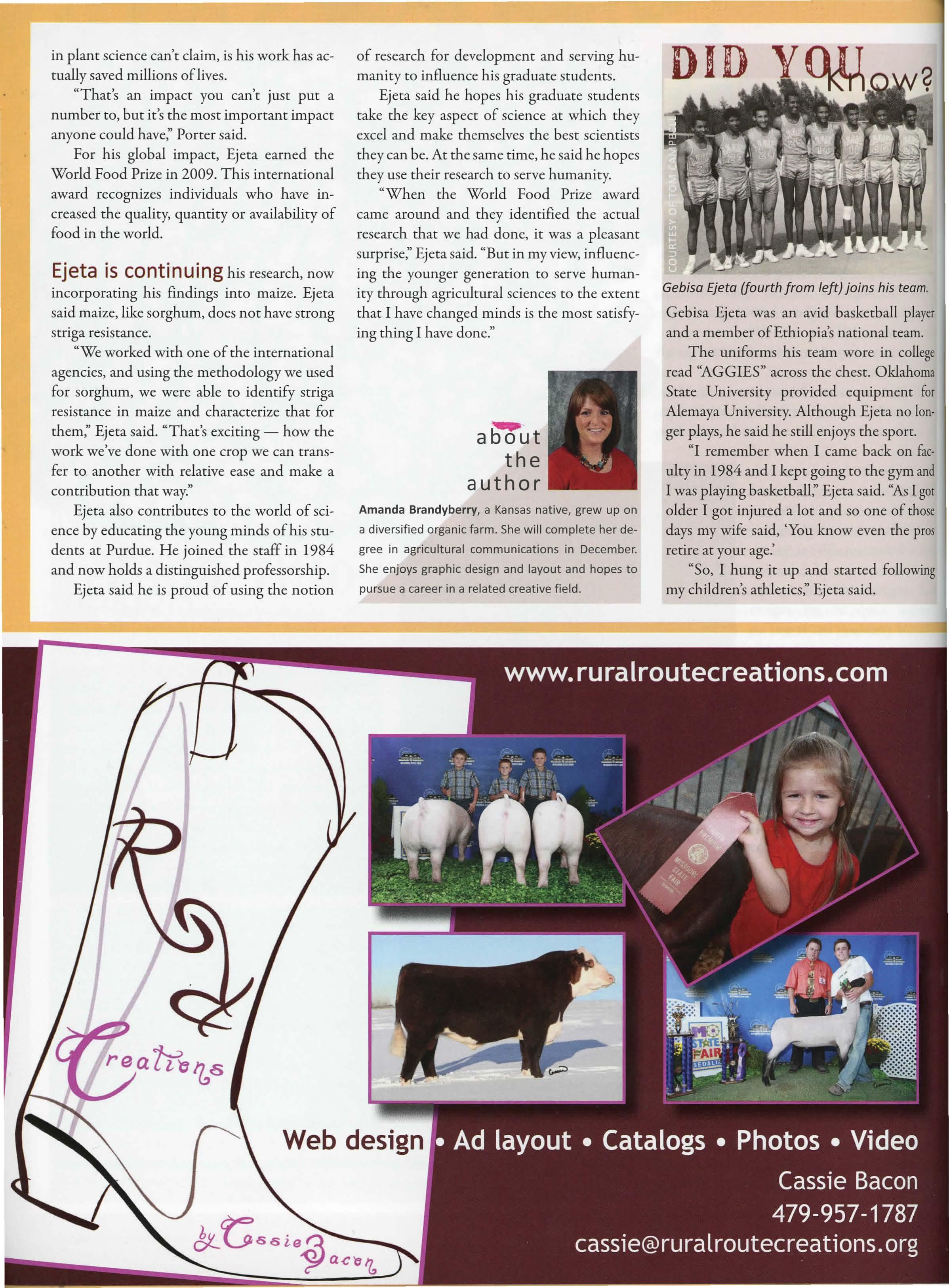
Gebisa Ejeta (fourth from left) joins his team. Gebisa Ejeta was an avid basketball player and a member of Ethiopia's national team.
The uniforms his team wore in college read "AGGIES" across the chest. Oklahoma State University provided equipment for Alemaya University. Although Ejeta no longer plays, he said he still enjoys the sport.
"I remember when I came back on faculty in 1984 and I kept going to the gym and I was playing basketball;' Ejeta said. ''As I got older I got injured a lot and so one of chose days my wife said, 'You know even the pros retire at your age.'
"So, I hung it up and started following my children's athletics;' Ejeta said.
OKFEEDLOTTOTHEGREATWALL
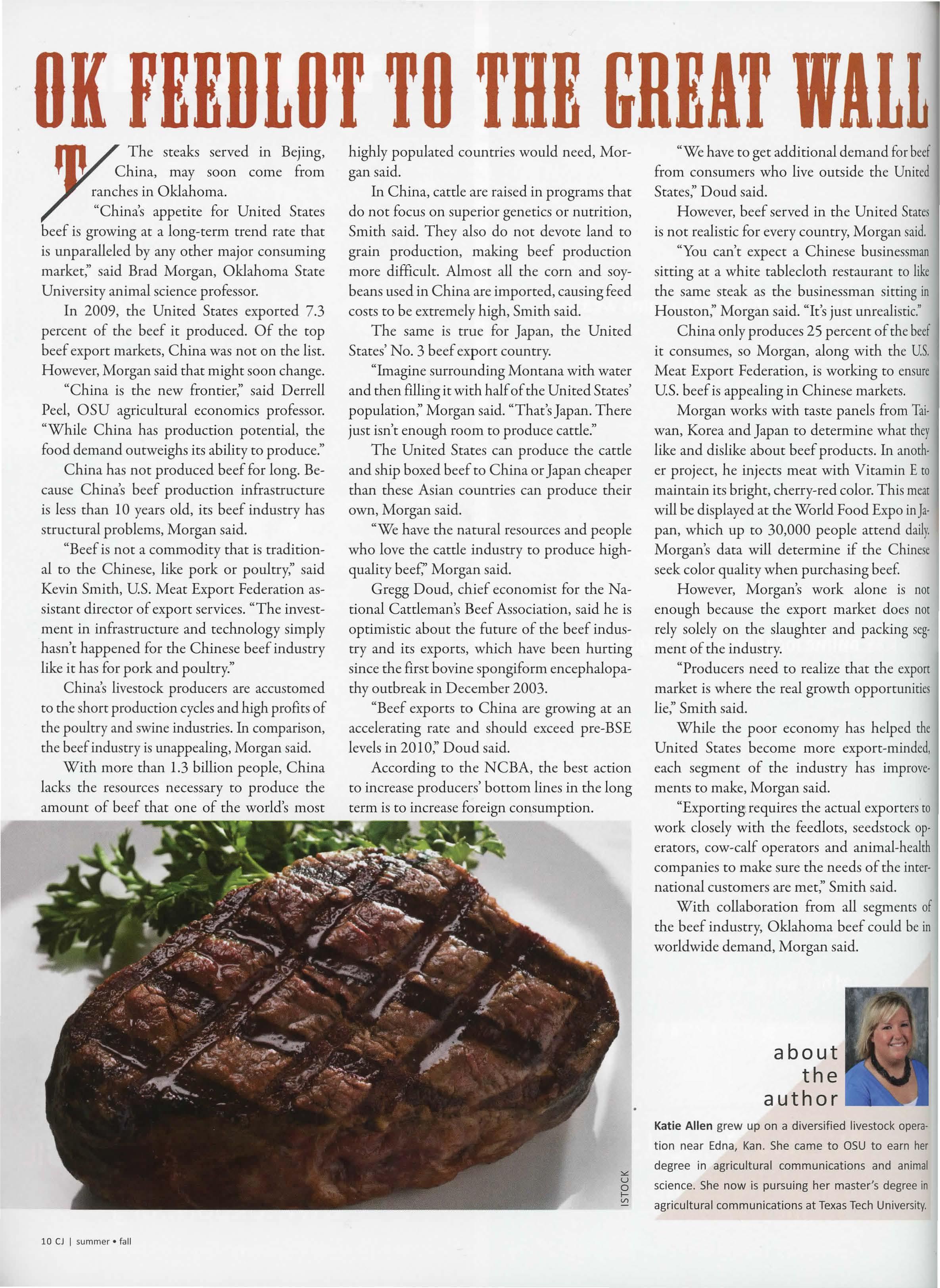
The steaks served in Bejing, China, may soon come from hes in Oklahoma.
ina's appetite for United States beef is growing at a long-term trend rate chat is unparalleled by any ocher major consuming marker;' said Brad Morgan, Oklahoma State University animal science professor.
In 2009, the United States exported 7.3 percent of the beef it produced. Of the top beef export markets, China was not on the list. However, Morgan said that might soon change.
"China is the new frontier;' said Derrell Peel, OSU agricultural economics professor.
"While China has production potential, the food demand outweighs its ability to produce."
China has not produced beef for long. Because China's beef production infrastructure is less than 10 years old, its beef industry has structural problems, Morgan said.
"Beef is not a commodity that is traditional to the Chinese, like pork or poultry;' said Kevin Smith, U.S. Meat Export Federation assistant director of export services. "The investment in infrastructure and technology simply hasn't happened for the Chinese beef industry like it has for pork and poultry."
China's livestock producers are accustomed to rhe shore production cyclesand high profits of the poulcry and swine industries. In comparison, rhe beef industry is unappealing, Morgan said.
With more than 1.3 billion people, China lacks the resources necessary to produce the amount of beef that one of the world's most
highly populated countries would need, Morgan said.
In China, cattle are raised in programs that do not focus on superior generics or nutrition, Smith said. They also do not devote land to grain production, making beef production more difficult. Almost all the com and soybeans used in China are imported, causing feed costs to be extremely high, Smith said.
The same is true for Japan, the United States' No. 3 beef export country.
"Imagine surrounding Montana with water and then filling it with half of the United States' population:• Morgan said. "That's Japan. There just isn't enough room to produce cattle."
The United States can produce the cattle and ship boxed beef to China or Japan cheaper than these Asian countries can produce their own, Morgan said.
"We have the natural resources and people who love the cattle industry to produce highquality beef,' Morgan said.
Gregg Doud, chief economist for the National Cattleman's Beef Association, said he is optimistic about the future of the beef industry and its exports, which have been hurting since the first bovine spongiform encephalopathy outbreak in December 2003.
"Beef exports to China are growing at an accelerating rate and should exceed pre-BSE levels in 201 o;'Doud said.
According to the NCBA, the best action to increase producers' bottom lines in the long term is to increase foreign consumption.
"We have to get additional demand for beef from consumers who live outside the United States;' Doud said.
However, beef served in the United States is not realistic for every country, Morgan said.
"You can't expect a Chinese businessman sitting at a white tablecloth restaurant to like the same steak as the businessman sitting in Houston;' Morgan said. "It's just unrealistic."
China only produces 25 percent of the beef it consumes, so Morgan, along with the U.S. Meat Export Federation, is working to ensure U.S. beef is appealing in Chinese markers.
Morgan works with caste panels from Taiwan, Korea and Japan to determine what they like and dislike about beef products. In another project, he injects meat with Vitamin E to maintain its bright, cherry-red color. This meat will be displayed at the World Food Expo inJa· pan, which up to 30,000 people attend daily.
Morgan's data will determine if the Chinese seek color quality when purchasing bee£
However, Morgan's work alone is nor enough because the export market does nor rely solely on the slaughter and packing seg· ment of the industry.
"Producers need to realize that the export marker is where the real growth opportunities lie;' Smith said.
While the poor economy has helped the United States become more export-minded, each segment of the industry has improvements to make, Morgan said.
"Exporting requires the actual exporters to work closely with the feedlots, seedstock op· erators, cow-calf operators and animal-health companies to make sure the needs of the international customers are mec;' Smith said.
With collaboration from all segments of the beef industry, Oklahoma beef could be in worldwide demand, Morgan said.
about the author
Katie Allen grew up on a diversified livestock operation near Edna, Kan. She came to OSU to earn her degree in agricultural communications and animal science. She now is pursuing her master's degree in agricultural communications at TexasTech University.
LiTeBeyond the
Six Oklahoma State University Agricultural Communicators of Tomorrow members spent their spring break "north of the border" learning about agriculture through an exchange program with the University of Guelph ACT.
"The Canada ACT chapter is trying to rebuild its program;' said Amanda Brodhagen, president of CanACT.
"I went to the Agricultural Media Summit in Ft. Worth with this idea and approached
several different ACT chapters but fell in love with che people from OSU;' she said.
The Canadians were excited when OSU agreed to do the exchange, Brodhagen said.
OSU's ACT began planning for the Canadian visitors at che first executive meeting in August 2009. Krista Anderson, agricultural communications senior, said it was easy finding places for che Canadians to visit.
"The OSU ACT executive team wanted che Canadian students to gee a real feel for Oklahoma;' Ander- son said. "They saw everything from the Express Ranches to Marland Mansion to Oklahoma City's Bricktown. We had so many things we wanted them to see, but we didn't have enough time to take them everywhere."
In addition to sightseeing, Canada ACT members spent their spring break in Oklahoma learning about the state's agricultural sector, visiting the OSU campus, and networking with communications professionals.
"Communications is an important part of the agricultural industry;' said Rebecca Hannam, UoG agricultural business
sophomore. "This opportunity allowed us to learn about the differences in Oklahoma agriculture and Canadian agriculture and cake back what we have learned and apply it to our everyday lives."
As a part of their trip, che students experienced Oklahoma food at famous restaurants: Head Country Bar-B-Q Restaurant, Cattlemen's Steak House, Eskimo Joe's, Hideaway Pizza, and Toby Keith's Bar and Grill.
"My favorite food was the lamb fries at Cattlemen's Steakhouse;' Hannam said. "Lamb fries are not something that would be found in Canada."
What could be found in Canada later chat semester were OSU ACT members during their spring break.
"The timing was great;' Anderson said. "It was a great way to spend spring break and was a great opportunity I won't be able to have after I graduate."
Anderson said her favorite part of che trip to Guelph, Ontario, was che new perspective, friendships and contacts she made while studying abroad.
"Networking and perspective is key in our industry;' Anderson said. "Being from a place other than Oklahoma, I understand the benefits of a new perspective and how producers interact with the general public."
Tanner Robertson, OSU ACT co-adviser, also said this trip offered all participating students new ideas and outlooks.
"This type of exchange allowed our students and the Canadian students to see a part of North America and experience a part of agriculture they may have not seen before;' Robertson said. "It provided a chance to experience cultural similarities and differences and get engaged in that culture."
David Henneberry, director of the OSU College of Agricultural Sciences and Natural
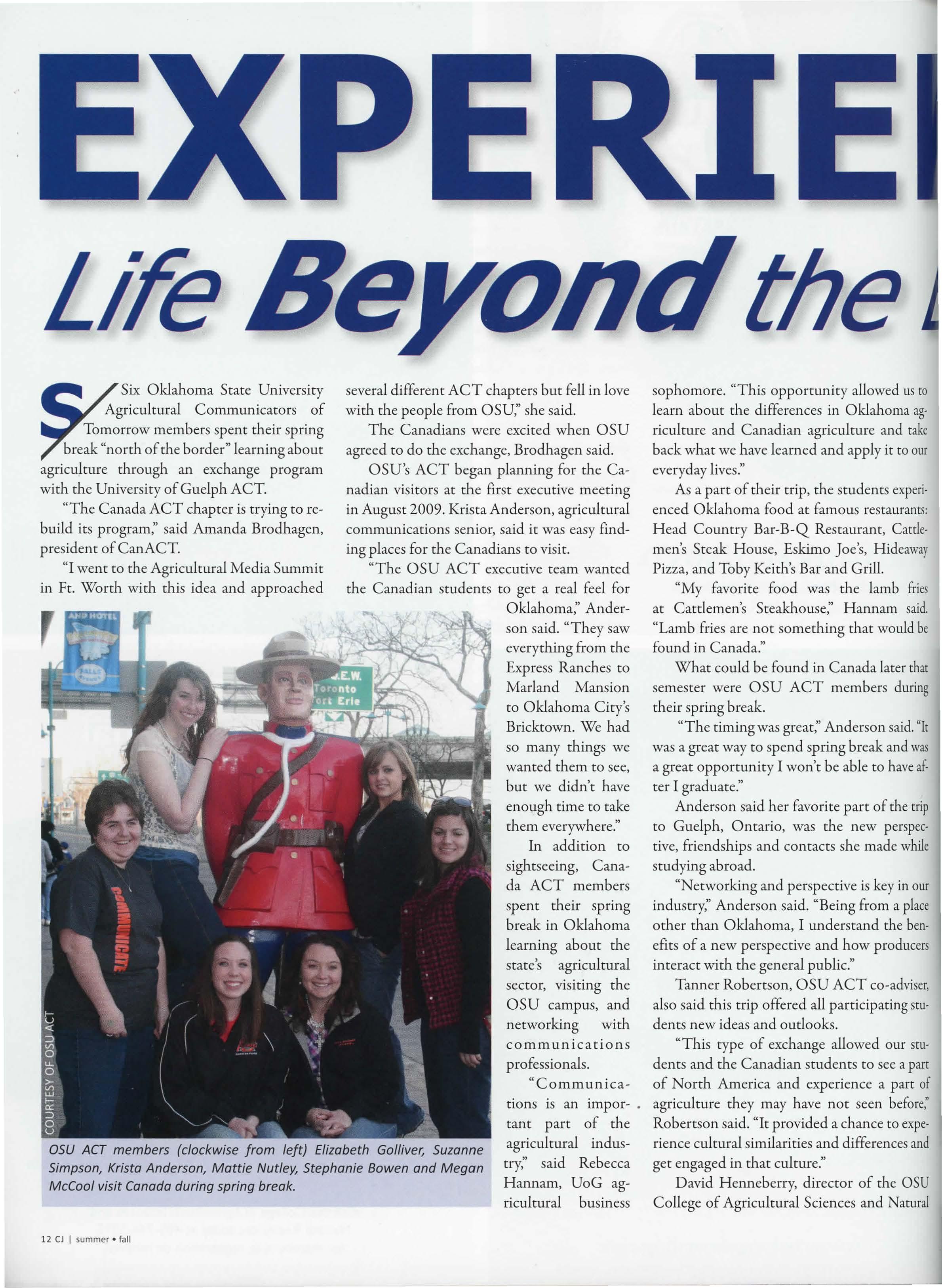
OSU ACT members {clockwise from left) Elizabeth Go/liver, Suzanne Simpson, Krista Anderson, Mattie Nutley, Stephanie Bowen and Megan McCool visit Canada during spring break.
"There is no substitute for the real world;' said Kuzmic, who has led a study-abroad trip to Honduras for 11 years. "There is only so much I can teach in a classroom. When students get off campus, out of Stillwater, out of the country, the learning possibilities are endless. Learning about your career is good, but knowing about the world is imperative."
Henneberry said studying abroad helps prepare students for the future.
~ders
"Study abroad is an expansive experience that prepares an individual for a career in the 21st centurY:' Henneberry said. "Our world is increasingly globalized, and every CASNR graduate needs to prepare for work in a multicultural, global economy."
Resources Internacional Agricultural Programs,said spring break traditionally has been a time codo something uniquely different and challengingfor students.
"The study-abroad courses offered by CASNRwere created to provide a suitable background on agriculture and culture of a particular country, with the students gaining experienceschat are transferable to other situationsthey may encounter;' Henneberry said.
Thomas Kuzmic, professor in natural resourcesecology and management, said studyingabroad in a specific discipline is important.
about the author
Brenna Dee Davis grew up on a family farm near Minco, Okla. She came to OSU as a freshman to earn her degree in agricultural communications with a minor in agricultural economics. She enjoys photography and working with youth in agriculture.
CASNROpportunities
The Oklahoma State University College of Agricultural Sciences and Natural Resources International Agricultural Programs office coordinates opportunities for students to learn across the state line, the U.S. border or the ocean.
In 2008-2009, CASNR offered 19 study-abroad options. The most common programs are short-term and are led by OSU faculty.
"Study-abroad trips commonly are taken in the summer;' said David Henneberry, director of OSU CASNR International Agricultural Programs. "However, students enjoy spending their winter and spring breaks in other countries."
The OSU Study Abroad Office offers scholarships for its study-abroad programs. SAO scholarships are available on a firstcome-first-serve basis to OSU students.
"The $500 scholarship is a one-tin1e award for undergraduate students;' Henneberry said. "Total cost for trips vary depending on location, but it can be a significant reduction in the total cost of a trip."
For more information about studyabroad opportunities, visit sois.okstate.edu.
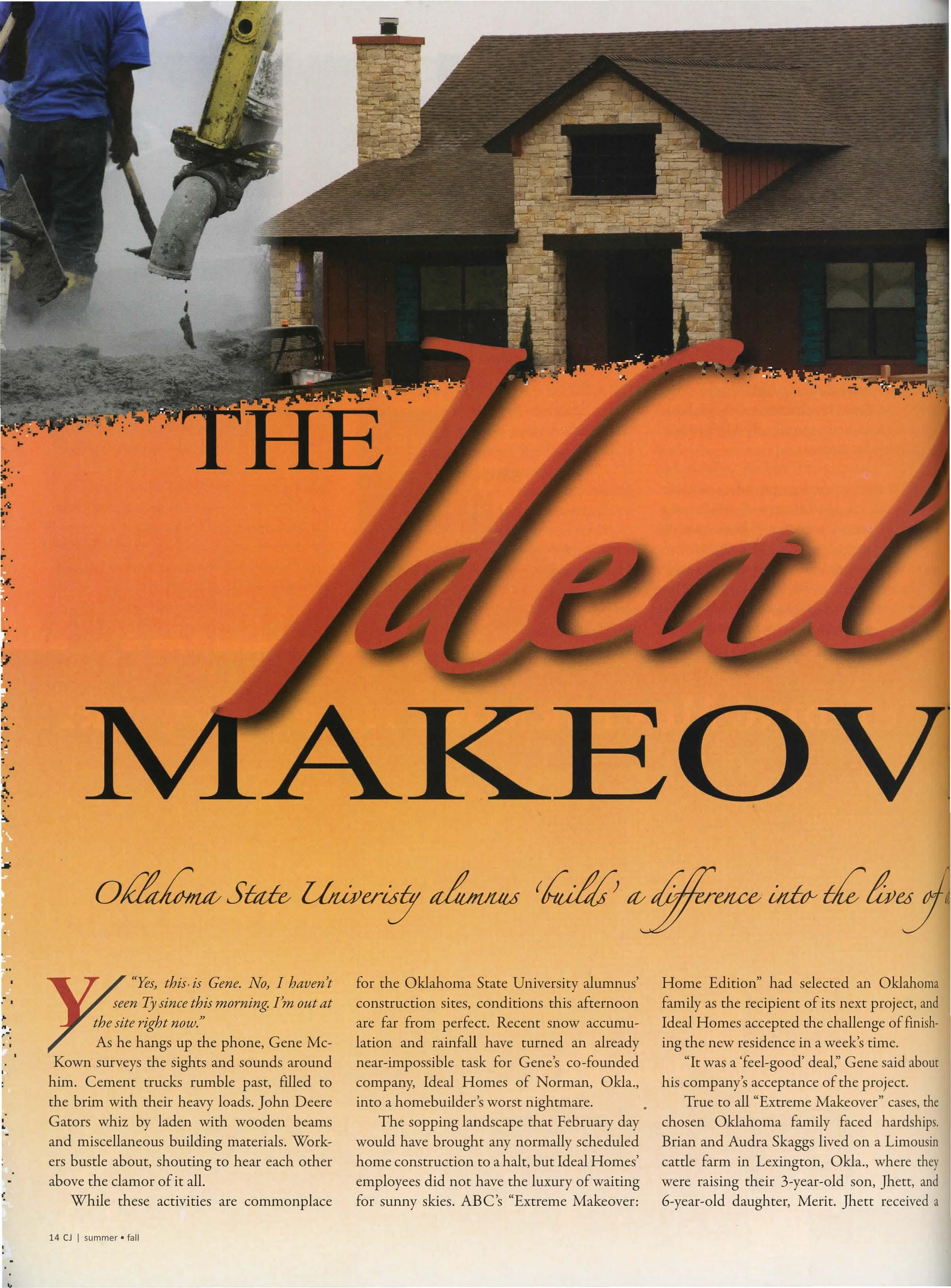
"Yes, this, is Gene. No, I haven't seen Tysince this morning. Tm out at the site right now."
As he hangs up the phone, Gene McKown surveys the sights and sounds around him. Cement trucks rumble past, filled to the brim with their heavy loads. John Deere Gators whiz by laden with wooden beams and miscellaneous building materials. Workers bustle about, shouting to hear each ocher above che clamor ofic all.
While these activities are commonplace
for the Oklahoma Scace University alumnus' construction sites, conditions chis afternoon are far from perfect. Recent snow accumulation and rainfall have turned an already near-impossible cask for Gene's co-founded company, Ideal Homes of Norman, Okla., into a homebuilder's worse nightmare.
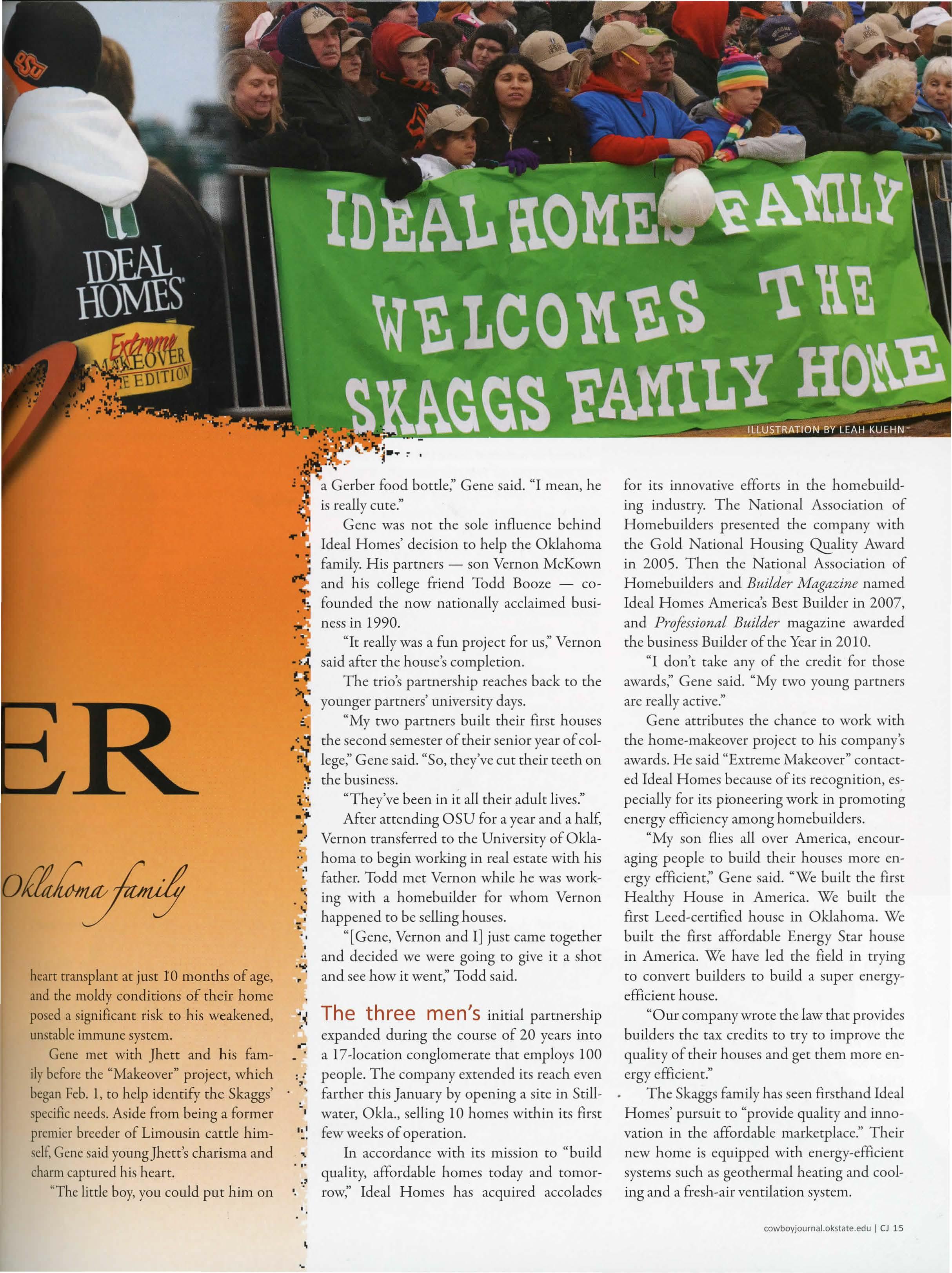
The sopping landscape chat February day would have brought any normally scheduled home construction co a hale, but Ideal Homes' employees did not have the luxury of waiting for sunny skies. ABC's "Extreme Makeover:
Home Edition" had selected an Oklahoma family as the recipient of its next project, and Ideal Homes accepted tl1e challenge of finishing the new residence in a week's tune.
"It was a 'feel-good' deal;' Gene said about his company's acceptance of the project.
True to all "Extreme Makeover" cases, the chosen Oklahoma family faced hardships. Brian and Audra Skaggs lived on a Lirnousin cattle farm in Lexington, Okla., where they were raising their 3-year-old son, Jhecc, and 6-year-old daughter, Merit. Jhecc received a
heart transplant at just 10 months of age, and the moldy conditions of their home posed a significant risk to his weakened, unstableimmune system.
Gene met with Jhett and his family before the "Makeover" project, which began Feb. 1, to help identify the Skaggs' specificneeds. Aside from being a former premier breeder of Lirnousin cattle himself,Gene said youngJhett's charisma and charmcaptured his heart.
"The little boy, you could put him on
a Gerber food bottle;' Gene said. "I mean, he is really cute."
Gene was not rhe sole influence behind Ideal Homes' decision to help the Oklahoma family. His partners - son Vernon McKown _ and his college friend Todd Booze - cofounded the now nationally acclaimed business in 1990.
"It really was a fun project for us;' Vernon said after rhe house's completion.
The trio's partnership reaches back to the younger partners' university days.
"My two partners built their first houses the second semester of their senior year of college;' Gene said. "So, they've cut their teeth on the business.
i: , "They've been in it all their adult lives."
•:• After attending OSU for a year and a ha!£
• Vernon transferred to the University of Oklahoma to begin working in real estate with his •., father. Todd met Vernon while he was work' ing with a homebuilder for whom Vernon ·.:
• , happened to be selling houses.
"[Gene, Vernon and I] just came together .. and decided we were going to give it a shoe -~ and see how it wenr:' Todd said.
:~ The three men's initial partnership expanded during the course of 20 years into a 17-location conglomerate rhat employs 100 : .- people. The company extended its reach even , ' farther this January by opening a site in Still·, water, Okla., selling 10 homes within its first "' few weeks of operation.
'\
In accordance with its mission to "build quality, affordable homes today and tomor·.' row;' Ideal Homes has acquired accolades
for its innovative efforts in the homebuilding industry. The National Association of Homebuilders presented the company with rhe Gold National Housing ~ality Award in 2005. Then the National Association of Homebuilders and Builder Magazine named Ideal Homes America's Best Builder in 2007, and Professional Builder magazine awarded the business Builder of the Year in 2010.
"I don't take any of the credit for chose awards;' Gene said. "My two young partners are really active."
Gene attributes the chance to work with the home-makeover project to his company's awards. He said "Extreme Makeover" contacted Ideal Homes because of its recognition, especially for its proneering work in promoting energy efficiency among homebuilders.
"My son flies all over America, encouraging people to build their houses more energy efficient;' Gene said. "We built the first Healthy House in America. We built the first Leed-certified house in Oklahoma. We built the first affordable Energy Star house in America. We have led the field in crying to convert builders to build a super energyefficient house.
"Our company wrote the law chat provides builders the tax credits to try to improve the quality of their houses and gee chem more energy efficient."
The Skaggs family has seen firsthand Ideal Homes' pursuit to "provide quality and innovation in che affordable marketplace." Their new home is equipped with energy-efficient systems such as geothermal heating and cooling and a fresh-air ventilation system.
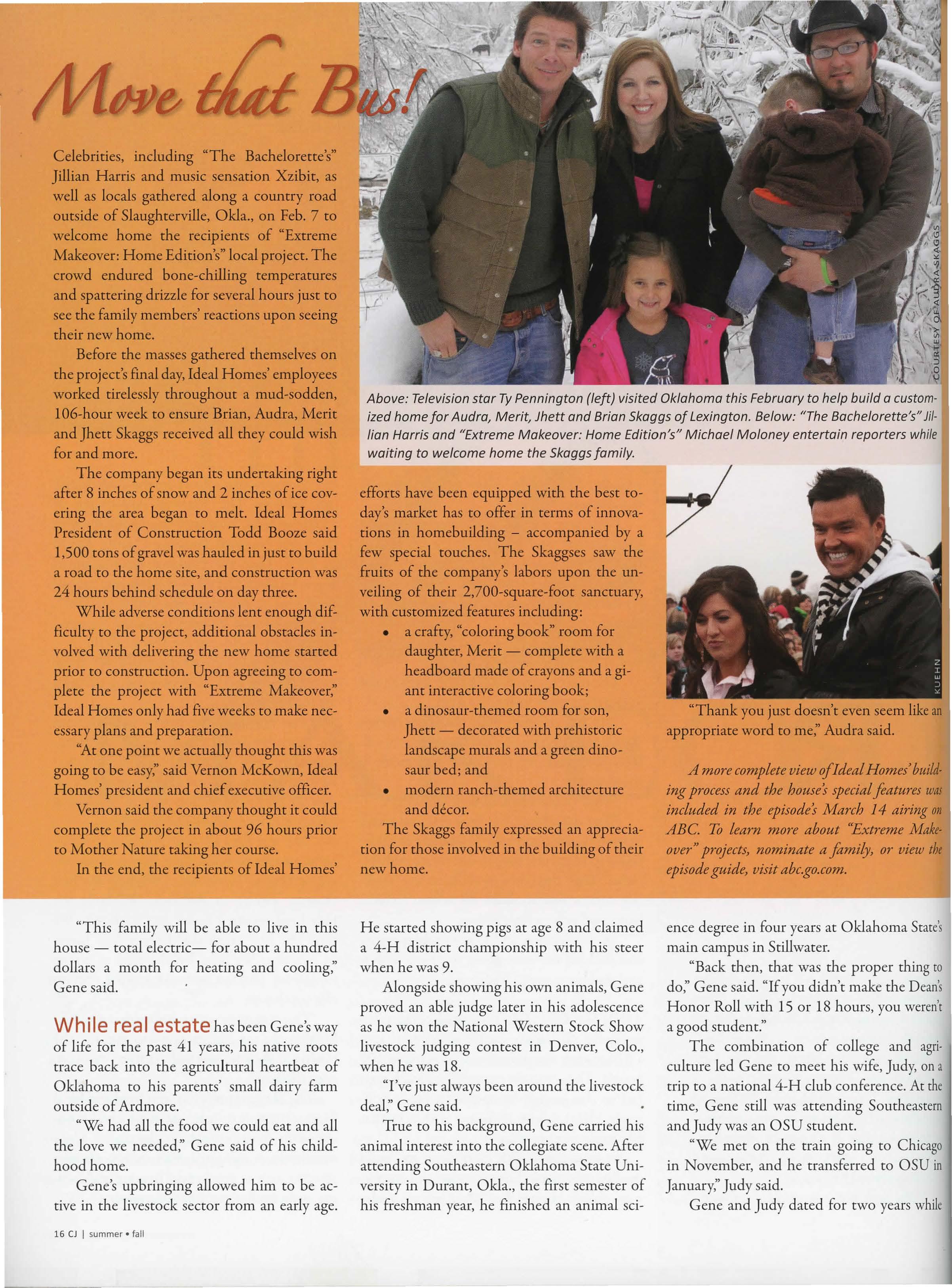
Celebrities, including "The Bachelorette's" Jillian Harris and music sensation Xzibit, as well as locals gathered along a country road outside of Slaughterville, Okla., on Feb. 7 to welcome home the recipients of "Extreme Makeover: Home Edition's" local project. The crowd endured bone-chilling temperatures and spattering drizzle for several hours just to see the family members' reactions upon seeing their new home.
Before the masses gathered themselves on the project's final day, Ideal Homes' employees worked tirelessly throughout a mud-sodden, 106-hour week to ensure Brian, Audra, Merit and Jhett Skaggs received all they could wish for and more.
The company began its undertaking right after 8 inches of snow and 2 inches of ice covering the area began to melt. Ideal Homes President of Construction Todd Booze said 1,500 tons of gravel was hauled in just to build a road to the home site, and construction was 24 hours behind schedule on day three.
While adverse conditions lent enough difficulty to the project, additional obstacles involved with delivering the new home started prior to construction. Upon agreeing to complete the project with "Extreme Makeover," Ideal Homes only had five weeks to make necessary plans and preparation.
"At one point we actually thought this was going to be easy; said Vernon McKown, Ideal Homes' president and chief executive officer.
Vernon said the company thought it could complete the project in about 96 hours prior to Mother Nature taking her course.
In the end, the recipients of Ideal Homes'
"This family will be able to live in this house - total electric- for about a hundred dollars a month for heating and cooling;• Gene said.
While real estate has been Gene's way of life for the past 41 years, his native roots trace back into che agricultural heartbeat of Oklahoma to his parents' small dairy farm outside of Ardmore.
"We had all the food we could eat and all the love we needed;' Gene said of his childhood home.
Gene's upbringing allowed him to be active in the livestock sector from an early age.
waiting to welcome home the Skaggsfamily.
efforts have been equipped with the best today's market has to offer in terms of innovations in homebuilding - accompanied by a few special touches. The Skaggses saw the fruits of the company's labors upon the unveiling of their 2,700-square-foot sanctuary, with customized features including:
• a crafty, "coloring book" room for daughter, Merit - complete with a headboard made of crayons and a giant interactive coloring book;
• a dinosaur-themed room for son, Jhett - decorated with prehistoric landscape murals and a green dinosaur bed; and
• modern ranch-themed architecture and decor.
The Skaggs family expressed an appreciation for those involved in the building of their new home.
He started showing pigs at age 8 and claimed a 4-H district championship with his steer when he was 9.
Alongside showing his own animals, Gene proved an able judge later in his adolescence as he won the National Western Stock Show livestock judging comest in Denver, Colo., when he was 18.
"I've just always been around the livestock deal;' Gene said.
True to his background, Gene carried his animal interest into the collegiate scene. After attending Southeastern Oklahoma State University in Durant, Okla., the first semester of his freshman year, he finished an animal sci-
"Thank you just doesn't even seem like an appropriate word to me," Audra said.
A more completeview ofIdeal Homes'building processand the house'sspecialfeatures was included in the episode'sMarch 14 airing on ABC. To learn more about "ExtremeMakeover"projects, nominate a family, or view the episodeguide, visit abc.go.com.
ence degree in four years at Oklahoma State's main campus in Stillwater.
"Back then, that was the proper thing to do;' Gene said. "If you didn't make the Dean's Honor Roll with 15 or 18 hours, you weren't a good student."
The combination of college and agriculture led Gene to meet his wife, Judy, on a trip to a national 4-H club conference. Ac the time, Gene still was attending Southeastern and Judy was an OSU student.
"We met on the train going to Chicago in November, and he transferred to OSU in January;' Judy said.
Gene and Judy dated for two years while
Above: Television star Ty Pennington {left) visited Oklahoma this February to help build a customized home for Audra, Merit, Jhett and Brian Skaggs of Lexington. Below: "The Bachelorette's" Jillian Harris and "Extreme Makeover: Home Edition's" Michael Moloney entertain reporters while
at Oklahoma State before getting married in 1965.Shortly thereafter in l 969, the McKowns then decided to enter the business of buildinghouses.
"When we started in real estate, we had fivesales associates, and I was the secretary;' Judysaid.
Within l Oyears, the couple had expanded their company's beginning numbers into three officesemploying l OSsales people. They then soldthe business in the early 1980s. But when the Oil Bust hit the state, Gene and Judy felt its economic blow right along with their fellowOklahomans.
"I'd saved $10 million by the time I was 40, and I went bankrupt at 44;' Gene said.
Judy described the next five years as "traumatic"for her family. During that period, she was diagnosed with breast cancer and both her mother and Gene's father died. In addition, the couple's sons, Vernon and Richard, left for college and those who bought their businesswent bankrupt, returning to them one site with 24 employees.
"I couldn't wait to turn so;' Judysaid, laughing. "The 40swere the pits!"
Judy said Gene met the adversity head-on by per-
forming tasks he had during the beginning of his career, like hosting open houses on Sundays. Judy also acquired a job in Oklahoma State's Student Union to help ease their financial burdens.
"We just started working a day at a time, and it started turning back around;' Judy said. "You just continue to work, do the basics, and don't worry about the end results."
Soon after Judy
secured her position, Gene began searching for a new owner for their
non as president and chief executive officer, Todd as president of construction, and Gene as president ofland development.
Gene has credited his "unbelievable success" with his company during the last 23 years to being blessed.
But becoming a leader in his industry has emailed more than luck.
I'd saved $10 million by the time I was 40, and I went bankrupt at 44.
- Gene McKown least a book a quarter and sometimes one a month. Whatever's the No. 1 book in America on business, I read it."
"I've read more books since I got out of college than I ever read while I was in college;' Gene said. "I read at struggling business. Judy said she encouraged him to do so because of his reputation as a smart and talented businessman.
The first person Gene called ended up buying the company.
Judy said when Vernon and Todd decided to join forces with Gene at Ideal Homes, they came in with the enthusiasm, energy and new ideas necessary to pull the company out of its existing slump.
"I don't think we would be where we are without those two;' Judy said.
Ideal Homes has since developed into its current thriving state.
The three owners have built themselves up from ground level to the positions they now hold - Ver-
Gene's dedication to savvy business practices has paid off Gene said Ideal Homes has continued to survive in an era where the total market for homes in the Oklahoma City metropolitan area has dropped from 7,SOOhouses annually to 3,SOO.
"We've had, this past year, the worst recession in 70 years, but Ideal Homes has had one of our most successful years in about 20 years;' Gene said.
Gene said he is sad to attribute the majority of t!1eir success to the loss of more than l 00 competing companies. He said those who didn't have adequate capital to survive this downturn are now out of business.
As a man who has overcome all adversity
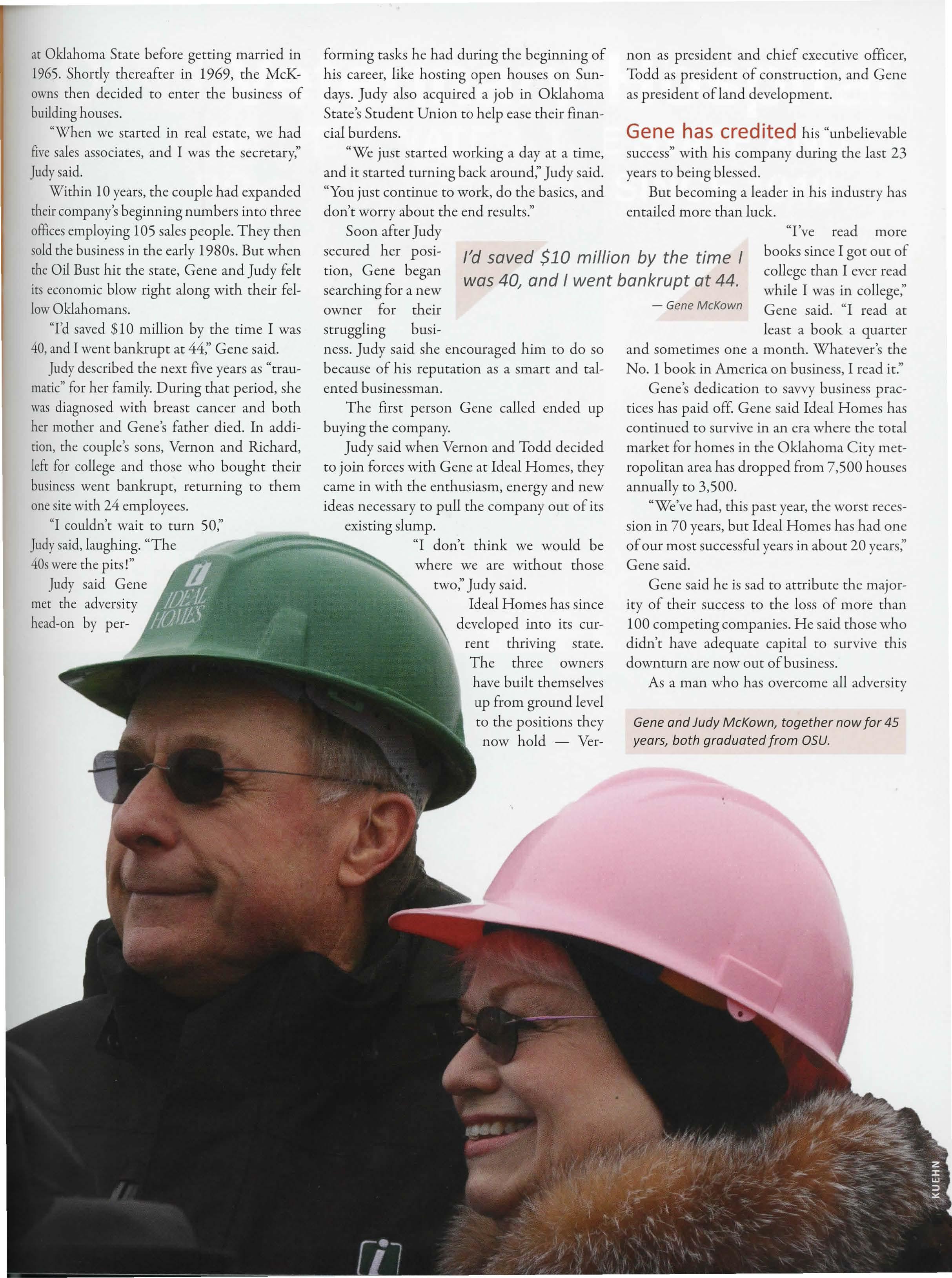
Gene and Judy McKown, together now for 45 years, both graduated from OSU.
lain before him to follow his passion, Gene now offers a word of advice to Oklahoma State graduates preparing for entrance into today's business scene.
"It's a big world, and you can do anything in life you want to do;' Gene said.
Along with chasing his dreams and securing financial success, Gene has managed to keep his company true to its owners' values. Judy said the company's recent "makeover" project for the Skaggses was a way to give back to the community.
"We always have believed very strongly in citizenship;' Judy said about her and Gene. "What we just got done doing with 'Extreme Homes; chat's citizenship."
about the author
Leah Kuehn grew up on a family farm outside of Sidney, Neb. She came to OSU in 2006 to earn her degree in animal science and agricultural communications and ride for the equestrian team. Leah is pursuing an MBA at the University of Denver.
Audra Skaggs expresses her appreciation to Ideal Homes' owners Gene McKown {left) and Todd Booze at the unveiling of her family's home on Feb. 7. The Skaggses returned to Oklahoma after being sent to vacation at Walt Disney World during the home's construction.
e,m.~
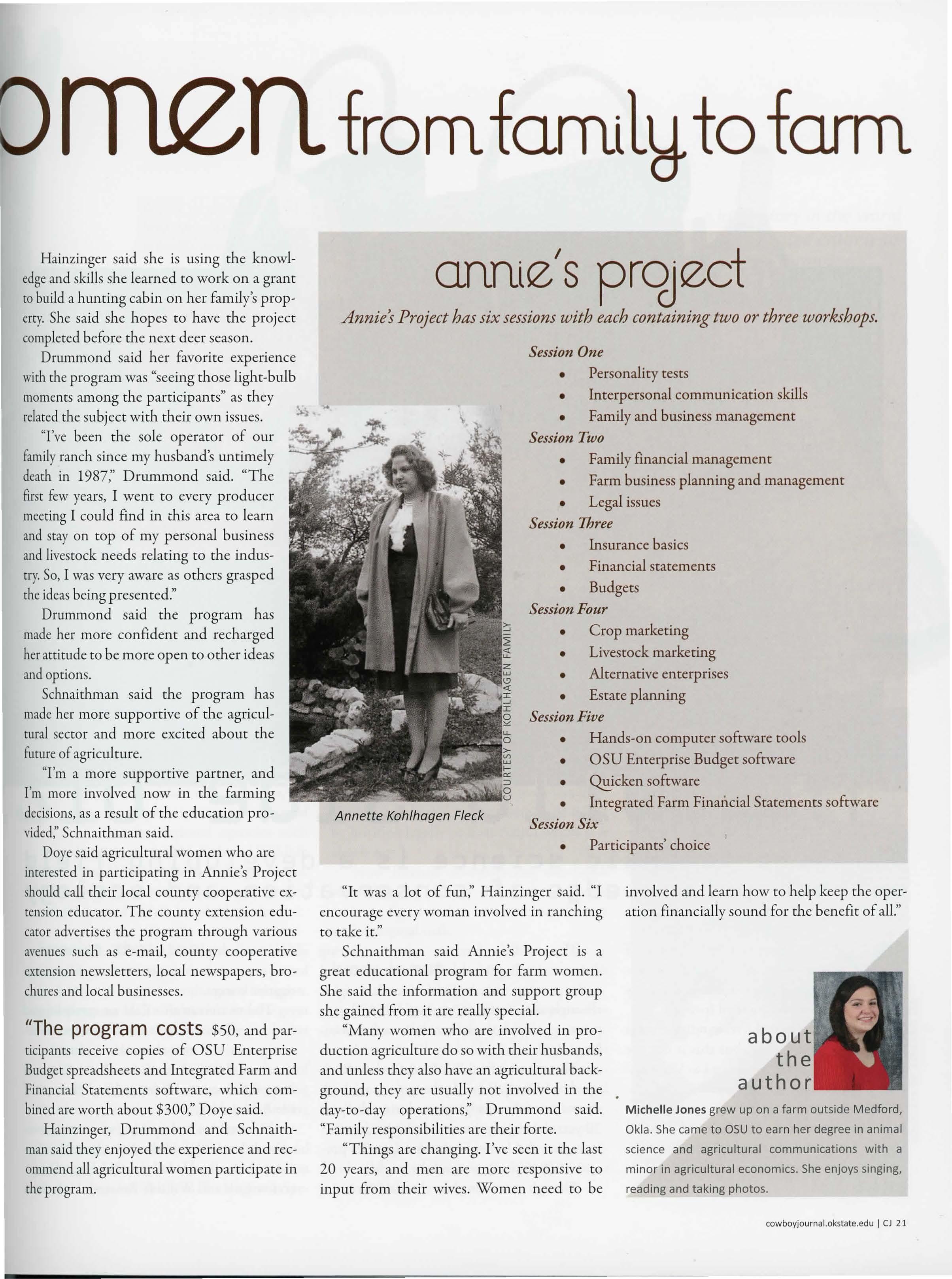
Annette "Annie" Kohlhagen
Fleck dreamed of marrying a farmer and spending her life on the farm. As a business partner with her husband, she endured three generations living under the same roof, low profitability and changes in farm operations and regulations.
She kept thorough records, which she used to make tough financial decisions, including sending her husband to an off-farm job while she managed the farm. Eventually, her records led the family to leasing its land to other farmers who had more equipment and resources to manage the farm efficiently.
Now, Annie's legacy lives on in Annie's Project. Annie's Project provides an oppormnity for women to learn basic farm and ranch management skills as well as form a network of contacts.
"Annie's Project is an educational program focused on farm and family management for women in agriculmre;' said Damona Doye, Oklahoma State University regents professor and extension farm management specialist.
Ruth Hambleton, Annie's daughter, founded Annie's Project in February 2003 in Illinois through a U. S. Department of Agriculture grant for underserved audiences. OSU began Annie's Project in 2007 and is one of 19 states hosting the program.
The mission of Annie's Project is to empower farm women to be better business partners through networking and by managing and organizing critical information.
"It is a series of workshops at the local level with small groups of 10 to 20 people;' Doye said. "Small groups are by design to encourage interaction among participants."
The program is comprised of six sessions with classes meeting weekly for three hours. A variety of workshops are presented in each session. Some of t!1e workshops involve speakers from the community who share their expertise relating to business and the agricultural industry.
The participants take personality tests to learn about their personality style, said Bill Burton, northeast district area agricultural economics specialist. The women are encouraged to have their spouses and business partners cake che tests, also.
"We have talked co them about how certain personality types don't communicate well with other personality types;' Burton said. "If you understand what cype your personality is, then you can do a better job with chat."
The participants also learn about property ownership and basic estate planning, said Sandra Drummond, who participated in Annie's
Project in Osage County during fall 2009. The women also learn business financial management and discover management cools co use in their operations.
"I learned a lot about insurance, setting up wills and crusts co be che most beneficial co future generations, and budgeting," said Sara Hainzinger, a fall 2009 Osage County participant. "Most of these topics were intimidating to me in the past, so I appreciated having several hours of face-to-face time with an expert to explain things and answer questions."
Becky Schnaithman, a fall 2008 Garfield County participant, said she learned more about che farm record keeping and budgets and how to incorporate chose into her overall farm plan.
"Besides introducing che ~icken program, they also helped us with OSU Enterprise Budget software to help determine our financial inputs and outputs in our commodity operations by measuring our ranch financial performance;• Drummond said.
Schnaichman said they worked through scenarios on the ~icken program chat were helpful because many of them applied to their farm operations.
"I have also talked with our accountant and set up a better record-keeping system to help with taxes;' Hainzinger said.
Doye said the women gain confidence in management skills, learn new things about programs, and become familiar with local resources in terms of the people and programs.
"Probably, things they value most are getting co know better oilier people locally who are in similar situations and being able to connect with people who have similar life experiences," Doye said.
Hainzinger said me skills she learned in the program have benefited her in insurance and accounting decisions.
"Since participating in Annie's Project, I have met with our insurance agent and updated things on our ranch policy that I hadn't realized weren't previously covered;' Hainzinger said.
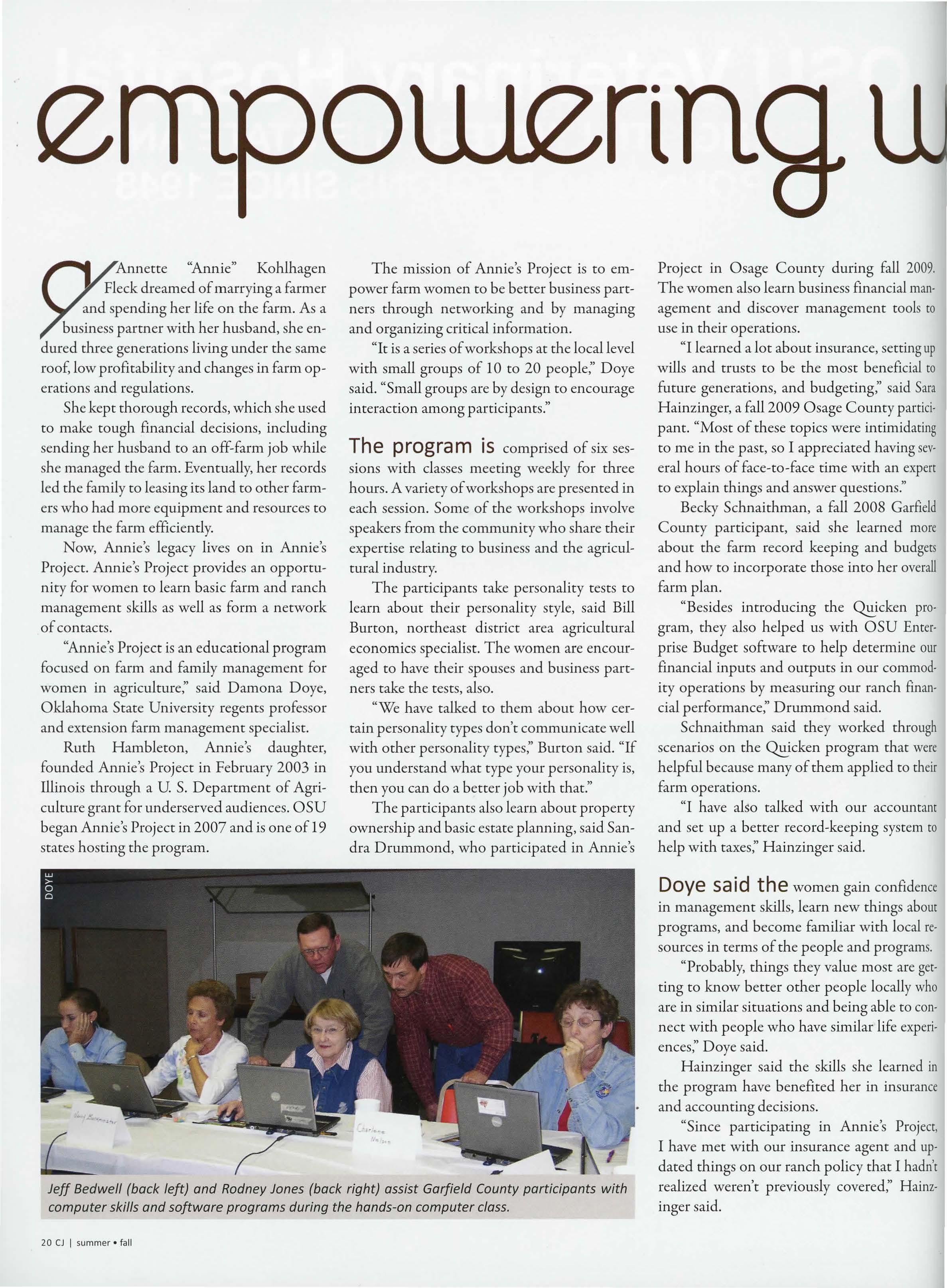
Jeff Bedwell (back left) and Rodney Jones (back right) assist Garfield County participants with computer skills and software programs during the hands-on computer class.
Hainzinger said she is using the knowledgeand skills she learned co work on a grant cobuild a hunting cabin on her family's property. She said she hopes co have the project completedbefore the next deer season.
Drwnmond said her favorite experience withthe program was "seeing chose light-bulb momentsamong the participants" as they relatedthe subject with their own issues.
"I've been the sole operaror of our familyranch since my husband's untimely death in 1987;' Drummond said. "The first few years, I went to every producer meetingI could find in this area co learn and stay on cop of my personal business and livestock needs relating co the industry.So, I was very aware as ochers grasped the ideasbeing presented."
Drummond said the program has made her more confident and recharged herattitude co be more open to ocher ideas and options.
Schnaithman said the program has madeher more supportive of the agricultural sector and more excited about the futureof agriculture.
'Tm a more supportive partner, and I'm more involved now in the farming decisions,as a result of the education provided;'Schnaichman said.
Doye said agricultural women who are interestedin participating in Annie's Project should call their local county cooperative extension educator. The county extension educator advertises the program through various avenuessuch as e-mail, county cooperative extensionnewsletters, local newspapers, brochuresand local businesses.
"The program costs $50, and participants receive copies of OSU Enterprise Budgetspreadsheets and Integrated Farm and Financial Statements software, which combined are worth about $300;' Doye said.
Hainzinger, Drummond and Schnaichmansaid they enjoyed the experience and recommendall agricultural women participate in the program.
anrue's prqJect
Annie's Projecthas six sessionswith eachcontaining two or three workshops.
Session One
Personality tests
Interpersonal communication skills
Family and business management
Session Two
Family financial management
Farm business planning and management
Legal issues
Session Three
Insurance basics
Financial statements
Budgets
Session Four
Crop marketing
Livestock marketing
Alternative enterprises
Estate planning
SessionFive
Hands-on computer software cools
OSU Enterprise Budget software ~icken software
• Integrated Farm Financial Statements software
Session Six
• Participants' choice
"It was a lot of fun;' Hainzinger said. "I encourage every woman involved in ranching co cake it."
Schnaithman said Annie's Project is a great educational program for farm women. She said the information and support group she gained from it are really special.
"Many women who are involved in production agriculture do so with their husbands, and unless they also have an agricultural background, they are usually not involved in the day-co-day operations;' Drummond said. "Family responsibilities are their force.
"Things are changing. I've seen it the last 20 years, and men are more responsive to input from their wives. Women need co be
involved and learn how co help keep the operation financially sound for the benefit of all."
about the author
Michelle Jones grew up on a farm outside Medford, Okla. She came to OSU to earn her degree in animal science and agricultural communications with a minor in agricultural economics. She enjoys singing, reading and taking photos.
Annette Koh/hagen Fleck
Wildlife forensic science is a developing field on the cutting edge of conservation and ecology
Dim fluorescent lights reflect off cold stainless steel decor. A middleaged scientist peers down at the body on che cable with a puzzled frown.
You expect co hear che resounding chords of che "CSI" theme song, hue chis is not che glamorous New York, Miami or Las Vegas setting of a high-stakes crime drama.
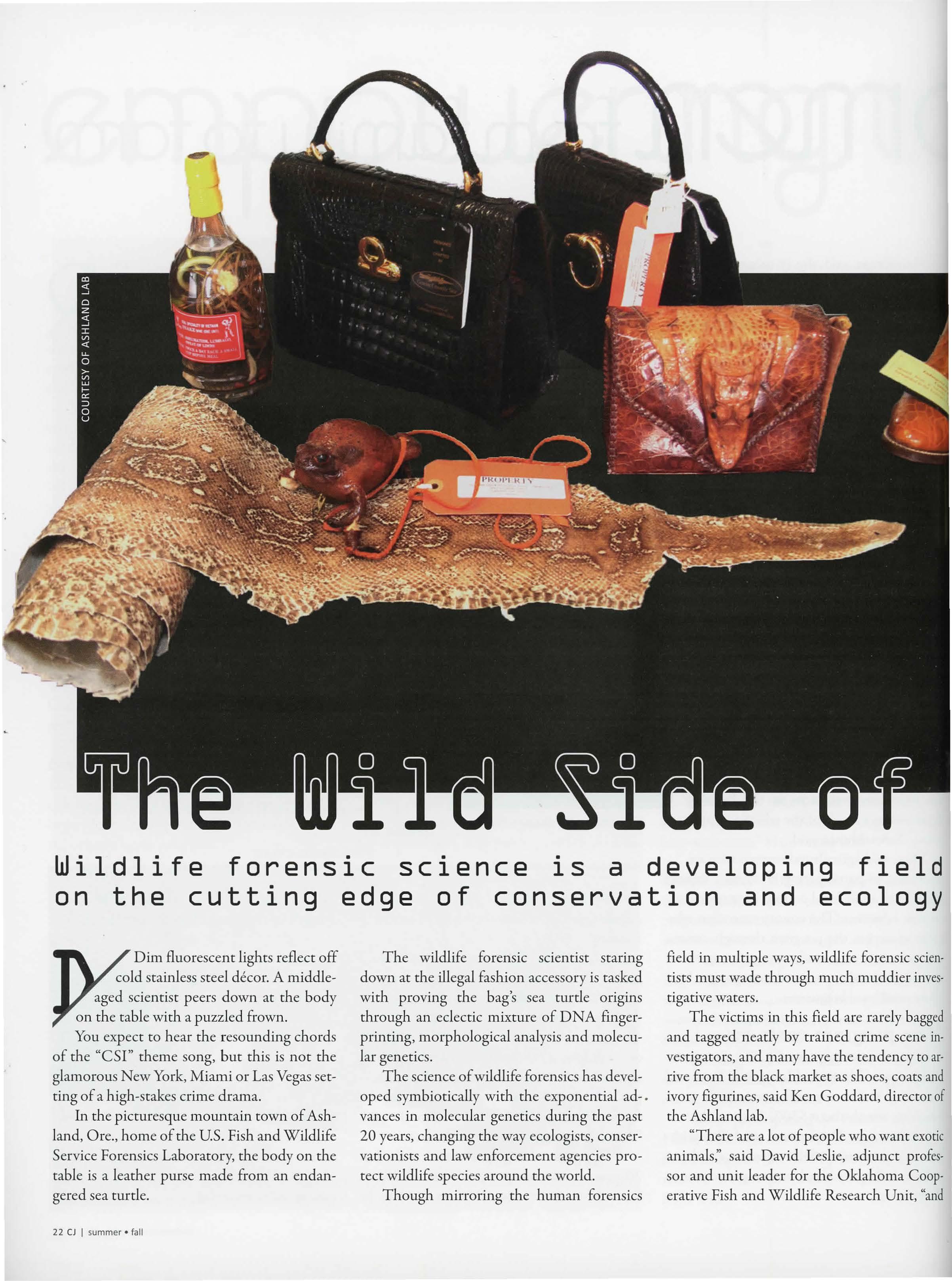
fo the picturesque mountain cown of Ashland, Ore., home of the U.S. Fish and Wildlife Service Forensics Laboratory, the body on the cable is a leather purse made from an endangered sea turcle.
The wildlife forensic scientist staring down at the illegal fashion accessory is casked with proving the bag's sea rurcle origins through an eclectic mixture of DNA fingerprinting, morphological analysis and molecular genetics.
The science of wildlife forensics has developed symbiotically with the exponential ad-. vances in molecular genetics during the past 20 years, changing the way ecologists, conservationists and law enforcement agencies protect wildlife species around the world.
Though mirroring the hwnan forensics
field in multiple ways, wildlife forensic scientists muse wade through much muddier investigative waters.
The victims in this field are rarely bagged and ragged neacly by trained crime scene investigators, and many have the tendency co arrive from the black market as shoes, coats and ivory figurines, said Ken Goddard, director of the Ashland lab.
"There are a lot of people who want exotic animals;' said David Leslie, adjunct professor and unit leader for the Oklahoma Cooperative Fish and Wildlife Research Unit, "and
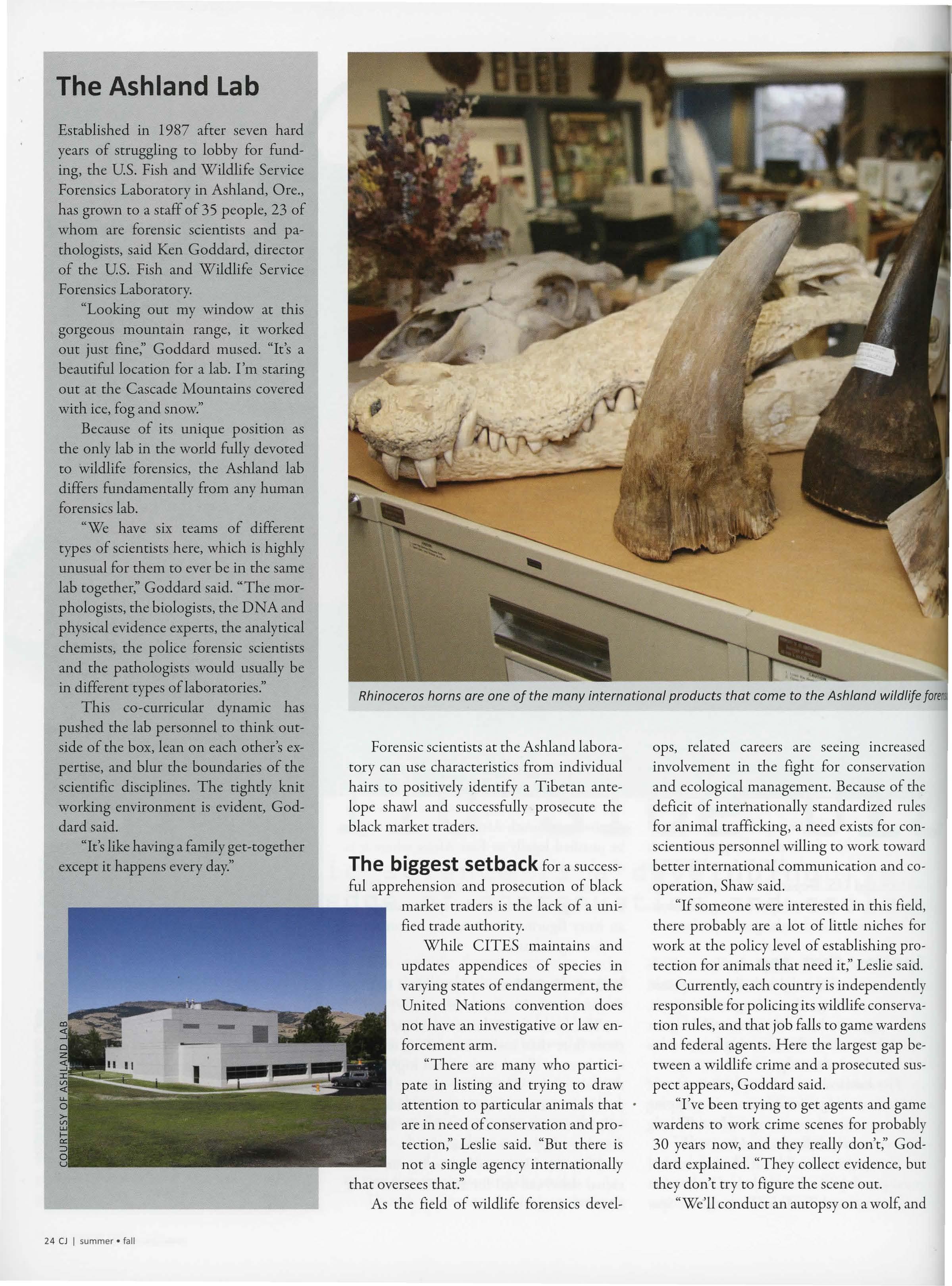
Reptile products from the Caribbean to Southern Asia are sent to the Ashland, Ore., laboratory for analysis and identification. The majority of these products were illegally produced and sold.
many of those animals are illegal, so people will go to great lengths to try to bring them into the United States or any other country where they might be illegal."
Illegalities are determined using a combination of genetic technologies, chemical analysis and morphologic comparison.
"In the old days, when you thought someone took a deer out of season because of a bunch of blood in the back of a pickup truck, and he said, 'No, we killed a goat; you couldn't tell the difference;' said Jim Shaw, professor of wildlife ecology at Oklahoma State University. "Now you can."
The majority of cases from state fish and game agencies involve illegal hunting and poaching, Goddard said. However, the highest priority is reserved for national agencies such as the U.S. Fish and Wildlife Serviceand U.S. Department of Agriculture, which are charged with protecting the country's threatened and endangered species.
Species that top the list include Cayman crocodiles, .whose skins are prized for boots and bags; the endangered sturgeon, whoseeggs are stolen for caviar; and the great white shark, whose fins are in high demand as a delicacyin Asian soups.
The Ashland site is the only laboratory of its kind, making advancements in stopping the international poaching and trafficking trade extremely difficult, Goddard said.
Though the number of threatened and endangered species listed by the Convention on International Trade in Endangered Spe-
cies, a United Nations oversight committee, continues to grow, funding is nonexistent.
"Sadly, only about I or 2 percent of our work is international;' Goddard said. "I wish it were more because they really need our help, but we have to do our highest priority work first, and the highest priority is our own federal stuff. I constantly make the argument that we need more people, more funding, to do the work for the international people."
One of the species on the CITES list that poses a conservation dilemma for ecologists and forensic scientists is the African elephant. South African nations are seeing overpopulation problems as elephants begin to damage the ecosystem. Because of food shortages, elephants are converting forests to savannas and savannas to grasslands.
Conversely, elephants in East Africa were heavily poached in the '80s and '90s and are struggling to maintain population size.
"South African countries want to be able to market ivory to help pay for the costs of conservation;' Shaw explained. "East African elephants need protecting, period. Until molecular genetics came along, there was no way to tell if a tusk or piece of ivory was from elephants in South Africa where trade might be justified legally or East Africa where it is clearly not."
Now forensic scientists can use DNA technology to identify the species origin of an ivory figurine that bears no resemblance to the original tusk.
Ivory is not the only product in high demand on the black market.
The hair of a Tibetan antelope is five times finer than cashmere, making it a coveted item in illegal trade. From high in the thin air of the Tibetan mountains, hunters poach the rare antelope, strip the hides, and sell them across the Chinese border into India where they are made into shawls.
"On the black market today, an individual shawl can sell for $5,000, $10,000 or $15,000;' Leslie said.
laboratory in the world is dedicated entirely to wildlife forensics.
percent of cases at the Ashland laboratory are international.
thousand dollars buys a Tibetan antelope pelt on the black market.
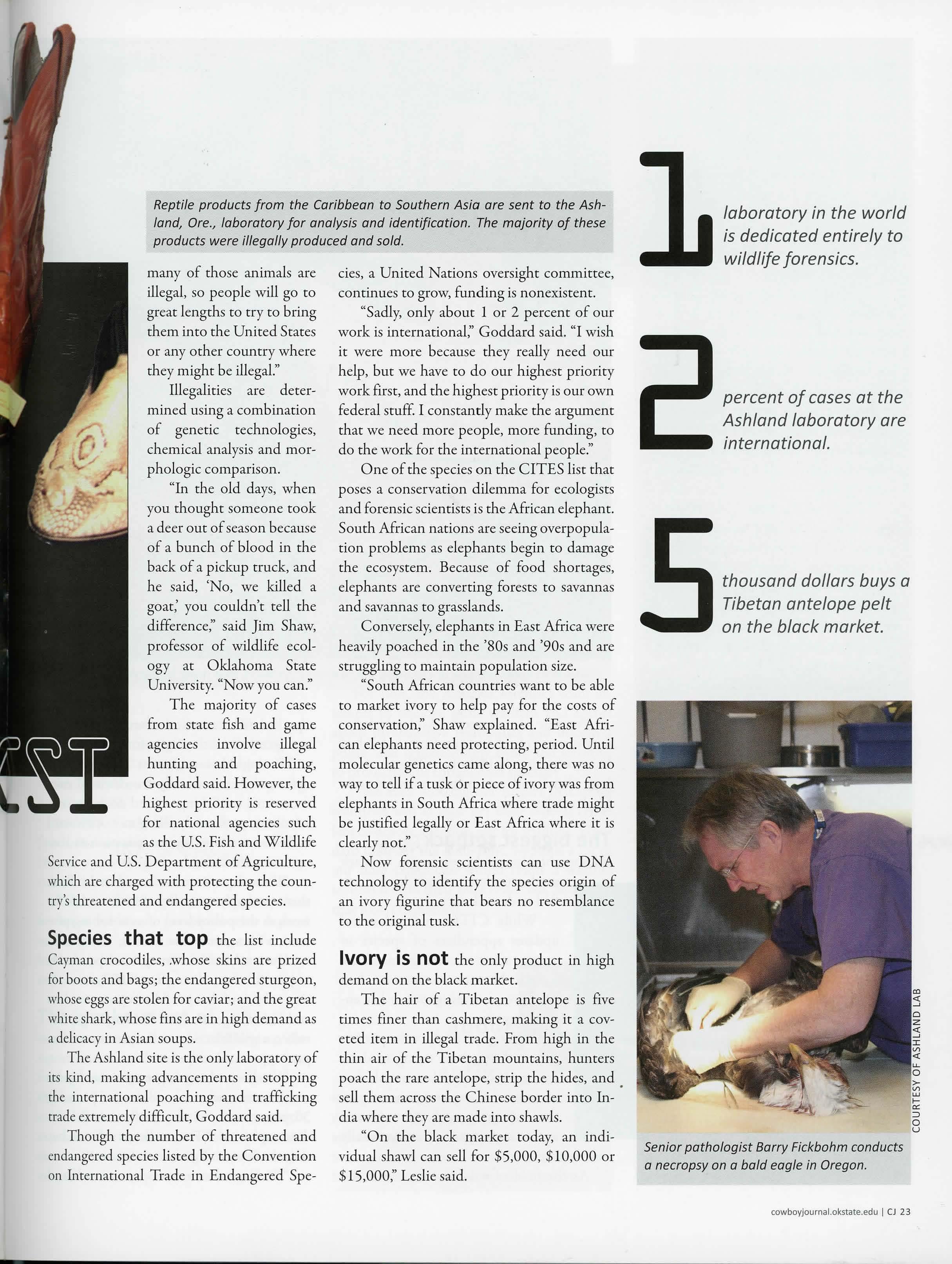
Senior pathologist Barry Fickbohm conducts a necropsy on a bald eagle in Oregon.
The Ashland Lab
Established in 1987 after seven hard years of struggling to lobby for funding, the U.S. Fish and Wildlife Service Forensics Laboratory in Ashland, Ore., has grown to a staff of 35 people, 23 of whom are forensic scientists and pathologists, said Ken Goddard, director of the U.S. Fish and Wildlife Service Forensics Laboratory.
"Looking out my window at chis gorgeous mountain range, it worked out just fine;' Goddard mused. "It's a beautiful location for a lab. I'm staring out at the Cascade Mountains covered with ice, fog and snow."
Because of its unique position as the only lab in the world fully devoted to wildlife forensics, the Ashland lab differs fundamentally from any human forensics lab.
"We have six teams of different types of scientists here, which is highly unusual for them to ever be in the same lab together;' Goddard said. "The morphologists, the biologists, the DNA and physical evidence experts, the analytical chemists, the police forensic scientists and the pathologists would usually be in different types oflaboratories."
This co-curricular dynamic has pushed the lab personnel to think outside of the box, lean on each other's expertise, and blur the boundaries of the scientific disciplines. The tightly knit working environment is evident, Goddard said.
"It's like having a family get-together except it happens every day."
Forensic scientists at the Ashland laboratory can use characteristics from individual hairs to positively identify a Tibetan antelope shawl and successfully prosecute the black market traders.
The biggest setback for a successful apprehension and prosecution of black market traders is the lack of a unified trade auchoricy.
While CITES maintains and updates appendices of species in varying states of endangerment, the United Nations convention does not have an investigative or law enforcement arm.
"There are many who participate in listing and trying to draw attention to particular animals that are in need of conservation and protection;' Leslie said. "But there is not a single agency internationally that oversees that."
As the field of wildlife forensics devel-
ops, related careers are seeing increased involvement in the fight for conservation and ecological management. Because of che deficit of interhacionally standardized rules for animal trafficking, a need exists for conscientious personnel willing to work toward better international communication and cooperation, Shaw said.
"If someone were interested in chis field, chere probably are a lot of little niches for work at the policy level of establishing protection for animals that need it;' Leslie said.
Currently, each country is independently responsible for policing its wildlife conservation rules, and that job falls to game wardens and federal agents. Here the largest gap between a wildlife crime and a prosecuted suspect appears, Goddard said.
''I've been crying to get agents and game wardens to work crime scenes for probably 30 years now, and they really don't;' Goddard explained. "They collect evidence, but they don't try to figure the scene out.
"We'll conduce an autopsy on a wolf, and
Rhinoceros horns are one of the many international products that come to the Ashland wildlife foren
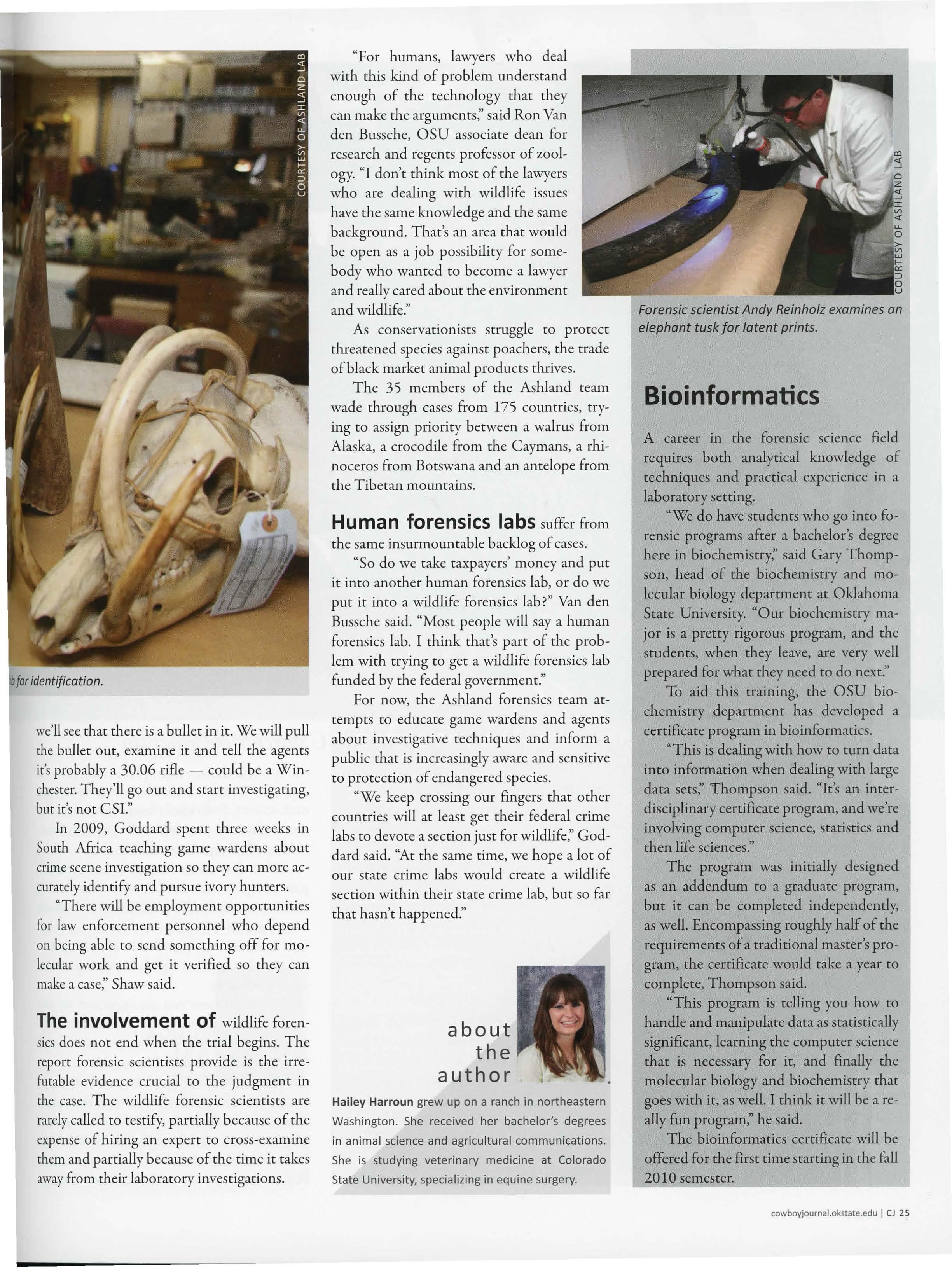
bfor identification.
we'llsee that there is a bullet in it. We will pull the bullet out, examine it and tell the agents it's probably a 30.06 rifle - could be a Winchester.They'll go out and start investigating, but it's not CSL"
In 2009, Goddard spent three weeks in South Africa teaching game wardens about crimescene investigation so they can more accmately identify and pursue ivory hunters.
"There will be employment opportunities for law enforcement personnel who depend on being able tO send something off for molecular work and get it verified so they can makea case;• Shaw said.
The involvement of wildlife forensics does not end when the trial begins. The report forensic scientists provide is the irrefutable evidence crucial t0 the judgment in che case. The wildlife forensic scientists are rarelycalled ro testify, partially because of the expense of hiring an expert tO cross-examine chemand partially because of che time it takes awayfrom their laborat0ry investigations.
"For humans, lawyers who deal with this kind of problem understand enough of the technology that they can make the arguments;• said Ron Van den Bussche, OSU associate dean for research and regents professor of zoology. "I don't think most of che lawyers who are dealing with wildlife issues have the same knowledge and the same background. That's an area chat would be open as a job possibility for somebody who wanted to become a lawyer and really cared about the environment and wildlife."
As conservationists struggle tO protect threatened species against poachers, the trade of black market animal products thrives.
The 35 members of che Ashland team wade through cases from 175 countries, trying tO assign priority between a walrus from Alaska, a crocodile from the Caymans, a rhinoceros from Botswana and an antelope from the Tibetan mountains.
Human forensics labs
suffer from the same insurmountable backlog of cases.
"So do we cake taxpayers' money and put it into another human forensics lab, or do we put it into a wildlife forensics lab?" Van den Bussche said. "Most people will say a human forensics lab. I chink that's part of the problem with trying tO get a wildlife forensics lab funded by che federal government."
For now, the Ashland forensics team attempts ro educate game wardens and agents about investigative techniques and inform a public that is increasingly aware and sensitive to protection of endangered species.
"We keep crossing our fingers that other countries will at least get their federal crime labs tO devote a section just for wildlife;' Goddard said. "At the same time, we hope a lot of our state crime labs would create a wildlife section within their state crime lab, but so far chat hasn't happened."
about the author
Hailey Harroun grew up on a ranch in northeastern Washington. She received her bachelor's degrees in animal science and agricultural communications. She is studying veterinary medicine at Colorado State University, specializing in equine surgery.
Bioinformatics
A career in the forensic science field requires both analytical knowledge of techniques and practical experience in a laborarory setting.
"We do have students who go into forensic programs afrer a bachelor's degree here in biochemimy;' said Gary Thompson, head of che biochemistry and molecular biology department at Oklahoma State University. "Our biochemistry major is a pretty rigorous program, and the students, when they leave, are very well prepared for what they need to do next."
To aid this training, the OSU biochemistry department has developed a certificate program in bioinformatics.
"This is dealing with how tO turn data into information when dealing with large data secs," Thompson said. "It's an interdisciplinary certificate program, and we're involving computer science, statistics and then life sciences."
The program was initially designed as an addendum to a graduate program, but it can be completed independently, as well. Encompassing roughly half of the requirements of a traditional master's program, the certificate would cake a year to complete, Thompson said.
"This program is telling you how to handle and manipulate data as statistically significant, learning the computer science chat is necessary for it, and finally the molecular biology and biochemistry that goes with it, as well. I chink it will be a really fun program;' he said.
The bioinformatics certificate will be offered for the first time starting in the fall 2010 semester.
Forensic scientist Andy Reinholz examines an elephant tusk for latent prints.
Oklahoma wineries see a bright future with the help of the OSU viticulture program
When driving down a dusty Oklahoma road, most visitors would not expect to see grapevines on the corner section.
Bur with the help of Oklahoma State University's horticulture and landscape architecture department, grapevines might become a staple in Oklahoma agriculture.
In a cooperative effort among Oklahoma State University-Stillwater, Oklahoma State University-Oklahoma City, Tulsa Community College, and the Oklahoma Grape Growers and Winemakers Association, faculty and producers have developed a viticulture education program.
"The program's purpose is to create in the student a broad base of horticulture knowledge applicable not only in the vineyard but also across disciplines;' said Eric Stafne, OSU assistant professor and viticulture specialist.
Now in its 10th year, the program has had
more than 600 students from eight states. The program's basic level is designed to be completed in two years, while an advanced level of the progran1 requires an additional threeyear commitment. Both program levels offer a variery of horticulture, viticulture and management courses and can be applied toward a bachelor's degree in horticulture.
"Many of the students have gone on to create their own vineyards or winery businesses;' Stafne said.
Winery owners and prospective growers can choose classes from any of the participating schools.
"The program was designed to be flexible for the student but encompass a wide variety of class offerings;' Stafne said. "The OSU grape-management short course has been the cornerstone of the program."
The six-month grape-management class
costs $250 and is limited to 70 participants each session. Individuals learn about vineyard establishment, pruning and site selection, among other topics.
"The class meets once a month from I p.m. to 5 p.m., but the class was so interesting that it went by fast;' said Kim Hunn, a shorecourse participant.
Hunn said she enrolled in the viticulture program because her family is putting a vineyard on its farm.
"I learned how you are supposed to test the soil before planting the grapes, the different diseases that can occur in grapes, and different pesticides to use;' Hunn said.
Mary Steichen, marketing and development coordinator for Silvertop Farm and Vineyards, said she has benefited from the grape-management short comse, as well. After evaluating her Ponca City, Okla., operation, Steichen decided to enroll in Stafne's course.
"After going through Eric's class, I realized Silvertop Farm could start growing grapes;' Steichensaid. "We raise Shropshire sheep here at Silvercop Farm, and what goes better with an upscale cut oflamb than a glass of wine?"
With Stafne's help and the knowledge Steichen gained from the grape-management shore course, Silvertop Farm and Vineyardshas a fresh start.
"I helped Mary with site selection, variety selection and numerous other questions she had;'Stafne said. "This year she should be able to harvest a few grapes off some of the vines."
Steichen credited Stafne for her success.
"Withour the help of Eric and the grapemanagement short course, I would have pur my vineyard in the wrong location and wouldn't be successful;' Steichen said.
Oklahoma grape growers also have beneficedfrom the viticulture education program.
Don Neal, manager ofStableridge Winery in Stroud, Okla., credited Stafne and the staff at OSU for helping with issues at his winery. Neal's success at wine-making garnered four international awards in 2009.
"Ifyou are in the agriculture business, you have got to use your resources to succeed;' Nealsaid. "When I find a new bug that I have no idea what it is, I send it to Eric and his staff. We are so fortunate to have OSU nearby to helpsolve our issues."
Thoughchallengesarisewith any new vineyard, Oklahoma can be a good place to start a winery, Stafne said.
Stafne stressed proper management, pruningand pest control as the keys to operating a successfulvineyard.
"Having a vineyard is work, but good growersare out there now, and more are on theway;' Stafne said.
Formorein.formationabout the viticulture educationprogram, visit www.grapes.okstate.edu. about the author
HaleyRieff grew up on a livestock operation near Bentonville,Ark. She came to OSU as a junior from Northeastern Oklahoma A&M College to earn her degreein agricultural communications. She is workingon her graduate degree to be a teacher.
OSU viticulture receives national grant
Oklahoma State University's viticulture and enology program recently received a competitive grant through the Specialty Crop Research Initiative, a national program administered by the U.S. Department of Agriculture and the National Institute of Food and Agriculture.
"It was important for this grant robe successful so that we could put significant effort into developing a singular source of information for the grape-growing community," said Eric Stafoe, OSU assistant professor and viticu Itu re specialist.
Scafne said websites from each state currently inform growers, but no single, comprehensive information source has been available until this grant project.
The three-year, $850,000 grant will create a community of practice, which will provide scientific research information about grape production. The grant is cksigned to
contribute co the success of prospective and current growers in the grape and wine industry, Stafne said.
"The hope is folks who arc chinking about getting started will consult the grapes website on eXtension, find out what they need co get started, and use the site for upto-date information on new happenings and research;' Scafne said.
The community of practice materials will be available on cXtension.org, a collaborative site in conjunction with the Cooperative Extension System.
Faculty members and professionals from the 13 participating institutions hope to create interest in Oklahoma wineries as well as chose in other scares.
"We arc striving coward a goal of serving all grape growers across che United States, and thus growers in Oklahoma will benefit as those in another state would;' Stafi1c said.
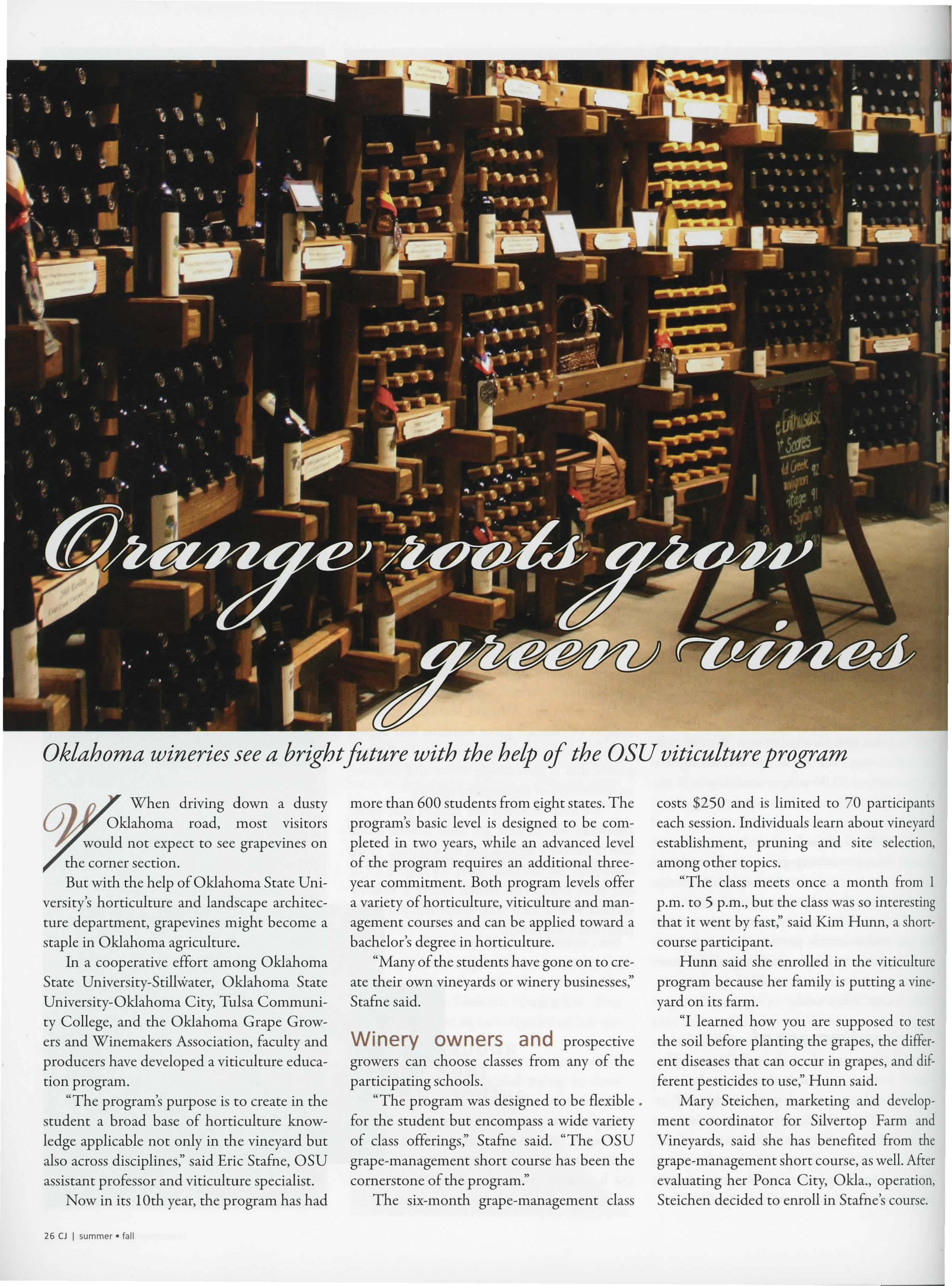
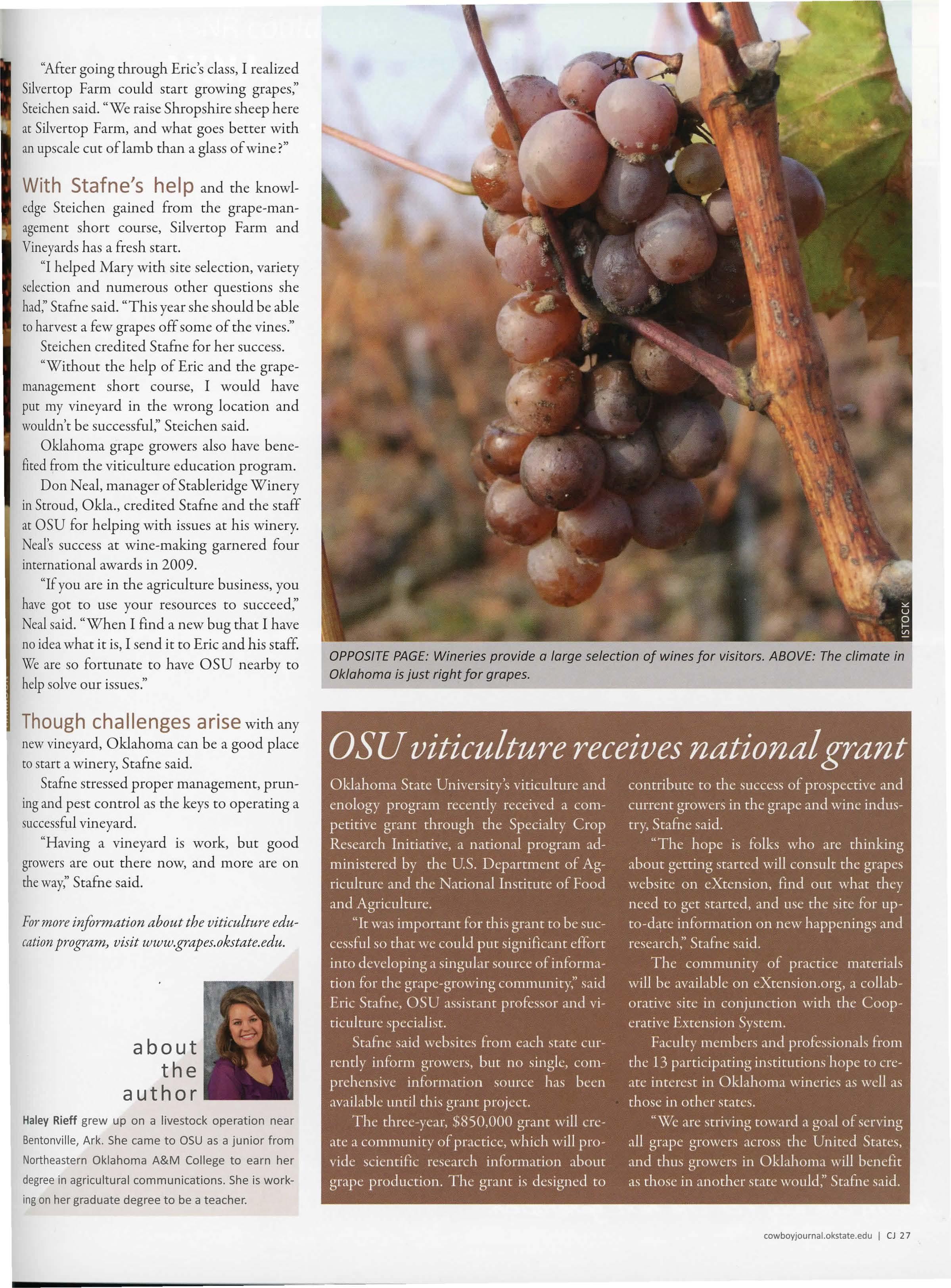
OPPOSITEPAGE: Wineries provide a large selection of wines for visitors. ABOVE: The climate in Oklahoma is just right for grapes.
A ~ICH T~ADITION OF 5UCCE55 IN ACADEMICS, IN LEADE~5HIP AND IN THE COMMUNITY
Future of Farming on ~,,~,,,a
111/WIIIII
As farming becomes more diversified, Monsanto is caking technology one seep further by transporting its lab to students and crop producers across the United Scates.
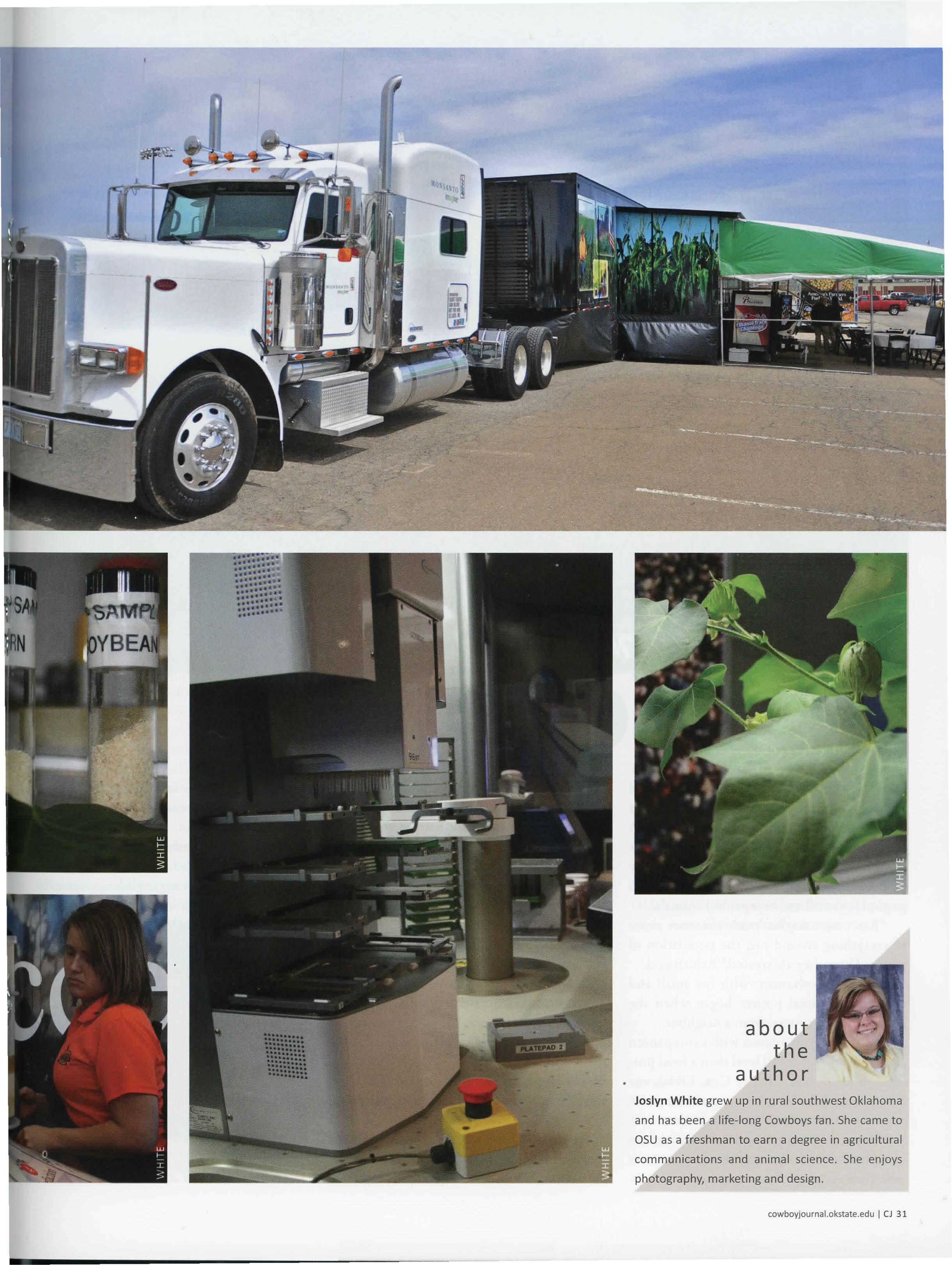
The Mobile Technology Unit, a custommade 53-fooc semi, hie the ground on all 18 wheels nearly three years ago. The MTU brings learning experiences to farm shows, w1iversicies, the National FFA Convention and ocher events.
The MTU visited Oklahoma Scace University for three days chis past spring.
"Hosting the MTU allowed students co see careers in agricultural biotechnology and learn about science in agriculture;' said Sarah Lancaster, OSU assistant plant and soil sciences professor, who coordinated the event.
The MTU came to OSU because "a number of Monsanto employees received at lease one of their degrees from OSU:' said Allan Ciha, Monsanto's agricultural educator.
Monsanto works worldwide ro provide retailers, crop producers and plane pathologists with cutting-edge research knowledge about planes and crops.
As an agriculturally based company, Monsanto spends $2.6 million a day in research for its new product development. It usually cakes eight to 10 years and an investment of $50 million to $100 million co develop and introduce a single new trait in a plane species.
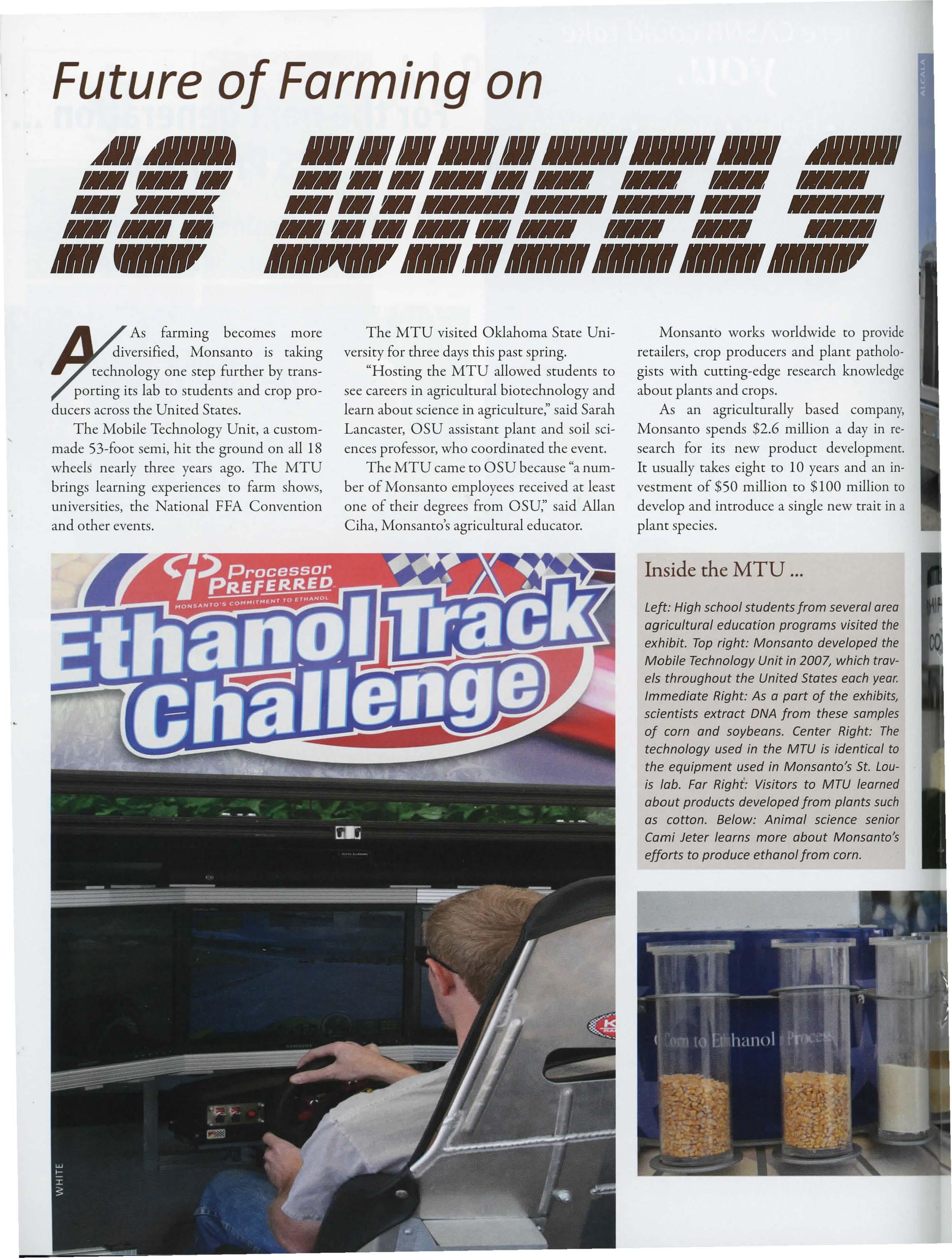
Insidethe MTU ...
Left: High school students from several area agricultural education programs visited the exhibit. Tap right: Monsanto developed the Mobile Technology Unit in 2007, which travels throughout the United States each year. Immediate Right: As a part of the exhibits, scientists extract DNA from these samples of corn and soybeans. Center Right: The technology used in the MTV is identical ta the equipment used in Monsanto's St. Louis lab. Far Righi: Visitors to MTV learned about products developed from plants such as cotton. Below: Animal science senior Cami Jeter learns more about Monsanto's efforts to produce ethanol from corn.
about the author
White grew up in rural southwest Oklahoma and has been a life-long Cowboys fan. She came to OSU as a freshman to earn a degree in agricultural communications and animal science. She enjoys photography, marketing and design.
Joslyn
BIG IM?act on
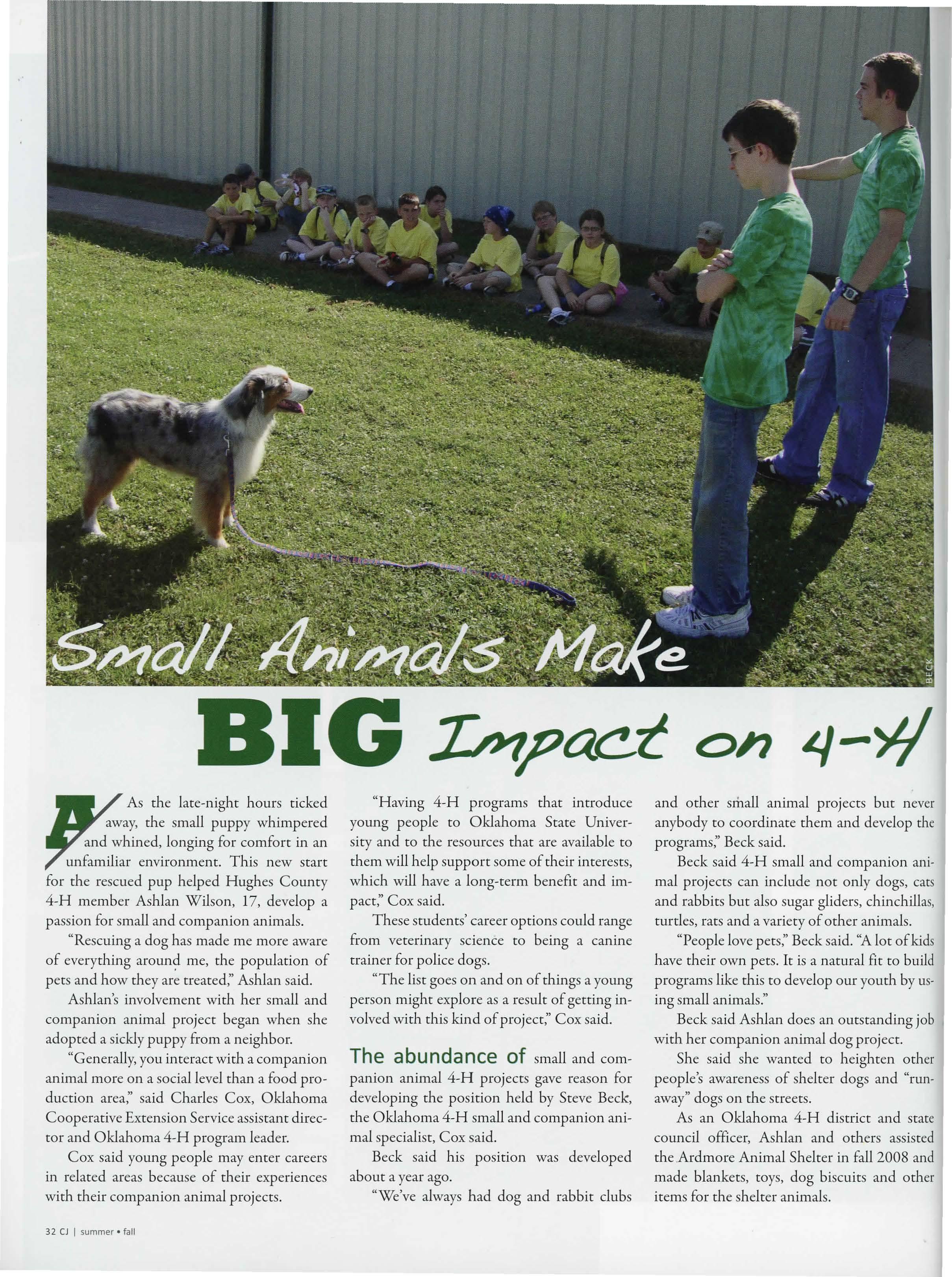
As the lace-night hours ticked away, the small puppy whimpered and whined, longing for comfort in an unfamiliar environment. This new scare for the rescued pup helped Hughes County 4-H member Ashlan Wilson, 17, develop a passion for small and companion animals.
"Rescuing a dog has made me more aware of everything aroun~ me, che population of pets and how they are created;' Ashlan said.
Ashlan's involvement with her small and companion animal project began when she adopted a sickly puppy from a neighbor.
"Generally, you interact with a companion animal more on a social level than a food production area;' said Charles Cox, Oklahoma Cooperative Extension Service assistant director and Oklahoma 4-H program leader.
Cox said young people may enter careers in related areas because of their experiences with their companion animal projects.
"Having 4-H programs chat introduce young people co Oklahoma Scace University and co the resources chat are available co chem will help support some of their interests, which will have a long-term benefit and impacc;' Cox said.
These students' career options could range from veterinary science co being a canine trainer for police dogs.
"The list goes on and on of things a young person might explore as a result of getting involved with chis kind of projecc;' Cox said.
The abundance of small and companion animal 4-H projects gave reason for developing che position held by Steve Beck, the Oklahoma 4-H small and companion animal specialise, Cox said.
Beck said his position was developed about a year ago.
"We've always had dog and rabbit clubs
and ocher small animal projects but never anybody co coordinate chem and develop the programs;' Beck said.
Beck said 4-H small and companion animal projects can include not only dogs, cats and rabbits but also sugar gliders, chinchillas, turtles, rats and a variety of ocher animals.
"People love pees;' Beck said. "A lot of kids have their own pets. le is a natural fie co build programs like chis co develop our youth by using small animals."
Beck said Ashlan does an outstanding job with her companion animal dog project.
She said she wanted co heighten ocher people's awareness of shelter dogs and "runaway" dogs on the streets.
As an Oklahoma 4-H district and state council officer, Ashlan and others assisted the Ardmore Animal Shelcer in fall 2008 and made blankets, coys, dog biscuits and ocher items for the shelter animals.
"It has really changed my outlook of shelters;' Ashlan said. "I've gotten co impact a lot of other people's lives."
Ashlan and other 4-H members also helped the Humane Society of Stillwater by making approximately 250 dog and cat coys for the shelter in summer 2009.
They made braided chew coys from fleece and cat coys from recycled water boccies for the shelter animals, Ashlan said.
"We cue fleece until we couldn't cut fleece anymore;' said Debbie Wilson, Ashlan's mother and 4-H leader. "We all helped. She rea!lyhas a passion for wanting co get out there and educate people."
Patti Miller, mother co Okfuskee County 4-H members Mitch, 15, and Mark, 19,said Mark was introduced to the small and companion animal dog program when he was 11yearsold by a woman from an ocher county.
Mark started in obedience, lacer became certified with the American Red Cross and traveled chroughouc Oklahoma conducting seminarson pet safety, CPR and the Heimlich maneuveron animals, Patti said.
"As soon as Mitch curned nine and could join 4-H, he jumped into 4-H," Patti said.
Patti said they showed their Australian Shepherds for the American Kennel Club, joined an Oklahoma obedience program, and participated in a reading program at Oake Elementary School in Okemah, Okla.
"They started the program at our school charthey called 'Read to the Dog~' Patti said. "Some kids who have problems reading have difficultiesreading co a class of scudents.
"The more they read to the dog and Mark, rhe more confident they get and che better readersthey become."
Mark and Mitch also have written pet manualsgiving advice and instructions for basicknowledge for pet owners.
Patti said Mark and Mitch branched off
than 200 youth and 60 adult volunteers.
into different areas for their projects at times buc their activities with therapy dogs are what they have done together.
Patti said the 4-H companion animal program is "really a neat project" because kids living in town either cannot afford livestock. or cannot keep livestock in their residential areas.
"They started the program co give all kids a chance co get out cl1ere and show something;' Patti said.
Members do not need pedigree dogs or animals to have a 4-H small and companion animal project, Cox said.
"If you have a dog, you can train it to do obedience or agility, and it's not a new investment;' Cox said. "You don't have co go out and buy a multi-thousand dollar animal."
Cox said young people also could participate in a citizenship project by teaching others, working with children through promoting involvement wim their projects, and becoming involved in nursing home programs or certifying their canines as therapy dogs.
"All of chat would be citizenship;' Cox said. "Young people would not only have a small animal project they could enter into a state contest, but they also have citizenship or leadership projects."
4-H members can earn scholarships through keeping a state record book or
through obedience and other small and companion animal shows.
"We see more and more counties that are organizing groups around dog or companion animals;' Cox said.
Youth interested in the small and companion animal project can enroll through their local county extension office.
"We hope before long we also will have an enrollment system where young people can enroll in a-.4-H program online without ever having co go to a county office;' Cox said. "Then they will become connected virtually to ocher kids who are in chat project area."
To find additional information about Oklahoma 4-H and its multitude of project areas, visit oklahoma4h.okstate.edu.
about the author
Whitney Jameson grew up in Claremore, Okla. She transferred from Connors State College her junior year and is in her first year of graduate school. She enjoys writing and helping her family with their Missouri Fox Trotting horse operation.
Ashlan Wilson's rescued dog, Wrangler, plays with a fleece toy made by his owner.
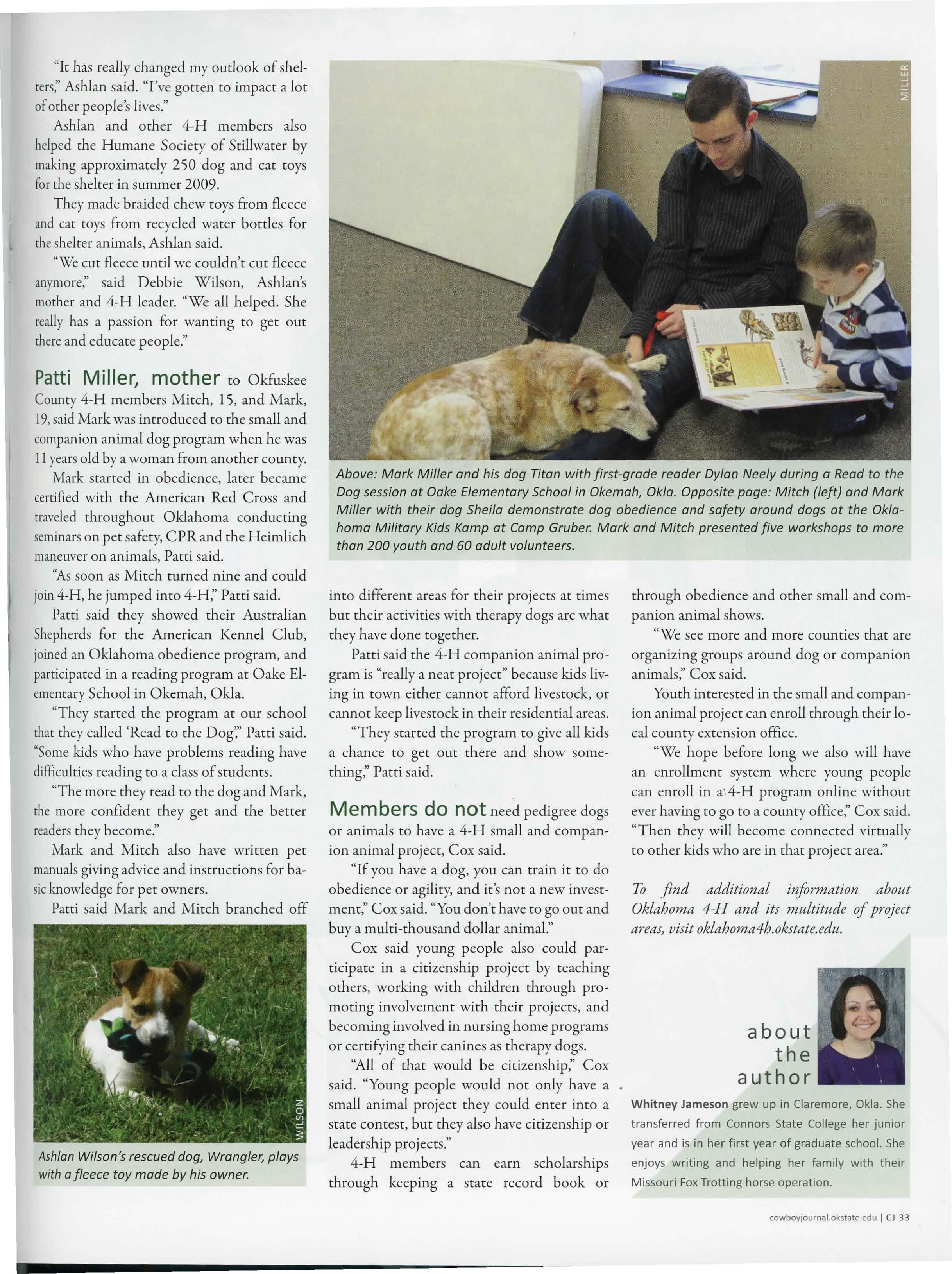
Above: Mark Miller and his dog Titan with first-grade reader Dylan Neely during a Read to the Dog session at Oake Elementary School in Okemah, Okla. Opposite page: Mitch (left) and Mark Miller with their dog Sheila demonstrate dog obedience and safety around dogs at the Oklahoma Military Kids Kamp at Camp Gruber. Mark and Mitch presented five workshops to more
In perfect stance, the crimsonclad pitcher throws a fast pitch to home plate. As the crack ojthe bat echoes through the spring air, the announcer shouts, "HOME RUN!" The crowd erupts as CalebSpady scoresanother home run for his belovedteam and the Oklahoma State University Cowboyswin in Bedlam.
While many young boys dream ofbeing professionalball players, Caleb's dream will never cometrue.
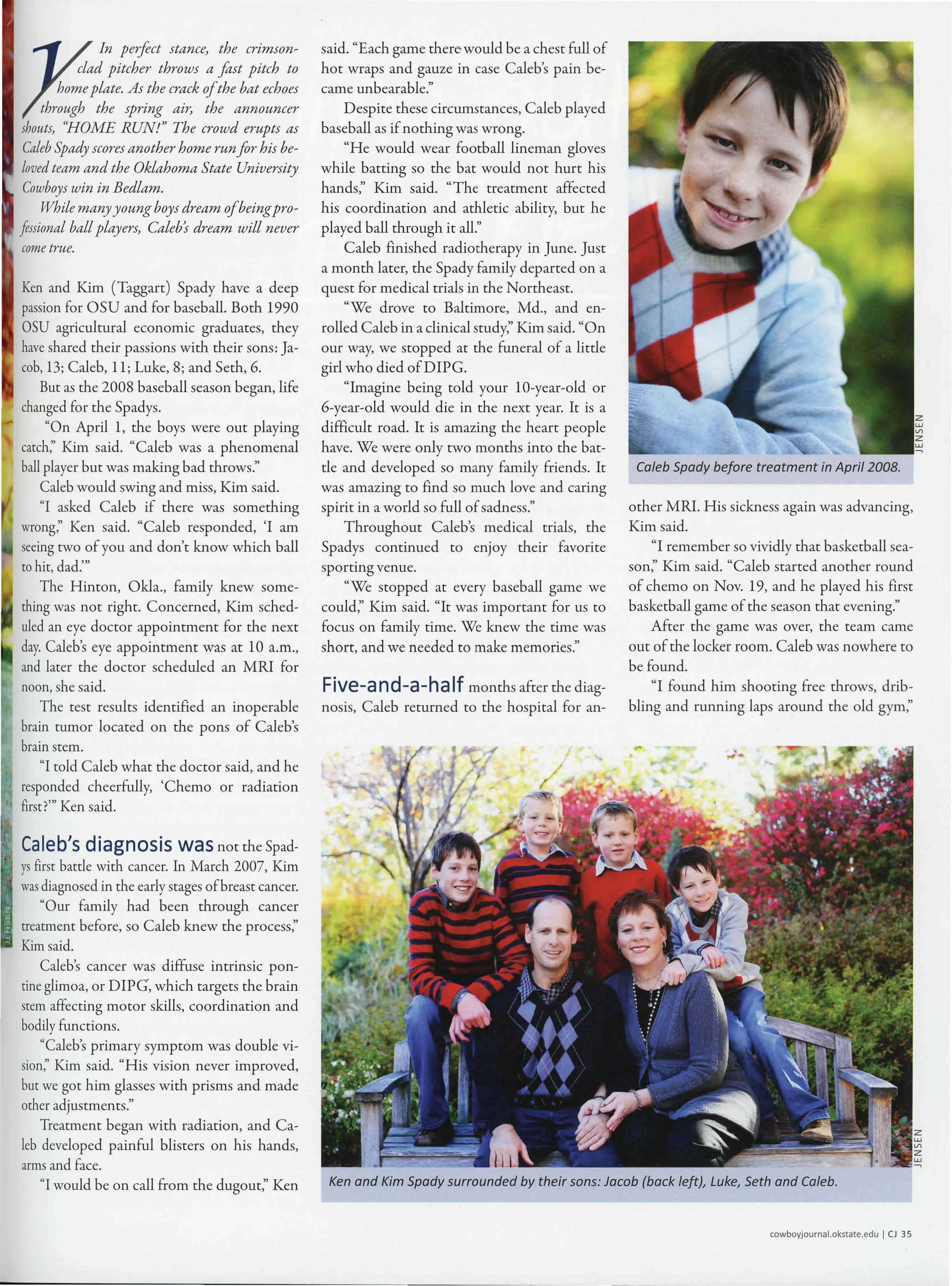
Ken and Kim (Taggart) Spady have a deep passionfor OSU and for baseball. Boch 1990 OSU agricultural economic graduates, they haveshared their passions with their sons: Jacob,13; Caleb, 11; Luke, 8; and Seth, 6.
Bueas the 2008 baseball season began, life changedfor the Spadys.
"On April 1, the boys were out playing catch;' Kim said. "Caleb was a phenomenal ballplayer but was making bad throws."
Caleb would swing and miss, Kim said.
"I asked Caleb if there was something wrong;' Ken said. "Caleb responded, 'I am seeingtwo of you and don't know which ball to hit, dad."'
The Hinton, Okla., family knew something was not right. Concerned, Kim scheduled an eye doctor appointment for the next day.Caleb's eye appointment was at 10 a.m., and later the doctor scheduled an MRI for noon, she said.
The test results identified an inoperable brain tumor located on the pons of Caleb's brainstem.
"I told Caleb what the doctor said, and he responded cheerfully, 'Chemo or radiation first?"'Ken said.
Caleb'sdiagnosiswasnottheSpad-
ysfirst bacclewith cancer. In March 2007, Kim wasdiagnosedin the early stages of breast cancer.
"Our family had been through cancer treatment before, so Caleb knew the process;' Kimsaid.
Caleb's cancer was diffuse intrinsic poncineglimoa, or DIPG, which targets the brain stem affecting motor skills, coordination and bodilyfunctions.
"Caleb's primary symptom was double vision;' Kim said. "His vision never improved, bur we got him glasses with prisms and made ocheradjustments."
Treatment began with radiation, and Caleb developed painful blisters on his hands, armsand face.
"I would be on call from the dugout;' Ken
said. "Each game there would be a chest full of hot wraps and gauze in case Caleb's pain became unbearable."
Despite these circumstances, Caleb played baseball as if nothing was wrong.
"He would wear football lineman gloves while batting so the bat would not hurt his hands;' Kim said. "The treatment affected his coordination and athletic ability, but he played ball through it all."
Caleb finished radiotherapy in June. Just a month later, the Spady family departed on a quest for medical trials in the Northeast.
"We drove co Baltimore, Md., and enrolled Caleb in a clinical study;' Kim said. "On our way, we stopped at the funeral of a little girl who died ofDIPG.
"Imagine being cold your 10-year-old or 6-year-old would die in the next year. It is a difficult road. It is amazing the heart people have. We were only two months into tl1e battle and developed so many family friends. It was amazing co find so much love and caring spirit in a world so full of sadness."
Throughout Caleb's medical trials, the Spadys continued co enjoy their favorite sporting venue.
"We stopped at every baseball game we could;' Kim said. "It was important for us to focus on family time. We knew the time was short, and we needed co make memories."
Five-and-a-halfmonths after the diagnosis, Caleb returned co the hospital for an-
ocher MRI. His sickness again was advancing, Kim said.
"I remember so vividly that basketball season;' Kim said. "Caleb started another round of chemo on Nov. 19, and he played his first basketball game of the season that evening."
After the game was over, the team came out of the locker room. Caleb was nowhere to be found.
"I found him shooting free throws, dribbling and running laps around the old gym;'
Caleb Spady before treatment in April 2008.
Ken and Kim Spady surrounded by their sons: Jacob (back left}, Luke, Seth and Caleb.
Ken said. "Caleb knew chat he did not perform at his best and was working on his game."
Caleb did not realize the effects chemotherapy had on his body, Kim said. He just thought he played poorly.
"Caleb was an amazing guy and was quite a fighter;' Kim said. "He was such a competitor and factual go-getter.
"In March [2009], the chemo had stopped working. We were treating the untreatable."
Caleb's healch prevented him from playing in the 2009 baseball season.
"There came a point when Caleb could no longer play baseball;' Ken said. "He could not swing a bat, run the bases, or throw the ball.
Caleb had to write a short biography to introduce himself before one of his appearances at an OSU Coaches vs. Cancer event. He kept his speech short and to the point.
"Caleb firmly said, 'I am going to kick this cancer in che rear, play baseball for the OSU Cowboys, and then play baseball for the Texas Rangers. That is all these people need to know about me;" Kim shared.
Caleb loved OSU so much. There
was no greater OSUfan than Caleb.
- Kendria Cost
In the midst of Caleb's battle, Kim was diagnosed with colon cancer in July 2009. At the same time, Caleb was in need of urgent medical attention only found at St. Jude Children's Hospital in Memphis. He never gave up, though. He would work out and life weights but could not play."
Strict treatment procedures prevented Caleb from starting a different treatment option.
"It is hard to know what to do wich your daY:' Kim said. "I had laundry to do, meals to cook and toilets to clean, but I had to do it with the boys."
To cope with life's struggles, the Spadys put cheir situation "in God's hands" and used baseball to spend rime together.
Ar the 2009 Bedlam baseball game in Oklahoma City's Bricktown, Frank Anderson and his OSU Cowboys Baseball Team honored Caleb, and each player sported a "Pray for Caleb" bracelet.
"Coach Anderson was such a minister to Caleb;' Kim said. "He changed Caleb's life. Coach Anderson reached out to our family."
"Caleb's health was declining rapidly;' Ken said. "Just after Kim finished her first surgery, Caleb and I left for Ten-
nessee. By the time we made it to Memphis, Caleb was very weak."
Doctors said Caleb's health was not stable enough to treat him.
"I remember Caleb wanted an Oreo cookie, but he could hardly eat ir;' Ken said. "We knew the end was near, and rhe clear goal was to get him home."
They returned home and Kim arranged to be in the same hospital room as Caleb.
"The doctors moved me to Caleb's hospital room so we could be together;' Kim said. "I did my recovery in pediatrics ICU"
Later in July, Caleb took his last breath and completed his short life in Ken's arms while Kim underwent emergency surgery.
"Between family and faith, we got through ir;' Kim said.
"Our family was so blessed by Caleb in the last months ofhis life;' she continued. "All we have is his memory, and it makes it all that much more special."
Caleb was laid to rest clad in his orange and black.
"He wore an OSU ball cap and was wrapped in an OSU blanker;' Kim said. "He bled orange, for sure."
Caleb's admiration for Oklahoma State was known by all who knew him and by many who did not, said Kendria Cost, OSU Seretean Wellness Center marketing coordinator and Coaches vs. Cancer coordinator.
"Caleb loved OSU so much;' Cost said. "There was no greater OSU fan than Caleb. "Nor a day goes by char I don't think of him in some way;' Cost said. "I still wear my 'Pray for Caleb' bracelet and keep his picture and the signed baseball by my bed. He reminds me of all the things good and right in this world.
"Caleb reminds me that we have to keep fighting for a cure;' she said.
A signed portrait of Caleb also peers across Anderson's desk.
"When Caleb was very sick, he was busy doing the thing he loved - playing baseball;' Anderson said. "Caleb touched more lives chan I have in my 50 years of existence."
about the author
Kylee Willard grew up on a farm near Hudson, Colo. She transferred to OSU from a community college in Illinois to earn her degree in agricultural communications. She is attending graduate school at OSU. She enjoys designing ads and video production.
OSU Baseball Coach Frank Anderson and Caleb Spady before the first pitch of the 2009 Bedlam baseball game.
fectiveness of their teaching methods;' Offalter said. "A teacher cannot complain about becoming a more efficient educator."
Robinson said he visits each alternatively certified teacher's classroom once a semester. This interaction can ease the anxiety of beginning one of Robinson's courses during their first year teaching, he said.
Participating teachers complete work online and through face-to-face instruction, Robinson said.
"Dr. Robinson's classes provided me with the understanding of how to better prepare and execute lessons and lesson planning;' Offalter said.
Although the experience they bring to the classroom is beneficial, a few drawbacks exist with being an alternatively certified teacher.
Offolter said one of the biggest disadvantages she has is she cannot participate in the student-teaching program offered through the agricultural education degree program.
"Leadership has made me an effective teacher;' Offolter said. "From there, you use
the resources you have to get the information and knowledge our. You can be as good of a teacher as you put forth."
The job of an agricultural education instructor is to teach the importance of agriculture, bur O'Hara is quick to say what an impact his students can have on him.
"When I see a kid come in and say they 'can't' do something, and then they do it, is really what makes this a rewarding job;' O'Hara said with a smile.
about the author ---
Megan McCool grew up in Cushing, Okla. She came to OSU to earn her degree in agricultural communications. She enjoys designing and writing. McCool has been involved with many organizations and community service projects while at OSU.
A different 'alternative'
Oklahoma State University is one of 88 institutions in the United States with an agricultural education program to prepare high school teachers.
One of the ways the agricultural education program benefits new teachers is by immersing them in a classroom setting. Each fall and spring semester, Oklahoma agricultural education teachers work with OSU to host college seniors in student-teaching experiences.
"We have a rigorous program:' said Shane Robinson, assistant professor in OSU's agricultural education, communications and leadership department.
Before completing their degrees, agricultural education students must pass the Oklahoma General Education Test, the Oklahoma Professional Teaching Examination and the Oklahoma Subject Area Test-Agriculture.
"Agricultural education can open any door you want opened:' said Jack Staats, Oklahoma FFA adviser and former agricultural education teacher. "If you want to challenge yourself and your students, teach agricultural education."
People who have a bachelor's degree should consider returning to school to complete a graduate degree in agricultural education, Robinson said.
"We have a strong Master of Agriculture program with an emphasis in agricultural education:' said Dwayne Cartmell, associate professor and graduate coordinator for agricultural education, communications and leadership.
Applicants to the agricultural education graduate program must provide the following information:
• completed online application,
• three recommendation letters,
• undergraduate transcripts and
• a statement of purpose describing why you want to enroll in a master's program.
For information about completing an agricultural education graduate degree, please visit aged.okstate.edu.
Bert O'Hara, Coyle agricultural education instructor who is alternatively certified, works with students on various topics including mechanized agriculture projects.
Kids& Kows& Moreis a programdesignedto help schoolagechildrengrades3-5 developan awarenessand understandingofourfoodand fiberproductionsystem,and howagricultureimpactstheir dailylives.ThroughourMobileDairyClassrooms andKids& Kows& Moreevents,childrenare exposed to Iife onthefarmandtheprocedures andprocessesthatgointofeedingandclothing a nation-andtheworld.
TheMobileDairyClassroom is aneducational exhibitonwheels.Trainedinstructorsdemonstrate howtomilkacow,anddescribehowmilkgoesfrom thefarmto thekitchentable.Request a freevisit toyourschoolatwww.southwestdairyfarmers.com.
ExtensionService.Theprogram is managedby full-time Extensionprofessionalsandis stronglysupportedby the ,.. cooperatingsponsorsin the wayof funding,equipment andleadership. ContactAlfredGonzalezat915494-1807orat ap-gonzalez@tamu.edu; or the SouthwestDairy Museumat903439-6455tofindoutmoreabout thislife-impactingprogram.
Think Oklahoma, and cattle probably are the first animals co come co mind. Bue the veterinarians at the Oklahoma Seate University Center for Veterinary Health Sciences also chink of llamas and alpacas.
While the center's primary case load is cattle, an increasing number of camelids are created at CVHS because of their high value and unique physical features.
Alpacas and llamas are valuable species of livestock, witl1 llamas ranging from $200 co $3,500 and breeding-quality alpacas ranging from $10,000 co $100,000, said veterinarian Kacie Simpson, CVHS food animal medicine and surgery resident.
The Oklahoma alpaca industry has grown from 14 farms in 2004 co 44 farms in 2010, according co the Alpacas of Oklahoma organization.
"It's a miniscule number of animals compared co cattle, but because of the high value of the individual animals, the owners typically go co great lengths co seek veterinary care if they are having problems;' said veterinarian Bob Streeter, CVHS adjunct associate professor of food animal medicine and surgery. "There are a lot of sick cattle, sheep and goats out there chat are treated by their owners and never see a vet, but almost every sick alpaca sees a veterinarian."
Steve Hull, AOK board member and co-owner of Timberlake Farms in Arcadia, Okla., said he has referred owners from Oklahoma and Texas co CVHS because he knows it is a great program.
Stephanie Olssen, who runs the llama rescue Stephanie's Zoo in Gainesville, Texas, said how the CVHS staff treated her on her first visit co CVHS is what convinced her co be a repeat client.
"Veterinary schools are always in need of support and clinical cases, so I make sure when I hear of an alpaca in trouble at a local veterinarian I say, 'You know, chis would be a good one co bring up co the vet school; and they often do;' Hull said.
CVHS typically has one or two camelids in the hospital at a time,
but occasionally up co five, Streeter said. CVHS veterinarians have provided care for a multitude of camelids with a wide range of medical issues.
Robin Howser, AOK board member and owner of Chisholm Trail Alpacas in Guthrie, Okla., cook one of her baby alpacas, called a cria, in for emergency treatment after she noticed he was doing poorly about six hours after he was born.
"He had low blood sugar, was getting dehydrated and wasn't able co stand and nurse:• Howser said. "They ended up putting an IV in him co give him extra fluids and gave him a plasma transfusion for the immunity since he wasn't able co nurse initially."
Howser's cria was at CVHS for about a week before he recovered and was sent home.
"He got the support he needed co gee him through che first couple of days;• Howser said. "This baby is about 10 months old now, and he's doing great!"
Howser also has taken some of her pregnant female alpacas co CVHS for ulcrasounds.
Some of Screeter's favorite cases involve the uncommon but occasional birching problems in camelids because he said they are "rewarding co correct."
A few years ago, Hull had an alpaca go into labor, but she was not dilating. So he rushed her co OSU's CVHS for an emergency cesarean section.
"This was the only C-section I've had in
15 years;' Hull said. "Most of the time there are actually no problems with the births."
The situation worsened when the CVHS staff realized the cria was premature. They worked hard co save him, and now he is a "magnificent breeding male;' Hull said.
Simpson's involvement with Hull's cria case is what led her to choose neonatal intensive care cases as her favorite type of case.
After finishing her residency in July, Simpson will accept a new CVHS faculty position as a small ruminant and camelid clinician for the hospital.
"My job will involve creating camelids, sheep and goats in the clinic as well as providing on-farm services co can1elid, sheep or goat producers for both routine procedures and emergency calls;' Simpson said. "It will also involve formulating herd-healm programs tailored co the needs of each individual herd and providing herd-health monitoring through scheduled on-farm herd visits."
Simpson's position also will include presenting at continuing education seminars and creating research projects for camelid and small ruminant studies. Ocher specialized camelid programs, including an elective course on small ruminants and camelids, also are offered for CVHS veterinary students.
"There's a small ruminant club, and it encompasses sheep, goats, llamas and alpacas," Simpson said. "We do a lot of 'wee
Above: CVHSveterinarian Katie Simpson has a specific interest in came/ids like this alpaca. After her residency, Simpson will join the CVHSfaculty as a small ruminant and came/id clinician. Opposite page: Alpacas are the most popular of the came/ids found in Oklahoma.
Above: This mole cria, named Bubba, who is owned by Michael and Sherry Alpert from Oklahoma City, was treated at CVHSafter being born premature. Below: Bubba survived and is now a full-grown alpaca who has been successful in the show ring with
labs,' which are just experiences for the students to learn different procedures on all of those species outside of their class time and outside of the clinic. The club has actually grown exponentially."
Veterinarian Melanie Boileau, CVHS assistant professor of food animal medicine and surgery, has presented at three continuingeducation seminars for camelid owners and veterinarians in the past year.
CVHS is unique because it has specialized equipment and veterinary specialises in a wide range of areas who work together to diagnose and treat animals, Boileau said.
"One of the main advantages co bringing a sick llama or alpaca to OSU is to allow veterinary students not only to learn about camelid normal behavior, normal physical examination findings, and handling techniques, but also to be proficient at examining a sick camelid, diagnosing the animal's disease or condition, and providing treatment as well as recommendations for prevention of the disease;' Boileau said.
CVHS receives support from clients as well as local associations.
AOK, which is the state affiliate of the national Alpaca Owners and Breeders Association, is growing in popularity as alpaca numbers increase, Howser said.
The AOK alpaca show, held in January as the association's annual fund-raiser, had more than 500 entries in 2010, and the public attendance also increased, Howser said.
"We always try to do a donation to Oklahoma Scacewith the proceeds from the show because they're trying to learn more about camelids, and that helps us in the long run;' Howser said.
In 2007, AOK gave scales. The next year they donated a cria scale. In 2009, AOK and MSA Equipment donated an alpaca chute to the veterinary school.
"We wanted to donate the chute because a lot of us are caking our animals there for care;' Howser said. "Having a speicalized chute to restrain the animals makes it safer for them and the veterinarians."
The alpaca chute has straps to put under the animal's belly to prevent it from laying down, or "kushing;' Simpson said.
"You can do a really good physical exam, and they're basically still in standing position;' Simpson said. "It's really great."
The CVHS veterinarians are appreciative of the association's continued support, Simpson said, because they encourage people to bring their animals to CVHS.
"I wouldn't go anywhere else;' Olssen said.· "There is nowhere to go but OSU for my animals. They're just wonderful. Even if it's a simple gelding, I'll drive the three and a half hours up there because I know they'll be well taken care of."
UNIQU~P~TS ANDLIV~STOCK
The camelid family includes the four species of the Lama genus. The two domesticated species are llamas and alpacas, and the two wild species are guanacos and vicunas. Llamas and alpacas are two types of camelids commonly seen at CVHS, with alpacas being the more popular of the two.
"First, it was llamas, and now the interest has kind of shifted toward alpacas, so alpacas are our predominant camelid now;' said veterinarian Katie Simpson, CVHS food animal medicine and surgery resident.
Llamas were first imported to the United States in the 1920s, while alpacas first arrived in the mid-1980s, said veterinarian Bob Streeter, CVHS adjunct associate professor of food animal medicine and surgery.
"The alpaca industry definitely seems to be increasing;' said Bob Streeter, CVHS adjunct associate professor of food animal medicine and surgery. "I saw recently Oklahoma is thirty-fifth in the nation as far as the number of registered alpacas."
Streeter said alpacas are probably more popular than llamas because of their smaller body size and more valuable fiber.
Stephanie Olssen, who runs the llama rescue Stephanie's Zoo in Gainesville, Texas, said she enjoys having llamas because they each have different personalities, they are good guardians of ocher animals, and they are fun and gentle.
"A lot of the owners are younger retirees who have moved into areas surrounding cities where they have 20 to 100 acres and they want to have an agricultural lifestyle;' Streeter said. "But having a large animal like a cow or horse takes quite a bit of facility input. Camelids are small, relatively docile, and need minimal facility infrastructure."
about the author
Katie McKinnis grew up on a cattle and horse farm in Watertown, Tenn. She came to OSU to earn her degree in animal science and agricultural communications. She enjoys photography and is currently working on her master's degree in education.
Sherry Alpert.
Create. Innovate. Educate.
As Oklahoma State University works to "create, innovate and educate;' faculty members in the College of Agricultural Sciences and Natural Resourcesadd one more responsibility: advise.
"Faculty advising provides the best overall mentoring for the students;' said Cheryl DeVuyst,CASNR assistant dean of academic programs."This relationship better prepares studentsfor the future."
Faculty members have career experience in their academic areas, and they bring their professionalknowledge to the classrooms and to the student-adviser relationship.
"Advisers take a personal interest in the student,and the student notices the adviser is sincereand genuine;' said Patricia Ayoubi, an assistantprofessor in biochemistry and molecularbiology. "Making sure the students stay on track is my greatest responsibility."
Students appreciate the personalized attention they receive as they meet the challengesof earning their degrees, DeVuyst said.
"It really feels like walking into home when you come into the front doors of Ag Hall;' said Jamie Andrews, an agribusiness pre-law sophomore. "We aren't the biggest college,so it's relatively easy getting to know yourpeers as well as the faculty."
The inviting atmosphere is especially helpfulto new students.
"I can't express enough how much better it isfor me co be in CASNJ.3.-;'said Jessica Lewis, an agricultural communications senior who transferredfrom Carl Albert State College in Poteau,Okla. "I feel like every faculty member has advised me in some way, not only in whatclasses to rake, but they are always there to just talk when I need to. As a student, I find that very encouraging."
Although students can schedule appointments,Ayoubi and most of her CASNR colleagueshave an "open-door policy;' allowing studentsto come at any rime they need help.
"The CASNR advisers are student-oriented;' said animal science professor Bob Kropp, who has served as an academic adviser for 38 years. "I treat my advisees like I would treat my own children."
Being student-focused includes meeting with prospective students and their parents when they come to campus and discussing everything from degree programs to ways the students can meet their professional goals.
Parents want a positive atmosphere so they know their children will do well during their college experience, Kropp said.
"My parents never attended college, so for them to see how well I have fit
academic careers, not to do the work for them, Kropp said.
"We offer a warm, friendly and helpful atmosphere, but we also provide a challenging learning environment co prepare students for their careers;' DeVuyst said.
Williams said his main job was co push and stretch students to be their best in all aspects of college life and lacer on in their professional lives.
"The most enjoyable thing about being an adviser is co see a student enter a university with a lot of energy and ideas about what they want co do in life and seeing how chose ideas and dreams in has really been a surprise;' said Wyatt Swinford, an agricultural economics senior. "The students work together. Whether it is presentation It really feels like walking into home when you come into the front doors. are redone or reshaped;' said Jeffory Harrey, plant and soil sci-Jamie Andrews, agribusiness sophomore ences professor. night for agricultural sales or ifit is the Christmas tree philanthropy, you are working hand in hand with students, faculty and alumni."
DeVuyst said most CASNR advisers keep in touch with their former students even after they graduate.
"I have a list of every one of my advisees since 1971;' said Joe Williams, agricultural economics professor emeritus. "I keep in constant contact with many of them."
Williams said he keeps every business card he receives from former students. His collection has grown to more than 600.
Bart Fischer, one of William's former advisees and now a graduate student at Texas A&M University, has kept in touch with Williams throughout his academic career.
Fischer said his career at OSU was successful because of the faculty advising.
"I had a fantastic experience with Dr. Williams;' Fischer said. "It is a great format, and you get out of it what the adviser and student are willing to put into it."
Advisers are here to help students in their
Being able to work closely with students toward their goals is enjoyable for both the advisers and students, DeVuyst said.
"Fortunate is word that fits our situation here in CASNR;' said Jace White, an agricultural economics sophomore. "To have faculty who care this much about us as students, and as people, is something amazing about CASNR."
For more information about CASNR programs, visit casnr.okstate.edu.
vanessa Ailey grew up in Ponca City, Okla. She came to OSU as a junior from Northern Oklahoma College to earn her degree in agricultural communications and minor in agricultural economics. In her spare time, she enjoys reading, photography and politics.
WHISHOULD I GO TOGRIDIDHOOLP
The day every student waits for: Graduation! While some college graduates move directly into the workplace, others are at a crossroad, contemplating the idea of work or furthering their education through graduate school.
"There are several good reasons to go to grad school: It is required to meet your career goals,it fulfills a personal goal, or you want to pursue a career with a focus on research;' said Ed Miller, Oklahoma State University Collegeof Agricultural Sciences and Natural Resourcesassociate dean for academic programs.
Veterinary and human medical professions, for example, require additional school as a standard. Other professions do not require more school to enter a career field or to advanceyour career.
"Be well informed about the educational requirements for your career interest;' Miller said. "Does your ideal professional position require a bachelor's, master's or even a Ph.D.?"
For some students, receiving their master's degree is something they have simply alwayswanted.
"A great reason to go to grad school is for your personal goals;' said Amy Gazaway, CASNR career development coordinator. "Youknow what you want to do, and you can advance your career."
Obtaining an advanced degree has always been an important goal for her, said Cori Woelk, who received her )\faster of Agriculture in agricultural leadership from OSU in 2009. Woelk earned her bachelor's degree from Kansas State University in 2003.
"When the opportunity to pursue a master'sdegree presented itself, I jumped right in;' Woelk said.
Even if graduate school is part of your educational plan, it may not follow immediately after you obtain your first degree. Some students decide to take time away from school before pursuing an advanced degree.
"I took one full year off before returning to grad school;' said Matt Stockman, who earned a Master of Agriculture in agricultural leadership. "At the time of graduating, I already had a job and was a little burned out on school, so I needed some time to regroup and determine what program area best suited me."
With the potential to advance one's career, make more money, and further your education, graduate school has several perks.
"I chose to go to graduate school because I wanted to pursue a new career;' Woelk said. ''At the time, I didn't feel like I could pursue what I wanted with only my B.S. degree."
Graduate school is not right for every student, however.
"Going to grad school is not always the best choice;' Gazaway said. "When you do not know what you want to do, have a fear of a bad economy or you believe there are no jobs available, these are not good reasons to go."
If a student pursues graduate school without a clear plan or is still deciding on a career path, they could find themselves undecided after graduation, Gazaway said.
CASNR takes extra
steps to ensure its students are well aware of job opportunities. The CASNR career services office provides students with help in their career searches as well as access to potential employers. The staff is also there to assist students with resources to apply for graduate school.
"Getting your master's does not necessarily mean you will have a higher starting salary;' Gazaway said. "Your ideal job may not require a master's, and you could have made the same salary with a bachelor's degree."
During the past five years, enrollment has increased 36.8 percent in CASNR's graduate programs, Miller said.
Several different reasons exist for this increase, but the most important reason was more opportunity for funding, Gazaway said. ''A few years ago we had an increase in new
faculty who received grants for new research;' Miller said. "With this increase in grants, opportunities to fund assistantships opened up and as a result, increases in recruiting graduate students occurred."
Going
to graduate school does not mean one must obtain more student loans or support from parents. Several options for financing a graduate degree exist, including assistantships, fellowships and scholarships.
"Assistantships are typically in research, teaching or an educational service area;' Miller said. "They normally require students to work 20 hours a week and typically pay $14,000 to $20,000 for the year."
Although assistantships offer financial assistance, they often help students in other ways, Miller said.
"Without my assistantship, I would not have known as many students, professors or other CASNR personnel;' Woelk said. "Since I was not familiar with OSU and CASNR, the assistantship created many personal and professional oppo,tunities that I would not have had otherwise."
Graduate school is a big step, but it is a great opportunity for many students.
"My advice is figure out what you want," Stockman said. "If you want a higher degree, then go for it."
corev Ann Duysen grew up showing cattle and lived on a citrus farm in Porterville, Calif. She started at OSU as a freshman in agricultural communications. She enjoys designing websites and creating complete marketing materials and plans for companies.
e Encounter
A chance Encounter changed the path of Kristi Bishop's life.
As a youth on her family's purebred Hereford ranch in southeastern Montana, Bishop sought every opportunity to develop her leadership skills, a passion that continued when she chose to study at Oklahoma State University in 2004.
"I came to the animal science department
because I knew the department was good at crossing the real world with classroom education;' said the 24-year-old, who now serves as the grant writing specialist and futurity sales coordinator for the Oklahoma Youth Expo.
She said coming to OSU from Hardin, Mont., was an easy decision because her father, Gary Bishop, graduated in 1973 with a bachelor's in animal science.
At OSU, she earned a degree in animal science and a minor in agricultural leadership. She joined Oklahoma Collegiate Catclewomen as well as the College Republicans and Alpha Zeta, but it was her decision to apply for cl1e Oklahoma Agricultural Leadership Encounter cl1atchanged her future.
"OALE was a way that I could learn about Oklahoma;' Bishop said. "Being an out-ofsrare student, I was unaware of the unlimited possibilities contained within Oklahoma and the diversity of the industry contained within its rural counties."
As a member of OALE "Class rv;· Bishop gained a better understanding of people and agriculture, which is what makes her a good leader, said Jeramy Rich, OYE execu-
rive director and partner of Capitol Resource Group, a lobbying firm in Oklahoma City.
"I had the opportunity to meet Kristi and her classmates throughout their year on OALE;' Rich said. "I was able to see her really blossom through the year."
Networking is the No. 1 thing students are able to do during their OALE experience, Rich said.
"Her love is youth development and youth leadership;' said Jerry Fitch, OSU animal science professor and OALE adviser. "She has been able to get more out of this program than any other participant."
Not only did Bishop network with Oklahoma professionals, she also had the opportunity to travel to Australia and learn more about agriculture.
Bishop's OALE experience
became a steppingstone to graduate school in the OSU animal science department, she said.
"I was able to further my education before going out into the real world;' Bishop said."[ was able to take many different types of classes like environmental law, agricultural economics and so many more."
How to start your OALEexperience
College of Agricultural Sciences and Natural Resources students can apply for the Oklahoma Agricultural Leadership Encounter during their collegiate junior or senior year.
"The application is available the first day of class in cl1efall, and students have about three weeks to get them submitted;' said Jerry Fitch, Oklahoma State University professor and OALE adviser.
Oklahoma Youth Expo personnel review the applications and select approximately 20 individuals based on grades, leadership, community activities, club activities and other activities, Fitch said. Finalists participate in interviews as part of the selection process.
Since OALE Class I began in 2003, more than 85 students have participated in this program, said Rusty Gosz, OSU extension youth livestock specialist and OALE adviser.
Each OALE class is given a different number to help identify when students participated in the program.
OALE participants complement their monthly trips within Oklahoma with a trip to Washington, D.C., and an international exi-erience.
"The international trip is funded by the Oklahoma Youth Expo and other sponsors after the first $1,500, which the student pays;' Fitch said.
The international trip is the only cost the participants will have to pay during their experience, Fitch said.
Kristi Bishop, a Hardin, Mont., native, said GALE provided her the opportunity to learn about Oklahoma agriculture and the diversity found in the industry.
Amaral
Alex Tolbert, Shana Robson, Kristi Bishop, Clayton Smith, Lindsey Coupe, LeeAnna McNally,Chase Runyan, Tyler Castonguay, Wravenna Phipps-Bloomberg, Cale Walker, Tyler Smith, ColemanHickman, and Ashley Marquart-Harris.
While pursuing her master's degree, she servedas an intern for OYE and CRG. Bishop saidshe always has enjoyed politics, and workingwith CRG allowed her to become more involvedin the political arena.
After graduating with her Master of Agriculture in animal science in 2009, she wentto work for OYE and continues to work wirhCRG.
"I really enjoy my job because it is somethingdifferent every day;' Bishop said. "I am
able to market animals one day, work with kids the next, and then lobby the next."
Bishop said she enjoys her job because it combines her three passions in life: kids, cows and public policy.
"I love my job;' Bishop said. "I love the people chat I work with."
Bishop's main focus at OYE is grant writing to find funds for OALE and OYE.
"My grant writing has been focused mainly on OALE funding, although I am trying to expand to writing grants for OYE;' Bishop said.
Bishop said she hopes to find additional grants for OALE so the program can become self-sufficient in the near future.
While working at CRG, she has seen many of the people she met while in OALE.
"OALE opens up so many doors for those who have the opportunity to participate in the program;' Bishop said. "Class members are introduced to the diversity of agriculture, the legislative process on both the state and national level, and the entrepreneurial spirit of countless Oklahomans who have helped contribute to the state's economic development.
"At the collegiate level, there is no other program that ties so many influential leaders, one-of-a-kind encounter trips and an international experience in the same package!"
about the author
Leslie German grew up on a dairy farm in Cushing, Okla. She came to OSU as a freshman to earn her degree in animal science and agricultural communications. She enjoys taking photographs and designing publications.
Oklahoma Agricultural Leadership Encounter Class IV visits an Austral/ion farm in 2007: Katie
(left},
As Kirn Wilson steps our her door and smells the aroma of cattle, it reminds her of her home in Missouri.
The Oklahoma Scace University animal science senior said she finds living at rhe OSU Dairy Cattle Center to be a home-awayfrorn-home.
"I live at a dairy back home;' Wilson said. "Living at che Dairy Caccle Center made the transition easier chan it would have been if I would have lived in an apartment."
Wilson said residing on the university farm also has helped her with the transition from a family farm to a commercial operation and has given her the chance to work with newcomers to the dairy industry.
"Working at the Dairy Cattle Center is a benefit because I gee to work with all kinds of people, whether people know about dairy cattle or nor;' Wilson said. "And getting to see how the herd managers make their decisionsis very interesting."
Because she wanted to compete on a university dairy judging team, Wilson said she was deciding whether to attend school ourof-state when David Jones, OSU's dairy judging team coach and the Dairy Cattle Center herd manager, cold her about living on OSU's farms to help decrease living expenses.
"Ulcimacely, I came to OSU because of the money I could save living at the Dairy Carrie Center;' Wilson said.
Animal science junior Tanner Pullen made a similar choice.
"I decided to live at the Swine Research and Education Center because it was the best financial decision;' Pullen said.
The students who live at the farms work to offset their living expenses, which means they are expected to work more and are given more responsibility than other scudenr employees, said Kim Brock, the swine center herd manager. For example, these students are the first to be called if an emergency arises.
"One of us has to be here constantly, or ar lease in town, because every SREC building is climate-controlled;' Pullen said. ''A power failure could cause the ventilation system co shut off."
Pullen, a native of Davis, Okla., who lived at the swine center from January 2009 )
to March 20 I 0, said by Lving on a university farm,students also gain experiences and qualitiesto benefit them in the future.
Animal science juniors Jeremy
Leisterand Chase Reed said they chose to live at the OSU Purebred Beef Center to gain realworld experience and learn more about beef caccleproduction.
"We learn a lot of hands-on things you can't learn in a classroom;' said Reed, a Winfield,Kan., native who grew up on a ranch.
JeffMafi, herd manager at the beef center, saidhaving students on site benefits OSU.
"We like having students live here since I can'tbe here all the time;' Mafi said.
Borh Leister and Reed said their jobs provide a way to blend their passion into their dailylives.
"It's a chance for responsibility;' Leister said."I really like working with the show cattle because if you look at a lot of other purebredbeef units, they don't have as many show cattleas we do."
Leister, an Amsterdam, Mo., native who alsogrew up on a ranch, said he lives at the beef center to help him achieve his goal of producing beef catcle after graduation.
Pullen said he expects employers will appreciatehis experience at the swine center.
"An employer can see that I have worked at the swine center for three consecutive years,
and I have lived here for a year;' Pullen said. "Knowing the responsibilities of the farm could really help you in the job market."
For alumni like CodySankeyofCouncil Grove, Kan., being "on-call" for two years helped him move into his career.
Sankey, now the herd manager for Michigan State University's Purebred Beef Center, said Lving at the OSU Purebred Beef Center was valuable to him.
"I gained a better understanding for beef catde production;' Sankey said. "It was good hands-on experience living out there."
Jones credited the quality of animal science program for attracting student workers.
''Although rhose who apply have a formal interview, most students have been referred by alumni - someone who has lived or worked here in the past;' Jones said. "We prefer animal science majors, but anyone can apply."
Students who· consider rhis living and working option can apply with the herd manager at each location.
Regardless of location, students living on OSU farms gain more than a roof above their heads and a paycheck in rheir pockets. Their experience opens the door to their futures.
about the author
Amy Storts grew up participating in sports in Owasso, Okla. She came to OSU as a freshman to earn her degree in agricultural communications. She enjoys designing publications and taking photographs as well as broadcasting.
Tanner Pullen feeds at the swine center on a daily basis. He also performs regular inspections like checking the hogs and making sure the temperatures are correct in the buildings.
JeremyLeister (left) and Chase Reed indicated their favorite part about living and working at the OSUPurebred Beef Center is getting to work with the show cattle.
Not everyone who earns a degreefrom the Oklahoma State University College of Agricultural Sciences and Natural Resources travels a conventional careerpath in their academic major. Some, like Amy Pierce and Matt Ralls, use their educational experiences to explore hidden opportunities.
For 1996 OSU alumna Amy Pierce, the skills she learned in agricultural communications have helped her down her unconventional road to becoming a partner at the Oklahoma City-based law firm Corbyn Hampton.
Pierce, who earned her law degree from Oklahoma City University in 1999, said one of the main similarities between her undergraduate degree and her job as a full-time lawyer is writing.
"Writing a brief is like writing a storY:' Pierce said. "You have to get your information, write a 'scory; then present it, where you use your oral argument skills. You have to be able co take a logical path."
Pierce said she enjoys the day-co-day activities at the law firm and the fact her work
From a young age, Matt Ralls dreamed of being a federal agent. After earning a degree in environmental science in 1998, his dream came true.
While at OSU, Ralls was involved in the Student Government Association, was a member of the Alpha Gamma Rho fraternity, and served as Pistol Pete from 1996 to 1998.
"Being Pistol Pete was the greatest job I everhad;' Ralls said with a smile. "Being a Secret Service agent is a close second."
is anything but monotonous. One of the challenges of her job, however, is not being able to leave her work at the office, she said.
"The hardest part really is your mind is always spinning;' Pierce said. "It is difficult to turn your mind off."
Now married to John Barbush and the mother of two children, Ella and Mac, Pierce said she has found a good professional fit for herself and is the only lawyer in her firm with an agricultural communications background.
Pierce has multiple family members who are lawyers, but she said chat is only part of the reason she decided to become a lawyer.
"I learned through my undergraduate classes what I was good ac:' Pierce said. "I learned I was very good at writing and research. That transferred well into law."
The Idabel, Okla., native said he learned responsibility on the family farm. He credits his parents for instilling his work ethic as they managed their cow-calf and sheep operations.
"As an agent, I understand we have a very important job chat requires long hours, tough assignments and working under stressful conditions:' Ralls said. "When things get tough or uncomfortable, my farm work ethic kicks in and says, 'Get the job done, no matter how long it cakes or what is required."'
Ralls' desire to serve ochers started while working at the Rocket Roller Rink, his hometown skating rink.
"lewas my job to ensure that everyone had a safe and enjoyable time while at the skating rink;' Ralls said.
Ralls said he uses the skills he gained in college on a daily basis.
"The three things I use the most are researching, writing and presenting;' he said. "I will investigate a case, write a formal repou, and sometimes will be asked to testify before a jury or court."
Ralls said the diversity of the people he works with is an asset to the agency.
"The Secret Service has agents from all
walks of life;' he said. "I do not know of any ocher agents with an agricultural degree. Our backgrounds make us a stronger agency and good at what we do."
The heart Ralls has for service fits his role.
"The opportunity to serve my country by protecting the Office of the President and our nation's financial infrastructure was a perfect match for my desire to serve ochers."
Ralls said he enjoys the variety in his work.
"One day I can be protecting the most powerful person in the country, and the next day I could be arresting someone for manufacturing counterfeit credit cards;' Ralls said.
about the author
Lindsey Missel grew up showing horses in Bartlesville, Okla. She came to OSU as a freshman to earn her degree in agricultural communications and minor in agricultural leadership. She plans to own an equine advertising agency one day.
The Oklahoma State University College of Agricultural Sciences and Natural Resources honors its best each spring.
The 2010 Outstanding Seniors include Cami Jeter {back left}, Stephen Eller, Travis Schnaithman, Joshua Ketch, Tyler Powell, Jared Crain, Brady Brewer, Michelle E. Jones, Hailey Harroun (front left), Ashley Mason, Carrie Highfill, Megan McCool and Ana Gessel.
OUTSTANDING SE IORS SHINE
Students, advisers and staff of the College of Agricultural Sciences and Natural Resources watched as Carrie Highfill of Enid, Okla., received CASNR's Outstanding Senior Award on March 26.
"My time at Oklahoma State University has been amazing, and I feel truly blessed for the many wonderful experiences, opportunities and friendships I made while a student at OSU," Highfill said.
Highfill, an animal science major, studied abroad in Mexico, competed in the International Meat Judging Contest in Australia, and served on numerous leadership teams.
"Organizations such as Mortar Board, Homecoming steering committees and my social sorority provided many opportunities for me co organize events and complete community service with students across the campus;' Highfill said.
In addition to Highfill, the cop five CASNR seniors received the Dean Fred LeCrone Leadership Award: Jared Crain, plant and soil sciences; Ana Gessel, animal science/ biochemistry and molecular biology; Hailey Harroun, animal science/agricultural communications; and Tyler Powell, agribusiness.
Crain of Woodward, Okla., said the clubs and opportunities CASNR offered allowed him to succeed and broaden his horizons.
"There has never been any typical day;' Crain said. "One day I might be in class and working at the Agronomy Farm and the next day going co Mexico or Honduras on a studyabroad trip."
Gessel of Plano, Texas, said CASNR was one big family and she really enjoyed her experience at OSU.
"My involvement in multiple student organizations allowed me co develop strong leadership skills that will help me immensely as a veterinarian;' Gessel said. "I am taking with me a strong knowledge of the agricultural industry and the confidence co succeed in vet school."
Harroun of Chewelah, Wash., said the education she received at OSU made it possible for her co fulfill her dream of becoming a veterinarian.
"I have been fortunate co have some outstanding professors who have a passion for teaching and have gone out of their way co help me succeed;' Harroun said. "My involvement in leadership and service at OSU has helped me mature as a person and find my place in the world."
Powell of Guthrie, Okla., said the college has a great atmosphere in which to learn.
"Being a student in CASNR has really put my experience over the cop;' Powell said. "Having the opportunity to work with faculty
members who truly care about me allowed for the creation of a learning environment second to none."
• Completing the list of CASNR's outstanding seniors were Brady Brewer, agricultural economics/accounting; Stephen Eller, biosystems and agricultural engineering; Cami Jeter, animal science; Michelle Jones, animal science/agricultural communications; Joshua Ketch, natural resources ecology and management; l:,eah Kuehn, animal science/ agricultural communications; Ashley Mason, agricultural economics; Megan McCool, agricultural communications; and Travis Schnaithman, agricultural economics.
CASNR presented several student, faculty and staff awards as well as more than $1 million in scholarships at the 2010 banquet.
Ryan Ramsayer, an agricultural economics/accounting major, received chis year's Charles and Magda Browning Outstanding Freshman award.
Udaya DeSilva, an animal science professor, received the Alpha Zeta Outstanding Teacher award. Sarah Lancaster, a plant and soil sciences professor, received the Ag Ambassadors Outstanding Adviser award. Debbie Wells, agricultural economics department senior secretary was named the Ag Ambassadors Outstanding Professional Staff - compiled by Corey Duysen
Not pictured: Leah Kuehn
A note to alumni
Serving the past year as the president of the Agricultural Ambassadors has been one of my most memorable experiences as an undergraduate. I had the opportunity to meet and work with several of the members of the CASNR Alumni Association, and I am grateful for those experiences.
A variety of opportunities are available to you. I encourage CASNR students, alumni and all readers of the Cowboy Journal to look for ways to support agricultural sciences and natural resources in our state.
One opportunity is the Annual Access Tour, which is planned by the CASNR Alumni Association's board of directors. The tour is a trip designed to educate the division of the current issues Oklahoma agriculturalists face. The participants travel the state to meet with agriculturalists, farmers and ranchers.
Other opportunities for students and alumni to work together are the legislative days at the capitol. DASNR Day at the Capitol, 4-H Day at the Capitol and State FFA Convention are all times when legislators meet with the DASNR team to discuss the legislative aspects of agriculture. These events are critical to agriculture because they teach legislators about agriculture and help them realize the importance of continued funding.
Staying involved in CASNR after graduation is a goal I have set for myself. I have learned through my experiences that staying active in CASNR after graduation is important and can be accomplished easily.
As a retiring Agricultural Ambassador, I look forward to graduation and to joining the CASNR Alumni Association. Participating in the support of our college and university will allow me to continue learning, to keep up with friends, and to meet new people who support agricultural sciences and natural resources and Oklahoma State University. I encourage you all to do the same to ensure a growing future for agriculture.
CASNRalumna and state Rep. Skye (Varner) McNiel, R-Bristow (right), meets with Oklahoma 4-H Ambassadors Paige Blevins (left}, Chelsea Ann Blevins and Marissa Perryman during the 20104-H Day at the Capitol.
Cothren leads CASNR Alumni Association
Newly elected College of Agricultural Sciences and Natural Resources Alumni Association President John Cothren grew up in Stratford, Okla., on a farm and cow-calf operation. While in high school, Cothren served as state 4-H president and was active in FFA.
After high school, he attended Oklahoma StateUni:versity where he received a Bachelor of Science degree in agribusiness with minors in economics and management.
While at OSU, Cothren was active in the CASNR Student Council, Alpha Gamma Rho fraternity and Student Alumni Board.
"My OSU experience taught me a lot that I still use todaY:' Cothren said. "I learned a greatdeal about how to work with others and about leadership."
OSU and CASNR are a Cothren familytradition. Cothren's mom, Phillis, recently retired after more than 25 years of service as an extension educator in Garvin County. His dad, Donnie, has an agronomy degree from 0SU, and his sister, DonEtta, received her degreein animal science.
Cothren started his career with John Deere Co. as a summer intern with the Dallas marketing branch.
After graduating, Cothren went to work forJohn Deere Co. full-time, holding several different positions in Missouri, Arkansas and Texas.His last position was as an instructor in the agricultural equipment division, where he interviewed students at OSU and Texas A&M Universityfor full-time arid intern positions. He also managed summer interns for the Dallasmarketing branch.
Cothren currently is the general manager of Grissoms John Deere LLC. The company has six John Deere locations in central and easternOklahoma.
"The most rewarding part of working for GrissomsJohn Deere LLC is helping farmers havethe most productive and profitable operations possible with their equipment and input needs;' Cothren said.
Newly elected CASNR Alumni Association president John Cothren serves as the general manager of Grissoms John Deere LLC.
In addition to serving as the president of the CASNR Alumni Board, Cothren is a recent graduate of Class XIV of the Oklahoma Ag Leadership Program and is still active in his family farm in Stratford.
Cothren said his goals as president include continuing programs such as the Access Tour, CASNR Round-up and the Homecoming Alumni Barbecue while also increasing the involvement of young alumni.
''Another goal is to promote OSU and all of agriculture in a positive manner and to educate the public on how we feed and clothe the world;' Cothren said. "Most of all, I hope I can give back to a university and college that has done so much for me personally."
Cothren and his wife, Leigh-Anne, currently live in Shawnee, Okla., where LeighAnne is a pharmaceutical representative for Merck Inc. They have one infant son, Cash, who Cothren said already is a Cowboys fan!
Learn the inside scoop on how to become a true OSU Cowboy.
Wea Orange!
Welcoll]e to Oklahoma State University and rhe land of orange! Ir's time to support the Cowboys! You have many choices on campu and around Stillwater, so purchase an orange shire and fir in with the student body.
"On Fridays, you get to be part of something bigger than yourself,' said Mary Hunt, an animal science junior. "It's funny that you usually stick out by wearing such a bright color, but here at Stillwater you stick out if you are not wearing orange."
Avoid the Freshman (or Sophomore or Junior or/enior) 15. The Colvin Recreational Center is an incredible place to get fit and stay in shape. The $23-million, 240,000-square-foot center features 10 basketball and volleyball courts, 12 racquetball courts, an indoor track, weights, fitness equipment, dance studios, indoor and outdoor pools, a rock climbing wall, and golf The Colvin also coordinates intramural sports all year.
"We have a great place to go and work out;' said Chris Muegge, an agricultural business junior. "The Colvin offers lots of fun things to do. I enjoy getting involved with intramurals or just going there to work out by myself on the equipment."
dlines.
he Office ofi che Registrar in the Student ion works to lee you know deadlines of adding an dropping classes, but it is your job to be responsible. Procrastinating will lead co long lines and "shore fuses."
"Take advantage of e-mail notices;' said Samuel Donica, an animal science senior. "Pay on time co avoid enrollment holds and decide early if you are going co drop a class. Make sure you do it in the first week co gee your full refund. Any dropping after the deadline should only be a lase resort."
~s.
fflany faci:,y give attendance points coward the fi'na11fradeof che class.
"Almost 99 percent of making a decent grade in a class is showing up;' said Trevor Thomasson, an agricultural education junior. "Going co class and letting the professor see chat you are there is a big deal. Don't go out the night before if you are planning on making it co class in the morning.
"If you are paying for school, you might as well go."
ed.
of Agricultural Sciences and Na ·:Fa:!Resources houses 35 student organizations co help students engage in a variety of diverse activities.
"Students will get co meet and develop relationships with ocher students and faculty, learn about important legislative and current issues pertaining co the purpose of the organization, build a resume, and learn valuable skills related co working with large and small groups of people;' said Stephen Eller, 20092010 CASNR Student Council president.
Through student organizations, students have a chance co meet OSU alumni who could be potential employers. They also get a chance co make a difference through community service on a local and national level.
Be a pare olione of the rowdiest arenas in che nation: We r your orange and gee loud! OSU is home co 49 National Championships, the best in the Big XII. Gallagher-Iba Arena and Boone Pickens Stadium host multiple Cowboy and Cowgirl athletic events. OSU provides free entrance for students at all sporting events except men's basketball and football.
"The games and crowd have so much passion for the Cowboys," said Eric Humphreys, a landscape architecture sophomore. "It's really neat co go co all the sporting events and feel like you are really a pare of something. It doesn't matter whether it's basketball, wresclingor football. They are all fun."
not far away. With 30 locacio s co choose from, OSU offers many choices in campus cuisine. One of the newest locations is Roots, located in the Classroom Building North, where, OSU offers "Made in Oklahoma" products. These foods are from local producers who offer students healthy, wholesome food choices.
Another new restaurant on campus is Which-Wich?, located in the Kerr-Drummond residence hall. This eatery lets customers pick their sandwich and toppings, as well as if they want a milkshake, cookie or other yummy addition. The sandwich is made fresh right in front of the customer.
J~mQolcd boo« md ~, metal grate in front of the Animal Science Building or ocher places on campus. When the snow and ice arrive in Oklahoma, traversing campus can be a little treacherous. Kyle McLean, an animal science senior, recalled falling on his way to. class.
"It had been sleeting and snowing all morning;' McLean said. "When I walked across the grate, I stepped onto it with one foot and my foot just kept going. I unintentionally did the splits and proceeded co fall. Just be careful."
have definitely seen someone get hie by a ike," s "d ay Schaczer, a biosystems and agricultural engineering senior. "I saw a girl walkout into a crosswalk while talking on her phone. She never even looked. When the biker hit her, they both went flying through the air. They were both fine, but it can be dangerousif people don't pay attention."
While walking on the crosswalk without looking can become habit, it can be dangerous. By looking both ways, you can avoid a bigwreck.
l'.£eacingsc50l like a job and your professor 1~ bos"rteaches professionalism and prepares you for the real world. In large classes, if your professors know you are interested in their subject area, they are likely co help you and your grade (and they may be good for future references on applications).
"Professors can be scary, but they are normal people;' said Dillon Sparks, an animal science junior. "Don't be nervous when you go and talk co chem. If they get co know your name, who you are, and know you are interested in the class, they will typically help you if you need it."
about the author
Rachelle Holt grew up on a farming and ranching operation in Gruver, Texas. She received an agricultural communications degree and is pursuing an MBA degree. She enjoys rodeoing and riding horses and will continue to rodeo professionally.
one farmer at a time.
Paul and Melinda Fruendt's cattle are just one part of their diversified Logan County farm. In any given year, you will find any combination of wheat, corn, soybeans, grain sorghum, canola, sunflowers and experimental crops growing in their fields. It takes time and dedication, but these Oklahoma Farm Bureau members love coaxing a living from the Oklahoma soil - and providing a safe and reliable food supply for the United States ·and the world.