Mid-Valley Health Care Advocates In Coalition with Health Care for All Oregon
www.hcao.org
www.mvhca.org
MVHCA NEWS
-
Editor: Dianne Farrell
July 2015 dianne.farrell@gmail.com
IT WAS A RED-LETTER WEEK! There were a host of reasons to celebrate: The Supreme Court decided in the landmark King v. Burwell case that all healthcare exchanges will continue to provide tax credits to individuals qualified by income status.
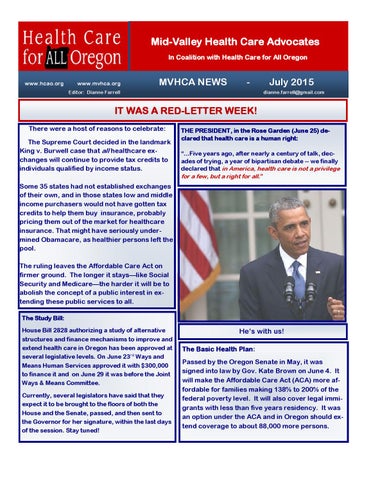
THE PRESIDENT, in the Rose Garden (June 25) declared that health care is a human right: “...Five years ago, after nearly a century of talk, decades of trying, a year of bipartisan debate -- we finally declared that in America, health care is not a privilege for a few, but a right for all.”
Some 35 states had not established exchanges of their own, and in those states low and middle income purchasers would not have gotten tax credits to help them buy insurance, probably pricing them out of the market for healthcare insurance. That might have seriously undermined Obamacare, as healthier persons left the pool. The ruling leaves the Affordable Care Act on firmer ground. The longer it stays—like Social Security and Medicare—the harder it will be to abolish the concept of a public interest in extending these public services to all. The Study Bill: House Bill 2828 authorizing a study of alternative structures and finance mechanisms to improve and extend health care in Oregon has been approved at several legislative levels. On June 23rd Ways and Means Human Services approved it with $300,000 to finance it and on June 29 it was before the Joint Ways & Means Committee. Currently, several legislators have said that they expect it to be brought to the floors of both the House and the Senate, passed, and then sent to the Governor for her signature, within the last days of the session. Stay tuned!
He’s with us! The Basic Health Plan: Passed by the Oregon Senate in May, it was signed into law by Gov. Kate Brown on June 4. It will make the Affordable Care Act (ACA) more affordable for families making 138% to 200% of the federal poverty level. It will also cover legal immigrants with less than five years residency. It was an option under the ACA and in Oregon should extend coverage to about 88,000 more persons.