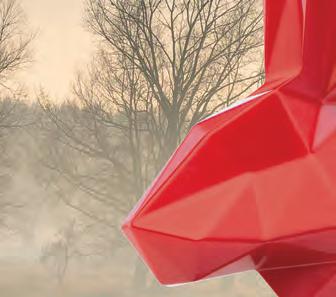
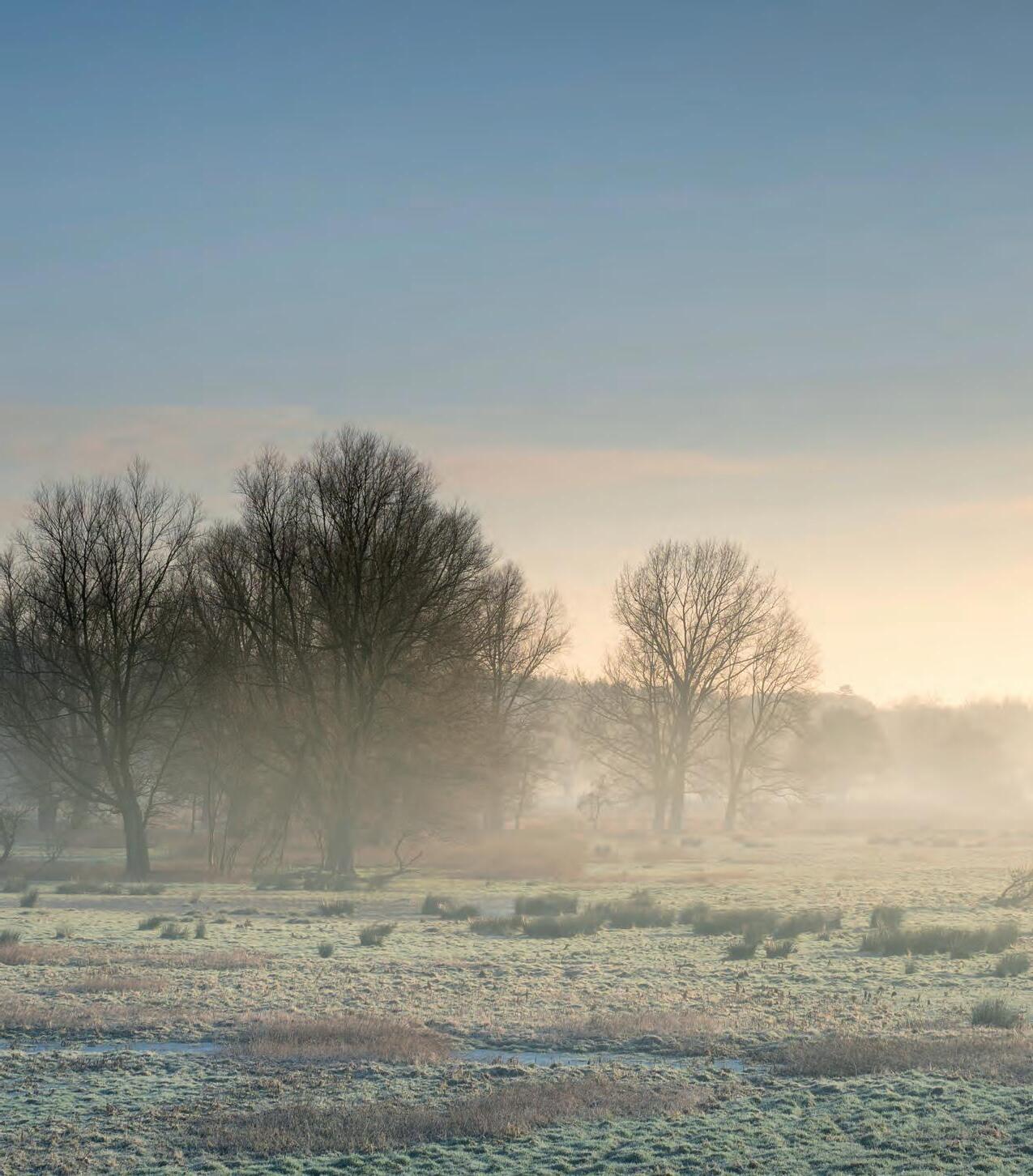
A celebration of Foxley Wood and our future plans
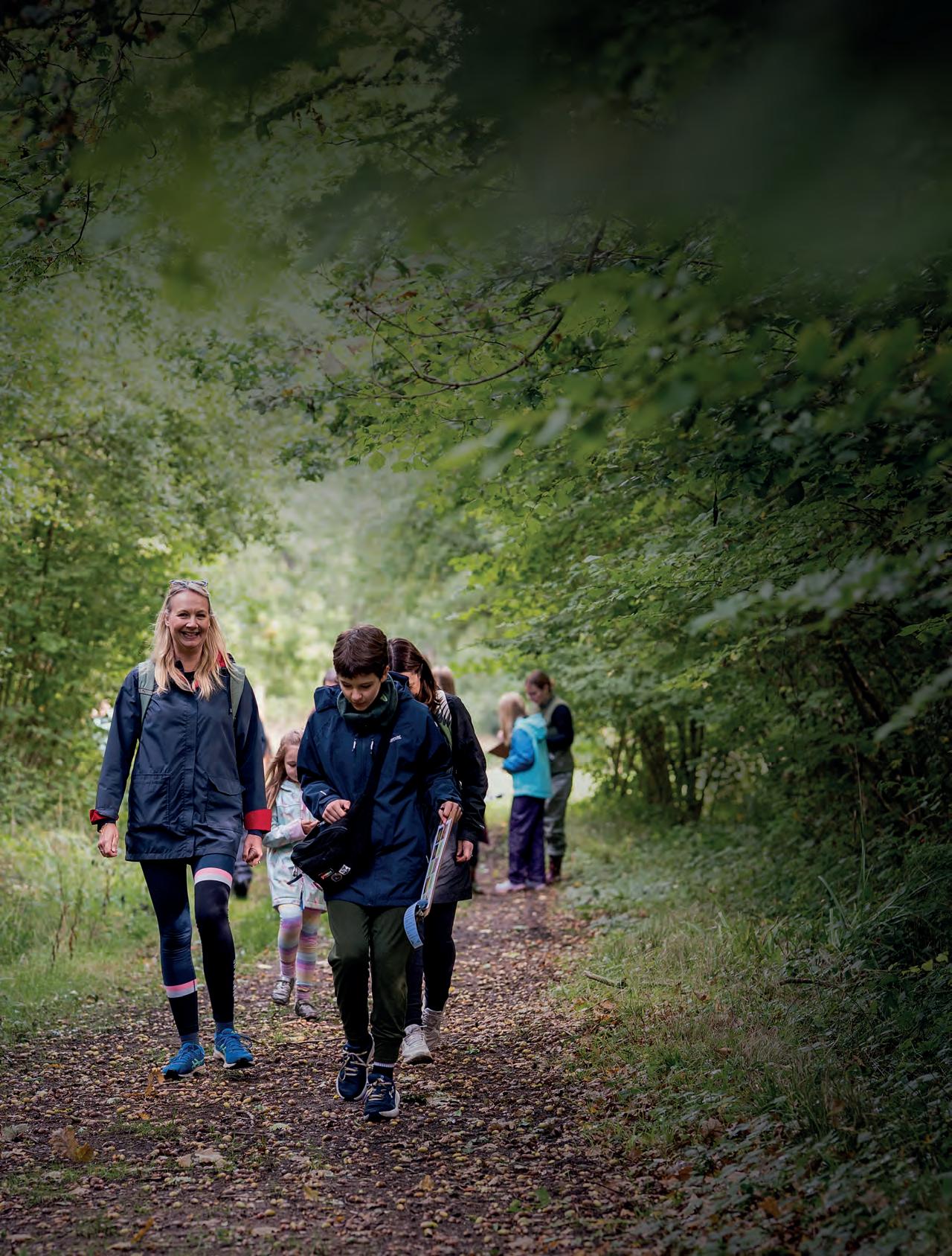
Youth-led nature reserve Winning images from our 2025 photo competiton
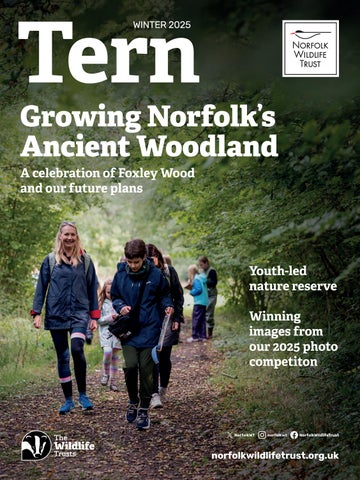
A celebration of Foxley Wood and our future plans
Youth-led nature reserve Winning images from our 2025 photo competiton

Our members make a difference
Norfolk Wildlife Trust is a charity dedicated to all aspects of wildlife conservation in Norfolk. Our members help us to create a county where there is space for nature to thrive and more people are inspired to take action for nature.
Thank you so much for being a member. Why not give the gift of wildlife to someone else? A gift membership is a unique present for wildlife watchers, outdoors enthusiasts, or families keen to explore Norfolk further. We can even post a welcome pack with a message directly to the recipient on your behalf. They will also receive three copies of Tern each year, access to local events, and be able to explore NWT nature reserves for free. Visit our website to buy your gift or call 01603 625540.
If you’re not already a member of NWT, please join us today by visiting our website, calling our friendly team using the details below, or asking a member of staff at one of our visitor centres. Help us create a wilder Norfolk for all. norfolkwildlifetrust.org.uk/Join or 01603 625540
Tern is published three times a year by Norfolk Wildlife Trust. Advertising sales by Countrywide Publications.
Printed by Micropress Printers Ltd.
Editor: Vicky Boorman
Designer: Hannah Moulton
While every care is taken when accepting advertisements neither Norfolk Wildlife Trust nor Countrywide Publications can accept responsibility for unsatisfactory transactions that may arise. The views expressed in this magazine are those of the contributors and not necessarily those of Norfolk Wildlife Trust.
NORFOLK WILDLIFE TRUST
Bewick House, 22 Thorpe Road, Norwich NR1 1RY, UK
T: 01603 625540
E: info@norfolkwildlifetrust.org.uk norfolkwildlifetrust.org.uk
All contents © Norfolk Wildlife Trust.
Reg Charity No: 208734
Cover photo: Phil Barnes
Welcome to the winter issue of Tern magazine. As our centenary year approaches in 2026, it seems apt that our cover story focuses on the rich history of NWT Foxley Wood, while also looking to its future. During the past 100 years, with your support, NWT has changed the fortunes of nature for the better. As with Foxley, we must continue to flourish and deliver for Norfolk’s wildlife. We have big ambitions for the next 100 years and even more successes for nature that we look forward to sharing with you soon.
Talking of a bright future, it’s great to hear from our Youth Forum members about their experience of managing Norfolk’s first youth-led nature reserve (p32). Developing a strong youth voice to ensure younger generations are represented in our work and empowered to act for nature is a key part of our strategy, so it’s wonderful to see this group in action.

We also share the winning entries from our photo competition, with images submitted from Norfolk residents and visitors, aged six to 93! (p28–30). Twelve of the stunning images were chosen for the NWT 2026 calendar, which would make a lovely Christmas present — we’ve got more wild gift suggestions on page 18.
If you’re venturing out for a woodland walk this festive season, be sure to look up — the bare branches of trees can make it easier to spot birds and hear their calls (p34). We also provide tips on the best winter bird roosts around (p36) and suggest a spot of fish-watching at NWT Hoe Rough nature reserve (p37).
On behalf of everyone at Norfolk Wildlife Trust, we wish you a naturefilled winter season. Thank you so much for your continued support.
Eliot Lyne, Chief Executive
Alternative ways to read Tern The magazine can be read on our website as a textonly document. You can make changes to font size and background colour, for easier reading, and enjoy Tern using a screen reader. This issue is available to download at norfolkwildlifetrust.org.uk/PlainTextTern
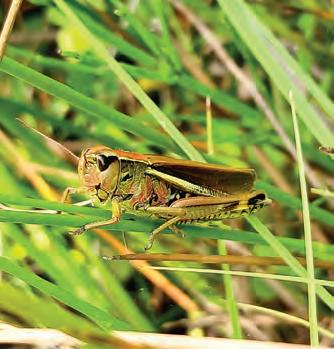
We have helped unleash a small army of rare large marsh grasshoppers across Norfolk, and they are thriving! Last hatched in the wild in Norfolk in 1968, the grasshoppers are now breeding and creating sustainable populations. This is all thanks to Citizen Zoo, funding from Natural England and some amazing partner organisations. Plus, the incredible volunteers who home-reared the grasshopper nymphs.
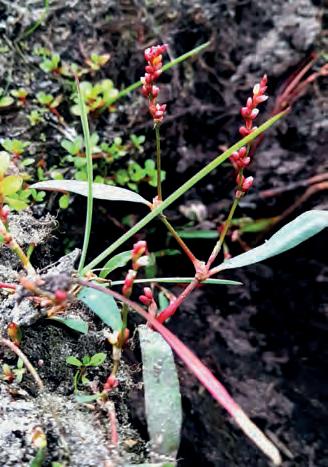
Small water-pepper is a nationally scarce plant. It hasn’t been recorded on NWT Sweet Briar Marshes nature reserve in recent years. However, it is now doing well in areas disturbed by our small team of conservation cattle. You can see a hoof print to the right of the photo! Other annual plants, like water purslane (visible in the background), are also thriving in areas that have been grazed.
A snapshot of our latest conservation work, successes and favourite wildlife photos across Norfolk
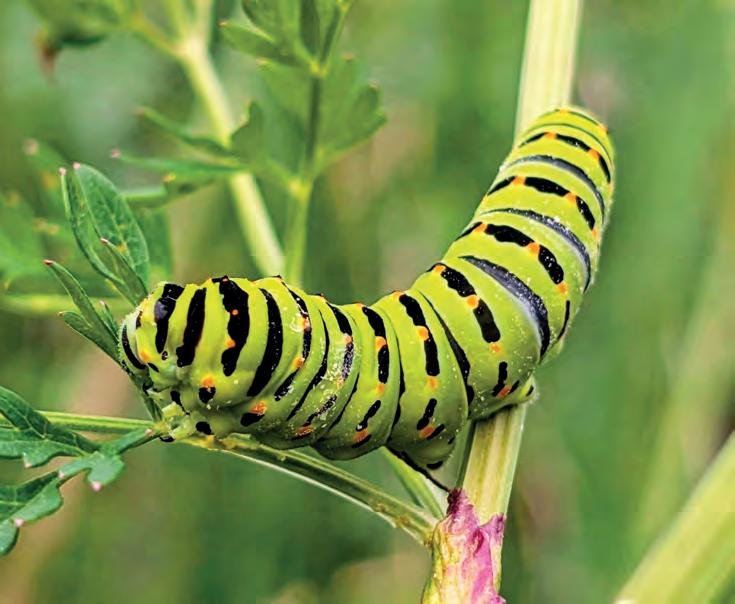
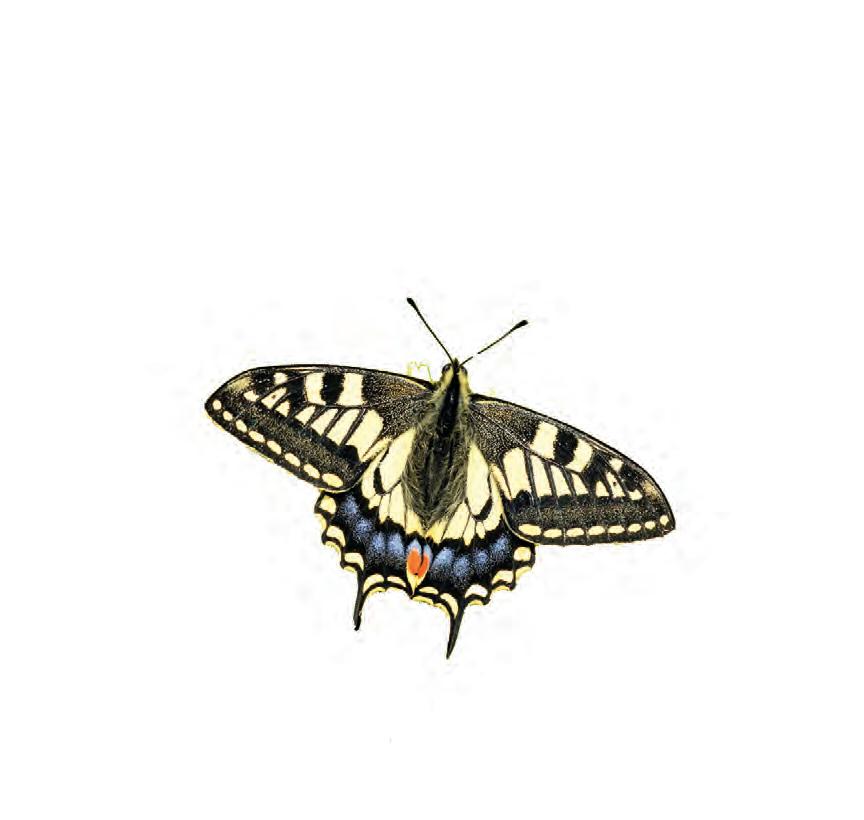
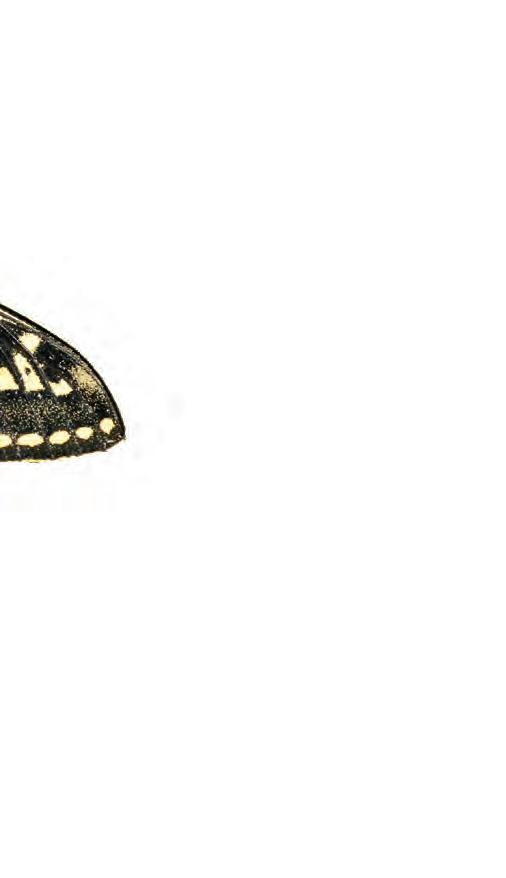
Swallowtail butterflies were ‘on the wing’ for longer than usual this year. Reserve staff observed them in flight from May through to August. Swallowtails are only found in the Norfolk Broads, where they seek out sites with plenty of milk parsley and lay their eggs on the tallest plants. Our conservation work at hotspots such as NWT Hickling Broad and Marshes helps support these beautiful creatures.
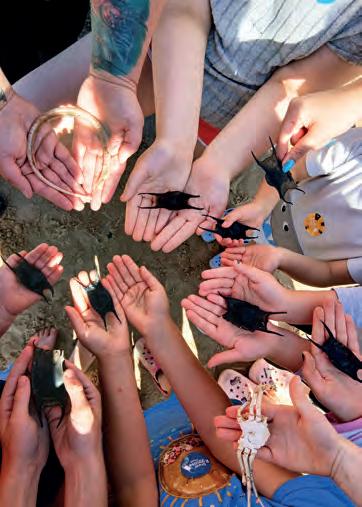
Every summer, we celebrate our marine wildlife during National Marine Week. Our Wilder Learning team pulled out all the stops and put on some wonderful family-themed events to raise awareness of our beautifully wild Norfolk coast. Activities included exploring rock pools, searching for sharks and sea dipping! This photo shows a few of the marine natural history items we found during some of the sessions.
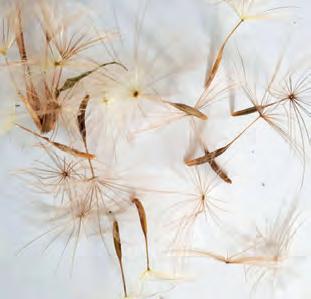
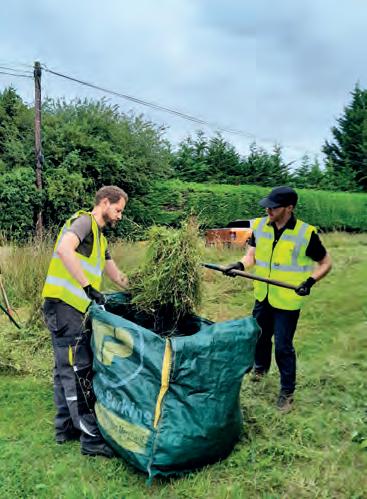
Wildflower meadows are incredible habitats for wildlife and an integral part of our landscape. One method of enhancing a meadow is to add freshly cut wildflowers and grasses from flower-rich areas. It must be collected when the seed is just ripe but not yet dropped from the plant. This ‘green hay’ is then immediately spread on prepared areas of meadows we are working to enhance. Our conservationists and volunteers carry out this technique in the late summer.
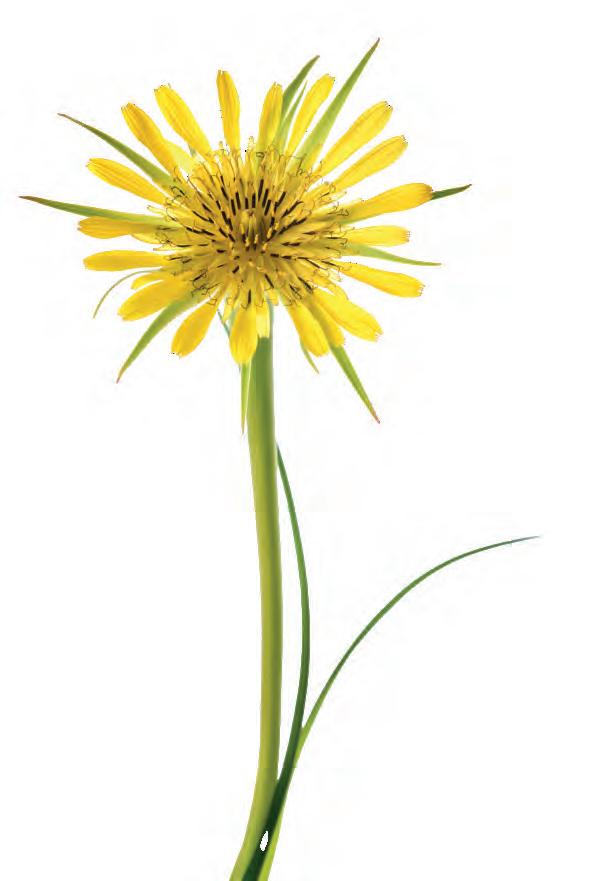
There is usually a variety of wildflower seeds in the green hay that we collect. However, it can lack early flowering species that may have dropped their seed before the green hay is harvested. We collect some seeds by hand to add to the mix, such as goat’sbeard and meadow cranesbill. The hand-collected seed captures both early and late flowering plants and gives us a good quantity of rare species too.
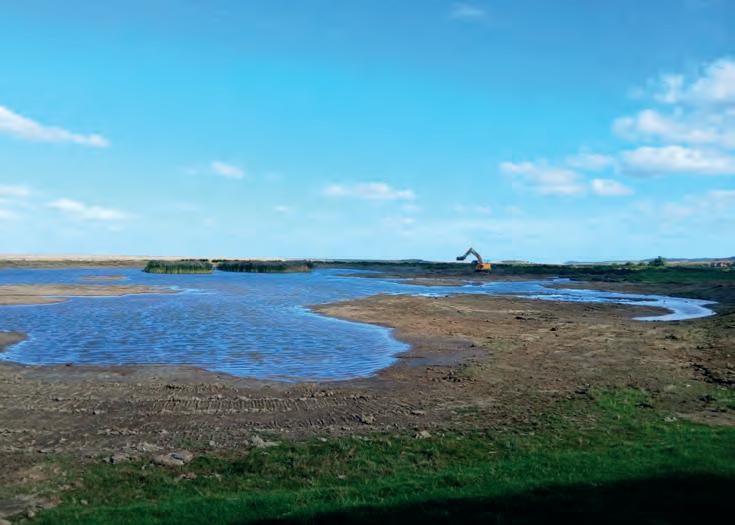
Thanks to funding from Cley Bird Club, our skilled machine operator at NWT has been doing a fabulous job restoring these shallow seasonal ponds, or ‘scrapes’, at NWT Cley and Salthouse Marshes. Having a variety of depths and slopes ensures this habitat is welcoming to a wide range of species, throughout changing seasonal water levels.
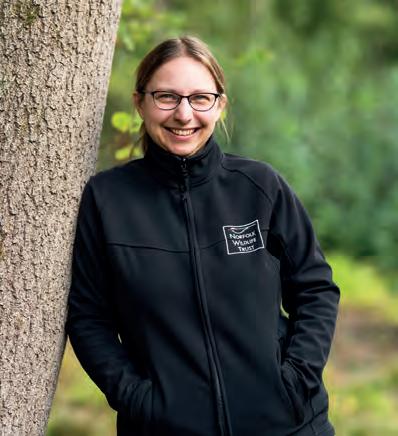
Rachael tells us more about her work in our ancient woodland nature reserve in South Norfolk.
Ifound myself in conservation thanks to a lot of enthusiasm and a dose of luck. After university and volunteering, I began work with the RSPB as a Visitor Experience Officer, followed by some time as an Assistant Centre Manager at Essex Wildlife Trust. I had my children and was a full-time parent when we moved to Norfolk and I began job hunting. My role as Wayland Wood Warden is a sidestep from the visitor-based work I am used to, but a welcome change. It’s so exciting to be part of practical conservation work.
A key part of my role is demonstrating my presence, so the woods feel like a safe and welcoming environment. This might involve practical work, such as keeping paths in good condition, or chatting to visitors using the site. I’m currently working with our fantastic interpretation team to add way markers to guide people around the reserve. I’m also building a small team of volunteers to help with work parties and surveys. With their enthusiasm,
teamwork, and contributions, we can make a real difference — and share a few laughs together along the way!
I’m really enjoying building our relationship with the people of Watton who carry a huge amount of local pride. It’s so important to share knowledge about this wonderful ancient woodland, so people want to help us protect it, as well as to come and explore.
My favourite part of the job is the pure bliss and peace spending time exploring when surveying. I never know what I might discover, but more than anything, I just feel immersed in nature.
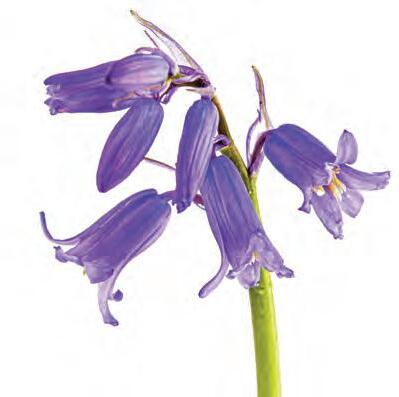
Being an ancient woodland, Wayland has a magical vibe. It’s steeped in both natural and social history, with evidence of our ancestors present all around, such as the wood banks, some Saxon and some medieval. You can visit regularly, and always experience something different. The glorious bluebells and yellow archangel in spring, endless
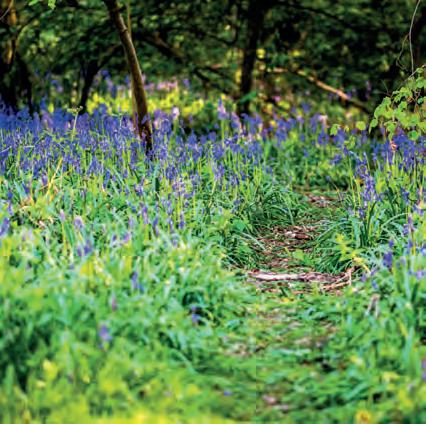
butterflies including silver-washed fritillary in summer. The autumn brings an abundance of fungus that manifests almost overnight. I’m entering my first winter now, excited to see what gems the new season will bring.
Outside of work I really enjoy playing a variety of tabletop games with my partner, as well as Dungeons and Dragons with some old school friends online, in which I play a wood elf bard! Along with this, I absolutely love being a parent to my two boys. They teach me to be in the moment — life is so enjoyable that way.
norfolkwildlifetrust.org.uk/ WaylandWood
Fancy getting more active and helping Norfolk’s wildlife? Why not volunteer with us at Wayland Wood? Find out more: norfolkwt.uk/ VolunteerWaylandWoods
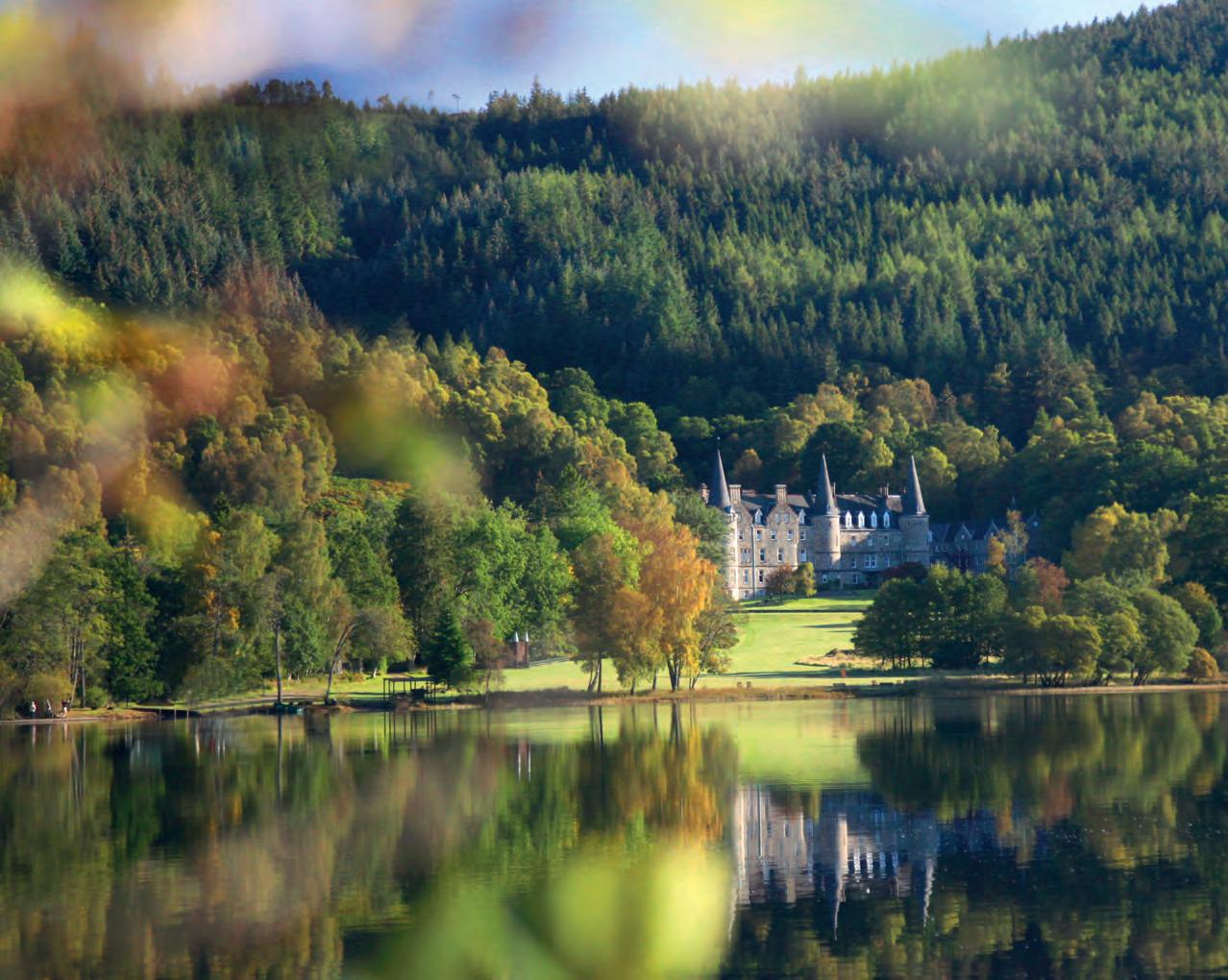
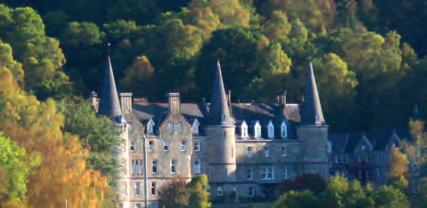


Imagine being able to enjoy fantastic holidays in unforgettable locations, like this. That’s exactly what over 40,000 discerning holidaymakers have already done.
The Holiday Property Bond’s portfolio currently includes more than 1,500 holiday homes in over 30 exclusive UK and European destinations. Discover this refreshing new approach to the way you plan and enjoy your holidays. You can even pass the benefits on to your children and grandchildren so they will have a lifetime of wonderful holidays to look forward to.

Become a Bondholder with HPB and you could take your pick from beautiful locations with breathtaking scenery every year, for life. HPB support The Wildlife Trusts in their aim to save and protect the UK’s wildlife and wild places.
That’s why we will donate £300 for every Norfolk Wildlife Trust member who becomes a Bondholder.
Exclusive holidays for life An initial payment from £5,000 and a quarterly fee of under £38 (that is around £150 a year), which can increase in line with but not exceed the Retail Price Index Excluding Mortgage Interest (RPIX), gives you access to all HPB’s holiday homes. For each HPB holiday, you will pay a no-profit user charge covering only property running and maintenance costs and use of on-site facilities. The average charge is the same throughout the year, the average weekly charge for a studio sleeping two is around £372 and around £569 for a two bedroom property, larger properties are also available. After an initial charge of 25% your money is invested in a fund of holiday properties and securities. The fund itself meets annual charges of 2.5% of its net
In 2025, The Wildlife Trusts and other environmental organisations became increasingly concerned about the risks to wildlife posed by rollbacks in environmental safeguards.
The UK government has been considering new legislation related to the planning system, including a new Planning and Infrastructure Bill. The bill aims to help development, like housebuilding, happen faster.
Some of the bill’s contents appear to be informed by unfounded claims from senior government ministers. These claims suggest that wildlife such as snails, bats and newts are ‘blockers’ to development.*
Despite the government promising a ‘win-win’ for development and the environment, early readings of the Planning and Infrastructure Bill suggested otherwise. They appeared to strip away environmental
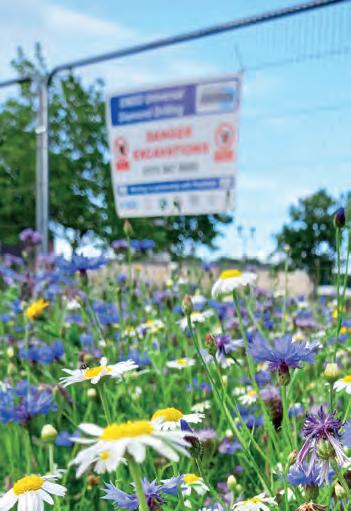
protections and remove requirements for developers to avoid harming nature. This would threaten Norfolk’s nationally and globally important wildlife sites — including chalk streams, wildflower meadows, and ancient woodlands.
As our concerns mounted, The Wildlife Trusts called on you, our supporters, to lend your voice. Over 30,000 of you — including thousands from Norfolk — emailed your MP to ask for parts of the bill to be withdrawn.
Thanks to your support, we have seen some progress, with amendments to the bill published by ministers in midJuly that go some way to addressing our concerns.
However, the risk to wildlife hasn’t disappeared. Some senior government ministers continue to blame nature for poor economic growth. We continue to work with parliamentarians on the bill. This includes the Bishop of Norwich who has joined us in calling for better protections for chalk streams. We will also continue to tell the government that weakening environmental protections will not produce the economic results they want.
We must stand firm. Nature is not a ‘blocker’ — it is the source of our security and prosperity.
Find out more: norfolkwildlifetrust.org.uk/PIB
*The Wildlife Trusts’ own research examined 17,433 planning appeal decisions made in 2024. Overall, bats and great crested newts were a relevant factor in just 3% of appeals.
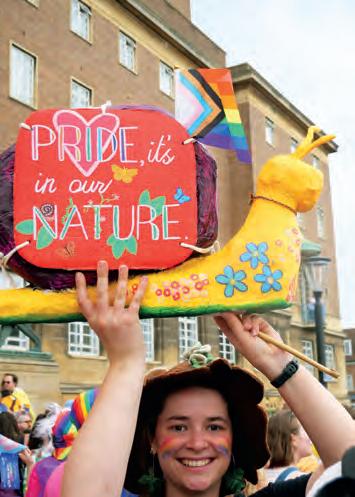
2025 marked the first year that Norfolk Wildlife Trust attended Norwich Pride.
The LGBTQIA+ community is as diverse and essential for our society as nature itself. We wanted to acknowledge, support and celebrate the incredible contribution of our LGBTQIA+ staff, volunteers, supporters, visitors and allies who help nature thrive.
We loved meeting everyone at our Pride stall; sharing facts, creating nature-themed crafts and celebrating the diverse beauty in nature. Taking part in the procession was joyous and we felt a real sense of community in taking our place alongside other partner organisations. It is important that everyone can enjoy nature and the many benefits it brings. We can’t wait for Norwich Pride 2026!
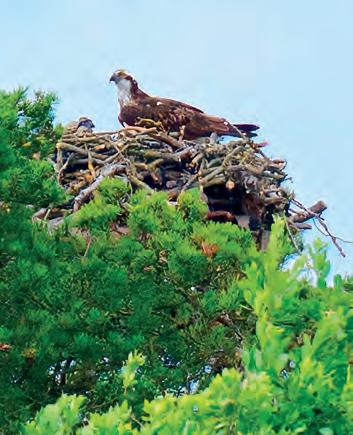
Back in June, we were excited to confirm that an osprey pair had successfully hatched two chicks at NWT Ranworth Broad and Marshes. Our nature reserve became the first known site in the region to make a home for breeding osprey in hundreds of years.
This was the third consecutive year that the site had welcomed a pair of osprey, but the first time they successfully bred.
As soon as the male arrived at the start of April, he was seen in flight carrying sticks for nest building. Unlike previous years, this spring, the female arrived soon after the male — just a few days later. As sightings of feeding and mating behaviour were reported, a sense of excitement built. Staff at the nature reserve realised that this could be a special year for osprey in the East.
Visitor Centre Manager at Ranworth Broad, Teala Leeder had kept a log of the pair’s behaviour and movements the summer before, noting the way they performed courtship dances, perched close together in the tree and started to build a nest. ‘Although they didn’t successfully breed last year, it
We are involved in an ambitious new project that will transform how nature is protected, connected and celebrated across the city.
Norwich City Council (NCC) has been awarded more than £750,000 from The National Lottery Heritage Fund, with thanks to National Lottery Players, to deliver NatureCityNorwich. We will be working in partnership with NCC on the project, alongside South Norfolk and Broadland District Councils, as well as Norfolk County Council.
Over three years, we will involve partners and communities across Norwich in co-creating a plan that
was such a privilege watching them get to know each other, like watching a romance blossom!’, Teala tells us. ‘When they returned this year, it was like welcoming back old friends.’
It was Teala who first confirmed the chicks as being in the nest on 20 June, spotting two small heads bobbing about through the camera set up in the visitor centre. ‘I’d been watching the pair of osprey flying back and forth to the nest, sometimes carrying fish, over the last couple of weeks feeling very hopeful and excited. So, getting my first glimpse of the chicks — and confirming our greatest hope — was just amazing. It’s a fantastic feeling to know that we are taking care of a special landscape that makes a home for incredible birds like this.’
The ospreys spent the summer in and around Ranworth Broad. Teala continued to keep a log of their activities, noting that one chick fledged the nest on 23 July and the other the day after. She watched their flying improve and saw them dive for fish in the nearby broad. ‘The better they got at flying, the less we’d see them as they explored the surrounding area,’
places nature and people at the heart of the city’s future. This will include working together to map and address ‘nature gaps’, establish a new Nature Commission for Norwich, as well as develop innovative funding and land management models. It will also support the city’s journey toward Nature Towns and Cities Advanced Accreditation.
Taking a leading role in the project enables us to build on our work at Sweet Briar Marshes — a place that nurtures wildlife and people in the heart of Norwich that was created by, and for, its local communities. We are looking forward to working with NCC to realise our shared ambition to make Norwich a city where nature and people can thrive.
As the project progresses, there will be lots of ways for people in Norwich to get involved — we’ll make sure to keep you updated.
she says. ‘The 8 September was our last sighting of an osprey, likely to be the male as they often leave last. Perhaps he was staying to ensure the fledglings had enough to eat for their migration to West Africa or Portugal.
‘I’ve loved sharing the excitement with visitors to Ranworth — and answering their many questions. It would be brilliant if the ospreys return to breed here again. There’s no guarantee of course, but I’ll certainly be watching the skies closely next spring.’
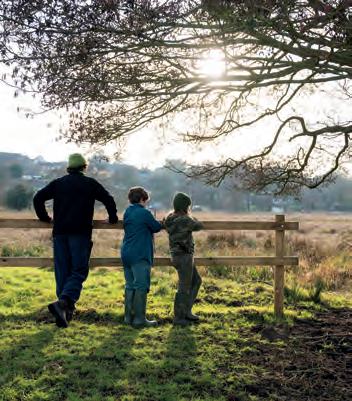

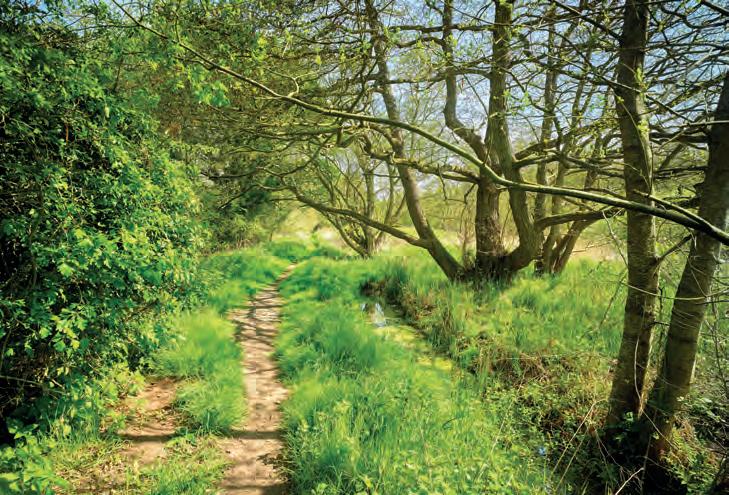
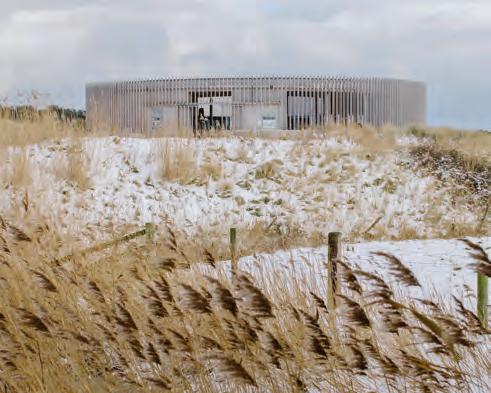
People will soon be able to enjoy a new wildlife haven in the heart of the Broads, thanks to our recent purchase of Sotshole Broad, near Ranworth village.
We were offered the opportunity to buy the site from a private seller on very generous terms in memory of their family member. David Pooley bought the land in 2005 and spent decades restoring the site for wildlife.
Thanks to the dedication of the Pooleys and the unique secluded location, the 25-hectare site is full of wonderful wildlife. The watery edges are ideal habitat for otters and water voles, while wetland birds such as teal and water rail can be found in the flooded alder carr. The drier woodland is alive with sound thanks to species that could include tawny owl, woodcock and treecreepers. Come spring, the nature reserve is home to a spectacular display of bluebells.
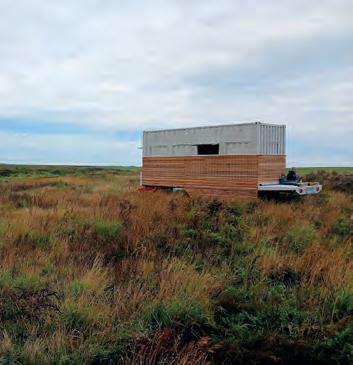
We have installed a new wildlife hide ‘on wheels’ at Cley Marshes thanks to generous donations from the late Robert Gillmor, renowned UK wildlife artist, and with support from Cley Bird Club.
The Gillmor Discovery Hide is part of a wider project focused on helping the nature reserve adapt to the impacts of climate change. It replaces a popular wildlife hide previously found along the shingle beach that was destroyed
in the big storm of 2013. The new hide has been put on wheels to protect it from the same fate. This allows site staff to tow it to safety when a major storm is forecast.
In tribute to Robert Gillmor, the hide features a series of his best-known artworks. For the last 25 years of his life, Robert lived and worked in Cley, exploring and celebrating the wildlife that made a home on the North Norfolk coast through his iconic linocut prints.
‘We are thrilled to celebrate Robert Gillmor’s passion for Cley’s wildlife through the installation of a new wildlife hide,’ says Dulcie Humphrey, NWT Legacies Officer.
‘Our deepest thanks to the Gillmor family for their ongoing support.
We intend to provide public access to the site, as well as areas for educational activities and events.
The purchase was made possible thanks to a wide range of local support from many generous individuals and organisations, including legacy gifts from Graham Churchyard and Peter Sinclair, and a grant awarded by the Anglian Water Flourishing Environment Fund.
Other generous donors include Peter Crook, South Walsham Parish Council, Upton with Fishley Parish Council, the Leslie Mary Carter Charitable Trust, Martin Laing Foundation, the Paul Bassham Charitable Trust, and individuals who contributed to NWT’s Sotshole Broad Purchase and Restoration appeal. Our huge thanks to them all.
We are continuing to raise funds towards habitat restoration and improving public access to the site. To find out more about our plans for the site and to donate, please visit: norfolkwildlifetrust.org.uk/ SotsholeBroadAppeal
‘We look forward to inviting you to enjoy some of Robert’s work adorning the inside of the wildlife hide and if you take a look from the windows, you might just catch sight of one of his favourite subjects.’
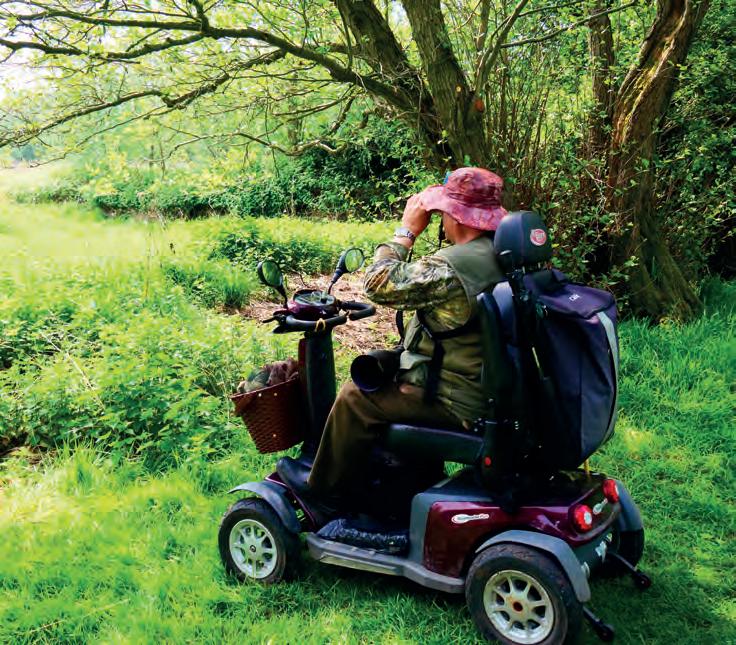
Our ambitions to enhance our newest Norwich nature reserve have received a major boost, thanks to further investment from longstanding project partners Aviva, alongside other generous funders.
The new funding, which also includes significant investment from the Greater Norwich Growth Board, as well as The Geoffrey Watling Charity, will enable us to continue enhancing the nature reserve for wildlife. It will also give more people in the community the chance to enjoy and connect with nature at the site.
Lookout decks and wildlife observation screens will offer views across naturerich meadows, while a new communal seating area will invite visitors to pause and enjoy the surroundings. Across the site, informative panels will share the nature reserve’s unique biodiversity and rich history.
Funding from the Greater Norwich Growth Board will help make the
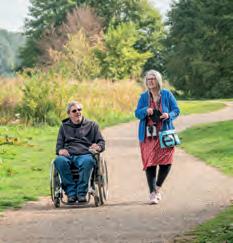
site easier for everyone to access. Plans include a small car park off Burnett Road for people with accessibility needs, along with a Changing Places facility and accessible toilet. The existing foot and cycle path will be improved, and a new accessible entrance to the marshes will make it easier for visitors with limited mobility to visit.
Habitat improvement to benefit native plants and invertebrates will take place alongside the infrastructure work. Aviva will also support the establishment of a dedicated base for reserve staff and volunteers near to the accessible parking point, significantly enhancing on-site conservation management.
Work is expected to take place in phases between November 2025 and May 2026 and in the autumn/winter of 2026/27 norfolkwildlifetrust.org.uk/ SweetBriar
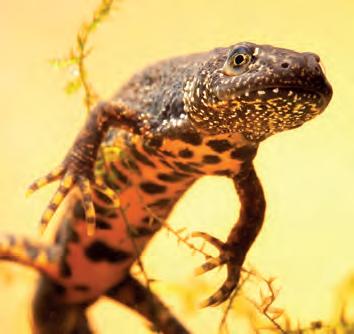
Norfolk Wildlife Trust and Norfolk Wildlife Services (our wildlife consultancy team) teamed up this spring to survey 36 ponds that had been restored on farms and other land under Natural England’s District Level Licensing pond restoration scheme. This funding targets ponds that have become unsuitable for great crested newts due to becoming overgrown with scrub or becoming filled up with silt or leaves over time. Fully funded restoration work can then give these ponds a new lease of life.
We used an eDNA testing method where water samples are taken from ponds and processed in an independent lab to look for traces of great crested newt DNA. Results from the surveys found that a quarter of the ponds recorded the presence of the newts — an average of just three years after the restoration work.
Ponds restored under this scheme are monitored over a 25-year period. Funding is also available for landowners to manage these ponds to keep them in peak condition as they mature.
If you have a pond on your land that needs some attention, we can help.
Find out more:
norfolkwildlifetrust.org.uk/ PondFunding
Norfolk and Suffolk are on the government’s fast track to devolution — which will see the creation of a new overarching ‘strategic authority’. Voters are set to go to the polls in May 2026 to choose the first joint mayor for the two counties. But what does this mean for nature?
The new mayor will have an important role in the strategic planning of housing, economic growth, transport, energy, and health. Importantly, they will also have the job of coordinating efforts to restore nature. This will be done through the delivery of the new Local Nature Recovery Strategies for Norfolk and Suffolk, which we have been involved in shaping.
Devolution is a unique opportunity to give local government the tools and power to deliver genuinely environmentally positive growth that helps restore nature. We are engaging with councils and the government to help put nature recovery at the heart
© Tom Marshall
of a devolution deal for Norfolk and Suffolk. This includes calling for a duty on the new mayor to set out how they’ll help meet nature and climate targets.
In May 2026, wildlife will also need your help as the new strategic authority is put in place. You will be asked to vote for the first joint mayor representing Norfolk and Suffolk. It’s vital that during the election process, we make sure our future mayor understands just how important nature and a stable climate will be to secure a prosperous future for our county.
Keep updated on devolution and how you can play your part for wildlife by visiting: norfolkwildlifetrust.org.uk/ Devolution
We are supporting more schools to get hands-on with nature thanks to new funding from Ørsted’s Hornsea 3 Community Fund.
We received £16,685 from the Fund to support the continued roll-out of our Wilder Schools programme. Thanks to the new funding, we’ll be able to work with three new Norfolk primary schools to deliver nature-based, curriculum-linked sessions. These are designed to inspire environmental action, improve wellbeing, and enhance biodiversity within school grounds.
Over the next two years, we will deliver outdoor sessions to a class of children from each school, teacher training, school assemblies, and
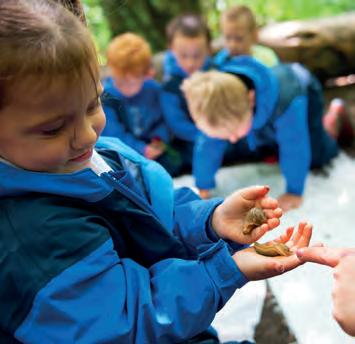
on-site conservation activities like wildflower planting and installing bat boxes. We are so excited to be working with Rollesby Primary School, Loddon Junior School and Hillside Avenue Primary and Infant School.
In case you haven’t heard, it’s our centenary in 2026! As if celebrating 100 years of caring for Norfolk’s nature wasn’t enough, we are also the first Wildlife Trust to reach this incredible landmark.
We have a wonderful lineup of special events and activities planned from our birthday month in March, to celebrate all that we’ve achieved together for Norfolk’s nature. And we will be looking ahead with hope as we set about doing even more for wildlife during the next century!
Think exciting guest speakers, touring exhibitions, a celebratory film and a specially published compilation of Nick Acheson’s writing, plus lots more.
As well as coming along to our events, we’ll be encouraging everyone to join us in celebrating 100 years of nature conservation in Norfolk with an invitation to ‘Do one thing for wildlife’. This could be taking part in a unique fundraising challenge, making a home for wildlife on your patch, or just learning something new about nature.
Spring Tern will be a ‘Centenary Special’, helping to kick off our celebrations. We can’t wait to share a special year with all of you.
Keep up to date with our centenary celebrations by signing up to receive our regular emails: norfolkwildlifetrust.org.uk/ SignUp










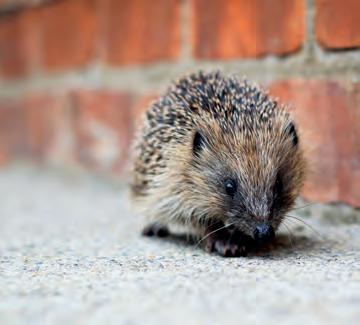
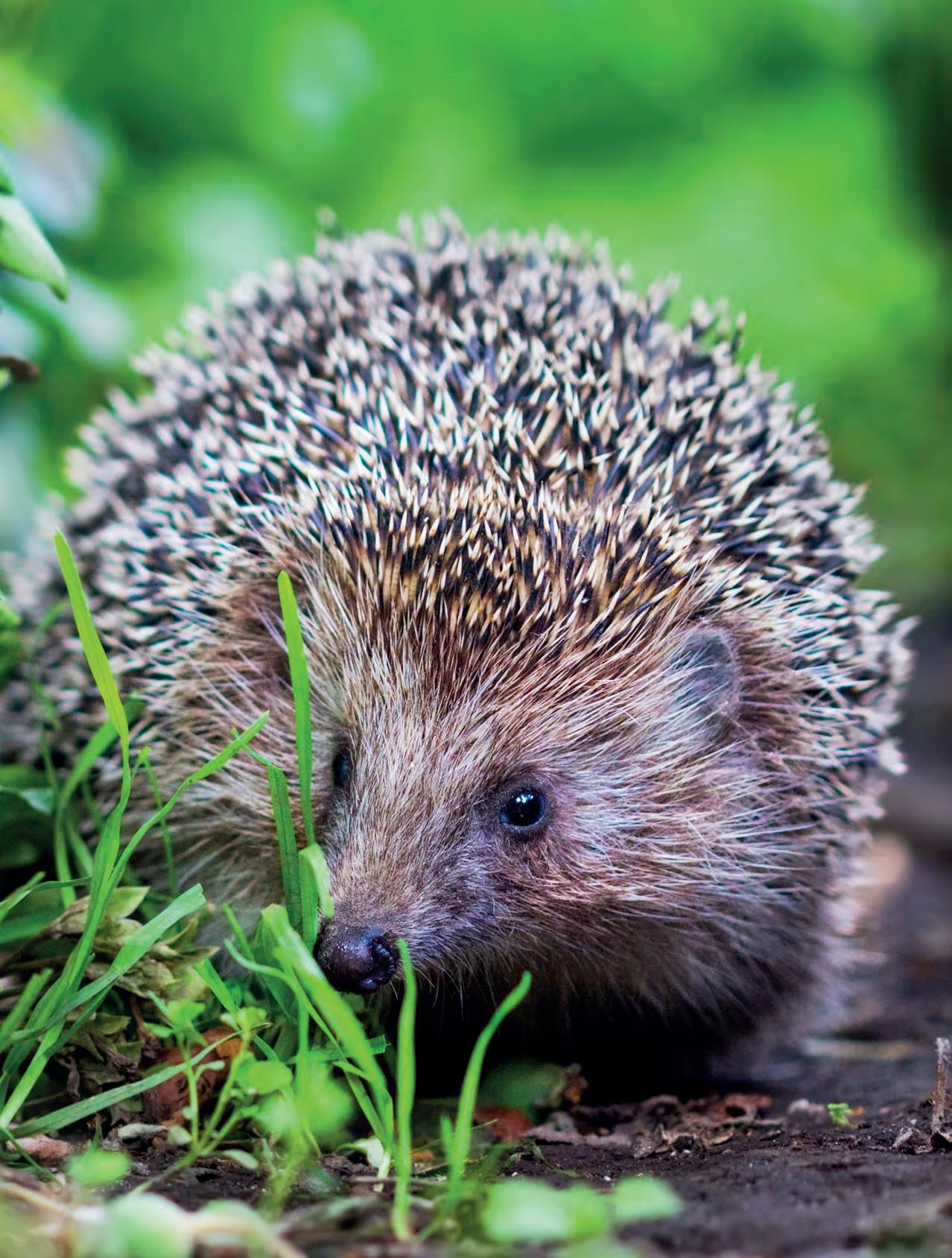
A hedgehog is such a distinctive animal almost anybody could correctly name it at sight. Of course, its coat of spines is an instantly recognisable feature. Adult hedgehogs have over 6,000 spines, with each one replaced over an 18-month period — a lifetime for most hedgehogs. Despite the old country tales, the spines can’t be fired out like arrows or used to collect crab apples to take back to their nests.
Along with bats and the hazel dormouse, hedgehogs are the only British mammal to hibernate. They are predominantly insectivores, which means they must hibernate due to a lack of food. Come November they will drag dry hay and leaves into a pile of brushwood, an old rabbit burrow or under a garden shed. It is essential that in the autumn they put on enough fat to see them through hibernation.
A spell of mild weather can often tempt them out, although this is risky as they can quickly lose condition if they don’t find enough to eat.
A generation of us grew up seeing hedgehogs everywhere, and even the smallest urban garden would be home to a hedgehog. Sadly, the creature has suffered massive population decline, with studies suggesting that a staggering 95% have been lost since the 1950s. Along with fatalities on our roads, reasons include habitat loss — including in our gardens, insecticides such as slug pellets, injuries from garden machinery and pressure from predators.
Find out more about helping hedgehogs and other wildlife at home: norfolkwildlifetrust.org.uk/Actions
Returning raptors and a swallowtail summer, photographer and writer Robin Chittenden looks back on some wildlife highlights.
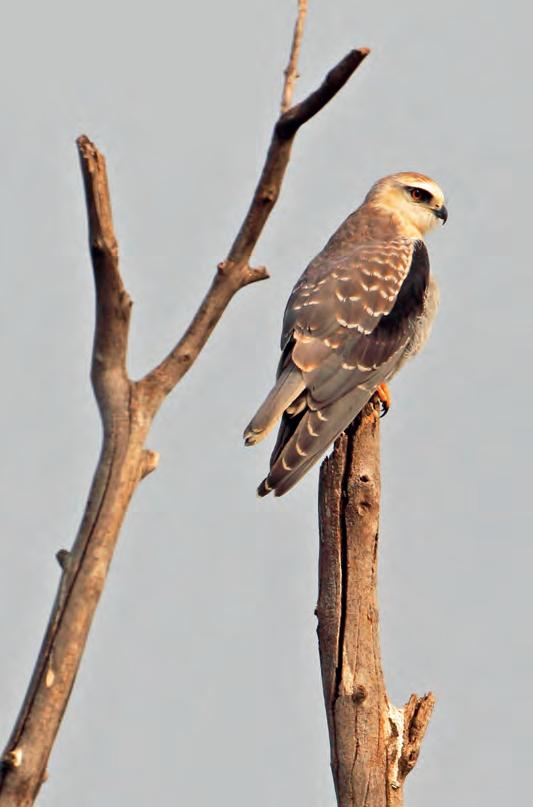
Three species of raptor more normally associated with the southern Mediterranean were seen in Norfolk. A black-winged kite was spotted at NWT Hickling Broad and Marshes in early September. Could this have been the same bird seen in the same area in 2023? It’s highly likely. What with record numbers appearing in Holland and a breeding attempt in Denmark, it surely can’t be long before this species becomes a regular sight in the UK. Their ghostly pale plumage, with black eye mask and black wing tips is very eye-catching.
‘‘ Glossy ibises arrived in southern England in September in their largest ever numbers.
It could join the kestrel as another hovering bird of prey to look out for on train and car journeys.
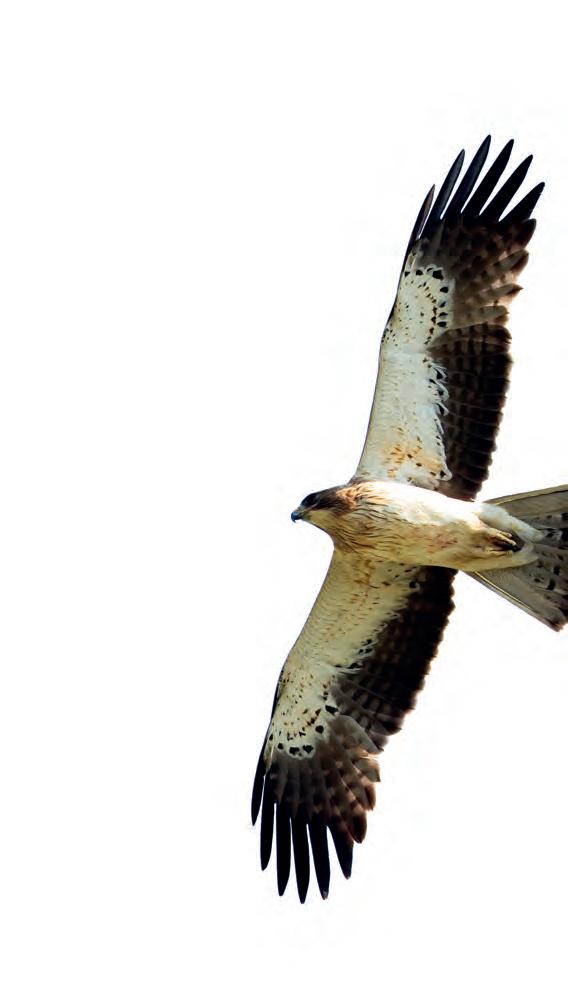
In early summer, an Eleonora’s falcon flew west along the beach at Walcott raptor threesome, a pale morph booted eagle was spotted at several sites in Norfolk in late spring. Feather details of this bird identified it as the same one that had over-wintered in Cornwall. Although an eagle, it is quite small, a similar size to a common buzzard.

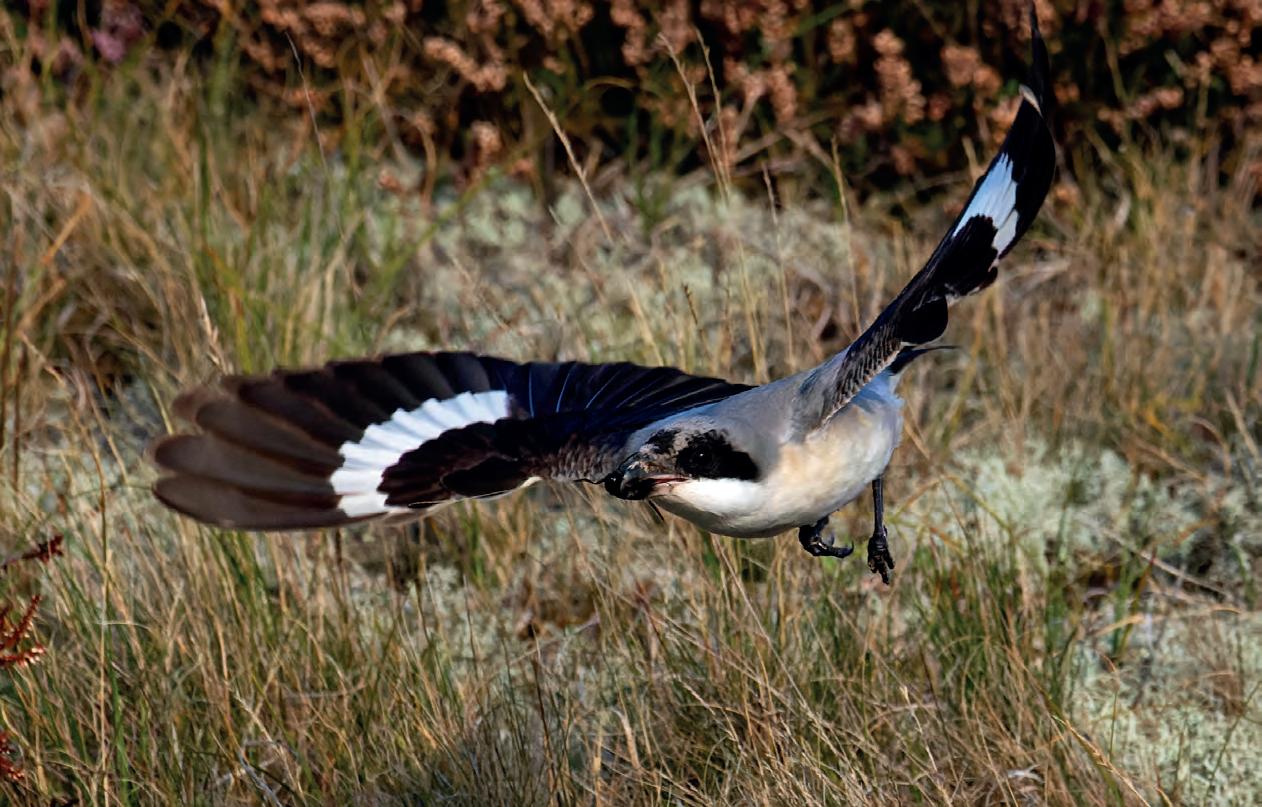
Talking of possible returning birds, there was a very confident adult lesser grey shrike at Winterton in September. It wowed the crowds as it pounced on morsels from its lookout perches, often flying down within feet of the observers. There was one last year at the same place and at a similar time. Prey included common lizard, devil’s coach-horse beetle larva, bumblebee species and long-winged conehead (a type of bushcricket) among other insects. It was a bit of a ‘shrike autumn’ with an isabelline shrike nearby at Happisburgh for a day, and a handful of redbacked shrikes scattered around the coast.
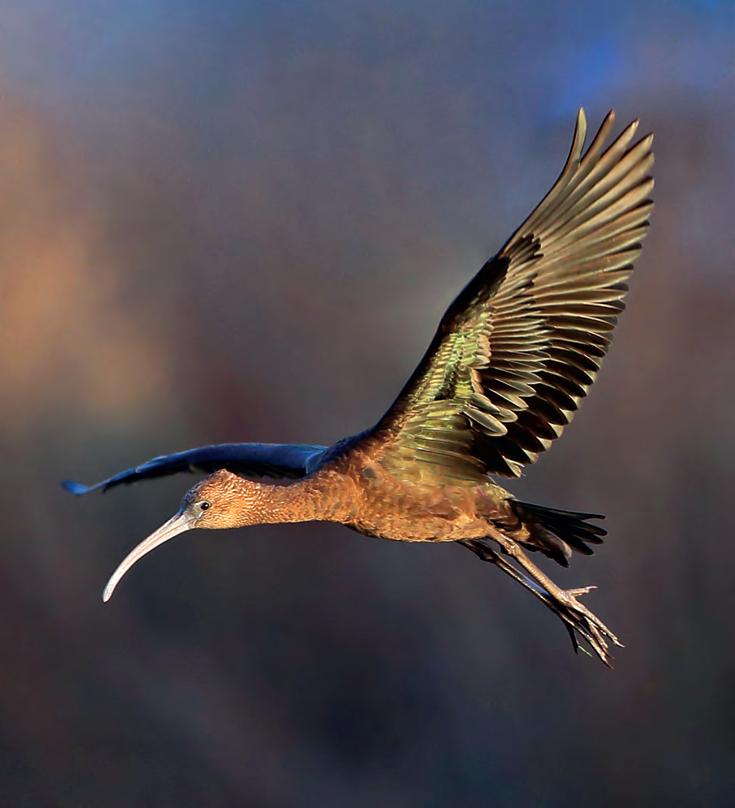
Glossy ibises arrived in southern England in September in their largest ever numbers. Presumably they flew north seeking damper conditions due to the drying out of their marshy habitats in the southern Mediterranean. Strange, perhaps, that this movement should coincide with our exceedingly dry summer but, despite this, they did find some wet spots to their liking. As with the curlew, glossy ibis have long downward curved bills that are great at extracting food from soft mud. Norfolk recorded many arrivals, including a peak count of 34 at Breydon Water. A further 31 were observed flying past NWT Cley and Salthouse Marshes, with up to six staying in the area.
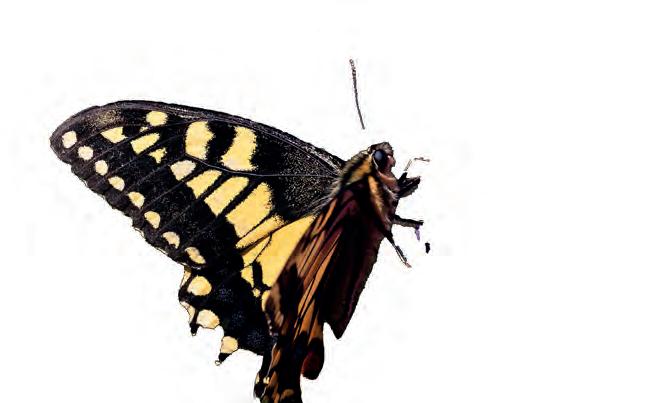
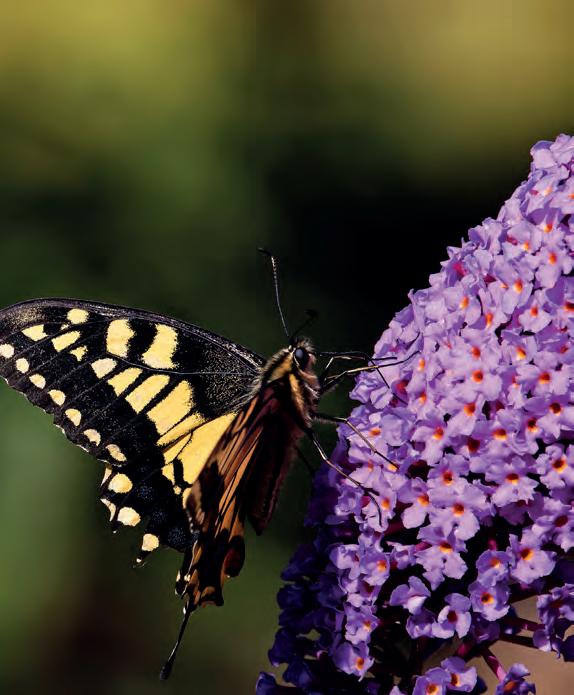
As it was such a fine summer, many butterflies were able to have a second or even a third brood. For example, swallowtails could be seen again in August at suitable Broadland habitats, following their appearance in spring. This photograph was taken at RSPB Strumpshaw Fen. It’s the first time I’ve seen them nectaring
Need some help with your Christmas list or present buying? Our gift ideas are great for people and wildlife.
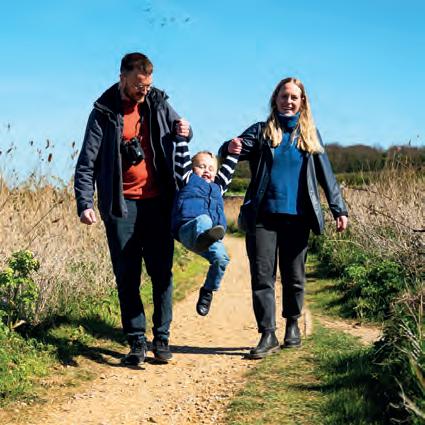
As you know, being a member of NWT is an excellent choice! Why not share the experience with a loved one by giving a gift membership this Christmas? Whether they are a keen wildlife watcher, outdoor enthusiast or armchair admirer of garden birds, our membership offers something for everyone. We even offer the option to post the pack directly to your recipient with a personalised greetings card.
norfolkwildlifetrust.org.uk/GiftMembership Call 01603 625540 Purchase from one of our visitor centres
Surprise someone in your life by gifting them a lottery ticket — a gift which gives back to nature and offers the chance to win £250! Since its formation in 1981, donations to the 250 Club have helped us restore over 800 hectares of fen, grassland, heath and woodland. And with tickets costing £12 a year, it’s an easy way to make a big difference — as well as a great gift.
norfolkwildlifetrust.org.uk/ 250Club
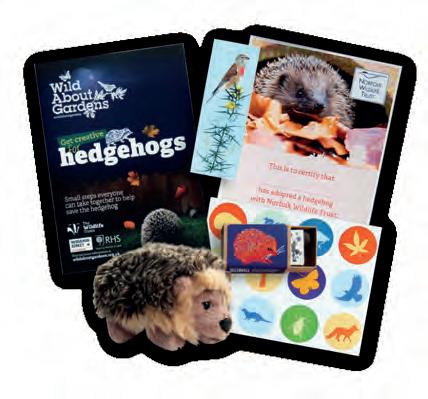
By adopting a hedgehog or an otter, you will be helping to fund our vital work to create a wilder Norfolk for all. You will receive a welcome pack that includes a certificate, a cuddly soft toy, a guide to your adopted animal, and a few other goodies to enjoy. We will send you (or your gift recipient) fun and fascinating email updates throughout the year.
norfolkwildlifetrust.org.uk/ AdoptAnAnimal
Please order by 12 December to receive in time for Christmas
If you need any help with Christmas gift orders, or donating please call
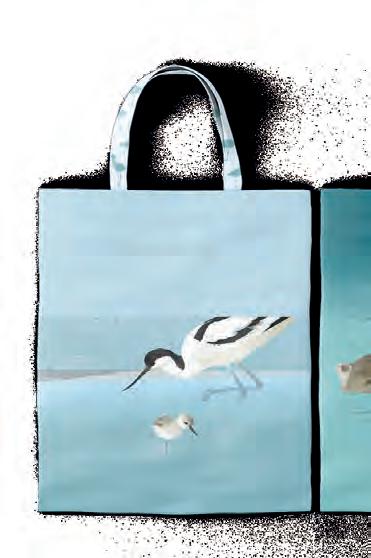
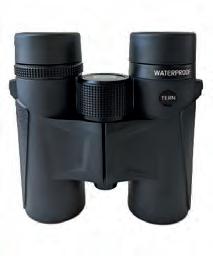
We have beautifully designed Christmas cards, our 2026 Calendar, soaps, binoculars and other bespoke products for anyone you know who loves nature. Or how about a nature book? See over the page for our recommendation. All of these gifts are available via our website, or to purchase from one of our visitor centres at Cley Marshes, Holme Dunes or Hickling Broad — and you can enjoy a winter walk too!
norfolkwildlifetrust.org.uk/ Christmas
As we retreat indoors to warmth and comfort this winter, nature is doing the same. Across Norfolk, wildlife is looking for places to sleep, hibernate, and rest — but with natural habitats disappearing, many are struggling to find shelter.
Our Norfolk’s Nature Needs a Home appeal supports vital work to protect and restore the wild spaces that local wildlife depends on. This Christmas, why not donate instead of sending Christmas cards — or even as well as?
norfolkwildlifetrust.org.uk/ NatureNeedsAHome
beautifully
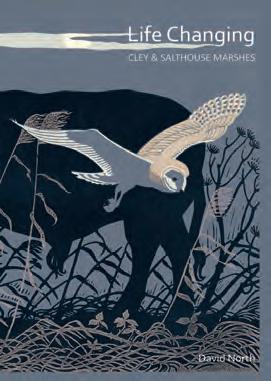
Museum curators speak of the patina an object acquires with time, with careful use, through long interaction with its environment. David North’s Life Changing: Cley and Salthouse Marshes (Mascot Media, July 2025) glows with a deep, authentic patina, of a kind acquired only through decades of tender and loving wear. David’s feet have worn hundreds of thousands of steps into the restless landscape of Cley and Salthouse. In turn, this rare place has worn deeply into his heart and mind. A profound, respectful knowing lies at the core of his book, making it the beautiful thing that it is.
To be sure the book is sumptuously beautiful as an object, laden with the work of some of our finest wildlife artists, many with their own long relationships with Cley. It is expertly designed and curated by Mascot Media, with each work of art chosen carefully to echo David’s narrative.
The story is simple: a year in the calendar of Cley and Salthouse Marshes, beginning in September with the return from Iceland of winter’s first pink-footed geese. Throughout the year — one of many years he has walked, worked and watched here — David makes regular visits to Cley and Salthouse Marshes and simply tells us what he sees.
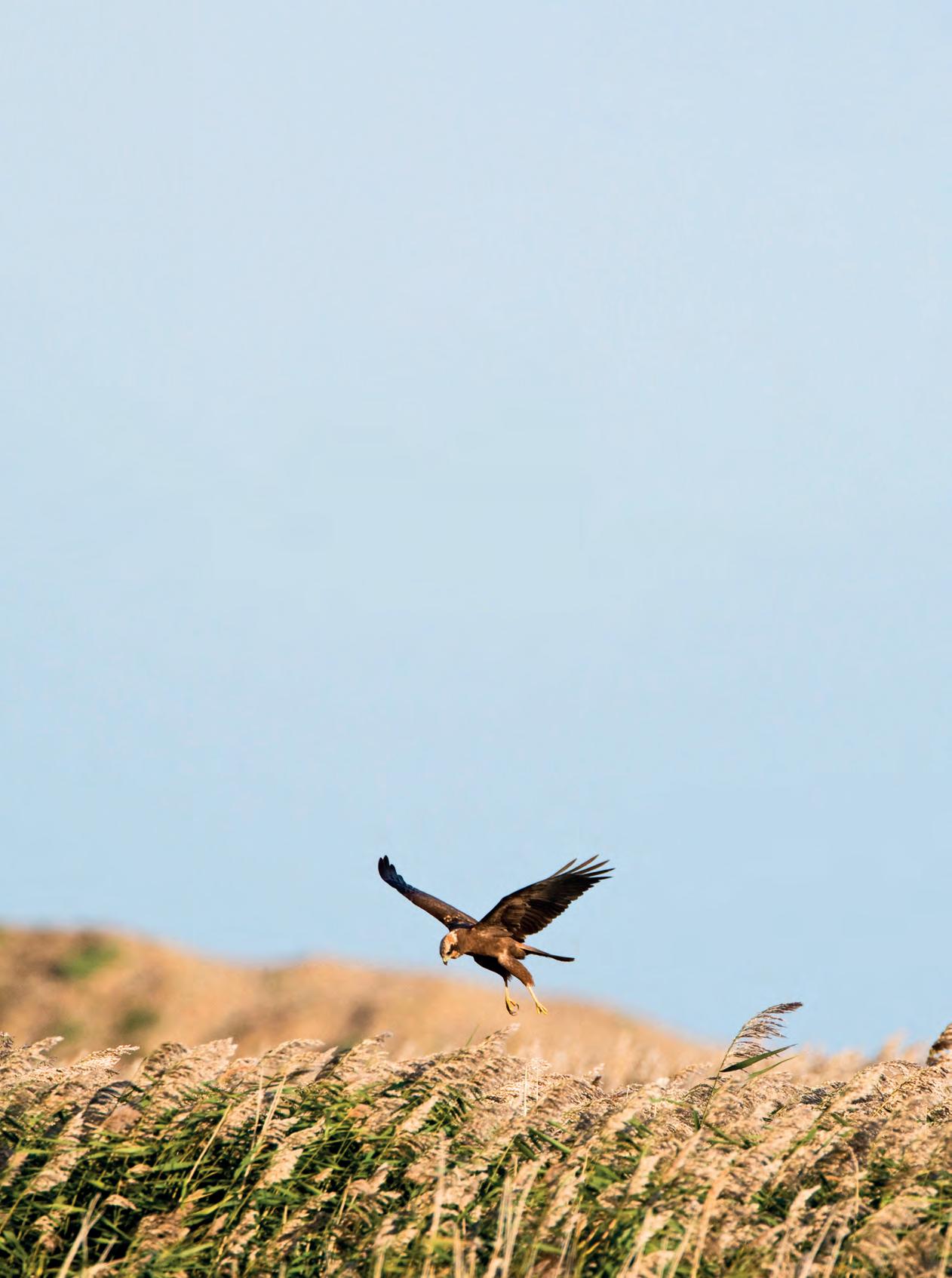
In unskilled hands, the diary format might easily become repetitive. But we are wholly spared from repetition by the closeness of David’s observation and by the gentle joy with which he shares the unfolding year and his meetings with the wild souls of the marsh. The marsh harriers swaying above the reed, the brent geese visiting over winter from Siberia, and spring’s wildly tumbling lapwings are all old friends. Their presence here, alongside countless other denizens of Cley, makes each of David’s visits at once familiar and entirely new.
Filled with historical, cultural and biological fact, and richly illustrated, but above all written with a humble, observant love, this is a treasure, worthy of every Norfolk bookshelf.
Available to purchase from one of our visitor centres at Cley Marshes, Holme Dunes, or Hickling Broad or by visiting norfolkwildlifetrust.org.uk/ Christmas


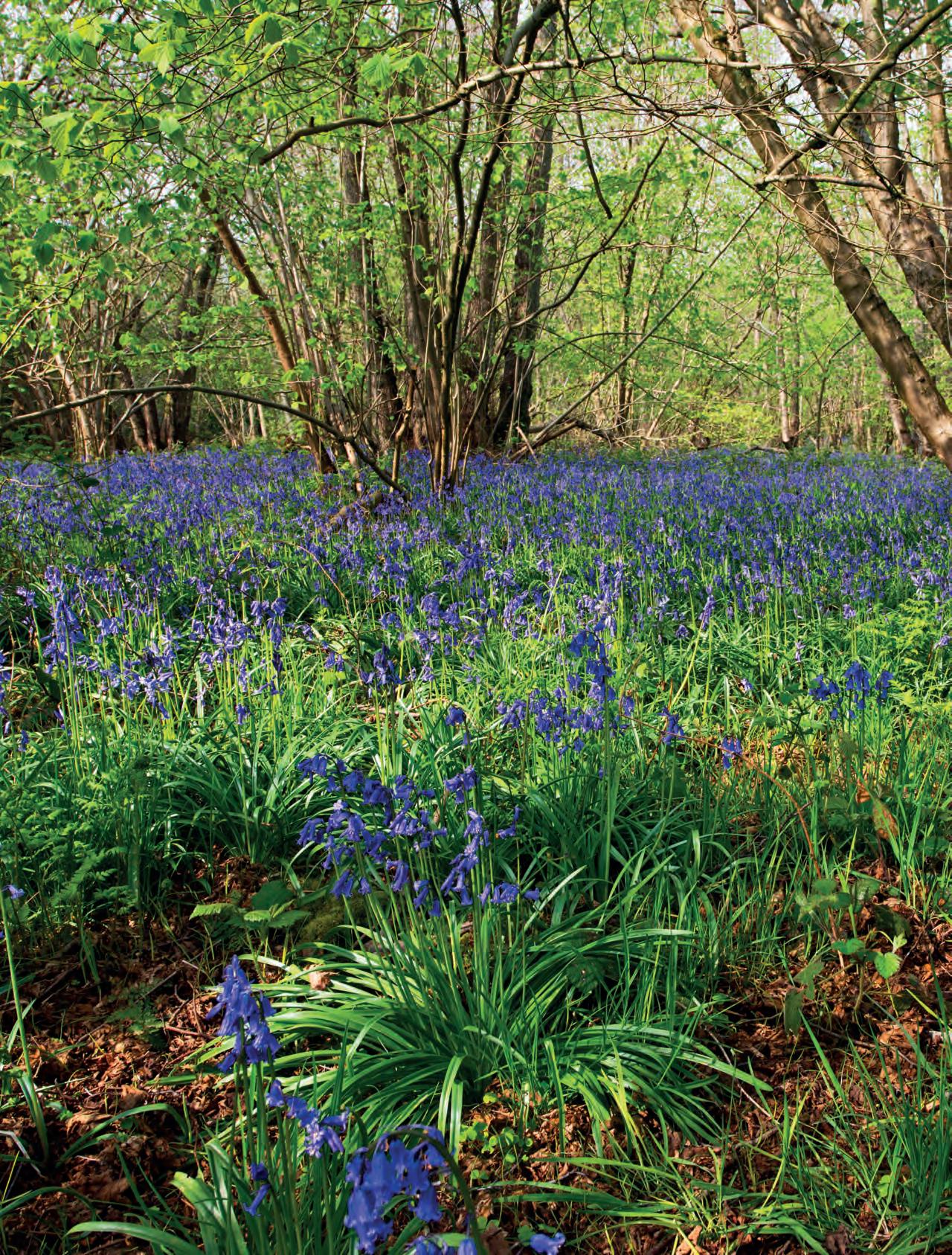

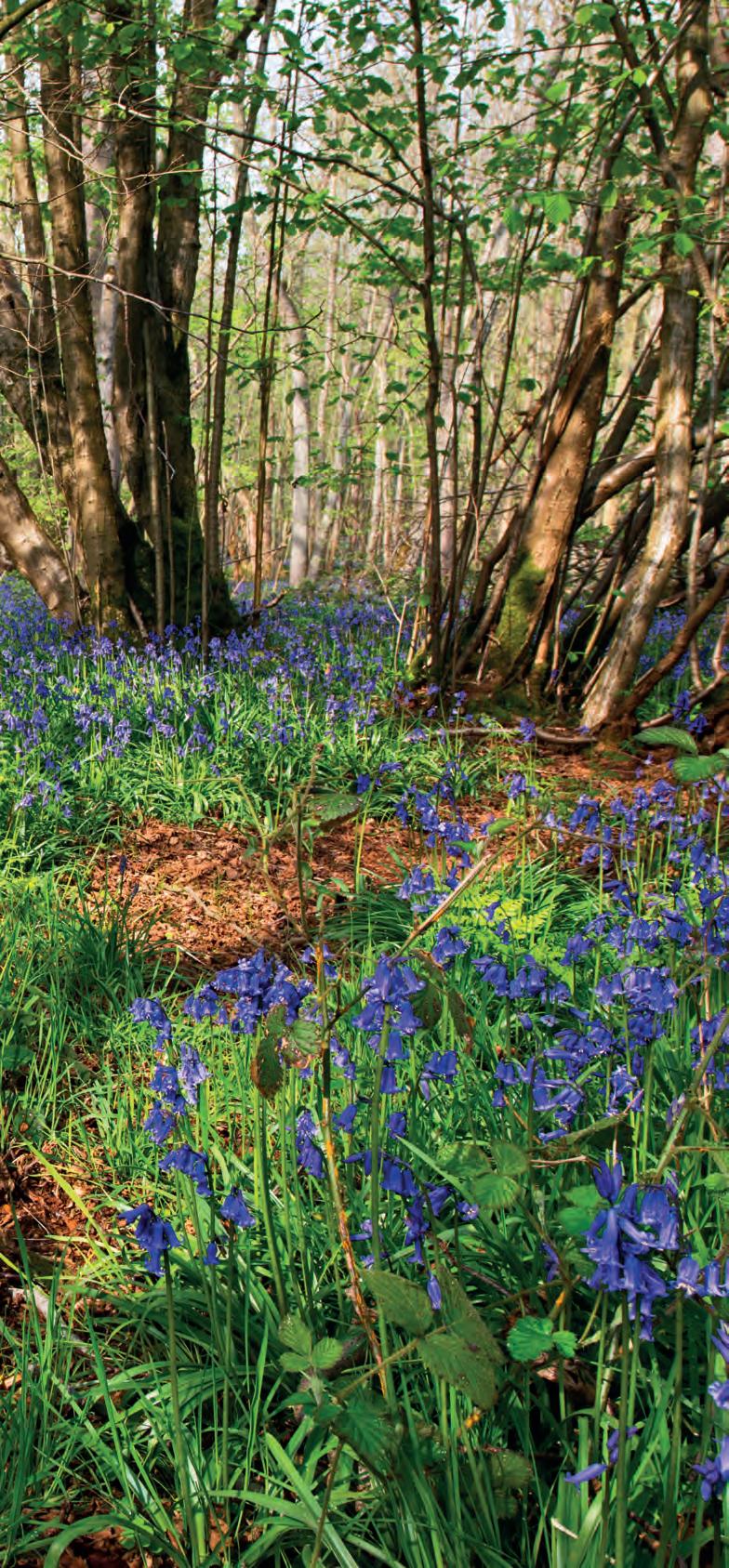
As we celebrate the expansion of Foxley Wood, NWT Nature Conservation Manager Steve Collin tells its fascinating story and looks to the future of this ancient woodland.
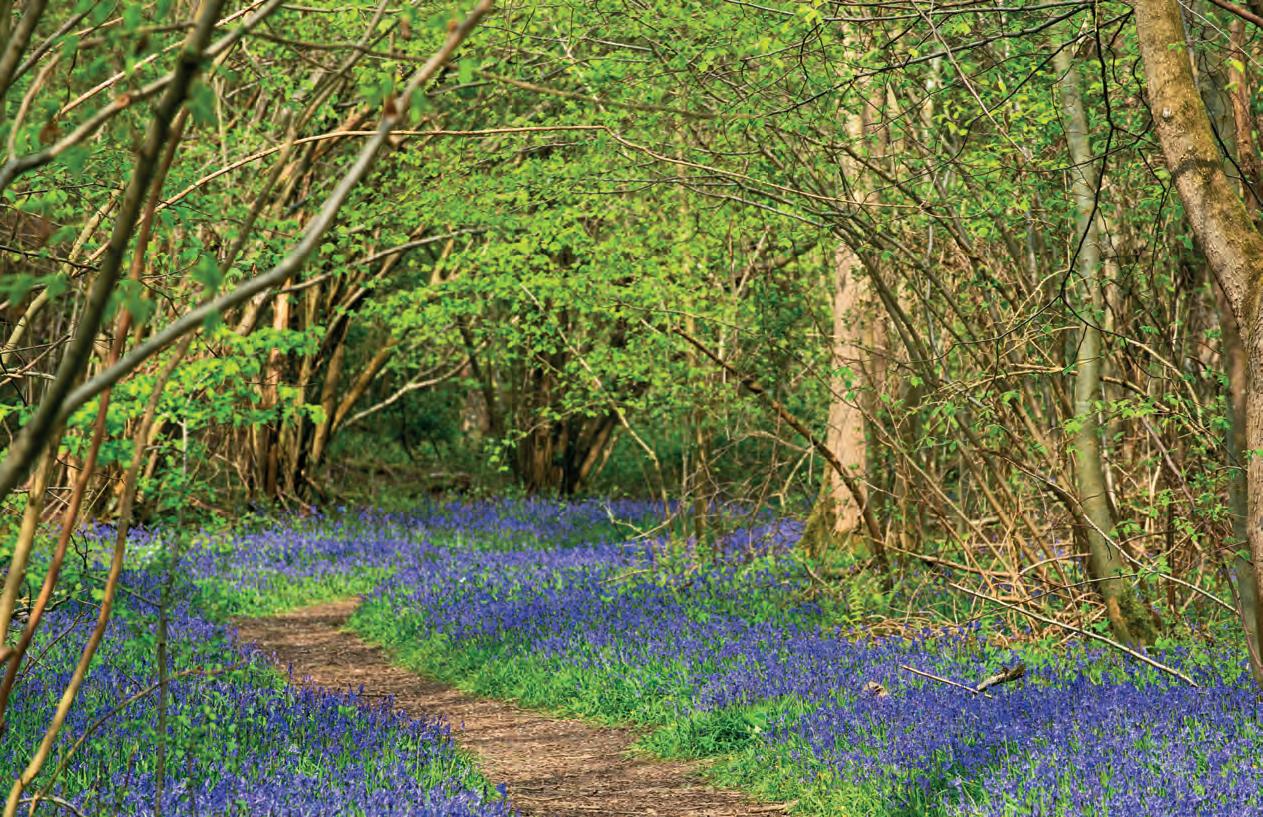
The light of a spring morning filters down through the canopy of oak, ash and field maple. The ride ahead glows with the pale blue haze of a thousand bluebells, still wet from the dew. A blackcap’s song rises in liquid phrases from the hazel thicket, answered by the drumming of a great spotted woodpecker deeper in the trees. A flash of acid yellow suddenly breaks across the glade — a brimstone butterfly, looping through the shafts of sunlight. All part of the wood’s rhythm.
Walking here feels like stepping into a place where time folds. You are in the present, watching butterflies and hearing birds, but you are also surrounded by layers of the past. Coppice stools have been cut and regrown for centuries, the ancient boundary banks still etched into the woodland floor. The spring ground flora has survived almost unchanged for millennia. Foxley is not just a beautiful wood. It is Norfolk’s largest and most intact ancient woodland — a living fragment of the wildwood that once stretched across England.
Foxley is ‘ancient’ in the truest sense of the word. Ecologists use the term to describe woodland that has been continuously wooded since at least 1600. In Foxley’s case, the story goes back even further. The soils, seedbanks and plant communities suggest that there have been trees here since the first woodlands colonised new land after the last Ice Age. That makes it ‘primal woodland’ — a place where the living memory of England’s original forests still endures.
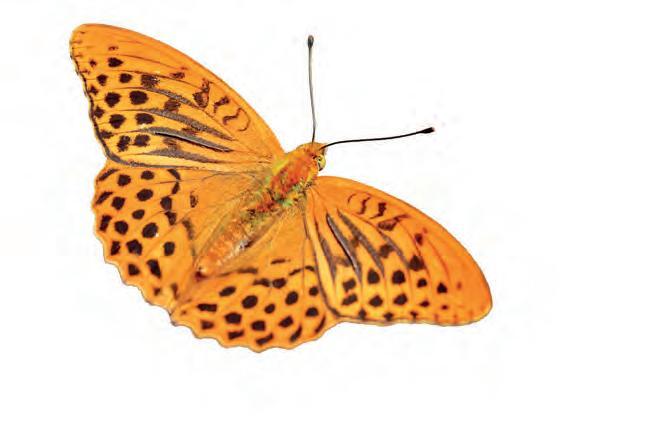
Silver-washed fritillary
‘‘ we have carefully restored the wood. Conifers were gradually thinned and removed, allowing light to reach the forest floor once more.
The Domesday Book records woodland here in the 11th century. It was part of the manorial economy shaped in the wake of the Norman Conquest. Coppicing was the dominant form of management. Hazel, ash and maple were cut on regular cycles, while oaks and elms were left to grow into tall standards. This created a patchwork of shaded groves and sunny clearings that supported both people and wildlife. Timber-framed houses, charcoal for forges, poles for hurdles and firewood for hearths all came from cycles of cutting and regrowth.
Wildlife flourished in that humaninfluenced mosaic. Red squirrels were once present, nightingales sang along sunny rides, and butterflies such as the purple emperor and silver-washed fritillary glided through clearings. Even as agricultural change and enclosure transformed much of Norfolk’s landscape, Foxley remained a working wood, its economy tied to the rhythms of coppice and the needs of surrounding villages.
But that balance was eventually broken. The 20th century brought the greatest disruption. Coppicing declined as fossil fuels replaced wood for heat and imported timber undercut local products. Parts of Foxley were planted with conifers in the post-war push for commercial forestry. These shaded out the ground flora and smothered the delicate structure that had supported such a diversity of life. Yet Foxley never lost its essence. The ancient soils remained intact, its wild plants endured in shaded seedbanks, and the old woodland boundaries still marked the land. It was waiting for renewal.
That renewal began when Norfolk Wildlife Trust stepped in to secure Foxley Wood in the early 1990s. Recognising its ecological significance, we purchased the site to protect it from further fragmentation or inappropriate management. At the time, much of the woodland was dark, uniform conifer plantation — a shadow of its former richness.
Over the decades, we have carefully restored the wood. Conifers were gradually thinned and removed, allowing light to reach the forest floor once more. Traditional coppice management was reintroduced, not for commercial production, but to bring back the cycles of cutting and regrowth that sustain woodland wildlife. Rides were widened and scalloped, letting sun spill deep into the interior. Veteran oaks and boundary features were protected as living archives of the past.
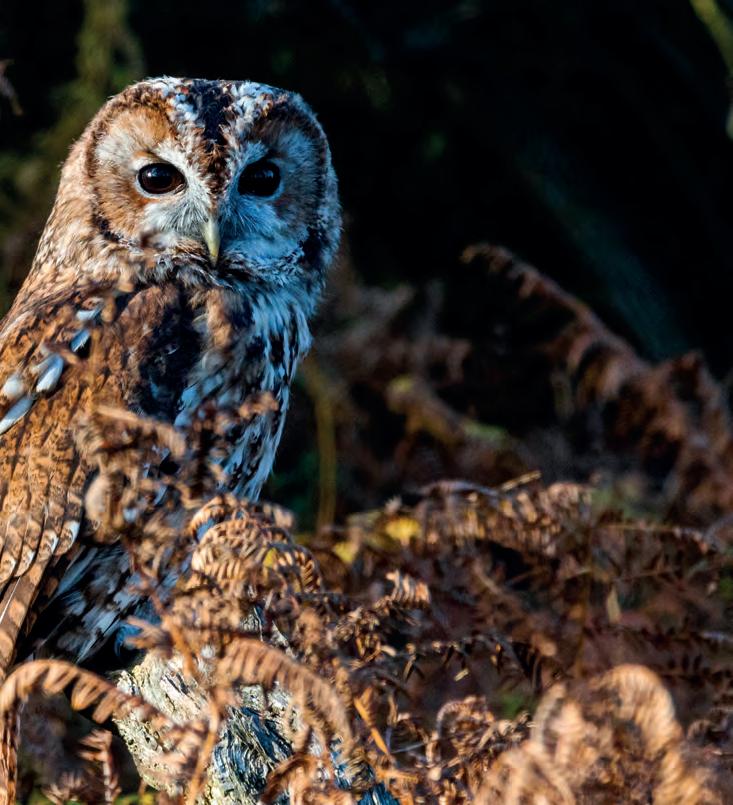
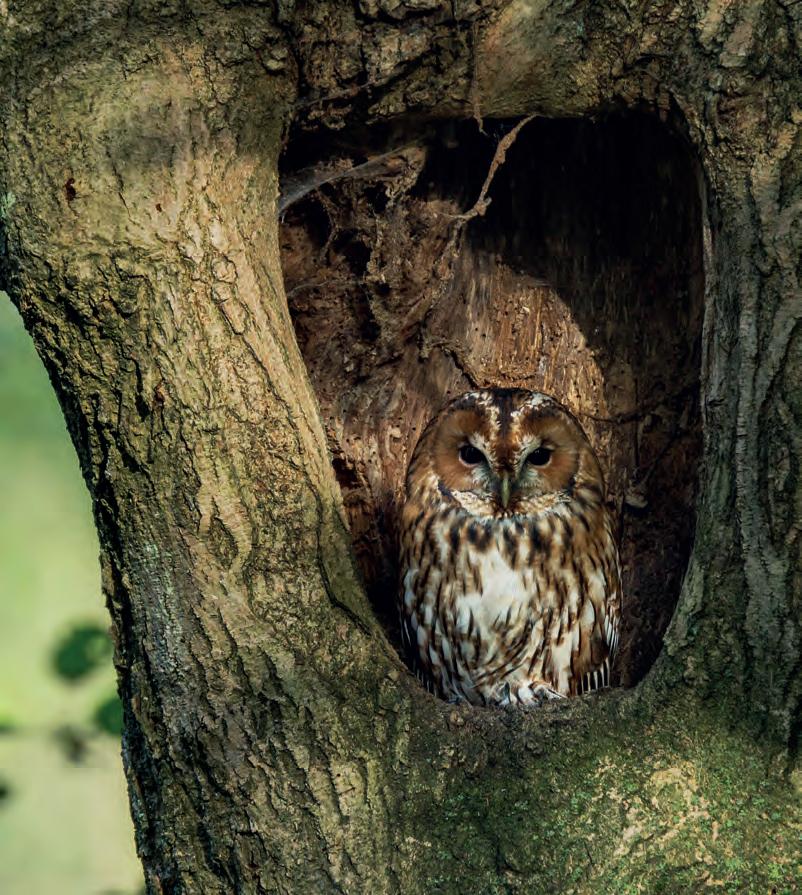
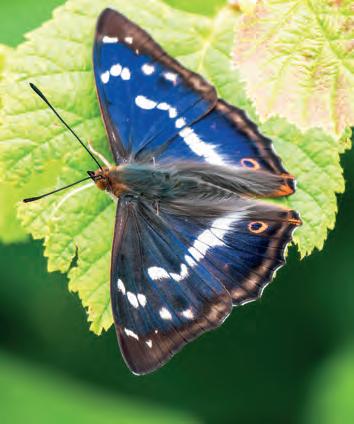
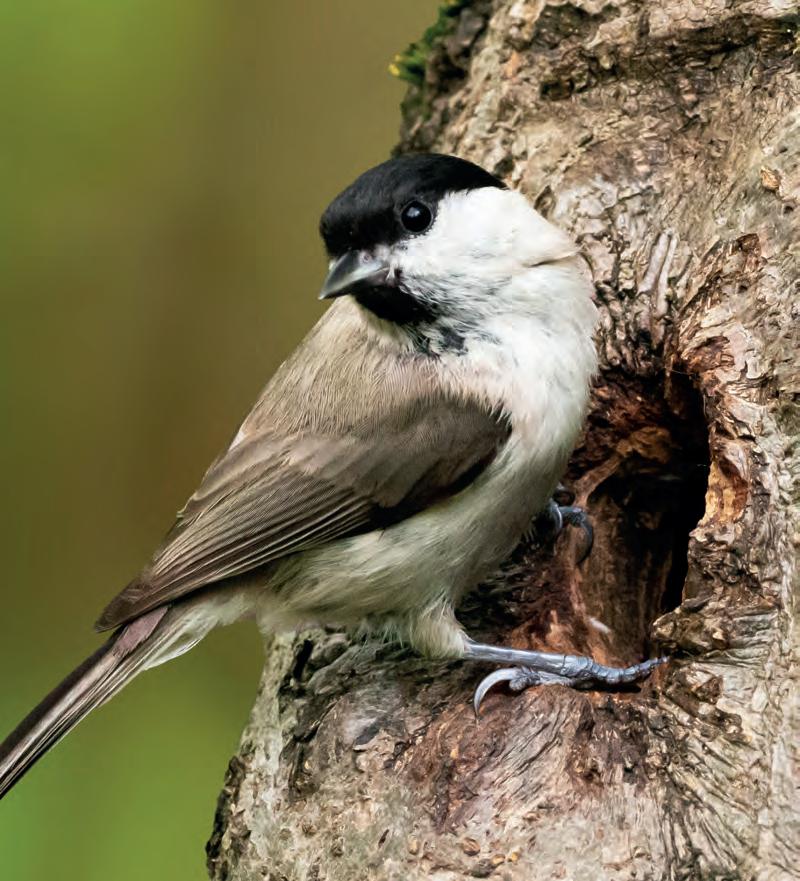
The results have been remarkable. The woodland ground flora has recovered with carpets of bluebell, dog’s mercury and wood anemone. Birds such as marsh tit, garden warbler and tawny owl thrive in the varied structure. Most dramatically, butterflies that had been lost for decades have returned. The silver-washed fritillary is once again a common sight in summer, while the purple emperor — long absent from Norfolk — has reclaimed Foxley’s canopy as a breeding ground.
In recent years, the story of Foxley has moved beyond restoration to expansion. In 2022, PSH Environmental kindly agreed to fund the natural regeneration and management of a 12-hectare enclave of arable land next to Foxley Wood — the first acquisition here for some years.
And in May 2025, thanks to generous donors,* Norfolk Wildlife Trust was able to acquire 100 acres (just over 40 hectares) of farmland surrounding the ancient core. This has enlarged the reserve by over a third and created opportunities for landscape-scale conservation. This expansion of the woodland has also enabled us to access funds from Natural England’s Nutrient Mitigation Scheme, which will contribute towards the Trust creating and restoring wildlife habitat at Foxley Wood and across Norfolk.
Though not ancient woodland itself, this newly acquired land provides crucial space where natural processes can take hold. The decision to buy the land was guided by a simple principle: will
this purchase strengthen, buffer and connect our existing sites, and can it be restored to complement them? At Foxley, the answer has been a clear yes.
Our vision is to allow natural regeneration to dominate, supplemented by targeted planting of locally native species where necessary. Over time, hedgerows, field margins, and naturally seeded groves will stitch together with the ancient core, softening the boundary between wood and farmland. This creates a richer, more connected landscape where wildlife can disperse and thrive.
Already, the expansion has given wide-ranging species such as bats, deer and owls greater room to forage. It has created corridors that butterflies, and woodland birds can use to spread. And in the long term, it ensures that the pressures of climate change and disease are buffered by diversity and scale. Foxley is no longer just a single ancient woodland, but the heart of a growing network.
‘‘ Our vision is to allow natural regeneration to dominate, supplemented by targeted planting of locally native species where necessary.

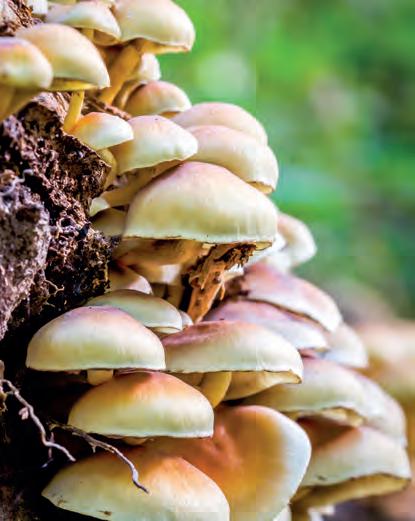
What will Foxley look like in 50 or 100 years? As we continue with our conservation management, the wood will be even more structurally diverse. It will feature a mosaic of coppice coupes, high forest, wet flushes and sunny rides. Ancient trees will remain veterans of immense ecological value, supporting fungi, lichens, insects and birds that depend on dead wood.
The surrounding land will, by then, have blurred into the core wood. Imagine a seamless landscape of mixed-age woodland, woodpasture and open glades.
Wildlife should flourish. Purple emperors are already once again becoming a widespread Norfolk species. Maybe
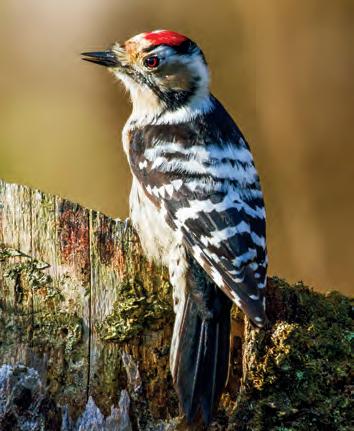
lesser-spotted woodpeckers, willow tits and other declining birds may find an opportunity here. The carpet of spring flowers will remain, but above them the canopy may shift as ash succumbs to dieback and is replaced by field maple, small-leaved lime and oak.
And importantly, Foxley will remain a place where people can connect with Norfolk’s deep past and hopeful future. It will be a living link between the wildwood and the landscapes we are creating for tomorrow.
Foxley Wood is a story of resilience; a place that has endured conquest, industry and neglect, only to return stronger with care. It reminds us that ancient woodlands are not just relics,
but dynamic, living systems that respond when given space and time.
As visitors walk its rides in spring or pause to watch a purple emperor gliding above an oak in midsummer, they share in that story. Every step helps to build the bond between people and place, reminding us why nature conservation matters.
Foxley’s future will depend on continued care and on the support of all who value Norfolk’s wild places. By visiting, volunteering, or supporting the work of Norfolk Wildlife Trust, anyone can become part of the wood’s unfolding story. Because Foxley is not simply history — it is hope, rooted in the soil and rising through the trees.
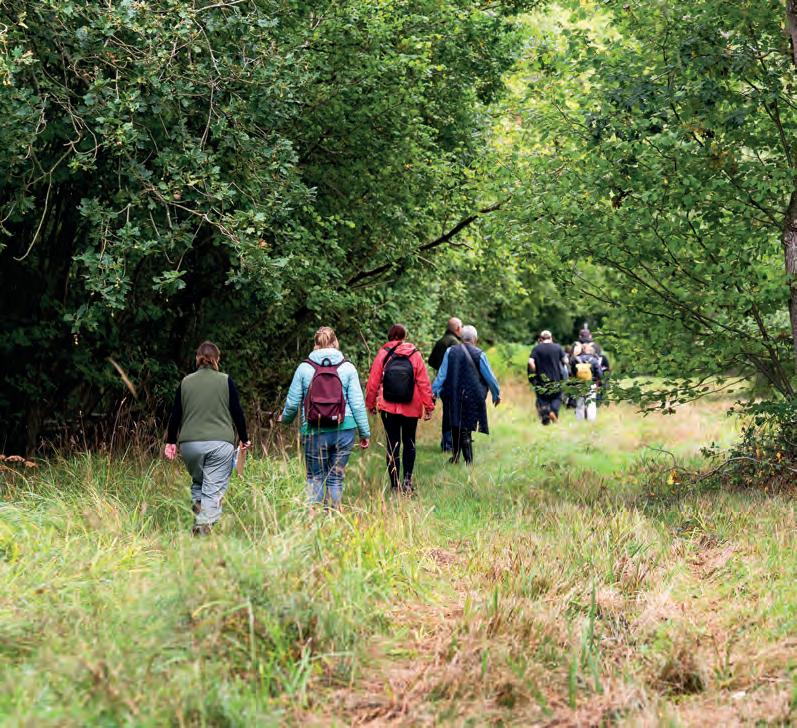
Visitors at Foxley Wood
‘‘Foxley’s future will depend on continued care and on the support of all who value Norfolk’s wild places.
Woodland rides
A ride is a linear trackway designed for access: depending on management, it can have several zones; a central track or pathway, some taller grassland areas either side and then some shrubs and bramble thicket grading into the taller woodland trees.
Coppicing
A traditional woodland management technique that dates back to the Stone Age. It involves felling trees at their base to create a ‘stool’ where new shoots will grow. Some of our oldest trees may be coppice stools rather than single stem trees (known as a ‘standard’).
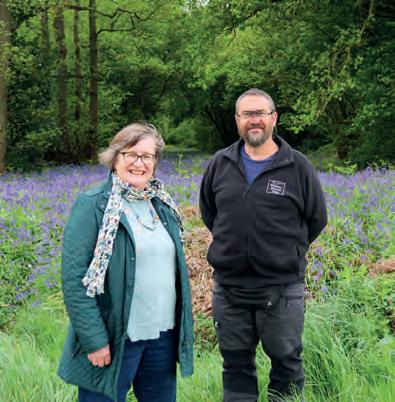
*The land we purchased to expand Foxley Wood in May 2025 was made possible thanks to several generous donors, including two significant legacies left for Norfolk Wildlife Trust by Graham Churchyard and Adrian Gunson.
Adrian Gunson’s widow and now NWT Wildlife Guardian, Tricia (right), said: ‘Adrian and I have always loved Norfolk, and its rich and varied wildlife, so I was very happy to release the legacy to help with this purchase.’
To find out more about leaving a legacy, email legacies@norfolkwildlifetrust.org.uk or visit norfolkwildlifetrust.org.uk/ GiftsInWills
Coppice coupe
Coppice woodlands are often divided into sections called coupes or cants, which are then cut ‘on rotation’.
Wet flushes
A flush is a small, sloping area of wetland formed when underground water comes to the surface, but instead of forming a stream, it spreads out and flows slowly over the ground.
Ground flora
Woodland ground flora refers to the layer of vegetation that grows on the forest floor beneath the canopy of trees. This layer is made up of a diverse array of plant species, including herbs, ferns, shrubs, and wildflowers, and it serves several important ecological functions.
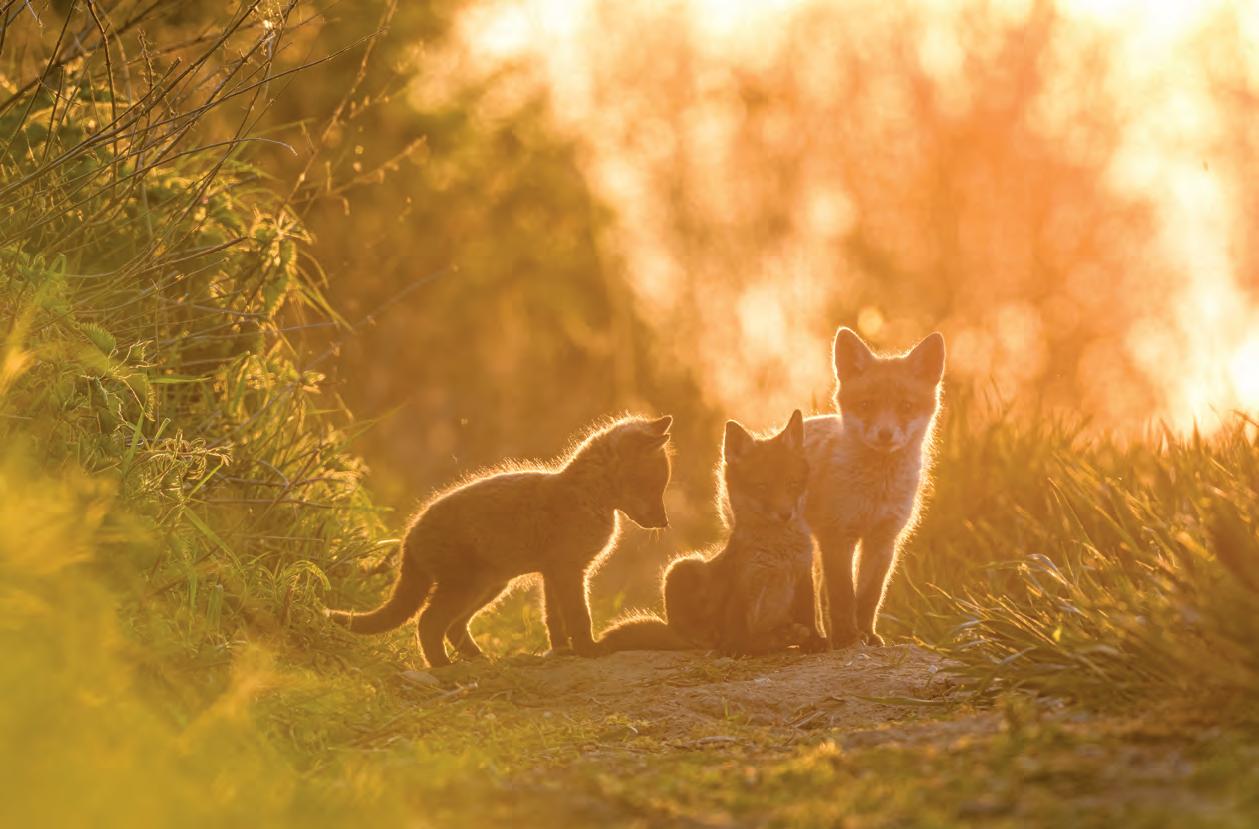
Overall winner
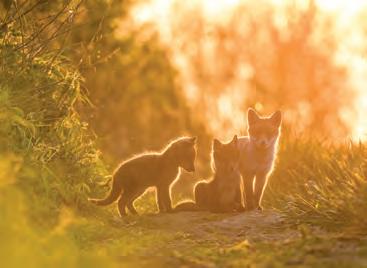
Fox cubs playing outside their den at sunset, Broadland
By Alan Dixon
This summer, we held our annual nature photography competition — the winners of which have formed our NWT calendar.
This year saw over 1,100 photos submitted from Norfolk residents and visitors, aged six to 93!
Of these, 12 stunning images were chosen for the 2026 calendar, while 59 highly commended entries were featured in an exhibition at NWT Cley and Salthouse Marshes. These photos capture the beauty of Norfolk’s nature through the eyes of the people who love it.
Taking on the tricky task of choosing the winners was an expert judging panel: wildlife photographer Megan James; photographer and creative director Fiona Burrage; photographer and art director Jimmy King; graphic designer Hannah Moulton; and NWT Youth Forum member Josh Pepper.
This year’s Overall Winner was Alan Dixon, with his photo of fox cubs perfectly capturing the characters of the cubs playing on a warm spring evening just outside their den. Alan patiently observed the cubs from a concealed spot.
‘The real bonus was that its location was ideal from a lighting point of view — it was lit from the front in the morning and backlit as the sun went down,’ Alan tells us. ‘I spent many hours watching and photographing the cubs and, occasionally, a vixen.’
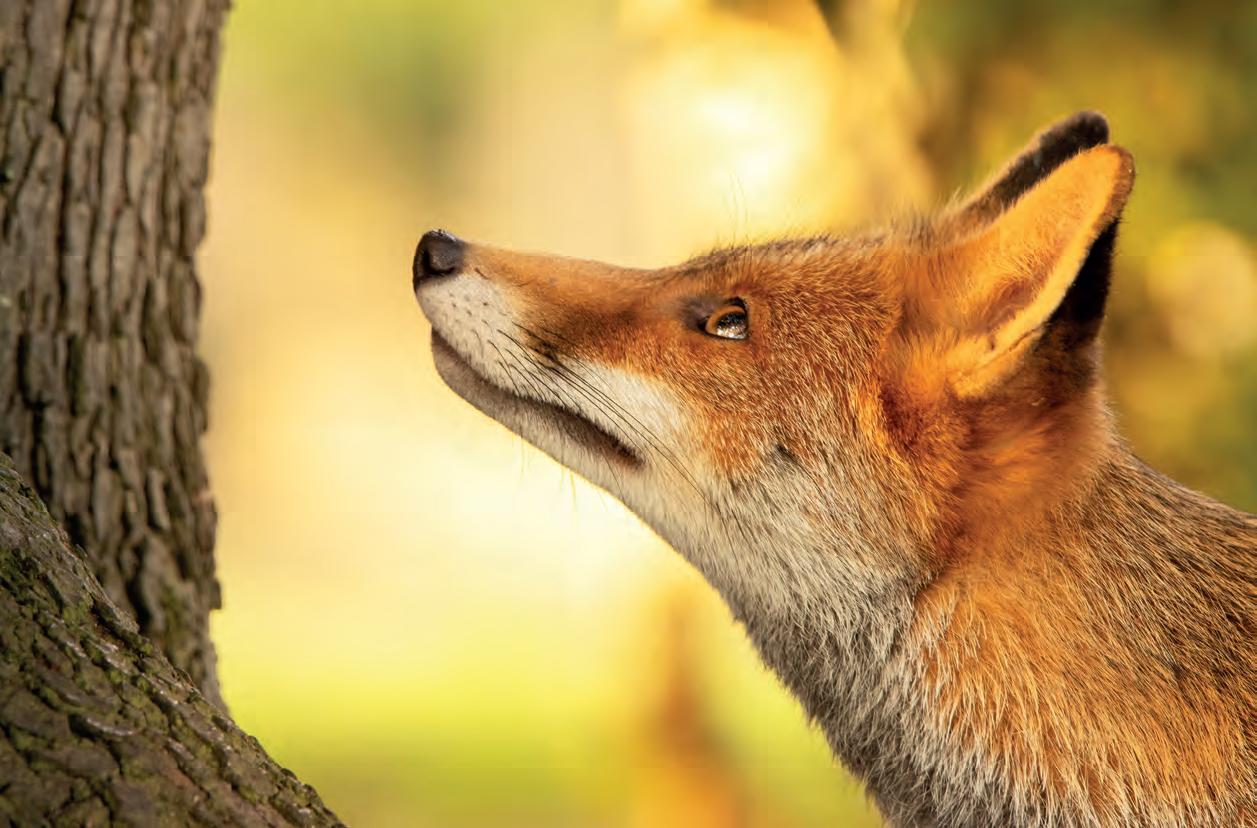
The judges were impressed by images from young photographers, with their favourite, 22-year-old Nathan Allen’s fox in Great Yarmouth, winning the category with its skilful capturing of
the animal’s inquisitive nature. New this year was a Mobile Phone Photography category, encouraging those without specialist equipment to share their vision of Norfolk’s nature. Winner 19-year-old NUA student Lori Coral captivated the judges with her photo of startled pigeons above Norwich Market, capturing a familiar sight in the city.
‘Momentarily the sound of the city was drowned by infinite flapping,’ Lori explains. ‘I hurriedly attempted to capture the sight before the flock had dispersed and was fortunate enough to get the photo that I did. The low angle against an unobstructed sky offers a rare look at urban wildlife in a seemingly human-free environment.’
Young person winner
Fox chasing squirrels in Great Yarmouth
By Nathan Allen, aged
22
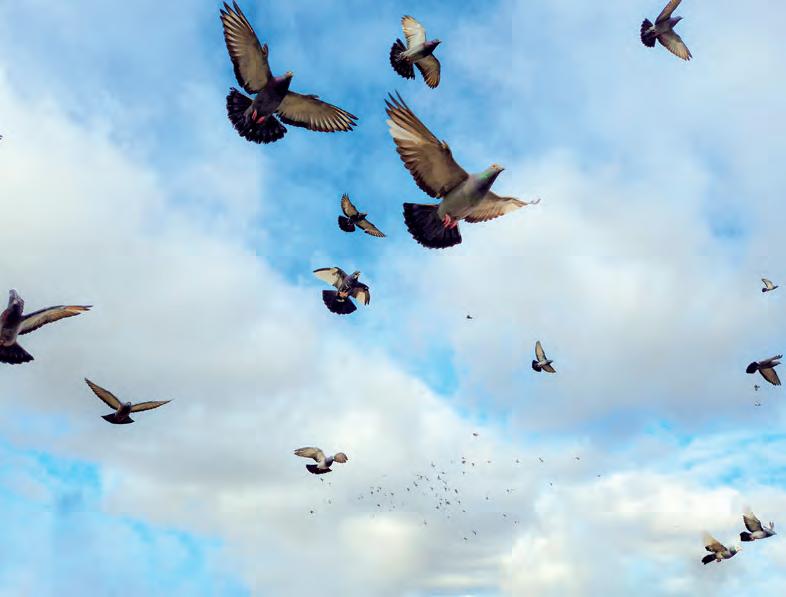
Mobile phone winner
Startled pigeons taking flight over Norwich Market
By Lori Coral
The Norfolk Wildlife Trust Nature Photography Competition will return next year, opening for entries in summer 2026 – so get photographing!
The three winners were awarded prizes generously donated by competition sponsors ZEISS, including a pair of SFL binoculars worth £1,800, with the 12 photographers featured in the calendar also receiving a prize package from brilliant local sponsors Lisa Angel, SOP and WILD Sounds & Books.




The calendar is available to purchase from Norfolk Wildlife Trust visitor centres at Hickling Broad, Holme Dunes and Cley Marshes or norfolkwildlifetrust.org.uk/ Christmas
We hear from some of our highly commended photographers.
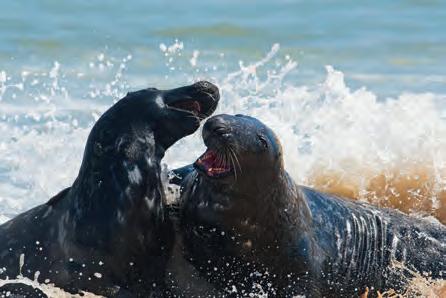
Grey seals jostling for a shoreline spot, North Norfolk, Michael Ogden
‘I was gifted a 500mm lens by a colleague (stuck at full zoom), and it has unlocked so much more opportunity to get out in nature and photograph wildlife. A real wellbeing boost. Horsey is one of our favourite places to visit with the kids — the seals are always so brilliant to watch on land and in the sea.’
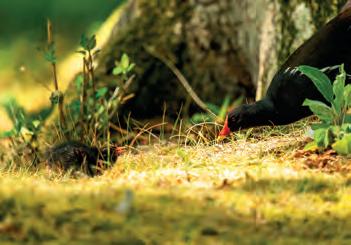
Moorhen checking its chick, NWT Ranworth Broad, Christopher Palmer
‘I love nature and wildlife photography! I get to witness moments most people may miss out on or overlook. I entered the competition to hopefully encourage people to just slow down a little bit and explore the beauty of our county.’
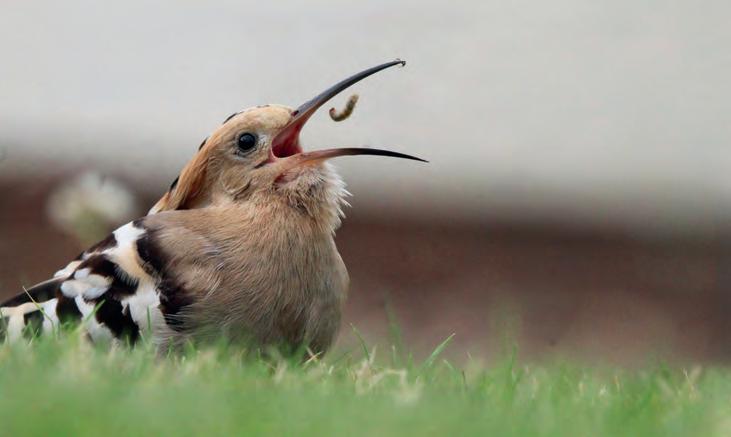
Hoopoe feeding on insects, North Walsham, Rishaan Shah, 13
‘I’ve been interested in wildlife for as long as I can remember, and my time in Norfolk last year was incredible. Seeing a rare bird like a hoopoe up close allowed me to get some of my favourite shots ever.’
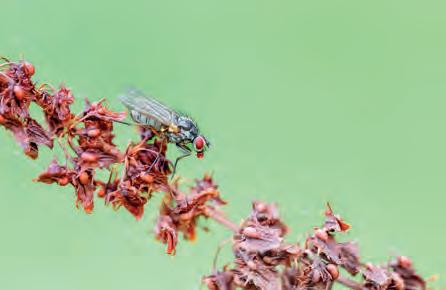
An anthomyiidae fly stopped for a clean, NWT Pigneys Wood, Terry Newman
‘My wife and I have had NWT memberships for a few years and decided to visit some reserves which we hadn’t been to before. On our first visit to Pigneys Wood I was lucky enough to capture this image.’
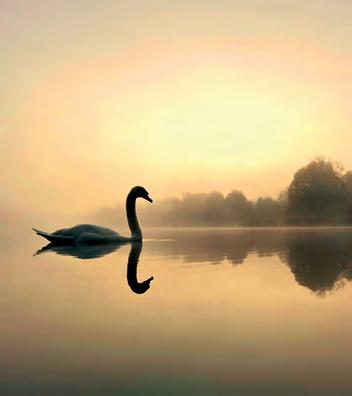
Mute swan on the misty water at sunrise, UEA Broad, Will Hulbert
‘The exhibition is a great way to raise awareness of the importance of the wildlife in Norfolk, the beautiful area we live in and some of the work of the region’s numerous photographers. Hopefully, this exhibition will continue to inspire a younger generation to take up photography and get on out there!’
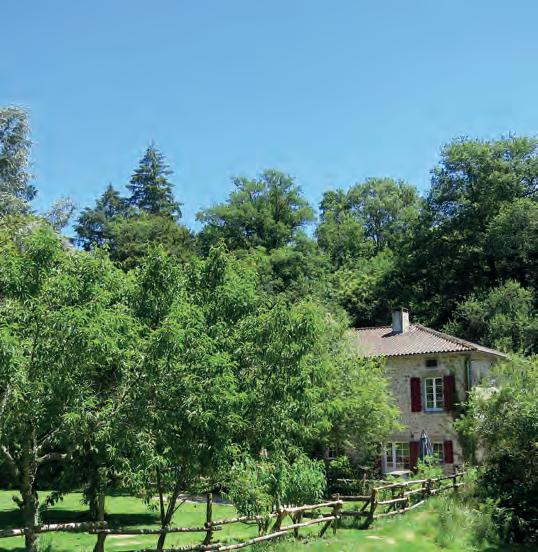
Limousin, France
Gites and B&B set in 20 acres of rewilded countryside
Incredible biodiversity -68 species of butterflies recorded on our grounds alone
TGV Train to Angoulême Flights to Limoges
Stansted Manchester Bristol East Midlands Leeds


Swap the daily grind for a gentle brew with Norfolk Tea Co. at Wiveton Café. Our small-batch teas and coast-roasted co ees arrive steaming beside homemade cakes, sea-view tables and the cry of curlews across the marsh.
Swap the daily grind for a gentle brew with Norfolk Tea Co. at Wiveton Café. Our small-batch teas and coast-roasted coffees arrive steaming beside homemade cakes, sea-view tables and the cry of curlews across the marsh.
Extensive tea and co ee menu. Seasonal brunch and home baked pastries. Beautiful outdoor seating area overlooking the marshes and sea. Dogs, children and well-behaved adults, sandy shoes and muddy bikes welcome.
Wiveton Hall Cafe, Wiveton, NR25 7TE
Swap the daily grind for a gentle brew with Norfolk Tea Co. at Wiveton Café. Our small-batch teas and coast-roasted co ees arrive steaming beside homemade cakes, sea-view tables and the cry of curlews across the marsh.

Between Cley-Next-The-Sea and Blakeney on the coast road
Open daily 10am to 5pm (seasonal variations may apply) norfolktea.co
Extensive tea and coffee menu. Seasonal brunch and home baked pastries. Beautiful outdoor seating area overlooking the marshes and sea. Dogs, children and well-behaved adults, sandy shoes and muddy bikes welcome.
Wiveton Hall Cafe, Wiveton, NR25 7TE
Extensive tea and co ee menu. Seasonal brunch and home baked pastries. Beautiful outdoor seating area overlooking the marshes and sea. Dogs, children and well-behaved adults, sandy shoes and muddy bikes welcome.
Between Cley-Next-The-Sea and Blakeney on the coast road
Wiveton Hall Cafe, Wiveton, NR25 7TE
Between Cley-Next-The-Sea and Blakeney on the coast road
Monday CLOSED, open Tuesday to Sunday from 9am (seasonal variations may apply) norfolktea.co
Open daily 10am to 5pm (seasonal variations may apply) norfolktea.co
What happens when you invite a collective of young people aged 16-25 to manage a nature reserve?
This summer we launched the county’s first youth-led nature reserve, delivered in partnership with Norwich Fringe Project. A group of 17 young people took the first step on their journey as wardens at Norwich City Council-owned Sloughbottom Meadows in Norwich.
The 16–25-year-olds are all members of our new Youth Forum. The group launched earlier this year with the aim of giving young people the opportunity to shape the future for Norfolk’s wildlife.
The new young wardens will work together with wildlife experts during monthly sessions to plan and deliver conservation activities on the site. In partnership with the Norwich Fringe
Project, they will continue to enhance this wildlife-rich space in the centre of Norwich, right next door to our Sweet Briar Marshes nature reserve.
Regular tasks will include cutting and raking grass from the wildflower meadows to help orchids thrive, improving the onsite woodland for wildlife through coppicing and inspecting trees, and installing dead hedges and bat boxes.
The wardens will also help to improve the accessibility of the nature reserve for the local community. This will include maintaining paths and removing litter as well as planning and installing new information boards.
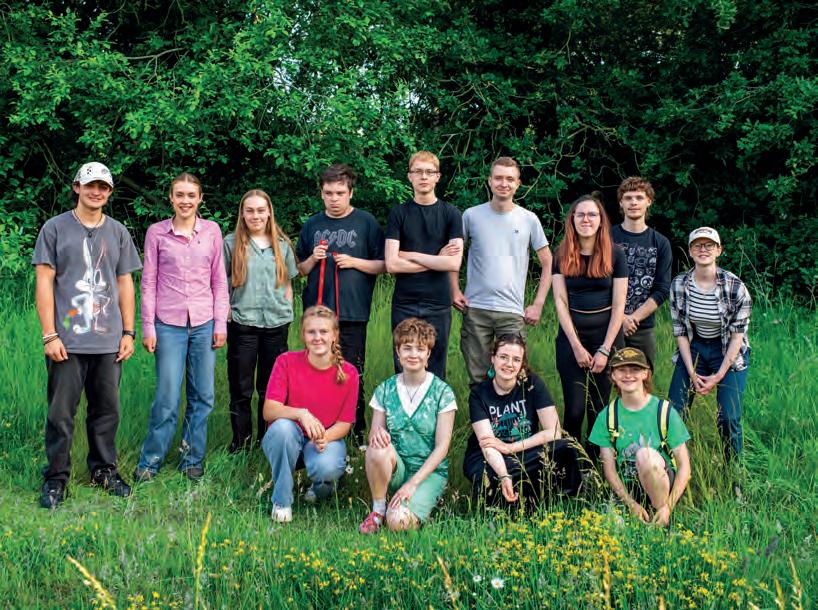
Youth Forum is an opportunity to take action for biodiversity’s recovery, to learn practical conservation skills and work with a team towards a collective goal; helping a new generation grow into conscientious stewards of our wild spaces. Find out more and sign up to our e-newsletter: norfolkwildlifetrust.org.uk/ YouthAction
The new initiative is part of the wider Building Foundations for the Future programme which aims to help us engage new audiences with nature, made possible with funding from The National Lottery Heritage Fund with thanks to National Lottery Players.
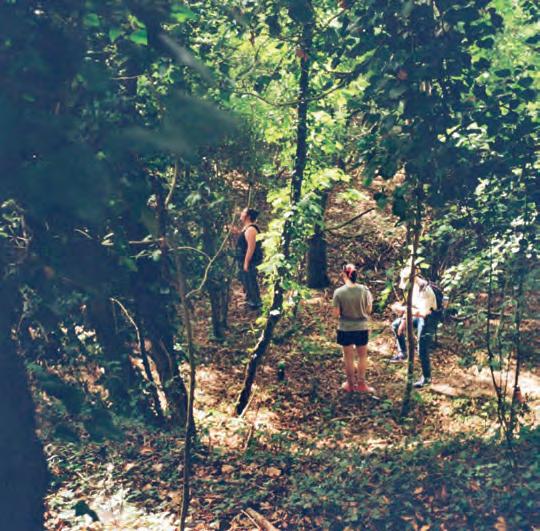

I have liked working at the meadows and have done a variety of different activities like litter picking, surveying the site, plant identification and even learnt how to use plants to dye materials. It feels good to do useful things to make the community better. Having Autism means socially mixing with new people can be difficult, but it has felt good to be part of the team. Everyone is friendly, and we even had a picnic of takeaway pizza in the meadows after our last activity, which was nice. I would encourage anyone to try and get involved in these kinds of projects, even if like me it pushes you a little out of your comfort zone. We must protect these environments, or they won’t be here in the future for others to enjoy.
We’ve made some really good progress in terms of surveying the area. We split up into smaller groups to find out what kind of nature was out there. Lydia [NWT Wilder Landscapes team] taught us how to identify different kinds of trees and how to record what we saw. I’d say one of the main things I get out of being involved in the Youth Forum is the sense of community — being around other like-minded people.
I studied illustration at uni and my main interest in nature was birds. I really enjoyed identifying them and drawing them. Joining the Youth Forum has opened my eyes to all the other nature out there. My drawings are now more about sharing my passion for nature with others. In the future, I’d love to engage more with the local community — so that they come here more. It’s such a good space, so close to the city and nature is so necessary for people’s mental health.
Read Jade’s longer blog post on our Youth Forum website page: norfolkwildlifetrust.org.uk/ YouthForum
You can read more from Joe in his blog about visiting NWT Thorpe Marshes in the summer: norfolkwildlifetrust.org.uk/JoesBlog
Nestled in between Sloughbottom Industrial Estate, Marriott’s Way and NWT Sweet Briar Marshes in Norwich, Sloughbottom Meadows has been designated as a County Wildlife Site. It is made up of young woodland including oak and ash and three wildflower meadows.
Despite its urban setting, Sloughbottom Meadows is rich in biodiversity, including wildflowers such as creeping cinquefoil, bird’sfoot trefoil and ribwort plantain. It’s an important biological corridor, connecting birds and small mammals with Sweet Briar Marshes, and further afield, along the Marriott’s Way cycle path to NWT Foxley Wood.
Sloughbottom Meadows is owned by Norwich City Council and actively managed by the Norwich Fringe Project, in partnership with the Youth Forum.
By NWT Nature Conservation Officer Bob Morgan
Our rain-soaked winter woodlands can, initially, seem rather empty. The thick moist air, stilled by the trees, absorbs and deadens sound. Patience will be rewarded, and a growing noise of ‘sirrits’ and ‘tsees’ will alert you to an approaching flock of titmice. However, they quickly pass, bounding from branch to branch, there for a moment, then gone!
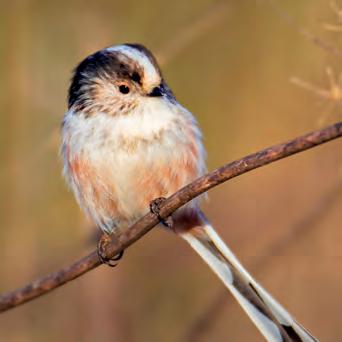
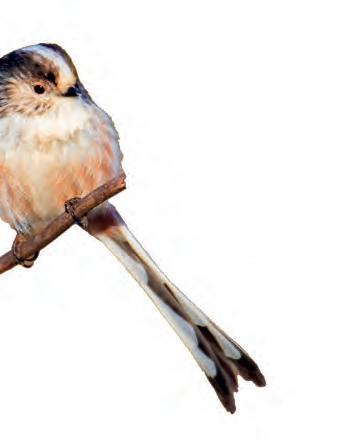
Small woodland birds spend the winter together, presumably staying in a group creates better chances of finding food. The commonest are, of course, the blue tits and great tits. They are often joined by the noisy and very active (even by titmice standards) long-tailed tits. They are a little ball of feathers, with lolly-pop stick tails. A smart looking bird, they are fundamentally black and white, but with a hint of pink running through their plumage. Other small birds will tagalong, with treecreepers, nuthatches and goldcrest joining
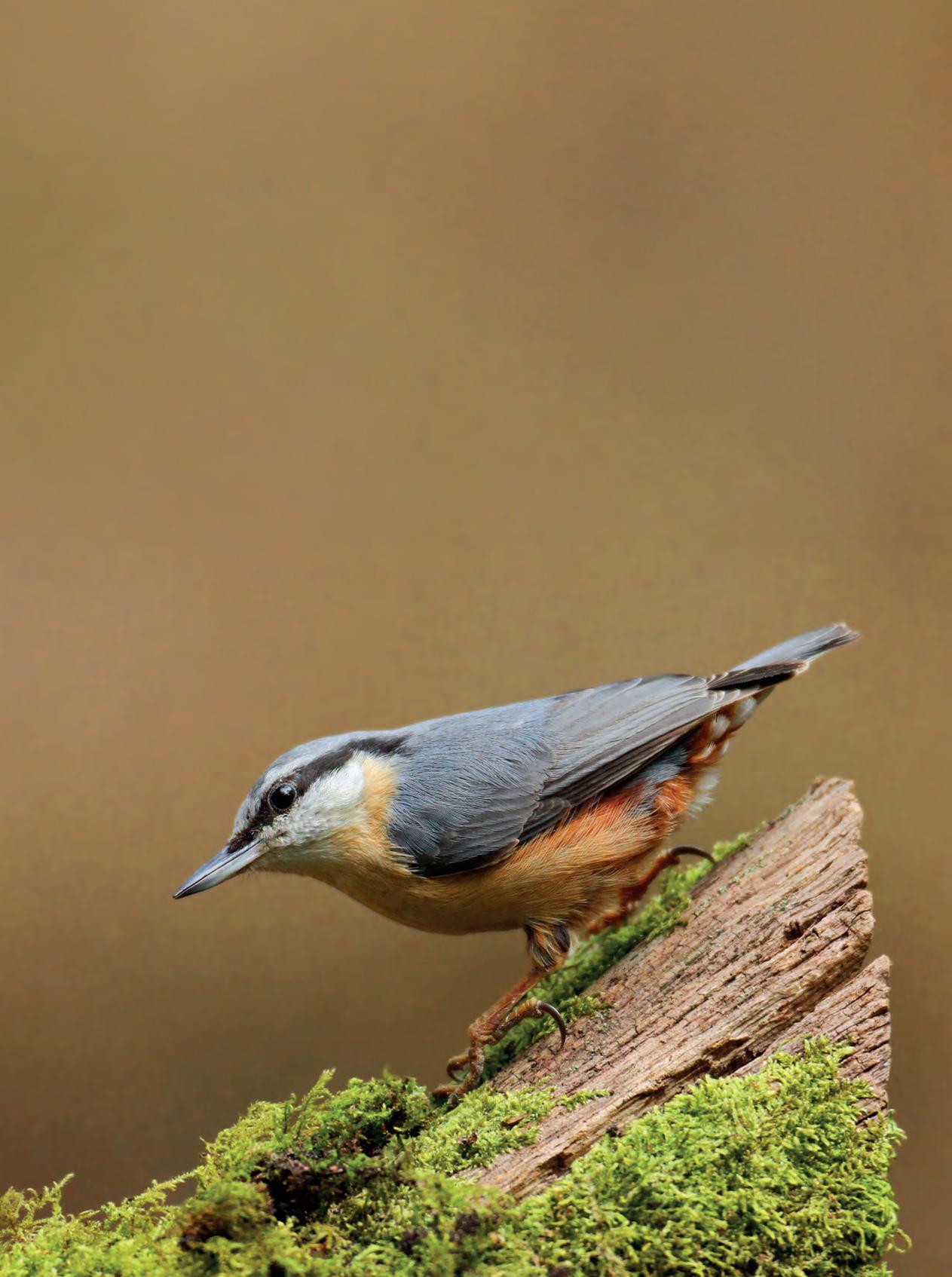
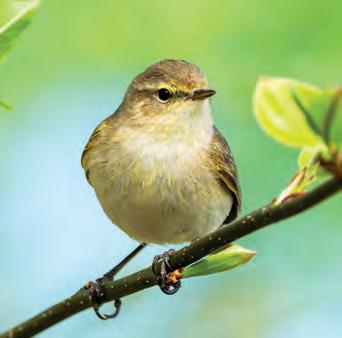
the flock’s relentless search for food. Our mild winters now see chiffchaffs staying to join the fray too. If you are lucky, a firecrest may be among their number. This spectacular bird is a real treat and will light up any winter’s day.
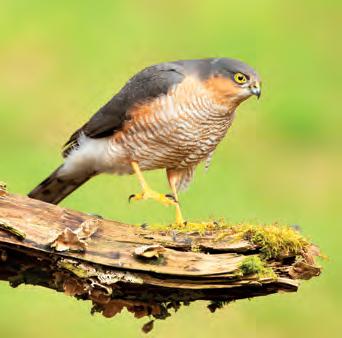
Down on the woodland floor, it is always worth checking through the chaffinches for the odd brambling. During a good ‘brambling year’ a decent size beech woodland can accommodate large flocks of these handsome winter visitors. Sudden alarm calls among the small birds cautions of the presence of a sparrowhawk. Its speed and agility make it a formidable woodland hunter. Few woodlands are without a pair of noisy jays. This woodland crow, unusually for its brethren, is a bright colourful bird. Understandably, after centuries of persecution, they can be rather shy creatures. Winter is also a great time to look for a great spotted woodpecker. A pied plumaged bird, it moves in a rather jerky fashion along bare branches and up moss-covered tree trunks.
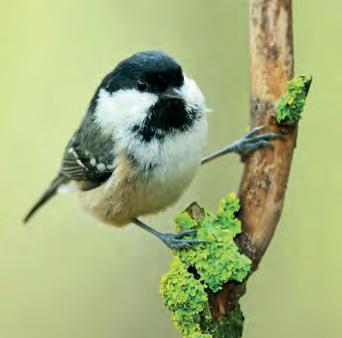
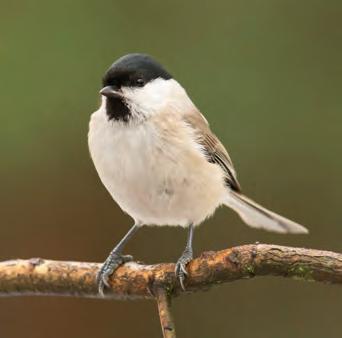
Three woodland tits to look for:
Three random woodland birds to look for:
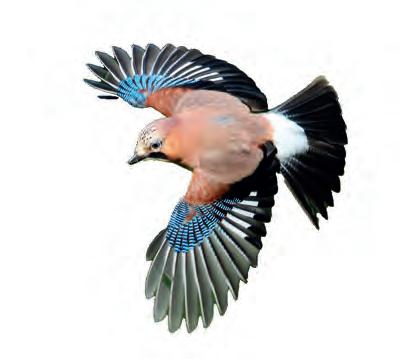
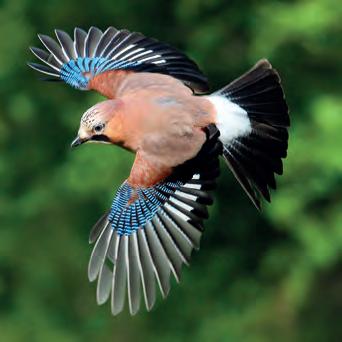
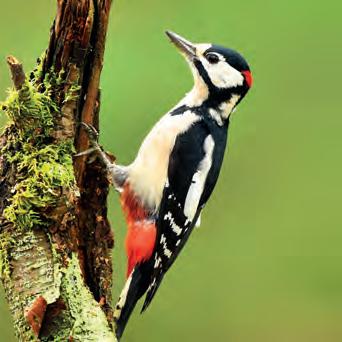
Three unusual woodland birds to look for:
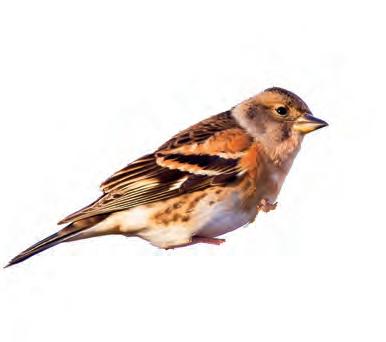
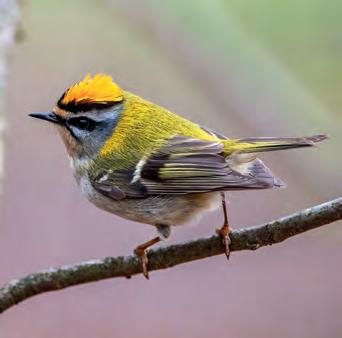
By NWT Nature Conservation Officer Bob Morgan
Communal winter roosting is a habit common for several bird species. Starlings, corvids and pied wagtails are known for forming spectacular roosts. These gatherings are more likely if cold continental weather has driven more ‘wintering’ birds to the UK. Starlings are best known for their pre-dusk murmurations, before settling in thorny scrub, a reedbed, or the shelter of a building.
The habit of forming a large roost, and the synchronised twists and turns of a murmuration, confuses predators. No doubt a sense of ‘safety in numbers’ affords comfort and provides information sharing opportunities. It also provides heat conservation, although starlings always keep a set distance apart, maintaining a strict pecking order.
Smaller birds such as long-tailed tits will huddle together along a branch, with blue tits and wrens often roosting communally in a nestbox or tree cavity. I once counted 42 wrens emerging from an old ivy-covered garden shed!
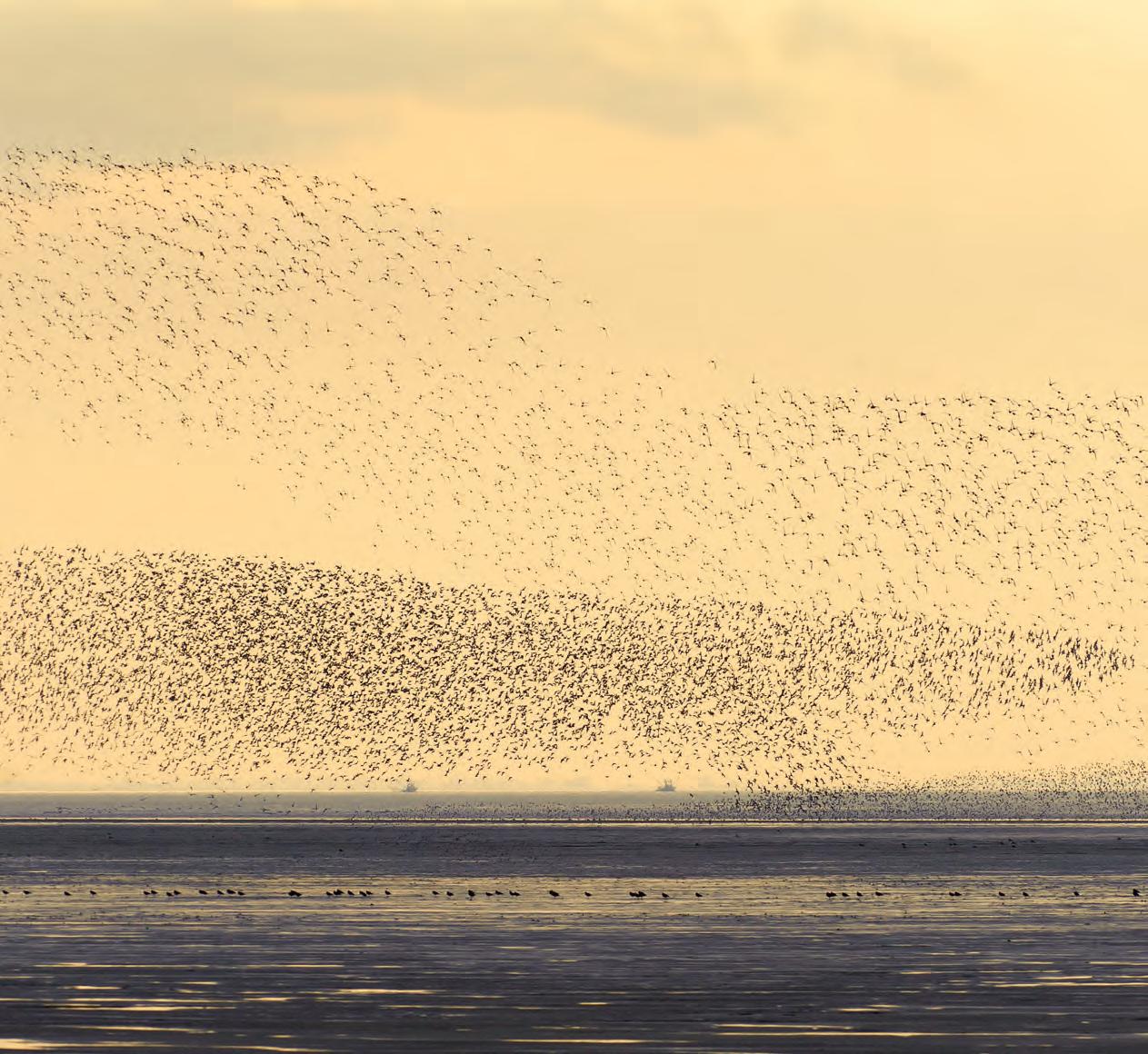
The best time to witness birds flying into roost is just before sunset. Look for individuals or smaller flocks all heading in the same direction. But, for a truly incredible roosting bird experience, a Norfolk mudflat on a rising tide is the place to visit. This is when thousands of wading birds such as knot, dunlin and grey plover are forced off the mud by the incoming sea. They can gather in vast numbers at a favoured roost site. It is one of nature’s marvels to see the huddled mass of birds move and sway together like liquid. Seemingly restless in slumber, they wait for the signal that the sea has once more retreated, then, like an explosion, burst out in sudden departure.
Here are a few of the best places to see winter roosts in Norfolk:
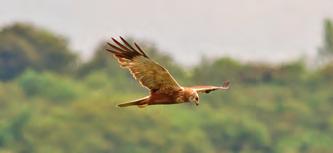
The viewing platform at NWT Hickling Broad, Stubb Mill is well known for the number and variety of birds spotted here. Fifty, or more, marsh harriers are often recorded. Hen harrier and merlin are commonly spotted too, and there are regular sightings of common crane. Stubb Rd, Norwich NR12 0BW
There are several large starling murmurations and roosts around the county, but they can suddenly switch location due to disturbance or predator pressure. A significant and regular site is Cromer Pier. Thousands of starlings roost on the pier stanchions. Pier, Cromer NR27 9HE
This is probably one of the best places in the country to see a wader roost. However, timing is everything! Arrive an hour before high tide to see the huge flocks moving around the Wash. The hides provided around the lagoons allow for great views of a variety of roosting waders. Beach Rd, Snettisham PE31 7RA
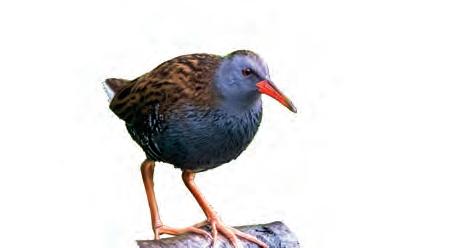
On a visit to one of NWT’s reedbed reserves, listen for two bird species that are often hidden within the reed. The ‘ping-ping’ of a flock of bearded tits or the piglet-like squeal of the water rail (right), once learnt, are rarely forgotten.
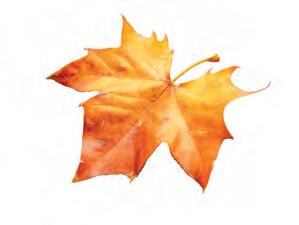
The smell of rotting winter leaves is often associated with melancholy and reminiscence. The aroma is certainly a powerful provocateur of emotion. Scent, unlike sight and sound, links directly to our brain’s hippocampus region, the area related to memory.
Once summer has faded away, our heath and grassland nature reserves can be overlooked as places to visit.
A winter’s walk on a frosty heath, or a stroll through a dew-soaked meadow offers the reward of quiet charm and subtle beauty. One such place is NWT’s Hoe Rough and Beetley Meadows. These two reserves are dissected by the Wendling Beck river. We recently installed a bridge, made possible with generous support by Biffa Award and the Landfill Communities Fund, which allows access to and from both locations. They are important for wildlife diversity, for within a small area there are dramatic differences in soil
types and water levels, leading to an unusually rich mosaic of habitats.
A walk here takes you along one of Norfolk’s rare chalk streams, of which there are fewer than 200 worldwide. It is home to scarce and threatened species such as brook lamprey, white-clawed crayfish and brown trout. The spring-fed Beetley Meadows hosts snipe in winter, and the small area of heath on Hoe Rough serves as winter quarters for a pair of stonechat. The riverside scrub is full of mixed flocks of tits, with treecreepers and goldcrests among them. Darting about in the tangled vegetation
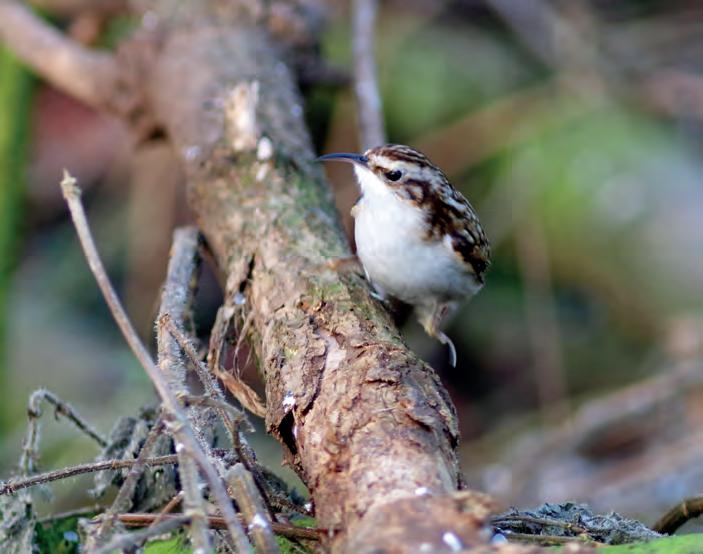
at the river’s edge, wintering chiffchaff pick off flies and other insects that find shelter there.
Binoculars are not only useful for watching birds, but fish-watching too! Find a spot of clear open water — the bridge is a good viewing platform. Chub, dace and the river’s unusual dwarf variety of brown trout are easily observed in the crystal-clear water. There is a population of water voles on the river, which often announce their presence by a ‘plopping’ sound as they dive underwater.
How to get there?
Hoe Rough and Beetley Meadows lies 4km north of East Dereham close to Gressenhall farm and workhouse. Take the B1110 East Dereham to Guist road and turn left after 3km onto the B1146 Fakenham road. The nature reserve is 1km ahead on the right, before crossing the river.
More information: norfolkwildlifetrust.org.uk/HoeRough
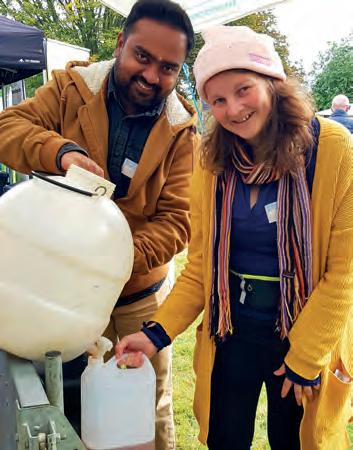
This Norwich-based group won a Norfolk Community Biodiversity Award for work to improve their local green spaces. Trustee Avril Wilkinson tells us more.
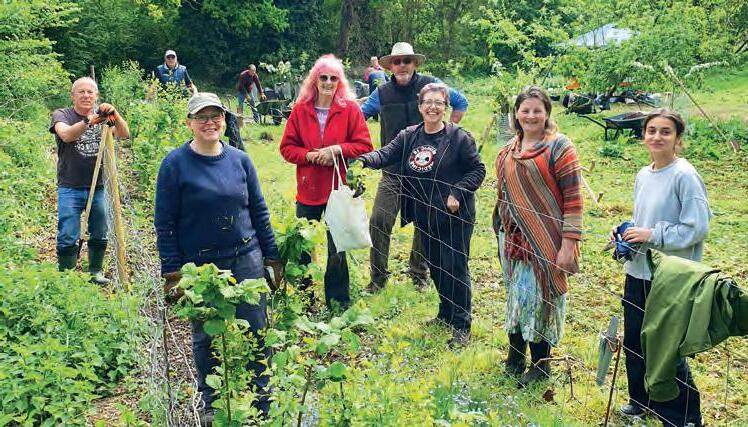
Our group manages a local area which includes an old orchard and a water meadow — both rare habitats. Volunteers began orchard restoration by planting 18 local varieties of heritage fruit trees, and 50m of edible hedge. They learnt scything skills and instigated a mowing regime. We leave tall vegetation for overwintering wildlife. There is now
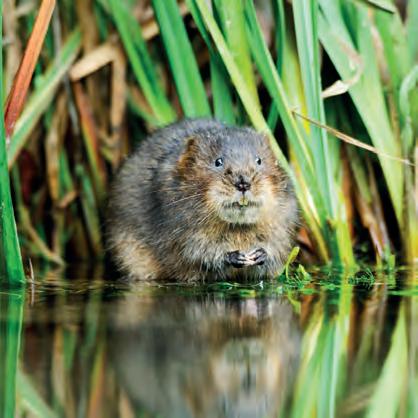
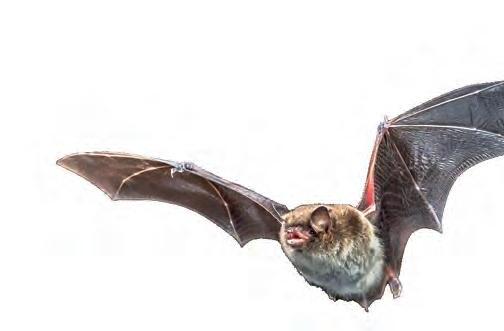
a colony of wasp spiders, and a more diverse range of plants is starting to establish. A local ecologist has found water rail, water voles and otters in our (very urban) area. Daubenton’s bats (right) hunt over the river.
We always give a warm welcome. Volunteers are encouraged to work at their own pace — and there’s always tea available! They might hand-pull thistles, learn to prune fruit trees or scythe. Freshly picked fruit is pressed each autumn and the fresh juice distributed amongst local people. There are regular free events for families. The group also has links with the the local church and the Czech community. We host a thriving WhatsApp group where people swap wildlife sightings.
Officers at Norwich City Council, as well as the Norwich Fringe Project, have been fantastic. Norfolk Wildlife Trust will be helping us with the meadow management and carrying out churchyard surveys. And this wouldn’t have been possible without support from our community.
To find out more, check out our Facebook page: Wild Lakenham
Wassailing is the secret to a successful orchard! This annual event, held in January, includes storytelling, singing, tree decorating, a bonfire and a noisy procession around the boundary.
We are lucky to have support for our work. The Community Enabling
‘‘Norfolk Wildlife Trust will be helping us with the meadow management and carrying out churchyard surveys.
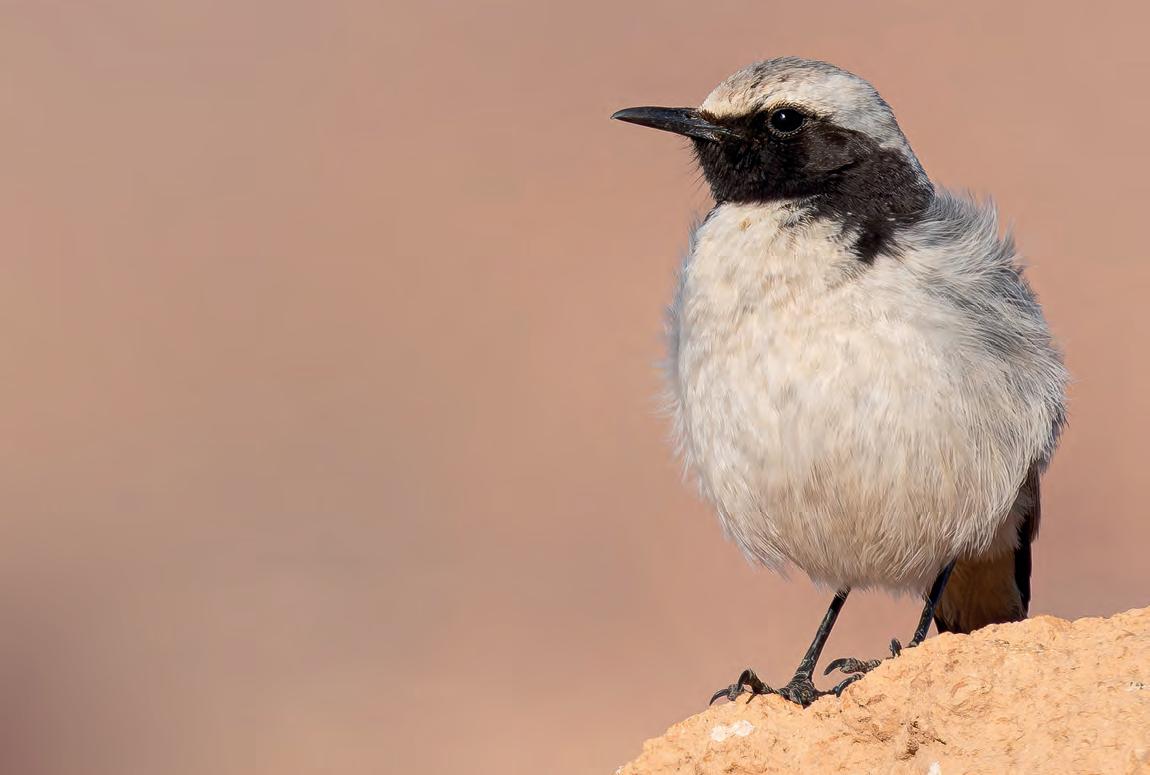


Julie Gould, Wilder Childhood Officer, and Becky Williams, Wild Network Officer, at Cheshire Wildlife Trust, share their passion for the magical world of winter seed heads and the wildlife they welcome.
Two years ago, Julie shook a teasel head, Dipsacus fullonum, over a patch of her garden, releasing the small brown seeds. This plant soon grew to seven feet tall, displaying fresh, bright green foliage. In the summer, the conical-shaped seed head was densely packed with lilac flowers, providing a rich nectar and pollen source for pollinators, such as bumblebees and a variety of our resident butterflies.
The magic of the teasel doesn’t end with summer. In winter, its sculptural seed heads become striking silhouettes, and more importantly, they provide a rich food source for wildlife.
One of Julie’s fondest wildlife memories is from her kitchen window, where she spotted a charm of goldfinches balancing on swaying teasel seed heads.
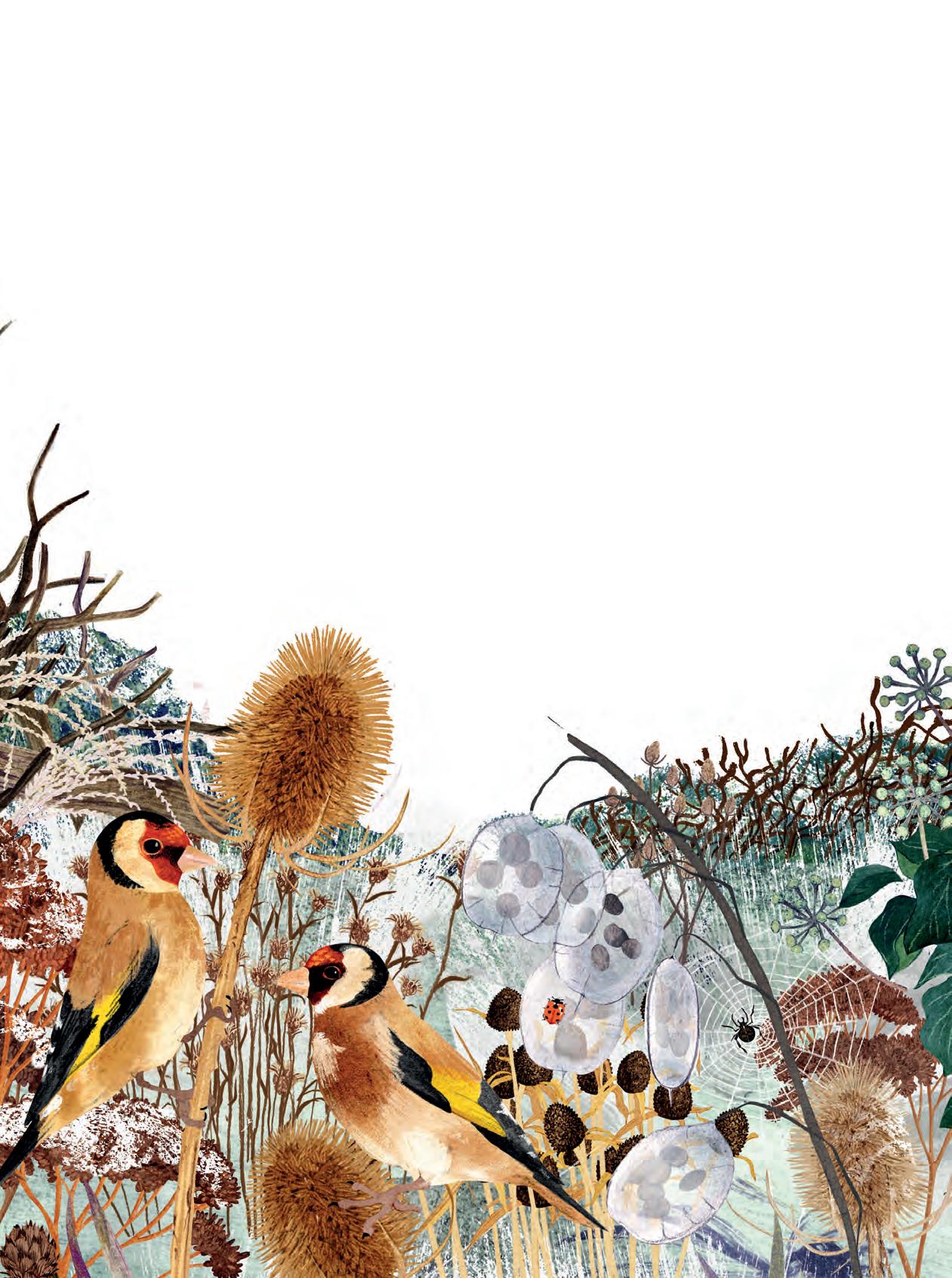
Their long, needle-like beaks root around for the small seeds. On frosty mornings, the seed heads sparkled silver in the low light — a truly enchanting sight.
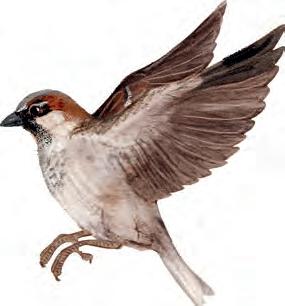
Teasels are just one example of how leaving plants standing throughout winter can benefit wildlife. From the warmth of your home, watch birds such as house sparrows feeding on flowerheads like rudbeckia.
Consider delaying the cutting of your herbaceous borders until early spring and leaving the leaf piles intact. This is a unique habitat that provides cover for ground-foraging birds, such as dunnocks, as well as hibernating frogs and hedgehogs. Hollow plant stems are a vital overwintering home for invertebrates such as ladybirds, earwigs, and butterfly and moth caterpillar larvae. Uncut ivy and hedgerows also offer protection and food to a plethora of wildlife. This winter, resist the urge to tidy too much. A wilder garden is better for both wildlife and our own enjoyment too.
Here are Becky’s favourite seed heads to be left in the garden through winter:
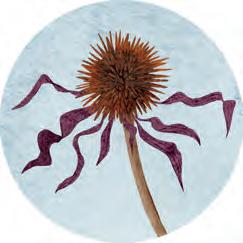
Their spiky seed heads stand tall through winter, offering shelter for insects and a vital food source for hungry finches and other seed-loving birds.
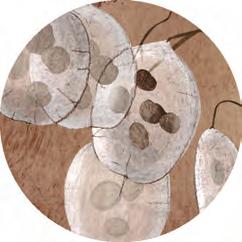
These papery silver seed pods are a winter must have. Beautiful and sculptural, providing shelter for insects and lingering seeds when food is scarce.
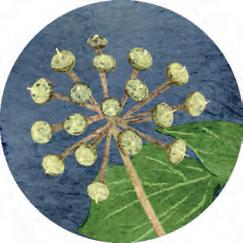
The garden’s unsung hero! Its evergreen leaves shelter nesting robins in spring, while fruits and seeds provide a vital food source for other birds in winter.
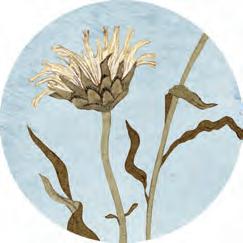
Thistle-like and wild, knapweed bursts with nectar-rich purple blooms in summer. By autumn, its fluffy seed heads feed goldfinches and flutter across meadows.
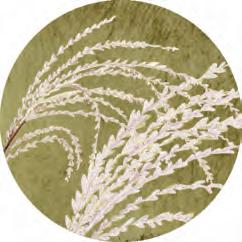
Rustling in the wind, its dense growth offers hiding spots for birds, mammals and insects, plus nutritious seeds through the long winter months.
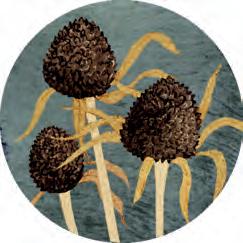
These bright summer blooms leave behind crispy, black seed heads that feed birds and shelter insects if left to stand through the winter.
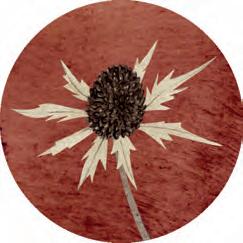
A prickly, garden ghost. Spiky, thistle-like sea hollies thrive in dry, coastal spots. Loved by pollinators in summer and birds in winter.
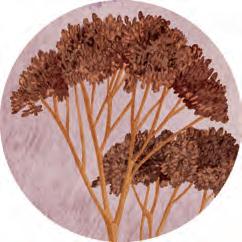
Easily Becky’s favourite winter plant, sedum’s tall flower heads offer late autumn nectar for bees, shelter for overwintering insects and look stunning covered in frost.

Nick Acheson Author and NWT Ambassador
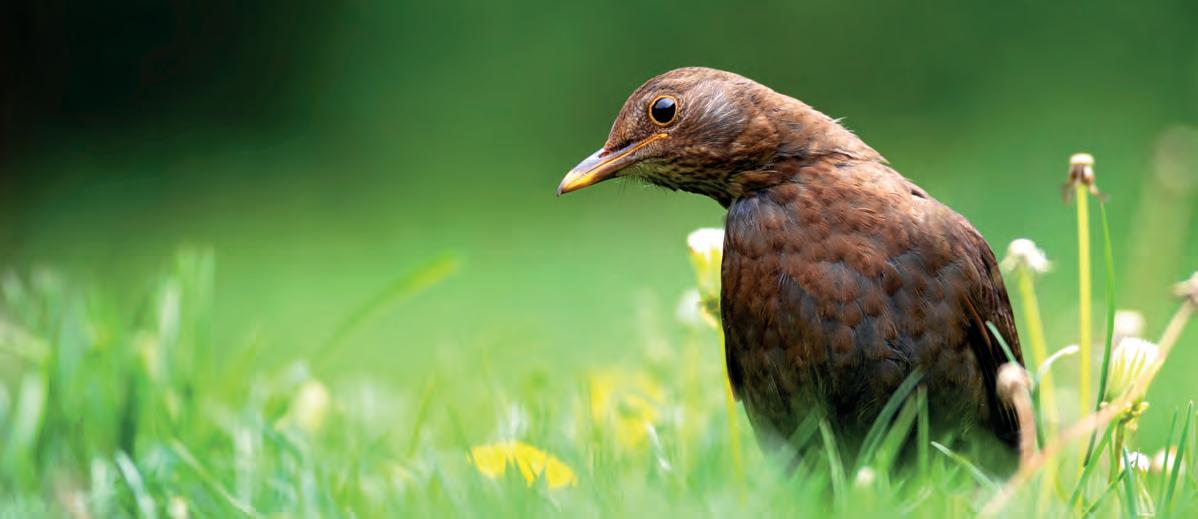
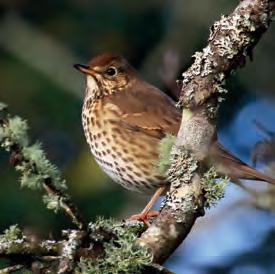
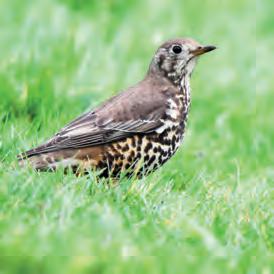
Six species of thrush are seen every year in Norfolk, three of which are breeding residents. Despite the recent impact of Usutu virus, the blackbird remains a common bird in UK parks and gardens. It is among our most familiar and best loved birds, barely needing any introduction. While less abundant, and more associated with wilder, more wooded habitats, our two spot-bellied thrushes — song thrush and mistle thrush — are also both numerous breeders in the county. Learn their distinctive songs and you will hear them commonly from late winter next year.
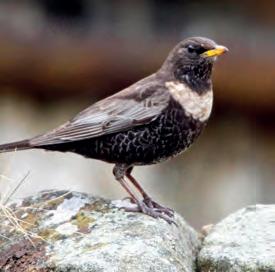
A fourth species, the handsome ring ouzel, breeds in UK uplands — in England, Wales and Scotland — but not in Norfolk. In early spring, ring ouzels migrate through Norfolk, when they are easiest to see in coastal scrub, heathland and grassland. Both sexes are similar to blackbirds, though ring ouzels have pale crescents marking their upper chests and a silvery wash to their wings. Their distinctive calls are like those of fieldfares, though sharper.
Our final two thrushes are winter visitors to Norfolk. Both are vanishingly rare as breeding birds in the UK. Arguably, these two northern breeders are our most attractive Norfolk thrushes.
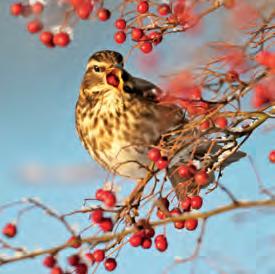
The redwing is a small thrush, by UK standards. Dark brown above and creamy white below, its breast, flanks and upper throat are heavily streaked in brown. Uniquely, among Norfolk thrushes, redwings have strong cream
brows and a dark orange wash on the flanks. Around 700,000 redwings are estimated to winter in the UK. Most breed in Scandinavia, though some (darker, streakier) redwings also visit from Iceland. Redwings arrive from mid-September, when their distinctive fizzing calls can be heard overhead at night. They typically stay with us until April, preferring open habitats such as fields, parkland and orchards, where windfall apples are a favourite food.
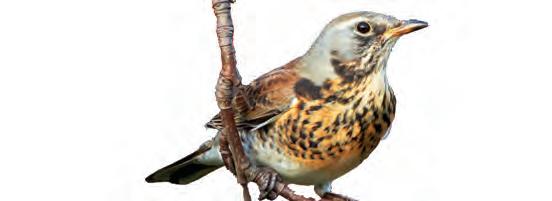
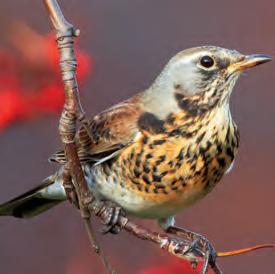
Perhaps our most beautiful thrush, the fieldfare is also a common winter visitor to the UK, similarly numbering around 700,000 birds (hailing from Fennoscandia and Russia). Like the redwing, it favours open country and is rarely seen in towns. The fieldfare is our largest thrush, fractionally larger even than the handsome mistle thrush. Its hood is a lovely bluish grey, broken by blackish streaks in the throat and along the lower cheeks. The upper breast is a warm honey gold, fading to white — marked with dark chevrons — on the chest and flanks. A fieldfare’s back is rich chocolate brown. Like the redwing, the fieldfare can often be heard on nighttime migration in autumn. It gives a loud series of scratchy, somewhat chuckling notes.
With the exception of ring ouzels, which winter in the Mediterranean and North Africa, five Norfolk thrushes are easily found in winter. And early next year, on a bright day, the loud clarion of the mistle thrush from a tall tree is likely to be among the first welcome signs of the coming spring.

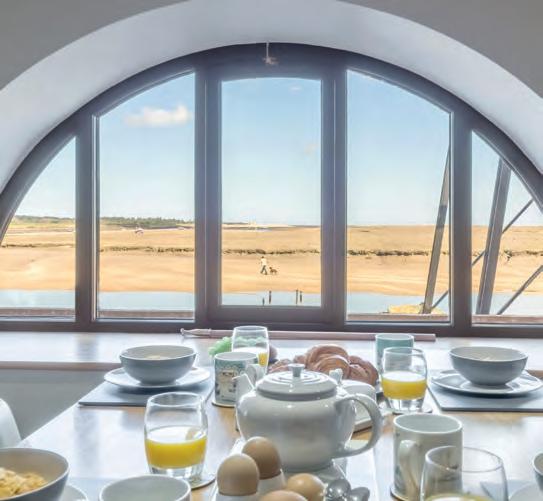

With its beautiful sandy beaches, big skies, pretty villages and wonderful coastal walks, Norfolk is the perfect choice when it comes to choosing a holiday destination here in the UK. From cosy cottages to luxury retreats close to beautiful sandy beaches, in rural hotspots or in the middle of quaint market towns, we’ve got something for everyone.
01328 887 658 | norfolkhideaways.co.uk |
with a late 6pmdepartureSunday
Do you have a property you would like to let with Norfolk Hideaways? To find out more please phone, visit the website or pop into one of our offices in Holt, Burnham Market or Wells-next-the-Sea for a chat.


cosy spot to rest, refuel and soak up the
On the edge of the Holkham National Nature Reserve, the Lookout offers spectacular views and delicious food and drink to enjoy inside or out.
Plan your day at holkham.co.uk
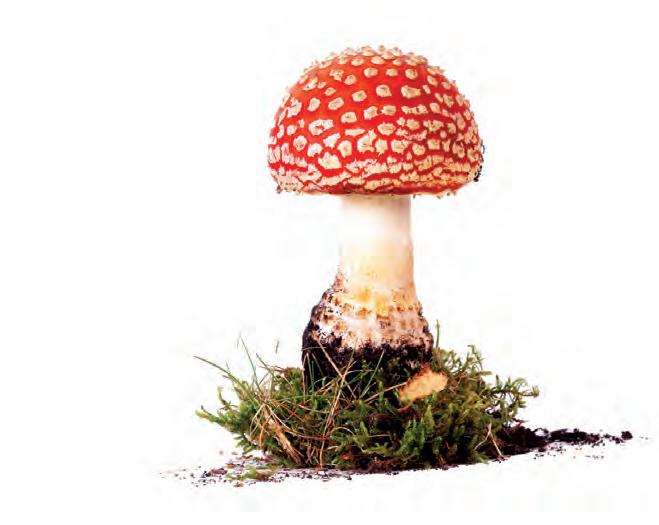
NWT Foxley Wood was alive with autumn colours, big smiles and bright spirits in September during our inaugural Trustorganised sponsored walk. Supporters of all ages explored woodland trails, discovered fungi and breathed in the crisp woodland air, all while helping raise vital funds for Norfolk’s wildlife.
The fun didn’t stop at the finish line either — walkers tucked into some very welldeserved tea and cake, picked up their Walk on the Wild Side medals and even got hands-on building insect houses.
We can’t thank our walkers, fundraisers and volunteers enough for making the day such a success. You’ve helped us give this special event a fantastic
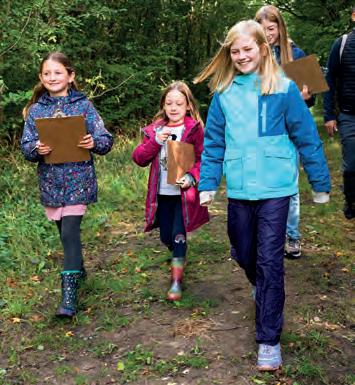
beginning and we can’t wait to see you all for Walk on the Wild Side 2026!
Fancy having fun and raising money for Norfolk Wildlife Trust?
Contact us for help planning events, or for tips, templates and sponsorship materials. Or why not take part in one of our planned activities next year.
Email: fundraising@norfolkwildlifetrust.org.uk
Phone: 01603 625540 Online: norfolkwildlifetrust.org.uk/Fundraise
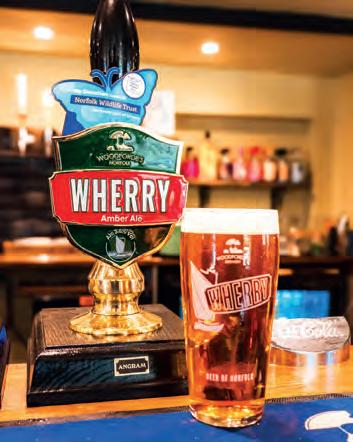
August marked the first anniversary of a very special partnership between Woodforde’s Brewery and our pub, The Pleasure Boat at Hickling. Over the past year, every pint of Wherry served at the historic waterside pub has raised funds for Norfolk Wildlife Trust — with £834 donated in just 12 months.
Since reopening last year under the ownership of Norfolk Wildlife Trust, The Pleasure Boat has been serving Wherry as its flagship ale. For every pint poured, 10p has gone directly to
the Trust to help protect the area’s wildlife and connect people with nature on the Norfolk Broads.
‘Woodforde’s Brewery, from its base in the Bure Valley, has been a great supporter of Norfolk Wildlife Trust for many years,’ says James Hogg, NWT Corporate Partnerships Manager. ‘We are so pleased that customers at The Pleasure Boat can savour their iconic Broadland beer ‘Wherry’ while also supporting Norfolk’s nature. We look forward to continuing our partnership as we develop further plans to welcome people to Hickling Broad and Marshes to enjoy and learn about the area and its special wildlife.’
Our 250 Club’s two prize draws for 2026 are scheduled for Tuesday 24 February and Tuesday 28 July.
These dates are subject to change, so please check our website nearer the time.
We wish good luck to all ticket holders, and we thank you for your support in 2025, which has seen £15,000 donated to Norfolk Wildlife Trust projects.
To join the 250 Club, or buy a ticket as a gift please visit norfolkwildlifetrust.org.uk/ 250club. At £12 per ticket, and with odds of 1:15, you can secure your place in the 2026 prize
To find out more about how your business can support us, contact our Corporate Partnership team on 01603 625540 or email: wilderbusiness@norfolkwildlifetrust.org.uk
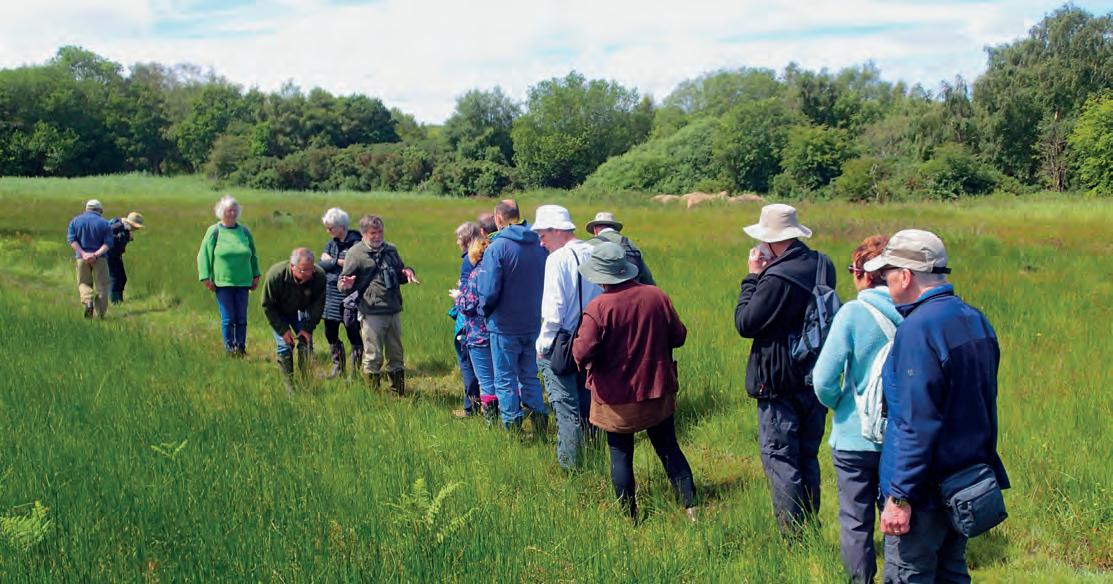
Did you know you can further indulge your love of wildlife and the great outdoors by getting involved in your Local Group?
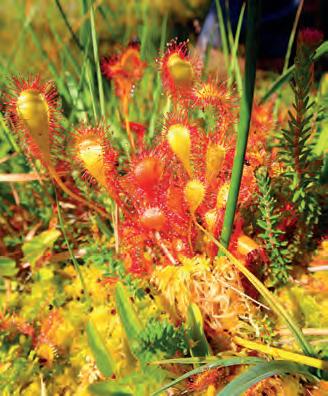
Our six groups are spread across Norfolk. They meet informally throughout the year for talks, walks, and social events. What’s more they raise money for the Trust and awareness about the work that we do — and many also carry out vital conservation work. In this issue, we hear more about the North Norfolk branch from current chair, Andy Clarke.
‘Joining in Local Group activities is a wonderful opportunity to meet others with a shared interest in wildlife and natural history. Being part of the North Norfolk group has enabled me to learn more about my local area, join in with both indoor and outdoor activities and broadened my knowledge. There is nothing quite so stimulating as continuing to learn and experience new things.
We usually try to make something special of our December event and last year we had a talk from TV personality, Mike Dilger. His talk was really engaging, with lots of amusing anecdotes and brilliant images. Afterwards we sampled some Christmas festive drinks and nibbles, while Mike signed copies of his book. The atmosphere was so convivial that we had to persuade people to leave so we could lock up! The evening fulfilled perfectly one
of the aims of a Local Group, which is to act as a focus to bring people interested in the natural world together in a pleasant social environment.
Participating in the Local Group committee has also been very rewarding as I have been able to help shape the programme of talks and walks. Over the years we have had talks on a huge variety of topics, including from leading scientists, a wonderful live painting demonstration from a top wildlife artist, and local members talking about their wildlife trips. And participating in the summer walks has shown how much enjoyment our Local Group members, and visitors, get from being shown wildlife by local experts.’
Find more about your nearest local group at: norfolkwildlifetrust.org.uk/ LocalGroups
North Norfolk Local Group are currently looking for new committee members. Please get in touch with current chair Andy Clarke: northnorfolk@norfolkwildlifetrust.org.uk or David Fieldhouse: davidfieldhouse@norfolkwildlifetrust.org.uk

MPatrick Barkham Natural history writer and NWT President
y dad John discovered Foxley Wood when he moved to Norfolk in the late 1960s.
As an ecologist, he was immediately drawn to Norfolk’s largest ancient woodland with its wondrous flora and fauna from bluebells to purple emperor butterflies.
Foxley is the ancient heart of Norfolk. It thrums with life, pumping biodiversity — fungi, dragonflies, birds, flowers and trees — into the surrounding countryside. It has probably been woodland since the last Ice Age. It’s mentioned in the Domesday book, and is a remarkably similar shape on old maps.
Now its shape is changing. We’ve increased Foxley’s size by more than a third, thanks to generous donors enabling the purchase of surrounding land. Nature is already bursting forth from the old wood onto these new acres.
To fully appreciate this miracle, we must remember that Foxley was very nearly destroyed. In the 1960s, almost half the wood’s venerable trees were sprayed with a now-banned herbicide related to the infamous ‘Agent Orange’ of the Vietnam War, and ripped out. All but the largest oaks were dragged into pyres and burned, replaced with conifers for plantation forestry.
By the 1980s, much of Foxley Wood was in a sorry, lifeless state, thanks to the conifers, a pheasant shoot, and the loss of traditional coppicing. My dad was among those who helped NWT buy the wood and, in 1992, its renaissance began. NWT’s first Foxley warden, John Milton, sold the conifers as Christmas trees. All were removed, and the wood allowed to naturally regenerate. Traditional coppicing was reinstated.
Foxley is the ancient heart of Norfolk. It thrums with life, pumping biodiversity – fungi, dragonflies, birds, flowers and trees – into the surrounding countryside.
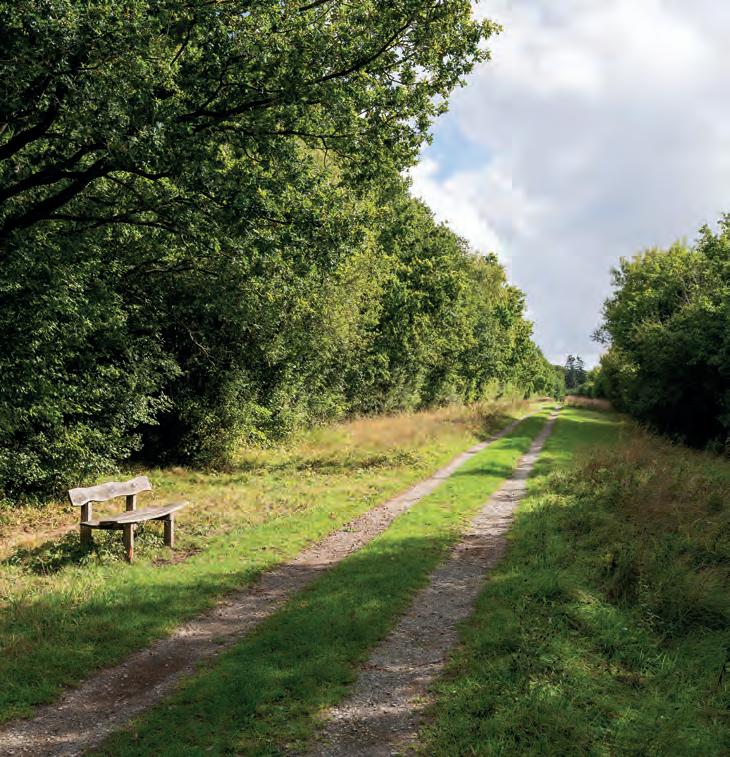
Today, it’s difficult to tell where the conifers were. In barely 30 years, the ‘ruined’ portion of Foxley throbs with life again. In another few decades, the new extra third of Foxley will be another spectacular story of nature recovery.
This is thrilling but you ain’t seen nothing yet! NWT will celebrate its centenary next year and we are redoubling our efforts to help people and nature in the ancient heart of Norfolk.
We are proud of our 100-year track record of saving nature. The next century will see us do even more,
not just protecting but restoring Norfolk’s precious nature at a time when — be in no doubt — it is under unprecedented peril. For that, we need your help — more than ever before.
As NWT’s Steve Collin puts it so beautifully in his feature, anyone can step into Foxley Wood, and become part of its story.
Join us. I’ll be stepping through London next spring, dressed as a badger, raising money for NWT in the marathon. As I stagger, the wonder of Foxley burgeoning with wildlife once again will spur me on.