
08 9325 2424 • www.easternguruma.com.au
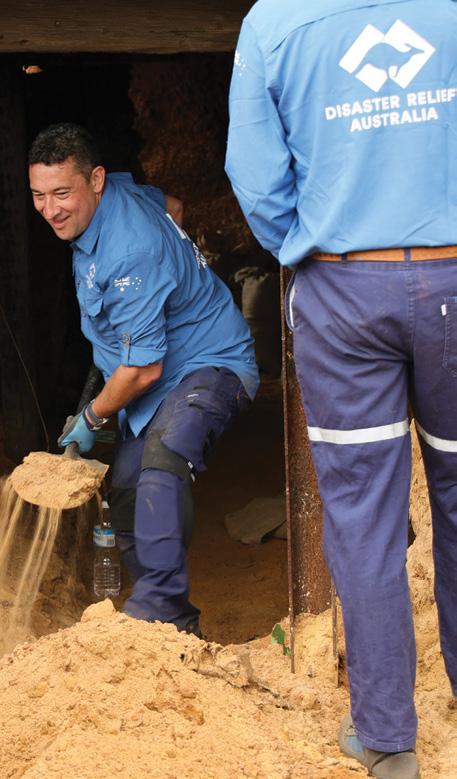
Eastern Guruma has been in operation for 20 years and is a 100% owned Indigenous company providing services in rehabilitation, landscaping, facilities management, traffic management, road works, drilling and more. Eastern Guruma is owned by members of the language group Muntulgura Guruma, the lands of which surround Tom Price in the Pilbara Region of WA the team has delivered services to Australia’s largest mining companies, Rio Tinto, BHP and Fortescue Metals Group.
Eastern Guruma is exploring the expansion into the building services industry. Leveraging its strong and reliable reputation; the aim is to extend our expertise into residential & construction maintenance including the refurbishment of houses and related projects in the Pilbara and Kimberly regions. Recognised as the ‘one stop shop’ for all maintenance and building services, Eastern Guruma will provide electrical, HVAC, plumbing, instrumentation and building services as it expands its platform into construction.
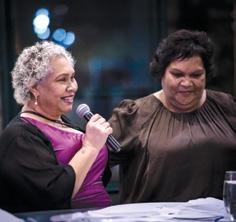
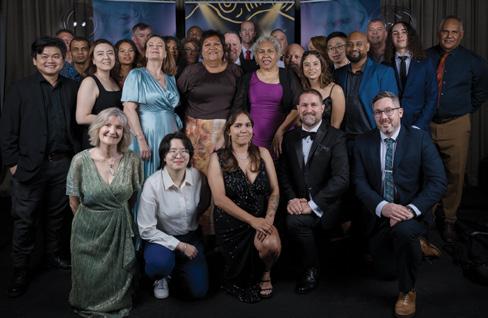
Eastern Guruma recently celebrated its 20th anniversary. Held at Frasers, Kings Park - it was the perfect venue for such a milestone occasion. Staff and VIP guests honoured the co-owners’ and directors’, Tania Stevens and Samantha Connors and all their accomplishments. All were incredibly proud of the journey and achievements over the past two decades. The milestone marked two decades of growth and achievements since its inception in 2004. The celebration highlighted significant milestones, including the rapid expansion from 2009 through to 2023 which saw Eastern Guruma receive prestigious awards such as the Business News 2023 RISE Business Award and the Rio Tinto 2023 Local Engagement Award. The 20-year celebration was a chance for all to celebrate and a testament to Eastern Guruma’s vision, dedication and hard work.
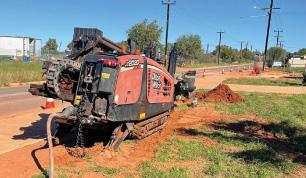
The company has recently invested in significant capital expenditures to its fleet, including the purchase of a CAPEX D9 100T float Liebherr Dozer, Excavator, Digger, and over 40 light vehicles. The acquisition of the Cat D9 Dozer comes with customizable blade options, efficient boosters, integrated components, advanced technology and cost-effective performance this empowers the team to deliver results that exceed client expectations. With this powerful tool at their disposal, the team is ready to achieve new heights in the industry. The dedication and expertise of the Eastern Guruma team have played a pivotal role in facilitating the purchase of new equipment on Site for our team.
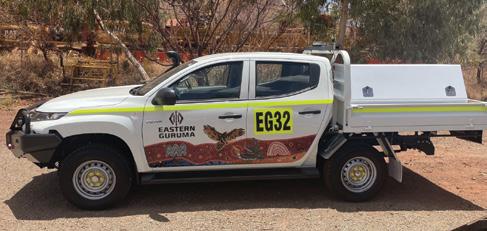


Additionally, Eastern Guruma’s landscaping and maintenance contract with Fortescue Solomon’s Kangi Camp has been renewed for another five years. The contract ensures continued collaboration and service excellence whilst working towards a carbon neutral supply of plant & equipment by transitioning from diesel to electric. Eastern Guruma’s ongoing growth and success is a testament to its commitment to community development, industry excellence, and the empowerment of Indigenous people.
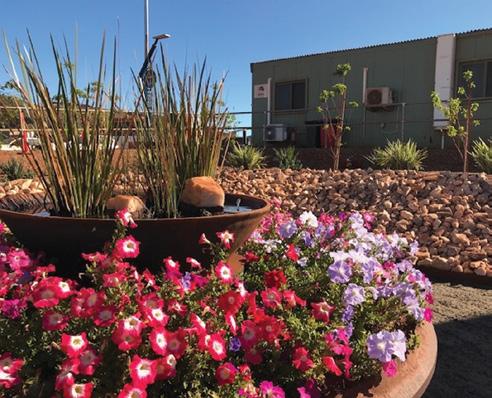
Eastern Guruma has been fortunate enough to acquire its own business premises in Perth. Located on the corner of Bulwer Street and Fitzgerald Street, Perth settlement was in July. The new premises has undergone a recent extensive refurbishment upgrade and includes open plan seating, 15 offices, five meeting rooms and one boardroom.
Eastern Guruma is proud to announce we have more than 30% of our 300 staff employed as First Nations People working full time in the mining industry. This is an outstanding result of focus and dedication from our HR and Indigenous Employment, Engagement and Development teams. Great efforts from the road shows, screening of candidates and assisting those who need a hand to get through the process. The milestone reflects the company’s dedication to providing employment opportunities for First Nations People.



Official Publication of
AUSTRALASIAN INSTITUTE OF EMERGENCY SERVICES
Print Post Approved PP 337586/00067
DISCLAIMER
Views expressed in this journal, unless specifically acknowledged, are not necessarily those of the Publisher, of the Institute, of its Board or of the Editor.
EDITORIAL RIGHTS
The Editor of National Emergency Response reserves the right to grant permission to reproduce articles from this journal. Such approval is hereby granted, unless a specific withdrawal of this permission is included in the article in question.
The Author and the journal must be acknowledged in any such reprint.
MAILING AMENDMENTS OR ENQUIRIES
For any amendments or enquiries regarding mailing, please email: secretary@aies.net.au
NOTICE TO ADVERTISERS
This publication is the official journal of the Australasian Institute of Emergency Services. It is published by Countrywide Austral for the Australasian Institute of Emergency Services and will be distributed to its members.
An illegal practice is presently operating where advertisements from some of our publications are used to produce unauthorised publications and our advertisers are contacted for payment for the unauthorised advertisement.
If you are approached to place an advertisement or with a request for payment for another publication, you should verify that the advertisement has been authorised and establish the bona fides of the company.
The invoice and any correspondence should have the company name, ABN, and an address (not just a PO Box) and you should ask for proof of publication.
If you do receive a request for an unauthorised advertisement, or have concerns about the bona fides of a company, we suggest you refer it to the Office of Fair Trading in your capital city.
PUBLISHER
National Emergency Response is published by Countrywide Austral
1, 460 Bourke Street, Melbourne GPO Box 2466, Melbourne 3001 Ph: (03) 9937 0200
Email: contact@cwaustral.com.au
ACN: 30 086 202 093
JOURNAL ENQUIRIES
For any enquires regarding the publication, please contact Tony Cornish: Mob: +61 411 055 050
EDITORIAL TEAM
Editor: Kristi High
Associate Editor: Steve Jenkins FAIES
Send articles for inclusion to: Email: editor@aies.net.au
WEBSITE
www.aies.net.au
WEBSITE CONTENT
The website has sections for each State as well as National Areas. If you have ideas for State Division content, please contact your State Secretary. For National content, email secretary@aies.net.au
Please be aware that all content must be cleared by the National President prior to web publication to ensure it meets required guidelines.
Disclaimer Countrywide Austral (”Publisher”) advises that the contents of this publication are at the sole discretion of the National Emergency Response and the publication is offered for background information purposes only. The publication has been formulated in good faith and the Publisher believes its contents to be accurate, however, the contents do not amount
specific professional advice. The Publisher disclaims all responsibility for any loss or damage
negligence on the part of the publisher, its directors and employees.
Copyright: All advertisements appearing in this publication are subject to copyright and may not be reproduced
Advertising: Advertisements in this journal are solicited from organisations and businesses on the


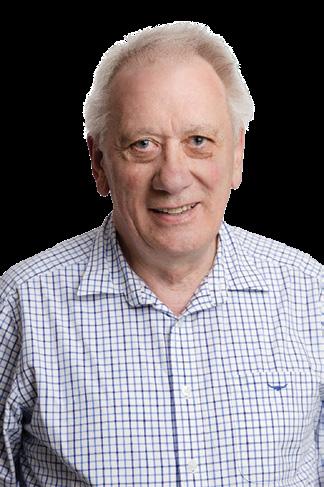
David Parsons ESM CESM FAIES
The last few months have been an exceptionally busy time for the AIES Board.
Our committees are working on improving the management of risk through the Audit and Risk Committee led by David Lyster, careful oversight of our finances through the Finance Committee led by Jenny Crump, development of our plan to celebrate our 50th birthday with the Anniversary Committee led by John Moy and work to develop our forward plan for professional development with our Professional Development Committee led by Dr Brett Henderson. This is all in addition to the development of our business strategy led by Dr Bodie Rodman. We have presented a range of national awards, had 11 members attend an emergency management exercise design course sponsored by Corporate Member ACIM Solutions and over 30 members are attending a Decision Making Under Pressure Master Class with Response and Recovery Aotearoa New Zealand.
Island. This event could see the loss of a large number of Australian lives and an airlift to rival that of the Cyclone Tracy response in 1974.
In September we launched the Health Emergency Management Committee of Practise.
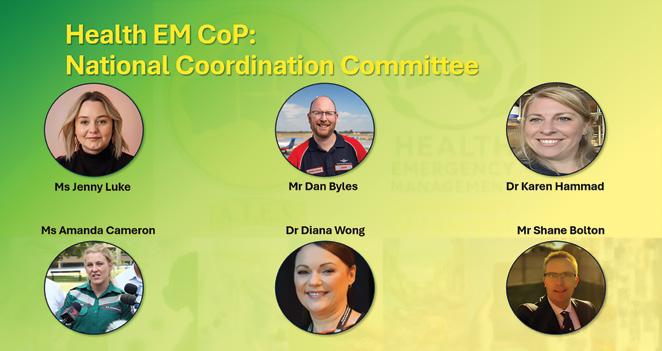
South Australian President Shane Bolton has put in a significant amount of work to get this Community of Practise established, bringing together health emergency managers in a common forum. It is exciting to see we have attracted members from a number of countries to this group.
The Institute has introduced a fee reduction for members holding an Australian Government Concession Card and for student members studying full time. This is in recognition that retired members take less advantage of the professional development opportunities and events offered by AIES.
“Our committees are driving real progress — strengthening risk management, advancing professional development, and shaping our future direction as a national institute.”
The AIES has been strategically working to develop a good relationship with our peers in New Zealand. We have been approached to provide an Exercise Evaluator for the New Zealand National Emergency Management Agency’s national space weather exercise. In 2027, AIES will partner with our New Zealand colleagues to conduct an exercise to explore the impacts for Australia of an Alpine Fault rupture on the South
We also welcome two new successful Certified Emergency Services Manager applicants.
Todd Miller from Auckland University in New Zealand and Deb Huxworth from Rio Tinto in WA. Congratulations to them both for excellent applications. This certification recognises their commitment to ongoing knowledge acquisition and contribution to the sector.
In this edition we publish Part I of an assignment from one of our
student members David Gellet on the Canterbury earthquake.
Earlier this year a call went out for umpires to assist with the mines rescue competition in WA and it is great to see NSW Division member Steve Brown supporting this.
There are many more developments to come in the way the AIES operates, and our products and services we deliver to members. In 2026, our AGM will begin the transition to being fully virtual. This will enable equality of access to all members across our Australian and international footprint. Cost savings from this change will be put into enhancing our member products and services.
Work is also underway to issue our first thought leadership paper to promote discussion and idea generation in the emergency management sector. We are very lucky to have Jonathan Curtis from the ACT volunteer to be the editor and drive this project forward.
In 2026, we plan to offer a range of opportunities for members to meet, develop contacts and support each other. We also plan to run a range of professional development opportunities for members.
The Board joins me in wishing all our members a safe and quiet Christmas and New Year. ●

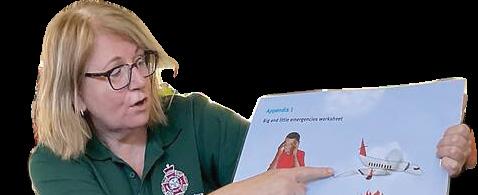
Source: Queensland Ambulance Service
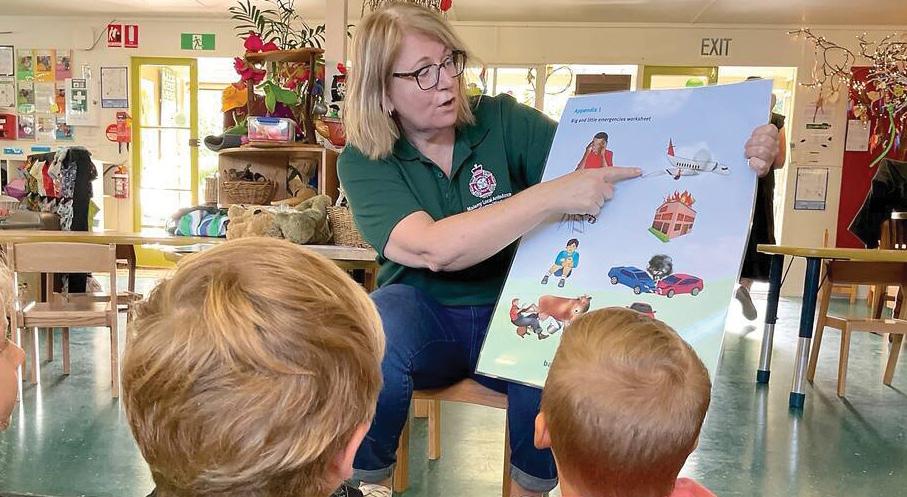
Two new life-saving community engagement programs were launched in August, when more than 200 Queensland Ambulance Service (QAS) volunteers descended on Bundaberg for the Biennial Local Ambulance Committee (LAC) Conference.
Around 200 LAC volunteers and QAS staff gathered at Bundaberg's Multiplex Civic Centre from 22-24 August to discuss ideas, learnings, and plans, all with the aim of building greater resilience within our communities.
QAS Statewide Community Engagement Operational Supervisor Suzette Dakin said this year’s conference provided the perfect opportunity to launch two new programs ready for LAC volunteers and operational staff to deliver to their communities across Queensland.
“Our LACs are an invaluable resource to QAS because of their local community knowledge and reach, and the countless hours given to raising awareness of the life-saving actions anyone can use within their local communities,” Suzette said.
“This weekend we were thrilled to launch two new community engagement programs including new RESQ R000’s units specifically for kindergarten children and a Yarning Circle cardiopulmonary resuscitation (CPR) program which we’ve developed alongside our Aboriginal and Torres Strait Islander communities, which can also be delivered in traditional language.”
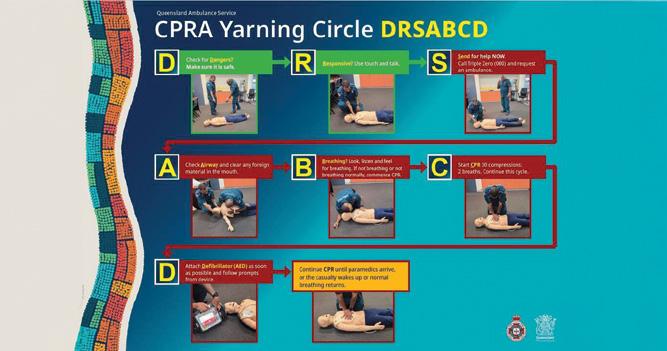
These new programs complement our suite of community engagement programs LACs deliver into communities including CPR awareness, first aid awareness, RESQ R000’s first aid program for primary school students, infant and child first aid awareness, Snakes Alive and STOPTHE-BLEED program.
Bundaberg LAC hosted this year’s conference and President Desley Cunnington said she was thrilled this biennial event had returned to the town after 20 years.
“As QAS has developed significantly over time from being an ambulance transport brigade in its early years to becoming a world leader in pre-
hospital care, our volunteer support has also changed significantly,” Desley said.
“And over time our LAC focus has also shifted, from the early days when we funded our stations’ vehicles, to still supporting our service and communities by providing community education and awareness programs which empower people of all ages to feel confident to step in and start CPR if they ever need to.
“We know bystander response is the first important step in the chain of survival for someone in cardiac arrest, or with a severe injury, so the more education we can provide to our communities, the more resilient they can become. ●
On behalf of the National Coordination Committee, we are thrilled to report on the successful launch of the AIES Health Emergency Management Community of Practice; a milestone marking the resurrection of a vital professional network for our sector.
By Shane Bolton MAIES AIES National Coordination Committee
The journey began with a lowkey soft launch just weeks ago, and the response immediately validated what many suspected: health emergency management professionals are seeking dedicated space for collaboration and advancement.
Within those initial weeks, 97 members registered and over 10 converted to financial AIES membership, building genuine momentum toward our official launch event.
The launch itself brought together 115 registrants, with 65 online at peak attendance. We were privileged to hear from Ms Julia Waddington-Powell (Chief Operating Officer, Women’s and Children’s Health Network, SA Health) and Dr Gina Samaan (Regional
Emergency Director, WHO Health Emergencies Programme), who powerfully reinforced the unique complexity of health emergency management and the critical need for cross-sectoral collaboration. While we experienced minor technical challenges during the event, these did not diminish the energy and engagement from participants across Australia, Oceania and beyond.
Importantly, even in these early phases, we have identified valuable opportunities to work with the National Board to enhance digital capabilities that will support Institute operations, sector collaboration, and Community of Practice functionality. The real work, however, begins now. Our immediate
challenge is sustaining momentum and ensuring the Community genuinely meets member and sector needs; moving beyond launch enthusiasm to create lasting value through knowledge sharing, professional development, advocacy, and innovation.
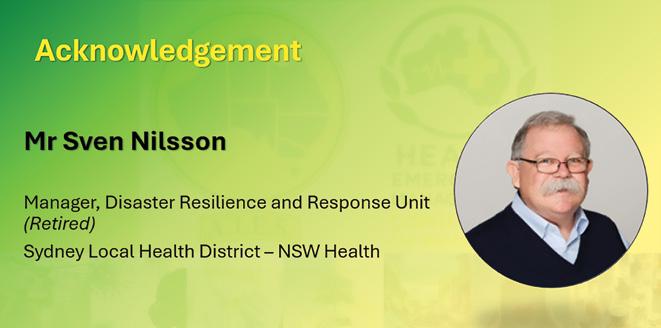
At the close of our launch, we acknowledged Mr Sven Nilsson, whose pioneering vision and nearly 50 years of dedicated health and emergency management service laid the foundation for this community. His initial work establishing the first iteration of this group created the foundation on which we build today. This launch truly stands on the shoulders of a giant.
As we embark on this journey together, I’m reminded of the African
proverb: “If you want to go fast, go alone. If you want to go far, go together.”
The challenges facing health emergency management: from climate-driven disasters to pandemic preparedness; demand collective wisdom, shared resilience, and sustained collaboration. Together, we will go far.
Not yet a member?
Join the Health Emergency Management Community of Practice:
Scan the QR code below or visit: forms.office.com/r/BRcZdcguht or Email us at hemsig@aies.net.au ●

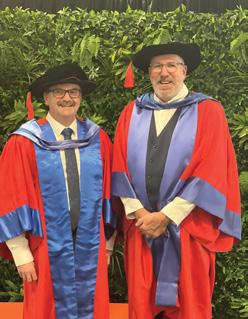
Congratulations to NSW/ACT/ International Division President Brett Henderson (right) and Russell Dippy CESM MAIES, who were recently awarded their Doctorates in Public Safety from Charles Sturt University. Congratulations to both on their multi-year dedication in achieving their PhDs.

Agroup of AIES members recently completed a nationally recognised incident-management course delivered by ACIM Solutions, the nation’s largest provider of emergency-management training.
Through AIES’s corporate partnership with ACIM Solutions, the 11 members were able to access the program at a reduced cost, ensuring professional development remains accessible across the sector.
RESPONSE AND RECOVERY DECISION UNDER PRESSURE COURSE
AIES recently funded our MoU partner Response and Recovery Aotearoa New Zealand to conduct a Response and Recovery Decision Under Pressure Course for 20 members.
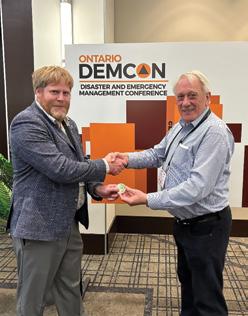
AIES President David Parsons ESM attended the Ontario Disaster and Emergency Management Conference in Toronto, Canada, in October. David met with the President of Ontario Association of Emergency Managers (OAEM) Richard Karsseboom MDEM, CBCP and presented him with an AIES Challenge Coin.
The unit, Design Emergency Management Exercises (PUAEMR032), forms part of the Diploma of Emergency Management and equips participants to design, document and evaluate complex, multi-agency training exercises.
For their capstone project, the class developed a transTasman exercise simulating the rupture of New Zealand’s Alpine Fault — a scenario testing coordination between Australian and New Zealand agencies.
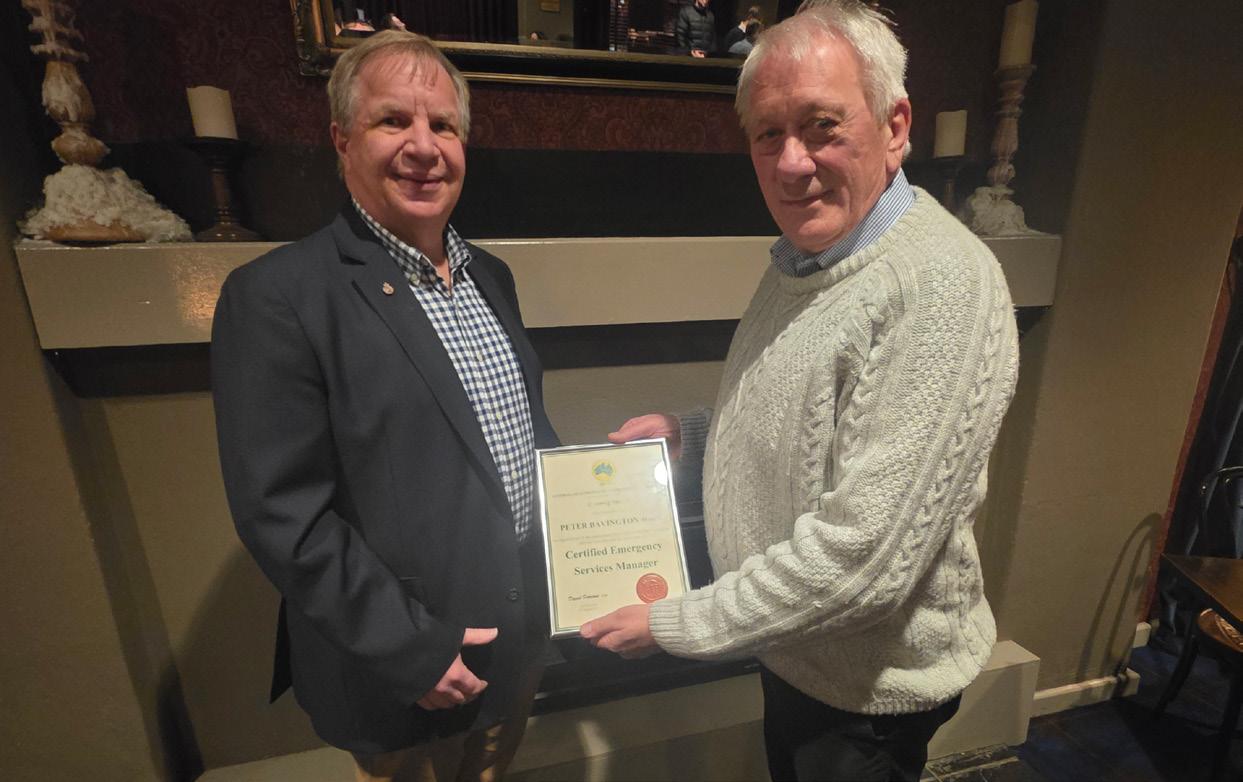
Congratulations to our participating Members: Matthew App (NSW), Peter Bavington (NSW), Jonathon Curtis (ACT), Michelle Gillman (NZ), James Guthrie (QLD), Dr Brett Henderson (NSW), Narelle Hocking (VIC), Katie Love (ACT), David Rose (ACT), Gabrielle Smith (QLD), and Abigail Walters (SA).
The course was a great success and there is now a waitlist for the 2026 course.
Congratulations to our participating Members: Matthew Apps, Chennell Allan CESM, Kathryn Burke, Matthew Bullock, Matthew Chadwick, John Cowan, Jim Delaney, Michelle Duxbury, Michelle Gillman CESM, Juverna Guinane, Chris Longmore, Murray Middleton, Bruno Monteleone, Jim Northfield, Cameron Powell, Steve Quinlan, Craig Ronan, Gabby Smith, Larry Ting CESM, Wayne Tippett, Anthony Waldron and Richard Webb.
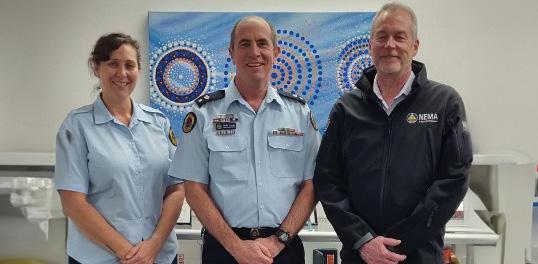
Mark Beard MAIES recently arranged a visit for the National Emergency Management Agency (NEMA) New Zealand to NSW SES headquarters. A strong emergency management partnership between Australia and New Zealand beneficial to both countries. New Zealand staff were deployed to support the NSW SES in the 2022 floods. New Zealand firefighters have lost their lives fighting bushfires on our soils. New Zealand has a number of disaster risks that could kill more Australians than any natural disaster in our history. Relationships established before a disaster are critical for effective disaster response.
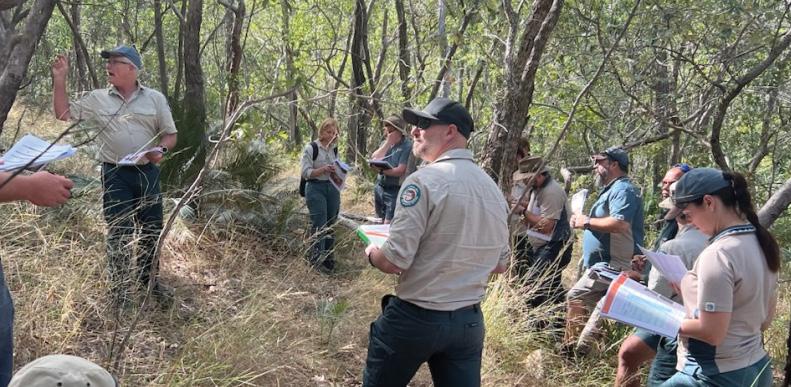
Queensland’s 13-million-hectare public protected area and forest estate is among the state’s most valued environmental and cultural treasures.
Source: Queensland Reconstruction Authority
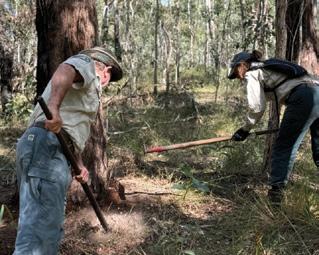
Our natural heritage jewels include Lamington National Park in the Gold Coast Hinterland, Girraween National Park on the New South Wales border, Carnarvon Gorge in the central west, and Cape York’s world-famous Daintree National Park.
But they are increasingly vulnerable to more intense and complex bushfires.
During the devastating 2019 Black Summer Bushfires, close to 750,000 hectares of national park and state forests were scorched by 173 separate bushfires.
With the risks rising, the Queensland Parks and Wildlife Service (QPWS) recognised the urgent need for innovative strategies to safeguard these lands and their surrounding communities.
Launched under the Better Queensland Parks initiative, the Fire Management Uplift Program reimagined how fire is managed by integrating traditional knowledge, community collaboration, and cutting-edge practices.
It’s a $39.2 million commitment to protecting not only biodiversity, but also the lives and properties of Queenslanders.
Key to the program’s implementation is partnerships with First Nations peoples.
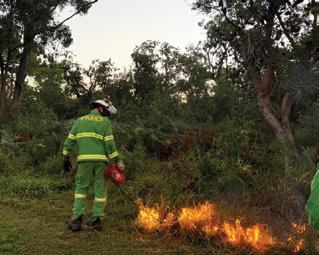
More than 2.5 million hectares of protected areas are now under formal joint management arrangements, with cultural fire practices embedded in all phases of planning and delivery.
This collaboration ensures traditional knowledge is harnessed to complement modern techniques, creating a more balanced and effective approach to fire management.
Additionally, QPWS has introduced dedicated fire teams across each of their six regional boundaries, supported by a State Fire Services team to coordinate and lead efforts to reduce bushfire risks while enhancing the health of native ecosystems.
The strategy ensures that every corner of Queensland benefits from tailored fire management solutions while maintaining a state-wide consistency in leadership and oversight.
Within just 12 months, the program exceeded its planned burn targets by nearly three months.
In 2024-25, QPWS conducted 637 planned burns covering 968,884 hectares, exceeding the target of 637,210 hectares by 52 per cent.
Planned burns are strategically applied to reduce fuel loads to prevent severe
bushfires while simultaneously improving habitat quality for native species.
By building capacity, incorporating diverse knowledge systems, and engaging directly with communities, the Fire Management Uplift Program exemplifies resilience, strength, and innovation.
In early 2025, the program withstood real-world testing when severe weather conditions, including record heat and bushfire conditions, demonstrated the effectiveness of the new fire practices.
Communities and biodiversity assets in high-risk regions, including the Scenic Rim and Southern Downs, were successfully safeguarded, proving the value of this forward-thinking initiative.
The Fire Management Uplift Program is a shining example of how innovative fire management is contributing towards a more bushfire-resilient Queensland while supporting a healthy environment.
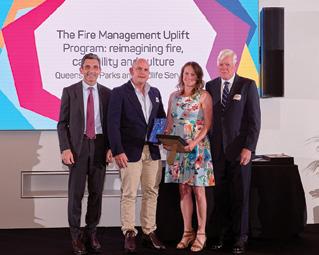
The Fire Management Uplift Program took out top honours in the Government Awards Category at the 2025 Queensland Resilient Australia Awards.
The full list of Queensland winners and highly commended entrants is available at www.getready.qld.gov. au/RAA25-QldAwards. ●



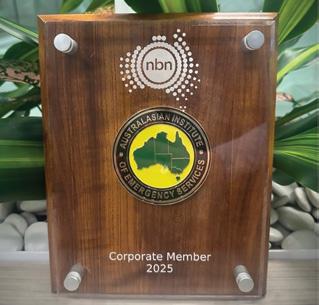
The AIES is proud to welcome NBN Co as a Corporate Member.
NBN Co, Australia’s national broadband network provider, plays a vital role in keeping communities connected, particularly during times of crisis.
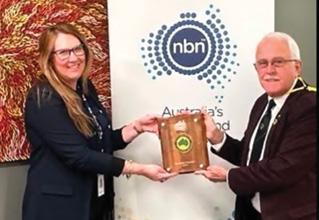
At a recent award ceremony held at the NBN Co headquarters in Melbourne, AIES Victorian Division President, Doug Caulfield OAM RFD FAIES, presented the National Emergency Integration Manager Nicole Blackwell with the Institute’s Corporate Membership plaque.
Joining the AIES as a Corporate Member is a strategic step that amplifies NBN’s commitment to supporting emergency management through its EM365 program — a year-round initiative focused on preparedness, response, and recovery.
EM365 brings together a nationally integrated Emergency Management Team, a network of Emergency Management Liaison Officers, and prepositioned disaster recovery assets.
These capabilities enable NBN to rapidly restore connectivity, provide critical communications infrastructure, and support emergency services and communities affected by bushfires, floods, and cyclones.
By joining AIES, NBN strengthens its partnerships with Australia’s emergency services and enhances collaboration across the sector.
The membership provides new opportunities to share insights, tools, and infrastructure that improve communications planning, promote fibre resilience, and embed connectivity into disaster response and recovery.
Through AIES, NBN can further its goal of building an informed and connected Australia — one where emergency responders, councils, and communities have reliable communication channels before, during, and after emergencies.
The partnership also supports national coordination efforts, ensuring that connectivity remains a key element in emergency management policy and practice.
Having NBN Co as a Corporate Member delivers meaningful benefits to both emergency services and the wider community. It’s not just about restoring networks after disasters;
it’s about empowering people with the knowledge and systems they need to stay safe and informed when it matters most.
The EM365 campaign provides practical education and outreach — including fact sheets, summary cards, and engagement with local councils and agencies — to help communities understand how to manage connectivity challenges during emergencies.
This collaboration will amplify those efforts, expanding awareness, supporting infrastructure upgrades, and helping ensure that remote and vulnerable communities are not left behind.
Together, AIES and NBN Co are helping to build a more resilient Australia — one that recognises connectivity as a critical part of emergency response and recovery. ●






















With a network that spans across 7 million square kilometres of the country, nbn is not new to emergency resilience and response - but we are new to the Australasian Institute of Emergency Services, and we wanted to share how nbn approaches resilience and connectivity when it matters most.
By Nicole Blackwell
NBN Co National Emergency Integration Manager
More than 20 million Australians rely on the nbn network every day and it now carries around 80 per cent of the nation’s data traffic. That makes it one of the most widely used and essential platforms in our country.
But when disaster strikes, staying connected becomes more than a convenience. It becomes a lifeline.
At the heart of nbn’s emergency response is a well-drilled, multidisciplinary Emergency Management team. From emergency management professionals, network engineers and field technicians to a team of Emergency Management Liaison Officers (EMLOs) and strategic planners, nbn has built a sophisticated emergency response infrastructure designed to respond quickly and effectively. These teams operate under tried and tested Australasian Interservice Incident Management System (AIIMS) aligned protocols with our Incident Controllers (IC) accredited to manage a Level 2 incident, and we work in close coordination with emergency services, to help enable connectivity to be maintained or restored even under the most challenging conditions.
During a crisis we know connectivity enables coordination and rapid decision-making for emergency teams. For families, we know it offers reassurance and access to vital information. And for communities,
we know it’s the thread that ties together resilience, recovery, and hope. Behind the scenes, nbn also plays a quiet but critical role in helping Australians prepare for, respond to, and recover from emergencies. As the nation’s digital backbone, we are working to help, as much as possible for Australians to stay connected when it matters most.
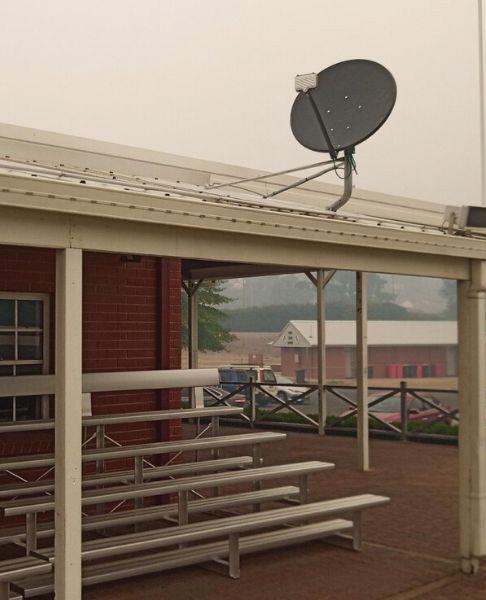
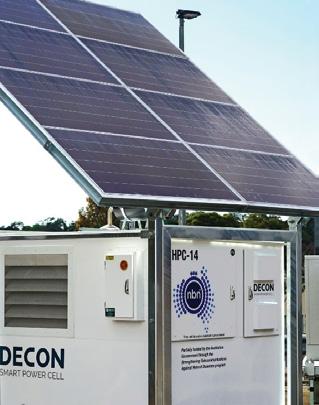
In high-risk areas across Australia, nbn has pre-deployed a range of technologies designed to keep communities online as much as possible — even when the power grid goes down.
These include:
• Hybrid Power Cubes - solar-diesel generators that provide backup power for our Fixed Wireless infrastructure (critical in parts of Australia, particularly regional areas, where fibre is not available) during power outages, especially in bushfire-prone or floodaffected zones.
• Commonwealth Government’s Strengthening Telecommunications Against Natural Disasters (STAND) program - installed at more than 1000 sites providing backup emergency connectivity for emergency services, evacuation centres and community hubs.
• Rapid Deployment Field Teams and Emergency Management Liaison Officers – ready, willing and more-than-able to work alongside emergency services to restore connectivity, as soon as conditions allow.
• Fundamentally, these elements help with enabling, as much as possible, emergency information to be accessed, loved ones contacted, and response efforts coordinated - even when physical infrastructure is compromised.
As any emergency manager knows resilience starts long before a disaster hits. That’s why nbn continues to invest in community education and preparedness, something ultimately guided by our Statement of Expectations from the Commonwealth Government.
On the ground, this includes:
• Multilingual emergency preparedness factsheets – available https:// www.nbnco.com.au/emergency in languages including Arabic, Filipino, Italian, Simplified Chinese, Thai, Vietnamese and others via https://www.nbnco.com.au/utility/ multilingual-support, helping diverse communities understand how to stay connected during emergencies.
• Practical advice - covering how the nbn network operates during power outages, tips for maintaining connectivity, and reconnection procedures after a disaster.
• Local engagement - through Emergency Management Liaison Officers in every state and territory, building relationships with emergency services and community leaders.

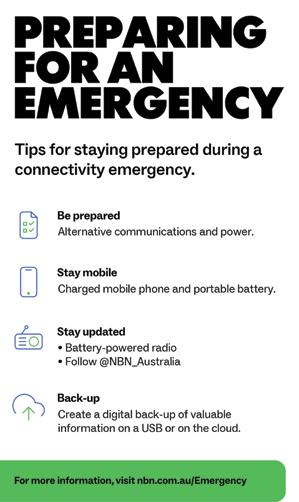
These efforts help Australians understand not just what nbn does, but how they can use it to help stay safe and informed.
After the immediate danger has passed, the road to recovery begins - and connectivity remains essential. nbn prioritises service restoration in coordination with emergency services, ensuring affected areas are reconnected as quickly and safely as possible. The organisation also provides clear guidance for residents and businesses on how to safely reconnect to the nbn network once their premises are safe to enter.
Looking ahead, nbn’s ongoing network evolution – including replacing
legacy nbn copper networks with fibre, upgrading our Fixed Wireless and HFC networks, and replacing our Sky Muster geo-stationary satellite services with low earth orbit satellite services –continues to help enhance long-term network resilience.
With more than 20 million Australians relying on the nbn network every day, our role in emergency management is both strategic and essential. From enabling Wi-Fi calls during blackouts to supporting virtual emergency operations centres, nbn is more than a broadband provider, we are a willing partner in resilience, a critical enabler in recovery.
For emergency services professionals and communities across the country, understanding how to leverage the nbn network can enhance operational effectiveness and improve outcomes when it matters most. Our details are below.
Thanks again to everyone at the AIES for the warm welcome and we look forward to being part of this vibrant community. ●
CONTACT YOUR LOCAL NBN EMLO:
• emloqld@nbnco.com.au
• emlonsw@nbnco.com.au
• emlovic@nbnco.com.au
• emlotas@nbnco.com.au
• emlowa@nbnco.com.au
• emlosa@nbnco.com.au
• emloact@nbnco.com.au
• emlont@nbnco.com.au
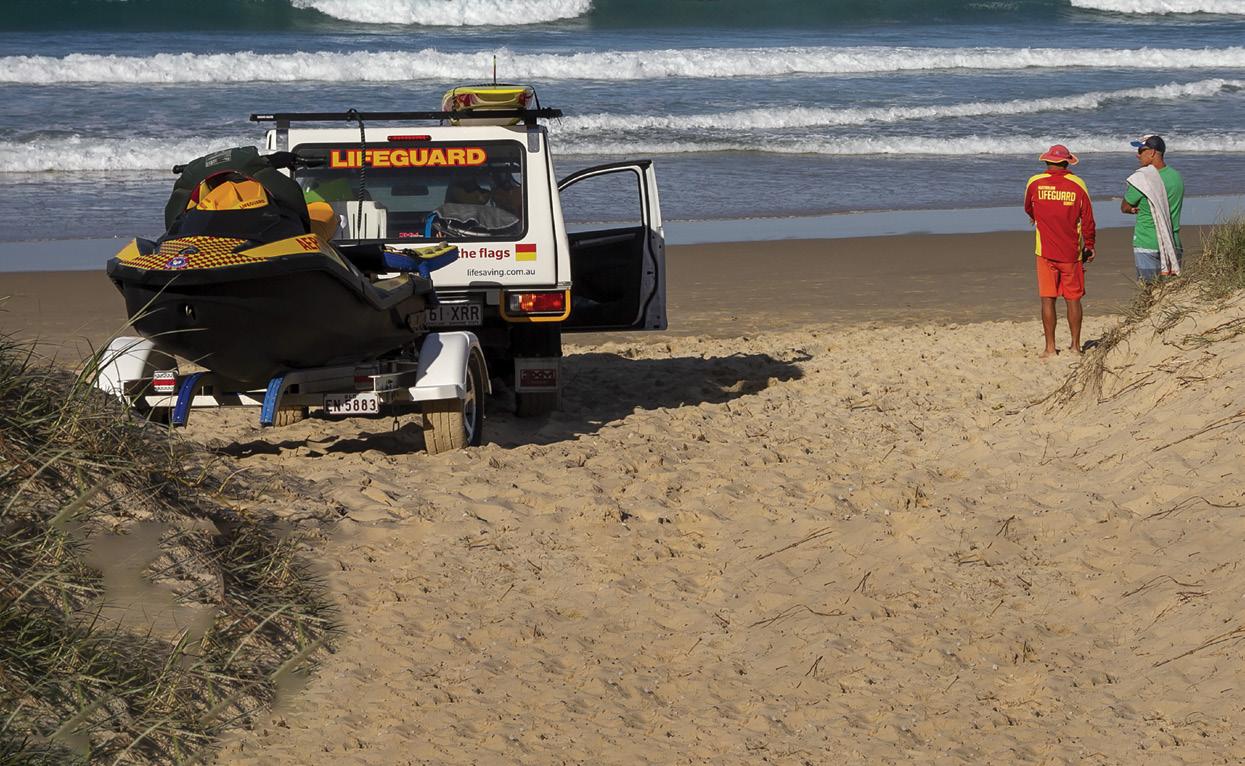
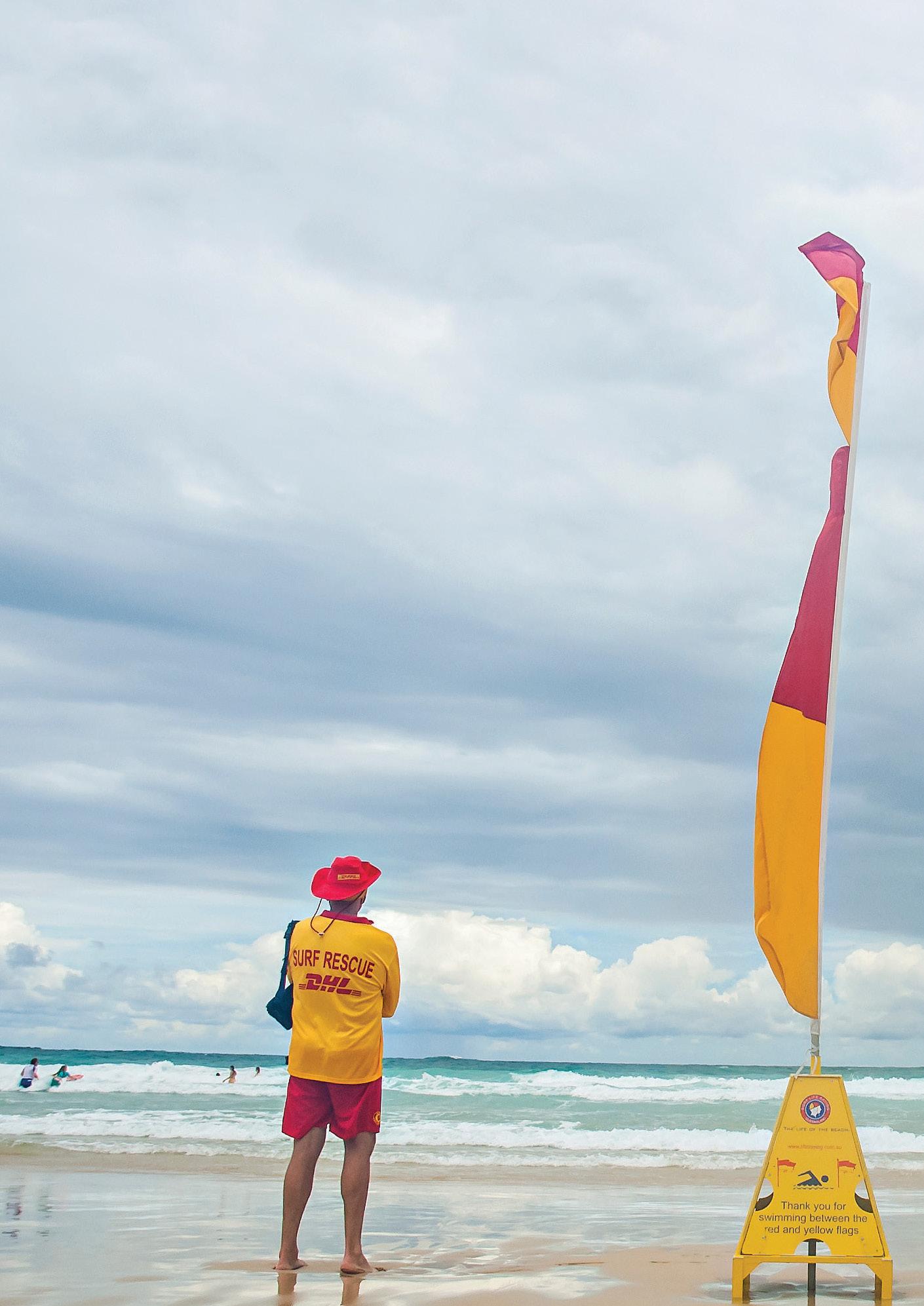
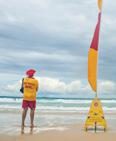
As another Australian summer approaches, the red and yellow flags are already flying — not just as beacons for swimmers, but as symbols of what readiness looks like in action.
By Kristi High Editor, National Emergency Response
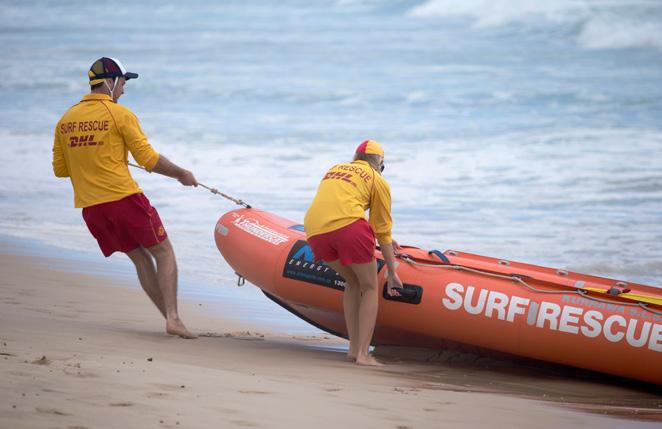
Surf Life Saving Queensland (SLSQ) has launched its 202526 patrol season across 58 coastal clubs, marking the start of what is expected to be one of the busiest beach periods in recent years. Behind the familiar sight of patrol tents and rescue boards lies a highly coordinated, state-wide operation. This volunteerpowered emergency network mirrors many of the same preparedness principles applied by other emergencyservices organisations and agencies.
Almost 10,000 volunteer lifesavers and 38,000 members from Queensland’s surf lifesaving clubs will be on patrol every weekend and public holiday throughout summer — a human network stretching the length of the coastline.
In the 2024-25 season, SLSQ lifesavers and lifeguards performed 2,350 rescues and more than 617,000 preventative actions while safeguarding nearly 23 million beach visitors across the state. Sadly, there were 21 beach-related drownings, with 57 per cent occurring more than 100 metres outside the flagged patrol areas. These figures show that too many people still choose to swim in areas beyond lifesaving surveillance — a pattern of risk familiar to many emergency professionals.
“They can’t save you if they can’t see you.”
- Dave Whimpey, SLSQ CEO
SLSQ Chief Executive Officer Dave Whimpey said the statistics are a reminder of why prevention must remain at the core of preparedness.
“The safest place to swim is always between the red and yellow flags at patrolled beaches,” he said. “These areas are monitored by trained lifesavers and lifeguards who are there to watch out for you and your family.”
“Our lifesavers are here to help, but if they can’t see you, they can’t save you.”
This season, SLSQ has strengthened its operational capability with new communications systems, upgraded coastal facilities and enhanced
rostering technology to improve coverage. On the Sunshine Coast, Kawana Waters Surf Life Saving Club recently unveiled a $2.4 million upgrade to its patrol and training base, while further south, Tallebudgera’s refurbished change rooms and firstaid areas have been completed ahead of summer. These investments are more than infrastructure projects — they build frontline capacity in highvisitation regions where minutes can make the difference between rescue and recovery.
Technology is also reshaping coastal readiness. SLSQ’s state
operations and communications centre integrates real-time data, drone vision and beacon technology to support situational awareness across multiple beaches. Combined with on-the-sand intelligence from patrol captains, these systems streamline escalation and coordination with Queensland Police, Ambulance and Marine Rescue — the same cross-agency model seen in broader emergency management.
For those working across the emergency-services and emergencymanagement sectors, SLSQ’s summer activation offers a clear case study in community-based resilience. Each flagged beach functions as a micro-operation
in prevention, coordination and rapid response. Volunteer patrols operate with command structures, communication protocols and risk-assessment processes that echo the frameworks used by their professional counterparts.
The logic is universal: invest early, coordinate locally and communicate clearly. Prevention and preparedness reduce the demand on formal emergency response. The surf-lifesaving model demonstrates how structured volunteer networks, properly equipped and integrated, can absorb and defuse risk long before it reaches crisis point.
Queensland’s summer outlook reinforces that need. Domestic tourism
remains strong, coastal visitation is climbing, and volatile weather patterns are again forecast. The combination of high temperatures, increased surf activity and public holidays creates predictable peaks in coastal risk that will test the strength of both volunteer and professional partnerships.
As the flags go up this summer, Surf Life Saving Queensland’s work stands as a reminder that emergency response begins long before the call for help. It starts with a plan, a patrol, and a conversation about risk — the same fundamentals that underpin every effective emergencymanagement system. ●


By Chris Webber
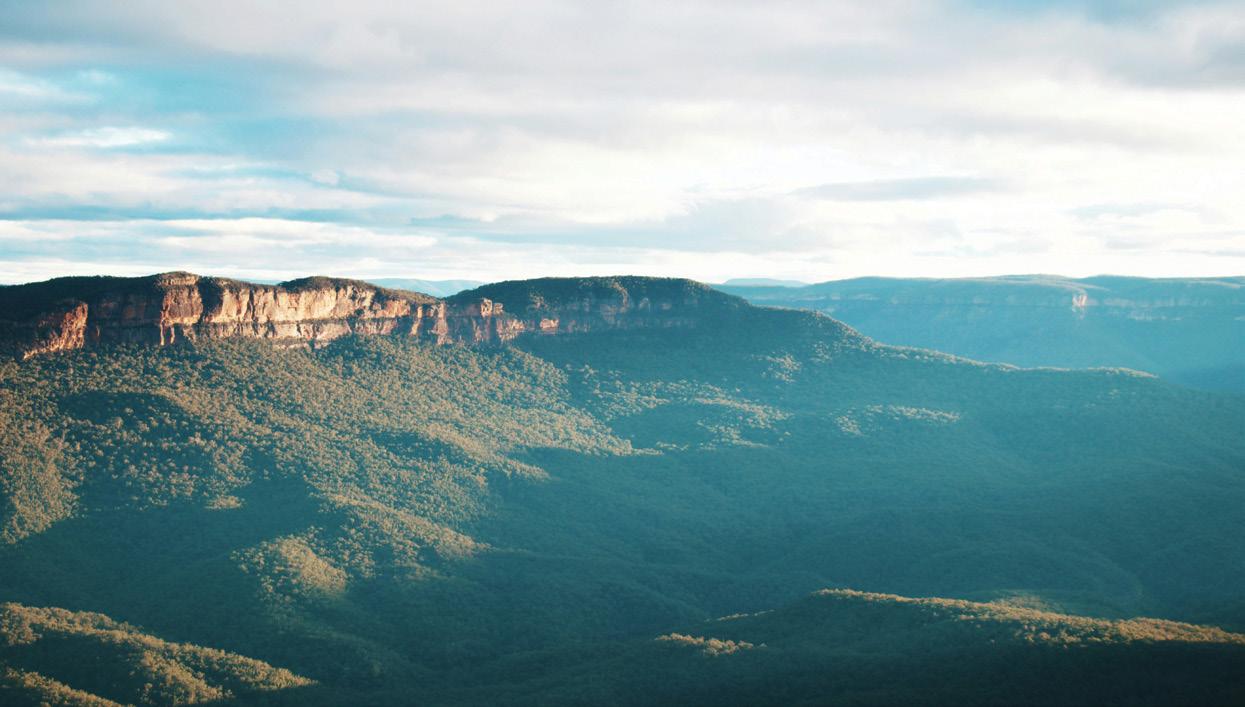
The City of the Blue Mountains covers 143,00 hectares and is part of the Greater Sydney Region. About 70 percent of the area is incorporated into the World Heritage listed Blue Mountains National Park, with approximately 11 percent in private ownership. It is sometimes described as ‘the city within a national park’ which is what makes it unique in Australia and quite vulnerable to disasters.
The city is a narrow ribbon of land on top of the plateaus and ridge tops, with the Great Western Highway being the only road in and out. The bushland reaches right up to the highway in many places, and since the highway follows the tops of the ridges, it is likely that winds will blow fires up the valleys towards the Highway. The same geography can make storms and strong winds more damaging.
There is a real threat that residents could be cut off in a bushfire. This is perhaps why living in what is reputedly Australia’s most bushfire prone area has made the 80,000 Blue Mountains residents very disaster conscious.
The enormous Greater Blue Mountains World Heritage Area comprises several national parks, with the Blue Mountains National Park alone having over a quarter of a million hectares. The latter has Australia’s largest network of walking tracks, covering over 250 kilometres. In addition, Blue Mountains City Council manages 135 km of walking tracks, more than 90 lookouts and five bushland campgrounds.
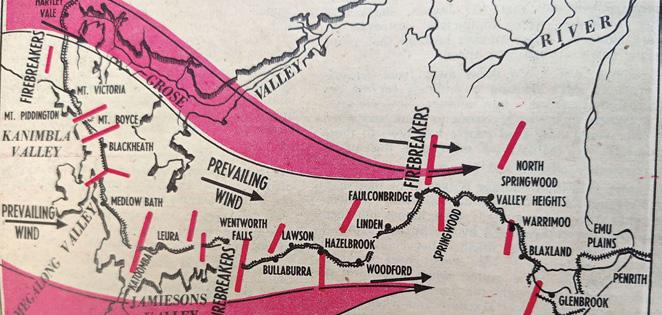
These keep the local emergency services busy, with, on average, about one rescue operation every other day (though they are concentrated on weekends and holidays, with up to nine being recorded in one day). There were 188 such incidents in the last financial year, including 53 resulting from a person getting lost.
Only 14 involved a PLB activation, with the most common reason for a helicopter rescue being an ankle injury. A rescue operation usually involves one or two people but can involve up to 14. This means that between 200 and 400 people are rescued every year, and the number increases by about 10% p.a.
However, due to the professionalism and teamwork of emergency services, deaths from these incidents are typically very low (0–2 per year). This does not include suicides, of which there are about 30 annually in the region.
People travel to the mountains to commit suicide, so there is a higher suicide rate than the rest of Australia. Body recoveries can be difficult due to the terrain, and sometimes take several days to complete.
Depending on the type of incident and its location, a rescue operation for a single person with a broken leg can involve up to nine organisations. The largest search operation so far (for Elizabeth O’Pray, unresolved) involved 1,500 people. Other search and rescue operations have had hundreds of participants, but there is no difficulty in finding volunteers, even for searches that concern people who are not local residents. Before helicopters came into use, it required up to 36 people working in relays to carry an injured person on a stretcher out of the valleys. The region is well supported by emergency services. There are five police
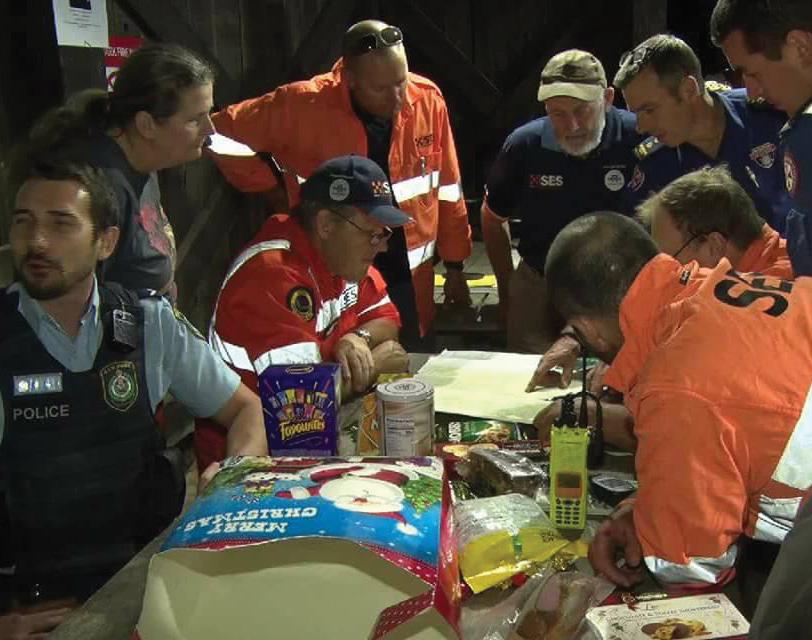
stations, two ambulance stations, eight Fire & Rescue Stations and one hospital. There are 23 RFS brigades, with a nominal membership of 2,500 people.
There are two SES units in the Blue Mountains (with a total of about 150 members) plus one in Lithgow and one in Oberon. The majority of Bush Search and Rescue (BSAR) members come from the Blue Mountains, where a permanent base for them will be built soon. There is a busy VRA unit in Lithgow with about 100 members. These services are backed up by Toll Ambulance Rescue helicopters flying from Bankstown, and Polair.
The services work so well together that they have been mentioned in parliament as an example of interservice teamwork and co-operation to the rest of the state. This co-operation is assisted by a joint Emergency Management Centre at Katoomba. This houses the Fire Control Centre, RFS resources, meeting rooms and the SES HQ. The services have improved their radio and data communications links so that it is easier for requests to flow from one service to another.
The Blue Mountains Police Rescue Squad has the responsibility for managing road crash rescues, vertical rescues, and other search and rescue incidents. It is very experienced and is often called to help with rescues outside the area. Recently they were called to rescue a rock climber from Belougery Spire in the Warrumbungles.
This is an example of the influence of Blue Mountains personnel in disaster management. They often volunteer for out of area service. Their involvement is also requested because have so much experience in particular fieldsin co-operation between services, the use of AIIMS and the use of disaster management computer systems. They also have particular skills that other units may lack. Blue Mountains SES, for instance, has a lot of experience with cutting up and removal of large trees.
The Blue Mountains is best known for its scenery but also for its fires. For instance, the 1957 fire burnt down the town of Leura, while fires in October 2013 destroyed or damaged nearly 500 homes. At that time, it was feared that the fires in the west and east would link up, but the emergency services were able to prevent that catastrophe. In 2019, you could see smoke from fires to the west, south, and north from the highway near Katoomba, but again the fires did not link up. Fortunately, there has been frequent rains since 2021, and fires have been rare. This may have led to complacency, which is dangerous, as the rain has caused a huge amount of regrowth, and a repeat of the 1957 situation is possible if there is another drought.
The Mountains also experience significant storms. In the 1980s, winds of 210 kph and 175 kph were recorded. The gullies and cliff face increase wind strengths by funnelling the winds or by diverting them upwards. The winds
usually come from the south-west, with the wind strength increasing as it moves from the western plains to the mountains. East coast lows are another cause.
The worst incident occurred on the night of 5-6 July 2011. Winds rose to 139 km/h and the SES received more than 1,100 calls for assistance, mainly in the Blackheath area. A passenger train was severely damaged by a falling tree and another train travelling in the opposite direction only just stopped in time to miss another tree. 13,000 properties were without power and diesel supplies ran out due to the large number of emergency vehicles operating in the area and the inability of fuel trucks to get through to the filling station. Luckily, there were no deaths and only a few injuries, with one man being trapped in his house for eight hours.
It was lucky on that occasion that, unusually, there was no rain with the wind storm. The Katoomba area receives the highest rainfall of the Sydney region. The highest daily rainfall was 285mm in 1978, and falls of around 200mm have happened several times in the region. Weekly rainfalls have reached 400 or even 500mm.
These high rainfall events cause rock slides and flooding. Roads may be blocked and, communities cut off. It may take weeks or even years to clear. The Wolgan Valley Road, the only access route to Newnes and the Wolgan Valley, was closed in November 2022 after heavy rain caused multiple landslides. It is not projected to re-open until 2026 at the earliest. Jenolan Caves has had similar problems.
Peak flood levels in the local rivers are rising, while their average water levels are falling. This indicates that there is an increasing problem with run-off. Fortunately, few people live along the rivers, as they are mostly contained in national parks. However, in the past, bushwalkers have died after being caught by rising flood waters.
The Grose River floods, on average, twice a year. There are some small dams above the Grose Valley, one of which has been the subject of white alerts a few times when water seemed about to over-top it. Although a dam failure is very unlikely and it would flow into the uninhabited national park, the NPWS estimates that there are 1,500 people in the Grose Valley at any one time who might be affected.
One cause of disasters has become less and less frequent. There used to be snowfalls every year, but for the last three years, snow has not settled east of Oberon. The last significant event was in 17 July 2015, when an east coast low caused up to 20cm snow to fall. Shops in Katoomba were closed most of the day as staff could not get to work. Hospital staff had to be ferried to and from work by SES vehicles to prevent the hospital from closing. The railway line closed because train drivers couldn’t get to the Mt Victoria depot. Many trees and power lines were brought down by the weight of the snow. This caused power cuts, damage to homes, and blocked roads. Schools were closed and 150 motorists were rescued from the Great Western Highway. It took a week for the snow to melt away in shaded locations.
The highway is often wreathed in mists, rain, and sometimes smoke or ice and snow so there a lot of road accidents. Every time it rains, the GWH may be closed for some hours. There have also been a few major train accidents (plus many smaller ones) with Australia’s worst train disaster affecting a Blue Mountains train.
The mists and rain have often been implicated in 43 aircraft incidents, as most occurred before the introduction of instrument flying.
These nearly always involved single engine aircraft but with the construction of Western Sydney Airport the possibility of larger aircraft crashes is set increase. Although modern aircraft are very safe and the possibility of an incident is very low, many of the aircraft flying into the airport will be cargo planes, which tend to be older and less well maintained.
All this means that the community is facing a constant common threat and is quite close-knit and caring. People who move there from the Sydney suburbs just down the road suddenly find they can no longer be anonymous and are likely to meet people they recognise in the shops. Many become volunteers, and there is a high proportion of volunteers with between ten- and 35-years’ experience.
Blue Mountains City Council regulations have grown increasingly strict over time but the battle to ensure that new building developments don’t cause a large number of people to be trapped by a fire or other disaster is a constant one. It’s thus a community shaped by disaster but prepared for it. ●
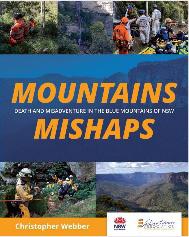
Chris Webber has been a member of Blue Mountains SES for 25 years. He is the author of Mountains Mishaps: death and misadventure in the Blue Mountains available from https://mountainsmishaps. com.au This book, sponsored by the SES VA, tells the story of local emergency workers through 650 incidents that caused 230 deaths.
Congratulations to AIES members who have recently achieved their Certified Emergency Services Manager (CESM) credentials.
By David Parsons ESM FAIES CESM
AIES President
We continue to evolve the points and rules around the CESM. Please visit our website and keep an eye out for updates if you are considering applying.
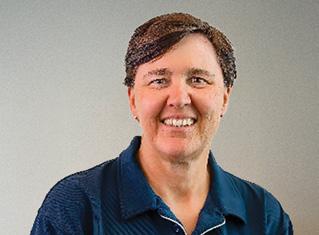
DEB TUXWORTH CESM MAIES
Deb Tuxworth is a forward-thinking emergency services professional with over two decades of experience spanning both public and private sectors, with a strong focus in the mining industry. Currently serving as Specialist –Business Resilience & Emergency Management at Rio Tinto Iron Ore, Deb plays a pivotal role in enhancing operational readiness and resilience across multiple sites.
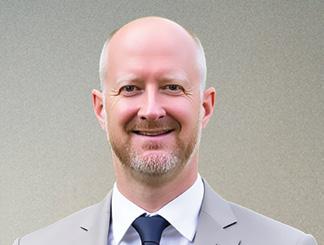
TODD MILLER CESM MAIES
Todd Miller is a leader and researcher in disaster and emergency management, with experience spanning government, academia, and community sectors. As Associate Director – Resilience at Auckland
Her expertise includes developing and implementing risk-based exercises, managing emergency response plans, and leading continuous improvement initiatives. With a Bachelor of Social Science in Emergency Management and multiple certifications in occupational health and safety, firefighting supervision, and prehospital care, Deb brings a comprehensive skill set to high-pressure environments. Her career has included leadership roles where she managed large teams and supported emergency response strategies.
Deb is known for her strategic thinking, calm leadership, strong communication skills, and ability to foster effective team dynamics. Deb is passionate about building resilient systems and teams and her commitment to safety, resilience, and innovation continues to drive improvements in emergency management practices across the mining sector.
University of Technology (AUT), he leads organisational resilience initiatives, business continuity planning, and the integration of emergency management systems aligned with national and international best practice.
Formerly Senior Advisor, Operational Readiness and Response at New Zealand’s National Emergency Management Agency (NEMA), Todd developed capability and partnerships for the alternate National Crisis Management Centre in Auckland, collaborating with agencies, lifeline utilities, iwi*, and local government. He is completing a PhD at AUT examining inter-organisational
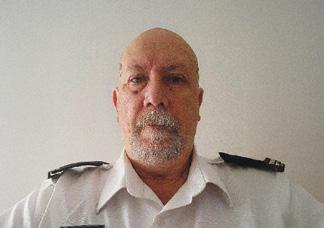
LARRY TING CESM MAIES
Congratulations to Larry Ting MAIES who recently joined the ranks of Certified Emergency Services Manager (CESM). Larry brings over 15 years of national and international experience in mining industry safety, risk management and emergency preparedness. He also has 30 years’ experience in vocational education in his role as Principal Advisor Safety with the NSW Rural Fire Service where he proudly supports a 70,000-strong membership of staff and volunteers. In addition to his AIES membership status, Larry is also a member of the Australian Institute of Health and Safety, and a Fellow of the Australian Institute of Training Development. We congratulate him warmly today for his ongoing professional contributions worldwide.
collaboration in New Zealand’s disaster and emergency management system through the Complex Adaptive Disaster and Emergency Management (CADEM) Framework.
A regular conference presenter and committee member for the Disaster and Emergency Management Conference (DEMC) 2026, Todd also contributes to European Union research projects such as the Indicators for Multi-Level Assessment of Disaster Resilience and Innovation Systems (IMLADRIS) consortium and mentors emerging professionals to strengthen adaptive, networked resilience across the sector.
Research from Black Dog Institute has revealed that global rates of PTSD among first responders are at record highs. Now more than ever, evidencebased support is needed to help first responders recover and thrive.
By Black Dog Institute
PTSD RATES IN FIRST RESPONDERS ARE RISING WORLDWIDE
Global rates of post-traumatic stress disorder (PTSD) among emergency service workers are now higher than ever before, according to a landmark new study from Black Dog Institute. Called ‘Global PTSD prevalence among active first responders and trends over recent years: A systematic review and meta-analysis’, the study provides the most comprehensive snapshot to date of first responder PTSD between 2008 and now.
The research shows that around 14% of all first responders have probable PTSD as a result of routine duties, a figure substantially higher than previous estimates of 10%.
Around 8% have probable PTSD specifically related to responding to disasters. Professionally employed first responders are generally at greater risk of PTSD than volunteers, likely due to increased exposure to potentially traumatic events.
PTSD is a mental health condition that develops in response to experiencing or witnessing a traumatic event. It is diagnosed based on of four types of symptoms that last for over a month. These include intrusive symptoms (e.g., involuntary and distressing memories, nightmares or flashbacks), avoidance of reminders of the event, negative changes in thoughts and feelings about yourself or the world, and feeling hyperalert (e.g., easy to anger or startle, difficulty sleeping).
Among first responders, PTSD is associated not only with serious
impacts on quality of life but also high levels of burnout and incapacity that can deplete this vital workforce.
“One of the most concerning findings is that rates of PTSD have worsened for a majority of first responders, despite significant international investment into the occupational mental health of this population,” says Dr Andrew Arena, a postdoctoral research fellow at Black Dog Institute and the study’s lead author.
INCREASING ACCESS TO EVIDENCE-BASED CARE
Previous research from Black Dog Institute and other organisations has identified trauma-focused cognitive behavioural therapy (TF-CBT) and eye movement desensitisation and reprocessing (EMDR) as the gold-standard treatments for first responder populations.
At Black Dog Institute’s National Emergency Worker Support Service, clinicians have delivered gold-standard treatment specifically designed to meet the unique needs of first responders. This approach has achieved longterm PTSD recovery rates of 70–80%, a figure double the recovery rates of some other specialised treatments.
However, despite the success of this approach, similar treatments are not broadly available. As an international leader in the field of first responder mental health, Black Dog Institute is now calling for improved access to evidence-based care for first responder communities.
“Right now, the mental health services available to this vital community are stretched very thin,” says Dr Arena.
“There is an urgent need to increase the availability of evidence-based support that can reduce trauma–related harm among these essential workers.”
Failing to deliver this support risks worsening the mental health outlook of first responders globally. According to Dr Arena, these professionals are already grappling with ongoing stigma around help-seeking, as well as the impacts of accumulated stress resulting from the COVID-19 pandemic and increasing natural disasters.
Black Dog Institute’s world-leading work in first responder mental health also has implications for global policy, providing important insights into how other countries can start adopting similar treatment PTSD approaches. This is particularly important in low- and middle-income countries where first responders are more vulnerable to PTSD.
First responder mental health remains a pressing global issue, and Black Dog Institute remains focused on research and innovation that makes a difference to this vital population. Connecting first responders to trauma-informed, evidence-based care matters not only for individuals but for their employers, colleagues, friends, families and the broader community.
“The public relies on first responders during times of crisis. We need to make sure they have access to the support they need, so that in turn, they can continue to support the communities they serve,” Dr Arena says. ●

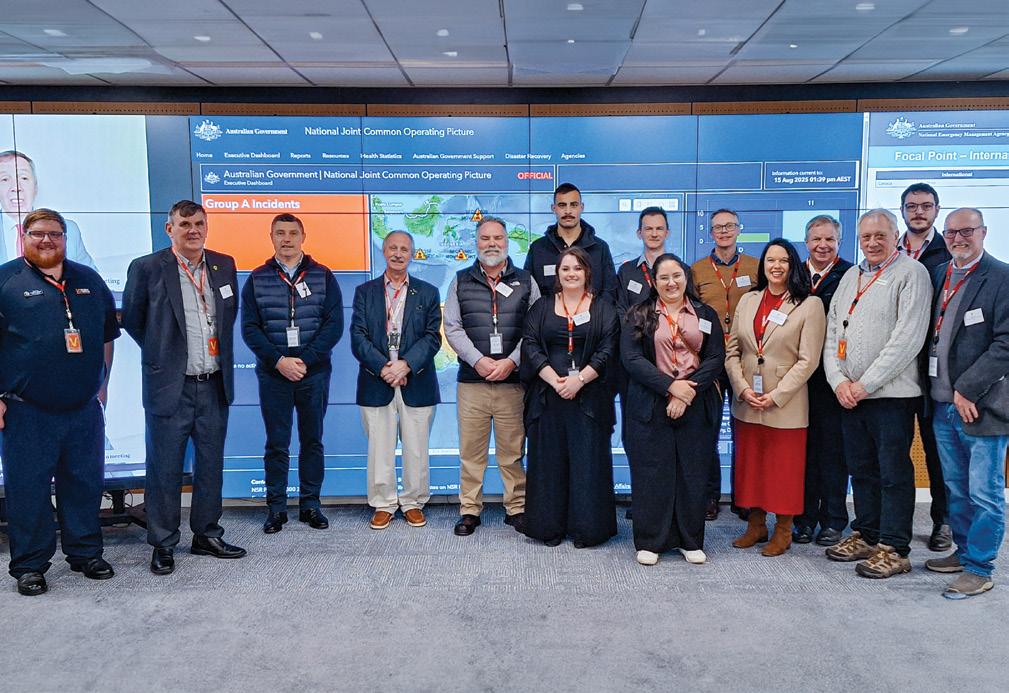
AIES members visit ACT ESA, NEMA, and AMSA to strengthen interagency collaboration and explore Australia’s emergency management capabilities.
By Tiffani King CESM MAIES
Members of the NSW/ACT/ International Division of the Australasian Institute of Emergency Services (AIES) recently undertook an engaging professional excursion through Canberra in August, visiting three cornerstone agencies in Australia’s emergency management network: the ACT Emergency Services Agency (ESA), the National Emergency Management Agency (NEMA), and the Australian Maritime Safety Authority (AMSA). The day offered participants an exceptional opportunity to connect with peers, gain insights into agency operations, and strengthen understanding of how local, state, and national functions interlink across response, recovery, prevention, and preparedness.
The day began at the ACT Emergency Services Agency, where the Territory Emergency Management Officer, Robert Kilpatrick, provided members with an in-depth briefing on the agency’s structure and Incident Management Team (IMT) functions. Attendees toured ESA’s coordination facilities and explored how the agency
integrates prevention, preparedness, response, and recovery operations across its key services, including ACT Fire & Rescue, the ACT Rural Fire Service, ACT Ambulance Service, and the ACT State Emergency Service. Robert highlighted how interoperability and teamwork underpin effective crisis management, noting that ESA’s approach relies on collaboration between government, volunteers, and community partners.
“Every response is built on preparation and connection; no single agency works in isolation.”
— Robert Kilpatrick, ACT ESA
The final session of the morning presentations was delivered by Assistant Director Strategic Planning for ACT SES, David Rose, who showcased the vital role volunteers play in supporting the ACT’s emergency response capability. David spoke about the SES’s wide-ranging responsibilities, from storm damage assistance and flood response to search and rescue
operations, and the strong community partnerships that underpin its success. Participants were particularly interested in how the SES integrates community education and volunteer training into its preparedness strategy, building local resilience before disaster strikes. David’s presentation reinforced the essential contribution of volunteers in maintaining safety and readiness across the ACT.
The group then visited the National Emergency Management Agency (NEMA), hosted by Acting Director Alex Mandziy, for an inside look at the National Situation Room which is the central coordination hub used during major national disasters. This was a highlight for many members to experience Alex explained how NEMA synthesises intelligence from states, territories, and federal partners to inform strategic decision-making during emergencies. Discussion focused on how NEMA is advancing community-led recovery, strengthening resilience through collaboration, and refining coordination mechanisms in light of lessons learned from recent large-scale natural disasters.
The final stop was at the Australian Maritime Safety Authority (AMSA), where Senior Search and Rescue Officer, Phil Gaden, provided an overview of Australia’s maritime emergency management system and global search and rescue coordination centre. Members learned how AMSA leverages satellite tracking, digital mapping, and international partnerships to manage incidents across one of the world’s largest search and rescue regions. Phil’s presentation offered a fascinating perspective on maritime incident response, demonstrating the scale and precision required to maintain safety across Australia’s vast coastal and oceanic zones.
The day concluded with a dinner at the Kingston Hotel, where members reflected on their experiences, shared stories, and strengthened connections made throughout the day. During the evening, AIES awards were presented, recognising members for their outstanding service and commitment to the emergency services profession.
The relaxed setting provided the perfect close to a day defined by learning, connection, and mutual respect among Australia’s emergency management professionals.
AUSTRALIA’S EMERGENCY MANAGEMENT COMMUNITY
The AIES extends its sincere thanks to Robert Kilpatrick (ACT ESA), Alex Mandziy (NEMA), David Rose (ACT SES) and Phil Gaden (AMSA) for their time, expertise, and hospitality. The excursion exemplified the importance of collaboration, communication, and continued professional development across the sector.
Through initiatives like this, AIES continues to foster stronger interagency relationships, promote shared learning, and enhance collective capacity to respond to Australia’s evolving emergency management challenges. ●
“Together, we strengthen capability, resilience, and the communities we serve.”
David Rose, ACT SES

AIES is proud to announce the first installment of our Academic Encouragement Series, designed to promote the work of students studying emergency management. To showcase their outstanding work, we will be publishing relevant assignments from students all over Australia to share their research with our readers.
By David Gellet MAIES
INTRODUCTION
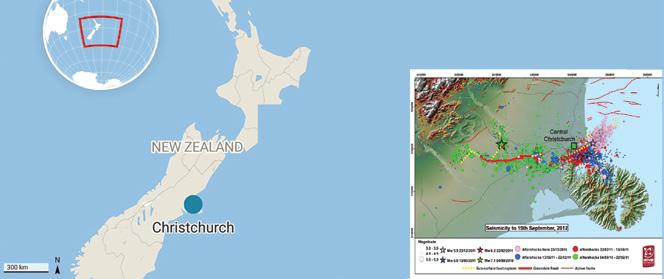
This assignment will examine the 2010-2011 Canterbury earthquake sequence in the south-island of New Zealand, commonly referred to as the 2011 Christchurch earthquake. This event commenced at 4.35am on 4 September 2010 with a magnitude 7.1Mw earthquake near the town of Darfield, in the Canterbury plains 40km west of Christchurch, and the sequence subsequently included the 6.3Mw Christchurch earthquake at 12.51pm on 22 February 2011. Both earthquakes lasted only a few minutes. Geologically, this event is still considered to be ongoing, where the probability for one or more Mw ≥ 6.0 earthquakes in the 50 years starting in September 2012 ranges from 50% to 93% (Christophersen et al., 2013).
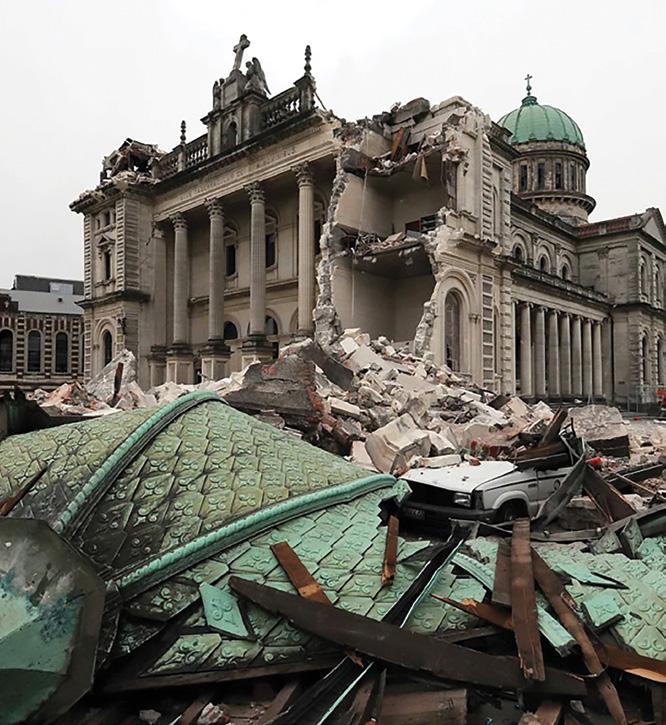
These earthquakes resulted in 185 deaths, 7,000 injuries, damage to 167,000 homes and destruction of much of the Christchurch central business district. The estimated cost for repairs and rebuilding was $40 billion NZD and took several years.
The Canterbury earthquake sequence was a disaster as it was “a serious disruption of the functioning of a community or a society at any
scale due to hazardous events interacting with conditions of exposure, vulnerability and capacity, leading to one or more of the following: human, material, economic and environmental losses and impacts.” (AIDR, n.d.).
Given New Zealand’s location in the Pacific Ring of Fire subduction zone, where the Australian and Pacific tectonic plates meet, the volatile geological nature of New Zealand results in high likelihood and consequences of natural hazards such as earthquakes and tsunami, and has resulted in higher community
awareness, better community emergency education and improved preparedness. These hazards have been clearly identified in the National Disaster Resilience Strategy (Ministry of Civil Defence & Emergency Management, 2019). Figure 2 shows the frequency of earthquakes over the past 65 years. The Canterbury earthquake sequence provided an opportunity to assess how effectively the preparedness and response skills and knowledge were deployed to a relatively well anticipated hazard.
One of the interesting aspects of events such as the Canterbury sequence, is that the time horizons
for emergency preparedness, response and recovery do not match up with the geological timeframes. The question then arises as to whether the Christchurch event should be treated as a separate event to the Darfield event from an emergency management perspective. Recognising and developing improved preparedness requirements for a potential future event, whilst an initial event is still in its recovery phase, is an important lesson to learn from these two events that occurred just over four months apart. For example, the establishment of improved legislative frameworks to coordinate both the response to a major event, as well as the recovery for the Darfield event, was implemented between these events, and subsequently further modified after the Christchurch event.
Given the substantial overlap of framework, policy and agency settings between New Zealand and Australia, the Canterbury sequence can provide valuable lessons within our local context. Understanding the different formal government structures, legislative settings and cultural variations is important to contextualise the decision-making processes.
An earthquake is “the sudden release of strain energy in the Earth’s crust, resulting in waves of shaking that radiate outwards from the earthquake source” (British Geological Survey, 2024). The scale of an earthquake is recorded by a seismographic network that measures the movement of ground
at multiple sites. Magnitude is the most common measure of an earthquake’s size, but the intensity (a descriptive shaking impact) of an event can also be described through the Mercalli scale. Magnitude is reported using the Moment Magnitude scale, built on the foundation of the Richter Scale, and records the largest amplitude reading within an event. The scale is logarithmic, so a 7.1Mw event is ten times stronger than a 6.1Mw event. (USGS, 2012).
Although the Darfield September event was an earthquake of significant scale with a magnitude of 7.1Mw at a depth of 10km and an intensity of X (extreme) on the Mercalli scale, the impact of the event was only moderate, due to the geographic context in which it occurred. It was the first significant earthquake to impact New Zealand in the ”internet age”, with implications for how information was collected and disseminated to the wider community (Gledhill et al., 2011).
Darfield is a sparsely populated agricultural region, with few buildings of more than two storeys, and there were no direct fatalities (with only two indirect fatalities recorded), however there was significant local land damage. The Darfield earthquake’s impact on Christchurch was only moderate, resulting in some minor building and infrastructure damage (Greater Christchurch Group, Department of the Prime Minister and Cabinet, 2017). As lead agency, local government authorities together with Civil Defence NZ, emergency services and community groups responded to ensure public safety and to support
the community. Although there were established response structures and plans, their implementation, coordination and communication was haphazard at times. Subsequent government inquiries identified and recommended ways to ameliorate these vulnerabilities.
The impact of the Christchurch event, a magnitude 6.3Mw earthquake at a shallow depth of 4.9km, registering at VIII (Severe) in intensity, only four and a half months later was significant, with its epicenter directly below Christchurch and occurring in the middle of a busy workday. The event resulted in the deaths of 185 people and injuring a further 7,000. 167,000 homes were damaged, representing approximately 90% of the local housing stock. Extensive structural collapse and severe damage to commercial buildings, particularly in the CBD, infrastructure and land (including significant liquification) resulted in further displacement of people, and ongoing mental health impacts on the community (Greater Christchurch Group, Department of the Prime Minister and Cabinet, 2017). Response efforts initially overwhelmed local government agencies, Civil Defence and emergency agencies, with a significant reliance on community engagement, even within specialised areas such as search and rescue.
A state of emergency was declared the following day to allow for better coordination of information and resources, and most of the CBD was cordoned off.
Beyond the severe structural damage in the CBD, there was
significant damage to infrastructure including roads, sewage and water supply. Communication systems were disrupted and response activities were undertaken within the context of ongoing aftershocks, many of which were considered significant in their own right.
Lessons learnt from the Darfield event were incorporated into the Christchurch response, and the government acted swiftly to declare a National State of Emergency and implement resultant improved command and control measures through the National Crisis Management Centre (NCMC), rather than local councils. Local Emergency Operations Centers (EOCs) provided information and coordination of the tactical implementation of the response strategies from NCMC. The establishment of the Canterbury Earthquake Recovery Authority (CERA) after the Darfield event was an important contributor to improved effectiveness and outcomes for the recovery efforts for both events.
Although the Canterbury sequence is considered a single geological event, from an emergency management perspective, it can be clearly delineated into the two separate but interconnected Darfield and Christchurch emergency events, having distinct and overlapping pre-impact, impact and post-impact phases.
Salient geographical, social, emergency management, operational and temporal scope aspects are highlighted within their pre-impact and impact contexts.
The primary pre-impact phase parameter for both events is the geological and geographic location of New Zealand on the Pacific Ring of Fire subduction zone, where the Australian and Pacific tectonic plates meet and interact, creating stresses in the earth’s geological crust. This parameter is based within a geological timescale. Figure 2 on page 25, highlights the regular and predictable likelihood of earthquakes occurring in New Zealand. Continuous seismic monitoring by the
Institute of Geological and Nuclear Sciences NZ provided an important source of information (GNS Science, 2019). Tsunami is also a known consequential hazard arising from an initial earthquake event.
European settlement and the subsequent urbanisation of New Zealand establish the demographics and population distribution of the Canterbury region. The 1840 Treaty of Waitangi between the Māori chiefs and the British Crown form the foundation of modern New Zealand governance. The integration of Iwi (Māori tribal) culture and engagement with general society is an important feature of New Zealand life.
Local governance was also an issue. In March 2010 the government replaced the elected Environment Canterbury Councilors with Crown based Commissioners following poor performance. There was also a breakdown in the relationship between local authorities and the Canterbury Civil Defence Emergency Management Group (Mclean et al., 2012).
The principal pre-impact legislative parameters for these events are the Civil Defence Emergency Management Act 2002 (NZ) and the Local Government Act 2002 (NZ). These form the basis of the standing emergency management arrangements in place prior to the Canterbury sequence events and incorporate planning and preparedness measures.
Given the known likelihood and consequences of natural earthquake and tsunami hazards, New Zealand has relatively broad and sophisticated public engagement and education systems in place. This is particularly well supported through strong Iwi community foundations.
An important pre-impact parameter for the February Christchurch event was the preceding Darfield event. Given the magnitude and location of the Darfield event, the likelihood of a significant subsequent earthquake in a similar location as part of a sequence was markedly increased. The response activities to the Darfield event, particularly the establishment and operations of CERA, are also important to the Christchurch event.
The impact phase for each of the two events commenced with the sudden onset seismic activity that occurred without warning. These times are well documented though the seismic records of the Institute of Geological and Nuclear Sciences NZ (GNS Science, 2019).
The Darfield event impact phase commenced at 4.35am on 4 September 2010 with a magnitude 7.1Mw earthquake at a depth of 10km and an intensity of X (extreme) on the Mercalli scale.
The Christchurch event impact phase commenced at 12.51pm on 22 February 2011 with a magnitude 6.3Mw earthquake at a shallow depth of 4.9km, registering at VIII (Severe) in intensity. The primary impact phase parameter for both events is the same geological and geographic parameters affecting the pre-impact phase. The geology of the crust at the Canterbury region is relatively thin Late Cretaceous to Cenozoic sedimentary and minor volcanic layers (12km) which resulted in the intensity of the events (Browne et al., 2012). The planning and preparation measures developed and implemented by local authorities and CDEM and incorporating other emergency services and community groups form the bedrock of the response activities in the impact phase. Due to the scale of impact from the Christchurch event, additional resources both nationally and internationally were necessarily utilised, including 600 Australian emergency services workers (Australian Institute for Disaster Resilience , 2011). The rural location of the Darfield earthquake, and its occurrence during the night, compared to the Christchurch earthquake, during a busy weekday whilst many people were in the CBD buildings so severely affected, presented very different issues to the response efforts.
With the exception of the 2011 amendments to CERA, the same governance and legislative parameters existed during the impact phase as to the pre-impact phase, with all the planning and preparation arrangements needing to be implemented. Again, the different scale and impacts of the two events presented different challenges, requiring differing response activities.
A wide variety of government and non-government agencies, together with community groups and individual citizens, played significant roles in the preparation and response to the Canterbury sequence event.
Primary emergency management agencies such as National Emergency Management Agency, Civil Defence Emergency Management, Hazard Risk Board, National Risk Register, local councils and core emergency services had formal and well defined roles and responsibilities prior to and once the events occurred. Strong public awareness and education of natural disaster events provided an important foundation for the broader assistance required in response and recovery, particularly to the more impactful Christchurch event.
The role of government and ministers to enact a declaration of emergency, and delegate authority and responsibility in a more focused and impactful manner was critical to the response and recovery efforts for the Christchurch event.
Indigenous Māori society comprises Iwi (tribes), hapū (clans or descent groups) and whānau (extended families), and made up 17.8% of the New Zealand population at the 2023 census (Stats NZ, 2024b). This high proportion of the population, together with the relatively homogenous communities between the Iwi (including a single unified language) and the historic formal peace treaties such as the Treaty of Waitangi (Te Tiriti o Waitang) have ensured that Māori culture is embedded within New Zealand culture, policy and institutions. Iwi are able to engage during emergency incidents with knowledge and skills to effectively respond to the physical event, but also to support the wellbeing of local communities. The Iwi maintain well established social structures that are invaluable in a time of crisis.
Due to the high likelihood and consequences of emergency management hazards in New Zealand, there is high community awareness of emergency management activities, good education and communication, as well as formal links between Civil Defence and community organisations.
There has been integration of emergency management education within the school curriculum, further improving community awareness. This is extremely valuable during an incident, improving community resilience, cohesion and helping the immediate and spontaneous public response efforts to be more structured and useful. This was clearly evident in the Darfield event with the emergent voluntary organisations like the Farmy Army, and again in the Christchurch event with the Student Army, and was highlighted in Civil Defence’s formal incident review (Mclean et al., 2012).
The population demographic and density differential between the Darfield and Christchurch events have been outlined above, as has the general history of earthquake likelihood in New Zealand.
Importantly, the Civil Defence post incident review concluded that “at the time of the earthquake the local civil defence emergency management (CDEM) structures were dysfunctionally divided and recovery from the 4 September 2010 earthquake had stalled.” (Mclean et al., 2012) and
there was poor cooperation with Christchurch City Council. The reappointment of John Hamilton to the previously delegated role of National Controller of CDEM was critical in reestablishing string command and control systems with clear roles and responsibilities. ●
David’s assignment will continue over the next two editions of National Emergency Response Journal. Part II will include Impact and Immediate Response and Part III will conclude the assignment by looking at Post-impact, Recovery and Lessons learned.
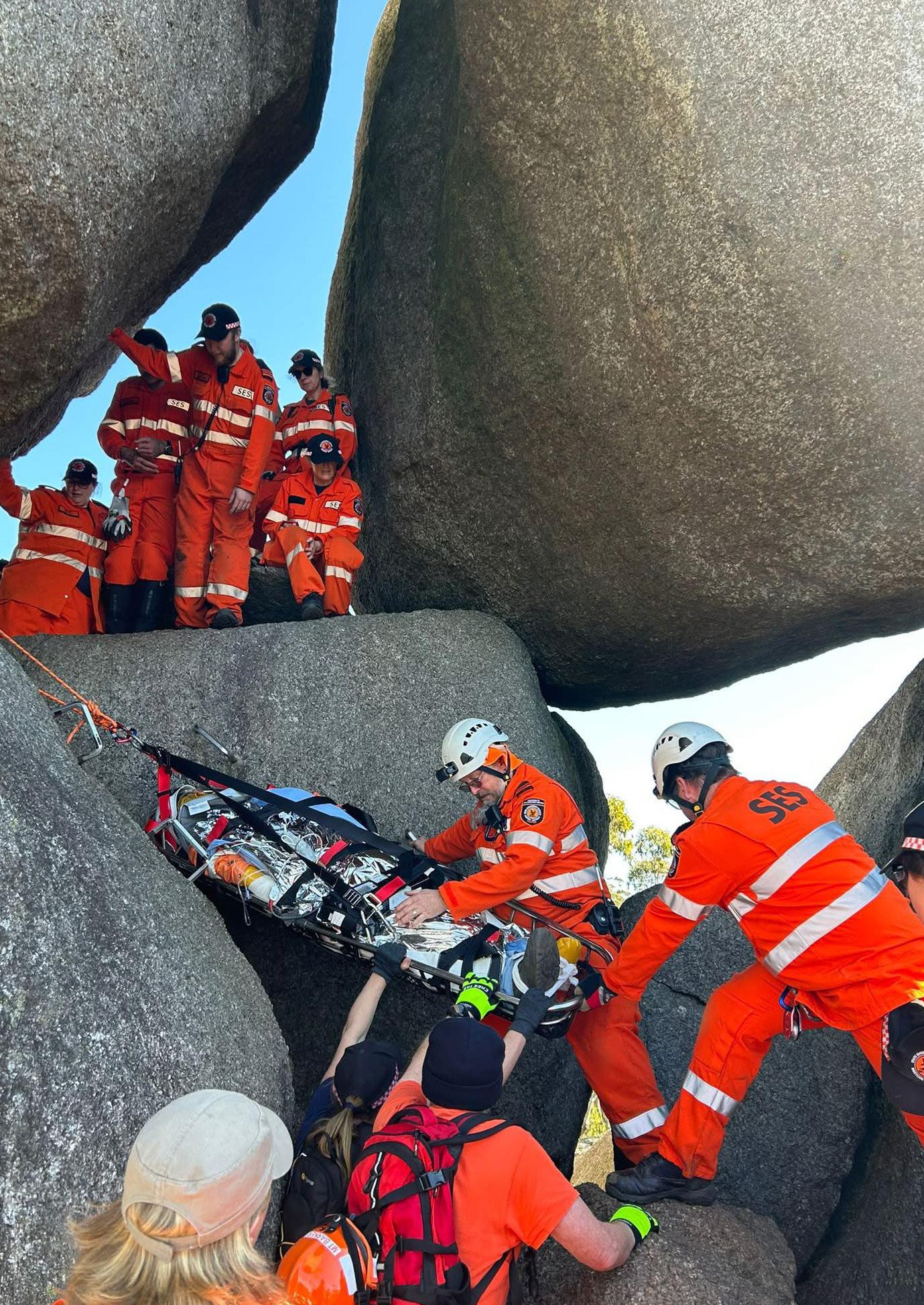
WA SES AND ST JOHN AMBULANCE WA TEAMED UP IN AUGUST FOR A SIMULATED EXERCISE INVOLVING A PATIENT RETRIEVAL FROM THE TOP OF CASTLE ROCK.
This includes:
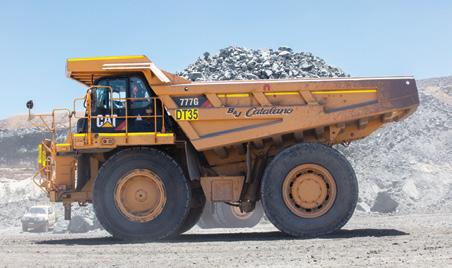
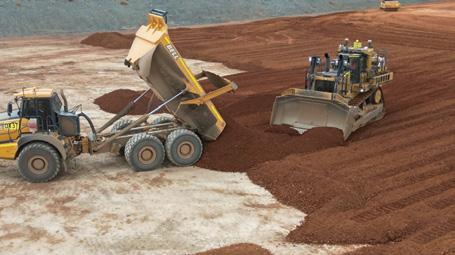
• Civil and mining services including wet and dry equipment hire
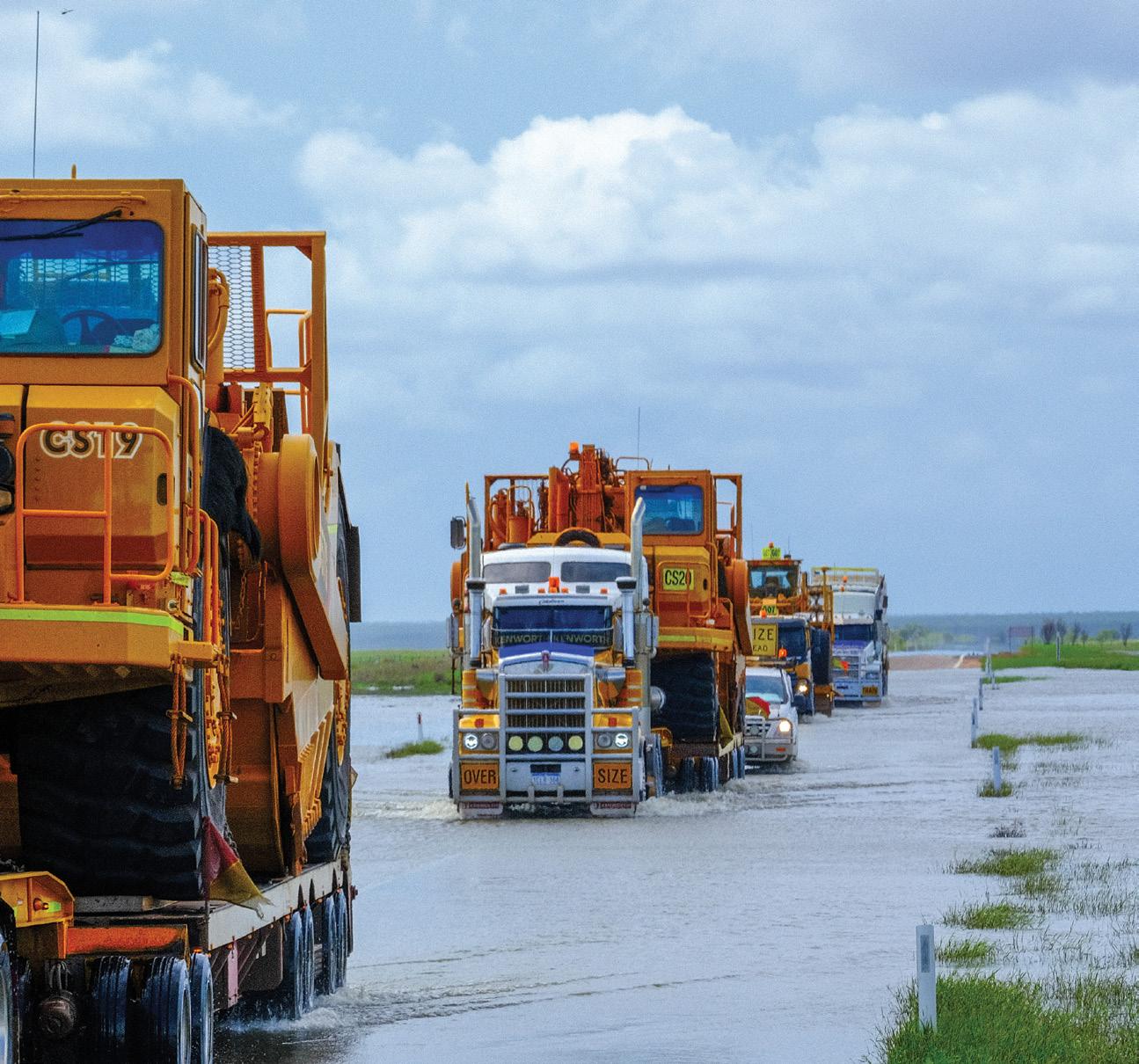
• Heavy haulage and transportation
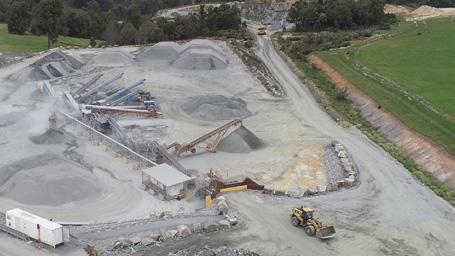
• Materials supply such as sand, gravel, limestone, and granite (includes road base materials to Main Roads WA specifications)
• Crushing services
• Bulk material handling and storage
• Port services (materials handling, loading and unloading)
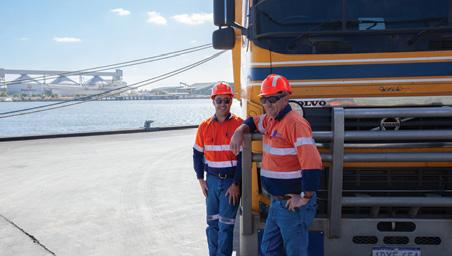
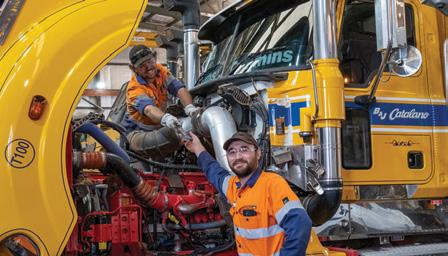
With over 60 years of continuous operation across Western Australia, B&J Catalano has built a reputation as one of the State’s trusted contractors and raw materials suppliers. We pride ourselves on delivering safe, efficient and cost-effective solutions that provide long-term value for our clients.
Through our workshops and depots located in Brunswick Junction and Perth, we operate a diverse fleet of modern and well-maintained earthmoving and haulage equipment capable of meeting a wide range of industry requirements.
Visit www.catalano.com.au for more information, or call us direct on (08) 9726 8100.
B&J Catalano Pty Ltd is a third-party ISO accredited business.


9726 8100
In recent months, we’ve had the privilege of meeting several recipients of the 2024 AIES National Awards and presenting them with their well-deserved honours in person.
By David Parsons ESM FAIES CESM AIES President
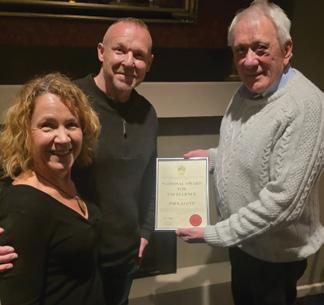
Recipient of an AIES Award for Excellence 2024
Across a career spanning more than two decades, Paul Lloyd has embodied the principles of emergency management — service, collaboration, and community resilience.
Paul began his journey with Fire & Rescue NSW, serving for 10 years as a retained firefighter, and later volunteered with the NSW State Emergency Service, contributing to road crash rescue and storm and flood response operations.
From 2000 to 2011, he worked in Wagga Wagga as a Garrison Firefighter with the Department of Defence, managing fire station operations and specialising in aviation firefighting, wildfire control, and structural fire protection at RAAF Base Wagga and the Kapooka Military Area.
In 2011, Paul was appointed Regional Emergency Management Officer for the Southern Region Command—a role he held with distinction for more than a decade. Under the NSW Emergency Management Arrangements, he focused on building trust and engagement across agencies,
local councils, and communities. Through clear communication and steady leadership, he consistently promoted a ‘comprehensive approach’ to emergency management, demonstrating how effective planning, prevention, response, and recovery are strengthened through collaboration.
Paul’s calm and compassionate leadership style brought people together to resolve complex challenges and foster innovation. His work inspired stronger interagency networks and improved public understanding of emergency management frameworks, contributing significantly to community resilience across New South Wales.
Even in retirement, Paul continues to champion the cause. As he travels with his wife, he studies the Emergency Management Plans (EMPLANs) of each region he visits— sharing insights and reflections that deepen understanding within his professional network. His commitment to continuous learning exemplifies the spirit of lifelong service.
A passionate advocate for mental health awareness, particularly among men and emergency service personnel, Paul approaches this sensitive topic with courage and authenticity—opening conversations that help break stigma and support wellbeing across the sector.
Respected by colleagues statewide, Paul’s enduring dedication to the NSW Emergency Management Arrangements and his tireless advocacy for the profession stand as testament to his integrity and leadership. His contributions—both in active service and beyond—make him a truly deserving recipient of recognition from the Australasian Institute of Emergency Services.
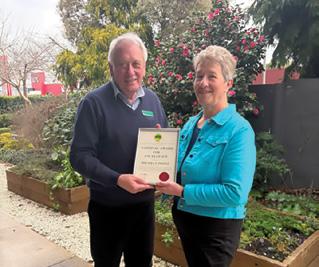
MICHELE POOLE MAIES, PUBLIC INFORMATION MANAGER FIRE AND EMERGENCY NEW ZEALAND
Recipient of an AIES Award for Excellence 2024
However nimble emergency managers are, we will always struggle to keep pace with the public’s need for information in a crisis.
Michele has been part of the evolving practice of public information management for over 25 years, acting as Public Information Manager in floods, fires, earthquakes, storms, and manmade hazards.
She has deployed to several of New Zealand’s most significant emergency responses, including the Christchurch and Kaikoura earthquakes, the wreck of the Rena, Cyclone Gabrielle, and the Port Hills fires.
During the 2020 COVID response, Michele swapped her purple vest for the red of a Response Manager, gaining a new perspective on the relationship between Control and PIM.
She is a member of the NZ Emergency Management Assistance Team, and Maritime NZ’s National Oil Spill Response Team, and she was deployed to Queensland in 2023 to support their bushfire response.
Michelle founded Emergency Management Public Affairs New Zealand Association and has contributed to training many Public Information Manager staff in New Zealand.
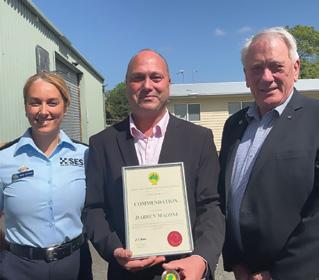
Recipient of a 2024 AIES National Commendation Award
Darren Malone was recognised for his outstanding contribution to public safety in the Illawarra through the Facebook group Illawarra Warnings, Incidents and Local Media Info, which he manages on a voluntary basis.
The group now has more than 70,000 members and is a trusted source of information, particularly during severe weather and other emergency events. Darren dedicates significant personal time to monitoring conditions, sharing accurate and timely updates, and ensuring that information is verified before it is posted. He routinely shares official warnings and advice from NSW SES and other local emergency services, and passes on community reports to the appropriate agencies, helping to ensure that emerging incidents are quickly brought to attention.
In doing so, Darren acts as an important link between the community and emergency services, helping to spread safety and preparedness messages to a wide audience. His calm, respectful and professional approach has built strong trust among group members and agencies alike.
As a regular community member, Darren’s sustained volunteer effort demonstrates a high level of civic responsibility and support for emergency services. His work has improved community understanding of local risks and contributed to a safer, better-informed Illawarra.
Darren was nominated for the award by Shellharbour City SES volunteer Nikki Ristovski.
Visit the page: https:// www.facebook.com/ share/8dp61tZUoVE7yi8T/
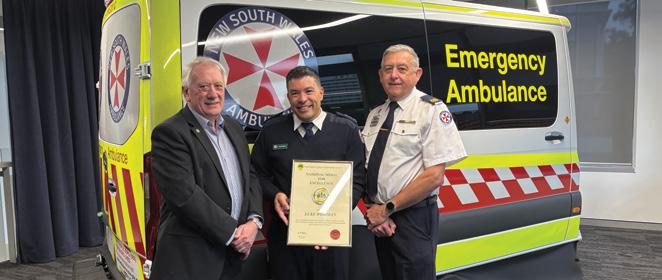
Recipient of the 2024 AIES National Award for Excellence
Among the distinguished professionals we recognised was Chief Superintendent Luke Wiseman, recipient of the AIES National Award for Excellence in 2024 — the highest honour bestowed by the Australasian Institute of Emergency Services.
Chief Superintendent Wiseman’s career reflects unwavering dedication to the people of New South Wales. Spanning more than two decades across nursing, firefighting, surf lifesaving and paramedicine, his contribution to community safety and emergency management is exceptional.
Luke began his career as a Registered Nurse (2001–2021), developing the clinical leadership and compassion that would underpin his later roles. For 20 years, he also served as a Retained Firefighter with Fire and Rescue NSW (2001–2021), responding to fires, rescues and hazardous incidents with courage and professionalism. In parallel, he volunteered as a Surf Lifesaving Patrol Member and Duty Officer (2000–2020), safeguarding
coastal communities and promoting public awareness of water safety.
For the past 15 years, Luke has been a Paramedic and senior leader with NSW Ambulance, where he now serves as Associate Director – Clinical Operations, Hunter New England Sector. His calm authority and collaborative focus were evident during one of the state’s most challenging incidents — the Hunter Valley bus crash.
In coordinating a complex, multi-agency response to one of regional Australia’s worst transport disasters, he led with empathy and precision, ensuring care for both victims and responders.
Beyond his operational leadership, Chief Superintendent Wiseman has advanced mental health and resilience initiatives across the emergency services sector. Recognising the lasting impacts of trauma, he champions psychological safety, post-incident support and interagency training to build stronger, more adaptive teams.
Luke’s career embodies the core values of the Australasian Institute of Emergency Services — excellence, education and community impact. His lifelong service and leadership continue to inspire all who dedicate their lives to protecting others.

By Aurora Jan MAIES
Contact: aurora.j.jan@gmail.com
Emergency management is a dynamic and evolving profession, encompassing preparedness and mitigation, response and recovery.
Characterised by its urgency, high stakes and visible action the response phase often receives the most attention; however, the other phases are equally as critical.
Preparedness and recovery efforts underpin the effectiveness of the response operations and contribute to long-term resilience of communities.
Professionals with experience in the operational and response phase bring valuable insights to resilience and recovery work.
However, transitioning from a fastpaced, high adrenaline environment to a strategic and policy-orientated environment presents unique challenges.
Settings such as frontline emergency services or incident control require rapid decision making and critical thinking to maintain order and safety. In contrast the shift to recovery and resilience roles often requires a different approach, one that is more reflective, systems orientated and focused on long term outcomes.
Drawing on lived experience and sectoral observations I aim to highlight some of the unique challenges such as identity shifts, communication barriers and structural adjustments that accompany this transition and propose strategies to better support professionals navigating this change.
Some of the key challenges include: loss of professional identity, isolation and network disruption, communication shift, and sense of urgency. In writing this article I investigated the current research around this transition and the benefits of operational experience in a strategic environment and how the transition effected the operator.
However, the current literature is limited due to the emerging nature of emergency management as a stand along profession.
There is limited research or academic writing about the challenges frontline staff face when moving to corporate or strategic roles, however anecdotally there is often conversations about this, and many have expressed their personal challenges with me. It is often commented that those not in the operational space are ‘out of touch’ and disconnected, I can say that working in that space I often felt the policy makers had no idea what happened on the ground. In moving out of operations myself I planned on working towards bridging the gap. My personal journey saw me moving from working as a Communications Supervisor with St John NT in Ambulance 000 communications centre, to emergency management with Red Cross then with Australian Government in an advisory role.
The first challenge that I encountered was the pace of work and apparent lack of urgency that I felt all my new colleagues lacked motivation, however on reflection it was more so, I was operating with the urgency as if lives were on the line.
Emergency communications especially in a health space is very much a life-or-death situation daily. Each job is different and almost every interaction has a level of urgency, quickly synthesising information from multiple sources and then ensuring the correct people attend.
In many cases there are clear cut protocols in place to support decision making, and where there isn’t a protocol, years of training mean that decisions are based on experience. This environment is often highly emotionally charged and requires

operators to be the ‘calm in the storm’, often resulting in close bonds with colleagues over shared experiences. In contrast, in the advisory role, I often felt initially that I was the only one who cared or that everyone else was subpar as they lacked urgency or apparent motivation.
Across the board in frontline operations there was a shared goal, minimal personal egos and strategic considerations in the decision-making process as it was reactive and focusing on the preservation of life. In contrast the strategy and governance space has seemed a complex webs of bureaucracy, nuanced interpersonal professional relationships and goals that come into every piece of work or decision.
The shift from clarity and urgency in an outcome driven environment to one governed by institutional complexity and slower timelines is a stark adjustment.
In frontline emergency services there is a trust, an empowerment, of the frontline operators whereas in governance and strategy the authority and decision-making lies higher up the chain with more levels of endorsement needed.
In navigating this I have had to develop ‘strategic patience’, I’ve learned
that the instinct to act or respond immediately often must be replaced by allowing space for reflection, negotiation and alignment. I have noted that sometimes decisions or advice from a conversation given one day may change to the next and that sometimes there needs to be time allocated for ideas to settle and stakeholders to shape their response.
This shift in decision making not only affect decisions but also how colleagues and professionals communicate and build networks as well as defining their role within the broader emergency management system.
Moving from ‘does’ to an ‘advisor’ can feel like a loss of purpose, where operational roles are action orientated and often have tangible outputs; policy roles are often influence orientated.
Our identity is closely linked to our work and moving to an emerging field along with a transition can be particularly challenging. This transition may cause imposter syndrome or foster
self-doubt or regret at leaving the operational space.
For me navigating this identity shift was about reframing my worth from immediacy to impact and consciously working on building a new network to support me in this journey. This transition was specifically challenging due to the emerging nature of the emergency management profession with many colleagues viewing the portfolio as an enigma.
Following the transition there is a period of network rebuilding, and isolation where policy and governance work can feel increasingly siloed stark comparison to frontline work.
During this period, it is important to actively work on building the professional networks and engaging in social events in the workplace, unlike the emergency operational space where relationships for hard and fast strategic networks take time and need intentional effort.
Professional bodies such as AIES and other social groups can be crucial in maintaining sanity in the middle of what can be a very isolating transition. During this transition I had to make a conscious effort to step outside my comfort zone to attend conferences or trivia nights, as well as keeping in regular touch with previous operational colleagues.
This transition is more than a career shift, it is a transformation of mindset, identity and professional rhythm. While the policy and strategy space has many opportunities for long-term impact it also has many competing demands and requires a redefinition of purpose. It is important to acknowledge the emotional and professional challenges of this transition to support ourselves or others through it.
As the emergency management profession continues to grow and evolve it will be integral to integrate frontline experience into the policy and strategy sphere to shape resilient systems that reflect both strategic insight and lived experience. ●

By Wonthaggi Life Saving Club
Sources: RLSSA; SLSA National Coastal Safety Report 2025
“If your children quit lessons before seven (years old), a second dose at age 10 could be a lifesaving decision.” Dr Justin Scarr, Royal Life Saving Society Australia.
As summer approaches, families flock to pools, rivers, and beaches to cool off, serving as a good reminder that water safety is a lifelong journey.
New research is now urging parents to look beyond early swimming lessons and consider a ‘second dose’ of water safety education before children enter high school.
The Royal Life Saving Society Australia (RLSSA) and Surf Life Saving Australia (SLSA) data confirm that both pre-teens and teens and older Australians face preventable drowning risks. Lifesaving clubs, emergency services, and families can reduce risk by promoting multi-stage water competence from refresher lessons for youth to programs for older adults.
The RLSSA and SLSA highlight a growing concern: a generation of young people and older Australians are at increased drowning risk.
RISE IN TEENAGE DROWNING RISKS
• Drowning risk among 10–20-yearolds has risen by 1300% from childhood to late teens
• Over 10 million swimming lessons missed during the pandemic.
• A 34% increase in drowning deaths amongst 15–20-year-olds since the COVID-19 pandemic.
WHY FIRST LESSONS ARE NOT ENOUGH
• Early lessons build foundations, but stopping too young leaves gaps
• Adolescents face increased risk in rivers, beaches, and unsupervised settings
• Older adults face higher risk due to solitude, medical conditions, and decreased physical ability
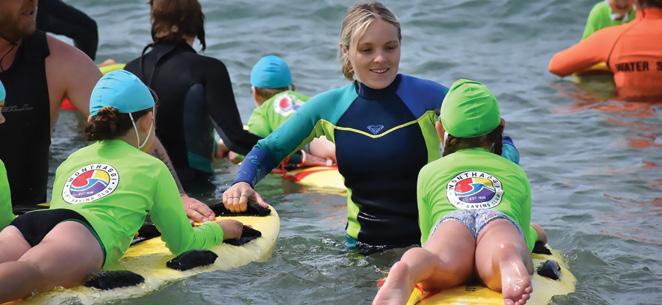
WHAT FAMILIES AND EMERGENCY AGENCIES CAN DO
1. Promote a second dose ( age 10) of lessons - swim 50 metres, float 2 minutes, escape rip currents.
2. Coastal safety messaging - swim between red and yellow flags. Never swim alone or under alcohol influence.
2025 NATIONAL COASTAL DROWNING DATA
3. Support older swimmers - programs like ‘Silver Salties’ provide fitness, confidence, and social connection.
4. Partner with clubs and schools - offer refresher lessons for preteens, teens, and older adults.
5. Extend messaging beyond the flags - Emphasise that most drownings occur unpatrolled.



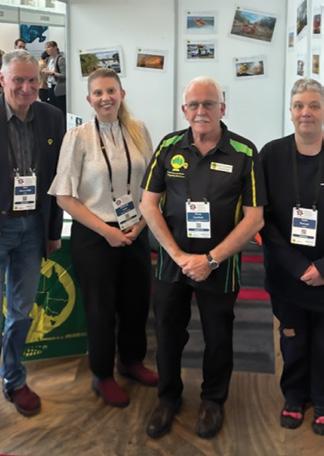
Iwas fortunate to attend the Disaster and Emergency Management Conference (DEMC) 2025 on the Gold Coast, supported by a scholarship from the Australasian Institute of Emergency Services (AIES).
This opportunity allowed me to engage in thought-provoking discussions, gain valuable insights, and connect with professionals from across the emergency management sector — all of which will enhance both my paid role and my volunteer work.
The conference featured an impressive range of presentations, each offering unique perspectives on current and emerging challenges in disaster and emergency management.
One of the standout presentations for me was the VicEmergency Plus Pilot Project, which explored the translation of emergency warnings into plain language for culturally and linguistically diverse communities in Victoria. This innovative approach has clear applications, not only within the emergency management sector but also across health services and community engagement strategies. It sparked ideas on how we can ensure that critical information is accessible and easily understood by all, particularly in high-stress situations.
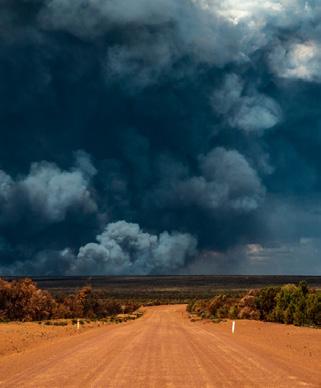
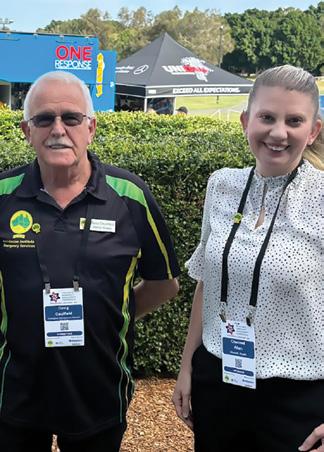
Another highlight was the presentation by the City of Gold Coast on flood watch and warning systems implemented during Cyclone Alfred. The city’s proactive and community-centric approach to communicating flood risks provided practical insights that could be replicated in other regions vulnerable to flooding events. It was fascinating to see the intersection of technology, community awareness, and emergency response come together in this context.
Cyber resilience was another critical theme of the conference. The session on Embedding Cyber Resilience in Emergency Response and Recovery on day one was particularly insightful. It offered a deeper understanding of the cyber threats that can undermine emergency operations and community safety. The ensuing discussion was rich with ideas on how to integrate cyber considerations into existing response frameworks. This is an area I’m keen to explore further within my organisation to strengthen our overall resilience.
Beyond the presentations, the exhibition space showcased a wide array of emergency management equipment, solutions, and services. It was valuable to see innovations in the sector and
explore practical tools that can support both operational and strategic efforts in emergency preparedness and response. No conference experience is complete without acknowledging the coffee cart — a popular and much-appreciated sponsor! It not only kept everyone energised throughout the days but also became an informal meeting point where engaging conversations continued between sessions.
Personally, the conference was also an opportunity to reconnect with familiar faces — old friends, colleagues, and peers from across the sector — and to build new professional connections. These moments of networking are just as valuable as the formal sessions, as they foster collaboration and knowledgesharing beyond the conference itself.
Attending the Disaster and Emergency Management Conference has reinvigorated my passion for the sector. I left with practical takeaways that I can embed in both my paid role and my volunteer contributions. I sincerely thank the AIES for supporting my attendance. It was a professionally enriching and personally rewarding experience. ●





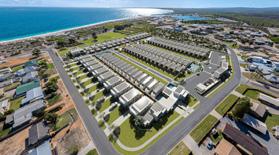



Making a call to Triple Zero (000) for a life threatening or time-critical emergency is something most of us learn how to do when we first use a phone. But do you know how a Triple Zero call actually works?
By Mark A Gregory www.theconversation.com
While it might seem simple, there are many steps involved between you calling Triple Zero, and paramedics, police or firefighters arriving to help. And as the recent Optus Triple Zero outage that left multiple people dead highlights, there are also several points of potential failure.
First, some important background.
The federal government is responsible for telecommunications nationally. It has put in place legislation and regulations for the operation of Emergency Call Services –the technical term for Triple Zero.
The Australian Communications and Media Authority regulates and monitors the provision of Triple Zero under Part 8 of the Telecommunications (Consumer Protection and Service Standards) Act 1999.
The very first step in the process is, of course, a person making a call to Triple Zero – or the international emergency number (112). People with a speech or hearing impairment can also use the 106 text-based service, provided by the National Relay Service.
You don’t need a sim card to call Triple Zero – nor a plan with a mobile phone company. However, you do need to be within an area with some network coverage.
Mobile phones connect to phone towers using radio waves that oscillate at a frequency within one of the
spectrum bands allocated for mobile networks. The transmission equipment located on the phone tower receive the signal being carried on the radio waves and convert it into digital data. This data is then carried across the mobile phone core network via optic fibres (or sometimes microwaves or satellite) to its destination.
Sometimes your network provider – for example, Optus, Vodafone/TPG or Telstra – may have no coverage where you are, but another network provider will. If this case, you will see an “Emergency calls only” message on your phone, and your call will be sent through an alternative network. This process is known as “camp-on”.
But this process can sometimes fail, as the recent Optus outage demonstrated. It was caused by an upgrade to a key system which only affected the Triple Zero network – not the regular network. Optus’s mobile towers did not stop transmitting – or, in technical terms “wilt”. This prevented Optus phones from connecting to the Telstra or Vodafone mobile networks to make Triple Zero calls.
This was similar to another Optus Triple Zero outage – one that thankfully didn’t have fatal consequences – that occurred in November 2023 that resulted in a national outage of the entire Optus network.
But if you find yourself within the 5 million square kilometres of Australia currently without any mobile coverage at all, you will not be able to make a Triple Zero call.
The Triple Zero call (provided it goes through) then goes to the nominated emergency call service operator in Australia – currently Telstra. It is responsible for the system that connects calls from the telecommunication carrier networks to the state and territory emergency service organisations. To fulfil this responsibility, Telstra has Triple Zero emergency service call centres located around Australia.
After answering the Triple Zero call, a call centre operator will ask the caller about the emergency at hand, then transfer them to the relevant emergency service organisation, such as the ambulance, fire or police.
Trained personnel will then handle the call and dispatch an emergency response team.
A review of the November 2023 Optus national outage identified the need for a Triple Zero custodian. The custodian would be responsible for overseeing the efficient functioning of the Triple Zero ecosystem, including monitoring the endto-end performance of the ecosystem.
Earlier this week, the federal government introduced legislation to parliament to enshrine the powers of the custodian into law. Under this legislation, the custodian will be able to demand information from telecommunications companies such as Optus. This will enable it to not only monitor Triple Zero performance, but also identify risks and respond more quickly to outages.
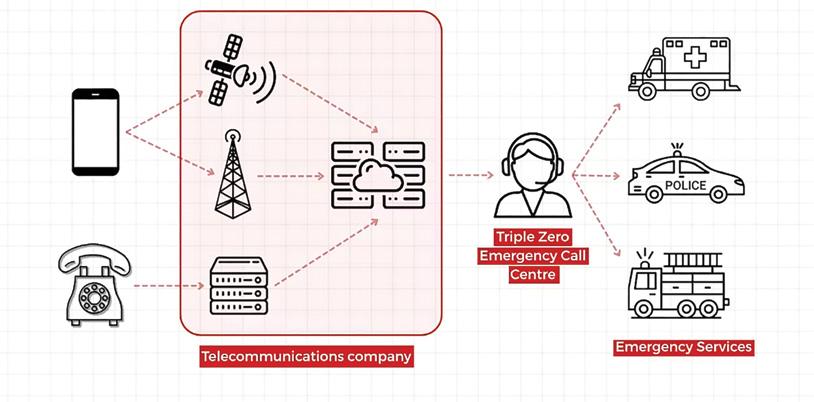
While it might seem simple, there are many steps involved between you calling Triple Zero, and paramedics, police or firefighters arriving to help. The Conversation, CC BY
Direct-to-device mobile technology is also currently being developed which will enable calls to Triple Zero that are connected through Low Earth Orbit satellites. This will be a major improvement to safety nationwide – particularly for people living in regional and remote areas, and during emergencies such as fires and floods.
Earlier this year, an amendment to the Telecommunications Act 1997 passed Parliament that enhances consumer safeguards. These safeguards include strengthening mobile network operator obligations.
Last month the federal government also released draft legislation for a
universal outdoor mobile obligation. This would require mobile operators to provide reasonable and equitable access to outdoor mobile coverage across Australia.
So hopefully in the next couple of years, Australians should be able to make calls to Triple Zero – no matter where they find themselves. ●
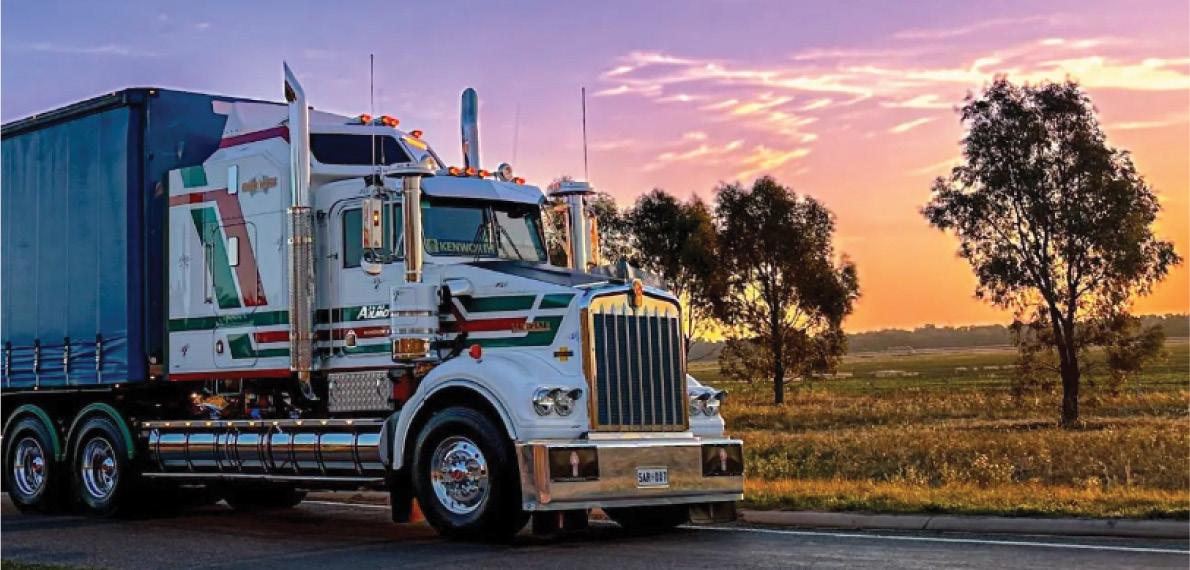

By Michelle Gillman MAIES, Aotearoa (New Zealand)
This book list began after great conversations at JCDR’s Emergency Management Institute in March 2025, sparked by a talk from AIES President David Parsons CESM FAIES ESM on learning from past events. I shared a form online inviting recommendations for must-read books for emergency managers and students. Here are some of the books on the growing list. We will keep publishing titles over the coming editions of National Emergency Response Journal.
102 minutes: The untold story of the fight to survive inside the Twin Towers, Jim Dwyer and Kevin Flynn, 2005
A crack in the edge of the world, Simon Winchester, 2005
A furious sky: The five-hundred-year history of America’s hurricanes, Eric Jay Dolin, 2020
A paradise built in hell. The extraordinary communities that arise in disaster, Rebecca Solnit, 2009
A river with a city problem: A history of Brisbane floods, Margaret Cook, 2019
A very short, fairly interesting and reasonably cheap book about studying leadership, Brad Jackson & Ken Parry, 2007
Alive: The story of the Andes survivors, Piers Paul Read, 1974
Antidote to the crisis of leadership: Opportunity in complexity, Stephen Wyatt, 2024
Antifragile: Things that gain from disorder, Nassim Nicholas Taleb, 2012
Atomic accidents. A history of nuclear meltdowns and disasters: from the Ozark Mountains to Fukushima, James Mahaffey, 2014
Breach of faith: Hurricane Katrina and the near death of a great American city, Jed Horne, 2006
Break point: SAS: who dares wins, Ollie Ollerton, 2019
Human-induced Terrorism
Natural hazards Earthquake
Natural hazards Hurricane
Natural hazards Community resilience
Natural hazards Flood
Human capability Leadership
Human-induced Aviation
Human capability Leadership
Human capability Leadership
Human-induced Nuclear
Natural hazards Hurricane
Human-induced Conflict
Call sign chaos: Learning to lead, Bing West and James N. Mattis (General), 2019 Human capability Leadership
Cascadia’s fault: the coming earthquake and tsunami that could devastate North America, Jerry Thompson & Simon Winchester, 2011
Challenger: A true story of heroism and disaster on the edge of space, Adam Higginbotham, 2024
Natural hazards Earthquake
Human-induced Space







The AIES now has polo shirts and caps available for purchase. Pictures of the shirts and caps are shown below.
To make an order:
• Complete and return this order form to the following email address: treasurer@aies.net.au
• or post to PO Box 2469, Chermside Centre, Qld 4032
• or by telephoning 0418 726 224 (after business hours)
Inquiries are to be directed to treasurer@aies.net.au or by telephoning 0418 726 224.
Allow 4-5 weeks for delivery as some sizes may not be in stock.
Invoice for payment will be issued once goods are in stock.
ORDER FORM
NATIONAL BOARD
Company Secretary
Email: secretary@aies.net.au
National website: www.aies.net.au
NEW SOUTH WALES, AUSTRALIAN CAPITAL TERRITORY AND INTERNATIONAL
The Secretary
NSW Division of Australasian Institute of Emergency Services
Email: secretary.nsw@aies.net.au
QUEENSLAND AND NORTHERN TERRITORY
The Secretary
QLD Division of Australasian Institute of Emergency Services
Email: secretary.qld@aies.net.au
SOUTH AUSTRALIA AND WESTERN AUSTRALIA
The Secretary
SA Division of Australasian Institute of Emergency Services
Email: secretary.sa@aies.net.au
Please forward all mail for all divisions to:
Australasian Institute of Emergency Services PO Box 2469, Chermside Centre, Qld 4032
THE INSTITUTE’S AIMS
To provide a professional body for the study of the roles and functions of Emergency Services and Emergency Management Organisations throughout Australasia, and the promotion and advancement of professional standards in these and associated services.
THE INSTITUTE’S OBJECTIVES
• To raise the status and advance the interests of the profession of emergency management and counterdisaster services administration.
• To represent generally the views and interests of the profession and to promote a high standard of integrity and efficiency in the skills of emergency and counter-disaster administration.
• To provide opportunities for association among members and students to promote and protect their mutual interest.
• To facilitate full interchange of concepts and techniques amongst members.
• To bring to the notice of the public such matters that are deemed to be important for safety and protection of the community and to promote research and development of emergency services generally.
• To establish a national organisation to foster international co-operation in counter-disaster services administration. THE INSTITUTE OFFERS
• An opportunity to be part of a progressive Australasiawide Institute dedicated to the progression and recognition of the Emergency Service role in the community.
• An independent forum where you can be heard and your opinions shared with other emergency service members.
• A journal with information from institutes and other sources around the world in addition to the interchange of views between Divisions in Australia, as well as access to the Institute website.
• Reduced fees for members at Institute Seminars and Conferences and an information service supplied by professional experienced officers.
• A Certificate of Membership.
• The opportunity to use the initials of the particular membership status after your name.
• Corporate members receive a plaque free of charge and can advertise on the AIES website, as well as provide articles for inclusion in the Institute’s journal.
TASMANIA
The Secretary
TAS Division of Australasian Institute of Emergency Services
Email: secretary.tas@aies.net.au
VICTORIA
The Secretary
VIC Division of Australasian Institute of Emergency Services
Email: secretary.vic@aies.net.au
Annual Subscription: $80 Fellows: $100
Corporate Subscription: $500
Note: Institute Fees may be tax deductible.
CLASSES
There are four classes of membership:
• Members • Fellows • Life Fellows • Corporate There are five categories of affiliation with the Institute that may be offered to persons who do not meet the requirements for membership:
• Associate • Student Member • Retired Member
• Honorary Member • Honorary Fellow
ELIGIBILITY
Applications for membership will be considered from persons who are at least eighteen years of age and who:
• Are members of a permanent emergency service or associated service, or
• Are volunteer members of emergency or associated services.
Admission as a member may be granted if in the opinion of the General Council the applicant meets all other conditions of membership and passes such examinations and/or other tests as may be required by General Council.
MEMBERS
Our members come from
• Ambulance Service • Community Services • Emergency Equipment Industry • Emergency Management Organisations
• Fire Services • Surf Life Saving • Health, Medical and Nursing Services • Mines Rescue • Police and law enforcement agencies • Safety Officers • SES • Transport Services • Volunteer Marine Rescue • Volunteer Rescue Associations
General Enquiries
NATIONAL BOARD
President
David Parsons CESM FAIES ESM
Immediate Past President
Steve Jenkins FAIES
Vice President
Rebecca Hunt MAIES
Company Secretary
Marilena Salvo
National Treasurer
Jenny Crump FAIES
Webmaster/Systems Administrator
Costa Zakis FAIES
Email: enquiries@aies.net.au PO Box 2469, Chermside Centre, Qld 4032
Email: president@aies.net.au
Email: steve.jenkins@aies.net.au
Phone: 0412 753 790
Email: vice.president@aies.net.au
Phone: 0438 844 316
Email: secretary@aies.net.au
Email: treasurer@aies.net.au
Phone: 0418 726 224
Email: webmaster@aies.net.au
Phone: 0414 606 538
NEW SOUTH WALES, AUSTRALIAN CAPITAL TERRITORY AND INTERNATIONAL
President
Brett Henderson CESM MAIES
Vice President
Dwight Robinson CESM MAIES
Secretary
Ian Manock FAIES
QUEENSLAND AND NORTHERN TERRITORY
President
John Moy MAIES
Secretary/Treasurer
Jenny Crump FAIES
SOUTH AUSTRALIA AND WESTERN AUSTRALIA
President
Shane Bolton CESM FAIES
Vice President
Corey Frazer MAIES
Secretary
Warren Erasmus CESM MAIES
TASMANIA
President
Vanessa Henry MAIES
Vice President
Bodie Rodman MAIES
Secretary
Greg Webster RFD MAIES
VICTORIA
President
Doug Caulfield OAM RFD FAIES MIAEM
Vice President
Kate Goldsmith CESM FAIES MIAEM
Secretary
Bill Little FAIES MIAEM
NATIONAL EMERGENCY RESPONSE JOURNAL
Editor
Kristi High
Email: president.nsw@aies.net.au
Phone: 0418 273 917
Email: vicepresident.NSW@aies.net.au
Email: secretary.nsw@aies.net.au
Phone: 0438 050 957
Email: president.qld@aies.net.au
Phone: 0437 550 371
Email: secretary.qld@aies.net.au
Phone: 0418 726 224
Email: president.sa@aies.net.au
Email: vicepresident.sa@aies.net.au
Email: secretary.sa@aies.net.au
Email: president.tas@aies.net.au
Email: vice.president.tas@aies.net.au
Email: secretary.tas@aies.net.au
Email: president.vic@aies.net.au
Email: vice.president.vic@aies.net.au
Email: secretary.vic@aies.net.au
Email: editor@aies.net.au
Phone: 0407 366 466