COUNTRY
Serving Marine on St. Croix, Scandia, May Township
WEDNESDAY, JANUARY 6, 2016 VOL. 32 NO. 36 www.countrymessenger.com $.75
TIME ATLAS: Scandia singer-songwriter courts success with new band. PAGE 6
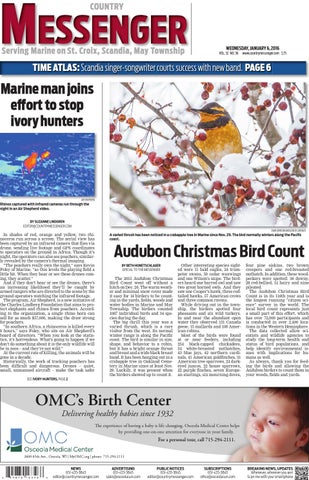
Marine man joins effort to stop ivory hunters
AIR SHEPHERD
Rhinos captured with infrared cameras run through the night in an Air Shepherd video.
BY SUZANNE LINDGREN EDITOR@COUNTRYMESSENGER.COM EVAN JOHNSON AND GENE DI LORENZO
In shades of red, orange and yellow, two rhinoceros run across a screen. The aerial view has been captured by an infrared camera that flies via drone, sending live footage and GPS coordinates to operators on the ground in Africa. Though it’s night, the operators can also see poachers, similarly revealed by the camera’s thermal imaging. “The poachers really own the night,” says Kevin Foley of Marine, “so this levels the playing field a little bit. When they hear or see these drones coming, they scatter.” And if they don’t hear or see the drones, there’s an increasing likelihood they’ll be caught by armed rangers who are directed to the scene by the ground operators watching the infrared footage. The program, Air Shepherd, is a new initiative of the Charles Lindberg Foundation that aims to protect elephants and rhinos from poachers. According to the organization, a single rhino horn can sell for as much $57,000, making the draw strong for poachers. “In southern Africa, a rhinoceros is killed every 8 hours,” says Foley, who sits on Air Shepherd’s board of directors. “When you look at the statistics, it’s horrendous. What’s going to happen if we don’t do something about it is the only wildlife will be in zoos – and they’re not wild.” At the current rate of killing, the animals will be gone in a decade. Historically, the work of tracking poachers has been difficult and dangerous. Drones – quiet, small, unmanned aircraft – make the task safer
A varied thrush has been noticed in a crabapple tree in Marine since Nov. 29. The bird normally winters along the Pacific coast.
Audubon Christmas Bird Count BY BETH HONETSCHLAGER SPECIAL TO THE MESSENGER
The 2015 Audubon Christmas Bird Count went off without a hitch on Dec. 26. The warm weather and minimal snow cover made it easy for 14 birders to be counting in the yards, fields, woods and water bodies in Marine and May Township. The birders counted 1087 individual birds and 34 species during the day. The big thrill this year was a varied thrush, which is a rare visitor from the west. Its normal winter range is along the Pacific coast. The bird is similar in size, shape, and behavior to a robin, but it has a bright orange throat and breast and a wide black breast band. It has been hanging out in a crabapple tree in Oakland Cemetery in Marine since at least Nov. 29. Luckily, it was present when the birders showed up to count it.
Other interesting species sighted were 11 bald eagles, 24 trumpeter swans, 59 cedar waxwings and one Wilson’s snipe. The birders heard one barred owl and saw two great horned owls. And they saw one Cooper’s hawk, three redtailed hawks, 57 American crows and three common ravens. While driving out in the township, the birders spotted four pheasants and six wild turkeys. In and near the abundant open water they observed 151 Canada geese, 15 mallards and 108 American robins. Most of the birds were found at or near feeders, including 254 black-capped chickadees, 54 white-breasted nuthatches, 43 blue jays, 42 northern cardinals, 41 American goldfinches, 31 American tree sparrows, 24 darkeyed juncos, 22 house sparrows, 22 purple finches, seven European starlings, six mourning doves,
four pine siskins, two brown creepers and one red-breasted nuthatch. In addition, these woodpeckers were spotted: 36 downy, 28 red-bellied, 14 hairy and nine pileated. The Audubon Christmas Bird Count is in its 116th year and is the longest running “citizen science” survey in the world. The local bird count represents just a small part of this effort, which has over 72,000 participants and is conducted in over 2,400 locations in the Western Hemisphere. The data collected allow scientists and wildlife agencies to study the long-term health and status of bird populations, and help identify environmental issues with implications for humans as well. As always, thank you for feeding the birds and allowing the Audubon birders to count them in your woods, fields and yards.
SEE IVORY HUNTERS, PAGE 2
OMC’s Birth Center
Delivering healthy babies since 1932 The experience of having a baby is life changing. Osceola Medical Center helps by providing one-on-one attention for everyone in your ur family.
For a personal tour, call 715-294-2111. 294-2111.
NEWS 651-433-3845 editor@countrymessenger.com
ADVERTISING 651-433-3845 sales@osceolasun.com
PUBLIC NOTICES 651-433-3845 editor@countrymessenger.com
SUBSCRIPTIONS 651-433-3845 office@osceolasun.com
BREAKING NEWS, UPDATES Whenever, wherever you are! Scan me with your smartphone