COUNTRY
WEDNESDAY, APRIL 6, 2016
Serving Marine on St. Croix, Scandia, May Township
VOL. 32 NO. 48 www.countrymessenger.com $.75
SURVIVAL OF THE BIRDS: adapting to climate changes. PAGE 5
Plans take shape for upgrades at Scandia Elementary BY SUZANNE LINDGREN EDITOR@COUNTRYMESSENGER.COM
Though there won’t be many visible changes when Scandia Elementary School students return to their pencils and books in Sept. 2018, the classrooms they walk into will not only be more energy efficient, says architect Marc DuBois, they’ll be more conducive to learning. DuBois is the architect in charge of planning changes for elementa-
ry schools in the Forest Lake district, where voters approved a facilities-upgrade bond last November. Some changes, namely a locked entrance vestibule and bathrooms that meet requirements set by the Americans with Disabilities Act, will be obvious. Others – new windows and a new system for heating, ventilation and air conditioning (HVAC) – are subtler, but according to DuBois, just as
SEE UPGRADES, PAGE 5 MNDNR
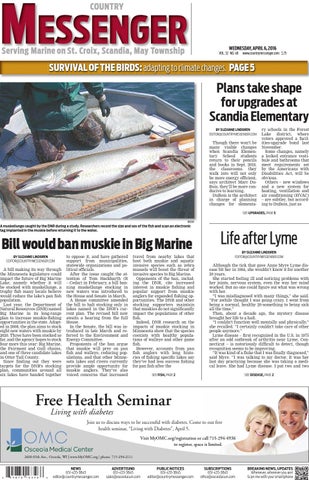
A muskellunge caught by the DNR during a study. Researchers record the size and sex of the fish and scan an electronic tag implanted in the muskie before returning it to the water.
Bill would ban muskie in Big Marine BY SUZANNE LINDGREN EDITOR@COUNTRYMESSENGER.COM
A bill making its way through the Minnesota legislature could impact the future of Big Marine Lake, namely whether it will be stocked with muskellunge, a trophy fish many locals believe would reduce the lake’s pan fish population. Last year, the Department of Natural Resources (DNR) named Big Marine in its long-range plan to increase muskie-fishing opportunities in the state. Adopted in 2008, the plan aims to stock eight new waters with muskie by 2020. Three have been stocked so far, and the agency hopes to stock four more this year: Big Marine, the Fairmont and Gull chains, and one of three candidate lakes in Otter Tail County. Since finding out they were targets for the DNR’s stocking plan, communities around all six lakes have banded together
to oppose it, and have gathered support from municipalities, statewide organizations and political officials. After the issue caught the attention of Tom Hackbarth (R – Cedar) in February, a bill banning muskellunge stocking in new waters was introduced to the House and Senate in March. A House committee amended the bill to halt stocking only in lakes named in the DNR’s current plan. The revised bill now awaits a hearing from the full House. In the Senate, the bill was introduced in late March and referred to the Environment and Energy Committee. Proponents of the ban argue that muskie will prey on pan fish and walleye, reducing populations, and that other Minnesota lakes and rivers currently provide ample opportunity for muskie anglers. They’ve also voiced concerns that increased
Life after Lyme BY SUZANNE LINDGREN EDITOR@COUNTRYMESSENGER.COM
travel from nearby lakes that host both muskie and aquatic invasive species such as zebra mussels will boost the threat of invasive species to Big Marine. Opponents of the ban, including the DNR, cite increased interest in muskie fishing and popular support from muskie anglers for expanded fishing opportunities. The DNR and other stocking supporters maintain that muskies do not significantly impact the populations of other fish. Indeed, DNR research on the impacts of muskie stocking in Minnesota show that the species coexists with healthy populations of walleye and other game fish. However, accounts from pan fish anglers with long histories of fishing specific lakes say they’ve had less success fishing for pan fish after the
Although the tick that gave Anne Myre Lyme disease bit her in 1984, she wouldn’t know it for another 20 years. She started feeling ill and noticing problems with her joints, nervous system, even the way her mind worked. But no one could figure out what was wrong with her. “I was misdiagnosed with many things,” she said. “For awhile thought I was going crazy. I went from being a normal, healthy 20-something to being sick all the time.” Then, about a decade ago, the mystery disease brought her life to a halt. “I couldn’t function well mentally and physically,” she recalled. “I certainly couldn’t take care of other people anymore.” Lyme disease – first recognized in the U.S. in 1975 after an odd outbreak of arthritis near Lyme, Connecticut – is notoriously difficult to detect, though recognition seems to be improving. “It was kind of a fluke that I was finally diagnosed,” said Myre. “I was talking to my doctor. It was her last day practicing because she was taking a medical leave. She had Lyme disease. I put two and two
SEE FISH, PAGE 2
SEE DISEASE, PAGE 2
Free Health Seminar Living with diabetes
Join us to discuss ways to be successful with diabetes. Come to our free health seminar, “Living with Diabetes”, April 5. Visit MyOMC.org/registration or call 715-294-4936 to register, space is limited.
NEWS 651-433-3845 editor@countrymessenger.com
ADVERTISING 651-433-3845 sales@osceolasun.com
PUBLIC NOTICES 651-433-3845 editor@countrymessenger.com
SUBSCRIPTIONS 651-433-3845 office@osceolasun.com
BREAKING NEWS, UPDATES Whenever, wherever you are! Scan me with your smartphone