St. Helens Water Taxi has arrived
Originally published in The Chronicle Vol. 141 June 7, 2023
WILL LOHRE Country Media, Inc.
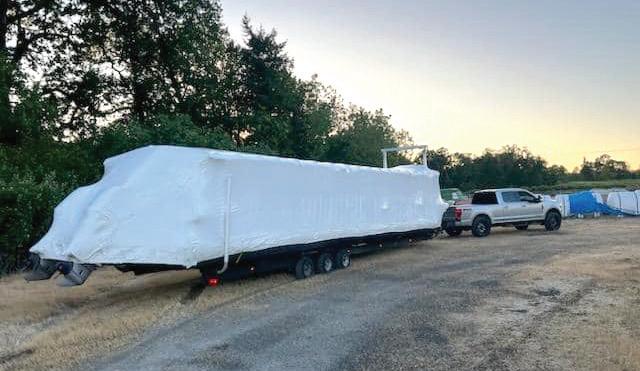
The water taxi that the City of St. Helens purchased has arrived and is scheduled to be operational for the summer’s city tourism events.
The total cost of the refurbished boat is around $230,000 and was fully paid for by tourism-related event revenues, according to St. Helens Communications Officer Crystal King.
The boat will support the city’s tourism programs, such as the annual sandcastle competition and Halloween activities which occur on Sand Island.
~ Crystal King, City of St. Helens
The boat will seek to provide convenient and safe travel for people to and from Sand Island, and support other waterfront tourism efforts. According to the Chronicle’s original report in May 2022
about the boat.
The capacity of the water taxi will be 30 occupants.
“Sand Island is a unique location that St. Helens is lucky to have. It’s been underutilized for decades,” King said. “Now, both community members and visitors will have better access to one of the few recreational islands maintained by a city on the Columbia River.”
The original budgeted cost for the water taxi was $250,000 and was offered by Bargeworx, LLC. When functional, it will be operated by a certified, licensed captain who will be paid out of the city’s tourism funds, according to the Chronicle’s original report.
King said that the boat is a strategic investment for the city that will enhance the city’s tourism efforts.
“The boat will support the city’s tourism programs, such as the annual sandcastle competition and Halloween activities which occur on Sand Island,” King said.
“Sand Island is an asset for creating unique tourism experiences in our region,” St. Helens City Administrator John Walsh told The Chronicle in the May 2022 report.
“Having a boat will allow the city to capitalize on the recreational opportunities and tourism-related events which can be developed along our riverfront.”
The St. Helens Marina currently operates a shuttle service to Sand Island to access the island’s campground. The new water taxi would be in addition to that shuttle.
The St. Helens City Council approved placing a deposit for the water taxi following a public hearing on May 18, 2022. According to the Columbia County Events
Facebook page, the boat arrived June 5. Boat controversy
The announcement of the boat’s purchase sparked controversy on social media. The original article from the Chronicle was posted on Facebook on June 6, 2022, and generated more than 70 comments.
Among the comments, some community members and Facebook users expressed dismay about using city money to procure a boat that needed repair and cost nearly a quarter of a million dollars. The city has emphasized that the cost was covered by tourism revenue, and not property taxes, but the comments still reflected opposition to spend-
ing city money in this way. With the summer fast approaching, the city will seek to get the boat in ship shape as the demand for waterfront tourism comes into full swing. Follow this developing story at thechronicleonline. com and in the Wednesday print editions of The Chronicle.
State issues ‘pig butchering’ scam alert
Originally published in
The Chief Vol. 132
June 9, 2023
STAFF REPORT
Country Media, Inc.
The Oregon Division of Financial Regulation (DFR) is warning consumers to be wary of an unexpected text or direct message from a stranger – it might be the first step in a “pig butchering” scam. The term pig butchering comes from the practice of fattening a pig before slaughter. These scams often involve fraudsters contacting targets seemingly at random, using social media or common communication apps.
The scammer gains the victim’s trust, often by starting a romantic relationship or a simple friendship. The scammer then starts to convince the victim to invest in phony investments, including fraudulent cryptocurrency schemes, before falsely claiming the initial investment grew significantly, according to the DFR. The scammer then asks for more and more money, and demand multiple types of fees if a victim requests to withdraw the funds. Even when
the victim pays the withdrawal fees, the fraudster does not refund the victim’s money, but rather disappears with the funds without any further communication.
Fast Fact
According to the Financial Industry Regulatory Authority (FINRA), there are several warning signs to be aware of involving these types of scams:
Unexpected contact: Never respond to unsolicited messages from unknown contacts, even about seemingly benign topics, especially via text message and on encrypted messaging applications.

Refusal to participate in video chats: If someone you consistently have been messaging with declines to interact face to face, they likely are not the person from the profile photo. Request for financial
information: Don’t share any personal financial information with anyone you have never met in person. If a new virtual friend or romantic connection starts making financial inquiries, put the brakes on the relationship. Invitation to invest in specific financial products: Be wary of any unsolicited investment advice or tips, particularly from someone you have spoken to only online and even if they suggest you trade through your own account. Always question what a source has to gain from sharing tips with you and whether the transaction fits with your financial goals and investment strategy.
before moving any money, particularly in an emerging market such as cryptocurrency, which has hundreds of exchanges and new avenues for trading continuing to evolve. Who controls the platform? What security measures are in place? How can you withdraw funds if needed? If you don’t know the answers to those questions, don’t put your assets there.
Frauds involving cryptocurrency, including pig butchering, represented most of these scams, increasing 183 percent from 2021 to $2.57 billion in reported losses last year. Courtesy photo
Unknown or confusing investment opportunity: Carefully evaluate the product, as well as the person or company requesting your investment. Along with a basic search, try adding words such as “scam” or “fraud” to see what results come up. Consider running recommendations by a third party or an investment professional who has no stake in the investment and use FINRA BrokerCheck to see if the promoter is a registered investment professional.
Unfamiliar trading platforms: Do extensive research
Exaggerated claims and elevated emotions: Take a closer look at any investment that offers much higher than average returns or is touted as “guaranteed.” Fraudsters will also often use their knowledge about you to appeal to your emotions –something like, “Don’t you want to have money to send your kids to college?”
Sense of urgency about an upcoming news announcement or share price increase: Remember that insider trading is illegal, and you should never trade in shares of a company on the basis of material, nonpublic information. “Romance scams and crypto scams continue to be the source of significant losses for consumers,” DFR Administrator T.K. Keen said. “Consumers who receive contacts out of the blue
through messaging apps on their phone or other means should be especially suspicious of those trying to entice them into cryptocurrency investments.”
Although the division has not received any complaints specific to pig butchering schemes, it knows that this activity is occurring based upon conversations with federal and nearby state law enforcement authorities. Several states and federal authorities have issued warnings on this sort of fraud.
In 2022, investment fraud caused the highest losses of any scam reported by the public to the FBI’s Internet Crimes Complaint Center (IC3), totaling $3.31 billion.
Frauds involving cryptocurrency, including pig butchering, represented most of these scams, increasing 183 percent from 2021 to $2.57 billion in reported losses last year. The division accepts consumer complaints and will forward to the appropriate law enforcement authorities. Consumers can also make a complaint to the FBI’s IC3 at https://www.ic3. gov/.
The Division of Financial Regulation is part of the Department of Consumer and Business Services, Oregon’s largest business regulatory and consumer protection agency. Visit dfr.oregon.gov and www.dcbs.oregon.gov.
Wednesday, June 14, 2023 Free Below is a list of WHERE to pick up a FREE copy of the print edition of the News-Advertiser. Also available every week at: thechronicleonline.com and at thechiefnews.com CLATSKANIE • CLATSKANIE SAFEWAY • HI SCHOOL PHARMACY IN CLATSKANIE • CLATSKANIE MARKET SCAPPOOSE • ROAD RUNNER GAS & GROCERY • JACKPOT 76 • ENGSTROM CHEVRON • B&B MARKET • FRED MEYER • SMOKE SHOP • NELSON NEIGHBORHOOD MARKET • ACE • GROCERY OUTLET ST. HELENS • CHUBB’S CHEVRON • SHERLOCK’S • YANKTON STORE • ZATTERBURG’S • MARKET FRESH • WALGREENS • BEST WESTERN • MOLLY’S MARKET • ACE • DON’S RENTAL DEER ISLAND • DEER ISLAND STORE COLUMBIA CITY • COLUMBIA CITY GROCERY & GAS RAINIER • ALSTON STORE • DOLLAR GENERAL WESTPORT • THE BERRY BATCH RESTAURANT • WEST MART STORE
Courtesy photo
The new tourism passenger boat has arrived.
SUBSCRIBE TODAY! 503-397-0116 www.thechiefnews.com ONLINE DESKTOP COMPUTERS • MOBILE • TABLETS The Chief










Page 2 Wednesday, June 14, 2023 News Advertiser Columbia County Classifieds Listings are updated daily at thechronicleonline.com and thechiefnews.com 150 Misc Services 312 Events 104 Landscaping J.J. LANDSCAPING 360-241-6889 or 360-762-9220 Gardening needs, lawn maintenance, clean ups, bark, soil, planting, pruning, aeration, fertilization, weed control, retaining walls, patios, sprinkler systems, installation/ repair/maintenance, plant trees, blackberry removal, free estimates and I have references. Cans and bottles If you have cans and bottles that you would like to get rid of call Steve the Can Man at 971-757-4117. Will pick up in St. Helens only. 301 Health & Nutrition Alcoholics Anonymous Info-line, (503) 366-0667 www.pdxaa.org Community Yard Sale Join Christ Episcopal Church in St. Helens for a community yard sale on July 8. Sell your goods at a safe place. We will do all the promotion & provide tables (for 15% fee). Deadline to reserve a table is June 24. Contact carol.craig19@ yahoo.com or call 971.221.4640. Immediate Opening Sewing, taping, etc. Part-time 6-Noon, M-Th. Apply in person only. 33550 SE Santosh St. Scappoose, OR 97056. 616 Trucks 2000 Chevy truck for sale for $2,200. Call 503-987-1266. Garage Sale New & Used Thurs-Sat 15th17th 9am-5pm 35287 Firlock Park Blvd. Fishing rods/reels, camping, outdoor gear, household stuff, weed eater and new set of kettles. Garage Sale One Day. Only Friday June 16th 10am-5pm Cash Only. 194 South 7th up behind the funeral home. Multi-Family Sale Thursday, 6/15, Friday, 6/16, and Saturday 6/17, 9 a.m. to 4 p.m. Loaded with vintage/antique items, shop and mens stuff, RV stuff, home-baked goods, homecanned goods, crafts, hardware, kid’s, men’s, and women’s clothing and shoes, and kids toys. A bargain for everyone. 502 Help Wanted 702 Garage Sales 702 Garage Sales Waterman Garage DoorsCCB#204858 SALES, SERVICE INSTALLATION 503.819.6715 St. Helens, OR 97051 Scott Waterman Owner Advertise your business in the Business & Service Directory. Call 503-397-0116 for more information YOUR AD HERE Columbia County BUSINESS & SERVICE DIRECTORY www.thechronicleonline.com Get your ad in the paper and reach out to potential customers. Call 503-397-0116 to place your ad in the newspaper and online. Garage Sale Special! Advertise your garage sale in the paper and online for only $10 for up to 14 lines! Email chronicleclassifieds@countrymedia.net to advertise! H21776 Sat., Aug. 26 & Sun., Aug 27 Looking for Vendors If interested contact Patty Watson 503-201-9912 or Beverly Anderson 503-300-9013 Regular vendors $50 Food vendors $150 Bay City Pearl & Oyster Music Festival Send subscription info to PO Box 1153, St. Helens OR 97051 Card No. __________________________________________ Exp. Date _________________ Name ______________________________________________________________________ Address ____________________________________________________________________ City __________________________________ State ________________ Zip _____________ Phone Number ______________________________________________________________ Enclosed is my check for $70.00 Bill my VISA/Mastercard Subscribe me to the: The Chronicle The Chief $70 a year in Columbia County, $90 a year for outside county SUBSCRIBE TO YOUR FAVORITE LOCAL COUNTY NEWSPAPER AND GET FREE ACCESS TO ONLINE NEWS Hosting a garage sale? Let everyone know with an ad in The Chronicle. Call 503-397-0116. Ads Deadline: Mondays by noon. Late submissions may not make the paper. Let Us Know What YOU Think. Have an Opinion on Current Events? EMAIL YOUR LETTERS TO: CHRONICLENEWS@COUNTRYMEDIA.NET










Wednesday, June 14, 2023 Page 3 News Advertiser Columbia County Get the word out in the paper and online by advertising with The Chronicle. Call us at 503-397-0116 or email chronicleads@countrymedia.net Starting a local business? 503-397-0116 1805 Columbia Blvd., St. Helens, OR 97051 The Chronicle Local news online Keep up to date on local stories, events, and ads by visiting thechronicleonline.com. Local news at your fingertips. Catch up on whats going on in Clatskanie wherever you are. thechiefnews.com The Chief 397-0116 1805 Columbia Blvd. St. Helens, OR 97051 Get your news directly from your mobile device, tablet, or computer SUBSCRIBE TODAY! 503-397-0116 www.thechiefnews.com ONLINE DESKTOP COMPUTERS • MOBILE • TABLETS The Chief

Page 4 Wednesday, June 14, 2023 News Advertiser Columbia County
