North Coast shows patriotism on Independence Day


Forest Trust Land Counties and the Department of Forestry
With many of the Oregon Department of Forestry’s current implementation plans expiring in June 2023, each state forest district has approved a Revised Implementation Plan that will serve as a transition to two new, longterm plans being developed by ODF.

Those plans, the forest management plan (FMP) that will govern state forest activities for an indefinite timeframe, and the habitat conservation plan (HCP) that will inform the forest management plan for the next 70 years, are currently the subject of much debate among timber companies, conservationists, ODF’s board and officials and the counties that rely on timber revenues.
County commissioners from across the north coast say that any cuts made under those plans will have drastic, rippling consequences across the economies in their counties.
The revised implementation plans that last until June 2025 list timber harvest levels that county officials expect to be similar to those of the forthcoming FMP and HCP will. In each ODF district except for Tillamook, timber harvest sales will decrease over the coming year when compared to the year prior. The total timber for sale across all districts is set at 165 to 182.5 million board feet (MMBF), 40 to 60 MMBF less than previous timber sale totals.
One way to estimate timber revenues from these harvest levels is through each district’s annual operating plan (AOP). AOPs list the predicted net revenues from timber harvest operations for the next fiscal year. Lower timber harvest levels typi-
cally mean less revenue for each ODF district.
Counties with state forests receive 63.5% of the revenues from state forests within their borders, with the remaining 36.5% going to ODF to fund state forest operations. From there, the county government typically keeps 20% of revenues while the remaining 80% is disbursed to the various school and special districts across the county
Because counties with state forests receive a portion of timber revenues, less revenue for each ODF district typically means less revenue for the counties and special districts in those districts. The Astoria, Forest Grove and West Oregon Districts all predict timber revenue decreases for fiscal year 2024.
But it’s not always that straightforward. Timber contracts usually give companies a three-year period to harvest the timber, meaning that districts will see revenue from this year ’s contracts only over the course of several years.
Further cushioning the impacts of the new implementation plan is a large amount of timber still standing in state forests from timber sales in recent years. Volatility in the timber market during the coronavirus pandemic led to many high purchase prices for sales, which led many timber companies to leave more timber standing than they would typically in hopes of maximizing their revenue.
This has led to approximately 325 MMBF of sold timber waiting to be harvested across the state forests.

Ron Zilly, Deputy Division Chief for State Forests, clarified this process at a public meeting ODF held earlier this year
“The revenues in the coming year won’t be significantly affected due to the amount of wood that we already have under contract,” Zilly said. “This gives us some time to assess our organizational structure and needs to effectively implement the habitat conservation plan as well as make spending adjustments.”
Either way, some counties will see timber revenue losses next year, and all counties will have to start preparing
Dr. Tyler Reed became superintendent of the Neah-Kah-Nie School District on July 1, taking over from the retiring Paul Erlebach.
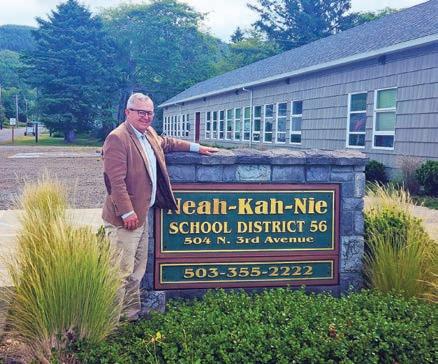
Reed told the Herald in a recent interview that he plans to emphasize literacy at all grade levels, facilities maintenance and continuing to maximize post-secondary opportunities for students in the district as superintendent.
“I just want to maximize the opportunities for our kids,” Reed said, “if that’s career tech, if that’s going to a four-year or two-year college, if that’s getting a job right after high school, that’s super important.”
WILL CHAPPELL Citizen Editor
Paul Erlebach retired from the superintendency of the Neah-Kah-Nie School district at the beginning of July, ending a 35-year career in education, and being succeeded by Dr. Tyler Reed.
Erlebach credited his longevity with Neah-Kah-Nie, where he served 11 years as superintendent, to relationships with district stakeholders built on trust that yielded strong results.
“I’ve felt like the district was committed to and invested in me and I felt like I was invested and committed to the district,” Erlebach said. “You do need to invest in the community if you want the community to invest in you.”
Born in Ontario, Oregon, Erlebach began his teaching career in Spain when he ran out of money there after a long bicycle trip across the United States and Europe.
“In Spain, it was either picking oranges or teaching English, so I decided I better teach English,” Erlebach joked.
Erlebach’s mother was a special education teacher and he began coaching youth sports when he was in middle and high school, drawing him to being involved with youth from an early age. These factors combined with Erlebach’s interest in being a lifelong learner to draw him
to the field of education.
“I’ve always placed myself as a learner so I can understand the learning, the teaching and the learning process,” Erlebach said.
After teaching English in Spain for a couple years, Erlebach returned to the University of Guanajuato in central Mexico, where he had earned his undergraduate degree, and continued teaching. Erlebach subsequently returned to Oregon, settling in The Dalles, where he taught Spanish for 12 years. Erlebach then moved to Ontario, where he was an elementary and middle school principal for another dozen years.
By the early 2010s, Erlebach was ready to become a superintendent and applied for and accepted the position with Neah-Kah-Nie.
Over the past 11 years, Erlebach has worked with 22 different board members on many initiatives that have improved the district. Erlebach was especially proud of the expansion of the district’s preschool offerings from a single, half-day option at the district office, to two, full-day options at Nehalem and Garibaldi Elementary Schools. He also mentioned the opening of a schoolbased health center and hiring of a full-time nurse, improvements to track and field facilities, a renovation of the stage and construction trades classroom as other points of
Reed arrives in NeahKah-Nie after serving as the Tillamook School District’s curriculum director for the past year. Born in Tuscaloosa, Alabama, Reed began his career in education with Teach for America, working in a school in Stuckart, Arkansas. While working in Stuttgart, Reed earned a master’s degree and doctorate from Arkansas Tech University, before becoming principal of a school in Rosebud, Arkansas.
While working in Arkansas, Reed met his wife, who also worked with Teach for America and hails from Astoria, Oregon. After spending the first decade of their married lives in Arkansas, the couple decided that they wanted to move closer to her family and began looking for job opportunities on the north coast, applying for and accepting the position in Tillamook last spring.
Reed said that in Arkansas he had been used to having more oversight from the state department and that he enjoyed the more community-driven style of Oregon schools.
“I think this area is great in that these feel like community schools and they are community schools,” Reed said. He also praised the support of local foundations for scholarships in both the Tillamook and Neah-Kah-Nie school districts, mentioning the Mudd Nick Foundation
in North Tillamook County in particular, which is helping to fund a production of Cinderella and recently contributed to a class trip to Washington D.C. Reed said, “It’s just great that communities like Tillamook and NeahKah-Nie are providing that for their kids.”
Reed said that he is appreciative of Erlebach’s steady stewardship of the district and help during the transition, appreciating that he is not being asked to serve as a “white knight” for the district. He mentioned both the GEAR UP grant aimed at increasing preparation for secondary education that the district was selected to receive last year and the AVID teaching program that teachers are training in as examples of Erlebach’s achievements.
Nonetheless, there are challenges facing the district for which Reed has been preparing. Chief among them is the uncertainty surrounding future timber harvest revenues, which along with property taxes make up the entirety of the district’s funding and may be cut with a new habitat conservation plan under development by the Oregon Department of Forestry.
As a representative of a special district drawing revenues from the state forests, Reed said that remaining in communication with legislators and the governor about the potential harvest cuts’ impacts will be key.
“I think it’s just gonna be making sure that we form a positive relationship with our state legislators and Tina Kotek,” Reed said, “making sure our voices are heard and that it’s not necessarily the timber companies that are being hurt in this it’s our kids and our districts.”
Reed said that he will also focus on continuing to improve academics to ensure the district offers students the best education. He said that the coronavirus pandemic and distance learning had led to difficulties in educating children but noted that Neah-Kah-NIe has begun to rebound and exceed state averages in test scores.



for the prospect of future losses. Fortunately, counties have representation with ODF in the form of the Forest Trust Lands Advisory Committee (FTLAC), which has a representative from each county.
The FTLAC is a statute mandated ODF committee that advises ODF’s Board of Forestry on policy matters related to state forestland management. The FTLAC has seven Commissioners that represent the counties that deeded the state forestlands to the state in the 1950s and 1960s on policy issues that affect those lands. The Committee Chair is Tillamook County Commissioner David Yamamoto, and the Vice-chair is Coos County Commissioner John Sweet.
Tillamook County Commissioner Erin Skaar represents Tillamook County; Clatsop County Commissioner Courtney Bangs represents Clatsop County; Colombia County Commissioner Margaret Magruder represents Colombia, Clackamas, and Washington Counties; Linn County Commissioner Will Tucker represents Marion, Linn, Benton, Polk, and Lincoln counties; and Lane County Commissioner David Loveall represents Lane, Coos, Douglas, Klamath, and Josephine counties.
While commissioners had their own takes on how the timber harvest levels in the revised implementation plans will impact the counties they represent, one thing was clear: lower harvest levels will create more obstacles to future financial stability.
Tillamook County: “All bets are off.”
Tillamook County is set to weather the next several years well as timber sales in the upcoming year are projected to remain at the same 47 MMBF as in FY 2023 or slightly increase.
But Yamamoto, Tillamook County Commissioner and FTLAC Chair, is still sounding the alarm about the long-term financial ramifications of an HCP that he says is more restrictive than others being implemented in Oregon and on the west coast.
“Why are the people of the state of Oregon being affected the harshest when it comes to an HCP when the numbers aren’t showing that you’re going to see a concomitant increase in endangered species,” Yamamoto wondered.
Yamamoto specifically pointed to the private forest accord passed in Oregon last year, which also includes an HCP to govern those lands. That accord and HCP were developed in negotiations between timber industry and environmental group representatives.
By contrast, Yamamoto says that the FTLAC has repeatedly been rebuffed in efforts to join the process of crafting the HCP for state forest lands, leaving the task entirely in the hands of representatives from state agencies and environmental groups.
Yamamoto has repeatedly complained to the board of forestry about the lack of involvement by the counties, which own the lands while they are held in trust by the state, but he said that those complaints have been met with silence.
Yamamoto also questions the conservational value of the HCP. Yamamoto said that the marbled murrelet population of Oregon has increased 60% in the last 20
years and that Coho salmon are harvested annually in Tillamook watersheds, belying the argument those species need additional protections. As for the spotted owl, Yamamoto points to federal forests where increased habitat conservation over the past 40 years has not led to widespread returns in the face of barred owls competing for food.
Tillamook County receives around $4 million in timber revenue contributions to a $50 million annual general fund budget and is set for financial security for the next few years. However, Yamamoto has been advising department heads to start thinking of potential budget cuts as he expects the final HCP numbers, expected in November, may reveal lower harvest levels.
“We’re going to be okay for the next year, year and a half, it’s after that that all bets are off,” Yamamoto said.
The financial impacts to the county are only one piece of the puzzle though, Yamamoto cautioned, saying that the impact on employment in the county would be double that of any on the county’s revenues.
“The timber revenue that the county and special districts get, that’s basically a third of what we’re going to need, because two thirds, the bigger portion, the two-thirds are the family-wage, fully benefited jobs that come to special districts and counties,” Yamamoto said.
A loss of timber jobs would have knock-on effects on the county’s economies by depleting its tax base and decreasing economic activity on a more general level, according to Yamamoto. He believes that the Board of Forestry should direct ODF staff to reverse course on the currently proposed HCP and work to craft a new proposal, with help from FTLAC representatives, that will be more in line with others and preserve the economic benefits of the forests.
Clatsop & Columbia Counties: “A huge impact.”

Both Clatsop and Columbia Counties fall into ODF’s Astoria District. Astoria’s revised implementation plan set a harvest level of 48 to 52 MMBF, down from 73 MMBF in the previous implementation plan.

The reduced harvest level will have a huge impact on the revenue that the district receives. For the next fiscal year, Astoria District is projecting net revenues of $20.6 million from timber harvest operations, a 31% decrease from fiscal year 2023. This will inevitably impact the timber revenue both Clatsop and Columbia Counties receive.
According to Clatsop County Commissioner Courtney Bangs, reduced timber harvest will impact Clatsop County in a number of ways.
One will be reduced funding for the county’s general fund and special taxing districts.
“If there is a cutback in harvest, there is a cutback in funding [for those districts],” Bangs said. “For example, our rule of law enforcement is going to have a decrease of $1.4 million [for next year].
When you’re operating on a $5- or $6-million-dollar budget, that’s a huge impact.” Commissioner Bangs said by far the most overlooked impact of reduced timber harvest was the secondary and tertiary job loss.
“Our major economies are associated with natural resources in our area. And so, when we are projected to have a 30% decrease in revenues, we are also going to see that reflected in the secondary and tertiary job loss. We look at our mill in Warrenton and the secondary and tertiary losses are going to be extreme,” she said.
Because of the three-year period of timber contracts, it is difficult to predict exact impacts for fiscal year 2024, but Bangs believes Clatsop County will really start to feel it in fiscal year 2025.
“[Decreasing revenue] is part of the conversation. Because each sale has a three-year window of harvest, we won’t really feel the fiscal cliff next year. But we will definitely start feeling and seeing the fiscal cliff after the 24-25 year. We will feel what’s happening now in one to three years.” Bangs said.
For Columbia County Commissioner Margret Magruder, her biggest concern for Columbia County is the impact reduced revenues will have on public services.
“Reduced harvest will result in a reduction in jobs and timber harvest revenue in the CFTLC (Council of Forest Trust Land Counties) Counties,” Magruder said. “These timber revenues support a variety of public services that counties provide. The costs of all of these services will continue to rise over the 70year life of the HCP while the harvest revenue is projected to decline substantially.”
Washington County
Magruder also represents Washington County on the FTLAC, which falls into ODF’s Forest Grove District. Forest Grove’s revised implementation plan set a harvest level of 43 to 47 MMBF, down from 61 MMBF in the previous Implementation Plan.
The reduced harvest level will have a large impact on the revenue that the district receives. For the next fiscal year, Forest Grove District is projecting net revenues of $18.1 million from timber harvest operations, a 42% decrease from fiscal year 2023. This is the largest decrease in time revenue among all ODF districts. This will inevitably impact the timber revenue Washington County receives.
According to Magruder, this drop will have a significant impact, just probably not this next fiscal year
“The Forest Grove District is expected to experience a 23% drop in harvest compared to the previous implementation plan,” Commissioner Magruder said. “Significant impacts of the lower harvest levels will mostly likely be seen starting in FY 25 due to the 3-year nature of ODF contracts and unusually high volume of timber under contract yet to be harvested.”
Clackamas, Marion, & Linn Counties
Clackamas, Marion and Linn Counties fall into ODF’s North Cascade District. North Cascade’s revised implementation plan set a harvest level of 9 to 10 MMBF, down from 19 MMBF in the previous implementation plan.
It’s unclear how the reduced harvest level will impact the revenue the district receives. For the next fiscal year, North Cascade District is projecting net revenues of $4 million, a 15% increase, and is one of the few districts
projecting an increase in timber revenues. According to Linn County Commissioner Will Tucker, the reduced timber harvest will still have an adverse impact on Linn County.
“Based upon preliminary numbers, it looks like the local ODF Region will net Linn County around 50% of the historical revenue,” Tucker said. “The biggest portion goes to the county general funds, then the local school district, then the county common school funds, and [finally] lesser amounts to multiple taxing districts.”
Tucker added that the percentage of timber revenue each district will receive next year – and therefore the level of impact they’d incur from reduced revenues – will depend largely on where the timber sales happen.
“The actual percentages depend on what taxing districts make up the regions,” Commissioner Tucker said. “For North Santiam Canyon, as an example, it affects mostly North Santiam School District, the local fire department, the community college, and a library district. In my county, the actual dollars split varies by drainage and taxing districts near the sale site.”
Benton, Polk, and Lincoln Counties Benton, Polk, and Lincoln Counties fall into ODF’s Western Oregon District.
Western Oregon’s revised implementation plan set a harvest level of 9 to 10 MMBF, down from 12 MMBF in the previous implementation plan.
The reduced harvest level will have a moderate impact on the revenue the district receives. For the next fiscal year, Western Oregon District is projecting net revenues of $3.4 million, a 36% decrease from fiscal year 2023. This will impact the timber revenue these counties receive.
According to Tucker, the reduced timber harvest will impact these counties, as well as Linn County, through job loss.
“The revenue from ODF is a small part of timber life cycle,” Commissioner Tucker said. “What stands out as the bigger effect on the county is what happens to jobs, mills, and the communities. This ends up as a much larger effect on the county than just
pride during his tenure.
Erlebach also praised the district’s response to the covid pandemic, which he said was made easier by a preexisting emphasis on technology in the classroom. All students from second through twelfth grades already had a Chromebook when the move to distance learning occurred in March 2020, smoothing the transition.
Those successful results came thanks of a range of factors according to Erlebach, foremost among them strong relationships built on trust and open communications. “If you’re not an effective communicator with the public, with the staff, with the board, then you’re not going to last very long,” Erlebach said.
Erlebach credited his bilingualism as a helping to facilitate those communications and pointed to the district’s continuous improvement plan as providing a strong framework for success. That plan assesses district policies and practices on an annual basis to determine which are working and which are not, before revising those policies and practices.
Erlebach said that he was confident Reed would continue to use the plan and have a successful tenure with the district. He noted that his predecessor had also had an 11-year tenure with the district and expressed hope
that Reed would experience similar longevity.
“The district is very fortunate to have somebody from the outside to give that outside perspective, to have that kind of beginner’s mind, to see things differently, and hopefully he’ll have as much fun as I had,” Erlebach said.
Having helped with Reed’s transition, Erlebach has now begun enjoying his retirement. “Retirement caught up with me, though in Spanish it’s called jubilation, so I’m jubilating, I’m not retiring,” Erlebach said.
Erlebach plans to travel with his wife and spend more time with their son and extended family, while continuing to live in Manzanita. He said he would remain active in the community, but not with the school district, so that Reed would have the time and space to run the district.

Erlebach thanked the district for his time as superintendent and the strong relationships he had formed and said he felt fortunate to have experienced all different aspects of education during his career.
“It’s been a wonderful experience seeing all different aspects and responsibilities of teaching and being a principal and then being superintendent so I got to see the whole gamut of education,” Erlebach said.
REED CONTINUED FROM PAGE A1
A main emphasis for Reed will be improving literacy in the district, with a focus on moving toward the science of reading approach, which emphasizes phonics. Reed said that he is a fan of the kindergarten through second grade curriculum from Foundations that the district uses and he hopes to see their offerings expanded to all grade levels.
“(I’m) just really excited to bring that to the district, to make sure it’s a K-12 initiative and not just an early literacy initiative and I think it’s going to do great things for our kids,” Reed said.
Reed will also be keeping an eye on the district’s various facilities, working to make sure that they stay up to date as Garibaldi and Nehalem Elementary Schools
the sale revenue from ODF.”
Tucker went on to explain the trickle-down effect of a reduced timber harvest, noting that the impact has an “8 or 10 times larger effect” on the economies of the communities he represents.
“Just looking at the mills who buy the logs, there is the property taxes and personal property taxes (equipment) paid by the mill for the mill sites,” Commissioner Tucker said. “Beyond that there is much more money stabilizing
approach their centennial anniversaries.
“It’s just a matter of making sure that we improve those buildings to be state of the art facilities for our kids because they deserve the best,” Reed said.
Reed said that he is excited to get to work in the district and to get to know and work with the community as he steps into a more public facing role.
“I’m excited to see where we can take Neah-Kah-Nie together and it is not a me thing, this is not what I’m doing, it is really what this community is doing,” Reed said. “I know that they love their kids and I’m just super proud to work in the district in which I live and see it move forward.”
the community: the mills who buy the timber, salaries for those who planned the sales, road construction teams to get crews to the sale site with their equipment and rock, those who cut the trees, those who transport the logs, the mill employees, and transportation of the timber to retail.” Look for more updates on ODF’s Habitat Conservation Plan and Forest Management Plan at tillamookheadlightherald. com.
Make
Enrich your family with another culture. Now you can host a high school exchange student (girl or boy) from Belgium, France, Germany, Ukraine, Scandinavia, Spain, Japan, Italy or other countries.
Single parents, as well as couples with or without children, may host. Contact us ASAP for more information or to select your student.
Serving North Tillamook County since 1996

Deadline Noon Mondays for Advertising, News, Classifieds, Legals, Obituaries

Editor Will Chappell, email headlighteditor@countrymedia.net
Sales Katherine Mace, email headlightads@countrymedia.net
Classifieds & Legals Siah J. Kennedy, Office Manager email classifieds@orcoastnews.com

Ad Production Stephania Baumgart
PHONE 503-842-7535 • FAX 503-842-8842
EMAIL editor@northcoastcitizen.com


WEBSITE northcoastcitizen.com
The North Coast Citizen (15503909) is published biweekly by Country Media, Inc.





1906 Second Street, P.O. Box 444, Tillamook, OR 97141

Publisher: David Thornberry
SUBSCRIPTION RATES
$60.00 annually in-county; $72.00 annually out-of-county.
$50.00 for online only.
Periodicals Postage paid at Tillamook, OR.
POSTMASTER
Send address changes to P.O. Box 444, Tillamook, OR 97141


Member Oregon Newspaper Publishers Association (ONPA) © 2023 by the North Coast Citizen. All rights reserved.



The Citizen welcomes letters that express readers’ opinions on current topics. Letters may be submitted by email only, no longer than 300 words, and must be signed and include the writer’s full name, address (including city) and telephone number for verification of the writer’s identity. We will print the writer’s name and town of residence only. Letters without the requisite identifying information will not be published. Letters are published in the order received and may be edited for length, grammar, spelling, punctuation or clarity. We do not publish group emails, open letters, form letters, third-party letters, letters attacking private individuals or businesses, or letters containing advertising.
Deadline for letters is noon Thursdays.

The date of publication will depend on space.
Obituaries


The North Coast Citizen has several options for submitting obituaries.
• Basic Obituary: Includes the person’s name, age, town of residency, and information about any funeral services. No cost.

• Custom Obituary: You choose the length and wording of the announcement. The cost is $75 for the first 200 words, $50 for each additional 200 words. Includes a small photo at no additional cost.
• Premium Obituary: Often used by families who wish to include multiple photos with a longer announcement, or who wish to run a thank-you. Cost varies based on the length of the announcement. All obituary announcements are placed on the North Coast Citizen website at no cost.




Citizen Editor
The final public hearing for updates to Ordinance 84, governing short-term rental properties in Tillamook County, was held on July 6, and county commissioners signaled their intent to approve the updated ordinance on July 19.
The final update to the proposed ordinance included several changes, among them a ban on short-term rentals on contiguous properties



Another Fourth of July is in the books, and judging by the size of the crowds it must have been a recordbreaker. As is traditional, the day began with the annual Fourth of July Parade, beginning in front of the Neah-KahNie School District offices on North 3rd.
This year, Rockaway was treated to a three-way tie for Grand Marshall of the parade. As always, Grand Marshalls are nominated by the community, and for 2023, the votes were evenly split between Terry Walhood, Ronnie Duckworth and the Rockaway Roastery.
Terry is no stranger to the community or to Fencepost readers. In August 2022, I featured Terry and her Hope Chest thrift shops for their contributions to the Meals for Seniors and the Food Bank.

“We were selected in 2006 as the Number 1 Volunteer Charity in Oregon,” Terry told me with pride.
Ronnie Duckworth was recognized by Mayor Charles McNeilly for his contributions to the community, as exemplified by the care and attention that he and his wife, Becki, gave to former Volunteer of the Year Cindy Kay Gregory in the last weeks of Cindy’s
SCOTT FISHER ROCKAWAY BEACH sfisher71@yahoo.combattle with cancer.
The Rockaway Roastery has been in town for just under a year, but their contributions to the community are many. Most notably, last April’s Rockway Writers Rendezvou brought a number of writers, journalists and others to town for a fund-raiser devoted to Nea-Kah-Nie High School students interested in pursuing literary or journalistic careers. It’s also become a center for live music, often featuring local performers in a wide range of musical styles.
Volunteer of the Year Sandi Johnson was notable for her absence in the parade—she was busy organizing the parade and stayed out of the limelight, which certainly confirms her suitability for the honor. Her name and face were visible on the green Mustang convertible of residents John and Beverly Goertzen,
who were happy to honor her with the rest of the dignitaries, just behind the full fleet of Rockaway Fire and Rescue vehicles headed by chief Todd Hesse.
With more than 40 individual floats and other participants in this year’s parade, it fell to Mayor McNeilly and a handful of officials to choose the top three. West Coast Outdoor Furniture’s beautiful depiction of a rolling porch took third place. Second place’s “There’sNo Place Like Rockaway” exhibit, based on the Wizard of Oz, delighted the crowd with its depiction of Dorothy, one of the apple trees on the Yellow Brick Road, and more favorites.
First place went to the Peter Pan display, beginning with a bed with a broomstick sail and continuing through an almost full-scale pirate ship. In between were costumed characters from the beloved story, including a duel between Peter Pan and Captain Hook.
When the parade turned south on 101, the real scope of the crowd became apparent. Both sides of the highway were lined six deep all the way to South 3rd, where the parade turned east at City Hall. It was a beautiful multigenerational crowd, all decked
out in red, white, and blue. We recognized some families and neighbors with grandparents and babies together for the celebration.
Following the parade, the Firecracker Wiener Nationals returned to Phyllis Baker Park. This was the 17th year under the ongoing leadership of Bob Newell and daughter Quincy.
If you’ve never been to the dachshund races here, there’s really nothing quite like it. Some of the dachshunds are just out for a romp in the park, while others are determined racers— “they’re in it to win it,” as Bob said. Clearly, little Maggie was one of those—she defeated Jasper in the finals to take the grand prize. Proceeds for the races went to support the Tillamook Animal Shelter.
A note about some upcoming events: Rockaway resident Jon Orloff, a longtime pioneer in the electronic industry, will be giving a Chautauqua-style talk about the unexpected results of innovation. His talk, titled “What is the Worth of a New Born Child - the unpredictable benefits of scientific research,” will be held at 11 a.m. on July 15 at Maxwell Park next to the Tillamook Main Library. Other talks are planned for later in the summer.

30 nights per calendar year, or their license will be revoked.
Around 200 of the 1200 licensees in the county have rented their STRs for less than 30 nights in recent years, meaning that the provision may lead to a significant number of licenses returning to the available pool.
those properties to continue their operations as long as they stayed in the same family was the most consideration they were comfortable extending.
outside of communities, a use-it-or-lose-it provision and a one-license-per-licensee restriction.


The use-it-or-lose-it provision was added to the ordinance at the request of the commissioners, with the goal of ensuring that shortterm rentals (STRs) contribute to the economy and to keep the licenses from becoming “golden ticket” property value boosters. Starting in 2024, license holders will be required to rent their properties for a minimum of
A ban on multiple licenses for single licensees was added to discourage the consolidated ownership of groups of houses by a single person or corporation. This raised potential issues for commissioners, as public commenters brought up the case of duplexes and triplexes where each unit held a separate STR license.
Commissioners agreed that it would be an added restriction to those properties, which could no longer continue to function as multiple STRs after a sale, but also noted that the same multifamily housing units were critical to addressing the county’s housing crisis. After lengthy discussions, it was agreed that the allowance for
Existing STR license holders will have until their first renewal after January 1, 2024, to bring their properties into compliance with the new ordinance, although Commissioner Erin Skaar mentioned extending that deadline to later in the year.
The updated draft of the ordinance also established a waitlist process for handling applicants once the license cap has been filled. Those property owners will pay $100 to be added to the waitlist, with names being selected to submit applications on a first-come-first-served basis as licenses become available.
A final decision on the cap on STR licenses was the only major policy decision not finalized by the end of the public hearing period. Commissioners indicated that they remained committed to setting a cap on the number
of new licenses that will be available based on the number of extant licenses, on a community-by-community basis. Most prior discussions have indicated that the commissioners are leaning towards a 1% increase per community, although 2% has also been mentioned. The commissioners will decide which percentage to allow licenses to increase by at their meeting on July 19.
However, Commissioner David Yamamoto reiterated to the public that those caps and the rest of the ordinance would be revised going forward. Yamamoto said that the STR advisory committee that produced the proposed ordinance revisions would continue to meet on a semiannual basis. He also said that the caps would be updated over the next year as the department of community development held meetings in each of the communities to determine suitable, individualized caps.
As at the first meeting in late May, the public


 By CHELSEA YARNELL
Guest Contributor
Home is where the hive is.
And some local honeybees have quite the new home thanks to the Tillamook Beekeepers Association (TBA) and supporting partners.
On March 28, TBA broke ground on their new apiary garden and learning center at the Port of Tillamook Bay.
The apiary garden and learning center features a dedicated location for several beehives, a storage shed, bee friendly flowering trees, and room to expand for additional education space
and gardens. The primary goal of the new apiary is to raise queen honeybees for local beekeepers, and to serve as a showcase for beekeeping demonstrations and educational site for the general public and beekeepers alike.
A walk-through video of the conceptualized apiary can
be viewed on TBA’s website.
The project was made possible by generous funding from Tillamook PUD, Loren E. Parks Trust and Tillamook High School Charity Drive Community grants. Fencing materials were donated by Rosenberg Builder Supply.
Each Saturday at 10 a.m., TBA will be conducting “Hive Dives.” These interactive learning experiences are great for anyone interested in learning more about beekeeping. Beekeepers will check on the apiary’s general health of the hive, the queen and take necessary steps to strengthen weak hives. Work on the apiary will continue to progress as funds allow. Until then, TBA is ready to educate visitors, and
even has enough bee suits for a crowd to wear.
The public is invited to the apiary and garden learning center’s grand opening on July 15 at 11 a.m. The celebration will begin in the Officer’s Mess Hall. Visitors can purchase raffle tickets for this year’s hive, honey, buy TBA branded merchandise (hats, patches, stickers, etc.).
Tillamook Creamery and Werner’s will be providing refreshments.

Guests will then we routed through the Food Roots and the Honey House Extraction Room.
A ribbon cutting ceremony will take place at the apiary arbor at about 11:30.
Want to learn more about beekeeping?
Catch TBA at the
comment portion of the meeting was dominated by STR owners and operators, who complained about the strictures of the new ordinance. They said it was unfair to hold STRs to a higher standard than other properties in the county and contended that the regulations were unnecessary. Commissioners reiterated that they had started the process in response to livability issues caused by STRs across the county and despite the owner and operator protestations, these issues were not imagined. That much was evidenced by the turnout at the second public hearing, when Tillamook locals came out in force and voiced support for the updated ordinance. Final minor revisions will now be made to the ordinance, before the final document is posted to the county’s website on July 14, and voted on by the board of commissioners at their regular meeting on July 19.
BY CHELSEA YARNELLTillamook County Fair. Their booth will feature information on beekeeping and a live hive: find the queen and earn a prize. Raffle tickets will also be sold for a chance to win a hand-painted beehive; crafted by Rick Stelzig.
The beehive, painted by Paige Andrus, depicts the Tillamook Air Museum, blimps, and other WWII navy aircraft that correspond to this year’s fair theme: Let Freedom Ring.
Following the Fair, new beekeepers are invited to attend the “Introduction to Beekeeping” course held on Aug. 19 at 1 p.m. in the Tillamook County Library’s Community Room.
For more information on TBA, visit their website at tillamookbeekeepers.org


280 Rowe Street, Wheeler Oregon 97147

or RN) – Full time & Part time




Nursing Assistant – Full time & Part time


For details, call 541-275-8593, email lbaertlein@nvcarecenter.org or apply online at https://nehalemcarecenter.com/careers/ H22313
Licensed Practical Nurse [LPN]
Part time position (24 hours weekly) w/excellent benefits.


Compensation: $29 - $39 Hourly, DOE


Tillamook Family Counseling Center (TFCC) seeks a Licensed Practical Nurse [Part Time 24 Hours per Week] as a health provider for its Assertive Community Treatment Team (ACT). The LPN provides health care coordination, client support, and triage in home and community settings to adults presenting with severe and persistent mental illness.





Tillamook Family Counseling Center is a drug free workplace and equal opportunity employer.

If you are interested in this position, please apply online at http://tfcc.bamboohr.com/jobs. Be sure to submit an online application and upload your resume. Any questions, please visit us online at http://tfcc.org.
Oregon Department of Forestry Tillamook District Firewood cutting sales will end Friday, July 28, 2023

ODF, Tillamook District will stop selling Personal Firewood Permits on July 28, 2023.
All permits purchased after July 7th will have a shorter cutting time and will expire no later than July 30th. You may purchase your permit over the phone or in person with cash or credit card. For more information call 503-842-2545. H22303

Kick off Summer With a clutter-free office

SIGHT UNSEEN SHREDDING, LLC








License #20-480


(503) 457-3089 sightunseenshredding@gmail.com
We provide CONFIDENTIAL



DOCUMENT SHREDDING for home or business


Locally Owned, Member of Tillamook Chamber of Commerce

PUZZLES

H22285


To





Deadline Aug. 23 Publishes Aug. 29
Deadline Aug. 21 Publishes Aug. 24



WILL CHAPPELL
Citizen Editor Manzanita’s City Council approved a water rate increase at their meeting on July 5, the city’s first in nearly a decade.
The council also denied an application to close Laneda Avenue for a music festival in August and approved a contract for asbestos remediation work at Underhill Plaza. The water rate increase was the first in the city since 2014, after previous councils declined to assess and adjust the rate every three years, as directed by ordinance. The long delay in rate adjustments means that they will raise significantly, with the base residential rate rising from $39.50 to $47.56, while the
new commercial base rate will be $57.07.

G2 Consultants were awarded a $39,000 contract to design the abatement procedure for the disused school building and Quonset hut at Underhill Plaza. The abatement itself will be completed by a separate contractor and is part of the prep work necessary to build a new city hall at the site, as approved by the council in June.
Police Chief Erik Harth also debriefed the council on law enforcement activity on the Fourth of July. Harth said that several groups of students from southeast Portland had come to Manzanita for the holiday and caused minor disturbances. Harth noted that the students had been staying at vacation homes, rather than
short-term rental properties. Harth also bemoaned the difficulty of enforcing the city’s anti-fireworks ordinance, noting that it was nearly impossible to catch all those illegally detonating fireworks, especially when considering the amount of time writing citations consumed.
The decision to decline an application for the Shipwrecked music festival to take place on Laneda Avenue on August 12 was unanimously denied by the council. The Sand Dollar Pub had requested to shut the Laneda Avenue from noon to 6 p.m. for a music festival. Councilors said that the closure would have a large impact on other businesses and that they saw no compelling civic interest in the festival.


Producing one ton of recycled paper uses 64% less energy and 58% less water than producing the same paper products from virgin wood pulp.
It also creates 74% less air pollution and 35% water pollution.
You can recycle paper (and other materials) at these locations: