



WILL CHAPPELL
North Tillamook County’s Mudd Nick Foundation hosted its 30th annual fundraising event, with a golf tournament at Manzanita links before dinner and live auction at the North County Recreation District on September 21. With the event, the foundation surpassed $3 million raised in the past 30 years in support of extracurricular activities for students in the Neah-Kah-Nie School District, who volunteered as wait staff and shared their talents with attendees at the dinner.
“We share the mission with the school, the teachers and the other community representatives, and that is to provide learning experiences to every student from Garibaldi all the way up to Manzanita, throughout their whole careers as students to open all their
See MUDD NICK, Page A3
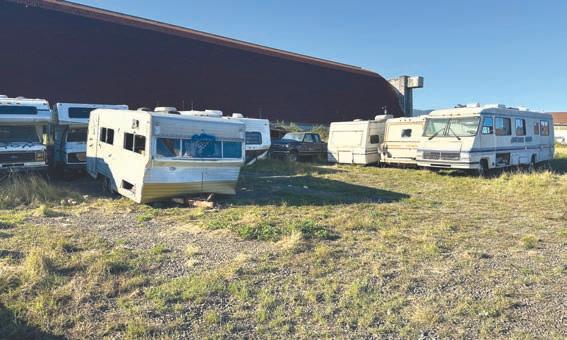
On August 28, deputies from the Tillamook Sheriff’s Office have worked with staff from the Departments of Public Works and Community Development, and Solid Waste Program, as well as Burden’s Towing to remove four abandoned RVs, three cars and a flatbed trailer from roadsides across the county. Building on that momentum, the office then had an inspector come out and test ten RVs in their possession for asbestos, which is still used in RV construction, a necessary step in the process of having the RVs destroyed. That testing and resulting remediation costs combined with the costs of towing and storing the vehicles and the difficulty of tracking down a registered owner for them make their removal a particular challenge for the county, but one that Tillamook County

$2.475 million
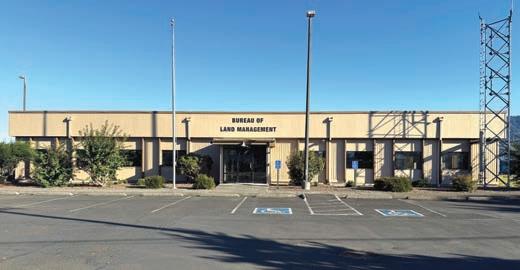
Tillamook’s board of county commissioners approved a purchase agreement for the building on Third Street in Tillamook that previously housed the Bureau of Land Management at their meeting on September 24.
This marked the second time in as many years the county has entered into a purchase agreement for the building as they seek to address a shortage of space in the county courthouse building. Previously, the county had planned to move state circuit courts to the building after a remodel, while now, they will look to relocate county staff to free up space for the courts in their current home.
At the meeting, commissioners also voted to support the transition of the Salmonberry Trail Intergovernmental Agency into an advisory committee at the Oregon Parks and Recreation Department (OPRD), which will take over the lease for the trail, as well as an agreement to contribute $25,000 to support the project.
The county has been looking for ways to upgrade, supplement or replace the current courthouse, built in 1932, since at least 2008, when a statewide study found that it was the fourth worst facility of its type in the state. The county, which is responsible for providing and maintaining a facility for the circuit court and district attorney, came close to constructing a dedicated justice facility near the jail on Long Prairie Road in the 2010s but the project fell apart amid funding questions.
Another plan was developed in 2021, envisioning a three-phase remodeling of the courthouse along with the addition of an annex to house the board of commissioners and other staff. The first phase of the project remodeling and reassigning courtrooms and moving the board of commissioners’ meeting room was completed in 2022, but forward momentum towards the annex stalled thereafter due to a funding gap.
In early 2024, when the Bureau of Land Management (BLM) announced plans to move to a new office at the Port of Tillamook Bay, the owner of the building on Third Street that had housed them, Sande
County commissioners from across Oregon, other elected officials and staff from state agencies traveled to Tillamook County for a tour of natural resource industry sites hosted by the Tillamook Working Lands and Waters Cooperative on September 18.
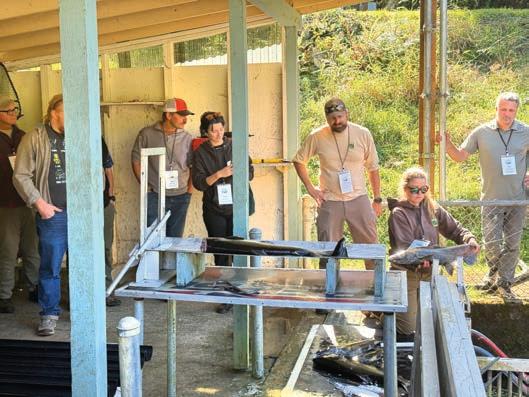
Attendees toured the Martin Dairy, inspected a timber harvest in the Short Creek watershed on Cape Meares and visited the Trask River Fish Hatchery, focusing on the importance of and steps taken to protect water quality in each industry.
Tillamook Working Lands and Water Cooperative (TWLWC) is a group made up of representatives from Tillamook’s natural resource industries that works to educate the public on the sustainable practices being used to manage the county’s resources. TWLWC hosts annual field tours for different groups to give locals and people from across the state a firsthand look at industry practices.
September’s tour started at the Tillamook office of the Oregon department of forestry, with Tillamook County Commissioner Erin Skaar welcoming attendees and leading a round of introductions. The group then proceeded to the Martin
WILL CHAPPELL
CITIZEN EDITOR
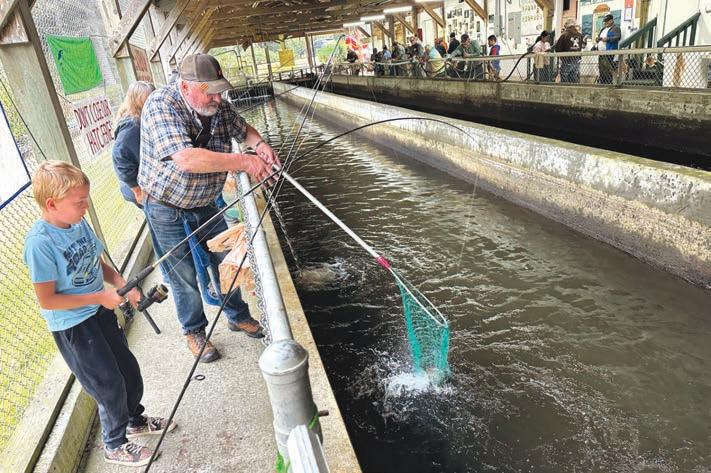
Families with members with intellectual and developmental disabilities from across the state converged on the Whiskey Creek Fish Hatchery on September 13, for the Tillamook Anglers’ 37th annual Kids and Adults with Disabilities Fishing Day.
In conjunction with staff from the Oregon Department of Fish and Wildlife, volunteers from the anglers helped to stock more than 900 rainbow trout from a Nehalem hatchery at Whiskey Creek and give participants the thrill of fishing.
“It’s a work of love really, you talk to all these guys that volunteer, and they all love it,” said Jerry Dove, a founding member of the Tillamook Anglers.
The idea for a disabled fishing day arose in the second year of the Tillamook Anglers’ existence in 1988, and Dove works
with hospitals and charitable groups from across the state each year to get the word out about the event.
Designed to give people of all abilities easy access to an opportunity to fish, the day is one of the anglers’ two big events of the year, with the other being a fin-clipping day in the spring that sees more than 100,000 spring Chinook salmons’ adipose fins clipped. At the disabled fishing day, participants were allowed to catch up to three trophy trout weighing two pounds or more, which are raised at a hatchery in Nehalem and transported to Whiskey Creek by Oregon Department of Fish and Wildlife staff, who release any excess fish into Cape Meares Lake following the event. There were also free coffee and doughnuts at the event’s beginning, complimented later by a BBQ lunch and Tillamook Ice Cream.
WILL CHAPPELL
CITIZEN EDITOR
Developers, elected officials, government staff and others involved in housing development assembled in Astoria on September 23, for the Northwest Oregon Housing Summit, hosted by the Columbia Pacific Economic Development District.
Throughout the day, panelists discussed different aspects of housing development in Oregon, and particularly Tillamook, Clatsop and Columbia Counties, which fall into the district, and attendees were given several opportunities to network.
The summit was convened to give attendees the
opportunity to learn about the work going on in their neighboring counties as the region and state work to address a housing crisis. Proceedings kicked off with a panel giving the lay of the housing landscape in the region, moderated by Steve Faust of 3J Consulting, which has helped with housing needs assessments for the Columbia Pacific Economic Development District (ColPac) and the counties. Faust shared figures from those assessments that showed that over the next 20 years, the three counties need to construct more than 14,000 housing units, including more than 4,000 in Tillamook County. Discussing the challeng -
es facing each of the counties, Faust said that there were similarities across the region, as well as unique challenges for each of the counties. In Tillamook, the challenges in housing include a scarcity of homes with limited options for different types of housing, high and rising home prices, low vacancy rates, and environmental and infrastructural concerns constraining new development. Faust then described the updates to development codes in Tillamook County earlier this year pursuant to Senate Bill 406 that allowed for easier development of so-called middle housing, which includes duplexes, triplexes, four-

Help protect your community and get your flu shot today.
Walk-in Flu Vaccine Clinics. No appointment needed. Bring your medical insurance card and a valid ID.
Medical Office – Manzanita 10445 Neahkahnie Creek Road, Manzanita Mondays, 8 a.m. – 4 p.m. | Sept. 29 – Dec. 29
Medical Office – Plaza 1100 Third St., Tillamook Wednesdays and Fridays, 8 a.m. – 4 p.m. | Oct. 1 – Dec. 31
Women’s and Family Health 1011 Third St., Tillamook Every Monday – Thursday, 8 a.m. – 4 p.m. | Sept. 29 – Dec. 31
Medical Office – Pacific City
38505 Brooten Road, Suite A, Pacific City Mondays, 8 a.m. – 4 p.m. | Sept. 29 – Dec. 29
Learn more about the flu at CDC.gov/flu.
plexes, townhouses and cottage clusters. The code updates prompted by the bill mean that across the county, each of those types of housing is now allowed outright on land served by water, sewer and power utilities, while duplexes are allowed on all lots where single family homes are permitted.
In Clatsop County, the biggest challenges are population growth, which ranges from 7% to 26% in incorporated cities and is 44% in unincorporated areas, a lack of alternatives to single-family detached housing, a large number of vacant units in beachfront communities and lack of housing for those with very high or very low incomes, as well as similar topographical and environmental challenges to those faced in Tillamook County.
Columbia County also faces hurdles from limited infrastructure and a shortage of buildable lands due to topographic and environmental constraints.
After Faust’s introduction, Tillamook County Housing Coordinator Parker Sammons discussed Tillamook’s recently completed housing needs assessment, which showed that of the roughly 14,000 units needed in the county, around 40% needed to be some variety of middle housing. Sammons said that the community did not currently look like that and that it would be critical to build those middle housing types to give residents the opportunity to age in place by moving into more appropriate housing and freeing up larger, singlefamily homes for younger residents.
Sammons also said that the median home value in the county had ballooned by 87% between 2019 and 2023, but pointed to the county’s multifamily housing grant fund, which has used revenue from shortterm rental license fees to help construct 400 units of affordable housing across the county, as a way the county is responding.
Sammons said that going forward he would continue to support projects large and small, as addressing the shortage in Tillamook will take varied solutions,
and continue to follow the availability of viable infrastructure.
Elissa Gertler, Clatsop County’s housing manager, said that in Clatsop County, it was important for the government to focus on key locations in the county that were able to support large projects. Identifying those locations will mean finding buildable land in places with developers looking to partner on projects, which Gertler said will look different in each community.
John Roberts, Astoria’s community development director, discussed several projects ongoing or on the horizon in the city, including a project by Clatsop Behavioral Health. The summit’s second panel focused on updates to housing law in Oregon and was moderated by Nate Stice, the regional housing solutions coordinator for the north and central coast from Governor Tina Kotek’s office. Stice began the panel with a brief overview of what the governor and legislature have done since Kotek took office to address a projected need of 400,000 housing units across the state over the next decade and as home prices grow seven times faster than wages.
Kotek formed a Housing Solutions Advisory Committee to provide guidelines for jurisdictions across the state to promote housing, focusing on six areas. Various bills have also seen the state invest in modular housing, allow a one time urbangrowth boundary expansion, provide funding for infrastructure to support housing, require larger cities to allow middle housing, and provided loans for construction and systems development charges.
Ethan Stuckmayer, head of the Department of Land Conservation and Development’s housing division, then detailed changes at his agency around housing needs analyses.
For the most recent statewide housing needs analysis, this meant that after calculating the needed units across Oregon, the department had divided that projection into region -
al projections, which were further assigned to counties and cities. Stuckmayer said that in 2023, the department moved from a model that used only population projections to analyze housing needs to one that also incorporated other local factors such as underproduction, homeless people, and the impact of second and vacation homes.
In the morning’s third panel, moderated by Kate Allen from Oregon Housing and Community Services, developers and government officials discussed ways that funding for affordable housing projects has become more difficult in recent years.
Mary Bradshaw of Northwest Housing Alternatives said that tax credits for affordable housing projects have become increasingly competitive and that many projects now needed eight or nine funding sources, up from three or four in the past. Bradshaw said that creating private-public partnerships allowed developers to access private equity funding and said that nonprofit bonds were another way to access financing.
Allen said that as this shift has happened, her agency has begun to ask developers to bring them projects that will work for their community, rather than creating grants for certain types of housing, to better utilize funds.
Astoria City Manager Scott Spence discussed his city’s commitment to helping finance housing projects, including a recent award of $200,000 to a project. Seth Hague, a developer with Mag-Amb Development, said that governments addressing infrastructure needs to make projects possible was a major factor in making projects financially viable.
The group then broke for lunch before two afternoon sessions with attendees choosing between panels on mass timber products in modular construction or brownfield property redevelopment, and flexible financing for green building practices or engaging the community in housing conversations.

BLM Building
From Page A1
Properties LLC of Redmond, listed the property for sale. Last July, county commissioners approved the purchase of the 13,000 square-foot building for $3 million, planning to use American Rescue Plan Act funds and a loan to cover the purchase price. Commissioners planned to access state funds to cover half of the budget for a remodel, projected to cost $12 million, while finding a way for the county to cover the balance.
However, during the due diligence process, the county discovered that remodeling the building to meet court needs would be cost prohibitive and the sale fell through. That led commissioners to contract with the DLR Group to complete a quantitative space needs assessment to help determine the best path forward. That assessment, com-
From Page A1
work on a solution.
“I went to solid waste, went to public works, and talked to them to see what their capacity was, went to the sheriff’s office,” Fournier said, “he was already sick of it because he was getting tons of calls.”
One of the main bottlenecks stalling action was a lack of available space in the county’s storage lot at the Port of Tillamook Bay, where impounded vehicles need to sit for 30 days in most situations before they can be scrapped. Don G. Averill Recycling, which takes impounded cars from the county free of charge, also leaves those vehicles in the lot until scrap metal prices are favorable for their junking.
The other sticking point for the removals is the cost of removing and undertaking required inspections of the RVs. According to Fournier, towing an RV to the lot costs between $200 and $800, depending on the
From Page A1
senses, to inspire them and influence them to be the best they can be,” said Monica Isbell, President of the Mudd Nick Foundation Board of Directors.
The seeds for the Mudd Nick Foundation were planted in 1987, when Jim Mudd and Doug Nicholson were introduced on the golf course and bonded over their shared love of Oregon State University. The next year, the pair started a golf tournament, named the Mudd Nick Invitational, which became a fundraiser for the school district in 1996.
pleted in August, found that county departments needed an additional 13,000 square feet beyond the courthouse’s capacity to adequately meet their needs. The consultants also included five options for different combinations of departments that could be relocated to free up the necessary space. At the same time as that process was ending, Tillamook County Administrative Officer Rachel Hagerty told commissioners that another opportunity to purchase the building, at a lower price, had presented itself.
Hagerty said that the tentative plan was for the board of commissioners’ office and board room, the treasurer’s office, and human resources and emergency management departments to move, as well as other departments that will be identified in the future.
The purchase agreement includes a closing date of March 31, 2026, and Hagerty said that since while some due diligence had been performed last year, a survey and building inspection would still need to be completed and a financing method determined. Hagerty said that
vehicle’s condition and location, paying for an inspector to visit the county costs $290 per RV and remediating any asbestos found can cost up to $5,000. The sheriff’s office’s budget includes $10,000 annually to deal with abandoned vehicles, sufficient to pay for the recent removals, and after shuffling some vehicles around, space was found for the RVs and cars.
Deputies first tagged the identified the vehicles, giving 24-hour notice of towing, before having them towed on the 28th. After an appraisal, an inspector visited the lot and tested the four RVs and six that were already present, with three identified as having or probably having asbestos, while the other seven were cleared.
Fournier said that he, Brown, Laity, Absher and Weiss have formed a task force to build on the recent success, cut down on the costs associated with removal and make the process as efficient as possible. “We’re looking to have a process in-house to get these problems taken care of quicker,” Fournier said.
To cut down on costs, Fournier said that he hoped to train a county employee to perform the necessary
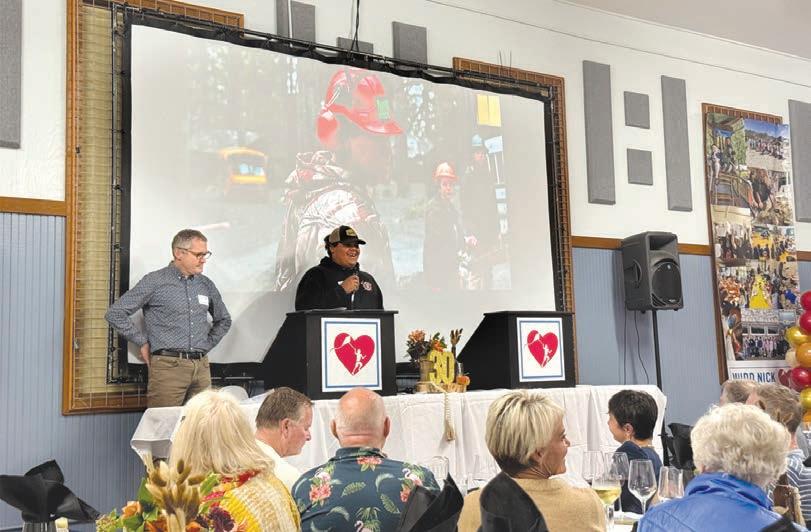
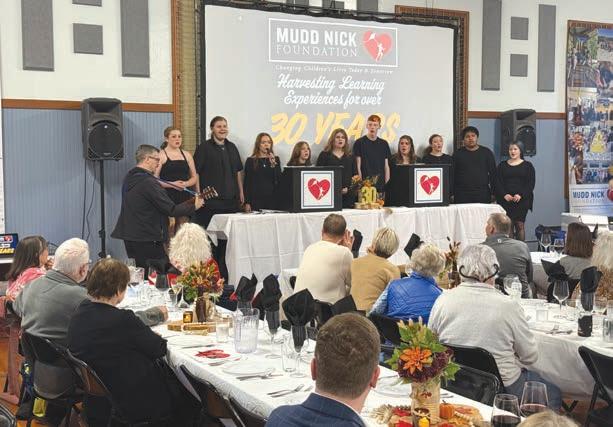
Golfers came from eight or nine states for this year’s tournament and in the evening reconvened at the North County Recreation District’s Performing Arts Center. After Isbell welcomed guests to the dinner, golf tournament winners were announced before the Neah Kah Nie High School choir performed.
The Mudd Nick Foundation’s donations support a variety of programs and opportunities in the school district, including field trips, the high school’s Future Natural Resource Leaders (FNRL) club, the district’s Chess for Success program and the Oregon Battle of the Books.
Neah-Kah-Nie Superintendent Tyler Reed
staff will now work to develop a financing package for the purchase, and that if the sale is consummated engineering and design for a renovation would be undertaken in 2026, allowing work to proceed in 2027 for a move-in late in that year.
Commissioners Mary Faith Bell and Paul Fournier said that they were excited about the prospect of the sale and solving a longstanding issue that has bedeviled past boards and floated the possibility of staff into the building prior to a remodel.
Commissioner Erin Skaar
stressed that the sale agreement was not a final decision and that the sale would depend upon positive survey and inspection results and the identification of an appropriate funding mechanism.
The board then voted unanimously to approve the purchase agreement.
The action on the Salmonberry Trail came as the documents governing the Salmonberry Trail Intergovernmental Agency (STIA), founded a decade ago, are set to expire at
the end of the year. With that deadline looming, members have been discussing next steps over the past year and agreed that moving the responsibilities of STIA to OPRD with an advisory committee replacing the agency’s board was the best approach.
OPRD will take over the lease for the 82 miles of rail between Tillamook and Banks, and a staffer will provide technical support for the advisory committee, whose members will be the same as STIA: Tillamook

asbestos inspections on RVs, which would reduce the cost of testing from $290 to $90. Fournier said that the group was also discussing the possibility of public works transporting abandoned RVs and destroying them following inspection, solid waste taking care of their disposal and where a full-time code enforcement officer should be housed in the county
said that support from the Mudd Nick Foundation and other community groups was critical, highlighting the recent example of the Mudd Nick Foundation and Eugene Schmuck Foundation partnering for a $7,000 donation to fill a shortfall in funding for students to attend outdoor school.
“Neah-Kah-Nie, we just pride ourselves on our strong community and there’s nothing that really defines our community more than how we come together and help our kids, and the Mudd Nick Foundation certainly is a big part of that,” Reed said.
After dinner, Karen Czopek was given the Jim and Lynn Mudd Service to Children Award before several students and
WILL CHAPPELL CITIZEN EDITOR
After switching to a new catalogue management system this spring, the Tillamook County Library will be debuting a new website utilizing that software on October 1. Tillamook County Library Director Donald Allgeier and Systems Librarian Danielle Meininger said that the switch would retain all the current site’s features and give the library system greater input on updates to the web platform’s design.
“This allows us to be in a position to be able to adapt, change things up,” said Allgeier. “That’s what we do in libraries anyway, on a day-today basis to try and make sure that libraries are able to meet people where they are.”
Currently, the library uses the same web services provider as the rest of the county government, but when it was announced this summer that a forthcoming update would
require a reworking of websites using the provider, the library started exploring its options. The library had just transitioned integrated library systems, used to manage collections and lending, from the Sierra system to the opensource Koha system paired with a discovery layer called Aspen in March, and were already using Aspen’s online platform for users to search its collection.
Meininger found that Aspen had added website support to its offerings last year and recommended that the library use the service for its new site. The new site will be at the same address, tillabook.org, and contain all the same information and capabilities as the current site, though with a different organizational flow. Instead of drop-down menus, most library information will be located on an “About Us” page and there will be separate home pages for kids, teens and Spanish speakers. Presentation of events will be upgraded on the new site, with
the new calendar color coding events based on which branch they occur at and allowing users to save events. One of the only changes with the switch is that patrons will now be required to be logged in to make materials requests.
Allgeier said that because the website, like the integrated library system itself, is based on open source software that the library contracts with a third-party company to manage and update, he expects that their feedback will be integrated more quickly than it would with other providers.
The library is also working to roll out a mobile app later this year, also using Aspen software, and Meininger said that patrons should call the library if they have any questions about the new site.
“I would just stress that we haven’t gotten rid of anything, everything that was on the old site is there,” Meininger said, “so people should call us if they’re not finding what they’re looking for.”
government. Fournier said that Absher is also in the process of updating ordinances for code enforcement and that he was working on an ordinance that would limit parking in pull-outs to eight hours.
Beyond the logistical and financial questions, Fournier said that the problem is also challenging simply because of the range of departments
teachers shared stories of the benefits they had experienced courtesy of the foundation.
Neah Kah Nie High School teacher Steve Albrechtsen and recent graduate Dontae Diaz shared the story of how Diaz’s participation in FNRL and fire school, both funded by the foundation, had helped set him on a path to a career in firefighting.
Diaz arrived in Rockaway Beach in 2017 and when he was a sophomore in high school, Albrechtsen encouraged him and several friends to join the FNRL club, which they did. When Diaz attended fire school, Albrechtsen said something clicked for him, and he has since been pursuing a career in firefighting.
and processes involved. For example, vehicles parked in rights of way are the purview of the sheriff’s office whereas those on private property are the responsibility of the property owner, unless they become a nuisance at which point they fall under the purview of solid waste, which must initiate a hearing process to deal with them.
After originally want
ing to be a wildland firefighter, an introduction to Rockaway Beach Fire Chief Todd Hesse led to an internship and focus shift to fighting structure fires. Diaz is currently working for the City of Rockaway Beach, while volunteering with the fire department and working towards EMT certification, with an eye on becoming a full-time firefighter in the future.
“That’s thanks to you guys and I really do appreciate it,” Diaz said, “and I hope to have a long-lasting career in fire, just to help communities and be able to get out and active.”
Middle School math teacher Katie Green and student Nikos Theohar -
and Washington Counties, the Oregon Department of Forestry, OPRD and the Port of Tillamook Bay. Advisory committee members will be responsible for partnering with local jurisdictions or groups to review proposed segments in their bounds before presenting those proposals to OPRD for final approval.
Skaar said that the move would make OPRD the trail’s backbone, while the Salmonberry Trail Foundation would remain the heart of the project. Skaar said that the decision to sunset STIA had been made to avoid hiring a staff for the agency when OPRD had the experience and willingness to provide support.
The memorandum of understanding commissioners agreed to regarding the new structure was accompanied by an agreement to contribute $25,000 towards the advisory committee and its staffing in fiscal year 2026. STIA will continue to function until details of the lease transfer and new advisory committee are finalized.
In the past, this has led to abandoned RVs and other code enforcement issues slipping through the cracks, but Fournier said that he believes the members of the task force are committed to addressing the issues and is optimistic that they will bring positive results to bear.
“We finally have department heads who are excited and motivated to clean up the county,” Fournier said. “I’m 100% supportive of their efforts and I believe they will establish a model for other counties to emulate.”
Fournier sounded a note of caution for residents with old vehicles, saying that if they sold or gave their RV to somebody, they needed to notify the department of motor vehicles, as the last registered owner is responsible for any abandoned vehicle.
Fournier also urged residents to call Tillamook dispatch if they saw somebody who appeared to be preparing to abandon a vehicle at the roadside and to take pictures of RVs they saw that looked as though they were ready for abandonment in case they were later left at the roadside.
ris then talked about the seventh and eighth grade summer field trip to Washington D.C. funded, in part, by the Mudd Nick Foundation.
Both Green and Theoharris extolled the trip’s value as an educational opportunity for students to get experiences in museums and monuments, as well as to hone their travel skills, thanking the participants for donating.
“I would like to say thank you all in here and those who have come before you for giving so generously to students of Neah-Kah-Nie School District throughout the years,” Theoharris said.
“This trip wasn’t just fun; it enriched our education and taught us important life skills.”

& Pokemon. Premuim paid for vintage. Corey 541-838-0364.











Nehalem


Nehalem Bay


Food Pantry





Pastor Celeste Deveney + Sunday service 11 a.m.





United Methodist Church 36050 10th Street, Nehalem, OR (503) 368-5612






Open Friday, Saturday & Monday 10 a.m. to 2 p.m. Wednesday





March - October 2 p.m. to 6 p.m.

Chief Executive/Operations: Joe Warren



November - February noon to 4 p.m.


Nehalem Senior Lunches

Tuesday & Thursday served at noon email: nbumcnsl2020@gmail.com


To feature your spiritual organization on this panel:




Contact Katherine at (503) 842-7535, headlightads@countrymedia.net


Serving North Tillamook County since 1996


Deadline: FRIDAYS at Noon for Advertising, News, Letters, Classifieds, Legals/Public Notices, Obituaries

Editor: Will Chappell, email headlighteditor@countrymedia.net
Advertising: Katherine Mace, email headlightads@countrymedia.net
Office Manager: Patty Archambault, email classifieds@orcoastnews.com
Classifieds & Legals/Public Notices: Due by Noon on Fridays the week of publication, send Classifieds to classifieds@orcoastnews.com, send Legals/Public notices to legals@orcoastnews.com, or call 503-842-7535 for more information.
Graphic Design: Steph Baumgart Office Phone: 503-842-7535
Website: northcoastcitizen.com
The North Coast Citizen (15503909) is published biweekly by Country Media, Inc. 1906 Second Street, P.O. Box 444, Tillamook, OR 97141 SUBSCRIPTION RATES
$60.00 annually in-county; $72.00 annually out-of-county. $50.00 for online only.
Periodicals Postage paid at Tillamook, OR. POSTMASTER
Send address changes to P.O. Box 444, Tillamook, OR 97141
Member Oregon Newspaper Publishers Association (ONPA) © 2025 by the North Coast Citizen. All rights reserved. LETTER POLICY
The Citizen welcomes letters that express readers’ opinions on current topics. Letters may be submitted by email only, no longer than 300 words, and must be signed and include the writer’s full name, address (including city) and telephone number for verification of the writer’s identity. We will print the writer’s name and town of residence only. Letters without the requisite identifying information will not be published. Letters are published in the order received and may be edited for length, grammar, spelling, punctuation or clarity. We do not publish group emails, open letters, form letters, third-party letters, letters attacking private individuals or businesses, or letters containing advertising. Deadline for letters is noon Fridays. The date of publication will depend on space. Obituaries
The North Coast Citizen has several options for submitting obituaries.
• Basic Obituary: Includes the person’s name, age, town of residency, and information about any funeral services. No cost.
• Custom Obituary: You choose the length and wording of the announcement. The cost is $100 for the first 200 words, $75 for each additional 200 words. Includes a small photo at no additional cost.
• Premium Obituary: Often used by families who wish to include multiple photos with a longer announcement, or who wish to run a thank-you. Cost varies based on the length of the announcement.
All obituary announcements are placed on the North Coast Citizen website at no cost.
Owen Nicholson
September 16, 1924 ~ September 8, 2025
Owen was called home to be with the Lord on September 8, 2025. He was born in Salt Lake City, Utah and grew up in Denver, Colorado. He enlisted in the Navy at the age of 17 and became a Sonarman on Destroyer Escort USS Reynolds DE-42 operating in the South Pacific. His ship was involved in 8 battles, sank 2 Japanese submarines, and was in Tokyo Bay when the Japanese surrendered to end WWII. Owen kept a diary hidden in the back of his foot locker, which was the basis of a book he published later in life “Tour of Sea Duy April 8, 1943 – February 15, 1946. After the war, Owen attended University of Colorado, majoring in Business and graduating in 3 years while playing football and wrestling. It was there that he met his beloved wife Constance Ann Doremus, to whom he was married for 66 years before Ann’s passing in 2016. His career took him to Utah (Mine & Smelter Co), California, Arizona, and Oregon (Anaconda Wire & Cable Co), and Texas (Condumex Wire & Cable Co) where he opened the first US office of this

Mexican company. Owen was always involved in the community including homeowner associations, High School Dad’s Club, PTA, and many professional organizations. After retiring in Manzanita, Oregon, Owen became a life member of Manzanita Links, cofounded with Ann the Nehalem Bay Historical Society, chaired the City of Manzanita Planning Commission, and served on the boards of Nehalem Bay Wastewater Agency, Rinehart Clinic, and the Mudd-Nick Foundation. He was named (along with Ann) the Manzanita Person of the Year in 2004 and the
He coached his 3 sons in Pee Wee, Little League, and Babe Ruth baseball. He was an OSU football season ticket holder for 50 years to spend time with Ann and the boys. Family events and vacations were always his priority.
Owen is survived by his 3 sons Doug (Michele), Jim (Lynda), and Bill (Kathy); grandsons Eric (Sara), and Spencer (April); and greatgrandchildren Stephen, Jeffrey, Gavin, and Adalyn.
Our family would like to thank the many good friends who supported Owen throughout his nearly 101 years and the loving caregivers who helped him live at home the past 7 years.
A Celebration of Life will be held on Sunday November 9 at 2 p.m. at the North County Recreation District Performing Arts Center in Nehalem, OR.
In lieu of flowers, donations may be made to the Mudd-Nick Foundation at muddnickfoundation.com or P.O. Box 250, Manzanita, OR 97130.

A Celebration of Life will be held on Sunday November 9 at 2 p.m. at the North County Recreation District Performing Arts
Oregon Department of Transportation projects on Miami-Foley Road and the Tillamook River Bridge on Oregon Highway 131 are both nearing completion in the coming months.
The Miami-Foley project, replacing two temporary bridges installed after culverts washed out at Crystal and Dry Creeks
in a 2023 storm, is on pace for completion this winter.
Crews closed the road on September 8, removing the old beams from the Crystal Creek span, and are planning another closure in the week of September 29, to place the final new beams.
An Oregon Department of Transportation representative said that the project was on schedule and on track for completion in
winter 2025. Preservation work on the Tillamook River Bridge on Highway 131 is also on schedule, with bearing pads being replace and concrete being repaired on the center span in addition to a complete repainting of the structure to extend its service life. Work began in late May and should be complete in October or November.
On Tuesday, September 9, 2025, at 8:25 a.m., the Oregon State Police responded to a single-vehicle fatal crash involving a pedestrian on Highway 6 near milepost 30 in Tillamook County.
The preliminary investigation indicated a white Freightliner semi-truck,



for early detection of breast cancer. This includes self-exams and mammograms! Scheduling your annual wellness exam could be one of the most important actions you take this year. While breast cancer is often thought of as a women’s health issue, it affects people of all genders. That’s why it’s essential for everyone to be aware of their bodies and recognize changes early. Early detection saves lives.
Do you have questions about how to perform a breast self-exam? Or want to learn more about risk factors for breast cancer and screening recommendations such as mammograms? Your provider is here to help. Give us a call today to learn more about your breast health.

operated by Scott Lee Gotchall (64) of Portland, was traveling eastbound on Highway 6 near milepost 30 when a pedestrian, Jaime Cristobal Aguilar Herrera (25) of Beaverton, entered the lane of travel for an unknown reason and was struck by the semitruck.
The pedestrian (Aguilar Herrera) was pronounced
deceased at the scene.
The operator of the semi-truck (Gotchall) was not injured.
The highway was impacted for approximately 3.5 hours during the onscene investigation. OSP was assisted by the Tillamook County Sheriff’s Office, Tillamook Fire and the Oregon Department of Transportation.
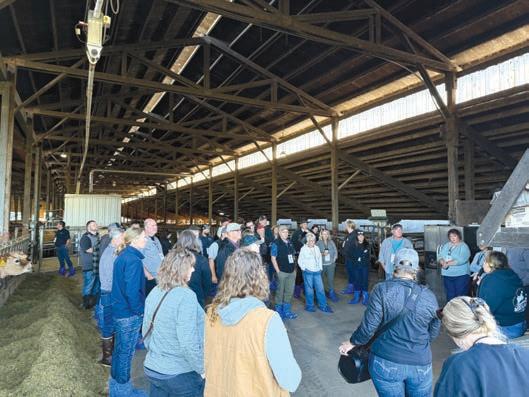
Dairy, where they were treated to a tour by fifthgeneration dairy woman Taryn Martin. The Martin Dairy is
to around 700 Jersey cows and recently completed a $1.8-million transition to robotic milking equipment for its herd.
On the tour, participants got a look at the milking machines, which monitor milk quality and quantity throughout thrice daily milkings of the cows. The dairy has nine robots, each capable of milking 60 to 70 cows. Martin also discussed the importance of nutrition at the dairy, describing the mixing of various nutrients including grass, corn and soybeans to maximize the herd’s milk yield.
Tour attendees were then given an opportunity to spend some time with the dairy’s calves. The Martin Dairy sees about 700 calves birthed annually, with bulls sold, while cows spend the first five to six months at the dairy, before traveling to Boardman
until they have their first calve at around 18 months and begin giving milk.
After leaving the dairy, the tour moved on to a timber harvest on Cape Meares in the Short Creek watershed. There, John Wehage from Stimson Lumber, discussed the steps the company takes to preserve water quality in watersheds where it operates and coordination with local water managers.
Wehage said that Stimson’s logging operations are governed by four layers of rules and regulations, starting with the company’s own bylaws, sustainable forestry rules monitored by an outside auditor, the private forest accords developed with the Oregon Department of Forestry and a final set of rules from the Oregon Department of Agriculture.
At the harvest, Wehage discussed how the private forest accords adopted in 2021 had increased riparian buffer zones and expanded protections to new classes of fish-bearing waterways. He also detailed how Stimson works with land managers from local water utilities to alert them of operations and address any potential concerns.
In Tillamook County, Stimson manages forestland in watersheds that provide drinking water to seven
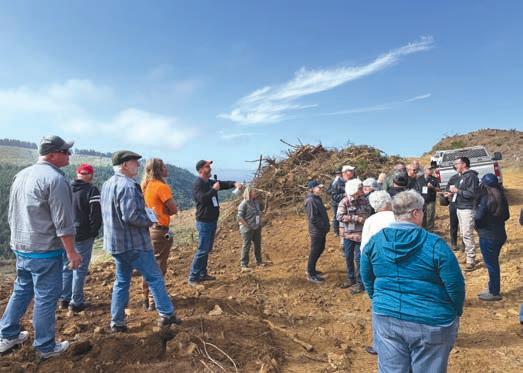
different communities, and representatives from five of those communities’ water utilities were present on the tour and briefly discussed their watersheds. Stimson gives those managers advanced notice of any harvesting or herbicide applications in their watersheds and the managers said that they appreciated the open channels of communication with the company.
Finally, the group traveled to the Trask River Fish


Hatchery, where they first stopped at the hatchery’s fish passage barrier, which helps to prevent the spread of disease by limiting the territory the fish have access too. The barrier is also next to the hatchery’s upper tanks and the intake on the Trask River that supplies the hatchery’s lower tanks. Ryan Fenwick from the hatchery discussed how the source water was clean and cool thanks to Stimson’s management of the watershed above it, providing
ideal conditions for fish to spawn.
Trask River Fish Hatchery was founded in 1914 and is operated by the Oregon Department of Fish and Wildlife (ODFW), currently producing 150,000 fall chinook salmon, 400,000 spring Chinook salmon, 100,000 brood stock coho salmon for the Trask River and 150,000 wild brood stock steelhead annually.
Next, the tour visited the hatchery’s upper fish tank
where 150,000 steelhead smolt were currently resident, and Fenwick discussed how the fish’s adipose fins would soon be clipped in an automated process in a special trailer owned by ODFW. The tour then moved on to the lower part of the hatchery. There, spring coho were being gathered as they returned up the Trask before staff scan them for tags placed by fisheries and harvest eggs from the female fish.
Hatchery team member Amy Bennet demonstrated the method used to measure the fish and recover the tags, which consists of chopping off the portion of their snouts with a tag and sending them to another hatchery for analysis. The tags help the Oregon Department of Fish and Wildlife to track the fish’s returns and the amount of time they spend in the ocean. Finally, the group entered the hatch house, where fertilized eggs were currently on racks of trays while the fish gestated before they will later be transferred into larger tanks. The group then moved to the hatch house’s second story and examined the facility’s filtration system that removes sediment from water and used UV light to treat it before it is used for spawning, concluding the tour.