Cannon Beach Food Pantry serving more than 250 families a month
Sinceit’s humble beginnings in the Cannon Beach Bible Church in 2009, the Cannon Beach Food Pantry has grown to serve an average of 65-70 local families a week.
In just the past 12 months, the number of families served by the Food Pantry has increased by more than 50% and in March 2023, the Food Pantry helped almost 1,000 people from 300 families, while welcoming 27 new families.
A large part of that increase was driven by the 45% reduction, to pre-Covid levels, in the Federal Department of Agriculture’s “Supplemental Nutrition Assistance Program (SNAP) benefits in March.

The Cannon Beach Community Food Pantry depends on about 50 dedicated volunteers, including eight volunteer board members, eight college students from the Cannon Beach Christian Conference Center and Seaside High School students volunteering for their Pacifica Projects. There are no paid staff; everyone is a volunteer.
The Food Pantry relies entirely on donations of cash and food and is an independent 501(c)(3) charitable non-profit, not affiliated with any other organization.

The Food Pantry is blessed with generous local donors, who contribute money to the ten “change jars” located throughout town, and through online cash donations. In addition, there are two food donation boxes located in the Police and Fire stations. All donations are greatly appreciated.
Along with the cash and food donations, several local businesses regularly donate food to the Food Pantry, including Fresh Foods, Mariner Market, Sea Level
Bakery, Cannon Beach Bakery, Sleepy Monk, Seaside Safeway and Costco.
The Cannon Beach Food Pantry is able to buy food at a discount at the Regional Food Bank in Warrenton, operated by Clatsop Community Action as part of the Oregon Food Bank network. Any additional items are purchased from Costco, Fred Meyer or the Dollar Store.
The Pongo Fund Pet Food Bank in Portland donates pet food for the 20% of Food Pantry
clients who have pets. Food Pantry clients are provided with three days of food according to the size of the family, which can include meat, eggs, cheese, milk, fresh fruits and vegetables, oatmeal, peanut butter, nuts, beans, rice, spaghetti sauce, pasta, cooking oil, coffee and tea, along with toothbrushes, toothpaste, soap and shampoo, dish soap, laundry detergent and diapers.
Residents are eligible for the Food Pantry’s services if they live or work in Cannon Beach, Arch
Cape, Jewell or locations north of the intersection of Highway 26/101, but no one is turned away.
Volunteers regularly hear comments from Food Pantry clients such as “thank you, you guys are such a blessing,” “I don’t know how I could make it without you,” “this makes such a difference in my family’s life,” and “this helps so much.”
During the darkest days of the Covid pandemic in the spring of 2020, the dedicated volunteers of the Cannon Beach Community Food Pantry did not miss a single day of providing food and essentials for their clients.
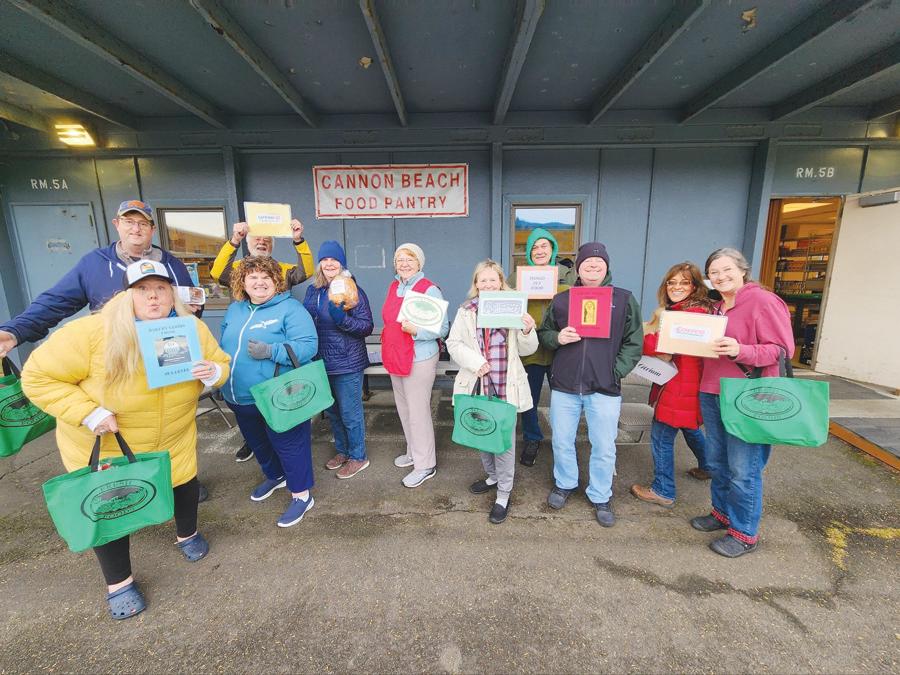
The Cannon Beach Community Food Pantry is open every Wednesday from 3:00 p.m. to 5:15 p.m. and is located at 268 Beaver Street next to the parking area behind the old grade school at the north end of Cannon Beach.
Besides cash and food donations, their greatest need is for more volunteers who are able to work 1-2 hours a week in a variety of jobs behind the scenes on different days of the week. Anyone wishing to donate or volunteer can visit the Cannon Beach Community Food Pantry’s website at: cannonbeachcommunityfoodpantry.com or by calling 971-326-0479.
Council discusses city hall, police station and elementary rejuvenation plans and budgets
Cannon Beach’s City Council appears ready to move forward with an $11.9 million budget for the elementary school rejuvenation project after discussions at their workshop on April 5.
They also set a public meeting to solicit feedback on citizens’ feelings about siting the city hall on Gower Street while building a separate police station on Highway 101.
A representative from Bremick Construction began the meeting by presenting three potential work packages for the Cannon Beach Elementary rejuvenation project at different price points. The expanded list of options came after public feedback that the projected $11 million price tag for the full
Proposed changes to FEMA flood plan draw criticism at Tillamook meeting
Representatives of the Federal Emergency Management Agency updated residents of Tillamook on proposed changes to the national flood insurance plan that would greatly restrict development in the 100-year flood plain.
Several dozen community members, including county government representatives, workers from the dairy, logging and fishing industries, and concerned property owners took the FEMA representatives to task over the economic impacts of the proposed change.
John Graves, who manages the national flood insurance plan for FEMA in Oregon, Washington, Idaho and Alaska, started the meeting by giving the hundred-person-plus crowd an overview of the changes and the history behind them.
The national flood insurance program was started in 1968 to provide subsidized insurance for homeowners against flooding. That support is conditioned on localities adopting FEMA-approved ordinances to reduce the risk of flooding through building standards and development restrictions.
The currently proposed updates to the program were precipitated by a 2009 lawsuit by the Audubon Society, which claimed that the flood insurance program was causing harm to coho salmon in Oregon. The suit claimed that the program operated in violation of the National Environmental Policy Act that says government agencies shall not harm endangered species.
program as designed with community feedback was too high.


The first alternative presented was a basic rehabilitation of the school to add seismic resistance, ADA compliance and a new HVAC system that would cost $6.3 million. The second included all those elements as well as the envisioned lobby connecting the Quonset Hut and school building and would cost $9.9 million. The second option would not include the kitchen or the entirety of heritage garden and landscaping on the project’s exterior as envisioned by the community. The original $7 million estimate generated by firm ZCS in 2020 was also included in the presentation as a point of comparison.
As at the city council meeting a week prior,

public commenters on the presentation were fairly evenly divided in their opinions. One group felt that the project needed to be built with the full $11.9 million budget to achieve the “magic” that they envisioned, while the other wanted the budget cut.
Councilor Gary Hayes said that he would consider postponing certain elements of the exterior program until outside grants or other funding could be secured to pay for them.
Councilors Lisa Kerr and Nancy McCarthy disagreed with Hayes and said that the exterior elements were key to the project’s purpose as a cultural heritage center. They said that they wanted to see the entire project approved, leaving the possibility for grants to backfill funding rather than waiting for them to proceed with work.
Hayes seemed swayed by this argument and the council preliminarily agreed to move forward on the project with the $11.9 million option, with a vote to come at next month’s council meeting.

The council then moved on to a discussion about the city hall and police station project that has been complicated by new state building codes requiring essential operations be located outside of the maximum tsunami inundation zone.
This requirement rendered the Gower Street location of the current city hall, which had previously been selected for the replacement facility, an unsuitable location for the police station.
With plans thrown into flux, the project team evaluated alternative sites around Cannon Beach
and identified as suitable one on the south side of the city, currently home to the Tolovana emergency materials cache.
According to Leslie Jones from CIDA, the architecture firm working with Cannon Beach on the project, geotechnical data will be gathered at the site over the next couple of weeks to help generate a full report. Jones said that report would help the team determine a more accurate budget for the project.

At a late March meeting, CIDA presented two possibilities for the project. One was to site both the police station and city hall at the Tolovana cache site, costing around $22 million. The other was building the police station at the cache site, out of the
FEMA commissioned the National Marine Fisheries Service to investigate the claim and in 2016, the fisheries service released a report saying that the flood insurance plan was causing a take of coho and other salmonids that would lead to their eventual extinction.
Since that biological opinion was rendered, FEMA has been working on changes to the program that would bring it into compliance with federal laws on endangered species.
The biological opinion called for the program to update the ordinances for building in flood plains to achieve zero net loss in three areas of floodplain functionality that help preserve fish habitat: flood storage, water quality and riparian vegetation.
Under the new rules, any projects proposed in the 100-year floodplain would have to include mitigation efforts that would lead to no loss in any of the three fish habitat functions to receive building permits. The new regulations would allow normal agricultural, forestry and fishing activities in the floodplain but would make placing fill, adding water impervious surfaces or removing vegetation more difficult to permit and costly.
Since FEMA is a federal agency and not allowed to make land use laws, it will be relying on the localities it partners with in the flood insurance program to implement the new standards.
Graves said that after listening to feedback from their partner communities, FEMA had decided to offer four different options for communities to satisfy the new requirements. Localities can use a FEMA model ordinance, develop an ordinance using a FEMA checklist, develop a community compliance plan for FEMA approval or create a habitat conservation plan for review by federal agencies.
Former Congressman Peter DeFazio delayed progress on the updates for three years, but with his retirement and lack of further congressional delay last year, the development process
BEST HEALTH of INSIDE Serving Clatsop, Tillamook and Lincoln counties and Wellness VOL. 47, ISSUE 8 FREE CANNONBEACHGAZETTE.COM April 14, 2023 Saying Goodbye to Rafael PAGE 3 Best of Health Inside n See COUNCIL, Page 2 n See FEMA, Page 3 Will Chappell Gazette Editor Deb Atiyeh Reporter Will Chappell Gazette Reporter We’re Better Together. VISIT A BRANCH OR OPEN ONLINE TODAY! APY = Annual Percentage Yield. APY is effective 12/19/22. Minimum opening deposit of $500.00. Fees may reduce earnings on your account. Early withdrawal penalty may apply. Relationship is defined as opening and using a consumer or business checking account with 1st Security Bank. Maximum opening deposit for these certificates of deposit is $240,000.00 per account. 3APY = Annual Percentage Yield. APY is effective 12/19/22. Minimum opening deposit for the 11 Month Risk Free CD of $25,000.00. Total balance plus interest earned may be withdrawn to close the CD without penalty seven days or later after the account was opened and funded. Partial withdrawals of principal are not permitted. Fees may reduce earnings on your account. Early withdrawal penalty may apply. FSBWA.COM Member FDIC Non-Relationship Rate 3.65 % APY 1 With Relationship2 4.21 % APY 1 21-Month CD SUPER RATE! 11-Month Risk Free CD SUPER RATE! Non-Relationship Rate 3.15 % APY 3 With Relationship2 3.50 % APY 3
Volunteers at the food pantry on Thanksgiving in 2022 hold signs of local businesses who donate to the pantry. From left to right they are Krista Tye, Phil Vincent, Rock Wickham, Barb Knop, Nancy Littell, Nadine Nordquest, Jack Kerwin, Kyle Genin, Jenee Pearce-Mushen and Susie Logan.
Proposed increases shine spotlight on TLT



The transient lodging tax, paid by overnight guests, has recently become a contentious issue in Cannon Beach, with a proposal to increase this tax 1.5% to 2.5% to provide additional funding for the renovation of the former grade school along Ecola Creek, located at the north end of Cannon Beach.




Guests staying overnight in Cannon Beach currently pay a 10.5% transient lodging tax (TLT); split between the City of Cannon Beach (8%), Clatsop County (1%) and the State of Oregon (1.5%)







The City of Cannon Beach’s 8% TLT is currently the second lowest on the North Oregon Coast; only Gearhart’s is lower at 7%. For comparison, Manzanita and Nehalem are 9%, Tillamook, Rockaway, and Seaside 10%, unincorporated Clatsop County 10.5%, Astoria 11%, and Warrenton 12%.
The history of the TLT in Cannon Beach is long and complicated; made even more confusing by the different
allocations within each incremental increase over the years. Like the layers of an onion, each layer has a different allocation.
The first 2% TLT was initiated by the City of Cannon Beach in the late 1980’s, eventually growing to 6% by the late 1990’s.
In 2003, the State of Oregon established a 1% “State Lodging Tax” to fund Oregon Tourism Commission programs, raising it to 1.8% in 2016, then lowering it to 1.5% in 2020.
That 2003 Oregon law requires that 70% of revenue from any TLT increases after that date be used either for “tourism promotion” or “tourism-related facilities”. The other 30% is unrestricted and can be used for funding city services.

Of the 8% TLT currently charged by the City of Cannon Beach, the first 6% is completely unrestricted, because it was put in place prior to the state law’s restrictions in 2003.
The next 1% percent increase in the TLT, enacted around 2008, is restricted,
Bonnie
Bonnie is a beautiful, three-and-a-half-year-old Great Dane mix. This long-legged girl is full of personality and spunk. She is inquisitive, has lots of energy and loves to gallop around the play yard with her toys. Bonnie is strong and needs a family prepared to manage a large breed dog. She is smart, sensitive, and a quick learner. This big sweetheart is hoping for a home soon. http://clatsopcounty.animalshelternet.com/adoption_animal_details.

cfm?AnimalUID=283085


Pet meet and greets are by appointment, so if you’d like to meet Bonnie, call the shelter at 503-861-7387 or stop by the lobby to set up a time. The shelter is open 9:30 to 4:00 Tuesday through Saturday, closed 12:30 to 1:30 for lunch. You can also fill out an application at the shelter’s Adopting a Pet page: https://www.co.clatsop.or.us/animalcontrol/page/Adoptingpet Scroll to the bottom of the page for the fillable application and email it to ac@ClatsopCounty.gov or drop it by the shelter.
with 30% of it going to the City’s general fund, and the remaining 70% going to “tourism marketing” or a “tourism-based facility”. This 70% provides funding for the Cannon Beach Tourism and Arts Fund, with the Cannon Beach Tourism Arts Commission (TAC) awarding grants for arts programs, such as the Coaster Theater, and to the non-profit Cannon Beach Gallery Group, who organize events such as the Spring Unveiling, and the Earth and Ocean Festivals.
The most recent 1% increase in the city’s TLT, approved in 2015, is also subject to that 70/30 split, with 70% going to fund the visitors center (operated by the Cannon Beach Chamber of Commerce) along with marketing and advertising promoting Cannon Beach during the slow season. This increase was requested by the local lodging industry, and as a result, more people are visiting Cannon Beach in the slower months.

In 2018, Clatsop County added a 1% TLT, with 30% allocated to help pay for
operation of the County jail, and 70% going to the city, amounting to over $400,000 a year. This additional TLT revenue allowed the City to purchase the old grade school property and continues to provide funding for its renovation.
Each 1% increase in the TLT generates about $600,000 in additional annual revenue for the city. Around 75% of the general fund revenue for Cannon Beach is collected by the local lodging industry through the TLT and it is the largest overall source of revenue for the City.
In fiscal year 2021-2022, the TLT generated almost $6 million in revenue for the City of Cannon Beach; with $5.2 million coming from hotels and motels, and $725,000 from short-term vacation rentals (STR’s) For comparison, around $750,000, or 12%, comes from local property taxes. In a 2020 report based on fiscal year 2018 TLT revenue, ECONorthwest reported that the Oregon Coast region had the highest average TLT rate in the state, at almost 9%.
Cannon Beach had the highest “TLT Revenue Per Capita” of any city in Oregon, at $2,500 with Yachats and Manzanita in second and third at $1,400 and Seaside at $900.
Even with Cannon Beach having the second lowest TLT on the north Oregon coast, when looking at the TLT revenue for calendar year 2022 (the latest data available) the “TLT Revenue Per Capita” in Cannon Beach is currently around $4,000. This is a reflection of the large annual number of overnight visitors to Cannon Beach, the relatively small and declining number of residents in town, and the overall average cost of an overnight stay.
Over the past decade, Cannon Beach’s TLT revenue has been increasing anywhere from 4% to 44% per year, with the only exception being fiscal year 2019-2020, when TLT revenue fell 16% due to the negative effects of Covid.
After suffering that unusual decline, TLT revenue roared back with a nearly 44% increase the following year. The total annual TLT revenue has increased from just over
$2.3 million in 2010-2011, to just under $6 million in 2021-2022.
Overall, about 82% of total TLT revenue is unrestricted, and goes directly to the City of Cannon Beach’s general fund, while the revenue from the other 18% of the TLT is restricted.
Whether restricted or not, the TLT helps pay for things such as the Haystack Rock Awareness Program (HRAP) the visitors center, farmer’s market, Coaster Theater, local festivals and events, the Cannon Beach Police Department, maintenance of city streets and parks, the recycling center and the renovation of the mid-town public restrooms.
This explanation will likely be as clear as mud for some. If you’re still confused, you’re not alone. If your head hurts after reading this, you can either order another latte from one of our excellent local coffee shops, go for a walk, take an aspirin or take a nap. The choice is up to you - you’re at the beach.
What is happening at Sea Level Bakery + Coffee?
Sea Level Bakery + Coffee has opened a pop-up espresso stand at Public Coast Brewing, located at the north end of Cannon Beach, that is operating from 7 to 11:30 a.m. Friday through Monday. They have a full menu of coffee and espresso drinks and are baking fresh pastries daily. No bread or other food for the time being.

H21760
If you drive by the Sea Level Bakery + Coffee building along Hemlock Street in Tolovana, you will notice that half of the building has been torn down. They are remodeling and expanding to add more kitchen space, along with indoor seating for their customers, and hope to have this new addition completed in July.
Until then, stop by and say hello at Public Coast Brewing, and enjoy one of their wonderful lattes and pastries. July will be here before we know it, when you can once again enjoy their Acai bowls, as no one does them better than Sea Level.
Councilors did not have as definitive opinions about the division of the project as they had about the elementary school.
McCarthy said that she was in favor of building both facilities at the Tolovana cache site to keep the budget lower and to remove both from the inundation zone.
tsunami inundation zone, but constructing a new city hall at the Gower Street location. That option would cost around $25 million.
While they all agreed that the new police station would need to be built at the Tolovana cache site, they were uncertain about how to proceed with the city hall portion of the project.
Councilors Hayes and Kerr wondered if building the police station immediately and delaying the city hall’s construction might be an option, although City Manager Bruce St. Denis noted that the project had already been delayed for more than 20 years.
Mayor Barb Knop noted that taking that course would allow the current city hall site to be repurposed, mentioning the possibility of adding much needed workforce housing or parking.
Eventually, the council decided that they would like to solicit more public feedback on the question before moving forward with a decision. They noted that the public had not had an opportunity to comment on the question of splitting the facilities, with emergency operations located
out of the inundation zone.
They noted that it would be good to have the city hall on Gower Street to allow it to continue to function as a gathering place for the community and to give residents easier access to government services.
They set a meeting for May 16, for community members to provide feedback on whether they would like to see the new city hall built at the Tolovana cache site with the police station or separately on the Gower Street property, with a higher cost. Please send any comments to headlighteditor@ countrymedia.net.

April 28th at 7:00, Tillamook United Methodist Church, 383 12th St., Tillamook


April 30th at 3:00, Seaside United Methodist Church, 241 Holladay Dr., Seaside


May 5th at 7:00, Cannon Beach Community Church, 132 E. Washington St., Cannon Beach


May 7th at 3:00, Nehalem Bay United Methodist Church, 36050 10th St., Nehalem


April 14, 2023 2 CannonBeachGazette.com | Cannon Beach Gazette n Council Continued from Page 1 Bob Atiyeh For the Gazette 503-842-7535 Deb Atiyeh Reporter is FREE to read online! Keep up on the latest news at www.cannonbeachgazette.com MULTI-USE CANNON BEACH COMMERCIAL PROPERTY $3,150,000 OCEANFRONT HOME ON (2) OCEANFRONT TAX LOTS $2,999,500 VACANT CANNON BEACH LOT, ZONED R3 $389,500 IMMACULATE OCEAN VIEW BEACH HOME $1,195,000 CANNON BEACH OCEAN VIEW HOME $1,799,000 CANNON BEACH E PRESIDENTIAL 2 SEPARATE LIVING QUARTERS $949,000 VACANT ARCH CAPE LOTS $155,000 1/12TH SHARE OWNERSHIP OCEAN VIEW CONDO $85,000 ELEGANT, OCEAN VIEW BEACH HOME $2,795,000 PERFECT WEST GEARHART LOCATION NEAR GOLF COURSE $525,000 Michael HendersonManaging Principal Broker Jeremy YoungquistBroker Liqaa RansierBroker Duane Johnson - Founder Jeff EtchisonPrincipal Broker, GRI Chris ChildressPrincipal Broker, GRI What is RMLS? As the Northwest’s largest REALTOR®-owned Multiple Listing Service(MLS), RMLS serves approximately 10,000 Real Estate Professionals in over 2,200 offices licensed in Oregon and Washington. All brokers listed with firm are licensed in the state of Oregon 296 N. Spruce St. • Cannon Beach • (503) 436-0451 www.duanejohnson.com Active Members of & A VALUED AND TRUSTED RESOURCE WITHIN OUR COMMUNITY AND THE #1 OFFICE SINCE 1990. H21891 NEW LISTING NEW LISTING NEW LISTING NEW LISTING NEW LISTING BEAUTIFUL
NEW PRICE SALE PENDING SALE PENDING SALE PENDING
4.1 ACRE PARCEL WITH STUNNING PANORAMIC OCEANVIEWS! $4,495,000
H21871
Our sad goodbyes to Rafael JR Nolasco Luna
Afew days ago, the small community of Cannon Beach had to say goodbye to a boy who tragically lost his life in a car accident. The farewell was as dictated by Mexican tradition. We went to church and when the mass ended, we walked behind the coffin with a Mexican music band. As we walked through the center of Seaside, I saw many tourists and locals looking at us with respect, but their faces were surprised. I know it’s out of the ordinary for Americans, but in our culture it’s normal. We turn pain into strength, and music is an important part of letting the deceased know how much we love them. In Mexico we
Rafael enjoying time with his mom, dad and sisters.
n FEMA
Continued from Page 1
is now moving forward into its scoping phase.

The Tillamook meeting was the first of five meetings to gather public feedback with three planned in-person meetings around the state and two more to be conducted virtually before the end of April. The proposed updates would affect all but five counties in Oregon.

Even before the public comment section of the meeting, the disgust with the proposed changes was palpable in the room, with audience members interjecting to question assertions in Graves’s presentation. One man asked, “what about the extinction of businesses,” while Graves discussed the biological opinion’s dire predictions of salmonid extinction, and others expressed derision for the notion that these changes were not land use regulations being issued by FEMA.
After Graves completed his presentation, two other colleagues gave more specifics on the plan’s technical components and opened the meeting to public comment.
Tillamook County Commissioner David Yamamoto kicked off the public comment. Yamamoto said that he had been following the progress of the biological opinion and flood insurance plan updates for six or seven years, concerned all along at the implications for Tillamook County.
He said that the plan was turning FEMA into an environmental policy implementation agency, a responsibility that it was shunting onto counties and cities by making them enforce new restrictions on property owners. These restrictions will amount to property takings under the fifth amendment, according to Yamamoto, requiring the governments enforcing them to compensate property owners for lost value or face a litany of litigation seeking the same.
Yamamoto said that he had asked FEMA officials if they would help pay for these costs and they had told him they would not.
Yamamoto said that this
left the county in a tenuous position, as noncompliance would mean not only exclusion from the national flood insurance plan but all of FEMA’s services.
After laying out the urgency of the situation for the county, Yamamoto took issue with the more fundamental conclusions reached by the biological opinion about the future of salmonids. He said that Tillamook County has led the way on preserving habitat for coho salmon and other salmonids over the past thirty years. He pointed to numerous bridge updates, riparian zone rehabilitation projects, flood gate removals and other projects undertaken by the county and property owners through and said that credit was never given for those projects. Yamamoto wondered why a take of wild coho salmon was allowed in Tillamook County if the preservation situation is as dire as the new measures suggest.
Yamamoto said that he had been meeting monthly with officials from FEMA for the past year and a half but that he hadn’t seen any of his concerns addressed in updates to the proposal.
Several dozen community members then proceeded to harshly criticize the plan and the impacts that it would have on Tillamook’s economy.
Concerns about the impact on the dairy industry were foremost in comments with around three quarters of the dairy farms in Tillamook County lying in flood plains. While the new provisions would not impact existing structures, they would seriously complicate repairs or additions.
During his presentation, Graves had noted that improvements and repairs within the footprint of existing buildings would not be subject to the new standards.
However, Damian Laviolette, a business owner who has been in contact with FEMA, said that that exception would not apply in the case of “substantial” changes to the structure, which are defined as costing more than 50% of the building’s assessed value. Laviolette pointed out that this would make replacing

Coaster Theatre holds auditions for Sherwood: The Adventures of Robin Hood
Auditions for the Coaster Theatre Playhouse’s summer production of Ken Ludwig’s Sherwood: The Adventures of Robin Hood will begin at 6:30 p.m. April 25 in the theatre.
The Coaster Theatre is looking for actors to fill the roles in this swashbuckling comedy. Sherwood: The Adventures of Robin Hood is directed by Patrick Lathrop, who will begin rehearsals around May 15. The show runs Thursday, Friday and Saturday June 23 to Sept. 3 for 29 performances. More
buildings damaged in fires, floods or other natural disasters cost prohibitive, as well as effectively stopping new growth.
Another group seriously concerned about the new regulations was representatives from ports. Mike Saindon, the Port of Garibaldi’s general manager, and his counterpart from the Port of Toledo both voiced concerns about impacts on their ability to dredge at their facilities.
Graves confirmed that dredging was considered a development activity and that the ports would need to comply with the new ordinances to perform dredging operations. Both port managers said that this would endanger their business, as dredging was essential to continued operations and already expensive to the point where the additional regulations would make it financially impracticable.
The restrictions on dredging also alarmed the dairy farmers at the meeting, who said that dredging the irrigation trenches on their properties was a normal and necessary part of their work.
Beyond these specific complaints about the proposed modifications to the flood insurance program, commenters expressed deep unhappiness about the general conceit. Like Yamamoto, numerous commenters said that they felt that Tillamook County residents have been strong stewards of the environment and were offended that the changes seemed to completely ignore that.
There was also a sense of distrust of federal government agencies dictating land use regulations to local governments, which several commenters said they felt was part of a long-running trend.
No commenters spoke in favor of the proposed changes and the FEMA representatives did their best to answer questions about the proposal’s impacts while making note of the myriad complaints being lodged.
Public comment continued for well over an hour, pushing past the meeting’s two-hour scheduled timeframe, before finally starting to slow down.
At that point, Commis-



sioner Mary Faith Bell addressed the crowd and reiterated Yamamoto’s comments from earlier in the meeting about the serious impacts the changes would have on the county and its economy. Bell said that without financial support from the federal government to make property owners whole, there was a “real scenario” where the county could face bankruptcy from litigation.
Public comments on the plan will be accepted until May 5, and FEMA will be hosting in-person events in Pendleton and Eugene and two virtual townhalls on April 18 and April 20 at 4 p.m.
The comment period will be followed by the development of the draft environmental impact statement, which is expected to be completed and published by December 2023. That draft will be open for additional public comment in early 2024, and updates will be made prior to the publication of a final draft in December 2024 before community implementation in 2025.
Please send any comments to headlightreporter@countrymedia.net.





accompany our loved ones to their last resting place, and we walk to the cemetery behind the coffin. This tour is also accompanied by a band or mariachi, it all depends on the favorite music of the deceased, until we reach the place where his grave will be. Very special tradition. We said, “no one dies as long as we remember them.”
Nuestras tristes despedidas
Hace unos días, la pequeña comunidad de Cannon Beach tuvo que despedirse de un niño que trágicamente perdió la vida en un accidente automovilístico. La despedida fue como dicta la tradición mexicana. Fuimos a la iglesia y cuando terminó la misa, caminamos detrás


del ataúd con una banda de música mexicana. Mientras caminábamos por el centro de Seaside vi a muchos turistas y lugareños mirándonos con respeto pero sus caras estaban sorprendidas. Sé que es fuera de lo común para los estadounidenses, pero en nuestra cultura es normal. Convertimos el dolor en fuerza y la música es una parte importante para hacerle saber al difunto cuánto lo amamos. En México acompañamos a nuestros seres queridos a su último lugar de descanso, y caminamos al cementerio detrás del ataúd, este recorrido también es acompañado por una banda o mariachi, todo depende de la música favorita del difunto hasta llegar al lugar donde será su tumba. Nostros decimos, “Nadie muere mientras los recordemos”.
information about the show and auditions is at coastertheatre.com.
Written by Ken Ludwig, Sherwood: The Adventures of Robin Hood is packed with thrills, romance, laughter and immortal characters like Little John, Friar Tuck and Maid Marian. The play tells the enduring story of a hero of the people who takes on the ruthless powers that be.
Upcoming shows and events at the theatre: Sylvia , May 12-June 3
Auditions: Sleuth, June 27 & 28
April 14, 2023 Cannon Beach Gazette | CannonBeachGazette.com 3
Keep up on Cannon Beach news at www.cannonbeachgazette.com The Cannon Beach Gazette is FREE to read online Print Digital Job Recruitment Services We can now programmatically distribute employment listings to the right aggregators and take the guesswork out of deciding where to post. Our system continually adjusts a job post’s performance for optimal results on our Job Recruitment networks! Contact us today to get started! Social Media Advertising that works! Contact Katherine to get started: (503) 842-7535 headlightads@countrymedia.net Contact Katherine to get started: (503) 842-7535 headlightads@countrymedia.net www.brucescandy.com • 503-436-2641 Mother’s Day is May 14th Sweet Treats for Mom Made in Cannon Beach H21824 Downtown Cannon Beach Visit our online store and shop for Sweet Treats from Cannon Beach WE SHIP!
Iolanda Ramirez For The Gazette
El Nino brings wet spring to Cannon Beach
The spring of 2023 has been relentlessly cold and wet; with long stretches of warm, dry weather as elusive as a pot of gold at the end of the rainbow.


Even with all the rain this spring, the total amount of rainfall in Cannon Beach since the first of October is far below normal.
The six months from October 1st through March 31st are the wettest months of the year, with Cannon Beach normally drenched with 67.5 inches of rain. Only 49.5 inches fell on






Cannon Beach during these six months, for a rainfall deficit of 18 inches, or 25% below normal.
How is that possible you might ask. The Cannon Beach rain gauge must be broken. Think back to that long stretch of warm, dry weather in November, which is normally the wettest month of the year. After being soaked with an atmospheric river that dropped almost 6.5 inches of rain in four days during the first part of November, high pressure anchored itself over the west coast, with a strong east wind kicking in.
Applications open for Fire Mountain School



Fire Mountain School is welcoming applicants for Fall 2023 enrollment in the school’s pre-K through 5th Grade classrooms. Two mixed-age classes support up to 12 students each and reflect an emphasis on community.


For 40 years, Fire Mountain School has nurtured each child by providing a joyful, place-based learning experience for students to develop a positive sense of themselves, come to see learning as an ongoing, joyful and self-initiated quest, and come to know themselves as interactive participants in the wider natural, social, and practical world.
“It’s really the teachers, the spectacular location— which serves as an outdoor


classroom—and the multi-generational community of parents, grandparents, children and alumni that make Fire Mountain School such a special place. We feel so fortunate to be able to share this with our children,” said Fire Mountain parent and school administrator Emily Akdedian.
The school is located in the community of Falcon Cove, nestled in a rainforest setting adjoining the northern boundary of Oswald West State Park, above the Cape Falcon Marine Reserve.
Families are invited to learn more and apply online for Fall 2023 enrollment at firemountainschool.org or reach out to firemountainschool@gmail.com.
SUMMER APPRAISAL


Multiple wildfires burned in Clatsop County for over a week, including one on Tillamook Head.
Over half the days in November had little to no rain. Same thing in January. Little to no rain for 22 days in October.
Almost a third of the days in December were dry, but December also had an atmospheric river that soaked Cannon Beach with 6.75 inches of rain in the 4 days around Christmas.
The long stretches of dry days finally ended in February and March, and the first








part of April has been very wet. The National Weather Service predicts that much of April will likely be cool and wet, followed by a hot, dry summer. The winter of 2022-2023 was the third winter of a rare “triple-dip” La Nina weather pattern, which normally brings colder and wetter weather to the Pacific Northwest. This past winter also brought multiple strong atmospheric rivers to California. Even though California was soaked, Oregon’s average snowpack was 172% of normal on April 1st, which is the highest measure-
ment since 2008. Timberline Lodge, sitting at 6,000 feet on the south side of Mt. Hood, has 15 feet of snow.
Highway 26 running through the north Oregon Coast Range was snow-covered and treacherous on many days in February and March.
El Nino, which is the opposite of La Nina, is expected to begin affecting global weather patterns later this year. El Nino is an abnormal warming of the central and eastern equatorial regions of the Pacific Ocean, and normally brings warmer and dryer winter weather to the Pacific




Northwest, while drenching California and the desert Southwest.
Climate researchers are concerned that the cooler La Nina weather pattern of the past three years has been masking the effects of climate change. They worry that the warmer El Nino weather pattern will amplify the effects of a warming climate, potentially pushing average global temperatures to a new record high. This could lead to increasingly extreme weather events and pushing the planet towards critical climate tipping points.

Diatoms: The simple marine organism of which you have probably never heard





A simple single-celled marine organism, known as a diatom, has an enormous impact on our atmosphere and oceans, and without these chlorophyllproducing organisms classified as phytoplankton, life as we know it would not be possible.
Oceans produce 50% of the oxygen we breathe, and diatoms produce a significant percentage of that oxygen; while also absorbing and removing large amounts of atmospheric CO2. Sitting at the base of the oceanic food web, diatoms are eaten by zooplankton (microscopic animals) who are eaten by fish larvae, continuing all the way up the food web to



salmon, halibut, seals, sea lions, and whales.
Filter feeders like clams and sea cucumbers gorge themselves on diatoms like hungry diners at an all-you-can-eat Thanksgiving buffet. Although smaller than the width of a human hair, diatoms account for almost 50% of all organic material in the oceans, and are responsible for half of all photosynthesis in the sea. The humble diatom makes up a significant portion of the Earth’s total biomass (amount of all living things) and are one of the largest groups of organisms on the planet. When fed by crucial nutrients like nitrogen and phosphorus that wash into the ocean from rivers and streams, and illuminated
Forestry to reverse course. It has been nearly a month, and we have not heard from the Governor.
Safe School Package
Last week, I joined my House Republican colleagues in supporting the Safe Schools Package following the tragic school shooting in Nashville. The seven-bill package would have funded school resource officers, invested in school safety technology, and studied ways to secure our schools.
by sunlight, populations of diatoms can explode in a boom-and-bust cycle. Anyone walking the beach during one of these population booms, more common in the spring and fall, will notice brown-colored waves, and a stinky, brown goo deposited on the high tide line of the beach. Commonly mistaken for an oil spill or pollution, these masses of diatoms are actually an indication of healthy ocean conditions.
Locally, populations of diatoms are greater in an area extending north of Tillamook Head all the way to the Long Beach peninsula in Washington, thanks to the nutrients washed into the sea by the Columbia River; and a big reason why 80% of all razor clams in
tal Rights
















Oregon reside on the beaches north of Tillamook Head. So the next time you enjoy a bowl of clam chowder or salmon dinner, or marvel at the sight of huge whales off the coast, you can thank the simple, humble diatom.
Anyone desiring to learn more about diatoms, or curious about any of the multitudes of beautiful and mysterious creatures inhabiting our local shores, can ask one of the many friendly and knowledgable Haystack Rock Awareness Program (HRAP) volunteers on the beach at Haystack Rock daily during low tide, can visit haystackrockawareness.com, or email questions to: hrap@ ci.cannon-beach.or.us
March marked the halfway point of the 2023 Legislative Session. I wish I could report that it is all downhill from here, but as the end of the session approaches, things will undoubtedly get more contentious.
Just like any business, the Legislature has deadlines. These deadlines help prioritize bills and keep the process moving by “thinning the herd” of bills that can pass and become law. Several of my bills were amongst those thinned. The most disappointing was my bill to protect North Coast jobs from a devastating Habitat Conservation Plan (HCP) proposed by the Oregon Department of Forestry (ODF).
House Bill 3585 would have required the ODF to better balance the economic value of working forests and environmental protection. Around 300 North Coast timber jobs could be lost under the current HCP. Local law enforcement and school budgets would be devastated by decreased tax revenue.
I, along with other Representatives and Senators from the Coast, wrote Governor Kotek a letter urging her to work with the Department of


The Nashville Police Chief said the shooter decided against attacking a different school because it had “too much security.” I envision a world where every Oregon school possesses an abundance of security measures that act as a deterrent. That is why I sponsored HB 3350. The bill would examine ways to protect our children by hardening schools and providing them with security like I have at the Capitol. The presence of even a single school resource officer might have significantly altered the outcome and perhaps even averted the tragedy entirely.
The Majority party blocked all but one. It is deeply frustrating that politics is getting in the way of protecting our schools.
Controversial Legislation


I noted that things would undoubtedly get more contentious as we head into the latter half of the Legislative Session. Here are two of the most controversial bills. I have more comprehensive comments in my newsletters (sign up here: www.oregonlegislature.gov/javadi).
HB 2002 – “Gender-affirming care” and Anti-Paren-




























This bill would expand the use of taxpayer dollars spent on “gender-affirming care” for minors. It would expand abortion, including repealing all parental notification requirements for minors seeking abortions. The bill even repeals the crime of concealing the birth of an infant. According to ORS 167.820, someone commits this crime by concealing the corpse of a newborn child with the intent to conceal its birth or to prevent a determination of whether it was born dead or alive.
Many European countries are going in the exact opposite direction as this bill wants to go when it comes to “gender-affirming care” because they do not see sufficient data or evidence to support these procedures. For example, the Norwegian Health Investigation Board recently determined that puberty blockers, cross-sex hormones, and surgery are experimental and not evidence-based.

These procedures are life and body-altering. We must proceed with extreme caution.

HB 2005 – Omnibus Gun Bill
This bill would do three things if passed:
1. Criminalize the possession of unserialized or homemade firearms
2. Ban 18, 19, and 20-year-olds from buying or possessing a firearm, including hunting rifles
3. Allow local governments to establish more gun-free zones
We don’t have any reason to believe this bill would have stopped the shooting in Nashville. At a time when there are bills in the Legislature to lower the voting age to 16, ban flavored tobacco to stop minors from smoking it, and allow a minor at any age to get an abortion without parental consent, HB 2005 wants to raise the age to purchase a firearm to 21. We need to figure out who is
an adult in Oregon. I don’t believe we should pick and choose who gets to exercise their constitutional rights.
Homelessness & Housing
The House passed House Bills 2001 and 5019 to dedicate about $200 million toward the critical homeless problem in the state. That money is projected to house about 1,200 people currently without homes, prevent homelessness for more than 8,000 and expand shelter capacity by 600 beds within one year.
I voted yes, not because I believe this will single-handedly solve the homelessness problem, but because it is a step in the right direction to build more homes and get some of our neighbors off the streets. When we talk about homelessness, we cannot continue spending money on housing without addressing the underlying drug issues. We must reform Measure 110, so there is accountability for those refusing the state’s help.
Constructing buildings in hazard zones carries inherent risks, but some coastal communities like Rockaway Beach and Seaside are entirely within tsunami hazard zones. These communities require workforce housing, but existing regulations prevent it. In response, I have introduced HB 3442, a bill to promote housing in these communities. If passed, this bill would provide coastal cities with increased opportunities to construct housing without incurring the exorbitant costs associated with land production or rezoning.
The bill passed out of the Housing and Homelessness Committee with only one no vote. I expect the bill will be voted on by the entire House of Representatives sometime next week.
As always, I welcome your feedback in input. It helps me better represent our community. Email me at Rep. CyrusJavadi@oregonlegislature.gov or call my office at 503-986-1432.
April 14, 2023 4 CannonBeachGazette.com | Cannon Beach Gazette BUSINESS DIRECTORY CONSTRUCTION LANDSCAPING BoB McEwan construction, inc Excavation • undErground utiitiEs road work • Fill MatErial sitE PrEParation • rock owned and operated by Mike and Celine MCewan Serving the paCifiC northweSt SinCe 1956 • CC48302 503-738-3569 34154 Hwy 26, Seaside, OR P.O. Box 2845, Gearhart, OR ADVERTISE YOUR BUSINESS HERE TO CREATE TOP OF-MIND-AWARENESS CALL 503-842-7535 TODAY! Laurelwood Farm Laurelwood Compost • Mulch • Planting MacMix Soil Amendments 34154 HIGHWAY 26 SEASIDE, OR 503-717-1454 YARD DEBRIS DROP-OFF (no Scotch Broom) H49573 Church Services by the Sea Cannon Beach to Nehalem Nehalem Nehalem Bay United Methodist Church 36050 10th Street, Nehalem, OR (503) 368-5612 Pastor Celeste Deveney + Sunday service 11 a.m. Food Pantry Open Friday, Saturday & Monday 10 a.m. to 2 p.m. Wednesday March - October 2 p.m. to 6 p.m. November - February noon to 4 p.m. Nehalem Senior Lunches Tuesday & Thursday served at noon email: nbumcnsl2020@gmail.com To feature your spiritual organization on this panel: Contact Katherine at (503) 842-7535, headlightads@countrymedia.net ARBORIST - TREE CARE ISA Certified Arborists ISA Board-Certified Master Arborist ISA Tree Risk Assessment Qualified Comprehensive Service, Pruning/Removal, Stump Grinding/Hazard Evaluations (503)791-0853 www.arborcarenw.com Care for Your Trees H20157 CCB#171855 WA#ARBORCI909RW Bob Atiyeh For The Gazette LEGISLATOR’S LETTER - CYRUS JAVADI Bob Atiyeh For the Gazette
Cyrus Javadi PERSONAL PROPERTY EQUITABLE DISTRIBUTION ESTATE EVALUATIONS CHARITABLE DONATIONS INSURANCE CLAIMS DIVORCE SETTLEMENTS SUMMER APPRAISAL Providing professional valuation and appraisal services on the Oregon Coast Reports are USPAP and IRS-compliant and can be entered as evidence in a court of law. Written appraisals are specifically designed for a variety of legal and taxation purposes including: summerappraisal@gmail.com summerappraisal.com 972-363-6340 PERSONAL PROPERTY EQUITABLE DISTRIBUTION ESTATE EVALUATIONS CHARITABLE DONATIONS INSURANCE CLAIMS DIVORCE SETTLEMENTS SUMMER APPRAISAL Providing professional valuation and appraisal services on the Oregon Coast Reports are USPAP and IRS-compliant and can be entered as evidence in a court of law. Written appraisals are specifically designed for a variety of legal and taxation purposes including: summerappraisal@gmail.com summerappraisal.com 972-363-6340 PERSONAL PROPERTY EQUITABLE DISTRIBUTION ESTATE EVALUATIONS CHARITABLE DONATIONS INSURANCE CLAIMS DIVORCE SETTLEMENTS
Rep.
Providing professional valuation and appraisal services on the Oregon Coast Reports are USPAP and IRS-compliant and can be entered as evidence in a court of law. Written appraisals are specifically designed for a variety of legal and taxation purposes including: summerappraisal@gmail.com summerappraisal.com 972-363-6340


















April 14, 2023 Cannon Beach Gazette | CannonBeachGazette.com 5 Citizen North Coast Purchase a display classified and get an online classified liner FREE! 503-842-7535 Classified Ad Special ABOUT US CANNON BEACH GAZETTE The Cannon Beach Gazette is published biweekly by Country Media, Inc. Publisher, David Thornberry 1906 Second Street, P.O. Box 444, Tillamook OR 97141 PHONE 503-842-7535 • FAX 503-842-8842 cannonbeachgazette.com Member Oregon Newspaper Publishers Association (ONPA) © 2023 by the Cannon Beach Gazette. No portion of this newspaper may be reproduced in any manner without prior written permission from the publisher. All rights reserved. Katherine Mace Sales 503-842-7535 headlightads@countrymedia.net The Cannon Beach Gazette is part of the Country Media family of newspapers. LETTER POLICY Email letters to: headlightreporter@countrymedia.net The Cannon Beach Gazette welcomes letters that express readers’ opinions on current topics. Letters may be submitted by email only, no longer than 300 words, and must be signed and include the writer’s full name, address (including city) and telephone number for verification of the writer’s identity. We will print the writer’s name and town of residence only. Letters without the requisite identifying information will not be published. Letters are published in the order received and may be edited for length, grammar, spelling, punctuation or clarity. We do not publish group emails, open letters, form letters, third-party letters, letters attacking private individuals or businesses, or letters containing advertising. OBITUARIES Email obituaries to: classifieds@orcoastnews.com The Cannon Beach Gazette has several options for submitting obituaries. • Basic Obituary: Includes the person’s name, age, town of residency, and information about any funeral services. No cost. • Custom Obituary: You choose the length and wording of the announcement. The cost is $75 for the first 200 words, $50 for each additional 200 words. Includes a small photo at no additional cost. • Premium Obituary: Often used by families who wish to include multiple photos with a longer announcement, or who wish to run a thank-you. Cost varies based on the length of the announcement. All obituary announcements are placed on the Cannon Beach Gazette website at no cost. Will Chappell Editor headlightreporter@countrymedia.net Advertising Deadline: 4 p.m. Mondays Deadline for letters: 4 p.m. Mondays, the date of publication will depend on space classifieds@orcoastnews.com Siah J. Kennedy Office Manager/ Classifieds & Legals H21691 Sat., Aug. 26 & Sun., Aug 27 Looking for Vendors If interested contact Patty Watson 503-201-9912 or Beverly Anderson 503-300-9013 Regular vendors $50 Food vendors $150 Bay City Pearl & Oyster Music Festival Tillamook Beekeepers Association Presenting 2018 Garden& Artisan Vendors Wanted Tillamook Home & Garden Show April 29 & 30 Contact us to find out about our special low rate for small businesses: 503-842-7535 headlightads@countrymedia.net H21449 H21841 CONFIDENTIAL DOCUMENT SHREDDING We rent paper recycling bins. (503) 457-3089 SIGHT UNSEEN SHREDDING, LLC Locally Owned Member - Tillamook Chamber of Commerce License #20-480
Day is April 18 An organized office makes filing taxes easier .
Tax
Pink Martini performs at the Coaster Theatre

After many years, the band Pink Martini returned to Cannon Beach for a concert on Saturday, April 1, at the Coaster Theater.
“The Little Orchestra” took the audience on a musical adventure of discovery around the world to Japan, Turkey, Croatia, Portugal, France, Mexico, and Brazil.
The crowd became so uplifted by the music that they rose from their seats and danced up and down the aisles of the Coaster Theater to the rhythm of the music, looking like they had been taken to another time, space and enchanted state of being.
Pink Martini’s music ranges from classical to jazz, pop, cabaret and Latin music blending into a multi-lingual celebration of many cultures with diverse appeal. Pink Martini enthralled everyone, and the crowd was happy and smiling in a sort of wild, heavenly wonder. Listening to Pink Martini is truly a magical gift.
Pink Martini has been together for 25 years, and they perform songs in 15 different languages. They are 12
uniquely talented musicians playing a variety of instruments with amazing skill and
precision.
The group’s singers China Forbes and Edna Vasquez were dramatic and captivating. Singer, songwriter, and composer Vasquez played the guitar, and it was uniquely beautiful. Vasquez “pays homage to her international influences with passion rooted in human emotion and cultural healing.”
Forbes came to Pink Martini from New York City in 1995, enticed by Harvard classmate Lauderdale to sing with the group. Forbes performs songs in 20 different languages and her voice is robust, beautiful and multifaceted.
Oregonians are proud to say that Pink Martini is from Portland, yet their appeal is international. We will never stop falling in love with them, as one of their songs says, “let’s never stop falling in love.”
Days later we were still singing. Their music is so uplifting that we could have danced all night. Pink Martini, please come back to the Coaster Theater soon. You are loved and always welcome in Cannon Beach.
Applications sought for Recreational Lands Planning Advisory Committee


Clatsop County invites applications from individuals interested in serving on one open seat on the Clatsop County Recreational Lands Planning Advisory Committee. The Recreation Lands Planning Advisory Committee regularly meets in Astoria on the last Thursday of each month beginning at 1 p.m.
The Board of Clatsop County Commissioners created the Clatsop County Recreational Lands Planning Advisory Committee to assist the County in the development of long-range plans for County parks and to direct the formulation and preparation of amendments to Clatsop County’s Recreational Lands Element of the
Comprehensive Plan.
In addition, the Committee advises County staff regarding the County’s update of its Parks Master Plan; and provides a public forum for citizen input regarding proposed changes that potentially impact parks, recreational lands, trails, boat ramps and related programs within the county.
The Board of Clatsop County Commissioners may use the County Recreational Lands Planning Committee as a primary public review body for any County actions related to recreation issues such as:
· Potential county land sales, trades or exchanges involving county park lands or lands adjoining
Bilingual Certified Peer Support/Recovery Mentor (English/Spanish)



F.T. 40-Hours/week Position
Tillamook Family Counseling Center is currently looking to add a bilingual peer specialist to our Prime+ program. The mission of the Prime+ program is to prevent acute life-threatening outcomes of substance use which include reducing overdose morbidity and mortality by providing harm reduction centered overdose prevention education and facilitating access to Naloxone. We also strive to reduce injection-related infections by providing harm reduction centered infection prevention education and facilitating access to safer use supplies. The Prime+ program supports linkage to care, diagnosis and treatment of substance use related conditions and substance us related infections.


This position includes training that leads to state certification according to OAR 410-180-0305 (12) and (13). As a certified Peer Specialist, you will be a living example and role model of recovery life. As a peer you will be a provider of the life wisdom gained through your own lived experience of recovery as well as a change agent for hope.
Benefits: Dental Vision and Medical-prescription coverage. HSA and FSA plans. 9 paid holidays a year, paid sick leave and vacation time. Vacation starts out at 8 hours a month with increases over time. Generous retirement program: non-contributory 403(b), we put in 9% of your salary and you are vested after 6 months.

To see our complete job description and to apply go to http://tfcc.bamboohr.com/jobs. Be sure to submit an online application and upload your resume. Any questions, please visit us online at http://tfcc.org or contact us at jobs@tfcc.org
Together, we can create a healthier future
When you include OHSU or OHSU Doernbecher Children’s Hospital in your estate plan, your generosity improves the health and well-being of our community and beyond. Our experts can help you decide the giving option that works best for you, including gi s that:
• Complement retirement planning and reduce estate and gi taxes
• Cost nothing now
• Provide lifetime income to you and your family, while also supporting OHSU
Create your legacy by building a stronger tomorrow.
For sample bequest language and more, visit us online. Or call us directly.




county park properties
· Potential county timber sales involving county park lands or lands adjoining county park properties

· Land acquisitions
· Major improvement proposals, and









· Annual budget proposals
For more information about this committee’s meetings or responsibilities, please email or call Steve Meshke, natural resources manager, at 503-325-6452

The deadline to apply is 5 p.m. Friday, April 28.
Committee Application forms are available at the Clatsop County website or the County Manager’s office at 800 Exchange St., Suite 410 in Astoria.

Cannon Beach Chorus to host spring concerts
The Cannon Beach Chorus is celebrating 35 years of performing choral music for the communities of the North Oregon Coast. “All About Love, from Mozart to McCartney“ presents the many facets of love from silly to steamy to sublime. Selections include a wonderfully tender piece, “The Seal Lullaby” and the hauntingly beautiful “Northern Lights.” Several pieces feature soloists from the chorus. Violinist, Tim Berthelson will perform in several pieces. Bob LaTorre will play his trumpet with the chorus as well. Barbara Richmond provides piano accompaniment and Roy Seiber conducts. The chorus members represent communities from Astoria to Tillamook.
Concerts will be performed at the following times and locations:
April 28th at 7:00, Tillamook United Methodist Church, 383 12th St., Tillamook

April 30th at 3:00, Seaside United Methodist Church, 241 Holladay Dr., Seaside
May 5th at 7:00, Cannon Beach Community Church, 132 E. Washington St., Cannon Beach

May 7th at 3:00, Nehalem Bay United Methodist Church, 36050 10th St., Nehalem
Tickets at the door are $10 with Students under 16 free.
April 14, 2023 6 CannonBeachGazette.com | Cannon Beach Gazette Are you DOWNSIZING, organizing an ESTATE SALE, GARAGE SALE or FUNDRAISER? Use our classifieds to get the word out! Contact us today! 503-842-7535 headlightads@countrymedia.net classifieds@orcoastnews.com Cannon Beach Gazette North Coast Citizen Tillamook Headlight Herald Lincoln City News Guard Clatskanie Chief St. Helens Chronicle Deb Atiyeh For the Gazette Tillamook 2023 VENDORS! To reserve a booth & be in the event program, contact us by April 14. Call 503-842-7535 or email Katherine at headlightads@countrymedia.net www.tillamookheadlightherald.com • 1906 Second St., Tillamook, OR 97141 Saturday, April 29 9 am to 4 pm FREE ADMISSION • FREE PARKING at Tillamook County Fairgrounds Honey and bee-related arts/crafts for sale Live demonstration hive on display Bee Day 2023 Enter to win this Beehive built by Rick Stelzig and painted by Paige Andrus. Drawing held Sunday at the show. Tickets: $5 ea. or 5 for $20. Purchase at the show or online, tillamookbeekeepers.org Sunday, April 30 11 am to 4 pm Seeyou atthe Show! Headlight Herald Tillamook County Solid Waste Brought to you by Co-sponsored by RaffleGreat Prizes! Benefits KT Days Scholarship Drive Stop by Tillamook PUD’s booth and enter to win a battery-operated Milwaukee pole saw and leaf blower combo kit! Featuring New this year! Speakers Series The value of this hive is estimated at $750. The winner will also receive a one-year membership in the Tillamook Beekeeper Association. 2nd Place Prize $100 gift certificate for the TCCA Farm Store. 3rd Place Prize $50 gift certificate from JAndy Acres Nursery. Featuring lectures by Dr. Dewey Caron, author of Honey Bee Biology and Beekeeping, Saturday 11 a.m. & 3 p.m. The Master Gardener Learning Garden will be open 9am-4pm Saturday and 11am-4pm Sunday during the Home & Garden Show Free Western Red Cedar Seedlings! ODF booth # 37 Office of Gift Planning · 503-228-1730 · plannedgiving.ohsufoundation.org
H21629
Thomas Lauderdale played the piano like a magician making music that
flowed through his hands like he was manifesting joy.