Donald G. Costello College of Business at George Mason University
Ajay Vinzé, Dean
Patrick Soleymani, BS Management ’07, MBA ’09
Associate Dean, Outreach and Strategic Engagement
Nadine Bullock-Pottinga, Senior Director, Development
Duane Bailey, Senior Director, Marketing and Communications
Jennifer Braun Anzaldi, Managing Editor
Jeffrey Porovich, Multimedia Content Designer
Greg Johnson, BA Communication ’13, Copy Editor
For more information, contact Jennifer Braun Anzaldi
703-993-9618
janzaldi@gmu.edu
Greetings from the Costello College of Business!
I recently marked my three-year anniversary as your dean and continue to be energized by your unwavering support and commitment to the success of our students and the continued growth of our business college.
Despite the recent changes we have witnessed in higher education, the college is pushing forward in its mission to prepare our students to succeed in a global business environment. Our faculty continue to produce outstanding scholarship in business and are working to maximize the impact of their scholarship. We remain steadfast in our desire to instill a strong ethical compass and a lifelong habit of learning in our students.
At the Costello College, we are guided by our five strategic priorities of student experience and career readiness, impactful research, modular education for lifelong learning and global engagement, innovative business collaboration, and inclusive excellence and cohesive culture. These priorities, along with the tactics we have created to operationalize them, have allowed us to make a real impact.
With a mindset that “strategy is important and results are critical,” I wanted to share some notable achievements from the college:
Student experience and career readiness
• Our student enrollment headcount for the Fall 2025 term grew by 5.5 percent over the previous year
• Our inaugural Camp Costello community-building event for incoming students, faculty, staff, and other student success resources saw participation from over 50 new students
• We awarded over $1.3M in student scholarships to undergraduate and graduate students during the 2024-25 academic year, which marked a continued upward trajectory in the amount of scholarship funding in the last five years
Impactful research
• We announced seven new named faculty positions in 2025; these positions joined two existing named positions that were awarded through the generous support of individual and corporate donors
• Our named positions recognize our faculty’s impact on their students, their high-quality research, and their engaging innovative approaches to experiential learning
Modular education
• We enrolled 135 students in our reimagined Master of Science in Management degree program this fall, a four-fold increase for this degree offering from prior years
• Our multidisciplinary, stackable credentialing is an innovation that is providing greater flexibility to our students, who now have the option to earn credits toward their degree by completing a certificate from one of six schools or colleges across George Mason University
Global engagement
• The college continues to lead the way with a clearly defined global engagement strategy around Pan-Asia—with industry, government, and academic partnerships in South Korea, Viet Nam, India, and Qatar
Innovative business collaboration
• We’re clearly defining roles for businesses that want to invest in our students and our success, either through our advisory boards or the newly renamed Corporate and Community Partners program
Inclusive excellence and cohesive culture
• We welcomed our largest class in our nearly 50-year history this fall, with 1,673 undergraduate, graduate, and certificate students. This year’s undergraduate class had an average GPA of 3.72 and an average SAT score of 1250
• We celebrated our incoming class during this year’s annual WelcomeFest event in August, where nearly 800 students connected with faculty, staff, and other student resources
We’re positioned for a great academic year and I hope you will visit or find other ways to engage with us in the months ahead.
My best,
PHOTO BY JOHN BOAL PHOTOGRAPHY
Costello College of Business Senior Administration
Dean’s Office
Ajay Vinzé, Dean
JK Aier, Senior Associate Dean, Academic Affairs and Global Engagement
Cheryl Druehl, Senior Associate Dean, Faculty Affairs and Research
Tara Hammond, Senior Director, Finance and Administration
Academic and Administrative Leadership
Mehmet Altug, Director, Center for Retail Transformation
Duane Bailey, Senior Director, Marketing and Communications
Nadine Bullock-Pottinga, Senior Director, Development
Long Chen, Area Chair, Accounting
Charles Dolgas, Director of Operations, Greg and Camille Baroni Center for Government Contracting
Dean’s Advisory Council
Nancy Collins, BS ’80
Dean’s Advisory Council Board Chair Principal, Everest Care Management
Anne K. Altman, BS ’82
CEO and Co-Founder, Everyone Matters Inc.
Mike Creasy, BS ’91
Audit Partner, Grant Thornton LLP
Kinsey Fabrizio, BA ’04
President, Consumer Technology Association (CTA)
Michael Gallagher, MBA ’94
The Stevie Awards Co-Founder, ImageShield
Kaylene H. Green, BS ’87 Retired, Flagship Government Relations
Craig Havenner
President, Commonwealth Development Solutions
Cameron Harris, BA ’06, Area Chair, Business Foundations
Rebecca Howick, MS ’15, Director of Operations, Center for Innovation and Entrepreneurship
Christine Landoll, BS ’89, MS ’92, Director, Business Engagement
Claus Langfred, Area Chair, Management
Patrick Soleymani, BS ’07, MBA ’09, Associate Dean, Outreach and Strategic Engagement
Pallab Sanyal, Area Chair, Information Systems and Operations Management
P. David Tarter, Executive Director, Center for Real Estate Entrepreneurship and MS in Real Estate Development Program
Kerry Willigan, Assistant Dean, Career Services
Paige Wolf, Associate Dean, Graduate Programs
Stefan Becker, BS ’92, MBA ’94
Dean’s Advisory Council Vice Chair
Senior Vice President and Business Unit Leader, CGI Federal
Ginny Heine
Owner/Advisor, Infinitus Reston LLC
Mary Davis Holt (Emeritus)
Executive Coach and Speaker, Mary Davis Holt Enterprises, LLC
Rick Hubbard, BS ’85, MBA ’90 CEO, Gemini Communications LLC
Jeffrey M. Johnson, BS ’75
Retired, Chairman and CEO, Johnson & Strachan Insurance
Anand Kangala
Vice President and Chief Information Officer, Trex Company, Inc.
Brian E. Luther, MBA ’04
President and CEO, Navy Mutual
Elaine Marion, BS ’95 (Emeritus) CFO, ePlus Inc.
Scott Plein Founding Principal, Equinox Investments, LLC
Amit Puri President and CEO, Kurtek LLC
Judy L. Redpath, MBA ’84 Founder and Owner, VISTA Wealth Strategies LLC
Susan Riel
Anil Sharma CEO, 22nd Century Technologies
Sumeet Shrivastava, MBA ’94 President and CEO, Unissant
Abduljabar (Jabs) Totonji, BA ’12 CIO, Golden Eagle Group Inc.
Geoffrey Weber, BS ’91, MBA ’98 Partner (Principal), KPMG LLP
Teresa A. Weipert Principal, SLC Associates
George Mason faculty and staff receive Presidential Citation for taking heroic action in an emergency
George Mason University President Gregory Washington recently recognized four faculty and staff from the Costello College of Business with a Presidential Citation for their bravery and quick actions to save a colleague’s life during a medical emergency.
The Presidential Citation is a noncompetitive award recognizing an individual or group who performed an exceptional deed or service that may or may not be related to their job responsibilities, took a personal risk or sacrifice to perform the deed or service, and displayed good citizenship and a sense of public responsibility.
The Costello faculty and staff recognized at the ceremony included Cheryl Druehl, senior associate dean for faculty and research; Cameron Harris, BA Integrative Studies ’06, foundations area chair; Mako Honda, executive assistant to the dean; and Margaret Kébé, BS Accounting ’11, MS ’20, director of fiscal management.
The group’s acts of heroism occurred in May 2025, when they discovered a colleague unconscious in their workplace. The team of four quickly provided lifesaving care before emergency medical services arrived. They performed CPR, retrieved and applied an automated external defibrillator (AED), called 911, directed first responders to the faculty member upon arrival, and assisted with initial triage and support.
“You were there when somebody needed you, and that is the ultimate testament, in my opinion, in terms of what being a Patriot means,” Washington said.
President Washington praised their willingness to take first-aid training and act upon it.
The quick response, lifesaving actions, and teamwork of these four individuals saved their colleague’s life. Their exemplary conduct embodies the compassionate and action-driven spirit that defines the George Mason community.
Training related to CPR, first aid, AEDs, and emergency preparedness is available to the George Mason University community through Mason Recreation and Employee Health and Well-Being.
(Left to Right) Cheryl Druehl, Cameron Harris, BA Integrative Studies ’06, President Gregory Washington, Mako Honda, and Margaret Kébé, BS Accounting ’11, MS ’20.
PHOTO BY EVAN CANTWELL
COSTELLO BUSINESS
Costello announces seven named Faculty Fellowships
by Jennifer Braun Anzaldi
The Costello College of Business continues its long-standing commitment to expanding impactful research through seven new named faculty positions. These new positions, five made possible by the Corporate and Community Partners Program at Costello, recognize faculty members’ impact on their students, their high quality research, and engaging innovative approaches to experiential learning. The Corporate and Community Partner fellowships join two existing named positions that were awarded through generous support from individual donors.
“The introduction of these fellowships is a ringing testament to the overall quality of the teaching and scholarship practiced at Costello,” says Ajay Vinzé, dean of the Costello College of Business. “I congratulate and thank all of our faculty for the hard work, vision, and dedication that made these deeply gratifying awards possible.”
Costello’s Corporate and Community Partner Program provides an opportunity for strategic partnership, offering companies a high level of engagement, showcasing their commitment to business education including students, faculty, and the university community, supporting recruitment, internship
opportunities, scholarships, and school activities. The faculty fellowships contribute to faculty research relevant to both teaching and industry, one of the college’s strategic priorities.
Faculty Fellowships
These faculty are dedicated to teaching, research excellence, and committed to developing the workforce of the future.
• Amit Dutta – Leroy Eakin, Sr. Endowed Chair in Business
• Brad Greenwood – Costello Distinguished Professor
• Bret Johnson – Kearney & Company Corporate Partner Faculty Fellow
• Jiasun Li – Robert D. Johnston Associate Professor of Finance
• Brian Ngac, BS’16, MS ’17, PhD ’24 – FWI Corporate Partner Faculty Fellow
• Kevin Rockmann – CGI Corporate Partner Faculty Fellow
• Min Shen – Phillip G. Buchanan Endowed Fellow
Costello continues upward trajectory in rankings
by Jennifer Braun Anzaldi
The Costello College of Business moved up five spots with a new ranking of #55 among public universities (#88 nationally) in the 2026 U.S. News & World Report Best Undergraduate Business Programs released in September. This ranking places Costello fourth in Virginia among publics. U.S. News & World Report surveyed all 532 undergraduate business programs accredited by AACSB International for the 2026 rankings.
This recent ranking comes following an MBA ranking released earlier this year where Costello’s online MBA program jumped 19 spots nationally, with a new ranking of #55 for Best Online MBA (#41 among public universities) from U.S. News & World Report out of the 355 degree-granting distance-education
programs surveyed. In addition, the Online MBA Program jumped 16 spots from last year for Best Program for Veterans, landing at #34 nationally (#30 among public universities). This new ranking places the Costello online MBA program #1 in Virginia for veterans.
Costello’s MS in Accounting Program also rose six spots on the Best Online Business Programs to #56 nationally (#39 among public universities), out of the 205 programs surveyed.
“The new rankings reflect our continuous investment and commitment towards the strategic priority of enhancing the learning experience and career success of all students at the Costello College of Business,” says JK Aier, senior associate dean for academic affairs and global engagement.
COSTELLO BUSINESS NEWS
Costello College of Business celebrates more than 1,200 graduates
by Jennifer Braun Anzaldi
The Costello College of Business celebrated 1,204 graduates, including 833 undergraduate students, 239 graduate students, and 132 certificate students, at a special ceremony on Friday, May 16 at EagleBank Arena. These new graduates join a Costello network of nearly 40,000 alumni, 70 percent of whom live in the Northern Virginia region.
“Our goal is to make sure you are ready to tackle the challenges ahead, with the grit and audacity that will enable you to drive solutions for a peaceful, healthy, and prosperous future,” said Dean Ajay Vinzé. “These can seem like difficult times but, looking out at you today, I can say you are ready to take on these challenges and succeed.”
“You’re about to become Costello Business alumni and with that, comes the grit and audacity to ask, ‘What if we can change the world?’”, said Vinzé, “and then answer your question by asserting ‘This is how we will!’”
“No matter where you go, or what you do, remember you will have a degree from George Mason in hand and all of us in the Costello College of Business—faculty and staff—will be cheering you on,” said Vinzé.
Nationally recognized business leader, Guylaine Saint Juste, BA International Relations ’94, president and CEO of NABA, took the podium to offer graduates advice for the future. “There is no such thing as a self-made person. It is one of the greatest fallacies in the world. We are all a part of something beautiful,” said Saint Juste, as she brought the graduates to their feet to chant, “Thank you very much” to those there to support them.
Saint Juste shared the three core values that have guided her: Truth, love, and harmony. “Truth is light…Being committed to telling the truth requires a spirit of curiosity. Stay curious. Demand and stay committed to observing data, observing people, and most importantly to get to know yourself deeply,” said Saint Juste. “Love is a discipline. It is a choice that we make every day to loathe unkindness . . . Love says that we must be kind . . . Love says that together, not only we will solve big problems, but we will leave the world better than we found it,” Saint Juste said. She spoke of the importance of having harmony with nature. “As business leaders, I charge you to create worlds that resemble our nature and our environment, build it, cultivate it, curate it.”
Master of science in accounting graduating student, Sarah Oulton, BS Criminology, Law and Society ’21, served as this year’s student speaker. Oulton, who maintained a 4.0 GPA while working full-time at the Drug Enforcement Agency (DEA), plans to pursue a career in forensic accounting and risk assurance following graduation.
“George Mason spent years renovating, transforming old spaces into something bigger, something better,” said Oulton. “I used to see the construction as a nuisance—something in the way. But now, I’m grateful for it. I look around and see a campus that’s not just finished—it’s thoughtful. A place with a memorial to the past, groundbreaking research for the future, and—somewhere in between—a stronger version of myself. All of us.”
“So, as we walk out those doors—ready to build something of our own—let’s carry more than a diploma. Let’s carry the resilience we built, the lessons we learned, and the understanding that we are—always—under construction. Always evolving. Always striving. Always in progress,” said Oulton.
Kevin Connor, MBA ’22, director of graduate enrollment at Costello and president of the Costello College of Business Alumni Chapter, welcomed the new alumni reminding them the importance of connections. “Real connections happen beyond LinkedIn,” said Connor. “Whether you’re starting a business, looking for a promotion, or dealing with a challenge at work, don’t hesitate to tap into this community.”
“Your network is only as strong as the effort you put into it. So, take the time to build it, reach out, and make the most of these connections,” said Connor.
Congratulations to all graduates! Once a Patriot, always a Patriot.
Sarah Oulton, BS ’21, MS ’25, speaks to more than 1,200 graduates at EagleBank Arena in Fairfax, VA
PHOTO BY JOHN BOAL PHOTOGRAPHY
COSTELLO BUSINESS NEWS
Costello welcomes largest incoming class
by Jennifer Braun Anzaldi
The Donald G. Costello College of Business welcomed the largest class in its nearly 50-year history with 1,673 undergraduate, graduate, and certificate students this fall. This is a 17 percent increase in just three years. Established in 1977 with 1,216 students, the Costello College of Business has continued to grow. This year’s class of business students had an average GPA of 3.72 and an average SAT of 1250.
Costello celebrated the incoming class at the business college’s annual WelcomeFest event, bringing together nearly 800 students to connect with faculty and staff, and learn about the resources available to students.
“It was incredible to see the energy in the room and the level of engagement from our students, faculty, and staff as we kicked off the new academic year together,” says Yena Kim, director, academic achievement and innovative learning.
In addition to WelcomeFest, a cohort of new students had an opportunity to participate in the business college’s firstever Camp Costello this year.
“We proudly launched Camp Costello to give our newest Patriots a strong foundation for their journey ahead,” says Dean Ajay Vinzé. “And we look forward to welcoming a larger group next year.”
This three-day camp for incoming, first-year students provided them with an opportunity to connect with their peers, academic advising and career services resources within the college, and Costello faculty, staff, and alumni—all before the start of fall semester classes. More than 50 students attended. Camp Costello was designed to foster a sense of community and build traditions among its participants. These students come to Costello with the grit to face whatever challenges come their way.
“We’ve had a fantastic start to the academic year,” says Vinzé. “It reflects the strength of our college and the momentum we are building together in close collaboration with our alums and a very supportive business community. Now excitedly looking forward to what promises to be an exciting and impactful year ahead!”
Costello College of Business staff, faculty, and students gather for a group photo at WelcomeFest 2025, celebrating a successful event filled with community spirit and enthusiasm for the new academic year at George Mason University.
PHOTO BY HANNAH PATTERSON
FROM THE ALUMNI CHAPTER PRESIDENT
Kevin Connor, MBA ’22
Costello College of Business Alumni Chapter President
Fellow Alumni of the Costello College of Business,
First, to our largest graduating class in our history, welcome to the Costello College of Business Alumni Chapter! We are thrilled to welcome you. For many of you, this may be your first time receiving Impact magazine, and I encourage you to take some time to explore the inspiring stories of your fellow alumni who are making an impact locally, nationally, and globally.
This year has been impactful for the Alumni Chapter. We continue to grow our Friends of the Board and now boast over 60 dedicated Alumni Chapter Board members and friends. If you’re interested in joining as a board member or friend, feel free to reach out to me!
Additionally, we’ve expanded our affinity groups. Our Finance Industry Group is supporting the Student Managed Investment Fund, which provides valuable experiential learning opportunities for our finance concentration and master’s students. Learn more at smif.business.gmu.edu. We’ve also welcomed the Women in Business affinity group, which will lead student and alumni events aimed at empowering women across industries.
The Philanthropy Committee was instrumental in fully funding our Emerging Business Leaders Award Scholarship and securing sponsorships for key events like the Patriot Pitch Competition and Annual Business Celebration.
The Alumni Engagement Committee organized three successful Industry Happy Hours with nearly 300 attendees, engaged with alumni and students at Patriots on Wall Street, and hosted our most successful Homecoming Tailgate in recent history.
As we close in on our 50th anniversary as a business college, there’s no better time to get involved with the Alumni Chapter. If you’re interested in joining one of our committees or contributing to our mission of raising funds for scholarships, engaging with students, enhancing our alumni network, and giving back to the community, please
COSTELLO COLLEGE OF BUSINESS
ALUMNI CHAPTER BOARD 2024–2025
President Kevin Connor, MBA ’22
Incoming President
Dan Williams, MSTM ’11
Immediate Past President
Pam Maple, MBA ’09
Historian
Sandra Flores, BS ’23, MSBA ’25
connect with me on LinkedIn. Trust me, giving your time and talents back to your alma mater is incredibly rewarding.
Please also make sure to mark your calendars for events next academic year like our Homecoming Tailgate, Industry Happy Hours, and the Annual Business Celebration.
With the $50 million transformational naming gift from the Donald G. Costello Trust, we are able to provide $500,000 in student scholarships each year. These scholarships are transforming lives and fulfilling our mission of fostering an innovative and inclusive academic community, committed to creating a more just, free, and prosperous world.
Finally, I’d like to congratulate our alumni award winners from the past year (see page 11).
Thank you to each of you for being stewards of what it means to be a George Mason Patriot and Business College Alum!
For more information on all things Costello Alumni (and to see the improved Alumni website), please visit business.gmu.edu/alumni.
Whose time is it? Costello’s Time!
Treasurer
Kevin Connor, MBA ’22
Alumni Chapter President Director of Graduate Enrollment Costello College of Business
Other Ways to Engage with the Costello College of Business:
If you are interested in continuing education and lifelong learning opportunities, contact:
• Executive Education at execinfo@gmu.edu or (703) 993-2109
• Graduate Programs at gradbus@gmu.edu or (703) 993-2216
Michael De La Rouge, BS ’19
Chair of Alumni Events and Outreach
Andrew Sanchez, MBA ’18
Chair of Philanthropy
Lisbeth Guerrero-Vasquez, BS ’00
Chair of Student Engagement
Brad Stein, EMBA ’94
Jeanine Callahan, MSTM ’98
Jessica Davis, MBA ’25
Waleed Effendi, BS ’15
Andrew Good, MBA ’24
Amber Moore, MRED ’23
Charles Morin, BS ’24
Michael VanPatten, MBA ’90
Manya Vij, BS ’21
Thompson Greenspon principal credits George Mason for career success
by Greg Johnson, BA Communication ’13
When Chip Helme, BS Accounting ’85, was a student at the Costello College of Business (formerly the School of Business Administration) at George Mason University, he participated for two and a half years in the co-op program, which had him take classes for six months followed by six months of working in an office setting.
The office portion was done with the Department of Defense Audit Service (DAS), and upon graduation, he accepted a full-time job with them. Though he gained invaluable experience, his studies were concentrated on public accounting and not the type of work he was doing for the government. So, six months after graduation and working at DAS, he returned to George Mason and sought out the assistance of career services. “I still remember the woman,” he says. “Her name was Vicki Robinson. She was great. We did mock interviews and this and that. Long story short, I went back to campus in November of ’85, interviewed with different CPA firms, and got hired by Thompson Greenspon.” At the firm, he found a home where he enjoyed working and his professional growth was encouraged—climbing the ladder to become managing principal. Helme loves working at Thompson Greenspon to this day. He also never forgets the difference that his Costello education made in his life.
Another principal at Thompson Greenspon was also a college of business alum. The 1995 George Mason Alumni Service Awardee, Doris Kidwell, BS Business Administration ’75, MS Taxation ’92, was already on the Accounting Advisory Council at George Mason when Helme became a principal. “She said, Chip, this is something that I think you ought to get involved with,” he says. “So, I got involved.” He appreciates how the Costello College of Business supports and builds partnerships with the business community, making its members even more eager to support the institution. “I think it’s very important for people who have gone to the university or are in accounting to go back on campus and talk about the opportunities,” he says. This is something that Helme continues to do as he enjoys seeing both the traditions and changes that define his alma mater. “We are truly fortunate to have outstanding accounting alumni like Chip Helme serve on our Accounting Advisory
Council, creating a valuable cycle of mentorship,” says Long Chen, area chair for accounting at the Costello College of Business. “His unique perspective as both a former student and current recruiter provides invaluable insights to both our students and faculty.”
In anticipation of retirement, Helme recently stepped down as managing principal. His time as a principal brought new challenges each day as he worked to resolve issues for clients and the firm. He typically structured his day by completing the most challenging tasks in the morning, including billable work for clients. The afternoons he would try to keep open for interactions with others. “Being a managing principal—and really being a principal in a public accounting firm—you never know when somebody’s going to call you and they may have a huge issue,” he says. These daily interactions are among his favorite aspects of working at the firm. They are also why he encourages students to sharpen their communication and English skills. “There are more problems created by incomplete or inaccurate communication than actual issues sometimes,” he says.
The college student version of Chip Helme would be astonished to see where he is today given the rough start he had academically. After his first two years, his academic advisor sat down with him and explained the reality of his situation. “He lit a fire under me, and I never looked back,” he says, “I owe my success to George Mason.” He recalls how he always had first-rate professors who challenged him.
Helme learned that to be the best manager of his own career he had to challenge himself by taking on things that he was not comfortable with. For instance, he used to dislike public speaking— something that he had to get comfortable with as he progressed in his career. He also learned the importance of understanding his strengths and weaknesses and playing to those strengths. “You’re not going to know everything but at least look it up and have an idea of what it is,” he says. That way, he explains, others can more quickly steer you in the right direction. He enjoys relating to current accounting students and helping shape the curriculum and programs that will help them succeed. The accounting area at the Costello College of Business greatly benefits from Chip Helme’s approach and expertise.
I owe my success to George Mason.
Chip Helme, ’85
PHOTO COURTESY OF CHIP HELME
ALUMNI STORIES
19th Annual Business Celebration honors Distinguished Patriot Awardees
by Greg Johnson, BA Communication ’13
The Costello College of Business held its 19th Annual Business Celebration on April 24, 2025, at the Mason Square Campus in Arlington, Virginia. It was an evening to raise glasses to the accomplishments of the Costello College of Business family, especially to the Distinguished Patriot Awardees. These honorees included Prominent Patriots, Distinguished Alumni of the Year, Service Awardees, Ambassadors, and Emerging Business Leader student awards. The Annual Business Celebration was presented by J.P. Morgan Private Bank.
Purchased tickets and additional donations contributed to the Emerging Business Leader Scholarship endowment, raising more than $7,000. Lydia Samuel, BS Accounting and Finance ’25 and Faith Kim, BS Management of Information Systems ’24, the most recent recipients of the scholarship, also took the stage to receive their awards and be recognized by Costello leadership. Anne Webb, MBA ’23, the graduate level recipient was unable to attend. Throughout the reception, guests interacted with tables of student organizations and alumni scattered around the room. As in years past, the Costello Alumni Chapter did an outstanding job organizing and hosting the Annual Business Celebration, making it a successful fundraiser, networking event, and awards ceremony. In addition to the title sponsor J.P. Morgan Private Bank, the Costello College of Business thanks their Patriot Sponsor, Fairfax County Economic Development Authority and Gold Sponsors, John Marshall Bank and Silverline.
This year’s Distinguished Patriot awardees honored during the 2025 Annual Business Celebration Ceremony; (Left to Right) Kevin Connor, MBA ’22; Patrick Soleymani, BS ’07, MBA ’09; Erika Alexander, Executive MBA ’99; Nancy Collins, BS ’80; Peg Contrucci, Joe Contrucci, Susan Riel, Dean Ajay Vinzé, President Gregory Washington
This year’s Prominent Patriot awardees honored during the 2025 Annual Business Celebration Ceremony; (Left to Right) Kevin Connor, MBA ’22; Meera Pillai, MBA ’98; Jason Chesky, BS ’12; John Sutton, MBA ’96; Robert Duhart, MS ’16; Hannah Davis, MS ’22, and Dean Ajay Vinzé
PHOTO BY JOHN BOAL PHOTOGRAPHY
DISTINGUISHED F THE YEAR ALUMNA O
Erika Alexander, Executive MBA ’99
Jason Chesky, BS ’12
Hannah Davis, MS ’22
Robert Duhart, MS ’16
Meera Pillai, MBA ’98
John Sutton, MBA ’96
Joe and Peg Contrucci
Susan Riel CEO, Eaglebank
ALUMNI STORIES
Leave a Legacy
For nearly 50 years, the Costello College of Business has prepared alumni and allowed faculty to make a difference in the world. A legacy gift allows you to make a lasting impact that will be appreciated by future generations.
How It Works
You can remember the Costello College of Business in your estate plan in a variety of ways:
☐ Give a specific dollar amount or percentage of your estate through your will or trust.
☐ Leave a specific asset, such as artwork, jewelry, or real estate.
☐ Name the Costello College of Business as a residual beneficiary of your estate so that the school receives the remainder after all other bequests have been satisfied.
☐ Designate the Costello College of Business as a sole or partial beneficiary of a retirement plan, such as a 401(k) or IRA.
☐ Recommend that the Costello College of Business be considered as a successor beneficiary of your donoradvised fund.
☐ Consider an income-retained arrangement that would benefit you now and the Costello College of Business later.
Let’s Work Together
The Advancement and Alumni Relations Office can help you craft a gift that fulfills your financial and philanthropic goals. To learn more, contact :
Alumnus gains new perspective on decision making from MS in Management Program
by Greg Johnson, BA Communication ’13
After graduating from the Master of Science in Management program at the Costello College of Business at George Mason University, Stone Brickhouse, MS Management ’21, MBA ’25, found that he approached decision making at work entirely differently. The timing could not have been any better with his beginning a new management role a week after graduating from the program. “The timing of this transition allowed me to immediately apply the concepts and frameworks I was learning in real time,” he says. “In this role, I gained a new perspective on top-down decision making, shifting from the middle management viewpoint I’d previously had.”
Driven to keep learning and be better, Brickhouse chose Costello’s MS in Management Program because it offered a clear pathway to get his MBA. “It allowed me to pursue further education and gain valuable business acumen while still being early in my career,” he says. “We were able to learn from each other, grow together, and build lasting relationships.” He found within this cohort that many of his classmates were at similar points in their careers.
In addition to building a network among his classmates, Brickhouse greatly benefited from the guidance of Victoria Grady, associate professor of management and director of the MS in Management Program, who continues to play the mentor role today in his career. “It’s rare to find an instructor so invested in your academic, personal, and professional development,” he says. “Dr. Grady consistently champions my achievements, even engaging with and encouraging me on LinkedIn. That
level of genuine mentorship has made a lasting difference in my life.”
Brickhouse was able to make these strong and meaningful connections despite completing the program online. Living and working in Richmond, Virginia, he was not previously familiar with George Mason. However, his own research showed how competitive the program was and what a great fit it was for him. Another selling point was reading about the diversity that George Mason is so known for—whether it be diversity of race, ethnicity, religion, thought, etc.
Recently, Brickhouse’s incredible drive was honored by George Mason’s Black Alumni Chapter as one of their 40 under 40. “There were so many pioneers included in this year’s class, and to think that I’m likened to their accomplishments—especially while I’m still in my mid-20s—is both validating and reassuring,” he says.
An MBA at Costello was already in the plans for Brickhouse. He found himself at a point in his young career where he was more qualified for strategic positions, and he both trusted and enjoyed his graduate experience at Costello.
“The MBA program offers a unique opportunity to adopt visionary, big-picture solutions to process obstacles, positioning myself to tackle more complex challenges and lead with a broader perspective,” he says. As a brandnew MBA graduate, and now Costello double alumnus, Brickhouse can clearly see himself in the boardroom making important decisions. He now has the skills, mindset, and resume to make that happen. That journey continues, as he recently stepped into a senior operations management role in food distribution— relocating to Miami, Florida, to apply those same strategic principles on a larger scale.
PHOTO COURTESY OF STONE BRICKHOUSE, MS ’21, MBA ’25
Financial Planning and Wealth Management scholarship honors alumni couple’s daughter
by Greg Johnson, BA Communication ’13
When Cory, BS Finance ’18, and Ashley Brooks (formerly Reichert), BS Finance and Marketing ’19, first started dating at George Mason University nearly a decade ago, they didn’t yet realize that their love story would one day turn into marriage, with both working as wealth advisors for the same company, volunteering their time at the school where they first met, becoming parents to a beautiful baby girl—and so much more. Through their academic courses and networking, Cory and Ashley became well acquainted with several members of the Financial Planning and Wealth Management Advisory Board at the Costello College of Business—a board of which they are now members. Dan Lash, BS Economics ’97, one of the founding members of the board and owner of VLP Financial Advisors, hired Cory and Ashley as interns when they were in school. Another founding board member is their close friend and former classmate, Ali Kahil, BS Finance ’19, who, after being inspired by the Brooks family, decided to create a scholarship in honor of their daughter.
Now, through the Daphne Diana Brooks Scholarship Fund, they are excited to give back even more. The scholarship supports students pursuing undergraduate degrees, especially in business, with a focus on financial planning and wealth management. “Ali, who is passionate about supporting others, is now paying it forward by establishing a named scholarship in honor of the Brooks’ newborn daughter, Daphne, a hopeful future Patriot,” says Christina Spring, director of advancement and alumni relations at the Costello College of Business. A named scholarship at George
Mason University does more than provide financial support; it forges a meaningful connection between the student receiving support and the donor, often someone who has walked in their shoes.
Today, Cory and Ashley Brooks work as wealth advisors at Focus Partners Wealth (formerly Buckingham Strategic Wealth), a firm that shares their values. “We wanted to work for a firm that really valued tax planning, estate planning, holistic wealth management, and cared about their clients. It is our passion helping families just like our own work to secure their financial futures, no matter where they are in life,” says Ashley. Though they work on separate teams—giving them different perspectives—they really enjoy working toward the same goals at the same firm each day. “I think a lot of people come home every day and think about how to make their spouse understand their work life without boring them to tears,” says Ashley. “That’s not how it is in our house. We speak the same language and know the same jargon!”
As engaged alumni, they are contributing their time, talent, and treasure to help Costello students reach their goals and get to where they want to be. “Cory and Ashley are the epitome of what a George Mason family should be. ‘Full circle’ wouldn’t be sufficient enough to describe how incredible of a journey these two have been on and the future they continue to write today as husband and wife, working in service to the George Mason community,” says their friend Ali.
With the Daphne Diana Brooks Scholarship Fund, Cory and Ashley are ensuring that Costello students have the tools, support, and network they need to thrive in the world of financial planning and wealth management.
ALUMNI STORIES
Giving Back
One of the greatest things you can provide to the Costello College of Business is your time and knowledge.
Share Your Expertise
Speak in a classroom, sponsor a student internship, mentor a student, provide career advice... the possibilities are endless. Your business experience and knowledge make a world of difference in educating George Mason business students.
Become Active in the Costello College of Business Alumni Chapter
Your Costello College of Business Alumni Chapter provides a wide range of programs and services that benefit students and alumni.
Refer Exceptional Students
Refer the best and brightest students to our graduate and undergraduate programs to build both the quantity and quality of our student body.
Recruit Our Graduates
Hire Costello College of Business graduates at your company by encouraging recruitment through Costello’s Office of Career Services, participating in the school’s career fairs and networking events, and thinking of the Costello College of Business first when new job and internship opportunities arise in your organization.
Help a Fellow Patriot
The Gowns for Grads Lending Program allows students who are unable to purchase their own regalia to borrow a cap and gown for graduation from the university. Our current inventory does not match the needs of our students. We are asking new alumni to donate regalia to give students the chance to walk across the stage and celebrate.
Costello College of Business expands access through increasing scholarships
by Greg Johnson, BA Communication ’13
As one of Virginia’s largest business schools, housed within the commonwealth’s largest public university, the Donald G. Costello College of Business is making significant strides in expanding access to high-quality education. The college’s renaming came with a transformative $50 million planned gift from Donald G. Costello’s estate. In academic year 2024-2025, the college was able to increase scholarships by a total of $500,000—split between undergraduate and graduate—from the Costello gift. This supplemented an already active scholarship program.
For the 2024–2025 academic year alone, the college awarded $1.3 million in scholarships to undergraduate and graduate students. Over the past five years, the total amount of scholarship funding has more than doubled. The number of recipients has also grown significantly—from 67 to 163 students.
“At Costello, we’ve seen how scholarships can truly transform lives—helping students reach their goals, stay on track
in their studies, and see themselves as future leaders,” says Yena Kim, director of academic achievement and innovative learning. “Reading students’ aspirations in their applications and the heartfelt thank you letters they write to our donors is a powerful reminder that these scholarships are more than financial aid—they’re an investment in the next generation, who are already eager to give back.”
The Costello College of Business continues to demonstrate its unwavering commitment to student success and inclusive excellence through its growing scholarship programs. The college is not only easing financial burdens but also empowering a diverse community of future business leaders. As scholarship support expands, so does the impact—fueling ambition, fostering innovation, and reinforcing the college’s role as a catalyst for opportunity and transformation across Northern Virginia, the greater Washington, D.C., region, and beyond.
SOAR initiative expands to empower more entrepreneurs across Fairfax County
by Greg Johnson, BA Communication ’13
With the fall semester in full swing, the SOAR Initiative continues to grow and gain momentum. Led by the Center for Innovation and Entrepreneurship (CIE) within the Costello College of Business at George Mason University, SOAR is building new pathways for small business development by offering entrepreneurship training and support resources to community members through its Shrivastava Family, the Shrivastava Family Refugee and Immigrant Success through Entrepreneurship (RISE), and Workforce Innovation Success through Entrepreneurship (WISE) programs.
The SOAR Initiative consists of three key phases— bootcamp training, mentoring, and consulting with George Mason students—designed to empower individuals who previously lacked access to entrepreneurship education. Through these phases, participants gain the skills, guidance, and support needed to turn their ideas into viable businesses.
Following the success of the inaugural Shrivastava Family RISE Program cohort launched in 2023, the SOAR Initiative’s dynamic team is currently implementing the consulting phase for the second cohort of the Shrivastava Family RISE program. Jonathan B. Morse, the Center for Innovation and Entrepreneurship's entrepreneur in residence, is leading the center's student consulting team and MGMT 452 students, working directly with aspiring entrepreneurs and providing them with consulting deliverables. To date, a total
of 157 community members have participated in bootcamp, 78 in mentorship, and 55 in consulting.
Building on the Shrivastava Family RISE Program’s success, the WISE Program was officially launched this past August. WISE is a major effort focused on fostering entrepreneurship and workforce development in Fairfax County, Virginia. Thanks to a strategic partnership with Melwood Community Services, the W.I.S.H. Center, and the Fairfax County government, the program is offered free of charge to county residents.
Instructor Andres Jordan and staff members are excited to witness the program’s impact on both individual lives and the broader community. “Our community partnerships and dedicated stakeholders have come together to create an incredible opportunity to expand the center's social impact for aspiring entrepreneurs within the region,” says Rebecca Howick, MEd Counseling and Development, ’15, director of operations and engagement at the Center for Innovation and Entrepreneurship. In a short period, the SOAR Initiative has already begun empowering underserved communities by providing training, mentorship, and resources to aspiring entrepreneurs. As SOAR continues to expand its reach and deepen its impact, it stands as a powerful catalyst for inclusive economic growth—transforming entrepreneurial dreams into thriving realities across Northern Virginia.
SOCIETAL IMPACT
Students put skills to work for Fairfax charities
by Gretchen Hendricks, Jennifer Braun Anzaldi
Not often can you take a course where you receive top-level instruction for how to prepare for a career, while also having the opportunity to give back to the world around you; but that is exactly what students in Costello’s BUS 303 class experienced this past spring semester when they planned and hosted multiple “Humanitarian Happy Hours.”
Gretchen Hendricks, senior instructor of business foundations, brought this new spin to her course titled, Developing Professional Skills – Advanced Elements, providing students with the opportunity to develop their professional skillset through a humanitarian lens. Students put into practice the soft skills emphasized in the course, including teamwork, persuasive writing, effective communication, problem-solving, networking, and leadership, all while flexing their civic responsibility by contributing to the well-being of the community.
“The Humanitarian Happy Hour events were designed to bring together individuals with similar interests and ideals in a social forum to learn about and potentially get involved with charitable organizations championing great causes,” says Hendricks. “The desired outcomes were apparent—to increase awareness, volunteerism, and donations that result in meaningful change for those in need.”
Students worked in teams to identify and research multiple Fairfax-based charities they were passionate about supporting. Once identified, each team collaboratively wrote a proposal to a senior leader within the organization to persuade them to partner. The proposal included how their team core values and goals aligned with the charitable organization's mission and needs, as well as the benefits (raising awareness, volunteerism, and donations) of holding the event.
Once all four charities—Dulles South Soup Kitchen, Lucky Dog Animal Rescue, Food for Others, and Britepaths—said YES, the event planning and management part of the project began to ensure they were executed successfully. Each team worked directly with a charity point of contact to handle tasks including venue selection and logistics, outreach to corporate sponsors, and identifying attendees to include current students, faculty, staff, and alumni from George Mason as well as key community members.
“I was inspired by the Humanitarian Happy Hours,” said Christine Landoll, BS Accounting ’89, MS Taxation ’92, director of business engagement at Costello. “This idea is so aligned with who Gretchen Hendricks and Costello are: bold, communitydriven, and rooted in purpose. Each event, sponsored by local partners and spotlighting a nonprofit, empowered students to step outside their comfort zones, grow professionally, and lead with kindness. At George Mason, we’re All Together Different—and Gretchen’s class showed how by immediately stepping up to give back and help others move forward.”
“Participating in the Humanitarian Happy Hour event was one of the most rewarding experiences I have been through during my time in the Costello College of Business,” says Grant Goodson, a senior business management student who served as a team leader. “From hurdling unexpected obstacles to coordinating timelines and tasks, these skills haven’t just been tested but have grown. Seeing the team’s hard work come together in an impactful way and witnessing the difference we made for Food for Others doing life changing work in our community was immensely fulfilling. I also learned how effective leadership and collaboration can turn a couple of ideas into something with real, tangible impact in the community.”
While the events raised an incredible $3,910 in donations for the four charities, the real win was the power of connection. Each event hosted a mixture of current students, staff, faculty, and alumni, as well as representatives from the charities and other members of the community, including many student family members.
Corporate sponsors also supported each Humanitarian Happy Hour including Angel Tips, Good Neighbor Exterior Services, TFA Soft Skills, Thompson Greenspon, and VLP Financial Advisors.
“Our students value experiential learning and appreciate the opportunity to develop job-related skills,” says Cindy Parker, BS Psychology ’92, MS Industrial/Organizational Psychology ’94, PhD ’98, instructional professor of management, director of faculty success, and Leidos Corporate Partner Faculty Fellow at Costello. “This type of semester-long project allows students to not only develop critical teamwork and project-management skills but also provides them with insight into how business can—and should— contribute to society.”
PHOTO COURTESY OF GRETCHEN HENDRICKS
Costello hosts first AI Symposium
by Greg Johnson, BA Communication ’13
On Wednesday, October 22, the Costello College of Business at George Mason University welcomed students and members of the local business community to its first-ever Artificial Intelligence Symposium, held on the Fairfax Campus. Sponsored by NABA and Deloitte, the event featured two dynamic panel discussions focused on the evolving role of artificial intelligence in the workforce.
As the lights dimmed, attendees were greeted by an AI-generated voice, setting the tone for the evening: “The future isn’t written by algorithms. It’s co-authored by people bold enough to lead them.”
Following the introduction, Patrick Soleymani, BS Management ’07, MBA ’09, associate dean for outreach and strategic engagement and emcee for the evening, framed the significance of the event. “Artificial intelligence is no longer an emerging concept—it's a transformative force shaping every industry, discipline, and leadership decision,” he said. “Tonight’s program brings together leading voices from academia and industry to discuss how AI is changing the way we work, learn, and lead.”
The first panel focused on the technological implications of AI. Moderated by Cheryl Druehl, senior associate dean for faculty affairs and research, the discussion featured Rajiv Shenoy, partner and associate director at Boston Consulting Group; and James Suh, CTO/CIO of NABA, Inc. and CEO and co-founder of Nashville Analytics, LLC. Both Shenoy and Suh emphasized the importance of analyzing threats, challenges, and opportunities within the organization that AI would be addressing. “AI can’t compete with human creativity,” said Shenoy. However, he said, using AI is critical to upskilling, and those unwilling to embrace the
technology will eventually be replaced. Suh shared that at NABA they strive to hire hyper curious employees.
“Now we turn our focus to the people, policy, and leadership implications of AI adoption,” said Ajay Vinzé, dean of the Costello College of Business, who moderated the second panel that featured Tasha Austin-Williams, principal at Deloitte; Guylaine Sainte Juste, BA International Relations ’94, president and CEO, NABA Inc.; and Amarda Shehu, inaugural vice president and chief AI officer, George Mason University. Acknowledging that one person cannot be an expert at everything, Sainte Juste noted, “This technology will move us from a world of expertise to a world of adaptability.” Shehu shared that George Mason has worked closely with students, faculty, and staff to provide access to AI tools in a secure and user-friendly environment, with a strong emphasis on innovative curriculum development.
The message of the evening was clear: The era of AI is here. Now is the time to embrace this transformative technology and integrate it into skillsets, leadership strategies, and educational frameworks. “Whether you’re in academia, business, or government, the future of AI requires bold thinking, inclusive design, and ongoing collaboration,” Soleymani said in closing. The Costello College of Business is committed to convening thought leaders and equipping students and faculty with the tools to not only keep pace with AI—but to lead with it.
(Left to Right) Dean Ajay Vinzé, Patrick Soleymani, BS ’07, MBA ’09, Cheryl Druehl, Tasha Austin-Williams, James Suh, Amarda Shehu, Rajiv Shenoy, Guylaine Sainte Juste, BA ’94
Introducing CareerAI: A powerful new career tool for Costello College of Business students
by Kerry Willigan
The Costello College of Business Office of Career Services is thrilled to announce the launch of CareerAI, an innovative artificial intelligence platform designed to enhance career success and support job seekers and entrepreneurs. Starting this fall, students have access to personalized, data-driven career support that adapts to their unique career paths, skills, and goals.
“CareerAI represents a powerful advancement in how we support student success. By leveraging cutting-edge artificial intelligence, we’re able to offer personalized, on-demand career support that meets students where they are—helping them sharpen their skills and pursue opportunities with clarity and purpose,” says JK Aier, senior associate dean for academic affairs and global engagement. “This is the future of career support, and we’re proud to bring it to our students."
Supporting Career Services with AI
CareerAI leverages cutting-edge artificial intelligence to deliver customized career support that empowers students at every stage of their professional journey. For current job seekers, CareerAI offers tailored resume reviews, personalized job recommendations, and dynamic interview coaching—providing students with the tools and confidence to tell their story effectively and identify the right opportunity.
For aspiring entrepreneurs, the platform helps refine ideas, write business plans, and create powerful, professional content. By integrating CareerAI into the career services strategy, the Costello College of Business Career Services team can expand access to career support—24/7 on demand, and fully personalized.
Supporting Lifelong Career Success
“Our goal is to prepare students for the workforce of today,” says Kerry Willigan, assistant dean in the Costello College of Business Career Services office. “CareerAI allows us to offer high-impact career support for both immediate job search success and longterm career planning.”
Learn more about CareerAI at Costello College of Business Office of Career Services
Tech Expert, George Mason alumna, and Costello Dean’s Advisory Council Member
talks about the AI Revolution and its positive disruption
by Jennifer Braun Anzaldi
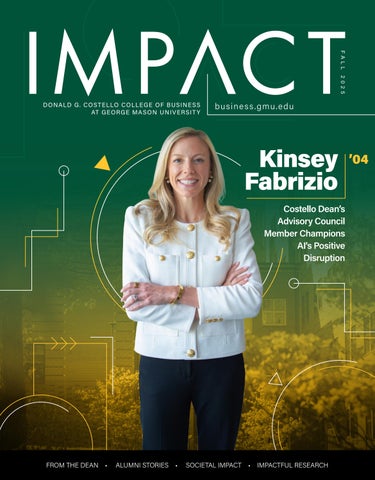
As president of the Consumer Technology Association (CTA)®, which represents more than 1,200 technology companies and owns and produces CES®—the most powerful tech event in the world, Kinsey Fabrizio, BA Government and International Politics; Spanish ’04, is a force in the tech world. Since joining the association in 2008, Fabrizio has played a pivotal role in transforming CTA and CES. Fabrizio was awarded the Women in CT Legacy Award in 2023, recognizing her longtime leadership and contributions to the consumer technology industry. Most recently, Fabrizio was named one of Washingtonian’s 2025 Most Powerful Woman. She served on the Costello College of Business Management Advisory Council from 2023-2025, and is serving as a member of the Dean’s Advisory Council.
PHOTO BY HANNAH PATTERSON
About George Mason
What made you choose George Mason University for your degree?
I grew up in Winchester, Virginia, and what I loved most about George Mason was its capacity to really challenge me and expose me to diverse people, opinions, thoughts, and different ideas.
What was the most rewarding experience for you at George Mason?
I remember a class my senior year that centered on conflict resolution and international politics, and I loved it! That class connected me to an internship that led to my first job. I got trained in conflict resolution and as a mediator, and it was just this amazing door that opened. That was definitely a moment that I'll never forget, and I think about that class often.
You have served on Costello’s Management Advisory Council in the past, and have recently joined our Dean’s Advisory Council. What do you think is special about Costello?
Costello is special because of its unique focus on the intersection of innovation and business. It’s tech-forward, dynamic, and truly one-of-a-kind. The more I’ve learned about Costello, the more impressed I’ve become. I’ve been able to learn from the really brilliant people that are part of this group and get exposed to a different part of the university while being able to give back and volunteer my time.
About AI
Where do you see AI going?
AI is a foundational leap. It's as big a new technology and tool as the Internet. We're just at the very beginning of this AI revolution, but we're already seeing it improve lives. We're seeing it solve some of society's toughest challenges, from energy production to climate resilience to chronic disease management to efficiency for enterprises and businesses. AI is an amazing and powerful tool.
Businesses are going to be able to optimize their strategy and their operations through AI by boosting efficiency and productivity. I don't think AI is going to completely replace a workforce, I think it's going to add value to the existing workforce. People using AI will make the workforce more efficient and more effective. You've probably heard it before, the saying that AI won't replace people, but people who use AI will replace people who don't. I think that's really important to keep in mind as we move forward. AI is something that we are going to integrate into our daily lives, helping us turn all kinds of data into action.
CTA supports establishing clear, effective guardrails for AI to encourage innovation while protecting consumers. What are your thoughts on the best approach to AI regulation moving forward?
We feel strongly about a light touch, risk-based approach to regulation that protects consumers, but also gives businesses clear rules of the road and doesn’t hinder innovation. One of the ways we think you achieve that is with a federal AI framework, rather than 50 different states with different sets of AI regulations. That is nearly impossible for companies, especially startups, to keep up with, and it would inhibit innovation. The AI Action Plan released by the White House this summer is a good blueprint. It looks at AI innovation in terms of acceleration and ensuring that the U.S. stays a leader. It focuses on streamlining outdated regulations and strengthening public/private partnerships, which is going to be great for AI advancement. It also rightly focuses on infrastructure and the need to modernize the energy grid.
Do you have any advice for higher ed when it comes to AI and technology?
AI is here to stay and it’s important to train students on how to effectively, efficiently, and ethically leverage AI because it is a powerful tool. AI could really accelerate research. It's important that higher ed leans into AI adoption and creates opportunities for students to learn and use these tools. Building AI into the curriculum is really important. So is training students on real world uses of AI , because when students graduate today and go into the workforce, AI is going to be a part of it. Preparing them in the best way possible is a responsibility of higher education.
The Costello College of Business is on the eve of its 50th Anniversary. Technology has grown immensely in the last 50 years. In what ways do you see AI and new technology having an impact on business for the next half century?
We’re just at the beginning of this AI revolution. As AI disrupts entire industries, businesses are trying to figure out how to embrace these new tools to advance and accelerate. A couple areas where we’ll see the biggest leaps forward are blockchain and quantum. AI is going to make blockchain technology more efficiently scalable. Think about financial transactions that can be more traceable and transparent, and health care data transactions that’ll be more secure. We’re years away from quantum technology being an everyday reality, but AI will offer testing platforms to develop quantum technologies in areas like cybersecurity, transportation, and biotech, and make it more scalable.
PHOTO BY HANNAH PATTERSON
You work with some of the top leaders in technology, what are you hearing about the latest trends in AI and technology?
Across the business world, you’re seeing companies use AI to boost productivity. We’re also seeing AI used to enhance the customer experience, including as a frontline customer service tool. AI in health care is advancing lifesaving innovations and medical research. There’s also digital twin technology applied to manufacturing to create smart factories and even create models of entire cities. AI is really quick at solving complex problems that humans alone can't solve. AI chips are more advanced than ever, and agentic AI that can manage tasks semi autonomously with a little bit of human oversight expedites basic but necessary back office functions that every business needs. We'll see a lot of these—and some new and exciting applications of AI technology—at CES 2026!
Our dean likes to say, “Everything is business and that we are all in the business of some thing.” Please tell us about the business of technology and how you think the business college needs to be preparing our students for successful careers in the business of technology.
I think the business of technology is the most exciting business! I love tech and innovation. Think about the benefits of the Internet— everything from streaming content, to digital advertising, to platforms that allow you to connect with anyone, anywhere. And these days, everything is tech! From entertainment, to health care, to enterprise, they’re all solving real world issues.
The business college needs to prepare students to embrace technology and to adapt. The job opportunities available to kids coming out of college today are going to look different than they do in a few years, and different again in the next 10 years. Making sure today’s business school students are ready to embrace tech and adopt new ways of doing things is critical. Ensuring that curriculums highlight new technologies and advancements is really important. It’s also important to find opportunities for tech leaders to connect with students through tech challenges, startup competitions, and hackathons, which I know George Mason does already.
One more thing: we can’t forget the importance of being in person and engaging in the physical world, not just the digital world. You learn so much from observing a leader's body language, watching how they present themselves in a meeting, when they speak up, who they make eye contact with, and looking at how they bring different people into the conversation. CES is all about bringing people together to connect, discover, learn, and solve, so we see the value in those things every year at the show. In our world today, real-life, in-person connections give you a competitive edge. That includes CES, which is open to students! We love when people come to CES and get inspired by how technology is transforming the world, see new ideas, meet people, and network.
What advice would you give to George Mason students who are about to graduate or fellow alumni who are already in the workforce?
First, align your work with something that you care about because that passion will carry you through challenges that you encounter in your professional career. Second, raise your hand for new opportunities in school or at your first job, even if they are outside of your comfort zone. When you are willing to say yes and try something that you wouldn’t naturally do, doors open. Third, seek out a mentor and don't be afraid to ask for constructive feedback. We all need it! It’s so important to get real feedback, because then you can identify what you're great at and where you have opportunities to improve and be the best version of yourself. Seeking out a good mentor is a great way to do that in the professional space.
AI-related classroom use and research
by Jennifer Braun Anzaldi
Costello College of Business faculty are embracing AI in the classroom and in their research. Here’s a sneak peek at what some faculty have been up to:
In The Classroom
Sabari Karmegam, Information Systems and Operations Management: Teaching a new course, MIS 491: Generative AI for Business Applications, that equips students with practical skills to develop, evaluate, and deploy generative AI solutions responsibly.
Ethan Kinory, Accounting: Created a subjectspecific GPT for ACCT 461: Assurance and Audit Services and ACCT 472: Government/ Not-for-Profit Accounting, for students to use as a personal tutor and answer course content questions.
Pallab Sanyal, Information Systems and Operations Management: Teaching a new course, MBA 797: AI for Business Transformation that explores the fundamentals of AI and its role in business transformation, deepening students’ understanding of AI. ,
Research
Steve Maex, Accounting: Employed AI across the Accounting Analytics Certificate Program in the MS in Accounting Program, introducing students to AI and LLMs in ACCT 661: Advanced Acct Analytics I. The capstone project in ACCT 771: Audit Analytics asks students to innovate and develop a new tool or usecase for AI/analytics that can improve the efficiency/ effectiveness of traditional ways of working.
Brian Ngac, BS ’16, MS ’17, PhD ’24, Information Systems and Operations Management: Established an opportunity for students to work on an AI-related project with a client from the Professional Readiness Experiential Program (PREP).
Maria Nykyforovych, Accounting: Created an AI-based research assignment to harness the power of AI for financial statement analysis in ACCT 331: Intermediate Accounting I helping students build essential competencies, critical thinking, and responsible human-AI collaboration.
These faculty have working papers in progress with colleagues on the following topics:
Yi Cao, Accounting
• Executives vs. Chatbots: Unmasking Insights through Human-AI Differences in Earnings Conference Q&A
• The Digital Wordsmith: AI-Assisted Disclosures and Crowdfunding Success
• AI and Its’ Relationship with Labor Market: A LLM Approach
Long Chen and Yi Cao, Accounting
• What do they say and what do they mean: A Multimodal LLM Approach to Decipher Conference Calls’ Audios
Jingyuan Yang, Information Systems and Operations Management
• Who Thrives, Who Stays? Predicting Talent Potential from Level-Aware Career Moves
Mariia Petryk and Nirup Menon, Information Systems and Operations Management
• AI Impacts at a Macroeconomic Productivity Level: Political Economy Analysis
by Benjamin Kessler
As with any innovative technology, the latest developments in artificial intelligence (AI) and machine learning (ML) are only valuable if one knows how and where to use them. Academic research can play a vital role in finding and validating business use cases that help to justify the large investments of money and resources that AI entails.
In recent months, Costello College of Business faculty have produced scholarship documenting innovative and impactful uses for artificial intelligence, in fields as disparate as nonprofit fundraising, investment advising and corporate audit regulation. This effort aligns with George Mason University’s deep commitment to tapping the vast potential of this technology while maintaining ethical guardrails, thus balancing grit with audacity.
What follows are just a few examples of Costello’s contribution to this institutional initiative—by no means a complete list.
WHAT AI KNOWS ABOUT YOUR COMPANY (THAT YOU LIKELY DON’T)
Yi Cao, assistant professor of accounting, is using AI to ferret out hidden company information in unlikely places, such as LinkedIn job postings. His research finds, for example, that companies planning to engage in shady accounting behavior are likely to telegraph that intention in their job ads. In this case, AI was used to help identify “rulebender” and “rule-follower” language in job postings, and the predictions turned out to be accurate. Job postings can serve as early indicators of a company’s intent, offering insight into its values without needing insider access. By analyzing public-facing language used in hiring, the study offers a new way for regulators and investors to identify financial manipulation, i.e. detect risk not just through numbers, but through words.
“We utilize large language models (LLMs) as a tool that is capable of gauging verbal or textual variation—using this powerful tool to find information that can be indicative of financial misbehaviors,” Cao says. “This is beneficial to everyone in the financial market: policy makers, shareholders, tax agencies, and other stakeholders. So, we hope this study can bring new insight to a hot topic that people care about.”
In addition, Cao and Long Chen, area chair for accounting, have co authored research suggesting that large language models such as ChatGPT could rival investment professionals in at least one area essential to firm valuation: generating lists of relevant “peer firms” against which to benchmark corporate performance.
Using “Gemini,” a Google-developed LLM, Cao and Chen could
generate about seven peer firms for a focal firm, a number that is similar to the SEC recommendations on how firms should disclose their segments.
The researchers then compared the LLM’s performance to the lists generated by three human experts for a set of 40 leading computer software companies. The average overlap was a little over 40 percent, greater than expected.
But it wasn’t a clear-cut case of LLM supremacy, since standard systems outperformed AI for mid-sized firms.
Chen concludes, “We need to embrace this new technology, but we must recognize that it is not yet in a perfect state. Competition to improve the technology is fierce. Our findings might just represent the lower bound of the effectiveness of the technology.”
ARTIFICIAL INTELLIGENCE’S SOCIAL IMPACT
Further, Costello faculty are discovering how AI can help missiondriven organizations do more to further their worthy causes. Amid robust debate about Big Tech’s impact on society, these use cases indicate that there’s more to AI than a profit engine for businesses. Indeed, AI can help promote societal virtues such as inclusivity.
Jiyeon Hong, assistant professor of marketing, developed an algorithm to help improve the effectiveness of donor solicitations for DonorsChoose.org, a digital fundraising platform for teachers looking to finance classroom projects.
Similarly, Siddharth Bhattacharya and Pallab Sanyal, two professors in the information systems and operations management area, are partnering with real nonprofits to perfect and refine their chatbots and thus increase donations to these deserving organizations
“We completed a project in Minneapolis and are working with other organizations, in Boston, Massachusetts, New Jersey and elsewhere, but the focus is always the same,” Sanyal says.
“How can we leverage AI to enhance efficiency, reduce costs, and improve service quality in nonprofit organizations?”
After training with more than 60,000 DonorsChoose projects from the period 2009-2017, the algorithm identified which sentences within the DonorsChoose proposals were the most pivotal to the outcome (i.e. getting funded or not).
The effectiveness of the algorithm was then verified in an experiment, in which teachers revised the essays and a group of undergraduates rated the revised work. Overall, the essays revised with the help of the algorithm were judged 4.5 percent more likely to be funded, a difference amounting to nearly $10 million in additional funding.
The takeaways from this experiment may also apply to fundraising language in general, not just for DonorsChoose. Noting that more complicated language was often more persuasive with donors than a more simplistic presentation, Hong says “We conclude that the most successful appeals for help will not be those that make the simplest and tightest arguments. Instead, they will a) expose the reader to a modest amount of desirable difficulty; and b) put forth a detailed case that is low on emotional coloration.”
Their field experiment with a Minneapolis-based women’s health organization involved designing a custom chatbot to interact with prospective patrons through the organization’s Facebook Messenger app. The bot was programmed to adjust, at random, its responses to be more or less emotional, as well as more or less anthropomorphic (human-like).
Over the course of hundreds of real Facebook interactions, the moderately emotional chatbot achieved deepest user engagement, as defined by a completed conversation. But when the emotional level went from moderate to extreme, more users bailed out on the interaction.
When human-like features were layered on top of emotionalism, completion rates fell further, reducing the organization’s ability to use emotional engagement as a motivational tool.
The takeaway may be that “there is a sweet spot where some emotion is important, but beyond that emotions can be bad,” as Bhattacharya explains. Furthermore, he observes that “in the retail space, studies have shown anthropomorphism to be useful. But in a nonprofit context, it’s totally empathy-driven and less transactional. If that is the case, maybe these human cues coming from a bot make people feel creepy, and they back off.”
GRAND CHALLENGE INITIATIVE
As the above examples make clear, faculty at the Donald G. Costello College of Business are producing world-class research in line with George Mason University’s core belief that innovative technologies can be instrumental in bringing about the future we want. Helping to drive this work across the institution, the university’s recently-launched Grand Challenge Initiative is dedicated to developing transformative solutions through strategic investments in talent, projects, programs and/or infrastructure.
PHOTOBYJEFFREYPOROVICH PHOTOBYJEFFREYPOROVICH
IMPACTFUL RESEARCH
The Potential Role of AI in Legislative Research and Drafting
by Jeeho Sohn
Writing legislation is no easy task. Policymakers must translate big ideas such as improving climate change or issuing technology regulations into detailed, legally appropriate language. As policymakers strive to work smarter and faster, the use of AI to support policymaking has begun to increase. To what extent can artificial intelligence (AI) help?
A recent white paper from the Greg and Camille Baroni Center for Government Contracting explores whether large language models (LLMs), ChatGPT and GROK, could assist with legislative research and drafting. The experiment focused on the FoRGED Act, a major reform bill introduced by Senator Roger Wicker to overhaul the Department of Defense’s acquisition system.
Richard Beutel and Art Nicewick coauthored the paper.
The researchers trained two AI models to analyze the FoRGED Act’s complex legal provisions and suggest improvements. They asked AI to analyze past defense reforms, predict legal challenges, synthesize research, and draft notes.
The results were promising. The AI models produced detailed notes, historical comparisons, and plain-language summaries. In one example, AI explored how the FoRGED Act’s acquisition reforms might affect deterrence against China, drawing on unclassified threat assessments to frame the analysis.
However, there were also some limitations. An expert panel, including members of the Senate Armed Services Committee, reviewed the AI’s performance. They found that AI often provided helpful summaries and comparisons but lacked the persuasive finesse that human drafters bring. AI was also less successful at understanding the nuanced stakeholder dynamics in politics. And while the models processed massive amounts of information quickly, they could not always explain what they did not know. Therefore, human oversight remains critical.
The panel also raised important ethical questions. AI systems rely on existing data, which may contain biased data or outdated assumptions. Additionally, the expert panel raised concerns
about over-reliance on AI. This could lead to “path dependency,” where staff favor incremental tweaks over bold reforms because AI excels at refining what already exists, possibly limiting policy innovation over time.
Still, the findings showed how AI could reduce the time, cognitive load, and cost for legislative staff. AI helped identify gaps, anticipate implementation challenges, and process vast datasets—work that would usually require hours of time. Rather than replacing human judgment, the goal is to give policymakers better tools.
When using AI models for legislative purposes, the panel recommends prioritizing the questions AI is likely to have sufficient information to appropriately answer. This targeted approach may reduce the risk of misleading or overconfident responses. Moreover, there is a need for transparent caveats. Policymakers using AI should clearly acknowledge what they do not know to avoid future consequences.
As defense and technology policies continue to evolve, this pilot marks an early but important step. AI won’t write the laws of the future alone but it might help policymakers write them better.
Read the full White Paper by Richard Beutel and Art Nicewick
PHOTO BY RON AIRA
Study: Left-handed CEOs are more innovative
by Benjamin Kessler
Two Costello College of Business accounting professors are exploring how inherent personal traits may influence business success—and their early findings will gratify the left-handed among us.
Q: What do Steve Jobs, Bill Gates and Mark Zuckerberg have in common (besides the obvious)?
A: All three belong to a community comprising about 10 percent of the population—the community of the left-handed.
And they’re far from the only business luminaries who are members. Steve Forbes, Oprah Winfrey, and Lou Gerstner (of IBM fame) are left-handed, as were John D. Rockefeller, Henry Ford, and Ratan Tata.
Of course, this could be a mere coincidence—but perhaps not. The popular belief that left-handers think more creatively—and hence may enjoy an innovative edge in business— has been supported by cognitive neuroscience research, which shows that the left hand is controlled by the brain’s right hemisphere, a region closely associated with creative thinking.
A forthcoming research publication by Long Chen and June Woo Park, two accounting professors at the Donald G. Costello College of Business, constitutes the first rigorous scholarly investigation into whether—and how—handedness plays a role in business innovation.
The paper was co-authored by Albert Tsang of Southern University of Science and Technology and Xiaofang Xu of Beijing Technology and Business University.
The researchers searched Google for photos and videos of S&P 500 CEOs engaged in activities like writing, throwing, drawing, and eating to determine their dominant hand, if it wasn’t already disclosed in published sources. When in doubt, they followed up with calls or emails to the respective companies. All in all, they were able to identify the handedness of 1,008 CEOs across 472 companies: 91.4 percent were right-handed, 7.9 percent left-handed, and 0.7 percent mixed.
The researchers then looked at the numbers of patents and citations received by the firms from 1992 to 2015. They controlled for firm and industry characteristics, as well as other personal traits known to affect CEO innovativeness (such as age, education, risk preference shaped by experience, birth order, and founder status).
Every variation of the study produced essentially the same result: Firms led by left-handed CEOs demonstrate significantly higher innovative output. The differences were qualitative as well as quantitative. Patents under left-handed leadership were more likely to represent something new under the sun, rather than a spin-off from established technology.
The researchers hypothesized that the left-handers’ creative orientation would impact the way they ran their firms,
including hiring decisions. Indeed, they found that companies applied for more H-1B and STEM visas when left-handers were at the helm. This emphasis on talent acquisition was not only a key indicator of innovation commitment, but may have also contributed to the firms’ creative advantage.
Yet innovative success is complex and multifaceted. Left-handedness is only one potentially meaningful trait among many—a lot more are yet to be explored. Their efforts fit with George Mason's aim to cultivate sources of grit and audacity in its graduates.
“Our results are based on a large sample. But investors should not assume a CEO that is not left-handed lacks innovative potential,” Chen says.
For their ongoing and future research projects, Chen and Park are looking beyond left-handedness to explore other deeply personal CEO traits that may have business implications.
“We find it fascinating to draw on insights from disciplines outside accounting and finance,” Chen says. “CEO decisions may be shaped by factors like family experiences, genetics, academic background, career paths, and more—really, the full range of experiences that makes them who they are. Understanding that can help market participants better interpret and predict CEOs’ decision-making.”
PHOTO BY JEFFREY POROVICH
Your Daughters Will Prophesy: Religion and Rhetoric in the NineteenthCentury Woman’s Movement
George Mason professor explores the “prophetic” side of the early woman’s movement
by Benjamin Kessler
A new book co-authored by a Costello professor reveals an overlooked strength of the early woman’s movement—“prophetic” rhetoric reconciling reform with religious faith.
In the United States, the struggle for women’s rights began under a spiritual cloud. Nineteenth-century American women’s subordinate place in society was solidly reinforced by a style of Biblical interpretation and social constraints that historian Barbara Welter called “the cult of True Womanhood”. Women’s place was thought to be in the home—public speaking and political or social activism were closed off.
Your Daughters Will Prophesy: Religion and Rhetoric in the Nineteenth-Century Woman’s Movement (University of South Carolina Press) is a new book co-authored by Lisa Gring-Pemble, associate professor at the Donald G. Costello College of Business, which explores the overlooked history of how women reformers strategically used religion to carve out a public role for themselves.
Gring-Pemble’s co-author is Martha Watson, Dean Emerita of the Greenspun College of Urban Affairs and an Episcopal priest currently serving in the Washington, D.C., area.
Gring-Pemble, a rhetorical critic, has long been interested in the early woman’s movement. She says, “I wrote an article in graduate school about the correspondence between Antoinette Brown Blackwell and Lucy Stone, and it made me think about the origins of social movements… How did women find one another? How did they come to see each other as agents of change?”
The four texts that anchor the book—Jarena Lee’s Journal, Sarah Moore Grimké’s “Letters on the Equality of the Sexes,” Lucretia Coffin Mott’s “Discourse on Woman,” and Frances Willard’s Woman in the Pulpit—were selected quite deliberately.
“The focus of the book was tracing the trajectory of an argument through four key texts,” Gring-Pemble says. “We were interested in how women developed arguments around Scripture, and how Scripture could be reinterpreted, how they could reclaim stories of women who had been forgotten or ignored.”
As the first African-American woman to “preach” within the African Methodist Episcopal Church, Jarena Lee never argued for women’s equality but rather for the idea that God could call certain women to preach the gospel. Positioning her autobiography as a “journal,” a form familiar to Methodists, Lee patterned her life story upon Biblical themes of the call to prophecy that would be immediately recognized by Methodists.
Grimké, a Quaker and abolition activist, developed a fully formed method of interpreting scripture to argue that Christian women had a moral obligation to engage in reform efforts. And Mott, a Quaker minister, leader in abolition, and one of the organizers of the first meeting (Seneca Falls) to discuss women’s rights, demonstrated how women could make positive contributions to public life and maintain their femininity.
Frances Willard, president of the Women’s Christian Temperance Union, used her public platform to argue for the right of women to preach, among many other rights. She skillfully brought thousands of women into the suffrage movement under the banner of “home protection.”
What united all four was their masterful use of dissent and prophetic rhetoric. For GringPemble, that theme is what links their stories to present-day reform movements.
“The strategy of dissent, of working from within to push change, is still incredibly relevant. The idea of assuming a prophetic voice, about seeing what is possible for us all to live the best version of ourselves, is still a powerful argument.”
PHOTO COURTESY OF LISA GRING-PEMBLE
IMPACTFUL RESEARCH
Professional Readiness experiential program enhances cybersecurity workforce
by Greg Johnson, BA Communication ’13
At the Costello College of Business at George Mason University, students can expect to engage in experiential learning, both through experts brought into the classroom and visits to outside organizations.
At the end of the 2025 spring semester, Brian Ngac, BS Applied Information Technology ’16, MS ’17, PhD Information Technology ’24, an instructional assistant professor of information systems and operations management (ISOM) at the Costello College of Business and FWI Corporate Partner Faculty Fellow, and Nirup Menon, professor of ISOM at Costello, received word that another one of their experiential learning proposals won a grant from the Commonwealth Cyber Initiative (CCI). This grant garners additional funding to scale and enhance George Mason University’s Professional Readiness Experiential Program (PREP).
An Experiential Learning (EXL) Program, PREP was started by Ngac to give honors and high-performing students hands-on experience on real impactful projects with real companies.
The 2025-2026 CCI EXL Grant enables PREP to enhance the cybersecurity workforce by recruiting students—a total of 30 are accepted—interested in the field and pairing them with industry partners. Students accepted into PREP can expect to be mentored by both industry participants and faculty members as they develop and deliver client-facing project presentations. PREP is not possible without its partners. And it has great ones—several of whom are eager to continue working with PREP after past success with the program. Among them are Mobius Consulting, LLC, and FedWriters, Inc. (FWI). “Mobius Consulting, LLC is proud to partner with the Commonwealth Cyber Initiative and George Mason University on the 2025 Experiential Learning Program,” says Lashdeep Singh, director of operations at Mobius Consulting, LLC. “Mobius is an awardwinning, SBA Woman-Owned Small Business. We’re honored to support this initiative by mentoring students, contributing to
project-based learning, and helping build a stronger cybersecurity workforce. We look forward to advancing this mission alongside CCI and our academic and industry partners” As part of the program, Mobius will present a hands-on Microsoft Sentinel workshop to teach students how to create and operate a security operations center within the Microsoft Azure cloud platform.
Mitchell Cho, a George Mason alumnus and CEO of FWI, is also excited to participate, saying, “FWI is proud to support George Mason’s PREP initiative and thrilled to see it recognized through this important funding. This initiative equips students with the technical and client-facing skills needed in today’s cyber landscape, while creating a strong pipeline of agile, industry-ready professionals” For their part in PREP, FWI will conduct a seminar on the cybersecurity maturity model certification implementation that they recently completed.
Additionally, both Mobius and FWI will be hosting some of the student participants in the program. MAXIMUS, a large business focused on technology innovation in government and health care, has graciously agreed to be another industry participant.
Aligning with the CCI’s objectives in education, innovation, and workforce development, PREP runs its experiential learning projects for a total of 125 hours, so the student participant can choose to work those hours over three, six, or 12 weeks. Student participants will receive competitive stipends for their hours completed.
Since PREP first began in spring of 2021, multiple students have been hired full time by the industry participant following project completion. Even if they are not directly hired, the students can expect specialized training, technical experience, and the opportunity to be published—all furthering their successful transition into the cybersecurity field. If your organization is interested in becoming an industry participant, please contact Brian Ngac at bngac@gmu.edu.
PHOTO COURTESY OF BRIAN NGAC, BS ’16, MS ’17, PHD ’24
A common challenge for marketers is understanding people who have “thin” data profiles, such as donors with little demographic information or brief interaction histories. Jiyeon Hong, assistant professor of marketing, helped develop Attributed Graph Contrastive Learning (AGCL), a machine learning model that addresses this challenge, helping organizations make more of the data they already have in a way that respects privacy.
The research team consisted of Hong and co-authors Qing Liu of University of WisconsinMadison and Wenjun Zhou of University of Tennessee-Knoxville. Their working paper has been made available at SSRN.
The team tested AGCL using data from DonorsChoose.org, a platform where public school teachers can post requests for classroom project funding. More than 70 percent of donors on the platform give only once, which limits the insights that traditional methods can generate. AGCL
“fills the gap” by connecting donors with similar profiles based on their brief interactions, creating a broader context for understanding each donor’s interests. The idea behind AGCL’s unique graphbased approach is to bring together sparse data points, turning them into actionable insights. In the study, AGCL achieved a 34 percent success rate in recommending projects that donors in the test dataset would likely support next, compared to 24 percent using other methods.
Hong described how visualizations from AGCL can highlight “interest clusters” among donors. This mapping helps nonprofits understand the preferences of one-time donors, allowing them to build engagement strategies for those who may return in the future. “We’re looking at ways to use these insights not just for individual recommendations but to craft campaigns that resonate with larger groups sharing latent interests,” she added.
MS in Finance students answer burning investment questions
by Benjamin Kessler
Master of Science in finance students have the rare opportunity to use their budding analytical skills to solve some of the mysteries of today’s financial markets. Moreover, their faculty-supervised research projects can land their names in the pages of The Wall Street Journal (WSJ).
To date, these projects have spawned nearly 40 WSJ articles, not to mention dozens of write-ups in outlets such as MarketWatch, The Conversation, and the CFA Institute blog. They have also received television coverage on CNN and NewsNation.
As finance professor Derek Horstmeyer tells it, “I had started writing for the CFA and The Wall Street Journal. In my talks with my students, some of them revealed they had research interests. It just kind of took off from there.”
Student researchers are mainly recruited from Horstmeyer’s Montano Student Managed Investment Fund (SMIF) class, where they complete
a hands-on exercise in security analysis and portfolio construction.
Students develop research projects themselves and Horstmeyer will help the student teams devise their scope and direction.
Although students are usually comfortable with datasets, finding the appropriate dataset for the question they’ve posed can be a challenge. “We, as faculty, have access to these private databases. So I’ll guide them or set up the data,” Horstmeyer says. Horstmeyer says students are able to hone skills and techniques that enhance their careers and give them a competitive edge in the job market.
Melvin Jonathan Reyes Echeverria, who completed his MS in finance degree in May 2024, says, “I assisted Professor Horstmeyer with data analysis for the WSJ and the experience was amazing…I was able to leverage everything that I was taught in my MS in finance classes.”
PHOTO BY JEFFREY POROVICH
IMPACTFUL RESEARCH
Book bans are not what they seem
by Ali Kaan Tanju
Between 2021 and 2022, more than 1,600 titles were removed from U.S. schools and libraries at the behest of parents, advocacy groups, elected officials, etc. The paradox? Banning these titles often dramatically increased readership interest in the circulation of banned books.
What began as banning a book over specific themes—race, gender, or sexuality— has turned into a widespread and successful unintended promotional tool for lesser-known authors and politicians.
In a forthcoming paper for Marketing Science, Sabari Rajan Karmegam, assistant professor of information systems and operations management, found a 12 percent rise in circulation for the top 25 most-banned books.
Karmegam’s study draws upon large-scale library circulation data from 38 states, focusing on the most commonly banned titles as identified by PEN America and the American Library Association. The paper was co-authored by Uttara
M. Anantakrishnan, Naveen Basavaraj, Ananya Sen, and Michael D. Smith of Carnegie Mellon University.
Karmegam explains that the focus of his research was not initially on political rhetoric or the broader culture war across the American electorate. “We specifically looked at all the books that were banned, but we did see that the majority of these book bans dealt with LGBTQ+ themes, race, and gender,” he says.
Using Amazon sales rank data and publicly available conversion tools, the researchers estimated that banned books were likely to have sold an additional 90 to 360 copies per month on Amazon alone—an effect corresponding to an average 41 percent improvement in sales.
Twitter (since renamed X) played a key role in increasing the visibility of banned books to a relatively newer audience. “We see that these banned books make them more desirable or make more people want to read about them,” says Karmegam.
Does your organization understand the whole of a person?
by Ali Kaan Tanju
We all wear multiple hats. There’s our workplace identity, identity at home, identity with our family and friends, etc. When we face a big change to any one of these identities, we tend to feel out of control and disjointed. Sarah Wittman, assistant professor of management and industrial-organizational psychology, studies the power of narratives in steadying us during these uncertain moments.
“Narration isn’t necessarily to an audience, it can be for yourself,” Wittman says. “It’s that sensemaking of ’how do I understand the world, how do I understand my different pieces fitting together?’”
Wittman’s paper in Academy of Management Review—co-authored by Blake Ashforth of Arizona State University and Herminia Ibarra of London Business School—describes two key beneficial outcomes of narrative sense-making: static and dynamic holism.
Static holism comes from a moment in time wherein we form a consistent sense of self that merges various identities. This might occur, for
example, when a person unifies their personal and professional identities under a larger umbrella. In contrast, dynamic holism emerges from narrating our lives across time, multiple roles, and identities.
Wittman’s research shows that holism benefits individuals through authenticity, wisdom, adaptiveness, and resilience.
However, Wittman believes most workplaces overlook the whole of a person. Not considering employees’ holistic identities can influence how they show up, and how much they can put into their work. Therefore, organizations are prone to damaging misunderstandings about their employees, resulting in employee turnover.
In addition to more accurate business analyses, organizations that help employees develop tools for narration benefit from fostering mutual trust.
“That’s what I think is the beauty of it. It makes a first step in starting to look at the whole human and say that the whole human matters,” Wittman says.
PHOTO BY JEFFREY POROVICH
PHOTO COURTESY OF SARAH WITTMAN
Meet the newest additions to the Costello Family
by Benjamin Kessler
For the 2025-26 academic year, the Donald G. Costello College of Business is proud to welcome 11 highly accomplished new members to our faculty.
This talented cohort of researchers and instructors have already started to make valued contributions to the college, and we look forward to seeing how they enhance the environment and productivity of Costello in the years to come.
They are, in alphabetical order:
Laura Carrubba
Instructor, Accounting
Carrubba has more than 30 years of accounting experience, most recently at PricewaterhouseCoopers (PwC), where she was a lead U.S. tax partner on several multinational corporate clients as well as an audit team member for both public and private companies. Carrubba retired from PwC in June 2022 and began instructing at George Mason as an adjunct course lecturer in August 2023.
Qiaodan (Jordan) He
Assistant Professor, Information Systems and Operations Management
He’s research focuses on the impact of artificial intelligence (AI), user behavior, and online platform strategies in mobile commerce and social media contexts. She received her PhD from Lehigh University, where she also was awarded the Warren York Fellowship.
Chen Jing
Assistant Professor, Marketing
Jing’s research examines the social impact of firms, as well as how innovative technologies, especially generative AI, are reshaping business and society. His PhD is in quantitative marketing from Boston University.
Stephen A. Karolyi
Associate Professor, Finance
Karolyi comes to Costello fresh from a stint as senior economic advisor of the Office of the Comptroller of the Currency, U.S. Department of the Treasury. Prior to that, he served as assistant professor of finance and accounting at Carnegie Mellon. He has published widely in top-tier academic journals on topics mostly related to banking, financial intermediation and corporate finance.
David S. Lucas, BS Economics ’14, MA ’15, PhD ’18
Assistant Professor, Management
Lucas is a three-time George Mason University alum, having received his bachelor’s, master’s and PhD from George Mason. He comes to Costello from Syracuse University, where he was the Edward Pettinella assistant professor of entrepreneurship. He has published more than a dozen papers in peer-reviewed journals; his research interests include entrepreneurship, public policy and grand societal challenges.
Rod D. Raeshler
Instructional Assistant Professor, Business Foundations
Raeshler taught economics and quantitative analysis at Clarion University for 34 years after receiving his PhD from the University of Iowa. During this time, he also served as the chairperson for Clarion’s economics department for 13 years and the director of the honors program for 10 years.
Thomas Robinson
Instructional Assistant Professor, Finance
Over a career spanning more than 40 years, Robinson has held tenured faculty and administrative positions at the University of Miami, as well as leadership roles as president and CEO of AACSB International, the global business school accreditor, and managing director of education at CFA Institute. He has also authored numerous publications on financial analysis, valuation and personal financial planning.
Min Shen
Associate Professor, Accounting
Shen makes a triumphant return to George Mason University’s accounting faculty after holding an associate professorship of accounting at Baruch College. Her research on corporate disclosures, capital markets, and information dissemination has been published in top-tier journals, and she serves on the editorial board of Journal of Accounting, Auditing and Finance. Shen received her PhD from Michigan State University.
Barbara Su
Assistant Professor, Accounting
Su comes to Costello from Temple University, where she was assistant professor of accounting. Her research specialty areas include financial institutions and debt markets. Prior to entering academia, she acquired professional experience as an analyst and financial auditor for Diageo, Bain & Company and General Electric in Beijing and London. She completed her PhD at University of Toronto.
Mike Wetklow
Instructor, Accounting
Wetklow held various senior executive positions in the federal government for 17 years, including chief risk officer at the IRS, where he oversaw enterprise risk management and audit relations. His public service career also includes leadership roles as the deputy chief financial officer at the National Science Foundation, as well as positions at the Office of Management and Budget and the Department of Homeland Security.
Zhechao Yang
Assistant Professor, Information Systems and Operations Management
Yang’s research interests include the economics of AI, social media, e-commerce retailing, and design science. Her scholarship has been presented at a plethora of academic conferences and published in Production and Operations Management, a top-tier journal. She received her PhD from University of Florida.
Mengxin Zhao
Associate Professor, Finance
Prior to joining Costello, Zhao served as a senior financial economist at the U.S. Securities and Exchange Commission and was an associate professor of finance at the University of Alberta. Her research has three overlapping themes: corporate governance, international finance, and capital market frictions. She received her PhD from the University of Pittsburgh.
While many of their peers were spending spring break catching sun at the beach, members of the Impact Fellows Program were busy engaging with organizations and professionals in New York City to see how they run their operations while being dedicated to social impact, sustainability, and community service.
Using the United Nations’ sustainable development goals as their framework, the Impact Fellows Program is a competitive two-year program for students in the Costello College of Business at George Mason University who want to foster their leadership abilities and personal development.
The Costello students in the Impact Fellows Program come from different backgrounds and have different interests, but they are united in the belief that business should be a force for good in the world.
“The Impact Fellows residency trip is a powerful example of our commitment to student experience and career readiness— giving students the opportunity to apply what they’ve learned, explore their purpose, and connect with professionals making a difference in the world,” said Yena Kim, director of academic achievement and innovative learning at the Costello College of Business. “Experiences like this are where leadership is forged and career paths come into focus.”
“We had learned about the UN sustainable development goals, and we had done other co-curricular trips that were almost like stepping stones into this experience,” said Camila Rosales, a junior studying supply chain and operations management. “This residency trip almost felt like a final exam situation.”
But rather than sitting in a classroom and filling out exam sheets, they joined several organizations who are making a real difference.
Leaving on Tuesday and returning on Friday, the Impact Fellows had many places to see and people to meet during their residency trip to the Big Apple. Touring the High Line, they saw a clear illustration of sustainability for all who walk along or around it. “When you go to a city like New York, you really experience the interconnectedness, the history, all of the fundamental values of community,” said Mike Van Dyken, a senior studying business analytics and management information systems.
At God’s Love We Deliver, the group learned how the nonprofit prepares and delivers specialized meals to people suffering from chronic illnesses.
At the International WELL Building Institute, the Impact Fellows had the opportunity to engage directly with leaders in sustainable finance and workplace innovation. The visit not only deepened the students’ understanding of sustainability in business but also provided valuable networking opportunities with a global leader in the field—an experience many described as inspiring and eye-opening.
The Impact Fellows had a full itinerary on their trip, also touring the Tenement Museum and the United Nations Headquarters. Their experiences showed the students that profitability and sustainability are not mutually exclusive. “It opened my eyes to the fact that there are businesses that have made it possible to get revenue and also do good,” said Leticia Nunez Nova, a senior studying marketing and business analytics.
Besides seeing how everything operates, the Impact Fellows learned how to communicate and work effectively with professionals and volunteers from a wide variety of backgrounds. “The Impact Fellows Program teaches you not only cross-cultural communication, but also how to implement and communicate with professionals that work in the industry,” said Shriganesh Sivakumar, a sophomore studying finance.
For the Impact Fellows, the residency trip to New York City brought their program experience full circle. When they graduate, they will be entering the workforce with connections, leadership skills, and the inspiration to make the world a better place through business and innovation.
Learn more, or get involved with the Impact Fellows Program at Costello College of Business
PHOTO COURTESY OF YENA KIM
At George Mason basketball game, students ran the show
by Sarah Holland
Most students at Division 1 universities like George Mason can say they’ve been to at least one sport event. A sold-out football game, a baseball no-hitter, or a Cinderella run at the NCAA Final Four: these games bring the campus together and make core memories for future alumni.
But while many can say they’ve cheered in the stands, only a handful can say they’ve run the show.
In fall 2024, Donald G. Costello College of Business students had that unique opportunity, leading the marketing and management of the Ferrum vs. George Mason basketball game on November 23.
Mentored by marketing professor Niki Vlastara, assistant director of fan engagement Lily Plizga, and Costello College of Business senior director of marketing and communications Duane Bailey, five students took responsibility for various aspects of the game: from marketing ticket sales to managing check-in to developing a creative timeout game.
For Plizga, the experience was an opportunity to show students the breadth of career possibilities in sports management and marketing. “I found this career because I was a student wage worker with Athletics; I wouldn’t have known about all the opportunities here otherwise,” she said. “So for me, this experience helps showcase all the different paths available to them.”
For Vlastara, it was an opportunity to give students hands-on experience to practice theories and concepts from their coursework. “In event marketing, once the event is done, it’s done; you can’t resell. So, it’s important for the students to have that experience of having one chance to get it right and fill the seats,” Vlastara explained.
George Mason is nationally ranked for internships/ co-ops and its graduates report high job success related to their career goals, which underscores its prioritization of experiential learning opportunities like this one.
“I think this experiential part of education is what students are looking for. Projects like this help them really understand where the concepts I’m teaching in class apply,” said Vlastara. “It’s very holistic.”
Melissa Quinteros, a senior in Costello, said that this hands-on opportunity challenged her to improve the skills she was developing in her classes and extracurriculars. “Having interpersonal skills and collaborating on projects have always stood out as necessary skills in my marketing and business classes,” she said. “For this, I needed to take those skills and learn what worked when trying to promote an event to attendees. I had to figure out how to be brief while emphasizing what parts of the event would be most interesting to the person I’m talking to. That was a challenge, but I learned so much.”
The students, Bailey said, “jumped in with both feet and smiled the whole way.” They brought ideas not just from the classroom, but also from their own experiences: winter 2024 graduate Cody Salenga, for example, pitched the idea of the timeout game based on a game he saw at an NBA game. According to Plizga, the game was really successful.
Athletics also saw increases in their social media engagement when the students had taken over; Plizga’s data showed more comments and higher views.
“We want students to feel like they’re part of something bigger than themselves, that extends beyond graduation,” said Bailey, “We want them to invest in George Mason, and experiences like these plant that seed early.”
The team hopes to continue this collaboration next season. “Athletics and the fans were excited by the collaboration. So we hope to keep it going in the fall, maybe make it a big event each year that becomes tradition,” said Plizga. “And I hope that other departments, schools, and colleges see what we did as a baseline for opportunities in the future.”
PHOTO COURTESY OF DUANE BAILEY
This story is a first hand account from students.
ACADEMIC EXCELLENCE
All roads lead to Omaha: Finance students witness Warren Buffett's final shareholder meeting
by Luigi Bilibio, Aakriti Adhikari, and Kevin Peña
With the help of Indy Bal, BS Accounting and Finance ’14, a group of Costello College of Business finance students attended the 2025 Berkshire Hathaway Shareholders meeting on May 3. Witnessing the final meeting before Warren Buffett’s retirement was a remarkable experience that will stay with them for a lifetime.
It was a Wednesday evening when we packed our bags and checked out of our dorms. The hum of the rental car echoed in the background as we began our 20-hour drive to Omaha. After many stops at the gas station, the sun finally rose and revealed farmlands stretched endlessly on both sides. We had finally made it just outside of Omaha, home of the legendary oracle, Warren Buffett. Our Friday was spent exploring the various Berkshire Hathaway subsidiaries at the convention center, with occasional purchases here and there. The following morning at 4:00 a.m., we stepped out of our Uber and rushed to join the growing line for the annual shareholder meeting. Around us stood people of all ages and backgrounds—financial professionals, executives, tourists, and students like us—each drawn here by a shared reverence for Buffett’s wisdom.
The day before the meeting, while waiting in line at Bookworm to purchase Berkshire Hathaway’s 60th anniversary book, we struck up a conversation with David and Isabella, a retired couple from London and Paris. David, the founder and CEO of an asset management firm, had a good laugh recalling how he once thought Buffett would retire soon and Berkshire’s strong returns would decline. Now, at 95, Buffett is finally stepping down, while David is the one long retired and still investing his income in Berkshire. During the meeting’s recess, we spoke with another shareholder, this time from Boston, Massachusetts, working in an insurance investment firm. He mentioned that he has been invested in Berkshire for over six years now and plans to stay invested for life. He is drawn by the unique community and longterm vision of Berkshire.
As college students studying finance, this experience was nothing short of transformative. For those of us still early in our journey, attending the Berkshire Hathaway annual meeting isn’t just an event—it’s an awakening. While seasoned professionals and retirees bring years of industry insight, students bring curiosity, hunger, and openness. In that room, surrounded by the legacy of Buffett and Munger, we felt a rare clarity about the kind of investor—and person—we aspire to be.
This wasn’t just about stock picking or investment metrics—it was about philosophy, character, and values. To witness Warren Buffett’s final meeting as CEO and to be part of that history is a gift we will carry with us for the rest of our lives. Someday, we’ll tell our children not just about Buffett’s wisdom,
but how we had the privilege to be there, live, for the closing of a legendary chapter in financial history.
Warren Buffett, alongside Charlie Munger, shaped the investment world with their unconventional, brilliant philosophy: Focus on the long term and invest in businesses, not just stocks. After sixty years of taking control of the then-textile manufacturer Berkshire Hathaway, Warren Buffett is now set to retire.
We have no words to fully capture what it meant to witness this historic moment. Of course, like everyone at the meeting, we were saddened by Buffett’s retirement. We left with a deep gratitude for having learned in person from such a wise and humble man, in addition to immense respect for his legacy, and a quiet understanding that, with Munger gone and Buffett stepping down, we witnessed the close of one of the most iconic
PHOTO COURTESY OF LUIGI BILIBIO AAKRITI, ADHIKARI, AND KEVIN PEÑA
PHOTO COURTESY OF LUIGI BILIBIO, AAKRITI ADHIKARI, AND KEVIN PEÑA
Warren Buffett, Greg Abel, and Ajit Jain at the Q&A session
Shareholders lining up at 4:00 a.m. outside Omaha’s CHI Health Center
Checking in to a “suite” internship with Marriott International
by Sarah Holland
When business major Kyle Samuel went to George Mason University’s Career Fair with a list of companies to speak with, he didn’t realize he would land an internship that would kickstart his career.
With a legacy connection to Marriott hotels through his father, who worked for Marriott at the property level, a chat with the Marriott representative led to securing a competitive spot as a finance HQ intern with Marriott International.
Now, in addition to completing a summer internship with Marriott, Samuel is working part-time for the hotel company and making plans to return for a second internship.
Why did you choose George Mason?
There are a couple of reasons why. First, it’s close to home, and within my culture we try to live with our parents even after we’re 18. So that was important to me. Affordability was a major aspect, too, because staying home saves some tuition. George Mason’s Costello College of Business is also great and well-established, especially compared to other schools in the region.
What inspired your interest in finance?
In junior year of high school, one of my uncles recommended the book Rich Dad, Poor Dad by Robert T. Kiyosaki and Sharon Lechter. And that opened my eyes to how much personal finance matters in your life. I started reading more, like The Outsiders: Eight Unconventional CEOs and Their Radically Rational Blueprint for Success by William N. Thorndike, Jr., and my interest just took off from there.
How did you find out about the internship at Marriott?
Through the career fair at George Mason. I went into the fair with notes about each company I was interested in, and Marriott was on the list. I spoke with the representative, and we really connected. She told me about the internship—I didn’t know that Marriott offered internships—and she recommended that I apply.
It’s funny, whenever someone asks me about the career fair, I tell them I have a 100 percent track record, because I went to one fair and got an internship from it!
What did you do during your summer internship with Marriott?
Some of my major projects were conducting reviews of around 50 capital expenditure budgets from Marriott Select brands to ensure compliance and accuracy, checking the integrity and translation of data from Excel sheets to visualizations, and helping a senior manager send out revenue share allocations to select brand owners.
I also participated in a competition with the other interns where we were given a real-life business challenge that Marriott is facing, and we had to design a potential solution. So we brainstormed ideas for improving Marriott Bonvoy sign-ups among the Gen Z demographic.
One of the things I really appreciated about my internship is that I wasn’t just doing internship work that wouldn’t go anywhere once I was done: I was doing projects with impact.
How have your experiences at George Mason prepared you for your internship?
Many classes gave me the foundations I needed to succeed at my internship. BUS 210 Business I and BUS 310 Business Analytics II were really helpful because it allowed me to strengthen my Excel skills, and BUS 103 has helped improve my professional development skills.
University Career Services also played a monumental role. They helped me establish my resume, create my LinkedIn profile, and prepare for the interview with Marriott.
What would you say is the importance of an internship?
School does prepare you for the workplace, but there’s really no substitute for actually experiencing a workplace. Understanding office culture, learning the hierarchies, networking; you can only really learn those soft skills through being in the workplace. And networking is so valuable. I’ve had a meeting with the CEO of Marriott because I was able to network with the former intern, who connected me to the right people.
Where do you hope to be in ten years?
My long-term goal is to become the CFO of Marriott. I’m minoring in real estate, so working for Marriott combines my interest in finance with my interest in real estate. I love the culture; I feel like they really put people first and work together as a team. And there’s a lot of potential for them to grow in the future.
PHOTO COURTESY OF KYLE SAMUEL
Kyle Samuel (right) with Anthony Capuano, current CEO of Marriott
ACADEMIC EXCELLENCE
Costello College of Business unites under one roof
by Greg Johnson, BA Communication ’13
With a vision for the future that includes a brand-new building, the Costello College of Business at George Mason University has successfully consolidated its faculty and staff into Enterprise Hall on the Fairfax Campus ahead of the fall semester. For the past five years, many team members were housed in a leased office building on Main Street in Fairfax, Virginia. As the lease approached renewal, Costello leadership faced a pivotal decision.
“We knew we needed to get faculty and staff input on what folks were feeling about the off-campus space and what they wanted to do,” says Tara Hammond, senior director of finance and administration. Through surveys, listening sessions, and thoughtful conversations, a plan emerged: bring everyone together under one roof while reducing costs and investing in the future. This approach would involve renovating the Enterprise Hall space to convert single offices into shared workspaces, ensuring sufficient offices to accommodate everyone.
Leading the initiative along with Hammond were Cheryl Druehl, senior associate dean of faculty affairs and research, Ty Koroma, administrative manager, and Kathi Gelona, IT director. Faculty and staff were settled or resettled on four floors of Enterprise Hall, with shared offices and an increased number of workspaces. This transition affected approximately 65 percent of Costello faculty, who graciously packed up and vacated their offices over the summer to allow for renovations. Instead of purchasing new furniture, existing pieces from Enterprise Hall and the former Main Street location were repurposed.
The move yields financial benefits, eliminating a $350,000 annual lease. Newer furniture from the leased building was redeployed in Enterprise Hall, enhancing the workspace without additional expense.
Fostering a cohesive culture is a strategic priority for the Costello College of Business. With everyone now in one location,
the sense of community has grown stronger, supported by pop-up social events and newly created conversation areas. Students are also reaping the benefits, as they now have easier access to faculty and resources in a fully staffed and upgraded building.
“We need a thriving environment to help these students thrive in person,” Hammond emphasized.
The consolidation was a meticulous process, involving detailed planning, design work, room painting, packing, furniture disassembly and reassembly, electrical work, and inspections. The success of the transition was made possible by the cooperation and flexibility of faculty and staff and the hard work of the working group comprised of Costello and central George Mason colleagues.
Bringing the Costello College of Business under one roof reflects smart, forward-thinking decision-making—and marks a significant step toward its future home.
We are proud to share that our AACSB accreditation in Business and Accounting has been extended six more years. The Costello College of Business was reaccredited in May 2025 by the Association to Advance Collegiate Schools of Business (AACSB), the premier business school accreditor. The rigorous accreditation process, which occurs every six years, ensures program quality and recognizes student success and program excellence. Our extension of accreditation is a testament to the dedication, excellence, and hard work of everyone who contributes to Costello’s continued success. Congratulations to the Costello College of Business on this important achievement!
Left to Right: Tara Hammond, Ty Koroma, Cheryl Druehl (Photos by Jeffrey Porovich), Kathi Gelona (Photo by Creative Services, George Mason University).